



Abstract
Previous research has highlighted age-related differences in social perception, in particular emotional expression processing. To date, such studies have largely focused on approaches that use static emotional stimuli that the participant has to identify passively without the possibility of any interaction. In this study, we propose an interactive virtual environment to better address age-related variations in social and emotional perception. A group of 22 young (18–30 years) and 20 older (60–80 years) adults were engaged in a face-to-face conversation with an embodied conversational agent. Participants were invited to interact naturally with the agent and to identify his facial expression. Their gaze behaviour was captured by an eye-tracking device throughout the interaction. We also explored whether the Big Five personality traits (particularly extraversion) and anxiety modulated gaze during the social interaction. Findings suggested that age-related differences in gaze behaviour were only apparent when decoding social signals (i.e., listening to a partner’s question, identifying facial expressions) and not when communicating social information (i.e., when speaking). Furthermore, higher extraversion levels consistently led to a shorter amount of time gazing towards the eyes, whereas higher anxiety levels led to slight modulations of gaze only when participants were listening to questions. Face-to-face conversation with virtual agents can provide a more naturalistic framework for the assessment of online socio-emotional interaction in older adults, which is not easily observable in classical offline paradigms. This study provides novel and important insights into the specific circumstances in which older adults may experience difficulties in social interactions.
Introduction
Social perception is a core domain of social cognition and refers to the ability to decode and react appropriately to various social cues from others, including facial expressions, eye gaze, prosody, or body language. Accurate social perception is critical to individuals’ social interactions and well-being across the adult life span. With advancing age, people acquire extensive experience in maintaining social relationships, focus more on achieving emotional well-being, and typically report high levels of satisfaction (Charles & Piazza, 2007; Sims et al., 2015). As such, social perception in day-to-day life, including the perception of emotions, can be expected to improve with age.
Paradoxically, results from previous studies consistently show that older adults are less accurate than younger adults at decoding various social cues (Chaby & Narme, 2009). More specifically, studies agree that the ability to identify facial expressions of fear, anger, sadness, and to a lesser degree joy and disgust, decreases (see Gonçalves et al., 2018; Hayes et al., 2020; Ruffman et al., 2008). These effects generally persist when using dynamic stimuli through morphing techniques (Grainger et al., 2017; Orgeta & Phillips, 2008), even if such methods improve overall identification accuracy (Richoz et al., 2018). In a further step closer to real-world likeness, a few studies have indicated that older adults generally perform better in multimodal evaluation of congruent visual and auditory emotional expressions (Chaby et al., 2015; Lambrecht et al., 2012), or in the emotional rating of dyadic interactions (Castro & Isaacowitz, 2019; Sze et al., 2012).
Other studies have highlighted difficulties in processing relevant facial cues. Thus, age-related difficulties have been reported in configural face processing (Meinhardt-Injac et al., 2017), especially the eye region (Chaby et al., 2011). Studies have also emphasised age-related difficulties in attending to eye-related visual cues. These difficulties, which include eye-gaze following, have been attributed to involuntary/exogenous attentional changes, reflected by impairments in the reflexive component of saccades (Kuhn et al., 2015) or in both involuntary/exogenous and voluntary/endogenous attentional changes (Slessor et al., 2016).
Thus, one possible explanation has been to consider that these age-related difficulties in decoding social cues are the result of changes in visual attention (Isaacowitz & Stanley, 2011). In this context, eye-tracking studies have highlighted that age-related differences in social perception could be explained by different face exploration patterns due to attentional changes. Indeed, some studies have reported that when exposed to static expressive faces, older adults show a preferential gaze pattern away from negative stimuli (Knight et al., 2007) and spend more time exploring the mouth area (e.g., Murphy & Isaacowitz, 2010; Wong et al., 2005), which unlike the eye region, does not typically play a key role in decoding social cues. In a previous study using static faces (Chaby et al., 2017), we showed that younger adults adopt an exploratory-gaze strategy according to specific emotions, whereas older adults adopt a focused-gaze strategy on the lower part of the face, rendering expressions such as anger, fear, and sadness challenging to decode. Even with a dynamic presentation, these strategies remain unchanged (Grainger et al., 2017).
All these laboratory-based paradigms have traditionally required the participant to passively process social stimuli without or with limited social and emotional engagement, and no opportunity for social interaction. These kinds of paradigms can be viewed as the “offline” study of social cognition which only partially reflects the “online” dynamics of social interactions from the perspective of the person who is interacting (De Jaegher et al., 2010; Schilbach et al., 2013).
Successful human–human social interactions rely, however, on the continuous exchange of social signals such as gaze, which through its dual function, is a powerful vector for decoding and communicating social information (Cañigueral & Hamilton, 2019b; Gobel et al., 2015). This is most evident in conversational settings—where gaze is used to facilitate turn-taking (Ho et al., 2015)—which may induce a series of cognitive processes that are missing when participants react passively to images or videos (Cañigueral & Hamilton, 2019a). For instance, recent studies have highlighted that in face-to-face conversation, participants showed a preferential gaze allocation towards their conversational partner when they were listening (Freeth et al., 2013; Hessels et al., 2019; Rogers et al., 2018), but tended to avoid looking at their partner when speaking (Hessels et al., 2019; Ho et al., 2015; Mansour & Kuhn, 2019). Finally, as an interesting note, gaze patterns may be modulated by individual traits, such as personality (Libby & Yaklevich, 1973; Perlman et al., 2009). For instance, a higher extraversion level has been associated with greater sensitivity to the eye region (Wu et al., 2014) and more eye contact during face-to-face interaction (Roslan et al., 2019), whereas a higher anxiety level has been associated with an increased tendency to avoid looking at the eye region (Green & Guo, 2018).
Recently, it has been proposed that social interactions can be finely studied by using virtual environments enabling communication between a human and a virtual partner (Parsons et al., 2017). Thanks to the ability of “embodied conversational agents” or “virtual agents” to simulate and mimic human behaviour, users tend to interact with them as with a real person (Demeure et al., 2011; Gratch et al., 2013) and to assign them mental states (Callejas et al., 2014). Older users are generally disposed to interact with virtual agents (Sin & Munteanu, 2020) and perceive them as trustworthy (Hosseinpanah et al., 2018). Thus, virtual agents have shown the potential for studying social-emotional behaviour (Cohen et al., 2017; Dautenhahn, 2007) in interactive and socially engaging paradigms (Oertel et al., 2020) while enabling experimental control and reproducibility (Oker et al., 2018; Wykowska et al., 2016). Studies in cognitive and educational psychology have investigated the effects of virtual conversation on the impressions, understanding and learning gains of adult or child users (Cassell et al., 2000), but to date no studies have examined to what extent young and older adults’ spontaneous gaze behaviour differs when interacting with a virtual agent.
This study aims at better understanding age-related perceptual changes in face-to-face interaction using an eye-tracking methodology in an interactive virtual setting. We animated a virtual agent capable of speaking and expressing facial emotions, which allowed us to create a simple social interaction scenario, involving the decoding and signalling of social cues with the virtual partner.
Our first research question was: How does age influence gaze behaviour during a face-to-face conversation with a virtual agent? We expected age-related differences in gaze behaviour, in particular that older adults gaze less at the upper face than younger adults. In addition, we further conducted exploratory analyses on the relationship between gaze behaviour and personality traits, such as anxiety and extraversion.
Our second research question that focused on the decoding of facial expressions was: How does age influence identification abilities and gaze behaviour towards different facial expressions? In line with studies showing that individuals have successful and satisfying social interactions in daily life up to an advanced age, we expected our task to be relatively easy for all participants. However, consistent with past studies, we expected differences with age in identification abilities and gaze patterns for emotions that rely primarily on the extraction of information through the eye (i.e., anger, sadness) rather than the mouth region (i.e., joy, disgust). In addition, we further explored the possible link between gaze towards the eye or mouth region and emotional identification scores.
Method
Participants
Initially, 32 younger adults and 22 older adults were recruited for this experiment. Inclusion criteria required that participants had no history of neurological or psychiatric disorders, or cognitive impairment. Older participants were required to have a score on the Mini Mental State Examination (MMSE, Folstein et al., 1975) above the 26/30 cutoff. All participants were required to have a normal score on the Beck Depression Inventory (BDI-II; normal score range from 0 to 17) (Beck et al., 1996). It was ensured that none of the participants, younger and older, were particularly familiar with virtual environments or interacted with virtual agents on a regular basis before the study.
Data from four younger adults were excluded from the experiment because of high scores on the BDI-II resulting in moderate to severe depressive symptomatology. Data from six younger and two older adults were not analysed due to unreliable or corrupted eye-tracking recordings, typically due to interference from eyeglasses, contact lenses, or pupil obfuscation (Allard et al., 2010). Thus, analyses were performed on 22 younger adults (M = 24.55, SD = 4.02 years) and 20 older adults (M = 68.15, SD = 5.52 years). Participant characteristics are reported in Table 1. The study was approved by the ethics committee of INSEAD University (no IRB: May 2018/1). All participants gave their informed consent and received a financial compensation of 8 euros for their participation.
Demographic and clinical information about participants: mean ± standard deviation, and p values.
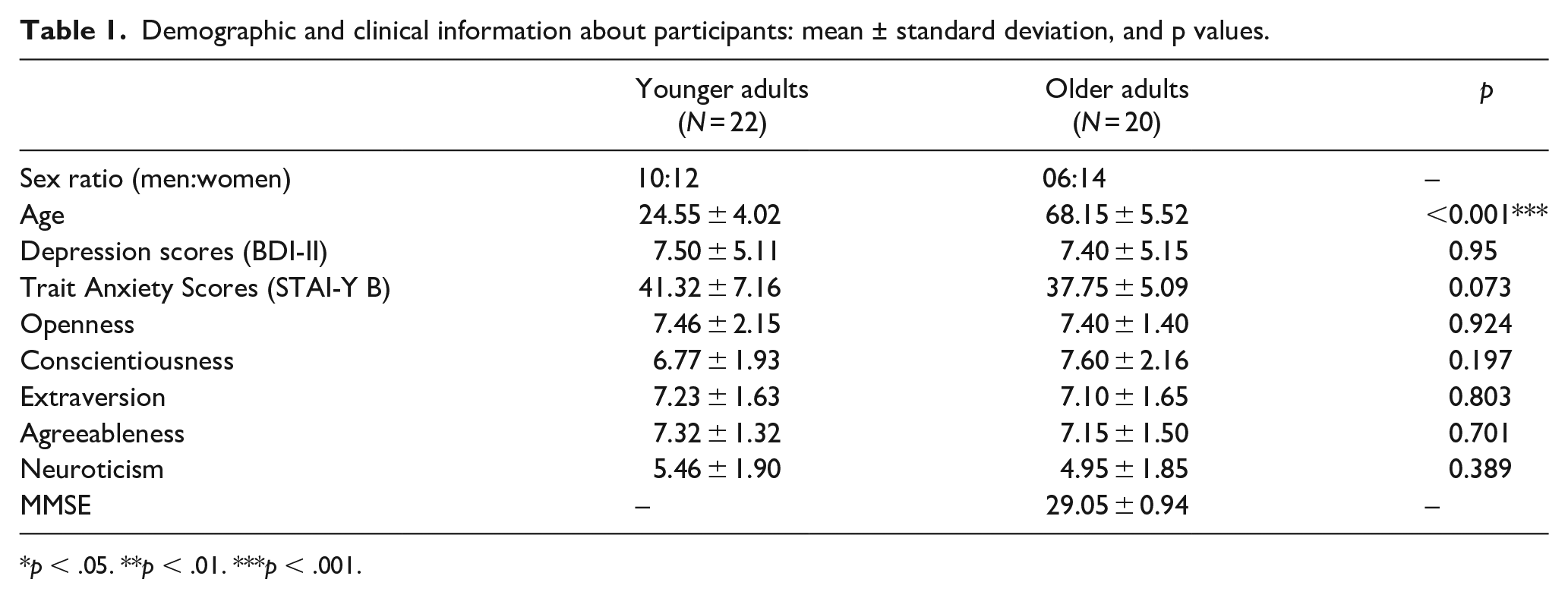
p < .05. **p < .01. ***p < .001.
Self-report measures
Participants completed questionnaires assessing different individual traits: the STAI-YB evaluating anxiety trait (STAI-Y, Spielberger, 1983) and the Ten Item Big Five Inventory assessing Openness, Conscientiousness, Extraversion, Agreeableness, and Neuroticism (Rammstedt & John, 2007).
Stimuli
We used the Virtual Interactive Behaviour (VIB) platform (Pecune et al., 2014) which generates affective and reactive virtual agents. A pre-test led us to select the most natural looking virtual agent for a face-to-face interaction. The selected male virtual agent was able to speak with a non-prosodic synthesised voice, display a direct gaze, head movements, blinks and facial expressions during the interaction so as to give the impression of a natural face-to-face interaction (Oker et al., 2018). Dynamic facial expressions were generated by activating relevant Action Units (see Supplementary Material 1) based on the Facial Action Coding System—FACS (Ekman & Friesen, 1978), which is a taxonomy of emotional expressions based on the contraction-relaxation of human facial muscles. The videos of the virtual agent that were generated were presented so that his face subtended a visual angle of approximately 10° × 15°. To simulate a face-to-face conversation (i.e., small talk), we generated four sets of videos, which served as a basis for the four different steps of the interaction (Figure 1).
Step 1 consisted of videos of the virtual agent asking the participant a question. A total of 20 questions were created, covering different topics of daily life (see Supplementary Material 2), and formulated so as to elicit a brief answer.
Step 2 consisted of videos of the virtual agent listening to the participant answering his question. During this step, the virtual agent displayed a neutral expression with slight head movements or blinks to simulate a more natural display.
Step 3 consisted of videos of the virtual agent expressing joy, disgust, anger, or sadness. The virtual agent initially displayed a neutral face and gradually expressed an emotion whose apex was reached after 2 s before becoming neutral again.
Step 4 consisted of videos of the virtual agent answering why he had felt certain emotions. The virtual agent showed a predominantly neutral face but could raise the corners of the mouth, wrinkle his forehead slightly, or blink to appear more natural. A total of 20 sentences were created, broad enough so that for each trial the virtual agent provided an appropriate response to the participant.
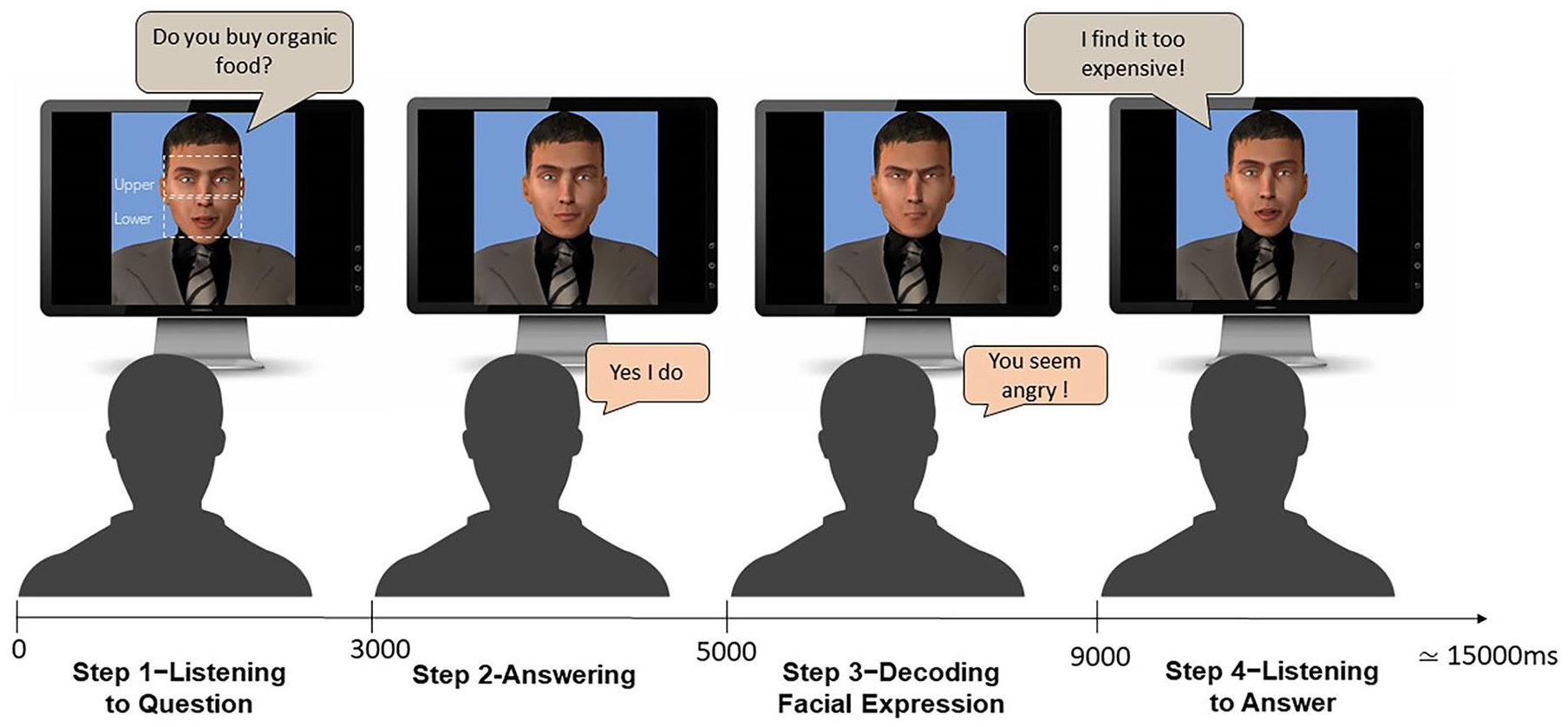
Representation of the temporal dynamics of a conversation.
Apparatus
A Tobii Pro X2-60 eye-tracker (Tobii Technology, Sweden), with a sampling frequency of 60 Hz and a spatial resolution of 0.4° was used to record eye movements. Two rectangular areas of interest (AOI) were defined based on previous studies (Grainger et al., 2017; Noh & Isaacowitz, 2013) and coded manually on each video as follows (see Figure 1): an upper-face AOI (a box covering the area from the top of the forehead to the middle of the nose), and a lower-face AOI (a box covering the area from the middle of the nose to the bottom of the chin). The size of each of the two AOIs was 380 × 160 pixels. A fixation was defined as the eyes remaining in the same 30-pixel area for at least 100 ms (Manor & Gordon, 2003). Gaze analyses were conducted on binocular data.
Procedure
First, participants reported demographic information and completed affective, cognitive, and personality measures. At the beginning of the experiment, the virtual agent introduced himself and gave the instructions verbally. Participants were instructed to interact naturally with the virtual agent and were told that he would express four emotions (joy, disgust, anger, or sadness) during the interaction that they should identify verbally. Before data collection, the eye-tracking system was calibrated with a 5-point calibration procedure.
In all, there were 20 conversational trials, each trial consisting of four steps following the same order from the participants’ perspective: Step 1–“Listening to Question,” Step 2–“Answering,” Step 3–“Decoding Facial expression,” and Step 4–“Listening to Answer.” Note that once the participant had given their answer, the experimenter initiated the next video so that the conversation seemed continuous to the participant. Prior to each trial, a centred fixation cross appeared on the screen for 1 s to focus the participants’ attention. Participants were given four practice trials to familiarise themselves with the virtual agent and the procedure. Thus, data analyses were performed on the remaining 16 trials. The order of the trials was pseudo-randomised, with the restriction that the same emotion could not be displayed by the virtual agent in two consecutive trials. The average duration of each trial was 15 s, and the entire experiment lasted approximately 30 min.
Statistical analysis
As the duration of each video differed between trials and participants, the analyses were conducted on the percentage of fixation time allocated to each AOI based on the duration of each video, excluding from the analyses the percentages of fixation time outside the predefined AOIs.
Primary statistical analyses consisted of exploring participants’ gaze behaviour with analyses of variance (ANOVAs) throughout the entire interaction with the virtual agent. Planned comparisons were conducted according to our hypotheses on age-related differences. Otherwise, post hoc Tukey tests were conducted. Finally, correlation coefficients were also computed between fixation duration percentages and scores related to personality traits.
Secondary statistical analyses consisted of exploring participants’ accuracy and gaze behaviour during the facial expression decoding step. As facial expression identification scores were not normally distributed, non-parametric tests were used. The Mann–Whitney U test was used to compare Younger and Older adults’ performance for each facial expression. Then, gaze behaviour was investigated with an ANOVA. Planned comparisons were conducted according to our hypotheses on age-related differences. Otherwise, post hoc Tukey tests were conducted. Finally, correlation coefficients were calculated between gaze behaviour and facial expression identification scores.
Statistical analyses were performed using the R-statistical environment (R Core Team, 2013, version 3.6.1). ANOVAs were computed using the “afex” package (Singmann et al., 2015) followed by planned comparisons performed with the “emmeans” package (Lenth, 2019). Planned comparisons and correlations were corrected for multiple comparisons by the Benjamini–Hochberg method. When sphericity assumptions for the ANOVA were violated, a Greenhouse–Geisser correction was applied. For clarity’s sake, uncorrected degrees of freedom are reported.
Results
To control for potential gender differences, this variable was initially entered as a between-subject factor in the analyses. 1 However, gender failed to yield any significant main effects (F < 1) or interactions (p > .4) so we collapsed across gender in the reported analysis.
Gaze behaviour during the interaction
A three-way mixed ANOVA was conducted on the fixation duration percentages: 2 (Group: younger vs. older adults) × 2 (AOI: lower-face vs. upper-face) × 4 (Steps of the interaction: Step 1—“Listening to Question,” Step 2—“Answering,” Step 3—“Decoding Facial Expression,” Step 4—“Listening to Answer”).
The ANOVA revealed no significant Age Group effect, F(1,40) = 2.14, p = .15,
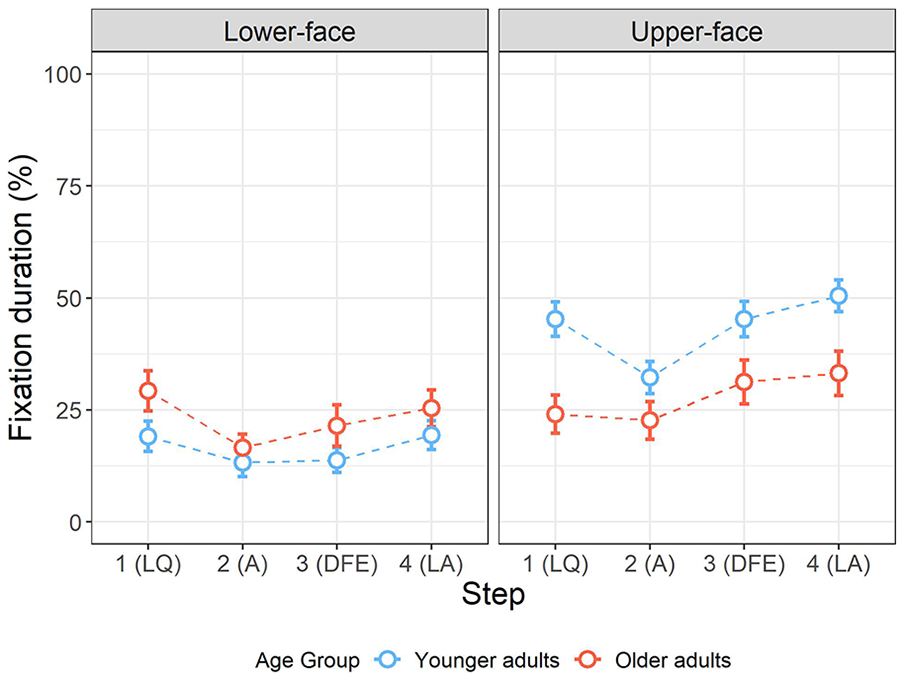
Mean percentages of fixation duration within lower-face and upper-face AOI for younger and older adults in each step of the interaction: Step 1—Listening to Question (LQ), Step 2—Answering (A), Step 3—Decoding Facial Expression (DFE), Step 4—Listening to Answer (LA). Error bars indicate standard errors of the mean.
To further examine age-related differences in gaze behaviour, planned comparisons on Younger versus Older adults’ fixation duration percentages were carried out separately in each AOI and for each Step. For the upper-face AOI, planned comparisons showed significantly lower fixation duration percentages in older adults compared with their younger counterparts in all steps of the interaction (ps < .01), except for Step 2—“Answering” (MOA = 22.68%, SD = 18.89 % vs. MYA = 32.25%, SD = 16.91%, p = .09). For the lower-face AOI, planned comparisons showed a tendency for higher fixation duration percentages in older adults compared with their younger counterparts only in Step 1—Listening to Question (MOA = 29.29%, SD = 20.07% vs. MYA = 19.10%, SD = 15.76%, p = .07), but no age-related difference emerged in the other steps (ps > .1).
To further explore this tendency for an age-related difference in Step 1—Listening to Question—and to shed light on how average gaze behaviour reflects individual gaze profiles, we categorised participants according to three preferred gazing profiles: an “upper-preference” (more than 20% of additional fixation duration percentage in favour of the upper-face AOI), a “lower-preference” (more than 20% additional fixation duration percentage in favour of the lower-face AOI), and a “no preference” gazing profile otherwise. The number of participants corresponding to each gazing profile was entered in a 2 (group) × 3 (gazing profile) contingency table and compared with the Fischer exact test. Results revealed a significant effect of group × gazing profile (Fisher’s exact test, p = .02). The analysis of residuals and post hoc pairwise tests confirms, in Step 1, a significantly higher number of older than younger adults with a lower-preference gazing profile (p = .007), a tendency for higher numbers of younger than older adults with an upper-preference gazing profile (p = .07), whereas there was no significant difference between age groups for the “no preference” profile (p = .34).
Correlation analyses between gaze and personality traits
Spearman’s rho (rs) correlation coefficients were calculated between fixation duration percentages and scores related to stable personality traits.
First, we explored associations between Big Five personality traits and gaze behaviour. No significant correlations emerged (all ps > .1) except for Extraversion scores. For the Upper-face AOI, there were significant (or nearly significant) correlations between fixation duration percentage and Extraversion scores in each step: Step 1—“Listening to Question” (rs = −.29, p = .06); Step 2—“Answering” (rs = −.43, p = .004); Step 3—“Decoding Facial Expression” (rs = −.42, p = .005); and Step 4—“Listening to Answer” (rs = −.40, p = .008). The comparison of Spearman correlations across age groups revealed no significant differences (zs ranging from −0.58 to −1.12). For the Lower-face AOI, no significant correlations emerged with extraversion scores (all ps > .1).
Second, we explored associations between Anxiety trait scores and gaze behaviour. For the Upper-face AOI, no significant correlations emerged (all ps > .1) except a moderate positive association in Step 1—“Listening to Question” (rs = .34, p = .03), with no significant differences between older and younger adults (rs OA = .15 vs. rs YA = .17, z = 0.06). For the Lower-face AOI, no significant correlations emerged (all ps > .1) except a moderate negative association in Step 1—“Listening to Question” (rs = −.34, p = .03), with no significant differences between older and younger adults (rs OA = −.62 vs. rs YA = −.11, z = 1.84).
Focus on Step 3—“decoding facial expression”
Facial expression identification accuracy
The Mann–Whitney U test revealed a significant age group effect (see Table 2), with older adults being on average less accurate than younger adults (p < .001). Age-related differences were examined for each emotion separately, and the analyses revealed that older adults were less accurate than younger adults for each emotion (all ps < .05), except for joy.
Participant’s emotion recognition performances (in percentages) for all emotions, and each emotion separetely.
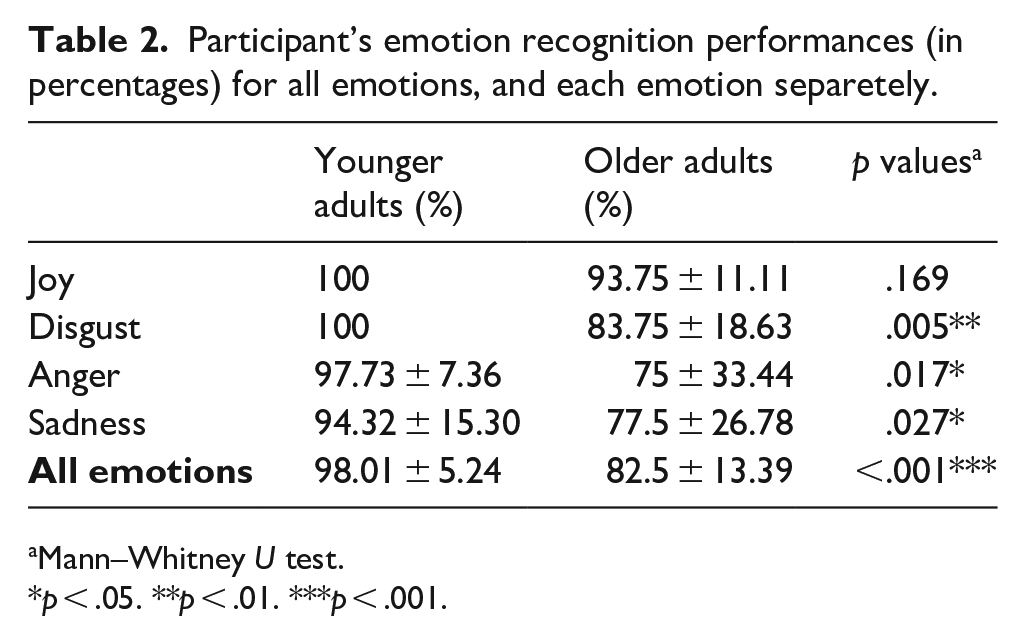
Mann–Whitney U test.
p < .05. **p < .01. ***p < .001.
Gaze behaviour during facial expression decoding
Fixation duration percentages in Step 3—“Decoding Facial expression” were entered into a three-way mixed ANOVA (see Figure 3): 2 (Group: younger adults, older adults) × 2 (AOI: upper-face and lower-face areas) × 4 (Emotion: “joy, “disgust,” “anger,” and “sadness”).
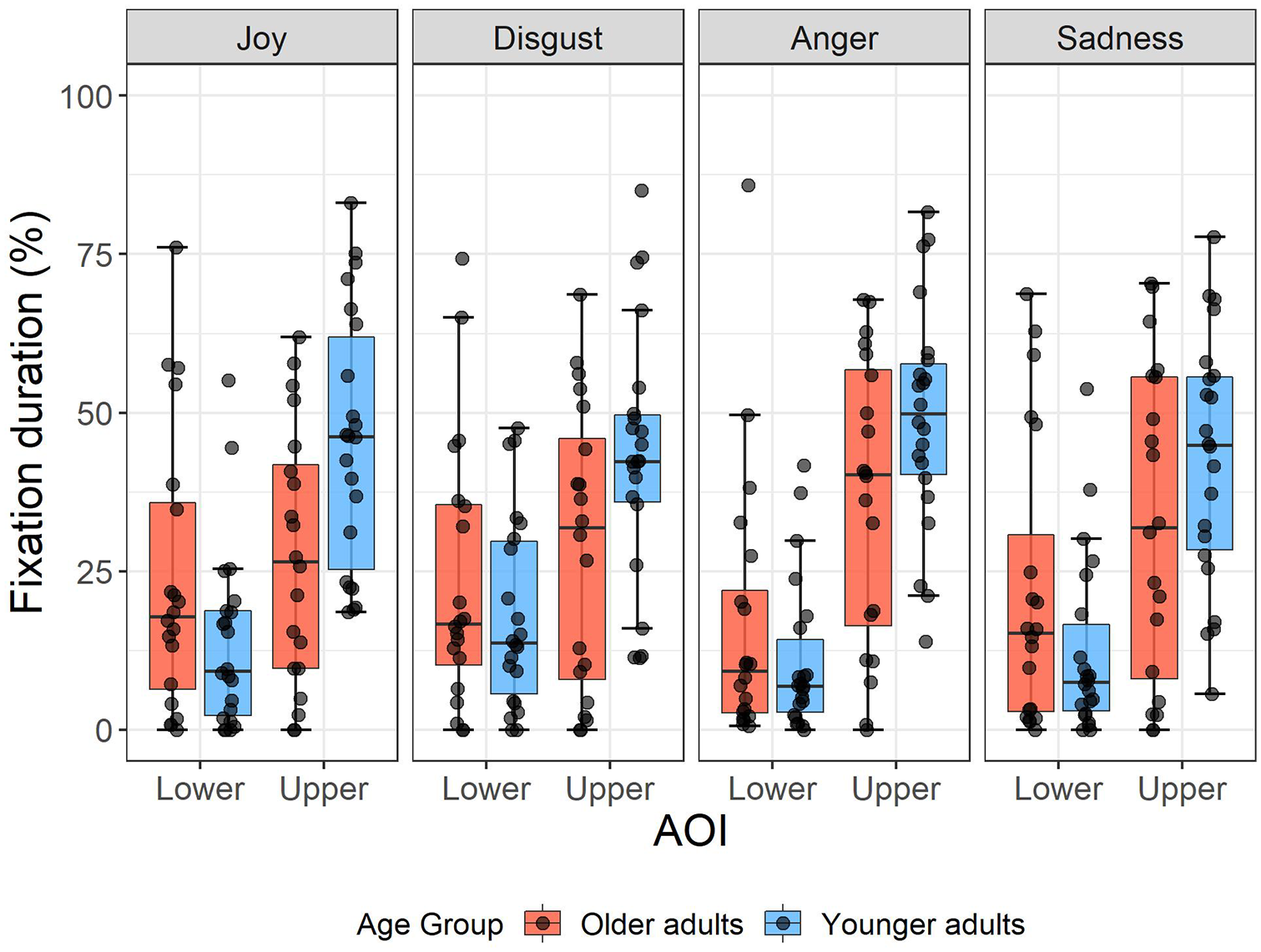
Mean percentages of fixation duration by participants within lower-face and upper-face AOI for all emotions. The boxplots show the median percentages of fixation duration, and lower and upper quartiles. The whiskers indicate data points within plus or minus 1.5 times the interquartile range. Circles represent individual percentages of fixation duration.
Results revealed a main effect of AOI, F(1,40) = 19.33, p < .001,
Discussion
Successful social interactions are crucial in everyday life and until old age. However, so far, studies in the field of psychology of aging have mainly investigated offline social interactions, with low ecological validity, in which participants are passive detached observers of social stimuli (e.g., Chaby et al., 2017; Grainger et al., 2017; Sze et al., 2012). Thus, it is not clear whether age-related differences remain in more natural interactive settings that offer the possibility to exchange social signals, especially through gaze behaviour. To the best of our knowledge, our study is the first to combine the use of embodied conversational agents—which offer good experimental control while enabling reproducibility and innovative interactive contexts (see Pan & Hamilton, 2018)—with eye-tracking technology which enables the tracking of gaze behaviour during online interaction. Here, we introduced a new interactive paradigm reproducing several steps of an interaction in which participants had to decode social information from a virtual partner (i.e., listening to a question, decoding a facial expression, and listening to an answer) or to produce social information (answering a question).
Our results shed light on how gaze strategies unfold in an interactive context for younger and older adults. The first interesting finding is that age-related differences in gaze behaviour towards the eye region—that is, older adults spend a shorter amount of time on the eye region than younger adults—mainly concern the “decoding” of social information, either emotional (observing and decoding the partner’s facial expression) or not (listening to the partner’s question/answer) during a face-to-face conversation. This suggests that in a context that requires being actively engaged, older people still exhibit a gaze behaviour that consists of reducing engagement with the eye region of others. One possible reason could be that for older adults, decoding visual social information requires a high cognitive load, which may result in averting one’s gaze away from the partner (Doherty-Sneddon & Phelps, 2005). Thus, our results confirm and expand previous studies on the effect of aging on gaze using well-established offline settings, ranging from emotional faces to emotional social scenes (Castro & Isaacowitz, 2019; Grainger et al., 2017; Hayes et al., 2020). Surprisingly, both older and younger adults gaze less towards the upper-face area when speaking. These results confirm what has already been observed in young adults, namely that when someone is speaking, gaze serves to signal information about ourselves, which generally leads to a reduced amount of time on the partner’s eye area (Hessels et al., 2019; Ho et al., 2015; Mansour & Kuhn, 2019). In addition, it is important to note that gaze towards the eyes may be modulated by the personality trait of extraversion. Our results highlighted that individuals with a high extraversion level tended to spend less time on the upper-face area. While much of the literature casts extraverted individuals as enjoying social interactions with a tendency to more eye contact (Roslan et al., 2019), here we suggest that their desire for more stimulation may also lead them to gaze away and pay less attention to their partner (see also Rauthmann et al., 2012).
The second important finding is the lack of age-related differences in gaze behaviour towards the mouth region, except when it is necessary to decode the question addressed by the virtual partner, which leads older adults to gaze more at the mouth than younger adults. This observation was confirmed by individual analyses of participants’ preferential gazing profile, which revealed that older adults were more likely than young adults to have a preferred mouth-gazing profile at this critical step of the interaction. Although older adults are generally considered to be poorer lip-readers (Sommers et al., 2005), one possible reason could be that they engage in more frequent lip-reading to gain cues—at this crucial step of the interaction—that will help them decode a question that they have to answer. This may be due to the need for older adults to rely more than their younger counterparts on visual rather than auditory cues (Freiherr et al., 2013), which may reflect the use of multisensory integration as a compensatory mechanism for declines in unisensory perception (Chaby et al., 2015; Stevenson et al., 2015). It should be noted that at this crucial step of the interaction gaze may be slightly modulated by the level of anxiety, because the more anxious participants tend to gaze less at the mouth and more at the eyes. However, further studies are necessary to ensure which components of anxiety may be involved (e.g., social, cognitive, or ruminations), as the STAI-YB used in this study gives only a global overview of participants’ anxiety.
A second objective of our study was to explore how age influenced identification abilities and gaze behaviour towards different facial expressions. We expected facial expression identification to be quite easy for both age groups, as participants were engaged in an everyday-like interaction and previous studies indicated that aging is associated with improved emotional functioning and well-being in daily life (Burr et al., 2020; Sims et al., 2015). Interestingly, while overall participant performance exceeded 80%, our results suggest that in an interactive and engaging paradigm, age-related differences remain, with older adults identifying each facial expression more poorly than younger ones, except for joy. For each of the facial expressions, older adults spent significantly less time on the eye region than younger adults, but we did not observe any age-related differences for the mouth region. These novel results are in contrast with previous studies (Chaby et al., 2017; Murphy & Isaacowitz, 2010; Wong et al., 2005) which showed that younger and older adults do not prioritise the same facial regions when identifying facial expressions (i.e., an exploratory strategy in young adults and a focusing strategy on the mouth region in older adults). What is new in this study is that participants focused primarily on the eye area during the decoding of facial expressions, although this was less evident in the older age group. We suggest that in our study, the direct gaze of the virtual partner may have oriented the participant’s gaze towards the eye area (Lyyra et al., 2018).
Finally, although this may appear counterintuitive, in accordance with previous work, no association was found between gaze behaviour and emotion identification abilities that would explain older adults’ well-established difficulties (for a review, Grainger & Henry, 2020). As facial expression identification takes roughly 200–300 ms (Calvo & Nummenmaa, 2009; Eimer & Holmes, 2002), participants likely keep on exploring the virtual partner’s face after processing relevant facial areas; hence, further understanding would require more fine-grained methods for the investigation of visual processing of facial expressions (see Birmingham et al., 2018).
Our results are not without limitations. First, although our study comes a step closer to real-world likeness, one might wonder to what extent our results are generalizable to human–human interactions. As current technology allows virtual agents to successfully simulate human behaviour, users tend to act with them as they would with their peers (Krämer et al., 2015). However, other studies of human–human interactions have indicated that the way we look at others may be influenced by whether or not they are physically present and thus the feeling of being seen (Laidlaw et al., 2011). Thus, although eye contact with a virtual agent can probably evoke the experience of being seen, one cannot be certain that it is similar to eye contact with a real person (Syrjämäki et al., 2020). Another possible limitation is that our emotional identification task relied mostly on the visual decoding of facial expressions. Previous studies with non-interactive stimuli demonstrated that older adults benefit particularly from the integration of visual and auditory cues (Chaby et al., 2015; Lambrecht et al., 2012) or contextual emotional information (Noh & Isaacowitz, 2013) for enhanced emotion identification performances. Here, the absence of emotional prosody during the emotional identification task did not provide a fully multimodal experience. However, the implementation of emotional prosody was limited by technology and was beyond the aim of the study. In addition, the agent’s facial expressions were not contextualised in relation to the question-and-answer conversation format, which could make them less easy for older people to decode. In future research, these issues should be considered as variables to see to what extent older adults rely on them as strategies for recognising emotions in social interaction.
In conclusion, this study has proven to be relevant in highlighting age-related differences in face-to-face social interactions through gaze behaviour. Based on our results, as well as insights from previous research, we believe that specific moments of social interaction likely modulate how younger and older adults allocate their gaze. On the whole, our results are consistent with studies that have indicated that gaze is not only used to extract social information about others, but also to signal information about ourselves, which is referred to as the duality of gaze. We argue that as we age, only the extracting function of gaze may be affected while the signalling function tends to be preserved. Our findings provide additional evidence that even in a more interactive and engaging context of a face-to-face conversation, older adults spend a shorter amount of time than younger adults on their partner’s eyes when extracting socio-emotional information from the face. In addition, we believe that individual differences in gaze behaviour for extracting information from the face need to be more explicitly considered in future experiments, as they may be crucial for our understanding of how gaze behaviour is allocated in different social contexts.
Supplemental Material
sj-pdf-2-qjp-10.1177_1747021820982165 – Supplemental material for Age-related changes in gaze behaviour during social interaction: An eye-tracking study with an embodied conversational agent
Supplemental material, sj-pdf-2-qjp-10.1177_1747021820982165 for Age-related changes in gaze behaviour during social interaction: An eye-tracking study with an embodied conversational agent by Katarina Pavic, Ali Oker, Mohamed Chetouani and Laurence Chaby in Quarterly Journal of Experimental Psychology
Supplemental Material
sj-pdf-3-qjp-10.1177_1747021820982165 – Supplemental material for Age-related changes in gaze behaviour during social interaction: An eye-tracking study with an embodied conversational agent
Supplemental material, sj-pdf-3-qjp-10.1177_1747021820982165 for Age-related changes in gaze behaviour during social interaction: An eye-tracking study with an embodied conversational agent by Katarina Pavic, Ali Oker, Mohamed Chetouani and Laurence Chaby in Quarterly Journal of Experimental Psychology
Supplemental Material
sj-png-1-qjp-10.1177_1747021820982165 – Supplemental material for Age-related changes in gaze behaviour during social interaction: An eye-tracking study with an embodied conversational agent
Supplemental material, sj-png-1-qjp-10.1177_1747021820982165 for Age-related changes in gaze behaviour during social interaction: An eye-tracking study with an embodied conversational agent by Katarina Pavic, Ali Oker, Mohamed Chetouani and Laurence Chaby in Quarterly Journal of Experimental Psychology
Footnotes
Acknowledgements
We are grateful to all the volunteers who generously gave their time to participate in this study. We would like to thank the INSEAD—Sorbonne University Multidisciplinary Centre for Behavioural Sciences, as well as their research assistants Hoai Huong Ngo and Jean-Yves Mariette for their help in data collection. Study Material was designed with the Virtual Interactive Behaviour (VIB) platform and more information is available upon request from the corresponding author. Data cannot be made publicly available due to ethical and legal restrictions. This study was not preregistered.
Declaration of conflicting interests
The author(s) declared no potential conflicts of interest with respect to the research, authorship, and/or publication of this article.
Funding
The author(s) disclosed receipt of the following financial support for the research, authorship, and/or publication of this article: This work was partially supported by the Labex SMART (ANR-11-LABX-65) under French state funds managed by the ANR within the Investissements d’Avenir program under reference ANR-11-IDEX-0004-02.

Notes
References
Supplementary Material
Please find the following supplemental material available below.
For Open Access articles published under a Creative Commons License, all supplemental material carries the same license as the article it is associated with.
For non-Open Access articles published, all supplemental material carries a non-exclusive license, and permission requests for re-use of supplemental material or any part of supplemental material shall be sent directly to the copyright owner as specified in the copyright notice associated with the article.

