



Abstract
Working memory is thought to be strongly related to cognitive control. Recent studies have sought to understand this relationship under the prism of the dual mechanisms of control (DMC) framework, in which cognitive control is thought to operate in two distinct modes: proactive and reactive. Several authors have concluded that a high working memory capacity is associated with a tendency to engage the more effective mechanism of proactive control. However, the predicted pattern of proactive control use has never been observed; correlational evidence is made difficult to interpret by the overall superiority of participants with a high working memory capacity: they tend to perform better even when proactive control should be detrimental. In two experiments, we used an experimental-correlational approach to experimentally induce the use of reactive or proactive control in the AX-CPT. The relation between working memory capacity and performance was unaffected, incompatible with the hypothesis that the better performance of participants with a high working memory capacity in the task is due to their use of proactive control. It remains unclear how individual differences in working memory capacity relate to cognitive control under the DMC framework.
Keywords
Working memory, or the ability to hold information in mind in the face of concurrent action (Baddeley & Hitch, 1974), holds a central place in high-level cognition. For example, individual differences in working memory capacity (WMC) have been linked to fluid intelligence (Ackerman et al., 2005), reading comprehension (Daneman & Merikle, 1996), and mathematics performance (Wiley & Jarosz, 2012). According to the executive attention theory of WMC (Engle & Kane, 2004), the variation in working memory and its relation with the above skills are primarily driven by individual differences in cognitive control, or the ability to regulate behaviour to achieve a particular goal (Braver, 2012). Because of the importance of cognitive control for WMC, many studies have investigated the relation between these two constructs and found that a high WMC is indeed associated with better performance in cognitive control tasks (e.g., Engle et al., 1999; Kane & Engle, 2003).
A recurring criticism of this working memory literature is the fact that cognitive control is usually approached as a homunculus: an inscrutable, unspecified agent that can just perform any function of regulation at will (see, for example, Baddeley, 2003; Cowan, 1988; Shah & Miyake, 1999). This makes it difficult to test precise hypotheses regarding WMC and cognitive control. Past studies have predominantly viewed cognitive control as a unitary ability, adding to this homuncular problem. However, more recent evidence suggests that cognitive control may be dualistic in nature (Braver, 2012; Braver et al., 2007), comprising two qualitatively different mechanisms: proactive and reactive control. This possibility offers a new perspective on the relation between WMC and cognitive control: it could be the case that participants with a high WMC use a different control mechanism, explaining their better performance. If the data confirmed this hypothesis, it would connect the WMC literature with the emerging literature on mechanisms of cognitive control, and it would allow for a precise mechanistic account of how exactly participants with a high WMC proceed to solve a task—beyond the simple observation of a higher total score ascribed to a “more efficient homunculus.”
The dual mechanisms of control framework and the AX-CPT
According to the dual mechanisms of control (DMC) framework, cognitive control operates in two distinct modes: proactive and reactive. Proactive control is described as an anticipatory mechanism, in which one prepares future actions based on predictive contextual cues. Reactive control is described as a “wait and see” mechanism, where behaviour is regulated on a post hoc basis after a critical event has occurred. For example, consider a person driving on the freeway. As the person is driving, they see ahead of them a car that may change into the same lane as the one they are driving in. Taking a proactive approach, the driver can sustain attention on the car and prepare for the lane switch. Conversely, the driver could take a reactive approach and not focus attention on the car until the other driver switches lanes and the car captures attention.
Proactive control is thought to be more effective in most situations, but it also requires active maintenance of contextual cues in working memory during the anticipatory period, reflecting the computational trade-off of the two modes. In the above example, using proactive control makes it possible to react faster if and when the other car does change into the same lane, but to use this form of control, the driver needs to actively maintain goal-relevant information in memory until the event occurs. This need for active maintenance is supported by functional magnetic resonance imaging (fMRI) studies: participants who use proactive control demonstrate sustained activation in the lateral prefrontal cortex (see Braver, 2012; Braver et al., 2009). Proactive control is also used to a lesser extent by older adults (Braver et al., 2005), patients with schizophrenia (Henderson et al., 2012), and young children (Gonthier et al., 2019).
The differences between proactive and reactive control make them good candidates for a possible relation with WMC: given that proactive control is both more effective in most situations (as long as the task or situation provides reliable predictive cues; Braver et al., 2007) and more demanding in terms of working memory resources, it can be expected that this mechanism is used to a greater extent by participants with a high WMC, giving rise to their better performance in cognitive control tasks. The DMC framework was developed with this possibility in mind (Braver et al., 2007), and multiple authors have adopted this perspective (e.g., Redick & Engle, 2011). In theory, testing this hypothesis should just require a task capable of assessing which control mechanism is used by participants.
The most popular paradigm to assess proactive and reactive control is the AX-CPT (Braver, 2012; Braver et al., 2007). In this task, participants are presented with cues followed by probes; they are asked to press a target key when presented with an A-cue followed by an X-probe. In a standard version of the AX-CPT, there are four trial types: AX, which are the target trials; BX, which are trials composed of any non “A” cue followed by an “X” probe; AY, which are trials composed of a cue “A” that is followed by any non “X” probe; and BY, which are trials composed of a non “A” cue followed by a non “X” probe. An A-cue is usually followed by an X-probe, which means a trial starting with an A-cue is very likely to require a target response.
Participants using proactive control in the AX-CPT are thought to actively maintain cue-related information and prepare in advance the response most likely to be correct, whereas participants using reactive control wait for the probe to appear to select their response, retrieving the identity of the cue in memory if necessary. Proactive control yields high performance on AX trials (where the usually correct response can be prepared in advance), as well as BX and BY trials (where the B-cue predicts a non-target response with perfect certainty); critically, however, it comes with low performance on AY trials, because based on the A-cue participants prepare a target response which turns out to be incorrect when the probe appears. Conversely, reactive control yields low performance on BX trials, where the X-probe incorrectly invites a target response, but it yields high performance on AY trials where the probe directly elicits a non-target response.
This design elegantly separates the use of proactive and reactive control, because the task includes both a trial type where proactive control is more effective (BX) and a trial type where it is less effective (AY) than reactive control. Including a condition where proactive control elicits low performance thus makes it possible to draw more specific and falsifiable predictions than a task where proactive control always leads to higher performance. In other words, if a group of participants demonstrates both lower AY performance and higher BX performance than another, it can be reliably concluded that this group is using proactive control; it is this pattern that is observed in young versus old adults (e.g., Braver et al., 2005).
Prior studies on working memory and proactive control, and their core issue
Based on the AX-CPT, multiple studies have directly tested the hypothesis that WMC is related to the use of proactive control (Ball, 2015; Belletier et al., 2019; Boudewyn et al., 2015; Braver et al., 2005; Gonthier et al., 2019; MacDonald et al., 2005; Redick, 2014; Redick & Engle, 2011; Richmond et al., 2015; Stawarczyk et al., 2014; Troller-Renfree et al., 2020; Wiemers & Redick, 2018), using versions of the same basic protocol: collect a measure of WMC and test whether this measure correlates with performance in the AX-CPT. Measures of overall performance for these studies included response times (RTs) across trials, errors across individual trial types, and d′, among others. All these studies concluded in favour of a correlation between WMC and overall performance (with the exception of Braver et al., 2005, whose analysis suffered both from a small sample of N = 33 and from the use of a single task, backward digit span, to estimate WMC; see Conway et al., 2005). When reported, correlations were usually in the .20–.40 range (Ball, 2015; Boudewyn et al., 2015; MacDonald et al., 2005; Richmond et al., 2015; Stawarczyk et al., 2014; Wiemers & Redick, 2018).
The major problem, however, is what exactly can be concluded from a correlation between WMC and overall performance in the AX-CPT. As we have seen, WMC tends to correlate with performance in a wide range of cognitive tasks, including not only high-level cognition but also processing speed (Ackerman et al., 2002; Fry & Hale, 2000) and secondary memory (Unsworth & Engle, 2007; Unsworth et al., 2014). A quicker response speed or a better ability to retrieve the identity of the cue in secondary memory would be sufficient to explain faster RTs or lower error rates in the AX-CPT, without participants actually using a qualitatively different mechanism, i.e., without using proactive control to a greater extent. In other words, the problem hinges on the fact that the AX-CPT does not only measure which mechanism participants use; the results are confounded with how effectively they use this mechanism. As detailed in the previous section, the cornerstone of the AX-CPT is the lower AY performance that should be observed for participants who use proactive control. If a participant performs both higher on BX trials and lower on AY trials than others, then it can be unambiguously concluded that they use proactive control. This is the critical pattern that should appear for participants with a high WMC.
In fact, no study has ever reported this pattern. A number of researchers have exclusively analysed the AX-CPT based on the d′-context measure (Ball, 2015; Belletier et al., 2019; Boudewyn et al., 2015; Stawarczyk et al., 2014; Troller-Renfree et al., 2020), which is a composite of accuracy on AX and BX trials; a higher d′ reflects higher overall accuracy, but not necessarily higher use of proactive control, which means not much can be concluded from these results. Other studies have tested the relation between WMC and separate trial types and found that participants with high WMC had higher performance overall, not just on BX trials as expected, with no evidence for an interaction between WMC and trial type (MacDonald et al., 2005; Redick, 2014; Wiemers & Redick, 2018). Our own earlier study found a negative correlation between WMC and AY performance (Gonthier et al., 2019, supplemental material), but this was a study in children where AX-CPT performance was confounded with age, which means this correlation could be driven by the increase of both WMC and proactive control with age and does not directly test the hypothesised relation.
To our knowledge, only two studies analysed the AX-CPT by trial type and obtained data that could point towards the expected pattern of lower AY performance for participants with a high WMC, and both had ambiguous results. The first (Redick & Engle, 2011) found a significant interaction between WMC and trial type, such that participants with a high WMC were significantly better on AX, BX and BY trials, but not significantly better on AY trials. The authors concluded that this reflected the fact that participants with a high WMC were disproportionately slowed on AY trials, which compensated their overall greater facility with the task. However, participants with a high WMC were still descriptively both faster and more accurate on AY trials. The other study (Richmond et al., 2015) used hierarchical regressions to test the relation between WMC and performance when controlling for BY trials, considered as a sort of “neutral” condition to account for baseline differences of accuracy and response speed. These hierarchical regressions showed that participants with a high WMC were somewhat slower on AY trials RTs in one experiment (β = .24, p = .003), but not in the other (β = .14, p = .092). Again, however, participants with a high WMC performed descriptively the same or better on AY trials without taking this covariate into account.
In short, no study has unambiguously found the predicted pattern of a negative relation between WMC and performance on AY trials: on the contrary, participants with a high WMC systematically demonstrate better or equal performance. It is possible, as suggested by Redick and Engle (2011), that the general superiority of participants with a high WMC counterbalances their difficulty with AY trials, leading to a non-significant relationship—but this is difficult to reconcile with the fact that the predicted pattern of lower AY accuracy can be found in young adults when compared with older adults (e.g., Braver et al., 2005), despite the fact that older adults should be expected to perform lower overall, like participants with a low WMC. Thus, the uncertainty remains as to whether participants with a high WMC actually use a qualitatively different mechanism.
The experimental-correlational approach: inducing shifts in cognitive control
It seems difficult to solve the issue of prior studies failing to find the predicted negative relation between WMC and AY performance, while retaining a purely correlational approach. Some steps could be taken to incrementally improve on their designs (e.g., using different measures, such as the proactive behavioural index or PBI, which reflects the balance between AY and BX trials, instead of the d′-context which ignores AY trials), but ultimately the core issue will remain: a high WMC is associated with higher effectiveness in a number of processes (e.g., Kovacs & Conway, 2016; Simmering & Perone, 2013), which could blur all correlations and make it difficult to observe actually lower performance in these participants.
A possible way out of this conundrum is to combine the experimental and correlational approaches (Cronbach, 1957): experimentally manipulate the use of proactive and reactive control, and test whether this affects the correlations with WMC (see Gonthier, Macnamara, et al., 2016, p. 2). The rationale is that if it really is the use of proactive control that drives the superior performance of participants with a high WMC, then inducing these participants to use reactive control (or inducing participants with a low WMC to use proactive control) should eliminate any effect of WMC, or at least radically alter its correlation with performance. If, on the contrary, the higher performance of participants with a high WMC has nothing to do with which mechanism they use and everything to do with how effectively they use it, then inducing a change in control mechanism should not affect the relation with WMC.
This point is best conveyed using an analogy. There are two roads to arrive at a destination; participants with a high WMC always arrive at the destination earlier, but it is unknown whether this is because they take the shorter road or just because they walk faster. The solution is to induce all participants to take the same road. If participants with a high WMC usually arrive earlier because they spontaneously take the shorter road, then inducing all participants to use the longer road should necessarily decrease or erase the difference with participants with a low WMC. Conversely, if participants with a high WMC arrive earlier to the same extent, even when they are induced to take the longer road, then it means the effect of WMC is driven by quantitative differences in walking speed rather than a qualitative difference in the road they choose (see also Schelble et al., 2012; Thomassin et al., 2015).
Prior studies have proposed methods to selectively induce the use of reactive control (Braver et al., 2009) or proactive control (Paxton et al., 2006, 2008). With the purpose of the experimental-correlational approach in mind, we recently demonstrated that these methods function well in adult participants (Gonthier, Macnamara, et al., 2016). Specifically, proactive control can be induced by explaining the proactive strategy to participants and explicitly asking them to use it (“strategy training”). Conversely, reactive control can be induced by adding no-go probes in the task, thus reducing the predictive validity of the cue and encouraging a probe-driven response strategy. Our results showed that these two manipulations induce changes in behaviour consistent with an increase in the use of proactive or reactive control, respectively. They can therefore be used as the basis of an experimental-correlational approach to test the relation between WMC and use of proactive control.
Summary and rationale for the study
Our objective was to test the hypothesis that a high WMC is related to greater use of proactive control. Given the fact that the prior correlational studies testing this question with the AX-CPT have all found higher performance overall for participants with a high WMC, rather than the predicted pattern of higher performance on BX and lower performance on AY trials, we decided to use a different approach. In two experiments, we experimentally manipulated the use of proactive and reactive control in an attempt to influence the correlation between WMC and performance (see Gonthier, Macnamara, et al., 2016). Experiment 1 used a baseline and a reactive condition of the AX-CPT (i.e., a condition designed to induce reactive control); this dataset was presented in a prior publication (Gonthier, Macnamara, et al., 2016) without the WMC data. Experiment 2 was a new experiment; it used a baseline, a proactive, and a reactive condition of the AX-CPT.
If the correlation between WMC and performance is driven by the more frequent use of proactive control by participants with a high WMC, we would expect that correlation to be higher in the baseline condition than in a condition inducing all participants to use the same mechanism—either reactive or proactive control. If, on the contrary, the correlation between WMC and performance is driven by other processes—such as faster processing speed or a higher ability to retrieve the identity of the cue in secondary memory—then we would expect that correlation to remain relatively unchanged, regardless of which control mechanism participants are using.
Of secondary interest, we also performed complementary analyses to verify that the experimental manipulations of reactive and proactive control functioned as expected and induced the predicted shifts in performance in the AX-CPT; we also replicated the analyses of prior correlational studies, including the hierarchical regressions of Richmond and colleagues (2015), in an attempt to replicate prior findings concerning the relation between WMC and performance.
Experiment 1
The aim of Experiment 1 was to test the extent to which control shifts influenced the correlation between WMC and cognitive control performance. Specifically, this experiment included a baseline and reactive condition. The reactive condition contains No-go trials (i.e., a letter stimulus followed by a digit number, “A-7”) with the goal of inducing reactive responding.
Method
Participants
Data collection was initially planned for 100 participants, in line with other studies (N = 65 in Redick & Engle, 2011; N = 105 in Richmond et al., 2015). A sample of 95 students at the University of Savoy participated for course credit (74 women and 21 men; mean age = 20.19 years, SD = 1.80). All participants were French-speaking adults with normal or corrected vision, and none had completed any of the experimental tasks before. All participants provided informed consent to participate.
Redick and Engle (2011) reported η2 = .112 for the interaction between WMC and trial type for RTs in the AX-CPT; achieved power for this effect size with 95 participants was .92. Richmond and colleagues (2015) reported η2 = .058 for the negative relation between WMC and RTs on AY trials in a hierarchical regression controlling for BY performance; achieved power for this effect size was .66.
Materials and design
Working memory tasks
WMC was estimated using three tasks: a symmetry span, an operation span, and an alpha span. A French version of all three tasks was constructed and validated in a prior publication (Gonthier, Thomassin, & Roulin, 2016). The symmetry span and operation span are classic complex span tasks (see Conway et al., 2005; Redick et al., 2012), which were adapted from their English-speaking version (Unsworth et al., 2005). In each trial, participants had to alternate between solving simple problems (deciding whether images are vertically symmetrical, deciding whether mathematical operations are correct) and memorising unrelated stimuli (spatial locations in a 4×4 grid, consonants). The alpha span was adapted from Oberauer et al. (2000). In each trial, a series of two- and three-syllable words were presented to participants, who then had to recall the first letter of each word, in alphabetical order.
Set sizes ranged from 3 to 6 for the symmetry span, from 3 to 7 for the operation span, and from 4 to 8 for the alpha span (with one trial for the lowest and highest set size and two trials for other set sizes, presented in random order). For all three tasks, performance was scored as the proportion of stimuli correctly recalled in their correct serial position (Conway et al., 2005; Redick et al., 2012). The three scores were standardised and then averaged to yield a composite estimate of WMC. Reliability was excellent for the composite WMC estimate, with ωt = .89 (using the omega total coefficient of internal consistency, a better alternative to Cronbach’s alpha for multidimensional scales: McDonald, 1978; see Revelle & Zinbarg, 2009; when considering the tasks separately, reliability was α = .72 for the symmetry span, α = .72 for the operation span, and α = .68 for the alpha span).
Baseline AX-CPT
Participants completed the AX-CPT-40 version of the AX-CPT (as in Richmond et al., 2015). The AX-CPT-40 includes 40% of AX trials, 10% of AY trials, 10% of BX trials, and 40% of BX trials. This version is similar to the classic AX-CPT-70, except that it has the desirable property of equating the frequency of A-cues and B-cues, while leaving the conditional probability of an X-probe following an A-cue relatively unchanged (80% of A-cues are followed by an X-probe, as opposed to 87.5% in the AX-CPT-70). Participants first completed 12 practice trials (repeated until they reached 70% accuracy), followed by 100 trials (40 AX, 10 AY, 10 BX, 40 BY), in pseudo-random order (arranged so that there were never more than five consecutive AX trials or more than two consecutive AY, BX, or BY trials).
The task was as described in Gonthier, Macnamara, et al. (2016, Experiment 2). Each trial comprised a cue presented for 500 ms, a 3,500 ms delay, and a probe presented for 500 ms. The inter-trial interval was 1,000 ms. Cue letters (E, G, P, R, S, or A) were presented in blue and probe letters (F, J, M, Q, U, and X) were presented in white at the centre of the screen (see Henderson et al., 2012). The screen remained empty during the delay period and the inter-trial interval. Participants had to respond to each stimulus presented on the screen (including cues, to ensure that they were encoded; Paxton et al., 2008) by pressing either a target button (yellow, mapped on the right hand, when they saw the X-probe and the preceding letter was an A-cue) or a non-target response (blue, mapped on the left hand, in all other cases). Failure to respond within 1,000 ms was recorded as an error. Audio feedback was given after each response (a “ding” sound for a correct response, a “buzz” sound for an incorrect response, or a “knock” sound for failure to respond within the deadline). Participants were instructed to respond as quickly and as accurately as possible.
Error rates and average RTs (on correct trials only) were computed separately for each trial type. We also considered three composite indices of proactive control use, in line with prior literature (see Gonthier, Macnamara, et al., 2016): the d′-context, computed as z(AX hits) − z(BX false alarms) (where z represents the z-transform); the A-cue bias, computed as z(AX hits) − z(AY false alarms); and the PBI, computed as (AY − BX)/(AY + BX). PBI was calculated separately for RTs, error rates, and the standardised average of the two. To account for participants who had 0 errors, a log-linear correction was applied to all error rates prior to computing these three indices (see Braver et al., 2009; Gonthier, Macnamara, et al., 2016), as error rate = (number of errors + 0.5)/(number of trials + 1).
The reliability of the various measures obtained from the AX-CPT is displayed in Table 1. All reliability co-efficients were computed as the mean of 1,000 resampled Spearman-Brown corrected correlations between splithalves, with the splits made randomly in each resample (for details, Parsons et al., 2019). The results are functionally equivalent to a classic Cronbach’s alpha, but this method provides more stable estimates in this context (because the alpha cannot be computed for derived measures such as the d′-context, A-cue bias, and PBI and cannot be computed when some trials have null variance, as sometimes happens for the rare AY and BX error rates).
Reliability coefficients for the AX-CPT.

ER: error rate; RT: response time; PBI: proactive behavioural index.
Coefficients are the mean of 1,000 Spearman-Brown corrected correlations between splithalves, with their 95% confidence intervals presented in brackets.
Reactive AX-CPT
The reactive AX-CPT was identical to the baseline AX-CPT, except that the task also included no-go trials. In these trials, the probe took the form of a digit (1, 2, 3 7, 8, or 9) rather than a letter. Participants were instructed to withhold their response entirely when they saw one of these probes. A special feedback (a “dee dum” sound) was given if they pressed any key on a no-go trial. To diminish the predictability of the no-go trials, half of these trials started with an A-cue and the other half with a B-cue. Participants completed 124 trials for the reactive AX-CPT (40 AX, 10 AY, 10 BX, 40 BY; and an additional 24 No-go trials).
Procedure
Participants performed the testing session in a university computer room, in groups of up to eight participants. They completed the working memory tasks first (alpha span, symmetry span, then operation span), followed by the two conditions of the AX-CPT in counterbalanced order. Testing time was approximately 1 hr.
Data analysis
We performed three series of analyses on the data: (1) A comparison of average performance in the control and no-go conditions, to confirm that the no-go manipulation induced a reactive control shift. These analyses used repeated-measures analyses of variance (ANOVAs). (2) Individual differences analyses to examine the correlation between WMC and performance in the AX-CPT, and how this relationship differed as a function of conditions. The relationship between WMC and performance in each condition was examined using simple linear regressions. To determine whether this relationship was influenced by the experimental manipulation, we used a general linear model to test the interaction between WMC and experimental condition (in other words, to test whether the slope for the effect of WMC differed as a function of condition). (3) The same individual differences analyses were also conducted using hierarchical regression analyses, as a replication of Richmond and colleagues (2015). These analyses examined the relationship between WMC and performance, controlling for performance on BY trials (RT on BY trials when the dependent variable was related to RTs, and error rate on BY trials when it was related to error rates). The objective was to test the relationship between WMC and performance, taking into account general differences of processing speed and accuracy. (Note that hierarchical regressions are strictly equivalent to multiple regressions in this context, because only the effect of WMC was examined.)
Results
Data for one participant with 0% accuracy on BX trials was excluded; the results for the other 94 participants are reported here. Descriptive statistics for the AX-CPT as a function of condition and trial type are provided in Table 2.
Descriptive statistics for the AX-CPT.
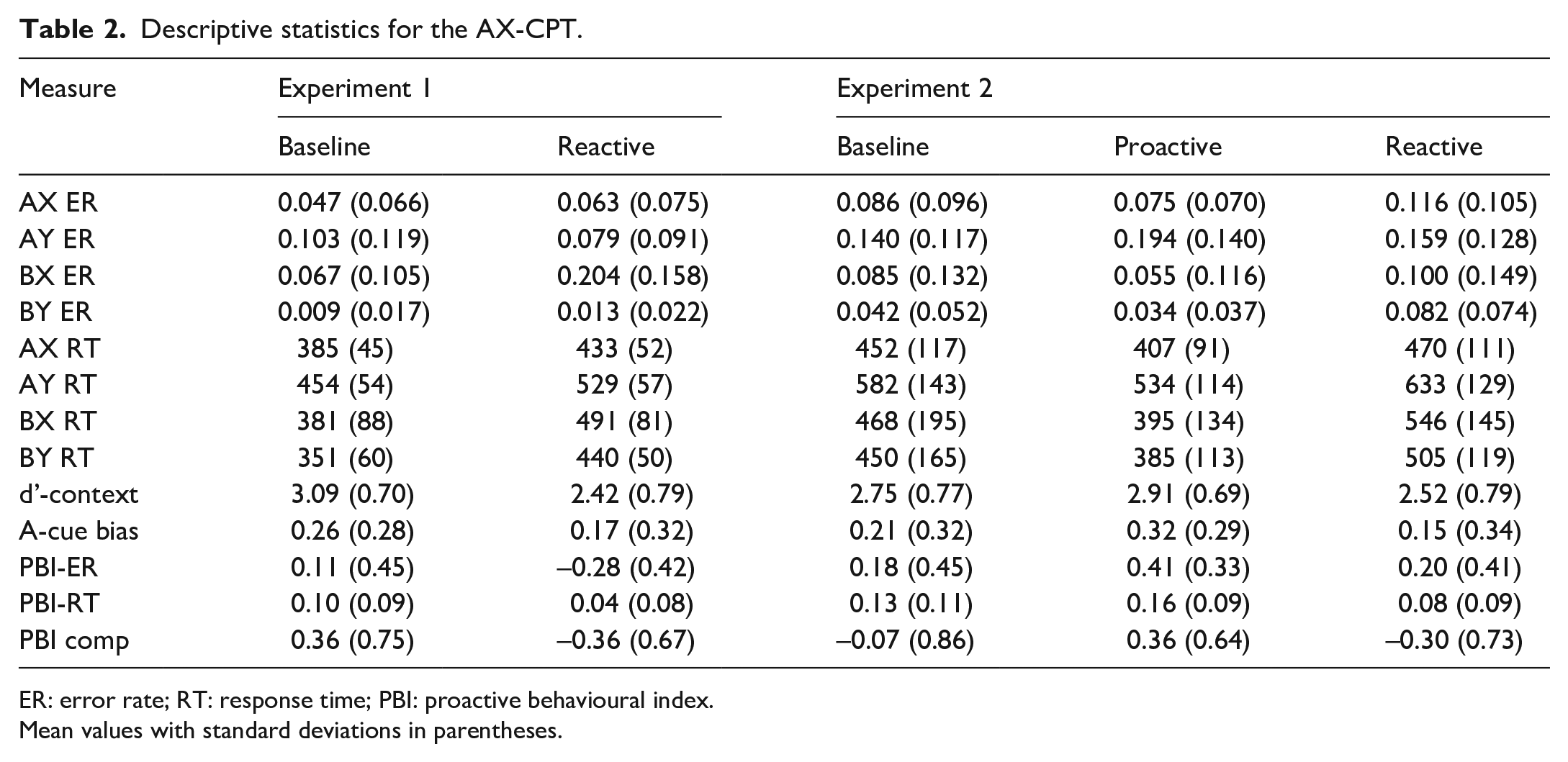
ER: error rate; RT: response time; PBI: proactive behavioural index.
Mean values with standard deviations in parentheses.
Reactive control shift
A 2 (condition: baseline, reactive) × 4 (trial type: AX, AY, BX, BY) repeated-measures factorial ANOVA was conducted on error rates (see Figure 1). The main effect of condition was significant, F(1, 93) = 28.74, p < .001,
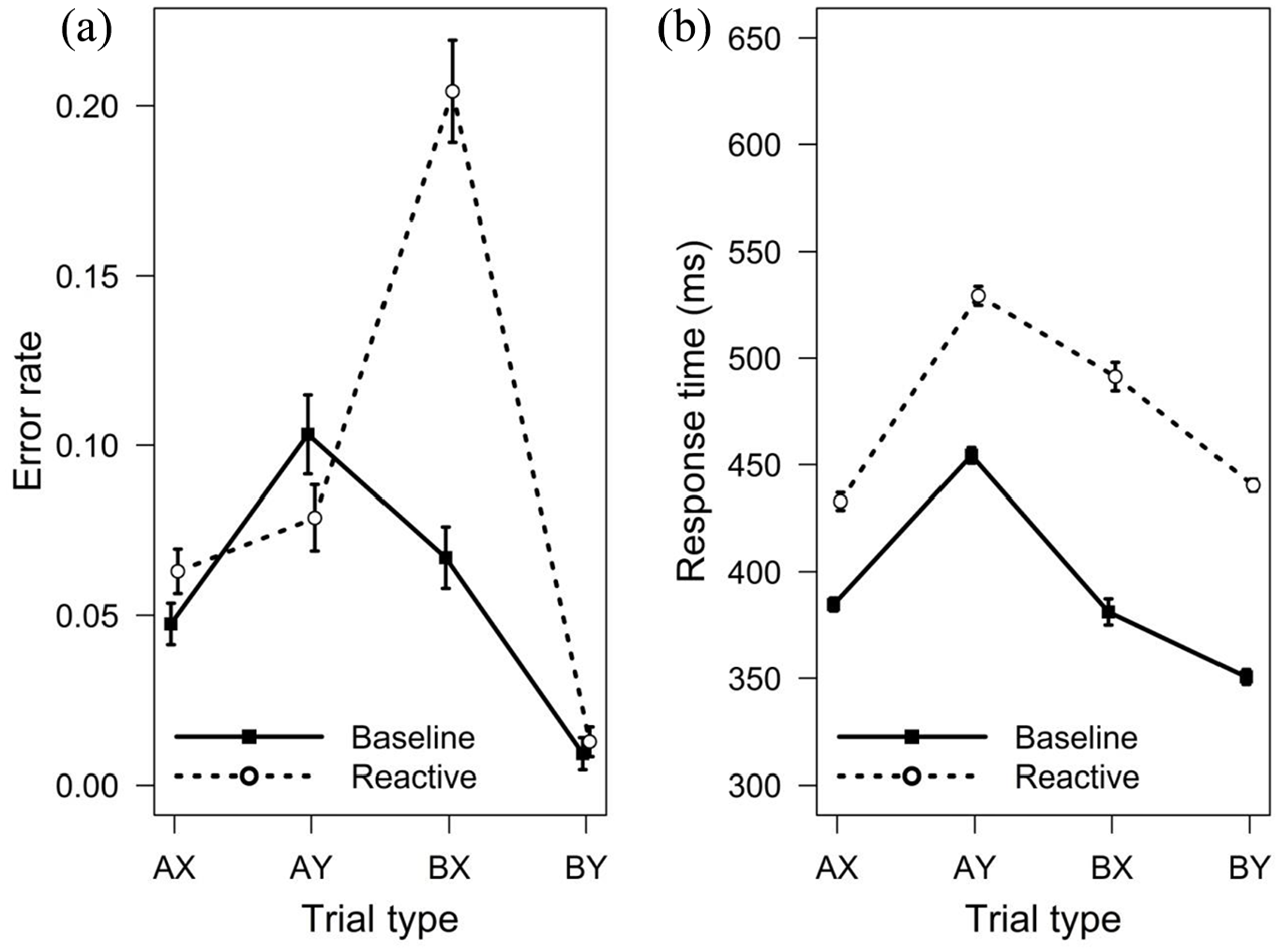
Experiment 1: (a) error rates and (b) response times in the AX-CPT as a function of trial type and experimental condition.
Next, a 2 (condition: baseline, reactive) × 4 (trial type: AX, AY, BX, BY) repeated-measures factorial ANOVA was conducted with RT as the dependent variable (see Figure 1). The main effect of condition was significant, F(1, 93) = 403.48, p < .001,
Composite indices of proactive control use confirmed that there was a reactive shift: the PBI computed for error rates decreased from the baseline to the reactive condition, F(1, 93) = 47.53, p < .001,
Correlations between WMC and performance
Correlations between composite WMC scores and performance measures from the baseline and reactive conditions of the AX-CPT are summarised in Table 3. In general, the correlations between WMC and AX-CPT were weak in the baseline condition. The only significant correlations were observed between WMC and baseline RTs, showing that participants with higher WMC were generally faster. These correlations were similar for all trial types: no particular pattern emerged for BX or AY trials. WMC did not correlate with error rates, or with any of the composite measures of proactive control. Overall, these results did not provide support for a relation between WMC and the tendency to use proactive control at baseline.
Correlations between WMC and indices of AX-CPT performance.
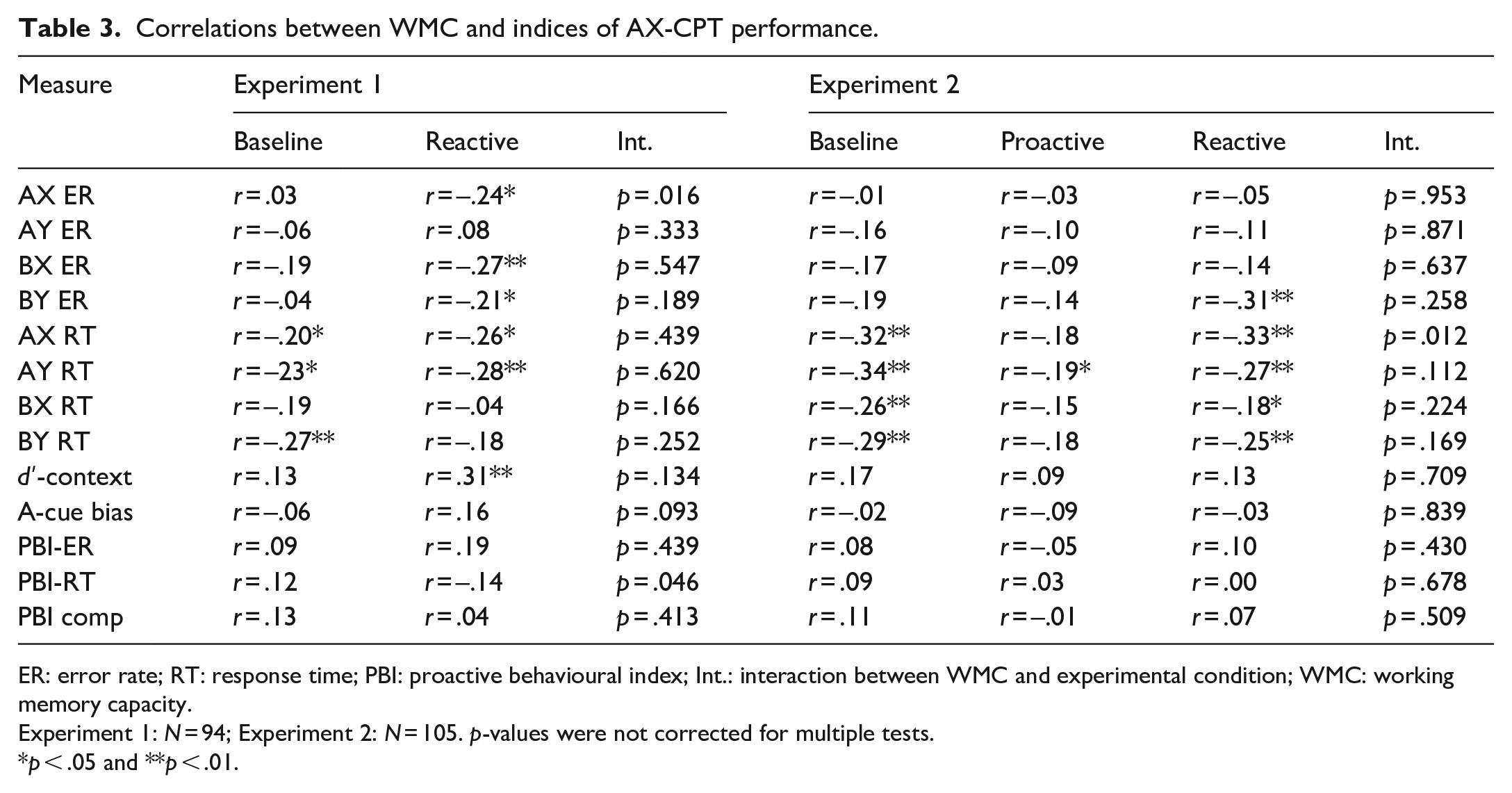
ER: error rate; RT: response time; PBI: proactive behavioural index; Int.: interaction between WMC and experimental condition; WMC: working memory capacity.
Experiment 1: N = 94; Experiment 2: N = 105. p-values were not corrected for multiple tests.
p < .05 and **p < .01.
In the reactive condition, the pattern of correlations was similar to the baseline for RTs, with overall faster responses for participants with a high WMC on AX, BX, and BY trials. For error rates, WMC was associated with less errors on AX, AY, and BY errors in the reactive condition. For composite indices, there was a small correlation between WMC and the d′-context measure, reflecting the lower error rates of high-WMC participants, but there was no correlation with other measures. The fact that these correlations with performance were non-specific and the fact that they were observed in the reactive condition would be difficult to reconcile with the idea that the advantage of participants with high WMC is due to their greater use of proactive control.
Overall, the effect of WMC on performance did not interact with experimental condition. The interaction was only significant for error rates on AX trials, reflecting a stronger relation between WMC and AX accuracy in the reactive condition, and for the PBI computed on RTs, with no straightforward interpretation given that the correlation with this measure was non-significant in both conditions. Overall, inducing the use of reactive control did not affect the relation between WMC and performance.
Hierarchical regressions
The hierarchical regressions, controlling for BY performance to account for general differences in processing speed and accuracy, showed that overall WMC was not predictive of cognitive control performance. The results are summarised in Table 4. WMC had no relation with performance in the baseline condition. In the reactive condition, WMC was associated with better performance on both AY and BX trials, also incompatible with the hypothesis that high-WMC participants used proactive control to a greater extent. This better performance on BX trials also elicited a higher d′-context measure in the reactive condition, but again, this should not have occurred in a condition inducing participants to use reactive control.
Hierarchical regression results with WMC as a predictor of AX-CPT performance by condition, controlling for BY performance.
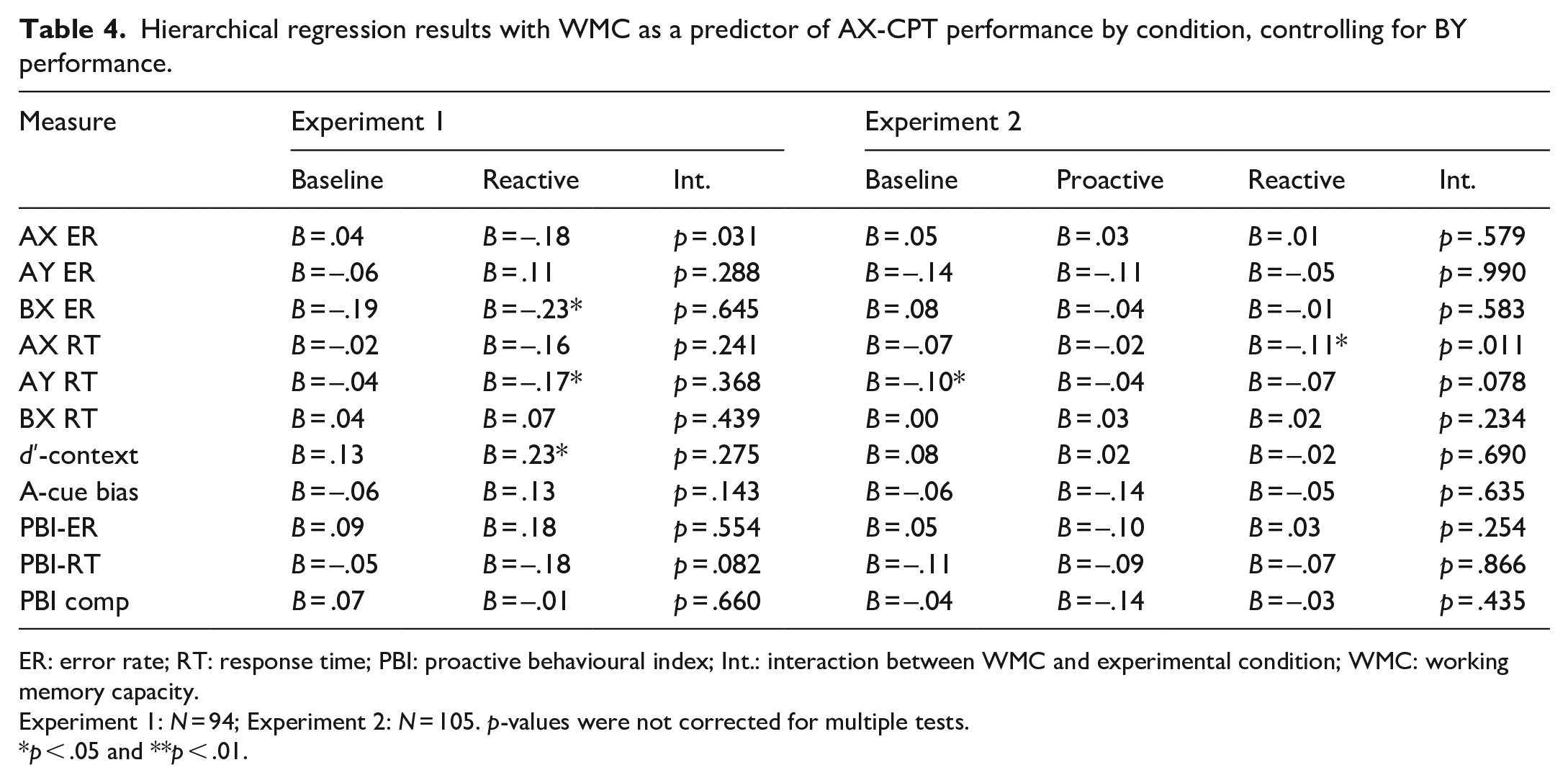
ER: error rate; RT: response time; PBI: proactive behavioural index; Int.: interaction between WMC and experimental condition; WMC: working memory capacity.
Experiment 1: N = 94; Experiment 2: N = 105. p-values were not corrected for multiple tests.
p < .05 and **p < .01.
Discussion
Contrary to previous studies, we did not find a meaningful relationship between performance on the AX-CPT and WMC. The association between WMC and performance was consistently low and non-significant. A few correlations appeared in the baseline condition, but they were not specific to certain trial types as expected, and they were no longer significant when controlling for BY performance. The reactive condition of the AX-CPT (including no-go trials) successfully produced a shift towards reactive control, as evidenced by a decrease in BX performance, a marginal increase in AY performance, and a substantial increase in composite measures of proactive control. However, the relations between WMC and performance did not substantially change in the reactive control condition, also incompatible with the idea that they could have been due to a greater tendency to use proactive control at baseline.
Overall, these findings challenge the conclusions of prior studies (Redick, 2014; Redick & Engle, 2011; Richmond et al., 2015), due to both the absence of a relationship at baseline and the absence of moderation by an experimental manipulation inducing reactive control. As a further test of the relation between WMC and the use of proactive control, Experiment 2 investigated the effect of experimental manipulations inducing both proactive and reactive control shifts.
Experiment 2
The aim of Experiment 2 was to test the impact of experimental manipulations on the correlation between WMC and cognitive control performance. The tasks used in this experiment to measure WMC and cognitive control differed from those used in Experiment 1 because these studies were conducted in different labs at different times. In contrast to Experiment 1, this experiment includes a proactive control condition (in addition to baseline and reactive conditions). The proactive condition consisted of a strategy training phase designed to produce a proactive control shift.
Method
Participants
Data collection was planned for 105 participants, identical to the study of Richmond and colleagues (2015). A sample of 108 participants (68 women and 40 men; mean age = 25.05 years, SD = 7.40) completed the study for payment. Participants were recruited from the local community in Claremont (California) from a pool of voluntary subjects, as approved by the Claremont Graduate University institutional review board. Participants were a mixture of college students and community members. All participants were English-speaking adults with normal or corrected-to-normal vision. With this sample size, achieved power was .94 for the effect size reported by Redick and Engle (2011) and .71 for the effect size reported by Richmond and colleagues (2015), similar to Experiment 1.
Materials and design
Working memory tasks
WMC was measured using two automated complex span tasks: rotation span and reading span. These two tasks were the standard versions developed by Engle and colleagues (see https://englelab.gatech.edu/complexspantasks; Unsworth et al., 2005). As described in Experiment 1, both complex span tasks consisted of interleaved processing and storage components followed by a recall of the remembered items.
For the rotation span task, an image of a letter (“R,” “G,” or “F”) was presented in the centre of the screen, rotated at different degrees; participants had to judge whether the presented letter was mirrored or not. Following each letter, an arrow was presented on the screen. At the end of a series of rotated letters and arrows, participants had to recall the length (short or long) and direction (eight possibilities: up, down, left, right, or diagonal) of each arrow in the correct serial order. The set size ranged from 2 to 5, with three trials per level. For the reading span task, a sentence was presented in the centre of the screen; participants had to judge whether this sentence was semantically correct by clicking “yes” or “no” at presentation (processing component). Following each sentence, a letter was presented on the screen. At the end of a series of sentences and letters, participants had to recall each letter in serial order. The set size ranged from 3 to 7, with three trials per level.
As in Experiment 1, performance in each span task was scored as the proportion of stimuli recalled in the correct serial position (Conway et al., 2005; Redick et al., 2012), and scores for the two tasks were averaged after standardisation. Reliability was excellent for the composite WMC estimate with ωt = .86 (α = .80 for the reading span and α = .82 for the rotation span).
Baseline AX-CPT
The baseline AX-CPT was adapted from Gonthier, Macnamara, et al. (2016, Experiment 1) and was similar to the version used in Experiment 1, with minor procedural differences. Stimuli could be any letter except K or Y. Cues were presented in white for 1,000 ms, and the delay period lasted 4,000 ms. Subjects responded using the index and middle finger of the right hand, and no feedback was provided. Reliability estimates are again displayed in Table 1.
Proactive AX-CPT
For the proactive AX-CPT, trial types and proportions were identical to those described in the baseline version, but a strategy training manipulation was additionally implemented to induce a shift towards proactive control (as described in Gonthier, Macnamara, et al., 2016). Specifically, the strategy training consisted of three phases. First, participants were explicitly told that it is very probable that an X-probe will follow an A-cue. Second, participants were instructed to mentally prepare for a target response when presented with an A-cue. Third, participants practised the implementation of the strategy in a series of 20 trials. After training, participants completed two blocks of the AX-CPT for a total of 100 trials. Trial types and trial type proportions were identical to those in the baseline version.
Reactive AX-CPT
The reactive AX-CPT was identical to the baseline version, with added no-go trials as in Experiment 1. No-go probes could be any digit (i.e., 1–9). Participants completed 2 blocks for a total of 120 trials (40 AX, 10 AY, 10 BX, and 40 BY; and an additional 20 No-go trials).
Procedure
In a first session, participants completed the reading span followed by the rotation span. In a second session, participants completed the three conditions of the AX-CPT in the following order: baseline, proactive, reactive. (Note that the order of the baseline and proactive conditions could not be counterbalanced, because the effect of the strategy training performed in the proactive condition could have been expected to transfer to the baseline; see Gonthier, Macnamara, et al., 2016.) Testing time was approximately 1 hr per session (2 hr total).
Data analysis
The data analyses were identical to Experiment 1.
Results
Data for three participants showing less than 60% accuracy on at least one version of the AX-CPT were excluded; the results for the other 105 participants are reported here. Descriptive statistics for the AX-CPT as a function of condition and trial type are provided in Table 2.
Group-level analyses
Proactive control shift
The first set of analyses tested for a proactive control shift (see Figure 2). A 2 (condition: baseline, proactive) × 4 (trial type: AX, AY, BX, BY) repeated-measures factorial ANOVA was conducted on error rates (see Figure 2, first panel). The main effect of condition was not significant, F(1, 104) = 0.05, p = .826,

Experiment 2: (a) error rates and (b) response times in the AX-CPT as a function of trial type and experimental condition.
Next, the same 2 (condition: baseline, proactive) × 4 (trial type: AX, AY, BX, BY) repeated-measures factorial ANOVA was conducted on RT data (see Figure 2, second panel). The main effect of condition was significant, F(1, 104) = 52.28, p < .001,
Composite indices of proactive control use confirmed that there was a proactive shift: the PBI computed for error rates increased from the baseline to the proactive condition, F(1, 104) = 19.02, p < .001,
Reactive control shift
The second set of analyses tested for a reactive control shift by comparing the baseline and reactive conditions. First, a 2 (condition: baseline, reactive) × 4 (trial type: AX, AY, BX, BY) repeated-measures factorial ANOVA was conducted on error rate (see Figure 2, first panel). The main effect of condition was significant, F(1, 104) = 18.02, p < .001,
Next, a 2 (condition: baseline, reactive) × 4 (trial type: AX, AY, BX, BY) repeated-measures factorial ANOVA was conducted with RT as the dependent variable (see Figure 2, second panel). The main effect of condition was significant, F(1, 104) = 41.41, p < .001,
Composite indices of proactive control use provided mixed evidence in favour of a reactive shift in this condition. There was no effect of condition for the PBI computed for error rates, F(1, 104) = 0.08, p = .773,
Correlations between WMC and performance
Correlations between composite WMC scores and performance measures from the baseline, proactive, and reactive conditions of the AX-CPT are summarised in Table 3. As in Experiment 1, the correlations between WMC and AX-CPT performance were weak. The most consistent pattern of correlations was observed between WMC and RT, in both the baseline and reactive conditions. In both conditions, participants with a high WMC were faster on all trial types; there was no advantage of WMC for BX trials and no disadvantage for AY trials, as would have been expected. In the proactive condition, WMC was only associated with significantly faster RTs on AY trials (r = −.19), but the correlation was descriptively similar for BX trials (r = −.15) even though it did not reach significance. WMC did not correlate with error rates in any of the three conditions, except for BY error rates in the reactive condition, which does not represent a meaningful pattern. WMC did not correlate with any of the composite indices of proactive control use in any of the three conditions.
Furthermore, the effect of WMC on performance did not interact with experimental condition. The interaction was only significant for RTs on AX trials, reflecting a stronger relation between WMC and AX RTs in the baseline and reactive conditions than in the proactive condition, which would be difficult to interpret in terms of control mechanisms in the absence of a difference for AY or BX trials. Experimental manipulations did not influence the pattern of correlations for any of the other measures. In other words, inducing the use of proactive or reactive control did not affect the relation between WMC and performance.
Hierarchical regressions
The results of hierarchical regressions, controlling for BY performance to account for general differences in processing speed and accuracy, converged with the results of the correlational analyses. WMC was not predictive of any measure of performance in any of the three experimental conditions, with two exceptions: a high WMC was associated with significantly faster RTs on AY trials in the baseline condition, contrary to what should have been observed for a relation with a greater tendency to use proactive control; and a high WMC was associated with significantly faster RTs on AX trials in the reactive condition, which is not readily interpretable. Again, these results are inconsistent with prior studies (and in particular Richmond et al., 2015). As was the case for correlational analyses, the effect of WMC did not significantly interact with experimental condition, except for AX RTs, reflecting a slightly stronger relation in the reactive condition than in others.
Discussion
Similar to Experiment 1, we did not find a meaningful relationship between performance on the AX-CPT and WMC. The few correlations that did exist reflected a general advantage of participants with high WMC, not the specific pattern on AY and BX trials predicted based on the literature, and they generally disappeared when controlling for BY performance. The experimental manipulation inducing the use of proactive control was successful, but did not change the relation between WMC and performance. The effects of the induction were more ambiguous for the reactive condition performed after strategy training, but no change of the relation between WMC and performance appeared in this case either.
General discussion
The goal of the current study was to examine the relationship between WMC and cognitive control mechanisms. Based on past literature (Braver et al., 2007; Redick, 2014; Redick & Engle, 2011; Richmond et al., 2015; Wiemers & Redick, 2018), we expected a high WMC to be related to a higher tendency to use proactive control at baseline, and we expected that experimentally inducing participants to use the same control mechanism—either reactive or proactive control—would decrease this relation. Overall, neither prediction was supported by our results.
We found consistently weak correlations between WMC and performance on the AX-CPT. Those correlations that did exist did not follow the predicted pattern of higher BX performance and lower AY performance for participants with a high WMC, even when controlling for BY performance. Instead, we found a general advantage for participants with a high WMC, who tended to respond faster and more accurately for all trial types. This is in line with the many studies that have found higher performance overall for participants with a high WMC (Ball, 2015; Belletier et al., 2019; Boudewyn et al., 2015; MacDonald et al., 2005; Redick, 2014; Stawarczyk et al., 2014; Troller-Renfree et al., 2020; Wiemers & Redick, 2018), but it is incompatible with the possibility that this higher performance is specifically attributable to a higher tendency to use proactive control.
This finding highlights the fact that performance in the AX-CPT is always confounded by individual differences in processes other than cognitive control, such as processing speed: the task measures both which mechanism is used and how well it is used. In turn, this underlines the importance of analysing the AX-CPT in a way that specifically tests the pattern predicted by the DMC framework, by comparing the balance between performance on AY and BX trials. This should be done by analysing them separately, and/or through the lens of a composite measure such as the PBI (Braver et al., 2009; Gonthier, Macnamara, et al., 2016). This approach allows to pinpoint, in a theory-driven way, whether individual differences of performance are qualitative (with participants using qualitatively different control mechanisms, as reflected in a different balance between AY and BX trials) or quantitative (with participants using the same control mechanisms, but with a different level of efficiency, as reflected in higher or lower performance overall). Conversely, other analytic strategies based on nonspecific measures such as the d′-context make it impossible to tell whether proactive control is used to a greater extent, or more efficiently.
Our results are thus in line with the general benefit of a high WMC reported in the literature, but they fail to support the two prior studies that concluded in favour of the predicted pattern of low AY and high BX performance (Redick & Engle, 2011; Richmond et al., 2015). As detailed above, one of these studies actually obtained descriptively higher performance for high WMC participants on AY trials (Redick & Engle, 2011), and the other only found the predicted pattern of lower AY performance in a hierarchical regression (Richmond et al., 2015); in both cases, the obtained effect sizes were relatively small (η2 = .048, .058, or .112). The discrepancy with the current results may be due to a false positive in prior studies; another possibility is that we may have lacked statistical power to obtain the effect in correlational analyses in both experiments, but in this case, it is unlikely that there is a substantial relation between WMC and proactive control.
Even more worrying than the lack of correlations is the fact that experimentally inducing the use of proactive or reactive control did not affect the correlations between WMC and performance. In an experimental-correlational perspective, this experimental manipulation should necessarily have altered the pattern of correlations. In other words, if WMC were actually related to the tendency to use proactive control, then it would be difficult to explain why inducing all participants to use proactive or reactive control had no effect on the correlational results. This was not due to the experimental induction of proactive and reactive control, which seemed to function well across both studies, i.e., the findings of Gonthier, Macnamara, et al. (2016) were mostly replicated here, for both the reactive induction in Experiment 1 and the proactive induction in Experiment 2. The results for the induction of reactive control in Experiment 2 were more ambiguous, given that we failed to obtain the predicted pattern for error rates. Still, the combination of Experiment 1 and Experiment 2 comprised both reactive and proactive conditions that functioned well, and the overall pattern of results clearly demonstrated that simple experimental manipulations induced proactive and reactive control shifts within participants, consistent with prior studies (Braver et al., 2009; Gonthier, Macnamara, et al., 2016; Paxton et al., 2006, 2008).
This observed pattern, with participants with a high WMC performing higher than others to the same extent in all conditions, is not reconcilable with the possibility that their higher performance was due in the first place to the use of a qualitatively different control mechanism. All participants were similarly sensitive to the induction of reactive and proactive control, as evidenced by the non-significant interactions between WMC and experimental condition. If the higher performance of participants with a high WMC had been due to a higher tendency to use proactive control, then inducing all participants to use reactive control should have affected them to a greater extent than participants with a low WMC (for similar points, see Schelble et al., 2012; Thomassin et al., 2015). Conversely, inducing all participants to use proactive control should have had less effect on participants with high WMC if they had been using this mechanism to a greater extent in the first place. In sum, our results make it clear that the difference between participants with low and high WMC is not primarily driven by qualitative differences in which control mechanism they use, but by the ability to implement cognitive control. Low WMC individuals appear to differ not in their intent to use proactive control, but rather, in their ability to successfully implement control, relative to higher WMC individuals.
Methodological issues
There were a few methodological differences with prior studies, but it is unclear to what extent they could contribute to the difference with the present results. One difference is that, in study two, participants completed the WM tasks and the cognitive control tasks in two different sessions, whereas Richmond et al. (2015) administered all tasks in a single session. When tasks are completed in the same session, correlations may be inflated due to a combination of both state and trait variance. The parameters of the AX-CPT were not exactly the same: for example, the ISI between the cue and the probe was shorter in the current experiments (3,500 and 4,000 ms) than in the study of Richmond and colleagues (5,000 ms). A longer ISI could conceivably strengthen the role of WMC: participants with a low WMC may have more difficulty actively maintaining the cue with a longer ISI and may end up using reactive control to a greater extent. However, the effect of WMC has been shown not to depend on the ISI to a large extent (Redick & Engle, 2011), and the difference of ISI between our studies was in the range of typical variation between versions of the AX-CPT (e.g., Gonthier, Macnamara, et al., 2016): again, if such a minor difference is enough to remove the effect of WMC, it is unlikely that the use of proactive control is a major contributor to the general advantage of participants with a high WMC in complex tasks.
One particular point that deserves discussion is the extent of variability in the current dataset. The current samples consisted of young adults with high overall performance, compared to the samples of prior studies (Redick & Engle, 2011; Richmond et al., 2015) which displayed relatively high error rates and slower RTs overall. This lower performance may have served to create more variability, and thus, improved reliability (see Cooper et al., 2017), which could facilitate the detection of an effect. A related point is the moderate discrepancy between performance at baseline in Experiments 1 and 2 of the present study (which were performed in different countries), with slightly lower baseline performance in Experiment 2. However, there is good reason to think that insufficient variability did not play a significant role in driving the current results. First, no effects of interest were detected in Experiment 2 despite performance being close to the sample of Richmond and colleagues. Second, performance in the AX-CPT is generally high in non-clinical adult samples (e.g., Cooper et al., 2017), so the current results should be relatively representative: the 30% AY error rate with 650 ms RTs reported in Redick and Engle (2011) is comparatively more unusual than the high performance found here. Third and most importantly, the experimental approach used here should be relatively immune to restriction of range: if participants with high and low WMC were actually using different control mechanisms, inducing a change in control mechanism should affect their performance differently even if differences were difficult to distinguish in the first place. Given that the manipulation did have a substantial effect on performance, baseline level of performance is not a critical issue here. In sum, it is difficult to explain our challenge in finding an effect by attributing the issue to a restriction of range in our samples.
The ambiguous pattern for reactive control in Experiment 2 was presumably attributable to participants performing the reactive condition after the proactive condition, with the effects of the proactive strategy training carrying over into the reactive condition. The issue of counterbalancing the order of conditions is not entirely straightforward in this context: order was counterbalanced for Experiment 1, but it could not be counterbalanced in the same way in Experiment 2, given that the proactive condition includes a strategy training that cannot be performed before the baseline. This is not a major issue here given that a reactive condition was available in Experiment 1, but in future studies using a similar design, it would be preferable to have participants perform the baseline and reactive conditions first, possibly in counterbalanced order, and the proactive condition last.
Implications and directions for future studies
Overall, our results suggest that WMC is not related to the tendency to use proactive control. On the contrary, it seems to be only associated with a general advantage on cognitive control tasks, an advantage that translates to generally faster response speeds and lower error rates, and that does not disappear when all subjects are induced to use qualitatively the same cognitive control mechanism. This conclusion is at odds with the long-standing prediction that a high WMC should help participants use proactive control in the AX-CPT, but it is not entirely illogical from a mechanistic point of view: using proactive control in the AX-CPT only requires the active maintenance of a single piece of information over a delay of a few seconds, which should be easily accomplished even for those adults who have low WMC. This leaves open the possibility that WMC places a greater constraint on the use of proactive control in samples where it is substantially lower, such as very young children (see also Gonthier et al., 2019), older adults, or patients with a brain lesion. In other words, the lack of a relation between WMC and the tendency to use proactive control in a non-clinical sample of young adults does not mean that WMC plays no role at all in proactive control.
In addition, several studies have suggested that traditional measures of cognitive control that are used for experimental research do not serve as effective measures of individual differences for correlational research. For instance, Hedge et al. (2018) found that traditional cognitive control tasks like the Stroop task, Flanker task, Simon task, and Go/No-go task are successful at producing classic group level effects (e.g., the Stroop effect), but when used as individual difference measures in correlational studies, the results are often mixed due to the psychometric properties of the tasks. Likewise, the AX-CPT tends to suffer from low psychometric qualities, despite functioning well as a measure of between-group differences (Cooper et al., 2017). This apparent paradox is largely a problem of variability (Cooper et al., 2017; Hedge et al., 2018). Traditional cognitive control measures were originally designed to maximise between-groups variance and minimise within-groups variance. For this reason, group-level effects, like the Stroop effect, are robust and consistent. The minimisation of within-groups variance is the Achilles heel of individual differences research. If traditional cognitive control tasks are designed to reduce within-groups variance, then there are minimal individual differences to examine. Hence, the lack of correlational findings in individual differences research when using traditional tasks of cognitive control. This paradox was observed in the current study. Group-level effects were found to be robust (shifts to proactive and reactive control), but cognitive control tasks and WMC were not related.
In terms of future directions, an interesting question is whether people differ in how quickly they adapt or notice changes in context or task demands that encourage a shift in modes of control. Do individuals with higher levels of WMC shift more quickly than people with lower WMC? Or is it the opposite, i.e., perhaps individuals with higher levels of WM are slower to notice changes in task demands and therefore shift more slowly. And of course, shifts in control may vary depending on the type of manipulation to task demands, or task context. For example, explicit manipulations, such as strategy training, should induce a faster shift than implicit manipulations, such as the addition of no-go trials. Even in the absence of experimental manipulations of control, there may be subtle effects of WMC on intra-individual variability of cognitive control in the AX-CPT (Wiemers & Redick, 2018), not necessarily because participants with a high WMC use proactive control to a greater extent, but because their high WMC comes with advantages in terms of processing speed or secondary memory that impact other aspects of the task. These predictions remain to be explored.
In conclusion, it is shown here that individual differences in WMC are not directly associated with the tendency to use proactive control, contrary to the literature, and that the association between WMC and performance in the AX-CPT is more adequately explained in terms of a general advantage of participants with a high WMC for all trial types indiscriminately than in terms of a specific pattern consistent with proactive control. The results are otherwise in line with studies claiming that WMC correlates with performance (Ball, 2015; Belletier et al., 2019; Boudewyn et al., 2015; MacDonald et al., 2005; Redick, 2014; Stawarczyk et al., 2014; Troller-Renfree et al., 2020; Wiemers & Redick, 2018), and with studies showing that strategy training and the inclusion of no-go trials in the AX-CPT can produce shifts towards proactive and reactive control, respectively (Braver et al., 2009; Gonthier, Macnamara, et al., 2016; Paxton et al., 2006, 2008), in line with the DMC framework of cognitive control.
Footnotes
Declaration of conflicting interests
The author(s) declared no potential conflicts of interest with respect to the research, authorship, and/or publication of this article.
Funding
The author(s) received no financial support for the research, authorship, and/or publication of this article.
