



Abstract
In many decision-making contexts, people often persist with their previous selections. This predisposition to choose to maintain a current (or previous) choice is referred to as the status quo bias (SQB). In this work, we propose that increased attention towards the status quo option—enabled by its visual salience—is a previously underappreciated driver of SQB. We base this hypothesis on three propositions: (1) the status quo bias option is often more visually salient relative to the non-status quo options on offer, (2) greater visual salience of an option biases attention towards that option, and (3) increased attention towards an option leads to that option being selected at greater rates. We examined the attention hypothesis among 6,854 participants in four studies. Studies 1 and 2 showed that increasing the visual salience of a non-status quo option (i.e., the type of visual salience often garnered by the status quo option) increased the selection rate of that option. Study 3 directly tested the hypothesis by lessening the visual salience of the status quo option. Doing so eliminated SQB. Study 4 replicated and extended the findings of Study 3 in a real-world decision context. Collectively, these studies suggest that the selection of the status quo may often be related to its salience relative to other available options.
In many contexts, people choose to persist with their previous selections. For example, people are often reluctant to switch from one brand of phone to another (Shi et al., 2018), from one health insurance policy provider to another (Krieger & Felder, 2013), or even from choosing a challenger over an incumbent legislator (Erikson, 1971). This predisposition to choose to maintain a current (or previous) choice is referred to as the status quo bias (henceforth SQB; Samuelson & Zeckhauser, 1988).
Given its ubiquity and importance, understanding the drivers of SQB has attracted the attention of researchers from diverse fields, including psychology (Eidelman & Crandall, 2012) judgement and decision-making (e.g., Samuelson & Zeckhauser, 1988), law (e.g., Korobkin, 1997), business (e.g., Burmeister & Schade, 2007), behavioural economics (e.g., Kahneman et al., 1991), health policy (e.g., Suri et al., 2013), and economics (e.g., Fernandez & Rodrik, 1991). Researchers in each field have attempted to identify the drivers that undergird the SQB.
Known drivers of the SQB
In some cases, the reason people choose the status quo option is simply because it is superior to other available options. For example, if all available alternatives offer equivalent value, then it may not be worth the cost of analysis to choose from among those options. For example, rather than weigh the pros and cons of each available 401(k) fund—each of which has historically yielded similar returns—many people may elect to contribute to the fund they had contributed to last year (e.g., Madrian & Shea, 2001). In other cases, decision-makers may justifiably assume that the status quo option constitutes an implied recommendation of an expert. For example, when installing new software, many people choose the recommended defaults of the software manufacturers rather than customising installation parameters on their own, in part, because doing so affords the benefit of reducing effort related to decision-making (McKenzie et al., 2006). In still other cases, uncertainty of future outcomes (Eidelman & Crandall, 2012), or a desire to satisfice and choose the “good enough” status quo (Schwartz et al., 2011), or even a desire to conform with others (Sherif & Sherif, 1964; Zimbardo, 1960) may lead to a logical preference for the status quo option.
However, there are many cases in which the status quo option is selected even when it is not discernably superior to other available options. For example, in their seminal work on the SQB, Samuelson and Zeckhauser (1988) described a scenario in which a participant was asked to select a car colour based on their preferences. In the status quo version of the scenario, the participant was asked to imagine that she had previously picked a red car as it was the only colour that had all the features she wanted. By sheer luck at the dealership, it turned out that three other differently coloured cars (with all the desirable features) had also become available, and so the participant now had a choice of four cars—with the red car as the status quo option. In the neutral option, all four car colours were available all along. Compared with selection rates in the neutral condition, participants demonstrated a clear preference for the status quo—even though this scenario did not prominently feature the cost of analysis, implied recommendations, uncertainty of future outcomes, impetus to satisfice, or forces related to conformity. A plethora of similar scenarios have convinced researchers in the field that the preference for the status quo option may appropriately be labelled a “bias” as it is not always the most superior available option (Arkes, 1991; Eidelman & Crandall, 2012).
What drives such “irrational” preferences for the status quo? The first driver is loss aversion—the tendency to focus on losses over equivalent gains (Kahneman et al., 1991; Moshinsky & Bar-Hillel, 2010; cf. Gal, 2006). Since prospective losses and gains occur with reference to the current state (Tversky & Kahneman, 1991), a greater focus on losses may favour retaining the status quo. The second driver is the desire for consistency—people may be motivated to stay consistent with their prior choice and may therefore persist with it (Samuelson & Zeckhauser, 1988). The third driver is the desire to avoid potential regret which is associated with action rather than the omission of action (Ritov & Baron, 1992). The final driver is related to the existence bias, according to which the simple fact of something existing imbues it with positive qualities (Eidelman et al., 2009). Current options may (without rational justification) be judged to reflect the way things ought to be.
These drivers collectively explain some instances of SQB. However, loss aversion, a desire for consistency, and the existence bias do not appear to explicate at least some scenarios featuring irrational preference for the status quo option. Consider the scenario described above related to choosing a car colour. It is not clear that the hypothesised drivers can collectively explain the increased selection rate of the red car in the status quo condition: there are no clear losses or gains on offer (though in a non-hypothetical version of this scenario endowment-related-losses may have emerged), there is no threat to consistency or regret (as the prior selection of the red car was not based on colour preference), and cars have always existed in many colours—not just red. Several other examples demonstrate a similar unattributed selection of the status quo (Samuelson & Zeckhauser, 1988), suggesting the possibility that there remain additional drivers enabling SQB preferences.
Biased attention as a driver of SQB
In this work, we hypothesise that increased attention towards the status quo option, which we assume is enabled by its visual salience, is a driver for SQB.
Our hypothesis is based on three propositions: First, the SQB option is often more visually salient relative to the other options on offer. Second, greater visual salience biases attention towards the status quo option. Third, all else being equal, increased attention towards an option leads to that option being selected at greater rates. We next briefly discuss evidence supporting each of these three propositions.
Related to our first proposition, option salience is of crucial importance in the marketing domain and its drivers have been carefully examined. There is broad agreement that items that are stand out, repeated more than once, and categorisable differently from other items are more salient than items that are not (Lurie & Mason, 2007; Wang & Pomplun, 2012).
In SQB contexts, options are often presented via text, and the status quo option almost always stands out due to being the “odd man out.” For example, and as detailed in Figure 1, in an SQB scenario (Samuelson & Zeckhauser, 1988) involving the allocation of funds the options were described as follows:
(A) Maintain present budget amounts for the programs
(B) Allocate 30% to auto safety and 70% to highway safety
(C) Allocate 60% to auto safety and 40% to highway safety
(D) Allocate 50% to auto safety and 50% to highway safety
Here, the status quo option (Option A) is linguistically and structurally distinct from the other options. In addition, the status quo option, unlike the other options, was mentioned twice: once in the body of the scenario describing the overall context, and then again as an option that could be selected by the participant. Finally, the status quo option was readily in a category of its own—precisely because it was, uniquely, the status quo whereas the other options were not. These characteristics were true of most decision scenarios we examined across the SQB literature suggesting that the status quo bias was often more visually salient than other available options.
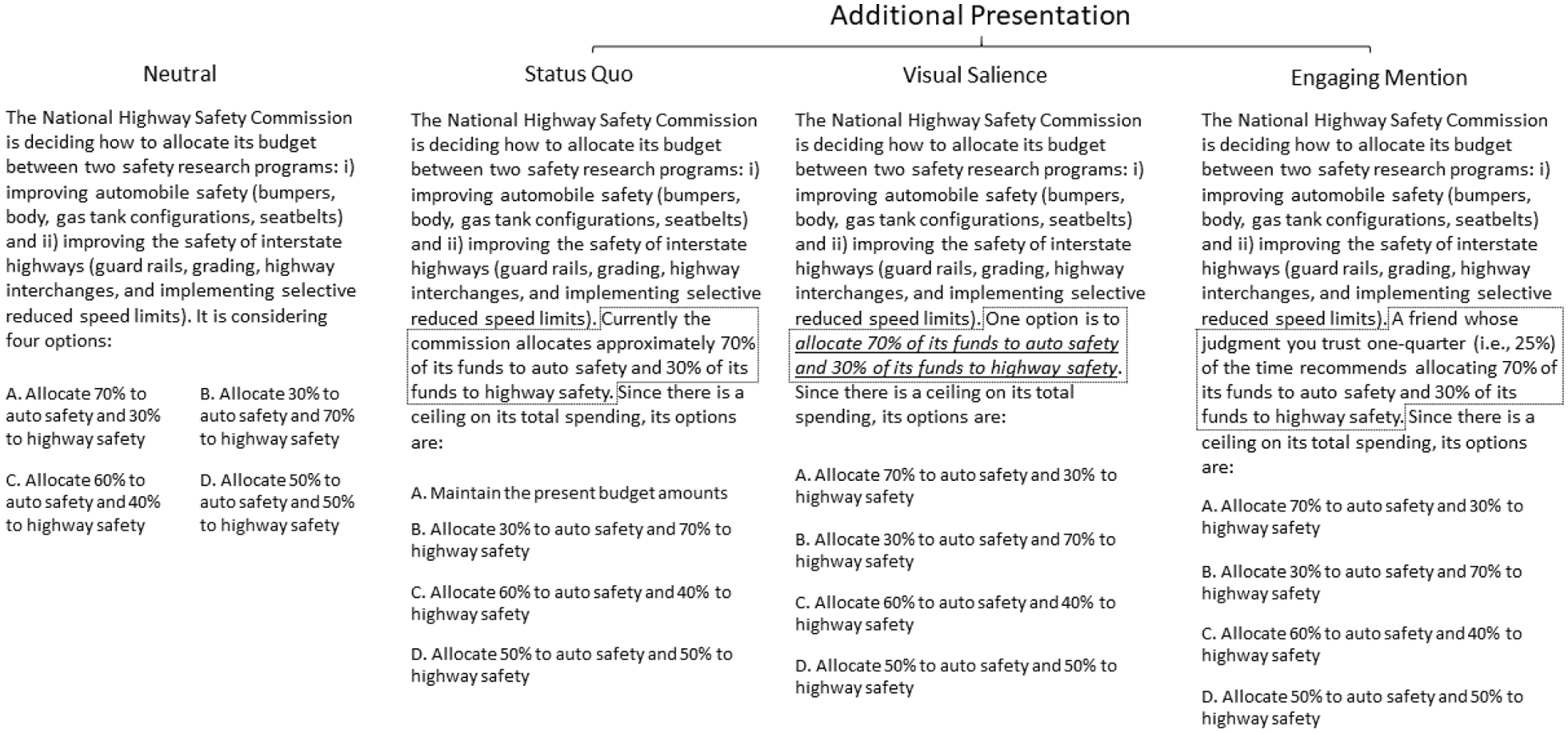
Decision problems were framed in one of four frames: neutral, status quo, visual salience, and engaging mention. The boxes highlighting parts of each problem description are used to show how each additional presentation frame differed from the neutral frame. The boxes did not appear in the problems administered to participants.
Related to our second proposition, there is broad behavioural and neural evidence that an item’s visual salience increases the level of attention directed towards it. Behaviorally, visually salient stimuli are known to draw more fixations for longer periods than other stimuli (Parkhurst et al., 2002). Neurally, such amplified visual input is known to mediate competition between representations in the human visual cortex and elsewhere (Yantis, 2005). Overall, visual salience is known to lead to enhanced attention (Parr & Friston, 2019).
Related to our third proposition, there is strong empirical evidence that suggests that increased attention with respect to a particular option, increases the probability of selection for that option (Milosavljevic et al., 2012; Krajbich et al., 2010; Shimojo et al., 2003; Suri et al., 2018; Suri & Gross, 2015; for a review see Orquin & Loose, 2013). This empirical evidence is bolstered by influential drift-diffusion accounts of decision-making (Krajbich, 2019) according to which decision-makers accumulate evidence in favour of an alternative when attending to it, and that the speed of accumulation is a function of the value of the alternative relative to other alternatives in the choice set, which is called the bias rate or drift rate. If all available alternatives have undifferentiated values, then different levels of attention towards each alternative is a key determining factor in choice.
Thus, a broad range of evidence appears to support the hypothesis that attentional bias towards the status quo option—driven by its visual salience—is a driver of SQB. Importantly, we do not claim, and nor do we believe, that attentional bias is the only driver of SQB. We fully acknowledge and accept the empirical evidence supporting the previously described drivers of SQB. In this work, we invite consideration of the possibility that the SQB has many underlying drivers and that attentional bias towards the status quo option is one such, previously underappreciated, driver.
The present studies
We tested this attention hypothesis among 6,854 participants in four studies (summarised in Table 1). Studies 1 and 2 were designed to test the proposition that changing the visual salience of an option affects its selection rate. In particular, in Study 1, across several decision scenarios, we increased the salience of a randomly selected (non-status quo) option by italicising it and by mentioning it twice. We found that enhanced salience did in fact increase the selection rate of that option. In Study 2, across several decision scenarios, we tested whether increasing the salience of a non-status quo option—by making it syntactically differentiated—would increase its selection, even when it was pitted against the status quo option.
Study Objectives.
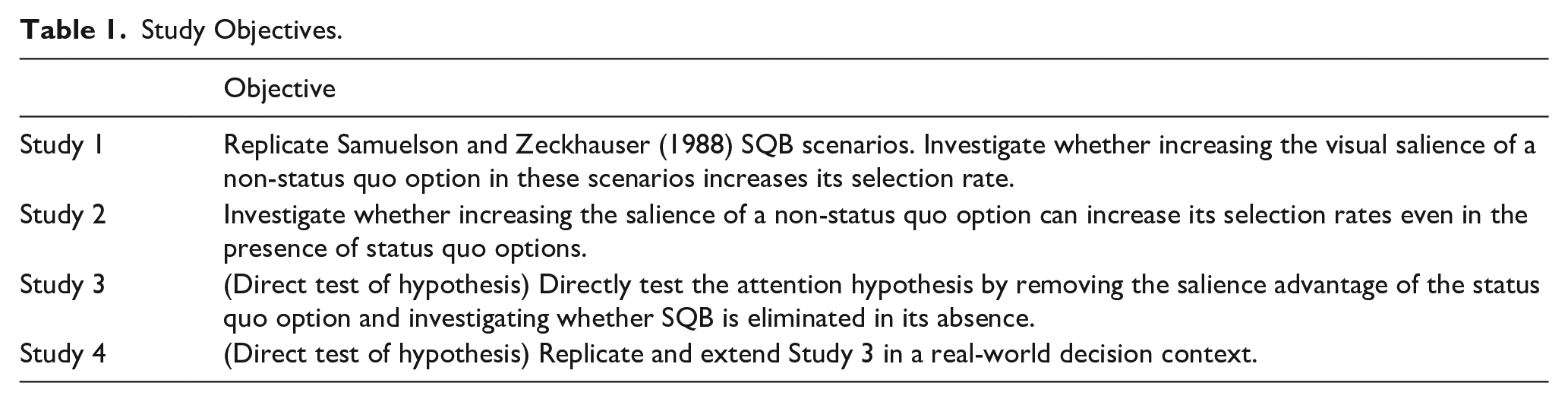
In Studies 3 and 4, we directly tested the attention hypothesis. In Study 3, across several decision scenarios, we removed the visual salience advantage of the status quo option relative to other options. Consistent with our hypothesis, we found that under these conditions, the status quo option was not preferentially selected over non-status quo options. Finally, in Study 4, we created a real-world test of the attention hypothesis. Students were asked to pick among two essay topics in which one topic was given the status quo status. When the status quo topic was visually salient, it was preferentially chosen; however, this preference disappeared when all options were equally salient.
Study 1: increased salience via additional presentation increases selection
The purpose of Study 1 was twofold: (1) to determine whether simply increasing the salience of an option through its additional presentation could increase rates of selection for that option and (2) to replicate the seminal findings of Samuelson and Zeckhauser (1988) which demonstrate selection bias for the status quo.
In Samuelson and Zeckhauser’s (1988) demonstration of SQB, the status quo option stood out relative to non-status quo alternatives in several ways. The primary way (and the focus of Study 1) was that the status quo option was presented twice: first, in the decision scenario description in which the status quo was defined and then, again, among choice alternatives. By contrast, non-status quo alternatives were not presented in the decision scenario description but only once among choice alternatives. For example, in the National Highway Safety decision scenario (see Figure 1, Status Quo frame), the status quo budget allocation of “70% of funds to auto safety and 30% of funds to highway safety” was presented first in the scenario description, and then again among choice alternatives as the option “[m]aintain the present budget amounts.” At the same time non-status quo budget allocations, such as 60% to auto safety and 40% to highway safety, were presented just once among choice alternatives as options like “[d]ecrease auto program by 10% and raise highway program by like amount.” Altogether, status quo options were presented twice, whereas non-status quo alternatives were presented once. Therefore, we tested whether making reference to an option twice without defining any status quo could also lead to that option’s increased selection.
Method
Participants
To obtain a sample sufficiently large to examine additional presentation and status quo effects on choice across various decision contexts, we recruited participants from Amazon’s Mechanical Turk (MTurk; Berinsky et al., 2012). Online participants were subjected to rigorous attention checks (described below) to ensure quality responses. In addition, participation was restricted to Amazon Turk workers with a Human Intelligence Task (HIT) approval rate > 98% and a minimum of 1,000 approved HITs. Such requirements are known to help ensure a higher quality of survey responders (Buhrmester et al., 2011). Of the 2,910 participants recruited, 6.4% of respondents failed attention checks, and another 4.7% failed to finish the study. Finally, .5% of respondents (or 14 participants) had recorded survey completion times either greater than 3 standard deviations above the mean completion time, or under 30 s (the minimum time required to click through the survey). In all of the aforementioned circumstances, response data were excluded from analyses. The final sample comprised 2,571 individuals (Mage = 38.88, SDage = 12.06; 1,455 women) who were paid $.10 for their participation. The sample was restricted to U.S. residents. Fifty-five percentage reported having a college degree or higher.
Experimental design
Our procedure followed the experimental design of Samuelson and Zeckhauser (1988). Each participant was required to make a choice in a single decision task. Each decision task began with a brief description of a problem, followed by a set of four mutually exclusive alternatives from which participants were required to choose. Decision problems could be framed in one of four ways: in a neutral, status quo, visual salience, or engaging mention frame. In the neutral frame, all options were presented just once among choice alternatives. In the status quo, visual salience, and engaging mention frames, a single choice alternative was presented twice, both in the problem description as well as in the set of choice alternatives from which participants were required to choose. Because a single option was presented an additional time in each of these frames, we refer to the status quo, visual salience, and engaging mention frames, collectively, as the additional presentation frames. An example of a single decision problem in each of the four frames is provided in Figure 1. Full text of the decision problems used in Study 1 is presented in the online Supplementary Materials, Section 1.
Altogether there were six different decision scenarios and four frames (each participant completed one scenario in a single frame). Decision problems of the neutral and status quo frames were exactly those used by Samuelson and Zeckhauser (1988), and served the purpose of replicating part of their laboratory demonstration. The engaging mention and visual salience frames were designed to mimic the ways in which the status quo option was made more attentionally salient through its additional presentation but without the definition of a status quo. Notably, the 25% probability in the engaging mention scenario provides no additional information (as there are four options). Even if a participant did not note this probabilistic fact, the subjective interpretation of 25% is known to be coded as “a poor chance” or “very doubtful” (Beyth-Marom, 1982). Examining lift for this frame is therefore a conservative test.
For each decision problem, the mix of choice alternative types varied by frame. In the neutral frame, all choice alternatives were presented as new alternatives. In the status quo frame, one choice alternative was defined as the status quo in the problem description, and then presented alongside the three other non-status quo alternatives. In the visual salience frame, one choice alternative was first presented in the decision scenario in a visually salient manner (i.e., italicised and underlined). Otherwise, all choice alternatives were presented as new alternatives. In the engaging mention frame, one choice alternative was first presented in the decision problem setup in an engaging, but nonvisually salient manner. Here, too, choice alternatives were presented as new alternatives.
The presentation of choice alternatives also varied by frame. Following Samuelson and Zeckhauser (1988), in the neutral frame, choice alternatives were presented in a 2 × 2 matrix; the position of options within the 2 × 2 matrix was fully randomised. Thus, no single-choice alternative was privileged. However, choice alternatives in the additional presentation frames (i.e., status quo, visual salience, and engaging mention) were not all on equal footing: options listed one after another rather than in a 2 × 2 format. In addition, the first option listed in the set of choice alternatives was also presented in the decision scenario description. For example, in the status quo frame of the National Highway Safety Commission problem, the first option (i.e., “maintain the present budget amounts” or the status quo option) was presented not only in the list of choice alternatives but also in the problem description wherein the status quo was defined. In the visual salience and engaging mention frames, the first options (i.e., “allocate 70% to auto safety and 30% to highway safety”) were presented in the scenario descriptions in addition to being listed in the set of choice alternatives (thus making them parallel to the status quo option). Alternatives to the option targeted by the additional presentation manipulation were ordered randomly following the target option (following Samuelson & Zeckhauser, 1988).
For each additional presentation frame, there were four main versions of a given decision problem, one for each possible target option. For example, in the status quo frame of the National Highway Safety Commission problem presented above, each different budget allocation could be framed as the status quo option. In all, there were four possible allocations that could be framed as the status quo and thus four main versions of the decision problem. Altogether, there are 13 versions of the decision problem above: one neutral version, and four versions for each of the three additional presentation frames (1 neutral version + 3 additional presentation frames × 4 versions per frame = 13 versions).
Procedure
Participants were randomly assigned to a decision problem, decision problem frame (neutral, status quo, visual salience, engaging mention), and target option version (i.e., the option presented first in the decision scenario description in the non-neutral frames). After consenting to participate, participants have presented the exactly one version of a single decision problem and chose one of the four possible options. Following their choice, participants completed an attention check to help ensure their thorough participation. The attention check was a multiple-choice question that tested participants’ knowledge about the decision problem. To illustrate, the attention check for the National Highway Safety decision scenario is presented below.
Based on the previous question, the National Highway Safety Commission allocates funds to . . .
(A) Improve automobile safety only
(B) Improve highway safety only
(C) Improve both automobile safety and highway safety
(D) Improve maritime safety
After completing the attention check, participants answered several optional, demographic questions (age, gender, and educational attainment), and were then provided a completion code for payment.
Results and discussion
The purpose of Study 1 was to test whether status quo and options made salient through an additional presentation were preferred to neutral alternatives. We expected selection rates of status quo options to be greater than those of corresponding neutral alternatives. We also expected the selection rates of salient options to be greater than corresponding neutral alternatives.
Selection rates were determined by condition as follows. The status quo selection rate of Option A, say, is the number of participants who selected Option A when framed as the status quo divided by the total number of participants who were presented the version of the decision scenario in which Option A was the status quo. For example, 29 participants presented a version of the Highway Safety scenario in which the budget allocation 60–40 (i.e., “Allocate 60% to auto safety and 40% to highway safety”) was the status quo. Of those 29 participants, 19 selected the status quo option of 60–40. Therefore, the status quo selection rate for option 60–40 is 19/29 = .66. However, the neutral selection rate of Option A is the number of participants who selected Option A under the neutral condition divided by the total number of participants presented the neutral version of the decision scenario in question. Of the 118 participants presented the neutral version of the Highway Safety scenario, 19 participants selected the option 60–40. Thus, the neutral selection rate of the budget allocation of 60–40 is 19/118 = .16. For this particular budget allocation, the status quo selection rate is clearly greater than that of its neutral selection rate. Specifically, this difference between the status quo and neutral selection rates, or the “lift” in selection attributable to status quo framing, was 50 percentage points (i.e., .66 − .16 = .50). That is, participants chose the option 60–40 by 50 percentage points more when it was framed as the status quo than when it was presented as a neutral alternative.
The preference for status quo and other salient options relative to neutral alternatives was quantified by calculating their lifts in selection (i.e., the differences between each option’s experimental selection rate and its neutral selection rate; see Figure 2 for illustration). In general, a positive lift indicated that an option targeted by the experimental manipulation (i.e., framed as the status quo, or made more salient) was selected more frequently than as a neutral alternative. A negative lift in selection indicated the opposite: that the option targeted by the experimental manipulation was selected less frequently than as a neutral alternative. Finally, no lift (i.e., a lift of zero) indicated that the rates of selection remained constant across experimental and neutral conditions. In other words, the experimental manipulation did not impact choice.
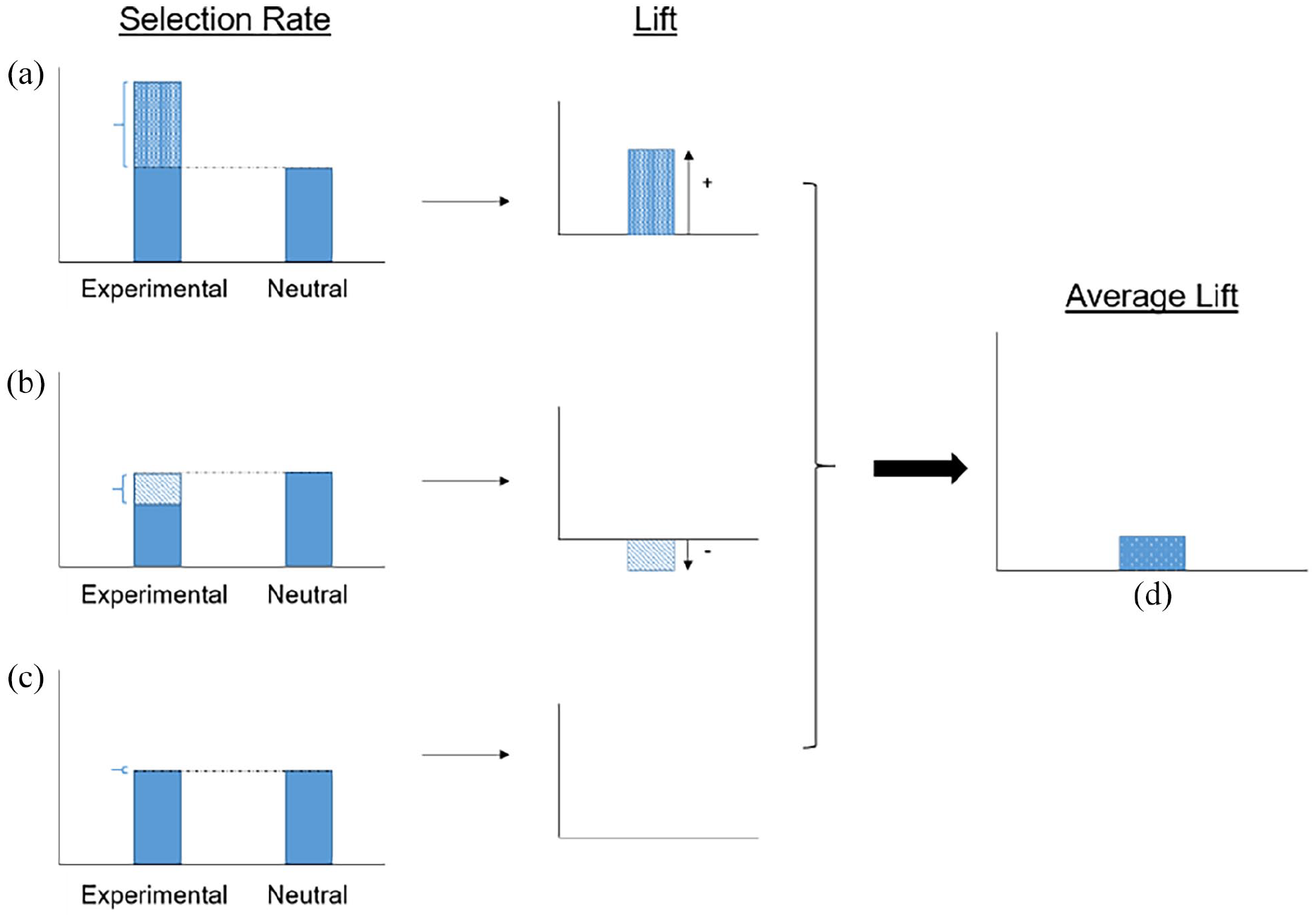
Lift refers to the difference in selection rates of an option when targeted by an experimental frame (e.g., framed as the status quo) versus a neutral alternative. In (a), the selection rate of an option in the experimental frame exceeded that of the same option in the neutral frame. Thus, the lift in selection due to the experimental frame was positive. In (b), the resultant lift was negative. In (c) there was no lift in selection due to framing because selection rates for the option did not differ in the experimental and neutral frames. Finally, averaging lifts from (a) to (c) yields the average lift (d). The average lift quantifies, overall, how the experimental framing of an option impacted its selection. Lift might also be conceptualised as Treatment Effect or Choice Bias.
To understand the impact of experimental manipulation on choice, we averaged lifts by experimental frame. To determine the overall lift for a given experimental frame, we first calculated the lift (i.e., difference in experimental selection rate and neutral selection rate) for each option in every decision scenario in such a frame. Then, we calculated the mean of these individual lifts within the given frame across all decision scenarios, yielding the frame’s average lift. For example, to calculate the impact of status quo frame on choice, we first found the lift in selection for each option framed as the status quo. By averaging these lift scores, we could determine the overall impact of the status quo frame on choice (for a given decision scenario). Finally, we used bootstrapping to determine confidence intervals (CIs) for these average lifts.
Average lifts by frame are presented in the left panel of Figure 3. Participants preferred status quo and salient options more than the corresponding neutral alternatives (MSQ = .16, 95% CI = [.12, .20]; MVS = .22, 95% CI = [.19, .26]; MEM = .10 95% CI = [.07, .14]). Figure 3 also demonstrates that the magnitude of the status quo bias effect was relatively consistent over time: there was no difference in the magnitude of bias for the status quo (i.e., lift in selection for the status quo) across studies (MSQ-1988 = 0.14, 95% CI = [.11, .17]; MSQ = .16, 95% CI = [.12, .20]). Thus, the findings of Samuelson and Zeckhauser (1988) were replicated.
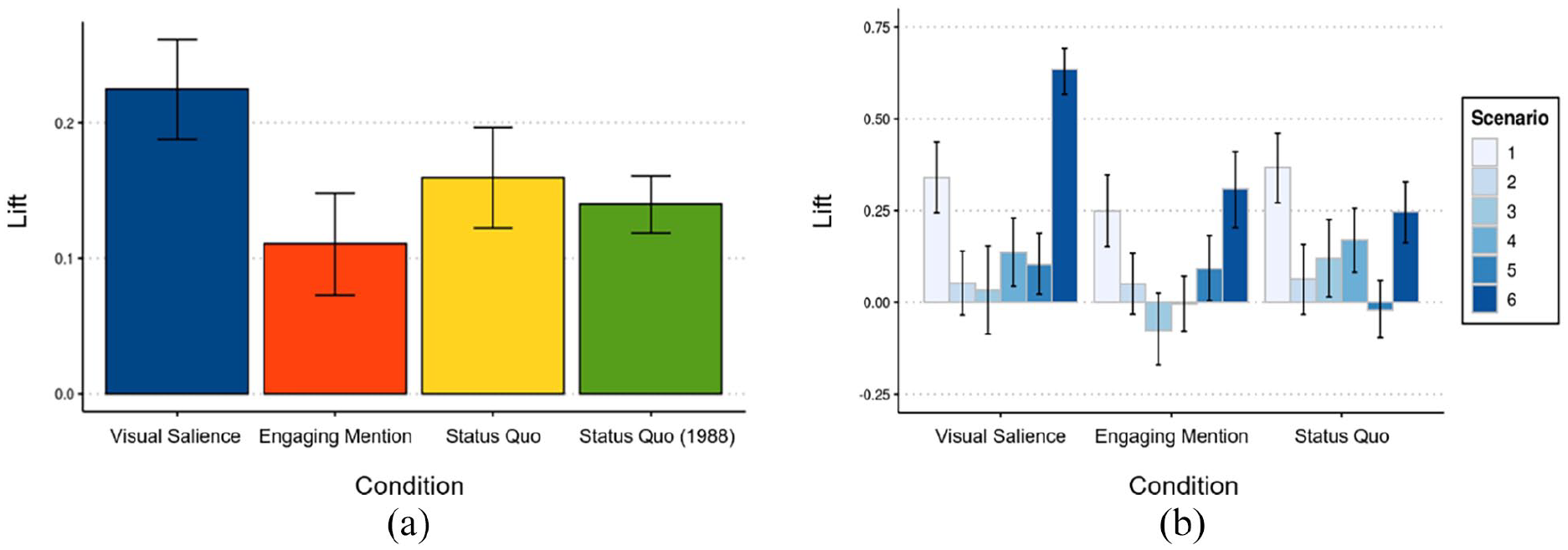
In the left panel, all average lifts were positive, a result which indicates that, on the whole, options were selected more frequently as the target of each experimental frame than as a neutral alternative. The experimental frames are as follows (left to right): Visual Salience, Engaging Mention, Status Quo, and Status Quo (1988), where the Status Quo (1988) is the average lift in selection found by Samuelson and Zeckhauser (1988). In the right panel, the majority of lifts by scenario-condition combination were positive. Decision Scenarios 1 and 6 resulted in the largest lifts in selection across conditions. Error bars are 95% CIs determined via bootstrapping with 10,000 bootstrap samples.
In addition, the preference for salient options by engaging mention differed from the preference for status quo options (MSQ = .16, 95% CI = [.12, .20]; MEM = .10, 95% CI = [.07, .14]). Furthermore, participants preferred visually salient options over and above options mentioned in an engaging manner (MVS = .22, 95% CI = [.19, .26]; MEM = .10, 95% CI = [.07, .14]) but not status quo options (MSQ = .16, 95% CI = [.12, .20]).
Further examination revealed that the lifts in selection due to increased salience were directionally consistent with those of the status quo frame. The lifts due to the visual salience and status quo frames were moderately correlated, r(21) = .54, p = .008, 95% CI = [.16, .78]; as were the lifts due to the engaging mention and status quo frames, r(21) = .59 p = .002, 95% CI = [.24, .81]. Interestingly, the lifts between the visual salience and engaging mention frames were highly correlated, r(21) = .86, p < .001, 95% CI = [.70, .94].
From a qualitative standpoint, the right panel of Figure 3 reinforces the fact that lifts by scenario and frame largely travel together. Across all frames, decision Scenarios 1 and 6 resulted in the greatest lifts, whereas Scenarios 2–5 saw much smaller (if any) lifts in selection. Moreover, we saw increases in selection for 3–4 of 6 decision scenarios. At the same time, in every condition, there were at least 2–3 scenarios for which no increase in selection was observed. In general, the lifts in selection due to visual salience and engaging mention frames aligned in magnitude and direction with those of the status quo frame. Selection rates by choice alternatives are presented in Supplementary Materials, Section 4.
Overall, status quo and salient options were preferred to neutral alternatives. Moreover, the visual salience and engaging mention frames produced a lift in selection similar to that of the status quo frame. These results provide preliminary evidence that status quo bias could potentially be driven by option salience via additional presentation.
However, in prior work, an additional presentation was not the only way in which status quo options have stood out from non-status quo alternatives. Frequently, the status quo option has visually stood out relative to alternatives through syntactic differentiation. We examine how increased option salience through syntactic differentiation impacts choice in Study 2.
Study 2: increased salience via syntactic differentiation increases selection
The purpose of Study 2 was to test whether increasing an option’s salience through syntactic differentiation would increase its selection, even when pitted against the status quo itself. We expected not only that syntactically differentiated, non-status quo options would be chosen at increased rates relative to baseline preferences (i.e., neutral selection rates), but also that status quo alternatives would be selected less frequently than at baseline. Such an increase in selection for the salient, non-status quo alternative, would provide evidence that option salience may, at least in part, explain instances of status quo bias.
In both Sameulson and Zeckhauser’s and in a breadth of subsequent research on SQB (1988), status quo options have often visually stood out through syntactic differentiation: their appearance is unique relative to non-status quo alternatives. For example, in the National Highway Safety Commission scenario (see Figure 1, status quo frame), the status quo option was presented in the set of choice alternatives as “[m]aintain the present budget amounts” while the other choice alternatives used different language and were all of a similar form, for example, “[a]llocate 40% to auto safety and 60% to highway safety.” Thus, the status quo option visually stood out relative to the three, syntactically alike, non-status quo alternatives. Clearly, having made an option salient by an additional mention increased its selection; however, it was not yet clear whether differentiating an option by subtler means such as through syntax could similarly influence choice, especially if the target of such a manipulation was not defined as the status quo. Accordingly, we tested whether syntactically differentiating an option would increase its selection, even when pitted directly against the status quo.
Method
Participants
Two-thousand two hundred and eleven participants were recruited via MTurk. Individuals who had previously participated in Study 1 were ineligible. As in Study 1, responses were screened on the basis of rigorous attention checks, and participation was restricted to MTurk workers with HIT approval rates > 98% and at least 1,000 approved HITs. Of the 2,211 participants we had recruited, 4.4% of respondents failed attention checks, and another 3.3% failed to finish the study. Finally, roughly .3% of respondents (i.e., six participants) logged study completion times either greater than 3 SDs above the mean completion time or less than 30 s (the minimum time required to click through the survey). In all of the aforementioned circumstances, response data were excluded from the analysis. The final sample of participants was 2,033 individuals (Mage = 37.98; SDage = 12.03; 1,223 women) who completed this study in exchange for $.10 or $.15. The sample was restricted to U.S. Citizens. Forty-nine percentage reported having a college degree or higher.
Experimental design
To test the impact of option salience on choice, we created a decision context in which a non-status quo option was visually differentiated through syntax and, thus, stood out relative to alternatives. We modified the decision scenarios in Study 1 such that now there would be three, syntactically similar status quo options and a single, comparatively salient, non-status quo alternative. To make sure status quo and non-status quo options were, otherwise, equivalent in terms of references made in the scenario description, we also modified the Study 1 decision scenarios such that the non-status quo option was previewed along with the status quo in the setup of the decision scenario. In addition, we created three novel scenarios to test this question of option salience due to syntactic differentiation in additional decision contexts. In all, there were nine decision problems and two frames (neutral and salient, non-status quo). Full text of the decision problems used in Study 2 is presented in Supplementary Materials, Section 2.
As in Study 1, participants were confronted with a single-decision scenario and required to choose one of four mutually exclusive alternatives. Also as in Study 1, the neutral frame presented all choice alternatives as new alternatives. In the salient, non-status quo frame, the three options presented first were framed as status quo options, and the last option was framed as a comparatively salient, non-status quo alternative. In every decision scenario, the non-status quo alternative is always presented last, and the status quo alternatives are ordered randomly, otherwise. See Figure 4 for an example of the decision problem frames used in the present study.
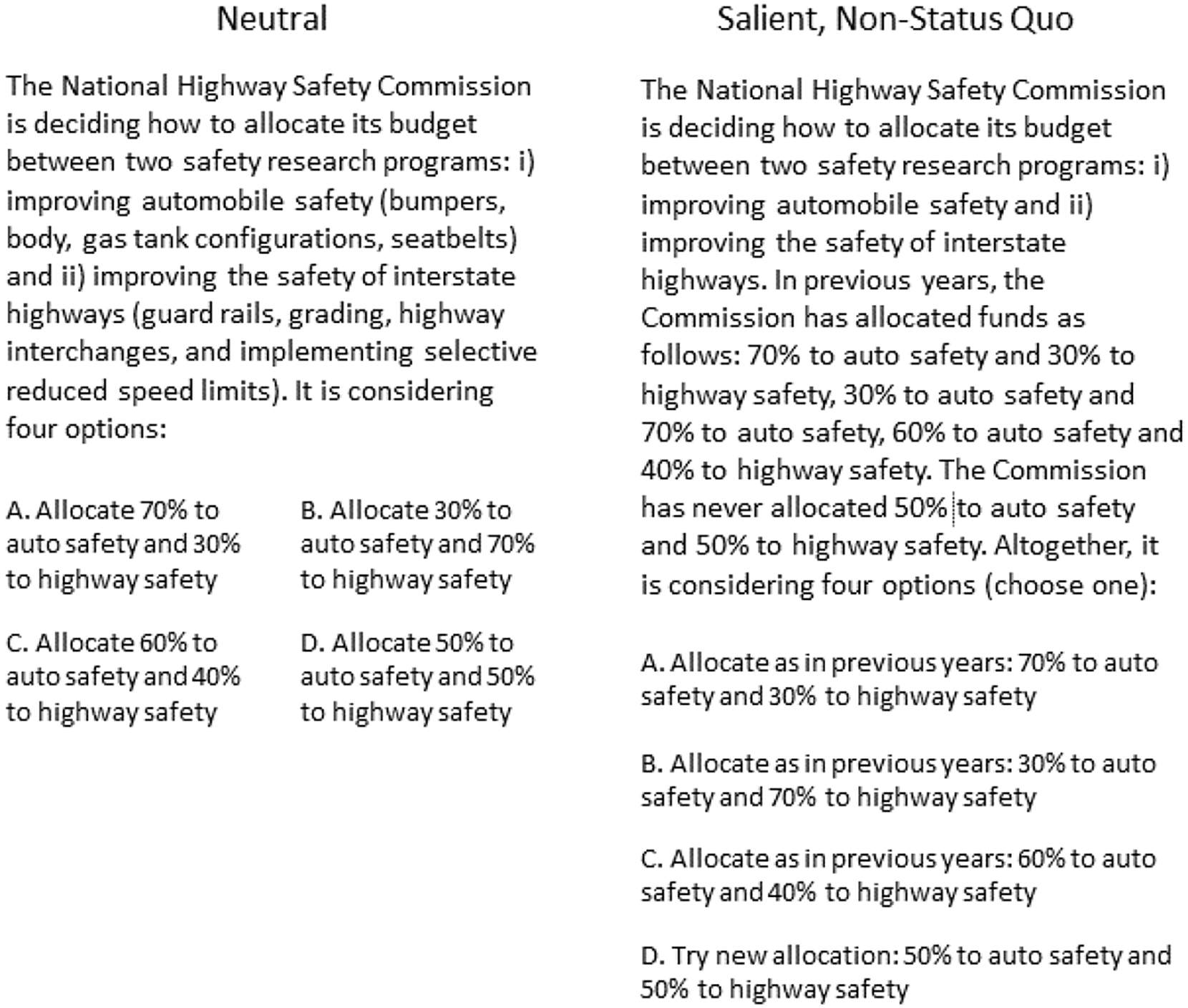
Decision problem in Study 2 was framed in one of two ways: in the neutral frame or in the salient, non-status quo alternative frame. To hold the number of references to an option constant in the salient, non-status quo alternative frame; all four choice alternatives were previewed in the decision problem description. In addition, the non-status quo alternative was made salient through its syntactic differentiation from the three preceding, syntactically similar options.
As in Study 1, there are four versions of a given decision problem corresponding to each of the four possible salient, non-status quo options. So, altogether, there are five versions of the decision problem above: one neutral version, and four versions for each non-status quo alternative. Across all conditions, a particular option occupied three possible positions: as a neutral alternative, as a non-status quo alternative, or as a status quo alternative.
Procedure
The procedure was identical to that of Study 1.
Results and discussion
The purpose of Study 2 was to test whether the increased salience of an option due to syntactic differentiation would increase its selection. We expected that, on average, selection rates for salient, non-status quo alternatives would exceed those of corresponding neutral alternatives, demonstrating a bias for salient options. We also expected that, on average, selection rates of status quo options would be less than that of corresponding neutral alternatives, and, thus, result in the reduction, or possibly the elimination, of status quo bias.
Selection rates were calculated in the same manner as in Study 1. In the present study, selection rates were calculated for each salient, non-status quo; status quo; and neutral alternatives. Also, as in Study 1, to evaluate the change in selection for salient, non-status quo options relative to neutral alternatives, we examined the differences between a given option’s selection rate as a salient non-status quo alternative and its selection rate as a neutral alternative. In addition, to evaluate the change in selection for status quo options, we examined the difference between a given option’s status quo selection rate and neutral selection rate. These differences are the option’s lift in selection in non-status quo and the status quo frames, respectively.
To understand the impact of experimental manipulation on choice, we averaged lifts in selection by option type (i.e., whether an option was framed as a status quo option or the salient, non-status quo alternative). The left panel of Figure 5 shows that, on the whole, options framed as the status quo were selected less frequently than the corresponding neutral alternatives (MSQ = –.06, 95% CI = [−.07, −.05]). In addition, salient, non-status quo options were selected more frequently than the corresponding neutral alternatives (MNSQ = .19, 95% CI = [.16, .22]). Interestingly, the lift in selection for the salient, non-status quo alternative is roughly in line with the lift in the selection of the status quo frame in Study 1. In the present study, however, the salient, non-status quo frame did not just reduce but eliminated bias for the status quo. Moreover, the salient, non-status quo frame appears to have produced a slight, bias against the status quo.
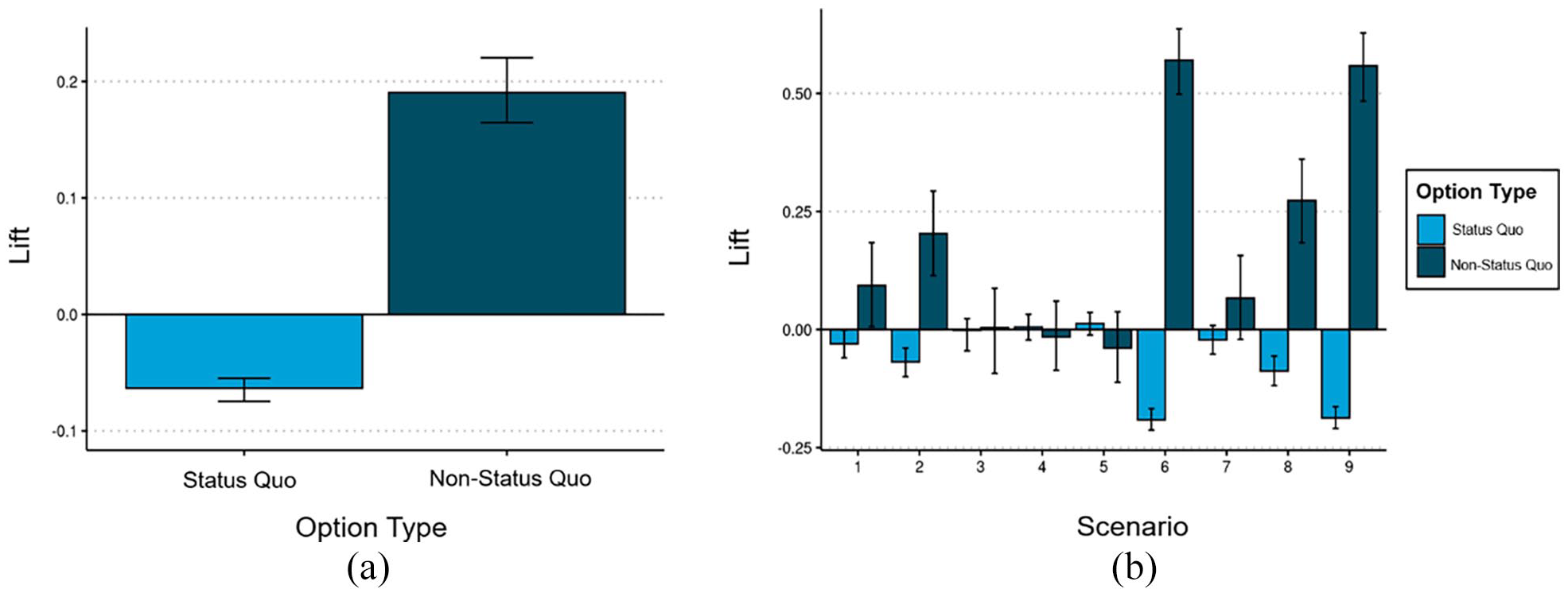
The left panel shows that options framed as the status quo were selected less frequently than corresponding neutral alternatives, in general. Moreover, options framed as attentionally salient, non-status quo alternatives (i.e., targets of the experimental manipulation) were selected more frequently than corresponding neutral alternatives. The right panel shows that, in general, options framed as the status quo were selected no more frequently than corresponding neutral alternatives. At the same time, options framed as attentionally salient, non-status quo alternatives were selected at least as frequently as corresponding neutral alternatives. Error bars are 95% CIs determined via bootstrapping with 10,000 bootstrap samples.
The increase in selection for the salient non-status quo, and elimination or, in some cases, reversal of bias for the status quo was consistent at the decision scenario/option-type level, as well. The right panel of Figure 5 shows that, in most decision scenarios, options framed as non-status quo alternatives were preferred to corresponding neutral alternatives. Scenarios 6 and 9 show the largest lifts in selection for options framed as non-status quo alternatives (M6-NSQ = .57, 95% CI = [.50, .63]; M9-NSQ = .56, 95% CI = [.48, .63]). In these scenarios, status quo options were preferred significantly less (nearly 20 percentage points) than the corresponding neutral alternatives (M6-SQ = −.19, 95% CI = [−.21, −.16]; M9-SQ = −.19, 95% CI = [−.21, −.16]). In addition, the right panel shows that, across decision scenarios, options framed as the status quo were selected no more frequently than corresponding neutral alternatives. In just under half of the decision scenarios, there was no difference between status quo, non-status quo, and neutral selection rates. That is to say, in just under half of decision scenarios, choice alternatives were preferred the same, whether framed as status quo, non-status quo, or neutral alternatives. Results are presented at the scenario, option type, and choice alternative level in Supplementary Materials, Section 4.
One limitation of Study 2 is that by itself, it does not preclude the possibility that the non-status quo option was in-part chosen because it was the only option that is new and novel, whereas the status quo options were tried in the past. Participants motivated by variety seeking (Sevilla et al., 2019) may have therefore preferred the new option precisely because it was new and different. One, at least partial, mitigation of this possibility is that participants do show a reliable preference for the status quo which, by definition, has been tried in the past and does not represent a variety-seeking option.
Aggregating across all scenarios, increased salience due to syntactic differentiation of non-status quo alternatives increased their selection. At the same time, bias for the status quo appears to have been eliminated and, in some cases, to have resulted in bias against the status quo. Together with the results from Study 1, these data suggest that option salience due to status quo framing may, in part, explain instances of status quo bias. However, other interpretations of these data are possible. For example, these results could indicate that the effect of option salience due to an additional presentation and syntactic differentiation need not explain SQB, but simply resemble it. If the status quo were no more salient than its alternative, would it still be preferred? We examine this question in Study 3.
Study 3: reduced salience eliminates bias for status quo
The purpose of Study 3 was to see what survived of SQB when the status quo was made no more salient than its alternative. If SQB were unrelated to option salience, then such manipulation should not impact SQB. However, were SQB related to option salience, then equalising the salience of each choice alternative should reduce or even eliminate SQB. Based on our findings in Studies 1 and 2, we expected the latter: that the overall preference for the status quo relative to neutral alternatives would be eliminated. Moreover, roughly equivalent selection rates for the status quo and neutral alternatives would further underscore the importance of option salience in SQB. To minimise Type II error, we conducted a highly powered study and used the decision scenarios with the most pronounced SQB effects from Studies 1 and 2.
Method
Participants
One-thousand two-hundred and eighty participants were recruited via MTurk. Sample size estimation was informed by a statistical power analysis using GPower (Faul et al., 2007). Based on previous research (e.g., Samuelson & Zeckhauser, 1988) as well as Studies 1 and 2, lifts in selection ranged from 12 to 37 percentage points, with an average lift in the selection of 16 percentage points. Assuming a conservative lift of 10 percentage points, a two-tailed test, an alpha = .05, and power = .9, the projected sample size required to detect such an effect was approximately N = 1,160. Based on this analysis, and expecting to exclude roughly 10% of responses due to incompletions or failed attention checks, we recruited 1,280 participants.
The basic requirements for study participation were similar to those of previous studies. Individuals who had previously participated in either Study 1 or Study 2 were ineligible. In addition, as in the previous studies, participation was restricted to MTurk workers with HIT approval rates > 98% and a minimum of 1,000 approved HITs, and responses were screened on the basis of rigorous attention checks. Of the 1,280 participants recruited, 9% of respondents failed attention checks, and another 1% failed to finish the study. Finally, .5% of respondents (i.e., seven participants) logged study completion times either greater than 3 SDs above the mean completion time, or survey completion duration less than 30 s. In all of the aforementioned circumstances, response data were excluded from the analysis. The final sample of participants was 1,149 individuals (Mage = 38.29; SDage = 12.01; 673 women) who completed this study in exchange for $.10. The sample was restricted to U.S. Citizens. Sixty-one percentage reported having a college degree or higher.
Experimental design
To test the impact of equal salience on choice, we created a decision context in which the status quo did not stand out relative to its alternative. As previously noted regarding the extant literature on SQB, the status quo option has typically stood out relative to alternatives in several ways (i.e., through syntactic differentiation, one option among many, and an additional mention in the scenario description). Therefore, we devised a context that would minimise these salience-inducing aspects of the status quo. We sought to level the playing field between status quo and non-status quo options by pitting a single status quo option against a single alternative; by wording both options in a similar manner; and by previewing both options in the decision problem description. Moreover, the order in which options were presented was partially counterbalanced such that the option previewed first was always the option listed first.
As in Studies 1 and 2, participants were confronted with a single decision scenario and required to make a choice. In this study, participants chose between two mutually exclusive alternatives. As before, the neutral frame presented all choice alternatives as new alternatives. The equal salience frame presented one option as the status quo and one option as a non-status quo alternative. Figure 6 provides an illustration of the test design. The full text of the decision problems used in Study 3 is presented in Supplementary Materials, Section 3.
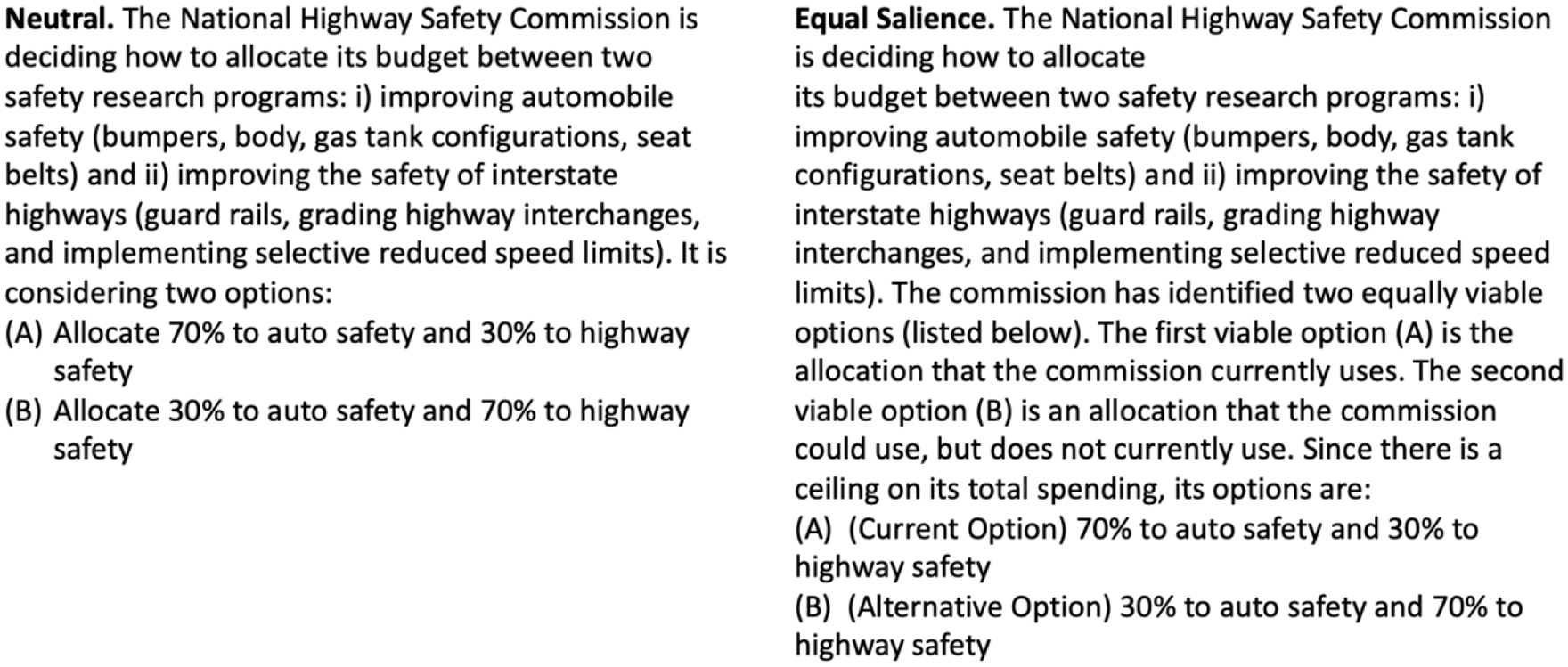
Decision problem in Study 3 was framed in one of two ways: in the neutral frame or the equal salience frame.
Several aspects of the equal salience frame were notable. First, not just the status quo option was previewed in the text body, but so, too, was the non-status quo alternative. Second, the listed choice alternatives were syntactically alike (i.e., in this scenario, all of the form “Allocate XX% to auto safety and XX% to highway safety”). Third, the status quo and its alternative were clearly designated via parenthetical statements. Fourth, both options were declared equally viable to minimise any implied recommendation for one option over the other. Finally, the order in which options were both previewed and listed was partially counterbalanced such that the option previewed first was always the option listed first in the option pair.
Option pairs were selected to match those used by Samuelson and Zeckhauser (1988). Each decision problem had two distinct pairs of options. For example, in the National Highway Safety Commission example above, the budget allocations of 30–70 and 70–30 were one pair of mutually exclusive alternatives, and 40–60 and 50–50 were the second pair of alternatives.
To provide the fairest possible assessment of how equally salient alternatives would impact status quo selection, we used only those scenarios which showed significant SQB in Study 1 (i.e., significant, positive lifts at the scenario level in the status quo condition). These were Scenarios 1, 3, 4, and 6. Collectively, their average lift in selection for the status quo was 23 percentage points. In other words, an option in one of these four scenarios, on average, was selected 23 percentage points more as a status quo option than as a neutral alternative.
Altogether, there were six main versions of a given decision problem: two neutral versions (one for each pair of choice alternatives), and four equal salience versions (one for each option that could be framed as the status quo). Across all conditions, a particular option occupied three possible positions: as a neutral alternative, status quo alternative, or non-status quo alternative.
Procedure
The procedure was identical to that of Studies 1 and 2.
Results and discussion
The purpose of Study 3 was to investigate whether making the status quo and its alternative equally salient would impact SQB. We expected that, on average, the robust effect of SQB would be eliminated: the selection rates of status quo options would not differ from those of neutral alternatives.
To evaluate the impact of status quo framing on choice, we averaged lifts in selection for all status quo options. On average, the lift in selection for the status quo was no different from zero: status quo options were selected no more frequently than their neutral counterparts, χ2(1, N = 1,149) = .249, p = .617. Seeing that both status quo and neutral choice alternatives were selected at similar rates, it appears that reducing the stand-out nature of the status quo option relative to its alternative eliminated the preference for the status quo.
On the whole, little to no difference in selection rates (i.e., lifts of zero) was found at the decision scenario, choice alternative pair level. The left panel of Figure 7 shows average lifts by decision scenario and choice alternative pair. Across decision scenarios and choice alternative pairs, we see that choice alternatives framed as the status quo were selected no more frequently than neutral alternatives (i.e., the lifts in selection straddled zero). That said, in Scenario 4 (i.e., the College Teaching Scenario), the status quo option was preferred to neutral alternatives no matter the choice alternative pair (M4-E|W1 = .17, 95% CI = [.08, .26]; M4-M|W2 = .10, 95% CI = [.02, .19]). In addition, in Scenario 6 (i.e., the Car Purchase Scenario), participants preferred the non-status quo alternative when choosing between red and silver blue coloured vehicles (M6-R|SB = −.14, 95% CI = [−.23, −.05]). Full details across all scenarios are shown in Table 2.

The x-axis shows pairs of choice alternatives presented to participants. The choice alternatives are separated by “.|” For example, the option pair “50–50|60–40” corresponds to the pair of Scenario 1 budget allocations, 50–50 and 60–40 (i.e., “50% to auto safety and 50% to highway safety” and “60% to auto safety and 40% to highway safety”). In general, for a given choice alternative pair and scenario combination, the lift in selection for an option designated the status quo was no different from zero. However, in Scenario 3, participants slightly preferred the status quo to alternatives. In Scenario 6, individuals slightly preferred alternatives to the status quo. Error bars are 95% CIs determined via bootstrapping with 10,000 bootstrap samples.
Study 3 Scenario Details.

Note. LiftSQ refers to the lift in selection attributable to status quo framing (i.e., the difference in the rates of selection for a given choice alternative when designated the status quo versus a neutral alternative).
There were few differences in selection found at the decision scenario, choice alternative level. Overall, choice alternatives framed as the status quo were no more likely to be selected than corresponding neutral alternatives (i.e., their lifts in selection when framed as status quo options were no different from zero). From a qualitative standpoint, the lifts in selection for options designated the status quo were no different from zero for the majority (11/16) of choice alternatives. Thus, the majority of choice alternatives were selected no more frequently as status quo options than as neutral alternatives.
In all, reducing the comparative salience of status quo relative to its alternative appeared to have eliminated bias for the status quo.
Study 4: real-world replication and extension of Study 3
There were two limitations in Study 3 that we addressed in Study 4. First, while Study 3 did show that the equal salience arm did not reveal a preference for the status quo relative to the neutral arm, it did not include an arm in which the status quo was salient and was preferred. We reasoned that such an arm would strengthen the conclusion from Study 3 that equal visual salience for all options would nullify SQB, whereas keeping visual salience for the status quo option would retain SQB. Second, Study 3 (like Study 1 and Study 2) was based on hypothetical scenarios. While such scenarios have been ubiquitous in the SQB literature, we thought that it would be helpful to extend the findings to a real-world context in which choices had actual consequences.
Method
Participants
We recruited 453 undergraduate psychology students and randomly assigned them to three equally powered conditions of 151 students each (Figure 8). Our sample size was dictated by limitations related to student enrollment but was in the range suggested by effect sizes found in prior studies.

Study 4 assigned 453 participants into three equal conditions: the “Neutral” condition, in which there was no status quo option, the “Status Quo” condition, in which the status quo option was salient relative to the non-status quo option, and the “Equal Salience” condition.
The participants ranged from age 19 to 52 (M = 22.4) and were 57% female, 42% male, and 1% other/declined to state. They were enrolled in a psychology course which required them to take a multiple-choice test.
Experimental design
Students were informed that they could choose from one of two question banks, “Question Bank 1” and “Question Bank 2.” They were informed that this was to enable the instructors to test the validity of a broad range of questions. They were also informed that previous testing had determined that the two question banks were of precisely equal difficulty. Both statements were factual and did not involve deception.
The choices were delivered to students via a course management system. In the “Neutral Condition,” students were simply asked to pick between the question banks (the options were presented in order, Question Bank 1 followed by Question Bank 2). In the “Status Quo” condition, students were informed that they had been randomly assigned to Question Bank 1 and that they were free to select which ever question bank they preferred. However, Question Bank 2 was not explicitly mentioned. Thus, Question Bank 1 was the status quo option. The presentation of the decision emphasised the status quo option by mentioning it twice (once in the description of the choice, and once in the option presentation). In the “Equal Salience” condition, students were also informed that they had been randomly assigned to Question Bank 1. However, they were explicitly told that they could switch their selection to Question Bank 2 if they preferred. Thus, the status quo option was retained, but its comparative visual salience was eliminated in the “Equal Salience” condition.
Procedure
In each condition, participants selected their preference in the course-management system.
Results and discussion
In the Neutral condition, 90 of 151 (59.6%) participants preferred Question Bank 1. This preference for the first mention option is a known phenomenon, and we expected it to occur (Johnson & Raab, 2003). In the status quo condition, 111 of 151 (73.5%) participants preferred Question Bank 1, and in the Equal Salience condition, 92 of 151 (60.9%) participants preferred Question Bank 1.
A chi-square test of independence was performed to examine the relation between the condition and the propensity to select Question Bank 1. The relation between these variables was significant, χ2(2, N = 453) = 7.79, p = .02. Participants in the Status Quo condition were more likely to select Question Bank 1 (the status quo option) than participants in the Neutral and Equal Salience conditions.
Study 4 provided confirmatory evidence suggesting that visual salience effects could drive SQB in real-world decision contexts.
General discussion
It is clear that status quo bias—the predisposition to keep things as they are—is both ubiquitous and consequential. Decision scientists have suggested that loss aversion, desire for consistency, and the existence bias are responsible for some decision scenarios featuring the irrational preference for the status quo. In this work, we invited consideration of the possibility attention-related effects due to the visual salience of the available options are an additional driver of SQB.
In Study 1 and Study 2, we tested whether increasing the salience of an option increases its selection rate. We found this to be the case: in Study 1 mentioning an option twice increased its selection rates. This was suggestive because, in many choice contexts designed to measure SQB effects, the status quo option is also mentioned twice. In Study 2, we found that increasing the salience of an option via syntactic differentiation not only increased its selection, but also eliminated the preference for the status quo. This was also suggestive because in many choice contexts designed to measure SQB effects, the status quo option is also syntactically differentiated from other options.
In Study 3 and Study 4, we directly tested whether decreased attention, achieved via diminished visual salience of the status quo option relative to other options can decrease SQB. In Study 3, we found that making non-status quo and non-status quo options equally salient wiped-out bias for the status quo option. Study 4 replicated this result in a real-world, non-hypothetical decision context. Collectively, these studies provided support for the proposition that visual salience increases selection and that some instances of SQB are attributable to the relatively higher salience of the status quo option compared with the other options.
To be clear, we are not suggesting that loss aversion, desire for consistency, and existence bias play no role in some instances of SQB. Such a claim would require a comprehensive survey of all possible decision scenarios in which SQB could occur. Our (more modest) proposal is that some cases of SQB previously explained in terms of such drivers, may be explained via attention-based effects related to the visual salience of the presented options. Importantly, increased visual salience is not the only path to increased attention. Previously proposed mechanisms for SQB may also involve attention: loss aversion may increase attention to the current state because losses are determined in reference to the current state; the desire for consistency may increase attention to the current state because the current state is the reference point from which we are consistent; and the existence bias may result from increased attention to the status quo precisely because it is the option which already exists. Thus, our account based on changing attention via changing visual salience is likely synergistic with prior explanations of SQB. At the same time, we are open to the possibility that option salience will turn out to play a disproportionally influential role in SQB.
Our work adds to a growing body of research that highlights the role of attention in value-based decision-making. The attention may sometime be goal-oriented—in which case, decision-making outcomes are frequently consistent with the predictions of subjective expected utility theory (Peterson, 2017). Other times, attention may be directed towards contextual variables which do not directly bear on the normative valuation of the available options. In these cases, decision outcomes may deviate from the subjective expected utility theory and may be profoundly shaped by the influence of contextual variables that do not appear to be connected with value in any direct way (Suri et al., 2020).
One mechanism relating to the path through which visual salience and/or attention might influence choice is provided by accounts of value-based decision-making that conceptualise choice as a function of the level of activation that reaches the output layer of a neural network (Suri et al., 2020). According to these accounts, additional visual salience and/or attention influences a neural network via providing increased input that, all else being equal, results in increased activation at the output layer.
In addition to its theoretical implications, the present work may offer decision architects practical tools to nudge (Thaler & Sunstein, 2009) towards societally desirable status quo and default options. For example, the present work suggests that in the realm of food choice, displaying healthier food options more prominently (and at multiple sites on a menu or display aisle) will increase their uptake (Graham & Jeffery, 2011). Such a move may not immediately maximise a restaurant’s profit, but could presumably be combined with government incentives from policy-makers seeking to focus on healthful eating and prevention-oriented health care.
A similar application may be possible application in the realm of clean energy adoption. Increasingly, municipal power utilities seek to expand their commitment to clean energy, but may leave the decision to buy power from clean energy sources to the consumer (O’Shaughnessy et al., 2018). Policy makers may therefore choose to present the clean energy option so that it stands out relative to the status quo option (e.g., via visual salience and repeated mention). This could increase the selection of clean power, and critically speed the transition to 100% renewables. Related examples may be found in domains of increasing savings (Karlan et al., 2016), and reducing debt (Karlan & Zinman, 2012).
Since the intended purpose of the current work was to get initial purchase on a complex question, several limitations of this study set are worth noting. First, while results highlighted the importance of increased attention in status quo bias, these findings emerged from a constrained operationalisation of attention. Although a considerable body of work connects visual salience to attention (e.g., Anderson et al., 2011; Stilwell et al., 2019; Theeuwes, 1992; Theeuwes & Godijn, 2002), we have not directly measured attention, but have used visual salience as its proxy. Future studies must endeavour to operationalised, manipulate, and measure attention in other ways (e.g., as gaze fixations or gaze duration). Second, as previously mentioned, results indicated that certain decision contexts were more susceptible to status quo bias or increased attention effects. Although some decision scenarios showed a large lift in the selection, others saw little to no such lift. What about these contexts make it so? Is it possible that characteristics of the scenario (e.g., their affective content) can be related to their lift-rate? Although the present study set was not designed to investigate this question, future studies should investigate the interaction among scenario variables such as affect, context, and status quo bias.
Finally, although the present work showcases the powerful influence of the impact of visual salience, it bears noting that we have not directly measured the effect of attention on SQB. Rather, we have manipulated the visual salience of available options and inferred, via revealed preferences, the involvement of attention. Future studies, using techniques such as eye-tracking, are required to confirm this inference.
Supplemental Material
sj-docx-1-qjp-10.1177_17470218221136827 – Supplemental material for The role of attention in status quo bias
Supplemental material, sj-docx-1-qjp-10.1177_17470218221136827 for The role of attention in status quo bias by Anthony C Miceli and Gaurav R Suri in Quarterly Journal of Experimental Psychology
Footnotes
Declaration of conflicting interests
The author(s) declared no potential conflicts of interest with respect to the research, authorship, and/or publication of this article.
Funding
The author(s) received no financial support for the research, authorship, and/or publication of this article.

Data accessibility statement
References
Supplementary Material
Please find the following supplemental material available below.
For Open Access articles published under a Creative Commons License, all supplemental material carries the same license as the article it is associated with.
For non-Open Access articles published, all supplemental material carries a non-exclusive license, and permission requests for re-use of supplemental material or any part of supplemental material shall be sent directly to the copyright owner as specified in the copyright notice associated with the article.
