




Abstract
This study examines the relationship between coaching competency as evaluated by athletes and their perceptions of trust in their coaches. The authors hypothesize that athletes’ evaluation of four dimensions of coaching competency is positively related to their trust in their coaches, and that this relationship is stronger at the team level than at the individual level. In total, 438 basketball players (251 males and 187 females) from 34 teams completed the Coaching Competency Scale (CCS) and the trust in the coach questionnaire during the postseason. The hypotheses were tested through hierarchical linear modeling. The analyses revealed that individual- and group-level evaluations of the four-dimensional CCS (motivation, game-strategy, technique, and character-building competencies) positively predicted trust in the coach; furthermore, group-level coaching competency was the primary contributor to this relationship. Therefore, improving the psychological and tactical skills of coaches and their skill detection abilities and instruction at training together with a positive attitude toward sports may help improve the trust of athletes in their coaches.
Introduction
Coaching competency has grown in stature as a research topic and has gained increasing interest in the field of sports coaching over the last decade.1–4 Studies have suggested that coaching competency substantially influences athlete satisfaction with coaches,4,5 forming the basis from which moral judgments 2 and perceptions of role ambiguity 1 arise. Despite theoretical progress in the field of coaching competency, empirical evidence supporting the emerging theories is scant, and literature on the outcomes of coaching competency development in athletes’ perceptions of coaches is severely lacking.4,6
Trust is a critical issue that has been discussed in sports coaching. Jowett and colleagues7,8 have argued that trust is an index for close relationship between coaches and athletes. Moreover, researchers9–11 have labeled trust/inclusion as a typical servant–leader characteristic in sport. In the current study, we employed social exchange theory12,13 to propose that coaching competency may positively enhance trust in coaches as perceived by athletes. This study contributes toward the examination of the positive relationship between coaching competency and trust in the coach.
Through multilevel modeling, this study examined the relationship between the coaching competency evaluated by athletes and their perceptions of trust in the coach. Relevant research on coaching competency and trust in the coach is reviewed in the following sections.
Trust in the coach
Trust has been predominantly conceptualized as a psychological phenomenon.14–16 Mayer et al. 17 defined trust as “the willingness of a party to be vulnerable to the actions of another party based on the expectation that the other will perform a particular action important to the trustor, irrespective of the ability to monitor or control that other party” (p. 712). Thus, trust is the positive expectation and willingness of the trustor to be vulnerable.17–19 In the context of direct and repeated interactions between coaches and athletes, if athletes believe that the coach will fulfill their commitments to the relationship, they will trust the coach more. Trust in the coach considerably affects the performance of collegiate basketball teams, 20 positively relates to perceived justice and performance, 21 and moderates the relationship between gratitude and self-esteem. 22
Good, 23 Lee, 24 and Mayer et al. 17 have proposed that ability is a trustworthy characteristic of the trustee (coach) that affects the degree of trust that the trustor (athlete) has in the trustee. Zhang and Chelladurai 25 demonstrated that coaching competence is an antecedent of a positive effect on the trust of athletes in the coach. Given this relationship between competency and trust, differentiating the forms of coach competency is warranted.
Coaching competency
Coaching competency was initially developed from the conceptual model of coaching efficacy. 26 Myer et al. 3 defined coaching competency as the evaluations of the ability of the head coach to affect the learning and performance of athletes and conceptualized coaching competency as a combination of motivation competency, game-strategy competency, technique competency, and character-building competency. Motivation competency refers to evaluations by athletes of the ability of their head coach to affect their psychological mood and skill, game-strategy competency is related to the evaluation of the strategizing ability of the head coach during competition, technique competency is the evaluation of instructions and diagnostic abilities of the head coach by athletes during practice, and character-building competency denotes the evaluation of the ability of the head coach to influence the personal development and positive attitude of athletes. Thus, coaching competency is related to the perceptions of the capacity of coaches to influence athletes’ perceptions, beliefs, and attitudes.3–5
Coaching competency can be considered in a broad sense as the athletes’ perception of the coaching behavior. 3 Numerous researchers have highlighted the crucial link between leadership behavior and trust.12,27–29 Thus, coaching competency can be considered a key element in addressing the link between competence of the coach and trust of athletes in their coach. Evaluation of coaching competency by athletes may denote a trusting relationship through which athletes can obtain support from the coach easily.
This study proposes that athletes will trust coaches when they perceive high coaching competency during their interaction with coaches. Arguably, this effect is because of a behavioral exchange between coaches and athletes. Therefore, we examined the relationship between coaching competency and trust in coaches that extends the previous coach–athlete trust relationship.
Coaching competency and trust in the coach
In the current study, we use a social exchange approach12,13 to understand the trust relationship between the coach and athlete. According to social exchange theory, 30 the quality of social interactions induces obligations to return favors to those who acted in one’s interest. This relationship is often depicted as a form of reciprocity in which people seek to repay favors until a perceived balance of exchange exists. 30 Coaches who are servant–leaders transcend self-interest, express care and concern, and act in the best interest of their athletes, thereby creating a social context in which athletes may reciprocate by trusting.9–11,31 Similarly, mutual feelings in positive closeness (i.e., trust and respect) is reported in literature on the coach–athlete relationship.7,32
Direct experiences allow athletes to observe leadership behavior and evaluate the trustworthiness of the coach. Athletes’ knowledge based on training and competition experience increases the validity of the competence-based attributes of the coach. Athletes may rely on specific coaching behavioral information to develop their trust in their coach over time. Led by social exchange theory, 30 a high perception of coaching competence by athletes may trigger more trust in return.
The perceptions of coaching competency by athletes (i.e., motivation, game-strategy, technique, and character-building competencies) is conducive for the development of trust among athletes. Motivation competency refers to the use of effective psychological skills by coaches, thus providing the athletes useful psychological experience. The perceptions of motivation competency by athletes are hypothesized to be positively related to their trust in the coach. Game-strategy competency refers to the use of effective tactical skills by coaches. The achievement needs of athletes are fulfilled by tactical knowledge and strategizing skills of coaches; therefore, a positive relationship is hypothesized between perceptions of game-strategy competency and trust in coach by athletes. Technique competency refers to the practice of instruction, corrective feedback, and detection of skill errors by coaches for improving the skill and performance of athletes; therefore, a positive relationship is hypothesized between perceptions of technique competency of athletes and trust in the coach. Character-building competency relates to the concern of wellness and positive attitude by coaches. The sense of reliability of athletes is instilled when they perceived that the coach as humanistic; therefore, a positive relationship is hypothesized between perceptions of character-building competence by athletes and trust in their coach. In brief, we propose the following. H1: The four-dimensional evaluation of coaching competency by athletes is positively related to their trust in the coach.
Because of the characteristics and context of sports teams in this study, considering the multilevel structure of the data was crucial. Indeed, athletes are members of teams, and athletes within a team may hold more similar perceptions (i.e., coaching competency, and trust in coach) than do athletes in different teams. Thus, multilevel modeling was statistically required to distinguish the relationship between coaching competency and trust in coach into within-group and between-group components. 33
Both the constructs examined in the present study (i.e., coaching competency and trust in coach) have been discussed and examined using a multilevel approach.4,5,34,35 Myers et al.
5
demonstrated that group-level coaching competency positively affected satisfaction and accounted for most of the variance (88.3%) in satisfaction. Similarly, perceptions of team/group-level constructs (e.g., collective efficacy and motivational climate) at an individual level may not be the same as those at a team level.36,37 Therefore, in the current study, the positive relationship between coaching competency (i.e., motivation, game-strategy, technique, and character-building competencies) and trust in coach was expected to be stronger at the group level than at the individual level. Accordingly, we propose the following: H2: The positive relationship between coaching competency and trust in coach is higher at the group level than at the individual level.
Method
Participants
The participants of this study were 438 competitive basketball players (males = 251, females = 187) playing for 34 teams (19 male teams and 15 female teams) participating in Division I & II men’s and women’s college basketball in Taiwan. This sample represented an average of 12.88 (SD = 2.42; range = 7–17) players per team. The mean age of the participants was 20.10 years (SD = 1.39). The participants were playing competitive basketball for an average of 7.04 years (SD = 2.85), and were playing for their present coach for an average of 2.34 years (SD = 1.53). For coaches’ and players’ gender match, 17 male and two female coaches worked for the male teams, whereas nine males and six females led the female teams.
Procedure
The team coaches were initially contacted through phone calls or emails for permission to contact their players. Once permission was granted to approach the athletes, written informed consent was obtained from each participant. Questionnaires were distributed and collected before or after practices, respectively, in the absence of the coach. The questionnaires were administered by the authors during the postseason to ensure that the players had adequate time to interact with the coaches during the season. The questionnaire took approximately 15 min to complete. Prior to data collection, ethical approval for the study was obtained from the Regional Ethical Review Board at Fu Jen Catholic University.
Measures
Coaching competency
Coaching competency was measured using the Coaching Competency Scale (CCS), 3 a 24-item instrument designed to assess the four dimensions of coaching competency; each item was preceded by the stem “how competent is your head coach in his or her ability to.” The motivation competency subscale consisted of seven items (e.g., “build the self-confidence of his/her athletes”), the game-strategy competency subscale included seven items (e.g., “understand competitive strategies”), the technique competency subscale contained six items (e.g., “coach individual athletes on technique in practice”), and the character-building competency included four items (e.g., “instill an attitude of fair play among his/her athletes”). Athletes indicated their responses on a 5-point Likert-type scale ranging from 1 (complete incompetence) to 5 (complete competence). The structural validity of this questionnaire was analyzed through a confirmatory factor analysis of the present participants; the four subscales of coaching competency exhibited an acceptable fit (chi-square (χ2) = 1225.83, df = 246, χ2/df = 4.98, Comparative Fit Index (CFI) = .97, Normed Fit Index (NFI) = .98, standardized root mean square residual (SRMR) = .05, and root mean square error of approximation (RMSEA) = .09). All items were loaded onto their respective factors and all standardized factor loadings were higher than .55 (p < .01). Internal consistency for Cronbach’s alpha was acceptable for motivation (α = .92), game-strategy (α = .94), technique (α = .90), and character-building (α = .86) competencies.
Trust in the coach
Trust in the coach was assessed using a trust in the leader questionnaire. 20 The trust in the coach questionnaire is a nine-item one-dimensional measure of the trust of athletes in their coach. In a construct validity study, 38 the 12 items were loaded onto a single factor, and the factor loading values ranged from .69 to .88. Accordingly, we used the items with the top four factor loading values (e.g., most team members trust and respect the head coach) to assess the trust of athletes in the head coach. Trust in the coach was scored on a 5-point Likert scale ranging from 1 (strong disagreement) to 5 (strong agreement). The results of a confirmatory factor analysis at the present participants provided evidence for a one-factor structure (chi-square = 1.97, df = 2, χ2/df = 0.98, CFI = 1, NFI = 1, SRMR = 0, and RMSEA = .01), and all standardized factor loadings were higher than .59 (p < .01). Cronbach’s alpha for trust in the coach was .87.
Statistical analyses
The data in this study consisted of two hierarchical levels: athlete (level 1) and group (level 2); therefore, hierarchical linear modeling (HLM) was used to test the hypotheses.
33
The two HLM models used for testing the hypothesis (H1 and H2) are as follows

In the multilevel analysis, by adding the team coaching competency to level 2, we further specified that the intercept coefficient or trust in the coach varied with a group-level indicator

Snijders and Bosker’s 39 overall pseudo R2 for the models indicate the strength between coaching competency and trust in the coach at the group and individual levels.
Results
Data were examined for missing data and outliers. Once incomplete cases were removed, the remaining data set had no missing data on any of the variables used in the analyses. We then identified multivariate outliers by using Mahalanobis distance estimates. 40 In four cases, less than 1% of the data, were identified (p < .001). In the identified cases, data were entered correctly, and the participants were within the expected years of playing for the present coach and the expected years of playing competitive basketball; moreover, they were nested with two teams. Outlier cases were determined to be random. The final sample size was 438.
Descriptive statistics
Descriptive statistics for coaching competency and trust in coach. a
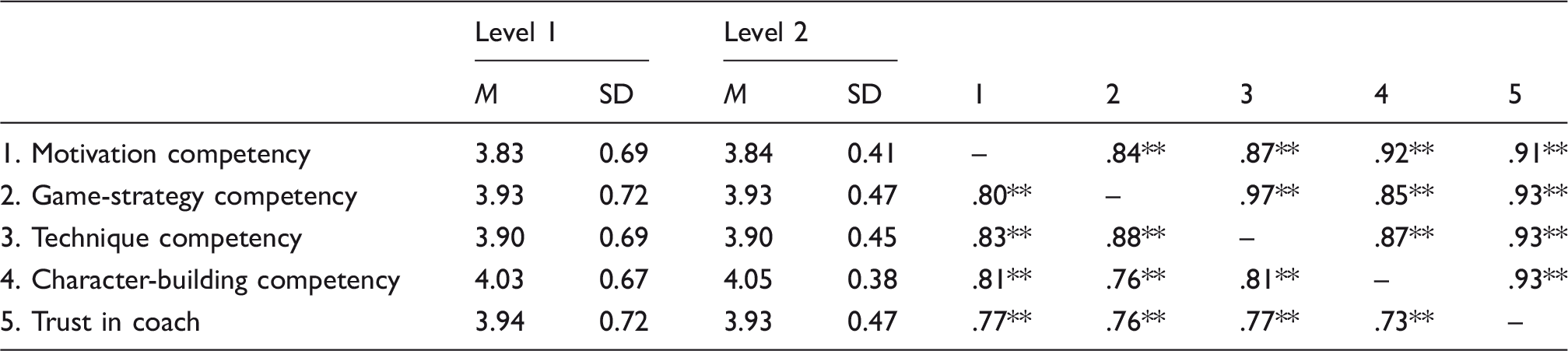
Correlations below the diagonal are for level 1, N = 438. Correlations above the diagonal are for level 2, N = 34.
p < .01.
Aggregate statistics
Before aggregating the individual scores related to coaching competency as the group-level variables, we performed a within-group agreement analysis using the rwg test and a between-group analysis using one-way analyses of variance (ANOVAs) and intraclass correlations (ICCs). The within- and between-group analyses were used to determine whether the evaluated coaching competency of the athletes is presentable at the group level.
Following James et al. 41 we estimated the within- group inter-rater agreement index rwg. The within-group agreement analysis estimated the mean values of motivation, game-strategy, technique, and character-building competencies to be .84 (range = .52 to .96, SD = .09), .86 (range = .63 to .96, SD = .07), .86 (range = .66 to .96, SD = .07), and .85 (range = .73 to .96, SD = .06), respectively These values were comparable to the recommend index rwg and were higher than the recommended cutoff of .70. 42 ANOVA was used to identify the significant between-groups variance for motivation (F (33, 404) = 6.87, p < .1), game-strategy (F (33, 404) = 9.70, p < .1), technique (F (33, 404) = 8.96, p < .1), and character-building (F (33, 404) = 6.40, p < .1) competencies. Furthermore, ICC1 and ICC2 were .22 and .81 for motivation, .35 and .88 for game-strategy, .33 and .86 for technique, and .26 and .82 for character-building competencies. These values are comparable to the medium to high ICC values of aggregated constructs reported in the literature.42,43 Therefore, the four coaching competencies were aggregated to determine the team-level values. The results supported the multilevel effects of coaching competency.2,5 In addition, the ICC for trust in the coach indicate that 39% of the variance in athletes’ perceived trust in their coach can be explained at the group-level, and that basketball teams can be distinguished from one another by using their perceptions of trust in their coaches.
Hypothesis testing
Hierarchical linear modeling results for trust in coach and coaching competency. a
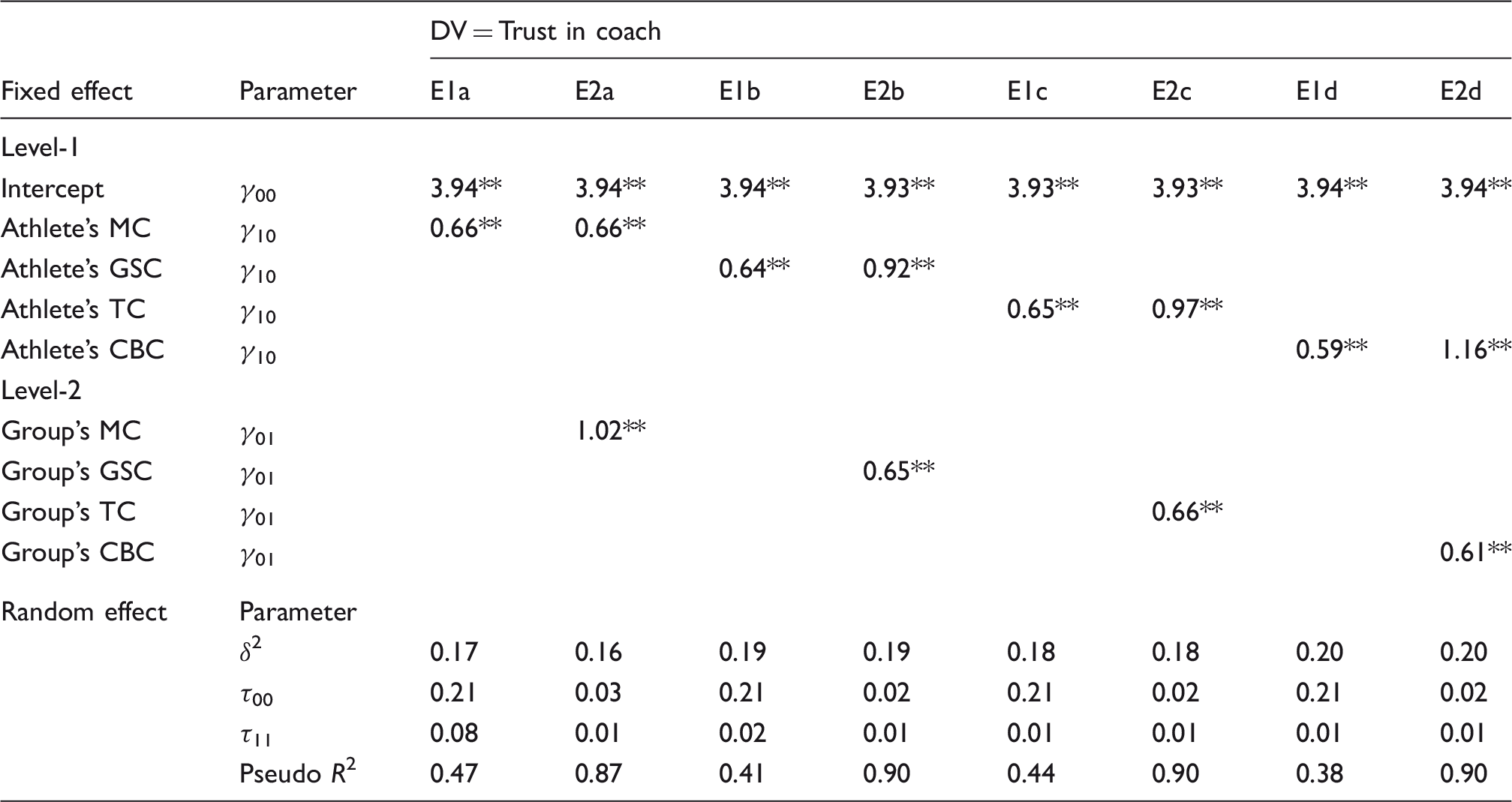
E: equation; DV: dependent variable; MC: motivation competency; GSC: game-strategy competency; TC: technique competency; CBC: character-building competency.
df for τ00 is 32, for τ11 is 33. Pseudo R2 for E1 = (δ2 of mull model − δ2 of E1) / δ2 of mull model. Pseudo R2 for E2 = (τ00 of H1 − τ00 of E2) / τ00 of E1. Mull model of δ2 and τ00 for trust in coach are 0.31 and 0.20.
p < .01.
The second hypothesis is that the positive relationship between coaching competency and trust in the coach is stronger at group level than at individual level. The results revealed that the strength for group-level motivation competency (pseudo R2 = 0.87) in trust in the coach was higher than that at the individual-level (pseudo R2 = 0.47). Similarly, the results for group-level pseudo R2 were higher than those at the individual-level pseudo R2 in game-strategy (pseudo R2 = 0.90 and 0.41), technique (pseudo R2 = 0.90 and 0.44), and character-building (pseudo R2 = 0.90 and 0.38) competencies. Therefore, the second hypothesis is also supported.
Discussion
The current study examines the relationship between evaluation of coaching competency by athletes and their trust in the coach at the individual and group levels. We hypothesized that the four-dimensional evaluation of coaching competency by athletes is positively related to their trust in the coach, and the positive relationship between coaching competency and trust in the coach is higher at the group level than at the individual level. Using HLMs, evidence pertaining to the positive relationship between the four dimensions of coaching competency and trust in the coach at both the individual and group levels was demonstrated. When the levels were considered jointly, athletes perceiving higher motivation competency (capacity to motivate the team), game-strategy competency (tactical strategy for guiding the team during competition), technique competency (presenting instructions during training sessions), and character-building competency (humanistic/positive attitude toward sports) were more critical of their trust in the coach. These results support the hypothesized connections between evaluations of coaching competency and the athletes’ trust in the coach.
The present study extends the literature on coach–athlete trust relationships7,9–11,31,32 in that the evaluation of coaches’ ability is a trustworthy characteristic for athletes toward coaches. Zhang and Chelladurai 25 demonstrated that the competence of the coach is an antecedent of athletes’ trust in the coach. In particular, we extend Zhang and Chelladurai, 25 in that coaching competency is also antecedents of athletes’ trust in their coach. Coaching competency appears to signal to athletes that the coach is reliable, respectable, and trustworthy.
This study demonstrates the strengths of coaching competency–trust in the coach–athlete relationship as well as the manifestations of team-perceived coaching competency. Pertaining to the strength of the relationship, 87–90% of the variance of trust in the coach was explained by the four dimensions of coaching competency at the group level, whereas this value was only 38–47% at the individual level. The result that the relationship was stronger at the group level is in conformity with that of Myers et al., 5 wherein the relationship between coaching competency and athlete satisfaction was examined from a multilevel perspective. This result may support earlier arguments on the relevance of group concept in sports (e.g., collective efficacy and motivational climate).36,37 Specifically, regarding the group concept, a group provides more reliable and valid ratings than an individual player does. The results of the present study suggest that basketball players develop similar (i.e., shared) perceptions of team coaching competency. These perceptions in turn contribute to individual players’ trust in the coach.
This study provides empirical evidence that the relationship between the four dimensions of coaching competency and trust in the coach is stronger at the group level than at the individual level. These results extend the findings of the study by Myers et al., 5 who examined the relationship between coaching competency and athlete satisfactions in only two dimensions of coaching competency (motivation competency and technique competency). Accordingly, group evaluations of the four coaching competencies (motivation, game strategy, technique, and character building) are highly influential across the group for building a sense of trust in the coach.
Data from the 34 teams included in this study was inadequate for testing the construct validity through multilevel structural equation modeling, 44 thus necessitating further investigation. Therefore, confirmatory factor analyses supporting the different coaching competency and trust in the coach dimensions at the individual level did not indicate whether these dimensions existed at the team level. Consequently, our results must be interpreted cautiously. Further research is necessary to determine the construct validity and the strength of the relationships between the coach competency and athlete trust at the group level. Furthermore, motivation climate is the theoretical construct that may clarify the relationship between coaching competency and trust in the coach. Motivational climate is the situational goal structure of social environment created by the coach. The development of a task-involving motivational climate (i.e., emphasizing role importance, cooperation, and improvement) or an ego-involving motivational climate (i.e., emphasizing punitive responses to mistakes, rivalry, and unequal recognition) influences the perceptions of the coach–athlete relationship 45 and may moderate the relationship between coaching competency and trust in the coach. Finally, a previous study indicated that team winning–losing percentages affect athletes’ perceptions of their coaches. 46 Thus, winning–losing percentages may influence athletes’ evaluation of coaching competency and their trust in the coaches. Future studies can explore these topics.
The results of our study present crucial implications for coach education. First, several Cs of coaching practical guidelines have proposed enhancing coaching effectiveness. These are Côté et al.’s 4Cs for coaching effectiveness and expertise,47,48 Jowett et al.’s 3 + 1Cs for coach–athlete relationships,7,32 and Harwood’s 5Cs for coaching efficacy. 49 These C guidelines are useful for facilitating coaches’ trustworthiness. For example, Harwood 49 indicated the importance of coach education training for improving coaches’ coaching efficacy and athletes’ perceptions of coaches’ related behaviors. Harwood suggested that the improvement of coaches’ coaching efficacy would increase athletes’ evaluation of their coaching competency. Therefore, coaches are encouraged to behave and reflect on Harwood’s 5Cs (i.e., commitment, communication, concentration, control, and confidence) coaching efficacy for improving their coaching behaviors and strategies. The improvements may facilitate evaluations of coaching competency by athletes and help them develop more trust in their coach. Second, our results highlight the individual- and group-level impacts of coaching competency on athletes’ trust in their coach. Coaches must focus on having a collective sense of motivation, game strategy, technique, and character-building competency. Both individual- and group-directed coaching competency behaviors positively influenced team athletes’ trust in their coach. In particular, our results indicate that group-directed coaching competency behaviors can instill a strong sense of trust in the coach for athletes.
Several limitations are associated with the current study. First, the employed cross-sectional design has inherent limitations that preclude any conclusion regarding the causal sequence between the two constructs. Particularly, interpersonal trust develops over time. 12 Future research can consider applying longitudinal designs to examine the development of the coaching competency–athlete trust relationship. Second, all sampled teams were Chinese basketball teams. Recently, Kao et al. 50 identified that non-work-related personal interaction plays a major role in Chinese (collectivist culture) sports settings. They suggested that athletes in the Chinese context are motivated to invest in close personal relationships with those who are in authority (i.e., their coach) to seek protection or advantages. Therefore, the results of the present study may not be generalizable to other cultures. Third, the small sample size and the unbalanced players’ gender composition did not permit an analysis stratified by gender. Studies have shown that leadership perceptions vary with players’ gender (e.g., Chelladurai and Saleh 51 ). Moreover, female coaches have reported having difficulty establishing credibility and respect as head coaches of male teams. 52 Therefore, the relationship between coaching competency and trust in the coach stratified by gender (or gender match between coaches and athletes) warrants investigation. Finally, we used the top four factor loading value items to assess the trust of athletes, changing Dirks’ questionnaires from nine items to four items. Although the four items indicate a good fit index, they may not adequately account for the entire domain of trust in the coach. Future research could use more items.
This research offers empirical support for the positive relationship between coaching competency and trust in the coach and serves as a reference for future research on coach competence–athlete trust relationships.
Footnotes
Declaration of Conflicting Interests
The author(s) declared no potential conflicts of interest with respect to the research, authorship, and/or publication of this article.
Funding
The author(s) disclosed receipt of the following financial support for the research, authorship, and/or publication of this article: The first author’s research on coaching competency was received funding support from the Ministry of Science and Technology (104-2410-H-134-017), Taiwan, R.O.C.