



Abstract
To address the need for theoretical investigations of life skills development, the current study looked to combine Self-Determination Theory and the 3C's model when investigating life skills development in sport. The purpose of this study was to investigate the role of the coach-athlete relationship in mediating the potential associations between coach autonomy support and participant's life skills development in Brazilian youth sport. A total of 724 (380 boys and 344 girls, Mage = 14.57, SD = 1.62) took part in the study. These participants completed measures assessing their perceptions of coach autonomy support, coach-athlete relationship (closeness, commitment, and complementarity) and life skill development (teamwork, goal setting, interpersonal communication, problem solving and decision making, time management, emotional skills, leadership, and social skills). Our analyses indicated that coach autonomy support had an indirect effect on participant's total life skills development (i.e., all eight life skills combined) via the coach-athlete relationship. In practice, these findings suggest that when trying to promote participant's total life skills development through sport, coaches should display autonomy-supportive behaviors and foster a positive coach-athlete relationship.
Over the past three decades, numerous researchers have developed, implemented, and evaluated programs within sports to promote the development of life skills in young people.1–3 Life skills have been defined as “functional skills that individuals develop in one context (such as the home, school, sport, community, workplace) and that are also used effectively in other contexts beyond that in which they were learnt”. 1 Examples of life skills include social skills, goal setting, teamwork, and communication skills. These life skills are considered essential, as young people can transfer the life skills learned in sport to other important areas of life, such as education, employment, family life, personal relationships, and the community.4,5 Nevertheless, some studies criticize the individualistic neo-liberal approach to life skills development, which focuses on the economic productivity of life skills and integrating young people into the existing social order.6,7
By acknowledging these critiques, current literature demonstrates an increasingly reflective and critical stance towards existing models of teaching life skills in sport, highlighting the need for more inclusive and socially aware approaches.7,8 While life skills have been widely recognized as valuable for youth development, it is essential to avoid uncritically adopting these concepts solely based on their widespread use. As the neoliberal framework may inadvertently commodify such skills, turning them into tools of social control that reinforce existing power dynamics and marginalize underprivileged groups, it becomes crucial to approach their application with nuance and sensitivity to broader social implications. Therefore, although research consistently indicates the benefits of sports participation for fostering skills like teamwork, leadership, problem-solving, time management, and communication,9,10 it is important to integrate these findings within a framework that actively addresses potential inequalities and challenges, ensuring that such skills contribute to the empowerment of all individuals, regardless of their social standing.
The question that many researchers have tried to answer is how exactly do young people develop life skills through sport?.2,4,10 In this regard, researchers have suggested that life skills can be developed both implicitly and explicitly in sport.2,11 Participants are said to develop life skills implicitly when the sport context is well structured and coaches, parents and peers create a positive developmental climate.2,10 Furthermore, it has been proposed that participants will explicitly develop life skills when there is a focus on life skills that involves discussing and practicing life skills in sport.2,10 Models proposed by Gould and Carson 12 and Pierce et al. 13 have also suggested that the inherent demands of sport, program design, coach characteristics, teaching strategies, the social environment, and the perceived usefulness of life skills play a role in the development of life skills in sport. Despite such knowledge on life skills development, Williams et al. 1 noted that few theory-based studies have been conducted to uncover the exact pathways or mechanisms by which young people develop a variety of life skills through sport.
According to Self-Determination Theory (SDT), 14 certain social/environmental conditions are needed for people to develop optimally. In sport, the coach is a key agent of the social environment who can help to either foster or forestall an athlete's life skills development.13,15 According to SDT,14,16 one of the key aspects of the coaching environment in sport is the degree to which the coach provides autonomy support. Mallett 17 has described seven key behaviours of an autonomy supportive coach: 1) provide choice to athletes, 2) give a rationale for tasks, 3) acknowledge the feelings and perspective of athletes, 4) provide athletes with opportunities for initiative taking and independent work, 5) give competence feedback that does not direct behavior, 6) avoid coaching behaviors that seek to control athletes, and 7) reduce the perception of ego involvement within the environment. According to Hodge et al.'s 18 conceptual model for life skills development, coach autonomy support is associated with life skills development in young people. Past research supports such a proposition by showing that coach autonomy support is associated with young people's development of their life skills through sport.19–22 Recently, Cronin et al. 21 highlighted that basic need satisfaction mediates the associations between coach autonomy support and British youth sports participant's development of eight different life skills. However, other possible mediators of the relationship between coach-autonomy support and participant's life skills development remain unresearched.
One such potential mediator is the coach-athlete relationship. Along with coach autonomy support, the coach-athlete relationship is at the heart of effective coaching. The quality of the coach–athlete relationship is defined by closeness (e.g., trust, respect, appreciation, and liking), commitment (e.g., loyalty and stability) and complementarity (e.g., cooperation, responsiveness, and receptiveness). These three C's (for a review, see Jowett & Shanmugam 23 ) – or what is known as the 3C's model – could potentially function as a predictor of life skills development in sport participants. In this regard, Jowett and colleagues24–26 have purported that the coach and athlete need one another to develop optimally in sport and beyond. Previous studies have identified that perceptions of a high-quality coach-athlete relationship is positively related to positive outcomes, such as team cohesion, 27 hope, 28 goal setting, 29 and leadership, 30 with the final two outcome being key life skills developed through sport. 31 Several models of life skills development have also highlighted the importance of the coach-athlete relationship for developing life skills in young people.12,15,32 Yet, there has only been one cross-sectional study by Vella et al. 33 which found that the quality of the coach-athlete relationship was positively associated with young Australian soccer players’ development of personal and social skills, goal setting, and initiative.
The present study
It is essential to study life skills development through sport in Brazil, given the unique characteristics of its social, political, and cultural landscape. To better understand this, it is important to first examine how the Brazilian sports system operates. Sports in Brazil are deeply influenced by social inequalities, with access often limited by factors such as income, education, and gender. Higher-income, more educated, and male Brazilians tend to have greater opportunities to participate in sports.34,35 The sports system is shaped by government policies that often prioritize elite sport and the hosting of major international events, frequently at the expense of grassroots and community-based sport initiatives. This political focus affects the accessibility and inclusivity of sports programs, potentially limiting the reach of life skills development initiatives.36,37
In terms of objectives, the Brazilian government and other agencies set targets that often emphasize international sporting success and national pride. However, these objectives do not always align with the goals of promoting life skills or fostering strong, quality coach-athlete relationships at the grassroots level. Life skills development, which includes promoting teamwork, leadership, and emotional resilience, is often overlooked in favor of competitive success and short-term results.38,39 This misalignment creates a gap in the sport system, particularly in community sport programs that could otherwise provide a platform for holistic youth development. By examining the current landscape, this study aims to shed light on how sports programs across Brazil can better incorporate life skills development into their core objectives. Understanding the social, cultural, and political ramifications of sports programming in Brazil is crucial for creating policies and practices that promote not only athletic performance but also the broader development of young people through sport. This research can contribute to designing and implementing quality sport programs that are both inclusive and capable of fostering meaningful coach-athlete relationships, leading to more impactful life skills outcomes.
In line with Appleton et al.'s 40 suggestion of combining theories when conducting youth sport research, the current study looked to combine SDT 14 and the 3C's model. 23 Specifically, the purpose of this study was to explore whether the coach-athlete relationship mediated the potential associations between coach autonomy support and participant's life skills development in sport. Based on past research studies and the propositions of Self-Determination Theory,14,18,41,42 the first hypothesis was that coach autonomy support would be positively related to Brazilian youth sport participant's life skills development. In line with past research findings29,30,33 and Jowett et al.'s23–26 propositions regarding the 3C's model, the second hypothesis was that the coach-athlete relationship would be positively related to participant's life skills development. Based on Hodge et al.'s 18 conceptual model for life skills development and past research findings,33,43,44 the third hypothesis was that the coach-athlete relationship would mediate the associations between coach autonomy support and participant's life skills development in youth sport.
Method
Study design and procedures
The present study involved a cross-sectional research design with all data collected at one time point. Before conducting the research, ethical approval was granted by the lead researcher's university ethics and human research committee. Initially, contact was made with the managers/coaches of the teams to request permission to conduct the research with their athletes at the end-of-season regional championship in 2022. After permission was granted, the researchers explained the purpose of the study to the coaches and parents who provided their written consent for the research to take place. Data collection was conducted before the team's first match at the competition and participants provided written consent prior to completing the questionnaire. Before completing the questionnaire, brief instructions were provided to participants about the purpose of the research and what was required when completing the questionnaire. Participants were informed that all information obtained in the survey would be kept confidential, and that they could withdraw from the research at any time. We also emphasised that there were no right or wrong answers to the questions, and that they should answer the questions with their perception at that moment. To avoid sources of bias, the order of the instruments within the questionnaire were randomised among the participants.
Participants
The sample included 724 Brazilian athletes from the states of Pernambuco and Bahia who trained and participated with club and school sports teams on a weekly basis. Participants included 380 boys and 344 girls aged between 10–18 years (Mage = 14.57, SD = 1.62). Participants were from the following sports: handball (n = 229), futsal (n = 172), volleyball (n = 93), soccer (n = 84), basketball (n = 50), combat sports (n = 44), swimming (n = 32), and track and field (n = 20). Participants reported playing their respective sport for an average of 36.9 months (Range = 3 to 156 months; SD = 25.4 months).
Instruments
Coach Autonomy Support. Coach autonomy support was assessed using the Perceived Autonomy Support: Exercise Climate Questionnaire (PASECQ) 45 which has been adapted for the Portuguese sports context. 46 This questionnaire consists of 6 items which evaluate perceptions of autonomy support provided by a coach/instructor. The item stem is “My coach/instructor” and an example item is “tries to understand my point of view before suggesting something new”. Participants respond to items on a scale ranging from 1 (totally disagree) to 7 (totally agree). Past research has supported the validity and reliability of this questionnaire with English and Portuguese speakers.45,46 Confirmatory Factor Analysis (CFA) showed that the scale displayed acceptable fit within this sample: χ2(9); p = .001; χ2/df = 3.57; CFI = .99; TLI = .98; RMSEA = .06. A satisfactory Cronbach's Alpha coefficient (α = .85) – representing internal consistency reliability – was found with the current sample.
Coach-Athlete Relationship. The Portuguese version 47 of the coach-athlete relationship questionnaire (CART-Q) 48 was used to measure the coach-athlete relationship. The 11-item direct perspective CART-Q has four items assessing closeness (e.g., “I like my coach”), three items assessing commitment (e.g., “I am committed to my coach”), and four items assessing complementarity (e.g., “When I am coached by my coach, I am ready to do my best”). All CART-Q items were measured on a 7-point Likert scale ranging from 1 (strongly disagree) to 7 (strongly agree). Past research has supported the factorial validity, test-retest reliability, and internal consistency reliability of this scale with youth sport participants. 25 CFA was conducted with this sample and revealed an acceptable fit for the scale: χ2 (36) = 174.62; p = .001; χ2/df = 4.85; CFI = .97; TLI = .96; RMSEA = .07. The Cronbach's alpha coefficients were also satisfactory with this sample: closeness = .85; commitment = .77, and complementarity = .84. In line with past studies, 25 we calculated the total coach-athlete relationship in the current study and included this as the mediator variable in our data analyses.
Life skills development. The Portuguese version 49 of the Life Skills Scale for Sport (LSSS) 50 was used to measure participant's life skills development. The validity and reliability of the P-LSSS has been supported with Portuguese speaking participants. 49 The 43-item scale uses the stem “This sport has taught me to….” and is followed by items assessing: teamwork (7 items; “work with others for the good of the team/ group”), goal setting (7 items; “set specific goals.”), time management (4 items; “control how I use my time”), emotional skills (4 items; “understand that I behave differently when emotional”), interpersonal communication (4 items; “communicate well with others”), social skills (5 items; “maintain close friendships”), leadership (8 items; “know how to motivate others”), and problem solving and decision making (4 items; “evaluate a solution to a problem”). Participants respond to items on a scale ranging from 1 (not at all) to 5 (very much). Past research has supported the factorial validity, test-retest reliability, and internal consistency reliability of this scale with youth sport participants.21,22 CFA was conducted with this sample and revealed an acceptable fit for the scale: χ2 (824) = 1571.36; p = .001; χ2/df = 1.907; CFI = .91; TLI = .90; RMSEA = .05. The Cronbach's alpha coefficients were also satisfactory as they ranged from .75 to .85 for each of the life skills subscales. In line with past studies,19,40 we calculated total life skills development in the current study and included this as the outcome variable in our data analyses.
Data analysis
Preliminary analysis
Means, standard deviations (SD), reliability coefficients (Cronbach's alpha), and Pearson correlations were calculated using SPSS 25.0 (IBM, 2017). Before the main analysis, we checked the data for univariate and multivariate normality, missing values, and outliers for all study variables following the procedures outlined by Tabachnick and Fidell. 51
Main analysis
The purpose of our study was to assess whether the coach-athlete relationship (mediator) mediated the association between coach autonomy support (independent variable) and participant's life skills development (dependent variables). We investigated this mediation model through structural equation modelling (SEM) using Amos 25.0 software. 52 Specifically, we followed the two-step model building approach recommend by Anderson and Gerbing (1988). 53 The first step involves testing the measurement model by using CFA, while the second step involves testing the hypothesized structural model. The internal consistency reliability of the measurement model (Step 1) was also assessed via composite reliability (CR), 53 while average variance extracted (AVE) was estimated to assess convergent validity. 54 CR equal or higher than .7 and AVE equal or higher than .5 are considered acceptable. 54
We used several fit indices to assess the fit of the measurement (step 1) and structural (step 2) models according to Hu and Bentler 55 recommendations: chi square (χ2), Normalized Chi-Square (χ2/df), Comparative Fit Index (CFI), Tucker-Lewis Index (TLI), Root Mean Square Error of Approximation (RMSEA). CFI and TLI values close to or above .95, RMSEA values close to or below .08, and the lower end of the 90% CI for RMSEA containing the value of .005 represent an excellent fit to the data for the hypothesized model. 48 Based on Kline's 56 recommendations, path coefficients were interpreted as follows: small effect (below .20 and p < .05); medium effect (.20 to .49 and p < .05); and large effect (above .50 and p < .05).
Mediation analysis
To test the theoretical model proposed for the study, the mediation effects were verified by the indirect effects (Williams & MacKinnon 57 ). Bias-corrected bootstrapped point estimates for the indirect effects of the independent variable on the dependent variable were estimated and their 95% confidence intervals were assessed. Significant indirect effects were present if the 95% confidence intervals do not include zero. Bias corrected and accelerated intervals supported by 1000 samples bootstrapping were used to make inferences. Bootstrapping procedures have been suggested by Williams and MacKinnon 57 as more effective and powerful at detecting indirect effects and have been utilised in past research studies.58–60
Results
Preliminary analysis
There were no missing values as the lead researcher ensured all surveys were fully completed during data collection. Examination of skewness and kurtosis values for all variables indicated univariate normality based on the cut-off values of < 3.0 for skewness and < 10.0 for kurtosis. 56 Skewness values ranged from −1.32 to −.55 and the kurtosis values ranged from .06 to 1.59. However, the Mardia's multivariate coefficient (which was 95.94) indicated that the data was not normally distributed. This justified the use of the Bollen-Stine bootstrap procedure to obtain a corrected chi-squared value of the estimated coefficients for the maximum likelihood estimator. There were no outliers within the dataset according to the square Mahalanobis distance (D2).
Descriptive statistics and correlational analyses
Table 1 presents the intercorrelations, scale ranges, means, standard deviations and reliability estimates for all variables. The mean score on the 1–7 response scale for coach autonomy support revealed that sport participants perceived their coaches demonstrate a high level of autonomy support during training and competitions (M = 5.49). The mean scores on the 1–7 response scale of the CART-Q revealed that participants perceived a high-quality relationship with their coaches in terms of closeness, commitment, and complementarity (M range = 5.51 to 6.01). The mean scores on the 1–5 response scale of the LSSS revealed that participants scores for life skills development were moderately high (M range = 3.93 to 4.15).
Summary of bivariate correlations, scale ranges, means, standard deviations and reliability estimates.
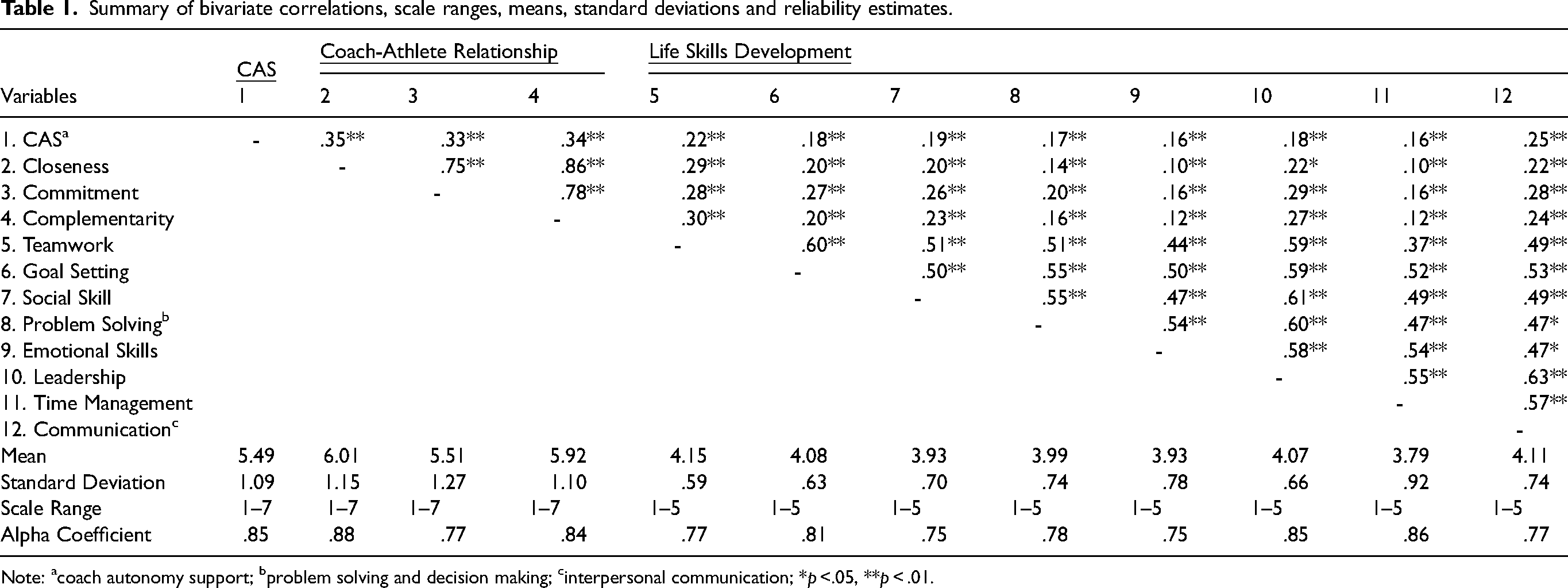
Note: acoach autonomy support; bproblem solving and decision making; cinterpersonal communication; *p <.05, **p < .01.
The correlations revealed that coach autonomy support was significantly and positively associated with all coach-athlete relationships variables and the eight life skills (r range = .16 to .35). The coach-athlete relationship variables showed significant and positive correlations with all other study variables (r range = .10 to .30). Furthermore, the life skills development subscales were significantly and positively associated with all other study variables (r range = .10 to .61).
Measurement and structural model fit
Initially, we tested a three-factor measurement model through CFA (SEM Step 1) by assessing the relationship of the items/variables analysed with their respective latent factors. Acceptable fit indices were obtained for the measurement model: χ2(116) = 374.55; p = .001; χ2/df = 3.23; CFI = .96; TLI = .95; RMSEA = .056) (see Table 2). All individual items loaded significantly onto their relevant factor. In order to assess convergent validity, AVE was computed. The AVE values were as follows: coach autonomy support = .50; coach-athlete relationship = .80; and life skills development = .53. The composite reliability values were as follows: coach autonomy support = .86; coach-athlete relationship = .92; and life skills development = .90.
Goodness-of-fit indexes of the measurement and structural models.

Note. N = 724. χ² = Chi-Square; df = degrees of freedom; B-S p = Bollen-Stine p value; RMSEA = root mean square error of approximation; CI = confidence interval; CFI = comparative fit index; TLI = Tucker-Lewis index.
Overall, these results supported the appropriateness of the measurement model for proceeding to SEM Step 2 (i.e., testing the structural model). The structural model (see Table 2) also indicated acceptable fit: χ²(117) = 390.70; p = .001; χ²/df = 3.34; CFI = .96; TLI = .95; (RMSEA = .05; CI 90% = .051 to .063). Firstly, it is important to highlight that coach autonomy support was not directly related to participant's life skills development in the structural model. As theoretically proposed, positive and significant direct effects were found amongst the study variables (see Figure 1). Namely, coach autonomy support positively predicted the coach-athlete relationship (β = .41; R2 = .17); which, in turn, positively predicted participant's life skills development (β = .32; R2 = .10). Hence, we moved forward to examining the specific indirect paths.

Standardized coefficients are presented with the thick lines significant at p < 0.05.
The indirect effect of coach autonomy support on life skills development via coach-athlete relationship was significant (see Table 3). This finding reinforces previous direct effect analysis, showing that relationship quality seems to stand as a significant predictor of life skills development, as well as it seems to play a positive mediating role in the association between coach autonomy support and life skills development (see Table 3).
Standardized direct and indirect effects for the structural model.

Note. β = standardized coefficient; CI 90% = Confidence Interval at 90%. **p < .01. *p < .05.
Discussion
This research aimed to explore the purported links between coach autonomy support, the coach-athlete relationship, and the development of life skills in young Brazilian athletes. To begin with, the results of the structural model did not support our first hypothesis that coach autonomy support would be positively related to participant's life skills development. Supporting our second hypotheses, the coach-athlete relationship was positively related to the development of life skills in young athletes. In line with our third hypothesis, there was an indirect effect of coach autonomy support on participant's life skills development via the coach-athlete relationship. Given that few theory-based quantitative studies have investigated life skills development in sport,1,61 our findings highlight that SDT (i.e., coach autonomy support) and the 3C's model (i.e., the quality of the coach-athlete relationship) can serve as theoretical frameworks for investigating the development of participant's life skills in sport.
In terms of our first hypothesis, our structural model did not support the idea of a direct effect between coach autonomy support and participant's life skills development. Although, it is important to note that our correlational analyses did show positive associations between coach autonomy support and participant's development of the eight life skills. This is likely the case as a bivariate correlation only shows that one variable is associated with another (or not), whereas a path coefficient in a structural model shows that one variable is associated with another (or not) whilst controlling for other variables in the model. So, in effect, whilst controlling for the coach-athlete relationship in our structural model, there was no statistically significant relationship between coach autonomy support and participant's life skills development. The findings from our structural model contrasted with the direct effects seen between coach autonomy support and athlete's life skills development in past studies in both Britain (Cronin et al. 21 ) and Brazil (Freire et al. 36 ) when including basic need satisfaction as a mediator. Given that ours was one of the first studies to look at coach autonomy support and the 3C's model in relation to life skills development, we would suggest that more research is needed to investigate if the findings from our study can be replicated or not by others.
In terms of our second hypothesis, the results from our structural model showed that the coach–athlete relationship had a significant positive impact on the development of life skills in young athletes. Such a finding was in line with Vella and colleagues 33 who found positive associations between the coach-athlete relationship and Australian youth soccer players development of personal and social skills, goal setting and initiative. As such, we can conclude that relationships with coaches characterised by closeness (e.g., trust and respect), commitment (e.g., loyalty and stability), complementarity (e.g., receptiveness and responsiveness) help young athletes to develop their life skills. Our own findings also aligned with Bean et al.'s 2 and Holt et al.'s 10 suggestion that a positive developmental climate helps support an athlete's life skills development. Likewise, our findings support Jowett and colleagues24–26 proposition that the coach-athlete relationship is important for an athlete to develop optimally. In practice, coaches can promote a positive coach-athlete relationship through open and honest communication, establishing clear goals, constructive feedback, empathy and understanding, creating an environment of trust, promoting teamwork, recognizing and celebrating achievements, developing a personalized training plan for athletes, fostering mutual respect, and demonstrating interest in the athlete's well-being. By looking at these behaviors, one can immediately see the links with life skills such as interpersonal communication, goal setting, and teamwork. Nonetheless, further research is required to uncover why such behaviors are associated with life skills such as time management, emotional skills, problem solving and decision making. Additionally, it is important to note that recent models of life skills development (Camiré 7 ) have indicated that coaches can have a normative approach (e.g., that focus on teaching conventional life skills and do not account for systemic issues like racism and ableism) or transformative approach (e.g., that focus on social justice, solidarity, and change) to teaching life skills (Camire 7 ). As such, future research ought to investigate a wider range of life skills that pertain to social issues (e.g., equality, diversity, and inclusion), and transformative coaching approaches to life skills development that ultimately lead to social change. Furthermore, recent models of life skills development suggest that coaches can adopt either a normative approach (focused on conventional skills and disregarding systemic issues such as racism and ableism) or a transformative approach (focused on social justice, solidarity and change). Future studies should investigate a broader range of skills related to social issues such as equality, diversity and inclusion, and transformative training approaches that lead to social change.62,63
Regarding our third hypothesis, the structural model showed an indirect effect between coach autonomy support and participant's life skills development. The path coefficients from the structural model showed that coach autonomy support was positively associated with the coach-athlete relationship, which, in turn, was positively associated with participant's life skills development. Regarding the first association (i.e., coach autonomy support to the coach-athlete relationship), the research literature has shown that young athletes prefer coaches who are involved in training and instruction, give positive feedback, and exhibit more democratic behaviour. 64 This preference for coaches who are autonomy supportive may explain the positive relationship between coach autonomy support and the coach-athlete relationship in the structural model. In practice, our findings suggest that coaches should provide participants with choices during training/practice, acknowledge participant's feelings and perspectives, provide reasons for tasks and exercises, provide opportunities for participants to work proactively and independently, and deliver individualized competence feedback. 31 By displaying such autonomy supportive behaviours, it seems that coaches can also enhance their relationships with their athletes and, in turn, develop their athlete's life skills. Nonetheless, given that ours is one of the first studies to look at the associations between coach autonomy support and the coach-athlete relationship, we feel that more research is required to unpick the exact reasons or mechanisms that explain the positive associations between these two variables. For this task, qualitative research with both coaches and athletes may be particularly beneficial.
When compared to other contexts, the results of this study show similarities with previous research carried out in different countries and cultures.21,33,43 The only exception was the lack of a relationship between coach autonomy support and participant's life skills development in our structural model. In social, cultural, and political terms, it is important to consider that training practices aimed at developing life skills may vary according to the diversity of each country. Taken as a whole, our findings suggest that both self-determination theory 14 and the 3C's model 23 can be used to investigate and promote life skills development through sport across the globe. However, it is important to consider that coaching practices aimed at life skills development may vary according to the cultural and contextual specifics of each country. 65 In the Brazilian context, for example, issues such as socioeconomic disparities and the political prioritization of elite sports over community-based programs can significantly impact how effectively life skills are taught and learned. Therefore, we would highlight that further research is needed in Brazil to investigate the social (e.g., socioeconomic status and educational level), political (e.g., the focus on elite as opposed to community sport), and cultural factors (e.g., carioca culture) that may impact the success of different approaches to life skills development through sport.
Limitations and future directions
This research has several limitations that ought to be highlighted. To begin with, there has been criticism of the concept of life skills, especially regarding the individualistic neo-liberal approach to life skills development and lack of consideration of issues pertaining to power and social justice.6,7 To address such a limitation, more research is needed on the teaching of non-conventional life skills (e.g., social justice) through sport and the coaching approaches that might bring about positive social change (e.g., transformative coaching). Furthermore, the self-report measures used in this study are potentially limited by response bias, social desirability, and common method variance. Although we took steps to mitigate against such limitations (e.g., requests for honesty when responding and alternating the order of the scales used), future studies could support our findings using alternative research methods (e.g., by conducting observational studies). Another limitation of this study is its cross-sectional nature, which does not allow for causality to be determined. To address this limitation, future studies should use both experimental and longitudinal research designs when investigating participant's learning of life skills in sport. The use of longitudinal research designs is particularly warranted given that some researchers suggest that development is best studied over time. Lastly, the participants within this study were culturally homogeneous (mostly white Brazilians) and therefore future research should investigate variations in life skills development amongst more heterogeneous groups.
Conclusion
By employing a combination of SDT and the 3C's model, the present study demonstrated that coach autonomy support indirectly influences the development of life skills in athletes through the quality of the coach-athlete relationship. These findings underscore the importance of understanding the nuanced dynamics within this relationship as a pivotal factor for fostering life skills. A key takeaway from our study is the practical implication that coaches should prioritize creating an autonomy-supportive environment, characterized by open communication, encouragement of athlete independence, and mutual respect. This approach helps cultivate positive coach-athlete relationships, which are essential for the effective transmission of life skills such as teamwork, leadership, and problem-solving.
Looking forward, future research should continue to explore life skills development through a combination of theories and models, such as SDT, Achievement Goals Theory, the 3C's model, and the two-continual model for teaching life skills. Moreover, given the distinct social, political, and cultural contexts that shape sports in Brazil, it is vital to investigate how these factors influence the applicability of these theories and models in different environments. The current study's findings reveal both similarities and unique aspects of life skills development in the Brazilian sports context when compared to other countries. Thus, future research should aim to unravel the complex ways in which these contextual elements shape life skills outcomes in athletes, potentially contributing to more tailored and context-sensitive approaches to sport programming both in Brazil and internationally.
Footnotes
Declaration of conflicting interests
The authors declared no potential conflicts of interest with respect to the research, authorship, and/or publication of this article.
Funding
The authors received no financial support for the research, authorship, and/or publication of this article.
