



Abstract
The aim of this study was to explore: (a) sociocultural features of a first team environment perceived to influence a player's progression, (b) the ways in which young players should manage these features and (c) how coaches operate to assist young players during specific phases in the youth-to-senior transition. Semi-structured interviews with eight elite development coaches in English Premier League football clubs generated two higher order categories: fitting in with standards of first team environment (e.g. handling social dynamics in the first team group) and facilitating shared perception of transition across key stakeholders (e.g. communicating with first team staff). Together, these findings indicate the need for young players to navigate between conforming, adapting to and breaking with specific features of the first team environment to successfully progress in the youth-to-senior transition to professional football.
Keywords
Introduction
I remember my first training session with the first team and it was war. I said to the boss at the door when I left, ‘This is different!’ … I remember seeing two players fighting in training, and I had an argument with Jens Lehmann as well and I was thinking, ‘Wow, where am I?’ Francis Coquelin, Arsenal FC
1
One of the key stages in the development of elite young footballers is the within-career transition from youth level to senior professional football. 2 Contemporary literature describes this transition as a multifaceted, complex and dynamic developmental phase.3,4 In this regard, within-career transitions often involve ‘a set of specific demands related to practice, competition, communication, and lifestyle that athletes have to cope with in order to continue successfully in sport' (Alfermann and Stambulova, 5 p. 713).
Career transition research suggests that athletes' progression from youth to senior level comprises specific within-transition phases: an anticipation phase (e.g. expectations of the transition), an encounter phase (e.g. the initial training sessions with the first team) and a process of adaptation (e.g. becoming a part of first team training). 6 Consequently, each of the distinctive phases may involve complex and dynamic sociocultural barriers, and distinct expectations and demands from senior players and management as stakeholders in a high-performing environment, which young elite players are required to overcome, comply to or conform. For example, it may be overwhelming and intimidating for a young player to encounter the ferocious humour in a first team environment by being subject to undermining from a senior professional in training. 7
High-performing cultures in elite sport contexts a have been defined as ‘a dynamic process characterized by the shared values, beliefs, expectations and practices across the members and generations of a defined group' (Cruickshank and Collins, 8 p. 340). Contemporary research on culture change in elite sport teams indicates that management-led processes (i.e. first team manager/team manager and staff) uphold the pillars of these dynamic and social systems.9,10 More specifically, these processes often involve collecting, negotiating and integrating the views and opinions of within-sport (i.e. players and support staff) and outside-sport (i.e. board, media and fans) stakeholders through reciprocal interaction and power-sharing.11,12
In professional football, these high-performing cultures, often male-only environments, have been described as authoritarian, ruthless and hyper-masculine,13,14 as well as ‘traditional, conservative and closed … resistant to change and suspicious of outsiders' (Eubank et al., 15 p. 31–32). In this context of practice, culture does not only entail ‘the daily practices, operational mechanisms and explicit processes, but … unwritten rules, precedents, values and patterns of belief' (Nesti, 16 p. 9). In the transition to first team level, young players may encounter individualistic attitudes, aggressive masculine identities, violent and abusive language, ruthless rivalry and ferocious humour and ridicule, as these can be features often prevalent in everyday work.7,16,17 However, few studies have investigated how such features of first team environments might be associated with the progression of young players in the youth-to-senior transition.
A cultural ‘gap' between the first team level and youth level have been reported in professional football. 18 To introduce young players into first team environments, professional football clubs appear to use a staggered approach (moving players up to first team brief and abruptly). 19 In this sense, a young player's ability to navigate in a successful way between different groups or cliques that invariably exist within team environments appears to facilitate progression in the youth-to-senior transition. 4 However, at first team level, young elite players have reported difficulties gaining approval and respect from senior players and first team management, 3 and they appear to struggle to integrate themselves due to the competitiveness and win-at-all-costs-culture.19,20 Indeed, when encountering high-performing environments of professional football, young elite players have reported experiencing a ‘culture shock'.21,22 To bridge the cultural ‘gap' between youth and first team level, it is important to investigate the features of first team environments perceived to be associated with young player's progression as it may potentially increase the youth-to-senior conversion rate in professional football clubs.
To examine the role of context-related features when moving up to first team level, we addressed the transitional phases (i.e. the encounter and adaptation phase) outlined by Jones et al. 6 Hence, the purpose of this study was to explore: (a) features of a first team environment perceived by elite development coaches to be associated with a player's progression, (b) the ways in which young players should manage these features and (c) to understand how these coaches operated to assist young players during specific phases in the youth-to-senior transition.
Method
Research strategy and philosophy
Reflecting the explorative nature of the research inquiry, and to examine the topic from a development perspective, we applied a qualitative approach interviewing elite development coaches. Working with youth players on a daily basis, the main task for elite development coaches is to ensure that youth players are sufficiently equipped to handle the demands of first team football. In light of the staggered approach applied by professional football clubs, the first team management often promotes young players for two main reasons. Either (a) because of injury to a first team player and they need a replacement in that session, which may result in a young player going up to train with the first team being (heavily) unprepared or (b) the first team manager has observed a young player and invites him to train with the first team. There are also instances where a combination of the two reasons occur.
The approach we applied enabled us to investigate the topic from both a conceptual and an applied perspective. Conceptually, it allowed us to explore features of an elite football environment through its perceived influence on the progression of young players. From an applied perspective, it allowed us to investigate how elite development coaches considered particular cases of transitioning should appropriately handle the features of first team environments.
This approach aligns with a pragmatic research philosophy. 23 By using methodological approaches relevant to the fields of study, a pragmatic-oriented research process ‘elucidates practical-level truths by developing understanding in how “real world” processes function in applied contexts' (Cruickshank et al., 10 p. 109). As a pragmatist, the researcher views current truths, meaning and knowledge as tentative, and likely to change over time, rather than definitive representations of realities. 23 Interested in bridging the gap between practice and theory, we seek to find provisional solutions to contemporary beliefs and/or perceived issues in the context of study,24,25 which in this case, represents the low conversion rate of young players into first team football in top-level professional football clubs.
Participants
Eight male elite youth development coaches, ranging from 28 to 59 years of age, participated in the study and were all recruited from top-level professional football clubs in the English Premier League. To confirm a highly informed and relevant sample, a number of pre-conditions were set. The development coaches needed to be: (a) working full-time as an academy coach and having obtained a UEFA A/Pro-license, (b) have a minimum of five years of coaching experience and (c) having worked with players who successfully progressed to the first team level (i.e. English Premier League).
Seven of the coaches worked, or had worked, at either U21 or U18 level, at their current or previous club. All the coaches had between 6 and 28 years of experience as full-time and part-time coaches. Three of coaches had comprehensive backgrounds as professional players in the English League One, Championship and Premier League, having successfully made the youth-to-senior transition themselves. On the contrary, three other coaches had not made the transition to first team in the club in which they were currently coaching (the remaining two coaches had played non-league football).
Procedure
Following institutional ethical approval, the process of identifying suitable clubs was undertaken (i.e. at least five players promoted to first team over last three years). Gaining entry to the working practices of elite sport contexts may be a complex and challenging task.15,26 To achieve this, the researcher initiated and upheld contact with informal (e.g. coach federation representatives) and formal gatekeepers (e.g. academy employees) over a 12-month period to facilitate access. After this, an information letter detailing the nature of the study was e-mailed to the club granting the researcher access to the site of study. 27
Interviews
A provisional interview guide was pilot-tested on four elite football coaches previously employed/currently employed by professional football clubs in the Norwegian Premier Division. This allowed the researchers to make alterations to ensure the narratives of the guide and stability of data collection. 28 Participants were interviewed once at mid-season.
Before the interviews began, the researcher discussed the information letter with each participant before informed consent was given. All the interviews ranged in duration from 33 to 82 min (M = 51.5, SD = 14.95). A semi-structured interview guide was structured to elicit open-ended responses pertaining to: (a) encountering the first team context and (b) adapting to the first team context. All the interviews were transcribed verbatim. After that, the transcribed texts were sent back to the coaches for verification to ensure no statements were misinterpreted or transcribed incorrectly. 29 Seven of the interviewees verified the transcripts and one coach sent back a revised version with minor amendments. All coaches received a pseudonym (e.g. Coach 1 = Coach Andre) in the transcribed texts to ensure their anonymity, and only this code is referred to in the Results section of this study.
Analysis
Following the procedures of a hierarchical content analysis,
28
the first step involved immersion and familiarization with the transcribed data. Specifically, this involved reading the interview texts repeatedly and identifying segments of data containing meaningful information to the inquiry of the study, whilst making personal notes of initial thoughts. After, these meaning units were labelled with codes derived from the exact text or reflective of its content. These codes, or raw themes, were coalesced into clusters of topical commonality, which generated lower order and higher order categories. For example, raw-data codes such as ‘threat to first team players' job situation’ and ‘rivalries in first team group’ were grouped to create the lower order theme ‘handling the competitiveness of first team environment’ (Figure 1).
Example of the hierarchical analysis process from meaning units to higher order categories.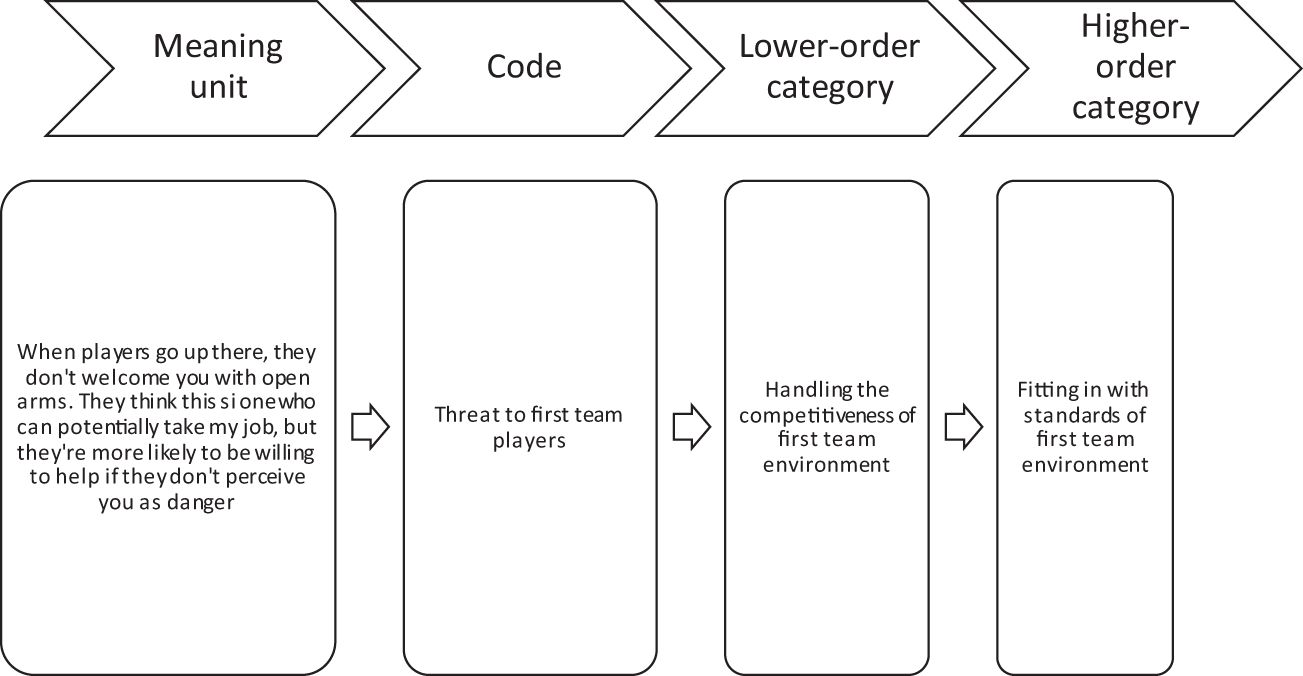
Following this phase, the primary investigator thoroughly re-examined the raw data units, coding and categories. Finally, the second and third author reviewed the categorization of data into lower and higher order clusters of generality and critically discussed this with the primary researcher as ‘critical friends'.30,31 Overall, our discussions constituted a high level of agreement on data grouping. 28
Trustworthiness
Based on the qualitative inquiry applied, the primary researcher utilized a systematic approach in the data collection process and during data analysis to assure the quality of this interview-based study.31–33 A purposive sampling strategy identified suitable coaches and clubs. 34 Due to the primary researcher's inexperience in professional football, discussions with senior researchers working in this context b and elite football coaches allowed better understanding of its nature, the appropriate conduct and jargon in the environment. 27 Understanding the field of study prior to entry may have facilitated acceptance and rapport with the elite development coaches during the interviews. 31 However, as an ‘outsider', the interviewees introduced and sensitized the primary researcher to cultural aspects of integration and appearance in professional football, which elicited rich and detailed accounts of the transition. 27 After data collection, because a non-native English speaker transcribed all interviews, the texts were sent back to the interviewees allowing for member-checking to assure an accurate reproduction of statements. 29
A reflexive stance 3 was adopted to ensure a ‘thoughtful and self-aware analysis of the intersubjective dynamics between the researcher and researched' (Finlay and Gough, 35 p. ix) during data analysis. Reflecting on assumptions and personal beliefs from working in Norwegian youth football sensitized the first author to potential biases and new perspectives in the data analysis. 36 To further account for this, cross-checking of the labelled raw-data themes and hierarchical categories was carried out by the second and third authors who acted as ‘critical friends'. 33 Both authors have extensive backgrounds working with elite athletes and teams across genres of sport. After engaging in critical discussion, all authors reached full agreement on data grouping. 28
Results
A total of 81 raw themes emerged from the initial coding of data. Analysis generated five lower order categories and two higher order categories. The higher order categories were fitting in with standards of first team environment (e.g. handling social dynamics in the first team group) and facilitating shared perceptions of transition across key stakeholders (e.g. communicating with first team staff). The first higher order category represents sociocultural features of first team environment perceived to be associated with player progression, and provides examples of how young players might manage these. The second higher order category is person-centred illustrating the role of elite development staff in aligning and sharing first team staff and players' perception of transition. A framework of lower order and higher order categories are presented in Figure 2.
A framework comprising two higher order categories and five lower order categories associated with player progression in specific stages of the transition from youth to professional football.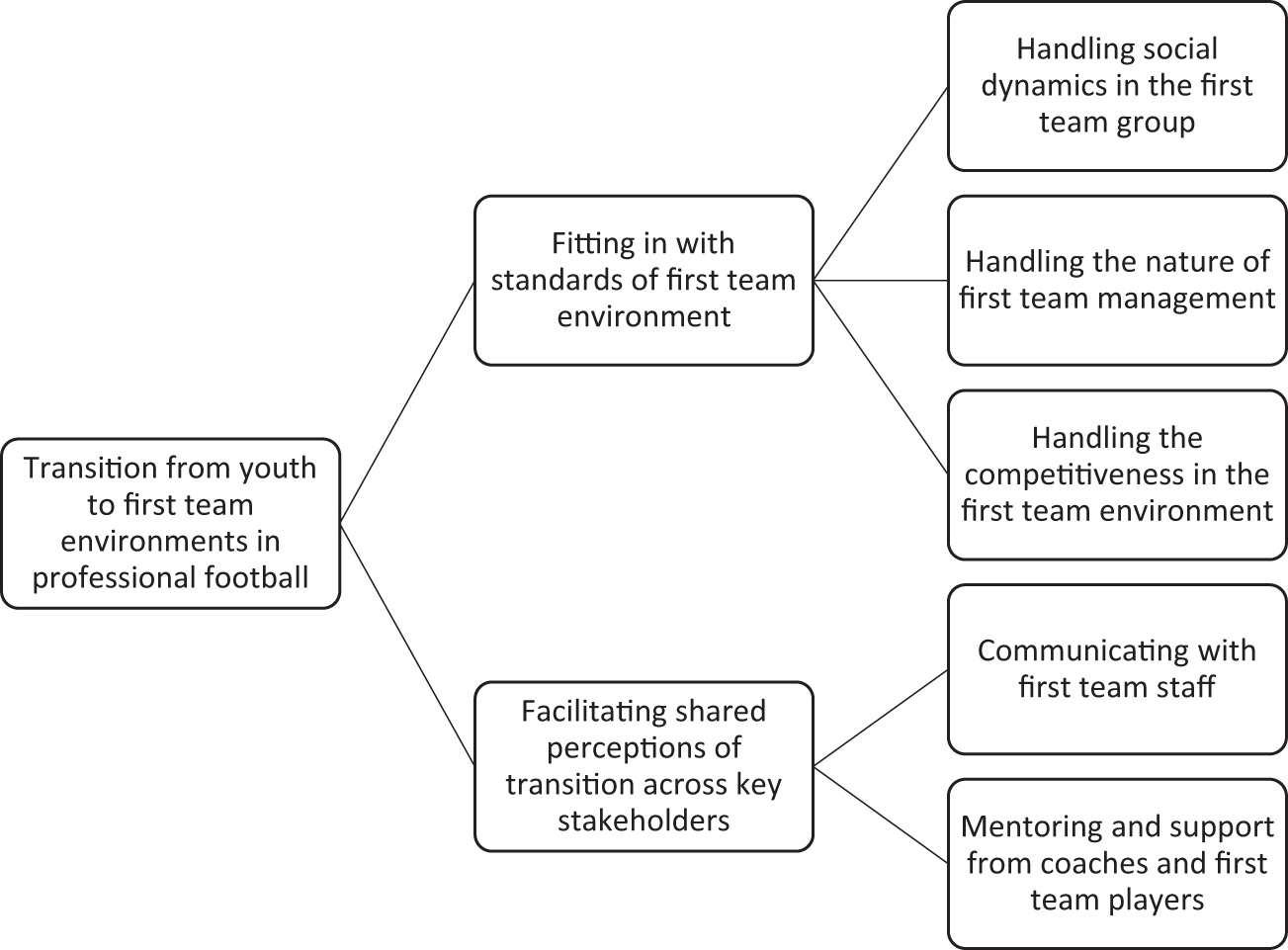
Fitting in with the standards of first team environment
The higher order category describes perceived notions of first team environment constituting elements of culture that young players would need to adjust to during the transition process. More specifically, this involves handling the social dynamics in the first team group, the nature of first team management and the competitiveness in this environment. In the following, the presentation of lower order categories will include supporting quotes pertaining to either the encounter and/or adaptation phase of the transition.
Handling social dynamics in the first team group
Understanding how to generate auspicious first impressions and to distinguish yourself from peers, both on and off the field, using social and emotional skills was important in the encounter phase. Coach Andre described how ‘the social side of it is massive, getting accepted by other players. Your talent will get you over the line, but the way you conduct yourself when you are in that group will count as well'.
To acquire full acceptance as a young player in the first team environment, managing various types of pressures and expectations from senior professionals seemed necessary. A part of this involved coping with technical and tactical requirements and speed of play; a process of player-surveillance referred to as gaining credibility. Coach Danny explained: You have to go up there and whatever practices or sessions you are going into, you have to understand very, very quickly what the rules are, what the conditions are … if they cannot get that straight away, then they lose the credibility straight away. Every time you are getting on the ball, an established first team player is getting at it. For the effect of the environment, because this is what they will say: ‘fucking hell, any chance of him keeping the ball!?’ If you are getting that, it is a huge pressure to deal with. Do they look assured or do they look like nervous kittens? Do they engender a trust from the players around them … I guess it goes back to animal instincts, do they exude an aura that they're okay here or do they exude an aura that they don't want to be here and that they're frightened to death?
Another part of the social dynamics in this phase referred to ‘the dressing room culture'. To deal with this, Coach Henry stressed that a young player's willingness to join in and manage the ‘banter' (a conversation that is funny and not serious) could be helpful in the encounter phase. Coach Eddie exemplified, ‘(when) the first ones give you a bit of stick, are you going to think in your head “I’d better slow it down, the lads are bantering me”, or are you willing to laugh at it and keep doing it?'
A player's ability to adhere to certain social norms, habits and espoused values in the first team environment seemed to influence the extent to which senior professionals and management perceived young players as professional during the encounter phase. Coach Ben described that, as a young player going up to the first team, you had to ‘make sure you’re in plenty of time (and that) you’re out and ready to train, looking the part (visual and physical appearance) and present yourself well in terms of your training kit and your boots'. Adding to this, Coach Danny said, ‘your punctuality, your general behaviour is an absolute given and if you don’t have that as a young player trying to break into the first team then you’ve got absolutely no chance'. In other words, failing to adhere to or ignoring grounded precedents of professionalism in the first team environment appeared have a negative effect on your progression.
During the adaptation phase, as transitioning players inertly established themselves as part of the group, the player-surveillance from other senior professionals seemed to decrease. However, peer coaching (from other senior professionals) was a feature of first team training that could complicate the process of social integration at this stage, because it seemed transitioning players were expected to display different interpersonal behaviours on and off the field. Referring to this discrepancy, Coach Greg said, ‘you’ve got to respect the older players (off the field), but show them no respect on the field. You’re there to take their place'. Indeed, the day-to-day behaviours and proceedings outside the training sessions appeared to be dissimilar to performance-related behaviours: They are here from early in the morning until late at night, and they cannot play football all the time. So they have to learn how to manage themselves around the place. It is a place that is built on respect; respect for yourself and respect for other people, allowing people to work and train. (Coach Chris) playing for (name of club), you may have French-speaking, Italian-speaking, Belgian-speaking, German-speaking, Dutch-speaking … despite the cultures you have to find a way of being together. If you are socially vacant or socially empty then you are going to have a problem.
Handling the nature of first team management
Understanding the first team manager’s key principles, ideas and requirements was a feature of the first team environment highlighted in the encounter phase. Coach Eddie stated, ‘it's a crime if you go and train today and you get undone on one of the manager's key principles'.
In the initial training sessions, the first team manager may require a young player to play in an unfamiliar position. In this sense, embracing and adapting to the ideas of first team management by displaying cognitive flexibility was emphasized as an asset for young players. In an example of how this might transpire, Coach Ben said: He might be a centre forward, but the manager might have something in his mind: ‘Actually, I think I might play him off the right hand side as a midfield player’ and want to see him in a training session. So you have to be able to adapt in that perspective. On day 22, if you still got that mental strength if you want to call it that, to continue to do the things we spoke about; to assert yourself on the training session, to have the bravery and courage to constantly get on the ball, the courage to be at a noticeably higher level than anybody else. Because you do that, you are making a statement. If it’s a bit cold and they (the first team players) want to put their hats on, jackets up to here (pointing at the chin), hands in the sleeves and they want to go at 50% through the session then it’s very difficult for a young player to not follow suit or be bold enough amongst established first team players and be at a noticeable higher intensity. So technically (by doing this), you are embarrassing the first team and you are showing them up. They want to train here, at a low level … so if the first team wants to train here, are you able to go up there and set your own bar extremely high regardless of circumstance? I have worked with seven or eight managers here, and a lot of them are looking for different things. Where some managers might be looking for arrogance, others might be looking for humility. And again, there are some players who have failed here because they have not read the change in manager and not read what he is looking for. (Coach Henry) I could go up there now, train once and run around like a mad man. But it is more about what they do on day 21 of training with the first team, when they have still not made their debut and they are still not sure. The manager is not really talking to them because he’s (the player) a young lad and he’s (the manager) got other things to worry about. So you are still not sure that they are having you, or that you are closer.
Handling the competitiveness in the first team environment
In the encounter phase, the interchangeable dyad of hostility and friendliness directed at transitioning players, often induced by the competitiveness in the first team environment, seemed to be a feature difficult to handle for young players. Coach Andre said: In an all-male environment, showing any kind of weakness is not perceived very well. You would not admit to any weaknesses and not necessarily to people within your team … the players would want to prove that they are better than the person that is in the team. And you need that, that’s healthy. When (young) players go up there, they do not welcome you with open arms. They think this is one who can potentially take my job, but they are more likely to be willing to help if they do not perceive you as danger. (Coach Chris)
In order to survive and/or thrive in the first team environment during the first training sessions, young players were encouraged to develop and use individual, wide-ranging and idiosyncratic survival mechanisms to deal with the competitiveness and interpersonal rivalry. Coach Henry said: They have to deal with it in their own way, so someone like (name of player) could threaten to knock somebody out … someone could have physical prowess, they have that aura that they are not going to be bullied. Somebody like (name of player), you cannot bully (him) because he has a very quick tongue so he can stand up for himself in a very different way … I think as long as you have outstanding survival strength, whether it is physical or mental, or it might be wit or humour; surviving in that changing room and surviving on that pitch in terms of body language or humour or whatever. They have to learn to develop that as a mechanism to survive.
To learn how to handle this feature of first team environment, an integral part of the adaptation phase often involved transitioning players going on loan to other professional football clubs. Referring to this, Coach Danny said: It is going out into an unfamiliar environment, dealing with the pressures of playing in men’s football where it is competitive and it is playing for three points. People’s livelihoods and careers are on the line, there is a passionate support base and it is a much more challenging environment then youth level football.
Facilitating shared perceptions of the transition across key stakeholders
This higher order category describes how elite development coaches interacted with first team stakeholders to align, share and manage first team staff and young players' perception of transition. More specifically, this involved a reciprocal communication with first team staff to understand their expectations of transitioning players, using this information to manage the players' perception, as well as allowing senior professionals to work and share their experience with young players as academy coaches. In the following, the presentation of lower order categories will include supporting quotes pertaining to either the encounter and/or adaptation phase of the transition.
Communicating with first team staff
A trustful and productive relationship between the elite development staff and first team staff seemed to facilitate a reciprocal communication between the two departments. On one hand, this entailed the first team manager sharing his values, views and principles with the elite development staff. Referring to this, Coach Greg said, ‘the academy manager, he knows all about him (first team manager) and he’s had many conversations with him. So he knows what his expectations (of young players) are and he feeds that back to the academy staff'.
On the other hand, this communication enabled prominent elite development coaches to discuss the capabilities of young players with the first team staff. In an example of this, Coach Henry said: (Name of player) went up there and he failed a couple of times, but with the backing and the support of the (youth) staff to the manager, we said, ‘Look at him again. He is a good player, look at him again'. And at some point, they prove when they are up there that they are good enough, but that is not always at the first time of asking.
Mentoring and support from coaches and first team players
In the encounter phase, the elite development coaches used the information acquired about the first team managers' preferences to support young players by framing the training sessions. Coach Eddie said, ‘I always try to educate the boys … build them or give the players an idea of exactly what the manager is looking for'. In one of the clubs, Coach Chris explained how the elite development coaches sensitized a young player to how his sociocultural background could oppose the preferences of first team staff when moving up to train with the first team: We have to be aware of those cultural differences when people move up and when they are under pressure because you do revert to type a little bit. So if the manager asks you a question, you have to be some character if you come from an African or West Indian background and you are used to not looking your parents in the eye or something and then go look him in the eye. That is one of the things they try to do here, getting kids to understand the type of things that are expected. I think what we have done here in recent years is quite good in that we have taken the time to coach many of the senior players (as coaches). So we get (name of player) around here regularly, (names of first team players) now are buying in. We have many of the academy boys who have come through the system, so I think it is far easier now because they got friends over there or familiar faces over there. So I think the (naming current first team players) were the pioneers because they had to go and break into something that was not there before. I think it is marginally easier for the boys now because there is maybe not the hostility or the lack of credibility (Coach Henry).
In the adaptation phase, the elite development coaches would interchangeably observe young players training with the first team as often as possible; gauge the manager's opinion and feedback to the players informing them of their status and progress. Coach Henry gave an example of how this might transpire: Someone like (name of player), he would need a little more guidance because he is younger, and he is only 17. But he needs a little bit help on his body language (because) he is quite laid back. He would get hints from me at what the manager is looking for and the criticism that the manager is giving him.
Discussion
The present study explored (a) how features of a first team environment as perceived by elite development coaches were associated with player progression, (b) the ways in which young players might manage these features and (c) how these coaches worked to assist young players in the youth-to-senior transition. The results of this study relate to specific phases in the youth-to-senior transition. As such, it contributes new insight into career transition literature in sports and it compliments extant sports-related literature proposing a flexible and strategic approach to elite talent development as a preparation for senior level sport.37–39
To progress in the transition to first team environment, effective management of non-verbal impressions pertaining to sport and non-sport domains in the first team environment appeared crucial. For example, if young players failed to exhibit the ‘right' type non-verbal behaviour when meeting first team players or did not display assertiveness in the environment of first team football during the adaptation phase, it could influence the extent to which senior professionals perceived them as credible cases in the first team environment. Impression management, also known as self-presentation, is defined as ‘the process of which people try to control others' impression of them'. 40 When using appropriate self-presentational strategies, the transitioning players were perceived to succeed in accommodating cultural expectations and demands endorsed by senior professionals and/or first team management.
High-performance culture is a social system upheld by management-led processes that collects, negotiates and integrates views of internal (as well as external) stakeholders.10,11 However, how elements of culture associate with the integration of young players in professional football is relatively unknown. To further understand the complexity of this process, it is useful to recourse to studies investigating the culture concept in leadership and management research. For example, Schein 41 considers organizational culture as a social force that is largely invisible yet very powerful that ‘(is) to be taught to new members (by existing members) as the correct way to perceive, think, and feel' (p. 18). Watkins 45 writes that organizational culture is a social system that promotes and reinforces ‘right' thinking and behaviours to uphold any established norms, and that its members imposes social sanctions on any wrong thinking and behaviour exhibited by new members that does not stay within the lines of conduct. Others, such as Gilley et al. 42 describe organizational culture as an immune system that prevents damaging bacteria/viruses from taking hold and harming the ‘body' (organization), which translates to its protective members potentially attacking and repelling agents that represent destabilization and/or presents unwanted novel perspectives and ideas. Unfortunately, and as the above understandings illustrate, there is widespread disagreement among scholars on both the definition, dimensions, mechanisms and scope of the concept of culture.43,44 It is impossible to measure or analyse the construct precisely if we do not have a clear idea of what exactly it constitutes, which renders the concept as ambiguous and perplexing.44,45 Without proclaiming its affiliation with the culture concept, a shared understanding seems to revolve around the importance of aligning the actual behaviours and values of a newcomer with those that members of a group expect. As such, it is likely that integration involves a form of person-centred sifting where existing members assess potential newcomers in relation to existing values and beliefs. To this end, to integrate as a transitioning player in the first team environment, understanding what is wanted and not wanted in terms of behaviours and values by key stakeholders and presenting yourself in such a way that you stay within these intangible lines of conduct appears helpful. 46
Based on the above understanding of culture, there are some practical implications related to the direct and indirect ways in which elements of first team environment associate with player progression in elite football. Firstly, a notion perceived as key for young players in this study refers to the perceived expectations from first team management that young players come ‘ready-made' to fit in at first team level. In professional football, it is highly significant for young players to generate and maintain visibility. 47 To do this, young players are advised to be competitive, to ‘go beyond' or ‘attack' other senior players to attract interest and to signal their intent to first team management. If cultural integration of newcomers involves a sifting process, it is possible that first team members can perceive these young players as agents that destabilize the first team environment and that oppose ‘the right thinking and behavior' endorsed at first team level. In this sense, adhering to the performance-related expectations of first team management could complicate the relations to other senior players, and thus, make it difficult to gain approval and respect from this group. 3 To successfully progress in the youth-to-senior transition, it appears central for transitioning players to be able to juggle and negotiate the act of social integration with adherence to the performance-related standards expected by first team stakeholders.
Secondly, the underlying values, demands and beliefs constituting the ‘right' type of behaviour in first team cultures appear to transform in conjunction with preferences of management. If young players failed to exhibit performance-related behaviours and attitudes as expected by first team staff, this appeared to hinder player progression. This was particularly important during changes in first team management. In light of Cruickshank et al.'s 11 understanding of first team managers as often the primary upholders of high-performance culture, this is an important finding to understand young players' transition to first team level. If we consider the position of power that elite football coaches possess 13 and their low average tenure of employment, 48 it is likely that transitioning players need to quickly understand the essence of, and adapt to, any behavioural markers (non-sport- and sport-related) acknowledged by first team management to succeed in the youth-to-senior transition.
Considering how perceived elements of first team culture can relate to player progression in the transition to elite football, the ways in which the elite development coaches purposefully operated to reduce a perceived cultural gap between first team and youth level are important.18,22 Through reciprocal communication and engagement with first team coaches, the development coaches were able to strategically adjust and manage players' perception of transition to accommodate the values, expectations and beliefs endorsed at first team level. This is comparable to how team members in effective high-performing teams across business organizations engage in dialogues with other competencies outside their own team to bring information back and increase productivity. 49
Allowing senior professionals to work as academy coaches for the younger age groups seemed to generate proximal role models and familiar faces in the environment for the young players when transitioning to first team level. 22 Through this, young players could become familiarized with ‘the right thinking and behaviour' supporting a successful integration to become approved members of first team culture during transition. This resembles a process of work induction inertly introducing young players to the professional practice of elite football.50,51 In the work induction literature, the use of mentoring as a tool to integrate and introduce new employees to a professional practice has been productive in both in schools and business organizations.52,53 Consequently, the ways the elite development coaches worked to support young players in the phases of transition appeared useful to reduce the cultural gap between first team and youth level.
Concluding remarks
The aim of this study was to explore how features of first team environments as perceived by elite development coaches associated with player progression, the ways in which young players might manage these features, and to understand how these coaches operated to support young players in the specific stages of youth-to-senior transition. We have discussed direct and indirect implications linked to how first team culture can relate to the youth-to-senior transition for young players and have exemplified how professional football clubs, sport practitioners and coaches can work to support and facilitate player progression in this phase of development.
It is important to acknowledge that the findings of this study represent the views of eight elite development coaches in English top-level professional football clubs. As such, the features of first team environment found to associate with player progression as presented in this study constitute perceived notions of first team culture. Only exploring the perceptions of elite development coaches as ‘outsiders' to first team culture denotes simply one aspect of a highly complex phenomenon. 54 As such, the views of the interviewed coaches may diverge from existing members of first team environment. Given the intercontinental sphere of professional football, only including accounts from Western European coaches also restricts us from commenting on whether young players from non-European cultures might interact and/or handle elements of culture during this transition differently. In addition, it is important to recognize that the coaches perceived the decisiveness of each topical domain to vary for each individual and circumstance. In this sense, we need to expand our preliminary understanding of how first team culture in professional football associates with player progression in the youth-to-senior transition. A recommendation for future research is therefore to explore the perspectives of first team management and senior players as existing members of culture pertaining to the progression of young players in the specific stages of transition investigated in this study.
Footnotes
Acknowledgements
The authors wish to thank all the eight coaches who kindly devoted their valuable time to participate in this study and share their knowledge with us. The authors would also like to express their gratitude to the people who helped us gain access to the clubs.
Lastly, a big thank you to Professor Glyn Roberts and Jørgen Holmemo for their advice and comments when writing up this paper.
Declaration of Conflicting Interests
The author(s) declared no potential conflicts of interest with respect to the research, authorship, and/or publication of this article.
Funding
The author(s) disclosed receipt of the following financial support for the research, authorship, and/or publication of this article: The Norwegian Football Coaches’ Association and the Norwegian School of Sport Sciences supported this research project by grant.