



Abstract
The purpose of the study was to provide an empirically based argument that grounds the relation between potentials of athletic performance and participatory settings within the autonomous inner logic of competitive sports. Therefore, the present paper systematically reviewed the empirical evidence of the association between complex motor learning and performance, and self-controlled practice conditions. Six electronic databases, reference lists and citations of full-text articles were searched for English and German language peer-reviewed articles. The search string multiply combined different terms relating to motor learning AND self-control. Two reviewers evaluated the full-text articles and critically appraised the included studies. Thirty-one studies with 1273 participants met the inclusion criteria. The vast majority of the studies reported significant learning advantages for experimental groups under self-controlled practice conditions compared to experimenter-imposed yoked groups. No study showed adverse effects. Thereby, the effects of self-controlled practice conditions have been shown to be relatively generalised to a variety of participatory variables and target groups. Advantages in accuracy, form and performance were more frequently reported than advantages in consistency. Despite increasing research efforts, the explanatory underpinnings behind the learning benefits remain debatable. The evidence indicates that complex motor learning and motor performance are typically enhanced when learners are given the opportunity to take part in decisions and therefore presents profitable implications for coaches and anyone responsible in competitive sports. However, in order to become a professional effective argument, the social context and the status of reasoning in changing habits need to be considered.
Introduction
Coaches in competitive sports hold a delicate social role. They are mainly responsible in a part of society, which is geared to achieving victories and avoiding defeats within athletic competition. The coaches' success thereby is directly related to the success of the entrusted athletes or teams. The central aim of the coaches' leadership task therefore is to optimally develop the individual and collective capabilities of their athletes. If this succeeds, the coaches fulfill their genuine role and at the same time ensure their professional existence. In the case of persistent failure, the sport system often reacts swiftly and replaces one coach by another.1,2
Hence, performance orientation and victory alignment are normatively assigned to coaches in sports and by this inevitably frame their professional work. In order to effectively work in this social environment, a complex conglomeration of competences is required. Besides technical, organisational and methodical skills, educational aspects play an important role: Without purposive training, teaching and learning, it is impossible to cultivate the potentials of athletes and to increase performances in training and competition.3,4 In general, two ideal types of learning environments are available: First, participatory settings, which allow learning athletes to take part in important decisions and are widely considered to be educationally valuable; and second, pedagogically rather disdained autocratic settings, which assign non-negotiable authority and independent decision making to coaches and assistants.5,6
In competitive sports, hierarchically defined learning environments appear widely established. Coaches and instructors necessarily tailor their behaviour towards the achievement of success and abundantly follow a habitus that binds performance development in training and performance in competition to autocratic leadership. 7 As a result, athletes are situated primarily as the passive recipients of a cultural good who require discipline and docility: Successful athletes are shaped and guided toward success by coaching figures who possess relevant knowledge and skills. The coach is the creative architect and master-builder who implements what is necessary at a specific point in time and phase of athletic development.8,9 When it comes to participatory alternatives, some attempts have been made to positively conceptualise the relationship between successful performance in competitive sporting events and democratic participation.10–13 However, in most cases, the respective empirical evidence is either inconclusive or shows participatory styles of training and competition to be more the exception than the rule.14–18 Consistent with these results, numerous psychological studies have shown a broad discrepancy between preferred and perceived patterns of interaction between athletes and coaches in competitive sports. While competitive athletes prefer more participative forms of interaction, their perceptions and experiences often fail to live up to their desires.19–21
The present paper builds on this insight by connecting the aspects outlined above. Its guiding aim is to provide an empirically based argument that grounds the relationship between athletic performance and participatory settings within the structural logic of competitive sports outlined above. The fundamental premise is that participatory educational environments only take on relevance and persuasiveness in opposition to the established hierarchical tradition when they are conducive to the agonal coding of competitive sports. With respect to acknowledged key factors of complex athletic performance,22–25 psychological issues related to athletic action regulation (i.e. motivation, emotions, cognitive abilities, tactical skills) and sensori-motor conditions of movement regulation (i.e. coordinative abilities, technical skills) appear especially pertinent to the argumentation that this paper plans to explore (Figure 1). While psychological influences have already made their way into the relevant scientific discourse, with studies reporting positive associations between participatory environments and, e.g., affective learning, feelings of autonomy, intrinsic motivation, satisfaction, decision making, or tactical skills,26–29 the adjuvant findings from the field of self-controlled motor learning and performance are at most rudimentarily integrated in the professional context at hand. Previous overviews and summaries, which could have been used for guidance purposes by coaches and other persons in charge within competitive sports, neither systematically control the research base nor differentiate between sports-affine complex and sports-distant simple motor tasks.30–33 Therefore, the current approach is to provide a systematic review of the relevant academic literature, compiling evidence from the empirical research on the association between self-controlled learning environments, on the one hand, and complex motor learning and motor performance, on the other hand.
Model approach of the generalised structure of athletic performance
23
(p. 48).
Methods
The systematic review was conducted according to the PRISMA Statement. 34 A detailed protocol has been published in the PROSPERO database (CRD42018084529).
Search strategy and eligibility criteria
In order to identify all relevant articles, a systematic computerised literature search was undertaken. The search string included terms of objective (motor + learning OR performance OR development OR skills) AND relevant terms of participation (autonomy OR self-control OR learner-control). The search was performed on 20 December 2017 in the following electronic databases: Web of Science, PubMed, Scopus, Education Source, ERIC, SPORTDiscus. Additionally, reference lists and citations of included articles were screened to identify additional studies. The following eligibility criteria were compulsory in order to be included in the review: (a) primarily empirical research, published in English and German language peer-reviewed journals; (b) relationship with at least one term of every term type; (c) participants with a customarily competitive sports-related mean age between six and 40;35,36 (d) assessment of novel and complex motor skills, i.e. motor skills that require rather intricate levels of coordinated body movements; 37 and (e) an understanding of autonomy/self-control as possibility to control or actively participate in determining one's own actions and behaviour. Studies involving therapeutic intentions or medical conditions were excluded from the review. No restrictions on publication periods were given. All study designs were allowed.
Study selection, data extraction and analysis
Two independent reviewers conducted and carefully documented a stepwise literature search. First, the search results were exported into EndNote X8 reference management software and duplicates were removed. Second, the titles and abstracts of these studies were screened for eligibility. If the abstract indicated that the study fulfilled the eligibility criteria, the abstract was missing or the abstract did not provide sufficient information for selection decision, both reviewers assessed the full-texts of the articles for eligibility. Third, all reference lists and citations of included articles listed in Scopus were reviewed using the same procedure to identify additional studies. At each step, any discrepancies regarding criteria fulfilment were consensually resolved by discussion. The extracted target data included: (a) study characteristics, i.e. author, date of publication, journal, objective of the study, research design, and study location; (b) sample characteristics, i.e. mean age, sample size, and gender distribution; (c) intervention characteristics, i.e. temporal setup, applied complex motor skill, aspect of participation, and dependent variables; (d) methodology and analytic process; and (e) main outcomes of the studies. When essential information was missing from the full-texts, the corresponding authors were contacted to obtain the missing details. The search and selection processes were illustrated in a flow chart. The main descriptive characteristics of the studies were outlined using a detailed table. The relevant results of the included trials were evaluated via narrative synthesis.
Critical appraisal of the included studies
Once accepted for inclusion, each article was critically appraised to judge the methodological quality and to determine the extent to which a study has excluded or minimised the possibility of bias in design, conduct and analysis. 38 The evaluation for randomised controlled studies (RCTs) was conducted using the Joanna Briggs Institute (JBI) Checklist for Randomised Controlled Trials, rating the scope of risk of bias over 13 domains. The evaluation for non-randomised experimental studies (NRESs) has been assessed using the Joanna Briggs Institute (JBI) Checklist for Quasi-Experimental Studies, rating the scope of risk of bias over nine domains. 39 All corresponding articles were independently assessed by the two authors and were then discussed until consensus was achieved. Cohen's kappa was calculated as a measure of initial inter-observer agreement. Three studies could not be clearly matched to the aforementioned study designs, but were not excluded due to supplemental information.40–42 The systematic critical appraisal was waived in these cases. Accordingly, the respective statements should be treated with caution.
Results
The initial literature search resulted in 787 hits, of which 468 remained after deleting the duplicates. After screening the titles and abstracts, 46 studies were included in the full-text audit. Twenty-six studies met all eligibility criteria. The reference search added three, the cited-by-search two additional studies to be appended to the sample in process. In total, 31 studies were included in the systematic review (Figure 2).
Flow chart of study search and selection process.
Risk of bias assessment
Initial inter-rater reliability on all assessed studies was moderate for RCTs (ϰ = 0.68) and moderate to strong for NRESs (ϰ = 0.78). 43 For all deviations, complete agreement was reached by discussion. The 31 included studies were mostly RCTs (n = 22; 71.0%) or NRESs (n = 6; 19.4%). Only few studies implemented a poorer study design (n = 3; 9.7%). The overall level of evidence therefore can be considered fairly high. 44 The final results of the methodological quality evaluation are presented at length in the supplementary Tables 2 and 3 which show a rather positive general pattern. The risk of bias assessment indicated some ambiguities that conceivably restricted the internal validity of the appraised studies. 38 All RCTs reported a random generation of groups. The method of the random sequence generation though remained indeterminate in all but one case. 45 In combination with a constantly unclear allocation concealment, a selection bias might have occurred. Contrary to the thorough blinding of the participants, no evaluated study reported clear evidence of blinded testing personnel. Thus, it remained uncertain, whether those delivering treatment were given the opportunity to behave differently with the participants from the different groups. Therefore, an unclear risk of performance bias can be assumed in all studies. Only eight studies were appraised as having a low risk of detection bias with regard to blinding of outcome assessors.46–53 All other studies did not provide sufficient information on outcome assessment but partially mitigated a possible distortion by measuring parameters that are rather obvious and therefore only provide a narrow margin of discretion. Potential attrition bias resulting from incomplete follow-up can largely be neglected. The majority of the studies implemented the study protocol without interference and remained without drop-outs. Studies with drop-outs reported the losses adequately.49,52–54 In summary, the analyses of the methodological quality and risk of bias revealed a tight range of methodological issues and indicated a moderate to strong quality within the appraised approaches. Taking the identified limitations into account, the systematically collected studies thus provide a useful basis capable of informing responsible actors in (competitive) sports and future research.
Study characteristics
Descriptive characteristics of the included studies.
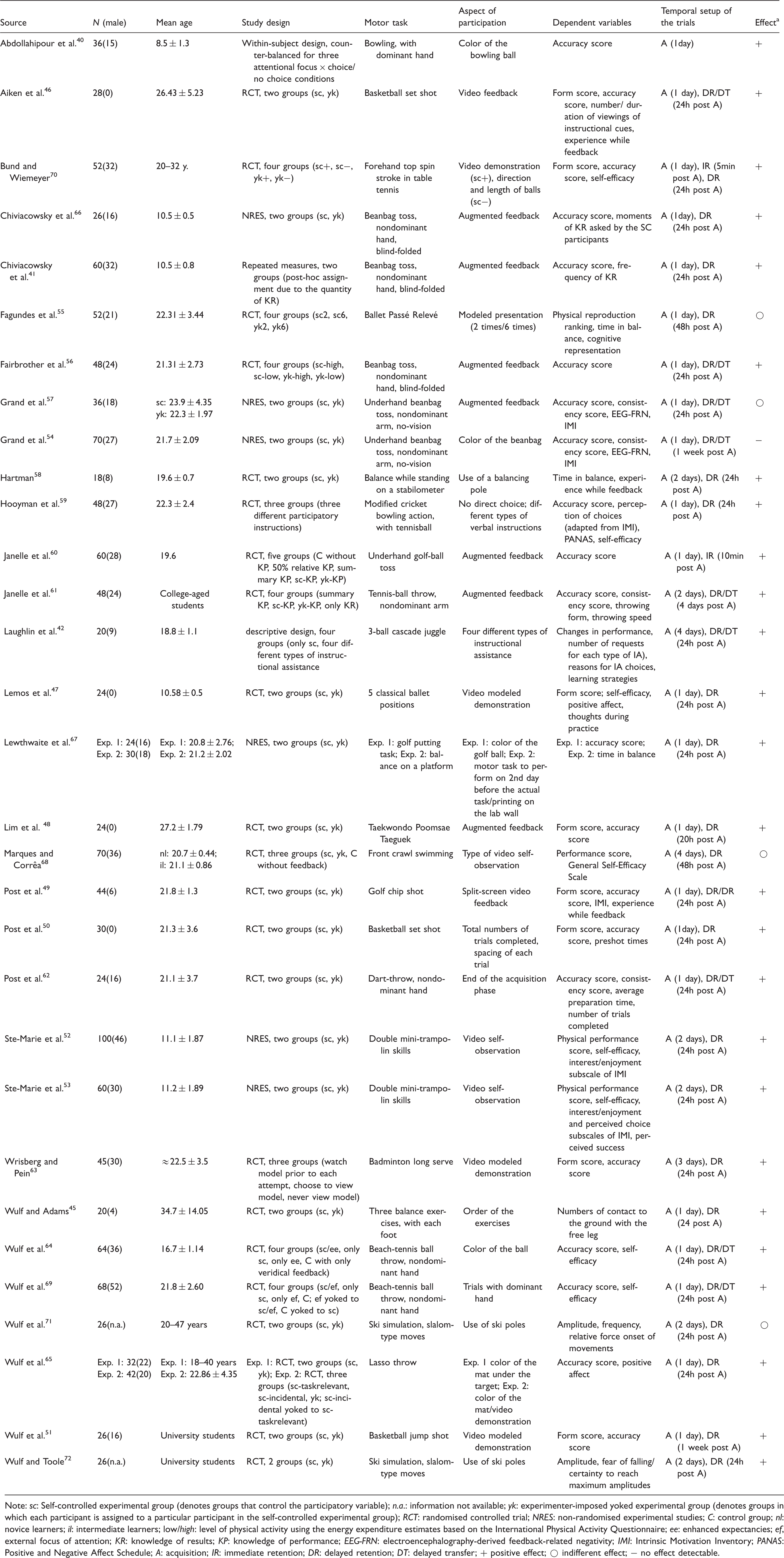
Note: sc: Self-controlled experimental group (denotes groups that control the participatory variable); n.a.: information not available; yk: experimenter-imposed yoked experimental group (denotes groups in which each participant is assigned to a particular participant in the self-controlled experimental group); RCT: randomised controlled trial; NRES: non-randomised experimental studies; C: control group; nl: novice learners; il: intermediate learners; low/high: level of physical activity using the energy expenditure estimates based on the International Physical Activity Questionnaire; ee: enhanced expectancies; ef, external focus of attention; KR: knowledge of results; KP: knowledge of performance; EEG-FRN: electroencephalography-derived feedback-related negativity; IMI: Intrinsic Motivation Inventory; PANAS: Positive and Negative Affect Schedule; A: acquisition; IR: immediate retention; DR: delayed retention; DT: delayed transfer; + positive effect; ○ indifferent effect; − no effect detectable.
The majority of the studies applied task-relevant aspects of self-control, such as different kinds of augmented information after or during trials of practice,41,46,48,49,52,53,56,57,60,61,66,68 access to instructional assistance devices,42,47,49,51,55,63,65,70 physical guidance58,71,72 and scopes of influence on the practice schedule.45,50,62,60,70 A few trials focused on preferences regarding choices incidental or unrelated to the practice task.40,54,64,65 The measurement of motor performance and motor learning was conducted in various ratings of movement scores, in most of the instances accompanied by psychological variables (e.g. cognition, affect, motivation) or aspects of learning behaviour in order to uncover underlying explanations to learning advantages/disadvantages of self-controlled motor learning environments. All trials but one 40 followed the standard paradigm of studying the effects of particular experimental manipulation on motor skill learning, including an acquisition phase as well as immediate or delayed retention and/or transfer phases (to determine the learning effects of practice with or without self-controlled practice conditions). The amount of practice time ranged from one day to four days.
Main outcomes
Based on the data of the included trials, there is strong evidence that the learning of sports-related complex motor skills particularly benefits from self-controlled learning atmospheres. In general, most studies showed significant learning advantages for experimental groups under self-controlled conditions. Four trials reported ambiguous results.55,57,68,71 One study remained without any positive effect.
54
Notably, no study provided negative learning effects associated with self-controlled learning conditions. Due to the considerable amount of included studies, the following synopsis relinquishes the frequently conducted overview study-by-study, and single studies will merely be mentioned in more detail to highlight distinct aspects. Due to focus in the included studies, the main results are presented in three converging categories instead: (1) Aspects of self-control during acquisition; (2) motor behavioural implications of the self-controlled practice conditions; (3) target groups aimed at in the reviewed studies.
Since the incipient demonstrations that self-controlled learning atmospheres provided the possibility to enhance complex motor learning,60,61 most of the trials explored the nexus by giving the participants at least some control over certain kinds of task-relevant aspects or practice conditions. The benefits of self-controlled conditions compared to a yoked experimental group were thereby confirmed for choices concerning the delivery of augmented feedback during practice,46,48,49,57,66 the type or frequency of self-observations,68,52,53 the use of assistive devices,58,71,72 the frequency of modelled demonstrations,49,51,63 and the amount of practice.50,62 In one study which examined the combined effects of self-control and frequency of model presentation on learning a complex motor skill, the significant group differences were limited to the reproduction of cognitive representations. Due to the restricted number of practice opportunities, the differences were explained by the authors as perceptual-cognitive precursor of a very likely already beginning motor behavioural enhancement.
55
More recently, some trials have shown that even choices that are more or less incidental to a given movement task, or connote autonomous degrees of freedom can enhance complex motor learning. For instance, given opportunities regarding the colour of the sporting equipment,40,64,65 the use of autonomy-supportive instructional language,
59
motor tasks to be practiced after the actual task, prints of paintings to be hung at the laboratory wall,
67
or the order of the exercises,
45
learners' skill development was superior to that of learners without such choice. One study failed to support the evidence that the choice of the colour of a beanbag enhances the ability to make a blindfolded toss at a target. This raised some doubts as to whether incidental choices are fully robust to experimental changes.
54
Depending on the different tasks, the included studies implemented a relatively broad range of motor-behavioural variables to assess learning effects of self-controlled practice conditions. Basically, there were four main analytical categories that all measured different degrees of approximation to a motor learning objective: (a) accuracy, reporting the closeness of a measured value to a target dimension by computing mean radial error scores;56,64,69,70 (b) precision, rating the consistency of the results applying bivariate variable error scores;54,57,61,62 (c) quality, evaluating the developmental stage of a movement form using expert ratings, standardised rating scales or form scores;46,47,63,70 (d) performance descriptors, appraising characteristic dimensions of specific movements, such as frequency, amplitude, time in balance or catches per attempt.42,58,71,72 The associated main results can be summarised in two general statements: First, in all of the four categories there were empirical findings in which self-controlled experimental settings significantly outperformed experimenter imposed complex motor learning conditions. While the results for accuracy, form and performance descriptors almost exclusively showed statistically relevant positive relations in at least one trial period of each included study,48,49,52,58,71 only one out of four studies that incorporated consistency scores detected superior performance scores of participants in self-controlled experimental group conditions.
61
Moreover, some studies that combined more than one dependent motor-behavioural variable provided evidence reporting partly beneficial, partly indiscriminate group differences towards the facilitation of a complex motor skill. Aiken et al. implemented self-controlled video feedback conditions during the practice of a basketball set shot and revealed that the self-controlled group had significantly higher form scores, but similar accuracy scores during the transfer phase.
46
Grand et al. reported superior accuracy in the transfer test, but no greater consistency for the task to toss a beanbag blindfolded at a given target.
57
Second, the studies reported diverging points of time at which the significant group differences could be determined in favour of the self-controlled conditions: admittedly, all included trials reported a general increase in motor learning over time. However, the scientific proof that self-controlled environments were a decisive factor of complex motor development could solely become apparent in comparison with experimenter-imposed, ideally yoked groups. With few exceptions,42,45,48,58,65 there were no group differences during the acquisition phase, but most commonly the self-controlled groups tended to show already higher performance scores.51,59,66,67 In the subsequent retention tests and/or transfer tests (with identical conditions for all participants), the groups underlying self-controlled practice conditions during acquisition at least partly performed significantly better. The benefits of self-controlled practice conditions therefore entered with delay. Several studies found a significant difference between groups only for transfer and not for retention, thereby suggesting that a transfer test may be more sensitive than retention tests in capturing learning effects, as it required participants to adapt to a novel context.46,49,56,57,62 The main distinction regarding the target groups in the included studies was undertaken between adult and underage participants. The studies with underage populations were clearly outnumbered. They focused primarily on relating developmental particularities of the target group, e.g. a cognitive skill acquisition under progress or minor motor experiences compared to adults. The main results entirely contributed to the largely advantageous relationship between self-controlled practice conditions and complex motor learning.40,41,47,52,53,64,66 The evidence base for adults was generally positive except for the limitations already described in 1. The main adult populations concerned the young adulthood. In addition, three studies compared specific populations: Chiviacowsky et al. compared a self-controlled group that frequently chose to receive knowledge of results (KR) and a self-controlled group that chose to receive KR less frequently. The participants choosing more frequent KR maintained better accuracy scores in the retention test and were significantly more accurate.
41
Fairbrother et al. explored whether high and low activity participants differed in terms of the effects of self-controlled feedback on the process of learning to toss a beanbag blindfolded using the non-preferred arm. Results indicated that the self-controlled condition was more accurate than the yoked condition during acquisition and transfer periods, and the high activity condition was more accurate than the low activity condition during all phases of the experiment.
56
Marques and Corrêa investigated the effect of the learner's control of self-observation strategies on front crawl learning. For that purpose, beginner and intermediate swimmers participated in the experiment. The findings showed that only for beginner swimmers the self-controlled conditions were the essential factor of learning. For intermediate learners, self-observation promoted better motor learning regardless of the opportunity chosen.
68
Discussion
The guiding aim of the paper was to provide an empirically based argument that grounds the relation between self-controlled atmospheres and athletic performance in the autonomous inner logic of modern competitive sports. For that purpose, a systematic review of the relevant literature was conducted.
State of research
The state of research can be considered good in respect to a comparatively recent field of research. The qualitative analysis of the 31 included studies identified three main topics. 1. The effects of self-controlled practice conditions have been shown to be relatively generalised to a variety of participatory aspects in complex motor learning. However, the experimental implementation of self-control is usually designed as provision of choice. Further possibilities and emphases, e.g. the provision of a meaningful rationale, acknowledgment of feelings that may be negative, attempts to nurture inner motivational resources, or the use of non-controlling language, were not yet taken into account or to a much lesser extent. 73 Moreover, for incidental choices further insights seem to be necessary due to inconsistent results. 54 2. The included studies largely indicate that the experimental groups provided with freedom of choice over at least one aspect of a practice condition, perform equally by all means and more often better than those not provided with choice when asked to execute retention and/or transfer skills. Admittedly, some studies striving for two-dimensional aiming tasks use a system of evaluation that is assigned to one numerical value.41,59,64,66,69 In doing so, the applied measurement of skill acquisition represents absolute error and disregards the fact that individual trials could vary circularly around the target as well as in the distance from the centre of the target. Crucial information to capture the participants' actual performance characteristics such as the direction of error and consistency is missing as a result and the conclusions drawn from the experiments are rather limited.74,75 Further studies implementing two-dimensional tasks therefore should rely on the comprehensive set of formulae introduced by Hancock et al. 76 Regarding the experimental validity, the internal validity can be considered reputable due to a treatment control by yoked groups and the possible choices being limited to only one exercise condition each. On the contrary, the ecological validity, and thus the direct relevance for real-world settings is questionable. Further studies under self-controlled field conditions in (competitive) sports are needed. They could focus on self-controlled motor performance improvements of skilled learners, on advantages of self-controlled motor learning processes embedded in dynamic competitive actions, on collective tasks or team interactions, or on individual athlete's preferences for self-controlled practice conditions such as age, experience, gender, cultural background and other personal characteristics.29,77,78 3. The learning advantages seem to be quite robust for a variety of target groups. However, for underage populations, the data are rather limited to choices of augmented information or incidental choices, and accuracy or form scores.
Explanatory approaches
While there is ample evidence for complex motor learning advantages in self-controlled practice environments, the explanatory underpinnings behind these advantages remain debatable. In general, two viable lines of research have been postulated and paradigmatically can be found in the included studies. From the beginning, a series of cognitive foundations was supported. In addition, motivational reasons were asserted and seem to dominate the corresponding scientific discourse at least since the highly regarded call for focus by Sanli et al. 31 and the prominent embedding within the OPTIMAL theory of motor learning. 33
The cognitive explanations proposed to explain the superior effects of self-controlled practice conditions are based (a) on the more active involvement of the learners in a task, (b) on a more effective processing of relevant information, (c) on increased cognitive effort with pertinent task variables within the acquisition phase, (d) on the application of learning strategies tailored to the needs of the learning participants, and/or (e) on enhanced metacognitive processing.42,46,50,55,57,58,60–63,70–72 Different empirical evidences are thus indicative for this: the included studies typically show that the beneficial effects of learner-control occur with a delay, i.e. in retention and transfer tests, whereas almost no performance differences are found during acquisition due to its additive cognitive demands implied by possibilities of choice (e.g. decision making, monitoring, evaluation, correction).50,60–62,70–72 Also, the varying, partly very low access rates and fading schedules over time show that self-control participants presumably request the given resources of choice when they believe it will be useful for their learning success.46,59,61 Further empirical precursors were longer average preparation times or more comprehensive preshot times, and obviously better results in different cognitive representation scores (e.g. trials completed during acquisition, important aspects of the task).50,55,62 Most recently, measurements of electroencephalography-derived feedback-related negativity (FRN) exhibited significantly larger mean FRN amplitudes for the self-controlled groups relative to a yoked group and confirmed that motor learners provided with choices processed augmented feedback information to a greater extent while practicing a task than yoked participants. 57
The motivational explanations highlight aspects that stimulate desire, want or need in learners to continually make an effort to attain a goal in order to theorise the learning advantages of self-controlled practice conditions.40,41,45,47,49,53,56,57,59,64–67,69 The included approaches therefore fix an indirect mechanism: self-controlled practice conditions tend to increase key ingredients of intrinsic motivation, which is positively associated with enhanced motor learning. For example, exercising choice or merely the prospective opportunity to do so, appears to impart a general trust in the participants’ agency or capabilities that, in turn, seems to enhance positive affect and/or task-specific self-efficacy, i.e. heightened expectations for positive performance outcomes and future success.59,64,69 Thus, self-controlled practice schedules apparently are inherently rewarding and, relating thereto, presumably trigger temporal linkages between spatially distinct neural networks relevant to task performance and higher skill levels, and motivation increasing interactions between dopaminergic midbrain structures and the hippocampus, which is responsible for neuroplastic changes including memory consolidation processes.47,65,67 Closely connected, self-controlled practice conditions are attributed to satisfy fundamental psychological needs. Based on the tenets of Self-Determination Theory (SDT) by Deci and Ryan, the self-controlled responsibility to set one's own goals and the freedom to have bearing on at least parts of the practice schedule in particular promise to meet the innate motivating human needs for autonomy and competence.31,33,45,49,64,69 Two specific empirical findings additionally support the motivational function of the self-controlled learning benefits: First, the findings confirm that single incidental choices or autonomy-supportive language usage facilitate complex motor learning considerably. This suggests that the root cause of the beneficial learning effect is the opportunity for choice per se.40,64,65 Second, some studies implementing choices on augmented feedback information reveal a marked tendency of the self-controlled participants to generally receive positive feedback as they tend to request feedback primarily after perceived good trials. Hence, the permitted possibility to affect the moment and frequency of feedback might at least partially be a useful instrument to create greater success experiences and subsequently self-validate perceptions of competency, shift or enhance intrinsic motivation and therefore benefit motor learning.56,66
Strengths and limitations
The major strength of this review is the rigorous foundation in social theory, and the strict reference to a search protocol and systematic design according to the PRISMA Statement. 34 Notwithstanding, some limitations warrant attention. First, the subject of the paper aims at a professional change within the social context of competitive sports. For this purpose, empirical findings on self-controlled motor development are systematically collated. However, in contrast to intermediate motor learning and performance requirements in competitive sports, all but one of the included studies were implemented with novices. 68 A transfer to competitive sports should therefore be considered with caution. Second, only peer-reviewed journal articles published in English and German languages and listed in the screened online databases were included. Articles in additional languages or outside the scope of the selected databases went unheeded. Third, the systematic review is not able to distinguish between low reporting and low methodological quality of studies and hence low scorings of methodological quality may reflect either weak reporting or weak study designs. Fourth, the study only surveyed the relation between self-controlled practice conditions and sensori-motor conditions of movement regulation, i.e. one albeit important determinant of complex sporting performance. With respect to the scheduled key factors of complex sporting performance, future studies thus should compile reviews on further performance elements in order to continually strengthen the intended argumentation.22–25
Professional implications
The included studies demonstrated a large persistence of self-controlled motor learning advantages across a variety of participatory aspects. Hence, the sensori-motor benefits of self-controlled practice conditions appear to present profitable implications for coaches, coaching educators and any other responsible protagonists in competitive sports. The implementation of self-controlled environments promises a way conducive to promote motor learning and motor performance. Thereby, an essential factor of complex athletic performance can be athletically promising and likewise implemented educationally more valuable. When realising such a social environment, it is important that athletes can participate in those aspects of the training and competition that affect their learning process and performance presentation. However, this does not mean that the athletes are completely free in their decisions. It signifies that the athletes receive choice options in order to design competitive sports successfully in collaboration with their coaches. The choices can be related to factors and information directly relevant for learning and performance (e.g. augmented feedback, assistive device, amount of practice). In addition, the empirical findings provide evidence that even the fact of having a choice, regardless of whether this is pertinent to motor learning and performance or not (e.g. color of equipment, room arrangement, order of exercises), may be conducive to the athletes' capability to succeed.
However, the effective integration of self-controlled learning settings in competitive sports requires considering the social context and social fabrication of existing coaches' and sport habits. According to social theory, human nature is anything but a mind-controlled and atomistic body machine that unresistingly reprograms actions and behaviours according to better cognitive insights. b Instead, man “is a creature of habit” 79 (p. 125), an inevitably socially shaped and culturally embedded living being guided by “an acquired predisposition to ways or modes of response” 80 (p. 42) and equipped with the learning potential to replace no more or less functional habits with new habits. So if in modern competitive sports certain disciplinary, authoritarian, and objectifying practices and routines are largely in-habited,8,81 every cognitive unit relating to the athletes' empowerment and autonomy-supportive conditions, no matter how well reasoned they are, will remain a drop in the bucket as long as it does not cause any irritation and subsequently activate critical habits of reconstructing the existing habits.82–84 An empirically based argument that affects the agonal coding of competitive sports conceivably has the potential to provoke such a process, but does not automatically imply the desirable change. Thereto, the corresponding scientific knowledge needs to become both visible in the sporting practice and meeting habit-reconstructive skills of coaches and assistants. So, if the challenge of successfully coaching differently in competitive sports is to be anything but inconsequential semantics, it is necessary to critically question the education and training practices of the sport federations and possibly adjust them according to the delineated requirements.
Supplemental Material
Supplemental material for Participation can make a difference to be competitive in sports: A systematic review on the relation between complex motor development and self-controlled learning settings
Supplemental Material for Participation can make a difference to be competitive in sports: A systematic review on the relation between complex motor development and self-controlled learning settings by David Jaitner and Filip Mess in International Journal of Sports Science & Coaching
Footnotes
Declaration of conflicting interests
The author(s) declared no potential conflicts of interest with respect to the research, authorship, and/or publication of this article.
Funding
The author(s) received no financial support for the research, authorship, and/or publication of this article.
Notes
Supplemental material
Supplemental material for this article is available online.
References
Supplementary Material
Please find the following supplemental material available below.
For Open Access articles published under a Creative Commons License, all supplemental material carries the same license as the article it is associated with.
For non-Open Access articles published, all supplemental material carries a non-exclusive license, and permission requests for re-use of supplemental material or any part of supplemental material shall be sent directly to the copyright owner as specified in the copyright notice associated with the article.
