



Abstract
Previous sport management research has demonstrated the positive relationship between political skill and personal career outcomes, but research addressing the question of how leader social effectiveness (i.e. political skill) influences the commitment and satisfaction of subordinates is lacking. This study sought to determine if leader (athletic director) political skill influences subordinate (head coach) evaluations of leader effectiveness, in turn influencing subordinate job satisfaction and commitment. Surveys were completed by interscholastic athletic directors (n = 250) and representative subsets of head coaches (n = 806) in the United States. Structural equation modeling was used to analyze the data. Political skill was shown to have a positive impact on evaluations of leader effectiveness. Leader effectiveness also acts as a mediator between political skill and employee job satisfaction and affective organizational commitment. Thus, political skill appears to be an important contributor to subordinate perceptions of leadership effectiveness, job satisfaction, and organizational commitment.
Introduction
Though leadership is one of the most observed phenomena on earth 1 and one of the most studied topics in the sport sciences,2,3 effective leadership is a practice that sport scholars still strive to more comprehensively understand. For instance, given that (a) achievement in life and work often stems from effective social exchanges 4 and (b) most definitions of leadership are based in the assumption that leadership involves an intentional influence process over others (e.g. subordinates), 5 Magnusen and Perrewé 6 focused on the lack of sport research about the relationship between social effectiveness and leadership effectiveness. After reviewing relevant sport textbooks and research articles on leadership, they critiqued numerous social effectiveness constructs before directing their attention to the potentially important relationship between leadership effectiveness and the social effectiveness construct of political skill. Their critical review, along with previous breakdowns of the myriad social effectiveness constructs present in the management literature,4,7 combine to create a compelling reason to examine the relationship between political skill and effective leadership in sport.
Political skill represents a comprehensive pattern of social competencies that include cognitive, affective, and behavioral manifestations. 8 The political skill construct combines social astuteness with the ability to relate well and otherwise demonstrate situationally appropriate behavior. Such behavior inspires confidence, trust, sincerity, and genuineness. 9 Moreover, politically skilled individuals not only adjust their own behavior to situational demands in a manner that appears sincere, inspires trust, and results in effective influence over others, but they also effectively understand others and use this understanding to exercise influence.6–10
Few areas hold greater value to the success of sport organizations than the execution of effective leadership.2,3 A recent meta-analysis of political skill research confirmed that political skill is positively related to many qualities present in effective leaders such as self-efficacy, job satisfaction, organizational commitment, work productivity, career success and personal reputation, and negatively related to physiological strain. 11 Perhaps the most important value of political skill to the study of leadership effectiveness is that politically skilled individuals are better at building relationships with subordinates and often experience more job satisfaction and career success than less socially effective individuals.6,10–12 Additionally, politically skilled individuals understand the dynamics of social situations and can combine social astuteness with the ability to make behavioral adjustments to different situational demands in the workplace.4,6,8 This behavior is adapted to situations in a way that appears to be sincere, inspires trust, and results in effective influence over others,6,7 allowing objectives to be accomplished without leaders appearing overtly manipulative or controlling.4,8 Accordingly, the purpose of this study is to examine the extent to which political skill, present in athletic directors (ADs), affects perceptions of leader effectiveness as well as the individual attitudes of head coaches (HCs) (employees under the supervision of the AD).
Theoretical foundations
Social influence, in a general sense, represents any physiological, attitudinal, emotional, or behavioral change that transpires in one person as the result of the real, implied, or imagined presence of others. 6 Social influence theory (SIT) posits that individuals use social influence to achieve desired social outcomes. This theory also ventures further to classify types of interpersonal influence as nonconscious, intentional, and unintentional. Such classifications point to social influence occurring in all interpersonal interactions, on conscious or unconscious levels, and being deliberate or unplanned. 13
Because achievement in life and work stems mostly from effective social exchanges, influence is a critical component of effective leadership.3,4,8 Leaders not only influence the attitudes, motivation, and satisfaction of subordinates among other outcomes, but through social influence, effective leaders build quality relationships and develop trust with critical stakeholders.6,8,14 Thus, SIT serves as an appropriate foundation for examining leader social effectiveness and subordinates’ responses to leader behaviors in the context of sport.
Research model and hypothesis
A leader who properly manages social interactions at work through the effective use of political skill is expected to be perceived as an effective leader.11,15 To evaluate the impact of effective leaders, job satisfaction and organizational commitment were considered because of their strong association with increased job performance and decreased turnover intentions. 11 Further, leadership effectiveness has previously demonstrated strong connections to both job satisfaction and commitment.16,17 Job satisfaction refers to positive or negative evaluations of one’s job situation. 18 Affective organizational commitment is a term used to describe one’s emotional attachment to an organization. 19 Collectively, the model proposes that politically skilled ADs will be perceived as effective leaders, thus leading to increased HC job satisfaction and affective commitment.
The research model is provided in Figure 1. The corresponding research hypotheses are as follows:
Proposed model of political skill, leader effectiveness, and job outcomes. H1: Political skill will have a significant positive impact on perceived leader effectiveness. H2: Leader effectiveness will have a significant positive impact on job satisfaction. H3: Leader effectiveness will have a significant positive impact on affective commitment.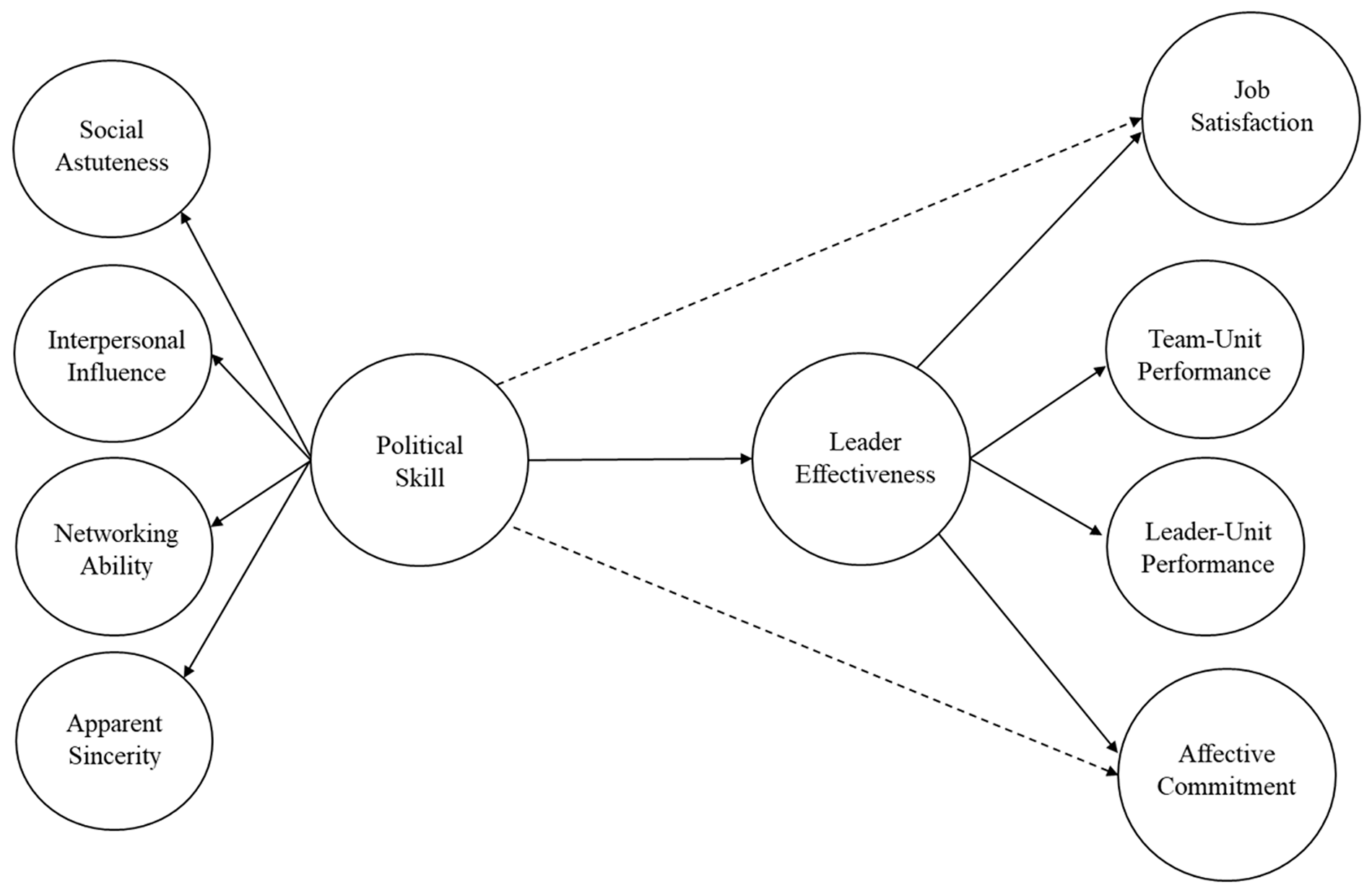
Methodology
Participants and procedures
Data were collected from 250 interscholastic ADs and corresponding subsets of HCs. The subsets of HCs ranged from 1 to 14. The sample of respondents was drawn by convenience and consisted of secondary schools (grades 7–12) covering 47 states in the United States. The sample of ADs (n = 250) was 83% male (n = 209) and 17% female (n = 41), with an average age of 48 years. The sample of HC’s (n = 806) was 71% male (n = 577) and 29% female (n = 229) with an average age of 43 years. The mean organizational tenure for ADs was 11 years, ranging from 1 to 38 years; the mean of HCs tenure with an AD was 4.8 years, with a range of 1 to 25 years.
Data collection consisted of two phases. Phase one utilized a purposive sample of interscholastic ADs invited to participate via a one-time e-mail distributed to active members of the National Interscholastic Athletic Administrators’ Association. Purposive sampling is a nonprobability sampling technique that researchers use when they desire to recruit study participants from specific, predefined groups (e.g. interscholastic ADs). 20 In the first phase, ADs completed the Political Skill Inventory (PSI) 9 utilizing a Qualtrics online survey. In phase two, HCs for participating ADs were then invited to respond, also via e-mail. HC respondents evaluated the leader effectiveness of ADs by answering items from scales for leader effectiveness, 15 job satisfaction, 18 and affective organizational commitment.19
Measure development and assessment
Descriptive statistics and correlation matrix of latent constructs.

Note: N = 245, SD: standard deviation.
Results of the CFA.

Note: λ = factor loading; 2nd λ = second-order factor loading.
Reversed items.
: Cronbach’s alpha coefficient; AVE: average variance extracted; S-B χ 2 : Satorra-Bentler scaled chi-square; df: degree of freedom; correction factor: S–B scaling correction factor; CFI: comparative fit index; RMSEA: root mean square error of approximation; SRMR: standardized root mean squared residual.
A confirmatory factor analysis (CFA) was used to validate the posited relations of the observed variables and the underlying constructs in the measurement model using M-plus 6.1. 21 The total sample of 245 was used for performing the initial CFA to examine the adequacy of the estimated model with model solution estimates and factor correlations. To adjust for multivariate nonnormality, Satorra–Bentler (S–B χ 2 ) scaling method 22 was used. Structural equation modeling (SEM) was employed to examine the hypothesized relationships between latent constructs.
Results
Reported in Table 1 are the correlations among the variables, means, and standard deviations. None of the correlation estimates between the pair of each latent factor was higher than .85. This indicates the latent constructs are not perfectly correlated and that discriminant validity is established. 23 Convergent validity was supported because all loadings were significant (p < .01) and AVE values exceeded .45. 24 The internal consistency of the measures was also adequate because all of Cronbach’s alpha coefficients were greater than the recommended .70 cutoff point. 24
Measurement model
The results of the measurement models are reported in Table 2. The overall fit indices for the CFA revealed that the measurement model fits the data well [(S–B χ 2 (df) = 348.10 (242), S–B χ 2 /df = 1.42, p < .001; CFI = .96; RMSEA = .04; SRMR = .04)], showing that the measurement model adequately accounted for the covariance matrices of the data from the sample. The ratio of Chi-square to degree of freedom indicated good fit (S–B χ 2 /df < 3). The RMSEA value less than .06 represented a reasonable error of approximation. The rule of thumb for the CFI is that values greater than .90 indicate good model fit. 25 When values of the SRMR are less than .10, it is considered favorable. 23 Additionally, the hypothesized measurement model exceeded the more stringent cut-off value for a well-fitting model. 25
Structural model
Structural model results.

p < .01. All results are standardized.
Job Sat: job satisfaction; AC: affective commitment.
Discussion
Political skill is a social effectiveness construct that describes how a leader understands social situations in the workplace and practices effective influence over others. Though the value of political skill to sport leaders is unmistakable,6,11,12 many areas remain underexplored. Indeed, several studies have examined the relationship between political skill and personal career outcomes10,12,14 but insufficient attention has been given to studying how leader political skill impacts various career outcomes (e.g. job satisfaction, commitment) of organizational personnel (e.g. subordinates) under the supervision of a sport professional holding a leadership role. Accordingly, the current study contributes to the sport sciences by highlighting political skill’s positive association with perceptions of leader effectiveness, which ultimately leads to more committed and satisfied subordinates (i.e. HCs).
Previously, political skill was linked to recruiting effectiveness,10,26 which is one facet of a coach being an effective leader. The current study, which focused on AD political skill and leadership effectiveness instead of coach political skill and effectiveness, reveals that coaches perceive ADs with political skill as more effective leaders than ADs with minimal political skill. Specifically, though the impact of political skill on perceptions of leader effectiveness was not statistically significant (r = 0.15, p = 0.051), which explains the rejection of H1, it still had a moderate positive impact. Thus, the potential importance of political skill to leader effectiveness should not be ignored because politically skilled ADs (leaders) do appear to influence HC (subordinate) perceptions of leader effectiveness.
Further, even though political skill and leadership are rarely discussed in sport contexts, an acute essay and commentary on leadership and man management by Jenkins 27 supports the results of this study. Jenkins, in his essay, offers observations of Tony Jacklin, captain of Europe’s Ryder Cup team for much of the 1980s. Tony was politically skilled, which is partly why he could enhance team member commitment levels, leave each team member feeling valued and satisfied, and be perceived as an effective team leader. 27
Leader effectiveness also fully mediated the relationship between political skill and increased organizational commitment and job satisfaction of followers. This result complements and extends previous research on the relationship between political skill and subordinate reactions,10,11,14 by demonstrating leaders have the potential, through the effective use of political skill, to encourage the development of employees who are willing to put forth extra effort in pursuing organizational objectives and who are less likely to leave their position for another job. Thus, for aspiring and current sport leaders, the positive ramifications of being politically skilled, as shown in this study as well as other studies,4,6,8,12,14 highlight the importance of this social effectiveness construct to successful leadership.
Limitations and future directions
Some limitations of this study need to be acknowledged. A potential limitation is ADs were first required to make the decision to participate. The testing of this model in a national population provided a large sample size, but some ADs may have declined participation if they thought leaders–subordinate relationships with their HCs were weak and lacking in trust. Another limitation is the inability to gather responses from every HC. Correspondingly, several ADs who initially chose to participate had to be dropped from the study because no HCs within their respective athletic departments responded to the survey.
The design of the study and choice of measures also may be sources of limitation. The PSI 8 is a self-reported measure completed by ADs evaluating themselves on political skill. Further, the use of self-reported measures means the hypotheses tests may be vulnerable to common method variance. Herein, the CFA results assuage some of this concern. Future studies could improve upon this limitation by including outcome responses from coaches and ADs.
Additionally, it is critical not to misinterpret the outcome of the statistical results. P values reflect both sample size and effect size. 23 That is, p values could be low when sample size and effect size are relatively large. This explains how a small effect can be statistically significant in a large sample size, and how a large effect can fail to be statistically significant in a relatively small sample size. Though Kline 23 explains that a sample size exceeding 200 cases is considered relatively large, more complex models require the estimation of more statistical effects. Meaning, large samples are necessary. Thus, prospective research in this area should use an appropriate sample size when testing the SEM with complex models.
Social effectiveness research in sport should also continue to probe outcomes of political skill and how political skill influences the effectiveness of various types of leadership styles. Consider how servant leadership has increasingly been emphasized as an important style of leadership for sport and non-sport business professionals to consider because of its connection to positive employee attitudes and behaviors. 28 Therefore, in the future, examining how political skill influences the effectiveness of servant leaders – be they coaches or ADs – is a line of research that is underexplored and ripe for inquiry.
Practical implications
Although political skill in leaders is inherent to some extent, those skills may never be realized without proper training.6,9 Fortunately, for current and aspiring sport leaders who may be politically inept or looking to enhance their current levels of social effectiveness, political skill can be improved with concerted effort and proper practice. Periodic evaluation and feedback from colleagues or superiors are recommended to aid in developing social astuteness because certain individuals may lack a keen sense of what is appropriate or tasteful. Networking ability can be improved with a concerted effort to interact with co-workers and by reaching out to develop relationships with others in the sport industry. Additionally, mentoring represents an avenue through which political skill can best be learned,6,9,10 especially during the early stages of one’s career. 29 Finally, communication training or courses in public speaking, including both developmental practice for verbal language (e.g. appropriate vocal tone, words selection) and nonverbal body cues (e.g. making eye contact, body position), may help sport professionals develop the ability to convey interest and concern when speaking with stakeholders.6,14 Collectively, the enhancement of social astuteness, networking ability, interpersonal influence, and apparent sincerity, should help sport practitioners develop into more effective leaders.
In conclusion, the present study found that leader (AD) political skill positively influenced subordinate (HC) perceptions of leader effectiveness. Leadership effectiveness also mediated the relationship between political skill and subordinate commitment and satisfaction. Taken together, the current investigation affirms previous statements on the importance of social effectiveness to the study of sport management and highlights the salience of political skill to subordinate perceptions of leadership effectiveness, job satisfaction, and organizational commitment.
Footnotes
Declaration of conflicting interests
The author(s) declared no potential conflicts of interest with respect to the research, authorship, and/or publication of this article.
Funding
The author(s) received no financial support for the research, authorship, and/or publication of this article.