




Abstract
The identification and development of talent is an essential component of modern professional football. The recognition of key physical characteristics of such footballers who successfully progress through talent development programs is of considerable interest to academics and those working in professional football. Using Football Yearbooks, we obtained the height, body mass and ages of all players from the English top-division over the seasons 1973–4, 1983–4, 1993–4, 2003–4 and 2013–4, calculating body-mass index (BMI) (kg/m2) and reciprocal ponderal index (RPI) (cm/kg0.333). The mean squad size increased over these decades from n = 22.4 (1973–4) to n = 27.8 (2013–4). Height also increased linearly by approximately 1.2 cm per decade. Body mass increased in the first four decades, but declined in the final season (2013–4). Regression analysis confirmed inverted “u” shape trends in both body mass and BMI, but a “J” shape trend in RPI, indicating that English top-division professional footballers are getting more angular and ectomorphic. We speculate that this recent decline in BMI and rise in RPI is due to improved quality of pitches and increased work-load required by modern-day players. Defenders were also found to be significantly taller, heavier, older and, assuming BMI is positively associated with lean mass, more muscular than other midfielders or attackers. The only characteristic that consistently differentiated successful with less successful players/teams was age (being younger). Therefore, English professional clubs might be advised to attract young, less muscular, more angular/ectomorphic players as part of their talent identification and development programs to improve their chances of success.
Introduction
The identification and development of talent, as well as the investment in talent from clubs is an essential aspect of modern football. As financial input into the professional game continues to increase, the identification, recruitment and training of players become even more inextricably linked to performance and success.1,2 Investment through sponsorship and television rights in the English Premier League (EPL) since its formation in 1992 3 has meant that increasing amounts of money have been made available for both the identification and development of players, and the purchase of players. 4 The successful recruitment and subsequent training of footballers is essential to any team’s success. Professional football clubs are willing to invest a considerable amount of money in order to compete, with figures from the 2014/2015 season showing that clubs in the EPL spent €3.4bn on signing players. 5
The early identification of young players and the effective scouting and acquisition of established players becomes critical for both financial and success-related reasons. Therefore, any possible mechanism or system which can increase the potential identification of young and established players should be given consideration by professional clubs. There is already in existence an increased requirement to develop ‘home-grown’ or domestic players, championed nationally by the Football Association (FA) in England.6,7
Expertise and talent development
The talent identification approaches adopted in football place an emphasis on the quantity and quality of training required to achieve elite level representation, performance and mastery,8,9 with a number of studies emanating from England, focused on the development of young players in English football, see, e.g.6,10–13 In addition to these recent developments, research has considered the move of athletes or performers in sport from novice to expert, with theoretical and conceptual models created to guide and explain these developments (see for example Côté et al. 14 ).
Once a part of the system, the focus for the professional club turns to maximising performance and longevity of players in the professional game. Studies have considered the length of career of the athlete and whether their playing position might impact upon this career length. 15 Baker et al. discovered differences in the career lengths of players in certain positions in both baseball and football, although they found no differences in basketball and ice hockey. Nevertheless, the research discovered that all sports indicated that longer careers were associated with superior performance. 15 While the length of career and superior performance of an athlete is clearly important to professional sports teams, so is the initial development of these athletes.
Given previous work outlined here, there are areas of research and investigation which require further attention, including a greater diversity in study design and general approach to cover the variety in high-performance sport. 16
The importance of body shape
The evolution in body size, body shape and age of successful professional footballers has attracted considerable interest, with increases in the height and weight of players leading to enhanced training programmes, with the aim of developing and increasing strength and power. 17 Moreover, it is recognised that although preparing players for competition involves a complex set of procedures and processes, understanding body composition and how it can impact upon and affect performance is an area that has drawn increased attention recently. 18
It can be argued that body-size and body-shape can be considered a contributory factor in the success of professional footballers. 19 Nevill et al. 19 explored the body-size and body-shape characteristics of players from the top English division over four decades, using data from seasons 1973–4 through to 2003–4. The concept of body shape used in the current study is defined as the ratio of two body-size dimensions, such as the reciprocal ponderal index (height/mass0.333), that yields a ‘dimensionless’ ratio variable reflecting body shape, see Mosimann. 20
Nevill et al. 19 were able to identify that, although the height and body mass of footballers increased in a linear fashion, no difference was observed between the height and body mass of players from successful versus less successful teams (successful teams defined as those ranked in the top 6 in the division at the end of the season). The study did identify, however, using binary logistic regression, that a key body-shape parameter able to discriminate between players from the successful teams (compared with players from the less successful teams), was the reciprocal ponderal index (RPI). Tanaka and Matsuura 21 had also identified the ponderal index as a key predictor of 10,000 m running performances of 114 Japanese young, middle- and long-distance runners (ages 19.0 ± 1.7 year). Note that in their study the authors reported the correlation between 10,000 m running time and the ponderal index as r = 0.443 (P < 0.01). Clearly, since speed is the reciprocal of time, 10,000 m running speed will correlate positively with the reciprocal of the ponderal index (RPI). The RPI is calculated by dividing a players’ height by their body mass (cm/kg0.333), frequently referred to as the linear somatotype “Ectomorphy”.
Another body-shape characteristic, body mass index (BMI), appears to have been overlooked as a possible indicator of successful footballers. In the general population, BMI is normally interpreted as a measure of excess body mass or adiposity. In athletes, however, especially power athletes such as middle distance runners, BMI has been shown to be associated with lean-body mass rather than fat mass. 22 Nevill et al. 22 found that the BMI of male middle-distance runners and male squash players was negatively associated with adiposity (using the sum of skin folds) and hence, for these male athletes, BMI is positively associated with fat-free and/or muscle mass.
The study by Nevill et al. 19 focused on the 11 ‘first-choice’ players selected on the opening day of the season. However, success is achieved by all players in a squad (substitutes, back-up players, etc.). Hence, the purpose of this article is to identify whether any key body size, shape and age characteristics taken from the full squad of players in teams from the English top-division, might be associated with more successful professional footballers and to detect whether differences in these key characteristics, if identified, have evolved over the past 50 years. To extend previous work, data from the next season (2013–4), an additional 5th decade in the sequence of decades used by Nevill et al., 19 will also be incorporated. Finally, in the discussion, we shall speculate as to the possible cause of any differences and changes that might have occurred over the past 50 years, and the implications of any changes on the modern game as well as professional clubs.
Methods
Since the data used in this study were in the public domain (obtained from books and the internet), ethics committee approval and informed consent were not required.
The body size (height and mass) and age of all squad players recruited by the teams from the top division, either the Premier League or old first divisions, during the seasons 1973–4, 1983–4, 1993–4, 2003–4 and 2013–4, were obtained from Rothmans Football Yearbooks 1974–5, 1984–5 and 1994–5,23–25 the Sky Sports Yearbook 2004–5 26 and Sky Sports Yearbook 2014–5. 27 Note that age was only available for the three most recent seasons, 1993–4, 2003–4 and 2013–14. The data were directly reported from FA Premier League and Football League Clubs for compilation in the Football Yearbooks. A 10-year interval was chosen for our collection to avoid too many players from being included in two overlapping data sets, i.e. 10 years will probably be sufficient time to allow the development of a new generation of players.
From the players’ height (m) and mass (kg), we were able to calculate their BMI (kg/m2) and reciprocal ponderal index (RPI) (cm/kg0.333).
As stated in the introduction, the purpose of the current article was to identify whether any key body size, shape and age characteristics varied systematically over the past 50 years, using players from the “full squad” of English top-division clubs. Throughout any season, some squad players will play in different positions. Nevertheless, most players can usually be divided into predominately defenders versus others (midfielders or attackers). Based on this simple dichotomy, positional differences in these key body-size, shape and age characteristics were explored over the five decades.
Statistical analyses
Initially, differences in body-size parameters (height and weight), shape parameters (BMI and RPI) and age were assessed using a one-way ANOVA (the fixed factor being season). We also assessed the presence of linear or curvilinear trends over time/years (over the five decades) in the body size/shape parameters and age using least-squares regression, by replacing the categorical variable ‘season’ with a continuous “year” predictor variable, entered either as a linear ‘year’ and/or quadratic ‘year2’ term. Note that “year” was centred about the mid-season 1993.
Independent sample t-tests were used to explore whether any of the body size (height and mass), body shape (BMI and RPI) and age characteristics were different between players from the more or less successful teams. We chose as our dichotomous independent variable whether a player was, or was not, playing for one of the top six teams in the five seasons 1973–4 to 2013–4 seasons. [The top six teams were chosen as our measure of “team success” because, in more recent years, these are likely to have qualified for European cup competitions].
Two-way ANOVAs were used to explore differences in the key body size, shape and age characteristics by position (defenders vs. others) and by years (five decades).
We chose to assess the importance of our results/observed differences by reporting the partial eta squared as our effect size. Partial eta squared cut-off points as reported by the Medical Research Council (MRC), University of Cambridge (http://imaging.mrc-cbu.cam.ac.uk/statswiki/FAQ/effectSize) are given as small 0.01, medium 0.06 and large 0.14. Significance was taken as P < 0.05.
Results
The average squad size of teams in the English top division significantly increased over the past five decades, from n = 22.4 (1973–4 season) to n = 27.8 (2013–4 season) (P < 0.001: Partial η2 = 0.312), with the greatest increase occurring between the 1983 season and the 1993 season.
One-way ANOVAs identified a significant differences in (a) height (P < 0.001; Partial η2 = 0.072), (b) mass (P < 0.001; Partial η2 = 0.047), (c) BMI (P < 0.001; Partial η2 = 0.025) and (d) RPI (P < 0.001; Partial η2 = 0.041) of footballers playing in the English top league over five decades, seasons from 1973–4 through to 2013–4. One-way ANOVA identified no differences in age (P = 0.072; Partial η2 = 0.003). Figure 1(a) to (e) (for age) illustrates the nature of the differences.
(a) Mean (SE) differences in height by seasons 1973–4 to 2013–4. SE: standard error. (b) Mean (SE) differences in body mass by seasons 1973–4 to 2013–4. SE: standard error. (c) Mean (SE) differences in BMI by seasons 1973–4 to 2013–4. SE: standard error. (d) Mean (SE) differences in RPI by seasons 1973–4 to 2013–4. SE: standard error. (e) Mean (SE) differences in age by seasons 1993–4 to 2013–4. SE: standard error.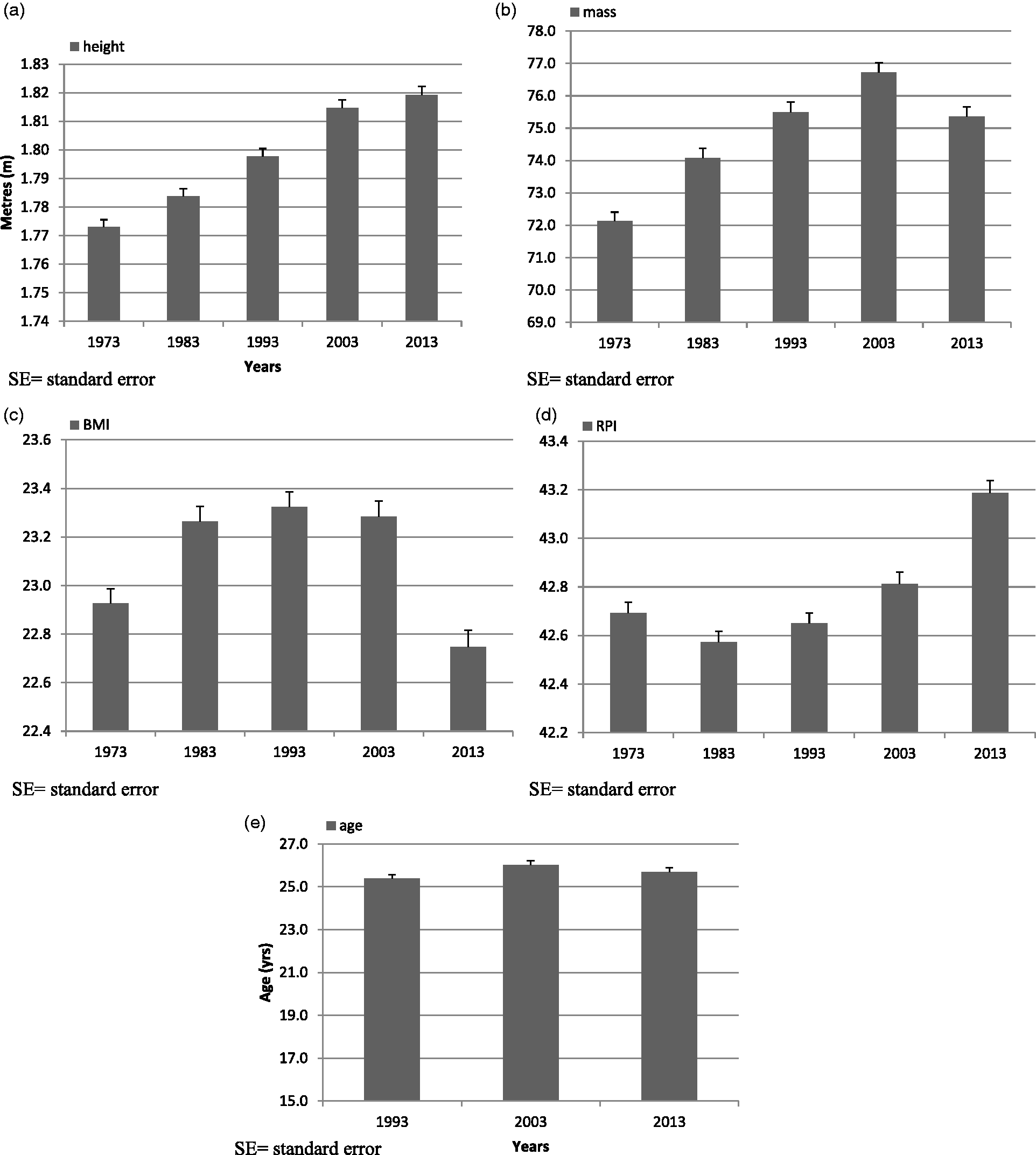
The least-squares regression parameters (constant intercept, linear ‘year’ and quadratic ‘year2’ terms, centred at 1993) for height, mass, BMI, RPI and age, together with their R and R2.

Note: The constant, linear term (units per year) and quadratic term (units squared per year) are all centred about 1993.
The two-way ANOVAs (factors being; position and year) revealed precisely the same significant “year” main effects in height, body mass, BMI, RPI and age as describe above (see Figures 1(a) and 1(b) to (e)). Significant main effects due to position (defenders vs. others) were also found in height (1.82 m vs. 1.79 m; P < 0.001; Partial η2 = 0.024), body mass (77.1 kg vs. 74.3 kg; P < 0.001; Partial η2 = 0.031), BMI (23.4 kg/m2 vs. 23.0 kg/m2; P < 0.001; Partial η2 = 0.007) and age (27.3 years vs. 25.3 years; P < 0.001; Partial η2 = 0.030) but not in RPI (42.77 cm/kg0.333 vs. 42.79 cm/kg0.333; P = 0.94; Partial η2 < 0.001). Note that there were no “positional” by “year” interactions, indicating that the main effect differences/gaps reported above between defenders and others remained approximately the same over the five decades.
Finally, the only significant difference associated with “team success” was due to “age” (Top teams’ age = 25 years [SE = 0.21] vs. Bottom teams’ age = 26 years [SE = 0.13], t = 3.95, P < 0.001; Partial η2 = 0.010).
Discussion
Results confirm that professional footballers are still getting taller by approximately 1.23 cm (0.123 cm × 10 years; 95% CI 1.06 to 1.40) per decade (see Table 1 and Figure 1(a)). A similar rise in body mass was observed in the first four decades of the study, but the players’ mean body mass has reduced, becoming lighter in the 5th decade (season 2013–4 players) (see Figure 1(b)). This change in the way body mass has evolved in the season 2013–14 was confirmed in Table 1, with a significant negative quadratic term (year-1993)2 = −0.0049 suggesting an inverted “u” shape trend in body mass as seen in Figure 1(b).
Unsurprisingly, a similar inverted “u” shape trend was observed in BMI, see Figure 1(c), again confirmed by the significant negative quadratic term (year-1993)2 = −0.0013 in Table 1. Given that the BMI of power athletes has been associated with lean body mass (e.g. muscle mass) rather than adiposity, 22 the inverted “u” seen in Figure 1(c) suggests that footballers were inclined to be more muscular in the 1980s, 1990s and 2000s. One could argue that being more muscular might be a physical characteristic required to overcome heavier going pitches, especially in the winter, compared to the almost perfect condition in which pitches are prepared and maintained in more recent years. Support for this arguments also comes from previous research into the somatotypes of South American international soccer players in the 1990s (n = 110). The results suggest that, at that point in time, top players were characterised by a more muscular physique, highlighted by a higher than average “mesomorphy.” 28
However, by far the most dramatic change in the key shape parameter (RPI) can be seen in Figure 1(d). The “J” shape in Figure 1(d) indicates that English top-division professional footballers are getting more angular and ectomorphic, especially in the most recent season 2013–4.
There are two possible explanations for this “J shaped” trend. The first has already been mentioned. Over the past 10 years, the quality of English top-division football pitches has greatly improved. Gone are the “mud baths” often seen in black-and-white pictures or poor quality TV footage. To overcome these heavy pitches, players were required to be stronger and more muscular as implied by the changes in BMI over the five decades studied, Figure 1(c). With the dramatic improvement in the quality of pitches, players can be lighter and more linear, a trend seen clearly in the RPI observed in Figure 1(d).
The second explanation for this “J shaped” trend in RPI comes from the ever increasing work that English top-division footballers have been required to perform over the past 50 years. The distance covered by English top division outfield players was around 8.7 km per match in the 1970s, 29 increasing to 11.4 km in the 1990s 30 and remaining over 10.5 km in the 2000s 31 and 2010s. 32 Since the turn of the century, the nature of the increasing work-rate has changed from an increase in total distance covered to an increase in the distance covered through high intensity running and sprinting. High intensity running distance by outfield English Premier-League players in the 2000s was about 660 m per match, while sprinting distance was between 220 m and 240 m.31,33 The distance covered by equivalent players in the 2010s increased to 710 m for high-speed running and 251 m for sprinting. 32 These increases in total distance covered up to the 1990s and the increases in high intensity running and sprinting since 2000 confirm the greater physical stress that the modern day footballers are put under and may well explain the need for such players to adapt their shapes, i.e. becoming lighter (see Figure 1(b)) and more angular as characterized by a greater RPI (see Figure 1(d)).
Positional differences in height, body mass, BMI and age were also identified over the five decades. The two-way ANOVAs revealed that defenders were taller (1.82 m vs. 1.79 m), heavier (77.1 kg vs. 74.3 kg), older (27.3 years vs. 25.3 years) and, assuming BMI is positively associated with lean body mass or muscle mass, 22 more muscular than midfielders/attackers.
The only characteristic that consistently discriminated between successful and less successful players/teams was age. The independent sample t-test identified age to have a significant effect (Top players = 25 years. [SE = 0.214] vs. Bottom players = 26 years. [SE = 0.13], t = 3.95, P < 0.001; Partial η2 = 0.010), indicating that successful teams had younger players over all three decades studied (season 1993–4 to 2013–4) compared with less successful players/teams. Clearly, these results emphasize the importance of (a) having a buoyant successful youth academy policy, and (b) the early recruitment of young less bulky, more angular/ectomorphic players, both characteristics that appear crucial to the success of English top-division clubs and their academies.
Conclusion
Prior research has investigated player body shape in professional football, although this research focused on the first 11 players of teams on the opening day of the season. 16 This study is unique as it identifies changes in body shape from the full squads of players in teams in the EPL over 50 years, up to the 2013–2014 season. Furthermore, the findings have been contextualised through a talent identification and development lens, in order to shed light on the implications of these findings for professional clubs.
What is clear from the discussion above is that English top-division footballers have adapted to the modern game, and as a result their body shape has altered. As finance has entered the game of football in England, facilities, training, as well as support services have increased in order to give players the optimum conditions for performance and to ensure that clubs can compete at the highest level of the game. This has meant that training facilities and pitches have developed in quality, as have the stadia and the pitches within the stadia on which players perform on a weekly basis. The increased quality of the playing surfaces in particular has meant that there is a reduced requirement for bulkier, more mesomorphic players, principally because the density of the pitches has reduced. The changing shape of players in the Premier League therefore better reflects the demands of the modern game of professional football, and in particular the Premier League.
Therefore, professional clubs are encouraged to use their talent identification systems to identify those players that are more angular/ectomorphic at an early age, and as part of any forthcoming players’ transfer or acquisition strategy. In addition, the training of players, once they are part of a club’s development system, should take into account the demands of the modern game, and the move towards players of this body type. In an industry that is so financially competitive, with limited opportunities for success through leagues or cup competitions, any competitive advantage that can be gained has the potential to positively influence future performance.
Footnotes
Declaration of conflicting interests
The author(s) declared no potential conflicts of interest with respect to the research, authorship, and/or publication of this article.
Funding
The author(s) received no financial support for the research, authorship, and/or publication of this article.