



Abstract
This study aimed to examine whether sprinting performance would be associated with knee flexion strength-power capabilities measured using a recently developed inertial measurement unit (IMU) based system. Sixteen male sprinters performed 60-m sprints and the IMU based knee flexion strength-power test which consisted of five serial knee flexion-extension motions in three conditions (unweighted, 0.75 or 1.5 kg ankle weighted) for both legs. Spatiotemporal variables during sprinting for a 50-m distance were obtained using a long force platform system. The knee flexion joint kinetic variables during the knee flexion strength-power test were collected using one IMU. Running acceleration during the entire sprinting was positively correlated with the knee flexion positive work measured using the unweighted right knee flexion strength-power test (r = .521–.721). Moreover, step frequencies at the 13th–16th, 17th–20th and 21st–22nd step sections and during the entire sprint were positively correlated with the knee flexion positive work measured using the unweighted right knee flexion strength-power test (r = .506–.566), while step length did not show any correlations with the knee flexion strength-power test variables. The results demonstrate that the greater right knee flexion strength-power capabilities measured using IMU based method in the unweighted condition are advantageous for better sprinting performance through higher step frequency. The IMU-based knee flexion strength-power test in the right leg unweighted condition will likely be useful for physical fitness evaluation of sprinters on the field setting.
Introduction
Sprinting performance, one of the critical factors for many sports,1–4 is determined by physical capabilities and running techniques. In order to indirectly evaluate the importance of the leg strength-power capabilities on sprinting performance in a field setting, vertical jumps, such as squat, countermovement and rebound continuous jumps, are commonly employed.5–8 And, the importance of the greater leg strength-power capabilities on better sprinting performance is broadly supported.6–8 While the vertical jump tests can evaluate sprint-specific leg strength-power capabilities, the tests are mainly performed with extending motions, measuring leg extension strength-power capabilities.
Knee flexion strength-power is an essential capability for achieving better sprinting performance.9,10 A study has revealed that the greater knee flexion power during the swing phase in sprinting is associated with greater sprint acceleration. 9 In a laboratory setting, knee flexion strength-power capability can be evaluated using an isokinetic dynamometer.6,11,12 Alexander 11 however found no significant correlation of peak knee concentric and eccentric flexion torques measured using an isokinetic dynamometer with the personal best 100-m time in 23 elite male and female sprinters. Moreover, Cronin and Hansen 6 also showed no significant correlation of peak knee concentric flexion torques measured using an isokinetic dynamometer with sprint times at the 5-, 10- and 30-m marks in 26 well-trained rugby players. These previous studies demonstrate that the variables measured using the isokinetic dynamometer are not useful enough to indirectly evaluate a specific requirement of knee flexion strength-power capabilities for better sprinting performance. The absence of the association of sprinting performance with knee flexion strength-power capabilities measured using an isokinetic dynamometer is likely because of the low (<300 deg/s) and constant angular velocity of the measurement condition6,11,12 which is largely different from the real sprinting movement (>1250 deg/s at peaks and acute changes in angular velocity). 9 Moreover, the knee flexion test using the isokinetic dynamometer evaluates the strength-power capabilities with a single joint motion in the closed kinetic chain condition (i.e. trunk, thigh and shank being fixed on the dynamometer). These are rare to be happened in actual sports. In addition, the measurement using an isokinetic dynamometer can be time-consuming, uncomfortable, and requires specific equipment. Accordingly, there is currently no well-established knee flexion strength-power test that can evaluate sprint-specific strength-power capabilities.
Recently, a simple field-based knee flexion strength-power test using an inertial measurement unit (IMU) has been validated. 13 The test consists of five serial knee flexion-extension motions, and kinetic variables which represent knee flexion strength-power capabilities are measured using the IMU. The test is performed with the participant’s torso and thighs being fixed to a specific platform while in a prone position, with the segment distal to the knee free to move (open kinetic chain). The knee flexion angular velocity in this test was over 900 deg/s for active male adults, 13 which is much higher than the knee flexion angular velocities used in previous isokinetic dynamometer studies.6,11,12 Although the test performed as single joint motion, the characteristics of the new IMU based knee flexion test are close to those of sprinting compared to the knee flexion test using an isokinetic dynamometer. Therefore, this test will allow us to evaluate dynamic knee flexion strength-power capabilities which can relate to sprinting performance. Strength-power capabilities underpinning better sprinting performance change during the acceleration phase.7,8 Thus, examining the association of sprinting performance with knee flexion strength-power capabilities throughout the acceleration phase until the maximal speed will bring a better understanding of the demand of knee flexion strength-power capabilities for better sprinting performance at specific locations in acceleration and maximal speed phases. Moreover, as running speed can be calculated by a product of step length (SL) and frequency (SF),14,15 elucidating relationships of knee flexion strength-power capabilities with SL and SF will lead to interesting aspects of a function of knee flexors for achieving better sprinting performance.
This study aimed to examine whether sprinting performance would be associated with knee flexion strength-power capabilities measured using the recently validated IMU based method. A simple field test that is able to evaluate knee flexion strength-power capabilities which is related to sprinting performance would improve physical fitness evaluation of athletes on the field setting.
Methods
Participants
Sixteen male sprinters, who had at least six years of specific training experience, from university and local track clubs participated in this study (age, 20.3 ± 1.4 yrs; stature, 174.2 ± 6.4 cm; body mass, 67.0 ± 3.8 kg; personal best 100-m time, 11.27 ± 0.42 s). The participants gave written informed consent before participating in the study. This study was approved by the Ethics Committee of the National Institute of Fitness and Sports in Kanoya, Japan and conducted in accordance with the Declaration of Helsinki II.
Experiment
After a self-directed warm-up including walking, jogging, dynamic stretching, drills, sub-maximal sprints and 30- to 40-m maximal effort sprints for 30 to 40 min, the participants sprinted for 60-m twice from the starting blocks. A rest period between the trials was at least 10 min for enough recovery to perform maximal effort 60-m sprint. Ground reaction force (GRF) from the start to the 50-m mark during sprinting was recorded using a long force platform system (TF-90100, TF-3055, TF-32120, Tec Gihan, Uji, Japan, 1000 Hz).16–19 After the sprint trials (at least 10 min), the participants performed a maximal effort knee flexion strength-power test which consisted of five serial knee flexion-extension motions. 13 The participant was requested to perform two trials at three different conditions (with and without adding ankle weight of 0.75 or 1.5 kg, hereafter unweighted, 0.75 kg and 1.5 kg conditions, respectively) for both legs, totaling 12 trials for each participant. The order of trials was randomized for the participants. The multiple loading conditions were employed to increase the probability to find a better test protocol for evaluating sprint specific knee flexion strength-power capabilities. That said, too many numbers of loads make the participants exhausted. Thus, we selected to add two additional loaded conditions (0.75 and 1.5 kg). Heavy loads (e.g. 10 kg) result in slow knee flexion angular velocity which is not appropriate to evaluate sprint specific knee flexion strength-power capabilities as discussed in the aforementioned section. Changes in the shank angle in the sagittal plane during the knee flexion strength-power test were recorded using one IMU (DSP wireless 9-axes motion sensor, Sports Sensing, Fukuoka, Japan; 16 G, 1500 deg/s, 200 Hz). For each trial, while in a prone position, the participant’s torso and thighs were fixed to a specific platform, with the segment distal to the knee free to move (see Nagahara et al. 13 for an illustration). The participants were instructed to extend and flex the knee with a range of full extension to at least 90 deg flexion without changes in ankle joint angle. To restrict the ankle joint movement, the participants wore an ankle brace (Mueller Japan, Kanagawa, Japan). The IMU was affixed to the medial, distal portion of the shank. In order to estimate the segment endpoint coordinates during the trial, segment lengths of both legs were measured. The shank length was obtained as the length from lateral malleolus to lateral femoral condyle, and the foot length was measured as the length from the posterior of calcaneus to the anterior of hallux in the horizontal plane. The lateral malleolus height was the length from the ground to lateral malleolus during standing. Furthermore, the length from posterior of the calcaneus to the lateral malleolus in the anterior direction was measured.
Data processing and statistics
The GRF signals of the sprint test were smoothed using a 4th-order Butterworth low-pass digital filter at a cut-off frequency of 50 Hz in reference to previous studies.17–19 Step-to-step running speed, acceleration, SL and SF during the 50-m distance were computed using the filtered GRF data in accordance with previous studies.16–19 Average values of running speed, acceleration, SL and SF for all steps were calculated. Moreover, average values of distance, running speed, acceleration, SL and SF for every four steps from the 1st to 20th step and for two steps from the 21st to 22nd step (limited by the minimum number of steps taken by all participants) were obtained in reference to a previous study. 9 This resulted in six values representing changes in each variable during sprint acceleration until the 22nd step (1st–4th, 5th–8th, 9th–12th, 13th–16th, 17th–20th, and 21st–22nd step sections). The 21st–22nd step section was considered as maximal speed phase.
Using manufacturer supplied software (ss_wSensor17, Sports Sensing, Fukuoka, Japan), quaternion data were calculated and Euler angles around the mediolateral axis were extracted using a direction cosine matrix in accordance with a previous study. 13 The initial coordinates for the segment endpoints of the shank and foot were estimated from the measured lengths, where the shank and foot were parallel and perpendicular, respectively, to the ground. The changes in segment endpoint coordinates of the shank and foot during the trial were computed using simple 2 D coordinate transformation in the sagittal plane using the Euler angles. Using the obtained coordinates of segment endpoints, simple inverse dynamics analysis was performed to compute knee joint torque. In the case of adding the ankle weight, the joint torque was calculated using the inverse dynamics analysis with a parallel axis theorem. The location of the center of mass and the inertial parameters of the respective segments were estimated from the body segment parameters of Japanese athletes that were obtained using mathematical modelling. 20 The location of the center of mass of the added weight was set at the 0.075 m from the ankle joint center in the direction toward the knee joint center. Based on a previous validation study, 13 angular impulse, mean torque, positive work which could be accurately and validly obtained were adopted as independent variables in this study. From each trial, four knee flexion angular impulse and mean torque were computed. Moreover, four positive (concentric) joint work were calculated for each trial, during which a knee flexion torque was produced (see Nagahara et al. 13 for detail). All variables for each participant were normalized to body mass and expressed as positive values. The average of the four values in each trial was computed for angular impulse, mean moment and positive work. The values in the trial with greater mean positive work for each condition were adopted for the statistical analyses.
Descriptive data were presented as means and standard deviations (SDs). Correlation coefficients (95% confidence intervals) were computed to examine the relationships of running acceleration, speed, SL and SF with the knee flexion strength test variables, on the basis of average values during the entire sprint distance, and of average values in each of the six step sections during sprinting. The significance level was set at p < 0.05. The statistical analyses were performed using Matlab (R2018a, Mathworks, Natick, MA). Threshold values for the interpretation of correlation coefficient as an effect size were 0.1 (small), 0.3 (moderate), 0.5 (large), 0.7 (very large) and 0.9 (extremely large). 21
Results
Running speed, SL and SF increased until the 21st–22nd step section, while running acceleration decreased until the 21st–22nd step section (Table 1). For the knee flexion strength-power test variables, angular impulse and mean torque for both legs, as well as positive work for the left leg, showed maximal values in 1.5 kg weighted condition (Table 2). For the knee flexion positive work of the right leg, maximum values appeared in 0.75 kg weighted condition.
Average distance, running speed, acceleration, step length and frequency over 50-m and for six sections of steps during 50-m sprinting.
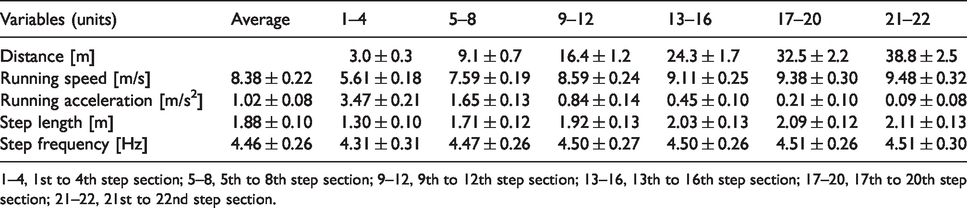
1–4, 1st to 4th step section; 5–8, 5th to 8th step section; 9–12, 9th to 12th step section; 13–16, 13th to 16th step section; 17–20, 17th to 20th step section; 21–22, 21st to 22nd step section.
Values of the knee flexion strength-power test variables in three weight conditions for the right and left knees and mean of the both knees.

Figures 1 and 2 show correlation coefficients of the right knee flexion strength-power test variables in the unweighted condition with spatiotemporal variables in each section of the sprinting and the entire sprint. Because there was no significant correlation of knee flexion strength-power test variables with the spatiotemporal variables other than relationships using the right leg unweighted condition, hereafter only the results in the right leg unweighted condition are provided.

Correlation coefficients of spatiotemporal variables with IMU-based knee flexion strength-power test variables. Horizontal dotted lines indicate P = 0.05. 1–4, 1st to 4th step section; 5–8, 5th to 8th step section; 9–12, 9th to 12th step section; 13–16, 13th to 16th step section; 17–20, 17th to 20th step section; 21–22, 21st to 22nd step section.

Relationship of average running acceleration over 50-m with angular impulse (a), mean moment (b), negative work (c), positive work of the right knee flexion strength-power test in the unweighted condition.
The right knee flexion angular impulse was positively correlated with running acceleration at the 9th–12th step section and during the entire sprint (r = .502–.596) (large effect) (Figures 1(a) and 2(a)). The right knee flexion positive work was positively correlated with running acceleration at the all step sections and during the entire sprint (r = .521–.721) (large or very large effect), with running speed at the 21st–22nd step section (r = .511) (large effect), and with SF at the 13th–16th, 17th–20th and 21st–22nd step sections and during the entire sprint (r = .506–.566) (large effect) (Figures 1(c) and 2(c)).
Discussion
This study firstly examined whether sprinting performance would be associated with knee flexion strength-power capabilities measured using IMU-based test. The findings were 1) the measured right knee unweighted flexion strength-power test variables were associated with running acceleration at all step sections of the sprinting and with running speed at the 21st–22nd step section and 2) the corresponding variables were correlated not with the SL but with the SF from the 13th–16th to 21st–22nd step sections of the sprinting.
Using the IMU-based test, this study revealed that the knee flexion strength-power capabilities are likely advantageous for better sprinting performance. Moreover, among the test variables, knee flexion positive work was the most useful indicator for evaluating the sprinting performance based on the relationships of the knee flexion strength-power test variables and average running acceleration for the 50-m distance. While the measured knee flexion strength-power test variables were correlated with running acceleration at all the investigated sections, the corresponding relationship with running speed was only found at the 21st–22nd step section. These results demonstrate that the knee flexion strength-power capabilities are important for achieving greater acceleration and high maximal speed. The step sections of significant correlations between the measured knee flexion strength-power test variables and running accelerations did not show a specific trend, suggesting that the knee flexion strength-power capabilities are required for better acceleration during the entire sprint and not at specific locations. A previous study has revealed that greater knee flexion power during the swing phase of sprinting is one of the determinants of greater sprint acceleration performance. 9 Thus, the requirement of knee flexion capabilities for greater acceleration would lead to the association of sprinting performance with the knee flexion strength-power test variables in this study. Moreover, it can be considered that the test used in this study evaluates sprint-specific knee flexion strength-power capabilities and is useful for monitoring the condition of an athlete and predicting athletic performance.
Regarding the SL and SF, only the SF showed significant positive correlations with the knee flexion strength-power test variables during the later section of the sprint acceleration, indicating that the greater knee flexion strength-power capabilities are likely advantageous for better sprinting performance during the later acceleration section through higher SF. With increasing constant running speed from 7 m/s to the maximal speed, rapid increase in SF is accompanied with acute increases in knee flexion work and power during the terminal swing phase of sprinting.22,23 Thus, knee flexion capability has an important role to increase SF during sprinting at high speeds, and this fact supports the findings in the present study. Greater squat and counter movement jump performances have been found to be related to longer SL and better sprinting performance,24,25 indicating that the greater leg extension strength-power capabilities measured using the vertical jumps are important for improving sprinting performance through SL and useful for evaluating a capability to produce long SL. Taking these into account, it can be said that combining the vertical jump tests and the current knee flexion strength-power test would improve an assessment scheme of sprinters from a specific aspect of sub-components (SL or SF) of running speed.
In contrast to the current study, previous studies using an isokinetic dynamometer found no significant relationships between knee flexion strength-power test variables and sprinting performance.6,11,12 This contradiction is probably because of the differences in angular velocities and muscle contraction modalities between the studies: >1250 deg/s at the maximal knee joint angular velocity and reactive muscle contraction in this study versus <300 deg/s of knee joint angular velocity and constant speed muscle contraction in the previous studies.6,11,12 The knee flexion mean torque did not show significant correlations with any sprinting performance variables in this study, while the knee flexion positive work was significantly correlated with sprinting performance variables. Because the joint work is calculated as integral of a product of joint torque and angular velocity, this also demonstrates the importance of high angular velocity to evaluate sprint-specific knee flexion strength-power capabilities. The fact that the significant correlations were only found in the present study underpins the advantage of the knee flexion strength-power test used in the current study for evaluating sprint-specific strength-power capabilities.
The significant correlations between the knee flexion strength-power test variables and sprinting performance were only found in the right leg condition. Although it is difficult to explain this bilateral difference, one possible reason is that the right leg was the dominant leg for all the participants in this study. For all the knee flexion test variables, the current test showed smaller values in the left leg condition compared to the right leg condition. During sprinting, there are bilateral differences in spatiotemporal and GRF variables, 17 suggesting that the sprinting performance possibly depends on stronger leg. Thus, it is likely that the bilateral difference in sprinting led to the bilateral difference in significant correlations between sprinting performance and knee flexion strength-power test variables. In addition to the bilateral difference, the significant correlations between the knee flexion strength-power test variables and sprinting performance were only found in the unweighted condition. This would be because of the similarity of high knee joint angular velocities in the unweighted condition of the current test and in sprinting (both >1250 deg/s at the peak). 9 The fact that the significant correlations were only found in the right leg unweighted condition indicates that the knee flexion strength-power test is useful when the dominant leg in an unweighted condition is examined. Moreover, only necessary to test in the right leg unweighted condition is advantageous for saving time to measure sprint specific knee flexion strength-power capabilities.
Regarding limitations of this study, the sample size (16 participants) was slightly small. Moreover, the participants were male sprinters and their performance level (personal best 100-m race time: 11.27 ± 0.42 s) was not an international standard. Thus, there is a possibility that the results may differ for female sprinters, higher level sprinters and athletes of other sports. Further studies are expected to verify whether similar results are obtained with large number of participants or with other athletes who have different characteristics.
Conclusions
The current results demonstrate that the knee flexion strength-power capabilities measured using IMU in the right leg unweighted condition are likely important for high SF and better sprinting performance. Given the current findings and its simplicity, the IMU-based knee flexion strength-power test in the right leg unweighted condition will likely be useful for physical fitness evaluation of sprinters on the field.
Footnotes
Declaration of conflicting interests
The author(s) declared no potential conflicts of interest with respect to the research, authorship, and/or publication of this article.
Funding
The author(s) disclosed receipt of the following financial support for the research, authorship, and/or publication of this article: This research was supported by JSPS Grants-in-Aid for Scientific Research Grant Number 17K13141.
