



Abstract
Soccer competitions in childhood should ensure a high involvement of all players regardless of their talent. The purpose of the present study was to compare soccer players’ technical actions and playing time parameters in 7v7 in comparison to 3v3 (on mini-goals without goalkeepers; under-7) and 5v5 (on 1.65 × 5 m. goals with goalkeepers; under-9) game formats in a competitive context. Using a quasi-experimental within-subject design, tournaments with under-7 (n = 42) and under-9 (n = 43) players were conducted. Technical actions and playing time parameters were rated. Based on the total number of technical actions in 7v7, median splits of the samples were conducted to compare differences between high-involved (dominant) and low-involved (non-dominant) players. No differences in the effective playing time comparing game formats within the age groups were found. In total, 7884 technical actions were rated. In both age groups, the total number of technical actions was higher in the smaller game formats. In under-7, the number of technical actions in all variables was higher in 3v3. In under-9, the number of technical actions was also higher in 5v5 except for unsuccessful passes as well as successful 1v1 situations. More unsuccessful 1v1 situations were found in 7v7. Concerning the total number of technical actions, both dominant and non-dominant players in both age groups performed more technical actions in small-sided games. Due to the higher involvement of the children, better conditions for the acquisition of soccer-specific skills in the smaller game formats compared to 7v7 game formats can be concluded.
Introduction
Participation in organized sport often begins in early childhood, where central interests, values and beliefs about sport are developed. 1 These early experiences are essential for future participation because attitudes towards sport are shaped.2,3 In particular, enjoyment, learning new skills and the perception of competence are children's intrapersonal motives for sport participation in this stage of development. 4 If the sporting environment does not address these motives, the probability of early drop-out from sport increases.5,6 To enable positive experiences to encourage long-term participation, training practices and competitions should optimally address the children's developmental stages.4,7,8 In recent years, concepts of scaling sport to the children's needs in terms of the equipment, play areas (e.g. field dimensions) or competitive rules have dedicated special attention within research (for an overview see Buszard et al. 9 ).
In soccer, there is consent on scaling down 11v11 matches for soccer competitions in childhood. 10 However, it is intensively discussed how competitive game formats should be scaled during childhood to optimally address the players’ stages of development.10–12 A common way to scale down soccer matches is the use of small-sided games (SSGs). They can be defined as ‘modified games, played on reduced pitch areas, often using adapted rules and involving a smaller number of players than traditional football matches’. 13 In some countries, various forms of SSGs are already used as competitive formats in child and youth soccer. However, there are not only international but also regional differences in the competitive game formats. 11 Many national soccer associations in different countries, for example, Australia, 14 Belgium,15,16 the Netherlands,17,18 Republic of Ireland, 19 Scotland 20 or USA 21 have already implemented SSGs as game formats for soccer competitions in childhood. 1 Most countries use 2v2 or 3v3 game formats in the youngest age groups, which are scaled up to 4v4 or 5v5 matches in under-10 (U10) age groups. In other countries, such as Germany, 7v7 game formats are used from the under-7 (U7) to under-11 (U11) age groups. Scaling down these 7v7 game formats is currently discussed in Germany to increase the children's game involvement and to better adapt the competitive formats according to players’ developmental requirements. However, the specific effects of such modifications on the players’ technical actions, as well as playing time parameters compared with the currently used form (i.e. 7v7), are unclear.
In adolescent and adult soccer, modifications of central constraints in soccer matches were investigated in numerous studies.22–24 In particular, the influence of field dimensions and the number of players on physiological and technical demands were frequently examined. 25 Studies showed that these two constraints influence physiological parameters, such as the players’ heart rate, the total distance or the number of sprints completed by the players.26,27 Additionally, some studies investigated effects on psychological parameters.26,28 Concerning technical variables, the vast majority of studies revealed an increase in the number of technical actions by a decrease of field dimensions and team sizes.29–32 More precisely, the number of shots,29,32–34 goals, 32 passes33,35,36 and dribbles29,32,35 were higher in smaller game formats. Casamichana and Castellano 29 also pointed out that the effective playing time decreased by using smaller field and team sizes. Concluding, the ‘studies showed a real importance of manipulating factors such as the number of players or field dimensions in small-sided soccer games, modifying physiological, kinematical and technical indicators’ 37 in adolescent and adult soccer.
In the early stages of organized soccer, the number of technical actions (e.g. passes or dribbles) as a parameter for children's game involvement is of special interest. However, as Sarmento et al. 24 indicated, the vast majority of studies on SSGs in soccer focused on age groups above the under-15. Only a few studies analysed the effects of scaling down soccer games during childhood. For example, Silva et al. 38 showed that U11 players were more involved in the games, defended more aggressively and shot more often on the goal in 3v3 in comparison to 6v6 game formats. In another study, only a slight increase was found for the number of technical actions of U10 players in 5v5 in comparison to 7v7 matches. 39 Garcia et al. 40 showed a higher involvement of under-9 (U9) soccer players in offensive situations in 5v5 in comparison to 7v7 and 9v9 game formats.
Only three studies evaluated the effects of reducing team and field sizes on technical actions in a competitive environment with players during childhood. The reduction of team, field and goal sizes of the traditional Spanish competitive form 8v8 in the U12 age group in comparison to 5v5 showed a greater number and variability of technical-tactical actions and team play. Thus, the modified competitive form was considered more suitable to the players’ individual development. 10 Joo et al. 41 pointed out that U12 Korean youth soccer players executed more passes and goal shots in 8v8 in comparison to 11v11 matches. Amatria et al. 18 analysed whether 7v7 or 8v8 game formats better address the learning needs of Spanish children aged 8–10 years than the previous 5v5 game format. They revealed that the chance of scoring a goal in 7v7 and 8v8 was lower than in 5v5. Moreover, the probability of ball control and passing to a teammate was higher in 7v7 than in 8v8 but also higher in 7v7 in comparison to 5v5. To sum up, various modifications of central constraints of play (i.e. field dimensions or team and goal sizes) were examined in adolescent and adult soccer. Studies’ results enable coaches to consciously influence many parameters (e.g. technical-tactical or physiological) during practice. 22 However, only a few studies investigated such effects in childhood. Moreover, there are no studies in a competitive context in the U7 and U9 age groups focusing on the number, type and success of players’ technical actions. Furthermore, the investigation of playing time parameters during competitions, such as the players’ individual and effective playing time or the number of game interruptions, was neglected so far.
Soccer competitions should provide high involvement and individual development opportunities for both high-performing and low-performing children, to encourage long-term participation and to promote skill acquisition. Based on these theoretical considerations and the lack of research conducted with children, the influence of different game formats (i.e. 3v3 and 7v7 in U7; 5v5 and 7v7 in U9) on the number, type and success of children's technical actions was investigated. To draw more detailed conclusions on the effect of the modified competition forms on soccer players’ technical actions, differences in the effects of such modifications between high-involved (dominant) and low-involved (non-dominant) players were analysed. Moreover, the players’ individual playing time, the effective playing time and game interruptions were examined. We hypothesized differences between the two game formats regarding the players’ technical actions, individual and effective playing time as well as game interruptions, and that the effects in technical actions differ between dominant and non-dominant players.
Methods
Study design
The quasi-experimental study was conducted using a within-subject design. Tournaments with U7 and U9 teams were carried out applying the traditional 7v7 and modified competition forms using SSGs. The SSGs were arranged in twin-game mode, where two SSGs were played simultaneously. The one-day tournaments were conducted with the same playing time of 20 min in each competition form. Due to the higher load in SSGs 32 , the matches were split into four twin games of 5 minutes each. All teams (four teams of the U7 and U9 age groups each) played two traditional (20 min) and two twin SSG (4 × 5 min) matches resulting in a total playing time of 40 min each. The total playing time of 480 min can thus be evaluated.
To reduce the influence of the physical load on the analysed parameters, each team started one match in the traditional form and the other match in the respective SSG format. Further, sufficient recovery time between the matches during the tournaments was ensured, at least the same time as the match duration (i.e. 20 min). The tournaments were conducted on natural grass. The weather conditions on the match-day were slightly cloudy and 19–22 °C.
Table 1 shows the rules of the traditional and modified competition forms. The rules and field dimensions of the 7v7 forms corresponded to the official rules of U7 and U9 soccer of the regional soccer association in Westphalia, Germany, during the season 2018/2019.48,49 The rules of the modified forms were developed by the research group in collaboration with a project group from the regional soccer association of Westphalia on SSGs as game formats in soccer competitions. The modified goal size in U9 was chosen according to the study by Schwab, 42 who calculated age-specific goal sizes, depending on the average body sizes of goalkeepers in different age groups.
Rules and organization forms of the U7 and U9 tournaments.

SSG: small-sided game; U7: under-7; U9: under-9; gr.: gram.
Note: The ‘player rotation’ as rule of substitution in SSGs requires a substitution after each goal in a fixed order.
The tournament schedule was drawn by the tournament organizers. Following the FairPlay League's recommendation in these age groups, 43 the match results were not announced during the tournaments.
Participants
Eight soccer teams (four teams of the U7 and U9 age groups each) from five different clubs participated in this study. The teams were invited by email and provided with general information about the study. The players’ parents agreed to participate in the study as well as in the video recording of the matches with written consent. The sample selection criteria were the regionality of the clubs, the age groups and the competitive level of the players: Every team belongs to a ‘local level’ soccer club in the region of Bielefeld, Germany, which is part of the Regional Soccer Association of Westphalia, Germany. The U7 players were born in 2012 and 2013, and the U9 players in 2010 and 2011. The teams usually trained twice a week for 60 to 90 min. In total, 85 soccer players from U7 (n = 42, 2 girls) and U9 (n = 43, 4 girls) age groups were involved. Based on previous studies, 10 the aim was to select a sample size that would allow detecting an effect of at least ηp2 = .1. With an alpha = .05 and power = 0.90, the projected sample size needed with this effect size is about n = 26 for a within-subject design. Therefore, the achieved sample size is sufficient.
The study was approved by the ethics committee of the University of Bielefeld (number: 2020–187). All procedures performed in this study involving human participants were in accordance with the 1964 Helsinki declaration and its later amendments or comparable ethical standards.
Data collection and variables
The games were videotaped with JVC (Japan Victor Company) cameras (type: 3ccd ProHD, Bad Vilbel, Germany) from two elevated perspectives (i.e. behind one goal and at the side of the pitch) ensuring a good quality of the recordings. The playing time parameters and technical actions were analysed as dependent variables in both game formats (i.e. independent variables). Using a systematic observation, 44 the number of passes, dribbles, 1v1 situations, goal shots and goals were coded as main technical variables. Additionally, the execution of passes, 1v1 situations and goal shots were rated as successful or unsuccessful. A successful pass to a teammate was defined by appropriate length and speed to the body (if the teammate is stationary) or lead pass (if the teammate is running). 45 A dribble was defined by three contacts in a row and was therefore split from 1v1 situations as a deliberate trial to overtake an opponent in a direct duel in possession of the ball. If the player was able to overcome the opponent by staying in possession of the ball, the action was coded as successful. A successful goal shot (shots with the intention to score a goal) was coded if the players scored. 41 Further on-the-ball subcategories (e.g. corners, but also a high number of uncontrolled actions involving touching the ball) were included in the total actions to compare the total ball actions by the players in both competition forms. The individual playing time of the soccer players was measured to calculate the number of individual technical actions in relation to the individual playing time.
The dependent variables were coded by four trained and independent raters (age: 23.38 ± 4.63 years). The raters were students of sports science and experienced in playing soccer (soccer experience: 16.44 ± 6.86 years). The raters’ training consisted of five steps: First, they were informed by the research group about the objectives and the research design. Afterwards, they had to familiarize themselves with the variables and the definitions by documents and video examples. Third, a rater training of 90 min was conducted with exemplary game situations. The week after, the raters had to code 5 minutes of the traditional and SSG format. In a fifth step, the researchers and raters met again to clarify questions and discuss problems.
Due to the fully crossed design, interrater reliability (IRR) was calculated using the intraclass-correlation coefficient (ICC) in a two-way mixed model and absolute agreement. 46 ICC coefficients for assessing the IRR can be categorized as poor (≤ .39), fair (.40–.59), good (.60–.74) and excellent (≥ .75). 47 The IRR for the effective playing time (ICC = .91) and the number of game interruptions (ICC = .96) were excellent. The coefficients for technical variables were good to excellent for 3v3 (.76 ≤ ICC ≤ .99) and 7v7 (.86 ≤ ICC ≤ .99) in U7 as well as for 5v5 (.89 ≤ ICC ≤ .99) and 7v7 (.79 ≤ ICC ≤ .97) in U9.
Statistical analysis
Due to the satisfactory results of the IRR, the dependent variables were calculated as means of the four independent ratings. The effective playing time and the number of game interruptions were evaluated for each game format. Only players who played a minimum of 5 minutes (i.e. the duration of one SSG) in each competition form were included in the analysis. Due to their unique profile of requirement and the use of mini-goals in 3v3, goalkeepers were excluded from the analysis, leading to the exclusion of two children in both age groups.
The number of technical actions was analyzed per individual playing minute. A median split of the sample was conducted in both age groups based on the total number of individual technical actions per minute in 7v7. We calculated diff-scores (differences in the number of technical actions in both game formats) to compare the effects of modifications for dominant and non-dominant players. The comparison of playing time parameters was carried out using univariate analysis of variance (ANOVA). Bonferroni adjusted post hoc comparisons were conducted. The number of technical actions as well as the comparison of diff-scores between dominant and non-dominant players were conducted using multivariate ANOVA (MANOVA). In the comparison of players’ technical actions per minute, we only compared in-game actions (i.e. no kick-ins and dribble-ins) in both game formats, to evaluate the number of successful and unsuccessful actions under comparable conditions. The total values of technical variables (including all ball actions) as well as the comparisons of dominant and non-dominant players’ diff-scores of total actions were conducted using ANOVAs. Alpha level was set at p < .05 for significant results. SPSS software (version 26.0; IBM, Armonk, NY) was used for all statistical analyses.
Results
Playing time parameters
Descriptive statistics for effective playing time, game interruptions and the individual playing time are reported in Table 2. A one-way ANOVA revealed a significant effect of game format on the percentage of effective playing time with large effect size F(3, 68) = 10.992, p < .001, ηp2 = .327). Post hoc analysis showed significant differences between the 3v3 in U7 in comparison to 5v5 (p < .001, d = 1.27) and 7v7 (p = .001, d = 1.76) in U9. No significant differences were found within the age groups between the traditional and modified competition forms in U7 and U9.
Descriptive statistics (mean ± SD) for playing time parameters in 7v7 and modified competition forms.

U7: under-7; U9: under-9.
Technical actions per individual playing minute in 7v7 compared to 3v3 (U7) and 5v5 (U9) game formats.
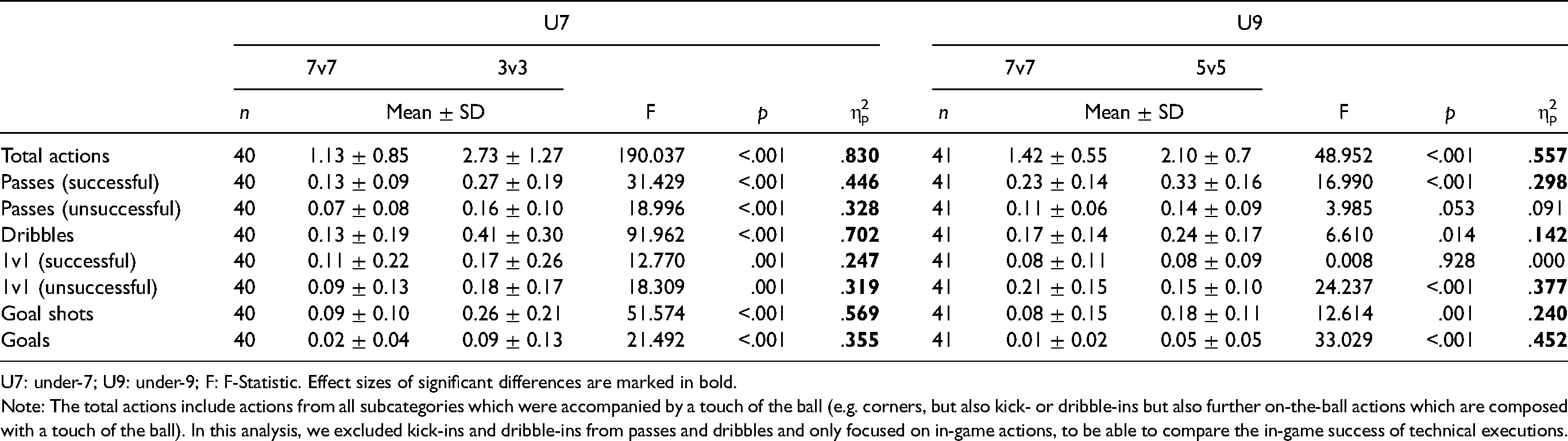
U7: under-7; U9: under-9; F: F-Statistic. Effect sizes of significant differences are marked in bold.
Note: The total actions include actions from all subcategories which were accompanied by a touch of the ball (e.g. corners, but also kick- or dribble-ins but also further on-the-ball actions which are composed with a touch of the ball). In this analysis, we excluded kick-ins and dribble-ins from passes and dribbles and only focused on in-game actions, to be able to compare the in-game success of technical executions.
Significant differences were also found in the number of game interruptions per minute F(3, 68) = 13.711, p < .001, ηp2 = .377). The 3v3 matches were more frequently interrupted in comparison to 7v7 matches (p < .001, d = 2.78) in U7, as well as in comparison to 5v5 (p = .012, d = 0.79) and 7v7 (p < .001, d = 3.58) in U9. The 5v5 game format has caused significantly more game interruptions than the 7v7 in U7 (p = .044, d = 1.51) and 7v7 in U9 (p = .005, d = 2.07). No differences were found between both 7v7 forms.
In U7, the individual minutes of the players did not differ between 7v7 and 3v3 competition forms F(1, 39) = 0.556, p = .460, ηp2 = .014). In U9, the modified form differed from the traditional form F(1, 40) = 31.278, p < .001, ηp2 = .439).
Technical actions
Total on-the-ball actions during the tournaments
In total, 7884 technical actions were coded. These technical actions consisted of 3863 actions in U7 and 4021 actions in U9. These total actions include as main technical variables passes (U77v7 = 197; U73v3 = 495; U97v7 = 325; U95v5 = 647), dribbles (U77v7 = 146; U73v3 = 576; U97v7 = 177; U95v5 = 315), 1v1 (U77v7 = 237; U73v3 = 382; U97v7 = 201; U95v5 = 308), goal shots (U77v7 = 97; U73v3 = 275; U97v7 = 85; U95v5 = 223) and goals (U77v7 = 25; U73v3 = 104; U97v7 = 14; U95v5 = 66). The results for passes and dribbles in SSGs also include the executed technical actions as kick- or dribble-in. In U7, the players executed 17.07% (SD = 14.99) of the total number of passes as kick-ins and 25.17% (SD = 17.29) of the total number of dribbles as dribble-ins. In U9, 10.12% (SD = 6.99) of the passes and 28.06% (SD = 23.66) of the dribbles were executed as kick- and dribble-ins.
Individual technical actions per minute in U7
The results for the comparison of U7 players’ technical actions are reported in Table 3. Univariate ANOVA for the comparison of total actions showed a significant difference of individual technical actions of the players per minute indicating more technical actions in 3v3. MANOVA revealed a significant main effect for game format on the number of individual technical actions per minute F(7, 33) = 12.296, p < .001, ηp2 = .804). The number of players’ technical actions was significantly higher in all technical variables in 3v3. The largest effects were found for dribbles and goal shots. The lowest effect was found for successful 1v1 situations. The effect for successful passes was slightly higher than for the number of unsuccessful passes.
Diff-scores (mean ± SD) of dominant and non-dominant players in total actions and technical variables.

U7: under-7; U9: under-9.
Influence of playing dominance in U7
A median split on the number of total actions in 7v7 was conducted. An independent t-test showed significant differences with a strong effect between dominant (n = 20, mean = 1.71, SD = 0.85) and non-dominant (n = 20, mean = 0.56, SD = 0.23) players in the number of total actions in 7v7 (t (21.734) = -5.802, p < .001, d = 1.85). The split was conducted to compare the diff-scores between dominant and non-dominant players in 7v7 and 3v3 game formats. Descriptive statistics are reported in Table 4. Diff-scores in a positive range represent a higher number of technical actions in SSGs (see also Figure 1). Univariate ANOVA did not reach significance comparing the diff-scores of the total actions F(1, 38) = 1.515, p = .226, ηp2 = .038). MANOVA for the comparison of diff-scores in the technical variables showed significant differences between the groups F(7, 32) = 3.152, p = .012, ηp2 = .408). Significant differences were found for unsuccessful passes F(1, 38) = 8.785, p = .005, ηp2 = .188), dribbles F(1, 38) = 8.796, p = .005, ηp2 = .188), goal shots F(1, 38) = 10.812, p = .002, ηp2 = .222) and goals F(1, 38) = 7.867, p = .008, ηp2 = .172). Dominant players had higher diff-scores of dribbles, goal shots and goals in SSGs. A higher diff-score was found for non-dominant players in the number of unsuccessful passes.
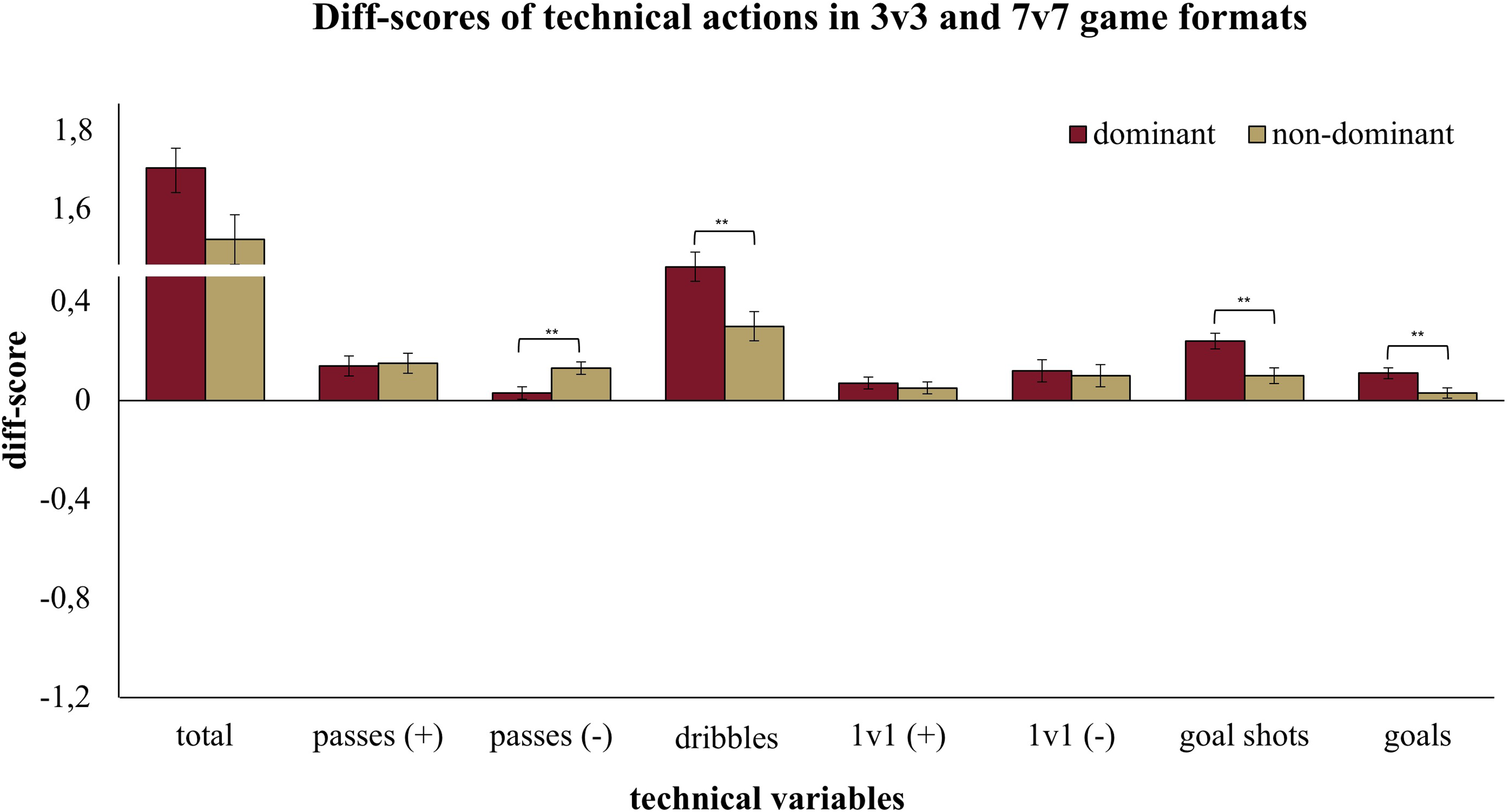
Comparison of dominant and non-dominant players diff-scores of total actions and technical variables in U7. Positive diff-scores represent a higher number of technical actions in 3v3. Results are reported as means and with standard errors. ‘(+)’ = successful action; ‘(−)’ = unsuccessful action; U7: under-7; *p < .05; **p < .01; ***p < .001.
Individual technical actions in U9
The results for the comparison of U9 players’ technical actions are reported in Table 4. ANOVA for total actions showed that the players executed significantly more actions in SSGs. MANOVA for the comparison of technical variables revealed significant differences between 5v5 and 7v7 game formats F(7, 34) = 9.799, p < .001, ηp2 = .669). Significantly more successful passes, dribbles, goal shots, and goals were performed in 5v5. The largest effect was found for goals, the lowest for dribbles. No significant differences were found for unsuccessful passes and 1v1 situations. The number of unsuccessful 1v1 situations was significantly higher in 7v7.
Influence of playing dominance in U9
Descriptive statistics for mean differences of dominant (n = 21) and non-dominant (n = 20) players are presented in Table 4. Dominant (mean = 1.84, SD = 0.97) and non-dominant (mean = 0.97, SD = 0.23) players significantly differ with a strong effect in their total actions in 7v7 (t (31.905) = -8.237, p < .001, d = 1.23). Concerning total actions F(1, 38) = 0.905, p = .347, ηp2 = 0.23) and technical variables F(1, 34) = 1.341, p = .263, ηp2 = .221), no differences were found between dominant and non-dominant players diff-scores (see Figure 2).

Comparison of dominant and non-dominant players’ diff-scores of total actions and technical variables in U9. Positive diff-scores represent a higher number of technical actions in 5v5. Results are reported as means and with standard errors. ‘(+)’ = successful action; ‘(−)’ = unsuccessful action; U9: under-9; *p < .05; **p < .01; ***p < .001.
Discussion
The purpose of the present study was to compare the number, type and success of technical actions and playing time parameters in traditional and modified soccer competitions in childhood. The modified competition forms aim to provide a higher game involvement of all children, regardless of talent level. This is expected to have positive effects such as more enjoyment and better development of soccer-specific skills. 7 A quasi-experimental within-subject design applying a systematic observation was chosen to investigate 7v7 and 3v3 (U7) as well as 7v7 and 5v5 (U9) game formats in a competitive context. Differences between dominant and non-dominant players were investigated by conducting a median split of the sample based on the number of total actions in 7v7. The within-subject design enables greater control of the participant variables, meaning that observed differences between the conditions are not confounded by intraindividual differences. 50
The reliability of the ratings for playing time parameters and technical actions was good to excellent, which was a prerequisite for later data analyses. Concluding, the rated variables were clearly defined. Within the age groups, no significant differences in the effective playing time but a higher number of game interruptions in the SSGs were found. Regarding technical actions, the findings support that the downscaled SSGs better address the children's requirements as the overall number of individual on-the-ball actions was higher. Especially, goal shooting and scoring were found to be greater in both age groups. Results also showed that the differences were present for both high- (dominant) and low-involved (non-dominant) children in 7v7. However, in U7, the high-involved players in 7v7 achieved greater benefits due to more dribbles, goal shots and goals in 3v3 compared with low-involved children.
The investigation of the effective playing time revealed no differences within the age groups between 7v7 game formats and SSGs. A significantly lower effective playing time was only found in 3v3 (U7) compared with both game formats in U9. Therefore, our results are partly in contrast to the study by Casamichana and Castellano, 29 who showed a lower effective playing time in smaller game formats in an adolescent sample. In the present study, the ball was out of play in the SSGs more frequently in comparison to 7v7 game formats within both age groups. An obvious explanation for this result is that the ball is more often close to the field boundaries in smaller fields. Although there was a higher number of game interruptions in SSGs, no lower effective playing time within the age groups in comparison to 7v7 matches was found. One reason for this is the rule to kick- or dribble-in balls that are out of play, whereas these balls must be thrown-in in 7v7. Maybe, kick-ins or dribble-ins can be executed faster than throw-ins, so that no lower effective playing time resulted from the higher number of game interruptions. From this point of view, the modified rule seems to be an appropriate way for children to get the game going again quickly and additionally executing more technical actions in the forms of passes and dribbles. Especially for low-performing players, kick-ins and dribble-ins provide opportunities to execute passes and dribbles without time and opponents’ pressure. Thus, the use of kick-ins and dribble-ins instead of throw-ins can be recommended for soccer competitions in childhood.
In U7, the individual playing times of the players did not differ significantly between the game formats. In U9, the players had more individual playing minutes in the modified competitive form. This can be explained because two 5v5 games were applied in twin game mode. Therefore, eight outfielders play simultaneously, while in 7v7 games as well as in 3v3 twin game in U7, only six outfielders play at the same time. As García-Angulo et al. 10 claimed, downscaling field and team size during competition should not lead to less individual playing time by the players. The twin game mode used in this study has been shown as an appropriate way to provide every child the same playing time in U7 and even more playing time in U9. This is an important precondition for the modified competition forms to achieve the desired objectives, such as a higher total game involvement of the children on the matchdays. 7
Greater involvement in playful activities is expected to contribute to more enjoyment and thus potentially encourage long-term participation. 51 Moreover, a higher number of technical actions contribute to better conditions for implicit skill acquisition, which is of vital importance for the development of expertise in a specific sport. In both age groups, significantly more total technical actions were executed in SSGs. Therefore, our findings are in line with previous studies in adolescent and adult soccer, as most studies reported a higher number of technical actions in smaller game formats.23,24 Concluding, the use of SSGs during competition contributes to a higher game involvement of U7 and U9 soccer players. From this global perspective, the chosen SSGs seem to be more appropriate formats for soccer competitions in comparison to the currently established 7v7 game format. However, in some cases, substantial differences were found between technical variables in both age groups.
In general, lower and less significant effects were found in U9. This can be explained by greater modifications in U7 (from 7v7 to 3v3) than in U9 (from 7v7 to 5v5). In both age groups, noticeable higher numbers of goal shots and goals were found in SSGs, which is in line with findings from previous studies investigating older age groups.32,34,35 Consequently, the chance of scoring a goal during competition is higher in 3v3 and 5v5 SSGs in comparison to 7v7 games in both age groups. Our results are therefore in line with the study by Amatria et al. 11 who reported better opportunities to score in smaller game formats in U10 soccer competitions. Scoring a goal in soccer has been shown to activate players’ reward processes, which are important incentives for human behaviour. 52 Our results suggest that children encounter this motivating event more frequently in SSGs, which contributes to one central objective in enhancing children's positive experiences in playing soccer. In U9, it should also be noted that the adapted goal sizes to the goalkeepers’ anthropometric characteristics did not hinder a higher number of goals in SSGs. Schwab 42 investigated these adapted goal sizes and verified that fewer goals were scored from large distances.
However, not all technical variables reached equally higher rates in the SSGs. While the higher number of dribbles – defined by three touches in a row – in 3v3 was the largest effect in the U7 age group, it was the lowest significant effect in U9. Castellano and Echeazarra 39 reported in the U10 age group that the number of one- and two-touch technical actions were higher in 5v5 in comparison to 7v7 matches, while no differences were found for technical actions with three or more touches. Therefore, these results are not in compliance with those of our study, as a higher number of dribbles were found in both age groups. More players – and therefore possibly more free teammates – may stimulate the players to pass the ball more frequently. This could also explain the low effect size regarding the dribbles compared with other variables in the U9 as one more outfielder as well as the goalkeeper in comparison to 3v3 on mini-goals in U7 may offer another opportunity for passing the ball.
Considering the number of 1v1 situations, both successful and unsuccessful 1v1 situations were more frequently performed in 3v3 game formats than in U7. Although the effect size for unsuccessful 1v1 situations was higher, the reduction of team and field sizes resulted in a higher number of 1v1 situations. This result is to be emphasized as particularly positive because 1v1 skills are important, and its development should be focused during childhood and youth. 53 It can be concluded that the higher number of 1v1 situations is a prerequisite for the implicit acquisition of 1v1 skills. However, the greater effect for unsuccessful 1v1 situations suggests that the smaller game format does not provide easier conditions for the execution of the 1v1 actions. In U9, no differences were found for successful 1v1 situations, and the number of unsuccessful 1v1 situations was even higher in 7v7. According to this result, the current field dimensions in 5v5 do not seem to encourage players to search for 1v1 situations. Generally, numerical superiority has been shown to encourage to pass the ball, while numerical inferiority leads to more dribbles. 54 Other studies showed that goalkeepers were more involved in offensive gameplay in smaller game formats.40,55 Possibly, the goalkeepers in our study were used in 5v5 to create numerical superiority in attack, whereas the players decided to pass the ball instead of creating offensive 1v1 situations. The fact that the number of successful passes was higher in 5v5 while no differences in unsuccessful passes were found supports this assumption. In this line, other studies on the effects of numerical superiority in SSGs found a higher number of successful technical actions. 56 In contrast to our results in the U9 age group, but consistent with our results from U7, Garcia et al. 40 showed that both successful and unsuccessful passes were higher in 5v5 in comparison to 7v7 game formats in U9 and U14 age groups. In our study, U7 players executed more successful and unsuccessful passes in 3v3. Larger effect size was found for successful passes indicating that the smaller game format provides easier conditions for the execution of passes. Especially for players with a low-performance level, SSGs may offer better conditions to successfully execute passes to a teammate.
According to common differences in the players’ performance levels at these young age groups, the effects of the modifications for dominant and non-dominant players were compared. In both age groups, no differences between dominant and non-dominant players’ diff-scores in the total actions were found. According to these results, the higher overall game involvement in SSGs does not depend on the players’ game involvement in 7v7. Thus, the use of SSGs offers both high- and low-involved players more on-the-ball actions, which may help to prevent drop-out, especially of low-involved players, by enhancing the perception of competence and learning new skills. 4 In U7, however, dominant players achieved a greater dominance in dribbles, goal shots and goals. The playing dominance in these variables is even more evident in SSGs. Concluding, the modified forms of competition do not balance the number of technical actions between dominant and non-dominant players. The proportional ratio in the number of technical actions between these groups, therefore, remains equal in the total actions and becomes even larger in dribbles, goal shots and goals in U7.
Further research perspectives arise in psychological questions, for example regarding motivational aspects, few of them were already investigated in older age groups26,28. To what extent SSGs are just as, or even more, motivating for the children in comparison to traditional formats is still questionable. Also, an important point is the use of mini-goals in the U7 age group. In future studies, it should be examined whether playing on and scoring in mini-goals is as attractive as playing on larger goals with goalkeepers for young soccer players. Furthermore, it is debatable whether successfully coded technical actions are also perceived by the players as experiences of success. Future studies should also investigate how different playing times impact the game dynamics to optimize the playing times in these young age groups. Generally, players’ development and adaptations using SSGs in a competitive league system over a longer period (e.g. one season) cannot be derived from either this or previous studies. Therefore, future longitudinal studies should consider both technical-tactical and psychological variables.
Limitations
The results of the present study need to be interpreted with caution as the tournaments were conducted on one match day, so that long-term adaptations of the children to the modified conditions were not considered. Besides that, the player's individual characteristics (e.g. anthropometrics) could not be assessed and were thus not considered as potential covariates. The analysed dependent variables only focused on the main technical actions of the players but did not include more specific variables, such as the ball possession time or tactical elements of the game. In addition, the variables were adapted from previous studies but not tested for content validity again. Further, it was not assessed whether different playing times within the game formats impact the players’ in-game behavior. However, the present study provides a first overview of the acute effects of scaling down competitive formats in childhood that need to be extended by long-term studies and more sophisticated variables.
Conclusion
This study was the first that investigated the number, type and success of players’ technical actions and playing time parameters during different U7 and U9 soccer competitions. In line with results from previous studies in older age groups, it was found that scaling down the field and team sizes during soccer competitions leads to greater involvement of the children. We can conclude that the use of 3v3 and 5v5 SSGs offers great potential for soccer competitions during childhood. The present results can support soccer associations as well as coaches and clubs in the development of age-appropriate soccer competitions. More concretely, stakeholders should think about scaling down their used competitive game formats in order to enhance the game involvement of their players and, thus, to create better conditions for skill acquisition and to enable more playing experiences.
Footnotes
Acknowledgements
We would like to thank Carsten Busch and Steffen Winter from the Regional Soccer Association of Westphalia, Germany. We would also thank Maneke Bondzio-Becker, Lorenz Bachmann and Paul Neu for their support in organizing and conducting the tournaments.
Declaration of conflicting interests
The author(s) declared no potential conflicts of interest with respect to the research, authorship, and/or publication of this article.
Funding
The author(s) received no financial support for the research, authorship, and/or publication of this article.
