



Abstract
The most important determinants of a cricket fast bowler's performance are bowling speed and accuracy. Even though various strength and conditioning practices (resistance, plyometric and modified-implement training) have been employed to improve these parameters, there is still ambiguity as to the effectiveness of such training programmes. This systematic review and meta-analysis examined the influence of various training interventions on fast bowling speed and accuracy. Searches were conducted across PubMed, Web of science, SPORTDiscus, Scopus and CINAHL. Inclusion criteria were studies that: were original research or conference presentations; recruited fast bowlers as participants; involved a physical training intervention; written in English; and included bowling speed or accuracy as outcome measures. Ten articles met our inclusion criteria for qualitative and eight for quantitative analysis. The quality of the studies assessed using Downs and Black checklist ranged from low to moderate with a mean ± SD of 64.5 ± 8.14%. There was a
Introduction
Cricket is a global sport followed by millions of people around the world. 1 The game is a contest between the batter and the bowler, with the batter aiming to score as many runs as possible while the bowler aims to restrict the number of runs and take wickets. 2 The duration and intensity of the matches make it a very physically demanding sport. 3 Further, the current body of literature indicates that fast bowlers are required to perform at the highest intensity (i.e. relative distance covered whilst performing low- and high-speed activity) compared to other playing positions.
The fast-bowling action has been considered to be an explosive activity involving complex inter- and intramuscular coordination. 4 Researchers have looked at the important determinants of ball release speed and reported positive correlations with upper-body strength (shoulder strength, one-repetition max pull-ups), upper-body muscle girth, upper-body power (bench throw), lower body power (static jump), lower-body strength and speed (0–20 metres).1,5,6 Fast bowling involves proximal-to-distal muscle activation pattern which share some similarities to other activities such as javelin or baseball throwing. 7 Such movements recruit proximal joint muscles to generate power to increase the speed of the ball on release in bowling.5,8 The smaller distal muscles are then used to enhance this speed of the ball as well as improving accuracy. 8 The findings from the aforementioned studies indicate that evidence based and specific strength and conditioning (S&C) training programmes (e.g. resistance training, plyometric training involving explosive and quick movements) should be incorporated in order to help fast bowlers perform at the highest level. For instance, it has been recommended that multi-joint exercises that have an activation pattern (proximal-to-distal) similar to fast bowling action should be incorporated into the training regimen of a fast bowler. 7 Further, the training programmes should also have the potential to induce adaptive responses in nervous system functioning. These include alterations in motoneuron recruitment, increased firing frequency and increased muscular activation, which lead to an improved rate of force development. These responses ultimately help with the proximal-to-distal activation pattern, and thus improvement in both bowling speed and accuracy.5,6 Even though various S&C practices have shown to help fast bowlers by taking into consideration their physical demands,3,9–14 there is still a paucity in the literature regarding the effectiveness and influence of training practices on bowling speed and accuracy, warranting further research.
Several studies4,15–20 in cricket have tried to understand the influence of biomechanical characteristics on fast bowling speed, accuracy and injury surveillance. However, there have been even fewer studies21–23 that have investigated the use of various training interventions aimed at improving the performance (i.e. bowling speed and accuracy) of fast bowlers by enhancing their physical fitness. As an example, a combined resistance training programme involving 20 m sprints with weighted resistance demonstrated a clear improvement in bowling speed. 24 However, Callaghan et al. 25 reported no significant improvement in bowling speed after eight-weeks of strength training. Further, modified-implement training programmes involving the use of underweight and overweight cricket balls have been administered in fast bowling training, with the results providing conflicting evidence. For instance, a significant increase in bowling speed of 0.9 ms−1 and beneficial improvement in accuracy when using overweight balls in training was observed by Wickington and Linthorne 22 while a 7% decrease in bowling accuracy was reported by Petersen et al. 21 The differences in results were attributed to the different methods adopted in each study for measuring bowling accuracy. Therefore, the contrasting findings reported in various studies complemented by a lack of research in the S&C domain necessitates further exploration to get a better understanding on this topic.
The game of cricket has become physically demanding with the addition of newer formats, increasing competition and increasing length of the season.
26
With regards to variation in game demands, fast bowlers have been reported to cover an additional 340 m and 400 m total distance per hour in Twenty-20 format compared to fifty over and multiday cricket respectively.
3
Fast bowlers have been reported to have 35% less recovery time in-between high intensity activities compared to other playing positions. Also, a fast bowler has been reported to cover a distance of 5.5 ± 0.4 km, 13.4 ± 0.7 km, and 22.6 ± 2.1 km during twenty over, fifty over and multiday matches.3,12,14 Therefore, providing evidence-based training recommendations would be useful for S&C coaches in implementing training programmes aimed at improving fast bowling speed and accuracy. Even though a previous narrative review
7
summarised the importance of S&C practices, a systematic review and meta-analysis combining the findings from previous work has not yet been performed. Such an analysis will not only be useful in providing a comprehensive summary of the available findings, but also help to highlight the methodological concerns that exist. Moreover, a meta-analysis will be useful in synthesising information from several independent studies to provide a better estimate of the relationship that exists between different training practices and bowling speed and accuracy. Therefore, the primary aims of this systematic review and meta-analysis were to identify whether:
S&C based interventions are associated with faster bowling speed; S&C based interventions are associated with improved bowling accuracy.
We hypothesised that various S&C training interventions i.e., resistance training, plyometric training and modified-implement training are effective in improving bowling speed and accuracy.
Methods
Experimental approach to the problem
This systematic review and meta-analysis was conducted in accordance with the Preferred Reporting Items for Systematic Reviews and Meta-Analyses (PRISMA). 27 The study was registered in PROSPERO (International Prospective Register of Systematic Reviews), an international database for systematic reviews prospectively registered by the Center for Reviews and Dissemination of the University of York (https://www.crd.york.ac.uk/prospero; CRD42021242204).
Literature search
A comprehensive literature search was conducted across PubMed, Scopus, CINAHL, Web of Science and SPORTDiscus between December 2020 and August 2021. The following keywords were used in different combinations using Boolean operators ‘AND’ and ‘OR’ in order to identify the training practices being administered in cricket for improving fast bowling speed and accuracy across various databases: cricket, fast bowling, strength and conditioning, resistance training, plyometric training, fitness, ball speed, accuracy, exercises. A grey literature search 28 was conducted across Google Scholar as well as the standard Google search engine. Further, the reference lists of each study identified using the comprehensive literature search were scanned to identify any further potential articles for inclusion.
Inclusion/exclusion criteria
Studies were deemed eligible to be included in our review if the following criteria were met:
the studies recruited cricket fast bowlers as participants with no restrictions on age, sex or fitness and playing level; the studies involved a training intervention; the outcome measure was related to fast bowling speed or accuracy; the articles were original research or conference presentations, providing the same data was not used for both; the articles were published in English. they were posters or case studies; were secondary research (e.g. reviews); the outcome measure was not related to fast bowling speed or accuracy; papers not related to cricket; not in English.
Studies were excluded according to the following criteria:
Selection process
Two authors (AR and US) conducted an independent search across all the databases to reduce the risk of selection bias. All the results were extracted to Endnote Library X8 (Clarivate, Philadelphia, US). Both the authors then screened the titles of the extracted articles according to the inclusion/exclusion criteria and identified the potential articles that could be included for the study eligibility phase of the systematic review. As reported in a previous review, the articles were classified as satisfying the inclusion criteria (yes), doubtful (maybe) or not satisfying the inclusion criteria (no). 2 The articles that met the “yes” or “maybe” criteria were further screened for abstract followed by full-text reviews. All disagreements were discussed with the third author (TL) in a consensus meeting and then a final decision was made. The flow diagram of the search process in given in Figure 1.
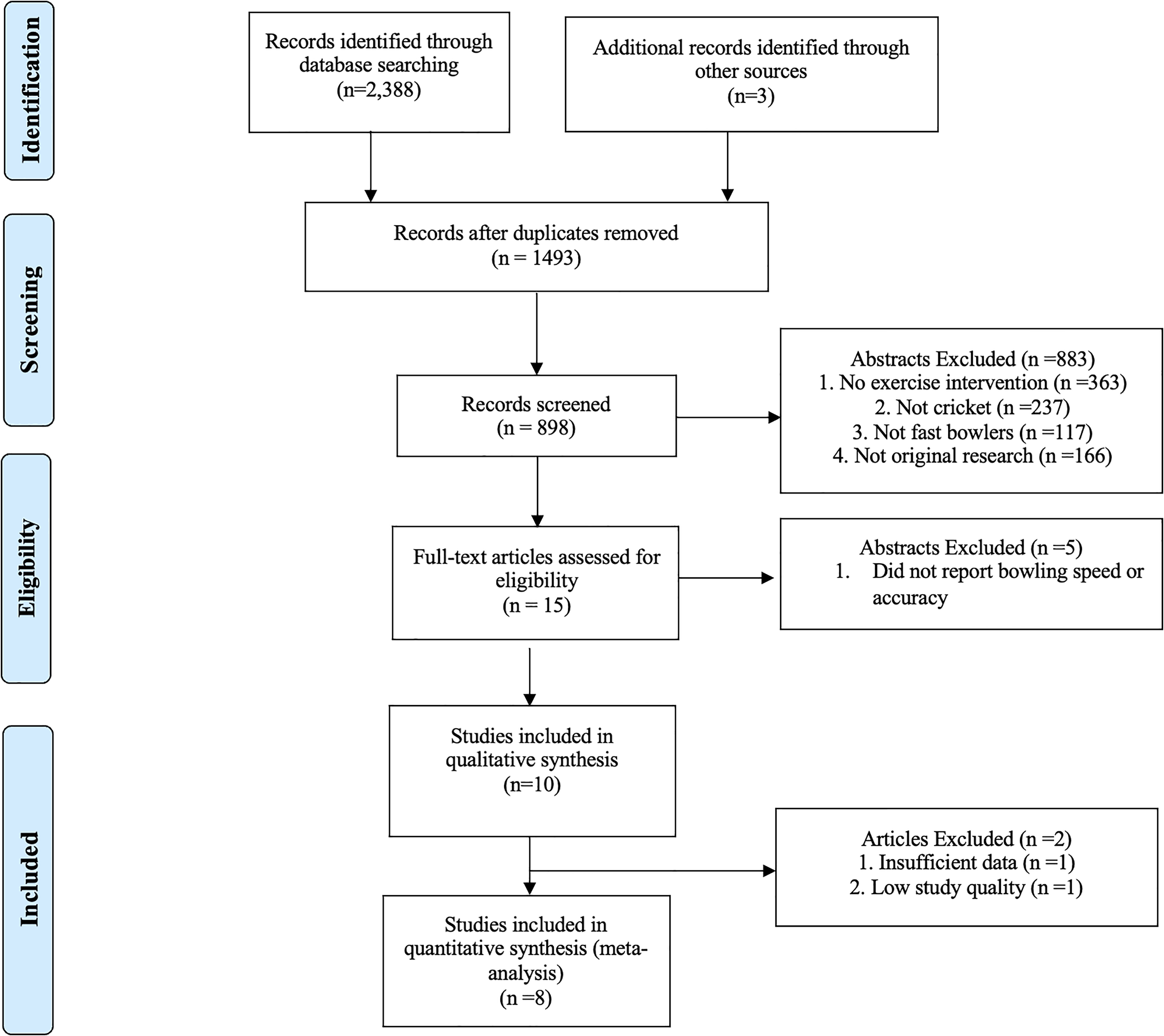
PRISMA flowchart for search strategy.
Quality appraisal of studies
The Downs and Black checklist 29 was used to evaluate the methodological quality of both randomised and nonrandomized experimental studies. The checklist consists of 27 items that address the following methodological components: reporting, external validity, internal validity (bias and confounding) and power. All the items were rated either as yes ( = 1) or no/unable to determine ( = 0). The quality index of the checklist has high criterion validity (r = 0.90), high internal consistency (KR-20 = 0.89), test-retest (r = 0.88) and inter-rater (r = 0.75) reliability. 29 The question on power was modified from a scale of 0–5 to a scale of 0 (no) to 1 (yes) where a score of 1 was given if a power or sample size calculation was present, or based on how narrow the confidence intervals were.30–32 A score of 0 was given if there was no power or sample size calculation, or no explanation on whether the number of subjects was appropriate or based on how wide the confidence intervals were. If sufficient information was available and bias was considered unlikely, the item was rated as a ‘yes’, whereas ratings of ‘no’ were confirmed where bias was likely. Criteria that were coded as a ‘yes’ were given one point, whereas ‘no’ responses did not receive any points. The sum of each of the ‘yes’ responses contributed to the overall quality score, with a higher score indicating higher methodological quality. High quality studies were categorised as 85–100%, moderate quality studies as 60–84% and low quality as less than 59%. 29 Studies considered to be of low quality were excluded from the meta-analysis. The two authors (AR and US) rated each article independently using the quality assessment criteria checklist with any disagreements settled by the third author (TL).
Data extraction
The following data were extracted in a Microsoft Excel (Microsoft Corporation, Redmond, WA, USA) sheet from each study: author's name, study design, participant information (age, sex, height, body weight, bowling experience), sample size, training interventions (e.g. resistance training, plyometric training) and outcome measures (bowling speed and accuracy). The pre- and post- test intervention mean and standard deviation data were extracted for the outcome measure for all the studies. The data extraction was carried out by two authors (AR and US) independently. The final sheet was cross verified in consultation with the third author (TL) to ensure that the required data was extracted.
Statistical analysis
All data for the meta-analysis were conducted using JBI SUMARI. 33 A meta-analysis was conducted when there were two or more studies available for each training intervention. 34 The inverse-variance method and random effect model was used for conducting the meta-analysis.35,36 Effect sizes (ES) were expressed as weighted (or standardised) final post-intervention mean differences (for continuous data) and their 95% confidence intervals were calculated. The ES of the primary studies were presented in a forest plot with values of 0.2, 0.5 and 0.8 corresponding to small, moderate and large ES, respectively. 37 Heterogeneity was examined with the I2 statistic. 38 The I2 statistic calculates the degree to which there is heterogeneity, with 25% suggesting low heterogeneity, 50% indicating moderate, and 75% indicating the threshold for high heterogeneity. The Q statistic was also calculated and provides the statistical significance of heterogeneity. All statistical analysis were maintained at a significance level of 0.05 (p < 0.05).
Results
Systematic literature search
A total of 2388 articles were extracted and screened based on our inclusion criteria from PubMed, CINAHL, SPORTDiscus, Scopus and Web of Science. The grey searches 28 conducted using Google resulted in three more papers being added. Further to the abstract screening process, 15 full-text articles were reviewed, with 10 articles being included for qualitative assessment while 8 articles were considered eligible for quantitative analysis. One study 39 was not considered for meta-analysis due to poor quality of the study (48%), as measured using Downs and Black checklist
Participant information
A total of 187 fast bowlers from 10 studies were analysed in our qualitative and quantitative assessment. The age, stature and mass of the bowlers in these studies were 22.7 ± 4.6 y, 1.78 ± 0.07 m and 78.37 ± 9.78 kg. The bowlers recruited in nine studies played at the community- or club-level and one study recruited national-level bowlers. The study characteristics and outcome measures of all the included studies have been summarised in Tables 1 and 2.
Summary of the key characteristics of each study.
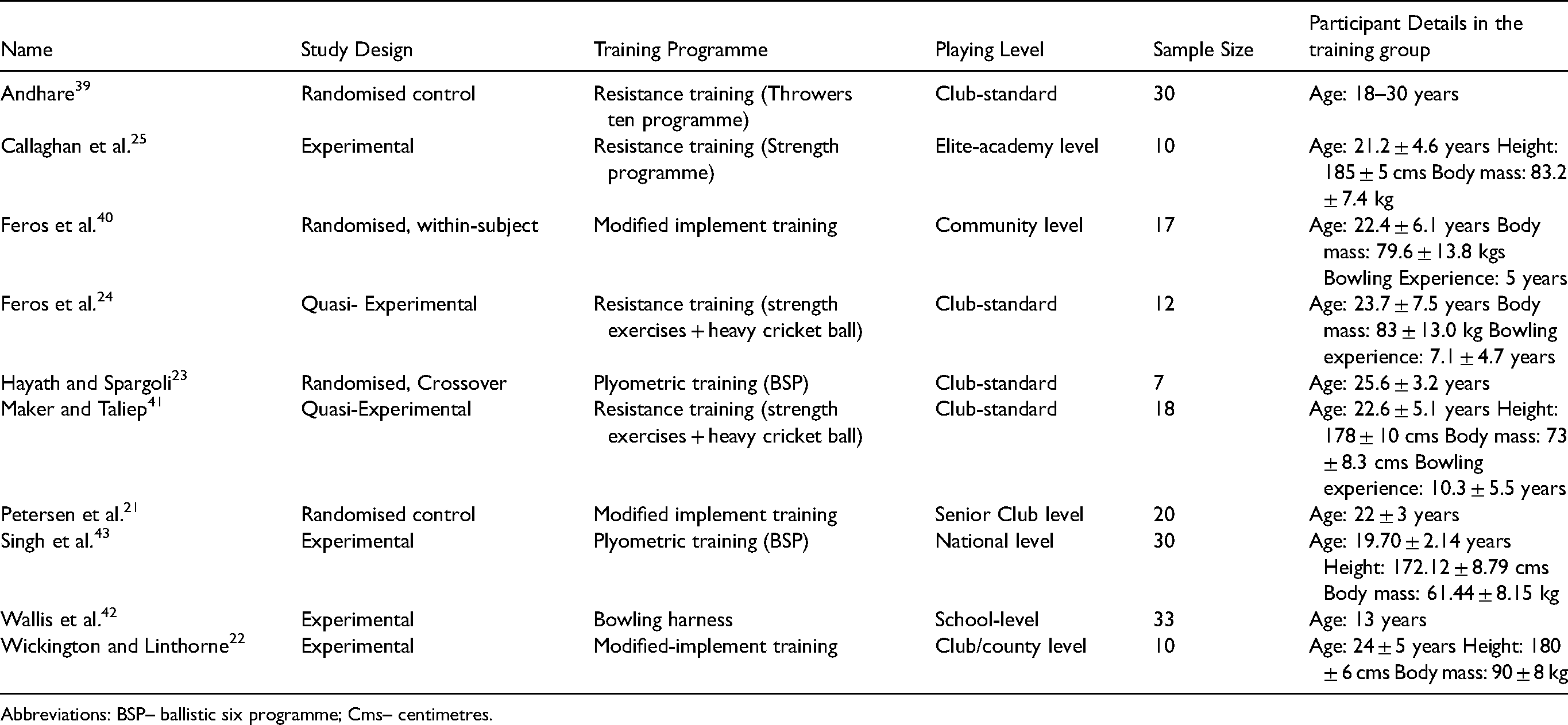
Abbreviations: BSP– ballistic six programme; Cms– centimetres.
Outcome measures and results of the included studies.
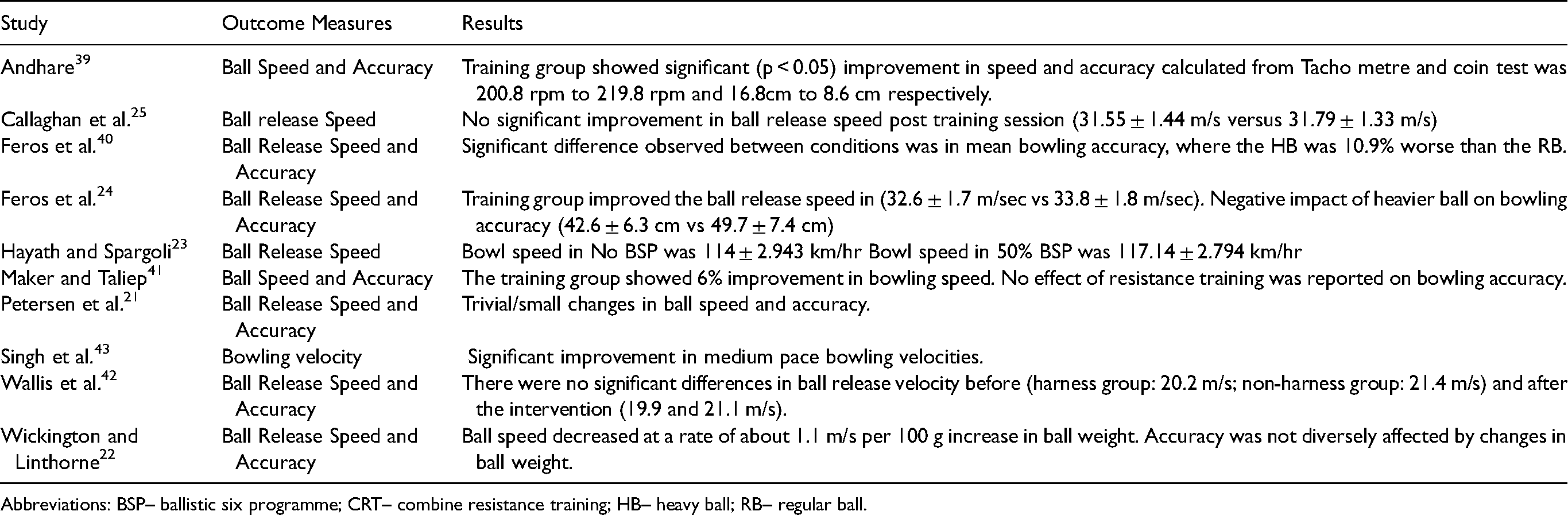
Abbreviations: BSP– ballistic six programme; CRT– combine resistance training; HB– heavy ball; RB– regular ball.
Methodological descriptions
Of the ten studies, seven studies21,22,24,39–42 reported outcome measures as bowling speed and accuracy whereas three studies23,25,43 reported bowling speed only. These studies utilised different interventions to examine the effect on bowling speed and accuracy. Three studies21,22,40 used modified ball weight training intervention where the ball weight ranged from 46% to 192% of the standard ball weight (156 g). One study 42 incorporated the use of a bowling harness to restrict the movement of the shoulders during the delivery stride. Two studies25,39 incorporated only resistance training whereas two studies24,41 administered a resistance training intervention along with a weighted cricket ball. Some examples of the exercises that were included in the three studies incorporating resistance training are 20 m resistance sprints, pull-ups, push-ups, press-ups, bench press, prone row, back squat, internal and external shoulder rotation, proprioceptive neuromuscular facilitation shoulder flexion and extension. Two studies23,43 incorporated “Ballistic Six” programme, which incorporates plyometric training principles. The exercises used were elastic external rotation, overhead soccer throw, deceleration baseball throw and baseball throw. The training intervention in all the included studies was performed for 7 ± 2.4 weeks. The characteristics of the training interventions of the included studies have been summarised in Table 3.
Characteristics of training intervention of included studies.
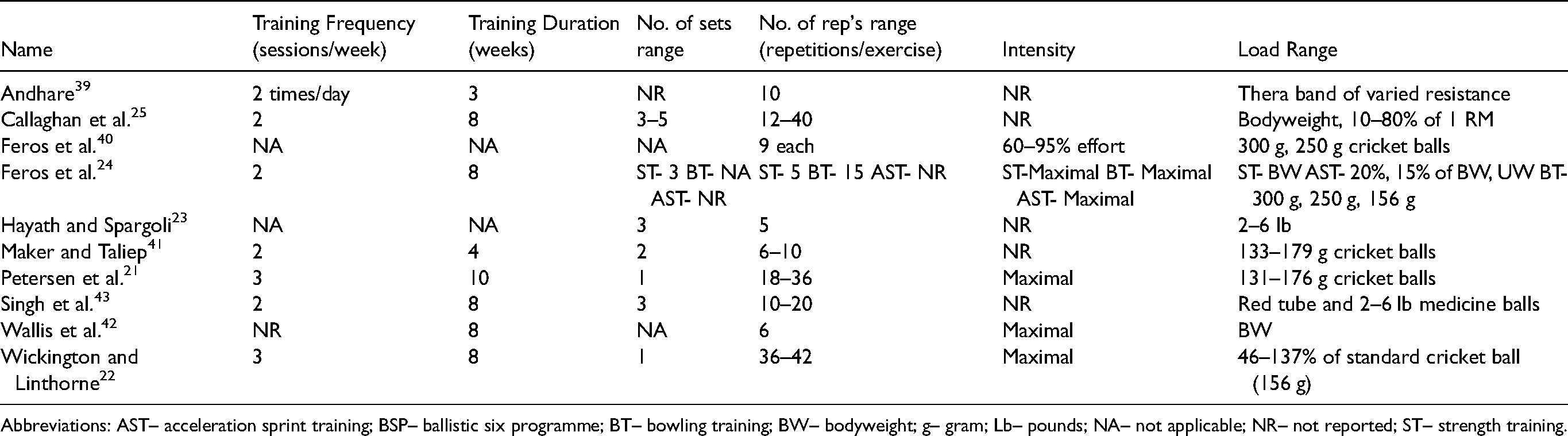
Abbreviations: AST– acceleration sprint training; BSP– ballistic six programme; BT– bowling training; BW– bodyweight; g– gram; Lb– pounds; NA– not applicable; NR– not reported; ST– strength training.
Methodological quality
Table 4 represents the quality score for the eight studies included for meta-analysis. The methodological quality according to Downs and Black had a mean score of 64.5 ± 8.14%. A total of nine studies were rated as of moderate quality with a mean score of 65.11 ± 8.39% and one study was of low quality with a score of 48%. The individual scores of each have study have also been provided in the Table 4. The least reported Downs and Black items included the following: allocation of concealment, adjustment for confounders, subject's follow-up consideration and sample size calculation.
Quality assessment of the studies using downs and black checklist.
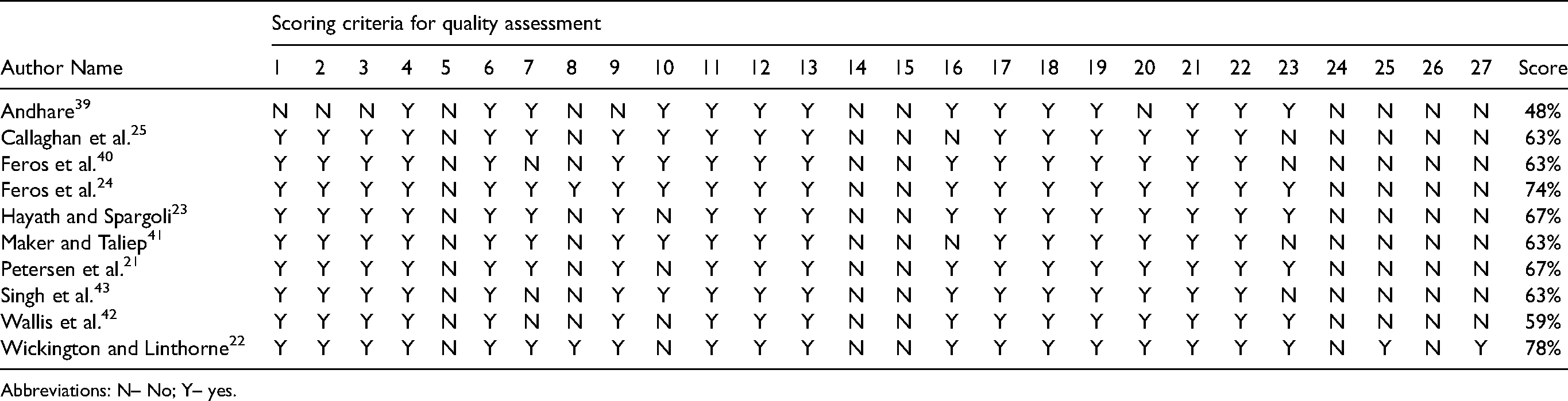
Abbreviations: N– No; Y– yes.
Quantitative analysis
A total of eight studies were included for quantitative analysis. Two studies were included for meta-analysis to determine the effects of plyometric training on bowling speed. Three further studies were included to investigate the influence of weighted ball training on bowling speed. Three studies were included to examine the effects of general resistance training on bowling speed. A moderate and significant difference in bowling speed was observed due to plyometric training (SMD = 0.75; Z = 2.98; p = 0.003) with a low inter-study heterogeneity (I2 = 0%; p = 0.588) (Figure 2). A small and non-significant effect of resistance training on bowling speed was observed (SMD = 0.40; Z = 1.39; p = 0.164) with a low inter-study heterogeneity (I2 = 0%; p = 0.666) (Figure 3). A small and non-significant effect of modified ball training was observed on bowling speed (SMD = 0.30; Z = 1.14; p = 0.252) with a low inter-study heterogeneity (I2 = 0%; p = 0.541) (Figure 4). We could not conduct analysis for measuring the accuracy due to limited availability of data points and the variation in methods used to measure accuracy in the included studies.

Standard mean difference and 95% CI for the influence of plyometric training on bowling speed.
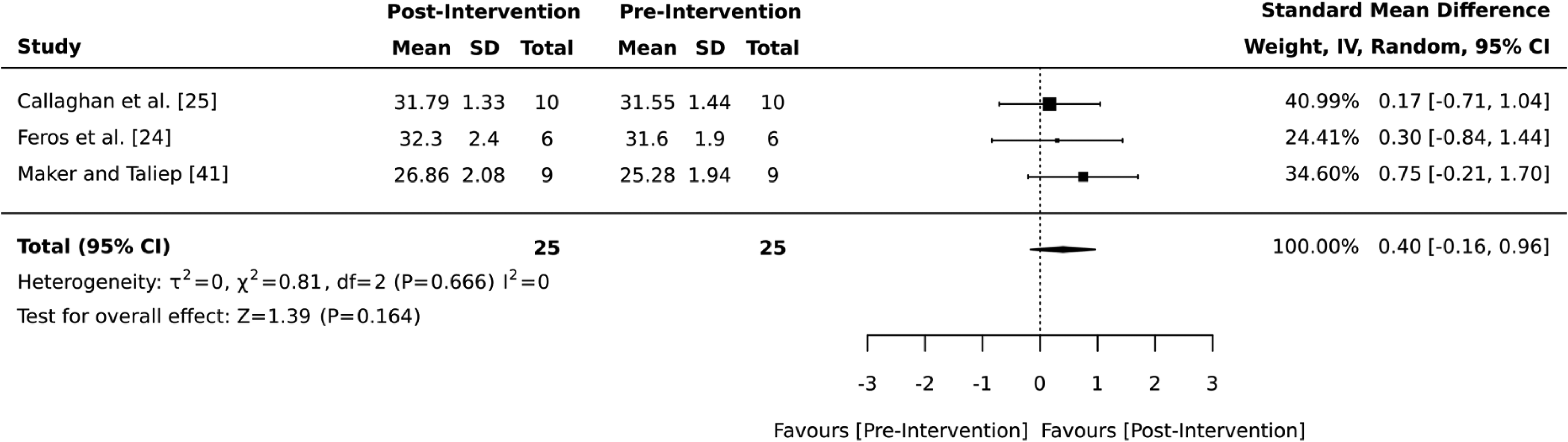
Standard mean difference and 95% CI for the influence of resistance training on bowling speed.
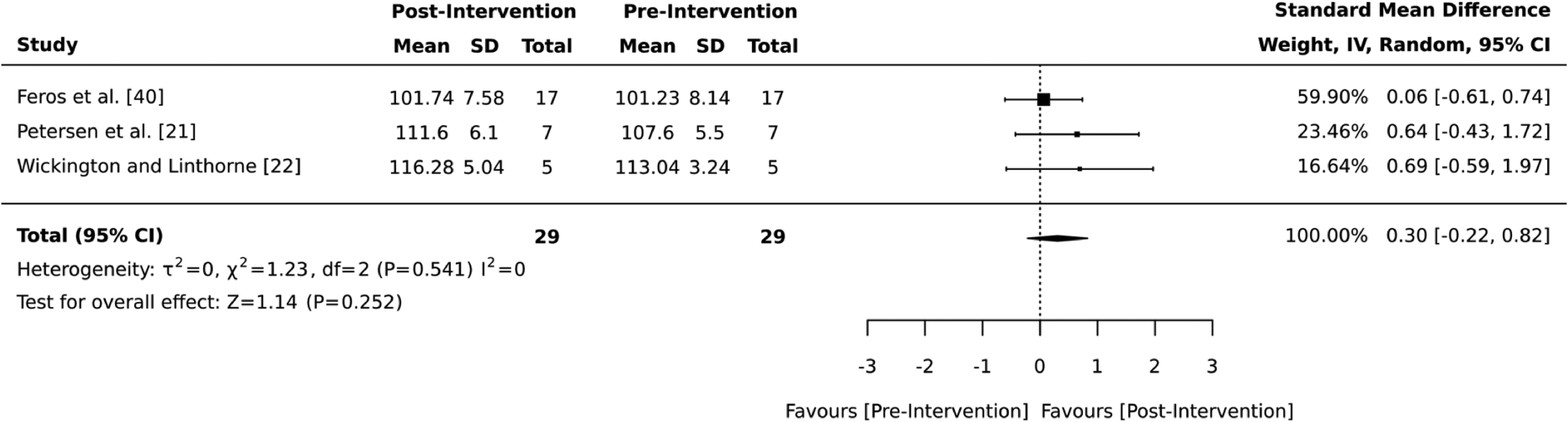
Standard mean difference and 95% CI for the influence of modified-implement training on bowling speed.
Discussion and implications
This review provides novel findings summarising the influence of various S&C interventions on bowling speed and accuracy. Consequently, a total of ten studies were included for the systematic review and the overall quality of the studies were assessed by Down and Black checklist with scores ranging from low to moderate quality. We examined the effects of modified ball weight training, general resistance training and upper body plyometric training interventions on bowling speed and accuracy. Of the ten studies, eight were included for quantitative analysis. One study 39 was removed from quantitative analysis due to poor quality. The main findings were; 1) a moderate and significant improvement in bowling speed due to the upper body plyometric intervention; 2) a small but non-significant effect of resistance training on bowling speed and 3) a small but non-significant improvement in bowling speed due to the modified ball weight training group. These findings highlight the influence of various training practices on fast bowling speed. Further, only plyometric training intervention supported our hypothesis that S&C training can help improve fast bowling speed. Our hypothesis that S&C training interventions improve accuracy could not be verified quantitatively via meta-analysis due to limitations and contradictions within the literature.
The upper body plyometric training intervention showed a moderate effect on bowling speed in our meta-analysis. The improvement in bowling speed is likely due to the nature of the plyometric exercise incorporated in the training programmes of these studies. During cricket fast bowling, the internal shoulder rotators are involved during the acceleration phase of the bowling arm while the external shoulder rotators are involved during the deceleration phase. 44 Fast bowling further requires the bowling arm to be rotated at around 6000°/sec, placing high demand on the shoulder joint. 44 Therefore, training programmes need to be developed and implemented that improve the dynamic stability of the shoulder joint by strengthening the rotator cuff muscles. The “Ballistic Six” programme consists of functional exercises performed at high intensity and volume in order to simulate the movements, positions and forces involved with the overhead throwing action. 43 These exercises require pre-stretching of the shoulder musculature; thus, activating the stretch-shortening cycle (SSC). The musculotendinous unit is first eccentrically loaded for storing elastic energy and then contracted concentrically.45,46 As a result, the reactive and elastic properties of the muscle and tendon produce maximal force with the help of the SSC.47,48 Further, the “Ballistic Six” programme also adheres to various S&C training principles i.e., 1) specificity as the exercises target improvements in overhead throwing motion; 48 2) progression as the programme requires the athletes to progressively increase the volume and intensity of the exercises; 48 3) overload as the programme aims to develop shoulder power and muscular endurance along with strength adaptations. 48 Although the baseball and cricket throws involve different technical requirements, there is some evidence that incorporating exercises such as deceleration baseball and baseball throws as part of the training regimen can be translated to cricket fast bowling as both of the activities rely on shoulder internal and external rotators strength. 43 Consistent with prior knowledge on this subject, the results of the two included studies23,43 showed a significant increase in bowling speed after the plyometric training intervention. The study by Hayath and Spargoli 23 reported a large improvement in bowling speed immediately after the plyometric training session during three different training sessions whereas a moderate improvement in bowling speed was reported after 8 weeks of plyometric training in the study by Singh and colleagues. 43 The minor disparity in results could be attributed to the duration of the plyometric programme, skill level of the participants and the heterogeneity of the included studies. However, further investigation is needed regarding the specific neural or physiological adaptations of fast bowlers to plyometric training in order to provide further evidence-based recommendations.
A small and non-significant effect of resistance training on bowling speed was found based on the inclusion of three studies.24,25,41 One reason for improvement in the speed can be attributed to the neural adaptations, i.e., training-induced changes within the nervous system due to resistance training. These adaptations can influence the activation of prime movers in specific movements and lead to better coordination of all relevant muscles, thereby effecting a greater net force in the intended direction of movement. 40 Further, increased motor unit recruitment, rate coding, synchronisation and intermuscular coordination in response to resistance training1,49,50 could have contributed to improvement in bowling speed. Of note, two studies incorporated weighted ball training24,41 as part of their training intervention. Since it is a cricket-specific movement, the increase in bowling speed could be attributed to the specificity of the training intervention with fast bowling action and improved power of the throwing arm and shoulder complex. 41 However, there are several reasons which might explain the non-significance of resistance training interventions on bowling speed. Firstly, there is a delay or “lag time” between the increased strength and ability to utilise it into improved performance. 51 It might be possible that the time between the training intervention and performance testing did not allow for the transference of the increased muscular strength/power post resistance training on bowling speed. This could be due to the nature of exercises incorporated during the resistance training intervention. While the resistance training exercises involves slow and controlled movement throughout the entire range of motion, plyometric training usually involves rapid eccentric contraction followed immediately by concentric contraction. 52 Therefore, rapid improvement in power characteristics post-plyometric training intervention 53 could have led to improvements in bowling speed compared to resistance training intervention. Secondly, two studies conducted the testing during the off-season phase in which bowlers were not undertaking pace bowling practice. Since bowling action involves complex sequencing of movements, there is a possibility that bowlers may require longer time duration to translate the increased strength into fast bowling speed or accuracy. 25 Thirdly, these studies were conducted on amateur and club-level fast bowlers. There is a possibility that the results might have been different if bowlers with greater bowling and resistance training experience were recruited as time involved in sport-specific skills can discriminate between the performance of expert and non-expert athletes as observed in other sports. 54 Also, highly skilled bowlers would be expected to demonstrate superior strength, power and bowling qualities compared to amateur or community level bowlers, which might influence the results. 24 Therefore, the effect of resistance training on bowling speed needs to be further researched in order to get a better understanding on this topic.
According to our meta-analysis, modified ball weight training had a small but non-significant effect on bowling speed. The small change could be attributed to the improvement in arm muscle strength due to the use of heavy cricket balls. 21 The participants in the study conducted by Feros et al. 40 bowled using 300 g and 250 g balls, which are heavier than the regular cricket ball (156 g). These bowlers reported that it was difficult to control the heavier balls and were also reported to release the heavier ball earlier during their action. Further, the participants were found to release the ball later during their action when they used the regular cricket balls. These findings highlight the negative transfer between heavy and regular ball training. Even though the movement pattern is similar between the different weighted balls, there might be differences in the force requirements while bowling with cricket balls of different weight. 40 While the underweight balls might teach fast bowlers on how to move body segments at higher speeds, the heavier balls might assist in developing the strength to produce higher bowling speeds. 21 In doing so, the intermuscular coordination could have negatively affected the transference of speed after bowling with the heavier cricket balls. 40 Therefore, it might be beneficial to examine the appropriate ball weight for eliciting improving bowling speed. However, it is to be noted that the bowlers recruited in these two studies were playing at community- or club-level. Therefore, there is a possibility that the findings might be different when conducted in a group of fast bowlers with greater experience in resistance training as time involved in sport-specific skills can discriminate between the performance of expert and non-expert athletes. 54 Further, the training intervention was implemented for a period of 10-weeks. A possible learning effect might occur with longer training duration which can help the athletes readjust to the regular weight cricket ball. Therefore, further research in terms of the playing level, ball weight, 22 length of the training duration and recovery periods between the repetitions should be conducted for safe and effective application of modified-implement training.
Bowling accuracy is considered to be an important trait for taking wickets and reducing the runs scored by the opposition batters. It is one of the crucial indicators of fast bowling performance. However, a quantitative analysis could not be performed because there were not enough studies (<2 for each condition) for the meta-analysis and there was substantial methodological variation in determining bowling accuracy. For instance, the studies included for determining the influence of resistance training had measured bowling accuracy either through the vertical grid system 41 or video analysis. 24 While the study by Feros et al. 24 showed decrement in bowling accuracy, Maker and Taliep 41 did not report any significant effect of resistance training on bowling accuracy. This could be in part be attributed to differences in measurement techniques in determining in bowling accuracy. With regards to the modified implement training, Petersen et al. 21 reported a 7% decline in bowling accuracy post 10 weeks of modified implement training with balls of 84–116% of standard mass. Likewise, Feros et al. 24 reported a “clear moderate” decrease in bowling accuracy post 8 weeks of resistance training combined with modified implement training with 300g, 250g, and standard cricket balls. However, Wickington and Linthrone 22 reported substantial improvement in bowling accuracy post 8 weeks of modified implement training with a ball weight 46–137% of standard mass. It is to be noted that Petersen et al. 21 measured bowling accuracy by scoring the delivery “successful” if the ball is pitched between 6 and 7 m from the stumps and “unsuccessful” if pitched outside the aforementioned range, whereas, Wickington and Linthorne 22 incorporated a points-based scoring system with a vertical target sheet positioned at the batting end in line with the stumps. Feros et al. 24 measured bowling accuracy by estimating radial error from digitised footage. Interestingly, Wickington and Linthorne 22 showed “unclear changes” in bowling accuracy; however, the substantial improvement in bowling accuracy was likely biased by two participants who showed greater improvements in bowling accuracy. Therefore, these findings from the included studies suggest that further research is required to determine the effects of various training modalities on bowling accuracy.
Methodological appraisal
The studies included in our review were of low to moderate quality. There are few potential reasons that we would like to highlight for future research. None of the studies had considered the confounding factors such as the bowling action. The technique of the bowler is an important confounding factor due to differences in body alignment and orientation depending on the type of bowling action (i.e. front-on, side-on and mixed). 55 Therefore, it might be possible that the exercises implemented in the studies might not have been suitable for a particular bowling action. Also, the studies did not report any information regarding the adverse effects (injury) of the training intervention. Such information could be useful for establishing the safety of various training practices and also in recommending exercises based on the age, skill level, gender and physical training experience of the fast bowler. Even though the included studies in our meta-analysis generally reported a clear description of the training interventions, a number of programming parameters such as resistance training experience, rest between training sessions, frequency, set range, intensity and duration were not clearly reported in a few studies. In order to improve overall quality, future studies should try to provide a better description of all the parameters that were considered while designing the training programme to improve the overall methodological quality.
Limitations
There are a few limitations in this study that need to be addressed. Firstly, our meta-analysis included only eight studies. Further research is required in this domain to identify the importance of various S&C practices on fast bowling speed and accuracy to further validate the findings of this systematic review and meta-analysis. Secondly, our systematic review involved bowlers from various levels of play (i.e. amateur, semi-professional and professional), which may have influenced the overall correlations reported due to the heterogeneity of the included studies. Also, we could not perform meta-regression analysis due to the low sample size. However, in order to reduce the variation across cohorts, we made every effort to ensure that similarities between cohorts of fast bowlers were included as part of our analysis by analysing the characteristics of participants included in the selected studies.
Directions for future research
The demanding nature of fast bowling requires confirmation of evidence related to performance at the highest level. Future research should focus on comparing fast bowlers of different playing levels (amateur, semi-professional or professional/elite). Such studies will help in the development of S&C training programmes that are specific to the physical demands at each level. This may also help with the development of junior athletes who are aiming to transition to a more advanced (i.e., Tier 3: national/state) level. 56 Furthermore, the majority of studies have been conducted on male fast bowlers and there are very few studies that have been conducted on female fast bowlers. This will help in identifying the differences in physical demands that exist between males and females and will help practitioners in designing and implementing S&C programmes that are either male or female specific. Also, further research in this area is required to identify the optimal training strategies and dosages (number of sets, repetitions and rest periods in between each exercise) in order to maximise the advantages induced by these training programmes. Further, our meta-analysis demonstrates that training interventions (resistance training, plyometric training and modified-implement training) between 3–10 weeks with a frequency of 2–3 sessions/week performed between 60%-maximal intensity can lead to small to moderate improvements in bowling speed. This information could be used by strength and conditioning coaches while designing and implementing training programmes. However, there is a possibility that interventions performed over longer durations and at a greater frequency might be beneficial for fast bowlers in improving their speed and accuracy. Lastly, there might be a delay in the transfer of strength gains following training interventions to bowling speed or accuracy. Therefore, S&C coaches and practitioners should implement training programmes in such a way that sufficient time is available for adaptations in physical capabilities, which can then transfer to increased bowling speed.
Conclusion
In summary, plyometric training intervention was associated with a moderate improvement in bowling speed. A small and non-significant improvement in bowling speed was found after resistance training programme. A non-significant and small effect in bowling speed was found for the modified ball weight training group. Coaches should consider the use of these training practices for helping fast bowlers improve their speed or accuracy. Our meta-analysis evaluated the effect of various S&C programmes on cricket fast bowling speed and accuracy. However, further research is required in this domain in order to get a better understanding on this topic. The findings from our study will be useful in informing the S&C coaches about the different training practices in cricket fast bowling. These results will help with further development of fast-bowling specific guidelines for effective S&C practices and in designing further evidence-based warm-up strategies specific to fast bowlers.
Footnotes
Acknowledgements
There are no acknowledgements for this manuscript.
Declaration of conflicting interests
The author(s) declared no potential conflicts of interest with respect to the research, authorship, and/or publication of this article.
Funding
The author(s) received no financial support for the research, authorship and/or publication of this article.
