




Abstract
The aim of this study was to identify and describe elements that influenced the engagement of the 2013 Brazilian handball female world champions from grassroots to elite sports levels. Seven members of the team participated in a retrospective examination of their athletic development, with a mean of 20 years of sports experience. A semi-structured interview and questionnaire were used for data collection, and the script was based on the development stages of the Developmental Model of Sport Participation1 and the dynamic elements of the Personal Assets Framework2. The thematic analysis showed that the athletes’ personal characteristics, their disparate environments, and the quality of their relationships were significant in their pathway to elite performance. The results show that well-structured settings are not important in the early years, but rather the coaches’ interest in keeping young athletes engaged in sport is one of the key elements. Moreover, the advance in the maintenance years, training in a more structured setting and the coaches’ caring attitude and attention to their athletes’ feelings and emotions can lead to pathways toward excellence.
Introduction
Athletes’ development can be explained by the comprehensive interaction between personal, environmental, and relationship-based elements, while also realizing the continuous exchange between developing individuals and their environment. 1 The strength, the content, and the direction of these interactions in the sporting environment (immediate and remote) directly affect athletes’ developmental outcomes, which can either contribute to engagement or to abandonment. 2 Côté 3 guided by the proximal processes proposed by Bronfenbrenner, 1 considering the interdependence between personal, contextual, and social elements, suggests that this establishes the basis for understanding the patterns of engagement of athletes in sports. Thus, engagement is the prolonged involvement in sports practice, expressed by the continuity of actions and interactions between the person and their context, which in turn may influence the development of personal assets.
The personal asset framework (PAF) was developed to highlight the interaction of the three core elements; personal engagement in activities, social dynamics, and appropriate settings all of which interact over time to promote short-term interest, the development of personal assets, and long-term outcomes.2,4,5 More specifically, these dynamic elements are understood as system gears, and as they interact, they provide specific sporting experiences that, strengthened over time, may promote the development of personal assets also known as the “4Cs” (competence, character, connection, and confidence). Thus, from the consistent development of personal assets over several seasons and the continued involvement of young people in sport, long-term benefits arise, including participation, performance, and personal development (known as the “3Ps”). 4
In PAF, personal engagement in activities is related to the interaction process between the athlete and his/her personal characteristics and their training opportunities, wherein the structure and quality of the activities develop both positive and negative influences on the athletes’ ability to engage with the sports environment. Social quality dynamics are represented by perceived relations of reciprocity among coaches, athletes, peers, family members, and other agents involved in the training and competition environments. Appropriate settings refer to the physical environments where athletes are directly and indirectly involved throughout their development, represented from the immediate training environment to the wider social, political, and cultural systems.4–6
The interaction of dynamic elements throughout the athletes’ career varies according to the age of the athletes and competitive level of the sports setting. Creation of an environment that enhances the development of personal assets is related to the quality, structure, and direction of activities, whether it occurs in youth sports or high performance.
Research shows that early sports experiences based on positive social relationships and activities that stimulate interest and fun, help athletes stay engaged in sport.7–10 Diversified training approaches, which include different practice types (deliberate play, play practice, deliberate practice, and informal practice), can create varied learning environments that facilitate high-quality emotional and social interactions. In high-performance sports, engagement can also be motivated by the willingness to be involved in demanding training and challenging competitions (e.g., world championships, Olympic games), athletes need to adapt to more taxing schedules, showing dedication, determination, commitment, seriousness, and responsibility. In high-performance sports, athletes routinely abdicate immediate rewards for the sake of a long-term goal. At this stage, in addition to the physical, technical, and tactical training, mental skills training is another way to maximize performance and prevent possible crises that may demotivate an athlete.11,12
Regardless of the environment, athlete-coach, 13 athlete-peer, 14 and athlete-family relationships,15,16 should align with the athletes’ level of development and competitive environment to drive their development process. 17 Mendonça, Honda, Massa, and Uezo 18 analyzed the sports career of athletes from the Brazilian Men's Handball Team and identified that parental and friend support, voluntary commitment to the activity, as well as the environment (school, public venues, and clubs) contributed to the athletes’ engagement and growth in sports. Accordingly, Fontes and Brandão 19 highlighted the personal characteristic of resilience linked to social support, as an element capable of averting early sports dropouts of basketball athletes. These studies emphasize the need to analyze the development process of athletes considering personal, interpersonal, and environmental factors. 20
Although the interaction between personal, interpersonal, and environmental factors is recognized in the development process of athletes, there remains little information about the interactive nature of these elements that affect engagement in sports over time. Moreover, little is known about female elite athletes from the Southern hemisphere. The 2013 Brazilian Women's Handball Team was the first team in the Americas and only the second outside of Europe to win the World Championship. Thus, the aim of this study was to identify and describe the interactive elements that influenced engagement in these Brazilian female world champion handball athletes throughout their entire sports career.
Methodology
The research process was carried out retrospectively, with a focus on understanding and interpreting the events and experiences lived by elite athletes throughout their sports careers. 21 The epistemological assumptions underlying this study are expressed in the ecological paradigm, which seeks to understand a phenomenon in its particular environment, being recognized as a fundamentally interconnected and interdependent system. 1 Thus, our epistemological position focuses on the need to understand the relationships between individuals and different ecological levels.
The ecological approach guided the development of the present research steps, keeping in mind the understanding of events and processes based on forms of reciprocal interaction between the developmental experiences lived by the person and his/her context of involvement. Thus, we opted for the positive youth development (PYD) perspective, through the PAF in sport, developed by Côté, Turnnidge and Vierimaa 3 and Côté et al. 4 As a developmental system approach, the PAF is a useful framework to organize the lifetime sports activities and physical environments of athletes throughout their development and the relational processes that influenced the course of the athletes’ sports career.
Participants
The Brazilian National Handball Team were women’s World Champions in 2013 for the first and only one time in history. Sixteen athletes were part of that team, and all were invited by email or text message to be interviewed for this research. Seven of those athletes accepted and participated in the interview for this research, and constituted the final group of participants. These seven athletes had a mean age of 30 (between 24 and 36) years and averaged more than 20 (between 14 and 26) years in handball with 11 (between 6 and 18) years devoted to high-performance sports. They had an average of 14 (between 7 and 19) years of experience in the Brazilian National Team (including junior teams). Six of them played handball in European clubs, which happened on average at 20 (between 17 and 24) years of age.
All athletes interviewed participated in the 2013 World Women's Handball Championship. At the time of data collection, five athletes were still members of the team; one athlete had ended her sports career, while another athlete had stopped participating in the Brazilian national team but was still involved in high-performance sports.
Study procedures and methods
Methods used for data collection consisted of a semi-structured interview and a sociodemographic questionnaire aimed to address relevant stages and elements of the PAF throughout the athletes’ sports careers. The sociodemographic questionnaire aimed to collect descriptive information about the athletes and their careers. It was used as a complementary instrument to gather personal data (name, academic background, and city of birth) and data about the athletes’ trajectories in sport (clubs, financial assistance, and main achievements).
The semi-structured interview was the main research instrument and was informed by the DMSP and PAF2,4,5 models, as stated below.
Considering the DMSP
22
performance sports pathway, the interview was organized by stages normatively set a priori: sampling years, specialization, investment, and maintenance; In each career stage, the athletes were asked about the PAF's three dynamic elements: personal engagement in activities, the social dynamics, and appropriate settings.
2
Engagement in activities corresponded to sport-related and non-sporting activities performed at each stage. In this topic, we asked questions to understand the quality, quantity, and meaning of their sports activities. Questions in this section included the type of activity, frequency of performance, where the activities took place, and with whom. Under the theme of the social dynamics, we investigated the role that each social agent (family, friends, coach, relationships, and peers) played in their careers. Finally, the last topic was directed to sports environment, including the training and competition facilities, as well as the financial and competitive support provided (or not) to the athletes.
Interviews were conducted in Portuguese and recorded on a Sony ICD px440 recorder and/or Ifree Recorder program (used as an extension of the Skype software, which allows recording calls), averaged 94 (57 a 127) minutes in duration, and were immediately transcribed for subsequent analysis. For validation purposes, the transcribed interviews were sent to the athletes, and no alteration was requested in any document. After transcribing, the transcripts were translated into English by a specialist, who is proficient in both languages. Subsequently, a PhD student in sport sciences, a native of an English-speaking country, verified the translation together with one of the authors, a native Portuguese-speaker with advanced knowledge of the English language. According to the code of research ethics, the athletes agreed to participate in the study and signed an informed consent form. The study was approved by the Research Ethics Committee involving Human Beings (CAAE no.: 60823716.7.0000.5404).
Data analysis
For data scrutiny, the thematic analysis technique was used, 23 and the examination of the data was deductive following the PAF 4 dynamic elements (personal engagement in activities, social dynamics, and appropriate settings) throughout the athletes’ career stages. The first author, who also conducted each of the interviews, performed all the analysis processes. The NVIVO 10 software was used to systematize the dataset and organize the themes during the analysis stages. The last author worked as a peer debriefer, by verifying the categories defined throughout the analysis process. The second and third authors also checked if the quotes fitted the analysis theme at the end of the process, pointing out uncertainties. In the case of uncertainties, the first and last authors referred back to the primary data, verifying the statements in accordance with the athletes’ discourse, and made the final decisions with other authors.1,5
Results
The interaction between the athletes’ personal characteristics and engagement in activities as well as the environmental influences and relationships were identified through the athletes’ discourse. The results allowed for a clear view into each of the three core dynamics elements of the PAF, as much as its variation according to the sport developmental stages timing. The results are presented by each dynamic element: personal engagement in activities, appropriate settings, and social dynamics.
Personal engagement in activities
Table 1 brings together the main findings on personal engagement in activities throughout the athletes’ careers.
The personal engagement in activities throughout the athletes’ career and its variation according to the sport developmental stages.

Concerning the training activities, they changed throughout each development stage, and this was closely related to the changing environments they were in (i.e., in maintenance years, competing in Brazilian or European clubs). In the sampling years, spontaneous and deliberate practice was usual, predominantly through technical training including coordination exercises, flexibility, and specific skills, performed from 1 to 3 times a week.
The specialization phase was very short and it involved a quick passage from sampling years, through specialization, into investment years. Three of the athletes reported having a longer specialization process (with the concomitant practice of handball and a second modality). The other four athletes, as soon as the athletes became handball players, they got involved in the state championships and it took them few years to make it to the junior national team. For these athletes, it seemed that they jumped directly from the sampling stage to the investment years. In addition, right from specialization years, the training sessions became a daily routine and the daily sessions became more intense. As senior athletes, they started having two training sessions daily. The athletes observed an increase in the quality of the technical, tactical, physical, and psychological components of their training over the years, as reported by A2 “When I started it was more technical training, then we evolved, with the passing time, advancement in age and we understood more, so it was more pro-technical, tactical.”
About athletes’ personal characteristics, as the athletes believed that their physical and technical characteristics were noticed in the first moment, as A4 declares: “In high school, for sure I was outstanding, I played left field, and so much that I went to the national [Brazilian] team because of it.” While A7 claimed, “Yes, I stood out, I excelled, I was the skinny girl that jumped a lot and scored goals.”
In general, their dispositions were founded on a positivity mindset, as A4 stated, “I’ve always been very positive and got it in my head […] and this gave me a lot of strength […]” while A1 mentioned, “[…] I easily adapt […] I don't know, I’m kind of a chameleon when it comes to these things, and I adapt very easily to this field.” The ability to adapt is significant, particularly given the major logistical and cultural changes required throughout these athletes’ careers. Moreover, personal and social skills, such as being outgoing, patient, decisive, humble, communicative, and participative facilitated positive reactions from the athletes throughout their sport careers stages. In addition, this statement from A5 complements this perspective, “[…] I’m a very outgoing person, really! So, even if I didn't speak a word in English, even if I didn't speak a word in Danish, I’ve always had a very nice contact with the girls, I joked around, I tried to talk […]. I was always trying to interact somehow […].”
From the investment stage, resilience seems to be one of the main attributes in supporting personal engagement in handball activities. All athletes mentioned having trouble throughout their careers, such as physical injuries, health and financial problems, and adaptation to different environments which included language changes and significant modifications to training intensity. On the other hand, six athletes highlighted that their positive personality and attitudes helped them to overcome the challenges and difficulties addressed in the interviews, such as setting new goals, seeking solutions to problems, adopting a positive attitude, learning from different situations, and sacrificing themselves for the sake of long-term objectives.
Only one athlete reported some negative personal attributes or behaviors that challenged her engagement in handball. According to her, lack of responsibility, shyness, depression, and arrogance were characteristics that hindered and interrupted her participation in the sport. After 6 months of interruption, this athlete resumed activity in the elite environment.
Appropriate settings
Table 2 presents the main findings regarding the element appropriate contexts during the athletes’ careers.
The appropriate settings throughout the athletes’ career and its variation according to the sport developmental stages.

Results about the appropriate settings included information from the Brazilian and European contexts, where most of the participants went to play during the maintenance years. Over the years, different sports environments were related. As young athletes, they practiced mostly at schools or in public sports projects developed by the municipals, as senior, structured Brazilian and European clubs, as much as the National Team environment, were relevant in fostering those athletes’ development pathway.
In the beginning of their sportive experience, mainly in the first years of practice in Brazil, the athletes related poor facilities and lack of equipment. As mentioned by A2: “Yeah, I didn't have ten balls in my (Brazilian) club to train, there was no glue, sometimes we trained with hair removal wax we bought, and there was no water, we had to bring it along.” A6 also stated about the environment in Brazil, “we had almost nothing and it was from there that the best athletes came, they have played in schools in a very precarious condition…” and she continued, “…our will was what made the difference there […] we wanted that training so much, we waited so much for that training that when we were there, we were focused.” As children or adolescents, having a well-structured environment does not seem to be required for engaging young people in sports. In fact, they also felt the need for financial support for transportation, feeding, or buying tennis shoes—coaches were the most usual providers. On the other hand, the value of experience through a pleasant environment and promoting social interactions may contribute to feeling engaged, motivated, and joyful when training more intensively in the specialization years.
If poor environments were not a disengagement factor in sampling and specialization years, it was not the same in the investment and maintenance years. Six of the seven participants stated that the instability/lack of training and financial resources were elements that almost made them dropout of the sport as senior athletes. Environments characterized as unsatisfactory were primarily related to the lack of resources and of policies on sport, including discontinuity of actions. These two factors were obstacles encountered by all the seven athletes in the Brazilian environment. For example, when playing in Brazil, A2 noted the structural difficulties she faced after an injury, “I thought about quitting when I realized that the (Brazilian) club had no funds to pay for my surgery. And for my family it was also impossible.”
As the local structure was not enough, six of the athletes moved to Europe in some point of their elite career, having access to a solid professional club structure played strong role in the athletes’ engaged in elite sport. A1 said, “[in Europe], indeed, I was a professional, in every sense. When I say ‘professional’ is not only on my part, but on the part of the team as well, you have assistance, you have all the support not only regarding the structure of the sports court, the gym, the locker room, but also health insurance plan, home, car, cell phone, food.” Additionally, A2 said, “It's different, there's a structure we don't have here in Brazil…there, we are professionals, you breathe, you sleep, you eat handball. Those were years that we simply didn't have to worry about anything; our concern was only with training, playing, and winning.” Even in Europe, the institutional challenges were still an issue as A1 said, “There was no more money, in the European club, they couldn't afford to keep everyone […]. And that's when the opportunity to go to another club arose; it took me a long time to sign the contract, because I didn't want to leave.”
Despite the quality of facilities or structure, some environments promoted positive social bonds that created an environment of encouragement and motivation to practice, like the Brazilian schools or municipal projects in the first years of practice. Advancing to the investment and elite stages, this relationship was linked to the environments that permitted and supported the most affective relationships, which were welcoming and provided certainty to the athletes (including professional relationships), creating a family and friendly bond between different stakeholders involved in the environment. As A3 reported, “I think it was friendship and respect, they treated us like a family, they didn't treat you as a product like most (clubs) do nowadays. Not there, it was more family-like, everyone wants to know if you’re okay, everyone calls, writes.” A5 also noticed this pleasant atmosphere in the club “people treated me with affection, the club I went to is a very affectionate club, the crowd really hugs you. It's a place I miss a lot; it's really good, really good!”
Social dynamics
Table 3 presents the main findings on social dynamics throughout the stages of development.
The social dynamics throughout the athletes’ career and its variation according to the sport developmental stages.
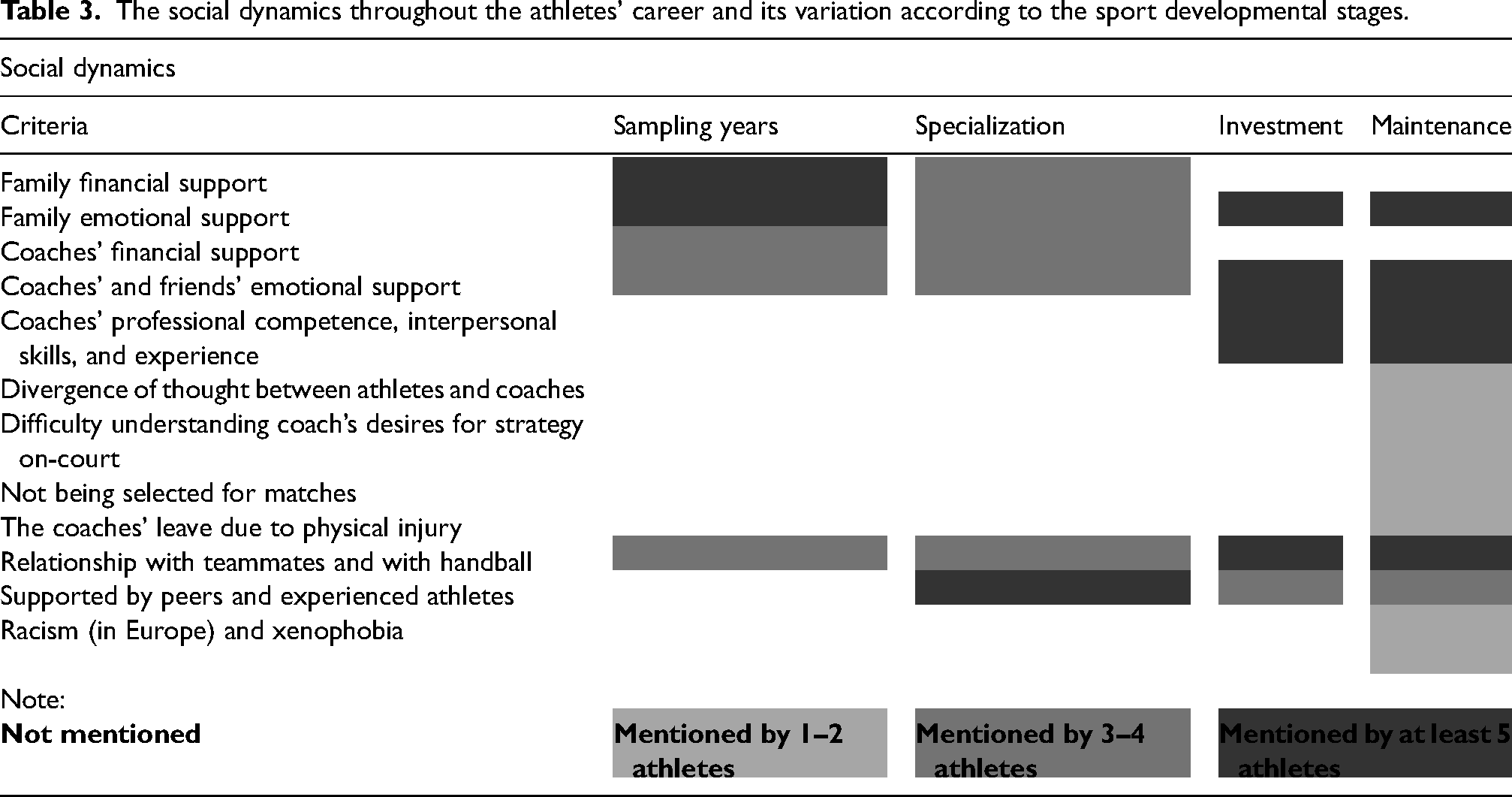
Based on the processes between athletes, their sports environments, and other stakeholders, social quality dynamics functioned as the main engineer capable of starting and maintaining athlete engagement in sports over the years. Positive and lasting relationships were elements that endured during the career, shown by the influence of family, coaches, and peers in athletes’ engagement.
Firstly, the athletes perceived that their families supported them providing emotional, motivational, and financial support to start and continue in handball. Families created emotional support, allowing athletes to train and play, and financial support for travels and equipment. For example, A7 said she would have missed training for not having transport fare, but her mother always found a way. “My mother said: Aren't you going for the training?’ I replied, ‘No, mum I want to go, but I have no transport fare’ ‘No problem, get ready, I’ll give you 5 min to get ready,’ then I ran to get ready, changed my clothes, she gave me some money and I went to the bus stop.”
Secondly, it seems that the athletes’ relationship with their coaches was paramount to their success, as long as the coaches regularly capitalized on specific learning opportunities while also facilitating engagement in all environments through open conversations, remaining open-minded, showing empathy in addition to inspiring confidence in each athlete. These coaches honed in on teachable moments in all environments and career stages. In the initial years of formation in the sport, and mostly during specialization years, coaches provided their own material or financial resources, such as for feeding or transportation in order to offer even the most basic conditions for the athletes to continue in the activity. As reported by A2, “Sometimes he (the coach) would pick me up at home because my father was working and therefore couldn't take me. He (the coach) would pick me up; he would take me […].”
In all the stages, the athletes related that the coaches were also critical in relation to emotional support. In the investment years, touching on behavioral change as an adult athlete, A5 recognized, “I’m also very grateful for that, ‘cause I didn't have much discipline, I was a person who did things as I wished, the way I liked it. And he (the coach) showed me that no, that there's a job, that we need to perform it in a way so the group achieve[s] more than the individual.” A3 understood that her coaches remained steadfast even when environments changed for both coach and athlete. She said, “My relationship with them (the coaches) was very good. They’ve always been very fond of me…they’ve always helped me. They went to my state too, got in touch with my family, until today, we keep in touch […] That friendship remains, the affection that I have for them. I think we experienced a lot of difficult times together; this kind of things strengthens you, too.” As well, A1 related that she found sport and personal confidence from her relationship with many coaches in different environments, “In those years I tried to make the best and learn the worst of each (coach) to be able to excel not only as an athlete, but as a person.”
Moreover, the athletes suggested that the coaches’ professional competence, interpersonal skills, and experience may have contributed to the development of feelings, such as respect and admiration, besides learning athletic and social-related contents. A2 stated “I really appreciate my coach, he's a great professional and a person that has supported me a lot […] he always says what you need to hear, outside and inside the court. He has that refined touch in the moment you need and never doubts about the work process”. A5 also highlights how a competent and trusting coach engaged her in European handball: “he was the one who looked at me and said: do you really want to make a career here in Europe? I’ll help you. He encouraged and collaborated with me, he’s a person who never doubted my talent, never doubted my ability or my intelligence […] he sat down with me and showed me videos.”
Negative experiences with coaches, related by the athletes, were due to the difficulty in understanding what the coach wanted on the court, divergence of thought, not being selected for matches, the coach's absence due to physical injury, and institutional culture which obliged the coach to first meet the demands of the club before the athletes’ requirements. As mentioned by A1: “last year I didn't have the best relationship with my coach on the court, because we did not understand each other, I couldn't realize what he wanted from me.”
Finally, from the athletes’ reports, relationships of the athletes with peers, friends, and other experienced athletes helped in the engagement along with different stage of careers and settings. Athlete A1 said, “And precisely in the sport, I had the privilege, the luck to meet and play with experienced players who helped me a lot in my training as an athlete; that thing of training along with, seeing your idol, and suddenly be playing by their side.” Including personal issues, like when A7 was not paid by her club, she stated the importance of her teammates, “And they (peers) helped me, when something was missing. When I saw that my mother needed money, I would say, ‘hey girls, lend me [some money] and when I start being paid normally […], after four months I was being paid, and then I came to them, ‘here's my first salary, here's everything you’ve lent me.’”
The establishment of social bonds that athletes connected in sports began in Brazil and continued in European clubs. This helped sustain the athletes throughout their careers. During investment and maintenance years, playing in European clubs, A3 stated, “[they] treated me more as a family member than as a professional. They didn't treat me as a product, as the vast majority does nowadays.” Likewise, A5 said, “people treated me dearly, the (European) club I went to is a very affectionate club, the crowd really embraces you, it's wild.” Finally, A1 said, “[…] and the relationship was something sport provided us with, you end up having a second family. And with all the problems a family has, it's not as if it was a bed of roses, but it was very good. A family, some with more affinity, some with less, but the relationship was pretty cool.” Athletes perceive social ties as an element that contributed to keeping them for many seasons. Thus, the family-like social relationships were highly valued by the athletes, and were integral to their experience and connection to handball sport. Finally, only three athletes mentioned difficulties in interacting with their peers. The cited problems were related to not being accepted, racism in Europe, and xenophobia.
Discussion
An understanding of the elite athlete's development process requires the examination of elements supporting engagement in sports over time. The three elements considered in this study conducted with seven world champion women athletes were their personal engagement in activities, the appropriate settings around them, and the social dynamics, which influenced career experiences.
5
More light will be shed on the three main findings in this discussion. These are: (i) in the beginning years of their careers, lack of quality facilities was balanced by the impact of caring coaches; (ii) in the maintenance years, the need to play aboard to have access to a high level of competitions, fair payments, and stability in a sportive career, as much as the personal characteristics fostered success in new settings; and (iii) positive relationship with coaches, providing emotional support through the years.
in the first years of their careers, the lack of quality in the facilities was balanced by the impact of caring coaches
From the Brazilian world champion athletes’ perspectives, the quality of the setting and social dynamics organized by coaches in fostering a fun, connection, and competence, in the sampling and specialization years was pointed out as one of the reasons that contributed to the desire to be engaged in these environments. Thereby demonstrating that in these stages, positive social ties are decisive in overcoming structural difficulties. Interestingly, when asked about the handball activities lived in the beginning years, they did not focus much on the activities, but rather on the social dynamics in which they were involved. Very caring coaches made a difference, both in providing an appropriate setting as much as in supporting athletes with different resources such as food, transportation, or sports materials. Other studies in the Brazilian context have found that coaches were fundamental in keeping youth in sports,
9
,49 or the relevance of the connection in engaging people in sports.
24
Studies in a diversity of contexts reinforce that a positive setting is pivotal in fostering engagement. For example, Alesi and colleagues
25
investigated young handball athletes and found that these athletes demonstrated high levels of basic psychological need fulfillment, self-determined behaviors, and commitment, and that these results were associated with the motivational climate that was created by the coach. From observing a community basketball team in Canada, Vierimaa et al.
6
suggest that positive experiences and engagement can be sustained by a safe and supportive setting.
(ii) In the years of investment and maintenance, the transfer to European clubs was considered important to have access to high-level competitions, fair remuneration, and stability in the sports career and to be able to mobilize personal characteristics.
From the investment years and mostly on the maintenance ones, beyond the positive social dynamics, the quality of competitions, appropriate facilities, and financial resources are needed. The topmost difficulties in career continuity in a less popular sport such as handball in Brazil were linked to a lack of organized elite sport, with no regular national league or not enough appropriate settings for potentially elite athletes when compared with the resources found by other research carried out in the Brazilian context, including research in football.10,17,26,27 That may explain why, during the transition from youth to elite sport, financial support was deemed as an influential factor for the athletes. In addition, being in an environment with better resources (training-related, financial, human, structural, and psychological) was recognized as crucial in the development of high levels of success.9,28 To access these resources, most of the Brazilian athletes had to move to Europe seeking better training conditions and the possibility to further their careers.
Competing and living in another country and culture demanded more than the motivated behavior shown in the first years of practice. Being resilient and having an adaptive mindset were highlighted as important for personal engagement in sport, enabling the athletes to face the challenges related to elite sports setting as much as some distress related to racism or xenophobia.10,25,29,30
For Baker and Horton,
28
achieving levels of success is linked to the development of professional skills and the ability to face challenges arising from a socio-cultural context. Those who are able to deal with the distractions and obligations external to their performance, have a distinct advantage over others. This point was very clear in our data, were the athletes demonstrate pragmatic characteristics including positive attitudes through career challenges, high commitment levels, and abdication of immediate rewards for long-term goals. Accordingly, positive psychological characteristics (motivation, trust, persistence, dedication, focus, and the ability to plan or establish goals for their careers) can act as one of the supporting forces capable of influencing the engagement of athletes in the sport.4,11,31
(iii) positive relationship with coaches, providing emotional support through the years
In this study, coaches were perceived as protagonist characters in promoting engagement in the entire careers of athletes, being able to offer access and financial support for a positive sports experience in the initial years and facilitating good relationships with an open dialog when they were adult elite athletes. The creation of a motivational and challenging environment is an important factor to avoid sports dropout43, because it may facilitate the development of professional skills needed to raise the level of sporting expertise. As in this investigation, Folle et al. 17 and Galatti et al. 10 pointed out that the relationship between athletes and coaches, in combination with sporting activities, were paramount to the success of the team, constituting social bonds similar to those of a real family. Nevertheless, it is noteworthy that the level of overload and pressure on the part of coaches should be cautiously applied during the development stage of the athletes. 2
Professional competence, interpersonal skills, and experience of the coaches may have contributed to affective traits such as respect and admiration while also supporting athletic and social-related contents. 32 For the Brazilian handball players, the events reported in the relationship between coach and athlete were specific and contributed to their personal development as athletes. This aspect was crucial in keeping the athletes involved and improving from the investment years, and been resilient when faced with challenges and career transitions or challenges like playing in another culture—what was indispensable to reach the status of the international elite in this sport. The positive relationship between coaches and athletes is integral for the development of high performance, in which successful athletes state having a more affective and closer relationship than athletes with lower performance,33,34 as related by the world champions.
We realize that the stages experienced do not completely coincide with what is established in the DMSP and shared in international investigations,22,35 mainly in relation to the duration of the specialization stage, which in this study proved to be short or non-existent for some athletes. In Brazil, initiation into less popular modalities tends to occur late and coincides with entry into Elementary School II. This late contact reduces the possibility of experiencing sports activities in the specialization phase and advances the investment in a single modality. Therefore, the sociocultural characteristics of the Brazilian context, specifically of the public studied, present results that differ from other investigations, mainly those conducted in countries of the northern hemisphere, demonstrating that it is necessary to consider different social configurations in the model.10,17,36
The first limitation of the study lies in the retrospective design, which depends on recall of events and situations experienced in the past. As the study participants were active athletes living abroad, the limitation of time for the statements was another limiting factor, with a single interview being possible with each one. The interviews were conducted in Portuguese and later translated into English; despite the care taken to rigorously express the athletes’ original speech, as well as the maintenance of the original message, the translation process can result in losses regarding the original content. Finally, the fact that the stages were normatively set a priori for the interviews can also be considered a limitation, especially considering that the DMSP was suggested for the context of South America. Studies like this can consolidate a set of evidence that, in the future, allow the proposition of sports development models based on scientific evidence from Brazil and Latin America.
Conclusion
The PAF framework indicates the interrelationship between three dynamic elements as sustaining personal development in sport, these being: personal engagement, quality social dynamics, and appropriate settings. This paper aimed to identify and describe the interactive elements that influenced the engagement of seven Brazilian female world champion handball athletes throughout their entire sports career. The social quality dynamic was the most significant element in the athletes’ engagement in sport throughout their careers. In fact, the strength of the interactions with family, colleagues, friends, and coaches minimized setting-related difficulties and contributed to engagement in the sport (e.g., the poor quality of the facilities in the sample years and the cultural challenge of playing in another country in the maintenance years).
On one hand, these results serve to strengthen the perspective of the interaction between the dynamic elements proposed by the PAF as an adequate framework to investigate the development of athletes, even in contexts different from the one in which it was originally proposed (e.g., Brazilian high-performance athletes). On the other hand, it shows that setting, person, and social dynamics are complex elements that do not manifest themselves ideally even for athletes who have reached the apex of the sporting carrier, thus it is essential to understand how the dynamics between the elements of the PAF can balance the strengths and challenges faced by each athlete in their sports development process over time.
In this study, in all stages of development, family, peers, friends, and coaches were present and involved in facilitating transitions and/or assisting in overcoming career crises. In addition, these relationships enabled engagement in different environments and cultures, facilitated adaptation processes, and supported lasting social bonds. The study showed that the interpersonal and professional knowledge of coaches, demonstrated in behaviors that indicate concern, respect, and care for athletes, established connections and expanded opportunities even beyond the sports environment. A well-managed athlete-coach relationship encouraged an atmosphere of trust where athletes could experience activities thoroughly while making use of all options available for the practice over different development stages. From this, the strength of the relationships was able to overcome weaknesses, like the lack of good facilities and training resources.
The choice of the PAF as the framework for this study contributed to the structuring and understanding of the development process of the athletes from an ecological perspective. This provided an understanding that the engagement of the athletes in sports was not only linked to their physical attributes, but also to the set of experiences built in the interaction person-context. The social dynamics were fundamental in providing support (financial and emotional) and meeting the demands of the context throughout the stages of development.
The results of this research contribute to the reformulation of the athlete development process, showing how coaches in different environments value establishing a strong relationship with their athletes, as well as creating an environment that enhances group relationships and unity. Moreover, coach development programs should consider these elements and endeavor to put them into practice.
In terms of world-level results, the trajectories of these athletes revealed that sending young adult athletes to more developed handball centers was successful as it facilitated the conquest of the world title. However, the absence of policies that encourage handball practice both as participation and performance sport, as well as the lack of quality in structure and competitions for youth and senior athletes may be associated with the failure to conquer other podiums in the women's handball world competitions or Olympic Games. However, further research needs to delve deeper into this topic.
Footnotes
Acknowledgments
The authors thank Espaço da Escrita – Pró-Reitoria de Pesquisa - UNICAMP - for the language services provided.
Declaration of conflicting interests
The authors declared no potential conflicts of interest with respect to the research, authorship, and/or publication of this article.
Funding
The author(s) disclosed receipt of the following financial support for the research, authorship, and/or publication of this article: This work was supported by the Conselho Nacional de Desenvolvimento Científico e Tecnológico-CNPq under grant no. 130429/2016-3, FAPESP (Fundação de Amparo a Pesquisa do Estado de São Paulo) under grant no. 2015/01599-911/2019 and PRPG University of Campinas (Unicamp) - Edital no. 11/2019.
