



Abstract
In this study, we explore goalkeeper (GK) coaches’ knowledge and use of the Spread, a 1v1 goalkeeping technique, and their experiences and perceptions on injury risks related to it. An online questionnaire was distributed internationally between January and March 2023, collecting a total of 411 complete answers (largest sample of GK coaches to date). GK coaches’ demographics were used to explore significant differences between answers. Almost all coaches recognized (99%) and used (78%) the technique. Coaches recommended to start training the Spread from a Recreational level and at an age of 11.3 ± 2.8. Contact with another player was the most (67%) perceived type of injury risk; 38% of the coaches recalled at least one player getting injured performing the Spread (Elite level coaches significantly more likely, p < .01); with Contusion (16.3%) and Musculo-skeletal (15.8%) being the most recalled type of injuries. Most coaches perceived no injury risk differences between male and female GK (68.1%), nor between young and adult GK (41.1%). These results show the Spread's popularity among GK coaches while highlighting knowledge gaps in some areas (e.g., technical execution, sources of knowledge). Both researchers and stakeholders can leverage from the results to develop and improve GK-coaching interventions, particularly in the field of injury prevention.
Introduction
The goalkeeper (GK) is only one of the eleven players that each football team has on the field, but the rules 1 and game dynamics make it a special position. 2 Compared to field players, GKs have significantly different anthropometrics and performances in physiological tests3,4; as well as typically being one position with a dedicated coach (also known as “specialist coach”). 5 As highlighted in some recent reviews on the GK position, most football research has focused on the team as a whole, ignoring this specificity as a consecuence.4,6–8 Some GK-focused studies have covered the distance and speed distribution during the game,9–13 and training.10,11,13 While it seems that most high-intensity actions occur when the GK's team does not have possession of the ball,4,6–8,14 a lack of consistency between studies results in most of them simply being labeled as “saves” or “explosive efforts”.10,11,13 Apart from the (lateral) diving save,15–19 for which recommendations have recently been published to increase performance,20–23 not much is known about the remaining techniques used by GKs. One study with a comprehensive analysis of the GK actions in elite level matches concluded that one on one situations (1v1) were the most complex, game-deciding defensive techniques, where most goals and GK mistakes occurred. 24 A few studies have analyzed the performance in these 1v1 events, covering the role of interpersonal dynamics, as well as informational constraints, interpersonal distance and relative velocity.25,26 Others have used Machine Learning to identify and classify the different 1v1 techniques based on similarity and effectivity. 27 The relevance of these situations seems to be known by GK coaches, who highlighted 1v1 techniques during a series of interviews. 28 References to this type of action can also be found in specialized media and GK coaching resources.29–33
To the best of our knowledge, no previous research has been published on the subject of GKs’ injury risk in 1v1 events. As highlighted recently, 34 this situations can be related some injury risks since they involve dynamic movements performed at high speeds and wide ranges of motion, which might lead to an overextension; or could end in collision with another player or the ball, due to the vulnerability of the GK while approaching the opposing player at high speed.34–36 Among the French-speaking football community, a specific 1v1 technique, commonly known as “La Croix”, has received attention from GK coaches and GK coaching associations.37–39 Some English-speaking coaches refer to it as the “Spread” or “block” technique (further referred as Spread), buts no written reference was found in the literature, including some recently published GK coaching manuals.40–43 This technique aims to protect the goal by occupying as much space as possible when the GK is the only defender left and faces an opponent facing the goal inside the penalty area. To do so, the knee of the leg closest to the nearest goal post is flexed and brought as close to the ground as possible, while keeping the shank parallel to ground. The other leg is fully extended, aiming to cover the maximum space towards the furthest goal post. Simultaneously, the trunk remains straight, and the arms are fully extended perpendicularly. This definition, however, is not entirely shared by all GK coaches and some execution differences might be seen from one player to another (see Figure 1 for one of its variations).
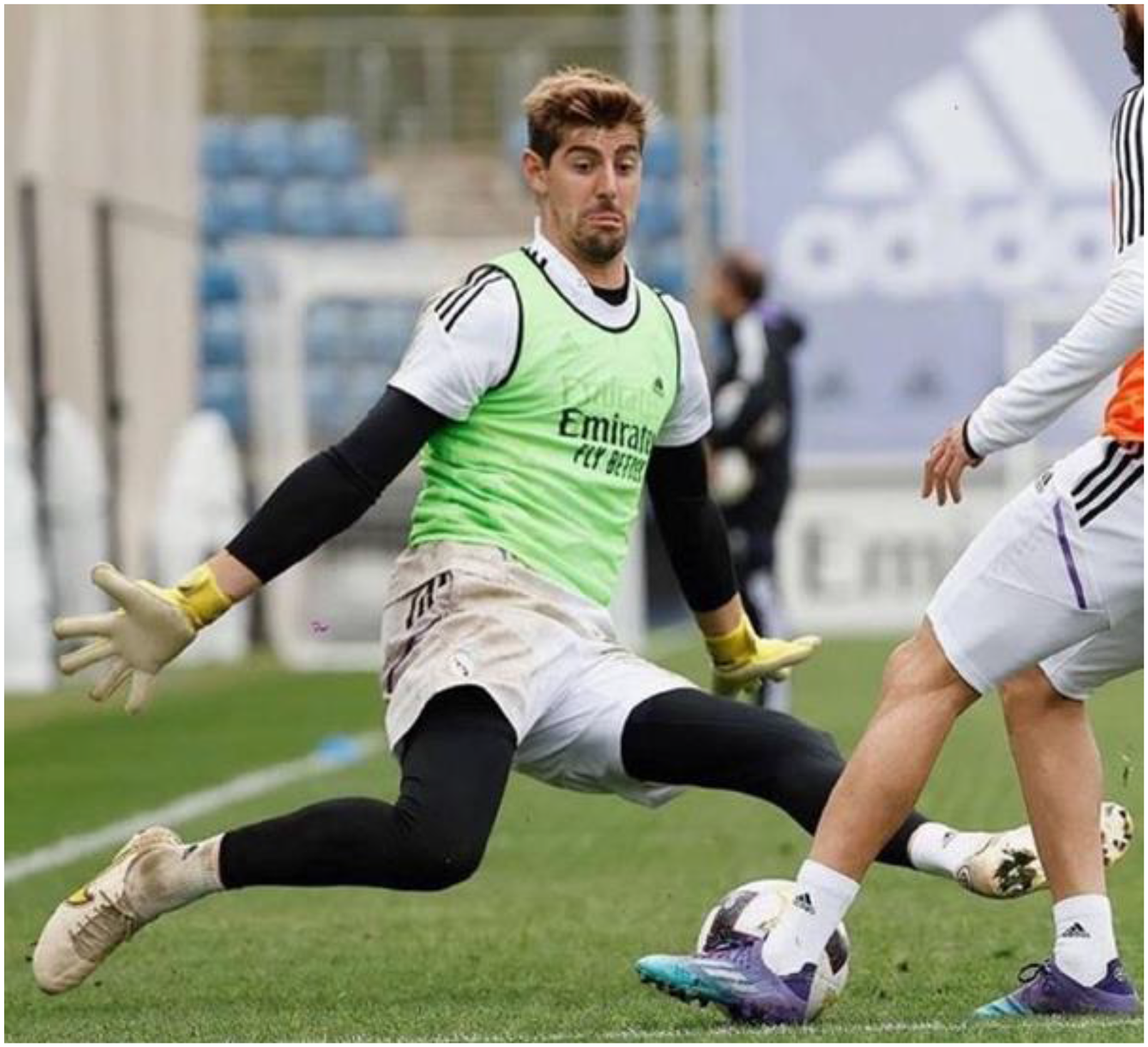
A goalkeeper performing the Spread technique.
Although a need for more relevant research for the GK position has been expressed,4,6–8 it is as important that it is conducted with the collaboration of coaches. 44 While there is reason to believe in the important role that 1v1 actions have for the position, there seems to be a lack of research to support it. Because of that, an exploratory study was designed to provide further insight on the Spread technique. A survey for GK coaches was developed with the aims of (a) exploring the knowledge and use by GK coaches of the Spread; and (b) assessing their experiences and perceptions on injury risks related to it.
Materials & methods
Questionnaire development
The questionnaire was developed by a multidisciplinary team of researchers and an experienced GK coach. The Checklist for Reporting Results of Internet E-Surveys (CHERRIES), 45 was used during the development phase and is available in the supplementary material (S4). The final draft was tested with three GK coaches from different levels, who completed it without reporting any difficulties. The questionnaire was originally developed in French, and later translated to English and Spanish by native speakers. An online platform (sondageonline.com) was used for collecting answers anonymously and on a voluntary basis. An explanation of the aims of the questionnaire; the use of anonymized data for research purposes; and the opt-in option to receive the results was included at the beginning of the questionnaire. The study was performed in accordance with the principles stated in the Declaration of Helsinki. No ethics approval was requested due to the nature of the study (i.e., survey).
Questionnaire structure
The questionnaire consisted of either closed-ended multiple choice or Likert-scale type of questions divided into three sections: (1) Coach profile, (2) Knowledge & use of the Spread, and (3) Perceived injury risk from using the Spread. The full questionnaire can be found in the supplementary material (S1 and S2, for the original French version and the English translation, respectively).
Part I: coach profile
Coaches were asked about their age, gender, and if they were GK coaches. If so, they were further asked about their coaching experience; number of coaching hours per week; team they trained (men/women/both); mean age of the players they coached; level of GK-specific courses that they had previously attended (International > National > Local > None); and self-rated competition level they coached at (Elite > Sub-elite > Recreational). When more than one option was selected in the last two questions, the higher rank was used for analysis. Three additional questions unrelated to the Spread were included but are not discussed in this article.
Part II: knowledge & use of the Spread
Based on a dynamic image (see S1.3 or S2.3), coaches were asked if they knew and coached the Spread; where did they learn the technique; their recommended age and level to start training it; whether or not there are different ways to perform it; how important was it that their players mastered it; the physical and psychological requirements to perform it, and the possible errors when performing it.
Part III: perceived injury associations risks
Coaches were asked if they perceived a risk of injury related to the Spread and, if they did, the type of risk they perceived; if any of their coached players had been injured performing the Spread; and if they considered any injury risk differences between adult and youth players, and/or men and women GKs.
Participants
Snowball sampling was used to reach as many participants as possible. 46 The questionnaire link was shared via email and social media by the authors and several collaboration partners (see Acknowledgments section below). The questionnaire was available for response from January until March of 2023. GK coaches with at least one year of experience and at least 18 years of age were eligible for inclusion.
Answers from coaches who did not know the Spread were excluded from the analysis of the rest of the questions about it. Answers from coaches who did not coach the Spread to their players were excluded from the analysis for the two questions exploring coaches’ experiences (i.e., importance of mastering the Spread, from Part II; and whether one of their players had been injured performing the Spread, from Part III).
Data treatment and statistical analysis
The original raw data was exported from the online platform and analyzed using JAPS v0.17.3 47 and R v4.2.3. 48
Descriptive analysis was performed for every question, comprised of means and standard deviations for numerical variables, and frequencies and total percentage for categorical variables.
GK coaches’ age and experience; coached competition level; and GK courses previously attended; were statistically analyzed to observe the influence on the collected answers in Part II and III. Additional comparisons were made for GK coaches’ perceived injury risk differences between GK's sex (against coached team's sex), and between young and adult GK's (against averaged coached players’ age).
Chi-Squared test was used between categorical variables; Pearson's correlation between numerical variables; and T-Test or one-way ANOVA (followed by post-hoc test with Tukey's correction) between numerical and categorical variables. Non-parametric alternatives (i.e., Mann-Whitney U test instead of T-Test, and Kruskal-Wallis instead of ANOVA) were used for non-normally distributed numerical variables (failed Shapiro-Wilk test). Significance level was set at p < .05.
Results
A total of 801 individual answers were registered in the survey platform, from which 466 (58.2%) were complete answers. After checking for inclusion criteria and erroneous answers, 411 (88.8%) were kept for further analysis. Table 1 shows the demographic data of the GK coaches included.
Summary of coaches’ demographics.

Knowledge & use of the Spread
Only 4 coaches (0.97%) reported not knowing the Spread. Figure 2 shows the source of knowledge of the Spread. No significant differences were found for level of GK-courses previously attended nor coached competition level. To the question on whether they knew if the Spread was taught in GK-courses, 184 (44.8%) answered “yes”, 141 (34.3%) “no”, and 86 (20.9%) “I don’t know”.

Coaches source of knowledge of the Croix technique. Multiple answers were allowed. GK: Goalkeeper *GK coaches who learnt the Croix in “GK coaching courses” were significantly more likely to teach it than those who did not.
On the coaches’ use of the Spread technique, 320 (78%) reported teaching it to their players, while 91 (22%) did not. Coaches that had learnt the Spread in GK courses, were found significantly more likely (p = 0.0012) to teach it than those who had not. No significant differences were found for level of GK courses previously attended nor coached competition level.
Recommended mean GK's age to start training it was 11.3 yrs. (± 2.8), with 21 (5.1%) coaches not considering there was such an age. The most recommended competing level to start training the Spread was Recreational (192, 47 %), followed by Sub-Elite (121, 29 %), and Elite (52, 13 %); with 46 (11 %) coaches not recommending any specific level. Coaches from the Elite competing group were significantly (p < .05) more likely to recommend their own level (i.e., Elite) and less likely to recommend Recreational. Coaches from the Recreational level and those who had not attended any GK-specific courses differences were significantly more likely to answer Recreational as the recommended starting level. Standardized residuals and equivalent p values are shown in the Supplementary Materials (Table S3).
Mean agreement (0 = completely disagree, 100 = completely agree) on whether there is a single or several ways to perform the Spread was 38.9 (± 29.0). Among coaches who trained the Spread, mean agreement on whether their coached GKs should master it was 63.9 (± 27.4). No significant differences (p > .05) between levels of coached competition nor GK-specific courses previously attended were found for any of these questions.
Likert-scale answers on the physical and mental qualities, and the possible errors related to the Spread are shown in Figure 3. All mental and physical qualities were rated as important, to some level, by more than 90% of the GK coaches except for Maximal arm span (89%). Among the possible technical errors that a GK can make while performing the Spread, all but one item (Bad timing for starting the gesture, 7%) were selected as not an error or not important by more than 10% of the coaches, with two items above the 20% value (To focus on the striker's support foot & body orientation when shooting, 21%; and To first open the legs and then the arms, 29%).
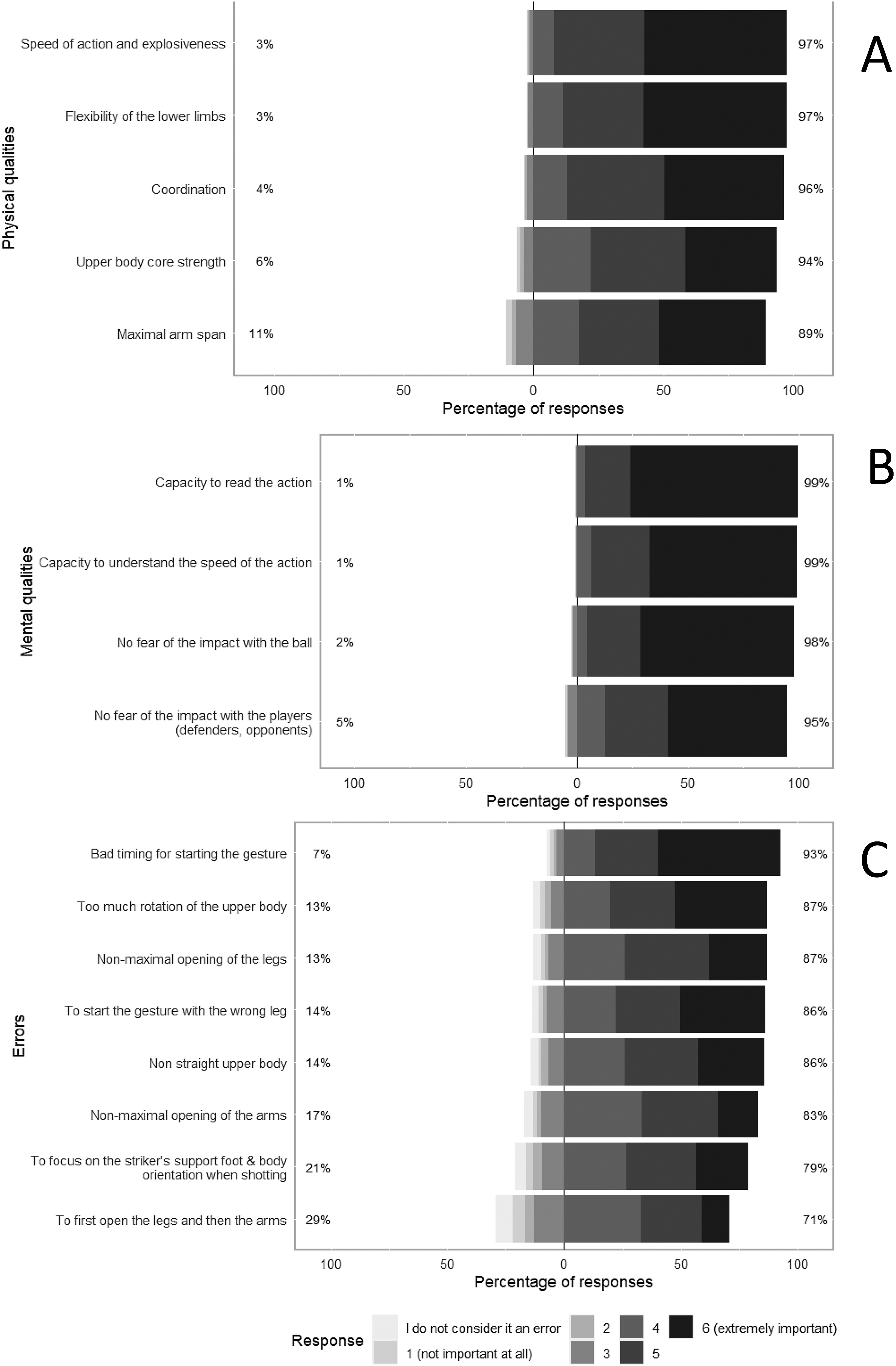
Coaches’ responses on the importance of required (A) physical and (B) mental qualities to perform the Croix; and (C) the possible technical errors that players might make when performing it.
Perceptions and experiences on risk of injury & the Spread
A total of 372 (90.5%) coaches perceived that performing the Spread was associated with different types of injury risk (see Figure 4A), with no significant differences (p > .05) for coached competition level nor level of GK-courses previously attended. A total of 120 (37.5%) coaches reported having at least one player injured while performing the Spread (see Figure 4B for the different type of injuries). Coaches from the Elite competition level were significantly more likely (p < .012) to have had one player injured, and the Sub-elite significantly less likely (p < .044). Contact with another player was the most perceived risk (68.6%), while close to 1 in 10 coaches (9.5%) perceived no risk. Contusion (16.3%) and Muskulo-skeletal (15.8%) were the most recalled type of injuries.
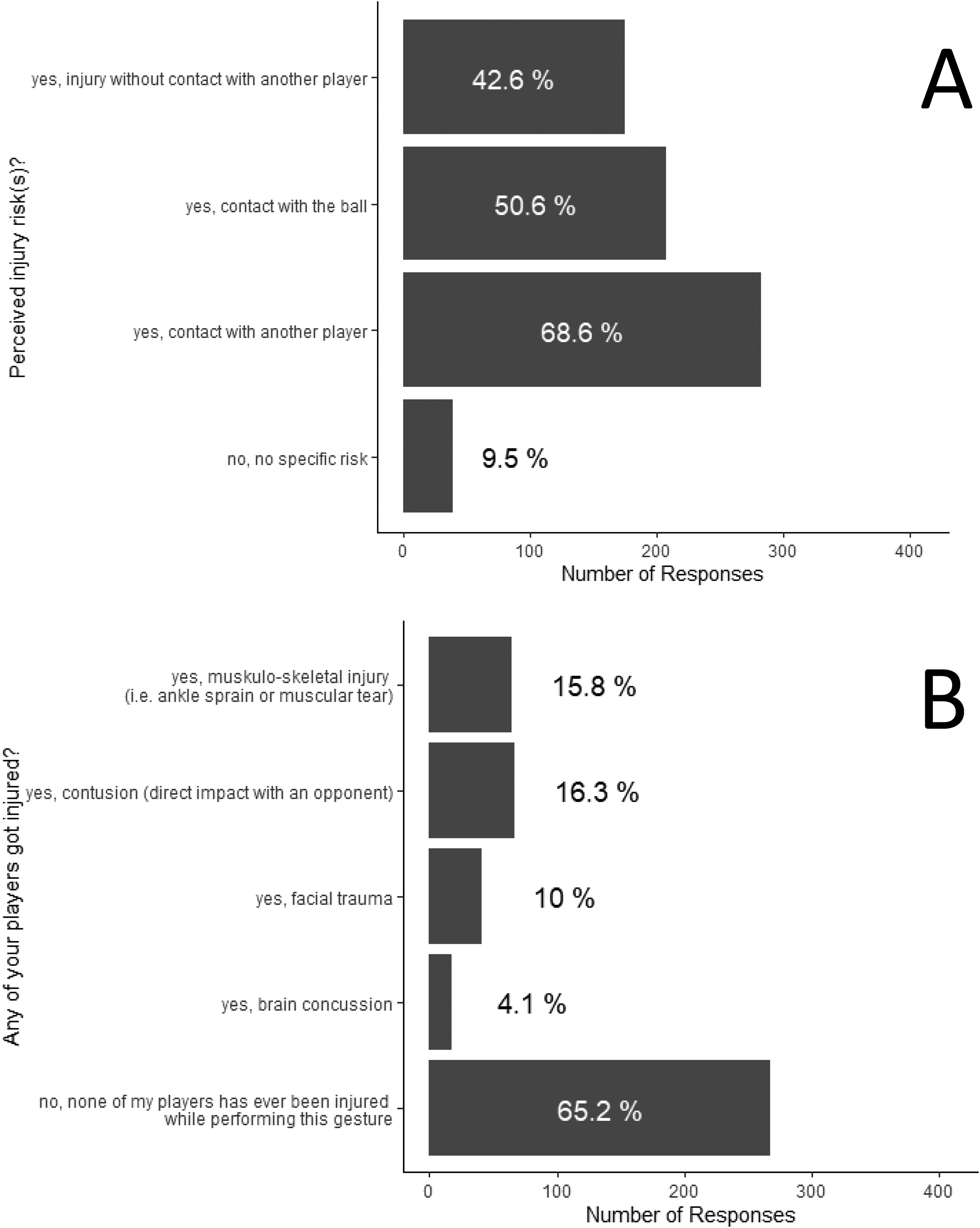
Coaches’ answers to: (A) Is performing this gesture related to specific risks for the health of the goalkeeper? If so, which specific risks? (B) Has one (or several) of your players ever been injured while performing this specific gesture? If so, what was the nature of the injury/injuries? Multiple answers were allowed.
The perceived injury risk differences between men's or women's teams, as well as young and adult GKs, can be found in Table 2. No significant differences were found for coached competition level nor level of GK-courses previously attended in any of the questions. Also, no significant differences were found when comparing the coached player's age against the adult/young injury risk; nor for the coached team (men, women, or both) against the men/women's team injury risk.
Coaches’ perceived difference on injury risk for the Spread based on GK's sex or age.

* p < .05 *** p < .001
Discussion
To the best of our knowledge, this is the first time GK coaches have been asked about 1v1 goalkeeping techniques as the main topic of concern. Likewise, in terms of the sample size of responses gathered from GK coaches, this study is the first of its kind. The large number of responses included in this study allows us to get a representative view of the valuable and necessary perspective of the field practitioners.
Knowledge and use of the Spread
Based on the responses, the Spread is a widely known technique that most GK coaches teach to their GK players. These findings indicate that, although 1v1 events account for few of GK's actions during the game, 24 they are relevant enough for GK coaches to pay attention to them. Therefore, further research and stakeholder interventions addressing the GK position should take these situations into account.
When looking into how GK coaches learn this technique, informal sources of knowledge showed to be more popular, with self-taught (via videos, etc.) and discussing with other GK coaches being 3- and 2-times more frequent, respectively, than reading articles or at GK coaching courses. These results are in line with prior investigations on sport coaching, which found that non-formal learning is typically preferred as a source of knowledge.49,50 Yet, on the matter of how this translates to practice, some authors have shown that “[after formal learning] more change was evident in coaching knowledge than in practice behaviors”. 51 Contrary to this, the coaches in our study who had learnt about the Spread in GK-specific courses (22.9%), were significantly more likely to teach it than those who did not. This interaction suggests that, at least for the case of the Spread, a formal way of education might be related to the practical use of the technique by coaches (i.e., their “practice behavior”). It seems, however, that the inclusion of the Spread in GK courses is limited: despite more than 8 in 10 coaches (81.5%) having previously attended some level of GK coaching courses, less than half (44.8%) reported knowing if the Spread was taught in GK courses. These results, coupled with the lack of reference to the Spread in recently published GK coaching manuals,40–43 might suggest that the offer of formal knowledge on the Spread is limited.
This lack of “formal content” could be influencing coaches’ perception on how this technique should be executed (i.e., “coaching knowledge”). When asked if there is a single way to properly execute different GK techniques (e.g., “Catching a volley”, “Scoop technique”), Otte, Millar, et al. 28 showed agreement responses ranging from 63.5 (±26.8) to 82.9 (±15.4). The results from our study were considerably lower (37.9 ± 29.0), which could suggest that the Spread has not been defined clearly for most GK coaches. In contrast with this, a widespread consensus was reached on the importance of several physical and mental requirements with just two items being selected as not important by more than 5% of the coaches (Upper body core strength, 6%; and Maximal arm span, 11%). While this could be interpreted as a general consensus, it might as well be a reproduction of others beliefs, particularly with the impact that internet and social media have in informal learning methods. 50 The higher variability among ratings of importance for the potential errors, though, suggests that some misunderstanding is present concerning the technical execution of the Spread.
Moving into the practical use of the technique, a majority of the GK coaches reported using the Spread in their trainings, and most of them consider it important for their coached players to master the technique. These results support the idea that the Spread is a relevant technique for GK coaches. As to their usage patterns, it seems that most coaches recommend introducing the Spread at the U11-U13 level, discarding the possibility that this is a technique solely used by adult GKs. The lack of significant differences found between coaches who train/do not train the Spread depending on the coached competition level, suggests that the technique is currently being used at all competition levels. This is further supported by most coaches recommending the Recreational competition level to teach the Spread, discarding the possibility that only GKs at the Elite level learn the technique. Although around half of the coaches answered differently (i.e., Sub-Elite, Elite, or no level recommendation), the significant differences between Elite and Recreational level coaches, more likely to recommend their own competition level, suggest that this disagreement might be influenced by the individual will of each coach to train the technique at their own competition level. A lack of consensus appears to be present on this subject, which could be due to the previously mentioned source of knowledge (formal or informal), or the individual GK coaches’ preference for the different types of 1v1 techniques.27,28
Perceptions and experiences on Risk of injury & the Spread
The second aim of the study was assessing GK coaches’ experiences and perceptions on injury risks related to the Spread. Although most coaches recognized some type of injury risk when performing the Spread, almost 1 in 10 coaches (9.5%) considered that no risk existed. While it could be obvious that performing this kind of movement entails a certain risk of injury, this is further supported by the fact that 37.5% of the coaches who train the Spread reported at least one of their players getting injured performing it. This indicates that there is still space for improvement on raising awareness of the risk of injury associated with these kinds of techniques.
Further into the coaches’ perceptions, the most common type of risk of injury was a collision with another player (68.7%) and the two most common types of injuries recalled were contusion and musculoskeletal (16.3% and 15.8%, respectively). Despite this being the first study investigating GK injuries in 1v1 events, these type of risks and injuries concur with published research on GK injuries. 34 While the risk of collision with another player might be difficult to overcome, protective equipment could help mitigate the consequences. Some authors have already raised the case for the use of helmets by GKs, 52 while others have tried to improve other types of padded equipment. 53 Further research in this field should also take 1v1 events into account.
Although no significant difference was observed for coaches’ injury risk perceptions; coaches at the Elite competition level were significantly more likely to have had an injured player performing the Spread. Apart from differences in the way that the movement is performed (e.g., speed or range of motion), this could be related to the higher training hours that players are typically exposed to at this competition level.13,28 Similarly, some studies have shown a higher risk of injury during training for GK, compared to field players. 54 According to these results, further works investigating the epidemiology or mechanisms of GK injuries, might want to aim at the Elite competition level, in order to obtain a larger data sample.
When asked about perceived injury risk differences between adult/young & men/women GKs, coaches mostly reported “no difference” for both categories, independently of their level of competition and the GK courses previously attended. This remained true when controlling the age or sex of the coached GKs. The coaches’ age and coaching experience, however, showed significant interactions: coaches perceiving a higher risk for men were significantly younger than those selecting no men/women difference; and those perceiving a higher risk for adult GKs had significantly less coaching experience than those who considered a higher risk for young GKs. On the one side, these results suggest that, for a majority of GK coaches, the risk of injury related to the Spread applies equally to all players. As other researchers have pointed out, different injury risks for young 55 and female players54,56 exist. On the other side, 31.9% of the coaches perceived a higher risk of injury for either men or women GKs, and more than half (58.9%) did so for either adult or young GKs. The latter shows that a lack of consensus is also present on this matter, and more work would be required in this area. Considering the significant differences found for coaches’ age and experience, this work should pay attention on the targeted audiences to make sure it reaches all kinds of populations. This could be done, for example, by adapting the communication channels where content is made available (e.g., traditional media vs new social platforms) or including some awareness content in courses aimed at new unexperienced coaches.
Limitations of study
Even though the sample included in this study is the largest one published to date for a survey focused on GK coaches, conclusions drawn from its results should be taken cautiously. Still, the role qualitative research plays in sport science is increasing in recent years, especially when it comes to injury prevention and the transfer of evidence-based knowledge to coaches and players.57–59 Coaches have been a valuable source of information in this field,60–62 and they become even more important in the case of the “specialist role” coaches, 5 such as GK coaches, due to the proximity to the players. Moreover, while injury incidence might be lower for GKs than for field players,63–68 studies covering pain34,69 and overuse injuries 62 reveal that some of the health problems affecting the players can be overlooked, underreported or simply not included in some epidemiological studies. 70
Another limitation of this study is the low number of women coaches included in the sample (n = 7). Although women's participation in football has been increasing recently, the current proportion of women coaches only represents 5% of the total. 71 Therefore, a much higher proportion than the one in our study sample seems unlikely. The overall results for this sub-group, however, are inline with the presented results: only two women coaches did not teach the technique (one of them did not know it); only two learnt about it in GK coaching courses; and three of them recalled having at least one of their players being injured performing the Spread technique.
Conclusion & implications
This is the first time that such a large sample of GK coaches has been consulted. Our results provide support that the Spread is a popular 1v1 technique both known and used by GK coaches indistinctively of their profiles. Their perceptions and experiences point towards a potential risk of injury related to the execution of the Spread; but an apparent lack of agreement seems to be present for the technical execution and the factors associated with a risk of injury. Because of this, future research should pay attention to this technique and build upon our results to properly fill the gap of formal knowledge currently available. Parallel to this, to achieve the knowledge transfer to field practitioners, stakeholders are advised to keep GK coaches at the center of the learning process and use our findings on their pre-conceived ideas and profile differences when developing the content and selecting the targeted profiles in future interventions.
Supplemental Material
sj-docx-1-spo-10.1177_17479541241289419 - Supplemental material for Coaches’ perceptions on the Spread: A 1 vs 1 goalkeeper technique. International survey on 400 + goalkeeper coaches
Supplemental material, sj-docx-1-spo-10.1177_17479541241289419 for Coaches’ perceptions on the Spread: A 1 vs 1 goalkeeper technique. International survey on 400 + goalkeeper coaches by Kevin Gramage Medina, François Delvaux, Cédric Schwartz, Gilles Berwart, Thierry Barnerat, Jean-Louis Croisier and Jean-François Kaux in International Journal of Sports Science & Coaching
Footnotes
Acknowledgements
The authors of this paper would like to thank all the coaches who filled the questionnaires, as well as the following partners, who collaborated in the dissemination of the questionnaire: Royal Belgian Football Association (RBFA), Association des Clubs Francophones de Football (ACFF), Fédération Française de Football (FFF), the FIFA Medical Center of Excellence (FMCE) network, ReFORM Network (IOC Research Center), A. Murray (Director of FIFA Medical); G. Rodas (FMCE-Barcelona, FC Barcelona); E. Van Den Steen and M. D'Hooghe (FMCE-Bruges); M. Ghrairi and E. Esteban (FMCE-Dubai); R. Bahr, T. E. Andersen, F. Grodås and J. E. Stinessen (FMCE-Oslo, OSTRC- IOC Research Center); P. D'Hooghe, N. Popovic and M. Cardinale (FMCE-Doha, Aspetar-IOC Research Center); F. Arroyo Paz (FMCE-Guadalajara); E. Orhant, E. Nöel and B. Sonnery-Cottet (FMCE-Lyon, FFF,); V. Gouttebarge (FIFPRO); E. Verhagen (Amsterdam UMC, IOC Research Center-ACHSS); L. Aguilar Cortez, W. Fritzler (Universidad del Fútbol y Ciencias del Deporte); C. Lopez de Subijana Hernandez, A. Garcia Aliaga, D. Muriarte Solana, P. Sainz de Baranda and M. A. Gomez Ruano (Universidad Politécnica de Madrid); F. Paternoster (Technical University of Munich); I. Fernández Cuevas (ThermoHuman); A. Navandar (Aspire Academy); M. Leitel (KINEXON); K. Puš (ZRS Koper); J. Larruskain Zabala (Athletic Club); X. Monasterio (Universidad del País Vasco); J. C. García Saucedo (NK Istra 1961); L. Schuster (FC Ingolstadt); N. Casado Ortiz.
Author contributions
All authors were responsible for the concept of the paper and survey development. KGM was responsible for the writing of the paper, while the rest of the authors supported in the analysis and interpretation of results, provided feedback and support throughout the writing process. All authors contributed to the article and approved the final version.
Data availability
The data of the survey can be made available (anonymized) upon reasonable request to the corresponding author, KGM.
Declaration of conflicting interests
The authors declared no potential conflicts of interest with respect to the research, authorship, and/or publication of this article.
Funding
The authors disclosed receipt of the following financial support for the research, authorship, and/or publication of this article: This work was supported by the University of Liege, Fonds Léon Fredericq, KeepExpert, (grant number SportS² prize).

Supplemental material
Supplemental material for this article is available online.
References
Supplementary Material
Please find the following supplemental material available below.
For Open Access articles published under a Creative Commons License, all supplemental material carries the same license as the article it is associated with.
For non-Open Access articles published, all supplemental material carries a non-exclusive license, and permission requests for re-use of supplemental material or any part of supplemental material shall be sent directly to the copyright owner as specified in the copyright notice associated with the article.
