




Abstract
This cluster-allocated interventional study examined the effects of the Football+ warm-up program on isokinetic muscle strength and dynamic balance in youth amateur male football players. Two Iranian U18 teams voluntarily participated, completed introductory sessions, and were team-allocated to either the Football+ (n = 15, age = 17.31 ± 0.12 years) or a control group (n = 16, age = 17.13 ± 0.09 years). Baseline assessments included concentric and eccentric quadriceps and hamstring strength at 60°/s and 180°/s, and dynamic balance using the Biodex Balance System. The intervention group performed the Football+ twice weekly for eight weeks, while the control group continued its regular warm-up routines. All assessments were repeated post-intervention. Repeated-measures ANOVA and non-parametric equivalents were used to analyze group differences at a significance level of p ≤ 0.05. ANOVA revealed significant time × group interactions for hamstring eccentric strength at both 60°/s and 180°/s in both legs, whereas quadriceps strength did not change significantly. For dynamic balance, a significant time-group interaction was observed for anterior-posterior stability of the right leg (p = 0.03). For the left leg, a Kruskal-Wallis test indicated a significant pre-intervention difference favoring the control group (p = 0.028), which was no longer present post-intervention (p = 0.42). Overall stability improved significantly over time in the Football + group without significant interaction effects. Eight weeks of the Football+ training (level 1) was associated with improvements in hamstring eccentric strength and selected aspects of dynamic balance, suggesting potential benefits for neuromuscular performance in youth amateur players. Further studies with larger samples across different age groups and playing levels are warranted.
Introduction
Football is considered one of the highest-risk Olympic sports due to its substantial physical demands, full-contact nature, and competitive intensity. 1 Injury surveillance studies report alarmingly high injury incidence rates (IIRs) in amateur male and female players at 5.70 and 6.77 injuries per 1000 training hours, and 14.43 and 14.97 injuries per 1000 match hours. 2 Even higher match-related IIRs have been documented for amateur males, reaching of 29.86 per 1000 h. 3
Muscle injuries account for 18–23% of total injuries in amateur football, with hamstring injuries representing approximately 12% of total cases. 4 Previous hamstring injury has consistently been identified as one of the strongest predictors of future hamstring strain, with affected players demonstrating approximately double the risk of re-injury.5,6 Accordingly, a history of hamstring injury is considered the most important non-modifiable risk factor for hamstring re-injuries.5,6 Research further highlights that reduced hamstring strength is a significant risk factor for both primary and secondary anterior cruciate ligament (ACL) injuries.7–9 Beyond individual health consequences, lower IIRs have been directly associated to players availability, higher league rankings and success in competitions,10,11 emphasizing the importance of effective preventive measures.
Despite proven effectiveness of injury prevention programs (IPPs) in reducing hamstring and ACL injuries,12–14 their implementation in real-world setting remains inconsistent,15–17 underscoring that even strong evidence for injury prevention (IP) alone may not grant widespread implementation of IPPs. Limited adherence, low perceived performance relevance, and insufficient integration into football-specific contexts often hindered widespread adoption of IPPs. 18 Thus, interventions that simultaneously target injury risk reduction and performance enhancement may facilitate greater compliance among coaches and players.
The Football+ warm-up program (the Football+) was developed to address this implementation gap by aligning neuromuscular IP principles with football-specific demands. The program aims to reduce injury risk while concurrently enhancing performance, thereby promoting practical applicability and adherence. Initial investigations have demonstrated superiority of the Football+ in optimizing acute performance, and developing landing quality in female players with and without a history of severe ankle or knee injuries, when compared with the established 11+ program and traditional warm-ups.19,20 More recently, a comparative trial has reported significant improvements in key ACL injury risk indicators including increased knee flexion angles, reduced knee valgus angles and moments, and lower vertical ground reaction forces following 3 months supervised training with the Football+. 21 This study also highlighted that the Football+ outperforms the 11+ and traditional warm ups in four performance metrics including 20-m sprinting, agility, dribbling speed, and vertical jump with large effect sizes. 21
Despite these promising findings, the effects of the Football+ on other modifiable injury risk factors, particularly muscle strength and dynamic balance, remain unexplored. Muscle strength, especially eccentric hamstring strength, and postural control are critical determinants of knee joint stability and neuromuscular performance. Therefore, evaluating the impact of the Football+ on these parameters is important to better understand the underlying neuromuscular mechanisms through which the program may influence performance and injury-related risk factors. The present study, aimed to examine the effects of an eight-week application of the Football+ on muscle strength and dynamic balance in Iranian youth amateur male players. It was hypothesized that participation in the Football+ would result in significant enhancements in both muscle strength and dynamic balance compared with a control condition.
Methods
Ethical considerations and study design
This registered cluster-allocated quasi-experimental trial (IRCT20240306061185N5) was conducted in accordance with the Declaration of Helsinki and approved by the Ethics Committee of Shahid Beheshti University (IR.SBU.REC.1404.86). Participants were allocated by team to preserve existing team structures and training routines, which reflects real-world implementation but may introduce potential between-team variability. Participants provided written informed consent prior to participation. The measurements were conducted at the Sport Injuries Laboratory, Faculty of Sport Science and Health, Shahid Beheshti University, Tehran, Iran.
Study criteria
Eligible participants were U18 male players competing in Division II of the Tehran Football League who i) were injury-free at baseline, ii) had ≥3 years of competitive playing experience; and iii) registered with their teams for the 2024–2025 season. Exclusion criteria included (i) absence from any measurement session; (ii) missing ≥2 intervention sessions; (iii) concurrent participation in other organized sports; (iv) severe lower extremity injury within six weeks prior to baseline assessment; or (v) musculoskeletal surgery, concussion, or severe cardiovascular disorder within six months prior to the study.
Sample size estimation
A priori power analysis (G*Power, F-test family, repeated-measures ANOVA within-between interaction) indicated that 24 participants were required to detect an effect size of f = 0.30, with α = 0.05 and power (1-β) = 0.80.22,23 To account for potential dropouts, 35 players from two amateur U18 teams were recruited. Four players were excluded based on eligibility criteria, resulting in 31 participants at baseline. Four additional players were excluded during follow-up, yielding a final post-intervention sample of the Football + (n = 13) and control (n = 14).
Study preparation
Prior to data collection, players and coaching staff attended an online briefing outlining study objectives, intervention procedures, and testing protocols. During the intervention phase, a blinded research assistant provided periodic on-site monitoring and feedback to the Football + group to support adherence, recognizing that adherence beyond mere participation and compliance is crucial to IPP success.24,25
Experimental procedure
Following demographic assessment and familiarization with the isokinetic protocol, participants completed baseline measurements of isokinetic knee flexor and extensor strength and Biodex dynamic balance test. Teams were then cluster-allocated rather than individual randomization to maintain team integrity and avoid contamination between intervention and control conditions to either the Football + group (n = 15; age 17.31 ± 0.12 years; weight 70.16 ± 2.09 kg; height 1.76 ± 0.12 m) or control group (n = 16; age 17.13 ± 0.09 years; weight 67.49 ± 2.03 kg; height 1.78 ± 0.03 m). Accordingly, the intervention group performed the Football+ warm-up twice weekly for eight weeks, from week 4 of the pre-season to match week 6. The control group continued its habitual warm-up routine consisting of jogging, basic football drills, and static stretching. All baseline assessments were repeated post-intervention using identical procedures.
Intervention
The Football+ comprises three structured sections targeting neuromuscular control and mobility, strength and conditioning, and football-specific movement patterns, with a total duration of approximately 20–22 min in practice. In contrast to the 11+, which primarily focuses on general neuromuscular control, strength, and balance through standardized exercises, the Football + incorporates more dynamic and football-specific movement patterns, including ball-related drills, change-of-direction tasks, and context-driven actions. The program begins with a 2-min self-estimated running at approximately 40–50% of maximal pace, serving as a gradual introduction to physical activity, followed by crossover running, mobility exercises, controlled lunges, tuck-jumps, dynamic core stability exercises, and a Modified Nordic Hamstring Exercise (MNHE). The second part includes 5 min small-sided games, namely, active passing, unanticipated dribbling tasks, and one vs one, followed by plyometric and sprinting exercises in the third part lasting 5 min.
The inclusion of targeted exercises such as the Copenhagen exercise, MNHE, mountain climbers, and rotational plank variations is intended to enhance hip and trunk muscle activation, particularly of the hip adductors, transversus abdominis, and internal and external obliques, which are critical for stabilizing the hip-pelvic-trunk complex. The program includes three progressive difficulty levels, typically advanced every 4–6 weeks. However, due to hazardous air pollution levels in Tehran resulting in cancellation of outdoor training on three occasions, and based on coaching decisions regarding player readiness, only Level 1 was implemented throughout the intervention period. Program materials are publicly available at https://dx-doi-org.web.bisu.edu.cn/10.17877/DE290R-26478 and https://dx-doi-org.web.bisu.edu.cn/10.17877/DE290R-26479.
Isokinetic dynamometry
Participants performed a standardized 5-min warm-up on a cycle ergometer (50–100 W). Isokinetic knee strength was assessed using a Biodex dynamometer (Biodex Medical Systems, USA). The dominant leg was defined as the preferred kicking leg. Participants were seated with the dynamometer's axis aligned to the lateral femoral epicondyle and the backrest adjusted to 70°-85°. Straps were used to stabilize the thigh, pelvis, and trunk. Each participant performed three submaximal warm-up repetitions at angular velocities of 60°/s (slow) and 180°/s (moderate) for both knee flexion and extension through a 0°-90° range of motion. Concentric strength was tested using a con-con protocol, followed by eccentric strength testing via an ecc-ecc protocol on both dominant and non-dominant legs. 26 Unfortunately, eccentric quadriceps data for most participants were not stored due to technical error. For each velocity, one set of three maximal-effort repetitions was recorded, with a 2-min rest between speeds and a 5-min break before testing the opposite leg. Verbal encouragement was provided to ensure maximal effort.
Balance test
Dynamic balance was assessed bilaterally using the Biodex Balance System, following the manufacturer's protocol. The device measures centre of pressure deviations in anterior-posterior (AP), medial-lateral (ML), and overall stability (OS) directions. The platform stability was progressively reduced from level 8 to level 4 during a 25-s single-leg trial. Each leg was tested in a single-leg stance with eyes open, focusing on a fixed point to minimize visual distraction. Each leg condition was repeated three times, with 30-s rest intervals between trials. Dynamic balance outcomes were reported as left and right limbs, consistent with the output of the Biodex Balance System. In contrast, isokinetic strength measures were categorized as dominant and non-dominant limbs due to their functional relevance in football.
Statistical analysis
Means, standard deviations (SD), and effect sizes were calculated for all outcome measures. The Shapiro-Wilk test confirmed normal distribution of majority of variables (p > 0.05), except for Biodex AP left and ML right (p ≤ 0.4). Repeated measures ANOVA was used for normally distributed variables, and the Kruskal-Wallis test was applied to non-parametric data. Analyses were performed using SPSS 31, with a significance level set at α ≤ 0.05. Effect sizes were reported as partial eta squared (η2) and interpreted as follows: small (η2= 0.01), medium (η2 = 0.06), and large (η2 = 0.14). 27
Results
Isokinetic strength test
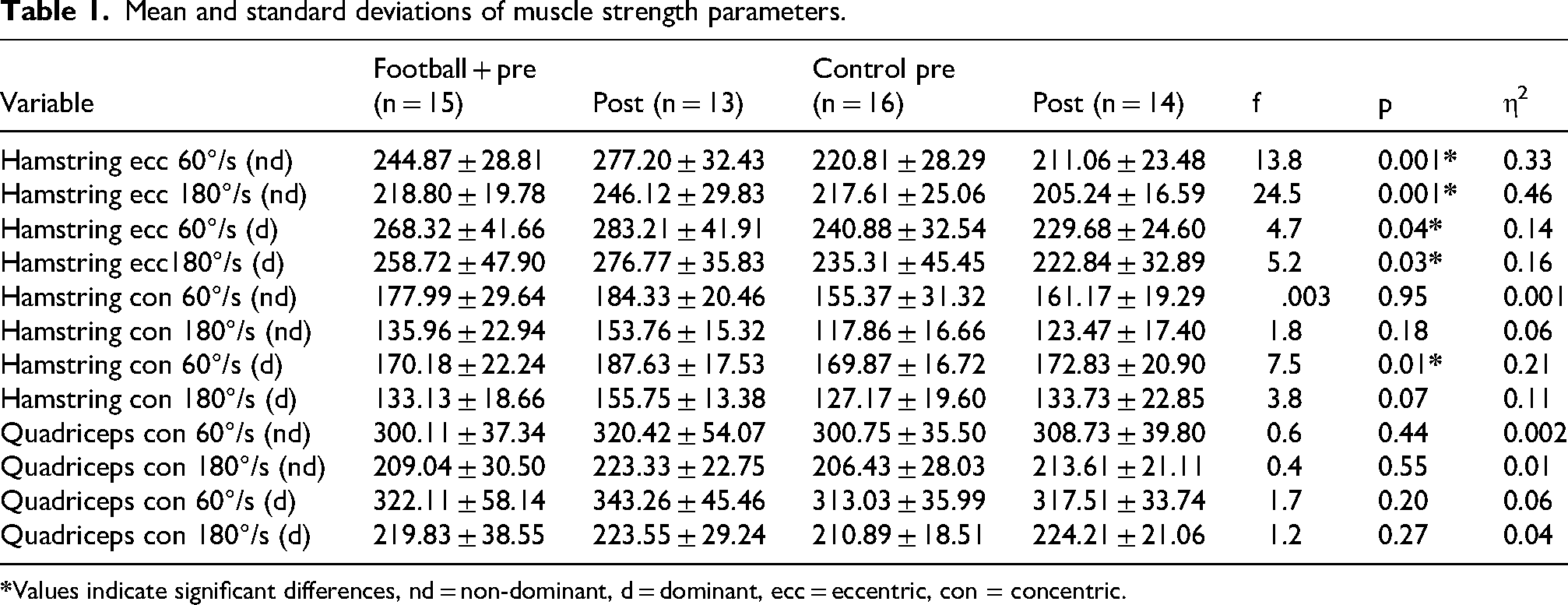
No meaningful differences were observed in baseline demographic characteristics between groups. The Football+ group showed significantly greater increases in hamstring eccentric strength than the control group at both 60°/s and 180°/s in dominant and non-dominant legs (all p < 0.05). No significant differences were observed between groups in quadriceps strength at either angular velocity (p > 0.05). Details are presented in Table 1. Although conventional (concentric hamstring/concentric quadriceps) and functional (eccentric hamstring/concentric quadriceps) H:Q ratios were calculated, they are not presented, as accumulating evidence suggests limited predictive validity of these ratios for ACL and hamstring injury risk. 28
Mean and standard deviations of muscle strength parameters.
Dynamic balance outcomes
The Football+ group showed greater improvements in AP stability of the right leg compared with the control group (p = 0.03). At baseline, the control group demonstrated better AP stability in the left leg compared with the Football+ group (p = 0.028); however, this difference was no longer present post-intervention (p = 0.42) suggesting the Football+ group improved enough to close the initial gap. Overall stability (OS) scores improved over time in the Football+ group, although differences between groups were not statistically significant (p > 0.05). No significant differences were found for medial-lateral (ML) stability parameters (Table 2).
Summary of Biodex balance outcomes.
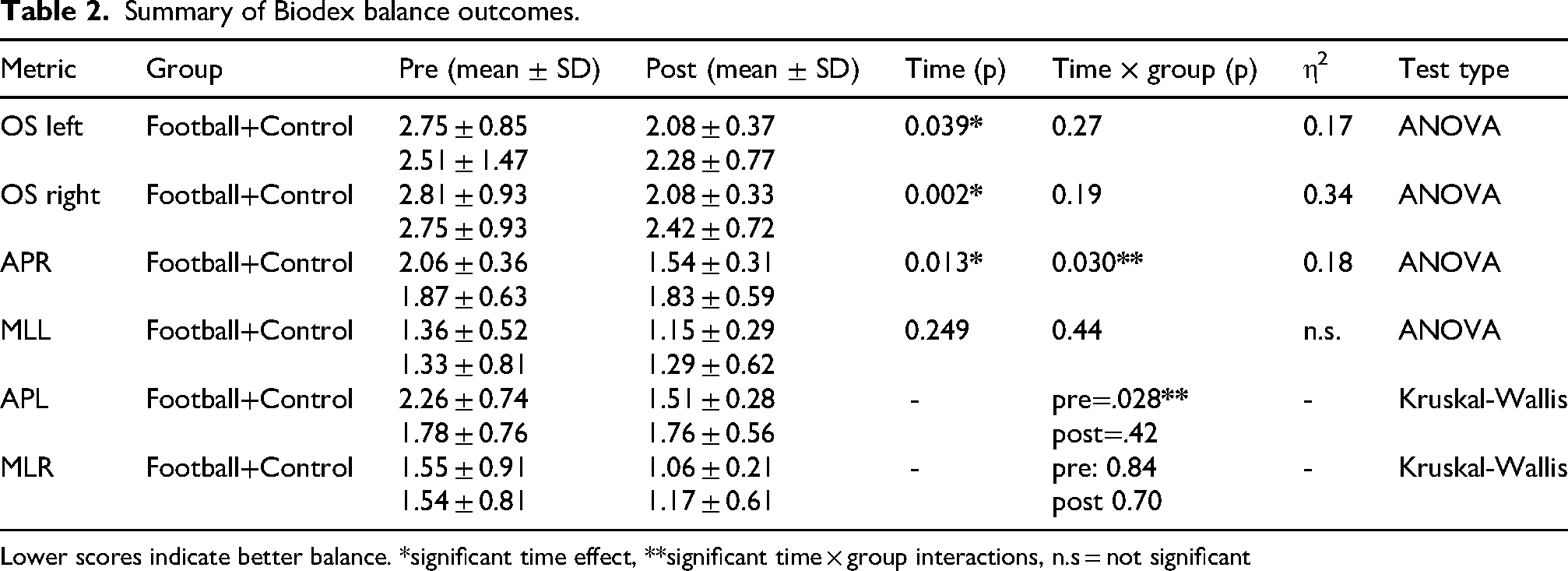
Lower scores indicate better balance. *significant time effect, **significant time × group interactions, n.s = not significant
Discussion
This study aimed at addressing alterations in lower extremity muscle strength and dynamic balance following application of the Football+ program among youth male amateur players. Our findings suggest that 8 weeks supervised training with the Football+ program (level 1) may improve the eccentric strength of the knee flexors at angular velocities of 60°/s and 180°/s in both dominant and non-dominant legs. This aligns with the available literature indicating that neuromuscular exercise-based modalities improve muscle strength of the amateur players.14,29–31 For instance, Arsenis et al. (2020) reported significant increases of approximately 6–8% in eccentric hamstring peak torque in both dominant and non-dominant limbs after an eight-week application of the 11+ (Level 2) performed three times weekly in youth male amateur players. 29 The magnitude of improvement observed in the present study appears comparable or slightly greater (approximately 12–13%), despite a lower training frequency (twice weekly) and the implementation of only Level 1 of the Football+ program. This may suggest that the football-specific and dynamically loaded structure of the Football+ provides a sufficient neuromuscular stimulus to elicit meaningful adaptations even at lower training volumes. Additionally, while both studies included similar populations, differences in exercise content and contextual specificity may further explain variations in the magnitude of observed outcomes.
Although considerable improvements were also observed across the knee extensor muscles especially in dominant leg, they did not reach statistical significance. This may be due to the limited sample size, or the restriction to level 1 of the Football+ program. More progressive loading or application of higher program levels might yield stronger or broader strength adaptations.
The observed hamstring strength gains are likely attributed to the inclusion of two specific exercises embedded in the Football+ routine, namely, the Hamstring walk-out as well as MNHD. Unlike the traditional Nordic protocol, MNHD is performed on a padded surface to minimize kneecap discomfort, allowing a smooth and soft implementation of the exercise in an optimal range of motion during eccentric loading. Such modifications could make the exercise more accessible and better tolerated among players, enhancing both effectiveness and adherence. Additionally, some gains in knee extensor strength may be due to specific exercises integrated into the program, such as single-leg squats and lunges, both of which target the quadriceps in a functional and sport-specific manner. Moreover, plyometric components of the Football+, known to improve neuromuscular coordination and muscular power may also have contributed to the improvements observed across both muscle groups. 32
Parallel with these strength findings, the Football+ program also positively influenced dynamic balance, especially in AP stability. Notably, the initial superiority of the control group in AP left leg balance disappeared post-intervention, suggesting that the Football+ helped bridge the gap. These improvements may reflect the program's integrated emphasis on proprioceptive and unilateral balance challenges, such as single-leg exercises, plyometric drills, and core-stability movements.
Although OA improved significantly over time in the Football+ group, time × group interactions were not statistically significant. This may suggest that while the program enhances general postural control, the degree of improvement may not consistently outperform traditional warm-up routines in all balance dimensions, or that a ceiling effect limited observable gains in already well-balanced athletes. Considering the large effect sizes observed for the balance metrics, the limited sample may also contribute to this non-significant findings. The observed improvements in dynamic balance are broadly consistent with previous studies employing neuromuscular training interventions. In a comparable study, Arsenis et al. (2020) found significant improvements of approximately 17–19% in OS and 16–19% in AP stability in youth male players following the 11+ (level 2). 29 In the present study, relative improvements in OS appeared to be of similar or greater magnitude (approximately 20–25%), despite the absence of statistically significant time × group interactions for all parameters. This may be explained by the football-specific and dynamic nature of the Football+ program, which incorporates multidirectional and task-specific movements that may enhance postural control under more ecologically valid conditions. Further, consistent with previous findings, no significant changes were observed in ML stability, suggesting that this component may be less sensitive to short-term neuromuscular interventions or may require more targeted loading strategies.
These findings provide primary insights supporting the Football+ program as a useful intervention that addresses both performance enhancement and IP, particularly in resource-limited environments where IPPs are often underutilized. The ease of integration into regular warm-up routines, combined with its sport-specific design and proven acute performance benefits warmups, 19 positions the Football+ as a strong candidate for wider adoption by coaches and sport federations. Although follow-up studies with larger sample sizes are required to confirm our findings and investigate the complete application of the Football+ on muscle strength in different populations and playing levels, football administrations are recommended to adopt the program into their routine training.
Conclusion and practical implications
Eight weeks application of the Football+ program (level 1) was associated with improvements in hamstring eccentric strength and selected aspects of dynamic balance, indicating beneficial neuromuscular adaptations in youth amateur male football players. Youth amateur male teams are recommended to integrate the football+ as a time-efficient warm-up into their training plan.
Future research
Additional studies with longer interventions, higher training levels, and larger, more diverse cohorts, including elite youth and female players are needed to confirm these findings and examine the program's effects on other injury risk factors. Further investigation into the mechanistic basis of performance improvements such as muscle architecture changes and neuromuscular adaptations would deepen understanding of how the Football+ exerts its effects.
Limitations
The present findings should be interpreted in light of several limitations. First, the relatively small sample size may limit statistical power and generalizability. Second, the cluster-allocated non-randomized design, with only two teams included, restricts the ability to fully separate the intervention effect from potential team-specific characteristics such as coaching style, training load, or baseline fitness. As a result, some of the observed differences might reflect inherent team differences rather than solely the effect of the Football+ program. Third, only Level 1 of the intervention was implemented, which may underestimate the full potential of the program. Finally, eccentric quadriceps data were not available due to technical issues. Therefore, the present study should be considered a quasi-experimental investigation, and future studies employing randomized controlled designs with larger samples and multiple teams are warranted to confirm these findings.
Footnotes
Acknowledgements
We would like to thank the trainers and players who took part in this study, as well as the technicians at the Sports Injuries Laboratory at the Faculty of Sport Science and Health- Shahid Beheshti University, for their invaluable assistance with the data collection process.

Ethics approval and consent to participate
This study received ethics approval from Ethics committee of Shahid Beheshti University (Code: IR.SSRC.REC.1402.069). Participation was voluntarily and the participants provided written informed consent prior to participation. The measurements were conducted at the Sport Injuries Laboratory, Faculty of Sport Science and Health, Shahid Beheshti University, Tehran, Iran.
Consent for publication
The authors have the same contribution, read, and approved the final manuscript.
Funding
This work is based on research funded by the Iran National Science Foundation (INSF) under project number 4037562.
Declaration of conflicting interests
The authors declared no potential conflicts of interest with respect to the research, authorship, and/or publication of this article.
Data availability and material
The datasets used during the current study are available from the corresponding author on reasonable request.
*
* The manuscript is