




Abstract
This study aimed to examine the effects of hurdle height on hurdling kinematics and spatiotemporal parameters during 40-m hurdle running in beginners. Thirty recreationally active students with no hurdling experience (20 males and 10 females) completed trials under three hurdle height conditions: high (0.84 m), medium (0.76 m), and low (0.68 m). A motion capture system (250 Hz) recorded the kinematics of the second hurdle clearance and the subsequent interval runs. Both hurdling and interval step speeds decreased as hurdle height increased (p < 0.001). The takeoff angle and maximum center of mass (CoM) height increased with hurdle height (p < 0.001), whereas hurdling step speed was strongly and negatively correlated with the takeoff angle (r = −0.915), the backward leaning of the body (r = −0.676) and the shank (r = −0.537) at foot strike during takeoff. The takeoff distance did not differ across conditions; however, hurdling step speed was positively correlated with takeoff distance (r = 0.573). These findings suggest that the body and shank orientation at foot strike during takeoff should be maintained as vertically as possible to lower the CoM trajectory during hurdle clearance. This appears to be driven by an increased takeoff angle and reduced running speed, whereas the takeoff distance remains unchanged. Conversely, lower hurdles were associated with higher running speeds. Thus, beginners should learn to keep their body and shank more vertically oriented at foot strike during takeoff, and practicing with lower hurdles may help maintain running speed and develop efficient hurdling techniques.
Introduction
Hurdle running is a track-and-field event that is an established component of the physical education curriculum. This event requires athletes to sprint over a fixed distance while clearing a series of hurdles. It integrates sprinting mechanics with technically demanding clearance actions. Among the various skills involved in hurdling, clearance is particularly challenging because it requires precise whole-body coordination, rapid temporal control, and adaptation to running mechanics. 1 This combination of technical and temporal demands is classified as a complex motor skill with high nominal task difficulty, 2 which is consistent with Guadagnoli and Lee's 3 challenge point framework. However, despite the recognition of these complexities, no systematically validated or empirically tested instructional approaches to learning hurdling have been established for beginners. A key factor in such an instructional design is the manipulation of hurdle height and interval distance, which are frequently modified in training and educational contexts.
In competitive hurdling, hurdle height and interval distance are standardized by World Athletics. However, in training and physical education, these parameters are often adjusted to accommodate individual needs and facilitate skill acquisition.1,4,5 Beginners typically practice with lower hurdles and shorter intervals, whereas more advanced hurdlers train under conditions closer to competition standards. Adjustments to hurdle configurations are also strategically applied to emphasize the technical components or reduce the risk of injury. Thus, hurdle height and interval distance are the primary variables in the instructional design of hurdling practice. Although elite coaches and athletes often adjust task constraints, such as hurdle height when instructing novice performers, empirical evidence supporting this practice is limited.
Hurdle height, in particular, strongly influences kinematic variables during clearance, as well as foot placement before and after the hurdle4,6–10. McDonald and Dapena 10 compared the men's 110-m and women's 100-m hurdle events, with hurdle heights of 1.06 m and 0.84 m, respectively. They reported that both the maximum center of mass (CoM) height and horizontal velocity were greater in men, consistent with findings from recent studies.11,12 However, these differences were affected not only by hurdle height, but also by other event-specific parameters, such as interval distance, total race distance, and sex. For instance, men are taller than women, which is reflected in the higher hurdle heights, longer race and interval distance in the men's event. Consequently, although cross-sectional studies have highlighted broad performance trends, they cannot isolate the specific contribution of hurdle height to clearance mechanics and subsequent interval running. To address this limitation, intraindividual comparisons are essential to determine the direct mechanical effects.
Intraindividual studies are also critical for examining individual movement patterns and the mechanisms underlying optimal technique.13–15 Techniques effective for one athlete may not be transferable to others, particularly across performance levels, because of substantial anatomical, biomechanical, and neuromuscular variability. 13 Ozaki and Ueda 9 investigated the effects of different hurdle heights on clearance kinematics in highly trained hurdlers. They compared clearance mechanics at the first hurdle following a 15-m approach, with hurdle height set at 10% above and 10% below the participants’ CoM height. They reported that higher hurdle heights were associated with lower clearance velocity, longer flight time, and higher maximum CoM height, and that these variables were related to the clearance velocity. Smirniotou et al. 7 compared three hurdle heights—0.76 m (the lowest official hurdle height used in the women's 400-m hurdles), 0.50 m, and 0.00 m (a line only)— at the first hurdle following a 13-m approach, in a sample of physical education students. They found that higher hurdle heights produced longer takeoff distances, lower horizontal velocities, and larger takeoff angles. These findings highlight the mechanical constraints imposed by hurdle height, which can influence the subsequent running phases. Seki et al. 13 further suggested that takeoff distance affects spatiotemporal parameters during interval running. In actual hurdle races, multiple hurdles are placed along the track, whereas previous studies used only a single hurdle. The need to prepare for the next hurdle influences both the clearance mechanics and spatiotemporal characteristics of the subsequent interval running. The interaction between clearance and interval running cannot be fully captured in single-hurdle studies; therefore, empirical data on this relationship are scarce. Importantly, these limitations indicate that the effects of hurdle height on clearance mechanics and subsequent interval running have yet to be examined under conditions that reflect continuous hurdling.
Therefore, the purpose of the present study was to investigate the effects of hurdle height on hurdling kinematics and spatiotemporal parameters during interval running in a 40-m hurdling trial. As higher hurdle heights are associated with greater maximum CoM height, it was hypothesized that clearance kinematics and spatiotemporal parameters of interval running would also be affected by hurdle height. To our knowledge, these hypotheses have not been previously examined under continuous hurdling conditions. These alterations could provide valuable insights for the development of hurdling techniques.
Methods
Sample size estimation and justification
The required sample size was estimated using G*Power 3.1 for multivariate analysis of variance (MANOVA). Assuming a medium effect size (f = 0.25), an alpha level of 0.05, and a desired power of 0.80, the analysis indicated that at least 29 participants were required. An intercorrelation of r = 0.50 between repeated measures was specified, consistent with values based on a previous study. 13 These inputs ensured that the study had adequate power to detect the expected effects.
Participants
A total of 38 Japanese university students were recruited for this study. None of the participants were hurdlers ranked above Tier 3, according to the classification by McKay et al.. 16 Eight participants were excluded because either they did not complete all trials or because of data collection failures, yielding a final sample of 30 students (20 males, 10 females; age: 20.9 ± 2.1 years; height: 1.69 ± 0.09 m; body mass: 64.8 ± 14.0 kg). None of the participants had received hurdle-specific training, although all had prior experience in sprint hurdling as part of their physical education classes. Based on their training and performance levels, the participants were classified as tier 1 or tier 2. 16
All participants provided written informed consent before participation. The study protocol was approved by the Ethics Committee of the College of Humanities and Sciences, Nihon University, Japan (approval No. 06-37) and was conducted in accordance with the Declaration of Helsinki.
Procedure and measurements
Before data collection, each participant completed a self-selected warm-up lasting between 10 and 30 min, which included jogging, sprinting, and practice trials. Figure 1 illustrates the experimental setup and the key terminology. All the measurements were conducted in an indoor sports hall. Participants performed a 40-m hurdle run from a standing start under three hurdle height conditions: high (0.84 m), medium (0.76 m), and low (0.68 m). According to the World Athletics regulations, medium and high heights correspond to the official hurdle heights for women's 400-m and 100-m hurdles, respectively. Because the participants in this study were not competitive hurdlers, the hurdle heights were set lower than the official height for men's 110-m hurdles. The approach and interval distances were set at 13.0 m and 7.5 m, respectively, based on pilot testing.
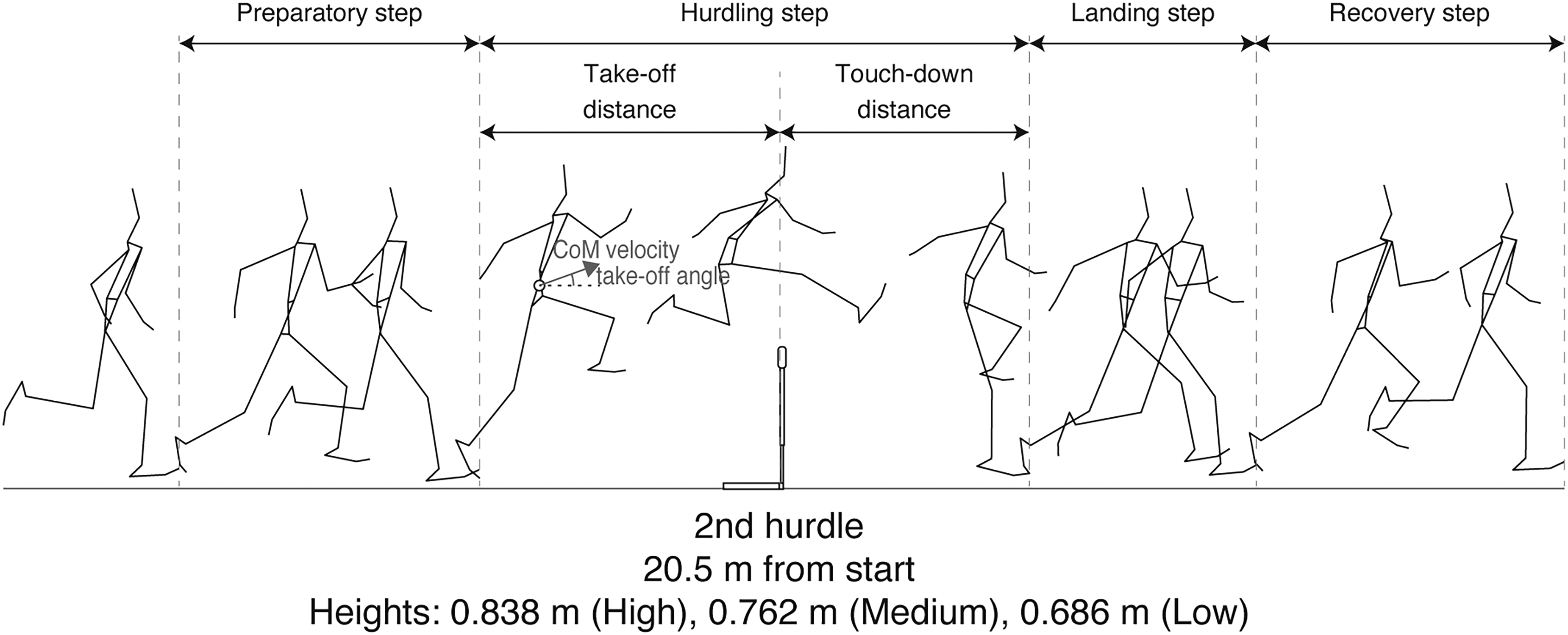
Experimental setup and terminology.
The trial order was randomized for each participant to minimize order effects. A minimum rest period of 5 min was provided between trials. All measurements were performed on the same day. The participants were not given specific training instructions or dietary restrictions before testing.
Reflective markers were attached to 45 anatomical landmarks, based on the model for Japanese athletes proposed by Ae et al.. 17 Markers were placed directly on the skin, except in a few cases. Markers for the greater trochanter, anterior superior iliac spine, posterior superior iliac spine, and lower ribs were attached to the tights, whereas markers for the toe, first and fifth metatarsal heads, and heel were attached to the shoes. Coordinate data of the anatomical landmarks were captured using a motion capture system (Vicon V5/v2.2, Vicon Motion Systems, UK) at a sampling rate of 250 Hz.
Data were captured from one step before hurdle clearance through two subsequent steps after the clearance of the second hurdle (Figure 1). The four steps within this captured sequence were labeled as follows: preparatory, hurdling, landing, and recovery, following the terminology of McDonald and Dapena 10 (Figure 1). A single step was defined as the movement from the foot strike of one foot to the foot strike of the opposite foot.
Analysis
The coordinate data were low-pass filtered using a Butterworth digital filter with a cutoff frequency of 10 Hz, based on previous studies using a motion capture system,18,19 and we visually confirmed that the filtered data were not substantially distorted. The location of the CoM and the masses of individual body segments were estimated using the method proposed by Ae et al.. 17 The whole-body CoM was computed as the resultant CoM for all the segments.
The step length was calculated as the displacement of the whole-body CoM in the forward progression during each step. 20 Step frequency was defined as the inverse of step duration, and step speed was calculated by multiplying the step length by the frequency.
Takeoff and landing distances were defined as the horizontal distances in the direction of forward progression from the hurdle to the toes of the takeoff and landing feet, respectively. The takeoff angle was calculated as the angle between the whole-body CoM velocity vector at toe-off and the horizontal plane. Maximum CoM height was defined as the highest vertical position of the whole-body CoM during the flight phase of the hurdling step.
An inverted pendulum model was built from the foot-ground contact point to the body's CoM. The contact point was assumed to be the metatarsophalangeal joint of the takeoff foot.21,22 The model, shank, and thigh angles were calculated as follows: the vertical position was defined as 0°; backward leaning was defined as positive values and forward leaning as negative values.
Statistical analysis
Two MANOVAs were conducted to evaluate the effects of hurdle height on biomechanical variables.
The first analysis focused on the interval variables (step length, frequency, and speed). A two-way repeated-measures MANOVA was performed with step (three levels: preparatory, landing, and recovery) and hurdle height (three levels: high, medium, and low) as within-subject factors. The step factor was included to account for the repeated structure of the interval but was not a primary variable of interest. When significant main effects of hurdle height were identified, follow-up univariate analyses of variance (ANOVAs) were performed, accompanied by Bonferroni-adjusted pairwise comparisons of each dependent variable.
The second MANOVA examined the clearance-specific variables across the three height conditions. Because these variables were not repeated across steps, a one-way repeated measures MANOVA was used with hurdle height as the within-subject factor. Significant multivariate effects were assessed using univariate one-way ANOVAs and Bonferroni-corrected pairwise comparisons. In addition, Pearson correlation analyses were performed to examine the relationships between the clearance variables and hurdling step speed. Correlation coefficients were interpreted as follows: small (0.10 ≤ |r| < 0.30), medium (0.30 < |r| ≤ 0.50), and large (0.50 < |r|). 23
Statistical significance was set at p < 0.05. All analyses were conducted using SPSS software (version 29.0.2.0; IBM Corp., Armonk, NY, USA).
Results
Interval variables
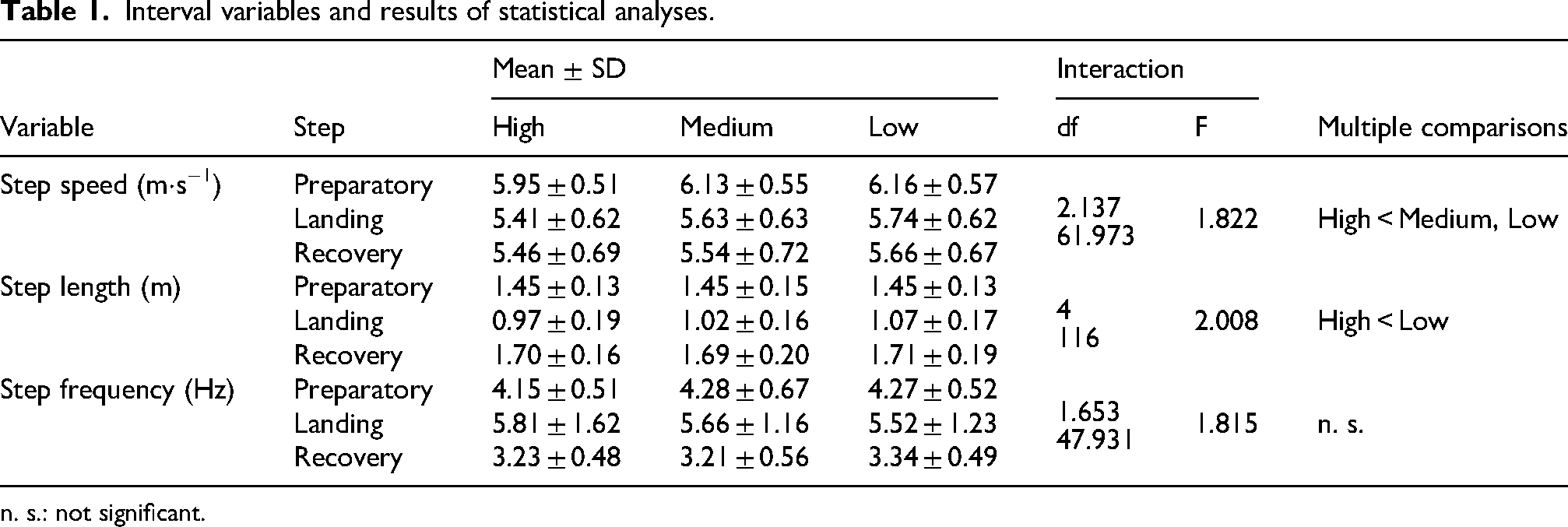
Table 1 demonstrates the descriptive statistics for the interval variables and the results of univariate analyses. The MANOVA revealed a main effect of hurdle height on the combined dependent variables (Wilks’ Λ = 0.341, F(6, 24) = 7.740, p < 0.001, partial η2 = 0.659). Although there was a step × height interaction at the multivariate level (Wilks’ Λ = 0.382, F(12, 18) = 2.423, p = 0.044), subsequent univariate tests revealed no significant interaction effects for individual dependent variables (ps = 0.098–0.179). Therefore, no further interaction analyses were conducted.
Interval variables and results of statistical analyses.
n. s.: not significant.
Univariate analyses showed that hurdle height had a main effect on step speed, F(1.672, 48.492) = 15.656, p < 0.001, and on step length, F(2, 58) = 3.954, p = 0.025. No significant effect of hurdle height was observed on step frequency, F(1.347, 39.067) = 0.185, p = 0.832. Post hoc pairwise comparisons (Bonferroni-adjusted) revealed that step speed was lower in the high condition than in both the medium (p < 0.001) and low (p < 0.001) conditions, with no significant difference between the medium and low conditions (p = 0.382). For step length, a small increase was observed from the high to the low condition (p = 0.026), whereas no significant differences were found between the high and medium conditions (p = 0.861) or between the medium and low conditions (p = 0.333).
Clearance variables
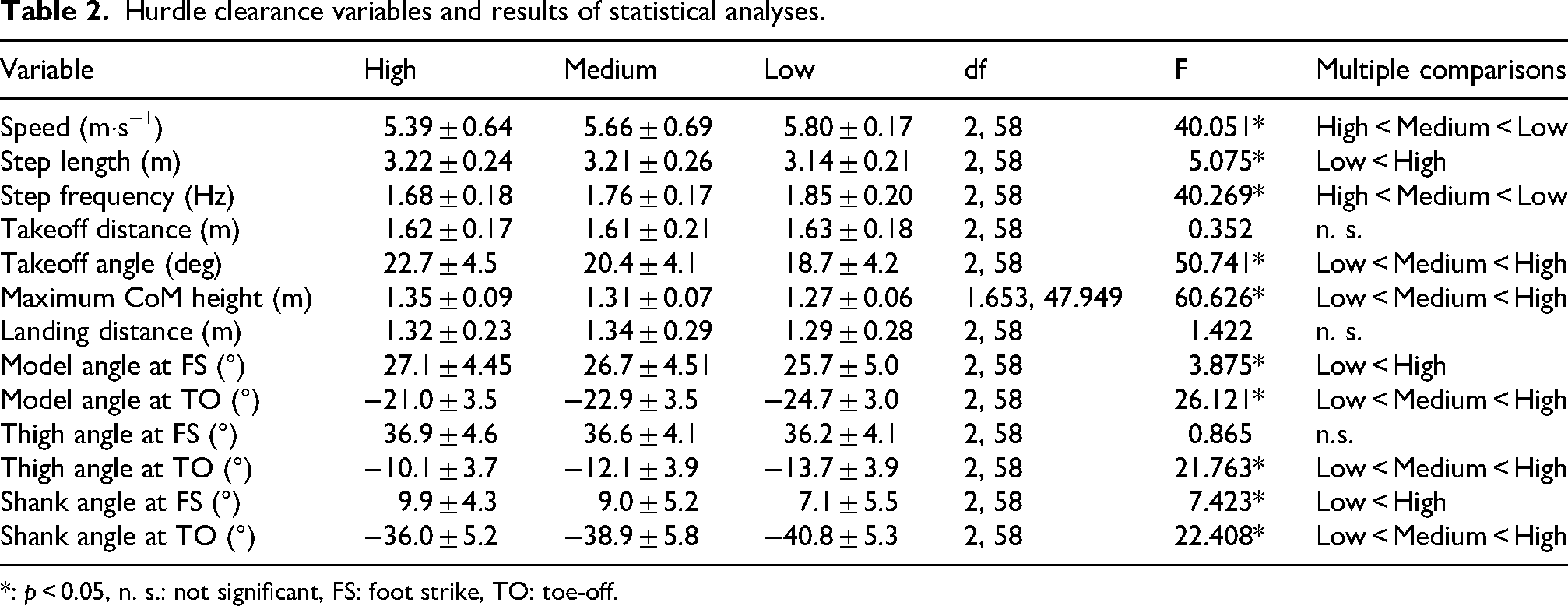
Table 2 demonstrates the descriptive statistics for the hurdling variables and the results of the univariate analyses. A one-way repeated-measures MANOVA revealed a effect of hurdle height on the combined dependent variables, Wilks’ Λ = 0.006, F(26, 4) = 24.702, p = 0.003, partial η2 = 0.994.
Hurdle clearance variables and results of statistical analyses.
*: p < 0.05, n. s.: not significant, FS: foot strike, TO: toe-off.
Univariate analyses revealed main effects of hurdle height on ten of the 13 variables: step speed (p < 0.001), step length (p = 0.009), step frequency (p < 0.001), takeoff angle (p < 0.001), maximum CoM height (p < 0.001), model angle at foot strike (p = 0.026), model angle at toe off(p < 0.001), thigh angle at toe off (p < 0.001), shank angle at foot strike (p = 0.001), and shank angle at toe off (p < 0.001). No significant effects were found for takeoff distance (p = 0.705), landing distance (p = 0.249), and thigh angle at foot strike (p = 0.426).
Bonferroni-adjusted pairwise comparisons indicated that both step speed and step frequency differed across all three hurdle heights. Specifically, both measures were lower in the high condition than in the medium (p < 0.001) and low (p < 0.001) conditions and were also lower in the medium condition than in the low condition (ps ≤ 0.001–0.008). Step length was longer in the high condition than in the low condition (p = 0.029). Takeoff angle, maximum CoM height, model angle at toe-off, thigh angle at toe-off, and shank angle at toe-off were greater in the high condition than in the medium (ps ≤ 0.001–0.008) and low (ps < 0.001) conditions, and greater in the medium condition than in the low condition (ps ≤ 0.001–0.019).
Pearson correlation analysis revealed that hurdling step speed had a large negative correlation with takeoff angle (p < 0.001; Figure 2), model angle at foot strike (p < 0.001; Figure 2), shank angle at toe off (p < 0.001; Figure 2), model angle at toe off (p < 0.001; Figure 2), and shank angle at foot strike (r = −0.537, p < 0.001). The hurdling step speed showed large positive correlations with step frequency (p < 0.001; Figure 2) and takeoff distance (p < 0.001; Figure 2). A medium positive correlation was observed with step length (r = 0.436, p < 0.001). Medium negative correlations were observed with thigh angle at foot strike (r = −0.316, p = 0.002) and maximum CoM height (r = −0.303, p = 0.004). No significant correlations were observed for landing distance (r = 0.107, p = 0.314).
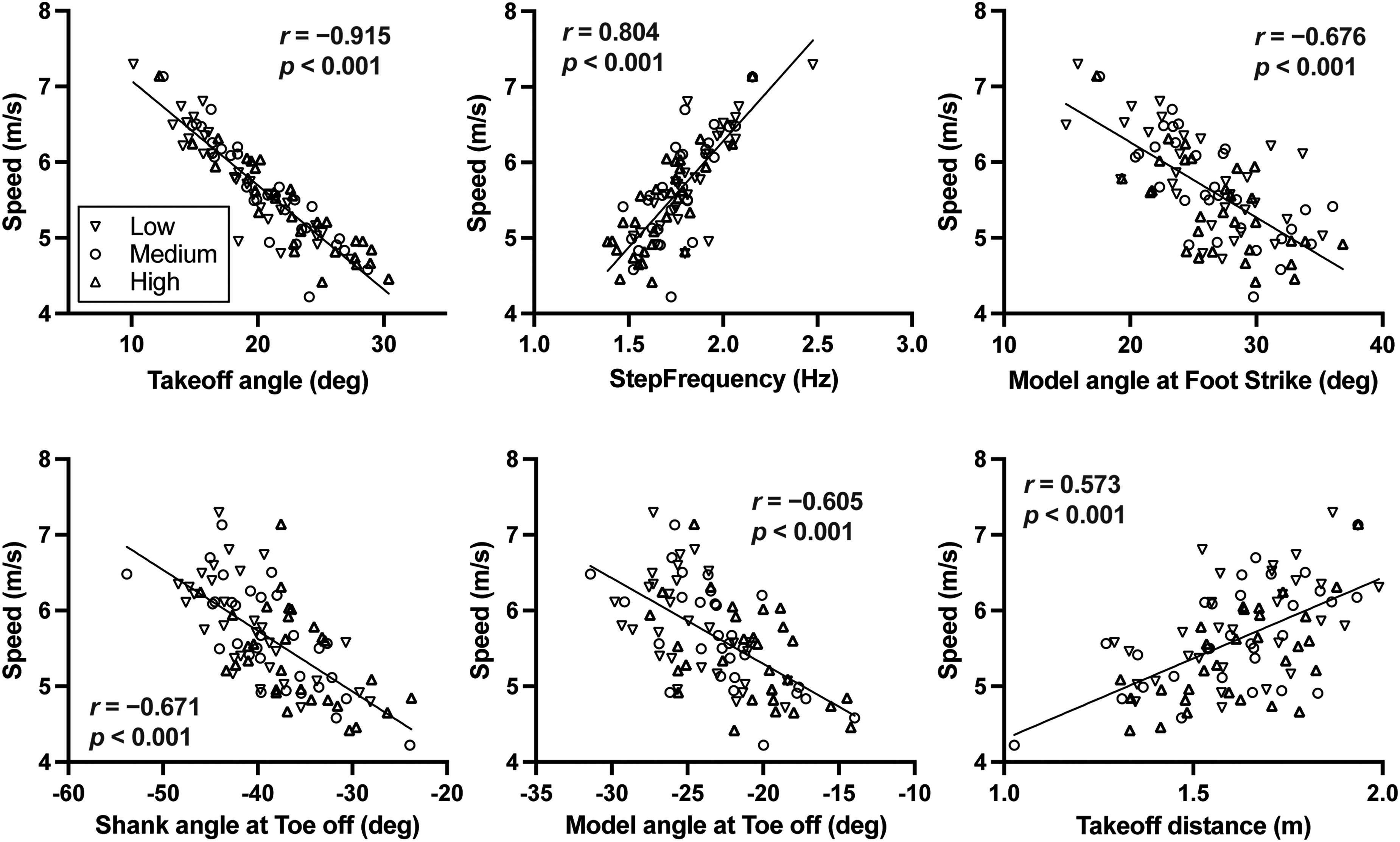
Relationship between hurdling step speed and selected variables.
Discussion
The main findings of the present study can be summarized as follows: (1) step speed, including both hurdle clearance and interval phases, decreased as hurdle height increased; (2) takeoff angle and maximum CoM height increased with hurdle height; (3) hurdling step speed was negatively correlated with takeoff angle; (4) the model, thigh, and shank angles at toe-off during takeoff increased with hurdle height; (5) the model, thigh, and shank angles at foot strike and toe-off during takeoff were negatively correlated with hurdling step speed; (6) hurdling step speed was positively correlated with takeoff distance; and (7) takeoff distance did not differ across conditions. These findings support our hypothesis.
A higher hurdle height reduced step speed during both hurdle clearance and interval running. Although direct comparisons with cross-sectional studies are limited, our results are consistent with the findings of previous intraindividual studies. For example, Ozaki and Ueda 9 reported that hurdle clearance velocity was lower in the higher- versus lower-hurdle condition among highly trained hurdlers. Similarly, Smirniotou et al. 7 observed that horizontal velocity was greatest in the line-only condition and lowest in the 0.76-m hurdle height condition among physical education students. These intraindividual studies demonstrated patterns consistent with those observed in the present study. Because step speed is directly linked to the overall hurdling performance, the present findings indicate that an increased hurdle height substantially impairs performance.
Takeoff angle and maximum CoM height were greater under the higher-hurdle condition compared with the lower-hurdle condition. The maximum CoM height observed in the present study was relatively higher than values reported in previous studies, despite differences in hurdle heights. For example, McDonald and Dapena 10 reported maximum CoM heights of 1.347 ± 0.025 m in the men's 110-m hurdles (1.06-m hurdle height) and 1.193 ± 0.033 m in the women's 100-m hurdles (0.84-m hurdle height) among world-class hurdlers. Hanley et al. 11 similarly reported values of 1.33 ± 0.02 m for the men's 110-m hurdles and 1.13 ± 0.02 m for the women's 100-m hurdles. Ozaki and Ueda 9 also reported maximum CoM heights of approximately 1.39 and 1.27 m under hurdle heights of approximately 1.063 and 0.87 m, respectively, in highly trained hurdlers. The relatively higher maximum CoM height observed in the present study suggests that the participants were at the beginner level of hurdling, as a less efficient technique requires a larger vertical displacement. However, given the differences between the maximum CoM and hurdle heights, the beginners were able to clear the high hurdle using a CoM trajectory similar to that observed under the low hurdle. This result suggests that beginners naturally adopt a higher CoM trajectory to avoid hitting hurdles.
Although the takeoff mechanics of running jumps, such as long and high jumps, have been reported,21,24 information on hurdle clearance mechanics is scarce. The present study did not measure kinetics; however, it revealed the kinematic characteristics of the inverted pendulum model and lower limbs. The model and shank angles were more backward-leaned at foot strike, and the model, thigh, and shank angles were less forward-leaned at the toe-off under higher hurdle conditions. Shibata et al. 21 also reported that, in running jumps, the model leaned significantly more backward at foot strike in a vertical running jump than in a horizontal running jump, and significantly leaned more forward at toe-off in a horizontal running jump than in a vertical running jump. Shibata et al. 21 also suggested that backward leaning of the body assists in generating vertical velocity during the takeoff of a running jump, as this posture tends to gain an impulse in the direction change component of velocity during the first half of the takeoff. In the present study, participants leaned their bodies more backward at foot strike during takeoff under higher hurdle heights. Thus, participants naturally chose to lean their bodies backward to achieve a higher takeoff. In other words, to clear a hurdle with a lower CoM trajectory, the body should be kept as vertical as possible while maintaining an appropriate backward lean. In addition, the shank angle also showed a backward lean at foot strike under higher hurdle heights. Furthermore, the model, shank, and thigh angles were more forward-leaned at toe-off under lower hurdle heights, and the model and shank angles were negatively correlated with speed. Therefore, a smaller backward lean of the body and lower limbs at foot strike and a greater forward lean at toe-off contribute to a lower hurdling trajectory and higher running speed. Among these variables, the shank angle is particularly important, as it affects the body posture during takeoff. However, it should be noted that a lower CoM trajectory may increase the risk of hurdle contact. Iwasaki et al.25,26 reported that even in trained hurdlers, a lower CoM height at takeoff may be associated with an increased risk of hitting hurdles, and hitting a hurdle is associated with a decrease in running speed. 26 This trade-off may be particularly relevant for beginners, who have less precise motor control. Decreasing speed by hitting a hurdle may disrupt the step pattern during interval running, leading to an inappropriate takeoff position for the subsequent hurdle. Therefore, coaches should be aware of this trade-off when applying these findings to instructional practice.
Given that the beginners exhibited relatively higher CoM heights, it is important to consider how these heights were achieved. Two primary strategies exist: increasing the takeoff velocity or increasing takeoff angle. If takeoff velocity increases, the maximum CoM height also increases, but the point of maximum height shifts further forward in the running direction, requiring a longer takeoff distance. Seki et al. 13 suggested that although a longer takeoff distance may introduce slight technical inefficiencies, it is less detrimental to performance than a shorter takeoff distance. However, extending takeoff distance is challenging for beginners. Strüder et al. 1 noted that beginners tend to takeoff too close to the hurdle, producing a steep upward trajectory. Therefore, increasing takeoff distance is unlikely to be a feasible strategy for beginners in this study. Instead, the large negative correlation between hurdling step speed and takeoff angle indicates that participants relied on the latter strategy, namely increasing the takeoff angle.
Given the potential influence of hurdle height on takeoff mechanics, one might expect takeoff distance to change under higher hurdle conditions. However, the present study demonstrated that takeoff distance did not differ across conditions. In contrast, Smirniotou et al. 7 reported that takeoff distance was significantly longer at a 0.76-m hurdle height compared with 0.50-m and 0.00-m hurdle heights. Although their results may appear inconsistent with those of the present study, the range of hurdle heights differed considerably. In addition, Smirniotou et al. 7 did not report maximum CoM height, making direct comparison difficult. In the present study, three hurdle heights were tested with increments of approximately 0.15 m, but the resulting difference in maximum CoM height was only about 0.04 m. Thus, adopting a greater takeoff angle appeared to be the most feasible strategy for participants to clear higher hurdles, even though this approach was associated with reduced step speed. Moreover, the small differences in maximum CoM height suggest that lowering CoM trajectory is challenging for beginners. Novices may takeoff too steeply even over lower hurdles, and such steep takeoff angles may be necessary to achieve the required step length for clearance. To achieve a lower CoM height when clearing lower hurdles, greater takeoff velocity would likely be required.
Interestingly, a moderate positive correlation was observed between takeoff distance and hurdling step speed. Several previous studies have examined the role of takeoff distance in performance. Salo et al. 27 reported that takeoff distance did not correlate with horizontal velocity in male athletes, whereas it was significantly correlated in elite female athletes. Based on analyses of world-class hurdlers, Mero & Luhtanen 28 suggested that extending takeoff distance helps maximize vertical velocity while preserving horizontal velocity. More recently, Mansour et al. 29 compared takeoff distance between hurdlers and decathletes—both classified as elite athletes according to McKay et al. 16 —and found that takeoff distance was significantly longer in decathletes than in hurdlers. Collectively, these studies suggest that achieving an optimal ratio between takeoff and touchdown distances is more important than simply increasing takeoff distance in elite athletes. At the same time, a short takeoff distance remains a common technical problem among beginners, 1 yet effective instructional strategies for addressing this issue have not been proposed. The results of the present study suggest that higher approach speed may contribute to extending takeoff distance. Consistent with this, Günter 30 reported that low horizontal velocity leads to shorter takeoff distance. Although the present study did not detect differences in takeoff distance across conditions, the randomized trial order minimized potential order effects, and practice effects specific to the lower hurdle height condition were not examined.
Hurdle clearance and interval running are closely interrelated. No significant interactions were observed in step variables during interval running. Step speed was lower under the high-hurdle condition compared with the medium- and low-hurdle conditions, which was likely a trade-off for increasing the takeoff angle, as discussed above. In addition, step length was shorter under the high-hurdle condition compared with the lower-hurdle condition. This finding can be explained by the fact that a longer hurdling step length at the high-hurdle condition required shorter subsequent steps within the fixed hurdle spacing. Seki et al. 13 reported significant interactions between step and takeoff distance conditions in step length. A possible explanation for the discrepancy is that the present study found no significant differences in takeoff distance across the three hurdle heights. As takeoff distance is a key biomechanical factor, 28 it may strongly influence both hurdle clearance and interval running.
Finally, the present study has several limitations. First, the participants were beginner university students, which limits the generalizability of the findings to other populations. Second, hurdle heights were not normalized to participants’ stature or CoM height. In particular, sex differences in body height may have influenced the results. Nevertheless, in the practical context of hurdle running, such as physical education classes, hurdle height cannot always be tailored to individual body dimensions, as commercially available hurdles are produced with standardized height settings. Finally, the present study did not assess kinetics. Future research should examine these variables, as doing so would provide additional insights into hurdle running mechanics and motor learning process.
Conclusion
The present study demonstrates that hurdle height significantly influences hurdling kinematics and spatiotemporal parameters in beginners. Higher hurdles were associated with reduced running speed, greater takeoff angles, and a greater backward lean of the body at foot strike during takeoff. To lower the hurdle clearance trajectory, the body and shank at foot strike during takeoff should be kept as vertical as possible. In addition, running speed was closely related to both takeoff distance and takeoff angle, indicating a strong interdependence among these variables within the hurdling movement pattern. Although lowering hurdle height did not substantially reduce the CoM clearance height, higher running speed was accompanied by less deceleration and smaller takeoff angles. Overall, these findings clarify how variations in hurdle height affect the movement strategies adopted by beginners.
Footnotes

Author contributions
Conceptualization: KS and GP; methodology: KS and RK; software: KS; formal analysis: KS; investigation: KS, RK and GP; resources, KS; data curation: KS and RK; writing—original draft preparation: KS; writing—review and editing: RK and GP; visualization: KS; project administration: KS; All authors have read and agreed to the published version of the manuscript.
Ethical consideration
This study protocol was approved by the Ethics Committee of the College of Humanities and Sciences, Nihon University, Japan (approval No. 06-37) and was conducted in accordance with the Declaration of Helsinki.
Consent to participate
All participants provided written informed consent before participation.
Consent to publication
All participants provided written informed consent for the publication of their data before participation.
Funding
This study was supported by JSPS KAKENHI (grant number JP26K14294).
Declaration of conflicting interests
The authors declared no potential conflicts of interest with respect to the research, authorship, and/or publication of this article.
Data availability
The datasets generated during and/or analyzed during the current study are available from the corresponding author upon reasonable request.
Artificial intelligence statement
A generative artificial intelligence tool was used to assist with language editing and improving clarity of expression. The authors take full responsibility for the content, including the accuracy of the data, analysis, and interpretations.