




Abstract
Rapid changes of direction, sudden stops, and jumping are prominent in basketball, contributing to a high incidence of anterior cruciate ligament (ACL) injuries. The Landing Error Scoring System (LESS) is a validated screening tool used to assess ACL injury risk based on kinematic patterns during a drop vertical jump. However, traditional motion capture methods used to obtain the required kinematics are costly and laboratory-dependent, limiting their use for routine athlete monitoring. This study evaluated the agreement between OpenCap, a smartphone-based markerless motion capture platform, and a gold standard Vicon motion capture system, and examined the feasibility of longitudinally monitoring LESS scores in collegiate basketball athletes across a competitive season. For validation, 10 healthy participants (4 males, 6 females) performed drop vertical jumps recorded simultaneously with OpenCap and Vicon. For longitudinal monitoring, 21 NCAA Division I basketball athletes (12 males, 9 females) were assessed at preseason, start of competition, and midseason. OpenCap demonstrated excellent agreement with Vicon (ICC = 0.884). Bland–Altman analysis showed a mean difference of −0.57 (95% CI: −1.19 to 0.05), indicating no systematic bias between systems. LESS scores did not change significantly across the season (p = 0.26), and positional differences were not statistically significant (p = 0.10), although a moderate effect size was observed (ηp2 = 0.062). Poor knee-flexion displacement, one of the most predictive LESS items, was present in approximately one third of athletes. These findings support the validity of OpenCap for facility-based ACL injury risk screening and longitudinal monitoring of athlete movement patterns.
Keywords
Introduction
Biomechanical analysis has become a valuable tool for identifying movement patterns associated with injury risk in sport. 1 Motion analysis systems are commonly used for this purpose, with laboratory-based motion capture widely considered the gold standard for measuring kinematic and kinetic variables. 2 However, traditional motion capture systems require specialized laboratories, expensive equipment, and extensive setup time, which limits their practical use for routine athlete monitoring in team sport environments. 3 As a result, there is increasing interest in portable and accessible motion analysis technologies that can provide biomechanical insights outside of laboratory settings.
The need for more practical motion analysis tools is particularly relevant in sports like basketball, which carries a high incidence of anterior cruciate ligament (ACL) injuries due to its physically demanding nature. 4 The game requires frequent sprinting, jumping, and rapid changes in direction. 5 At the collegiate level in the United States (U.S.), athletes often train daily and compete in multiple games per week, further increasing the physical stress placed on their bodies. 6 Although ACL injuries are relatively common, only about 55% of athletes who undergo ACL reconstruction successfully return to their previous level of competitive sport, 7 and these injuries can have long-term consequences for performance or even lead to withdrawal from sport. Several factors known to influence ACL injury risk—such as fatigue and cumulative workload—can fluctuate throughout a competitive season.8,9 For instance, U.S. collegiate basketball includes periods of intensified practice and competition that may contribute to these fluctuations. 10 Although prior studies have reported that ACL injury incidence does not vary according to the time in the season,11,12 seasonal changes in training demands and fatigue may still influence athletes’ biomechanical movement patterns. Therefore, longitudinal monitoring of biomechanical markers throughout the competitive season may help characterize how athletes’ movement patterns change during periods of training and competition.
One of the primary tools for assessing ACL injury risk is the Landing Error Scoring System (LESS), a biomechanical screening test that evaluates movement patterns during a drop vertical jump to identify indicators of non-contact ACL injury. 13 The test measures 17 items between initial landing and maximum knee flexion of a jump-landing task. To complete this assessment, an individual stands upright on a box, drops down, lands bilaterally, and immediately executes a vertical jump. 13 The LESS has established validity as a clinical assessment tool and is a frequently used to evaluate outcomes in ACL injury research. 14 Although the LESS was originally scored subjectively by an observer, prior studies have attempted to automate LESS grading using depth-camera, computer vision, or markerless motion capture approaches.15,16 While promising, these methods often require specialized hardware, technical expertise, or custom processing pipelines, which may limit their accessibility and scalability in clinical or team sport environments.
Among these approaches, markerless motion capture platforms have gained attention because they offer more flexible setups and may help overcome some constraints of traditional laboratory environments.2,17–19 However, their accuracy can vary by joint, movement plane, and task, with known limitations for ankle, frontal-plane, and transverse-plane kinematics.20,21 Therefore, task-specific validation remains important before these systems are used for applied biomechanical screening. One platform with potential for this purpose is OpenCap, an open-source markerless motion capture application compatible with iOS devices that generates musculoskeletal simulations and estimates three-dimensional kinematics from video recordings. 22 A recent study developed an OpenCap-based automated LESS scoring approach and reported strong agreement with expert-rater grading. 23 However, OpenCap's performance has not yet been evaluated against a gold standard laboratory motion capture system for LESS scoring, nor has it been used to longitudinally monitor changes in movement patterns across a competitive season. The present study addresses these gaps by validating OpenCap-derived LESS scores against Vicon motion capture and applying the system to longitudinally monitor ACL-related movement patterns in collegiate basketball athletes.
The aims of the present study were: (1) to evaluate whether OpenCap can serve as a valid alternative to a gold standard motion capture system for generating LESS scores, with the expectation that OpenCap-derived scores would be comparable to those obtained from a Vicon system; and (2) to examine changes in ACL-related movement patterns across a competitive season in U.S. collegiate basketball athletes using OpenCap. Exploratory analyses were also conducted to describe whether LESS scores varied by athlete characteristics, including sex, playing position, height, and body mass. This longitudinal approach enabled evaluation of whether ACL-related movement patterns varied across different periods of the competitive season while assessing the practicality of incorporating OpenCap assessments into regular team training schedules. We hypothesized that OpenCap-derived LESS scores would be comparable to those obtained from the Vicon system and that players would exhibit higher LESS scores over the course of the season.
Materials & subjects
Subjects
The procedures and methods used in this study were approved by the University of Miami Institutional Review Board (IRB), approval no. 20240774. All participants were informed of the study procedures, provided written consent prior to beginning the experiment, and given the option to withdraw at any time.
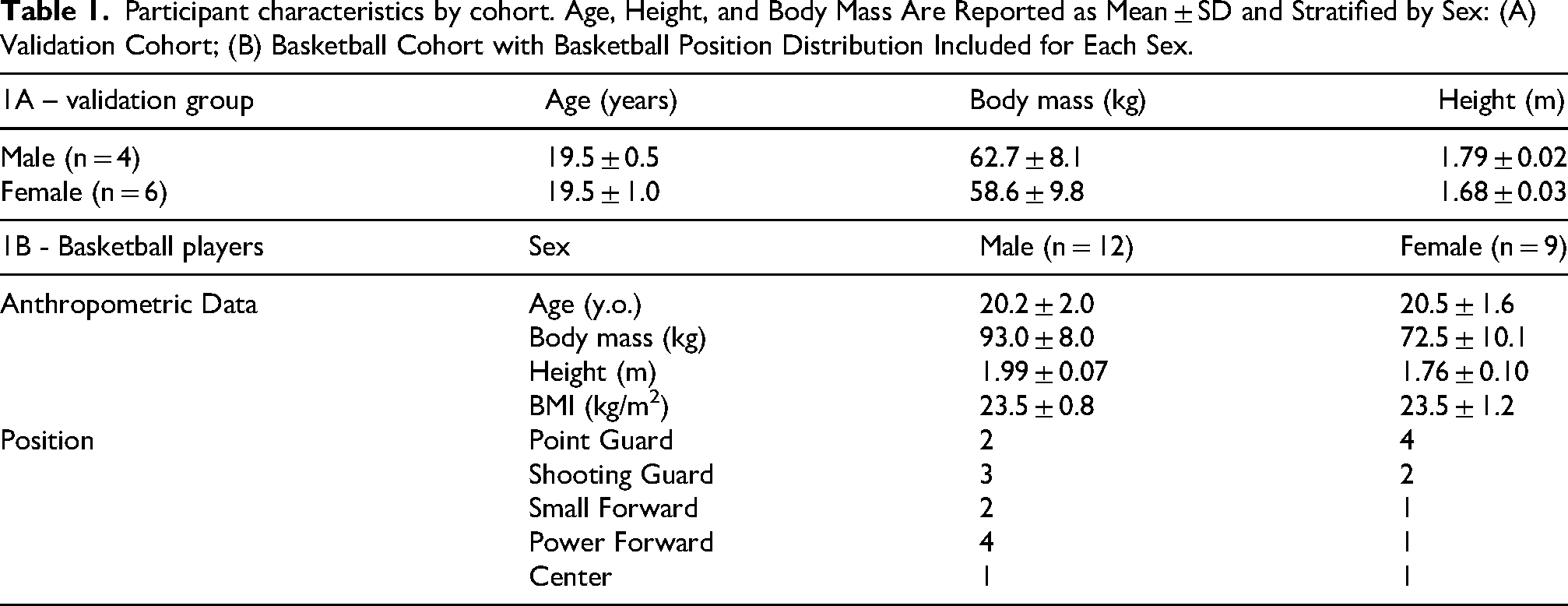
Two cohorts of participants were enrolled between August 27, 2024, and April 11, 2025. The first cohort was enrolled to assess the accuracy of OpenCap-derived LESS scores compared with motion capture. This cohort consisted of 10 university students (4 male and 6 female), aged 18–21 years (19.5 ± 0.8 years). Mean participant height and body mass were 1.72 ± 0.06 m and 61.0 ± 9.0 kg, respectively. Inclusion criteria required that participants had not sustained a lower extremity injury within the past six months. The second cohort was enrolled to examine longitudinal changes in basketball athletes’ LESS scores across the season. A total of 21 National Collegiate Athletic Association (NCAA) basketball players (12 male and 9 female), aged between 18 and 23 years of age (20.4 ± 1.8 years), consented to participate in the study. Mean participant height and body mass were 1.89 ± 0.14 m and 84.6 ± 13.5 kg. The additional inclusion criteria for this cohort were that participants were current members of an NCAA Division I men's or women's basketball team. Player position was self-reported on initial documentation and verified through the athletics website when unspecified. Table 1A and B describe participant age and anthropometrics for both cohorts.
Participant characteristics by cohort. Age, Height, and Body Mass Are Reported as Mean ± SD and Stratified by Sex: (A) Validation Cohort; (B) Basketball Cohort with Basketball Position Distribution Included for Each Sex.
Research design
To quantify ACL injury risk–related movement patterns, the LESS screening tool was applied based on the criteria in Padua et al. 24 which outlines 17 different metrics to be evaluated during the execution of the drop jump movement. Each metric is linked to its own threshold value defined by specific joint-angle criteria. A value of 0 or 1 is assigned to each metric depending on whether it exceeds the corresponding threshold. A final score is calculated as the sum of the individual metric scores. Higher LESS scores indicate greater injury risk. Previous studies have determined that a score between 5 and 6 indicates moderate risk of injury, and scores greater than 6 indicate high risk of injury. 13
To assess the accuracy of OpenCap-derived LESS scores during a drop vertical jump, automated pipeline-derived scores were compared with scores obtained from Vicon kinematics (2.15, Vicon Motion Systems, Inc, Oxford, England). To conduct a longitudinal analysis of the LESS score using kinematic data from OpenCap, the drop vertical jump of basketball players was evaluated with acquisitions done three times during the season: during pre-season (September 9th, 2024), at the start of competition (November 1st, 2024), and midseason (December 19th, 2024).
Data collection
For the data collection in the laboratory using both OpenCap and a motion capture system simultaneously, independent calibrations were completed prior to the arrival of participants. For the Vicon system, consisting of eight Vantage V8 (2016, Vicon Motion Systems, Inc, Oxford, England) infrared cameras, kinematic data were collected at 500 Hz, and calibration was performed with a 30 cm (12-inch) box positioned at the center of the room. A total of 39 reflective markers were placed on the participant, as outlined in the Plug-in Gait full body model. 25 A static trial was subsequently recorded with the participant standing upright on the box in a motorbike pose to establish baseline positional data, subject specific anthropometrics, and marker offsets. 25 For OpenCap setup, one iPad 10th generation and two iPhone 15 devices (Apple Inc., Cupertino, CA, USA) were mounted on tripods positioned 1.37 m above ground level and recorded at 60 frames per second. Camera placement followed OpenCap setup guidelines: one device was placed 3.07 m directly anterior to the jump area, and the remaining two were positioned at 45-degree angles relative to the center of the box, as recommended for minimal subject displacement activities. 26 Prior to calibration, visual inspection confirmed the participant was fully viewed in all three iOS devices by having the participant complete practice jumps. Calibration procedures followed standardized OpenCap guidelines and best practices. 22 A printed checkerboard calibration board (8 × 11 squares; 2.54 cm square size) was utilized for camera calibration. Then, a static trial was recorded with the participant standing directly in front of the 30 cm (12-inch) box to initialize the OpenCap model. The calibration videos were then assessed on the OpenCap web application to confirm acceptable quality prior to data collection. The experimental setup is shown in Figure 1. After calibration of both systems, the participant completed three drop vertical jump trials from the box. Kinematic data were captured concurrently by Vicon and OpenCap, ensuring temporal alignment for direct system comparison.
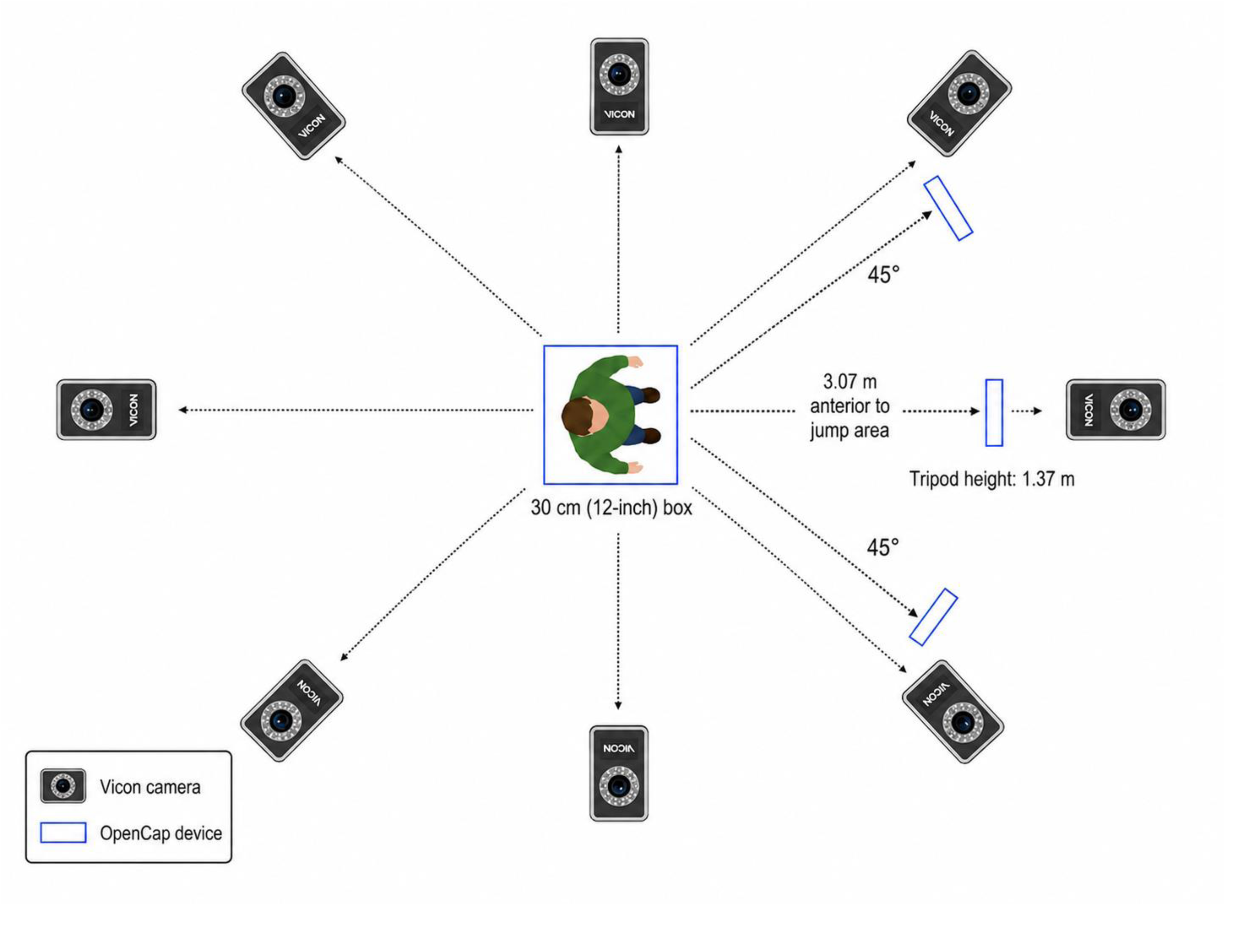
Layout of setup for recording with both Vicon and OpenCap simultaneously. Top-down schematic of the validation setup. Eight Vicon cameras were arranged around the participant in accordance with manufacturer guidelines and mounted on elevated tripods. Three devices recording with OpenCap were positioned on shorter tripods, with one tripod placed directly anterior to the jumping zone, and two additional tripods positioned at 45° angles relative to the zone. The vertical separation between systems minimized optical interference, which was confirmed prior to data collection.
OpenCap testing for the athletes was conducted in a basketball practice facility. Three iPads 9th generation (Apple Inc., Cupertino, CA, USA) were mounted on tripods at the team practice facility's basketball court and recorded at 60 frames per second. The protocol for the basketball players was the same as that for the participants in the laboratory. For all trials, visual inspections were conducted prior to data processing to ensure the recorded jumps displayed smooth, continuous movement.
Data processing
OpenCap data was automatically processed using its integrated cloud-based pipeline. As part of the OpenCap preprocessing workflow, two-dimensional key point positions were filtered using fourth-order, zero-lag Butterworth filters, with a default cutoff frequency of 30 Hz for non-gait trials. 22 Vicon data was processed in Nexus® data capture software (2.15, Vicon Motion Systems, Inc, Oxford, England) using the Plug-in Gait Dynamic pipeline, in which marker trajectories were filtered using a quintic spline filter prior to the modeling stage. 25 The Python pipeline then processed both OpenCap- and Vicon-exported marker coordinate and joint kinematic data to generate automated LESS scores. Initial contact was identified from heel and toe marker trajectories using the frame corresponding to the minimum vertical marker velocity, and maximum knee flexion was identified as the peak knee flexion angle during the landing phase. Data analysis was limited to the period from initial landing to takeoff following peak knee flexion. Based on the criteria in the Supplementary Material (Table S1), the pipeline extracted the necessary kinematic data and generated individual test item scores and a final LESS score for each trial.
Statistical analysis
All statistical analyses were conducted using Minitab (Version 21.1.1, Minitab LLC, Pennsylvania, USA) and Microsoft Excel (Version 16.101; Microsoft Corporation, Redmond, WA, USA). Statistical significance was set at 95% (α = 0.05) for all tests. For the validation component, the intraclass correlation coefficient (ICC) was used to assess agreement between OpenCap- and Vicon-derived LESS scores. A Bland–Altman analysis was also performed to evaluate agreement between the two systems across the full range of LESS test scores. Previous work on the LESS score has identified six of the seventeen items as the most predictive of ACL injury risk, including trunk flexion at initial contact, external rotation of the foot, knee displacement, hip displacement, trunk flexion displacement, and overall joint displacement. 24 A Fisher's Exact Test was used to compare the classifications produced by both systems across these six test items. A repeated-measures ANOVA was used to examine changes in LESS scores across testing rounds. Separate exploratory one-way ANOVAs were used to examine whether participant-level mean LESS scores differed by sex and playing position. Assumptions of ANOVA, including homogeneity of variances (Levene's test) and normality of residuals (Shapiro–Wilk test), were satisfied. Effect sizes were quantified using partial eta squared (ηp2) and interpreted using conventional thresholds, where values of approximately 0.01, 0.06, and 0.14 represent small, medium, and large effects, respectively. 27 A linear regression was performed to examine the association between athletes’ mean LESS scores and their height and body mass.
Results
Validation of the OpenCap system
The ICC for this study was 0.884, indicating excellent agreement (ICC > 0.75) 28 between the LESS scores obtained from Vicon and OpenCap. The Bland–Altman analysis (Figure 2) demonstrated a mean difference of −0.57 (95% confidence interval [CI]: −1.19 to 0.05); although the point estimate was not zero, the confidence interval crossed zero, indicating no statistically significant systematic bias between systems. The 95% limits of agreement ranged from −3.83 to 2.69, reflecting the variability in individual score differences across systems. Among the six most predictive items of ACL injury risk within the LESS assessment, items 3, 13, and 16, which evaluate trunk flexion at initial contact, hip-flexion displacement, and overall joint displacement, respectively, showed identical average scores across both systems (all scoring 0). Fisher's exact test indicated that foot external rotation (p = 0.002) and trunk flexion displacement (p < 0.001) differed significantly between systems, whereas knee flexion displacement (p = 1.000) did not differ between systems.
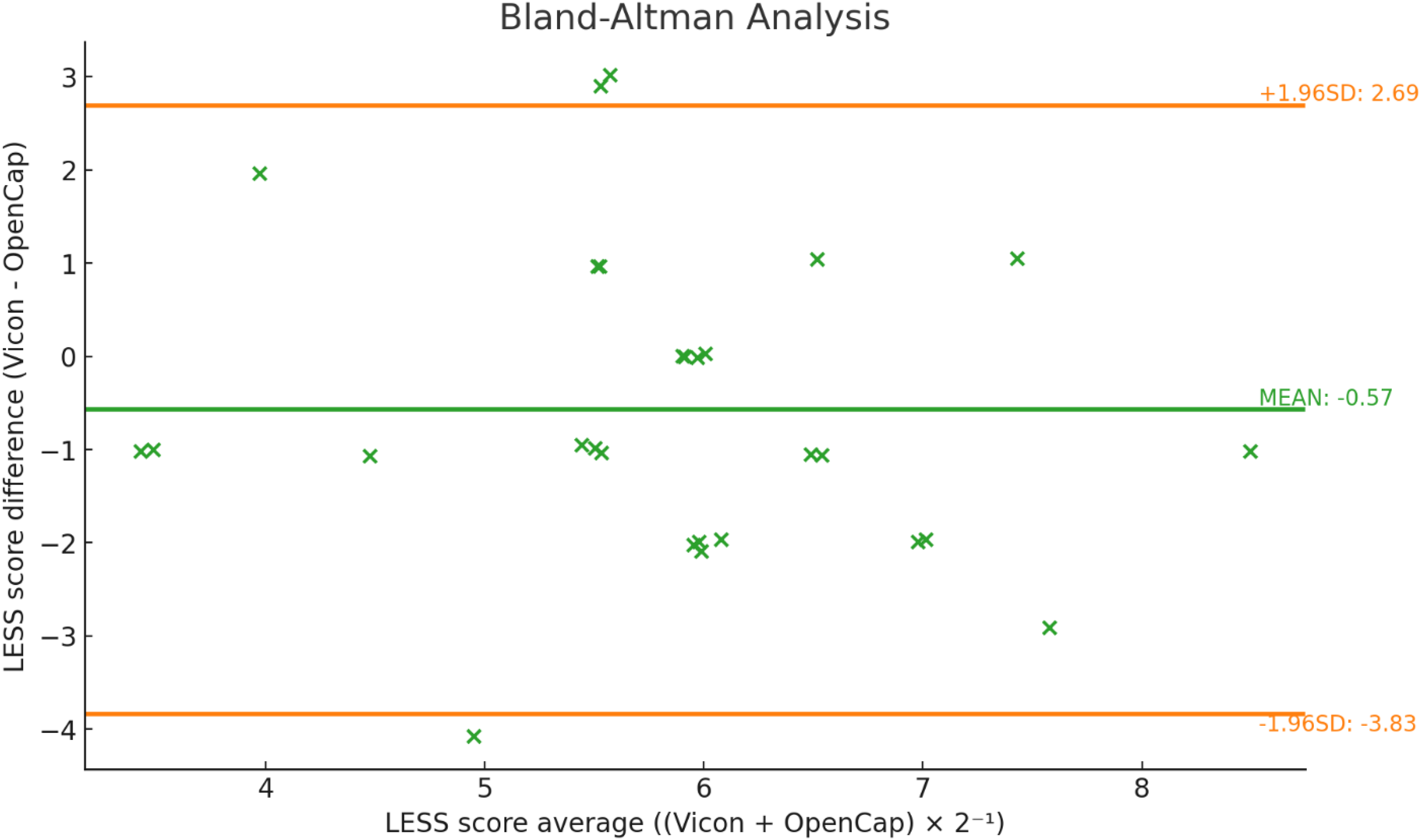
Comparison of Landing Error Scoring System (LESS) scores derived from OpenCap and the Vicon motion capture system. The Bland–Altman plot displays the mean difference between Vicon and OpenCap LESS scores, along with the 95% limits of agreement calculated as the mean difference ± 1.96 × the standard deviation of the score differences. Jitter was applied to overlapping points to improve visualization.
Athlete results
Repeated-measures ANOVA showed no significant change in LESS scores across testing rounds (p = 0.260; ηp2 = 0.070; Figure 3(a)). Because the main effect of testing round was not significant, post hoc pairwise comparisons were not performed. Although not statistically significant, mean LESS scores showed a slight increase from Round 1 to Round 2, followed by a modest decrease in Round 3. Exploratory analyses showed no significant differences in LESS scores by playing position (p = 0.100; ηp2 = 0.062; Figure 3(b)) or sex (p = 0.596; ηp2 = 0.015). Although the effect of playing position was not statistically significant, the moderate effect size suggests potential positional differences that may not have been detectable with the present sample size. Descriptively, point guards and small forwards tended to exhibit higher LESS scores compared with the other playing positions (Figure 3(b)). Linear regression analyses showed no significant associations between athletes’ LESS scores and either height or body mass. Among the six most predictive LESS items, knee-flexion–related errors were observed in approximately one third of the athletes across all testing rounds, indicating that nearly one third of players consistently exhibited less than 45° of knee flexion between initial contact and maximum knee flexion (Figure 4).
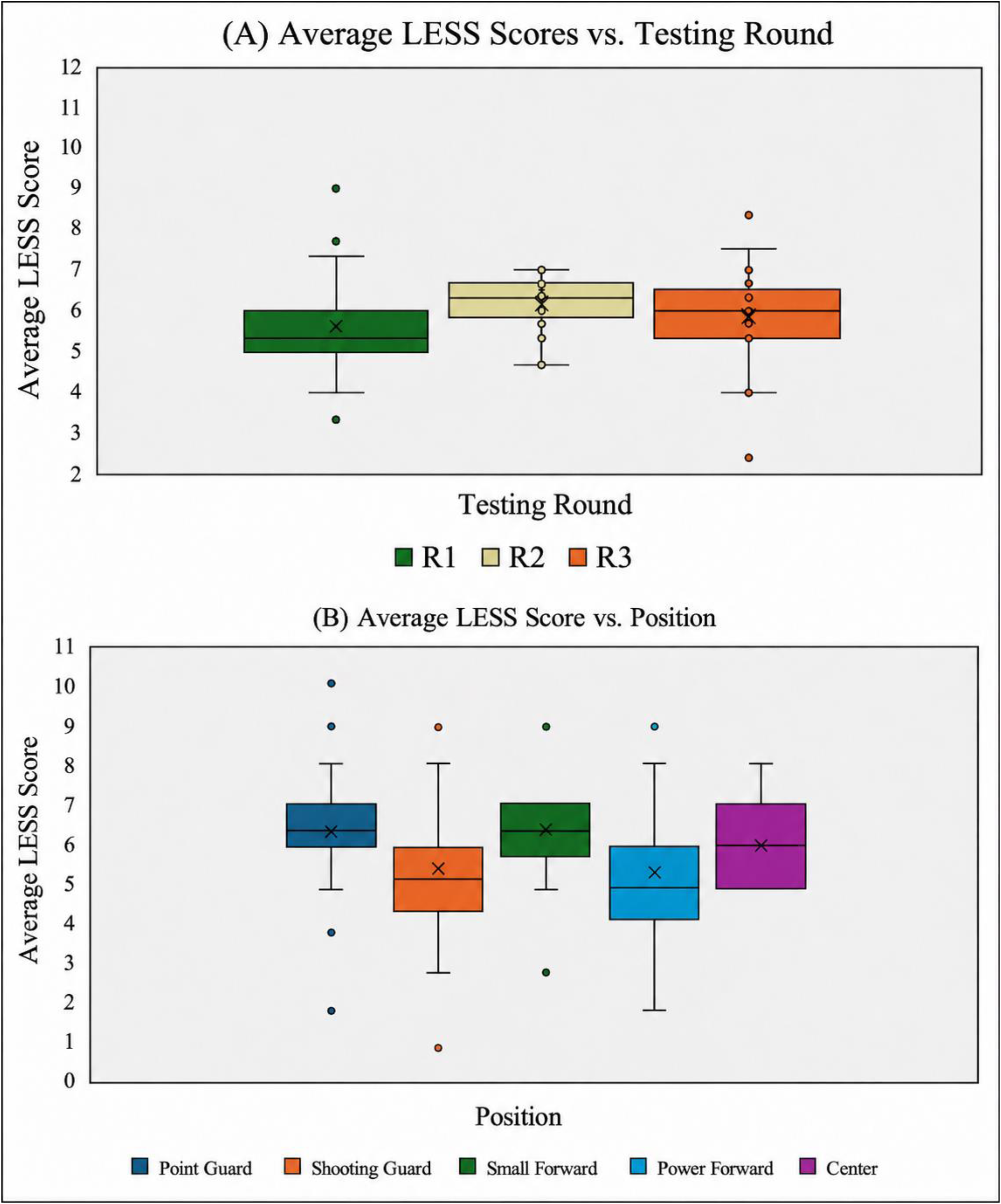
Landing Error Scoring System (LESS) scores. Boxes represent the interquartile range, the central line indicates the median, whiskers denote the data range, points represent outliers, error bars represent standard deviation, and the “X” denotes the mean. (a) Average LESS scores by testing round for all athletes, with each athlete's score computed as the mean of three jumps per round. (b) Mean LESS scores by player position, calculated across all testing rounds.
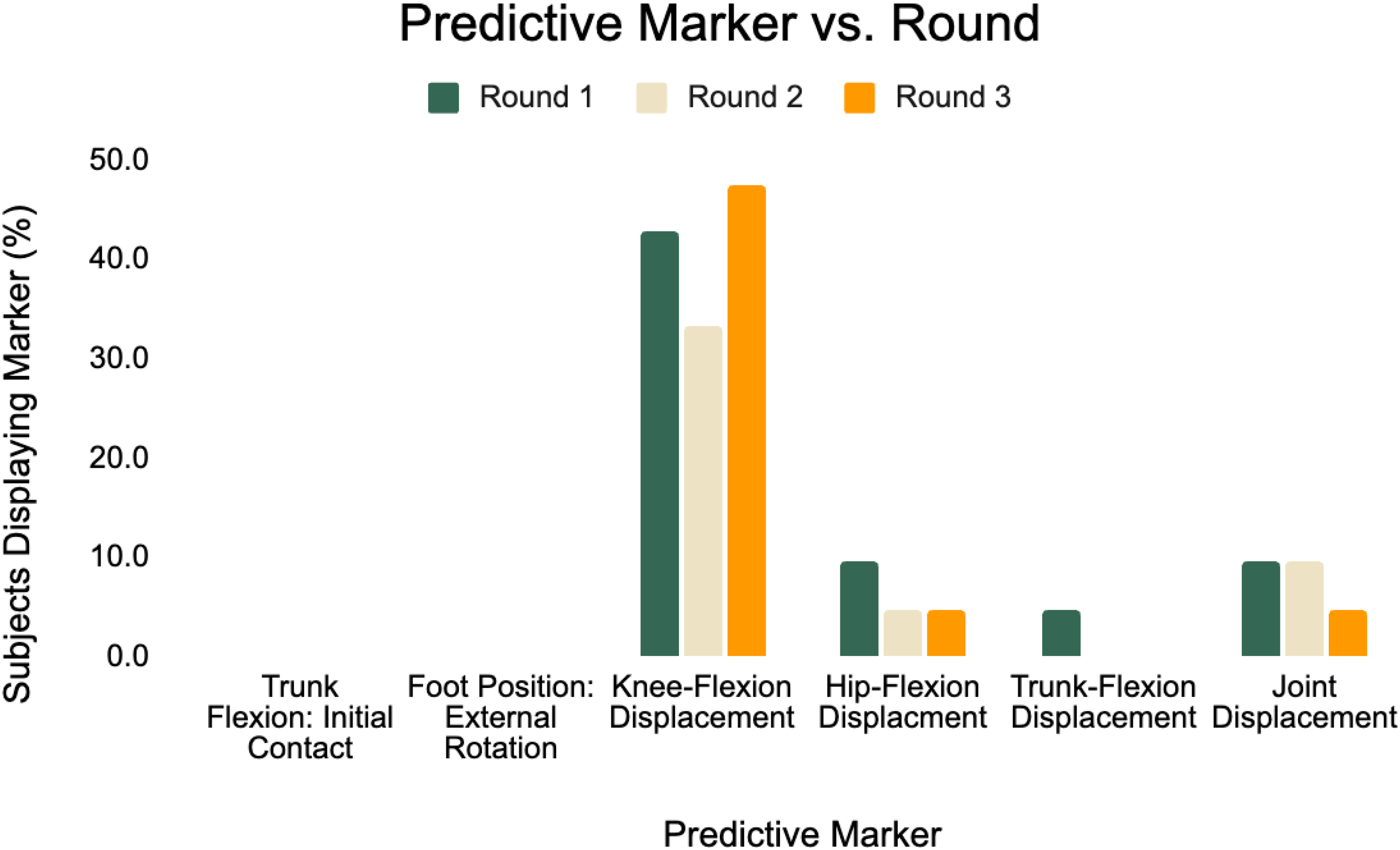
Prevalence of six most predictive markers for anterior cruciate ligament (ACL) injury across all rounds. Each player performed three jumps per round. Markers present in ≥2 of three jumps were counted as present for that athlete.
Discussion
This study evaluated the validity of OpenCap as an alternative to laboratory-based motion capture for generating LESS scores and explored its feasibility for longitudinal monitoring of movement patterns across a collegiate basketball season. The primary findings indicate that LESS scores derived from OpenCap showed excellent agreement with those obtained from a gold standard Vicon motion capture system, supporting its validity for assessing jump-landing biomechanics. In contrast to our second hypothesis, LESS scores did not change significantly across the competitive season. Differences across playing positions were also not statistically significant; however, the moderate effect size suggests that positional influences on landing mechanics may exist but were not detectable with the present sample size. Together, these findings indicate that portable markerless motion capture systems such as OpenCap can provide valid LESS assessments outside of a traditional laboratory environment and can be feasibly integrated into in-season athlete monitoring protocols.
The present ICC findings showed strong agreement between OpenCap and Vicon for evaluating jump-landing kinematics and deriving LESS scores. This is consistent with prior work, which has supported OpenCap as a valid biomechanical tool, while also noting joint- and plane-specific limitations. 29 Such findings are further supported by previous validation studies of various markerless motion capture systems, which demonstrate joint and plane-specific errors but otherwise strong agreement with marker-based systems.30–32 Previous studies comparing OpenCap to Vicon during jumping tasks have reported ICC values ranging from 0.62 to 0.93 across joints, 33 as well as strong frontal-plane hip agreement (root mean square error [RMSE] < 6°) and moderate sagittal-plane knee agreement (RMSE = 4–10°). 34 Because LESS scores are derived from joint kinematics—particularly in the sagittal plane—this established kinematic agreement contributes to the strong ICC observed in the present study. Prior research has also demonstrated OpenCap's ability to detect jump asymmetries with 85% classification accuracy. 22 Given that asymmetry-related features contribute to several LESS criteria, accurate identification of these movement characteristics further supports OpenCap's utility for ACL injury risk assessment. Additionally, OpenCap has shown moderate-to-excellent intersystem reliability (ICC 0.79–1.00) and test–retest reliability (ICC 0.70–0.97) during jump-landing tasks. 35 Together, this body of evidence—combined with the absence of significant systematic bias observed in the present study—suggests that OpenCap may serve as a practical alternative to laboratory-based motion capture for automated LESS scoring without requiring specialized equipment or expert raters. 23
The second objective of this study was to investigate how basketball players’ LESS scores vary over time. LESS scores did not change significantly between the preseason, start of competition, and midseason assessments, suggesting that the movement patterns captured by the LESS may remain relatively stable throughout a collegiate basketball season. This observation is consistent with prior reports indicating that ACL injury incidence does not vary substantially across different phases of the season.11,12 However, it is also possible that the LESS may not be sufficiently sensitive to detect subtle changes in landing biomechanics over time, particularly because it summarizes movement quality using discrete scoring criteria. Thus, the lack of significant change may reflect either true stability in landing strategies among high-level athletes or limited sensitivity of the LESS to detect smaller biomechanical adaptations across the season. In addition to temporal effects, anthropometric characteristics were examined. Prior studies have reported an association between higher body mass index (BMI) and increased risk of non-contact ACL injury36–38; however, BMI in collegiate basketball players may not accurately reflect body composition due to greater lean mass at this level of competition, 39 and BMI in the present cohort exhibited a relatively narrow range (Table 1B), potentially limiting its utility as a predictive variable. For this reason, height and body mass were analyzed separately, and neither variable demonstrated a significant association with LESS score. Similarly, sex did not show a significant effect on LESS score, which contrasts with prior literature reporting higher ACL injury rates among elite female athletes compared with males,40–43 suggesting that injury incidence may not always be reflected in biomechanical screening scores such as the LESS.
In terms of in-game position, small forwards exhibited the highest mean LESS scores, with point guards also showing higher scores relative to the other positions, although these differences were not statistically significant. This contrasts with prior literature reporting that centers—typically the largest players positioned near the basket 44 —have the highest incidence of knee injury, a pattern attributed to greater player contact and their presence in highly congested areas of the court. 45 Small forwards and point guards frequently perform high-velocity transitions, rapid changes of direction, and dynamic jump-landings in open space. It has been shown that players with increased driving tendency were more likely to tear their ACL. 46 These factors may contribute to greater biomechanical demands that could influence ACL injury risk. This interpretation aligns with prior work reporting elevated ACL injury rates in point guards, particularly during tasks such as attacking off the dribble, jump stopping, and landing after airborne contact. 47 These movement demands may promote less vertically controlled landing strategies compared to post-play centers, whose jumps near the basket are often more vertically directed and mechanically constrained.
Poor knee-flexion displacement was the only key LESS criterion consistently observed across athletes and testing rounds. This finding is clinically relevant because reduced knee flexion and stiffer landings during drop-jump tasks have been associated with increased ACL injury risk, including a reported 45% reduction in injury risk for every 10° increase in knee flexion. 48 Previous OpenCap validation work has also reported strong sagittal-plane agreement for knee and hip kinematics compared with marker-based motion capture, supporting the relevance of this item. 29 Increased lower limb stiffness has also been associated with improved performance in agility, sprinting, bounding, and jumping tasks. 49 In a basketball context—characterized by repeated high-intensity, short-burst movements—elite athletes may adopt stiffer landing strategies to optimize performance, which may increase ACL injury risk. Particularly, the risk may be exacerbated if the athlete lacks the underlying movement capability to decelerate, and if the knee is in a low degree of flexion (<20°) when planted. 50 These findings underscore the importance of monitoring knee-flexion displacement and support its relevance within the LESS assessment.
Although the overall cohort included 21 athletes, analysis of subgroups by playing position resulted in smaller and uneven group sizes, which may have reduced the sensitivity for detecting differences. A post hoc sensitivity analysis indicated that, given the observed variability (pooled SD = 1.11), the study was powered (80%) to detect LESS score differences of approximately 1.09 points. While the analysis was sufficiently powered to detect moderate differences, smaller changes may not have been identified. This limitation may partially explain why positional differences in LESS scores did not reach statistical significance despite a moderate effect size observed in the analysis. Furthermore, although OpenCap demonstrated strong overall agreement with Vicon, the limits of agreement suggest that individual LESS scores may differ by approximately 3 points between systems. Differences of this magnitude could influence injury risk classification, indicating that OpenCap-derived scores should be interpreted cautiously for individual-level risk classification. Although knee-flexion displacement was the most consistently observed LESS item and prior OpenCap validation work has shown strong sagittal-plane agreement for knee and hip kinematics, 29 interpretation of this item should still consider the individual-level variability observed between OpenCap and Vicon. Additionally, testing was conducted at three timepoints across the competitive season. While the design allowed evaluation under true in-season conditions, more frequent sampling may provide greater insight on different factors such as mechanical adaptions or fatigue-related changes. Future studies should continue to incorporate more balanced positional subgroup sizes and include additional timepoints to better characterize changes in landing biomechanics.
Conclusion
In summary, LESS scores derived from OpenCap demonstrated strong agreement with those obtained from a gold standard motion capture system, supporting the validity of this portable markerless approach for assessing jump-landing biomechanics. When applied longitudinally across a collegiate basketball season, LESS scores did not change significantly between testing rounds, suggesting that landing movement patterns may remain relatively stable throughout the competitive season in highly trained athletes. Differences across playing positions were also not statistically significant, although moderate effect sizes suggest potential positional influences that warrant further investigation in larger samples. Additionally, poor knee-flexion displacement was observed in approximately one third of athletes across all testing rounds, highlighting a biomechanical factor that may warrant targeted training interventions. Together, these findings demonstrate the potential for portable markerless motion capture systems to support routine biomechanical monitoring and injury risk screening in applied sport environments.
Supplemental Material
sj-docx-1-spo-10.1177_17479541261461182 - Supplemental material for Automated LESS scoring using OpenCap: Validation and in-season application in collegiate basketball athletes
Supplemental material, sj-docx-1-spo-10.1177_17479541261461182 for Automated LESS scoring using OpenCap: Validation and in-season application in collegiate basketball athletes by Eden Pearson, Sergio A. Lemus, Thomas Otley, Octavio Jalife, Pablo Legaz and Francesco Travascio in International Journal of Sports Science & Coaching
Footnotes

Ethical considerations
This study was approved by the Institutional Review Board (IRB) of the University of Miami (IRB approval no. 20240774).
Consent to participate
All participants provided written and informed consent.
Consent to publication
Not Applicable.
Funding
The authors received no financial support for the research, authorship, and/or publication of this article.
Declaration of conflicting interests
The authors declared no potential conflicts of interest with respect to the research, authorship, and/or publication of this article.
Data availability
The data that support the findings of this study are available from the corresponding author upon request. Additional data can also be found in the supplementary material files.
Supplemental material
Supplemental material for this article is available online.
References
Supplementary Material
Please find the following supplemental material available below.
For Open Access articles published under a Creative Commons License, all supplemental material carries the same license as the article it is associated with.
For non-Open Access articles published, all supplemental material carries a non-exclusive license, and permission requests for re-use of supplemental material or any part of supplemental material shall be sent directly to the copyright owner as specified in the copyright notice associated with the article.
