



Abstract
This conceptual article proposes a new integrative model of the country image by drawing on advances from the fields of business studies, social psychology, political science, and communication science. To interrelate different approaches, a communication management perspective is applied, providing a basic terminological framework systemizing the central constructs of country image, country reputation, country brand, and country identity. On this basis the authors develop the ‘4D Model' of the country image by integrating well-established concepts from national identity theory, attitude theory, and reputation management. The new model is suited for application in comparative analyses of country images both on the level of different groups (such as a country’s domestic and foreign publics) as well as different societal levels (such as individual attitudes on the one hand and mass-mediated prestige information on the other).
Keywords
Introduction
In times of globalization and mediatization, the image a country projects is becoming more important: as a recent historical trend the modern establishment of external observers of the state system—such as international organizations and media—has enforced new forms of competition between countries, shifting the focus onto ‘soft goods’ (Werron, 2014) such as image and reputation. Increasingly, countries are publicly rated and compared according to their economic development, political stability, the effectiveness and morality of their national and international policies, or the attractiveness of their culture. Research shows that the country image, as ‘the cognitive representation that a person holds about a given country’ (Kunczik, 2003, p. 412), has a wide range of effects: Country images critically influence foreign direct investment (Kotler and Gertner, 2002; Kunczik, 2002; Wee et al., 1993), the prosperity of national tourist industries (Chon, 1990; Gertner, 2010; Tapachi and Waryszak, 2000; Walmsley and Young, 1998), the attractiveness of domestic labor markets (Papadopoulos, 2004), and educational systems (Gertner, 2010; Srikatanyoo and Gnoth, 2002), as well as the stability of international relations and the degree of a country’s political influence in the international system (Gilboa, 2008; Kunczik, 1997; Leonard et al., 2002; Sun, 2008; van Ham, 2008). Furthermore, country images have a major effect on the success of exports (Dichter, 1962; Papadopoulos and Heslop, 1993) because they influence the way people evaluate the quality of products and services (Han and Terpstra, 1988; Jaffe and Nebenzahl, 2001; Papadopoulos and Heslop, 1993) and, by implication, affect peoples’ willingness to pay (Nebenzahl and Jaffe, 1996).
The growing importance of country images has raised the need to analyze and compare these constructs and their effects both in research and practice.
Political leaders are increasingly concerned about their country’s esteem abroad (Kunczik, 2003; Price, 2003; Werron, 2014) and practices of communication management are widely applied on the level of the nation-state system (Dinnie, 2008; Kunczik, 1997; Snow and Taylor, 2009; van Dyke and Vercic, 2009). One such example is Switzerland, which on the basis of a ‘Federal Act on the Promotion of Switzerland’s image abroad’ launched a separate unit in its Federal Department of Foreign Affairs that ‘supports the protection of Switzerland’s interests by using various public relations tools’ with a yearly budget of over 9 m. USD (FDFA, 2014).
In research, various facets of the phenomenon have been studied in the different fields of business studies (Dinnie, 2008; Roth and Diamantopoulos, 2009), social psychology (Brown, 2011; Cuddy et al., 2007), political science (Leonard et al., 2002; Wang, 2006), and communication science (Golan and Wanta, 2003; Kunczik, 1997). But sound conceptual models and appropriate measurement instruments to analyze and compare the constitution and effects of country images in different groups and contexts are rare. Most existing models lack theoretical foundations, cannot be applied to different countries or the comparative analysis of country images in different groups, often fail in comprehensively capturing all relevant dimensions, and refrain from clarifying the internal structure of the construct (Magnusson and Westjohn, 2011; Papadopoulos, 2004; Roth and Diamantopoulos, 2009). Furthermore, we see that Papadopoulos’ (2004) statement regarding a strict segregation of research on country images between the different disciplinary perspectives is still true and there remains ‘great need for integrative studies that would merge the available knowledge across the various fields’ (2004, p. 47). But these fields vary in their conceptual understanding of the construct, and the central concepts of country image, country reputation, country brand, and country identity are defined differently, making integrative efforts difficult. These challenges raise the question of how available knowledge from the different fields of research can be structured and consolidated in order to produce an integrative model for analyzing country images.
In the following, three steps are taken to deal with this question: First, advances in the aforementioned research fields are introduced in a comprehensive and synoptical literature review to show the central lines of research in studying country images, characterize their respective level of analysis, and outline the underlying conceptual understandings of the construct. Second, a communication management perspective is applied to systemize the concepts of country image, country reputation, country brand, and country identity in a single framework that helps to link the different research perspectives. Third, an integrative model of the country image is derived by combining concepts from national identity theory, attitude theory, and reputation management.
Literature review
A first set of studies addressing the perception of countries can be found in the 1930s and 1940s (Child and Doob, 1943; Katz and Braly, 1933; Klingberg, 1941; Kusunoti, 1936). Since then, the fact that country images are both the cause and effect of social as well as psychological processes, together with the multitude of their possible economic, cultural, and political effects, has led to various studies across a range of scientific fields. This has led to a plethora of definitions of the relevant concepts and divergent specifications of their dimensions. The substantial corpus of literature can be systemized by distinguishing between the four research perspectives of business studies, social psychology, political science, and communication science.
The business studies perspective
From the perspective of business studies, the phenomenon is researched with an interest in questions regarding consumption behavior. Different concepts have been developed in the subfield of marketing with a focus on nation brands as well as country-of-origin effects.
In country-of-origin research, the study of the constitution and effects of country images have a long history, starting with the works of Dichter (1962) and Schooler (1965) (see Peterson and Jolibert, 1995; Roth and Diamantopoulos, 2009; Verlegh and Steenkamp, 1999 for an overview of the field). Most of the studies have since conceptualized the country image as an attitudinal construct, suggesting a plethora of different dimensions and variables (Roth and Diamantopoulos, 2009). An important factor in many of the studies is the evaluation of the state of a country’s economy (e.g., Martin and Eroglu, 1993; Wang and Lamb, 1983) as well as of its political system (e.g., Allred et al., 1999). Heslop et al. (2004) also suggest the work training and competences of the people as an important factor. Another factor often referred to is the degree of technological advancement (e.g., Desborde, 1990; Kühn, 1993; Martin and Eroglu, 1993). Despite the substantial body of research in this field, the theoretical foundation and empirical testing of the dimensionality of the country image is still labeled unsatisfactory (Newburry, 2012). When looking at the basic components of the attitudinal construct, most studies have a strong emphasis on cognitive dimensions and fail to consistently operationalize country affects (Roth and Diamantopoulos, 2009). With a few exceptions (Brijs et al., 2011; Häubl, 1996; Heslop et al., 2004), researchers also largely refrain from clarifying the internal structure of the construct, raising the question of how different cognitive and affective image dimensions interrelate and affect each other. Also, if interested in the country image as a generic construct, most country-of-origin research has limited utility due to its focus on product-country images as a joined construct (Peterson and Jolibert, 1995; Verlegh and Steenkamp, 1999). When empirically analyzing country images, the fields’ focus on consumer research has left a gap of understanding with regard to other important groups such as foreign investors, politicians, political publics, students, or skilled workers (Papadopoulos, 2004). This is also strongly reflected in respective measurement models, since many researchers (like Puaschunder et al., 2004; Reindl and Schweiger, 2006; Schweiger, 1988, 1992; Schweiger and Kurz, 1997) develop these inductively from specific groups of consumers at a specific point in time. This leads to dimensions, which depend entirely on the focus of one specific group, in turn limiting applicability to comparative approaches analyzing different countries’ images in different groups.
The field of nation branding is grounded in research regarding the constitution, measurement, and management of brands (see Kaneva, 2011; Papadopoulos, 2004 for an overview of the field). The nation brand is commonly defined as ‘the unique, multi-dimensional blend of elements that provide the nation with culturally grounded differentiation and relevance for all of its target audiences’ (Dinnie, 2008, p. 15). This construct is applied both on the level of branding strategy (output) as well as the respective perceptions of the nation brand in the mind of the consumer (outcome); in outcome analyses it is often specified in terms of general associations with a country (Brown et al., 2010; Puaschunder et al., 2004; Reindl and Schweiger, 2006). So far, works on nation branding are strongly influenced by practitioners (Anholt, 2006; Gilmore, 2002; Olins, 2002), have a rather specialized focus on the target group of tourists (Morgan et al., 2010; Tapachi and Waryszak, 2000), and are often qualitative, while theory-driven concepts and quantitative approaches are rare (Gertner, 2011). A central gap is the development of concepts and measures to evaluate the success of nation branding strategies (Papadopoulos, 2004), i.e., instruments to track the development and change of nation brands (Loo and Davies, 2006, p. 208).
The social psychology perspective
From the perspective of social psychology country images are analyzed regarding individual cognition, emotion, and behavior. The field has developed concepts of country image and country self-image (i.e., country identity) in the two subfields of intergroup relations and collective identity research.
In research on intergroup relations, country images are analyzed with a particular focus on countries’ political actions, motivations, and abilities (Herrmann et al., 1997; Oskamp, 1965). The perceived quality of the relationship between countries is often an integral part of the image, e.g., in concepts of the ‘enemy country image’ (Jervis, 1976) or the ‘ally country image’ (Cottam, 1977). Further, central elements of the country image are the strengths and weaknesses of a country and its status as an enemy (Boulding, 1956, 1959; Cottam, 1977; Holsti, 1967; Shimko, 1991; Silverstein and Holt, 1989; White, 1965). More recent models, like the stereotype content model (SCM) or the model of behaviors from intergroup affect and stereotypes (BIAS), suggest warmth and competence as two universal dimensions in intergroup perceptions (Cuddy et al., 2007; Fiske et al., 1999, 2007). Generally speaking, research on intergroup relations—in a similar way to marketing research—has a tendency to underemphasize affective and emotional components that may affect how people behave toward another group (Hogg, 2006, p. 487) and is interested mainly in extreme forms of prejudice and intergroup conflict (Brown, 2011; Hogg, 2006). Accordingly, in the majority of the works, especially those on ‘enemy image,’ but also in the SCM and BIAS models, country images are specified as simplistic stereotypes rather than as differentiated attitudes. Furthermore, due to its perspective, this line of research generally applies a dichotomous distinction between ‘in-group’ and ‘out-group’; hence comparative analyses of specific publics are rare. Lastly, the focus on the human collective excludes nonhuman dimensions like the scenery and landscapes of a country.
The related field of collective identity research analyzes the identity of countries or nations as one distinct form of collective identity (David and Bar-Tal, 2009). Country identity can be described as the image citizens have of their own country or their ‘country self-image’ (Rusciano, 2003). It can foster the joint awareness among citizens that they share a common identity (Ashmore et al., 2004) and cultivate an understanding of a country as a unique community (Anderson, 1983). While national identity is constructed vis-à-vis a world public that constructs the global reputation of a country (Rusciano et al., 1997), the social group of the nation may employ identity management in an effort to improve its global reputation (Ellemers, 1993). Research on collective identity has so far largely focused on small groups and there is a gap in understanding collective identity on the macro level of countries (Huddy, 2001). Furthermore, David and Bar-Tal (2009) point out that the few existing psychological studies on national identity, like Herman (1977) or Bloom (1990), generally focus on the process of individual identification and barely address the generic dimensions of national identity and their specific content.
The political science perspective
From the perspective of political science, country images are studied regarding matters of international affairs, political identity, and behavior. Concepts of country image, identity, reputation, and brand have been developed and applied mostly in the subfields of international relations and political anthropology.
Within the subfield of international relations country images are studied mostly with regard to the concept of public diplomacy, i.e., the strategic communication of a nation-state aimed at enhancing the country’s reputation among foreign publics (see Leonard et al., 2002; Schatz and Levine, 2010; Vickers, 2004). A positive country image and reputation is seen as a means of building common understanding in the international system (Wang, 2006), thereby increasing the political action ability of a nation-state (Vickers, 2004). The central aspect is often seen in the affective image component or a country’s ‘ability to attract’ as it constitutes a nations ‘soft power’ in the international system (Nye, 2004). So far, research in public diplomacy is strongly influenced by practitioners (c.f. Snow and Taylor, 2009) and by the nation branding literature (Anholt, 2006), with respective concepts and methods still in the developing stages (Gilboa, 2008). One of the most pressing gaps is the conceptual and empirical development of instruments applicable for measurement and evaluation in public diplomacy practice (Banks, 2011; Fitzpatrick, 2007; Pahlavi, 2007), in order to make assessable the desired impact on awareness, attitude, and behavior (Banks, 2011, p. 29). In addition, it is argued that analyses need to include a wider range of target groups like elites, politicians, and journalists (Banks, 2011; Hall, 2010).
The field of political anthropology introduces a differentiated understanding of countries as culturally constructed national entities. Whereas some researchers have adopted a ‘radical constructivist’ perspective to characterize national entities as mere cultural inventions (e.g., Anderson, 1983; Gellner, 1983; Hobsbawm, 2006), others have developed ‘ethnographically grounded’ concepts that allow to define some more or less continuous attributes (e.g., Hroch, 1996; Smith, 1991; Wehler, 2011). According to these authors, manifest dimensions of the nation are, for instance, the occupancy of a distinct ‘homeland,’ common myths, and a shared history and the existence of a single economy (Smith, 1991). So far, these approaches have mainly been used to analyze nations and nationalism as a political ideology. However, recent works in nation branding (Dinnie, 2008) and collective identity research (David and Bar-Tal, 2009) have started to adopt concepts from leading scholars like Anderson (1983), Gellner (1983), or Smith (1987) to study country image and identity by including both cognitive and affective components of the constructs.
The communication science perspective
From the perspective of communication science, country images are studied as discursive phenomena in personal, organizational, and mass-mediated communication. The construct has attracted attention in analyses on international communication, on media content and effects, and—to a lesser extent—on organizational communication and communication management.
So far, communication science has mainly focused on mass-mediated country images. Analyses of the dynamics and patterns of the international news flow reveal the (unequal) salience of countries in international news (Chang, 1998; Golan and Wanta, 2003; Jones et al., 2013; Weaver et al., 1984; Wu, 1998), show the strong effect of mass-mediated country images on the formation of public opinion about foreign countries (McNelly and Izcaray, 1986; Manheim and Albritton, 1984; Perry, 1987; Salwen and Matera, 1992; Semetko et al., 1992; Wanta et al., 2004), and underscore the gatekeeping role of foreign editors in forming these mediated country images (Marten, 1989). The central role of mass media in the formation of country images has stimulated numerous content analyses evaluating images of certain countries as portrayed in foreign media (e.g., Sreberny-Mohammadi et al., 1985; Steenhoff, 1996; Wu, 1997). The conceptualization of the country image in these works is predominantly unidimensional (e.g., covering valence from positive to negative tonality) or based on (stereotypical) topics and themes found in media content (e.g., mountains, banking, and chocolate for Switzerland).
In the field of communication management that has a predominant focus on corporate communication, the study of country images has so far received only limited attention (Dyke and Vercic, 2009; Kunczik, 2003). Some researchers have shown a positive effect of public relations activities on country images in U.S. news coverage (Albritton and Manheim, 1983, 1985; Manheim and Albritton, 1984; Zhang and Cameron, 2003) and on public opinion (Kiousis and Wu, 2008). Others have addressed the potential and challenges of communication strategies for the cultivation of country images and brands (Kunczik, 1997; Volcic, 2008) as well as country reputation (Wang, 2006, 2008). Only few have addressed questions regarding the conceptualization of the country image construct in detail. Recently, Passow et al. (2005) and Yang et al. (2008) successfully applied a model of corporate reputation in analyses of country reputation. In contrast to the concepts from country-of-origin research, these works not only focus on functional aspects but also stress the importance of social dimensions like the social and ecological responsibility of a country. Despite these latest achievements, there is still much to be done in applying recent advancements from the field of communication management (e.g., Eisenegger and Imhof, 2008; Thiessen and Ingenhoff, 2011) to the conceptualization and specification of country images. These newer works go beyond the corporate focus and draw on more generalizable models including functional, normative, and affective dimensions. This allows for a specification of the concepts regarding a wide range of collective entities and is an advantage especially for more complex and variable entities such as countries.
Applying the perspective of communication management
Returning to the argument regarding the need for integrative approaches in the study of country images (Papadopoulos, 2004), the literature review discloses a manifest terminological challenge: There is, of course, no widely accepted conceptual understanding of the country image within any of the individual research fields. Depending on study objectives, country images are understood as brand associations, cognitive and/or affective attitudes, stereotypes, self-perceptions (i.e., identity), mass-mediated information, or social reputation. In doing so, the different fields also tend to employ either a micro-level (mostly business studies and social psychology) or a macro-level (mostly political science and communication science) of analysis. This heterogeneity complicates any transfer across the different approaches and suggests that for integrative efforts a common framework is needed.
Below, we apply the meso-level perspective of communication management to accomplish the following research goals: In order to enhance the commensurability of research on country images we aim to systemize the basic concepts of country image, country reputation, country brand, and country identity, and to clarify their conceptual borders as well as their interrelations. To show how available approaches can be integrated, we subsequently derive a comprehensive ‘4D Model' of the country image, which can be applied to different countries and utilized for comparative analyses of country images in different groups and contexts.
The perspective of communication management focuses on the meso-level of communication between an organization and its publics. The goal of communication management is often seen as drawing on the organizational identity to build a favorable image among different key stakeholder groups by means of strategic communication, ultimately aiming to safeguard and strengthen the degree of trust in the organization and thereby facilitating favorable stakeholder behavior (see Figure 1). From this analytical perspective, national agencies and the nation-state as a whole—seen as an ‘actor of world society’ (Meyer and Jepperson, 2000)—appear as the organizational entities. Accordingly, communication management means the management of communication between a nation-state and its (foreign) publics, sometimes also referred to as international public relations (Kunczik, 2003; Zaharna, 2000) or public diplomacy (Leonard et al., 2002; Snow and Taylor, 2009). An analysis of country images from the perspective of communication management thus unfolds three fundamental and interrelated levels of analysis: The identity of a country, the processes of international communication about countries, and the opinions and attitudes toward a country that form in these processes among relevant publics or stakeholder groups.
Conceptual relations between organizational identity, communication, and image.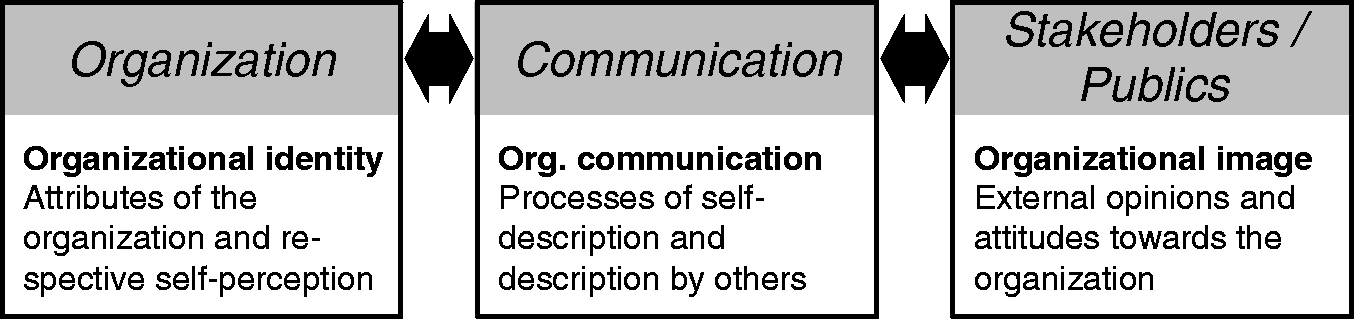
Systemizing concepts of country image, reputation, brand, and identity
The terms country image, country reputation, country brand, and country identity constitute important concepts in the different approaches from business studies, social psychology, political science, and communication science and are central to research in communication management. Currently, in each of the fields, there are very different ideas on how to distinguish between these constructs, how to model their interrelations, or even (as is often the case with image and reputation and also brand and image) how to assimilate them.
When aiming to integrate available knowledge across the different fields, it is necessary to develop a basic framework that coordinates these closely related concepts by clarifying lines of conceptual demarcation as well as interrelation. It is important to note, however, that such a framework can merely be a means to interrelate concepts in a way that helps us to integrate knowledge across a range of fields, not provide a set of exclusive and universally applicable definitions—which would not be desirable. We argue that—from the perspective of communication management—all four concepts can be systemized along two basic axes by differentiating between (a) the primal perspective and (b) the constitutive process underlying each of the concepts.
In the meso-perspective of communication management it is common to build on the fundamental distinction between the realm of the organization on the one hand and the organization’s environment on the other, the latter of which can be further segmented into an organization’s various external publics or stakeholder groups (Freeman, 1984; Grunig and Hunt, 1984). This distinction of perspective (y-axis) can be employed to systemize country image, reputation, brand, and identity by clarifying whether a concept is based within the realm of the nation-state or in the international context of its foreign publics. This bilateral classification can be further refined when clarifying whether the constitutive process of a concept relies primarily on individual perception or on public communication (x-axis). When referring to each of the constructs, these two axes allow for the clarification and coordination of conceptual differences as well as interrelations between country image, reputation, brand, and identity within a single terminological framework (see Figure 2).
A coordinative framework of country image, reputation, brand, and identity.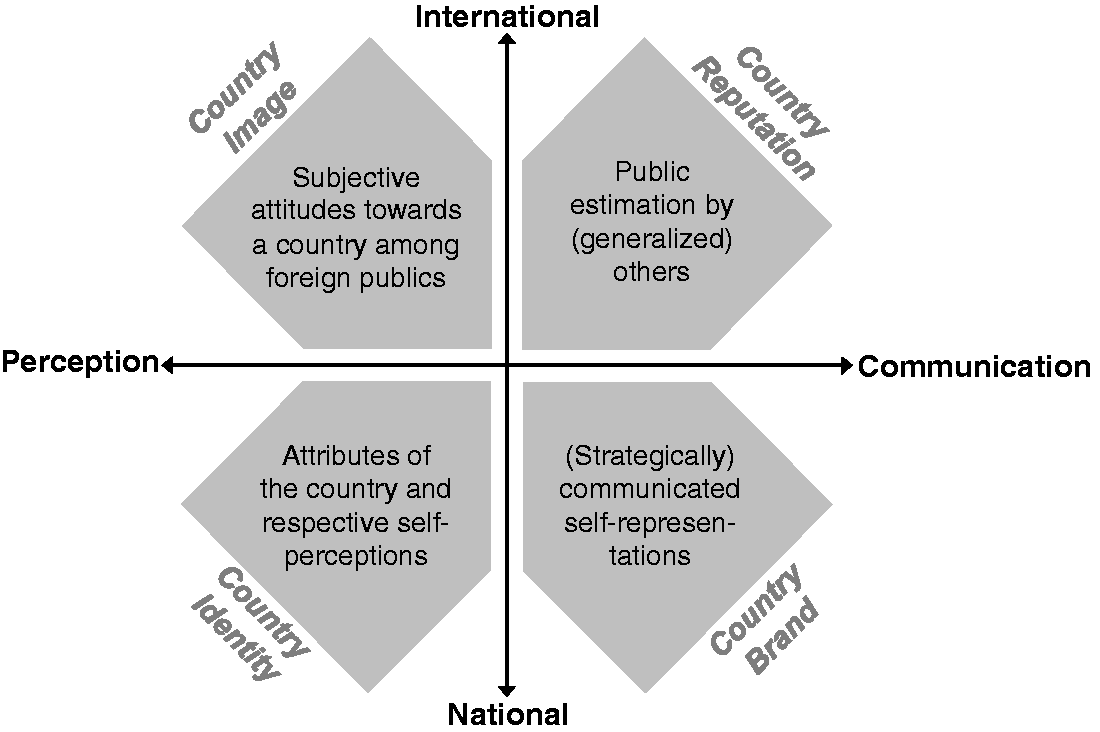
Analogous to a widely used image concept, the country image can be defined as ‘the sum of beliefs, attitudes, and impressions that a person or group of persons has of an object’ (Barich and Kotler, 1991, p. 95); in this case of a country. This concept can be further differentiated when distinguishing between the individual and the collective image, both of which are assimilated in Barich and Kotler’s definition. To make a clear distinction between a country image as an individual judgment made by a subjective behavior unit (Boulding, 1969) on the one hand, and the accumulated country image of a group on the other, it is useful, when referring to the latter, to speak of aggregated images. The above-mentioned definition should also be further qualified by introducing a differentiation of perspective: It has been stressed that there should be a clear conceptual distinction between outside perception (by foreign publics) and self-perception (of a domestic population) (Grunig, 1993). To account for this differentiation it is useful to distinguish between the concepts of country image and country identity.
While the country image is conceptualized as the perception among foreign publics, country identity refers to the self-perception of a country’s citizens (Rusciano et al., 1997). Country identity here means a form of collective identity based on the individual level (Ashmore et al., 2004; Rusciano, 2003). Therefore, when speaking of the country image, we refer to the perception of a country that exists among its foreign publics (out-group), while country identity is conceptualized as the domestic self-perception existing among a country’s domestic public (in-group). This analytical distinction should not veil the fact that domestic publics can in fact be very diverse. Respective of study objective it may make sense to further classify here along the lines of, e.g., migrants, regional populations, or ethnic minorities. In their constitution, both constructs, image and identity, are interrelated as country identity is shaped in constant ‘negotiation processes’ with the publicly communicated images held by foreign publics and vice versa (Rusciano, 2003).
These publicly communicated images, in turn, become important as they accumulate to form the global reputation of a country (Rusciano et al., 1997), which can be conceptualized as an emergent construct. In communication management, reputation is commonly defined as the overall estimation of an organization by all its stakeholders (Fombrun, 1996). Correspondingly, it is not an individual’s attitude (image), but the public esteem in which a social entity—in this case a country—is held. Here, the aforementioned term of aggregated images can be useful to substantiate the distinct character of reputation: Reputation is more than just an aggregated image; defined as the public esteem, it is based on ‘social, not individual judgments’ (Emler, 1990, p. 181). Country reputation is therefore not merely the sum, but the emergent synthesis of multiple individual attitudes about a country as the result of complex communication processes in modern media societies (Thiessen and Ingenhoff, 2011). As such, country reputation develops in the international environment of a country when evaluative assessments of that country are publically communicated (mainly via mass media) by generalized others. This publicized ‘prestige information’ can exercise a considerable degree of social pressure on countries, leading them to conform to ‘world opinion’ so as not to risk penalties or isolation (Rusciano et al., 1997).
A brand, according to a common definition, is ‘a name, term, sign, symbol or design, or a combination of these intended to identify the goods and services of one seller or a group of sellers and to differentiate them from those of competitors’ (Kotler and Armstrong, 2013, p. 255). As such, the brand is first of all an intentionally designed strategic self-representation. Although in academic literature there is often a distinction between the brand as communicated by an organization and the brand as conceived by its relevant target groups, the latter aspect can—with reference to the definitions established earlier—be conceptually aligned with the understanding of the image (or in this case ‘brand-image’) and as such lies beyond the primary concept of the brand. In line with this understanding, the country brand is seen as a product of strategically communicated information of a nation-state about itself. It is closely connected to the country identity, which constitutes the necessary basis for any consistent self-representation.
Defined as such, the concepts of country image, country reputation, country brand, and country identity can be systemized by drawing on the distinction, introduced earlier, between the characteristics of primal perspective (national versus international) and constitutive process (perception versus communication). Deployed as basic axes of demarcation, these characteristics help to clarify not only the distinct characteristics of the individual concepts, but also their mutual dependency due to their convergent interrelation within the broader social interaction process in which public communication is individually perceived and individual perceptions become part of public discourse.
A ‘4D Model’ of the country image
To develop our integrative model of the country image we refer to three basic concepts: The concept of national identity by Smith (1991) to substantiate generic attributes of the reference object of the country; the attitude theory by Ajzen and Fishbein (1980) as a foundation for the constitutive components of attitudes which build the cognitive foundation for the image construct; and the model of reputation as a multidimensional construct (Eisenegger and Imhof, 2008; Ingenhoff and Sommer, 2007), which serves as a framework for differentiating between multiple dimensions of the country image. By integrating these concepts, the country image is derived as a subjective stakeholder attitude toward a nation and its state, comprising specific beliefs and general feelings in a functional, a normative, an esthetic, and a sympathetic dimension.
The image object of the country is conceived of as the unity of a nation and its state. By drawing on Smith’s (1991) concept of national identity, the country can be defined as a named human collective consisting of six generic attributes: a distinct territory or ‘homeland,’ a common history and traditions, a domestic economy, a public culture, a set of common norms and values, as well as a sovereign political organization or state (see Figure 3). These attributes lend themselves well as a foundation for the model because they can be conceptually substantiated by Smith’s widely used theory on nations, have been successfully applied in research on country identity (David and Bar-Tal, 2009), and correspond to categories by which foreigners actually perceive and distinguish between different countries (Mittelstaedt et al., 2004).
Attributes of a country based on Smith (1991).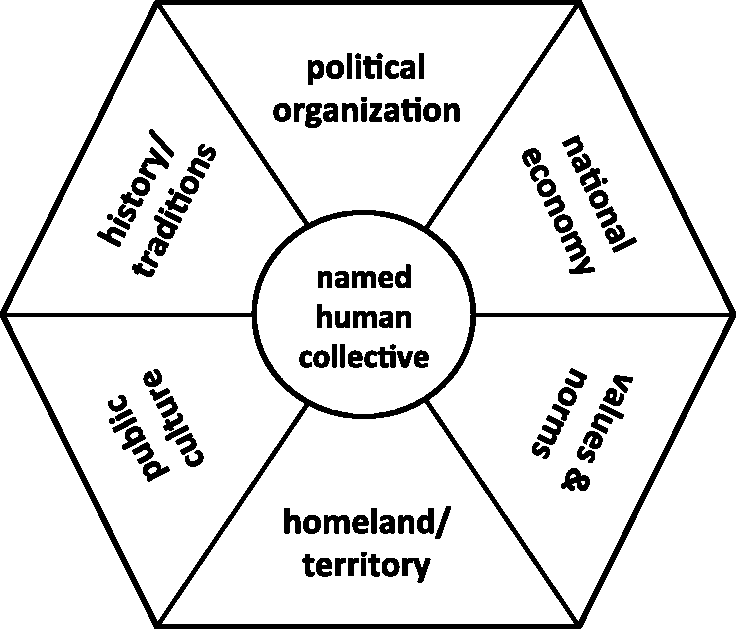
Having defined the image object as such, the country image is conceptualized correspondingly as an attitude toward a country, i.e., the attitude toward a country’s territory, its history and traditions, its domestic economy, public culture, norms and values, as well as its political organization. Thereby, it is possible for our model to ‘use the same descriptive dimensions to characterize the image and the object’ (Kelman, 1965, p. 26). As such, the model is well suited for comparative analyses of a country’s citizens’ self-image, i.e., the country identity, and the image of the country as perceived by foreign publics.
Following the concept of attitudes from the Theory of Reasoned Action (Ajzen and Fishbein, 1980; Fishbein and Ajzen, 1975), country images then comprise a component of beliefs (cognitive component) and a component of emotions (affective component) toward the image object. While the cognitive component can be seen as consisting of multiple specific evaluations regarding a broad range of attributes of the image object, the affective component consists of a necessarily general judgment regarding its sympathy (Bergler, 2008). Hence, the country image comprises (a) what people know (or think they know) about the different attributes of a country and (b) people’s general feelings toward the country.
To further differentiate these two general components we draw on a recent model of corporate reputation (Eisenegger and Imhof, 2008; Ingenhoff and Sommer, 2007). According to this model, each social object is judged according to ones beliefs about its functional qualities (abilities, competences, and success), its normative qualities (integrity), as well as its emotional qualities (sympathy and fascination). Ingenhoff and Sommer (2010) also specify the internal structure of the construct by showing that the functional and the normative dimension can be seen as antecedents of sympathy. This is in line with the concept of the Standard Learning Hierarchy from the Theory of Reasoned Action, which assumes a somewhat rational process in which what we know about an object affects how we feel toward this object. Although this hierarchy of effects can vary according to context (Ajzen, 2001), the standard learning hierarchy can be seen as the normal case of the constitution of attitudes (Pelsmacker et al., 2013) and can serve as the basic assumption for the analysis of country images (Bloemer et al., 2009).
Furthermore, to coherently apply this 3D model—which has been developed in the context of companies—to the image object of the country as conceptualized on the basis of Smith’s theory we need to integrate an additional dimension:
While functional judgments can refer to country attributes of the national economy and political organization, and normative judgments can be aligned with Smith’s country attribute of norms and values, the attributes of public culture, traditions, and landscapes resist coherent affiliation with any of the three dimensions. These attributes relate to esthetic judgments, which, in the model by Eisenegger and Imhof (2008), appear to be associated with the sympathy dimension. But when following Ingenhoff and Sommer (2010) in including a general sympathy dimension as a dependent outcome of beliefs about a country, esthetic evaluations should be conceptualized—like functional and normative ones—as a separate dimension influencing feelings of sympathy toward a country. Otherwise esthetic evaluations (e.g., about the natural beauty of a country’s landscapes) would be misconceptualized as outcomes of functional and normative judgments. Thus, to make this model entirely suited for analyzing country images, we further differentiate it by adding a fourth dimension that captures beliefs regarding the esthetic qualities of a country, that is its beauty and attractiveness as a cultural and scenic place. Accordingly, the country image is conceptualized as consisting of four different, but closely interrelated, dimensions: a functional, a normative, an esthetic, and a sympathetic dimension. According to the two-component model of attitudes (Ajzen and Fishbein, 1980; Fishbein and Ajzen, 1975), the functional, normative, and esthetic dimensions constitute the cognitive component, while the sympathetic dimension constitutes the affective component of the country image (see Figure 4).
The 4D Model of the country image.
In summary, with respect to the three concepts of national identity, image as attitude, and 3D reputation, we define the country image as a subjective stakeholder attitude toward a nation and its state, comprising specific beliefs and general feelings in a functional, a normative, an esthetic, and a sympathetic dimension.
With this conceptual model, we can consistently specify all cognitive image dimensions by referring to the country attributes as defined on the basis of Smith’s (1991) theory. The functional country image dimension, which covers beliefs regarding the competences and competiveness of a country, is specified with reference to the two country attributes of national economy and political organization. This dimension consists of specific judgments regarding the state of the economy and national businesses, the competitiveness of a country’s products and services, its labor markets and educational system, the competences and effectiveness of the political system, as well as the country’s performance in research and technology. The normative country image dimension, which covers beliefs regarding the integrity of a country, is specified in relation to the country attribute of norms and values. According to a common differentiation, this dimension consists of specific judgments regarding both the social and the ecological responsibility of a country. The esthetic country image dimension, which covers beliefs regarding the esthetic qualities and the attractiveness of a country as a cultural and scenic place, is specified by drawing on the country attributes of public culture, traditions, and territory. It comprises specific judgments regarding the attractiveness of a country’s culture and traditions as well as the beauty of its landscapes. Finally, the sympathetic country image dimension, which constitutes the affective component of the country image construct, consists of general feelings of sympathy and fascination for a country.
Conclusions and discussion
This article provides a comprehensive and synoptical overview of advances in conceptualizing country images in business studies, social psychology, political science, and communication science and shows how available knowledge from these fields can be consolidated in order to derive an integrative model of the country image. By applying the meso-perspective of communication management, a basic terminological framework is established that helps to interrelate the approaches from the different fields. Subsequently, a new 4D Model of the country image is derived by integrating concepts from national identity research, attitude theory, and reputation management.
By adopting the meso-perspective of communication management, it is possible to systemize the central concepts of country image, country reputation, country brand, and country identity in a coordinative framework using the primal perspectives and the constitutive processes as basic criteria of demarcation. While country image and identity are seen primarily as attitudinal constructs in that they are based on processes of perception, country brand and reputation are seen as constructs of representation which are formed primarily through public communication processes. Furthermore, country image and reputation are established within the sphere of a country’s international publics. Thus, located primarily ‘outside’ the realm of the nation, these constructs are to be distinguished from country identity and brand, which are related to national self-perception and -communication. Besides drawing these lines of demarcation, the established framework also highlights that the four key constructs remain mutually interrelated as public communication is individually perceived and individual perceptions become part of public discourse.
Starting from this terminological framework, concepts of national identity, image as attitude, and 3D reputation can be integrated in order to model the country image as a subjective stakeholder attitude toward a nation and its state, comprising specific beliefs and general feelings in a functional, a normative, an esthetic, and a sympathetic dimension. While functional, normative, and esthetic judgments constitute the cognitive component, the sympathetic dimension constitutes the affective component of the country image. This latter dimension is also seen as the dependent outcome of country cognitions: Beliefs about a country’s competences, its values, and norms as well as its attractiveness as a cultural and scenic place affect general feelings of fascination and sympathy for that country.
The approach presented here is the first to develop a coordinative framework that systemizes central concepts in the study of country images from different field perspectives and develops an integrative and multidimensional model of the country image. By suggesting a common terminological framework, this work also provides a valuable basis for further integrative studies involving concepts of country image, country reputation, country brand, and country identity.
In empirical applications, the developed 4D Model can be utilized to clarify how strongly different cognitive image dimensions (functional, normative, esthetic) contribute to the formation of the affective component (sympathetic dimension). Better understanding these relations is highly relevant, for instance, in public diplomacy research where the model can help to analyze how the different functional dimensions contribute to a country’s ‘ability to attract.’ Additionally, when placed in the context of public relations research, the model is suitable for analyzing the role of the country image in the formation of trust and legitimation as determinants of a country’s potential freedom of action in the international system. Depending on study objective as well as operationalization, this general 4D Model can further be applied to comparative analyses of different country’s images in different publics or stakeholder groups. As such, it can help to clarify differences in the constitution of specific country image dimensions among different groups like foreign investors, politicians, political publics, tourists, students, or skilled workers. Similarly, the model can be operationalized to clarify specific discrepancies between country self-perceptions (country identity) on the one hand and the external perceptions (country image) of foreign publics on the other. When combining this ‘identity-versus-image’ perspective with the focus on specific groups mentioned earlier, migrants, for instance, can pose an interesting object of study as they develop country images and identities orthogonal to the coarse distinction of national/international. When focusing only on the national level, the model is suited to compare the country identity of different subnational groups; besides migrants this can include ethnic minorities or regional groups in distinct cultural/language regions such as in Switzerland, the U.S., or Belgium.
Furthermore, the conceptual link to the Theory of Reasoned Action allows for the specification of the country image as an antecedent of conative variables. Thus, the 4D Model can be applied in analyses of the effects of the country image on behavior. Including variables on intended behavior regarding political support, travel, or investment practices will help to better understand the specific economic, cultural, or political implications of the construct. Combined with the comparative perspective on different groups, such analyses can deliver important insights on relevant differences in how the four country image dimensions influence the behavior of central stakeholders groups such as politicians or investors. Lastly, if the attitudinal component of the model is discarded, the established dimensions of the model can be applied to analyses of self-representations as in studies on country brand management (Kernstock and Brexendorf, 2009) or mass-mediated country reputation in content analyses (Ingenhoff et al., 2013).
Footnotes
Acknowledgements
The authors thank the anonymous reviewers for their valuable and constructive comments on the article.