



Abstract
Systematic examination of the role theory has played in the major associational journals in communication shows an exponential growth in the number of theories appearing in these journals. The sheer number and short lifespan of these theories as well as their limited impact on society suggest that they have little epistemological value but are, rather, the product of a closed system of discourse, symptomatic of a community speaking to itself.
Introduction
In November 2012, my colleague Michael Middleton and I set out to create a big data study of the intellectual production in communication as recorded by its leading journals since their individual inceptions (the first in 1915) in empirical, critical, and rhetorical scholarship (Anderson and Middleton, 2015). I reviewed the former; he the latter two. In this special issue, I step out on my own to summarize the findings on the empirical side and to take a detailed look at the last 15 years.
The work is guided by a pastiche of economic, systems, and social action thought to hold that scholars are no less economic actors operating within the push and pull forces of a global system of production and reward than any other actor. Consequently, a large sample of the output of this system should provide insights into the amplifications and constraints the system contains.
Another way to view this study is that it is a “run of the mill” history—a telling of the everyday practices of scholarship. As such, it is a much more mundane narrative than the one of grand ideas and great discovery that we favor. This quotidian approach echoes Thomas Kuhn’s notion of normal science with operators grinding away at small principles putting a high polish on tiny gems of insight.
The contemporary empirical scene
The last way to look at this study is as a reality check on the collective efforts of 100 years of published work. The empirical collective rarely looks back. Over 90% of its scholarship is a claim of discovery; less than 5% is stock-taking and reflection and most of that is a simple gathering up with little critical review. This reflection is certainly critical. As you already know, if you have read the challenge of this special issue, my position (independently shared by Professor Servaes in his own work) is that we have failed epistemologically but succeeded economically.
Stated plainly, my position is that the current state of empirical research is an expression of the economics and changing fashions of publication-as-currency (Hanitzsch, 2015) rather than epistemological progress. As we have documented elsewhere (Anderson and Middleton, 2015) current trajectories of empirical research follow the same lines of inquiry as they have from the beginning. Nothing has been put to rest; no scientific question settled. Large segments of research feed off of the moral panics that attend to technological change (media violence, problematic Internet); others chase technology at the surface practices of engagement (SNS studies). Still more is historicized description papered over in theory (agenda setting, message framing)
Measurement has been mired in the early 20th century and is a faint shadow of the robust requirements of the original approaches. Standards of sampling are ignored. The wonders of computer analysis have opened the doors to the use of highly sophisticated statistical routines by those poorly trained to adopt them and applied to measurements that measure little.
One of the most interesting changes, however, has been the role of theory. In the late 1970s, there was the equivalent of the “Big Bang” in theory creation. Prior to that time less than one-third of the publications used an explicit theory and less than half referenced theory at all. At the transition to the 1990s, the majority of authors were appealing to theory, not infrequently their own. The universe of theory has been expanding ever since. The focus of this necessarily very short report is on the presence of theory in empirical work and on the consequential destruction of the term.
Toward that end I begin by summarizing the detailed examination of the last 15 years of original empirical work (data collection and theory) as published by the general topic, associational flagship and highest impact factor journals in communication (Communication Monographs, Communication Research, Human Communication Research, Journal of Broadcasting and Electronic Media, Journalism and Mass Communication Quarterly, Journal of Communication, Quarterly Journal of Speech (which de facto ended publication of empirical work in the early 2000s), and as an addition for the 2014 focus year Management Communication Quarterly. These are big-stage journals upon which careers are made. Every original research piece was entered into analysis for a total of 2,597 complete articles. These articles were converted to searchable text, as needed, and imported into NVivo 11, a qualitative software program. This collection is supported by the 9,000 plus articles that are part of the 100-year archive to which I will draw comparisons.
Each article was coded for its source, date, epistemological quadrant location, form of argument, topic, scholarship type, theoretical family membership, and explicit use of theory (see Anderson and Middleton, 2015). We will examine three of these—form of argument, theory family, and use of explicit theory—in some detail.
Findings
Form of argument
Form of argument.
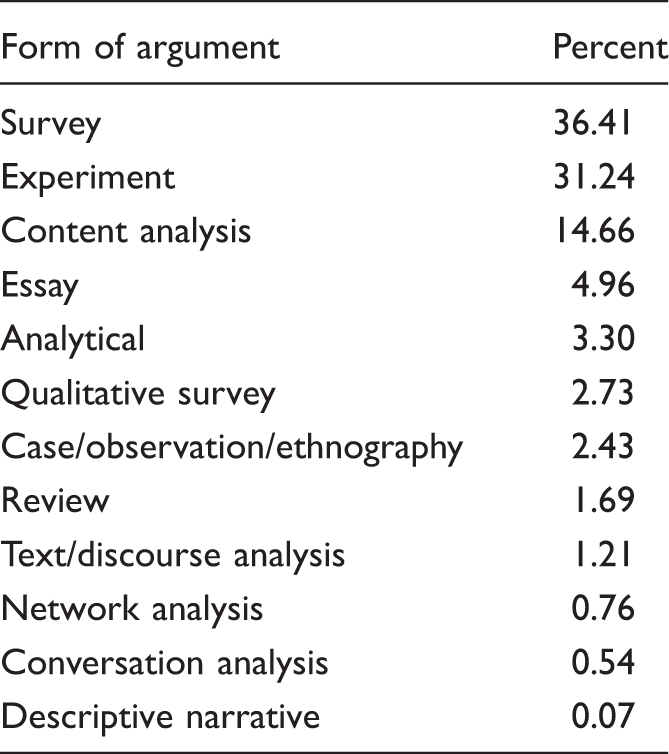
Economically, qualitative work cannot compete in the academic marketplace. Any competent researcher can run an on-line survey and complete the write-up in less than the 15 weeks of a typical US semester, whereas a competent ethnography could not complete its field work in that time. My economic argument is supported here by a backward look to the decade of ferment 1976–1985 (JOC’s Ferment in the Field issue appears in 1983) where 7% of the work in these journals was qualitative. It may be epistemologically more potent, but its decline shows it to be an economic struggle.
Theory family
Epistemological foundation.
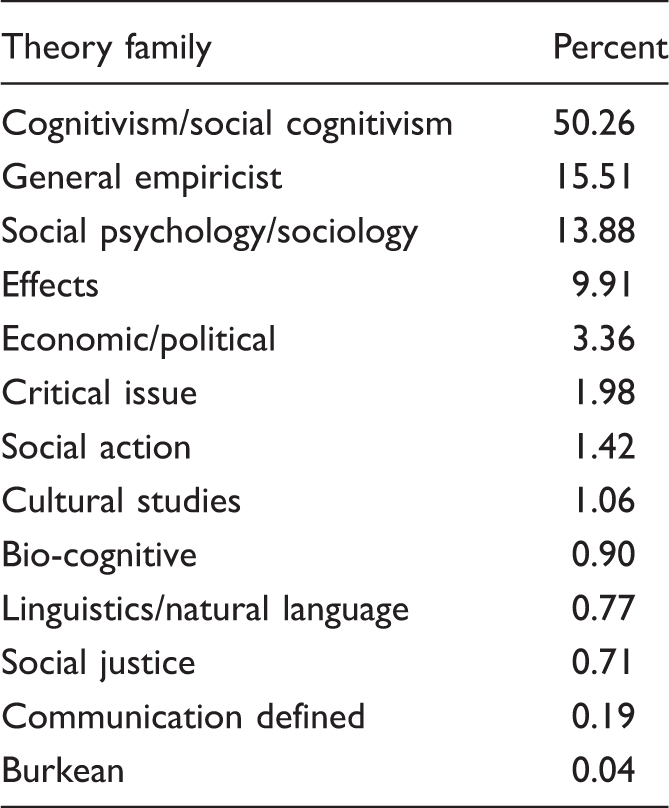
I believe economic rather than epistemological success better explains cognitivism/social cognitivism domination. Cognitivism with its internal structures that presumably predict behavior generates a simple and effective methodology. One does not have to investigate actual behavior; one only has to show movement on a scale following some intervention designed to produce that movement. It generates a tight argument.
Bandura’s social cognitivism (e.g., Bandura et al., 1963) was a boon to communication research. Its effect is quite apparent in the archive. It gave credence to the host of message and media effects research that is so apparent. With social cognitivism, one could not only argue local effects but global effects attributed to classes of content. It is the foundation for most of the moral panic research. This research can be claimed to be both true and socially important.
Finally, cognitivism paves a smooth road to theory development. The analyst can take any significant finding, posit some internal mental process as the basis for the finding, and call it a theory. Because the mental process is a metaphysical supposition and the analyst has no responsibility for actual behavioral effects, there is little impediment to the claim. We can see the consequence in the next analysis.
Use of theory
The category “presence of an explicit theory” was added to the coding set as we moved through the 1960s (all previous articles were consequently recoded) as it became apparent that authors were no longer appealing to, say, general information theory or behaviorism, but rather adopting or developing specific theories of explanation. Until the mid-1960s, less than a third of the sources reference a theory; by the mid-1970s, theory appears in half. For more than half of the current 15-year period, the proportion of articles referencing a specific theory was stable at about 65%. The last 6 years, however, show a remarkable acceleration to 80%. 1
Serendipitously, I happened across an excellent example of then and now. In 1956, Eliot Freidson, then an assistant professor of sociology, wrote that speech “is a type of flexible, continually adjusting behavior that, because of its interactive nature, is thoroughly social” (p. 362). It adapts to its audience and to its ends. Howard Giles and his colleagues among other social psychologists of language took this sociolinguistic description and searched for the underlying cognitive processes and motivations for communicative variations—questions of psychological but not sociological interest—thus giving rise to speech accommodation theory (Beebe and Giles, 1984) (to be followed by communication accommodation theory). We might say that cognitivism accommodated the ascension of what Freidson described as a linguistic truism into the realm of theory and the changing economics of the academy demanded it, while in no way denigrating the contribution.
I examined the content of those contemporary theories by extracting the textual segments that surrounded the word theory and its cognates and then identifying the theory referenced in them for each of the two 7-year blocks in the analysis (2000–2006 and 2007–2013; the 2014 analysis follows). For the 2000–2006 1,151 articles, 833 (72%) made some reference to theory—although not necessarily a theory—generating 6,238 such references. The 1,214 articles archived for the 2007–2013 block reported 1,165 with reference to theory (96%) generating 12,925 references.
Each of the over 19,000 text segments were read; they were recorded when they referenced a named theory; 729 different theories were in play during those 14 years. Duration of a theory’s presence was examined by subtracting the 350 theories duplicated across blocks from the block subtotals. For the 2000–2006 block, 164 theories did not make it to the future, and for the 2007–2013 block, 215 theories were not referenced in the past.
2014
The summary statistics give a rather muted view of these changing economics. A more vivid display can be generated by looking at the role theory production has played in the 2014 volume year (the last completely coded year as of this writing). Management Communication Quarterly was added to the group of journals as its impact rating went above 2.0, putting it in the same league as the others. A total of 231 articles were entered into the archive for that year from these once again 6 journals; 227 referenced an explicit theory or model (two of the other four were front matter); 440 unduplicated theories were identified in those 227 articles 2 ; 46% of these theories appeared in cognitivist arguments, and the journals with the highest proportion of cognitivist arguments (HCR-96% and CR-91%) had the highest theory per article ratios (2.9 and 3.1, respectively).
2014–2015
The effect of the continued spiral of theory production can be shown in the combination of the 2014 and 2015 volume years. 3 Over these latest available years, the 7 journals published 485 empirical articles, all but five of which reference either a theory or a model. These 480 articles generated 735 separate theories, only 89 of which appeared in both volumes. Someone entering the field in 2014 would have to learn 295 new theories the following year.
Implications and conclusions
The finding that we have at least 446 separate theories in play within a single year with cognitivism holding the major position has some powerful implications. It might suggest an exciting diversity, except that suggestion is not supported by the overall increasing constrictions on forms of argument and epistemological location. What it suggests to me is much darker: First, there is little editorial discipline governing the use of the term theory—nearly any supposition can qualify; second, that the claim of a theory greatly increases the likelihood of publication—in fact some journals require it; and third, the co-temporal rise of theory and cognitivism underscores my claim that cognitivism is a fertile medium for sprouting theory (but not for its epistemological development).
Within the empirical domain, other theoretical frameworks suffer in comparison. The grounded theory approach, 4 for example, appears to guarantee a new theory for every published result but its methodological demands clearly limit its application. The communicative constitution of organizing/organizations as another example is, of course, not a theory in any scientistic or positivistic sense but rather an explanatory framework that italicizes communication for the communication field. It has developed along multiple lines (Schoeneborn and Blaschke, 2014), most of which are attempts at the whole and even grandly so with ventriloquism (Cooren, 2010). Whether it can support the multiplicity of small scale theory, as cognitivism does, remains to be seen.
But the most serious charge that can be leveled from this finding is that developing theory is all that we are doing. It is theory without material consequence. To paraphrase Hanitzsch (2015): lots of work, little new knowledge (p. 353). How can this happen?
If we look to our 100-year history, in the first half, we paid for our bread by teaching presentational skills courses—the purely academic researcher was the canary in the gilded cage singing sweet academic authenticity and legitimation. But the changes that occurred in the decade of the 1970s indicated that a critical mass was being reached. The International Communication Association made its final break from the Speech Association of America; the Broadcast Education Association broke official ties with National Association of Broadcasters; conferences went from a few hundred submissions in the 60s to over 3,000 for ICA in Japan; multiple journals began publishing (e.g., Human Communication Research, Communication Research) and the number has multiplied rapidly since, pointing to a sufficient audience within professional academics and graduate students to be self-sustaining. Another indicator is the proliferation of self-congratulatory awards and prizes with little recognition from the outside. We have become both producer and audience, evaluator and the evaluated, and in imitation of the scholastics—a closed epistemological system.
The definitive response to this mildly outrageous claim is to show where our theories have made a material difference in decision-making, relationships, technology development, organizing and organizations, and the like. That material difference needs to be greater than teaching, say, decision making theory in our undergraduate and graduate classes. Again that is a difference only to us. And that difference has to be more than dire warnings against biased information or other problematic content. There is nothing unique to communication (or even technical) about such warnings. Whose lives are changed other than our own? That is the question to answer.
Variations of these findings have now been presented to five different conference venues involving three different communication associations (Anderson, 2013, 2014a, 2014b, 2014c, 2015; Anderson and Middleton, 2013, 2014; Middleton and Anderson, 2015. There has been much agreement but clear opposition as well. The responses in opposition to the presentation of these facts have been varied, but none has reached criterion level. What we have heard is forms of exceptionalism—not in my area of the field, not in my department, not in the journals I read, not with my theory; methodological critique—mostly in the number and title of the journal as if there were a motherlode of greatness residing elsewhere, although every new journal surveyed has simply added another set of unique theories (90% of MCQ theory references were unduplicated elsewhere); and ground shifting—there is no discipline of communication, critical studies solve this problem, women are underrepresented. No one, however, has challenged the facts; they just want them to go away. It has been a Fox News experience.
I can certainly understand the resistance. The critique strikes at the heart of what we do and how we rank ourselves in the doing. It calls for a radical reconfiguration of both value and action, not only in the discipline (or whatever our communality is) but also in public higher education. I have little of hope of either in either. What is happening is that the critical mass of self-reproduction is building across content, methodologies, and standpoints, spinning off smaller and smaller communities of communication scholars, which show even less impact on or concern for the society that funds them.
Footnotes
Declaration of Conflicting Interests
The author(s) declared no potential conflicts of interest with respect to the research, authorship, and/or publication of this article.
Funding
The author(s) received no financial support for the research, authorship, and/or publication of this article.