



Abstract
The increasing presence of sport broadcasting on public service broadcasters in Indonesia is driven by a mixture of interests. It may serve as a tool for education and entertainment as well as for increasing awareness of ‘symbolic nationalism’. Sport can also be used as a soft political campaign in the electoral system or even for pragmatic business purposes. This article assesses the sport broadcasting histories and policies of two Indonesian public service broadcasters: Radio of the Republic of Indonesia, and Television of the Republic of Indonesia. It assesses two political periods: the authoritarian period (1966–1998) and the transition towards a more liberal system (1998-present). Furthermore, this article critically examines both the political and economic interests behind the mediated sport policy. In addition, it intends to fill the gap in studies on sport policy, specifically public service broadcaster sport programming in transitional states. This study found that a change in the political structure resulted in unstable policies of sport broadcasting in Indonesian public broadcasters.
Keywords
Introduction: Sport broadcasting and the public service broadcastings
Sports, broadcasting, and politics enjoy a symbiotic relationship model in global society that profoundly affects trust towards broadcast policy, viewership, and institutional sustainability. Sport is a cultural product that develops within socio-history and within a political context (Brown, 2004), while the media is considered a social institution. In this sense, both sport and broadcasters aim to reach the public such as spectators, fans, consumers, or citizens, while the state plays a significant role in shaping macro policy and intervening in production processes for political interest. Some authors have shown this in previous research (Dart, 2012; Lin et al., 2009; Smith et al., 2015; Whannel, 2008).
State Broadcasters as well as Public Service Broadcasting (PSB) systems are a contested arena of government, market, and public interests. Scholars differentiate State Broadcasters from PSBs according to the following criteria: ownership, funding, employment status, and service remits (Jakobuwicsz, 2008; Harding, 2015; Smith, 2002). A state broadcaster system is under government control. The content relates primarily to government interests and the employees are mostly of a civil servant status. Conversely, PSBs are held and regulated by the public as their owner, being supervised by an autonomous board of trustees. They have their own employees and offer a range of programmes for public interest.
Sport broadcasting on PSBs is more complex than that of private broadcasters because it deals with politics and politicians, who interfere with policy design. In the state broadcaster model, the ruling regime, as the owner and financier, may remit and define the type of programme, including sport, as an instrument of their political propaganda (Brown, 2004; Junaedi, 2013). In the transitional period towards a liberal political system, the state broadcaster may formally transform into a PSB system, but the interest in sport broadcasting varies and depends on numerous factors.
Studies on the interactions between government, market, and PSB in sport broadcasting are relatively limited, particularly in transitional democracies, which link the tradition of political intervention with the pressure of a liberal economy. In the PSB sector, most studies have thus far concentrated solely on policymaking or institutional design as a whole (e.g., Im, 2006 in Korea; Im, 2011 in Cambodia). This article therefore aims to bridge this gap by exploring the dynamics of sport programme policies during both the state and public broadcaster models within the political context of Indonesia. With more than 270 million citizens and the PSB’s position as the furthest-reaching broadcasting network, studies on the policies of sport broadcasting in this country are challenging.
My work explores the effect of changing policies in sport broadcasting on both the Indonesian state and public broadcasters, and explores the ways in which sporting events have been mediated. The two eras of interest are the authoritarian politics of the New Order (1966–1998) and its reformation as of 1998. During these two political periods, football (both at national and global level) and badminton were the most popular broadcasted sporting events. I will start by looking at a conceptual debate on the role and interplay of broadcasters with state and market interests, followed by an explanation and critical reflection of the findings.
This article is based on the analysis of sport broadcasting policies in TVRI and RRI in two political eras: authoritarian, where state broadcasting existed, and transitional politics, where PSB was introduced. I uncover literature concerning both Television of the Republic of Indonesia (TVRI) and Radio of the Republic of Indonesia (RRI) sport programming and analyze regulation and policies in sport broadcasting and PSB at large. Then, I focus on sport programming policies during the two periods and examine the interplay between politics and economic pressures. Two events are of special significance, namely the 1962 Asian Games and the Italian League 2012–2013. Sources range from news publications, policy documents from the RRI and TVRI, and lists of their sport programmes, to secondary sources from previous academic studies.
Public broadcasting, government, and the market
The debate over the political and economic influence of sport broadcasting in both State Broadcasting and PSB, closely relates to the paternalistic relationship between government and the two broadcasting systems. Contrary to the state broadcaster, which is owned and governed by the ruling regime as its ‘mouthpiece’, the PSB is defined as a publicly owned broadcaster with a public service mandate, aiming to fulfill democratic, social, and cultural needs as part of a human right (Berka and Tretter, 2013; Smith, 2002). In practice, a PSB informs the public of relevant events, and promotes social and cultural cohesion (Nissen, 2015). Further roles of the PSB are described as a tool for public education, entertainment service, and awareness of social achievements in society.
Sport is, in part, a cultural service, which is used to boost national identity (Lin et al., 2009). Hence, it is the PSB’s mandate to fulfill social and cultural goals rather than economic goals (Kwak, 1999) while maintaining a ‘collective national experience’ through non-commercial means (Micova, 2012). With respect to sports, a PSB system is encouraged to promote various teams, leagues, and sports as national rituals while ‘personalizing’ athletes as celebrities. Furthermore, a PSB should maintain a balance between ‘mass and celebrity sport’ and ‘marginal-traditional sport’ events (Scherer and Rowe, 2014). For instance, during the 1980s and 1990s, in the Nippon Hoso Kyokai (NHK), Japan Public Service Broadcasting, a, Sumo tournament was slotted during prime time to maintain the sport’s profile (Wong et al., 2014).
In the authoritarian states, the political regimes practiced systematic intervention with state broadcasters, both institutionally and in its content. The use of popular sport programmes was considered a political tactic to maintain power. Sport broadcasting under authoritarian regimes promotes certain ideals such as norms of self-discipline and teamwork. Therefore, public involvement in sporting events aids social integration and achieves social and political control. In the case of Indonesia, government interest in sport was used to maintain social order, to promote ‘symbolic nationalism’ in the global forum, and to maintain legitimacy of the existing autocratic power from the 1960s to 1990s (e.g., Brown, 2004; Colombijn, 2000).
Moreover, sports and sport broadcasting are forms of diplomacy: they are used as political propaganda for national prestige, and for the maintenance of good relations with allies or neighbours. During the 20th century, nearly 60 new states were established and many of them faced the acute problem of establishing a sense of national identity (Lin et al., 2009). Mega sporting events such as the Olympic Games are a significant arena in which nations can showcase themselves, and the largest networks of the State or Public Broadcasters in Asian transitional states (e.g., Indonesia, India, etc.) are seen as a tool for promoting national interests.
After a series of dramatic changes in power over the last 25 years, the transitioning politics favoured a liberal media system as indicated by Hallin and Mancini (2004) and Jakubowicz (2008) in Eastern Europe as well as by Raboy (2002) and McCargo (1999) in Asia. After the fall of the authoritarian regime and the shift from State Broadcaster to a PSB system, the majority of new PSBs had to confront numerous obstacles such as deteriorating income, legitimacy in social life, and technological change (Ramsey, 2010). For instance, the enactment of Broadcasting Law No. 32/2002 in Indonesia formally changed the institutional design of RRI and TVRI as the state broadcaster to a PSB. The arrival of private broadcasting during the last 15 years, however, has marginalised RRI and TVRI viewership and has prompted them to adopt a ‘market logic’ of programming policy that provides for consumers, not the public. This is best illustrated through the development of broadcasting policies toward commercialisation.
Overall, the arrival of private competitors caused a decrease in PSB audience share. On the other hand, in the transitional societies of Cambodia (Im, 2011) and Indonesia, an obligatory license fee system as core funding may be difficult to implement with viewers who are accustomed to ‘free’ broadcasting. Adoption of ‘market logic’ in addition to secure state budget is among the ways in which PSBs responded to the above obstacles, particularly in countries where PSBs are legally allowed to conduct commercial activities such as in Indonesia (Masduki and Darmanto, 2014) or Macedonia (Micova, 2012). Experiences in Indonesia during the last two decades indicate that airing popular football games is seen as ‘the shorter way’ towards attracting new audiences and generating advertising as a source of income.
Authoritarian era: ‘Branding’ the ruling power
The intrusion of politics in Indonesian sport broadcasting has been in existence since TVRI was established. During the last decade of Sukarno's presidency (1950s), there were initiatives to establish state television. In 1952, the initiative was led by Maladi, the Minister of Information, to support the national election campaign and gain political benefits for Sukarno's power. However, due to the high cost of investment, the proposal was ultimately rejected by the majority of Sukarno’s cabinet members (SK, 2011).
In the next 10 years, a second plan to establish state-owned television was given an opportunity when Indonesia became the host of the 1962 Jakarta Asian Games IV. According to SK (2011), Maladi’s proposal was accepted by Sukarno for political reasons, most likely to recover staggering national spirit. Coverage of the Asian Games IV was regarded as a tool to reduce political separatism in some regions during the 50s.
Moreover, the idea of using sport as a strategy to drive political interest was based on the precedent of the first national sports competition, or Pekan Olah Raga Nasional (PON) in Surakarta. The 1948 PON raised unity among the Indonesian youth amidst a political movement poised against Sukarno’s policies in Central Java (Junaedi, 2013). In this sense, the use of a nationwide television network was necessary to reach all Indonesian citizens across thousands of islands.
Previously, TVRI’s older brother, RRI was established (11 September 1945) as a state-owned radio broadcaster during times of independence from Dutch and Japanese colonies. The idea of nationalism was marked by the popular slogan: Tri Prasetya (the three loyalty commitments of broadcasters). Firstly, to prevent RRI from working against national integration policy; secondly, to drive RRI as a vehicle toward a ‘national revolution’ spirit; and thirdly, to stand as equals in society in managing the country's safety. To ensure these commitments, the majority of RRI sport programmes were produced in Jakarta. In the 80s and 90s, RRI was well known as a vital interactive sound medium for rural people in airing local and national football leagues with full governmental support (Masduki and Darmanto, 2014).
The first national TV station, Televisi Republik Indonesia (or TVRI), was formally launched at the opening ceremonies of the Asian Games in the Bung Karno Sport hall on 24 August 1962. The event was broadcast from Jakarta for three hours a day (16:00–19:00). Kitley (2000) argues that by broadcasting the Games, TVRI complemented Sukarno’s spirit of ‘symbol wielding’ through televising high profile speeches, ceremonies, and exposure of the ‘insignia of national prestige and power’. Subsequently, TVRI was named as ‘a national culture project’ with nationalism as the dominant philosophy and President Sukarno as its chief promoter (Kitley, 2000; Rakhmani, 2013).
During the 1962 Asian Games, the international arena was a battlefield of regional and international politics between superpowers. 1 As the president of Indonesia, Sukarno positioned himself as a leader for newly emerging nations and as a leader of a non-aligned movement to defend against global pressure exerted by the US and the Soviet Union (Hong, 2006). Subsequently, Sukarno maintained a similar policy for future sporting events, concentrating on Asian and African nations, namely 1963s ‘GANEFO’ (Games of the New Emerging) held in Jakarta. The event involved about 2,200 athletes from 48 countries in Asia, Africa, Latin America, and Eastern Europe. With the slogan, Onward! No Retreat in the opening ceremony, TVRI and Sukarno presented GANEFO as a collective struggle for the empowerment of developing countries in Asia and Africa (Frey and Spakowski, 2011).
This policy was continued by Soeharto, the second president of Indonesia, who pressured TVRI to campaign for a national integration policy. In this era, a slogan stated, ‘TVRI weaves together our unity and the union’ (menjalin persatuan dan kesatuan). In the majority of TVRI stories, Soeharto delivered a speech on the importance of his ideology of the development (pembangunanisme) of Indonesian identity based on the ‘Pancasila norm’ (Kitley, 2000). For Soeharto, TVRI was the government’s partner in the process of nation building’ and ‘protecting the spirit of unity’ (Romano, 2003). To maintain this partnership, he provided financial support, which was the main source of TVRI funding, alongside licensing fees and advertising profits for specific live telecast sport programmes.
The Soeharto regime used sport broadcasting as a tool for maintaining both ideology and a positive political image. 2 In the case of badminton, the second most popular sport in Indonesia, RRI and TVRI played ‘the mediated-emotional battle’ of society by covering Indonesian players accompanied with a subtitle which stated, ‘this programme is funded by licensing fees collected from audiences as a symbol of collective support’. Brown (2004) described badminton as ‘part of life and identity of Indonesian society’ stemming from the Dutch colonial era. In the Asian region, Indonesian players dominated the badminton games, such as the Thomas Cup and other badminton tournaments.
In ensuring effective control of sport programmes, the Soeharto regime applied three key methods: regulating RRI and TVRI as a state agency, maintaining their monopoly in sport broadcasting with strong funding support, and deploying loyal civil servants as their employees. Aside from the Broadcasting Act 24/1997 which stipulated RRI and TVRI as state agencies, other strong policies included the Ministry of Information Decree No. 54 of 1971 and 1986 (revised version) and the Decree No 55 of 1975, which assigned the right of news monopoly to TVRI. To prevent commercialization, the Soeharto regime enacted decree No. 30 of 1981, which disallowed advertising on TVRI. According to this decree, time slots allocated for commercial ads were replaced with events portraying government-funded activities, designed to accomplish developmental objectives.
As the lone player in coverage of sporting events from the 1960s until the 90s, RRI and TVRI enjoyed full access to equipment and studios, and permission to cover all national sporting events. Additionally, state broadcasters received financing from local governments for the live telecast of local football games. As a result, the TVRI coverage of sport primarily favoured local government officials, which can be traced to the popular news programme Dari Gelanggang ke Gelanggang (from Arena to Arena) in TVRI during 1990s. Apart from field reporting on football games, the news programme covered ceremonial speeches from the officials.
In terms of staff, RRI and TVRI were managed under a government bureaucratic system. Employees, who were considered to have relevant expertise, were recruited from various government institutions. For example, in 1962, during TVRI’s infancy, Ir. Sutarto, former director of PPFN (National Film Company) was named as TVRI’s Development Project Head. Many other employees were simply senior bureaucrats and not broadcasting professionals. Similar hiring practices occurred again in 1975, as former army officers from the Land Base Transportation Office were hired as the heads of TVRI Medan and Palembang (1980) (SK, 2011). Moreover, the Ministry of Information became chief commissionaire of TVRI and RRI, which held the right to elect or dismiss the managing director at any time and appoint individuals he considered capable of adhering to the state mission (SK, 2011).
In summary, Kitley (2000) noted that in both the Sukarno and Soeharto eras, RRI and TVRI promoted symbolic nationalism as well as the idea of development and the unification of social forces through popular cultural programmes such as sports. In this sense, both the Sukarno and Soeharto regimes applied strong control and policies, using state budget as the core funding. Nonetheless, in the transitional political period (1998 to present), RRI and TVRI find themselves in an institutional crisis, coupled with an unstable legal status, underfunding, and limited professional staff, which all impacts the changing orientation of sport broadcasting.
Transitional era: Attracting the audience
The 1998 political reformation in Indonesia saw a shift from an authoritarian to a transitional political system, characterised by both new broadcasting policies and an oligopolistic model of broadcasting ownership. The new Broadcasting Act No. 32/2002 formally changed RRI and TVRI into PSBs. The law regulates the stations as independent publicly owned bodies serving public interests, managed by an independent supervisory board, which is accountable to parliament. The law allows PSBs to access various sources of financing, such as state budget, licensing fees, commercial advertising.
The 1998 political reform also promoted the adoption of liberal media policy. The new broadcasting law dissolved RRI and TVRI’s monopoly on news and entertainment, allowed free competition and a monopolistic model of the broadcasting landscape. This resulted in the arrival of private broadcasters called ‘the league of thirteen’, where only 13 owners dominated the broadcasting landscape (Lim, 2012). The introduction of open competition in sport programmes reduced the viewership of the two PSBs. In the last 20 years, Armando (2014) noted that TVRI failed to develop as an independent outlet, consequently losing almost all of its traditional audiences to commercial stations. 3
In its global report, the Indonesian Commission for Business Competition Monitoring (KPPU) noted, since 1998, the Indonesian-broadcasting industry has become more oligopolistic, being controlled by only a few companies. Competition takes place at the vertical and horizontal levels, where broadcasters compete for media content, while advertising firms compete in obtaining television slots for commercials (KPPU, 2013).
Ironically, in this period, there is no specifically designed policy of the new government to protect public interests or maintain PSB mandates through sport programmes. 4 Amidst the weak legal protection and the limited financial support, TVRI and RRI are in a ‘state of limbo’. In response to this double crisis of declining viewership and decreasing state budget, TVRI announced in 2012 a controversial decision to buy the terrestrial free to air sport rights for the Italian League Series A from the Singapore agency MP and Silva for three years. The acquisition was reported to have cost US$ 9.75 million. 5
Apart from the Italian League Series A, TVRI also bought the broadcasting rights for international boxing events and the Olympics. TVRI first bought broadcasting rights for the World Cup in 1978; however as of 1990, private broadcasters have acquired these rights due to the financial crisis and the omission of advertising opportunities.
The decision to buy the broadcasting rights for the Italian League was in response to a lesson learned in the 80s when TVRI enjoyed a monopoly position, being the only broadcaster providing coverage of the Football World Cup. The policy was also inspired by the private sector’s success in increasing both audience share and advertising revenue from football leagues. In the last 10 years, according to the AGB Nielson report, football was among the 10 most popular TV services ultimately moving ahead of family drama (Koran Tempo, 2015). To illustrate, in order to cater to the needs of its viewers and business partners, one of the leading private broadcasters, VIVA Groups, became the first media group in Indonesia to acquire full rights to World Cup 2014 Brazil and according to its 2014 report, the group has successfully gained the highest audience shares (VIVA, 2014).
Of all the European leagues such as the German Bundesliga, the English Premier league, or the Spainish La League, the Italian League gained the highest number of Indonesian football fans. The Seri A fans in Indonesia are among the biggest fan groups in Asia, holding regular meetings on social media platforms with more than 24,000 followers. Before TVRI, the Italian League had been the favourite programme of most private broadcasters (e.g., ANTV 1995–1998, Rajawali Citra Televisi 1990–2001 and 2009–2010, Surya Citra Televisi 2002–2005, TPI or MNCTV 2006–2007 and TransTV 2007–2009). 6
However, some believe this policy violates larger public interest and contradicts the public service mandate of a PSB (Karensa, 2012). According to Dimas and Darmawan (2014), TVRI violates its cultural role in how it deals with public awareness of Indonesian football players and their achievements. He found the broadcast motive of the Italian League in TVRI was in favor of commercial interests. Instead of prioritizing national football events, which involves all Indonesian players, it slotted a foreign football game during its prime time.
In short, the broadcast of Italian League from 2012 to 2013 represents a shifting policy of TVRI towards a market orientation in order to recover its central position in the marketplace. In addition to high viewership, broadcasting of the football league was seen as a tool to generate income through commercial ads, quizzes, and numerous events throughout Indonesia. Apart from the fact that the state budget was used for commercial interests (which was criticised by the civil society during the 2000s), the decision to broadcast Italian League during 2012–2013 also faced technical problems and corruption during the budget allocation process (Koran Tempo, 2014). As a result, the programme was discontinued at the end of 2013 without significant contribution to the recovery of TVRI’s audiences.
Conclusion: In search of a strong policy
In summary, the change of the political structure and the shift from an authoritarian to a liberal political system in the late 90s influenced RRI and TVRI’s sport broadcasting practices. During the monopoly era (‘70s and ‘80s), the two stations experienced political intervention in their sport policy, and the broadcasting of sporting events not only served as entertainment, but was also used as propaganda for the autocratic regime. However, as of the 1998 political reform, the new controversial PSB policy was designed to attract new audiences. The table highlights the sport broadcasting policy in the two periods.
Sport broadcasting policy in TVRI and RRI.
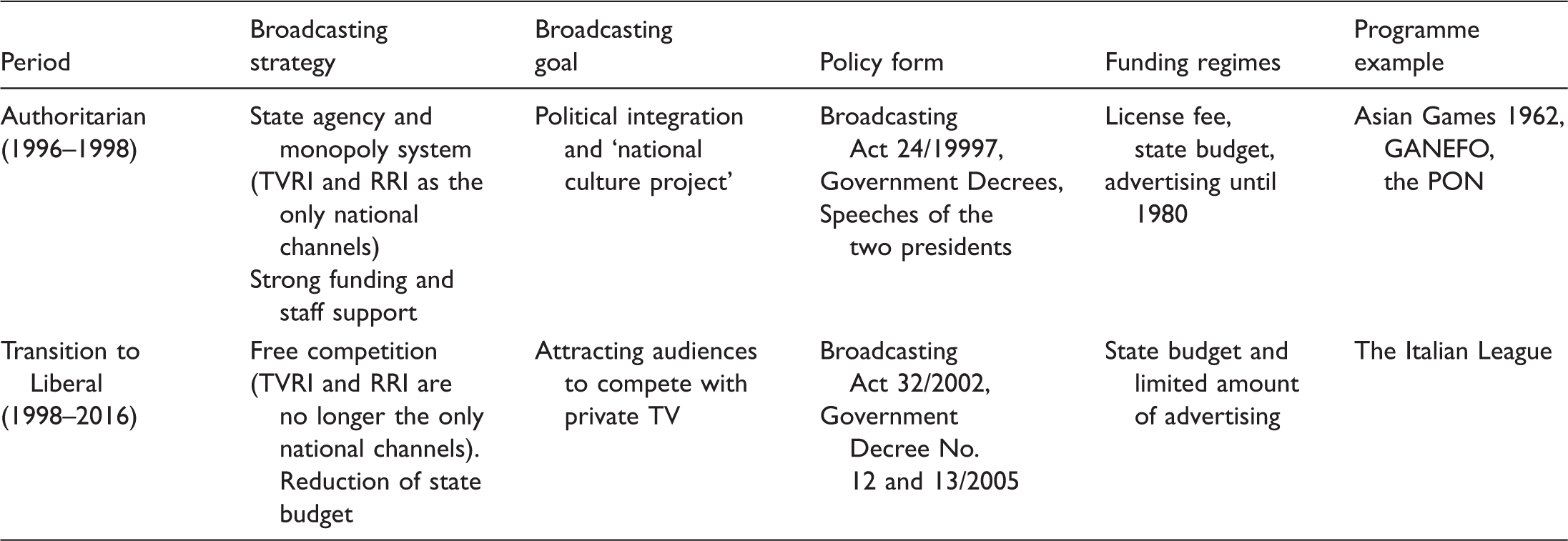
TVRI: Television of the Republic of Indonesia; RRI: Radio of the Republic of Indonesia.
To conclude, both politics and the orientation of the broadcasting system determine policy of sport programme in Indonesia. In the long history of state-owned broadcasters during 1996–1998, the sport programme worked for the interest of the ruling power. In the transitional political period (1998-present) where TVRI formally transformed from state into independent and not for profit oriented public broadcasters, the sport programme policy can be characterised as market-driven, favoring commercial goals rather than socio-cultural objectives.
Footnotes
Declaration of Conflicting Interests
The author(s) declared no potential conflicts of interest with respect to the research, authorship, and/or publication of this article.
Funding
The author(s) received no financial support for the research, authorship, and/or publication of this article.