



Abstract
Media representations have significant power to shape opinions and influence public response to communities or groups around the world. This study investigates media representations of Islam and Muslims in the American media, drawing upon an analysis of reports in the New York Times over a 17-year period (from Jan.1, 2000 to Dec. 31, 2016) within the framework of Critical Discourse Analysis. It examines how Islam and Muslims are represented in media coverage and how discursive power is penetrated step by step through such media representations. Most important, it investigates whether Islam and Muslims have been stigmatized through stereotypes, prejudice, and discrimination. The findings reveal that the New York Times’ representations of Islam and Muslims are negative and stereotypical: Islam is stereotyped as the unacclimatized outsider and the turmoil maker and Muslims as the negative receiver. The stereotypes contribute to people’s prejudice, such as Islamophobia from the “us” group and fear of the “them” group but do not support a strong conclusion of discrimination.
Introduction
Islam, the religion of Muslims, has been viewed historically with much suspicion and fear by the Christian West (Said, 1997) since its birth in the seventh century. During the Crusade (1100-1400 A.D.), Islam and the West were locked in ongoing battles (Esposito, 1992). Also, the hostility between Muslims and Christians was intensified. In modern times, a series of political events brought the Muslim world much closer to the West (Sheikh et al., 1996), such as the collapse of the Cold War system, the battle for oil, the Iran Revolution, the Iraq-Iran war, the Gulf War, and the Arab Spring. In the past three decades, the Western media have widely focused on Islam and Muslims, making them currently fodder for front-page news all over the world.
Although there is more awareness of the need for peace journalism today, the Western media have continued to focus on the negative portrayal of others (Roy and Ross, 2011). The Western media are not only critical toward Islam but also promote stereotypes about the Muslim world and Islamic values (Poole, 2002). As the media play a large role in framing the public discourse about Muslims and Islam, partial or inaccurate portrayals can only mislead readers and bring them a false understanding of this religion. Hence, this study investigates portrayals of Islam and Muslims in the American media to discover the hidden ideologies in the picture the media paint.
This study examines reports from the New York Times for the period from January 1, 2000 to December 31, 2016 with 874 reports in total. This period was selected because it covered a number of important terrorist incidents: the 9/11 attacks, the July 7, 2005 London bombings the November 2015 Paris attacks, and the 2016 Berlin attack. The theoretical framework is Critical Discourse Analysis (CDA) integrated by Fairclough (2013: 10)’s textual analysis and Wodak and Meyer’s (2015: 2–22) discursive analysis. CDA is problem oriented and is designed to unpack textual data, which is particularly useful in unraveling hidden ideologies and power.
This study is important not only because of its major contribution to enriching the literature with the framework of CDA and analytical methods of Corpus Linguistics (CL), but also because of its objectives of opening new insights into the media’s use of stereotypical representations to all areas of “text and talk” that harbour ideological meaning. Readers can be aware of what is going on and can recognize the discursive strategies and power of the media with better critical reading ability. Most important, the study can help distinguish distorted representations from real representations through linguistic evidence and contribute to a more inclusive understanding of Islam and Muslims. This study aims to answer three main questions: on the textual level, how are Islam and Muslims represented in the New York Times? How is discursive power penetrated step by step through media representations, and what are the specific discursive strategies employed? Have Islam and Muslims been stigmatized through stereotypes, prejudice and discrimination?
Literature review
Media, ideology and orientalism
The media present information about world events to masses of individuals. They play an important role in influencing the public response to Islam and Muslims. Because a large share of the population has limited face-to-face contact with Muslims, the media are the main sources through which the public receives information about them. The media have discursive power. First, Mass-media coverage can increase or decrease the salience of certain aspects of an issue, thereby priming which information will be used by citizens (Kim et al., 2012). Media representations also have significant power to shape opinions and influence perceptions about groups around the world (Roy, 2012: 556–570). Bennett et al. (2011) found that Muslims are generally portrayed in stereotypical terms, and Islam is seen as a threat to security. Stereotypes are always formed by the separation between “us” and “them” which indicates the ideological polarization of the media. It conforms exactly to characteristics of the media—they are manipulated by different hands in order to justify their own acts and remain a positive image among the public (Oroujlou, 2012). This manipulation is a result of the centrality of ideology in what is reported or produced by the media.
Ideology, closely tied to patterns of privilege and the exertion of power, has recently become salient in critical discourse studies. In this study, ideology is defined as “the mental frameworks, i.e., the languages, the concepts, categories, imagery of thought, and the systems of representation” (Hall, 1986). Ideology can be expressed and reproduced in and through language or discourse (Poorebrahim, 2012), which plays a very important role in the representation and reproduction of ideology. This study aims to clarify the relation between ideology and discourse with reference to the media, especially investigating if the Orient is othered as “them” and how “us” and “them” are represented in the Western media discourse.
Said’s notion of Orientalism provides one of the most influential critiques of discourse about Islam in the West. He (1978, 1994, 1997) articulates that Orientalism is the dominant ideology of Western relations with the Islamic world. Scholars such as Sardar (1999) and Karim (2000) argue that Orientalism constructs the Orient as separate, different, and “other”. In some stronger texts, the Orient is assumed to be the antithesis of the Occident, wherein “they” is represented by the negation of “us” (Poorebrahim, 2012). This stark black-and-white dichotomy pitting “us” against “them” encourages people to accept that the two opposites are strictly defined and set off against one another; this is how Said’s Orientalism functions.
Representation and stereotype
Representation is the complex process that symbolically embodies concepts, ideas, and emotions in order to produce, construct, and transmit meanings in society (Roy, 2012: 556–570). Representation is widely used in discourse analysis, especially in the realm of media discourse. As part of the meaning-producing nature of representation, certain meanings are deployed at particular times and places, constructing knowledge about particular topics (Foucault, 1972). This study adopts the term representation instead of description, interpretation, or presentation influenced by the features of the media. The media present information about world events to individuals, but the information is never a mere mirror of reality; it does not provide a thoroughly accurate and impartial account of events. Therefore, the information that the media present about events is a part of reality but sometimes distorted. From this perspective, accounts of world events involve not only “presentation” but “representation” as they are impregnated with various ideologies.
Fowler (2001: 17) defines stereotype as “a socially-constructed mental pigeon-hole into which events and individuals can be sorted, thereby making such events and individuals comprehensible.” As Hall (1974: 18) argues, a group of people can be marginalized by their portrayal as an unrepresentative minority, denigrated by being presented as abnormal, or excluded by only appearing in the media when they present a problem. There has been an intense focus on Muslims and Islam in the American and Western media, most of it characterized by a more highly exaggerated stereotyping and belligerence (Said, 1997). The stereotype of Islam and Muslims is not just a means of slotting them into a particular compartment; it also affects our attitudes and behaviors towards them.
Representation of Islam in the Western media
Islam has been a subject of discussion in the media for a long period of time. Critics have generally argued that the news media have given Westerners a false sense of understanding Islam, without at the same time intimating that a great deal in this coverage is based largely on subjective, rather than objective material (Al-Zahrani, 1988; Ghareeb, 1983; Mousa, 1984).
Said is regarded as the first scholar to conduct an extended study about Western media’s focus on Islam and Muslim societies (Alazzany, 2012). His Orientalism (1978) remains one of the most influential critiques of the representation of Islam in the Western media. In this book, Said points out that there is a dichotomous distinction between the Orient and the Occident, and the Orient is presented by the Occident, and Orientalilsm is directly indebted to various Western techniques of representation that make the Orient visible, clear, and “there” in discourse about it (Said, 1978). Said’s other masterpiece is Covering Islam (1997), which is about the Iranian hostage crisis through the Gulf War from 1979 to 1981 and the bombing of the World Trade Center in 1993. By pointing out that the American media have portrayed Islam as a monolithic entity synonymous with terrorism, Said expresses his great dissatisfaction and resentment at those distorted images. He demonstrates that even the most objective coverage of the Islamic world in the media must have been distorted with certain hidden ideologies.
After the 9/11 attacks, studies of Islam from a variety of perspectives have sprung up. Richardson, for example, has published a book (Mis)Representation (2004), in which he engages in a qualitative examination of linguistic and social practices within British broadsheets. Richardson finds there are four common argumentative themes associated with the reporting of Islam: as a military threat, as being associated with terrorists/extremists, as a threat to democracy, and as a sexist or social threat. Similarly, Poole (2002) finds that in the British media, Islam is frequently represented as an irrational and antiquated threat to liberal values and democracy. Islamophobia (Moosavi, 2015; Richardson, 2004) is another important argumentative theme in previous research. Moosavi’s (2015) study pays more attention to the issue of Islamophobia, in which Islam is demonized through historic stereotypes such as Islam is violent, barbaric, and oppressive. Moosavi investigated the representation of Islam by Labour cabinet ministers between 2001 and 2007, and he finds that the ministers were involved in presenting Islamophobic generalizations, stereotypes, and misrepresentations. He argues that the Islamophobia representation by mainstream politicians must be challenged, especially as it is undertaken by society’s respected elites. The above books and academic papers show that the negative themes of Islam are popular and stereotyped in the media news.
Representation of Muslims in the Western media
Public discussion about Muslims in the U.S. after 9/11 has never faded, especially after President George W. Bush has tried to distinguish “good Muslims” from “bad Muslims.” From this historical event on, the portrayal of Muslims in the American media has been consistent: unless proved to be “good,” every Muslim is presumed to be “bad.”
Karim (2006) points to several scholars who have isolated specific core stereotypes of muslims–essential thematic clusters–that characterize dominant Western representations of Muslims. Those essential thematic clusters include terrorism, Muslim fundamentalism, ethnic hatred, and the re-emergence of a virulent quasi-European (i.e., Nazi) type of anti-Semitism. Shaheen (1984: 4) points out that the media tend to perpetuate four stereotypes about Muslims: they are all fabulously wealthy, barbaric and uncultured, sex maniacs with a penchant for white slavery, and engage in acts of terrorism. This kind of unfavorable terminology has influenced people’s objective understanding and judgments. Therefore, Alazzany (2012: 31) explains such terminology as one aspect of the necessary contextual information used to dehumanize and discriminate against Muslims.
The unfavorable terminology and stereotypes of Muslims are partly influenced by social events. Therefore, many scholars have studied the impact of social events on the reporting about Muslims. For example, the 9/11 attacks (Karim, 2006; Poole, 2006) and the war in Iraq (Poole, 2006) have narrowed the framework of reporting whereby the West has led ideas and understandings of these events. Poole (2006) examines coverage of British Muslims in two British broadsheet newspapers from 2003. He compares these outputs to previous coverage (from 1994 onwards) to determine whether the framework of reporting has altered in any considerable way since September 11 and the war in Iraq. He finds that the newsworthiness of Islam is consistent with previous frameworks of understanding, and demonstrates how stories are only selected if they fit with an idea of who Muslims are.
A comparison of the media’s attitudes to different religions is drawing increased attention among scholars. The discrimination against religions, such as Christians and Jews, is common in the media. However, the discrimination practiced against Muslims is more extreme and consistent. Khleif’s (1998) study has verified this point. He demonstrates that institutional racism in America against Catholics and Jews has diminished considerably; instead, Muslims have become the substitute for prejudice and stereotyping that used to be directed against a number of other ethnic and religious groups.
Theoretical framework and methodology
CDA is a framework employed in discourse studies to analyze social issues with explanatory power. Fairclough (2013) defines CDA as “part of some form of systematic transdisciplinary analysis of relations between discourse and other elements of the social process, which addresses social wrongs in their discursive aspects and possible ways of righting or mitigating them.” Van Dijk (1993: 249) presents CDA as “the study and critique of social inequality.” The representation of Islam and Muslims formed by certain discursive strategies leads to social inequality, which influences the attitudes of readers. It is vital to use the explanatory power of CDA to explain how readers are influenced by the representations of Islam and Muslims.
This study integrates a CDA framework that consists of Fairclough’s (1995) textual analysis and Wodak’s(2015) discursive analysis. Textual analysis is a tangible means to identify the main ideological themes that dominate the representation of events, issues, and groups (Fairclough, 1995), while discursive analysis aims to interpret discursive strategies that perpetuate ideological themes embedded in discourse (Fowler, 2001). The construction of a theoretical framework and analytical approaches is retrospective and repeatable; researchers and readers can follow them to replicate and test the results of this study.
The methodology here is to combine qualitative analysis and quantitative analysis. Because corpus-based analysis uncovers the facts within the corpus, from a discourse perspective, language patterns can be generalized and interpreted through keywords, collocation, concordance lines, and co-texts. Combining corpus-based analysis with CDA can help reduce analysts’ bias (Mautner, 2015), help them obtain a much better picture surrounding the frequency of particular phenomena (Baker et al., 2013), and enable them to go beyond single texts and gain insight into the cultural and ideological meanings that circulate regularly (O’Halloran, 2010).
Data processing (the process of corpus operation) includes data sources, corpus building, corpus analysis, and statistical tests. This study selects the New York Times as its source of data. This newspaper was chosen mainly for three reasons. First, previous studies of Islam and Muslims have used the newspaper as a data source. Sheik et al. (1996), for example, investigate different portrayals of Muslims among the New York Times, the Los Angeles Times and the Detroit Free Press, and find the former uses the term fundamentalist most often and has more negative representations. Alazzany (2012) reveals that most of themes that dominate in the reports of Islam and Muslims in the New York Times appear to hover around concepts such as Islam is violent, Islam encourages turmoil, Islam is a threat, Islam equates with Jihad, and Islam is evil. Second, in other studies on minority groups/races/communities who are in a similar situation to the Muslims, the New York Times is also selected as a data source. Alam (2020) researches how Bangladesh has been portrayed in leading U.S. media. Some reports in the New York Times pose important questions on issues of democracy in Bangladesh, but its overwhelming focus on negative portrayals serves to stereotype Bangladesh. Stereotypes also exist in the paper’s coverage of Islam and Muslims. Third, the New York Times is representative of large national newspapers (Sheikh et al., 1996), generally representing the national dialogue on political discourse (Alazzany, 2012).
A LexisNexis search regarding the New York Times coverage that dealt directly with Islam and Muslims yielded 874 reports. The search query was Islam* OR Muslim* OR Islam and Muslim. The time span was set from January 1, 2000 to December 31, 2016 and the length of texts was required to be no less than 300 characters. By removing the overlapping ones, non-related ones, duplicate messages, and nonstandard word forms, 874 news reports remained as plain texts with 974,158 words. The statistical tests employed by AntConc requires texts be an appropriate length; thus, the length of texts was required to be no less than 300 characters. This self-built corpus was named as I & M corpus, and the computer software tool chosen was AntConc.
Results and analysis
Main themes of representation of Islam and Muslims
Theme is the main product of data analysis (Krauss, 2005). It is used as attribute, descriptor, element, and concept. As an implicit topic that organizes a group of repeating ideas, it has a high degree of generality that unifies ideas regarding the subject of inquiry (Ryan and Bernard, 2003). In discourse, Fairclough (1995: 6) explains, theme is generally manifested as common-sense assumptions that are meant to create a consensus around certain implicit stands. With the help of keyness, main themes in a corpora surface.
Keyness refers to salience in Corpus Linguistics. Baker (2006) suggests that analysts compare word lists from different corpora, determining which words are statistically more frequent keywords in a corpus. The keyword lists use the keyness function to compare a word list under study with other lists. Here, the reference corpus is the Open American National Corpus (hereafter OANC). The keyword list is made by Antconc. Figure 1 and Figure 2 show the Antconc overall keyness of the top 100 keywords. The two core query terms, Islam and Muslim are excluded.
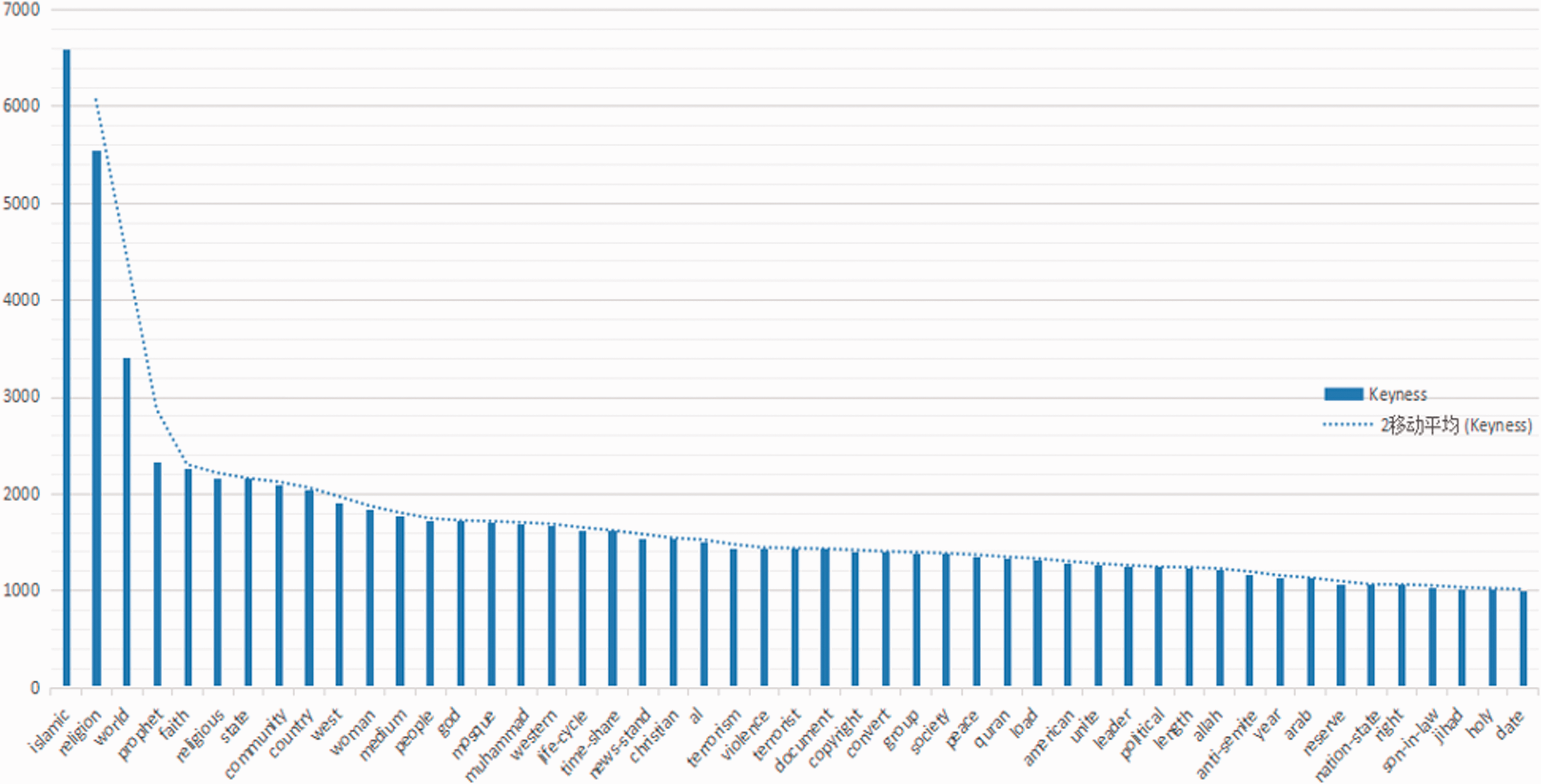
Top 100 keywords and their keyness.
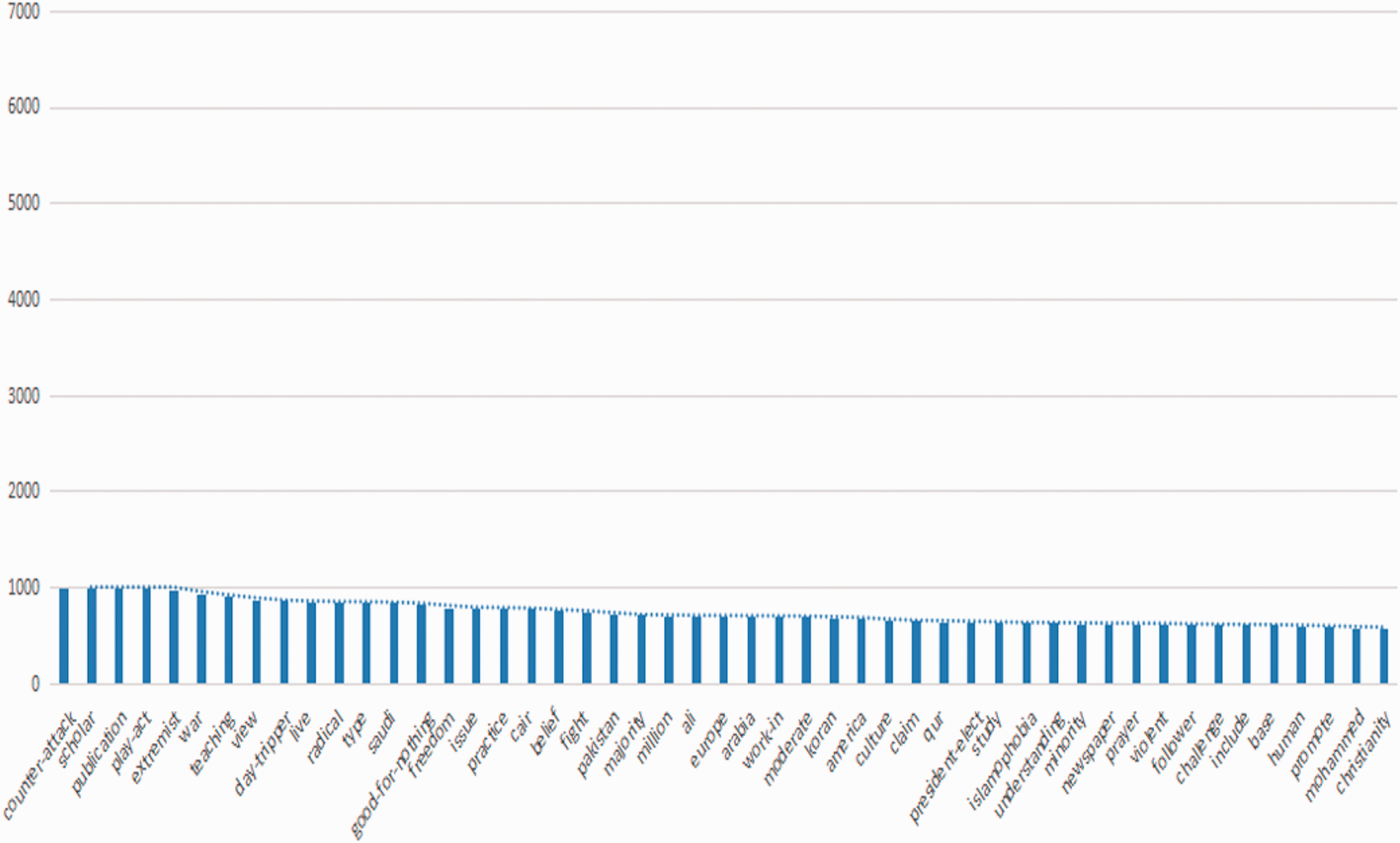
Top 100 keywords and their keyness (cont.).
For the top 100 keywords, the keyness score starts very high (at 6,584.993) for the word Islamic, and gradually decreases to 580.966 for the word Christianity. Generally, the keynesses of the top 100 keywords vary in a large range. The top three keywords have extremely high keyness, indicating that these three words are necessities for Islam-related and Muslim-related texts. For the next 44 keywords, their keyness decreases from 3000 to 1000 with noticeable salience. Hence, keywords in this keyness range indicate the topics on which writers choose to focus. The keywords with keyness beneath 1000 are common topics that are usually mentioned when some related events take place.
To analyze and refine the selection of keywords, a classification process for the data was pursued. The keywords’ categorization is a fairly subjective process, as ideological issues are often raised when categorizations are made and words are assigned. Furthermore, as some concepts overlap, many words can be assigned in different categories. For example, the word radical can both be assigned into the category of politics and religion. In order to make this categorization as reasonable as possible, we refer to Baker et al.’s (2013) classification method. In his study of the representation of Islam in British media, he classifies keywords into religion, conflict, culture, society, education, and others according to general meaning (without clear indicators, based on keyword’s meaning). Baker et al. (2013) do not explain what the definitions of those keywords are based on. Hence, we refer to Merrian-Webster’s English Dictionary, the America's most trusted online dictionary for definitions and meanings of English words.
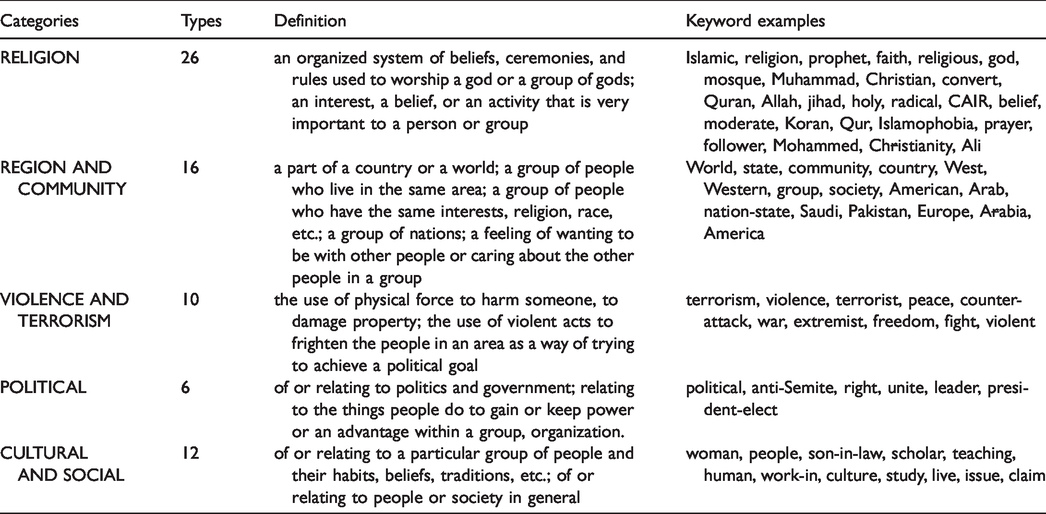
The data are classified into five categories, namely: religion, region and community, violence and terrorism, the political, and the cultural and social. Each of these categories is considered a dominant theme by itself with references to other subthemes.
Table 1 provides a representative overview of the five themes through keyword groupings. First, as to the capacity of the five categories, the religion category with the most keywords ranks first, followed by the category of region and community, violence and terrorism, the political, and the cultural and social. Second, among religion-related keywords, there are two different religions–Christianity and Islam. Obviously, the media have been accustomed to reporting on Islam and Muslims together with Christianity (Thiong’O, 2016). In addition, there are two opposite adjectives in this category: radical and moderate. These two different modifiers show that different voices exist in the media. Third, based on region-related and community-related keywords, the media reports in this corpus mainly focus on three regions: Europe, America and Arab countries (Saudi Arabia, and Pakistan). Regarding the distribution of Muslims, the Islam-related and Muslim-related areas in the American media are not areas with larger Muslim populations but those with high Muslim proportions of the population. The Arab Muslim has now become a figure in American media.
. Keyword categorization of five themes in the corpus.
Textual analysis of the representation of Islam
Islam’s L1 Adj-collocates
The adjectives that come directly before Islam in the corpus are named as L1 Adj-collocates. Table 2 shows the most frequent L1 Adj-collocates of Islam, grouped into five categories: location, identity, belief, periods, and others. In addition, the belief category consists of three subcategories, which are extreme belief, devout belief, and moderate belief.
L1 Adj-collocates of Islam in the corpus.

Using identity collocates as an example, the identity collocates of Islam could not be ignored in spite of their fewer types; their debuts and diachronic changes are important. Table 3 shows that before the 9/11 attacks, the New York Times reports Islam in a normal way that distinguishes one branch from others. But in the years of 2001 and 2002, when the 9/11 attacks happened, the newspaper responded to the terrorist attacks in the way that reported Islam as something homogeneous without distinguishing its branches. Not until the emergence of the Sunni and Shia in 2003 did the New York Times reflect on the different branches of Islam and began to make comparisons among them. Islam has many branches based on the distinctions of their doctrines. Here, in this paper, two most popular branches, Sunni and Shia, are selected as examples (shown in Table 3).
Identity collocates over time.

In Table 4, line 1, lines 2 and 3 pose the question about the real Sunni Islam. They indicate that the extreme brand should not represent the real Sunni Islam. Line 4 shows that the Sunni Islam and the Shia Islam both exist in the media as two opposites. From those concordance lines, it can also be seen that, in the post 9/11 period, the New York Times begins to represent Islam with attention to its branches. But it does not continuously insist on this way of reporting. In the years of 2007, 2008, 2010, 2013, and 2016, the media return back to their homogeneous representation of Islam.
Islam’s L1 Verb-collocates
The verbs that come directly before Islam in the corpus are named as L1 Verb-collocates. Table 5 shows the most frequent L1 Verb-collocates of Islam, grouped into three categories: collocates with positive semantic preference, neutral semantic preference, and negative semantic preference. The verification of those three types of semantic preference is based on the proximity of the consistent series of collocates.

L1 Verb-collocates of Islam in the corpus.

In Table 5, all collocates with positive semantic preference express a feeling of support and call for understanding. However, they are not employed to transmit positive information about Islam but to reflect insufficient understanding of Islam through concordance analysis. For those collocates with neutral semantic preference, some are always attached with unfavorable things even while here telling favorable stories; some work as descriptive ones, having a clear deviation of attitudes; and some words even have opposite semantic preferences in different concordances.
Using Collocates with Negative Semantic Preference as an example, there are plenty of derivations among Islam’s L1 Verb-collocates, especially derivational prefixes in the second category––collocates with negative semantic preference. Table 6 shows the three prefixes of Islam’s L1 Verb-collocates, de-, dis-, and mis-, with all three having negative meaning. The prefixes de- and dis- in particular show a reversal of an action or taking away of a quality, a negative semantic field.
Negative prefixes of Islam’s L1 Verb-collocates.

When the New York Times employs collocates with sets of negative prefixes to tell the stories of Islam, it considers whether the word Islam may be attached with some kind of semantic preference. As all three series of collocates have negative prefixes and transmit negative meaning, the central item Islam is surely attached with negative semantic preference. As for whether any clear semantic prosody can be identified for the item Islam under analysis, it should be verified through concordances in the corpus. According to Louw (2000: 60), a semantic prosody refers to a form of meaning that is established through the proximity of a consistent series of collocates, often characterized as positive or negative.
From the concordances (Table 7), the conclusion can be reached that the collocates with negative derivational prefixes appear with terrorists, radicalists, extremists and potential threats. Line 2 shows that some Muslims are defaming Islam, while Lines 4, 8, and 9 indicate that extremists, terrorists, and radicalism are responsible. From these concordances, as the largest part in collocates with negative semantic preference, the consistent series of de-, dis- and mis-collocates in the context succeed in shaping Islam as something inherently easy to be twisted by its own believers and closely related to extremists, terrorists, and radicalism. Therefore, Islam is attached with negative semantic prosody in this particular context.
Textual analysis of representation of Muslims
Muslim’s R3-Clusters
This section will analyze the clusters of Muslims. In consideration of the practicality of the clusters as well as the possibility of analysis, the size of the clusters is limited to four with the search term on the left (hereafter named as R3-Clusters). Table 8 shows Muslim’s R3-Clusters in the corpus with the frequency beyond five.
Muslim’s R3-clusters in the corpus.
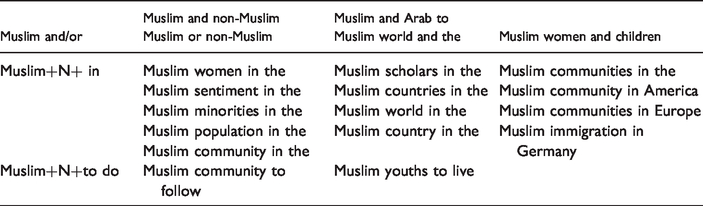
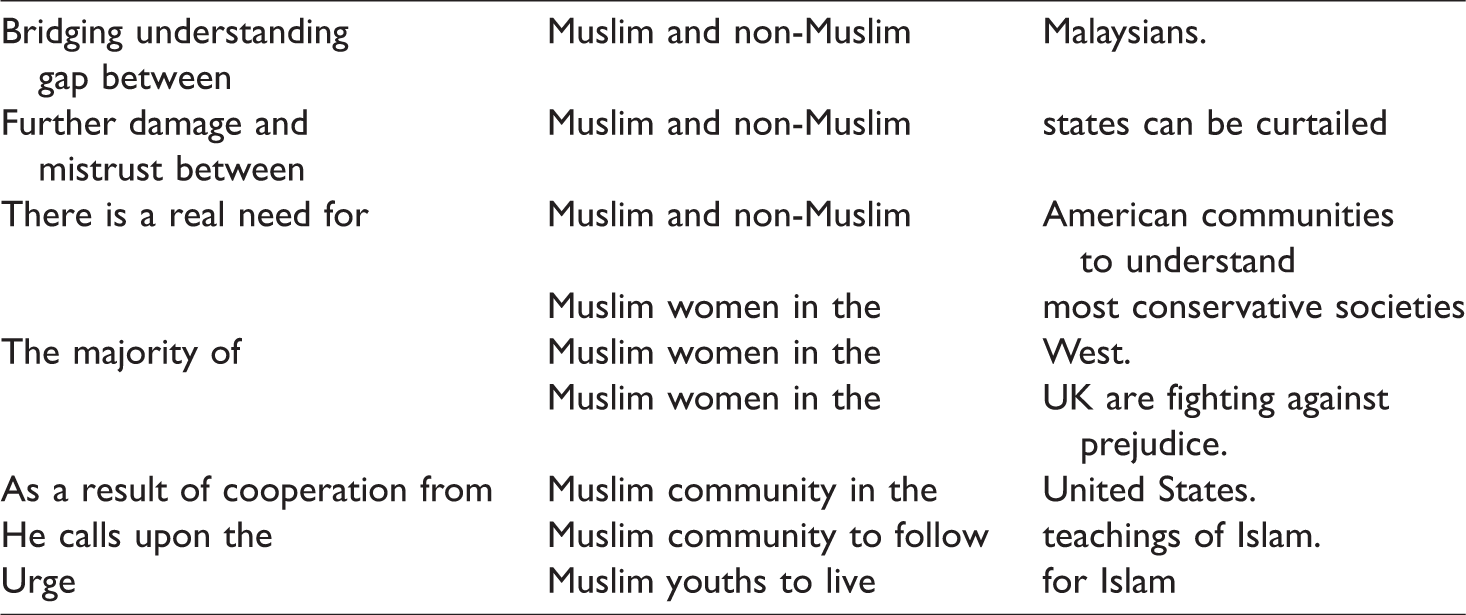
These R3-Clusters seem to be complex and disorderly, but deep analysis revealed three distinct formats among the R3-Clusters: Muslim and/or, Muslim+N+in, and Muslim +N+to do (as shown in Table 9).
Three formats of Muslim’s R3-clusters.

Based on those R3-Clusters in the concordance (as shown in Table 10), the things that the New York Times tends to hide within the formats or structures can be discerned. The New York Times chooses the Muslim and/or format to form some comparison or connection between Muslim and non-Muslim or between some Muslim group and others. Although these words do not have a strong semantic preference, the high-frequency comparison creates one image within people’s minds–Muslims are compared with others all the time. The format of Muslim+N+in shows as many hidden details as other formats. First, the Muslim+N refers to some part of the Muslims like those belonging to a certain identity or group. Then, the preposition in is used directly following the Muslim+N, giving this particular Muslim group some more detailed limits in space–the local context in which Muslims are expected to integrated. Hence, Muslims are represented in the New York Times as those needing integration under plenty of restrictions. From the concordances, the format of Muslim+N+to do indicates that Muslims are always required or forced to do things, suggesting that Muslims lack agency rather than following their hearts and making their own decisions. In this way, Muslims are represented as the negative receiver.
Above all, by analyzing R3-Clusters of Muslim, the conclusion can be reached that the representation of Muslims in the New York Times is one in which they are compared with others all the time and require integration under many restrictions as a negative receiver.
Discursive strategy analysis of representation of Islam and Muslims
This analysis focuses on interpreting discursive strategies exploited to perpetuate and promote the ideological themes in discourse. As Fairclough and Wodak (1997: 258) point out, “discursive practices may have major ideological effects–that is, they can help produce and reproduce unequal power relations between (for instance) social classes, women and men, and ethnic/cultural majorities and minorities through the ways in which they represent things and position people.”
Selection and silence
Selection serves as a potential strategy to promote ideologies in discourse studies. The selection of certain materials and topics to be published and the choice of linguistic structures to be exploited are ideological rather than conventional. In the I & M corpus, this strategy demonstrates the following aspects. First, with regards to the overall image, ideology is evident in the selection of stories from 2000 to 2016. According to the corpus, the New York Times chooses to provide more materials and stories of Islam and Muslims when the world is frequently disturbed by terror-related issues, such as the years from 2001 to 2002, from 2005 to 2006, from 2011 to 2012, and from 2013 to 2015. Second, in the representation of Islam, it reflects the selection of collocates. The New York Times chooses collocates with positive semantic preference to express an opposite view that Muslims rather than the Westerners fail to make Islam understood. In addition, for collocates with neutral semantic preference, the newspaper prefers to select their lower-frequency usage in the corresponding context. With regards to those with negative semantic preference, the New York Times tends to select words with prefixes having negative meaning, such as de-, dis-, and mis-, so as to combine Muslims with terrorists, radicalists, extremists, and potential threats. Third, in the representation of Muslims, it reflects the selection of clusters, especially in the analysis Muslim’s R3-Clusters.
Islam and Muslims, as the targeted topics, are sidelined in their own representation from media reports. In this course of representation, the media may exploit the strategy of silence, generating the absence of Muslims. The strategy of silence can be regarded as the inevitable result or the side effect of the strategy of selection. Once the media intentionally select among materials, they must make something salient while silencing other aspects of a topic.
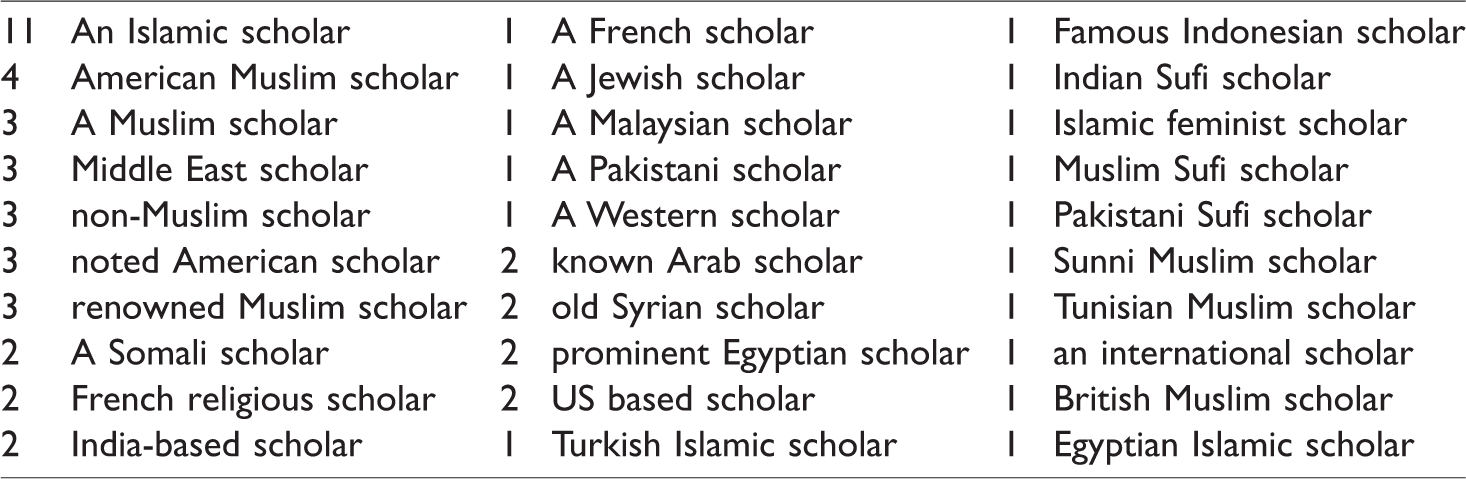
The New York Times has exploited the strategy of silence mainly in three aspects: silence in the economy, silence of the majority of Muslims, and silence of Islamic scholars from the Muslim Community. First, for the Muslim countries trapped in issues of terrorism, the newspaper ignores their economic conditions and silences their voices. Second, it sidelines the voices and experiences of the majority of Muslims. The Islam-related and Muslim-related areas in the New York Times are not areas with high Muslim populations but those with high Muslim proportions of the population. For the distribution of Muslims, Asia has the largest Muslim population, 60% of the total Muslim population. However, it is difficult for Asian Islam to make its voice heard over the strident clamor of extremists. Lastly, the newspaper makes the absence of Islamic scholars from Muslim communities more pronounced. Through a L2-clusters analysis of scholar (Table 11), three types are classified, including Islamic scholars with unknown regions, Islamic scholars from certain Muslim communities, and scholars from non-Muslim communities. The scholars from non-Muslim communities are the most frequent, twice the occurrence of Islamic scholars from certain Muslim communities. In other words, Islamic scholars from Muslim communities have less discursive power than scholars from non-Muslim communities in the discourse of Islam and Muslims. Without an accurate interpretation of Islam from the real Muslim scholars, the information transferred by the New York Times is far from objective and comprehensive. Furthermore, this strategy of silence accounts for the absence of Islamic scholars from Muslim communities.
Clusters of scholars in the corpus.
Generalization
Teo (2000) states that in media discourse, generalization offers reporters a convenient means to ascribe certain key qualities to the main subjects of news discourse without encumbering the reader with tedious details. In other words, reporters tend to make use of generalization as a discursive strategy to make limited self-description of a small group while expressing underlying collective knowledge. Fairclough (1995) points out that, as a discursive strategy, generalization contributes to the development of the negative representation or stereotyping of a certain group of people.
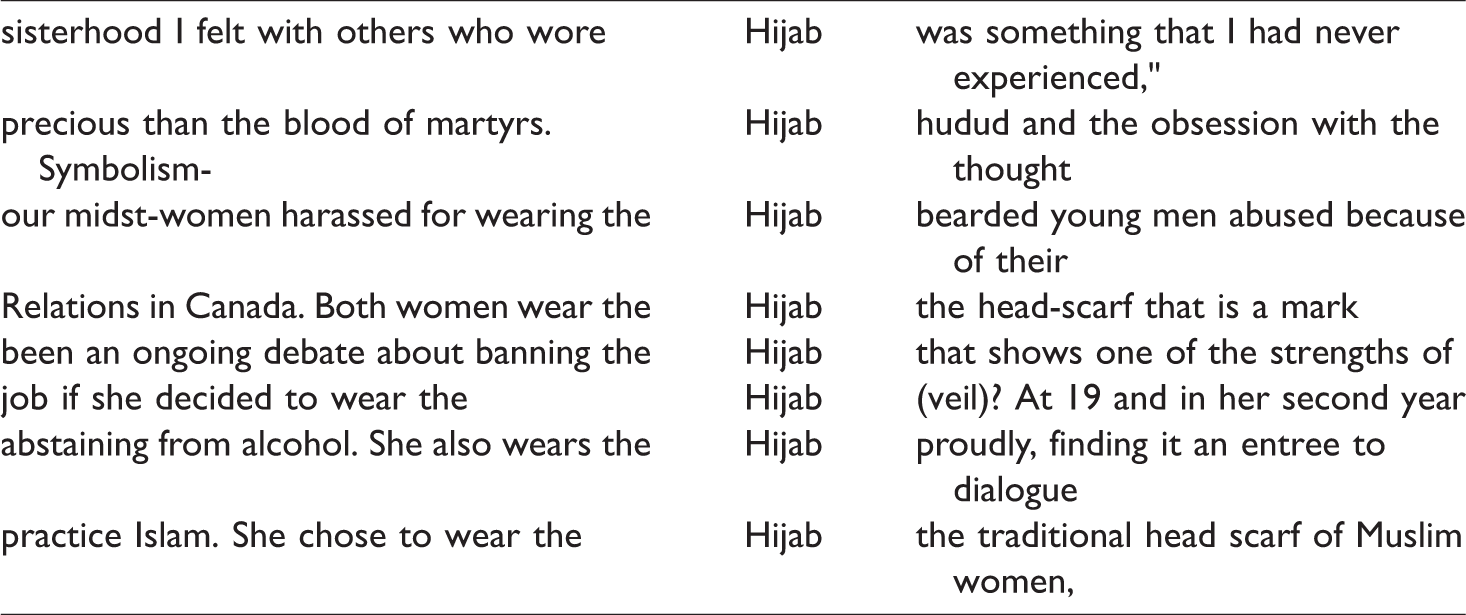
In a collocation analysis of Islam and Muslims, generalization has been found in the New York Times in two ways: one is using a certain quality as the only one to refer to the group; another is extending the characteristics of a specific group to a much more general group. These two ways can be discerned from the usage of hijab and Islamic terrorism in the corpus.
In the I & M corpus, the word hijab is closely related to Muslim women. Hijab refers to a covering for the head and the face worn by Muslim women. The hijab has been something special to Muslim women, but it is used by the New York Times as a primary subject when it talks about Muslim women, and other details of Muslim women are ignored. Meanwhile, hijab is combined with obsession in Line 2, with harassed in Line 3, with mark in Line 4, and with banning in Line 5 (as shown in Table 12). The hijab has been represented as a mark of Muslim women, indicating the unfair treatments they have suffered. Using hijab as the only representation of Muslim women actually forms a stereotype of this group of people. The issues arising from hijab, such as banning the hijab, oppression of Muslim women, or debates on Muslim women’ rights, have occupied the headlines in the New York Times.
Binary opposition
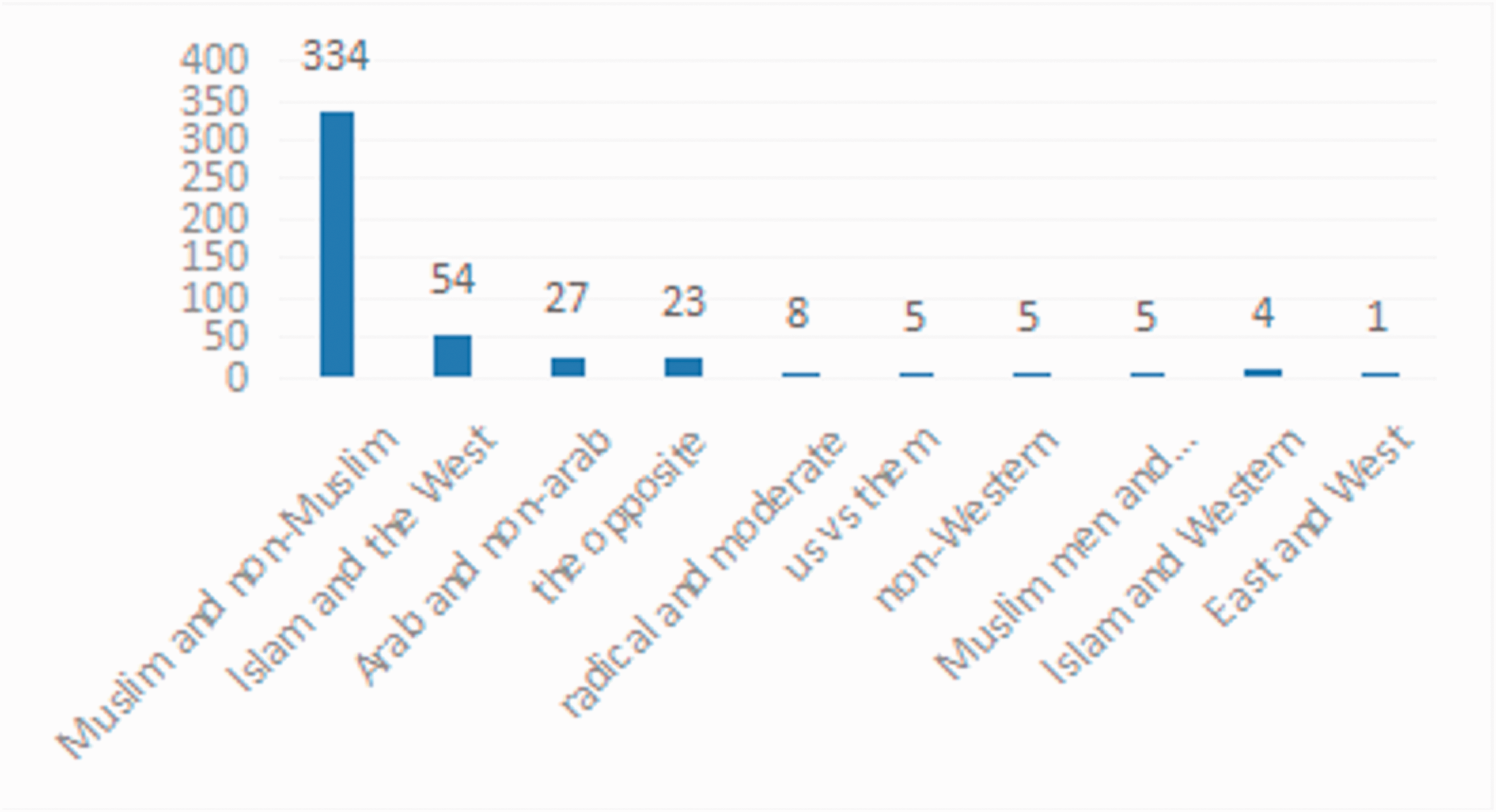
Many opinion pieces in the press develop a stark black-and-white dichotomy pitting “us” against “them.” Using the strategy of binary opposition. A binary opposition is a pair of related terms or concepts that are opposite in meaning. Binary has the potential for deep and problematic influences in society, constructing specific stereotypes about particular groups, silencing the diversity of voices, and breeding more discontent and conflict orientation in the process (Roy, 2012: 556–570). For example, when the press uses categories like Oriental and Western as both the starting and end points of reports, the result is usually to polarize the distinction, making the Oriental more Oriental while the Western becomes more Western. An analysis of N-grams in this I & M corpus reveals multiple binary oppositions employed by the New York Times. They are shown in the Figure 3.
Frequency of expressions with binary opposition.
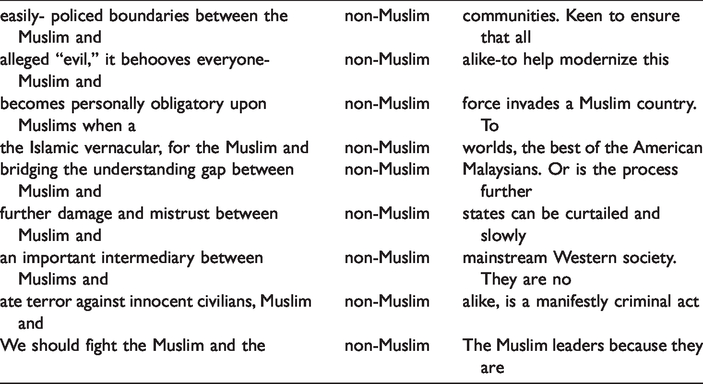
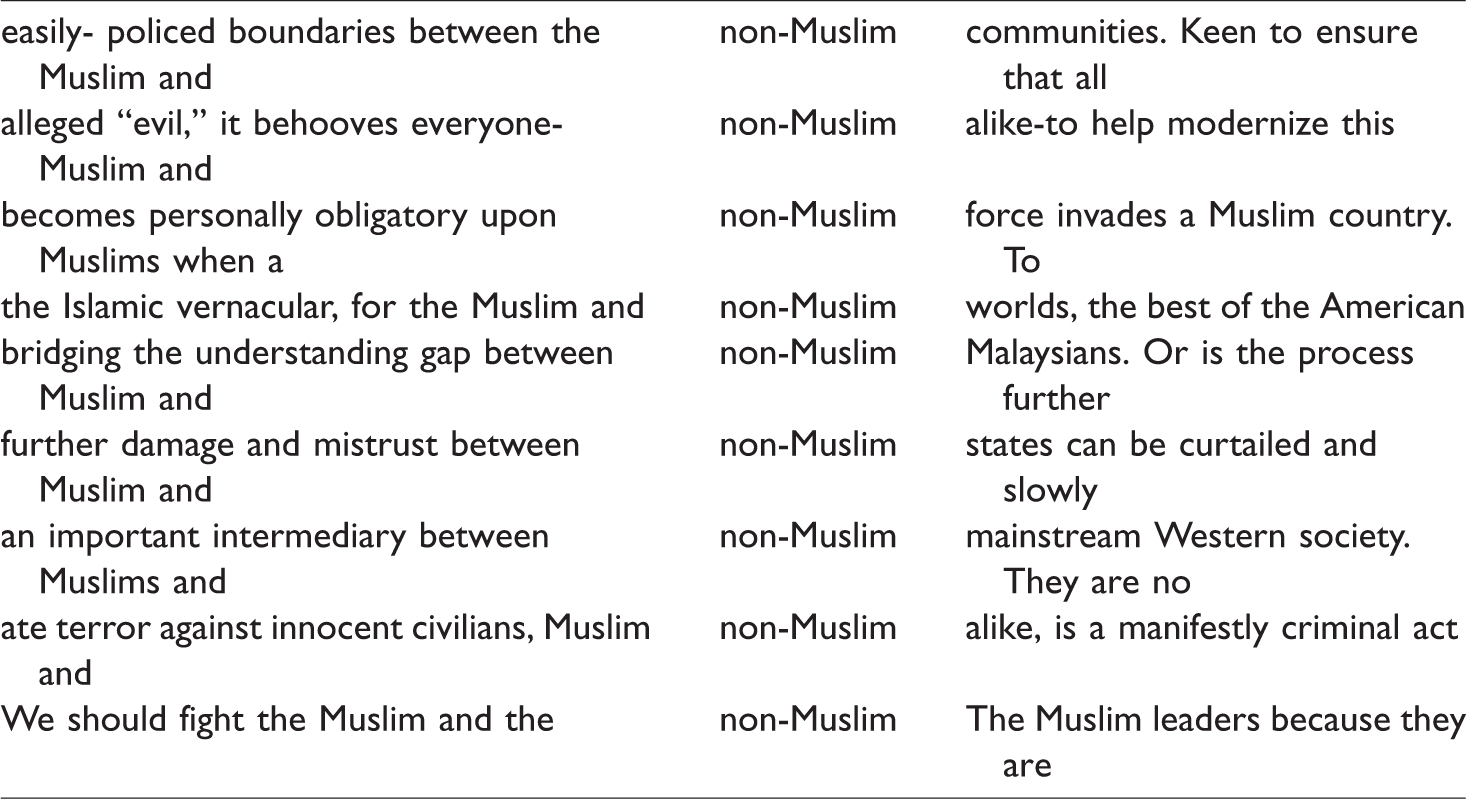
In Figure 3, the New York Times employs the expression Muslim and non-Muslim 334 times, distinguishing the world into two different groups. Furthermore, the New York Times has paid attention to the report of Muslim men and women. As for the representation of Islam, the newspaper chooses expressions indicating the gap between Islam and the West, such as Islam and the West and Islam and Western. Besides them, Arab and non-Arab, us vs. them, non-Western, and East and West are other regular binary oppositions that appear in the New York Times. The following table shows an analysis of the binary oppositions in the corpus through concordances using Muslim and non-Muslim as an example.
In Table 13, Muslim and non-Muslim has been used as an indicator to distinguish people into opposite groups in certain regions, communities or countries, such as Muslim and non-Muslim Malaysians in Line 5, Muslim and non-Muslim states in Line 6, and Muslim and non-Muslim communities in Line 1. The binary opposition of Muslim and non-Muslim has been used to foster further damage, mistrust and an understanding gap between two sides. The overemphasis on the gap makes Muslim and non-Muslim seem to be two complete opposites, which further strengthens the already heavily policed boundaries. This kind of binary opposition thought is well known as the concept of “us vs. them,” the characteristic of Orientalism. The Orient is assumed to be the antithesis of the Occident, just as “they” is represented as the negation of “us” (Poorebrahim, 2012).
Conclusion
Drawing on the process of media representation, this study reveals that region and community, violence and terrorism, the political, and the cultural and social emerge as the dominant themes to describe Islam and Muslims in the New York Times.
Based on the analysis of Islam, the stereotypes of Islam as unacclimatized outsider and Islam as turmoil-maker in the media have been formed. Lack of integration capacity is regarded as the incompetence of the whole “them” group from the perspective of the “us” group. The New York Times often speaks about Muslims rather than to them (Mamdani, 2004), reflecting the tendency to treat Muslims as outsiders. Gradually, the negative representation of the “them” group as unacclimatized outsiders develops into a knowledge structure known to most people in the “us” group. Turmoil maker means that in some regions, Islam is represented as the trigger of unrest, such as in Asia. In Asia, the current focus of audience on Asian Islam has concentrated on the Middle East, accompanied by the terrorist attacks, breakdowns, regime changes, and violence. Islam as a “them” group is depicted to account for the unrest and serious social issues in these regions. The potential for triggering unrest is regarded as the danger of the “them” group preparing for the “us” group. Similarly, the negative representation of the “them” group as a turmoil maker develops into a knowledge structure known to most people in the “us” group.
Based on the cluster and collocate analysis of Muslims, the stereotype of Muslims has been formed into the formats and linguistics structures. Taking the format of Muslim+N + in as an example, it gives a particular Muslim group detailed limits in space–the local context in which Muslims are expected to integrated. Hence, Muslims are represented in the New York Times as those needing and accepting integration under an abundance of restrictions. Similarly, the format of Muslim+N+to do indicates that Muslims are always required or forced to do things, making people apt to believe that Muslims need to do things that they are suggested or required rather than assuming agency. In this way, Muslims are represented as the negative receiver.
Discursive strategies on two levels have been clarified: the strategy of selection and silence on a macro level, and the strategy of binary opposition and generalization on a micro level. The New York Times succeeds in presenting a partial view of Islam and Muslims and separating “us” and “them” by ignoring the economic condition of the Muslim countries trapped in terrorist issues, sidelining the voices and experiences of the majority of Muslims, and ignoring Islamic scholars from Muslim communities. The New York Times protects itself from criticism by doubting the righteousness and legality of some Islam or Muslim-related subjects.
This study represents an attempt to enable a more nuanced understanding of the media portrayal of Islam and Muslim, and to provide the world an opportunity to view Islam and Muslims with accurate information, critical thinking, and a reasonable standpoint. Also, this portrayal contributes to an informed debate about the role of the media in constructing ideas about Muslim as well as deep conversations among different religions and cultures. Furthermore, this study helps distinguish the distorted and partial representation from the real presentation, return the objective Middle East, the Arab, the Islam and Muslims to the world, and most important, calls for awareness and an inclusive understanding of Islam and Muslims. Misrepresentation originates from ignorance, and unfamiliarity breeds misunderstanding. A change will also require journalists and media professionals to critically reflect on their role in shaping how Islam and Muslims are understood, and the key to reducing hatred against Muslims may come through more inter-religious contact (Putnam and Campbell, 2010).
Footnotes
Declaration of conflicting interests
The author(s) declared no potential conflicts of interest with respect to the research, authorship, and/or publication of this article.
Funding
The author(s) received no financial support for the research, authorship, and/or publication of this article.
