



Abstract
Procedural justice is known to enhance perceptions of police legitimacy. Studies show that procedural justice may be less effective for some individuals and groups, while others show it to be more effective. This study investigates the contingency of the procedural justice effect and considers the effectiveness of procedural justice for certain individuals through the concept of disengagement. Utilizing a survey of 1480 ethnic minority group members, the study tests whether or not disengagement moderates the effect of procedural justice on perceptions of police legitimacy. As expected, we find procedural justice is linked to enhanced perceptions of police legitimacy, while disengagement is associated with reduced perceptions of legitimacy. Interestingly, the study finds that procedural justice is more effective for building legitimacy for ethnic minority respondents who report being highly disengaged from police. These findings highlight how police might be able to improve perceptions of their legitimacy among disaffected minority communities.
Introduction
Policing agencies worldwide struggle to engage ethnic and racial minority groups. Ethnic and racial minority group members are more likely to avoid contact with police, and see police as less legitimate or trustworthy, compared to those from non-minority groups (Brown and Benedict, 2002; Murphy and Cherney, 2011; Tyler and Huo, 2002; Van Craen, 2012; Warren, 2011; Weitzer, 1999; Wortley and Owusu-Bempah, 2009). This distrust of police is exacerbated by both personal and vicarious experiences of police bias and racism.
Police-perpetrated violence against racial minorities is becoming the focus of increased scrutiny. At the time of writing, police-involved shootings in the USA figure prominently in international news stories. Videos of black men being shot by police, and subsequent community protests, rapidly circulate in news and social media platforms (Kochel, 2014). These acute examples of what poor police–citizen interactions can look like, are accompanied by frustrations about racial profiling and over-policing (Jonathan-Zamir and Weisburd, 2013; Spalek, 2010; Weitzer and Tuch, 2002).
Of course, such experiences are not unique to the USA. Numerous examples of biased or racist policing have also been noted in the UK, Canada and Australia (see Aly, 2007; Blackwood et al., 2013; Cunneen, 2001; Delsol and Shiner, 2006; Meehan and Ponder, 2002; Parmar, 2011; Royal Commission on Aboriginal Deaths in Custody, 1991; Wortley and Tanner, 2005). The consequence of biased policing is that many racial minority groups question whether police serve their best interests and, subsequently, seek to distance themselves from the police and avoid contact with police even in times of need (Weitzer, 2010).
In response to mounting police–minority tensions, police departments worldwide are reconsidering their approach to a diverse citizenry. In order to (re)gain the confidence and support of ethnic minority communities, police recognize that it is through positive police–community interactions, not bias and oppression, that they can win back the support of disaffected groups. In this regard, procedurally just policing is painted as the ‘panacea for all ills’, positively impacting all individuals and groups equally (Tyler, 1990; Wolfe et al., 2016). Recently, the President’s Task Force on 21st Century Policing in the USA recommended that procedural justice be used as a tool to increase trust and confidence in the police, particularly in light of police–ethnic tensions. However, recent studies have questioned the effectiveness of procedural justice for all minority or disenfranchised groups (e.g. Karakus, 2017; Murphy and Cherney, 2011). The current study examines the efficacy of procedurally just policing for improving police–minority relations. Of particular interest is whether procedurally just policing will be effective or ineffective when used with disengaged members of minority communities.
What Is Procedural Justice and Why Does It Matter?
Procedurally just policing is built on the premise that citizens’ views of authority figures are dependent on how they are treated. While people are concerned with the outcomes of their interactions with police (such as whether they are arrested or receive a traffic infringement), procedural justice theory states that beliefs about the legitimacy of police are primarily dependent on how the citizen is treated and how decisions are made during an interaction. If treatment and decisions are perceived as fair and reasonable by the citizen, then that citizen will be more likely to believe the police officer is legitimate (Tyler, 1990). Procedural justice can be experienced personally during an actual encounter with police, or it can be experienced vicariously through stories relayed through one’s social group.
Tyler (1990) contends for police–citizen interactions to be procedurally just they must include four elements reflective of the fairness of treatment and decisions. These are: voice; respect; neutrality; and trustworthiness. If citizens are given an opportunity to convey their side of the story before a decision is made (i.e. voice), if decisions are unbiased (i.e. neutrality), if citizens are treated politely and with dignity (i.e. respect) and if the police convey that they have the public’s best interests in mind (i.e. trustworthiness), then citizens will be more likely to believe the police are legitimate (Sunshine and Tyler, 2003; Tyler and Fagan, 2008).
Legitimacy is important because once citizens believe an authority is legitimate they feel more inclined to support that authority and abide by its rules. It follows that if police are viewed as legitimate, citizens will be more likely to assist police in their crime control efforts (Murphy et al., 2008; Sunshine and Tyler, 2003) and comply with police requests (Tyler, 1990). Legitimacy reflects the belief that the police are entitled to exercise their authority to maintain social order, manage conflicts and solve problems in their communities. Legitimacy has traditionally been conceptualized as reflecting three judgements. The first is public trust and confidence in the police. This is the belief that the police are honest, try to do their jobs well and are able to protect the community against crime and violence. Second, legitimacy reflects the public’s willingness to defer to the law and to police authority. Third, legitimacy involves the belief that police actions are morally correct and appropriate (Jackson et al., 2012). Research consistently shows that police legitimacy can be enhanced or damaged in personal or vicarious encounters with individual police officers, with Sunshine and Tyler (2003) demonstrating that legitimacy can be enhanced with procedurally just policing.
Procedurally Just Policing: Does It Always Work?
Procedural justice is promoted as a way in which police can better work with ethnic and racial minority groups (President’s Task Force on 21st Century Policing, 2015). However, despite mounting evidence in support of procedural justice practices, the extent to which procedural justice will be effective in promoting police legitimacy in different population groups has received very little attention in the literature; whether it will promote perceptions of legitimacy among disaffected individuals is yet to be fully explored. The effect of procedural justice may, in fact, be contingent upon other factors.
Braithwaite, for example, argues that procedural justice may not be enough to foster perceptions of legitimacy among those who are disengaged from authority (Braithwaite, 2009). Braithwaite (2009) suggests that procedural justice works for most, but she argues this may not be the case for those who are dismissive of authorities and question their right to govern. For such disengaged individuals, Braithwaite argues that procedural justice can be perceived as a disingenuous attempt by authorities to elicit the individual’s support, thereby rendering procedural justice ineffective. In other words, the efficacy of procedural justice may be contingent on people’s level of engagement with authorities. Tyler and Lind’s (1992) group value model similarly predicts that procedural justice should matter less to those who do not identify with mainstream authorities. The group value model posits that those who identify weakly with mainstream groups and their representatives are typically less inclined to support those authorities. Some ethnic minorities, for example, may be less concerned about how they are treated by police due to their general disconnect from law enforcement.
Disengagement is an important concept to consider when studying the policing of ethnic minorities because it is disaffected minorities that often pose the greatest challenge for police. This disaffection can be related to both personal as well as vicarious experience, as research suggests that the experiences of others are associated with how citizens in turn view the police (Rosenbaum et al., 2005). Through this form of legal socialization, one might disengage from police without actually having a negative interaction of their own with police; instead, adopting negative views of the police based on how friends and family members have been treated by police officers. According to Braithwaite (2009), there are a number of postures that individuals can adopt towards authority. These postures are based on the social distance they seek to maintain from authority. Individuals who adopt a disengaged posture towards authority elect to maintain the greatest amount of distance between themselves and the authority. In doing so they seek to operate outside of the authority’s social system, avoiding all contact with the authority and their rules. In a policing context this may include individuals going out of their way to avoid contact with police and refusing to call police as a victim or witness; opting to maintain an emotional detachment from police while no longer fearing the consequences that non-compliance could elicit. The ability of police to work collaboratively alongside individuals and communities to effectively address crime and disorder is compromised in such circumstances. For individuals who feel disengaged and have little regard for the police as a social institution, procedurally just interactions may be viewed as ‘too little too late’, having little impact on police efforts to improve relationships with minority groups (Braithwaite, 2009).
Other scholars have also articulated the effects of ‘disengagement’ and its possible relationship to procedural justice. Like Braithwaite (2009), Bradford and Jackson (2010) propose that people are differentially receptive to procedural justice. Bradford and Jackson argue that those who feel extremely marginalized by police may interpret unfair treatment as being much more unjust. In contrast to Braithwaite’s perspective, however, Bradford and Jackson (2010) frame procedural justice as being more (not less) effective for disaffected groups. While Lind and Tyler’s (1988) group value model suggests procedural justice should matter most to those who strongly identify with police, the model also leaves open the possibility that procedural justice will assume special importance to individuals who feel uncertain about their status within a group. Lind and Tyler (1988: 238) propose that when ‘persons of insecure status see a procedure as being unjust […] they will react especially strongly to the procedural injustice, and the perception of injustice will have strong negative effects on a wide variety of attitudes, beliefs, and behaviour’.
Lind and Tyler’s (1988) group value model as well as Lind and Van Den Bos’ (2002) uncertainty management model provide an explanation for why this might be so. The group value model suggests that police (as important representatives of society) convey important identity relevant information to people. Fair treatment imparted by the police communicates to people information about their level of inclusion, standing and value within society. Fair treatment signals inclusion and equal standing, while unfair and disrespectful treatment signals further exclusion. This suggests that disengaged individuals may place greater value on procedural justice because it communicates to them that they are respected and worthy of status within the valued ‘in-group’. Lind and Van Den Bos’ (2002) uncertainty management model makes a similar argument. Their model suggests that ‘status uncertainty’ can leave individuals feeling extremely anxious about what to expect in an encounter with an authority. To counterbalance these negative feelings, individuals therefore focus on whether they receive procedural fairness from the authority. In fact, Colquitt et al. (2012) show empirically that procedural justice can act as an uncertainty reducer in authority/subordinate relationships. One could reasonably argue that ethnic minorities will be more likely to feel status uncertainty than non-minorities, and several recent policing studies have put forward the uncertainty management model as a possible explanation for why procedural justice may take on special importance to individuals from different population groups (e.g. see Murphy, 2013, for ethnic minorities; Murphy and Barkworth, 2015 for crime victims; Wolfe et al., 2016 for a variety of population groups).
To date, the contingent effects of procedurally just policing have received relatively little empirical attention (Wolfe et al., 2016). Research predominantly tests whether procedural justice promotes public trust in police, the legitimacy of police or people’s willingness to cooperate and comply with police in a broader sense. Studies that question whether procedurally just policing affects all people equally in the population provide mixed evidence: some support Braithwaite’s (2009) predictions while others support Bradford and Jackson’s (2010) claims. For example, in studies that explore this question using ethnic minority groups, Murphy and Cherney (2011) find that ethnicity moderates the relationship between procedural justice and people’s willingness to cooperate with police. In their study, procedural justice was less effective in encouraging willingness to cooperate with police among ethnic minority group members when compared to non-minority group members. In a follow-up study, Murphy and Cherney (2012) find that procedural justice only has a negative effect on people’s cooperative behaviour for ethnic minority group members who report being disengaged from police. Sargeant et al. (2014) also find that procedural justice policing matters little to some minority groups, while Wolfe et al. (2016) find procedural justice effects are consistent across different racial groups in the USA.
Other studies, in contrast, suggest procedural justice matters more for ethnic minorities. Murphy (2013), for example, finds that procedural justice is a stronger predictor of trust in the police for ethnic minority group members who identify weakly with their minority cultural group, and that procedural justice matters less to those who identify strongly with the majority cultural group. In an experimental field trial of procedurally just policing during road stops, Murphy and Mazerolle (2016) also find that procedural justice results in more favourable assessments of police for young immigrants, but has a counter-productive effect for young non-immigrants.
Together the findings are mixed. Some reveal that procedurally just policing may not improve attitudes to police for disaffected minority groups, while others suggest the opposite. We need to know more about the conditions under which procedural justice policing will have positive or negative effects on minority attitudes and behaviours towards police. Through exploring potential moderators of the procedural justice effect researchers may gain a better understanding of when and why procedural justice policing is likely to have the most beneficial effect for promoting public perceptions of police.
The Current Study
The current study specifically examines how feelings of disengagement towards police moderate the effect of procedural justice on ethnic minority group members’ perceptions of police legitimacy. Based on prior literature, the current study tests three hypotheses: (H1) that positive perceptions of procedural justice policing will be associated with more positive perceptions of police legitimacy; (H2) that greater feelings of disengagement will be associated with lower perceptions of police legitimacy; and importantly, that feelings of disengagement will moderate the procedural justice–legitimacy relationship. The direction of the moderation effect, however, could go either way: (H3(a)) procedural justice might matter more to those who are engaged, in line with Braithwaite’s (2009) suggestion; or (H3(b)) procedural justice might carry greater weight among those who are disengaged from police, in line with Bradford and Jackson’s (2010) suggestion. These associations are examined using survey data collected from three ethnic minority groups in Australia.
Methods
Sample
To test the hypotheses described above, this study employs data from the Ethnic Community Survey (ECS). A total of 1480 people of Indian, Vietnamese and Arabic-speaking backgrounds living in Brisbane and Melbourne, Australia were surveyed. These three groups were selected because they comprise common ethnic minority communities in Australia, comprising just over 3 per cent of the total Australian population (Australian Bureau of Statistics, 2006). They were also chosen because they are each known to have experienced problematic relationships with the police in Australia (e.g. Dixon and Maher, 2002; Mason, 2012; Meredyth et al., 2010; White, 2009).
The Ethnic Community Survey was run in parallel with the Australian Community Capacity Survey (ACCS); a larger study of people living in 298 randomly selected suburbs in Brisbane and Melbourne, Australia. The ECS participants were sampled from postal codes (zip codes) in and around these 298 suburbs. 1 In order to obtain the sample, a sampling pool of surnames was compiled using an ‘ethnic naming method’ (a sampling methodology used in other Australian studies which require access to hard-to-reach groups in the population; see Challice and Johnson, 2005). Given that the populations of interest comprise only 3 per cent of the Australian population, traditional sampling techniques that rely on random digit dialling are inappropriate for sampling small population groups. The ethnic naming method involved generating three lists of the most common surnames in the three ethnic groups of interest: Arabic-speaking (99 surnames – e.g. Ahmed), Indian (116 surnames – e.g. Chopra) and Vietnamese (34 surnames – e.g. Nguyen). The electronic telephone directory was searched for these distinct surnames, generating the sampling frame. Random digit dialling was then employed to randomly select and contact participants for study recruitment from each of the three sampling frames. Thus, while the resultant survey sample cannot be said to be a true representative sample, given the population of interest, achieving a representative sample would be extremely difficult and would require a far larger research budget. The sampling strategy employed here was thus the most robust way to get as close to a generally representative sample of these three population groups as possible.
Data collection took place in two waves. Wave 1 took place between September and December of 2010, while Wave 2 took place between June and August 2011. In Wave 1, a sampling pool of 10,800 phone numbers attached to eligible surnames in the post codes corresponding to the 298 suburbs was drawn from the electronic telephone directory (1800 per ethnic group per city). In Wave 2 an additional sampling pool of 7200 phone numbers with eligible surnames was drawn (1200 per ethnic group per city).
It should be noted that no differences were found between the two waves nor were there any intervening events between the two waves of data collection. Rather, Wave 2 was needed to correct for an error in matching respondents between this sample and the larger ACCS study, where respondents were matched by post code rather than by suburb. While this was done to ensure comparability with the neighbourhood-level data collected in the larger study, both waves of data collected for the ethnic community portion of the study were suitable and could be used as stand-alone datasets. Given neighbourhood-level effects are not of interest to the current study, the Wave 1 and Wave 2 ethnic minority datasets were combined to create the sample used here.
On initial phone contact, the person in the household who was over 18 and was next due to celebrate their birthday was invited to participate in a face-to-face interview at a time convenient to them. A total of 487 Indian, 506 Vietnamese and 487 Arabic-speaking participants completed a survey. The total response rates for Wave 1 (N = 908) and Wave 2 (N = 572) were 44 per cent and 39.02 per cent respectively, with a combined response rate of 41.53 per cent (Murphy et al., 2012).
Variables
The key dependent variable in this study is police legitimacy (items are shown in Table 1). Legitimacy is typically measured with questions assessing public trust and confidence in police, feelings of obligation to obey police and perceptions that police are morally aligned with the public (Jackson et al., 2012; Tankebe, 2013; Tyler, 1990). Participants were asked to indicate their level of agreement with each statement, ranging from 1 = Strongly Disagree to 5 = Strongly Agree. A mean scale was then computed across the four items (M = 3.99, SD = 0.55), with a higher score on the scale indicating more favourable assessments of legitimacy (Cronbach’s alpha = 0.77).
Principal Components Factor Analysis with varimax rotation.

The procedural justice measure is based on the work of Tyler (1990) and comprised seven items (see Table 1), with each of the four key elements of procedural justice being measured (i.e. voice, respect, neutrality and trustworthiness). Participants were asked to indicate their level of agreement with each statement on a 1 = Strongly Disagree to 5 = Strongly Agree scale. It should be noted that this measure of procedural justice assesses general perceptions of procedural justice rather than assessments of procedural justice experienced during an actual encounter with police. A mean scale was computed (M = 3.70; SD = 0.63), with a higher score indicating more positive assessments of procedural justice (Cronbach’s alpha = 0.89).
The disengagement measure is drawn from the work of Braithwaite (2009) and comprised two items: ‘I don’t care if I am doing the right thing by police’ and ‘I don’t think there’s much the police can do to me to make me obey the law if I don’t want to’ (see Table 1). Participants were asked to indicate their level of agreement with these two statements designed to assess respondents’ level of apathy towards police and the extent to which the symbolic presence of police could compel them to obey the law. Each item was measured on a 1 = Strongly Disagree to 5 = Strongly Agree scale. A mean scale was computed (M = 2.36; SD = 0.83), with a higher score indicating a greater level of disengagement towards police (Cronbach’s alpha = 0.63).
A number of control variables were also measured and incorporated in the current study: age; gender; education level; annual income (in AUD); employment; survey wave; victimization (of the individual respondent or of someone in the household); perceptions of neighbourhood crime levels; marriage; number of children in the household; feelings of belonging in society; and whether the respondent reported being either Indian, Vietnamese or Arabic-speaking. Age and income were measured on a continuous scale, while gender (male = 1, female = 0), education (1 = tertiary educated; 0 = other) survey wave (Wave 2 = 1; Wave 1 = 0), employment (yes = 1; no = 0), marriage (yes = 1; no = 0), respondent or household member victimization (yes = 1; no = 0) were coded as dichotomous variables. Dummy variables were also created to measure ethnicity (Indian, Vietnamese and Arabic speaking), with Indian being the reference group.
Analysis
Prior to the regression analyses, the discriminant validity of the key independent and dependent variables were confirmed using a Principal Components Factor Analysis with varimax rotation (see Table 1). There was some weak cross-loading between two items in the police legitimacy scale with the procedural justice factor. However, these items were retained in the police legitimacy scale to ensure that all three elements of police legitimacy were captured (i.e. trust; obligation to obey; moral alignment). It should be noted when these two items were excluded from the legitimacy scale and the regression analysis was re-run without the items, it did not change the outcome of the results.
An Ordinary Least Squares regression analysis was computed to examine the relationship between the key independent variables and the dependent variable, police legitimacy, controlling for demographic characteristics and other control variables. Variables were entered into the regression analysis in blocks to examine the independent effects of control variables and the key independent variables on perceptions of police legitimacy. Prior to finalizing the regression analysis, a check for multivariate outliers was undertaken. While several outliers were identified, removal of outliers also had no effects on the final model. Therefore, the outliers were retained in the analysis.
Results
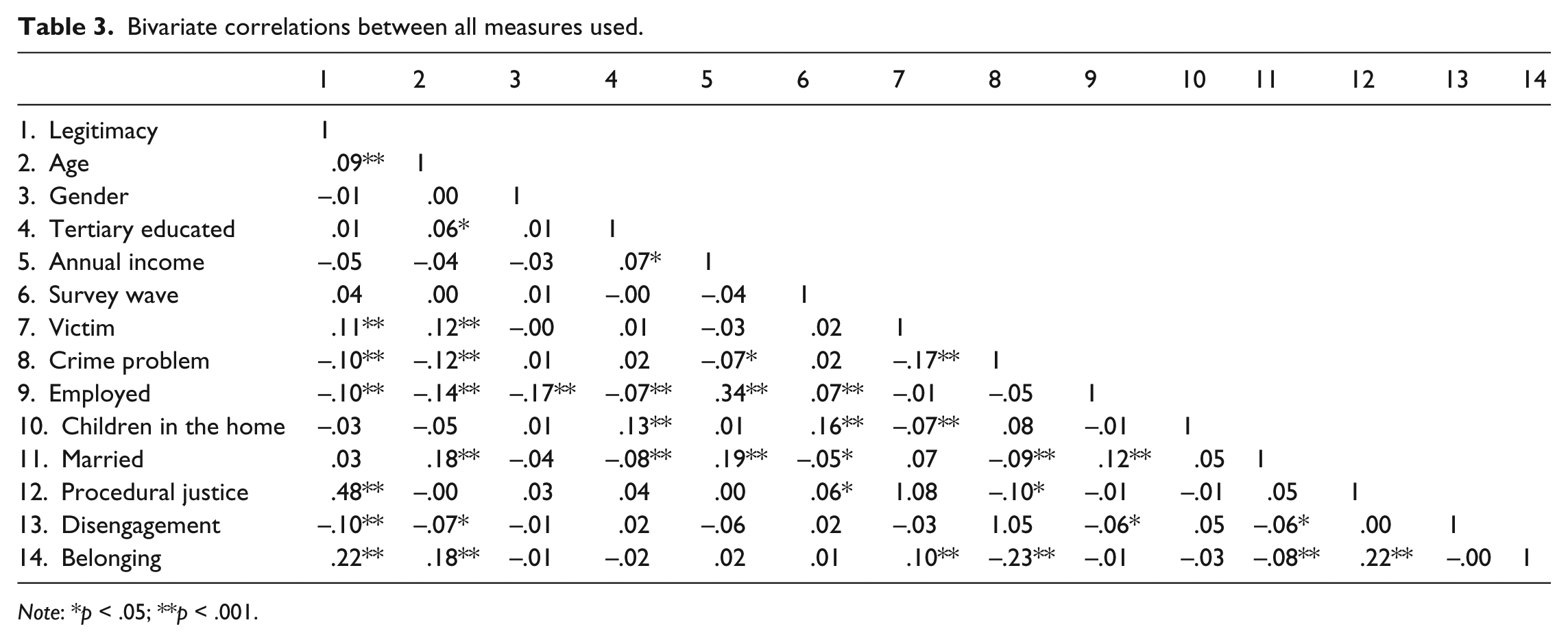
Descriptive statistics and bivariate relationships between each measure were calculated and are presented in Tables 2 and 3, respectively. The average age of participants was 39, and 50 per cent of the sample was male. Overall, it can be seen from Table 2 that both perceptions of police legitimacy and perceptions of procedural justice are above the mid-point of each respective scale, indicating that, on average, participants see police as legitimate authorities and believe the police are generally procedurally just. It can also be seen that, on average, participants do not report being highly disengaged from police and on average, tend to express feelings of belonging and pride in their current neighbourhood. When considering the bivariate correlations in Table 3, some important relationships can be noted. First, younger participants are less likely to view police as legitimate and are more likely to be disengaged from police. As expected, procedural justice is positively associated with legitimacy, while disengagement is negatively associated with police legitimacy. Interestingly, procedural justice and disengagement are unrelated to each other. While this finding is unexpected, this may be reflective of prior vicarious experience with police and the manner in which some may be socialized about the law and legal actors. In other words, they come with pre-existing views of police and procedural justice perceptions do not influence those views.
Descriptive statistics for all variables and scales used.

Note: % values reflect the 1 category; the income variable was measured on a 1 (<$20,000) to 8 ($150,000+) scale (the average of 3.19 fell in the $40,000–$60,000 range).
Bivariate correlations between all measures used.
Note: *p < .05; **p < .001.
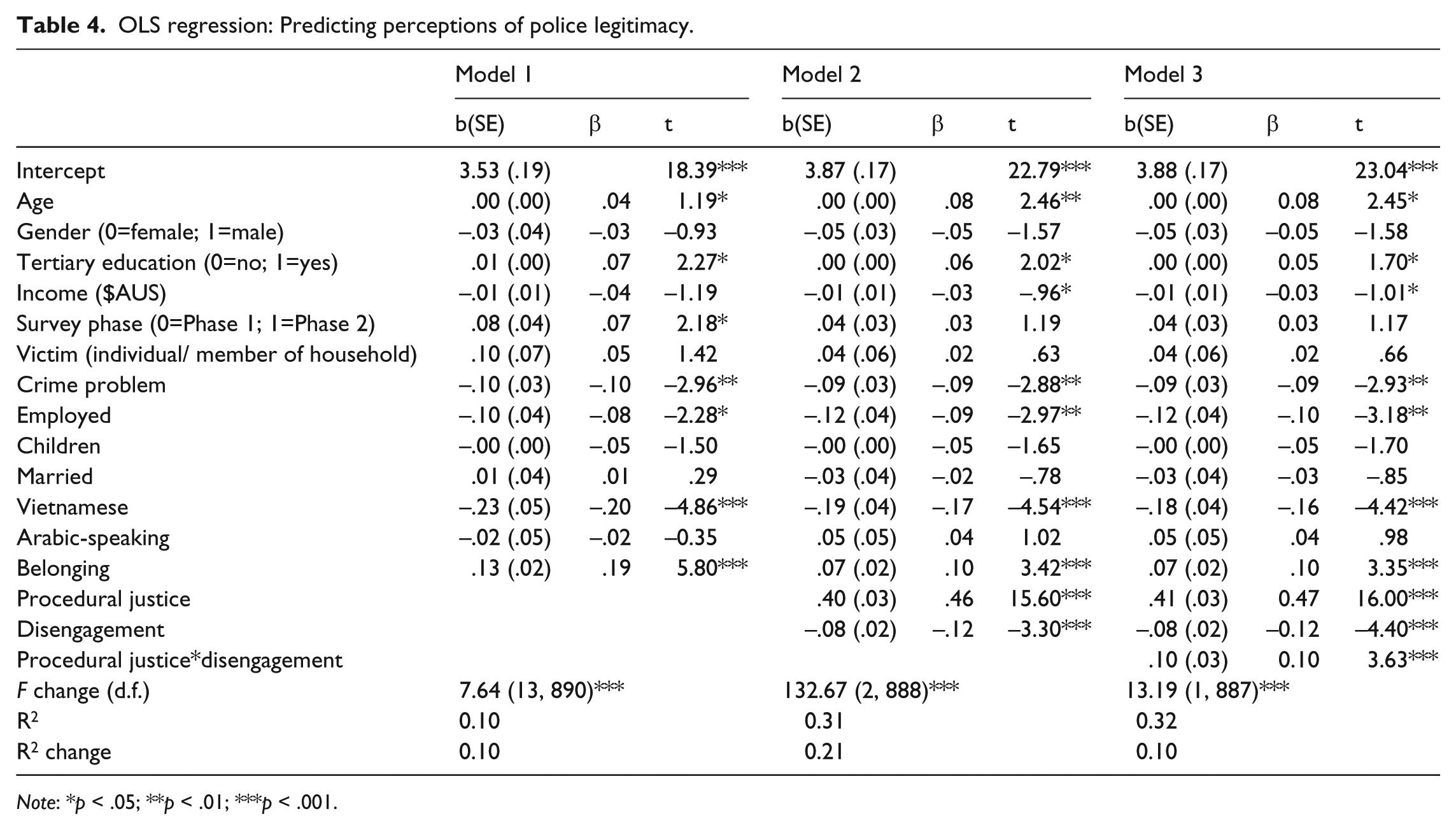
Turning to the Ordinary Least Squares regression analysis, demographic and control variables are entered first in Model 1 (see Table 4). The demographic characteristics explain 10 per cent of the variance in perceptions of police legitimacy. The results show that participants who are university educated are more likely to see police as legitimate, and as expected older participants also view police as more legitimate. Those who have a greater sense of belonging in their current neighbourhood are also more likely to perceive the police as embodying legitimacy. In contrast, when compared to Indian respondents, Vietnamese respondents are less likely to view the police as legitimate as are those who feel that crime is a problem in their neighbourhood.
OLS regression: Predicting perceptions of police legitimacy.
Note: *p < .05; **p < .01; ***p < .001.
Procedural justice and disengagement are entered together in Model 2, resulting in an R-squared change of 21 percentage points to the model. Combined with the demographic characteristics procedural justice and disengagement now explain 31 per cent of the variance in perceptions of police legitimacy. It can be seen that procedural justice has the strongest effect of all variables entered in the model so far. The findings reveal that procedural justice is positively associated with perceptions of legitimacy (H1 supported); the more respondents believe police are procedurally fair the more legitimate they view police. Disengagement, in contrast, is negatively associated with legitimacy perceptions (H2 supported); the more disengaged a participant is from police the less they view police as legitimate. Relative to the effect that procedural justice has on legitimacy perceptions, the effect of disengagement is quite small.
The final model examines the effect of the interaction term. 2 The interaction term is positive and significant (H3b supported). This indicates that disengagement levels do moderate the effect of general procedural justice perceptions on perceptions of legitimacy, at least for this sample. To better understand the nature of the interaction effect, simple slopes were calculated and the slopes were graphed (see Figure 1). Slopes were plotted for the relationship between procedural justice and police legitimacy for two values of disengagement: one standard deviation below the mean (low disengagement) and one standard deviation above the mean (high disengagement). Simple slopes were calculated as ß = 0.38, p < .001 for low disengagers, and ß = 0.56, p < .001 for high disengagers, respectively. These calculations, coupled with Figure 1, show that procedural justice has a greater positive effect on legitimacy perceptions for those who are highly disengaged compared to those who report low levels of disengagement from the police. Figure 1 also illustrates that high disengagers are just as likely as low disengagers to view police as legitimate if they feel police are procedurally fair. In contrast, compared to low disengagers, if high disengagers see police as procedurally unfair they are less likely to view police as legitimate.

The effect of general procedural justice perceptions on perceptions of police legitimacy as a function of disengagement levels.
Discussion
Even though prior research shows procedurally just policing can positively impact police–citizen relationships, and many studies have shown the procedural justice effect to be consistent across groups (see Wolfe et al., 2016), the contingency of the procedural justice effect remains underexplored in the literature. This study tests contrasting predictions about the relationship between procedural justice and legitimacy among survey participants from ethnic minority backgrounds. In particular, the focus is on whether disengagement levels within minority groups moderate the procedural justice–legitimacy relationship. Braithwaite (2009) suggests that police–citizen interactions characterized by procedural justice are likely to be inadequate when used with people who are dismissive of authority. She suggests that for disengaged individuals, attempts by authorities to use procedural justice can be viewed as disingenuous, or as the authority’s attempt to manipulate the individual. Bradford and Jackson (2010), in contrast, argue that procedural justice should take on special importance for such individuals because of the identity and inclusive conferring messages that fair treatment conveys to them.
The findings showed that procedural justice was positively associated with minority’s perceptions of police legitimacy, providing support for Hypothesis 1. Furthermore, the more disengaged an individual was, the less likely they were to perceive police as legitimate, confirming Hypothesis 2. Finally, confirming Hypothesis 3b, levels of disengagement moderated the relationship between procedural justice and views of police legitimacy. Contrary to Braithwaite’s (2009) argument, procedural justice was found to be more important for promoting perceptions of legitimacy among respondents who reported being highly disengaged from police. For those who were engaged, the analysis reveals that procedural justice had a positive effect on their legitimacy perceptions, but this effect was much weaker than for those who were highly disengaged. Importantly, the findings suggested that perceptions of police treatment characterized by a lack of procedural fairness are most likely to impact legitimacy perceptions for those who are disengaged from police (Bradford and Jackson, 2010); this can be observed by the lower legitimacy ratings in the procedural injustice/high disengagement condition displayed in Figure 1. Together, the findings are consistent with Bradford and Jackson’s (2010) postulation that individuals who feel more marginalized in society should place more emphasis on fair treatment from authorities. They also support predictions made by one version of Lind and Tyler’s (1988) group value model as well as Lind and Van Den Bos’ (2002) uncertainty management model.
Before discussing the theoretical and practical implications of these findings it is important to acknowledge some limitations of this study. First, this study sought to examine how disengagement levels moderated the effect of procedural justice on perceptions of police legitimacy among minority groups members. It can be argued that those who agreed to participate in the survey may not represent truly disengaged individuals, as these people may be unwilling to participate in surveys. Whether similar findings would be obtained with extremely disaffected individuals in the population remains to be seen. Second, it is important to highlight that while the sample included Indian, Vietnamese and Arabic-speaking members – some of the more common immigrant diasporas in Australia (Australian Bureau of Statistics, 2006) – these groups do not represent all ethnic and racial minority groups in Australia. The experiences of these groups may differ substantially from those of other ethnic groups in Australia. Third, the data utilized in this study is cross-sectional in nature. Hence, the true causal relationships between the variables examined cannot be ascertained. From the data, it is impossible to tease apart whether procedural justice and disengagement predict legitimacy perceptions or whether lower legitimacy perceptions result in lower perceptions of procedural justice and higher disengagement levels, respectively.
Despite these limitations the findings hold some important theoretical implications. In accordance with Lind and Tyler’s (1988) group value and Lind and Van Den Bos’ (2002) uncertainty management models the findings suggest that procedural justice may be particularly effective for building perceptions of police legitimacy if used with those who operate on the periphery of society. Lind and Tyler (1988) assert that when one holds negative feelings about their connection to a dominant group in society this can leave one sensitive to how members of the dominant group or their representatives treat them. When faced with biased or disrespectful treatment from a police officer this can result in solidifying distance between the minority individual/group and society more generally; it communicates an ‘out group’ status. Likewise, for status uncertain individuals, procedural injustice can serve to exacerbate their negative emotions and anxieties about how they expect to be treated by authorities.
Hence, when police use the elements of procedural justice during encounters with members of the public they can serve to reduce the social distance between both the specific officer and a marginalized individual, while also promoting more favourable views about the legitimacy of police more broadly. The findings support a growing number of empirical studies, mostly from Australia, that show that procedural justice effects can differ between population groups. Importantly, the findings challenge the recent view conveyed in the procedural justice literature that procedural justice effects tend to be consistent across population groups (see Wolfe et al., 2016). This is particularly important given the widespread support that policing agencies have bestowed upon procedural justice approaches, touting it as a means of improving citizen trust and confidence in police.
How Should Police Demonstrate Procedural Justice?
Overall, this study suggests that law enforcement strategies that seek to garner greater support and engagement from disaffected groups ought to be guided by the tenants of procedural justice. But how can this be achieved in practice? What should police do to ensure they utilize procedural justice in their interactions with all citizens?
When interacting with a citizen – whether as a suspect, victim, witness or concerned citizen – police ought to have procedural justice at front of mind. Police can employ the four key elements of procedural justice (i.e. respect, voice, trustworthiness and neutrality) as a means to encourage disaffected individuals to re-evaluate their disengaged position and view police in a more positive light. Police demeanour, for example, can signal either respect or disrespect when interacting with a member of the public. Appropriate and polite body language and carefully chosen words can be a powerful sign of respect, and can be a simple but effective starting point for police to consider how they are being perceived by others. Respect can also be demonstrated at a broader level by listening to the concerns of individuals, groups or communities. By giving voice and taking an active interest in the issues that concern disaffected groups, police can pave the way for two-way dialogue with minority communities. When pulling a driver over for a traffic offence, giving the driver an opportunity to explain themselves is another simple means by which police can offer voice and show respect to an individual (see Mazerolle et al., 2014). Police can further promote their legitimacy in the eyes of minority communities by working closely with their community leaders or community groups. Through community consultation police can demonstrate that they have a genuine desire for collaboration and inclusion. Doing so will also leave police better informed on what steps they can take to improve relations with disaffected individuals in the community.
To display trustworthiness officers should ensure that interactions with members of the public embody fair practices; police must demonstrate to citizens that they have their best interests at heart. For example, a driver of Asian descent who is pulled over by police may view such police action to be racially motivated. If police communicate to the driver the reason for their action (perhaps that the individual was speeding and they have been pulled over to prevent an accident) this may demonstrate that the police officer has the individual’s, as well as the community’s best interests in mind. As ethnic minority groups may be particularly concerned about the extent to which race shapes their interactions with law enforcement officers, police need to ensure that their interactions with all members of the public exhibit neutrality. Police stops that target particular minority groups can be perceived as a breach of neutrality (Tyler and Wakslak, 2004). The training of police on the importance of neutral, fair and unbiased treatment and decision making is likely to be a step in the right direction for promoting legitimacy perceptions among minority communities. The results presented in the current article suggest that such steps can improve police–minority relations, particularly among those who are highly disengaged from the police.
In conclusion, the current study shows that procedural justice effects can vary across different people. It also shows procedural justice has the potential to promote people’s perceptions of police legitimacy, particularly for those who are disengaged. As the current study demonstrates, legitimacy that is lost, or perhaps never conferred in the first place, can be built over time through the consistent application of procedurally just policing practices. However, police practitioners and scholars should not be so quick to presume that procedural justice will work equally effectively for all groups in the population. More research is required to understand when and why procedural justice works better for some groups but less so for others.
Footnotes
Declaration of Conflicting Interests
The author(s) declared no potential conflicts of interest with respect to the research, authorship, and/or publication of this article.
Funding
The author(s) disclosed receipt of the following financial support for the research, authorship, and/or publication of this article: The present research was supported by the Australian Research Council [Grant No.: DP1093960].