



Abstract
Police agencies are often seen as reliant on the public to give them the authority and power necessary to carry out their responsibilities, including controlling crime. As many police agencies begin to take on counterterrorism functions, this empowerment of the police is necessary in their fight against terrorism. To our knowledge, no study to date has focused on the empowerment of the police in their counterterrorism role and the factors that influence the willingness of the public to afford the police discretionary authority in terrorism matters. Using a sample of Israeli Jewish adults, we assess the impact of legitimacy-based evaluations, as well as fear of terrorism and political ideologies, on the public’s willingness to empower the police to handle homeland security matters. Police legitimacy and political ideology have a direct impact on police empowerment, while procedural justice, police performance, distributive fairness, and fear of victimization by terrorism also have indirect effects.
With the increasing threat of terrorism in western democracies, many police agencies are acquiring new counterterrorism responsibilities (Metcalfe et al., 2016; Weisburd et al., 2009). While this transition is more recent in some countries, other countries have extensive experience with policing terrorism. In Israel, for instance, homeland security was recognized as a legal responsibility of the Israeli National Police (INP) more than 40 years ago. Scholars acknowledge the potential consequences and costs of policing terrorism, including the problems and questions that arise within the community when the police become more heavily involved in homeland security (Jonathan and Weisburd, 2010; Weisburd et al., 2009). It is widely accepted that terrorism creates new challenges for police–community relations and can impact citizens’ perceptions of the police (Hasisi et al., 2009; Jonathan, 2010; Jonathan and Weisburd, 2010; Jonathan-Zamir and Weisburd, 2013; Metcalfe et al., 2016; Perry and Jonathan-Zamir, 2014).
These perceptions are crucial considering that citizens’ trust and inclination to provide information to the police can affect law enforcement’s ability to fight crime, and by consequence, the ability to fight terrorism (Cherney and Murphy, 2013; Hasisi et al., 2009; Jonathan and Weisburd, 2010; Schulhofer et al., 2011; Weisburd et al., 2009). One of the best ways for the police to gain intelligence is to develop good relations with the civilian populations (Cherney and Murphy, 2017; Hasisi et al., 2009; Huq et al., 2011a). Hasisi et al. (2009: 177) even recognize that not only the police but also citizens are “stakeholders and major actors in policing terrorism”. In particular, police often rely on empowerment from the public, which gives them discretionary authority to decide how to handle their responsibilities (Tyler, 2003). This empowerment legitimizes the activities of the police (Tyler, 2003), including counterterrorism initiatives.
Police empowerment, though, remains largely understudied and underdeveloped within the process-based model of policing. While some studies have focused on key factors that can influence citizen empowerment of the police to fight crime (Factor et al., 2014; Sunshine and Tyler, 2003), no studies to date have evaluated empowerment of the police to fight terrorism. In this regard, Israel presents an interesting case study considering its unique experience with homeland security and the police. Israeli citizens are generally more supportive of the Israeli Army and its counterterrorism strategies than the police, although some scholars have argued that the INP has earned a more positive public perception in recent years (Fishman, 2005; Weisburd et al., 2009). This lack of trust for the police, as well as the perception that the police are unfair, may have negative consequences for counterterrorism within Israel, particularly as it relates to the public’s willingness to empower the police to handle homeland security matters. The level of trust and empowerment could even vary depending on political leanings (Sunshine and Tyler, 2003), such that expectations of the police, including their responses to counterterrorism, are different across political ideologies. Alternatively, in a society, like Israel, faced with constant terrorist threats, fear, and concern may create demands on the police to focus on terrorism (Hasisi et al., 2009), thus elevating the role of the police in homeland security and leading to greater empowerment, despite the perceived legitimacy of the police or ideological leanings.
In consideration of these competing forces, and the key role police are continuing to assume in counterterrorism, the current study focuses on the factors influencing police empowerment to fight terrorism. Using a survey conducted in Israel in the summer of 2015, we assess: (a) public evaluations of police legitimacy, procedural justice, distributive justice, and performance; (b) risk of terrorism; and (c) political ideologies to determine the extent to which these factors influence the public’s willingness to support the police in their counterterrorism role. While fear and political leanings are identified as potential predictors of police empowerment, especially in relation to terrorism (Hasisi et al., 2009; Sunshine and Tyler, 2003; Tyler et al., 2010), few studies have considered the impact of these sentiments, as we do here. Ultimately, the goal of the study is to determine the circumstances in which the police are likely to be empowered to perform their counterterrorism responsibilities, especially when there may be reason for the public to oppose this role.
Police Empowerment
Stemming from the work of prominent social scientists (e.g. Easton, 1965; Thibault and Walker, 1975; Weber, 1946), Tyler (1990/2006) introduced a theoretical framework connecting public perception of legal authorities to normative compliance of the law. Since its introduction, Tyler’s (1990/2006) process-based model of policing has been used countless times to study both compliance and cooperation with law enforcement (e.g. Sunshine and Tyler, 2003; Tyler and Huo, 2002; Tyler and Jackson, 2014; Tyler et al., 2010), two facets of normative compliance (Gau, 2011). Far less studied is the empowerment of the police by the public. According to Tyler and Mitchell (1994: 718), voluntary empowerment of a decision made by authorities “facilitates behavioral compliance with that decision, although it may not ensure that compliance occurs”. In this respect, empowerment is tied to normative compliance and can be an indication of the willingness to cooperate with law enforcement, which becomes crucial in the intelligence gathering process (Cherney and Murphy, 2013, 2017; Huq et al., 2011a).
Although not discussed explicitly in the original framework, Tyler (2003: 291) recognizes that “legal authorities seek empowerment from the public”. According to him, “such empowerment involves the public’s legitimization of policing activities and the role of the police” to the extent that “the public must be willing to accept the use of discretion by legal authorities” (Tyler, 2003: 291). Essentially, empowerment entails a willingness of the public to allow the police to make decisions in a particular area. A rejection of their use of discretion by the public is presumed to constrain the police and their activities (Tyler, 2003). As Tyler and Mitchell (1994: 718) explain, “to the extent that people regard an authority’s ‘right’ to decide a controversial issue as legitimate, that authority has discretion to make whatever decisions on that issue it feels are appropriate”. Ultimately, empowerment elevates the role of law enforcement by the public, since it gives them “control over the definition of the issue” (Tyler and Mitchell, 1994: 731). While the typical focus of prior research is on the empowerment of the police to fight crime (e.g. Factor et al., 2014; Sunshine and Tyler, 2003), the willingness of the public to empower the police in their counterterrorism role should also be considered. According to Huq and colleagues (2011b: 420), “people have normative and political judgments about terror that diverge from their judgments about crime”, so the factors influencing empowerment of the police in relation to crime control may not be the same for counterterrorism (Cherney and Murphy, 2013).
With regard to counterterrorism, it can be argued that there are two facets of empowerment to consider: (1) accepting the police are best able to handle terrorism; and (2) supporting increased police powers to fight terrorism. Regarding the former, the police are traditionally recognized as the agency responsible for handling terrorist incidents (Clutterbuck, 2006), given that it is a natural extension of their security and order maintenance roles within the community (Perlinger et al., 2009; Weisburd et al., 2009). However, there is discussion surrounding whether the military should be the primary responders to terrorism events, which would support a war model of counterterrorism versus a criminal justice model that treats terrorism as a crime (Perlinger et al., 2009). Scholars and researchers, though, provide evidence that terrorism is best left in the hands of the police. According to these studies, the police are better equipped, through their training and experience, to work with communities to identify terrorists, build trust in communities to prevent recruitment by terrorists, and interact with civilian populations to handle terrorism-related issues (Jones and Libicki, 2008; Perlinger et al., 2009; Schulhofer et al., 2011). Despite this consensus among researchers, the perceptions of the community in this regard also matter given that public support and acceptance is valuable to the police in counterterrorism (Cherney and Murphy, 2013).
The latter facet of empowerment concerns public willingness to support greater powers of the police when it comes to terrorism, such as surveillance and detention. In Israel there is a concern that the police are becoming more focused on homeland security at the expense of controlling crime within communities (Jonathan and Weisburd, 2010; Metcalfe et al., 2016; Weisburd et al., 2009). It is suggested that by making homeland security a priority, the development of advanced data systems and technologies, as well as efforts to enhance police professionalism, are diminished (Weisburd et al., 2009). Others have also argued that policing terrorism results in a shift to high policing strategies, where the police become less transparent to the public (Bayley and Weisburd, 2009; Jonathan-Zamir and Weisburd, 2013; Weisburd et al., 2009). Metcalfe et al. (2016) even find that the shift in focus from policing to homeland security can erode evaluations of police legitimacy. If these are legitimate concerns, it seems necessary to consider the factors and circumstances that would lead the public to continue to give power and authority to the police and support police discretion, despite the fact that it could lead to neglect of their crime responsibilities and less transparency. Also, if empowerment facilitates compliance, it is important for the public to continue to empower the police as a means of ensuring their cooperation with counterterrorism initiatives.
Factors Associated with Police Empowerment
To our knowledge, no studies to date have explicitly focused on the empowerment of the police to fight terrorism and only two studies include measures of empowerment to fight crime (Factor et al., 2014; Sunshine and Tyler, 2003). These latter studies assess how willing the public is to give discretionary authority and power to the police in dealing with crime in the community. Sunshine and Tyler (2003) focus on two samples from the United States pre- and post-11 September, while Factor et al. (2014) study a sample of Israelis. Together, these studies, along with those focusing on normative compliance, identify important factors that could influence police empowerment in the counterterrorism context.
Tyler (2003: 292) suggests that granting of discretion to law enforcement is largely linked to the view that the police are legitimate authorities. Legitimacy has been defined in numerous ways but is traditionally understood as the “belief that legal authorities are entitled to be obeyed and that the individual ought to defer to their judgements” (Tyler and Huo, 2002: xiv). In its traditional form, legitimacy is typically assessed in terms of both the (a) obligation to obey and (b) trust and confidence in the police (Nix et al., 2015; Tyler, 1990/2006, 2004). It is also suggested that public judgments regarding the fairness of the police when making decisions and exercising authority affect empowerment, typically by increasing the perceived legitimacy of the police (Sunshine and Tyler, 2003; Tyler, 1990/2006). Under this procedural justice model, it is presumed that people evaluate police officials according to the fairness of the procedures followed in police activities (Tyler, 2004). Perceptions of procedural justice are expected to be influenced by the extent to which the police: (a) let citizens explain the situation and participate in the process; (b) make objective decisions; (c) treat citizens with dignity and respect; and (d) operate with legitimate motives that can be trusted (Schulhofer et al., 2011; Tyler, 1990/2006, 2004). In this sense, procedural justice focuses both on the quality of treatment received and the quality of decision making (Gau, 2011).
Both Factor et al. (2014) and Sunshine and Tyler (2003) linked perceptions of legitimacy to police empowerment, such that those who perceive the police as more legitimate are also more willing to support the police in their activities to fight and control crime. Sunshine and Tyler (2003) also found that procedural justice indirectly impacted people’s willingness to empower the police to handle crime by increasing the perceived legitimacy of the police. Additionally, Factor et al. (2014) noted a direct relationship between procedural justice and empowerment, such that those who saw the police as procedurally just were more willing to empower the police in their crime prevention efforts. Although not focused on empowerment, additional studies have recognized the importance of legitimacy and procedural justice in the counterterrorism context. Specifically, these two factors have been linked to increased cooperation with law enforcement in terrorism-related matters (Cherney and Murphy, 2013, 2017; Huq et al., 2011a; Madon et al., 2017; Metcalfe et al., 2016; Tyler et al., 2010). Particular emphasis has been placed on the significance of procedural justice within counterterrorism in that it can improve security efforts without a negative response from the community (Cherney and Murphy, 2013; Schulhofer et al., 2011).
It should be noted the conceptualization and operationalization of legitimacy is contested among many scholars (Beetham, 2013; Bottoms and Tankebe, 2012; Tankebe, 2013; Tankebe et al., 2016). Particular to the study conducted is the recent consensus that the obligation to obey authorities and trust and confidence in those same authorities, both identified as components of legitimacy, are statistically distinct concepts (Gau, 2011, 2013; Reisig et al., 2007; Tyler, 1990/2006). In studies that only use confidence, support, and trust as measures of legitimacy, though, it is argued that scholars must infer that the connection between legitimacy and the outcome is due to the obligation to obey the police (Reisig and Lloyd, 2009). As a result, we consider both aspects, but create separate constructs of (a) obligation to obey the police and (b) trust and confidence in the police.
In addition to legitimacy and procedural justice, instrumental aspects of policing are identified as possible influences on police empowerment. The instrumental model proposes that the police maintain a positive public perception when law enforcement: (a) controls the level of criminal behavior (performance); and (b) distributes police services fairly (distributive fairness) (Sunshine and Tyler, 2003; Tyler et al., 2010). Performance is typically assessed in terms of police effectiveness in managing crime and disorder within the community (Factor et al., 2014; Jonathan-Zamir and Weisburd, 2013; Sunshine and Tyler, 2003; Tyler, 2003). Distributive justice refers to the belief that law enforcement officials, in attending to their responsibilities, treat people fairly across groups and distribute police services fairly (Sarat, 1977; Tyler, 2003). Perceptions of performance and distributive justice are expected to increase police empowerment.
In accordance with this proposition, Factor et al. (2014) and Sunshine and Tyler (2003) both found that police performance and distributive justice increase empowerment of the police by the public, directly and by increasing police legitimacy evaluations. As with legitimacy and procedural justice, studies focusing on performance and distributive justice in the counterterrorism context have mostly concentrated on cooperation with the police. The findings from this research are fairly mixed. For instance, in a study of Muslim and non-Muslim Americans, Huq and colleagues (2011b) found that the perceived effectiveness of the police among Muslims was associated with a willingness to cooperate with the police in counterterrorism initiatives. Alternatively, in their study of British Muslims, Huq and colleagues (2011a) did not find a relationship between perceived effectiveness and willingness to work with the police or alert the police. In both studies, though, there was evidence that purposely targeting or profiling certain communities, as well as harassing members of certain communities – which are forms of distributive injustice – are seen as illegitimate and unfair (Huq et al., 2011a, 2011b). However, Cherney and Murphy (2013) did not find evidence that distributive justice is related to cooperation with the police in counterterrorism among their sample of Arabs living in Australia, although their more recent study found that Muslims in Australia who felt targeted by the police were less trustworthy of the police and less willing to cooperate (Cherney and Murphy, 2017).
With regard to police performance, scholars have recognized that the impact of police effectiveness may depend on the level of threat within the community. For instance, Sunshine and Tyler (2003) found a direct impact of performance on empowerment post-11 September, but not prior to 11 September, suggesting that police performance mattered more when the people felt threatened. Jonathan-Zamir and Weisburd (2013) also found performance to have a larger effect on legitimacy in the Gaza border city of Sderot, where there is a higher level of terrorist threat in comparison to other cities within Israel. As Tyler et al. (2010: 385) recognize, “the people generally accept police presence in their lives without changing their views” about the police “if they believe that the problem is grave and that the police are effective in responding to the problem”.
Aside from these factors highlighted in prior studies of police empowerment to fight crime and cooperation with the police in counterterrorism, relevant policing and terrorism literature has called attention to fear and political ideology in explaining perceptions of the police as well. As the research regarding police performance and empowerment indicates, the level of threat, both real and perceived, can influence public perceptions, including the level of authority and power the public is willing to give to the police to fight terrorism. Terrorism is designed to instill an overwhelming fear of victimization within the public (Hasisi et al., 2009). In countries like Israel, where terrorism is a recurrent problem, it would be natural for the public to demand that the police focus more attention on counterterrorism as a means of addressing these fears (Hasisi et al., 2009). Ultimately, vulnerability, uncertainty, and fear can create a desire by the public to “terminate the threat at all costs”, thus giving the police full authority and power to make the threat dissipate (Jonathan-Zamir and Weisburd, 2013: 9). Therefore, it is expected that increased fear and perceived risk of terrorism could lead to greater police empowerment to fight terrorism. Tyler et al. (2010) come closest to assessing this relationship by looking at the effect of perceived public safety on the willingness to cooperate with the police, but they do not find a significant effect. Although it is recognized that fear can alter public evaluations and expectations of the police, little is known about the impact of fear on police empowerment.
Finally, police empowerment can be influenced by political ideology. Perceptions of legitimacy may not only be derived from perceptions of police behavior, but also from philosophic or political ideologies held by the people (Sunshine and Tyler, 2003). In this circumstance, the willingness to empower the police, which stems from legitimacy, may depend on the political ideology of the citizens. Many of the counterterrorism functions in Israel are likely to impede police–community relations in minority neighborhoods (Weisburd et al., 2009), thus disrupting the possibility of conciliatory solutions between Israelis and Arabs (Pickett et al., 2014). The degree to which a citizen can accept this possibility and continue to support the police in their counterterrorism role may depend on political leanings. For instance, those who are more conservative and oppose a two-state solution to the Israeli–Palestinian conflict may be more willing to empower the police to fight against terrorism, especially if these people are in the Jewish majority. Tyler et al. (2010) actually controlled for views about authority, including liberal-conservative political views, preferences between social order and restrictions on liberty, and political distance in their study of Muslim Americans. They found that support for order over freedom, a more conservative ideology, was related to an increase in the willingness to alert the police to threats, and support for power distance was related to a willingness to work with the police.
Majority versus Minority Views
Most studies of public perceptions regarding police and counterterrorism focus on minority populations. Much less attention has been paid to majority communities and their perceptions of the police, although policing terrorism is relevant to both majority and minority communities (Jonathan and Weisburd, 2010; Metcalfe et al., 2016). The focus on minorities largely stems from the recognized anger and resentment toward counterterrorism in Muslim communities, because Muslims often feel they are targeted and identified as the source of the threat (Cherney and Murphy, 2013, 2017; Hasisi et al., 2009; Jonathan and Weisburd, 2010). Such behavior by the police can contribute to the lower levels of trust and confidence found among Arab minorities in some studies (Jonathan-Zamir and Weisburd, 2013). For this reason, community outreach has become central in policing terrorism among Muslim communities given that there is evidence both procedural justice and legitimacy can increase cooperation with law enforcement among Arabs and Muslims in terrorism-related matters (Cherney and Murphy, 2013, 2017; Huq et al., 2011a; Madon et al., 2017; Tyler et al., 2010). According to Jonathan and Weisburd (2010), majority communities are often assumed to prefer harsher counterterrorism options, suggesting a greater willingness to empower the police among majority groups. Yet, studies of police counterterrorism show that there are circumstances in which majority groups can lose confidence in the police and fail to cooperate (Huq et al., 2011b; Metcalfe et al., 2016). Given that we have limited knowledge regarding policing terrorism among majority groups, and that majority and minority communities have different relationships with law enforcement (Hasisi and Witzer, 2007; Jonathan and Weisburd, 2010; Jonathan-Zamir and Weisburd, 2013), we focus our attention on the majority community in Israel – Israeli Jews.
The Current Study
The current study aims to explain the circumstances in which Israelis are willing to empower the police in their counterterrorism role. We assess the following research questions:
To what extent do public evaluations of legitimacy, procedural justice, performance, and distributive justice impact police empowerment?
Does fear of terrorism influence the willingness of the public to empower the police?
Does police empowerment depend on the political leanings of the public?
We build upon the existing research in several ways. We contribute to the limited number of studies focused on police empowerment and are the first to consider empowerment of the police to fight terrorism. We account for both fear of terrorism and political ideologies, both of which are suggested to impact police empowerment but are rarely evaluated, to determine the extent to which these factors impact perceptions above and beyond legitimacy-based evaluations. Finally, we focus on Israel as a unique case study in which to evaluate the perceived role of the police in fighting terrorism, concentrating specifically on majority group perceptions.
Data
The data were collected as part of a public opinion survey of Israeli Jews conducted in Israel during the summer of 2015. A multiple location, site-intercept sampling design was utilized (Bush and Hair, 1985), such that respondents were approached in public meeting areas (e.g. parks, malls, shopping centers, boardwalks, and sites of mass transportation). Surveys were distributed in both Jerusalem and Tel Aviv, two of the largest cities in Israel, although the majority of the surveys were collected in Jerusalem. Participation was voluntary and eligibility was limited to Jewish adults, aged 18 and over. The surveys were self-administered and taken in the native language, Hebrew. After listwise deletion of respondents with missing data, the final sample size includes 411 Israeli Jews.
By using a non-probability sample, we recognize that the generalizability of the findings is limited. We compared the sample to the Jewish population in Israel to identify any disparities between our sample and the population at large. Our sample is 56 percent male and 44 percent female with a median age of 25 years old (see Table 1). The Israeli Jewish population is about 49.3 percent male and 50.7 percent female with a median age of 31 years old (Central Bureau of Statistics, 2010). Despite these slight disparities, it should be noted that non-probability samples can be useful, especially since they often allow for better operationalizations of important theoretical concepts (Cook and Campbell, 1979). In this study, in particular, we were able to consider a variety of theoretically relevant predictors of police empowerment because of the nature of the data collection.
Descriptive statistics.
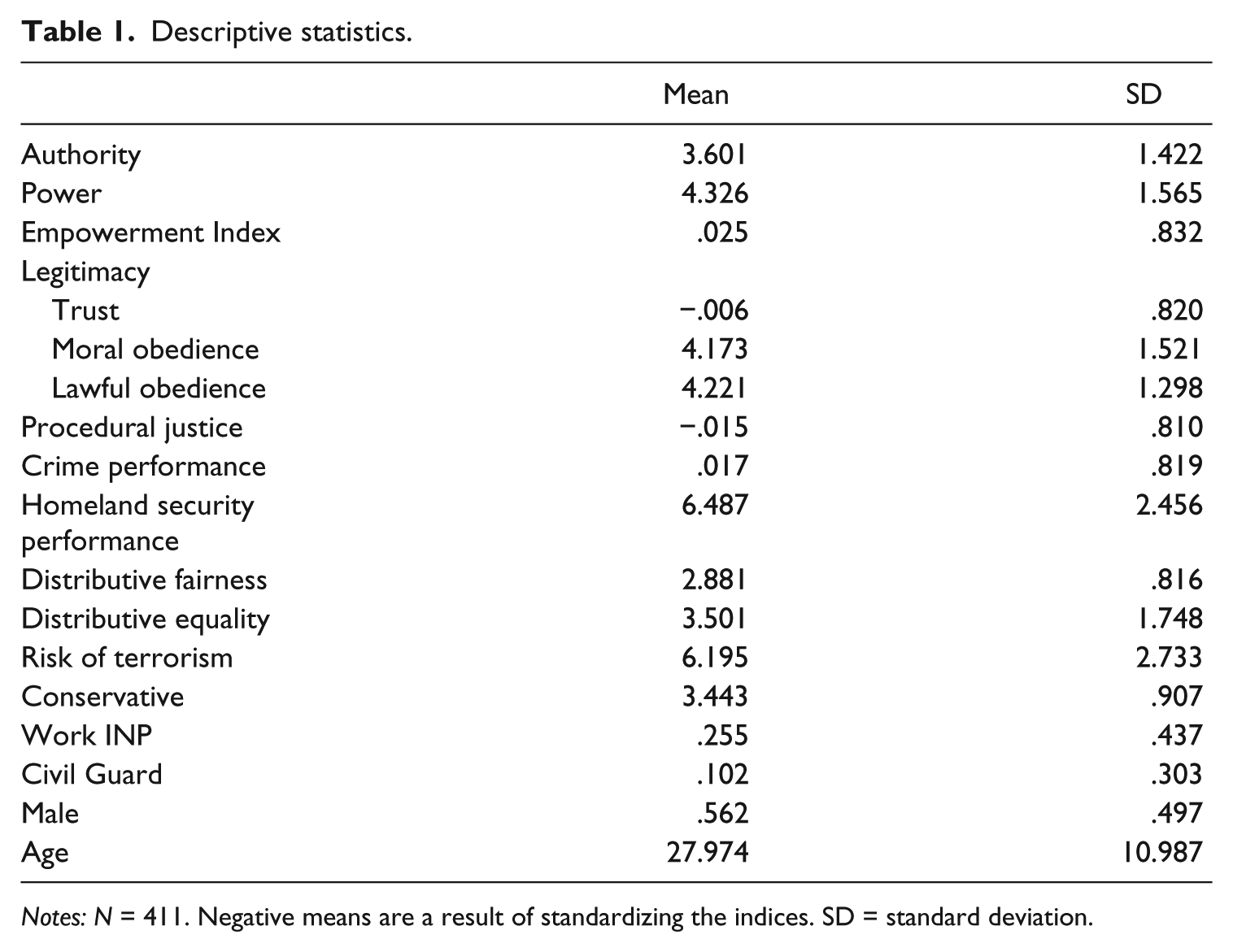
Notes: N = 411. Negative means are a result of standardizing the indices. SD = standard deviation.
Dependent variable
To assess empowerment, we relied on constructs developed by Sunshine and Tyler (2003) to determine how willing respondents were to give police authority and discretion in terrorism-related matters. Specifically, respondents were asked to indicate if they agree or disagree, on a six-point Likert scale, with the following statements: (1) because of their training and experience, the police are best able to decide how to deal with homeland security issues in my neighborhood; and (2) the police should have the power to do whatever they think is needed to fight terrorism. These two questions capture both the willingness to accept the police are best suited to handle terrorism issues and support increased powers of the police in dealing with terrorism. The indicators of empowerment are treated as separate dependent variables, denoted as Authority and Power, respectively, and also combined into a standardized Empowerment Index (alpha = .616). 1
Independent variables
To determine the perceived legitimacy of the police, we assessed both trust in the police and the obligation to obey. In terms of Trust, respondents were asked how much they agree or disagree, on a six-point Likert scale, with five statements regarding trust and confidence in the police. These statements included: (1) I have confidence that the INP can do its job well; (2) I trust the leaders of the INP to make decisions that are good for everyone in the country; (3) People’s basic rights are well protected by the police; (4) I am proud of the work of the INP; and (5) The police can be trusted to make decisions that are right for the people in my neighborhood. The five indicators were combined into a standardized index (alpha = .874), with positive values demonstrating higher evaluations of trust and confidence in the police.
Focusing on the obligation to obey, respondents indicated how much they agreed or disagreed, on a six-point Likert scale, with the following statements: (1) You should obey police decisions because that is the proper or right thing to do; and (2) You should obey the directives of the police if you consider their actions lawful. Although both measures focus on obedience to the police and fall on the same factor (in a promax-rotated exploratory factor analysis), the two represent statistically distinct constructs according to the reliability coefficient (alpha = .469). As a result, the measures are kept separate, with the former designated as Moral Obedience and the latter Lawful Obedience.
In accordance with the procedural justice model of policing, we assess the degree to which the respondents perceived the INP as procedurally fair. Respondents were asked to determine the extent to which the police: (1) use rules and procedures that are fair to everyone; (2) provide opportunities for unfair decisions to be corrected; (3) make decisions based on facts, rather than their own personal opinions; (4) treat people with dignity and respect; and (5) clearly explain the reasons for their actions. Responses ranged from “Strongly disagree” to “Strongly agree” on a six-point Likert scale. The indicators were combined into a standardized index (alpha = .878), labelled Procedural Justice, with higher values reflecting greater perceived procedural justice of the INP.
In addition to procedural justice, performance and distributive justice are included as instrumental predictors of empowerment. In terms of police performance, we consider the perceived effectiveness of the police in both fighting crime and maintaining homeland security. Respondents were asked to rate, from 1 to 10, the effectiveness of the police in handling the following responsibilities: (1) preventing crime; (2) investigating crime; (3) identifying offenders; and (4) bringing offenders to justice. Responses were combined into a standardized index to represent Crime Performance (alpha = .878). Respondents also rated the police’s effectiveness in “maintaining homeland security”. Because this was a single item indicator, responses were kept on a scale from 1 to 10 as a measure of Homeland Security Performance, with higher values representing greater perceived effectiveness in homeland security.
To measure distributive justice, respondents evaluated the degree to which police distribute their activities fairly across groups. In particular, respondents were asked, “how often do people receive the outcomes they deserve under the law when they deal with the police?” and “do you agree or disagree that minority residents of the country receive a lower quality of service from the INP than do Israeli Jews?” Responses ranged from “Never” to “All of time” for the first question and “Strongly disagree” to “Strongly agree” for the second question. The results of a promax-rotated exploratory factor analysis and the reliability coefficient (alpha = .053) suggest that the two measures do not represent the same underlying construct, as is found in prior research. Based on these results, the questions are kept as two separate indicators of distributive justice, the former representing Distributive Fairness and the latter representing Distributive Equality.
As previously mentioned, we also consider the effect of both fear of victimization by terrorism and political ideology. Risk of Terrorism is based on a single-item indicator asking respondents to rate, on a scale from 1 to 10, how likely it is that they or a family member are to “be hurt by terrorists”. Higher values represent increased perceived risk of victimization by terrorists. To determine political leanings, respondents were asked “how would you describe yourself politically?” Responses included “Extreme left wing”, “Left wing”, “Middle of the road”, “Right wing”, and “Extreme right wing”. Higher values suggest a respondent is more Conservative.
Control variables
In addition to the variables of interest, we consider four potential confounders. Because perceptions of the INP can depend on first-hand involvement with the police, we control for whether the respondent works for the INP and/or has a family member that works for the INP (coded 1). We also consider whether the respondent is a volunteer for the Israeli Civil Guard (coded 1), an organization that assists police units throughout the country by patrolling areas, setting roadblocks, securing events, controlling traffic, investigating, identifying disaster victims, and participating in rescue operations (Weisburd et al., 2009). The former is designated Work INP and the latter Civil Guard. Finally, we control for the sex (Male = 1) and Age of the respondent in years.
Analysis
OLS regression is used to assess the impact of the variables identified above on the public’s willingness to empower the police to fight terrorism. Because of potential multicollinearity, several tests were conducted to determine the extent to which the variables are collinear with one another. There is a fairly strong association between Procedural Justice and Trust (r = .785), and moderate correlations between Crime Performance and Trust (r = .590), Homeland Security Performance and Trust (r = .577), Distributive Fairness and Trust (r = .535), Crime Performance and Procedural Justice (r = .520), Distributive Fairness and Procedural Justice (r = .508), and Crime Performance and Homeland Security Performance (r = .563). Despite these associations, the individual variance inflation factors range from 1.07 to 3.44, with a model variance inflation factor of 1.61. Overall, these variance inflation factors do not suggest problematic multicollinearity.
It is likely that the associations observed are a result of a potential mediating effect of legitimacy. Prior research suggests that legitimacy mediates the relationship between the procedural and instrumental predictors identified and empowerment (Factor et al., 2014; Sunshine and Tyler, 2003; Tyler, 2003). In this circumstance, procedural justice, performance, and distributive justice may indirectly affect empowerment through legitimacy. To account for this possibility, we test for indirect effects through Trust, Moral Obedience, and Lawful Obedience for each of the key independent variables using the product of the coefficients approach (Baker et al., 2015; Hayes, 2009, 2013). Essentially, the coefficients for the effect of each of the key independent variables (i.e. Procedural Justice, Crime Performance, Homeland Security Performance, Distributive Fairness, Distributive Equality, Risk of Terrorism, and Conservative) on the potential mediator (i.e. Trust, Moral Obedience, or Lawful Obedience) are multiplied with the coefficient for the effect of the mediator on the dependent variables (i.e. Authority, Power, and Empowerment Index). A percentile-based bootstrap (k = 5000) is applied in accordance with scholars who recommend bootstrapping over Sobel’s z-test, since the z-test assumes that the indirect effects have a normal distribution (Baker et al., 2015; Hayes, 2013; Zhao et al., 2010). In these mediation analyses, all the covariates identified above are controlled. 2
Results
Table 2 reports the results for the OLS regressions of each of the key predictors on the various measures of empowerment. The first model focuses on Authority, or the recognition that the police are best able to decide how to handle terrorism incidents. The model explains about 39.1 percent of the variation in Authority. According to the findings, respondents who have more trust and confidence in the police and indicate greater obedience toward the police are more willing to accept police authority in counterterrorism. Procedural justice also seems to impact police Authority (b = .271, p ≤ .05), such that those who view the police as more procedurally just tend to agree that the police are best suited to handle homeland security issues in their neighborhoods. Overall, Trust has the strongest association with Authority (Beta = .317), followed by Moral Obedience (Beta = .169), Procedural Justice (Beta = .155), and Lawful Obedience (Beta = .101).
OLS regression of authority, power, and the empowerment index.
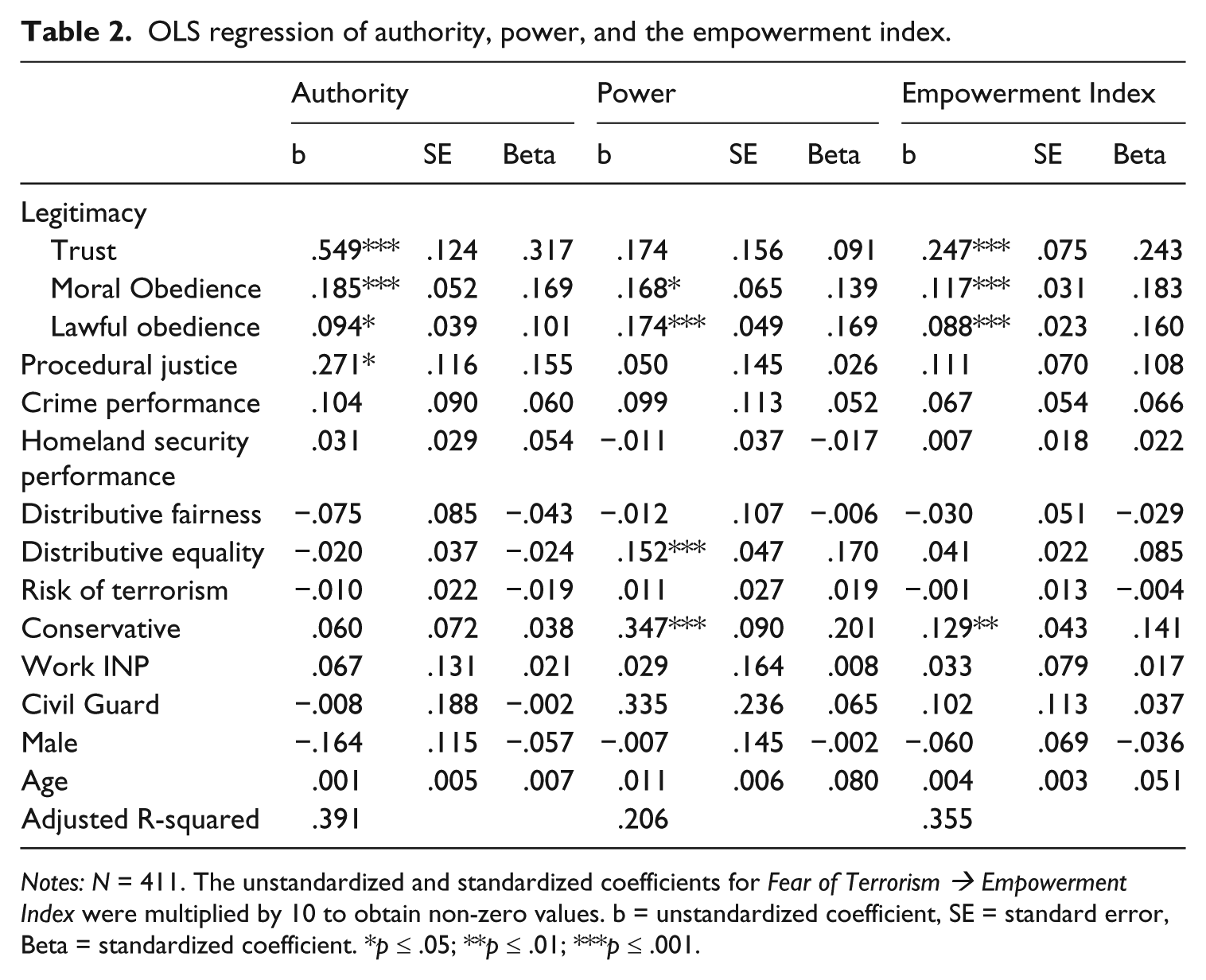
Notes: N = 411. The unstandardized and standardized coefficients for Fear of Terrorism → Empowerment Index were multiplied by 10 to obtain non-zero values. b = unstandardized coefficient, SE = standard error, Beta = standardized coefficient. *p ≤ .05; **p ≤ .01; ***p ≤ .001.
The second model focuses on police Power to do what is necessary to fight terrorism, with the model explaining about 20.6 percent of the variation in police Power. Those who express greater obedience to the police are more willing to grant greater power to the police in their counterterrorism role. Additionally, respondents who perceive that minority residents of the country receive the same quality of service from the police as Israeli Jews are more receptive to giving police the power they need to control terrorism (b = .152, p ≤ .001). Conservatives advocate for greater police power in eliminating terrorism as well (b = .347, p ≤ .001). This is not surprising considering that conservatives tend to oppose conciliatory solutions between Israelis and Arabs in the region and, therefore, are likely to afford power to the police to restore peace in their communities (Pickett et al., 2014). Conservative has the strongest association with Power (Beta = .201), followed by Distributive Equality (Beta = .170), Lawful Obedience (Beta = .169), and Moral Obedience (Beta = .139). Unlike the previous model, Trust and Procedural Justice are not significant factors in influencing police Power.
The results combining the two measures into an Empowerment Index are presented in the third model. Those who have greater trust in the police and obedience toward their directives are more willing to empower the police, granting them the authority and power to deal with terrorism in their communities. In all three models, obedience to the police remains a key predictor of police empowerment. As in the second model, Conservatives are more supportive of the police when it comes to counterterrorism (b = .129, p ≤ .01). Together, the model explains about 35.5 percent of the variation in police empowerment, with Trust emerging as the strongest predictor (Beta = .243), followed by Moral Obedience (Beta = .183), Lawful Obedience (Beta = .160), and Conservative (Beta = .141).
Table 3 reports the tests for indirect effects. While indirect effects were tested for each of the key independent variables on Authority, Power, and the Empowerment Index with Trust, Moral Obedience, and Lawful Obedience as mediators, only significant indirect paths are reported in the table. The results indicate that the effect of Procedural Justice on empowerment is mediated by Trust and Lawful Obedience across all measures of empowerment, except the relationship between Procedural Justice and Power, which is not mediated by Trust. For the most part, procedural justice increases trust and obedience toward the police if they are lawful, which increases the willingness to empower the police in their counterterrorism role. For both Power and the Empowerment Index, the effect of procedural justice appears to only operate indirectly given that the direct effects were insignificant in Table 2.
Product of the coefficient tests for indirect effects through trust, moral obedience, and lawful obedience.
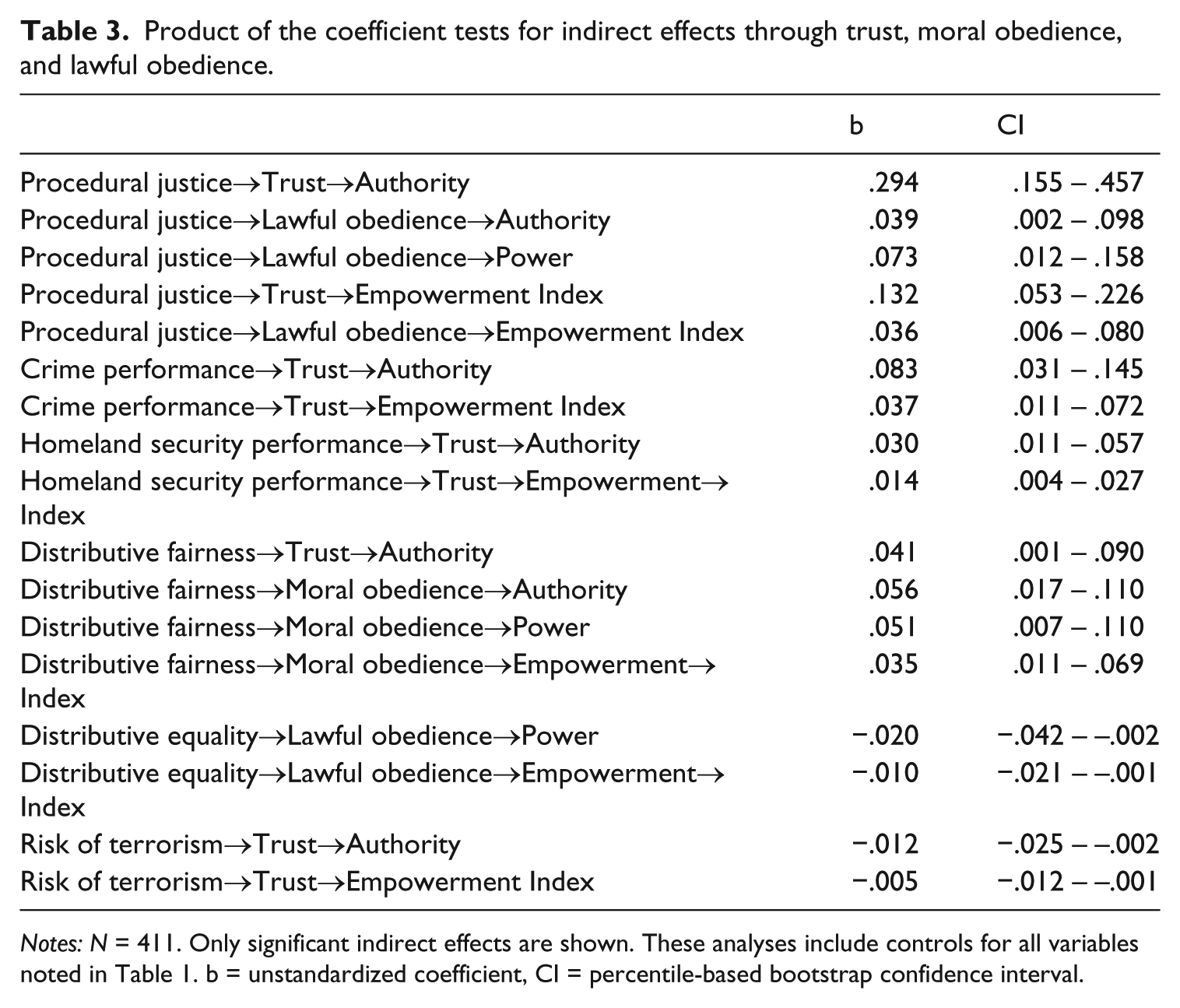
Notes: N = 411. Only significant indirect effects are shown. These analyses include controls for all variables noted in Table 1. b = unstandardized coefficient, CI = percentile-based bootstrap confidence interval.
The results also indicate that Crime Performance, Homeland Security Performance, and Risk of Terrorism influence both Authority and the Empowerment Index through Trust. Those who think the police are more effective in handling their crime and homeland security responsibilities are more trusting of the police, and this trust corresponds with increased (a) support for the police as best able to handle terrorism and (b) general empowerment of the police to fight terrorism. Interestingly, respondents who perceive a greater risk of terrorism are less willing to empower the police because they see the police as less trustworthy. Distributive Fairness and Distributive Equality also exhibit indirect effects, but mostly through obedience. The perception that police distribute their services fairly across groups increases obedience toward the police out of moral responsibility, which is then associated with beliefs that the police should have the authority and power to handle terrorism in their communities. In a similar way, those who agree that minority residents are receiving equal service from the police are more willing to obey the police if they behave lawfully, and as a consequence, are also more willing to empower the police to handle terrorism-related matters. In addition to these effects through obedience, Distributive Fairness does increase Authority of the police by increasing Trust.
Discussion and Conclusion
Considering the importance of the public in legitimatizing the police (Sunshine and Tyler, 2003; Tyler, 2003), we explored the circumstances in which the public is more willing to empower the police by giving them discretionary authority. We focused specifically on the empowerment to fight terrorism in Israel, given the increasing role of the police in counterterrorism and Israel’s past experience with policing terrorism (Weisburd et al., 2009). We found that trust and the obligation to obey were key predictors, such that Israeli Jews were more willing to empower the police in their counterterrorism role when they had more trust in the police and obedience to the law. Conservatives were also more willing to give the police power to fight terrorism. In addition, there were several indirect effects through legitimacy (both trust and obligation to obey), suggesting that those who believed the police were procedurally just, effective in controlling crime, effective in maintaining homeland security, fair in the distribution of outcomes, and equal in services provided were more willing to empower the police because they viewed the police as legitimate.
Many of the factors related to the empowerment to fight crime in prior research are also directly or indirectly related to the empowerment to fight terrorism in the current study (Factor et al., 2014; Sunshine and Tyler, 2003). In this way, terrorism is perceived in a similar fashion to crime, where the public is willing to legitimize police activities and give them the authority they need to handle terrorism as long as they are trustworthy, fair, and effective. In Israel, research has shown that there is a general distrust of the police (Jonathan, 2010). In order for the police to continue to be empowered in their counterterrorism role, they need to develop a stronger rapport and trust with the community. As the current study demonstrates, this can be achieved by focusing on procedural justice, distributive justice, and effectiveness in both crime control and homeland security.
However, improving these elements among police forces to garner greater authority and power in terrorism-related issues does not mean the police can do whatever they want. Part of developing trust and confidence involves striking a proper balance in the powers used to fight terrorism and maintaining transparency with the community. It is possible that police empowerment can further control-oriented forms of policing, such as high policing (Bayley and Weisburd, 2009; Jonathan-Zamir and Weisburd, 2013; Weisburd et al., 2009). A concern among scholars is that this form of policing shifts the dominant focus of police agencies from addressing crime problems in local communities to terrorism (Jonathan and Weisburd, 2010; Metcalfe et al., 2016; Weisburd et al., 2009). Too much of a focus on terrorism, and less transparency in the community, can erode police legitimacy (Metcalfe et al., 2016), thus potentially decreasing the public’s willingness to empower the police and constraining their ability to adequately deal with terrorism (Tyler, 2003).
While the majority of the findings were in line with our expectations, we did find a significant indirect effect of fear on empowerment, whereby those who exhibited a greater perceived risk of terrorism were less willing to empower the police because they saw the police as less trustworthy. It is unclear why this perceived risk seems to be eroding trust in the police, although we can speculate the reasons. Hasisi et al. (2009) discuss how terrorists attempt to create distrust in the existing government and convince the public that the government is unable to protect the people. It is possible that these sentiments may be felt most by those who fear victimization by terrorism. Also, when people experience fear or insecurity, they tend to focus more on the results of police activity (Tyler, 2003). If the police have been devoting time and effort to counterterrorism and are perceived as not producing positive results, including an elimination of the threat, then the public may have lost confidence in the police’s ability to protect them. This problem may be alleviated through improved police–community relations, in the form of community policing, increased communication of information by the police to the public, and efficient restoration of everyday routines in the sites of terrorist attacks (Hasisi et al., 2009; Weisburd et al., 2009). The erosion of trust due to victimization risk is a concern, though, especially considering that trust in the police was the strongest predictor of empowerment in two of the three models, and can facilitate both cooperation and compliance with law enforcement – key factors in the fight against terrorism (Hasisi et al., 2009; Tyler and Mitchell, 1994).
It is important to recognize that the study is not without limitations. First, we focus on Israel as a case-study, but the relationship between police and terrorism extends to other western democracies. It is necessary to replicate similar studies in these areas to determine the generalizability of the findings, although they are not out of line with existing research in the area and still have implications for these countries. In particular, it is clear that as police agencies begin to focus more attention on homeland security, it is necessary for these agencies not to lose sight of the community they are servicing. Based on our findings, an important part of the public’s willingness to give the police the authority and power necessary to handle terrorist threats depends on trust and obedience to the police, which is largely influenced by the procedural and distributive fairness of the police and their effectiveness in fighting crime and maintaining homeland security.
Second, there are some limitations within the data. The sample is restricted to the majority population in Israel – Israeli Jews – and therefore, the results can only be said to reflect majority perceptions. It is well understood that minorities have different attitudes toward the police (Jonathan-Zamir and Weisburd, 2013) and may feel particularly vulnerable, especially when it comes to homeland security matters (Cherney and Murphy, 2013, 2017; Hasisi et al., 2009; Jonathan and Weisburd, 2010; Weisburd et al., 2009). In Israel, studies find that Israeli Arabs generally perceive the police as less legitimate, which would have implications for police empowerment to fight terrorism (Factor et al., 2014). It is important for future research to consider this population as well, and whether similar or different factors influence their willingness to empower the police in their counterterrorism role, although more studies to date have focused on minority perceptions of policing terrorism (Cherney and Murphy, 2013, 2017; Huq et al., 2011a; Madon et al., 2017; Tyler et al., 2010). Also, the sample is a non-probability sample of the majority population in Israel. This, too, limits the generalizability of the findings. However, the use of a convenience sample provided the opportunity to measure and further develop many of the concepts within the legitimacy and homeland security literature. Given the limited number of studies regarding empowerment, there have been few tests of the validity and reliability of the existing indicators used to measure empowerment. We focused on two indicators used previously in relation to crime responsibilities (Sunshine and Tyler, 2003), but future studies should continue to explore additional measures of police empowerment.
Finally, as discussed earlier, there is evidence to indicate that certain factors can have a greater impact on the perceptions of the police when the threat is elevated. In particular, some studies suggest that performance has a larger impact on legitimacy-based evaluations when a terrorist threat is imminent or recently occurred (Jonathan-Zamir and Weisburd, 2013; Sunshine and Tyler, 2003). The surveys were collected during a period of six weeks when the threat within Israel was relatively low. Shortly following the completion of the data collection, a series of attacks from the Gaza Strip began. It is quite possible that public willingness to empower the police, and the perceptions that influence this willingness, may be altered during these heightened periods of security threat.
Footnotes
Declaration of Conflicting Interests
The author(s) declared no potential conflicts of interest with respect to the research, authorship, and/or publication of this article.
Funding
The author(s) received no financial support for the research, authorship, and/or publication of this article.