



Abstract
This article explores the questions posed for criminology when war and terror are seen through a gendered lens. Following Barberet this lens demands blurring the boundaries between peace-time, war-time and post-conflict situations. These boundaries frame the nomos of criminology and once challenged the connections to be made between the ‘callousness’ of femicide and the ‘callousness’ of environmental destruction are exposed. Using photographs as the vehicle through which such a challenge can be maintained, the gendered analysis that follows poses conceptual and methodological questions for the discipline which ultimately demands a reimagining of the contribution of criminology and victimology to understanding gendered violence(s).
Introduction
The centennial commemorations associated with the First World War, alongside the various 70-year commemorations of the Second World War, has seen a noticeable rise in publications linked to each of these moments in time. Some of this work, emanating from a wide range of disciplines, has been concerned to reflect upon the role of women in these events as workers, fighters and victims (see, inter alia, Altinay and Peto, 2016; Carden-Coyne, 2012; Ericsson, 2015; Gebhardt, 2016; Peniston-Bird and Vickers, 2017). Indeed the edited collections proffered by Jamieson (2014), McGarry and Walklate (2016) and Walklate and McGarry (2015) within criminology can all be situated within this same historically reflective moment. Not unsurprisingly a good deal of the wider commemorative work has been visual both in its representation and impact, from the ceramic field of poppies at the Tower of London in 2014 (Blood Swept Lands and Seas of Red: Cummins and Piper) to the lesser profiled but no less significant local ceremonies and gatherings which took place in all those countries who were party to both of these wars. Following this vein this article uses visual data, as a vehicle through which to explore not only what is made visible and left invisible by visual representations in and of themselves, but also how they can be used to illustrate some features of the domain assumptions of criminology (or victimology) as areas of investigation.
The photographs used here and the commentary offered around them are reflective of a personal journey both intellectual and passionate. This journey started some time ago when I first visited the Commonwealth and German First World War cemeteries along with many other noted commemorative sites. The vastness of these places and their peaceful presence in the Belgian and French countryside speaks volumes about the loss of young, male, life and the wider futility of the battles they fought. Subsequent journeys took me to places like Oradour sur Glane, in France (site of one atrocity of the Second World War) and Belchite in Spain (a site of the scars of battle from the Spanish Civil War). Both of these places speak differently about war and its consequences. There are many other places of this kind scattered across the globe. These experiences raised fundamental questions for me about perpetrators, victimhood and innocence some of which became embedded in my subsequent intellectual work and thus contribute to the kind of passionate criminology of which Carrabine speaks as part of this Debate and Dialogue issue. In what follows I endeavour to make some sense of these personal experiences and the interconnections they have for doing criminology and/or victimology.
One Place to Begin
During 2014 I made two separate trips to France: one in April and one in September. The first journey brought me back to the UK via the ferry port at Ouistreham. The photo in Figure 1 (my own) adorned the town and the adjoining coastal roads.

Personal photograph.
At the time of this visit, Ouistreham and the coast of Normandy were commencing their celebrations marking the 70 years since their liberation from German occupation. This sepia tainted poster depicts a rather classic image of the heroic soldier from that time offering a female child a gift (perhaps some chocolate) with her smiling mother looking on. It is not clear whether the soldier is a liberator or a home-comer. For the purposes of the analysis here this is of no great import. What is of significance is the deployment of this particular image to celebrate the moment of liberation. The soldier in it is certainly being welcomed. He is indeed the hero; the defender of women, children and, by implication, liberal democracy.
The second journey in that same year took me to Graveson, a small village in Provence, not far from Avignon. The photograph in Figure 2 was featured on the front page of La Provence (the Avignon edition) in August 2014 on the day the city marked the 70th anniversary of its liberation.
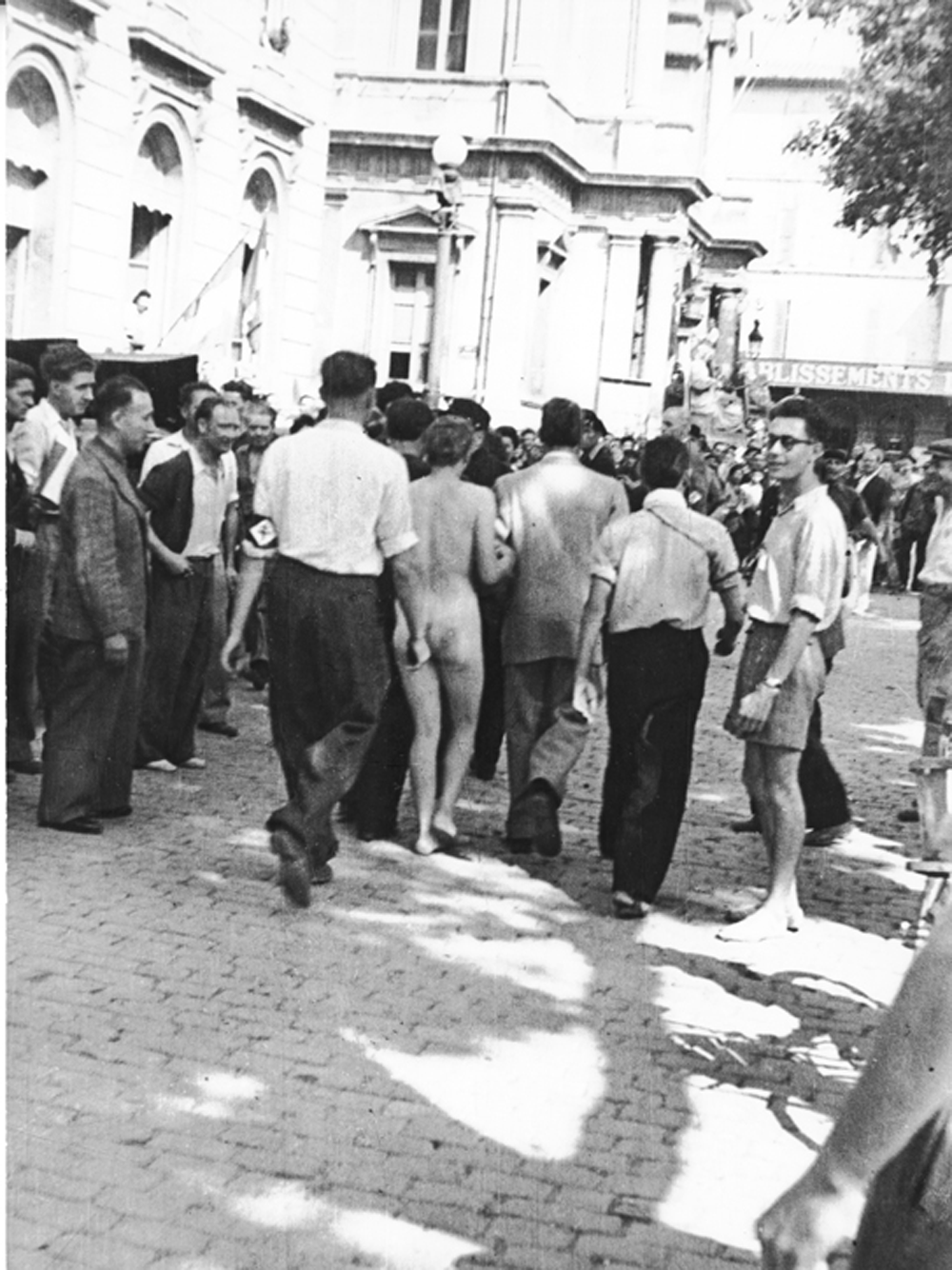
This photograph is used with the permission of the Archives de la ville d’Avignon 49Fi212, Phot. DR. It is unknown who took the original picture but it was taken on 25 August 1944.
This photograph captures quite a different sense of liberation than that of the poster in Ouistreham. The woman, a ‘collabos’ (her ‘crime’ as reported in the newspaper of 2014 was having had sexual relations with the enemy), is being escorted by men, naked, through streets full of male onlookers, to the square in front of the Palais des Papes, where her head is to be shaved. 1 In the photograph some men appear to be amused by the proceedings. Some appear to be passing comment. Her escorts appear to be offering her some kind of protection. One might assume that the woman felt (at least) threatened in the presence of these predominantly male onlookers. Indeed, there are different ways of making sense of this image (as there is with the one used from Ouistreham) and those different interpretations will be hugely contingent on the position of the onlooker and their appreciation of the historical context in which these images were produced. Such contingencies quickly led me to ask who it was who constituted the ‘enemy’ with whom the woman had sexual relations, given that Avignon was under the control of Vichy France for most of the Second World War. However, the purpose here is not to engage in debates of this sort. The purpose here is to consider what lies behind these images and ask: what messages do they convey beyond what it is that we can see and why might this be important for the work of the discipline?
Some time ago Berger (1972) commented that human beings learn much from their senses and this includes their visual senses. Moreover, Spencer (2010) suggests images constitute an opportunity, or a space, to reflect upon the past, to think about the future and ruminate on the connections between the two. Given the work I was engaged with during 2014 (an edited collection on criminology and war and ongoing preparatory work with a French colleague in relation to violence against women prior to a research visit with her), these photographs certainly afforded me that opportunity. This second photograph particularly provoked a personal epiphany moment for me in ‘seeing’ the connections between the violence(s) of war and the ongoing intransigence of violence(s) against women. The photograph haunted me and after gaining permission to use it, I have done so as a device for exploring the construction of women as ‘fearing subjects’ within criminology (see Walklate, 2018). For me, the photograph, in capturing this particular moment, offers a deep understanding of what might count as ‘fear’ and ‘terror’ and for whom these feelings take their toll. It has the capacity to take us beyond what we can ‘see’. It is of no great surprise that my personal epiphany moment did not constitute a novel insight. Others had been here before me in not only seeing that violence(s) against women traverse all aspects of social life (Brownmiller, for example, talks of rape in war in Against Our Will published in 1975), but also in using the language of war to capture the essence of women’s experiences of violence, as many feminist commentators, from Power Cobbe (1878) to Pain (2012)) have done. Moreover, as Barberet (2014) has pointed out, criminology and victimology assume that their respective concerns with violence and its victims is with the violence(s) of peace-time rather than the violence(s) of war. In this photograph I ‘saw’ all of this.
It is evident that whether in times of peace or times of war, violence and the recourse to violence, has commonly recurring features. The perpetrators of violence are (mostly) men and its victims are (mostly) women and children whether in peace-time, war-time or post-conflict situations (with the emphasis on the ‘mostly’). Yet, within criminology violence in the street, as opposed to violence in the home, as opposed to the violence(s) of the state, have all been viewed conventionally as separate and separable arenas of inquiry. However in these two photographs the violence(s) of war, the violence(s) of ‘peace’ and the violence(s) of post-conflict situations are in the foreground and the background all at the same time. Their (in)visible co-existence in these photographs clearly relates to one particular historical time and place: the aftermath of the Second World War as experienced in the global North. Taken together they endorse the inter-connections, largely ignored by criminology but centred by Barberet (2014) and others (see, for example, Eisenstein, 2007). Indeed Barbaret’s work, building on gendered conceptual work emanating from feminists such as Cockburn (2013) and Kelly (1988) demands that criminology revisits the presumptions that the violence(s) of war and peace are separate and separable. The question remains however, as to what, if anything, criminology (or for that matter, victimology) has done with this.
Seeing Beyond What We ‘See’
Of course there could have been a range of different starting points for asking the questions above. As Ruggiero and Carrabine demonstrate, literature and art also afford important insights into explorations of war and its associated violence(s). The ways in which such different sources of data impact upon the reader and/or the viewer can be highly personal as my own narrative above implies. However each of these different sources of data also carries with them huge possibilities for the criminological (or any other) imagination. For the purposes of this discussion the layered presence of violence(s) in all of its forms in each of these photographs serves to illustrate the ordinary nature of violence as experienced through time and space by ordinary people. As Bonger (1916: 518) observed, ‘[e]veryday violence is neither peace-time nor war-time it is both. War makes violence commonplace not only in those who take part in it, but in the whole population.’ In a different context (the partition in India in 1947) Das (2007: 16) talks of violence as being ‘folded into everyday life’ in which people become scarred. Genn (1988: 92–93) in discussing violence against women stated that violence is ‘just part of life’. Importantly this is a part of life in which people are rarely victims or perpetrators but are and can be both in war-time and peace-time; wonderfully captured in the award winning novel by Flanagan (2014). This violence is also gendered (Kruttschnitt, 2016). Yet criminology seems to have neglected its own history of recognizing these interconnections by displaying a preference for the perpetuation of the separate domains of a criminology of war, a criminology of peace and a criminology of post-conflict situations. It would seem that the discipline fails to see beyond what many of us can ‘see’. This claim requires further explanation and for the purposes of this article it will be explored by examining some of the criminological issues and criminological responses to the case of Sgt Alexander Blackman.
Criminology and the ‘Deviant’ Soldier
In many ways this photo (Figure 3) captures yet a further dimension to the images of war. This photo depicts the quintessential modern soldier, ready for action when required but in control as necessary. Moreover the recent high profile case involving this particular soldier poses a range of challenging questions for criminologists. In what follows three questions are elucidated.
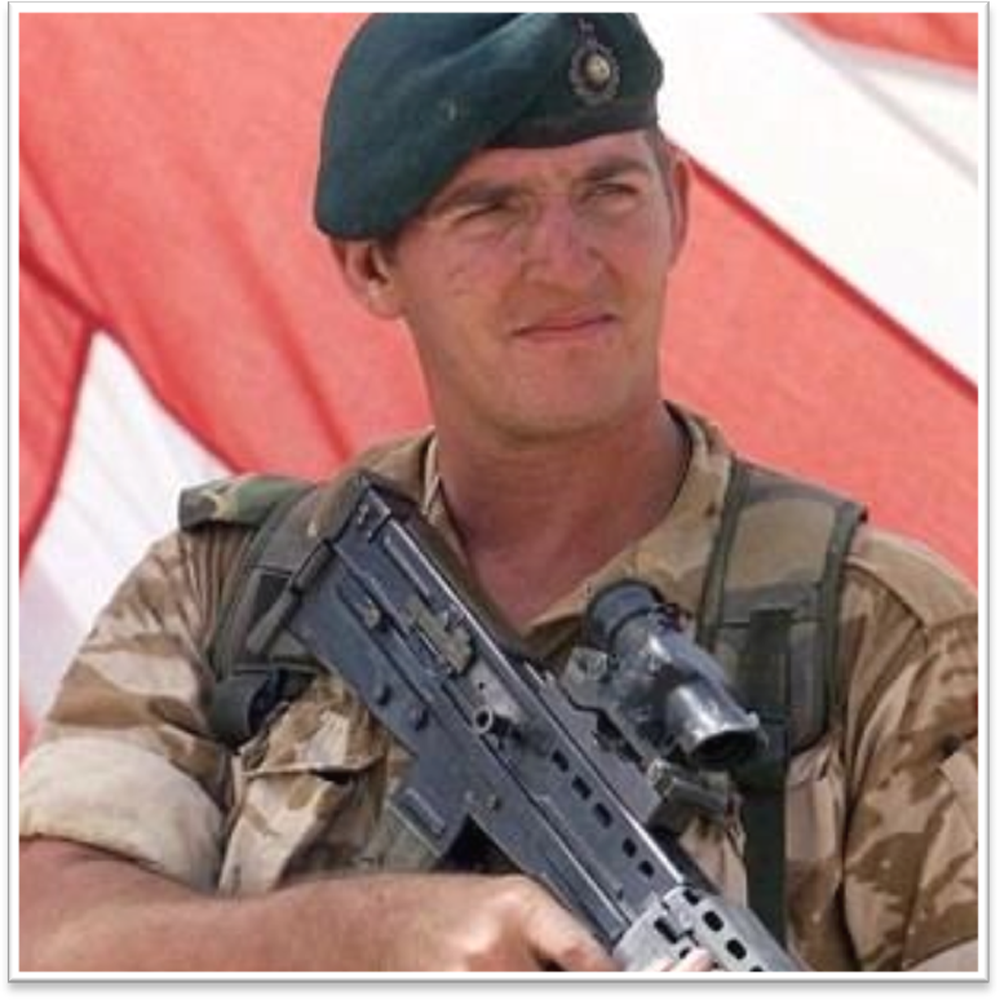
Downloaded from http://www.justiceformarinea.com/family-2/about-al-blackman.
Following Jamieson (1999: 26), ‘[l]ike most violent crime, war is “bad”. It is mainly conducted by men. But there is more to be said.’ Some of what ‘more to be said’ lies as Jamieson (1999: 26) observed, in the fact that war ‘is mainly conducted by men’. This in itself is uncontroversial. However when put alongside violent crime that is also mainly conducted by men then the issue of what more is to be said becomes a little clearer. It is no great surprise to observe, as evidenced from sexual assault, to violence in the street, to murder, violence is perpetrated for the most part by men. In some acts of violence the victims are predominantly female (like, for example, ‘domestic’ violence) but for others the victims are just as likely to be other men (like street violence and/or murder). This is a criminological truism, national and/cultural differences notwithstanding. Nonetheless, historically and contemporarily despite the self-evident continuities in this patterning, in relation to war it is the deviant soldier, as a soldier who has featured in the criminological agenda (see, inter alia, Spencer, 1954). Centring the soldier in this way serves two purposes: it renders the continuities between the gendered nature of different crimes perpetrated in different contexts invisible and it equates a concern with the deviant soldier as being equivalent to a criminological concern with war and its violence(s). As a result the discipline has told a consistent story: it is this ‘deviant’ soldier who perpetrates ‘excessive violence’ against civilians, against other combatants (as prisoners of war and otherwise), and persists with this behaviour once a veteran (see the contributions by Alvarez, Goldson, Mullins and Treadwell in McGarry and Walklate (2016)). The persistent significance of this story underpins some of the issues associated with the case of Sgt Blackman (pictured in Figure 3). One place in which to make sense of these is with the laws of war.
Put simply the laws of war legitimate the soldier’s task of killing on behalf of the state. This task of killing can be compromised depending upon whether the task itself is considered to be just or unjust. This has led to a legal distinction between ‘jus ad bellum’ and ‘jus in bello’ producing two further concerns. First, is the conflict itself just and justifiable? Second, is the behaviour conducted in the name of the conflict just and measured? Generally these ‘laws’ provide the legal and ethical boundaries within which people may take the lives of others when acting on behalf of the state in times of war. These laws of war offer neat legal boundaries that in contemporary conflicts have become increasingly complex and blurred. For example, distinctions between soldiers and non-combatants, public soldiers and private mercenaries are no longer clear-cut. Moreover wars driven by genocide, insurgency and/or other non-state led forms of conflict do not easily fit into the categories of just or unjust neither do they deal well with ‘illegal’ wars. These issues, when overlaid with the increasing use of surveillance measures, some of which are made available on YouTube and other outlets, add to the complexity of establishing ‘jus in bello’. Indeed it was precisely this kind of surveillance data that contributed to the conviction of Sgt Blackman. Leaving aside how these data came into the hands of the police, this evidence, taken at face value, appeared conclusive. He broke the Geneva Convention. His behaviour compromised the laws of war for which he was found guilty of murder and sentenced accordingly. In an interesting though relevant twist in the legal process, while he appeared before a military court, he was tried for murder under domestic law as defined by Sir Edward Coke in 1680. For some commentators this process has led to a call for the re-examination of the standards of reasonableness, taken as the benchmark in the Coke definition of murder, and their applicability in times of combat (see, in particular, O’Sullivan, 2016). Such issues notwithstanding, the case of murder against Sgt Blackman was subsequently quashed and replaced with a conviction of manslaughter on the grounds of his diminished responsibility at the time the act was committed. While this result was welcomed by his wife and supporters, the ramifications of this case are fundamental for any criminological agenda with the ‘deviant’ soldier.
To be clear, the concept of the deviant soldier is given by the laws of war and it is against this backcloth that Sgt Blackman was found guilty. The reduction in his sentence and his subsequent release was predicated on an admission of diminished responsibility in terms of him suffering ‘adjustment disorder’. This kind of decision, in ‘making sense’ of how ordinary men can do evil things (Young, 2011) has a historical legacy reaching back to the Vietnam War after which post-traumatic stress disorder was formally recognized as a problematic psychiatric condition, By definition recourse to ‘adjustment disorder’ (the term used in the Blackman case) separates out the suspect violence(s) undertaken under the circumstances of war from other kinds of violence(s). Of course other explanatory frameworks for his behaviour might resort to what Collins (2008: 87) has called ‘the emotional tunnel of the violent attack’, or might situate an understanding of what took place within an appreciation of the sociology of combat (King, 2013) or military masculinity (McGarry et al., 2014; Woodward, 2000). However, the defence of Sgt Blackman as outlined above set a legal precedent in England and Wales and perpetuated the notion of the deviant soldier, scarred by the violence(s) of war, as separate and separable from those same behaviours perpetrated by men not only in war but also in peace-time. It is at this juncture that the current criminal justice and criminological focus on the veteran soldier becomes problematic since it endorses and legitimates this focus as a separate and separable criminological concern. Thus a sense of gender is lost and a sense of gendered violence(s) is lost. In addition a sense of the potential threat to the state of the deviant soldier is lost particularly given the questionable legal status of the war in which Sgt Blackman was a part. As Walklate and McGarry (2016: 110) have commented, ‘the state remains invisibly responsible but visibly irresponsible’ in these processes and the commentary offered on them. The question remains, how can we see beyond what the discipline encourages us to see as illustrated by this case?
Historically speaking a concern with the homecoming soldier is not a new phenomenon. Starting with the soldiers returning from the Napoleonic War focus on the potential problems that a cohort of fit, relatively young men, experienced in combat, might pose for the home front has peaked and troughed over time (Alker and Godfrey, 2015). Arguably it has peaked contemporarily for a number of reasons but one must be that the traditional work placements for ex-military men have long since disappeared: police officers; prison officers; and so on. In fact the growth in the (armed) private security sector stands as testimony to this. However the contemporary criminological concern with the veteran demands a little more excavation. This concern poses questions, not just because it embraces the presumptions of the deviant soldier, but also as much because of what it leaves out as much as what it includes. For example, where is an appreciation of the role of the military organization itself as a conduit for violence, where is an appreciation of the role of the state, where is an appreciation of the role of gender in all of these contexts? Of course, none of these questions are new but asking them means facing what everyone knows (as the lived realities of women and children in relation to violence might illustrate) and for criminology and victimology, starting in a different place. These questions also entail ‘seeing’ from that different place.
Seeing from a Different Place
Both Morrison (2015) and Young (2011) are particularly concerned with the bounded intellectual imperial imperatives lying behind much criminological work. This is referred to by Morrison as the ‘nomos’ of criminology and discussed by Young in terms of the discipline’s ‘nomothetic impulse’. Both point to the ways in which the contemporary shape and form of the discipline, theoretically and methodologically, operates in such a bounded way that other ways of thinking and doing become marginalized: they are ‘othered’. This is nowhere more evident than when gender is the salient variable as illustrated in the work of Eisenstein (2007) and pertinently developed by Ashe (2007). This is not to say that researchers within the discipline have not concerned themselves with the gendered consequences of violence in all its forms. This is clearly not the case. However it is to suggest that if gender was centred in making sense of violence(s), the discipline would start in a different conceptual and methodological place (see also Jamieson, 2014).
For example, Crawford and Hutchinson (2016) have recently made a case for the re-orientation of criminological concerns with security (either national or human) towards ‘everyday security’. In so doing they acknowledge feminist interventions that have been long concerned with the question of security in women’s everyday lives. This is particularly the case if everyday security is understood as freedom from violence/freedom from harm. Yet the imbalance within criminology and elsewhere in making sense of security as equating with the security of the individual as opposed to the security of the state is palpable (see Walklate et al., 2017). At the same time criminology, especially feminist informed work has much to say about the freedom from violence and its consequences: from violence on the street to violence behind closed doors to more recently the violence(s) associated with terrorism. As has already been stated much of this violence is routine, ordinary and everyday even though it might be silenced (Jordan, 2011), smoothed out (Machado et al., 2010), with evidence about it routinely denied (Walby et al., 2016). In some respects starting in this place, in which gender is centred, is as simple as it is profound. As has already been stated, Power Cobbe (1878) talked of ‘wife torture in England’, Morgan (1989) talked of women’s fears as everyday terrorism and more recently Pain (2012) has analysed her findings on violence against women in the same vein. If this body of knowledge is placed side by side with that work documenting the experience of war as gendered; from the sexual violence(s) documented by Mullins and Visagaratnam (2015); to the disruption of war, conflict and violence associated with sexual trafficking and labour exploitation (True, 2012), to the gendered nature of migration prompted by fleeing from conflicts (Hudson, 2016); then the simplicity of this provocation becomes transparent. All of these are everyday violence(s) for those affected by them. Taken together they constitute powerful evidence for placing these experiences within the same critical plane following Cockburn (2013). Her development of a continuum of violence runs as follows:
For instance, a continuum of scale of force: so many pounds per square inch when a fist hits a jaw; so many more when a bomb hits a military target. A continuum on a social scale: violence in a couple, in a street riot, violence between nations. And place: a bedroom, a street, a police cell, a continent. Time: during a long peace, pre-war, in armed conflict, in periods we call ‘postconflict’. And then type of weapon: hand, boot, machete, gun, missile.
In all of these examples such behaviours are not separate and separable. Neither, in any of these examples, is it the deviant soldier, or indeed soldiers per se, who are necessarily the only ones to be feared.
Interestingly putting war-time, peace-time and post-conflict contexts within the same critical plane can involve asking very conventional criminological questions; like, for example, who is violent, who are they violent against, whose violence counts and under what conditions, how is this violence counted, what renders such violence visible and/or invisible within the discipline, and finally, having made it count, what conceptual tools does criminology have to make sense of violence? (These questions and some answers to them are developed more fully by McGarry and Walklate, 2016.) In whatever shape and form questions such as these are asked the answer for the most part is that men, on all fronts are the perpetrators of violence; and that violence is perpetrated mostly on women and sometimes on other men frequently endorsed by states peopled by men (Connell, 2016). These violence(s) are sometimes perpetrated in contexts, as Ruggiero (2015: 29) observes, where ‘torture becomes a patriotic act while rape may become an act of heroism’ and sometimes perpetrated in the safe haven of the home (see also Carrington, 2015). Indeed the relative criminological silences in the aftermath of the events in Cologne (and elsewhere) during 2016 speaks volumes about the challenge that centring gender in this way poses (see Hudson, 2016; Walklate, forthcoming). However, once these ‘different’ violence(s) are placed side by side the salience of gender is stark. Despite the apparent simplicity involved in this way of seeing resistance to starting in this different place is profound. This resistance is embedded within the ‘nomos’ of criminology (Morrison, 2015).
The (Criminological) Terrors of Blurring the Boundaries between War and Peace
Morrison (2015) identifies four domain assumptions constituting the ‘nomos’ of criminology. These are: liberalism; northern theorizing; nature blindness; and gender blindness. Much of this article has concerned itself with the last of these. However all of these assumptions are inter-connected. The ‘othering’ of gender as a salient variable is intrinsically connected to the projection of US liberal values, particularly concerning individualism, on to the criminological endeavour across the globe (qua Young’s (2011) ‘nomothetic impulse’) secured during the intellectual empire building of the Cold War era. This intellectual empire building has been saturated with northern theorizing (Connell, 2007) featuring both occidentalism (Cain, 2000) and a failure to take account of other ways of knowing (De Sousa Santos, 2014). This nomos also presumes a Cartesian relationship between society and nature denying in particular Indigenous understandings of the human–environment nexus. This nomos, spelt out in this way, once seen cannot be unseen. It demands a different way of thinking and doing, conceptually and methodologically. It demands a serious commitment to reflexivity. This kind of seeing certainly terrifies a discipline so deeply embedded in a modernist, liberal agenda, and the associated nomothetic impulse and whose origin stories have framed the discipline across the globe (Carrington and Hogg, 2017). It is without doubt that addressing such terrors carries disciplinary political consequences as do the images with which this article has been concerned.
The welcoming image of the liberating soldier portrayed in the first photograph in this article is intended, arguably, to bolster the Allies as saviours rather than implicate them in any atrocities known about the enemy but denied for the liberators. Yet all wars involve atrocities on all sides as Ruggiero’s reading of Stendhal and Tolstoy illustrates. Reading the recent work of Gebhardt (2016) alongside the first two images in this article is illuminating. This work evidences the nature and extent sexual violence against German women at the end of the Second World War by all Armed Forces in Germany not just the Red Army. Such work renders the juxtaposition of the first two photographs used in this article perhaps even more telling in the underlying continuities they point to. In addition, that wars involve ‘good’ men doing ‘bad’ things is, of course, endorsed in the image of Sgt Blackman. His conviction, in the first instance poses all kinds of (political) questions concerning the nature of illegality in an illegal war. This is invisibly visible in the coverage given to his case. Of course none of these observations are visible in the photographs themselves. Moreover neither is the nomos of criminology. Yet the discipline and its nomos are differently and differentially implicated in the agendas generated by all of the photographs used here. For the most part, both historically and contemporarily, the discipline has been complicit in centring the deviant soldier despite its discipline’s limited capacity to make sense of such deviancy.
Concluding Thoughts
Ways of seeing, whether discussing photographs, art, literature or the nature of a discipline, are part of a narrative (Brown, 2017: 494). Echoing the focus on ‘traces’ alluded to by Carrabine as part of this Debate and Dialogue, this article has offered one narrative of the ways in which the traces of violence(s), particularly gendered violence(s), are seen and unseen within the discipline of criminology. This narrative has been a personal one. I have used my own experiences and epiphany moments as a source of making sense of what I have seen. It is passionate, public and political and carries with it the traces of ‘the personal being political’ so favoured by second wave feminism. In so doing it centres the presence of patriarchal social relations which as Connell (2016: 15) reminds us, remain telling. As she says these social relations are supported by a hegemonic masculinity which is:
Not just a power-oriented masculinity but also a cultivated callousness is involved in organizing abductions of girls, suicide bombings, femicide, beheadings, and mass addiction. It seems close to the callousness involved in drone strikes, mass sackings, structural adjustment programmes, nuclear armaments, and the relentless destruction of our common environment.
Recognizing that such callousness is gendered does not imply that women do not engage in such behaviours. Neither does it imply that such behaviours have little to do with sex. A brief excursion into the available work on genocide, for example, serves to challenge such presumptions (Rafter, 2016). Neither does it imply fatalism. It is possible for criminology, criminologists, or indeed human beings, to engage in conversations and/or behaviours that see and do otherwise. However in order for the discipline to address the issues raised here means starting in a different place. This implies setting aside its imperialist ambitions and the concepts and methods informing them. Setting aside implies creating space not abandonment. In creating a space for other ways of knowing and doing a democratic epistemology in De Sousa Santos’ (2014) terms become possible. Thence the salience of gender in understanding war-time, peace-time and post-conflict violence(s) might come to be understood. Ferrell (2016: 227) says such setting aside ‘suggests a way of seeing the world glancingly, out of the corner of one’s eye, with an awareness that the most important action may take place out of frame and out of focus’. This might be a terrifying prospect for criminology but it also offers an exciting agenda for the future particularly if such ‘seeing’ encourages the discipline to loosen the shackles of positivism, its imperialist ambitions and its deep embrace of northern theorizing. Having once seen these issues, like the photographs used here, for me they cannot be unseen.
Footnotes
Acknowledgements
This article was presented at a seminar on Criminology and War held at Middlesex University in March 2017 and organized by Vincenzo Ruggiero. I am grateful to Vincenzo Ruggiero and Eammon Carrabine for their comments and those of the anonymous reviewers in furthering the development of this article. As ever the faults that remain are my own.
Declaration of Conflicting Interests
The author(s) declared no potential conflicts of interest with respect to the research, authorship, and/or publication of this article.
Funding
The author(s) received no financial support for the research, authorship, and/or publication of this article.
