



Abstract
Literary translations are worldwide predominantly made from English, which is far ahead of any other language. While various studies have proposed interpretations of this supremacy few have examined translation flows in the opposite direction, studying how literary authors from the periphery can transcend the boundaries of their language and gain access to the center of the global literary world by being translated into English. From the theoretical perspective of a multi-level field approach, we propose a case study of how literary translations from Dutch are published and presented in the UK and the US. The study specifies by which mechanisms Dutch authors overcame the obstacles they encountered on the macro, meso and micro levels. The theoretical framework proposed contributes to sociological understanding of how authors from the periphery can enter an internationally dominant center, demonstrating that such an understanding is part of the same theoretical approach that accounts for the far more frequent flows from the core to the periphery.
Keywords
The Globalizing Dynamics of Cultural Fields
The international circulation of cultural goods generally displays some form of center–periphery structure. The cross-border flows of art works, movies and music are highly uneven processes, dominated by products from a small number of centers that are often located in Anglo-American countries (e.g. Crane, 2002, 2014; Heilbron, 2010; Janssen et al., 2008; Kuipers and de Kloet, 2009; Quemin, 2006, 2013). Since literary texts are language-bound and circulate less easily than other cultural goods, book translations are an interesting case for studying transnational cultural exchange and examining the obstacles for the functioning of a global cultural field or cultural world-system (Bourdieu, 1993, 1999; De Swaan, 2002b; Sapiro, 2013).
The basic structure of the global field of translation 1 is well indicated by the fact that during the three decades since 1980, six out of every ten books translated worldwide were from a single language: English (Brisset and Aye, 2007). In the global ranking (Pym, 1998), the ‘hypercentral’ position of English is followed by two languages with a central position, German and French, each with a share of about ten percent in the world market for translations. They are followed by several ‘semi-central’ languages (Russian, Spanish, Italian and Swedish), each accounting for one to three percent of international book translations. With a share of less than one percent, all other languages occupy a peripheral position in the global translation system. Among them are languages like Chinese and Arabic, which have very large numbers of speakers, but from which only a small share of books are translated.
One of the general features of this center–periphery structure is that an inverse relation tends to exist between the centrality of a language in the global translation field and the proportion of translations in the national book production system (Heilbron, 1999, 2010). A central position in international exchanges implies that there are many translations made out of this language, but relatively few translations made into this language. Hence, the more central or dominant the cultural production of a country is, the more it serves as an example for other countries, but the less it is itself concerned with foreign cultural goods. Domestic translation rates illustrate this pattern. In the United States and Great Britain, only a few percent of all published books are translations. In less central countries like France and Germany, the proportion of translations is consistently higher, fluctuating between twelve and eighteen percent of the national book production. In semi-peripheral countries like Italy and Spain, the relative weight of translation is again more important, while in countries with peripheral languages like the Netherlands, about a third of all published books consists of translations.
Given this pattern of uneven exchange, it is hardly surprising that the larger share of the current literature on cultural exchange and translation has focused on the hegemonic position of the English language (e.g. Apter, 2001; Bielsa, 2005, 2010; De Swaan, 2002a; Franssen and Kuipers, 2013; Heilbron, 1995, 1999, 2010, 2011; Luey, 2001; Mélitz, 2007; Sapiro, 2008a, 2010). Yet translations do not flow merely from the center to the periphery, but also in opposite direction. Cultural goods from the periphery have various obstacles to overcome, but they can enter a dominant center, gain some degree of recognition and spread from there to other (semi)peripheral areas. These cultural flows from the periphery to the center have so far received limited attention (e.g. Heilbron, 1995, 2011; Sapiro, 2008a; Wilterdink, forthcoming). In this article we will present a case study of how literary authors from a peripheral language, Dutch, were translated into the most central language, English. Far from contradicting a center–periphery model, we argue that these processes are best understood from the same theoretical perspective, that is, as an integral part of the functioning of the global field of translation. Like any other globalizing cultural field, the field of translation is characterized primarily by unequal exchanges between language groups and countries that dispose of unevenly distributed resources.
In the global literary field, Dutch literature may legitimately be considered to have a peripheral status. Very few Dutch authors have entered the canon of world literature. Of the more than 1100 titles of the Penguin Classics series, for example, only three are written by authors from the Low Countries. One of them is a Renaissance scholar who wrote in Latin (Erasmus), the second is the 19th-century author of a pioneering novel about colonial rule in the Dutch East Indies (Multatuli), the third is Van Gogh, whose letters have gained fame as an exceptional artistic and literary document. Although the number of translations made from Dutch literature has been on the rise and contemporary writing from the Netherlands receives more acclaim from English language literary critics than before (Parks, 2011), these developments have not fundamentally altered its international status (Wilterdink, forthcoming).
In order to understand how authors from a peripheral literature get access to the English-language literary field, different levels of analysis come into play. Unlike the more common strategy of choosing one specific level, we propose a multi-level field approach, considering the macro, meso and micro levels of the translation process (Heilbron and Sapiro, 2007; Sapiro, 2008a). The macro level pertains to the center–periphery structure of the global translation system and the balance of power between the language groups and countries that form this system. The meso level concerns the predominantly national publishing fields and the strategies different publishing houses use to acquire translation and publishing rights. The micro level, finally, concerns the role of the various actors who are effectively involved in the selection (publishers, editors), translation (translators) and framing (publishers, literary critics) of particular books. It is on these three levels of the global translation field that peripheral authors encounter boundaries in the process of becoming translated into English. The involvement of (to varying extents) transnational intermediary actors, events and institutions such as international publishers, literary agents and book fairs such as the Frankfurter Buchmesse, is indispensable for Dutch authors to be able to transcend the boundaries imposed on each of the aforementioned levels in order to become consecrated into the English-language literary field.
Macro Level: Competing Centers in the Global Translation Field
Authors from peripheral languages and literatures need to overcome a multiplicity of barriers before they can enter the English-language publishing field. These barriers exist on different levels and specific mechanisms can be identified for each of them. Cultural flows from the periphery to the center depend, first, on the rivalry between the leading cultural centers. Processes of globalization have in various areas taken the form of polycentric concentration (Heilbron, 2010), that is, in the rise of competing international centers. These centers do not only compete for the diffusion of their own products, they also compete for the benefits that can be gained from the transit, transfer and translation of cultural goods from other countries and regions. Having the rights to globally represent, sell or reproduce foreign artists and authors has become a significant stake in globalizing cultural fields. Translating peripheral literature allows publishers in certain centers to gain material and symbolic advantages over their competitors in other cultural centers (Bielsa, 2010: 159; Casanova, 2004).
The translation of Dutch literature illustrates the dynamics of these international rivalries. Due to the geographical and cultural proximity of the Netherlands to Germany, Dutch literature first gained international visibility through being translated into German. Nineteenth-century Germanists considered the Netherlands and Flanders as outer provinces of the larger Germanic culture. In the course of the 20th century, translations from Dutch into German increased slowly, whereas for many decades very little Dutch literature was translated into either French or English (Heilbron, 1995). During the 1980s and 1990s, several Dutch authors were for the first time published by prominent German publishers, and the Frankfurt Book Fair of 1993 – during which the Netherlands was the ‘Guest of Honor’ – is generally considered to have represented a breakthrough in the international visibility and recognition of Dutch fiction outside the Netherlands. Foreign interest in Dutch literature remains highest in Germany, where authors like Cees Nooteboom are considered to be world-class writers and are valued more highly than in other foreign countries (Heilbron, 1995; Wilterdink, forthcoming).
The rising status of Dutch literature in Germany was followed by a similar process in France. In part because the leading role of French literature has declined, the country’s publishers and critics have become more open to foreign literature. Literary translations into French have increased, including translations from (semi)peripheral literatures (Sapiro, 2008b, 2012). The number of translations from Dutch into French enjoyed a provisional peak in 2003, when the Netherlands and Flanders were ‘Guests of Honor’ at the Salon du Livre – an influential international book fair in Paris (Heilbron, 2008; Voogel and Heilbron, 2012). Following this pattern of international diffusion upwards from international regional centers such as Germany and France to the global (hyper)center, German and French translations are likely to have served as examples for translations into English (Heilbron, 1995, 2010).
Meso Level: The Structure of National Literary Fields and Horizontal Isomorphism
Moving closer to the actual level on which translation takes place, it is crucial to consider the functioning of the publishing field. How do publishers select foreign literary works and acquire translation rights, in particular for works by authors from peripheral language groups?
Authors from the periphery who are liable to be translated into English must first have enjoyed considerable success within their own national literary field. This success, which is their starting capital in the international field, can be based on two types of resources: economic and symbolic capital (Bourdieu, 1993). Economic success is derived from national book sales. National ‘bestsellers’ are generally works of commercial fiction produced at what Bourdieu has called the pole of large-scale production (Bourdieu, 1993; Sapiro, 2010). Fiction which originates from the more autonomous pole of small-scale production can gain specific literary recognition, that is, favorable reviews by renowned literary critics and acquiring awards which endow books and their authors with symbolic capital that can also attract foreign publishers.
In Merchants of Culture, John Thompson (2010) has studied the recent transformations of the field of English-language publishing. Although he did not study translation, several tendencies he analyses are relevant for the dynamics of translation. The overall development has been in the direction of an increasing commercialization and a further predominance of short-term commercial interests. Like other cultural production fields, the publishing field has become increasingly concentrated. Publishing business today is dominated by a small number of large corporations, which are managed like other big companies and which have marginalized small, often independent, presses. In Bourdieu’s analysis, which Thompson does not share in this respect, these smaller publishers belong to the pole of small-scale production, that is, the type of production where literary or intellectual criteria prevail over short-term commercial interests.
On the distribution side, a similar concentration has occurred with the growing power of retail chains, which have strongly reduced the role of small and independent bookshops. Both the production and distribution of books have thus gone through a process of economic rationalization driven by economies of scale and leading to a never-ending quest for the next bestseller. Another development which Thompson (2010) highlights, and that has similarly marginalized the role of small publishers, is the rise of literary agents who have driven up the fees publishers have to pay for books that are considered potential bestsellers. The main consequence of these developments is that the commercial constraints imposed upon publishing have considerably increased. Referring to this as the ‘margin squeeze’, Thompson (2010) notes that publishers have become caught in between the demands for higher discounts to powerful retail chains on the one hand, and the increasing advances to be paid for a book as demanded by literary agents on the other (Thompson, 2010: 310).
Since literary translations from peripheral languages are commercially generally a minor affair, the largest share of English translations made from Dutch literature is likely to be located within the pole of small-scale production. 2 Smaller and often independent publishers tend to have a larger proportion of translations in their ‘backlist’, as compared to the larger publishing corporations, as they exploit market niches that are characterized by lower levels of sales and profitability (Sapiro, 2008a: 157).
But how do these publishers make decisions about which books to translate? Within the pole of small-scale production, commercial criteria are less important in the acquisition of books than considerations of literary, cultural or intellectual value. The actual practices of these small publishers are generally based on their ‘elective affinity’ with similar publishers from foreign literary fields. Depending on the specific niche in which they operate and the amount of symbolic capital they possess – as manifested in the composition of their backlist – publishers which occupy a homologous position within their literary field tend to be connected to each other through international networks (Franssen and Kuipers, 2013; Sapiro, 2008a).
Instead of mimicking the profit-driven, commercial practices of the larger publishing houses, small publishing houses tend to be focused more on foreign publishers, specifically on those publishers that share a similar literary identity underscored by distinctively non-commercial aims. This leads to what has been described as ‘horizontal homogenization’ (Sapiro, 2008a: 160) or ‘horizontal isomorphism’ (Franssen and Kuipers, 2013). The strategies of these publishing houses are shaped by monitoring foreign publishers with a homologous position in their respective national publishing field which creates an ‘elective affinity’.
In addition, cultural activity within the pole of small-scale production often relies on financial support from non-profit organizations, foundations, cultural institutions and/or national governments (Sapiro, 2010: 425). The possibility for (semi)peripheral writers to successfully transcend their national literary field and obtain international recognition often depends on the cultural policies adopted by nation-states and public agencies, which are aimed at increasing the international visibility of their culture. Since the 1950s, the Dutch government has actively stimulated translations of Dutch literature through a non-profit foundation, the Dutch Foundation for Literature (DFL). The DFL not only provides financial support for translations from Dutch literature, it also monitors the quality of translations and translators and suggests specific books and authors to foreign publishers. Many works which have been translated with the support of the DFL would probably not have been translated otherwise, as the economic risks involved for foreign publishers to translate books from relatively unknown authors would be too big.
Micro Level: Gatekeeping Practices and the Reception of Foreign Literature
The actual process of publishing translations involves the work of various people – editors, literary specialists, agents, translators – who operate within the constraints imposed on them by both the global translation field and the (supra)national literary field. This group consists of all those people who are the actual intermediaries between the foreign author and the new audience. Since the process of translation is carried out by this group, it is important to consider their specific practices as well, and to pay special attention to those who have played an important role in overcoming the barriers Dutch authors encounter.
Among the various intermediaries, editors have a special importance. Although publishers are often held to be central actors in the acquisition of translation rights, editors are the ones who make the selection from the globally available pool of foreign literature and hence function as the actual ‘gatekeepers’ of the literary field. With respect to the practice of translation, they mediate between different national fields and often have the final say about foreign works to be translated (Franssen and Kuipers, 2013). Together with their advisors, experts and scouts, they are in charge of classifying books and authors, thus drawing a ‘symbolic boundary’ (Lamont and Molnár, 2001) between those who are worth acquiring and those who are not.
In assessing the value of foreign literary works, editors use several indicators, such as previous sales, literary awards generated, recommendations from their peers and the backlist of their publishing house. At the heart of this process lies what Thompson (2010) calls the ‘web of collective belief’: At the end of the day, it is a specific combination of judgments and opinions, of who thinks what and why they think about it, that determines whether a house will buy a book and, if so, how much they are willing to pay for it. (Thompson, 2010: 204)
This belief is a more or less coherent, practical sense of what should and should not be published by the publisher in question. Individual editors operate on the basis of their specific version of this set of shared views and practices. Depending on whether the editor is active within the pole of large-scale or small-scale production, they legitimize their choices for the acquisition of certain titles in fundamentally different ways.
In order to compete with indigenous books and translations from other languages, Dutch authors have to be perceived and presented as having a ‘special quality’. Drawing attention to peripheral and otherwise unknown literatures requires specific ‘framing’ strategies. The particular way in which these titles are ‘framed’ is to a certain extent dependent on the location within the spectrum of cultural production. For publishers which are active within the pole of large-scale circulation, acquiring ‘bestsellers’ and other commercially interesting titles will frame such books according to these lines, i.e. noting their economic success in the Netherlands, being ‘easily accessible’ to a wide range of audiences or comparing the Dutch author to popular British or American writers within the same genre. At the other end of the spectrum, Dutch literature is more likely to be framed according to specific literary and cultural codes. Here, the commercial success of the title is subordinate to its acclaimed literary qualities, which in the case of the framing of Dutch literature in the English-language field can be broadly captured along two overarching frames: as being ‘typically Dutch’ on the one hand, and of ‘cosmopolitan quality’ on the other (for a discussion on this, see Wilterdink, forthcoming).
For those titles which are being framed as ‘typically Dutch’, this framing is generally done in four distinguishable but intertwined ways. In the first place, this is done by referring to their employment of a distinctively Dutch literary style characterized by strong realism in its detailed, precise and sober depiction of everyday life. Second, the novel can be framed as embodying typically Dutch culture, referring to its paradoxical combination of the more historical Calvinistic roots of Dutch society – realistic, sober, direct, practical, entrepreneurial – and the more recent connection to the typically Dutch tolerance towards cultural diversity, drugs and prostitution. The third frame refers to particular Dutch landscapes, such as the city of Amsterdam and its canals, the dykes, windmills and the polder. Fourth, novels can be framed in terms of their treatment of the typically Dutch role in and perspective on important historical events, such as colonization or the Second World War. These four frames encompass the diversity of reflections of Dutch culture in its literature (cf. Griswold, 1981) as commonly presented to a foreign public. This ‘typically Dutch’ conception can vary by genre. For example Dutch children’s books are conceived to be particularly rebellious in nature (Whitmore, 2013).
On the other hand, for those titles which are framed as possessing certain ‘cosmopolitan qualities’, this is typically done according to four sub-frames. First, in contrast to employing the ‘typically Dutch’ realistic literary style, some Dutch novels are praised for their distinctive European style, characterized as being more philosophical, experimental, fantastical and meta-fictional in their writings. Second, Dutch works can be framed in terms of their treatment of the currently popular issue of immigration in which tensions between the culture of origin and place of migration are brought to the fore. Third, Dutch authors and their works can be compared to well-known English and American authors with which they share certain literary characteristics. Fourth, the novel can be conceived as a ‘classic’, referring to its elaborate and successful history of being internationally critically acclaimed and conceived as of continued and important relevance within its respective field.
The Presentation and Reception of Dutch Fiction Translated to the English Language
In order to explore the extent to which the previously outlined theoretical framework and proposed multi-level approach are suitable for understanding cultural flows from the periphery to the center, we constructed a database which contains information about Dutch literary works which have been translated into English during the year 2010. The main data on these titles are derived from the Translations and Translators database, provided by the Foundation for the Production and Translation of Dutch Literature (currently: the Dutch Foundation for Literature). This database encapsulates a large part of the translations made from Dutch literature, containing both financially supported and unsupported titles, and has proven to be more reliable and complete than the frequently used international translation database, the Index Translationum (Voogel and Heilbron, 2012).
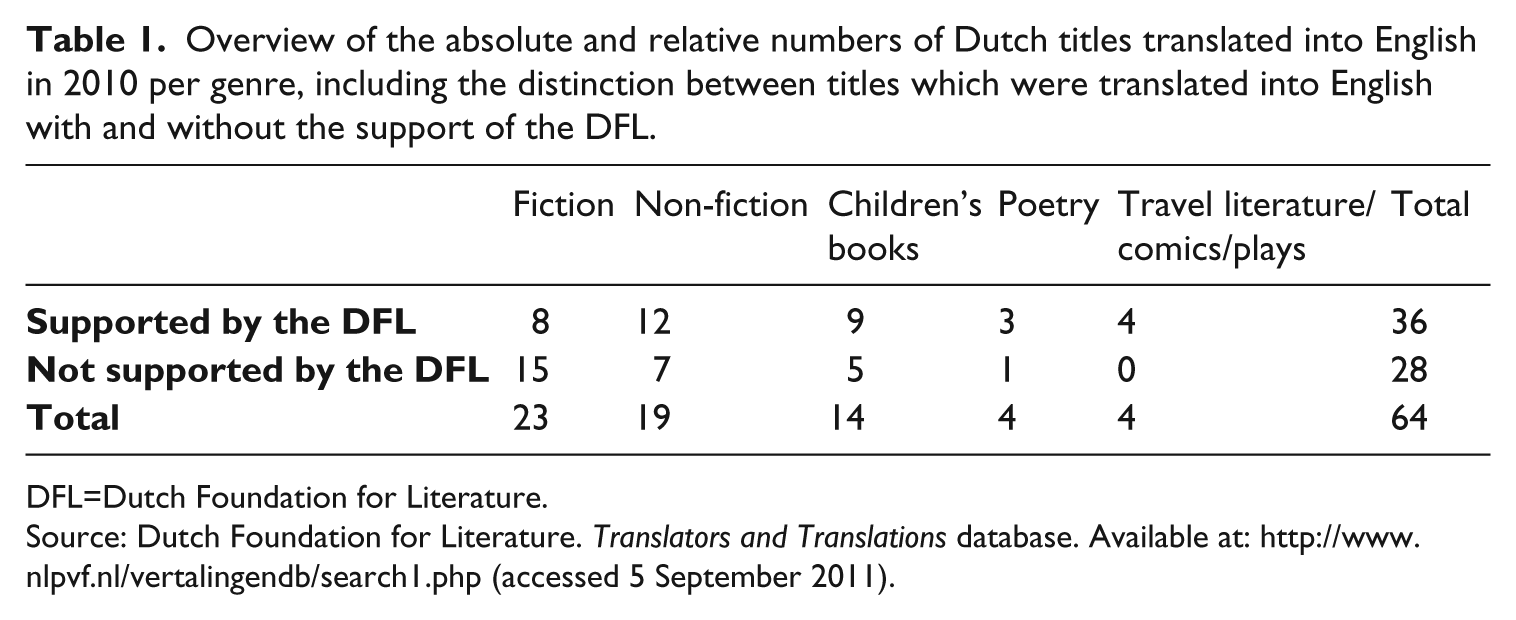
At the moment of data collection, in the autumn of 2011, a total of 74 titles had been translated into English in the course of 2010. After removing translated anthologies, 64 literary titles remained, stretching across genres including fiction, non-fiction, children’s books, poetry, travel literature, comics and plays. See Table 1 for an overview of all translated titles into English, broken down by genre and financial involvement from the Dutch Foundation for Literature.
Overview of the absolute and relative numbers of Dutch titles translated into English in 2010 per genre, including the distinction between titles which were translated into English with and without the support of the DFL.
DFL=Dutch Foundation for Literature.
Source: Dutch Foundation for Literature. Translators and Translations database. Available at: http://www.nlpvf.nl/vertalingendb/search1.php (accessed 5 September 2011).
Table 1 shows that, with the exception of fiction, more than 60% of the titles were translated into English with financial support from the Dutch Foundation for Literature. Since we were primarily interested in fiction, the 23 titles in this category will form the main corpus of data. 3 The difference between supported and unsupported titles will remain an important variable in the analyses.
Information regarding the 23 titles under study was derived from over 100 websites and other sources, 4 ranging from the websites of authors and publishers, the Dutch Foundation for Literature, Amazon, the Dutch Literary Museum and reviews in several prestigious newspapers such as The Times, The Independent, The Guardian, The Daily Telegraph and The Wall Street Journal (some accessed through the LexisNexis database). Authors, publishers, booksellers (Amazon) and cultural institutions such as the Dutch Foundation for Literature provide information about specific titles and authors, literary critics offer more elaborate interpretations. Both the presentation and reception of translated Dutch authors and their respective titles ‘frame’ their public perception. They make sense of the foreign book and shape its meaning (for framing, see Goffman, 1974). By analyzing the interplay between the presentation and reception of the titles under study, it is possible to clarify why these titles were considered to be worthy of translation into English.
Before continuing with the analyses however, it is first important critically to reflect on the sources of data which are utilized in this research in terms of the limitations which they bring with them. In the first place, the data are gathered in hindsight and are thus not able to capture potential important factors which might have occurred in the actual process of translating the titles under study into English. This relates to the second limitation, namely that the data are derived from a limited variety of publicly available sources which were not always equally available for each title and tend to emphasize certain aspects more while downplaying others in their framing, limiting the amounts of relevant information available per title. Last, but not least, in order to further facilitate comparison between the cases, the qualitative data will be reduced to quantifiable indicators which leaves out room for potential important qualitative variances encountered between titles in their translation into English. Having said that, we found that the available data for each of the titles under study were sufficient enough in order for us to explore whether the outlined multi-level field approach can be used to study cultural flows from the periphery to the (hyper)centers of our global literary field.
Crossing Macro-Level Boundaries: From the Periphery to the Center
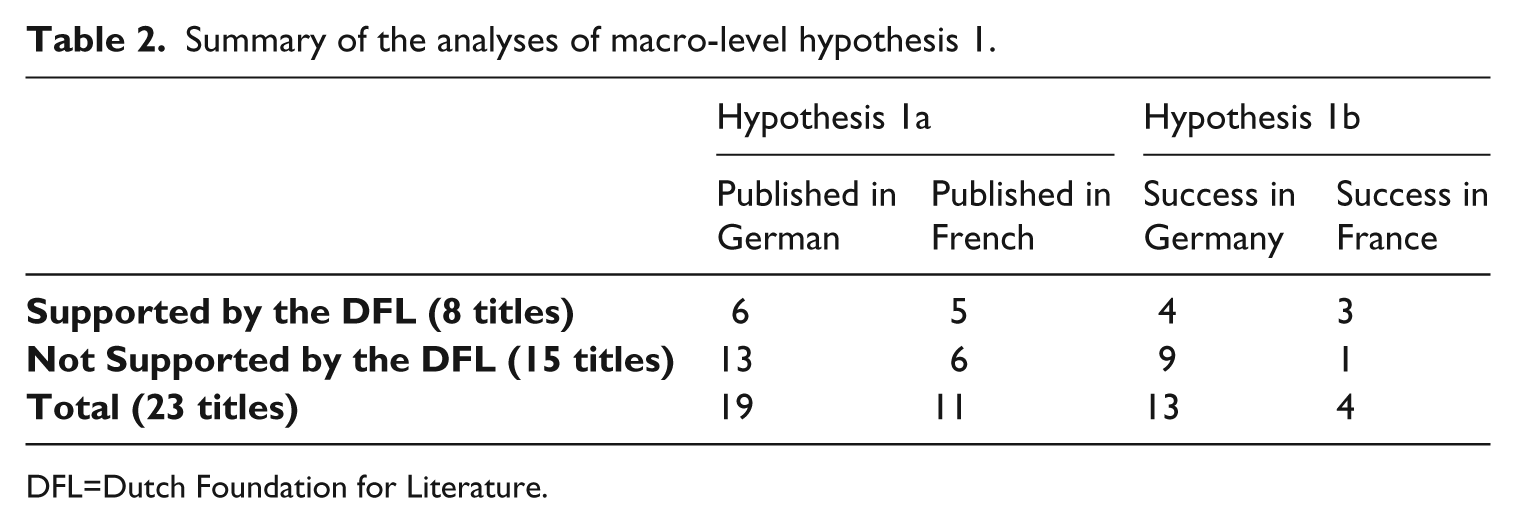
Before gaining access to the dominant English-language center, it is expected that Dutch writers have passed through international regional centers first. In the case of translated Dutch authors, this means that they were probably translated into German and/or French before being translated into English (hypothesis 1a). It may be hypothesized, furthermore, that either economic or symbolic success in the German and/or French literary fields makes it even more likely that these titles will be translated into English (hypothesis 1b). Analyzing the ways in which each of the titles has been presented and received in Germany and/or France allows a confirmation or rejection of the hypotheses. Table 2 presents a summary of the analyses per individual title. 5
Summary of the analyses of macro-level hypothesis 1.
DFL=Dutch Foundation for Literature.
When considering the number of titles translated into German and French before being translated into English, hypothesis 1a can be confirmed since two-thirds of the titles under study were translated into German and/or French before they were published in English. In line with previous studies of translated Dutch literature (e.g. Heilbron, 1999; Wilterdink, forthcoming), Germany is indeed the most significant market for Dutch authors in quantitative as well as in qualitative terms, that is, for obtaining some measure of international visibility. Although France plays a relatively limited role in the international diffusion of Dutch literature compared to Germany, French still remains the second most important target language for Dutch translations.
In terms of either economic or symbolic success, the pattern is less pronounced. A total of 13 titles (more than half) were commercially and/or critically acclaimed in Germany; in France, however, their success was relatively marginal. These results are illustrative of the importance of geographical, cultural and historical proximity between the Netherlands and Germany, which is in line with the existing historical pattern of translations made from Dutch literature, which shows an overwhelming dominance of translations into German (see Heilbron and van Es, forthcoming).
Crossing Meso-Level Boundaries: The Acquisition of Capital and Horizontal Isomorphism
Before gaining access to international regional centers, however, Dutch authors first have to acquire economic and/or symbolic capital in their own national literary field (hypothesis 2). A writer who has gathered economic capital is likely to be praised for commercially successful work, which is often presented as being a ‘major bestseller’. On the websites of authors, publishers and large retailers, the qualification ‘bestseller’ is regularly accompanied by national sales figures.
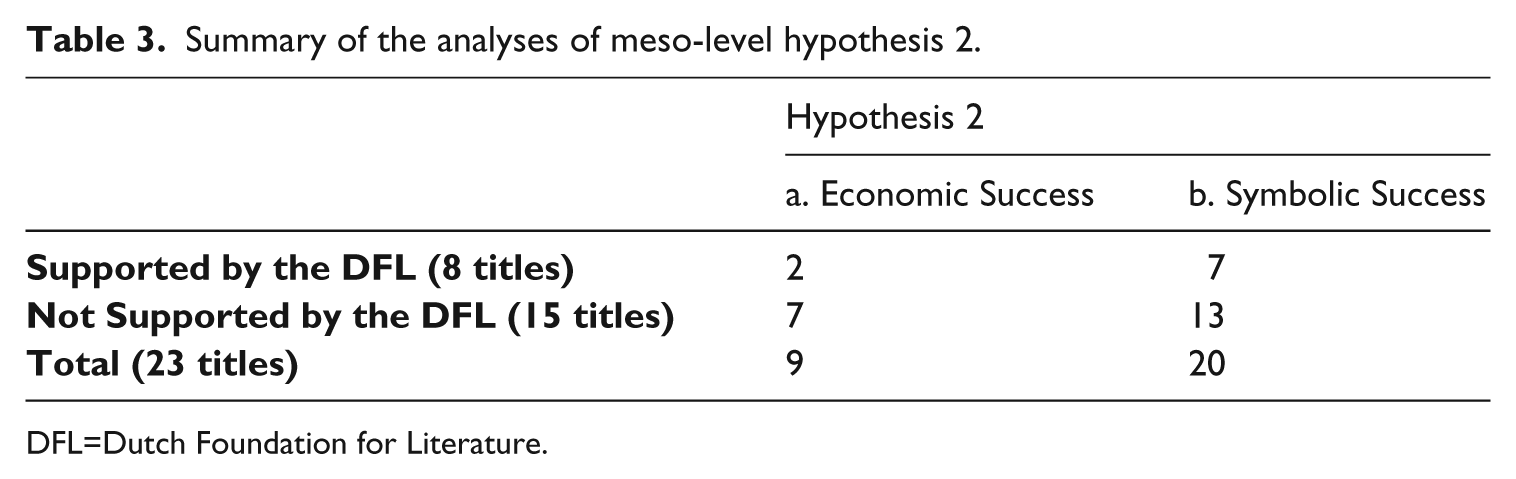
In a similar vein, authors can also be presented in such a way that their symbolic capital appears as their predominant quality. By considering the authors under study in terms of their critical literary acclaim, indicated by literary awards and positive reviews by renowned critics, it is possible to distinguish a group of writers whose reputation depends primarily on their symbolic capital. In addition to analyzing the framing of these authors on the websites of the authors and publishers themselves, Amazon, the Dutch Foundation for Literature, reviews in renowned newspapers and magazines, and the database of the Literary Museum (Letterkundig Museum) were used in verifying literary awards won by the authors under study. Table 3 summarizes the findings.
Summary of the analyses of meso-level hypothesis 2.
DFL=Dutch Foundation for Literature.
Almost all Dutch authors who have been translated into English have enjoyed considerable amounts of symbolic success. Economic capital, on the other hand, was less frequently encountered for the cases under study. Within the group of titles financially supported by the Dutch Foundation for Literature, only two titles can be considered as commercially successful works of literature. Since these commercially successful books tend to ‘sell themselves’, making financial aid available is often not necessary for selling the translation rights.
It is therefore not surprising that domestic economic success for Dutch authors is more prevalent within the unsupported group (almost half of the titles) than in the supported group (a quarter of the titles). Commercial authors, such as Kluun and his bestseller novel Komt een vrouw bij de dokter (translated as Love Life) are able to rely solely on their economic capital to transcend their national literary fields, despite the novel’s negative reception among literary critics. Selling over a million copies (author website: Kluun) and described as the most-sold novel in the Netherlands ever (publisher website: Podium), the critics denounced Kluun’s work as ‘a symbol of all that is wrong with modern society’ (Franks, 2007: 4). Kluun’s profit-driven exploitation of cancer was written in ‘the powerless literary language of a 12-year-old’ (Franks, 2007: 4).
However, as the case of Esther Verhoef illustrates, the acquisition of economic capital does not necessarily exclude symbolic recognition. Being famous for writing psychological thrillers ‘in the bestselling tradition of Nicci French’ (publisher website: F&M), she has received several awards for excellence within her genre (author website: letterkundigmuseum.nl). All in all, only one title under study received significant amounts of economic capital, and most obtained symbolic capital, thus confirming hypothesis 2.
The capital acquired by the author in both national and international regional fields determines to a large extent the location of the author within the publishing field. Being commercially successful makes an author more prone to be published at the commercial pole of large-scale production, whereas more critically acclaimed writers are more likely to be published by small-scale publishers. As translations of peripheral literature are frequently held to occupy a ‘niche position’ within the global literary field of publishing (Heilbron, 1995; Luey, 2001; Sapiro, 2008a), our titles under study are expected to be published mainly by publishers located at the pole of small-scale production (Hypothesis 3a).
By analyzing the profile of the English-language publisher – frequently described in the ‘about us’ section or in the ‘mission statement’ on their website – it can be assessed whether they operate predominantly within the pole of large- or small-scale production. Indicators, such as the publisher’s size, juridical and financial status (independent, part of larger media conglomerate, receiving financial aid), goals and motivations (profit-driven and/or enabling access to [foreign] critically acclaimed literature) and amount of translations in the backlist (e.g. Sapiro, 2008a: 156) will, where available, be used to determine the profile of the English-language publisher of Dutch translations. In general, clear statements are made on behalf of the publishers about being more oriented towards publishing ‘quality literature’ – and hence are located at the pole of small-scale production – or, in contrast, have more defined commercial interests underlying their publishing activities – indicative of their operation within the pole of large-scale production.
It has been argued that foreign publishers make decisions about translations on the basis of elective affinities (Franssen and Kuipers, 2013; Sapiro, 2008a) between the original Dutch publisher and the English-language publishing house (Hypothesis 3b). By comparing the publisher’s profile of the ‘original’ Dutch publication with their English-language counterpart, it can be assessed whether or not both publishers converge in terms of their publishing practices. A summary of the analysis of these hypotheses can be found in Table 4.
Summary of the analyses of the meso-level hypotheses.

DFL=Dutch Foundation for Literature.
In interpreting these results, hypothesis 3a can only be partially confirmed. The big difference between titles supported by the Dutch Foundation for Literature and unsupported titles can be attributed to the fact that the Dutch Foundation for Literature only provides financial support to publishing projects which are commercially difficult to publish otherwise (e.g. Sapiro, 2010; Thompson, 2010). The larger share of the unsupported titles is indeed published by large-scale publishers within the English-language field, due to the relatively larger amount of commercially successful titles within this group. This seems indicative of the competition which exists at the pole of large-scale production, driving some English-language commercial publishers to translate peripheral literature which might in the longer run be profitable. This is in line with the conclusion of Franssen (2015), where he states that innovation and cultural diversity are playing an increasingly important role in the publishing practices of larger commercial English-language publishing houses.
Moving on to the comparative analysis of the English-language and Dutch publishers, hypothesis 3b can also be partially confirmed. Whereas almost half of the titles under study show a similarity between both publishers, the small majority of these titles were published by different publishing houses, occasionally even at opposite poles of the field of cultural production. A first explanation for this finding would be that both publishers are operating in different worlds: one that is engaged in national publishing of Dutch literature, while the others devote a large share of their activities to translating and publishing foreign literature within the English-language field. The case of Kluun may again serve as an example. His Dutch publisher Podium is an independent, small publisher which specializes in publishing contemporary Dutch and translated literature (website: Podium), whereas the English translation is published by Pan Books, part of the British MacMillan Publishing conglomerate, specializing in publishing a broad range of popular, ‘commercial’ fiction (website: Pan McMillan). Although there seems to be a discrepancy between the indigenous and the foreign publisher, the overriding principle is that Kluun, despite being published by a small publisher, was an enormous commercial success in the Netherlands, whereas literary critics were unanimous in their rejection.
Some cases were less clear-cut however, such as the case of Tommy Wieringa’s Joe Speedboat, where both publishers seemingly diverged as well. De Bezige Bij, one of the largest literary publishers of the Netherlands, has a long history and a very prestigious list of authors in its backlist (Harry Mulisch, Hugo Claus, Gerard Reve, Cees Nooteboom). The English publisher, Portobello Books, is a young and independent publisher with a strong focus on introducing foreign writers within the English-language field; they describe themselves as: ‘a home to original and independent-minded writers, many of them from outside the UK, and a third of them coming into English in translation’ (website: Portobello Books). Occupying seemingly different positions in their respective literary fields, based on indicators such as their history and backlist of (prestigious) authors, both publishers do share an overarching drive to publish quality literature, denouncing any underlying commercial publishing activities and hence focusing more on critically acclaimed authors and literature.
Additionally, it is important to take the internal diversity of the English-language publishing field into account here. As English-language publishers operate within their respective national publishing fields – i.e. Australian, Canadian, North-American, British – there exists a certain competition amongst them to acquire the English translation rights for foreign literature. In our sample, the English-language publishers were mainly located in the United Kingdom, which underscores the increasing importance of the British English-language literary field for translated Dutch literature of the last decade. Although publishers located in the United States were dominant in translating Dutch literature, as they were more open to cultural diversity, around the year 2000 British publishers became increasingly interested in the acquisition of Dutch literature, which they sell for high prices to their American ‘colleagues’ (Wester, 2000). That this selling and re-selling of translation rights between English-language publishing fields can happen quite soon in succession is illustrated for example by the ‘double publications’ of Marieke van den Pol’s Bride Flight – published in both the United Kingdom as well as Australia in 2010 – and Louis Couperus’ Eline Vere, which was published in both the United Kingdom and the United States in 2010.
Looking at the majority of titles within the DFL-supported group which were published by different publishers, this can be explained by the fact that in these eight cases the DFL acted as an important intermediary between publishers in the Dutch and English-language literary fields. As the DFL possesses an international network of publishers, they provide them with information on potentially interesting Dutch titles. In doing so, the DFL effectively decreases the need for foreign publishers to invest a lot of effort, time and money in searching for the ‘right’ Dutch publishing houses in their selection of foreign works to acquire and translate, as they can regularly get updates from the Dutch Foundation for Literature. Occupying a similar position within each respective national literary field and having an ‘elective affinity’ with one another is less important when the process of translation is informed and supported by the DFL than when it is not.
Crossing Micro-Level Boundaries: The Power of Intermediary Actors
Arriving at the actual process through which translations take place, it has first been said that the various actors engaged in this process – editors, literary specialists/critics, agents and translators – play an important role in consecrating foreign, peripheral literature within their domestic literary field (Franssen and Kuipers, 2013; Heilbron, 2010; Sapiro, 2010). Gaining the favor of prestigious intermediary actors contributes significantly to the chances of entering the English-language field and of gaining some measure of visibility, attention and appreciation (hypothesis 4).
Due to the limitations of this research discussed earlier, we have not been able to contact the individual editors involved in the process of translating the Dutch titles under study into English, as well as the literary agents and literary scouts. These actors were completely absent in the presentation and reception of the translated titles under study, making it unfortunately not possible for us to systematically gather data on the particular role and importance of these actors in the translation process. Therefore we have chosen to focus the analysis on the translators on the one hand and the literary critics on the other, in terms of how their reputation in the field – acquired symbolic capital – has contributed to the entering of Dutch literature into the English-language field. Following this line of thought, we first set out to discern the amount of symbolic capital gathered by the individual translators involved in translating the cases under study. Through looking at the way in which the translator is being mentioned in the presentation and reception of the title abroad, as well as looking up their personal website (if available) and profiles to take notice of any awards or other literary distinctions earned by the translator, a good image of their status within their respective fields can be assessed.
In addition, all 23 titles and their authors under study will be analyzed in terms of their reception within the English-language field in renowned magazines and newspapers by literary critics. Reviews of each title were searched for in the LexisNexis database, as well as the websites of prestigious English-language magazines and newspapers. Reviews have been analyzed in terms of who wrote them and whether or not the Dutch author and his/her work were positively valued. Having gained the favor of having both a prestigious translator and positive reviews written by renowned literary critics allows for an increased visibility of Dutch authors and their works within the English-language literary field.
Mentioning prestigious intermediary actors who have worked on the book itself (translators) and who have judged the book from their position of expertise (literary critics), in the presentation and reception of foreign titles amidst a new audience, can in itself be seen as an important part of the ‘framing’ of a specific title. Legitimating the consecration of peripheral Dutch literature proceeds through emphasizing either a novel’s symbolic or its commercial qualities, depending on the location of the title within the publishing field (hypothesis 5).
When a title can be located, on the one hand, more towards the pole of small-scale production, it is expected that it will be framed accordingly through two main literary frames: ‘typically Dutch’ and ‘cosmopolitan qualities’. Both of these are further divided into four sub-frames which are frequently used in the framing of translated Dutch literature (Wilterdink, forthcoming). Dutch titles can thus be framed as ‘typically Dutch’ in their employment of a typical realistic, descriptive, detailed, sober and pragmatic style of writing, their relation to typically Dutch cultural values derived from Calvinism and tolerance, drawing on a particular Dutch landscape or providing a typically Dutch perspective on a major historical episode. In addition, titles can also be framed as having ‘cosmopolitan qualities’, employing a more typically European, philosophical, meta-fictional style, treatment of the issue of migration, being comparable to an established international writer (‘comp’) or deemed a ‘classic’. Those titles which are, on the other hand, located at the pole of large-scale production are expected to be presented more through commercial frames, referring to the title as a ‘bestseller’ or as being deemed ‘easily accessible’ for a large audience.
Table 5 presents a summarized overview of the analyses of each individual case, in terms of having prestigious intermediary actors facilitating the introduction of the author and his/her title to the English-language public (hypothesis 4). The way(s) in which each title is framed within the English-language literary field (hypothesis 5) can be found in Table 6.
Summary of the analysis of micro-level hypothesis 4.

DFL=Dutch Foundation for Literature.
Summary of the analysis of micro-level hypothesis 5.

DFL=Dutch Foundation for Literature.
Starting out by relating these results to hypothesis 4, it is first important to note that a total of 16 translators are responsible for the 23 English translations of Dutch fiction in 2010. One very important translator in this respect is Paul Vincent, who translated four of the titles under study into English. According to the English-language publisher of Dutch literature, Holland Park Press, Paul Vincent has been ‘one of the most renowned translators of Dutch literature for the past twenty years […] His work is internationally recognized and he has won quite a few major awards’ (website: Holland Park Press). Another prestigious translator of Dutch (historical) fiction is Ina Rilke, who translated the works of Louis Couperus and Hella Haasse into English in 2010. In addition to having been awarded the Vondel Translation Prize in 1999, Ina Rilke is also frequently praised by renowned literary critics, such as Paul Binding – an important reviewer of Dutch literature in the UK (interview DFL) – for her translations. About Rilke’s translation of WF Hermans’ De Donkere Kamer van Damokles (The Darkroom of Damocles), Binding illustratively states: ‘To read this novel in Ina Rilke’s sensitive, supple English is a literary experience of the rarest kind’ (website: Ina Rilke; Binding, 2007: n.p.).
Looking at the total numbers from Table 5, we can say that a small majority of the titles under study have been translated by a renowned translator and/or have received positive recommendations in prestigious English-language magazines/newspapers, leaning towards a confirmation of hypothesis 4. Taking a closer look at both groups of titles reveals that having prestigious intermediary actors is relatively more frequent within the DFL-supported group compared to the group of unsupported titles. This can be explained by the intermediary role of the DFL, as they keep internal records of ‘good’ translators which they can recommend to foreign publishers to call upon when deciding to translate with support from the DFL. Bringing less risk into the process of translation, as well as being more likely to gain the favor of literary critics abroad, involving a renowned and awarded translator in the process seems to have a positive effect on the entrance of a Dutch author into the English-language literary field.
However, a positive evaluation of foreign literature amidst a new audience does not rest on being connected to renowned intermediary actors alone, as this goes accompanied by framing these titles to reflect their ascribed symbolic or commercial qualities. Out of the 23 titles under study, not one proved to be unable to be framed by any of the aforementioned frames (see Table 6).
Looking at Table 6, it can be stated that in general Dutch translated works are presented and received through literary frames, which in most (almost all) cases involved a mentioning of their realistic and detailed depictions of everyday life. Further, the majority of the translated titles under study were compared in one way or the other to internationally renowned and prestigious authors, both from within and outside the Netherlands. In addition, over one-third of the translated titles were framed in relation to their description of a historical event in which the Dutch were involved, such as the colonial writings of Louis Couperus, Hella S Haase and Cynthia McLeod, or depictions of the Low Countries during and immediately after the Second World War in the novels of Louis Paul Boon and Otto de Kat. Overall, both the literary frames ‘typically Dutch’ and ‘cosmopolitan quality’ are relatively more frequently applicable to the titles translated with the support of the DFL compared to those which have not received support. As the non-supported group of titles is made up of relatively more commercially successful fiction, it is in line with expectations that we find here more commercial framing in terms of easily accessible literature and bestsellers.
Those titles which were framed mainly in order to highlight their economic qualities, were generally found within the non-supported group, which is reflected in the nature of the ‘comp’ frames encountered within this group as well. Being largely compared to similar, bestselling authors – Nicci French is a popular ‘comp’ to Simone van der Vlught as well as Esther Verhoef – the framing of these titles is in line with the fact that the large majority of these titles are published by publishing houses located at the commercial, large-scale pole of their literary field (see hypothesis 3a). Similarly corresponding to the fact that by far the largest share of the supported titles were published by small-scale, independent publishers, the titles within this group were relatively more framed to signify their symbolic value as ‘quality’ literature. This encompassed at times both typically Dutch as well as more cosmopolitan qualities in their presentation and reception in the field of English literature. It follows from this that in the case of framing translated Dutch literature, the employment of either more literary frames or more commercial ones, is indeed strongly related to the location of the English-language publisher in their respective fields, confirming hypothesis 5.
‘Fiction from the Periphery’: Implications of the Dutch Case
Starting from the notion that the global literary field is increasingly dominated by English-language literature, this article aimed at improving our understanding of the workings of this global literary field by looking at the way(s) in which translated literature from a peripheral country – the Netherlands – gains access to the English-language publishing world. In acknowledging the multiple levels on which the process of translation takes place, a multi-level field framework was outlined on the macro, meso and micro levels. After exploring this framework by means of analyzing the ways in which 23 Dutch fiction titles have been translated into English in 2010, it can be concluded that this process needs to be seen as an obstacle race in which progressively more and more authors are unsuccessful in overcoming the boundaries imposed upon them at various levels and stages into the translation process.
The first and most important boundary which Dutch authors have to overcome is that of their own national literary field by means of acquiring significant amounts of economic and/or symbolic capital (hypothesis 2). A large majority (20 titles) had indeed acquired especially significant symbolic capital in the Dutch literary field, which was about twice as frequent as their economic success. The acquisition of symbolic capital was particularly important in order to receive further aid from the Dutch Foundation for Literature, further increasing the chances of a successful translation not only due to their financial support in the process of translation but also due to their vast network of foreign publishers, translators and other intermediaries. The DFL thus does not only provide the necessary financial security for translating Dutch literature, it is also active in increasing its international visibility, contributing to the potential success of Dutch authors and novels in international regional centers. Being a significant characteristic of the niche market of translated peripheral literature located at the pole of small-scale production, support from non-profit institutions is often a necessary precondition for the translation process.
The importance of the Dutch Foundation for Literature and other similar institutions remains frequently absent from analyses of the dynamics of the global literary field, which mainly focus on the dominant flows from the center to the periphery. As the English-language field operates mainly without interference from public institutions, a focus on the role of actors such as publishers, editors, agents and literary scouts on the translation process results in omitting the (potential) influence of state agencies. Shifting the focus to cultural flows from the periphery to the center, as we have shown, illustrates the overall importance of public institutions in facilitating the translation process of peripheral literature into central languages. Though this has been mentioned in several previous studies (e.g. Heilbron, 1995; Sapiro, 2010), future comparative research towards the importance of public institutions in the translation process within other peripheral literary fields is needed.
Successfully getting access to the international regional centers of Germany and France is similarly important in order for Dutch authors to overcome macro-level barriers and gain access to the English-language field. Out of the titles under study, roughly two-thirds were translated into German or French prior to being translated into English in 2010 (hypothesis 1a), underscoring the importance of particularly the German publishing field for providing international visibility for Dutch literature. Although this was significantly less in the case of France, the French publishing field remains important for Dutch literature to increase its international visibility. The fact that about half of the titles under study had subsequent economic or symbolic success in Germany, showed that this is a contributing factor to eventually becoming translated into English (hypothesis 1b).
The importance of the regional center of Germany for Dutch literature in the process of gaining access to the English-language literary field points towards the relevance of further research into the importance of regional centers in facilitating the process of translating (semi)peripheral literature into English. Additionally, future studies might also look more into the cumulative effect of gaining capital in different literary fields – i.e. first gaining capital in a national field and then in regional field(s) – on the process of translation into English. This seems to manifest the underlying mechanics of polycentric concentration of the global literary field, where there is a rather gradual, cumulative transition of translations of peripheral literature via regional centers to the English-language hypercenter instead of a more sudden transition (Heilbron, 2010). However, further systematic research is needed to prove this further.
In finding a suitable publisher within the English language field, Dutch literature can overcome the meso-level boundaries of this field through being published by small-scale independent publishers focused on quality literature (hypothesis 3a), which was mainly the case in the supported group of titles, as the vast majority of titles within the non-supported group were published by more commercial publishing houses. On the other hand, sharing an ‘elective affinity’ between the original Dutch publisher and the publisher of the English translation (hypothesis 3b) was particularly important for over half of the titles within the non-supported group. This contrast between the supported and non-supported group of titles can be interpreted as an effect of the role of the DFL in bringing otherwise unconnected publishers into contact with each other and informing them on potentially interesting Dutch titles to translate and publish. As the non-supported group of titles has not received the aid of the DFL, it makes sense that an ‘elective affinity’ between publishers was encountered relatively more here, as the publishers need to rely on their own networks in acquiring new, foreign works.
Finally, Dutch authors and their works need to overcome the micro-level boundaries encountered within the English-language field in their presentation and reception amongst a new audience. In doing so, the majority of the titles under study made mention of the involvement of critically acclaimed translators who translated the novel in a praiseworthy way (hypothesis 4). In addition, all the titles under study were framed in one way or another, signifying either their symbolic, literary qualities or presenting the title and author more in commercial frames to highlight their economic success, based on the position of the title and English-language publisher in their respective English-language field (hypothesis 5). Following this, the fact that there are relatively more titles within the non-supported group which are commercially framed can be explained by the fact that a large share of these titles has been published by commercial publishers located at the pole of large-scale production in the English-language publishing field. In contrast, the larger share of supported titles are framed to signify their symbolic and literary qualities, corresponding to their overall translation and publication by small-scale, independent literary publishers in all but one of the cases.
The case of Dutch fiction in English translation shows that what we have called a multi-level field approach is well suited to understand transnational cultural flows from the periphery to the center. While field theory is most commonly used to understand national and international power relations and flows from the center to the periphery, it can be fruitfully used also to identify the mechanisms by which authors from the periphery overcome barriers of access to the English-language publishing field. From a consistently relational perspective, which avoids dichotomies, there is no contradiction between cultural flows from the center to the periphery and from the periphery to the center. Both processes take place in competitive fields in which actors dispose of unequal resources and are subjected to power relations. For the dynamics of the global literary field, three specific mechanisms are of particular importance. First, the polycentric structure of the global field highlights the particular role of international regional centers for obtaining international visibility for (semi)peripheral literatures. Second, the distinction between the poles of large-scale and small-scale production is crucial, in particular for the translation into English of literature originating from the (semi)periphery. Third, and related to the previous point, is the fact that the distinction between symbolic and economic capital is equally significant. Smaller publishing houses that are more oriented towards proper literary and symbolic recognition, and are able to obtain financial and other support from non-profit foundations which support cultural diversity, play a crucial role in translating fiction from the (semi)periphery.
Footnotes
Acknowledgements
The authors would like to thank Thomas Franssen as well as the three anonymous reviewers and the editor for their helpful comments on previous versions of this paper. Additionally, we would like to thank the Dutch Foundation for Literature for their assistance in providing additional information where necessary.
Funding
This research received no specific grant from any funding agency in the public, commercial, or not-for-profit sectors.
Notes

Author biographies
References
Supplementary Material
Please find the following supplemental material available below.
For Open Access articles published under a Creative Commons License, all supplemental material carries the same license as the article it is associated with.
For non-Open Access articles published, all supplemental material carries a non-exclusive license, and permission requests for re-use of supplemental material or any part of supplemental material shall be sent directly to the copyright owner as specified in the copyright notice associated with the article.
