



Abstract
This article contributes to the literature on the association between class position and cultural tastes by analyzing a unique historical data set and asking whether there were significant class differences in the consumption of music in the 19th century. Archival data from a publisher in Milan are used to analyze the characteristics of customers who purchased sheet music between 1814 and 1823. To avoid contemporary depictions of cultural hierarchies (e.g. ‘highbrow’, ‘lowbrow’ and ‘omnivorous’ tastes), we offer a new method for considering both the quantitative and qualitative dimensions of music consumption. Considering both the aggregate level of music consumption and the evolution of individual patterns over time, we find little evidence that musical tastes were aligned with class position. This finding calls for more research on the origins of the strong link between social structure and cultural preferences in general, or between class position and musical tastes in particular, which we witness today.
Keywords
Introduction
Sociological analysis of social inequalities has paid significant attention to the ways in which culture shapes processes of social stratification. Most notable are works by Weber (1978) on lifestyles and status groups, Veblen (1899) on the leisure class and Bourdieu (1984) on how cultural preferences serve social classes in creating social distinction and inequality. Contemporary research into cultural stratification tends to focus on how individuals in groups defined by an economic dimension (e.g. occupational category) often share tastes and consumption patterns in the realm of music (e.g. Bennett et al., 2009; Bourdieu, 1984; Peterson and Kern, 1996; Yaish and Katz-Gerro, 2010).
In this article we extend the analysis of the association between musical preferences and class position into the past. We do so by analyzing a unique dataset documenting the purchase of sheet music from a leading publisher in Italy during the period 1814–1823. We seek to understand patterns found in the quantity and variety of sheet music consumption, as well as the association of music consumption patterns with consumers’ class position in that period. These extraordinary data provide insights into a period characterized by dramatic social changes that have a bearing on the class-culture nexus. These changes include, most notably, increased demand for musical performances and musical education due to the rise of the middle class; music becoming a part of domestic life; the beginning of mass consumption in music; and musicians becoming virtuoso superstars (Taruskin, 2006; Weber, 1977).
This article makes two contributions to the literature. The first is to conceptualize the breadth of music consumption dynamically, both in terms of time frame and in terms of cultural preferences, at the level of individual consumers. Our time frame provides a snapshot of music consumption during one decade and our approach to measuring musical choice attends to a combination of volume and variety. Rather than applying discrete constructs such as highbrow and lowbrow genre patterns, which are contemporary constructions of cultural stratification, we use a flexible measure of the relationship between quantity (volume) of musical choice and quality (variety or breadth) of musical choice, which avoids presuppositions that stem from theories of taste developed 150 years after the period that we study. Thus, we offer an analysis that goes beyond a static picture of the state of individual consumption at one moment in time by spanning a decade, and we avoid a pre-determined hierarchical classification of the diversity of music in favour of a measure of eclecticism in musical choice.
The article’s second contribution consists in exploring the association between the quantity and variety of music purchased and class position of the consumers. Our main question here is whether class was already a social dimension structuring the purchase of music by individuals in significant ways during the particular historical period that we study. The answer to this question will provide a historical context for contemporary theories on the use of cultural preferences as social markers in processes of cultural stratification.
Culture and Class, Music and Musicians in the 19th Century
Research conducted at least since the 1970s portrays elite taste in culture as typically associated with specific genres that are considered highbrow culture, like classical music or opera (Bourdieu, 1985; DiMaggio, 1987; Katz-Gerro, 2002). These highbrow genres are perceived as sophisticated, intellectually demanding, and requiring some kind of cognitive competency and status motivation. Non-elite classes often exhibit a taste for lowbrow culture, which tends to be more popular and is characterized as spontaneous, light, simple and unsophisticated (Chan and Goldthorpe, 2007; Lizardo, 2006; Notten et al., 2015; Scitovsky, 1976). More recent work shows how elite taste has shifted from highbrow to a more eclectic, open and omnivorous taste encompassing a variety of lowbrow, middlebrow and highbrow genres (Peterson and Kern, 1996). This shift signals a transition of elite classes from a snobbish narrow taste (also called ‘univorous’) to the manifestation of cultural competencies in a variety of cultural genres. This phenomenon has received several conceptual and operational definitions and has been variously described as ‘omnivorousness’ (Peterson and Kern, 1996), ‘cultural dissonance’ (Lahire, 2004), or ‘cultural eclecticism’ (Ollivier, 2008). The eclectic consumer exhibits a variety of cultural tastes positioned along the cultural hierarchy to include highbrow, middlebrow, or lowbrow genres.
The distinction between highbrow and lowbrow cultural tastes is socially constructed, and it did not necessarily exist in the period that we study in this article. For example, starting in the 17th century and until the mid-19th century opera houses were places for the entertainment of aristocrats; however, they were open to those members of the middle and lower classes who were able to pay for a ticket (Santoro, 2010; Storey, 2003). Exclusion from these events was not marked by any symbolism attached to the opera as an art form; rather, it had a merely commercial basis. By the second decade of the 19th century, which is precisely the period that we analyze, notions of ‘art’ and ‘culture’ had come to refer to exclusive forms of aesthetic production, independent of the commercial rules of the market, and withdrawn from the world of entertainment and its cultural entrepreneurs (Williams, 1966 [1958]). The process of commodification reached a new peak in the second half of the 19th century; with the rise of the bourgeoisie as a dominant urban class, opera was reclassified as a form of art worthy of the status of high culture (Levine, 1988). By the 20th century, high culture had emerged in opposition to mass, or popular, or even petit bourgeois forms of culture produced and distributed by the growing cultural industries. The paradox in the commodification of culture was that this process, on the one hand, was socially inclusive and allowed the up-and-coming industrial bourgeoisie to access theatres, concerts halls and art galleries; but, on the other, it generated an anti-mass and anti-bourgeois stance which seized the public discourse on art and shaped it around a cultural hierarchy.
We propose considering the association between class and culture in a certain historical period with a specific focus on the relations among a nascent music mass culture, an emerging music industry and a changing class structure. Music historians maintain that early forms of mass culture had already emerged with the rise of the musical masters in the 18th century (Weber, 1977). The term ‘mass culture’, characteristic mainly of 19th-century social, economic and cultural dynamics, is appropriate for the analysis of sheet music consumption because it involved a commercialization of artistic phenomena through profit-seeking activities, the industrialization of music publishing (assisted by the development of print), instrument manufacturing and concert management (Dahlhaus, 1989; Weber, 1977). The demand for music was met by advances in the publishing industry to create a new market of music played by amateurs at home (Weber, 1977). Part of this embryonic form of mass culture and a consumer business was that publishing houses acquired the copyright of sheet music (Goehr, 1992).
One of the most innovative aspects of the 18th-century music scene is the growth of amateur musical training, leading to an emphasis on musical education among bourgeois and aristocratic homes (Weber, 1977). Music had become personal and a subject for private rather than public contemplation. This new trend was preceded by changes in aesthetic perceptions and resulted in significant changes in how the public behaved at concerts (Johnson, 1995). A new demand for music was socially constituted; a demand which Johnson (2006) terms engaged and which shaped how music was performed in the public and private spheres, and how it was listened to. It was then that music came to be a new cultural practice worthy of an investigation in the context of the social structure such as we offer here (Kramer, 1993).
The transformation of practices affected the profession of musicians. The 1800s witnessed a flowering of new traditions and aesthetics, such as light musical genres in the form of comic opera, operetta or other modernist compositions (Jones, 2016). Earning a living from musical commissions and public engagements was extremely difficult for musicians. As part of an emerging professional group, composers were subject not only to new marketing constraints and unstable social forces, but also to new exposure through the World Expositions that took place in different countries (Taylor, 2007).
As a result, musical works and their composers required publishing houses, performing bodies, and a paying public to sustain them (Goehr, 1992). The social distribution of audiences also underwent a long process of transformation from the mid-18th century, when the public display of sensibility became emphasized and new patterns of music listening developed, to the 1820s (Johnson, 1995). The classical repertoire of the 19th century in Europe reshaped musical taste by redefining the difference between entertainment and serious art, later to be termed ‘popular’ and ‘classical’ music (Weber, 1977). The period analyzed in what follows saw the rise and industrialization of mass culture, which generated new modes of social difference (Taylor, 2007).
Class Hierarchy and Cultural Hierarchy
To place our analysis in historical context and to avoid using measures of cultural stratification conceived a century later, we are reluctant to use a predefined hierarchy of genres for the purpose of classification because boundaries are disputable from an aesthetic perspective and they constantly change (Bennett et al., 2009; Rimmer, 2012). Our intention is therefore to determine the variety or heterogeneity of items consumed and the frequency or quantities of purchases. This terminology is similar to contemporary notions of ‘omnivorousness in composition’ versus ‘omnivorousness in volume’ (Warde and Gayo-Cal, 2009), which differentiate between the number of artistic genres consumed and the volume of consumption of each genre. In contrast with Warde and Gayo-Cal (2009), our conceptualization of consumption classifies individuals on the basis of both dimensions at the same time. While previous studies typically counted heterogeneity and frequency of consumption over a limited time span, with scant attention to the dynamics of the process, in this article we analyze how each individual developed their distinct path of consumption over time. These methodological innovations enable us to depict the link between class and culture in a historical period without imposing notions developed on the basis of contemporary hierarchical genre perceptions.
We therefore propose a taxonomy of cultural consumption patterns organized along two axes – quantity and variety of consumption – and as shown in Figure 1, the space is divided into into four quarters. In the first quarter, near the origin of the axes, we find the area of null or low levels of consumption, which refers to individuals who score low on the items used in this specific analysis. The second quarter shows limited consumption, but a propensity to test and try different options within a certain range of choices. Both the third and fourth quarters represent a high intensity of consumption, but the former includes a wide range of choices, whereas the latter is typically exclusive and focused on one specific cultural product, as in the case of ‘fandom’ for popular culture or subcultures. 1 We use this taxonomy to visualize the results of both the static and dynamic analysis of the data, with a particular focus on how the different consumption patterns are associated with social class. Our depiction of social class also deviates from contemporary discussions of the class/culture homology because our categorization of class does not include a working class. Ours is a study of low, middle and elite classes as understood in the context of mid-19th century Milan music consumers. We distinguish among consumers who had an aristocratic title, those with intellectual jobs (high bourgeoisie), and those in manual jobs (petit bourgeoisie).

Taxonomy of cultural consumption.
Table 1 summarizes the empirical approach implemented in the article. We test the extent to which cultural consumption, measured through the purchase of sheet music, is associated with class position and additional demographic characteristics. Since we define the type of consumption as the result of two continuous variables, we study how the distributions and the relationships of these two measures are affected by socio-demographic characteristics.
Methodological approach of the article.

We can thus summarize the focus of our analysis in the following research questions:
RQ1: How are consumers distributed in the proposed taxonomy? Can we identify a relation between the quantity and variety of the music consumed?
RQ2: Do socio-demographic characteristics explain the probability of consumers exhibiting specific consumption habits? Or, in other words, is there a consonance between social stratification and consumer preferences?
RQ3: Is it possible to identify a pattern in consumers’ behavior over time and explain it with socio-demographic characteristics?
RQ1 serves to test whether we can observe in the dataset a variety of consumer preferences and disentangle the dimensions of quantity and quality. On this basis, RQ2 addresses the question of the socio-economic basis of cultural stratification, doing so with a new method introduced in the article. Finally, RQ3 extends the analysis to the individual consumer’s pattern of consumption over time.
Data and Method
The dataset was drawn from bookkeeping records of the Ricordi publishing house. Ricordi is the best-known Italian classical music-publishing house. It was founded by the violinist Giovanni Ricordi in 1808 and during the 19th century grew to become one of the largest music publishers in Europe, with branches in several cities. The Ricordi Historic Archive in Milan is one of the most important private music collections in the world, conserving documents, manuscripts, libretti, original sheet music, letters, drawings, costumes, photographs, and posters dating back to the establishment of the Ricordi Company. The archive also conserves the bookkeeping ledgers (libri mastri) of the Ricordi shop in Milan. The information contained in these records has been transcribed in a dataset that can be considered a significant documentation of sales transactions at Ricordi in Milan between 1813 and 1824 (Baia Curioni, 2011). Baia Curioni (2011) details the specifics of the archive and the validity of the hand-written information. The records extend to 1824, the year when the Ricordi shop changed location and the publishing house opened new shops in Florence and London. 2
Analyzing the quantity and variety of music choice through the measure of composers is unusual, as is the extraordinary data source at our disposal. While the limits of a single measure of consumption heterogeneity are acknowledged, so too is the opportunity to follow customers’ purchasing behavior over time to enable depiction of evolving purchase preferences. There are several reasons why this dataset can be trusted to provide a reliable picture of the purchased sheet-music landscape of its time. First, the decade documented in the dataset was characterized by economic stagnation (Zanetti, 1977), meaning that purchasing behavior cannot have been the result of a change in the income level, since it remained constant. Second, Milan became the capital of the Napoleonic Cisalpine Republic in 1796, and its political role strengthened the cultural activity of the city (Rath, 1941). In the time span considered in our study, music printing flourished in Milan, which surpassed Venice in the number of theatres and venues of music production. Ricordi became a leader in the reproduction and acquisition of sheet music in Northern Italy. It attracted customers from all Italian cities and from major European countries, and purchased some of its competitor publishers in the 1820s (Baia Curioni, 2011). 3 Milan in that period was an important center of the music industry in general and of lyrical opera in particular. Finally, the dataset encompasses a good number of composers. While classical composers are today considered a relatively homogenous market segment, in the early 19th century they covered different areas of consumer preferences and each of them represented a specific music genre: Mayr, for instance, is considered to have produced pedantic pieces that closely follow the rules of the genre (Prunieres and Kincaid, 1921); the success of Rossini was due to his catchy aria tunes (Prunieres and Kincaid, 1921); and Mirecki was very sophisticated and even wrote the first Italian treatise on orchestration (Meucci and Waterhouse, 1996).
Composers
The dataset documents the sheet music consumption patterns of 1068 individuals from August 1813 to July 1824. Table 2 provides descriptive information on the number of customers and transactions per year. We can see, for example, that in 1823, 184 customers purchased a total of 623 sheet music items. Some customers purchased one item, while others purchased as many as 30. Overall, customers registered in the dataset purchased 5082 music works.
Customers and transactions per year.
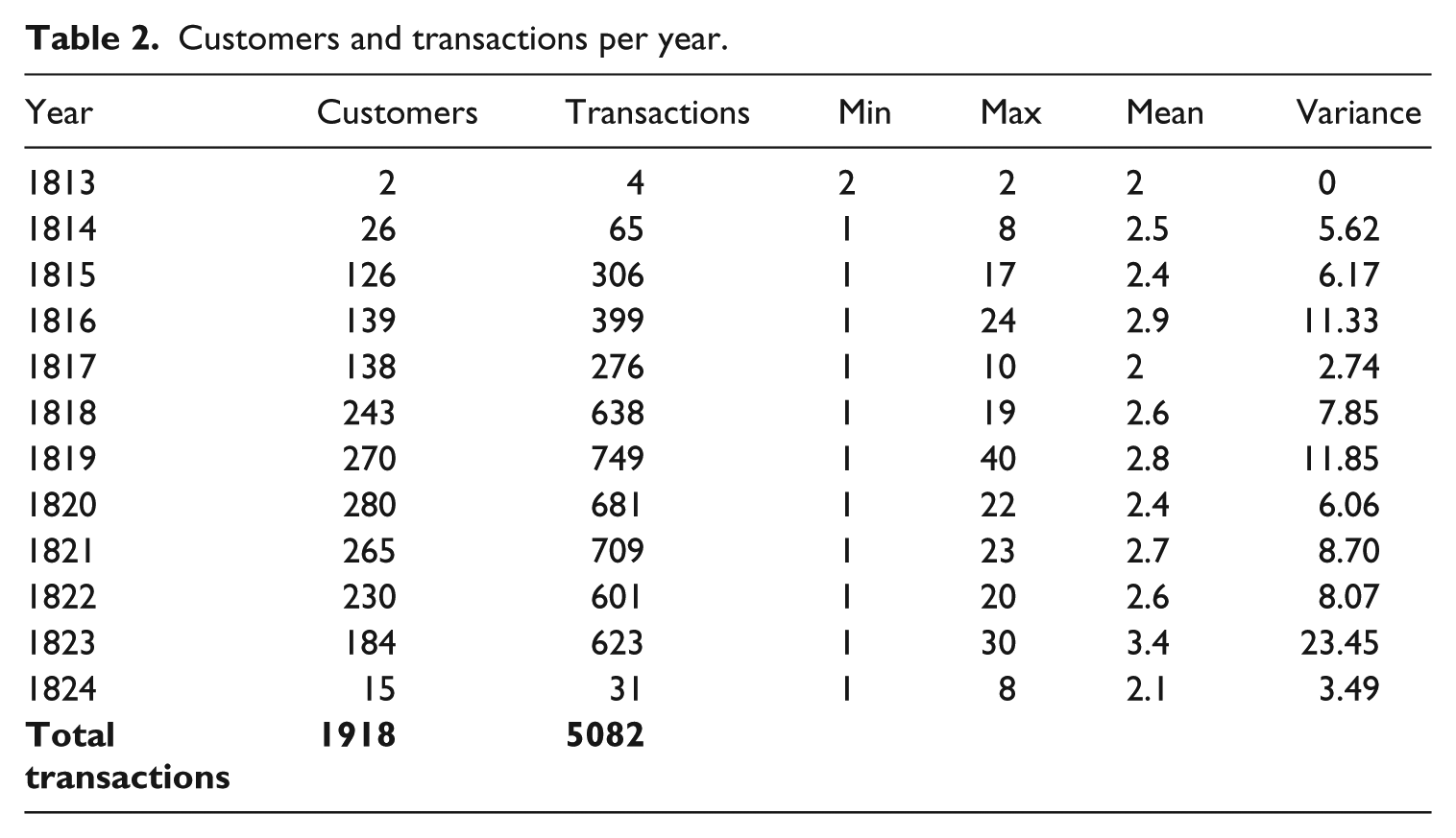
Table 3 provides descriptive information on the composers whose sheet music was purchased. For about half the sample (N = 2401), it is possible to associate single transactions with the name of the composer whose music was purchased, and this is the subsample of valid observations that we will analyse. The choice of composers is closely concentrated on a few names, since the top 12 most-purchased composers account for about 60% of valid transactions.
Transactions: by composer.
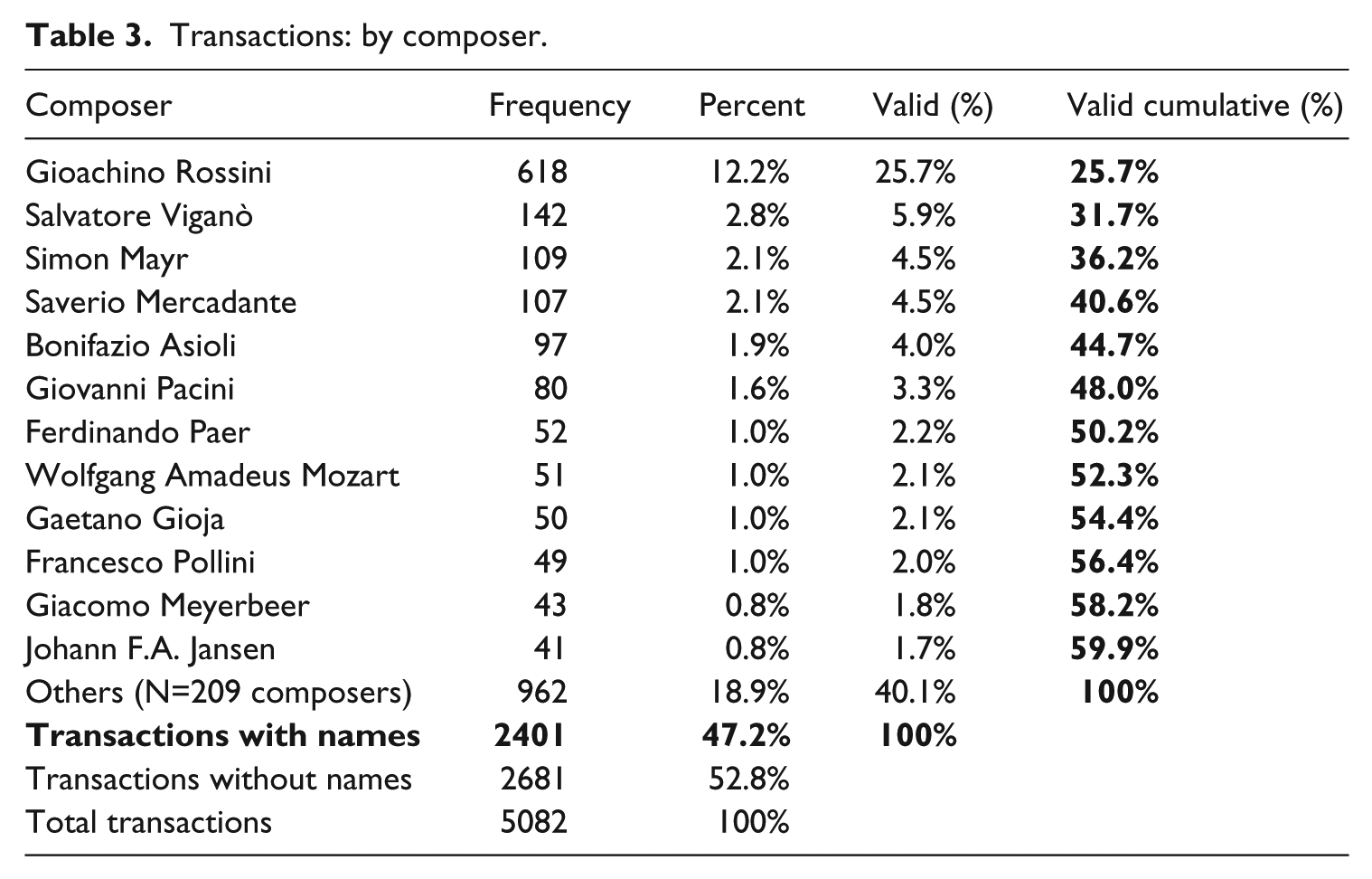
To offer a convincing interpretation of the data, we must mention the specific social and historical context of this period, because artistic fields are manifestly set within class struggles and social transformations. At that time, sheet music was purchased for two main reasons. The first was for educational purposes, as indicated, for example, by the name of Bonifazio Asioli appearing in Table 3. Asioli’s treatises and exercises were adopted by teachers in music schools, and studied by students who attended private lessons. Another example is Antonio Maria Nava, a lesser-known Italian singing teacher and guitar player who worked almost exclusively in Italy but whose performances were well-known in Italy, Germany, France and England (London). In 1808 he inaugurated the catalogue of Ricordi, which produced his four solo sonata guitars with the title The Seasons of the Year. In the time covered by the dataset he bought 52 different items, including 11 of his own works.
The second reason for purchasing sheet music was for private performances at home or for parties, and for performance in public spaces like opera houses and concert halls. The list in Table 3 comprises many composers who wrote music for opera, ballet and historical dance. As we have already mentioned, at the beginning of the 19th century, opera houses were still places of cross-social interaction (Santoro, 2010; Zelechow, 1993) and the transformation of opera into a high-cultural aesthetic experience occurred later. The evolution of dance performance followed a different path in the process of commodification. Dance culture was an essential part of celebrations and recreation (Zbikowski, 2012), although, over the 18th century, there was a clear separation between the complex dance performed in the aristocratic palaces and the simple music that accompanied dance for the masses. At the beginning of the 19th century, the practice and perception of dance changed dramatically, moving this artistic form outside the pantheon of auratic musical works (Zbikowski, 2012: 162). Unlike opera, which rose in the cultural hierarchy, dance became a social practice associated with the bourgeoisie, shifting performances from ballrooms in the palaces of the aristocracy to dance halls open to a broader audience. Dance as a higher form of art gradually lost its value as a means of distinction for the elite, and physicality was progressively detached from the legitimate music discourse.
The data analyzed here provide evidence of a unique moment in cultural history, namely, the birth of a music star. Rossini appeared abruptly on the music scene in 1810 and within a few years won the favor of Italian and European audiences, shaping music tastes across countries, cities and classes. 4 The emergence of a new composer is a rare and disruptive event for the market because it might attract not only existing consumers, but also new segments of demand (Guerzoni and Nuccio, 2014). The dataset shows ante litteram a long-tail effect (Anderson, 2006) where Rossini covers 25.7% of sheet music transactions for which the composer is documented. Unfortunately, however, the name of the composition is only mentioned in 30% of the sample. 5 Among the 10 best sellers, we find six works by Rossini, including the celebrated La Gazza Ladra and Il Barbiere di Siviglia, whereas La Vestale and Giovanna d’Arco, by Viganò, represent two dance music hits of the time. Rossini’s fandom was prominent and included people from heterogeneous cultural backgrounds and economic classes. Take for example female professional singers such as Ercolina Bressi, whose seven purchases in the period under consideration included five pieces by Rossini, or amateur artists like Mr Rossi who made nine purchases altogher, seven of which were works by Rossini. The Marquis of Aragon, Viscount Gerardini Triulzi, bought music by Rossini but also by Viganò, while Mr Zesi, a customs officer, collected six different works by Rossini.
We used the composer as the unit of analysis to measure variety. When studying music preferences, scholars have often preferred a higher aggregation level like that of music genres, which in our case was not possible. We avoided grouping composers into genres because we were investigating an historical context that is very different from today. Composers can represent the heterogeneity of the market well, since each one stood for a specific music taste ranging from the pedantic to the most sophisticated, and from opera arias to music for ballet. However, we did not go further in the disaggregation and we disregarded information on the single work of each composer. Indeed, the work of a composer is perceived to be representative of the same style and it would be impossible to argue that a consumer has a taste for variety when s/he buys numerous different works by the same composer. Moreover, we have mentioned the high percentage of missing data on this variable.
Consumers
The dataset also provides information about the customers. For each entry in the ledger (mastrino), Ricordi registered their name and home town; frequently gender (88.6%) and class (65.5%) were also recorded. Purchasers were largely male (81.3%) and often worked in the music field (45.9%) as opera singers, composers, or theatre managers. We can also find women who were somehow related to the music field, such as Giulietta Ricordi, daughter of Giovanni. There are 12 records under her name, in particular four music sheets from ‘Elisa and Claudio’ by Mercadante, who gained a reputation in Europe for opera buffa in a style similar to that of Rossini. With few exceptions, customers resided in all the former Italian states; however, 67% were from Milan and more than 80% lived in the Lombardy-Venetian Kingdom, which had been created in 1815 and remained under the control of the Austro-Hungarian Empire.
Table 4 shows the distribution of customers across classes defined by occupational category. Out of 1918 customers, we could access the names of composers on purchased sheet music for 1068 customers, and among these, we had information on class position for 700 customers. This information enabled us to classify the customers into four class categories: Artists, Nobles, High Bourgeoisie and Low Bourgeoisie. The lower classes, consisting of servants and workers, were not represented in our data because they were not typical consumers of sheet music and therefore were not part of the phenomenon that we were studying.
Distribution of customers: by class.
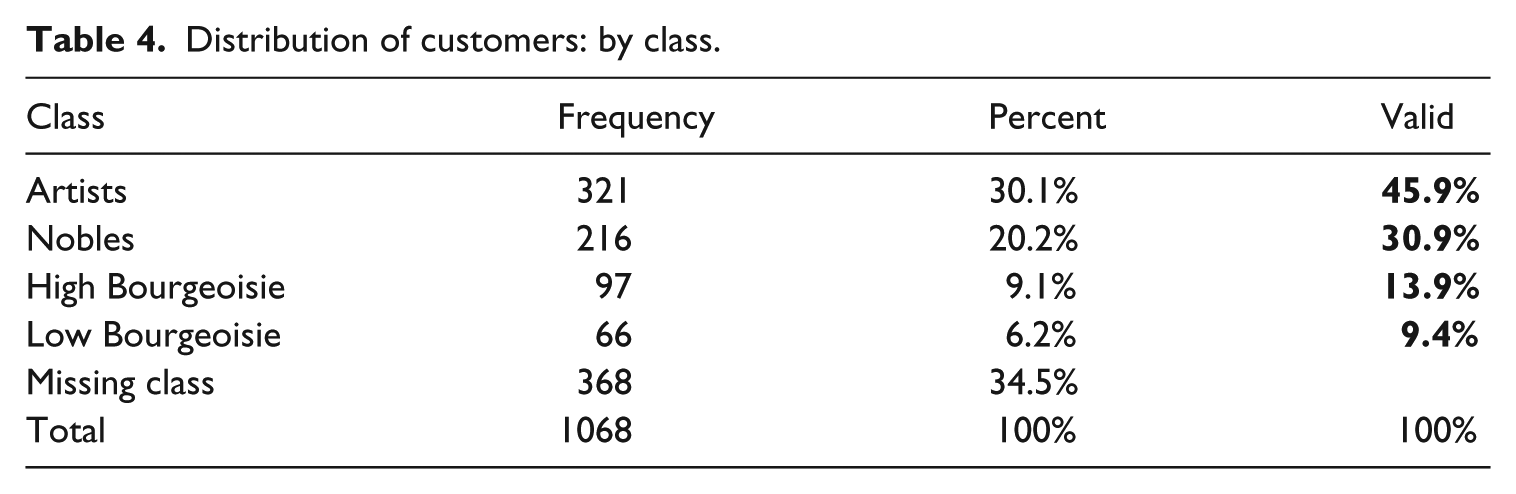
Nobles (30.9%) were distinguished by an explicit peerage in the name (count, marquis, cavalier, baron, etc.); High Bourgeoisie (13.9%) came mainly from the professions (for example doctors, lawyers, journalists, notaries, officials, etc.); Low Bourgeoisie (9.4%) were merchants, retailers and artisans, whether self-employed or shop workers (hairdressers, shoe makers, clock makers, printers, jewellers, bakers, carpenters, etc.). Finally, under the label Artists we included highly educated musicians, composers, music professors and maestros, who were the most represented group (45.9%) and, although they did not constitute a social class per se, are categorized separately since, in contrast with the others, they purchased music for both consumption and production purposes.
We chose to separate artistic workers into a distinct category for three main reasons: they are a group of consumers endowed with a specific form of cultural capital; they buy music as an input for their work activity and not only for leisure or education; and, because of their symbolic capital and their role as gatekeepers of the music field, they can affect the taste of other individuals. Simply put, this is a study of middle and upper classes in a period when the lower classes were just being formed and were certainly not consumers of sheet music. At that time, musical performances for small groups in people’s salons were becoming popular events and musical education grew increasingly important.
The cross-tabulation analysis of most frequently purchased music by class of the customer (Table 5) reveals two statistical features of our sample. First, the consumption of music represented in the dataset is closely concentrated on one superstar (Rossini) and a few other best-sellers, mirroring a market structure that is common in many art and cultural industries. These six best-selling composers account for a percentage of total purchases amounting to between 44% for High Bourgeoisie and 52% for Low Bourgeoisie. Second, the distribution of composers among the music purchased by customers with missing values on social class does not significantly differ from the distribution among customers for whom we have information on class. In other words, this aspect confirms that the subsample of valid observations is not biased as far as consumption choices are concerned.
Cross classification of most frequently purchased music: by customer class.

Empirical Analysis: Cultural Stratification in the 19th Century
Definition and Statistical Property of Variables
To answer RQ1 we conceived of musical taste as comprising two dimensions. We measured quantity as the count of sheet music items bought by each consumer:

where Nij is the number of sheet music items of composer j bought by individual i. We measured variety with an index that grasped the heterogeneity of a consumer’s music collection. To construct this index for each individual i, we first compute the Hirschmann–Herdfindahl index (HHI) over their whole consumption history:

The denominator is the sum of all the sheet music of the M composers purchased by an individual and the numerator is the number of pieces of each composer j bought by the same individual. Therefore, HHI is the sum of the squared shares of each artist in the individual i’s music collection. The HHI index ranges from 1/M to 1, when a consumer purchased music by one composer only. 6 We then normalize the HHI so that it ranges from 0 to 1:

Since NHHI is an index of concentration, we define:

Variety ranges from 0 to 1. It is 0 when a consumer purchased music by one composer only and it increases with the growth in diversity of each consumer’s music collection. The variables Quantity and Variety describe the consumption of each customer in the dataset. In addition, we use the variables Gender, Home Town, and Class. Gender is a dummy variable, coded 1 for male and 0 for female. Home Town is coded 1 for customers from Lombardy-Venetia and 0 otherwise. Class is a categorical variable including the class positions discussed above: Artists, Nobles, High Bourgeoisie, and Low Bourgeoisie. Table 6 summarizes the descriptive statistics for the variables Quantity and Variety.
Descriptive statistics.

Typically, research in this area tends to cluster consumers according to the level of their cultural behavior, for example by using latent class models to estimate the effects of various socio-demographic characteristics on the probability of consumers being assigned to a specific class of consumption (Chan and Goldthorpe, 2007; Katz-Gerro and Jaeger, 2013). We opted for a different approach, which minimizes the loss of information at our disposal: since we define the type of consumption as the combination of two continuous variables, quantity and quality, we study how the distributions and the relationships between these two measures are affected by socio-demographic characteristics.
Figures 2 and 3 depict the Kernel Distributions of quantity and variety, respectively, stratified by customer class. 7 The variable Quantity is left-skewed and shows that most consumers made a small number of purchases, while a few made a very large number. The distribution is remarkably similar across social classes, with an almost unnoticeable tendency for the Low Bourgeoisie to purchase a single item and Artists to display a fatter right tail of 60–80 purchases. The distribution of the variable Variety is bimodal, with one group of consumers showing a low degree of variety in its music collection (value around 0) while a second group exhibits a moderately high variety of choices (value between 0.5–0.6). Very few individuals appear to be in-between these two groups. Once again, the distribution across social classes is remarkably similar, with an inclination for Artists, whose density curve is higher for values in the middle, to belong more frequently to the group of moderately high variety.
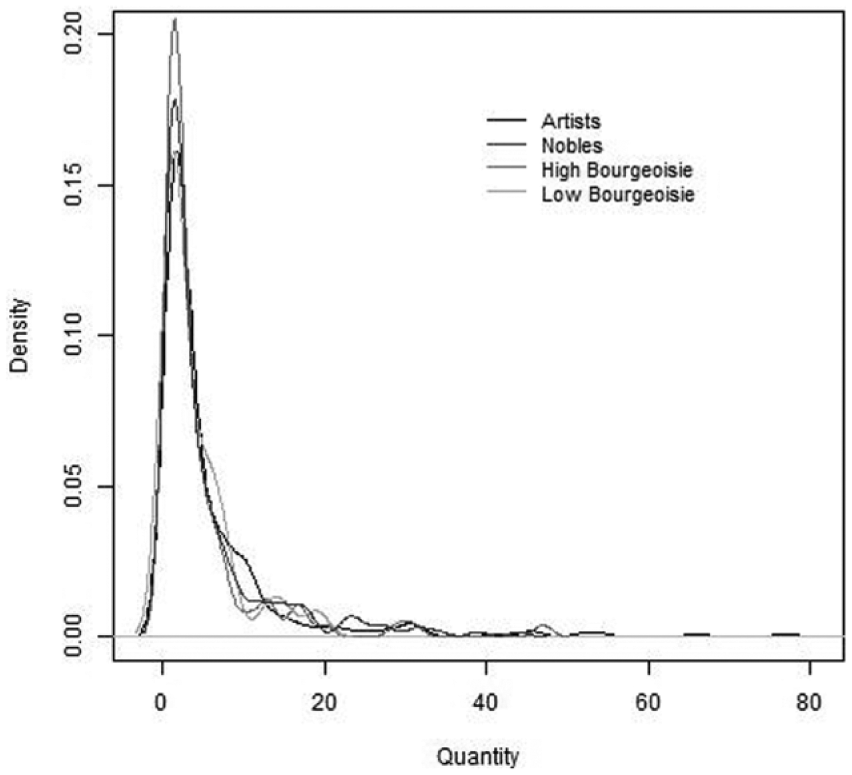
Kernel density distribution of Quantity.
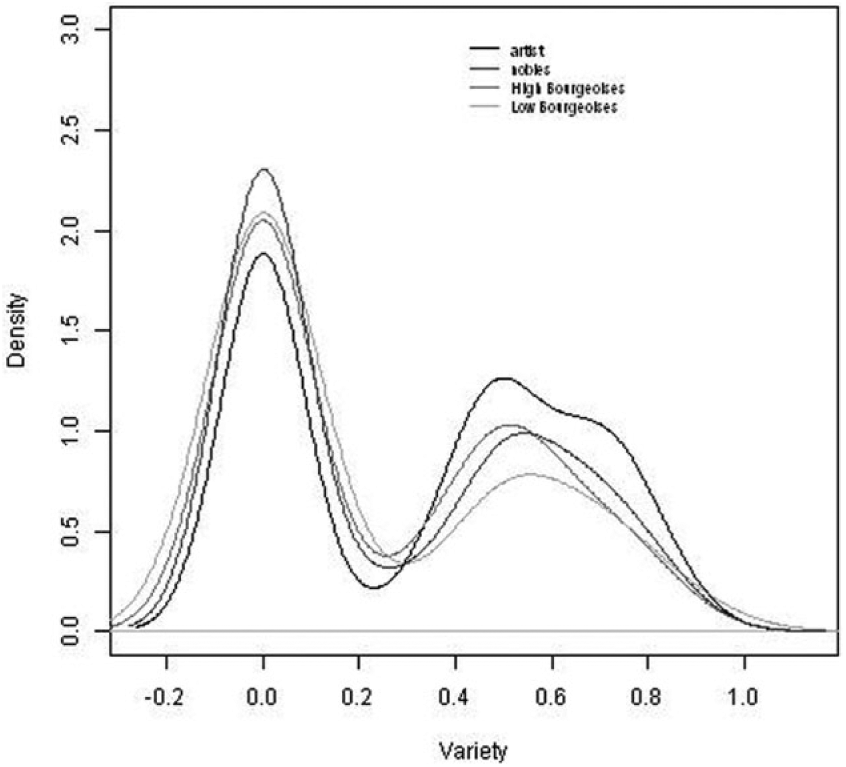
Kernel density distribution of Variety.
By crossing the two density graphs, we are able to portray empirically the taxonomy that includes quantity and variety. Figure 4 depicts the joint density distribution as a heat-map of the variables Quantity and Variety: light grey and white areas are associated with a higher density of observations. This depiction shows that a majority of consumers made few purchases. As purchases increase, variety shows a steep growth up to a certain upper boundary. The upper right area identifies voracious omnivores, who combine intensive consumption activity with high variety. The shape of the probability density functions, which is similar across social classes, indicates that the omnivore/univore dichotomy is present in various social classes, even in the period studied, which is the beginning of the 19th century. This prompts us to explore the dataset in more detail.

Heat-map with joint density distribution.
On the Relation Between Quantity and Variety of Purchases
Quantity and Variety are associated: each act of purchase, which by definition increases quantity, may or may not result in an increase in the breadth of a consumer’s music collection, and thus in Variety. For this reason, it makes sense to test whether Variety can be estimated as a function of Quantity, to analyse the shape of its graph and to study whether it is affected by the socio-demographic characteristics of the individual. As a first step, we estimated the relationship of consumers’ Quantity and Variety of purchases at the aggregate level. Thus, we considered the quantity and variety of each individual at the end of the period of observation and estimated the relation:

Z stands for the matrix of the socio-demographic variables Gender, Home Town, and Class; α, β, and γ are the coefficients to be estimated; and ε is the error term. Since the graphical analysis of Figure 4 suggests a logarithmic relationship, we also tested the same regression with the log of Quantity:

Table 7 reports the estimation of both linear and linear-log regression models of the Variety variable. Although there exists a robust positive effect of quantity of purchases on Variety, the linear-log model fits the data much better than the linear model and explains about 50% of the variance of Variety (R2=0.494). A logarithmic estimation with a positive coefficient corroborates the graphical intuition that Variety grows with the Quantity at a decreasing rate. In other words, the empirical analysis detects a propensity for Variety to grow slowly over time until it reaches an upper limit. The coefficients of the linear-log regression can be interpreted as the unit change of 0.2 points in Variety when Quantity increases by about 1%. 8
Regression: comparison between linear and lin-log models.
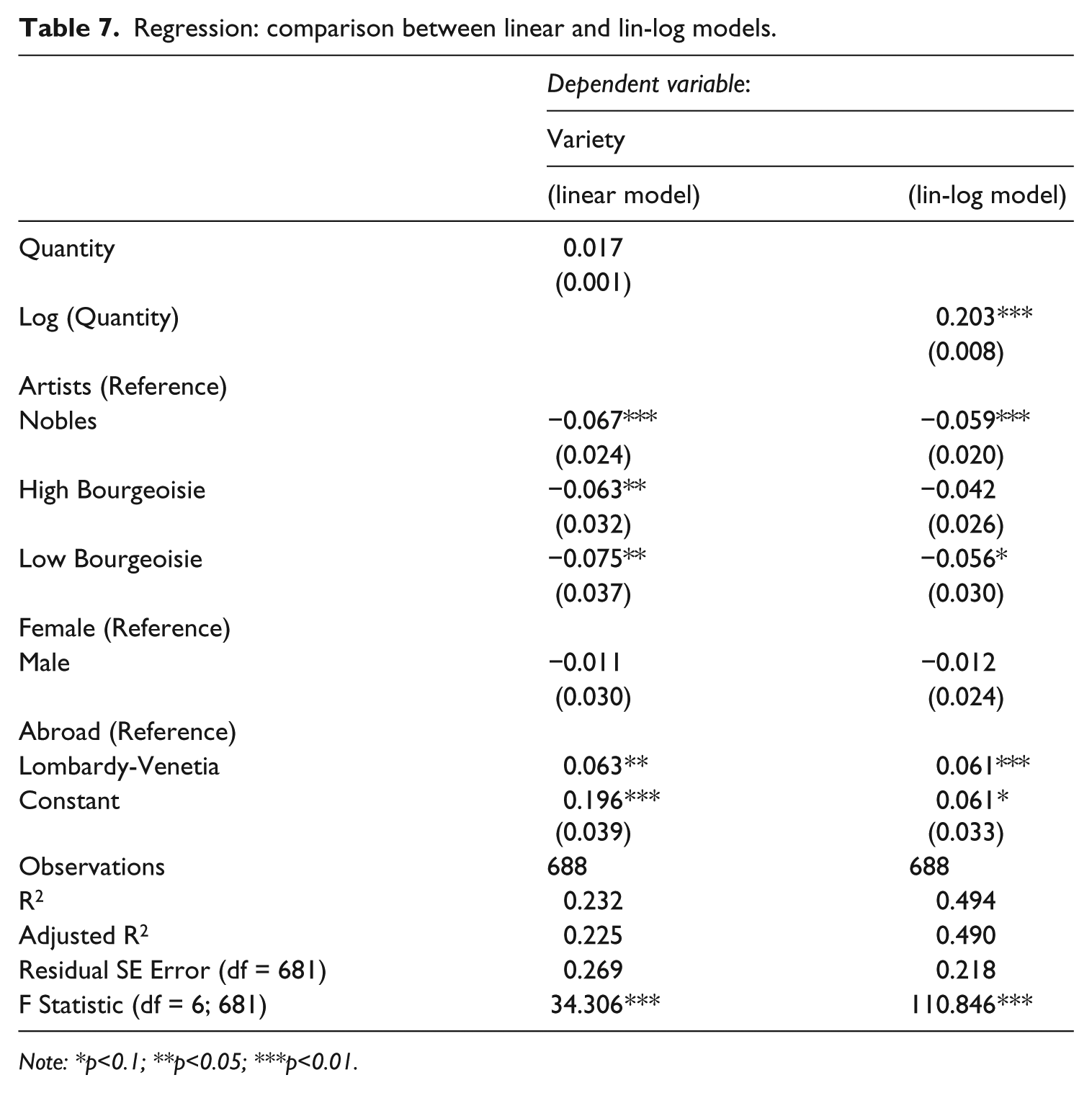
Note: *p<0.1; **p<0.05; ***p<0.01.
In response to RQ2, socio-demographic characteristics do not seem to exert a major impact on Variety: gender does not have a significant effect and the effect of living in the Lombardy-Venetian Kingdom compared to elsewhere is significant but the coefficient is weak. Dummy variables for social class show very weak effects, which become insignificant for High Bourgeoisie in the second model specification. This evidence indicates that belonging to specific social classes does not explain consumers’ patterns of consumption. The strongest result among the generally weak effects appears to be for Artists.
Artists serve as the reference category and we thus have to interpret the negative coefficients of Nobles, High Bourgeoisie, and Low Bourgeoisie as a downward shift of the relation between quantity and variety compared with the Artists. This is depicted in Figure 5, which shows estimated regression lines for Artists and the Low Bourgeoisie. Nobles and High/Low Bourgeoisie do not differ much from each other and show little or insignificant impact on the shape of the graph.
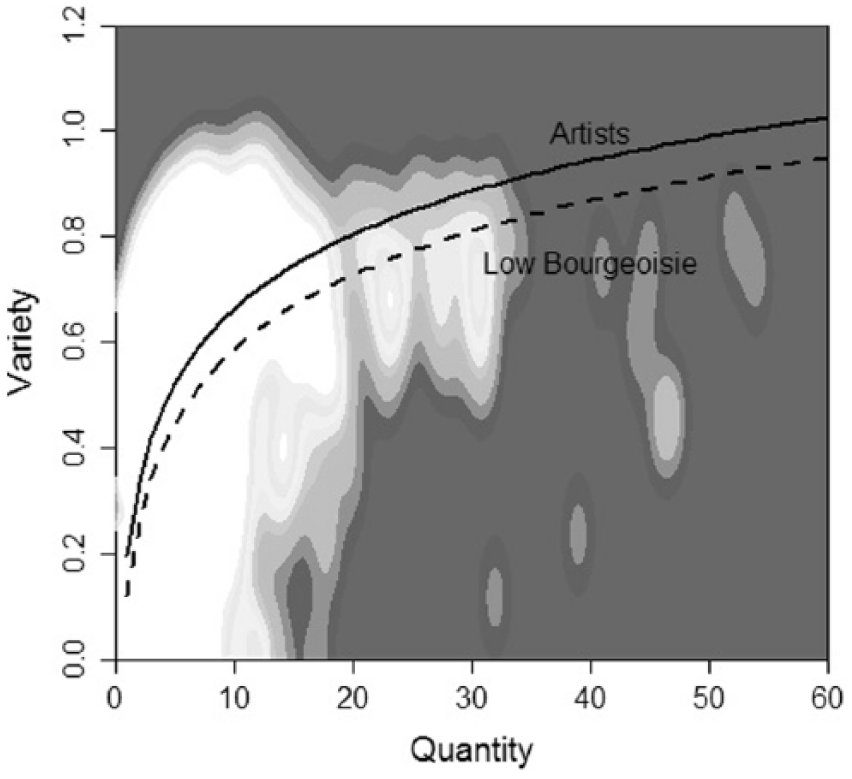
Regression lines over the heat-map with joint density distribution.
In the previous analysis we considered the cumulative consumption of each individual, observing their behavior without accounting for differences in time (cross-sectional data). This means that the estimated coefficients resulted from the average comparison among individuals and did not reflect the large unobserved heterogeneity among them. To answer RQ3, we applied a more powerful approach to estimate the relationship between Quantity and Variety by comparing the specific consumption history of each consumer and examining how Quantity and Variety changed over time at the individual (rather than aggregate) level. In other words, in the following section we exploit the panel nature of the dataset by considering the Quantityi,t and Varietyi,t consumption of individual i at time t. By doing so, we can track the consumption path of each individual and observe whether there are common patterns among individuals and differences dictated by social class.
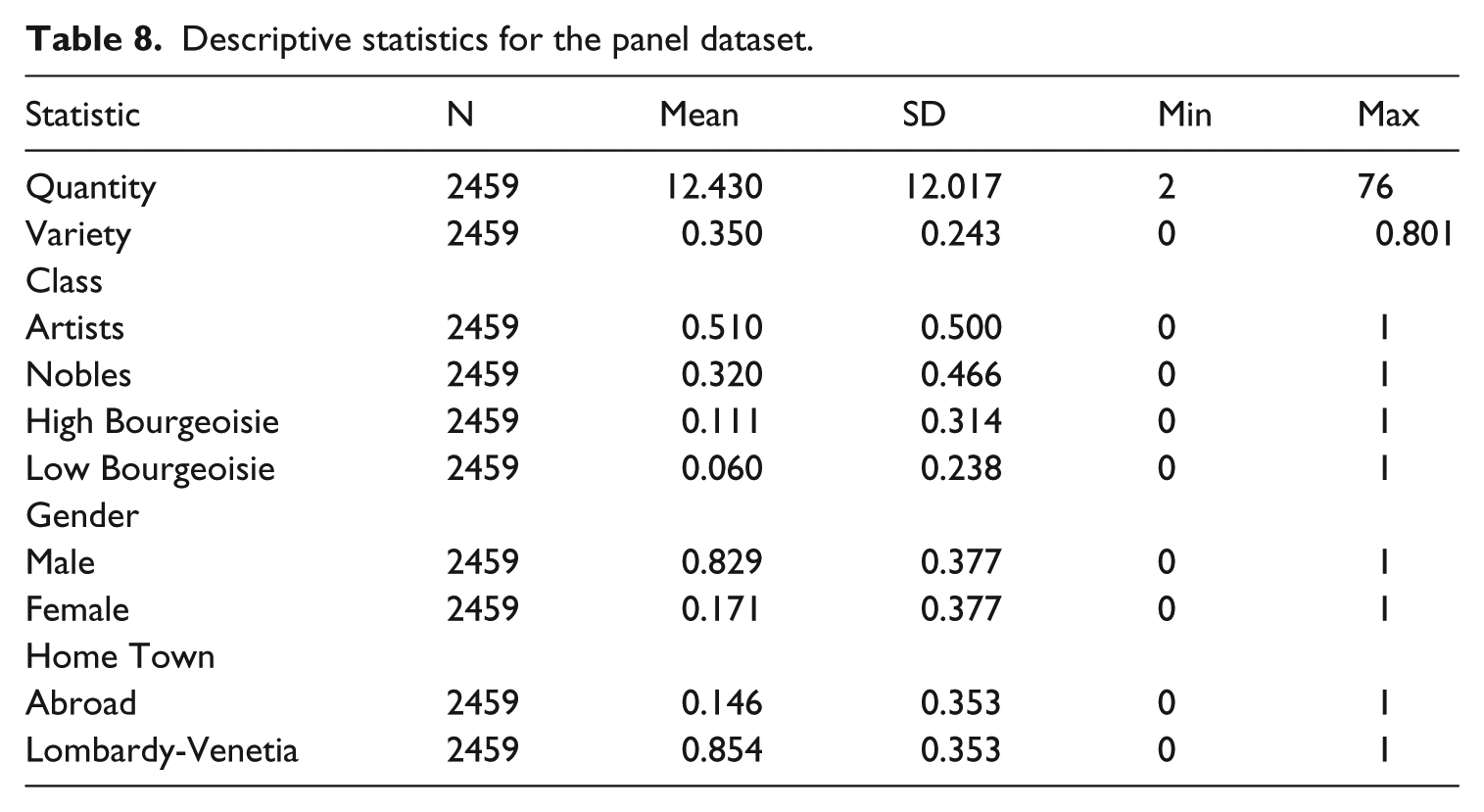
Table 8 lists the descriptive statistics for the panel data, and Figures 6 and 7 graphically describe consumption patterns of the individuals in the dataset overall and divided by social classes, respectively. It is remarkable that the logarithmic nature of the process – meaning a positive relationship between quantity and variety but with a decreasing coefficient for higher values of consumption – seems to be confirmed also at the individual level (Figure 6). However, we observe that the similarity in consumption patterns across social classes is not as pronounced as it is for individuals, since groups endowed with allegedly higher cultural capital, here represented under the label Artists and Nobles, purchase both more items and more diverse items.
Descriptive statistics for the panel dataset.

Path of consumption of each consumer in the dataset.
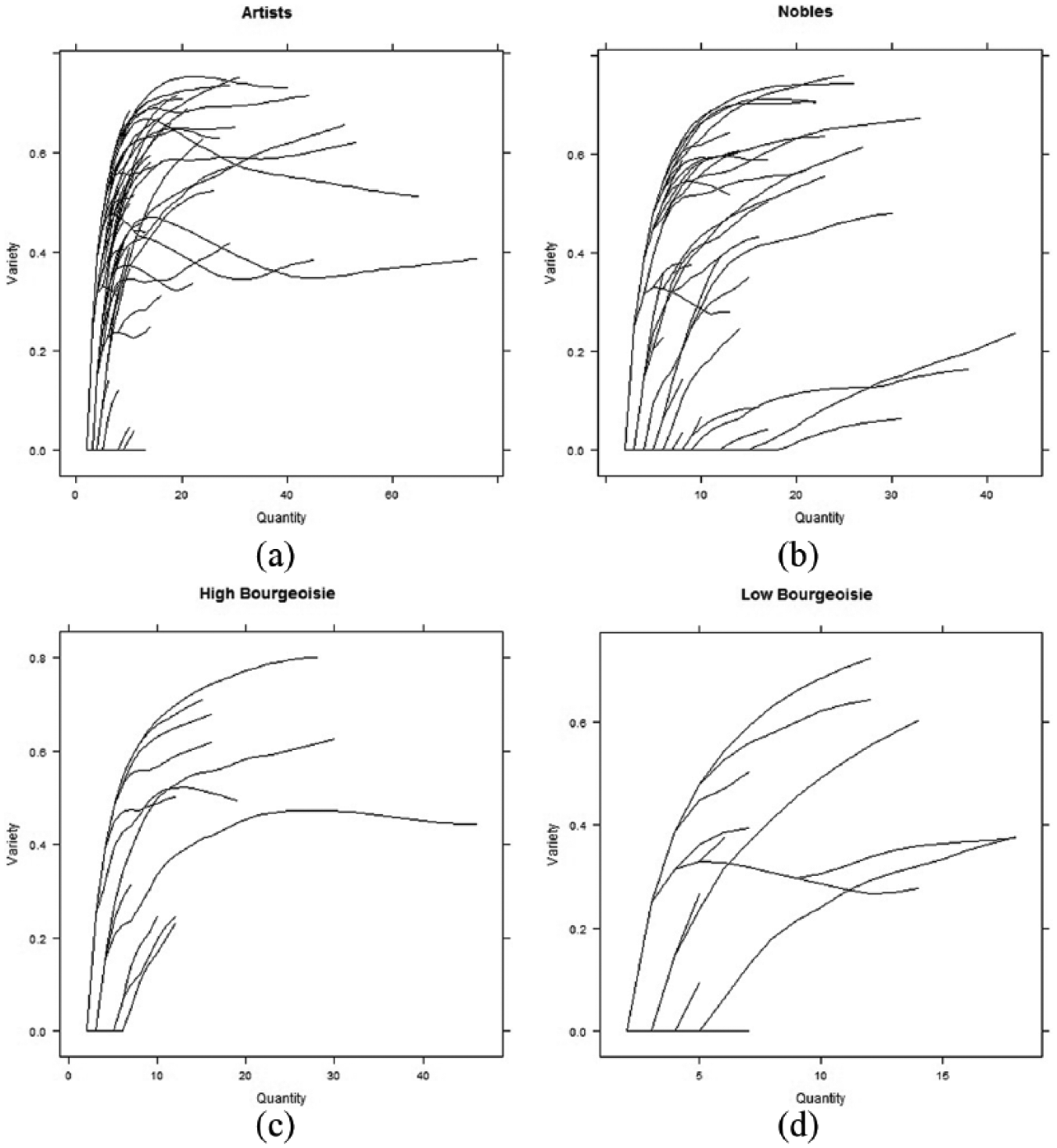
Path of consumption for each consumer by different social classes.
Thus, we re-estimated the relationship between the two variables and ran the following new panel regression:

In this case, we smoothed the variable Variety by taking a 3-year moving average, and for Quantity, we excluded this from the dataset of consumers who bought only one item of sheet music.
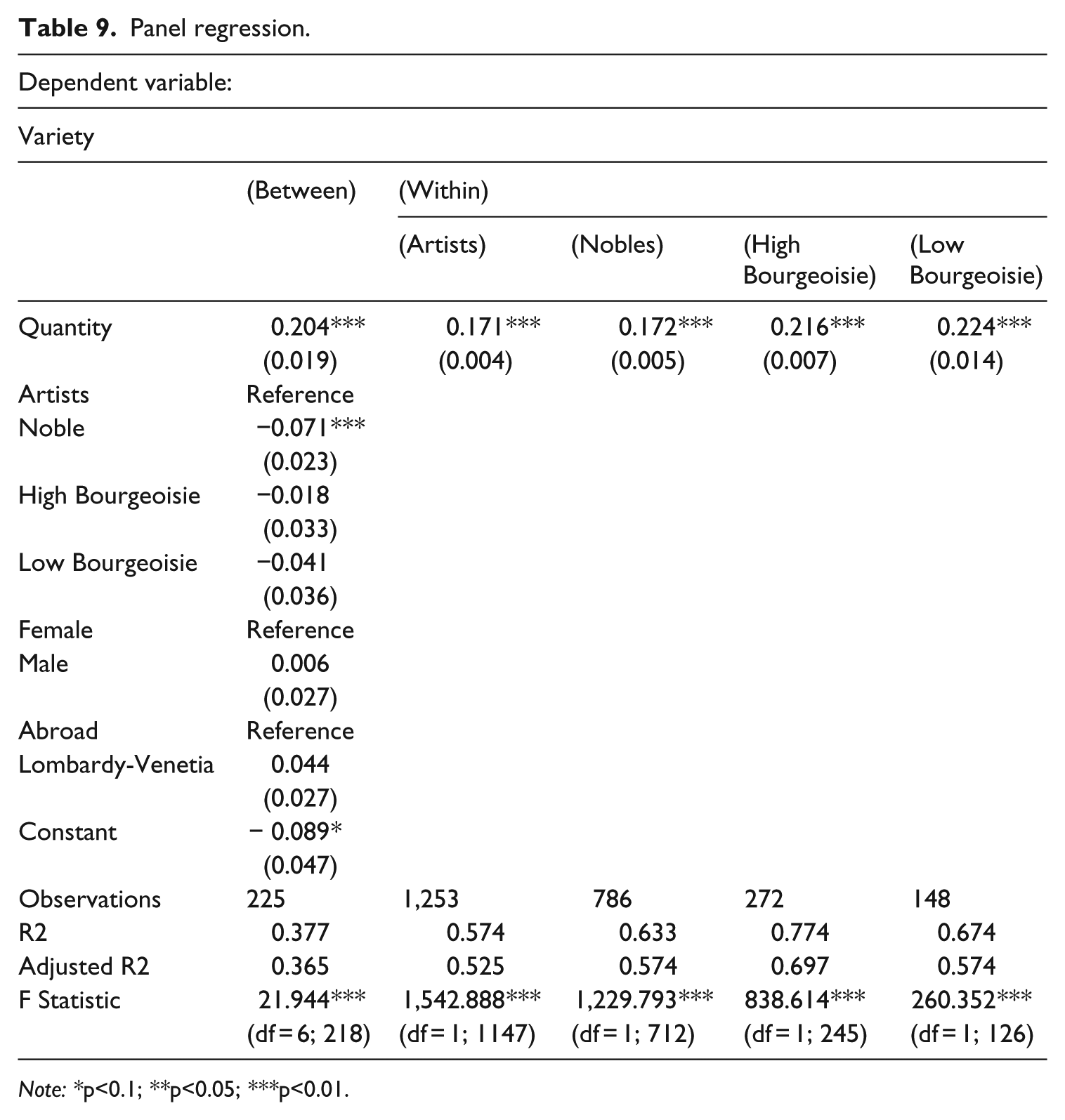
Usually, the estimation of a long-term relationship is performed with a between model, computing averages of the variables over time and discarding the intragroup variability. The first column of Table 9 reports the output of the between model. However, if the aim is to discard individual unobserved variability, the within estimator is more suitable. The within estimator is equivalent to taking the first difference of the variable; thus, it levels out all the unobserved effects that are constant over time. For this reason, the within estimator cannot take into account the socio-demographic characteristics since they do not change over time. However, being interested specifically in the effect of the variable Class, we opted to run different within estimations on each level of Class. Table 9 reports the results for the five estimates. The output corroborates the logarithmic functional form found at the cross-sectional level, and the four within models show a much better fit of the data to the regression line than the between model: the Adjusted R-squared increases from about 0.36 to over 0.5 in all models.
Panel regression.
Note: *p<0.1; **p<0.05; ***p<0.01.
Although Figure 7 points to some possible different patterns in consumption across social classes, both the between and the within estimations of model (7) reveal the negligible effect of Class. In the between model, the difference between social classes can shift the curve upwards or downwards, but the only significant detected effect is for the Nobles (see Table 9) which is consistent with the aggregate models (5) and (6) for both size and magnitude. In the within model, the maximum difference of the coefficients is between Artists and Low Bourgeoisie (a 0.04 unit change of Variety for a 1% increase in Quantity), whereas the difference between Artists and Nobles is negligible.
The logarithmic growth of Variety over Quantity depicts that elite consumers are characterized by more variety, but only because they have consumed more, probably due to higher disposable incomes. Evidence does not support any class-specific behavior other than the higher than average consumption of the Artists. Consider, for instance, Mr Triberti, a doctor in Milan, who bought 31 items of sheet music by 25 different composers, among which were the light and catchy operas of Rossini, pedantic pieces by Mayr, and sophisticated compositions by Mirecki. Similarly, Mr Troubetskoy, a prince from Turin, bought 15 works of music between December 1821 and January 1822, including the usual best-seller Rossini, but also the cryptic opera Annibale in Bitinia, the heroic drama by Giuseppe Nicolini, a minor chapel master in the service of Archduchess Mathilda of Austria. Finally, Mr Bertolotti, a hairdresser, seems quite eclectic in his taste, choosing works by 10 different composers over the course of 12 purchases recorded in the Libro Mastro.
Turning to RQ3, pattern analysis supports the hypothesis that, independently of social class, the level of variety depends on the past consumption history of each individual rather than on class affiliation. In this regard, Figure 8 is a graphical representation of the between estimation and reveals the underlying mechanism. Each line ends at the maximum level of observed Quantity for each level of Class (for instance 10 for the Low-Bourgeoisie and 76 for Artists). The similar shapes of the curves demonstrate the negligible class effect in the estimation.

Panel regression line (Between model).
Discussion
In this article we have examined the association between class and musical choice within a specific population: customers of a music publisher in Milan at the beginning of the 19th century. Looking to the past and trying to gain new insights into cultural stratification, we propose a research framework with three emphases. First, we stress the importance of both quantity and variety for assessing patterns of cultural consumption (RQ1). Second, we track the evolution of the association between music purchase patterns and socio-demographic characteristics of consumers such as class, gender, and place of residence (RQ2). Finally, to overcome the weakness of using aggregate measures of consumption that can only show a static picture of consumption at a certain point in time, we offer an analysis of the relations of the two dimensions of quantity and variety to unfold their dynamic interaction in the purchasing behavior of consumers (RQ3).
The article has employed a measure of consumption that accounts for the relationship between quantity (or frequency) and quality (or variety). This approach has enabled us to conceptualize a pattern of music preference in a continuum of consumption activities over time, while avoiding a clustering of individuals who score above or below a certain threshold within a single time observation. A majority of the sample had bought a small number of sheet music items and those were by a limited number of preferred composers. Nevertheless, there is a distinct group of consumers who purchased more frequently and chose a different composer each time. Quantity and variety are not linearly associated and the latter grows less than proportionally to the former.
The main empirical finding of this article is that choices in cultural consumption during the period studied can hardly be reduced to some form of class affiliation. We have been able to map patterns in individuals’ purchases of sheet music over time and found choices to be biased by social class insofar as class explains the actual purchasing opportunity in terms of quantity, but not in terms of the musical variety. Although classes show different levels of quantity, the structures of consumption are similar and draw a logarithmic relationship between quantity and variety at both the aggregate level and the individual level. Our results show that the variety of music selection is not unlimited, but has an upper bound of a remarkably similar size for any individual: more than a class attribute or a rational attempt of social belonging, eclectic music purchase behavior appears to be an individual attitude, a ‘practical disposition’ (Lizardo and Skiles, 2012) to explore cultural fields before concentrating on a limited number of preferences. This behavior is consistent with both the theoretical prediction and the empirical evidence offered by the learning-to-consume theory as described in evolutionary economics: consumers new to the market experience a phase of exploration in which they develop a taste for variety until the point where they reach a level of satiation (Chai, 2017).
To sum up, on the basis of unique data on music consumption – historically set at the beginning of the 19th century and geographically located in one of the capitals of European music – the research identifies an eclectic pattern of music consumption within each class in a hierarchy that included Artists, Nobles, High Bourgeoisie and Low Bourgeoisie. The eclectic pattern means that interest in music consumption in the period studied was varied rather than limited. This variety was similarly characteristic of the different classes and therefore cannot be associated with a specific elite class. This could be evidence of a gradual process of enculturation of the so-called ‘masses’ whereby they are transformed into some approximation of the bourgeoisie (Brantlinger, 1983). It would be only later that the distinction between classical and popular music and the defence of elite and nobility would achieve full expression. We find that class has a negligible effect on breadth of consumption and seems to explain only differences in levels. Differently from contemporary eclecticism and omnivorousness, which is considered confined to the upper classes (Peterson and Kern, 1996), this form of historical eclecticism is not linked to class stratification.
The empirical analysis evokes a pre-Bourdieusian framework: while in modern and post-modern society cultural goods are attached to symbolic values that mirror social affiliations, finding class differences only in quantity but not in variety, we argue that this symbolic value was much weaker in early capitalism. From the perspective of cultural and historical sociology, we see that the symbolic value of cultural goods is conferred by their progressive commodification and their transformation into cultural industries starting only in the second half of the 19th century. A possible interpretation of our findings is that commodification and the class-based stratification of art – and therefore artistic legitimacy and distinction – arose only with the establishment of a bourgeois society in the European countries starting with the liberal revolutions of 1848 aimed at subverting the conservative order. 9 Nevertheless, the generalization of these results should consider the specific socio-historical context analyzed and the fact that our data cover only the consumption of music and not other cultural products, and only a subset of the class structure with the omission of the most important comparison with the working class.
Footnotes
Funding
The author(s) received no financial support for the research, authorship, and/or publication of this article.
