




Abstract
This study applied discourse analysis to over 1500 publicly posted comments following the multilingual Coca-Cola ‘It’s Beautiful’ commercial which aired on 2 February 2014 (Super Bowl Sunday) across the United States. Discursive analysis found that immigrant groups were discussed by about one-third of respondents in predominantly negative ways. People employed categorization, comparison, consensus, generalizations, metaphors, rhetorical questions, and directive speech acts to discuss the commercial and immigration, more generally. The frequent presence of such negative responses to the commercial suggests that anti-immigrant sentiments continue and possibly are intensifying among segments of the population in the United States. The Model of Normalized Hate Speech is presented here, in order to promote future inquiry and understanding in this area.
Introduction
Every year, millions of citizens in the United States anticipate the Super Bowl Football Championship. Often, people use this event as an opportunity to get family and friends together for food, festivity, and fun. During this game, many media viewers also derive enjoyment from the creative and catchy Super Bowl ads that corporations hope will entice consumers to pledge product or brand loyalty. In 2014, Coca-Cola created an immediate national furor and buzz by celebrating cultural diversity in the United States. The company developed an advertisement using the ‘America the Beautiful’ anthem, which was performed in seven different languages, including English. The song was performed by seven girls belonging to different ethnic minority groups. It was an obvious attempt at multiculturalism and international branding, possibly designed to produce just such a public frenzy.
Within minutes of the advertisement’s debut, former Republican Congressman Allen West, of Florida, ironically a former member of the US Congressional Black Caucus, posted a blog that read, If we cannot be proud enough as a country to sing ‘America the Beautiful’ in English in a commercial during the Super Bowl, by a company as American as they come – doggone we are on the road to perdition. This was a truly disturbing commercial for me.
These feelings were swiftly echoed and multiplied. Todd Starnes, a Fox News columnist, tweeted, ‘So was Coca-Cola saying that America is beautiful because new immigrants don’t learn to speak English? Coca-Cola is the official soft drink of Illegals crossing the border’. The hashtag ‘#BoycottCoke’ via Twitter, Facebook, and other social media sites fizzed with intensity.
It seems that some people perceived that performing the ‘America the Beautiful’ song in several non-English languages disrespected a beloved national anthem that pays tribute to the culture and history of the United States (Day, 2014: 1). Critics have argued that such negative responses are merely reflective of modern racism and resistance to a commercial that infers that the country ‘isn’t a white man’s America anymore’ (Whitefield, 2014: 1). Considering that immigration trends are increasing worldwide, evaluating negative responses to this multilingual advertisement hopefully enables a clearer understanding of public attitudes and sentiments toward immigration, diversity, and multilingualism in the United States.
Aims
The main purpose of this article is to identify the strategies that were engaged during public discussion of a multilingual commercial that employed a patriotic American anthem. In what follows, the literature review addresses immigration trends in the United States and social identity issues as they influence perceptions of language vitality among minority and majority language communities. A brief history of the English-Only Movement in the United States will be presented, before laying out specific discursive strategies that are often evoked by members of dominant groups to discuss minority groups in society. Discursive analysis of over 1500 comments suggests that negative comments about the commercial aligned with the ideologies of the English-Only Movement in the United States and positioned immigrants in dehumanizing and derogatory ways. To conclude, the Model of Normalized Hate Speech will be introduced in order to guide future research in intergroup judgments, public discourse, and prejudice as it may relate to diversity issues in the United States and abroad.
Literature review
In the last 25 years, global migration trends have increased from 154 million people in 1990 to 232 million today. This represents an increase of almost 50% in roughly two decades (United Nations Department of Economic and Social Affairs, 2013). In 2010, the United States Census Bureau (2010) reported that there were 37.6 million documented immigrants living in the United States, many who speak a non-English language at home most of the time.
After arriving to their new homeland, immigrants may adopt Standard English for functional purposes, yet loyalty to one’s language of origin often remains (Clyne, 1982). Evaluations of standard and non-standard languages in the world have been the focus of inquiry across disciplines, and hundreds of studies have looked at the ways in which non-standard languages are evaluated (Bradac, 1990; Cargile et al., 1994). Generally, research has verified that non-standard languages tend to be evaluated less favorably than standard languages. In other words, people who maintain their language of origin after emigrating may be viewed in negative ways by members of more dominant language groups.
Social identity theory suggests that people are motivated to have a positive social identity about themselves and the groups they belong to (Tajfel, 1978; Tajfel and Turner, 1979). In order to achieve this, individuals may enhance the positive traits associated with their in-group and enhance the negative characteristics of the ‘Others’. For instance, some might compare themselves by concluding that their own group is smarter, more attractive, or more accomplished than others. Processes like this enable one to feel good about group affiliations and assist in cultivating self-esteem.
Subjective perceptions of linguistic vitality (or individual evaluations about the value of a given language) shape perceptions of social identity across various situations among minority and majority language communities (Barker et al., 2001). Specifically, social identity and perceptions of language vitality may influence how people perceive and respond to immigration policies across educational, political, or media contexts. Someone who perceives that the English language is under threat of being replaced will be more likely to try and limit minority language use. On the other hand, someone who believes that the English language holds high vitality will more likely support or promote bilingual language policies because, presumably, the presence of other languages does not represent a threat to the survival of English. Social group identity and perceptions of threat may cause people to view language diversity issues as a battle between ‘Us’ and ‘Them’.
Historically speaking, the United States has considered itself a nation of immigrants from a variety of places that merge into a ‘melting pot’. This metaphor assumes that immigrants assimilate into the mainstream culture by adopting the language and culture of their host country. However, upon closer examination, the ‘myth’ of the melting pot is found to be inaccurate. For instance, scholarship has confirmed that in the 18th and 19th centuries, German, Swedish, and Dutch languages were frequently employed throughout the American colonies (Zentella, 1997), while Spanish and French were widely used outside of the 13 colonies (May, 2012). Language policy and practice during the 18th and 19th centuries confirm that linguistic diversity and multiculturalism were routinely present during interactions (Pavlenko, 2002).
The history of restrictive language movements in the United States originated during the period following World War I (1880–1924) when anti-German sentiments emerged. This also coincided with immigration trends that included people from Southern or Eastern European nations, who were viewed as distinct from previous groups of immigrants (Pavlenko, 2002). English has never been the ‘official’ language of the United States, despite many recent attempts to ban non-English languages at the local, state, and federal levels.
The modern English-Only Movement re-emerged during the 1980s and reflects three main goals. The first deals with educational policies for children belonging to language minority groups. The second issue addresses linguistic access to civil and/or political services for non-English speakers (e.g. multilingual resources). The third goal of this movement deals with implementing legislation that would grant English official status in the United States (Schmidt, 2000). This movement has been of particular interest to communication scholars because of the adverse impact such initiatives have been found to have among people who have limited English proficiency (Barker et al., 2001). In fact, research conducted by the American Psychological Association (APA) has found that the English-Only Movement in the United States may impact limited English speakers negatively in terms of intergroup relations, psychosocial development, academic performance, and health care (Padilla et al., 1991). As a result, the APA has concluded that such a movement is unethical because of the multiple negative outcomes that such initiatives have on limited English speakers and intercultural relations more generally.
According to Van Dijk (2006), social and political ideologies include fundamental beliefs about groups of people that include general and abstract ‘mental models’. These kinds of schema tend to remain fairly stable over time and may reflect ongoing social struggles between certain groups in society. In the modern society, prejudice toward certain groups is usually considered to be a negative attribute. To reduce the likelihood of being viewed unfavorably when discussing diversity issues, people may deny, justify, or blame the target group for existing circumstances or problems (Weatherall, 2012).
Van Dijk (2006) previewed several categories of ideological discourse analysis that can be applied to better understand public attitudes about immigration. Appealing to an authority refers to an expert or moral leader to enhance the legitimacy and believability of claims. Categorization and sub-categorization organize people and groups by labels. For instance, when people categorize immigrants who are ‘legal’ or ‘illegal’, they are evoking such a strategy. Comparison is often used when speakers evaluate the similarities and differences between in-groups and out-groups, while consensus or the ‘power in numbers’ approach bolsters impressions of mainstream agreement and support about a given viewpoint, stance, or issue. Using the counter-factual, or speculating about what would take place under a different set of circumstances, is also used in public political debate. This tactic may take the form of a politician who invites people to ‘Imagine how much worse our fiscal situation would be if we allowed illegal immigrants to stay in the country’.
Disclaimers are also frequently applied when people talk about modern race issues, because they enable people to ‘save face’ by presenting a positive image of self and a negative impression of the other. Such a tactic may take the form of someone overtly claiming that they are not ‘racist’ immediately before using a racist term or statement. Relatedly, people may also employ euphemisms to talk about race or immigration issues, such as when someone criticizes a commercial or situation for being too ‘politically correct’ because it reflects diversity and social inclusion. Generalizations about certain groups of people also tend to occupy public debate about immigrants, which is in contrast to the use of concrete stories or examples as evidence. Van Dijk (2006) noted that generalizations are most often used to reinforce negative prejudices about immigrants or other stigmatized groups.
Rhetorical questions or hyperbole are also commonly used to reinforce persuasive appeal, such as when a person asks a question they intend to answer themselves in the next statement. National self-glorification praises the tradition, history, or values of one’s nation or country. The use of metaphors provides more concrete visual imagery to enhance perceptions of threat about immigrants (e.g. immigrants as ‘waves of water’, ‘social parasites’, or other dehumanized entities). Santa Ana (1999) analyzed discursive metaphors that were applied to immigrants in the Los Angeles Times and found that immigrants were referred to as animals, weeds, debased people, or commodities.
Methodology
Discourse analysis is focused on the implicit meanings found in texts (Van Dijk, 2006). Such arguments may marginalize minority groups and legitimize beliefs, values, and ideologies of more dominant groups. This research applied discourse analysis to better understand modern political and social ideologies held about immigrants in the United States by some members of the public. More specifically, this study sought to identify ways in which people use discourse to construct ‘mental models’ of immigrants. Furthermore, the analysis sought to better understand how people use discourse to minimize the likelihood that others would view them in negative ways, despite employing prejudicial and discriminatory language.
Overall, there were a total of 1512 postings included in the analysis. The data were gathered a few days following the 2014 Super Bowl. Publicly posted comments were gathered from the Coca-Cola Corporation website, the Coca-Cola Facebook Page as well as the Los Angeles Times and the New York Times websites. To begin with, all comments were assigned one of two categories. These two categories comprised comments in support of the commercial (labeled as ‘Pro’) and those that were not (labeled as ‘Con’). Roughly 1030 comments were in support of the advertisement, while 469 comments negatively evaluated the Coca-Cola Corporation, the commercial, or immigrant groups in general. There were 13 comments not clearly in support of the advertisement or against it. These comments were not included in either group. Analysis indicated that a total of 935 people posted comments, indicating that several people posted more than one.
The comments were then reviewed individually and every time a person used a certain discursive strategy, a number corresponding to that strategy was assigned (e.g. every time someone evoked consensus, the number 3 was assigned). These discourse strategies were discussed by Van Dijk (2006) and involved the use of authority, categorization, comparison, consensus, counter-factual, disclaimers, euphemism, evidence, examples, generalizations, rhetorical questions, metaphors, and national glorification. It became evident early in the analysis that some postings employed more than one discursive strategy, and it seemed important to acknowledge the multiple ways that people would discuss the issue.
It is noteworthy that many responses were posted in support of the commercial. Such support does suggest that many people are accepting and embracing a multicultural United States. However, given article length limitations, the scope of this study is to assess the negative sentiments expressed by some citizens who do not approve of the United States being depicted as multiracial and multilingual. In what follows, the frequencies of the applied discourse strategies will be reviewed and select excerpts will be presented to reflect current sentiments toward immigrants and diversity. The evidence demonstrates that many people in this group perceive themselves as the dominant ‘in-group’, while viewing immigrants and multiculturalists not actively practicing the ‘melting pot’ strategy of assimilation as the ‘out-group’.
Results
Most people engaged more than one of the aforementioned strategies to discuss the commercial. The most popular strategy for all comments included the use of evidence (51.2% or 772 comments), categorization (36.8% or 556 comments), comparison (31.7% or 380 comments), generalization (23.7% or 358 comments), speech act directives (21.5% or 324 comments), consensus (10.8% or 162 comments), metaphors (7.6% or 115 comments), and authority (7% or 106 comments). Table 1 presents frequencies and percentages for comments in support of the commercial (Pro) and those not in support of the commercial (Con).
Comment categories and frequencies.

Those in support were much more likely to use comparison (28% compared to 18.9% for ‘Con’ group) and evidence (56% compared to 41% for ‘Con’ group) discourse strategies to bolster arguments. Those not supporting the commercial were more likely to use authority (12.7% compared to 4% for the ‘Pro’ group), categorization (45% compared to 33% for the ‘Pro’ group), consensus (20% compared to 6% for the ‘Pro’ group), disclaimers (9% compared to <1% for the ‘Pro’ group), euphemism (15% compared to <1% for the ‘Pro’ group), generalizations (37% compared to 18% for the ‘Pro’ group), metaphors (12.5% compared to 5% for the ‘Pro’ group), and speech act directives (35% compared to 15% for the ‘Pro’ group).
Consensus
People frequently built consensus through discourse about the multilingual advertisement. For instance, person 1 wrote, Your company has gone too far, taking our national anthem and turning it into a multicultural advertisement to sell more of your product. True Americans respect the anthem in the language it was written regardless of their ethnicity. Our nation was founded on a common core of values and beliefs and people one of which was NOT multiculturalism but assimilation.
First, the person aligned with the entire nation by evoking the consensus term ‘Our’. This was done by stating that the advertisement was ‘taking our national anthem and turning it into a multicultural advertisement to sell more of your product’. By claiming that ‘Our nation was founded on a common core of values … NOT multiculturalism’, they legitimize this opinion as reflective of ‘our nation’. Also, it emphatically asserts that this ‘common core of values’ is NOT multiculturalism. Applying discursive strategies like this presents an impression of a general consensus among ‘Our nation’ that the advertisement was inappropriate because it promoted multiculturalism, rather than assimilation.
Person 2 also used consensus to criticize Coca-Cola for the advertisement. They wrote, ‘I was at a party with 50 pissed off Americans when I heard your commercial of America the Beautiful done in other languages’. Saying this, the person is implying that this opinion is reflective of all Americans and that the advertisement somehow denigrated a sacred American anthem because it reflected diversity. On a broader scale, this posting also suggests that this group disapproves of immigrants in the United States, and especially those who speak their native language after emigration.
Person 5 wrote that the commercial was ‘anti-American and offensive’. In the following, they employed several strategies, beginning with consensus. They wrote, My family thought the diversity ad was totally anti-American, offensive, and giving the finger to European-American culture.
Beginning with the phrase ‘My family’ allows the individual to build consensus by conjuring up an image of family members sitting around watching the commercial and becoming upset. It is also noteworthy that they reference a crude non-verbal symbol (the middle finger) sometimes displayed during hostile interactions. In depicting diversity as sending a ‘F*** you’ to European-American culture, the person positions more dominant race groups in the country as being under attack by non-English-speaking minorities and the corporations that cater to them.
Categorization
Categorization tactics were also commonly used by individuals who disapproved of the commercial. For instance, person 1 argued that ‘True Americans respect the anthem in the language it was written regardless of their ethnicity’. This statement suggests that people who sing the anthem in a non-English language do not qualify as ‘True Americans’ and should not be accepted as legitimate citizens. Later, the person again evokes these strategies when they write, ‘Bye bye, coke. No more daily purchases of your product from my true-blooded American family’. Using the term ‘true-blooded American family’ also implies that those who were singing in the commercial and those who speak a non-English language are not ‘true-blooded’ Americans and therefore do not belong in the United States.
Similar to person 1, person 3 also applied multiple discursive strategies to discuss the advertisement: Isn’t that sweet! Shame on Coca Cola for using ‘America the Beautiful’ to approve illegal immigration. How many viewers know that! I’m banning all products made with Coca Cola. The company’s agenda is to allow illegals to enter the United States illegally. Wow!
This is noteworthy for a pronounced use of sarcasm, ‘Isn’t that sweet!’ at the onset of their posting. It soon becomes obvious, though, that the person really does not perceive the advertisement as ‘sweet’ when they directly blame Coca-Cola because they ‘approve (of) illegal immigration’. The categorical term ‘illegal immigration’ also cues readers that when people speak a language other than English, the person is an ‘illegal’ or undocumented immigrant who does not belong.
Counter-factual
Another strategy that was commonly used included the counter-factual. For instance, person 4 wrote, None of we conservatives would have any problems if the Coke ad had sung ‘Kumbayah’, ‘We Are the World’, or the anthem of the United Nations in multiple languages. Sure, we would have groaned because it was politically correct but other than that, fine – Coca-Cola Corporation has its right to free speech.
In referencing a scenario where ‘Kumbayah’ was potentially sung instead of ‘America the Beautiful’, the person expresses collective ‘groaning’ because it would have been too ‘politically correct’. Applying this counter-factual scenario of the Coke ad being more appropriate using the song ‘Kumbayah’ allows this person to maintain a more positive image despite disliking the commercial because the immigrants were just singing the wrong song.
Disclaimers or denials
Disclaimers and denial were also commonly voiced when people vented their disapproval with the advertisement. Person 4 wrote, But our national anthem, and our second anthem (America the Beautiful) should be sung with the language of the nation. Anyone who calls that racist or nativist – well, think what you like but we are proud of our national heritage, our ONE language, and our music … Final point – save your breath calling me a racist because I am Hispanic.
Immediately following the assertion that the second national anthem should only be sung in English, the individual evokes a disclaimer (apparent denial) by writing, ‘Anyone who calls that racist or nativist – well, think what you like but we are proud of our national heritage, our ONE language, and our music’. By claiming that anyone labeling him as ‘racist or nativist’ is choosing to view him that way, this person distances himself from the ‘racist’ label because it is just a matter of opinion. To conclude, the individual writes, ‘save your breath calling me a racist because I am Hispanic’. By claiming his categorization and membership as part of the Hispanic racial group in the United States, this person is summarizing that it is impossible for him to be a minority group member and a racist, simultaneously.
Similarly, person 8 used direct denial that they were ‘promoting hate, racism or intolerance’, even though they applied degrading metaphors to immigrants. They wrote, I’m not promoting hate, racism or intolerance, or anything like that, not in the least. I’m merely say that this ad, in my opinion, has crapped all over our culture, and most people don’t even realize it, or even care.
The metaphor of ‘crap’, when applied to diversity and immigration in the United States, is particularly degrading (and will be discussed in more detail in the ‘Metaphors’ section). However, in denying hate or racism immediately before using that metaphor, the person creates distance from those people who are actually ‘promoting’ such values. This is one of the main ways in which people reinforce systems of hegemony and social dominance while maintaining a positive image of self in a society that disapproves of racist speech.
Directives
Directives were another discursive strategy evidenced by respondents. For instance, person 2 wrote that they were with ‘50 pissed off Americans’ after viewing the commercial. Following the use of consensus, the person directs Coca-Cola to ‘fire these people that thought this up!!!!’. Apparently, the advertisement was so unpatriotic that creators of the commercial should be fired (punished). Noticeably absent from this posting is an acknowledgment that the commercial is actually an accurate depiction of current racial and cultural demographics in the United States. It seems that those ‘50 pissed off Americans’ are not cognizant of such trends and/or do not approve of present day multicultural and multilingual America.
In addition to sarcasm, categorization, and consensus, person 3 also conveys directive speech when they suggest the correct theme song for the commercial ‘should have been “Hit the Road, Jack” until you follow the legal procedure for entering this great country’. Conjuring the phrase, ‘Hit the Road, Jack’ is a directive that orders immigrants who speak non-English languages to leave the country for not following the ‘legal procedure’ for being here. The very act of speaking a non-English language in the minds of some Americans translates to being in the country illegally.
Euphemism
Euphemism was another common strategy used to discuss the commercial. After stating their disapproval with the advertisement, person 5 wrote, I don’t personally care why Coke approved this ad. I know execs have been indoctrinated into the multicultural ideology and promoting it. We are in the process of pouring 7 cases of Coke products down the drain and will no longer purchase any Coca-Cola owned products.
In the above excerpt, the person claims that they ‘know execs have been indoctrinated into the multicultural ideology’. By suggesting that corporate executives are simply being ‘indoctrinated’ to the ‘multicultural ideology’, advertisers are positioned as potentially biased toward modern cultural trends in the United States. This also seems to call into question the legitimacy of people and corporations who support and reflect diversity. In retaliation, the person pledges to reject Coca-Cola and hyperbolizes that they are eliminating all seven cases of Coca-Cola products in their home.
Evidence
Evidence was another strategy intended to bolster claims about the commercial. Person 1 used evidence when they wrote that ‘Our nation was founded on a common core of values and beliefs and people one of which was NOT multiculturalism but assimilation’. In addition to using consensus and categorization strategies (discussed previously), person 1 also presents evidence for the legitimacy of their claims by referring to the ‘common core of values and beliefs and people’ who founded the nation. By referencing the original settlers, their argument is positioned as reflecting the opinions of ‘True Americans’. These ‘True Americans’ have a legitimate right to live in the United States and to define what languages should be spoken in public.
Generalizations
Generalizations were also commonly engaged to discuss the commercial. As previewed earlier, Person 5 wrote that the advertisement was ‘giving the finger’ to European-American culture. Later, they used generalizations when they wrote, There has been a marked increase in diversity advertising, particularly, black and white pairing, mixed race children, and promoting miscegenation. The subliminal message is White genocide … Shame on Coca-Cola for alienating such a large segment of the marketplace.
In the above excerpt, the person concludes that advertising like the ‘Its Beautiful’ commercial is promoting miscegenation (White genocide). In response, they conclude that Coca-Cola should be ashamed for promoting diversity. It seems clear, from this example, that race issues are still at the forefront of social and political ideologies, despite the myth that we live in a ‘post-racial’ society. It is also apparent through this example that some people view diversity as a threat to White and European-American groups in the United States.
Metaphors
Metaphors were another discursive strategy frequently applied to diversity and immigration. Person 6 suggested that diversity should be viewed as an illness and an undesirable substance that is being ‘shoved down our throat’. They wrote, I’m sick of multiculturalism being shoved down our throat. If you want to immigrate to the US, fine, learn English and assimilate … and we’ll welcome you. The commercial is trash and now I’m a Pepsi drinker.
As evidenced, the person positions the commercial (and multiculturalism) as something that is being violently shoved down the throats of citizens. They then deliver a speech directive by commanding immigrants to ‘learn English and assimilate’, which they claim will result in being ‘welcomed’. The metaphor of having something ‘shoved down our throat’ coupled with the ‘trash’ metaphor suggests that this person views immigration as something undesirable, sickening, and a threat to the country. Like others, they declare that they are boycotting Coca-Cola products in the future.
Person 8 applied metaphors, consensus, and denial to criticize the Coca-Cola commercial. Most dramatic, however, is the metaphor they used to refer to diversity. They wrote, I was offended because it felt like the commercial was telling us that ‘America the Beautiful’ was not significant enough to be sung in its original format. In short it kind of felt like they were crapping on our culture.
The person employs consensus building and categorization terms when they write ‘it felt like the commercial was telling us …’ Later, they evoke similar terms when they write that ‘it kind of felt like they were crapping on our culture’. Using terms like ‘us’, ‘they’, and ‘our’, there is a clear distinction being made between those who are legitimate members of the United States and those who are not. The metaphor of Americans being ‘crapped on’ by immigrants (or corporations that reflect diversity) also emphasizes that diversity is comparable to defecation. Such a denigrating metaphor is especially blatant and stresses that immigrant groups are disgusting and worthy of elimination.
Much like the others, person 9 also applied non-human metaphors to specifically label people of Middle Eastern origin. They wrote, Those towel headed bomb building firecrackers don’t belong here. We need to just nuke the Middle East already and get it over with.
This statement applies a non-human violent metaphor to people of Middle Eastern descent by labeling them ‘towel-headed bomb-building firecrackers’. Connecting the term ‘towel-headed’ with ‘bomb-building’ correlates people of Middle Eastern origin, especially those who wear cultural attire, with suspicion because they are building bombs used to attack the United States. In addition, the person summarizes with the directive that those people ‘don’t belong here’, as opposed to ‘real Americans’ (read as English speaking, White, and Christian). Given that Muslims were depicted as disposable and hazardous ‘firecrackers’, person 9 proposes a ridiculous solution by stating that the United States should just attack the Middle East to ‘get it over with’.
Similarly, person 10 wrote that I liked the ad, but for Muslims they should have had a Coke bottle with wings flying into the side of a skyscraper.
Such a statement obviously relegates Muslims to non-human status by painting an image of the soda bottle as an airplane flying into the side of a skyscraper. This discursive strategy conjures up images of the horrific terrorist events of 9/11. It dehumanizes people of Middle Eastern descent and generalizes that Muslims are all involved with terrorist activity.
National glorification
National glorification was also found in many arguments about the commercial. As previewed earlier, person 3 concluded their criticism of Coca-Cola with a directive that illegal immigrants should leave ‘this great country’. Using the phrase, ‘this great country’, this individual implies that there is something inherently superior about the United States, compared to other countries, and people who do not speak English exclusively do not deserve to live here.
It is ironic that the person references African-American musician, Ray Charles’ song ‘Hit the Road, Jack’ to discuss issues of immigration in the United States. The history of violence, racism, and discrimination against African-Americans is now well documented. Evoking a song by an African-American who probably experienced racism, in the directive that immigrants should leave ‘this great country’, serves as a poignant reminder of a haunted history of human rights. When connected with negative discourse about newer immigrants in the United States, this comment points to the fact that racebased discrimination is still a major problem that continues to thrive in a society that prefers to view racism as a thing of the past.
Rhetorical questions
Rhetorical questions were also applied to discuss the advertisement. Person 7 repeatedly challenged multicultural education and language assistance with this strategy. They wrote, Why do our schools need to be taught in different languages? Why do we have to pay to have documents printed in 100’s of languages? The reason is simple, people are refusing to do something even a baby can do … Learn the language.
As evidenced, the person answers their own rhetorical questions by concluding that immigrants refuse to ‘do something that even a baby can do’. This implies that immigrants are not intelligent because they cannot learn the language, or that they are too lazy or stubborn to try.
Overall, the results indicated that respondents used several discursive tactics that allowed them to deliver inflammatory anti-immigrant rants while denying and legitimizing such practices. These negative responses to a commercial depicting racial, cultural, and linguistic diversity suggest that racial tensions continue to simmer beneath the surface of social and political ideologies, despite utopian ideals of equality. In the upcoming discussion, theoretical contributions are briefly reviewed and the Model of Normalized Hate Speech will be introduced in order to promote further research in this area.
Discussion
This study found that public discourse among certain segments of the population continues to reflect negative attitudes toward minority race or immigrant groups in the United States. People employed authority, categorization, comparison, consensus, disclaimers, directives, generalizations, rhetorical questions, national glorification, and metaphors to maintain a positive self-image while expressing discriminatory discourse. Discourse practices like these elevate the status and superiority of ‘Us Real Americans’, while degrading the status of ‘Those Immigrants’ who do not speak English exclusively.
The Model of Normalized Hate Speech was developed to promote further research in this area (see Figure 1). The model identifies that negative discourse about stigmatized groups emerges during conversation and is collectively constructed, reified, and legitimized through communication. Conversations about immigrants provide a social forum in which people share stereotypes, learn prejudice, and collectively reinforce the normalcy of hateful speech about the ‘Others’. As social identity theory identifies, in order to enhance perceptions of in-group esteem and worth, people may denigrate or degrade those belonging to marginalized groups, while enhancing the value or worth of their in-group. With regards to discourse surrounding the ‘It’s Beautiful’ commercial, it seems evident that those who disapproved of the commercial construed immigrants in the United States in primarily negative, sub-human, and degrading ways.
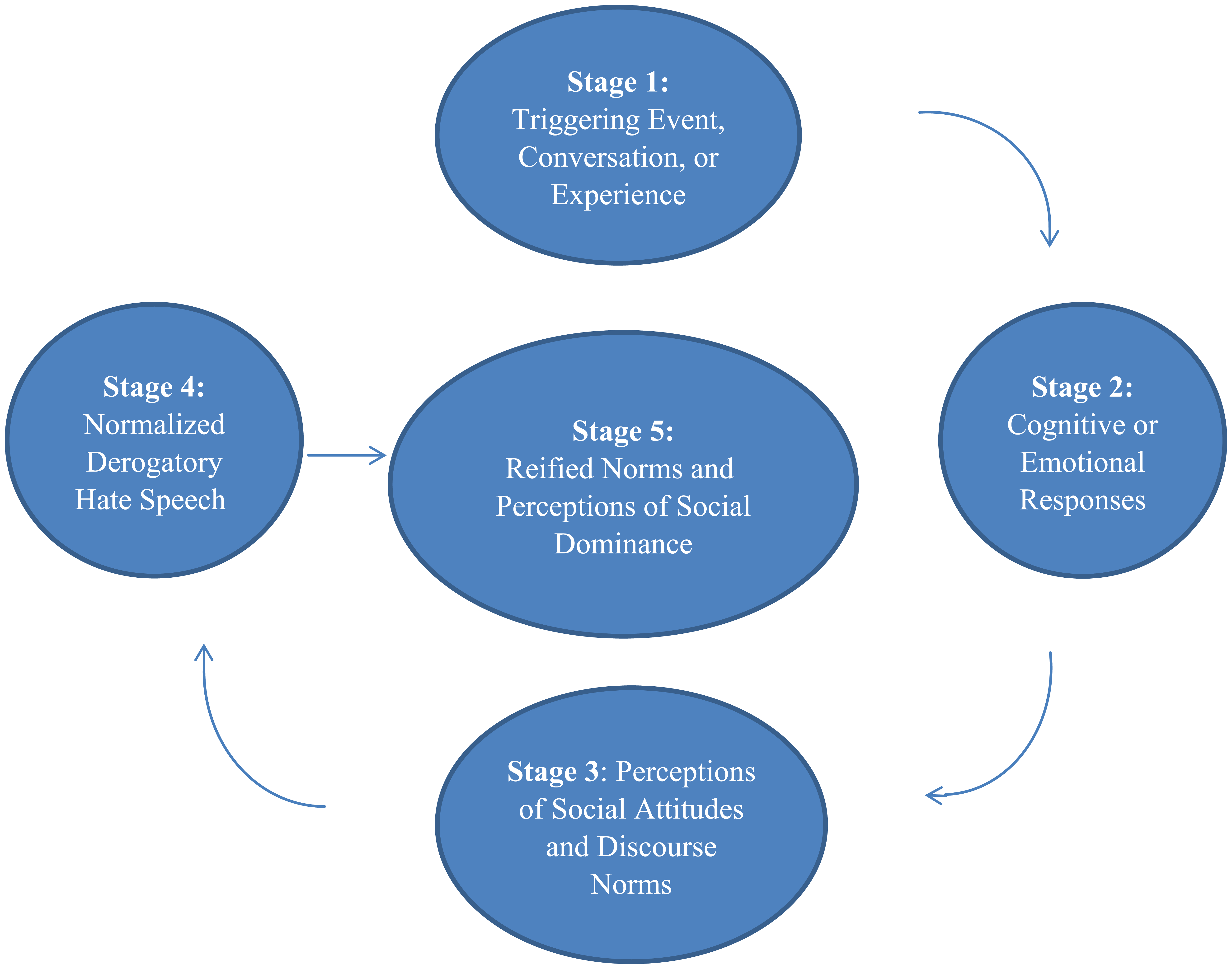
Model of Normalized Hate Speech.
Stage 1 of the model illustrates that negative discourse about marginalized groups is motivated by a triggering event, conversation, or experience that enhances submerged or pre-existing stereotypes or attitudes. Social identity theory suggests that when identity is salient, people tend to enhance the attributions they assign to their in-group, while degrading the characteristics of the out-group. Some people may not have negative attitudes toward a particular group prior to the triggering event, but may acquire or adapt them as a result of a negative experience or through conversations with others who have experienced negative encounters with a minority group.
In this study, the triggering event included viewing the Coca-Cola commercial during the Super Bowl game, which people often celebrate in groups with food and/or alcohol. This particular case study suggests that viewing the commercial prompted primarily Caucasian, Standard English-speaking majority groups to elevate the status of their group while disparaging the status of immigrants groups. Derogatory and degrading imagery was often promoted toward the immigrants who performed the commercial and immigrant groups more generally. People offered a plethora of justifications, denials, and excuses aimed at minimizing the likelihood that they would be viewed as ‘racist’ by readers, even when they used negative and, in many cases, dehumanizing labels. This included the commonly used strategy of appealing to authority or evidence, which was often seen when people referenced ‘the Founding Fathers’ and the history of the ‘melting pot’ model of linguistic and cultural assimilation in the United States.
During stage 2, Cognitive and Emotional Responses develop based upon the opinions and attitudes people have acquired and often serve to promote the interests or goals of one’s group. Cognitive impressions about various groups in society are determined by our familial, social, and cultural systems. Van Dijk (2006) proposed that most people maintain general and abstract ‘mental models’ about different groups in society. Socialization discourse during family, peer, and media-based interactions shape and reify notions of ‘the Other’ and people learn about the world from an intergroup framework (Van Dijk, 1993). Mental models are personal, yet they connect people with shared collective experiences, opinions, attitudes, and discourse. From this framework, more dominant group members interpret events based upon generalized opinions about ethnic minorities and reproduce ethnic bias, prejudice, and racism through discourse.
Moving in a clockwise fashion, stage 3 depicts the general Perceptions of Social Attitudes and Discourse Norms for the social or cultural group that is interacting. Nationalistic ideologies and historical mythology about the history of immigration in the United States appear to have influenced the discursive construction of modern immigration issues. Drawing from the false assumption that immigrants of the past would instantly abandon their language and culture to assume a strictly ‘American’ identity, respondents in this case study legitimized their hostile criticism of newer immigrants who do not speak English exclusively.
An established history of slavery and oppression of non-White groups and White supremacy movements in the past and present has been well documented in the United States. White privilege, or the special advantages and privileges enjoyed by European-Americans, are imperative to understanding normalized hate speech. European-American culture in the United States often remains the dominant standard by which all other groups are evaluated, yet remains unexamined, unnoticed, and often taken for granted. Consequently, many people who are assimilated to this system may experience their identity as devoid of culture and may not perceive race to be an important issue because they themselves do not experience disadvantages because of their racial group membership (Moon, 2009).
Is it possible that the same group privilege that allows many European-Americans to occupy dominant social positioning may also contribute, at least partially, to the resentment and judgment they feel toward immigrants that preserve authentic culture? For instance, this study found that people repeatedly posted comments that directly or indirectly stated, ‘My ancestors had to abandon their language and culture, so you must abandon yours to truly be a real American’. Perhaps the collective resentment we see playing out in this study is not only about privilege and dominance, but also about a lack of connection to authentic culture and language.
It could be argued that many European-Americans in the United States today lack knowledge or experience with their cultural roots or authentic heritage. In assuming a distinctive English-speaking and American identity, people adopt the privileges of this group, at the expense of their ethnic, cultural, or language heritage. Coming into contact with newer immigrants who exhibit an established cultural and linguistic identity may threaten those who lack cultural identity, especially if they are already hosting xenophobic attitudes acquired through socialization.
Stage 4 identifies that people collectively construct Normalized Derogatory Hate Speech toward the ‘Other’. Janis (1972) developed the theory of Groupthink to address situations in which a group makes faulty decisions when social pressures within the group cause moral judgment, realism, and efficiency to deteriorate. Excerpts presented in this study demonstrate the presence of collective rationalization (rationalizing discourse and not considering assumptions), belief in inherent morality (belief in the correctness of a cause and overlooking moral or ethical consequences), stereotyped views of out-groups, and an illusion of unanimity (group views are presented as correct and unanimous).
In this study, nationalistic and anti-immigrant ideologies permeated public posting forums. Furthermore, group-based consciousness legitimized the process as people agreed, supported, or encouraged others who applied demeaning language to immigrant groups. Achieving collective agreement legitimizes racist speech and behaviors, reinforcing the perception that ‘We’ are inherently better than ‘Them’. This process normalizes the use of degrading terminology and increases the likelihood that anti-immigrant sentiments will persist and be shared in the future.
Stage 5, Reified Norms and Perceptions of Social Dominance, reflects the long-term social and cultural effects associated with the use of denigrating labels to deal with marginalized groups in society. The excerpts presented in this article reveal a widespread resistance to and hostility toward immigration, multiculturalism, and globalization. Nationalistic ideologies about language are becoming more pronounced in many nations of the world, as immigration continues to increase and intercultural interactions become the norm (Woolard and Schieffelin, 1994). Given the prevalence of modern global migration patterns, such ongoing and increasing negative sentiments toward immigrants are alarming and reminiscent of the problematic past.
Historically speaking, the Pearl Harbor Attack on the United States in 1941 culminated in similar generalized hostility, leading to the internment and imprisonment of 110,000 people of Japanese ethnicity, many of them US citizens. In 2014, anti-immigrant protests erupted in California and elsewhere in response to the thousands of mothers and children from Central America who have recently sought asylum in the United States. Protestors angrily prevented detained migrants from joining their community by yelling things like ‘This is an invasion!’, ‘Go back home!’, and ‘Deport! Deport!’. Recently, anti-Semite and anti-Muslim demonstrations have echoed a tragic past in Germany, France, and across Europe. It is vital to remember how public attitudes and discourse practices may inform and direct public policy, as they have throughout the history of the world.
Finally, it is inconceivable that the Coca-Cola Corporation did not test this advertisement in focus groups before exposing it to the entire United States during, perhaps, the most viewed media event of the year. Given the hugely competitive nature of the event, the financial stakes, and the public discourse opportunity, it seems likely that the company made a shrewd decision knowing that such a stunt would provoke huge national and maybe international media fizz. The advertisement did just that. However, it seems both calculating and manipulative to stir up the kind of bitter juices that define racism and xenophobia in its ancient and modern varieties for the sake of profit margins and labeling strategies. The Real Thing is to find ways to identify, educate, and communicate our shared commonalities and our unique differences in ways that address and respect individuality. That’s the Real Thing! To this our research and work are dedicated.
Footnotes
Acknowledgements
I acknowledge and thank Teun van Dijk, Howard Giles, John Marlow, and one anonymous reviewer for their valuable contributions to this article. I dedicate this research to my great-grandparents, grandparents, and dad, who all left their homelands behind, immigrated to the United States, and whole-heartedly embraced multiculturalism so that future generations could truly realize “the American Dream”.
Funding
The author(s) received no financial support for the research, authorship, and/or publication of this article.