



Abstract
While the vital impacts of linguistic and discursive politeness on the sustenance of talk and the possibility of community-building have enjoyed a lot of attention in linguistic scholarship, attention is shifting to virtual communities with studies interrogating their language use and interactional patterns. This study seeks to further that line of inquiry by investigating politeness in Nigerian news-based virtual communities. Taking an etic interpretive analytical approach which relies on the facework and relational-work paradigms, it studies virtual communities generated by four Nigerian online newspapers purposively sampled to represent the Nigerian geo-political zones and political ideologies between 2015 and 2018. Given the relative newness of the virtual community in Africa as well as its significant impacts on socio-political activities and attitudes to democracy and governance, the research will contribute significantly to the exploration of online communicative behaviour in the African humanities.
Introduction
The world, as we know it, is changing. Outside of the scientific discourses of climate change, the political dialectics of democracy and nuclear weapon issues, the emergence of a global village and the unstoppable shrinking of borders and such other markers of heightened evolution in the affairs of things, one major social issue that permeates every facet of human life is the emergence of new forms of social interaction. These new forms permit the meeting of people across spatio-temporal settings, unhindered by all the sociolinguistic markers that used to define social interactions and seemed to proscribe the level of closeness and power relations in such interactions. Although arguments in scholarship seem to validate the subsistence of sociolinguistic markers in online interactions, it is pertinent to argue, as this study’s data show, that such might only exist in online situations where the participants have a parallel ‘real-life relationship’. It is no longer difficult or impossible for a person to register their presence in four or five places different from their immediate environment. Online interactions are in fact becoming a challenge to real human interactions as more people are losing interest in physical interactions due to the need to ‘hang out’ with ‘friends’ in virtual communities.
The word ‘friendship’ is assuming a new definition just as ‘meeting’, ‘discussion’ and ‘spending time together’ have evolved from the denotation of physical (in the flesh) presence that they used to carry. It thus becomes imperative to study how such interactions work and are sustained by language use just as has been done for the old and more familiar physical interactions. It is not unusual to find people carrying over emotions and opinions from their online groups into real life, making such groups worthy of study. In fact, a couple of these virtual groups do actually graduate into real-life relationships, movements and groups (CNN, 2011; Skinner, 2011). It is this need that forms the pivot of several studies in computer-mediated communication (CMC) including Walther’s (1996) expatiation on the interactional patterns found in computer-mediated-communication, Langlotz and Locher’s (2012) inquiry into ‘disagreement’ in the interactions of a virtual community based on the online news media, MailOnline, and Lamidi’s (2011) examination of linguistic borrowings as markers of informality in Nigerian English where attention is focused on Nigerian netizens’ attempt to de-formalise, and thus enhance, interactions through the strategy of linguistic borrowing in their interactions on the Naijaworld forum. Lamidi (2014) targets her own inquiry at the explication of discourse strategies used by netizens on the Nairaland virtual community, while Oha (2006) examines ‘hyper-communication’ in Whole Earth ‘Lectronic Link (WELL) where netiquette forms the basis for ‘electronic survival’. This study, however, takes the conversation further by attempting to probe the issues of politeness in news-based virtual communities that are also specifically Nigerian. The need is generated by the powerful influence that these communities exert, albeit informally, on policy making and policy reception in the Nigerian political space as well as how they steer attitudes of netizens, and citizens by extension, to issues in the real world.
This study is also borne of a need to better understand how people maintain conversations long enough to communicate vital ideas and opinions and as well sustain fairly long-term interactions or relationships in Nigerian news-based virtual communities through politeness practice. It also responds to the problem of building on and extending existing research by expanding the scale and scope of enquiry into virtual communities.
Nigerian news-based virtual communities are not only worthy of study due to the unique way they present as microcosms of the Nigerian society (as a social aggregation and speech community) on a small computer screen, but also because of the way they reveal the ‘real’ people’s attitudes to issues in the country rather than the various media (mis)representations, official manipulations and perspectivisations that pervade mainstream news media and the news in general. This study, therefore, seeks to contribute to the pragmatic study of politeness and virtual communities by exploring the nexus between online news reportage and politeness with some emphasis on the participants’ response to the news and other participants’ views on the news.
Literature review
Virtual community
Rouse (2006) writes that ‘a virtual community is a community of people sharing common interests, ideas, and feelings over the Internet or other collaborative networks’. She further explains as follows: Virtual communities might be thought of as subgroups within Marshall McLuhan’s notion of cyberspace as a ‘global village’. Before the Web, virtual communities existed on bulletin board services (BBS) and many still do. Some virtual communities or facilitators of them use the metaphor of a coffee house or something similar to help users visualize the community. In general, there are two kinds of communication among virtual community members: message postings and real-time chat. Usenet newsgroups are an example of the former. Many Web sites, such as Geocities, foster subject information exchanges. For real-time chat, Internet Relay Chat (IRC) is a system used by many Web sites that foster virtual communities. (Online)
This domain of communication relies on a set of rules that enhance any human community. While ‘offline’ human communities subsist on etiquette, online communities subsist on “netiquette” (Shea, 1997; Rheingold, 2001).
In his online publication, The Virtual Community, Rheingold (2000) defined virtual communities as ‘social aggregations that emerge from the Internet when enough people carry on public discussions long enough and with sufficient human feeling to form webs of personal relationships in cyberspace’ (Johnson-Lenz and Johnson-Lenz, 1997). As such, it is important to note that such a relationship to be formed must be hinged on a key ingredient in human interaction – politeness. He further asserts that people in these communities use language to exchange pleasantries and argue, engage in intellectual discourse, conduct commerce and do just about anything people do in real life with the exception of the physical use of their bodies. He maintained that there is no single, monolithic online subculture, but it is like an ecosystem of subcultures ranging from the frivolous to serious.
Of more interest to politeness research are the virtual communities where groups of people – tens, hundreds or thousands – who may never have met but who have interests or concerns to share using the Internet – converge. These interests may include a hobby, politics, religion, a rare illness or some aspect of computing or the Internet itself. Sometimes, they simply converge to read the news and discuss issues that interest them in the news. Netizens in news-based virtual communities formed this way read certain online news articles and respond to the writers’, as well as other readers’, opinions. The main tools for such virtual communities are real-time chats and newsgroups. These communities of interest may wax or wane in their activities and can be volatile in their exchanges because those participating usually have no common culture or background. They only know each other online. The members behave in manners similar to those found in chatrooms for romance, politics or games which include highly interactive and (permit us to say) addictive ones like multi-user adventures (MUAs), multi-user dungeons (MUDs), WELLs and a host of others.
Linguistic inquiry into virtual community
The increase in Internet access the world over has led to the proliferation of virtual communities which in turn have attracted various studies by researchers into language and human interactions. The subjects of their inquiries are, however, as multivariate as there are issues requiring linguistic description. While studies like Lamidi (2014), Lamidi (2011), Oha (2006) and Pauwels (2005) have taken Discourse Analytical and Pragmatic approaches to the explication of how members of virtual communities use language online, Das (2010), Locher et al. (2015), Matsumoto (1988) and Oyadiji (2016) have taken a look at politeness as a specific aspect of communication in online interactions.
Walther’s (1996) study expatiated on the interactional patterns found in CMC. His study provides insights into the levels of interactional perspectives that members of a virtual community bring into and expects from other members in their online interactions. For him, CMC is paradoxically impersonal, interpersonal and hyperpersonal at the same time. The interactions are as much imbued with a sense of impersonality (resulting from a scant knowledge of the real personalities behind the virtual person of the co-interactant) (p. 4) as a sense of hyperpersonality which is enhanced by the lack of social restrictions that face-to-face interactions impose on participants in a conversation (p. 16). In between is the constant sense of interpersonality necessitated by each interactant’s recognition of the fact that they are not alone online thereby forcing them to generate assumptions about others based on impressions textually formed from conveyed information. The relevance of this literature to this study is much more in its detailed attention to the description of the nature of CMC than its concern with its benefits and downsides. Besides, its findings on CMC are most negligent of varying levels of CMC especially those where the interactants are already acquainted in real life and use the CMC forum only to further their interaction. However, its findings are quite valid for a news-based virtual community hosted on Facebook where the community members pooled anonymously rather than from a known real-life aggregation.
Darics (2010) taking a computer-mediated discourse analysis (CMDA) approach to the analysis of naturally occurring text-based synchronous interactions of a virtual team opined that an interactional politeness approach rather than a linguistic politeness approach would be better suited to the explication of politeness in a virtual community due its ability to better explain strategies that compensate for lack of audio-visual cues in the virtual interactions. Using an intense analysis of the interactions of an 18-member hierarchically, culturally and geographically disparate group of people working for a UK-based consultancy company, she found that audio-visual cues are replaced for the purpose of clarity and politeness in CMC by strategies including deliberate spelling manipulations like ‘nooooo’ to invoke a sense of exaggerated emotional involvement and sympathy, unusual capitalization to compensate for stress/intonation and emoticons to compensate for smiles and other aspects of physiognomy (p. 15) as similarly argued by other studies (Herring and Dainas, 2017; Oyadiji, 2016; Warner-Garcia, 2014).
Das’ (2010) study also has politeness in CMC as its major pivot. His data were constituted by conversations on the Orkut social media where majorly Bangla speakers were observed with attention to their politeness behaviour vis-à-vis social distance in the virtual community. He developed a framework to re-examine Wolfson’s (1988) Bulge theory updated in Wolfson (1990) which argues for the predictable proportion of politeness acts usage by interactants along a social distance scale. His focus, compliments, expressions of gratitude and greetings, revealed that Bulge is hardly a significant feature of Bengalis’ linguistic politeness behaviour on the Orkut medium. He found specifically that the degree of intensity of some politeness practices of Bengalis on Orkut does not decrease with the participants’ levels of social proximity. ‘Unmarked greetings’ and ‘expressions of gratitude’ are more intense in interactions with acquaintances but reduces when intimate friends chat while ‘intensified’ patterns of the same practices behave in the opposite way. ‘Unmarked compliments’, however, also decrease as social distance increases.
He concludes that, each form of politeness practice interacts differently with the social distance scale and needs to be examined in its own right. His questioning of the cultural neutrality and universal applicability of the Bulge theory is particularly instructive and represents part of the consideration of this study which examines a multicultural virtual community being studied with theories that were developed based on different cultures.
Hemphill et al. (2011) examined how language is used by public officials to create clear boundaries on issues in their tweets. Using about 30,000 tweets from the Twitter accounts of US congress members, they found that polarising language is a deliberate tool used by these politicians to demonstrate their stance on issues using supporting language for self and pejorative language for others and their activities. This ‘self’, however, is creamed over in a face-saving strategy of fellowship/group identity that includes the speaker’s followers/supporters in the praise of self while the ‘other’ is attacked as a member of an unacceptable/devilish group through a use of competence face-threatening acts.
Herring and Dainas (2017) inquiry is into the use of the relatively new tools which they aptly termed ‘graphicons’ as a unique communicative tool setting Facebook apart. This lends much credence to the need to study news-based virtual communities hosted on Facebook in order to see how these tools impact the members’ interactions. For them, a whole range of graphical means of communication afforded by Facebook brings about the possibility of a myriad of expressions which were hitherto difficult or impossible in CMC. Among the functions of graphicons identified to have direct implications for this study are ‘mentions’, ‘reactions’, ‘riff’, ‘tone modification’, ‘action’ and ‘narrative sequence’. Reactions and mentions are especially vital for the identification of the direct recipients of (im)polite expressions, while the ‘tone modification’ function can be directly interfaced with the need for face-threatening mitigation when placed within the broader context of face work or relational work which would explain it as an attempt to speak as expected.
Langlotz and Locher’s (2012) inquiry was into ‘disagreement’ in the interactions of a virtual community based on the online news media, MailOnline. They found that native English online news-based virtual communities display a pattern of disagreement located through the display of conceptual implication, explicit expression and emotional description and that explications of emotions are a way of making sense of face threats. This stance has particular implications for the research questions 5, 6 and 7 put forward by this study. The crux of their inquiry is, however, based on the explication of emotions as a factor underlying disagreement, largely neglecting supportive instances. Langlotz and Locher’s (2012) investigation, like Langlotz and Locher (2017) gave much impetus to this study. Their attention to MailOnline and the virtual community it generated yielded deep insights into the nature of talk and discursive politeness in virtual communities. Their inquiry, however, creates a gap by neglecting to pay attention to instances of support/solidarity in the largely confrontational interactions under investigation, limiting their choice of data first to one news platform and also to a platform used majorly by a community of native English speakers in the United States and England. This study seeks to widen the scope by basing the investigation on five online news platforms with varying journalistic characteristics and readership patterns, an even wider and more heterogeneous platform which Facebook represents and a non-native English platform comprising netizens potentially from 500 different ethnicities (ESA.UN.org, 2017), and paying attention to both sides of the agreement/disagreement spectrum.
On one hand, the inquiry opens up a line of enquiry into online news-based virtual communities vis-à-vis the expression of agreement/disagreement. On the other hand, it calls for enquiries in other communities that are similarly generated but with a different speech community at its base. This study fills just a part of that gap by examining both disagreement and agreement within the broader spectrum of politeness and relational work, basing the inquiry on a broader and more populated community – Facebook (Papacharissi, 2009) – and applying relational work to a non-native English speaking virtual community.
Bastian (1999), from an anthropological perspective, paid attention to the construction of nationalist identities or, better put, ‘virtual’ nationalities by Nigerian immigrants in the Unites States on the Naijanet platform (a news-based virtual community generated around Nigeria-related news in Reuters). Her findings reveal that netizens construct even more cohesive communities in virtual space and that these communities like ‘Naija’ – the virtual Nigeria of Nigerians in the United States and Europe – become the netizens’/citizens’ re-imagination of their homeland however ethnically fragmented. However, the study’s thrust, apart from being anthropological, is mono-directional as there is an obvious lack of attention to the voice of the news agencies that generated the community considering the vital impact that this would have on explication of the responses of the different ethnic nationalities in the virtual space. This study sought to fill this gap by paying attention to the linguistic factors of politeness (in both the news items and the comments on them) which make virtual communities sustainable. It also expands the scope by basing the analysis on a larger group of participants not limited to the Nigerian diaspora as well as more than one online news agency. This would make for a more robust conclusion not only on the nature of community but also on the role of politeness in building such a community.
Lamidi’s (2014) examination of discourse strategies in the Nairaland community also holds a vital relevance for this study even though her strict classification of CMC into synchronous and asynchronous, which constrained her to consider virtual communities as asynchronous, is inconsistent with the thrust of this study. Research and experience has shown that immense improvements have occurred in Internet use and design to the extent that virtual communities like the news-based virtual communities under investigation have since moved into the realm of synchronous chat where there are possibilities of real-time chats. However, there could be contributors who join the conversations at intervals when other members are offline. This puts our description of the virtual community as a blend of the synchronous and the asynchronous chat patterns.
Interestingly, she found that Nairaland members were largely insensitive to co-interactants’ face needs although certain instances of hedges were observed where posters wanted to lessen the effect of face threats and maintain interpersonal relationships in the community. This study, however, seeks to fill the gap left in this lack of detailed attention to the ‘hows’ and ‘whys’ of (im)politeness in the community while the source of primary data is selected Nigerian news-based virtual communities rather than a single interest community like Nairaland.
Oha (2006) inquired into the pursuit of human interests in WELL. His investigation reveals that language is a vital tool in the netizens’ expression of creative freedom and the survival of the sense of community. He finds that netizens manage their conflicts, despite the power struggles, through discourse and language that take care of ‘WELLbeings’. This study seeks to examine in a more detailed way how politeness, specifically, helps in the sustenance of rapport in Nigerian news-based virtual communities which is a rather different community as issues in discussion are based on opinions generated by a participant who does not participate in the community as a virtual person but rather as a text which every other participant interrogate in relation to ideas offered by other participants.
Politeness from facework to relational work
Within the facework framework, politeness is defined as the art of presenting oneself in a certain manner that avoids offending others as well as protecting one’s own integrity (keeping face) (Goffman, 1967). This contains in both the linguistic and extra-linguistic aspects of communication. For Brown and Levinson (1978), expanded in Brown and Levinson (1987), participants in a communication have a positive face which entails the person’s desire to be liked, approved of and supported as well as a negative face which entails their desire not to be imposed upon and their desire unimpeded. Any communicative behaviour that threatens these face needs is thus seen as face-threatening acts which constitute impoliteness. In their review of the face theory, Lim and Bowers (1991) propose a re-designation of the classification of positive face as a bi-partite fellowship face and competence face which covers solidarity and affection, recognition and positive evaluation, while the negative face is renamed and reconfigured as autonomy face which deals with people’s need for autonomy (no one wants their ‘space’ infringed upon).
As earlier hinted, the theoretical framework for this study is hinged on two contiguous paradigms (face work and relational work). This is so because the virtual communities under study themselves are best understood as negotiated communities where people operate (or might choose to operate) with new, pretended or hidden identities and are simply interacted with on the basis of what they claim to be or what they are made to be by the factors of the contexts in the communities. Relational work is especially relevant as participants in the sampled communities have been observed to include those who are angling for phatic communion rather than the ideational form of communication often found in asynchronous CMC (Crystal, 2004), thus investing more in the progress of talk than in expectations of linguistic politeness (Locher and Watts, 2005).
Locher and Watts’ (2005) proposition, which this study aligns with, is that face work is hardly a sufficient model to study politeness in a conversation as politeness itself is just part of what makes interactions work. Face work, for them, caters for face-threatening acts mitigation but fails to totally cater for the specific contexts where politeness is not the norm (p. 1). They thus propose a ‘relational-work’ model which accounts for the ‘work interactants invest in negotiating relationships with others including what is polite, what is impolite or what is merely acceptable behaviour in talk’. The inclusion of this model in the framework for this study is necessitated by its ample capability to handle aspects of the conversations which tilt towards impoliteness yet count as acceptable strategies for advancing the chats under investigation due to the context. It is also better suited to aspects of the chats which seem to appear linguistically polite but which are adjudged as inappropriate due to their markedness in given contexts (p. 15).
Methodology
The target populations for this study are four conversations in four different Nigerian online newspapers posted on Facebook between 2015 and 2018. Sahara Reporters, Leadership, The Nation and Biafra TV were selected due to their relative popularity in the Nigerian cyberspace and their treatment of multivariate issues. The newspapers were also selected based on the need for adequate representation of different geopolitical zones, ideological leanings and ownership patterns of newspapers in Nigeria.
The data which were purposively sampled to include different levels of perceived conviviality were collected through direct capture using screenshot tools. Hard copies of the selected news and comments are printed and subjected to analysis. To maintain spontaneity and originality, there was no indication to the community members that their comments were being captured for research purposes. The samples are presented as undoctored as decency and ethical constraints would allow and sorted into labelled groups as shown in the table below.

The study employs an etic interpretive approach, similar to a hermeneutic phenomenological data analytical procedure, in the analysis of the data. This helps to create a clear presentation and contextual interpretation of pragmatic issues relating to politeness in the comments based on the politeness paradigm in use.
Each interaction that ensued on a news item is discussed according to a broad look at its level of conviviality and success. An explication based on a model which interfaces the face work and relational-work paradigms is then attempted with emphasis on the strategies, functions, reasons and perceptions of politeness behaviour by interactants in the comments as they progress towards the politeness levels observed. What counts for (im)politeness is thus identified in the exchanges. The context will be examined within the precinct of the paradigm before attention is directed at the components of the paradigm vis-à-vis their interactions with the exchanges examined in the virtual communities.
Interactional pattern in the data
Issues emanating and eliciting various shades of politeness behaviour, as witnessed in the data, could include the following:
Members’ reaction to contents (and related issues) of the news item;
Members’ reactions to persons referred to in the news item;
Members’ reaction to the ideology behind the news item;
Members’ reaction to the person of the news writer or the news agency;
Members’ reaction to other members’ opinion on the news or (1–3) (Langlotz and Locher, 2012; Muntigl and Turnbull, 1998);
Members’ activities (which may be unrelated to the news) as well as other members’ reactions to such activities.
Finally, the study considers every communicative act in the communities, irrespective of its mode, from the perspective of politeness and argues for the ability of the framework adopted to be stretched to account for the expression of (im)politeness embedded in each act.
Analysis and discussion of findings
A: Friendly and sustained
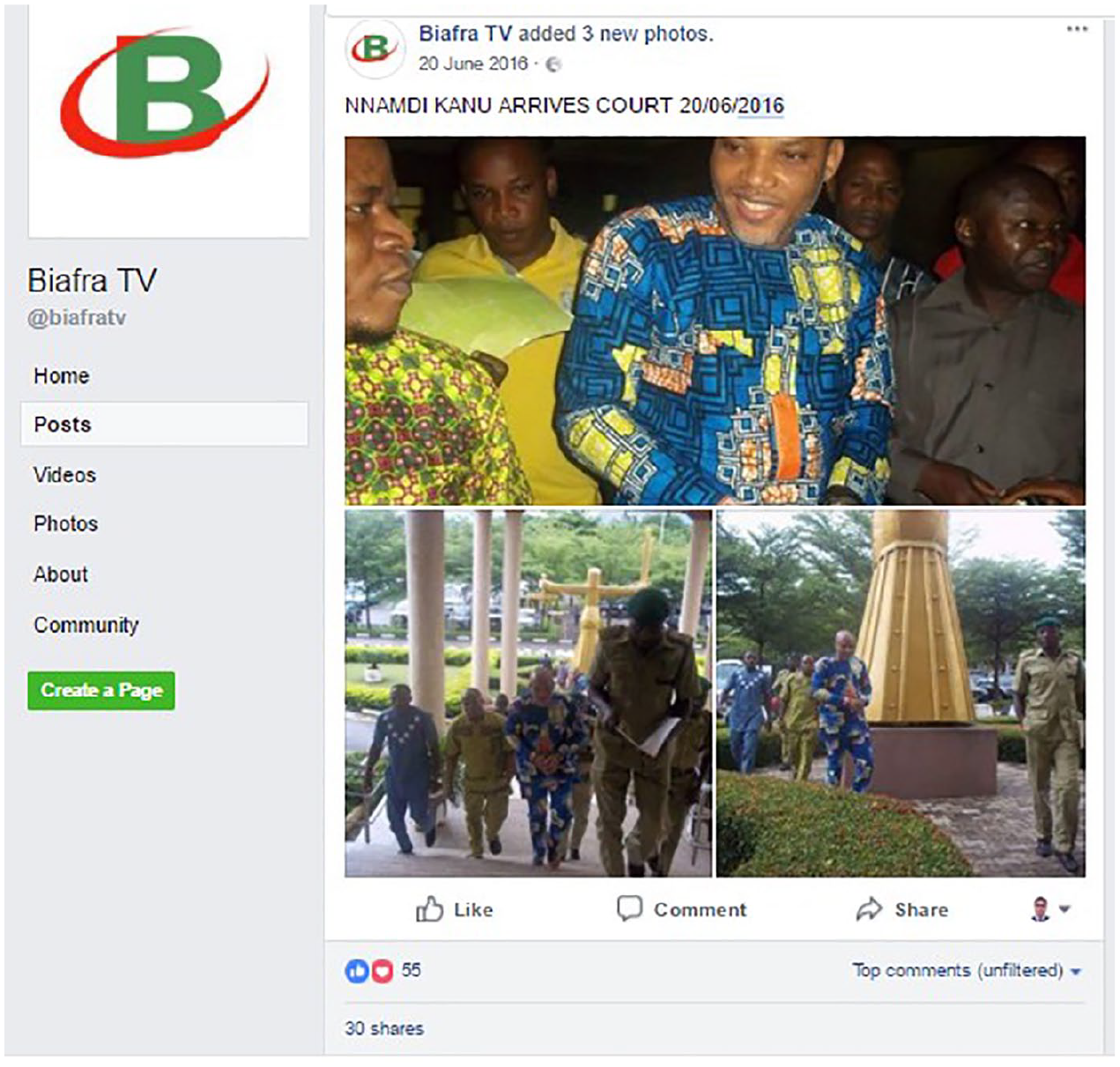
A is from the Biafra TV virtual community. It reports the arraignment of the leader of the secessionist group Independent People of Biafra (IPOB, now in exile) and seeks mobilisation of supporters for the Biafran cause as well as inauguration of propaganda machineries termed ‘warrior units’ in Biafran parlance. The most observable strategy employed to enact face observance is solidarity. Solidarity is expressed in different ways including free use of indigenous ‘Igbo’ words and phrases, a praise-singing and trance-like worshiping style of comments and the use of common lexical terms from the Biafran micro-cultural context – majorly zoo for Nigeria, Shalom and mentions of the diaspora locations – from which the posters are following the others. The frequent mention of diaspora location is interpreted after careful observance and research as a validation of the Biafran narrative of Jewish roots. Hence, an attempt by members of the community to demonstrate a sojourner status in other lands is processed as face observance to the community’s status as Jews who were first scattered all over the world and persecuted before returning to the ‘promised land’. Although this Israeli roots narrative is found objectionable by some community members, there seems to be a largely positive attitude towards it. Besides, the need for solidarity easily drowns the need for dissent. Hence, an exaggerated sense of politeness and acceptance of behaviour in these interactions is sustained.
Likes and laughs are conspicuously absent as tools of politeness in these interactions. Yet, each comment can be linked to all others in terms of fellowship face observance. Ultimately, the members of the group constitute a solid team behind the Biafran leader in the news. This interpretation brings a slightly new perspective to the interpretation of friendliness in virtual interaction. Unlike in Yabaleft or other news media posting entertainment news and thus pooling fun-seeking virtual audiences who end up sharing fun and polite banters, Biafra TV demonstrates a community with the ‘serious’ intention of showing support to a cause which had been outlawed by the Nigerian government and whose proponents have been reported to have been jailed or killed in numbers.
Therefore, the expression of politeness here is not to be enacted through laughs, jokes or back-patting as in other communities. Rather, politeness and friendliness is expressed through vociferous and almost ritual-like expression of group solidarity and hate towards the enemy. This is mostly achieved through criticism, name-calling and other forms of competence and fellowship face threat. Despite the obvious display of the community as English-based (the language of the videos and pictures posted), Ekene Ejiro feels no compulsion to hold back on the desire to post entirely in Igbo. Such a move would have been deemed as having a polarising effect and thus unacceptable and impolite in a culturally heterogeneous context. The fact that no poster attacks the move, rather that more of such instances permeate the interaction would help us arrive at the conclusion that it is a mono-cultural setting where unilateral selection of indigenous language and other Biafra cultural enactments are not only acceptable but desirable.
Eugene Ohakamma’s comment is a fellowship face observance towards the character in the news. Although a face threat could have been read into his choice to drop the leader’s title when placed within the cultural context, situating the post within the environmental context of a Facebook chat with its need for verbal economy and spontaneity renders such a reading superfluous if not irrelevant. Besides, the hyperspace context considerably weakens the expectations of deference based on age or social status given the scant contextual clues about the poster. Compared with Sampeace Brown’s comment therefore, both comments pass as equally acceptable and polite.

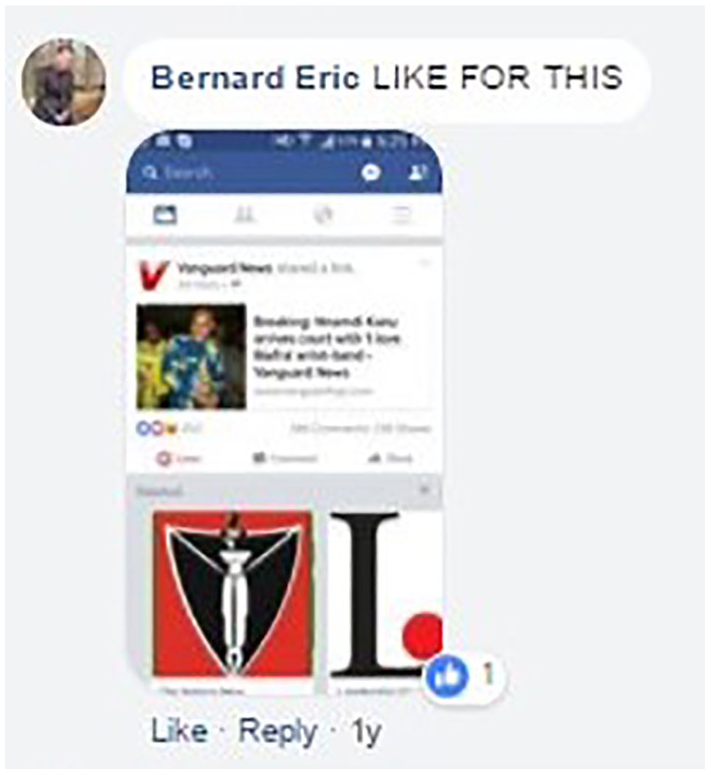
Bernard Eric’s post also observes the fellowship face of the group by recognising the group goal and aiming to fulfil it. By bringing up evidences of ‘Nigerian newspapers’ reports of the bravery of their leader, he validates the group’s belief thus contributing significantly to his relational work.
More attempts at friendliness towards the community is achieved through the tool of hashtags like #freeohamadike, #freeNnamdiKanu and #freemyhero, which exploit the digital tool combined with cultural tool to enact autonomy face threat at the Nigerian state. Taqueen Osuwune’s reference to Nigeria as a zoo can also be linked to this device as ‘zoo’ has been earlier used as a trending hashtag elsewhere. Sammy Somsak particularly ups the tempo of the interaction by employing the emotional cue of all caps.

His reversion to lower case in the next statement demonstrates the deliberate manipulation of letters for enacting emotional involvement as if his scream made him lose his voice. This paints a clear picture of his framing of the interaction as a public rally where shouting one’s agitation in unison with the group is part of the rule. Taqueen Osuwme’s seeming question about whether the Department of State Security (Nigerian) and Prison officers were tired of holding the leader is also divested of any possible autonomy face threat or a desire for further torture for the leader. Rather, it fits within the frame of the group’s depiction of the leader as a hero suffering for them in Nigeria. His question is thus a hint at what the leader has gone through, thus adding to the validation of his hero status as well as the illogicality and cowardice of the persecutor – Nigeria.
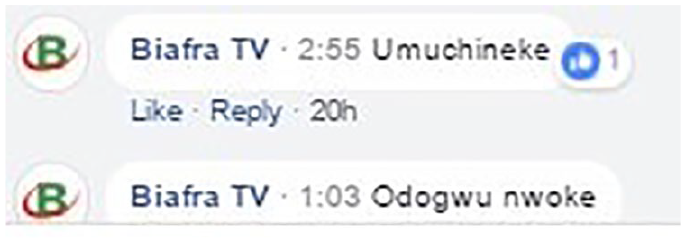
The news agency’s own comment to its post is an even deeper validation of the claim made that the community is a close-knit homogeneous one where the goal is to enact support for a common cause rather than a community of people coming to express divergent opinions on matters of interest in the news. The agency’s comment, posted in Igbo, sets the tone for the interaction as they heap praises on the Biafran agitators in the new referring to them as children of God and great men.
Linguistic impoliteness towards the Nigerian state and the president is also employed as a face-observance strategy towards the group as such comments are approved of by the group. Ezekwesiri, for instance, enacts group solidarity by distancing self and the group from Nigerians and its government who in the Biafran consciousness are cowardly and stupid.
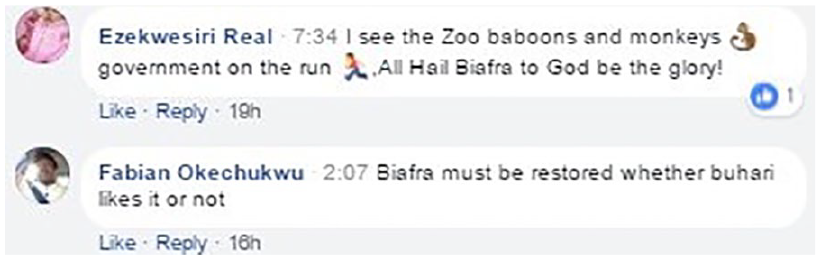
This strategy highlights the tripartite use of politeness observed in this study – to threaten faces, to observe faces and to negotiate interaction. Interestingly, outright linguistic politeness is employed majorly through code choice as all Igbo expressions in these interactions are polite while impolite expressions are limited to English. Examples of such Igbo expressions are glossed below:
Nwa Chineke – Child of God
Umu Chineke – Children of God
Chinemeem – My ‘Chi’ helps me
Chukwu Okike – God almighty (bless you)
Odogwu Nwoke – Great man
B: Unfriendly but sustained
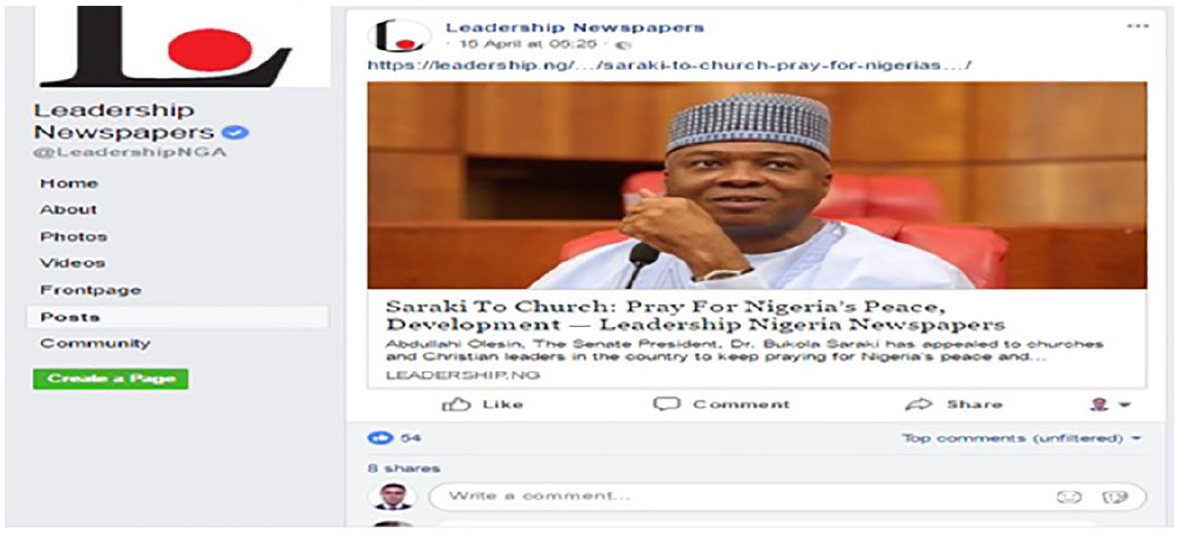
B is carried on in the context of hard news. In fact, readers of the newspaper – Leadership – are known to be information seekers who are expected to be ready to share opinions either through logical arguments or through rude imposition of perspective. This is even more expected given the prevalence of real-life arguments based on differing attitudes of the news-reading public to the ruling party and the government as well as the heated up political atmosphere of the country since the transition period around 2014.
Given Nigerians’ acknowledgement of the country’s status as a very religious country which yet wallows in poverty due to years of bad leadership and corruption, an appeal for more prayers is likely to be seen as laughable if proffered as a solution to the country’s woes. This becomes even more likely to generate ridicule when the advocate for that solution has been touted by sections of the media including sections of his own ruling party as the face of that corruption. A re-negotiation of the socio-relational context is thus emerging around this narrative. In other words, the members of the community interacting here see one another less as divided people seeking to criticise or justify one another’s perspective to the news or the government, rather as a team of concerned citizens who are here to laugh at the ‘jester’ in the news.
The first face threat is posted by Ebredeni Ebiegberi, whose comment can be interpreted as a curse and insult. By refusing to align with the proposition of the character in the news, he expresses what would be the position of all the members of this interaction. ‘Idiot . . . thunder for you’. The acceptance of this behaviour can be said to have been made possible first by the reputation of the character who, unlike other “funny characters” in A1 and 2, has actually wronged the members and hurt their feelings. Besides, the poster’s use of Pidgin and embedding of sarcasm into the post imbues it with a signal for humour. Relational investment in this post, therefore, supersedes any concern for face that the verbal expression may lack, thereby enhancing its processing as politic by other members. He has particularly played upon the idea of prayer in connection with his personally conceived idea of the character’s intention.
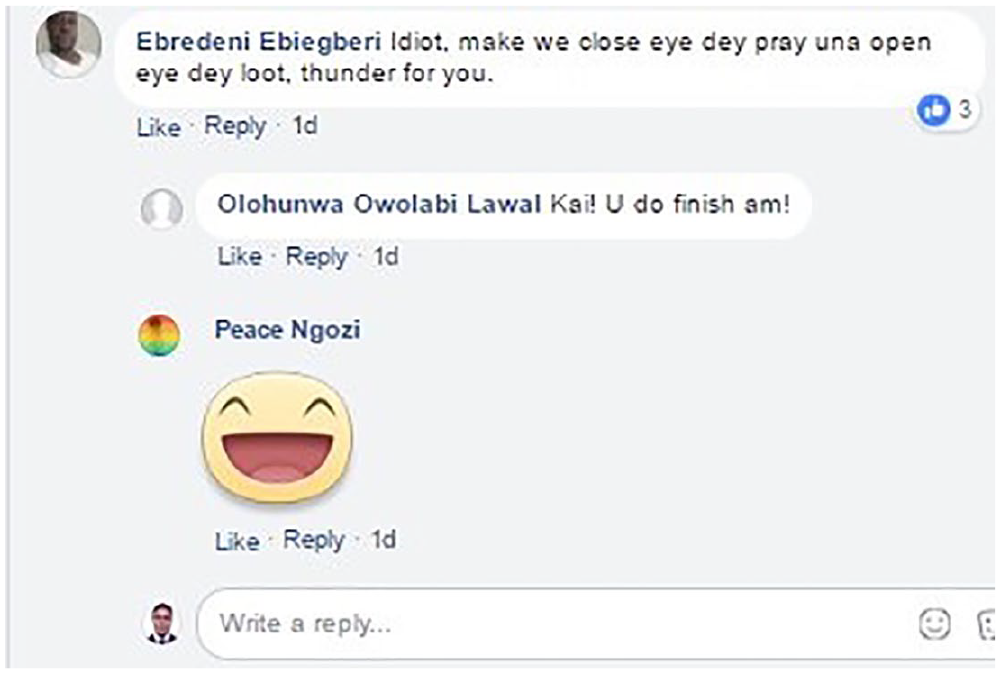
Agreement and observance of the poster’s competence and fellowship face is demonstrated by all in the thread. Olohunwa Owolabi praises his ingenuity, while Peace Ngozi’s sticker signals the overall effect of the post and others like it in the interaction. Her approving laughter highlights the tacit rule that redirects the perception of linguistic impoliteness to the perception of camaraderie and politeness. In other words, alignment with the desire of the majority of the posters is the polite form of behaviour rather than deference to the character in the news or his supporters who are considered irrelevant in the setting of rules in this interaction.
Although a departure from this rule was about to mar the friendliness in the interaction as Danladi Dutse posts a rather emotional outburst graphically represented by his all-caps scream, yet, his agreement with the idea in the previous post as well as other comment provides his post with sufficient mitigating force. Also, Seyi Oguns’s next act helps to reconnect the interaction to its jocular tone through its mimicry of a newscast style. Essentially, his intention is to evoke a parallel re-imagination of the sadness and interruption of people’s joys that the news in Nigeria always represents. Through this act, he is able to reposition the earlier interruptive post as a normal phenomenon which should be added to the pool of jokes. Besides, Danladi’s post can actually be interpreted as another joke itself given the equal interpretability of the capitals as graphically depicting laughter rather than anger.

Other comments conflate their competence face threats to the character with their fellowship or competence face observance towards other participants of the interaction. Adeniran Omo, for instance, chose to address the senator as ‘bros’, thus bringing him down to the street-level comradeship that satisfies the interaction’s context since they do not respect him as a senator but a common jester or prankster.
While the interaction does not enjoy the smooth interactional pattern of A, its display of longevity without flame war and sustained face threat among participants is an indication of friendliness based on application of politic behaviour. Arguably, lurkers may have conflicting opinions which could have threatened this pattern of politeness, yet, their failure to openly express such opinions counts more for the effectiveness of the rule of politeness negotiated in the interaction.
These interactions, despite the ‘unfriendly’ tag, appear to be relatively the longest and most interactive/interpersonal and most represented in the sample population as they form 44% of the sample population. While the factors that account for the prevalence of such interactions as well as the factors behind their sustenance are focussed in the analysis, it is apt to begin by looking at the factors considered before labelling them unfriendly on the surface:
The interactions feature a prevalence of flame wars;
There are more finely split ideological opinions, identifiable ethnic, religious and social polarity and expressions of intolerance towards oppositions;
There is a prevalence of Face-threatening acts-posing memes, derisive laughter and anger-expressing graphicons;
Many of the participants use foul language and violence-depicting memes (in fact, Facebook warns about a number of the memes and the researcher had to accept responsibility before they were displayed);
The interactions also feature the highest amount of posts identified as trolls.
Apart from these factors, the interactions seem to share a common factor. Each of the interaction is generated by a news post around hard news – politics and security especially. Of the 11 interactions forming the group, 4 concern politics, 2 are on security issues, 2 deals with education and youth development matters, and each of the last 3 deals with health, religion and entertainment. Interestingly, the item designated as dealing with entertainment has a political background to it and the interaction takes that direction while the same can be said of almost all the interactions. This brings up the prima facie assumption that unfriendliness is a characteristic of interactions exhibiting polarity among participants especially when they are split along political and ethno-religious lines.
C: Unfriendly and jagged
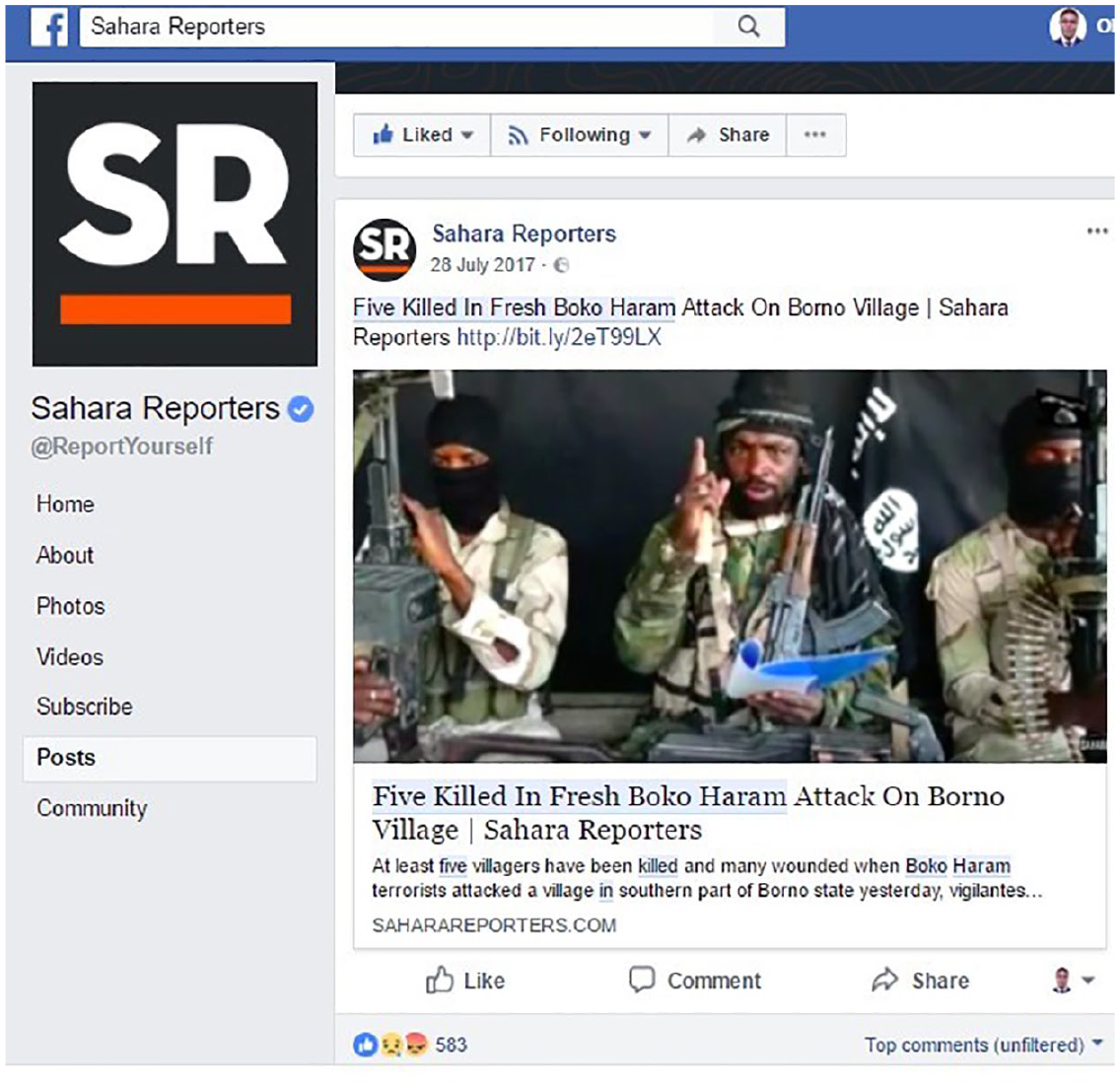
C is generated around a discussion of security although politics became the key issue. Hardly an issue to generate mockery or laughter, the Boko Haram menace has devolved into something to joke about in this interaction due to the varying perceptions of the citizens/netizens on how the government of Nigeria have handled it: particularly the just-elected-at-the-time Buhari administration which contested the presidential election on the promise of an immediate defeat (crushing) of the terrorist group. One of the most prominent voices is that of the disgruntled citizens who are calling for a secession of the eastern part of the country to form a Biafra republic as a remedy to the ‘lies and deceits’ they see in the system of the Nigerian state. While the Biafran proponents are bent on mocking the army and the government, the supporters of the government – especially the Northerners in the interaction, who are from the president’s constituency – find it irritating to joke about Boko Haram. This thus results in a fragmentation of the responses in the interaction: while some responses are directed at the issue in question as reported in the post, some are directed at the Boko Haram group, some at the Nigerian state and its government and leaders, while some are actually directed at the dissenting (or pro-Biafran/agitation) voices.
The interaction features an obvious lack of reference to age, status or other indicators of power. However, the interactants seem to be finely split along ethnic lines as indicated in their names (real or fictitious) and linguistic behaviours – word choices in particular.
The gory impact of the headline coupled with the signification in the picture of a heavily armed Shekau flanked by two even more heavily armed, masked terrorists with the dreaded and widely hated Boko Haram black flag sets up itself as a part of the environmental context (Neuliep, 2009), while the socio-relational context is set entirely by the perceptions of the interactants about one another’s cultures and attitudes to the Boko Haram and the Nigerian government in a two-fold perceptual configuration.
The progress of B is based, rather unexpectedly, on conflict and disagreement featuring obvious lack of face recognition and flout of what would count for SIPs in face-to-face interactions. There are, however, significant instances of competence and fellowship face observance among aligned members which force the interactants on the opposite side to respond with more face threats which we explain as expected observance of second-order SIP of directness and fundamental Socio-pragmatic interactional principle of goal achievement in the face of a need to respond directly to threats to one’s face.
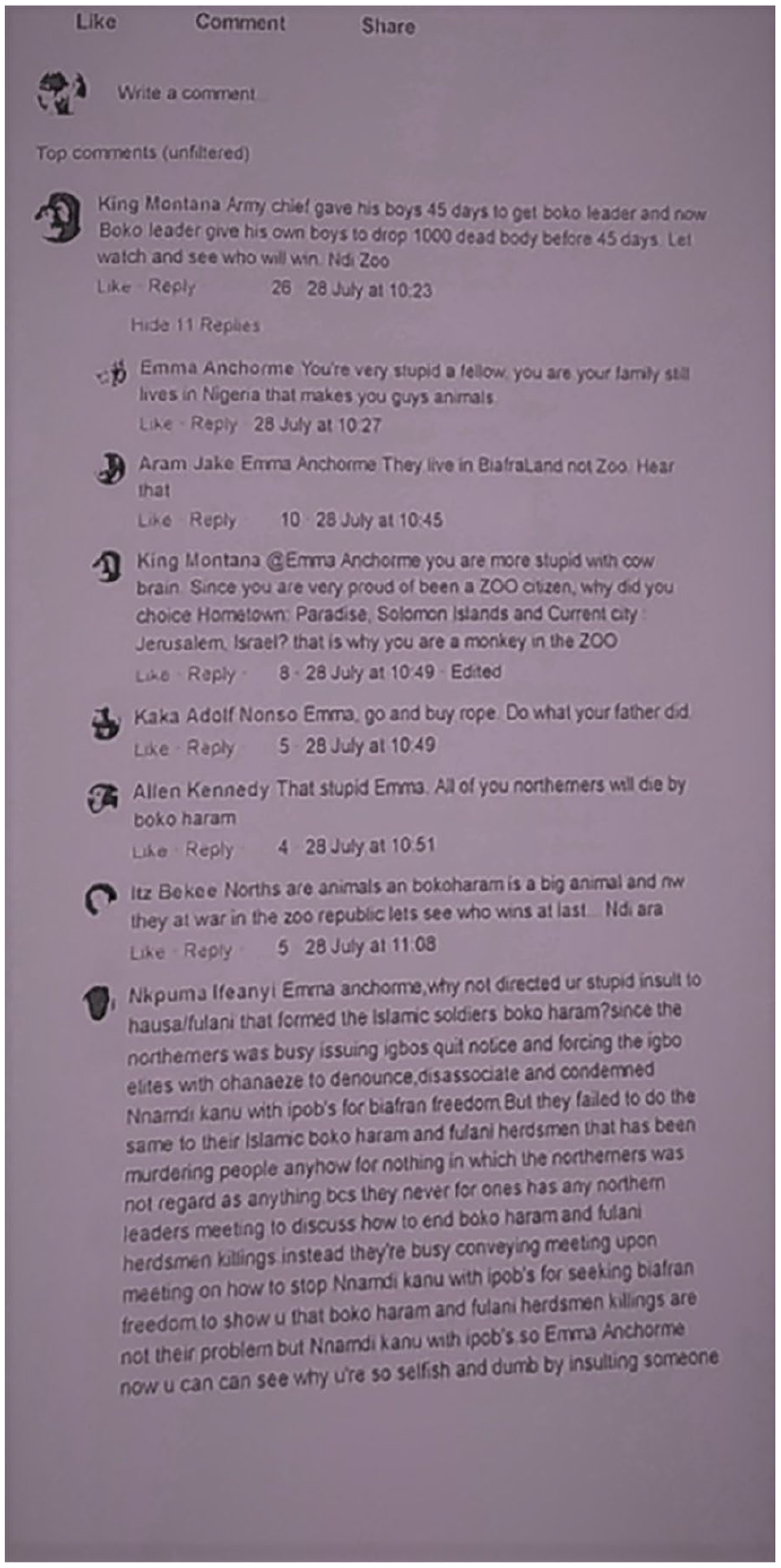
King Montana’s opening comment directly threatens the competence face of supporters of the Nigerian government’s tactics in the anti-terror war. In a rather indirect way also, it threatens both the fellowship and the competence faces of all ‘Nigerians’ by referring to Nigeria as a ‘zoo’. The explication of the perception and effect of ‘the zoo’ as face-threatening comment also stems directly from the micro-cultural context located in the Nigerian political space where the leaders of the IPOB, a pro-secessionist group, have in several forums referred to the Nigerian state as a zoo where larger ‘animals’ prey indiscriminately on smaller ones (see also Ugwu Bekee’s comment) and from where they are struggling to escape.
Such a direct threat as this in the hyperspace context may be difficult to label as morally or socially incorrect until the higher order SIP of task achievement has been considered. In this connection, King Montana’s comment, if seen as a troll, is pretty successful as can be seen in its ability to generate 12 emotion-filled responses that seem to set the tone for the cultural/ethnic/ideological alignment observed throughout the interaction.
Emma Anchorme’s reply, ‘you are very stupid fellow, you are your family still lives in Nigeria that makes you guys animal’, perfectly fits within the impolite antagonistic context set by King Montana and is best explained as a commitment to meet the co-interactant at the level of conviviality/hostility they have chosen for the current interaction. Responding either as an individual citizen of the insulted country or in the role (negotiated) of a representative of that community, he perceives the impolite import of the comment and counters with a threat to the interactant’s fellowship and competence faces, criticising his ‘inability to make a logical connection in his own comment’ as calling Nigeria a zoo automatically makes the speaker, who lives in Nigeria too, an animal. This interpretation of Emma’s, although co-operating in relational terms, however, relies on and aptly reflects a refusal to enter into a semantic component of the negotiated conversational contract which offers a definition of Nigeria as a mental/cultural and geographical entity which does not incorporate the separate mental/cultural and geographical entity that Biafra ‘is’ in King Montana’s perception.
It is this unspoken, negotiated, conversational contract that Aram Jake tries to reiterate in his own reply. Staying within the lower order SIP of restraint even though still threatening Emma’s competence face, the reply offers solidarity with King Montana and draws a clearer ethno-cultural battle line along which other members of the community would eventually line up. A double-edged use of politeness and impoliteness collapsed into one expression thus ensues here, as the interactant refuses to directly insult an earlier respondent (1) while recognising another interactant’s (2) competence and fellowship face in correction of the respondent (1)’s threat to the interactant (2)’s face. This threat to Emma’s competence face is mitigated by indirectness. It seems to offer a pragmatic repair rather than criticising Emma’s lack of enough information or political awareness. By paying attention to the timing of this asynchronous chat, it goes that Aram Jake’s reply brought back the war of words in the interaction which had earlier gone silent for 28 minutes – the longest span of silence observed in the replies.
King Montana makes the most obvious reference, yet, to the micro-cultural context and reveals his perception of Emma by responding with more animal names aimed at him in a direct face threat. First, the choice of the word ‘cow’ betrays King’s perception of Emma’s role. He places him going by his reply as a Northerner (people who are known for cattle rearing). Second, his use of the expression ‘cow brain’ expresses a stereotype about Fulanis which is a direct competence and fellowship face threat to the victim (including their community face as expressed by Nwoye, 1992). At this point in his comment, the word zoo forms a background which he achieves through a strategy of graphological signification by typing the ‘ZOO’ in all caps and repeating it three times.
His recourse to the ethnographic factor of participants, which in this case interfaces with the hyperspace context, also reveals his perception of Emma as a pretentious ‘monkey’ who refuses to identify as what it is. Obviously, Emma’s Facebook profile, which King must have looked up, shows him identifying as a Solomon Islands’ citizen living in Israel. This twist throws another shade of explanation in the data analysis as one might conclude that even Emma’s comment is a second layer of troll meant to generate a flame war (in which case, the intention should be seen as highly successful as well).
It is observable throughout the replies that other comments, excluding Emma’s, took swipes at the Nigerian government and by extension the North which the interactants perceive as the source of the Nigerian/Boko Haram problem since the president and (at least) the minister for culture and communication are from that region of the country.
Kaka Adolf’s reply, ‘do what your father did’, represents a face threat, this time hinged on an ‘unknown’ history beyond the immediate context but which, notwithstanding sufficiently, threatens the community face of Northerners in the community and Emma’s fellowship face in particular.
Another twist in the interaction, which has been hinted at earlier in this analysis, is brought in by Ukpong-Collins Akpan whose face threat is directed away from the Northerners or their cultures towards the Nigerian government. His non-verbal mode of comment drives his message home more clearly as all the dead bodies in the picture he posted as reply are in Nigerian army uniform.
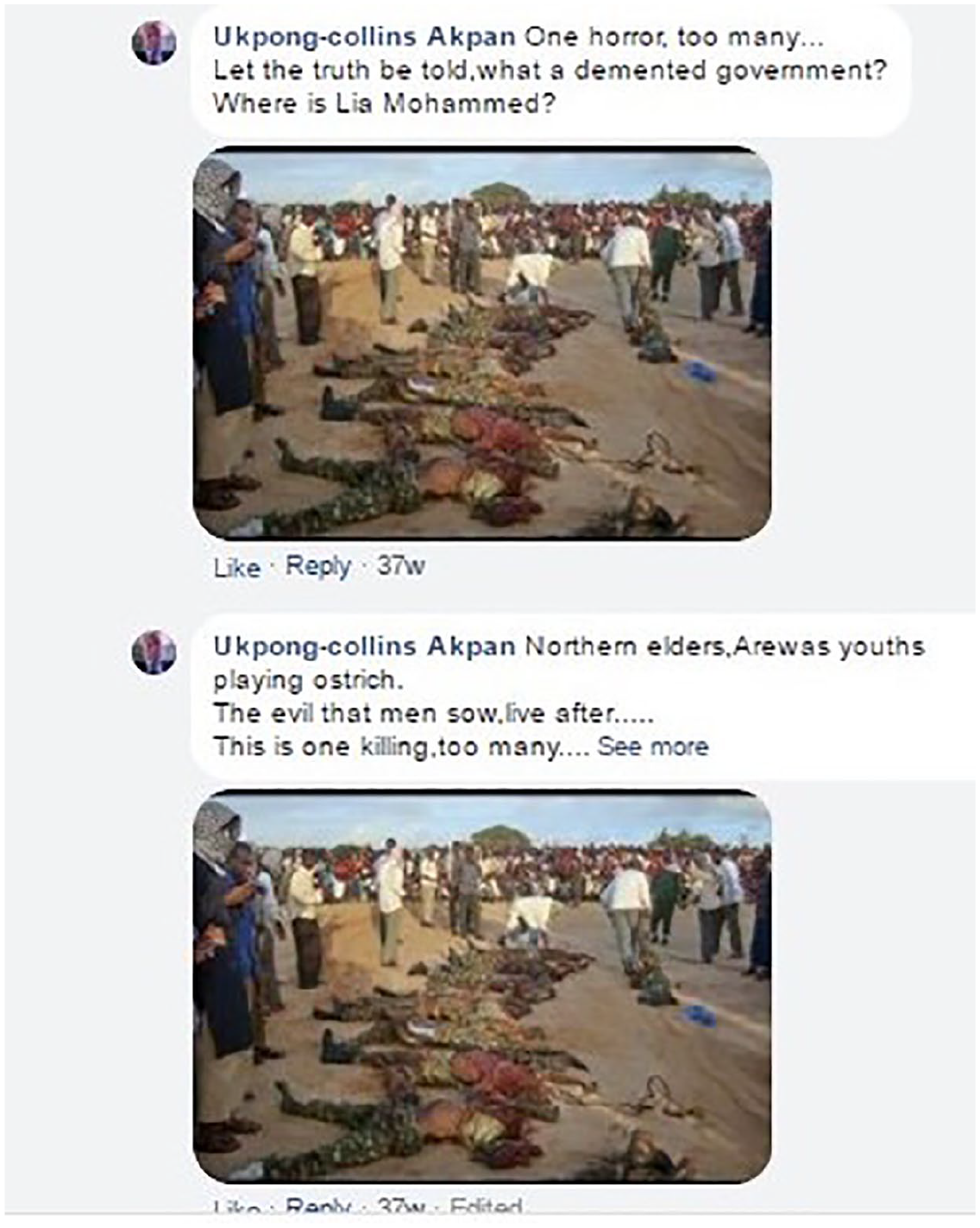
On one hand, it seems to directly reply to Sahara Reporters that more than five have died actually thus re-awakening the reading community to the real horrors of multiple deaths and loss suffered by the army in the fight against the religious extremists. Besides, it comes as a direct threat to the competence face of the Nigerian government, criticising its information dissemination style which has been heavily criticised as jaundiced. This explains the semiotic significance of the wrong spelling of Lai (Mohammed), the Nigerian minister of Information and Culture, which he makes to appear as ‘Lia’ (liar) as has been popularised in the Nigerian online communities. From the angle of relational work, this move can be interpreted as a form of politeness in its attempt to douse interpersonal conflict in the interaction and focus the members’ attention at an ‘external’ entity. It also counts as rapport management and given the contextual information about the poster (as a member of the most insulted group in the chat), it is taken as a commitment to maintain interpersonal relations, save his, others’ and their community faces and further the discussion in a more interpersonally polite direction. The impact is seen in the tone drift of the interaction immediately with competence face observance dominating the next string of replies except a few negligible who are insistent on competence face threat to the Northern community yet away from a personal attack which had been the norm so far. His attempt is, therefore, taken as successful.
Chris Favours’ reply which looks on the surface like a threat to Collings’ competence face, however, should be interpreted as recognition of his fellowship face. It follows that while others want to vilify the Northerners, he agrees with Collings that government should be at the receiving end of all the criticism. He only takes it further by fingering the past president (his fellow Southerner). Besides, if his name is taken into account, his ‘incredible’ self-identification as a Northerner is a further indicator of solidarity with Mohammed who is a Northerner by identification. His position would, however, generate conflict with his fellow Southerners one of whom notwithstanding responds with a mitigated competence face threat by arguing that some leaders – all Northerners – are founders of Boko Haram. He, however, avoids direct insults like those aimed at the Northern interactants. This further underlines the study’s claim about alignment and cultural polarisation in the interaction as well as the role of rapport management as a strategy of talk elongation.
The polarised nature of this interaction is further revealed with Chukwu O Chukwu’s comment despite Chama Joel’s attempt at rapport management, a strategy he employs by guiding focus of the criticism away from the North or the government towards the Boko Haram and which generates only two replies from like-minded ‘peace lovers’. Chukwu threatens the (community) competence face of the Northerners again and adds a fellowship face threat by asking ‘how is it a problem’ that Boko Haram is killing Northerners?
Aram Jake resurfaces in this new thread with an observable to once again spark a flame war as in the first thread. His use of solidarity face observance contained in the expression ‘my dear’ helps to maintain the interpretation of his non-antagonistic stance towards Chukwu’s criticism of Northerners. Rather, the question he raises seems to mean that the criticism should be extended to other Northern states outside Borno. This strategy is again successful albeit to a lesser degree in this thread as the response generated is much more measured in defence of the Northerner president and the Nigerian military.
Polarisation along ethnic lines, however, resurfaces in Obi Victor’s comment which uses politeness behaviour in a manipulative way to express impoliteness towards an ethnic group. His hash tag #Istandwithshekau is a direct threat to the Northerners’ fellowship face since his intention is to popularise or celebrate someone who not only kills them but also portrays them in bad light in the world. His historical reference and death narrative expectedly provoke another competence/fellowship face threat in the form of a stereotypical insult directed at the Igbos tagging them as ‘ritualists’, robbers, prostitutes and other unsavoury significations. The responder’s claim that Obi Victor is incompetent and unqualified to comment is based on his cultural perception of him and all Southerners by extension as ‘what they do is no better than terrorism’. Obi Victor’s equally impolite and vituperative response further aligns him with the Southern members in the interaction especially through the use of a familiar conceptual signification captured in the word ‘animal’ – ‘Nigeria being a ZOO’ in their micro-cultural perspective.
The major tools of impoliteness through competence and fellowship face threat in this thread include a picture, taunt hash tag, laughter emoticon and laughter which includes the Internet language LOL and the exaggerated ‘hahahahahah’ form common in other virtual communities.
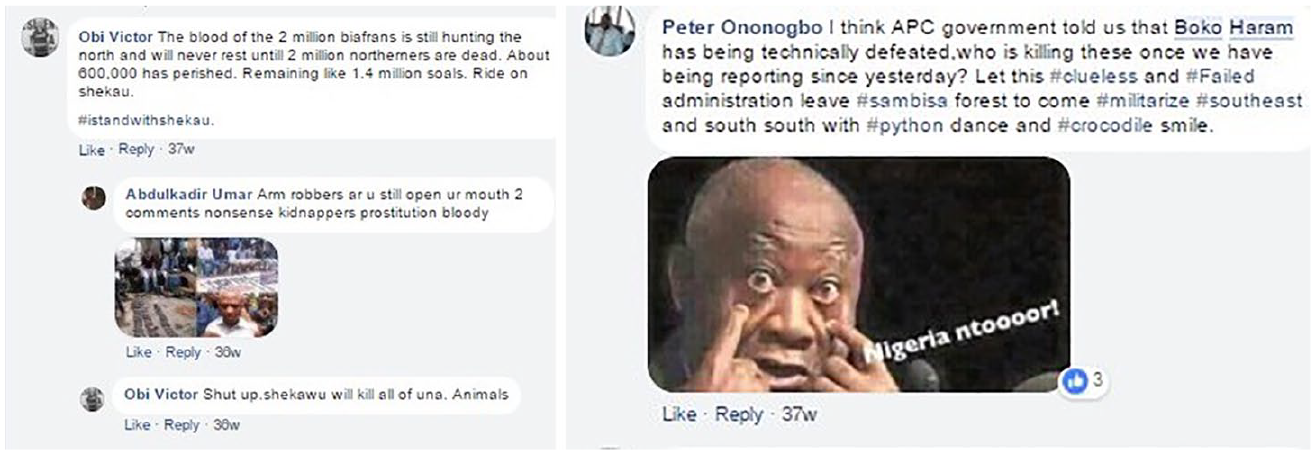
Rapport management is largely achieved through the recognition of co-interactants’ fellowship faces in the next thread, hence its smooth flow irrespective of the harsh use of language and direct face threats to the Northerners, Northern political leaders and the Buhari government. The member posting seems to have understood the desire of majority of the members posting in the community (Southerners) and thus recognises their fellowship face by further placing the blame about Boko Haram on the ruling APC party and the present administration. As expected, this position sits well with all 37 members replying except Nasiru Hassan who attacks Muhammad’s role playing and political identification, got through implicature, as non-APC. His response refuses to recognise Muhammad’s fellowship face unlike all other interactants in the thread but did not generate any response that is capable of disrupting the agreement and rapport that characterise the thread. This rapport would remain undisrupted even after Ohams Nnaemeka’s troll directed at the Hausa-Fulanis in the community which further generates more spitefully impolite behaviour and Southerners’ solidarity.
More ethno-cultural and ideological polarisation would ensue after Adeolu Alex Ladimeji’s veiled competence face threat to Nwokeocha David about being ‘unchristian’ in his taunt directed at the Northerners who were being killed by Boko Haram. Three community members respond with threats to his fellowship face albeit devoid of the harshness and name-calling that characterise their threats to the Northern members of the community. This observance of the SIP of indirectness and concern for face thus help the study to arrive at an interpretation of less animosity towards the Westerners by the Easterners in this community irrespective of the ideological difference that this Westerner seems to have expressed.
Umar A. Abubakar is, however, able to drive some decorum into the interaction through two successive posts that direct their face threat to Boko Haram and the army chief rather than at Igbo/Southern members of the community or the government. This is another significant attempt at rapport management, but the resolve of the members posting replies to post further face threats underlines the conclusion that impoliteness is a major tool for the progression of this interaction as a recognition of a need to be civil and stop the insults might have brought the interaction to an end.
D: Fiery and jagged
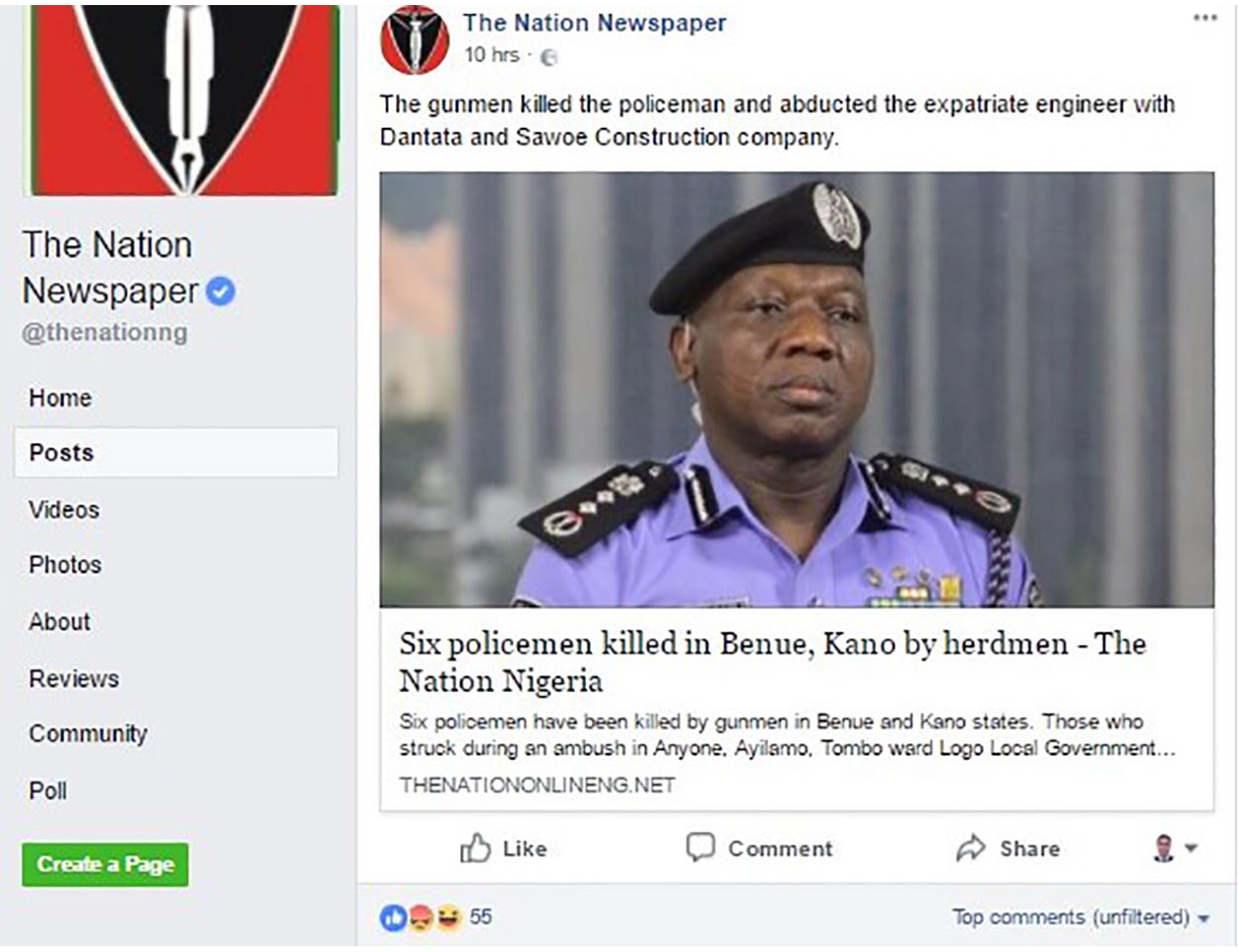
D could in fact be merged to either of the two unfriendly categories. However, some factors mark these interactions in a way that render them incompatible with either group. First, the interactions are the shortest in the sample population. In fact, they appear too short to be interpreted as sustained. Second, the interactions feature no attempt at rapport management or equilibrium relational investment to keep it sustainable. Rather, the largest percentage of curses and verbal expressions of ill-will seem to be more widespread and forcing participants out of the interactions untimely. The cover picture accentuates the contextual configuration identified in the interaction where hatred is directed at the reportage which some interactants accuse of bias against the Hausa-Fulani ethnic group.
D portrays a pattern of destructive use of language and aggressive enactment of ethnicity. Emotion based on recognition of face threat to ethnic identity caused the collapse of this interaction. The report of herdsmen killing constitutes a basis of face loss to the Northerners who are aware that they are commonly imagined and stereotyped as terrorists by the Southerners. Thus, the comments of Southerners do not only serve to ratify the interpretation but also enhances the explication of impoliteness behaviour. The main strategy in this interaction is the aggravation of face loss.
Adeola Ande, for instance, is a Southerner. His adopted strategy for aiming impoliteness at the North is the expression of praise for the news agency whose report has obviously caused face loss to the North. He goes ahead to extend the FTA by associating the killers with Fulanis which the news agency failed to do. Although, his move does not generate the expected verbal scuffle in the present thread, subsequent posts portray the effect of his behaviour as insults and flame wars marred the whole interaction. In yet another thread, Adeola and Anthonia’s interaction sufficiently demonstrate lack of agreement and tact or approbation in their discussion of the tactic of the news media in reporting terrorism in Nigeria.
Dominic Paulinius accuses the ruling party of being a problem in a double-edged enactment of impoliteness. First, he had demonstrated lack of concern for autonomy face by bringing up a topic of his choice without proper redress despite knowing that it is a demographically diverse community. Second, his attack on the party is a competence and fellowship face threat which attempts to further polarise the community. The interaction is replete with altercations constituted of vulgar expressions rather than the mock angers and jokes that characterise other groups of interactions.
Group D is an example of what purists in politeness studies consider as failed interactions. Obviously, little or no concern is shown for face management or face needs of others, rather, each member of the community seems to be only interested in imposing their views on others who are expected to accept them or to fight back with their own views. It could be argued that the impersonal nature of the community has a role to play in this phenomenon. However, most of the factors leading to the fiery nature of the conversations are down to the perceived bias of the newspapers towards one ethnicity as well as perceived bias of the Nigerian authorities in the same direction. Emotions linked to ethnic and political sentiments are largely responsible for the choice of impoliteness and verbal violence as reactions to perceived impoliteness by others in the communities. To some extent, a sense of proximity (psychologically or physically) would call for better management of face; however, the lack of it in the communities under study makes for a total disregard for face needs.
Conclusion
Participants in virtual communities engage in interactions (and politeness behaviour specifically) in a uniquely multi-directional pattern where the people who are mentioned in the news as well as the news writers, apart from other participants, are imagined as part of the community and engaged in the interactions. The polarity that exists in the communities is indicative of the strata in the real-world Nigerian society, and it is often a huge factor in the perception of (im)politeness in comments. While most polite expressions are verbal except in the use of ‘likes’ and ‘approving smileys’, impolite expressions do not sufficiently get transmitted in texts. Posters, thus, resort to mostly memes, GIFs, pictures and emojis in combination with the verbal parts of their posts to express disgust, ridicule or condemnation.
In the final analysis, politeness and impoliteness appear to progress along the same direction on the relational scale in Nigerian news-based virtual communities. While expressions of politeness make posters add more polite expressions to the interaction, expressions of impoliteness forces posters to respond also with more impoliteness to deepen the interaction. The success or length of talk in the communities are, thus, not dependent on facework but on relational work. Failure of interaction to progress can, thus, not be pinned down on lack of politeness. Rather, it is down to lack of relational investments by the interactants.
Footnotes
Declaration of conflicting interests
The author(s) declared no potential conflicts of interest with respect to the research, authorship and/or publication of this article.
Funding
The author(s) received no financial support for the research, authorship and/or publication of this article.