



Abstract
The article draws on the first findings of the INFOCORE project to better understand the ways in which different types of media matter to the emergence, escalation or, conversely, the pacification and prevention of violence. The authors make the case for combining an interactionist approach of media influence, which is centred on the effects of evidential claims, frames and agendas made by various actors over time, with greater sensitivity for the factors that make conflict cases so different. They argue that the specific role played by the media depends, chiefly: (a) on the ways in which it transforms conflict actors’ claims, interpretations and prescriptions into media content; and (b) their ability to amplify these contents and endow them with reach, visibility and consonance. They found significant variation in media roles across six conflict cases and suggest that they are best explained four interlocking conditioning factors: (i) the degree to which the media landscape is diverse and free, or conversely, controlled and instrumentalized by conflict parties; (ii) societal attitudes to and uses of different media by audiences; (iii) different degrees of conflict intensity and dynamics between the conflict parties; (iv) the degree and nature of the involvement of regional and international actors. The article maintains that de-escalatory media influence will be most effective over the longer term, in settings of low intensity conflict and when tailored carefully to local conditions.
Introduction
This special issue aims to better understand mediated communication about conflict and, in particular, the ways in which different types of media matter to the emergence, escalation or, conversely, the pacification and prevention of violence across different contexts and cases. We understand conflict in a broad sense as a ‘severe disagreement between at least two sides, where their demands cannot be met by the same resources at the same time’ (Wallensteen, 2007: 14). Resources are here not just measurable tangible realities such as money, territory or access to other forms of power, but can also involve socially constructed intangibles such as collective values, norms or psychological needs of actors for recognition or apology from other actors. Conflict does not necessarily need violent action to be observable, but can be latent, with no or few attempts to resolve the underlying issue, whereas a manifest conflict involves a broad spectrum of actions ranging from demonstrations to riots to full-blown war at the extreme end.
The need for a comprehensive and up-to-date investigation arises from interlocking changes in the nature of conflict as well as in the means, structures and participants involved in the communication about it over the last decade. In particular, scholars highlighted an ‘uneven, yet clearly visible, upward trend’ in the number and lethality of armed conflicts, particularly those described as internationalized with other states contributing troops to one or both warring sides as in Ukraine (Pettersson and Wallensteen, 2015). Syria has turned into the prototype of a multi-layered and complex conflict involving not just diverse conflict parties from within the country such as Hezbollah, Al-Nusra or Daesh, but also a strong regional dimension with the rivalry between Saudi-Arabia and Iran, coupled with the involvement of states from outside the region, most notably the US, France and Russia. These changes have been partly caused and partly affected by significant changes in how communication about conflict takes place, who shapes it and with what effect: winning the battle for international, regional and domestic public opinion is increasingly seen as essential by non-Western states that have invested in creating or expanding media outlets sympathetic to their views, whilst many news organizations based in Western capitals have been cutting back as advertising revenues declined. We have witnessed the rise of the internet and social media such as Facebook and Twitter with the effect of not only increasing the speed and accessibility of conflict news, but also diversifying the range of actors who shape them and the level they are located at. Conflict news is no longer produced exclusively by trained journalists, but involves to a growing extent active and innovating citizens, bloggers, Non-Governmental Organizations (NGOs) and diaspora communities. These new media types challenge not just the gate-keeping function and credibility of the traditional media, but also governmental and military control over the flow of information, leading to adaptations in military tactics and new forms of intelligence gathering and surveillance. They also impact how international media assistance is perceived and implemented worldwide.
As the media landscape becomes more heterogeneous, it becomes arguably more difficult to identify stable overarching patterns affecting conflict communication and to theorize the different roles that particular actors and media may play in conflict communication in specific cases. The articles in this special issue present the first findings of the INFOCORE research project, which combines a comparative design involving six conflict cases (two in the Balkans: Macedonia and Kosovo; two in the Middle-East: Syrian and Israel/Palestine; and two in Africa: Burundi and the Democratic Republic of Congo) over a period of up to 10 years. The theoretical point of departure for the project is the expectation that media content, which contains evidential claims, frames and agendas for action, influences conflict actors’ cognition, attitudes and behaviour and thus ultimately conflict dynamics. The research team used a multi-method approach involving automated and qualitative content analysis of a wide variety of media sources with evidence from practitioner interviews, focus-groups and surveys. This allows us to glimpse the complexity of conflict communication and identify any common patterns whilst being sensitive to the many ways in which each conflict case offers a unique combination of conditioning factors.
This first section of the introduction explains the research design, core concepts and methodological approach underpinning the research on which the articles draw. In a second step, we will present four findings emerging from the contributions to the special issue and the broader research project about (i) patterns of media coverage of conflict; (ii) who is shaping it; (iii) explanations for differences in media influence; and finally, (iv) normative perspectives on media influence. In the conclusion, we discuss what our findings mean for attempts to understand media roles in violent conflict. We make the case for combining an interactionist approach of media influence, which is centred on distinct episodes and effects that develop over time, with greater sensitivity for the factors that make conflict cases so different. We argue that the best intervention strategies will be carefully tailored to the conditions of each country and conflict, sustained over a longer term and will start before conflicts have already escalated.
Theory, design and methods
INFOCORE’s approach to the study of the role of the media in violent conflict aims to capture the ways in which communication about conflict is generated as well as the effects media content has on conflict actors and dynamics. Insofar as conflict news is produced by journalists working for different kinds of media, the answer to the first question can draw on insights from communication, journalism and communication media studies – for instance, research related to news values, routines and editorial cultures. In contrast, an answer to the second question requires an engagement with international relations and political science, most notably peace and conflict studies as well as foreign policy analysis.
As we argued elsewhere in more detail, theorizing the role of the media in conflict has been hampered by at least three forms of fragmentation of the state of the art (Baden and Meyer, 2016). The first dimension can be found in how possible media roles are discussed across and sometimes even within disciplinary fields such as sociology (on radicalization and the notion of risk in counter-terrorism and ‘Western ways of war’), critical and feminist scholarship (e.g. denouncing hegemonic discourse power, examining practices of masculinity or victimization), psychology and genocide studies (the emergence and impact of hate speech), journalism studies (peace or conflict-sensitive journalism), political communication (e.g. the CNN effect, Politics–Media relations), in International Relations and Security Studies (media roles in foreign policy and intelligence), and indeed in peace studies (especially media assistance for conflict prevention, the media role in peace building processes). However, there has been limited cross-fertilization between research fields and few attempts to integrate knowledge and identify connectable or generalizable insights about the multiple and contingent role of media in conflict (Livingston, 1997). Given the predominance of pessimistic accounts of media contributing to mobilization for war (Carruthers, 2011), hindering conflict prevention (Gowing, 1997; Jakobsen, 2000) and making peace processes more difficult (Wolfsfeld, 2004), it would be all the more important to understand under what conditions the media can also support peace and reconciliation as case study evidence suggests (Hoffmann and Hawkins, 2015; Frère, 2007).
The second source of fragmentation relates to the different explanatory approaches to specific observed media influences. Influence can be conceived in radically different ways depending on whether one operates within a liberal contestation, a cultural or a manufacturing consent paradigm (Cottle, 2006: 13–32). Even within the first model, one can distinguish between studies envisaging primarily cognitive effects from others concerned primarily with attitudinal or even behavioural effects of the media on conflict actors. At the same time, perceptions, attitudes and behavioural options of media audiences in conflict are at best scantly conceptualized, in contrasting ways. Most studies addressing media influences on conflict policies and decision-making, as well as some investigations of new media uses inside conflict areas assume reasonably rational actors with set interests and capabilities who seek information to generate and choose options for action. By contrast, research into media influences on the general public tends to assume a badly informed, emotion-driven audience, either torn between competing policy options or easily mobilized for individual or collective violent action. These reflect also differences as to whether influence is investigated at the level of individuals or at the aggregate level of institutions, social groups, or even societies. The expected reliance of the general public on the media ranges between the media as a main, complementary, or auxiliary source of information and interpretation, and media capable of influencing audiences with single reports or images, or only with consonant, salient coverage. Each combination of underlying mechanisms gives rise to quite different possible media roles and conditions for their occurrence, again necessitating a more systematic appraisal and integration.
Third, fragmentation is even more evident among the empirical studies conducted in each field. Proceeding in a highly case-bound fashion, most accounts of media influences are based on thick descriptions and argumentation, highlighting selected routes of media influence. Comparative assessments or other strategies able to control the complex confounding explanations for observed phenomena in each case have been rare, as have been efforts at testing hypotheses or identifying the specific conditions and factors enabling or obstructing specific influences (Fröhlich et al., 2007; Tenenboim-Weinblatt et al, 2016; Neuman, 1996). Moreover, most studies focus on single types of media, addressing influences of highbrow journalism, global social media, or specific regional radio stations. Differences between local media (operating in a conflict zone and addressing primarily a local audience) and transnational media (operating from abroad and targeting local or foreign audiences) are very seldom taken into account, and comparative studies are lacking in that field. A discussion of the changing roles of media due to changes in global as well as regional communication flows and technologies is largely absent. Moreover, many of the case studies chosen involve some degree of interest from or even direct participation by the United States and Britain, giving many debates about media roles in foreign policy an Anglo-American flavour and raising questions about generalizability.
Given the limited use of both theory and comparative data, most causal claims and proposed mechanisms are both underspecified and in need of systematic corroboration. While the wealth of case-specific, rich studies should in principle enable some classification and identification of recurrent patterns, which may reveal important conditions for different media influences to manifest themselves, to our knowledge no such effort has been undertaken to date. Therefore, we cannot draw upon a single theory covering these dynamics that is reliable, comprehensive and persuasive enough to be operationalized within a narrow ‘theory-testing’ design. Our approach is therefore sensitive to the different yet possibly complementary role media play in conflict situations and the competing explanatory approaches used in different fields. According to Cottle’s (2006) conceptualization of theoretical approaches, INFOCORE’s perspective can be broadly situated within a liberal interactionist paradigm, as opposed to culturalist or marxist perspectives. It aims to accommodate the variability of both channels and conflict contexts of possible media influences, specifying mechanisms that may operate in different ways depending on the investigated case, outlets and changes over time. Our investigation revolves around three discursive categories of media content, the ways in which these are shaped by different actors, and the effects they have on conflict dynamics. Specifically, we are interested in the interplay between the cognition, attitudes and behaviour of conflict actors and the evidential claims, interpretative frames and agendas for action. These are constructed by strategic actors and transformed in the process of including them within media content, applying journalistic interventions (Tenenboim-Weinblatt and Baden, 2016) and adapting them to the needs of different media genres and channels (Figure 1). The actual impact of these forms of media content in a concrete conflict case will depend on three amplification variables (Baden and Meyer, 2016): reach refers to the expectation that media content will be more influential if it is received by a larger audience visibility is a measure of how much attention or prominence media give to media content within their overall coverage; consonance, finally, denotes the expectation that the influence of media content rises the more it is being repeated by different sources over a prolonged period of time.

Interrelationship between actors and discursive categories in conflict communication.
Evidential claims aim primarily to create or modify cognitive beliefs about a given referent object, problem or dynamic in the social or natural world as well as conveying the limitations to what is known or knowable (Baden and Stalpouskaya, 2015; Meyer, 2016; Meyer and Sangar, 2014). Such claims can relate to the details of important events (who committed a chemical weapons attack?), actors (what are the intentions of leaders?) as well as dynamics (what is the main cause or driver of a conflict?). They can be made with varying degrees of certainty or confidence and can be distinguished as to whether they are rooted in some form of direct observation or whether they require analytical judgement about cause and effect in relationships. They are the backbone and main subject of news coverage as well as intelligence reports, although they may greatly differ in their specificity and nuance. They matter most to shaping the cognition of policy-communities who are trained to pay attention to detail and employ professional standards for judging the quality of information. However, evidential claims can also sustain or contradict widely held or mediated frames as substantially more abstract and simplified ways of making sense of reality insofar as they may legitimize or de-legitimate preferred interpretations about key actors’ intentions and overall conflict dynamics, for instance whether protests are secular or sectarian in nature.
Frames function by suggesting specific interpretations and appraisals of conflict events (Entman, 1993; Goffman, 1974). Embedding evidential claims within a selective context of related beliefs, frames imply a central organizing idea that renders conflict events understandable and endows them with specific meaning. Based on the presented interpretation, they suggest specific evaluative standards suitable for appraising framed information, enabling the formation of both ad hoc emotive responses and longer-lasting evaluative attitudes. Frames exist on different levels of abstraction and range from relatively transient contextualizations of specific events to long-lasting ‘master frames’ that organize complex issues and subsume numerous specific frames (Baden and Springer, 2017). They have been amply documented to affect recipients’ attitudes toward a wide range of issues, including violent conflict. For instance, framing conflict as grievances imposed by external actors tends to build positive attitudes toward a decisive, collective response, while highlighting the interplay of all sides in a conflict may foster conciliatory attitudes. Likewise, raising evaluative standards of human suffering among the in-group reduces cooperative attitudes (Butler, 2010), while paradoxically, depictions of vulnerable, victimized women often serve to reinforce readiness to engage in violent behaviour against masculinized outgroups. The specific power of media frames is evident primarily where they serve to synchronize the interpretations and attitudes of larger actor groups. By proposing widely acceptable situation definitions and promoting a shared sense of grievance, moral outrage, and a need for action, frames can forcefully mobilize public consensus (Klandermans, 1988).
Thirdly, distinctive agendas for action in a given conflict can be implied by the interpretations advanced by present frames as in the case of prognostic frames (Snow and Benford, 1988) and frames’ treatment recommendation function (Entman, 1993). However, as different frames may support the same course of action, it makes sense to think of agendas for action as separate media contents, which may appear with or without the support of a specific frame. Agendas for action explicate what, if anything, should be done about a situation. They can range from highly specific, sometimes elaborate plans involving multiple sequential or contingent steps, to vaguely specified calls for action, to simple requests that somebody should do ‘something’, or not pursue a specific course of action. Agendas for action both direct and motivate specific kinds of behaviour, and thus have the potential to directly impact the development of violent conflict. For instance, successful radicalization often involves incitement that motivates specific perpetrators to commit violent acts against specific target groups. Agendas for action suitable to affect conflict developments include calls for violence, but also political protest, boycott, denouncing possible accomplices of the ‘enemy’, raising donations, spreading propaganda or lower key activities such as voting in support of particular policies. Agendas for action may call for both realistic and unrealistic conflict actions and may take different forms depending on whether they address decision-making elites (calling for specific conflict policies) or lay publics to whom such courses of action are unavailable. To the extent that agendas for action are powerful enough to inform dispersed audiences of how a resolution of a perceived grievance can be achieved, they have the potential to powerfully shape collective action, if not collective violence in conflict.
While ‘frames’ have been used as a self-standing concept in research for decades, we argue that media roles can only be adequately understood by looking at the varied and aggregate effects arising from all three concepts and grasping their interdependencies. Frames include and presuppose specific evidential claims that must be accepted for the frame to become effective (e.g. blaming escalation on specific groups may depend on the belief that this group’s actions are responsible for specific events, were unprovoked, and so on). In turn, agendas for action are supported and justified by particular frames that must be accepted for the agenda to appear plausible (for instance, calls for a pogrom presuppose that the targeted ethnic or religious group is interpreted as a mortal enemy or ‘parasite’ and accordingly resented). This does not imply a linear or strictly hierarchical relationship as there is substantial evidence that agendas for action, say for instance calls to topple Saddam Hussein in 2003, can generate intelligence and news media coverage that is supportive of this aim. A major analytical question is thus who has the power to shape claims, frames and agendas for action in mediated communication, whereas a normative question is whether novel evidential claims arise from the professionally competent observation of new developments on the ground, or whether such claims themselves are selectively picked, ignored, or even created by powerful political or commercial interests to serve pre-existing narratives or preferred courses of action.
Case study selection
We follow Weissmann and Swanstrom (2005: 11) in distinguishing between stable peace, fragile peace, open conflict, crisis and war situations. Insofar as all conflicts are socially constructed, the transition from one conflict stage to another can be conceived as heightening or lessening of tensions through the verbal or non-verbal actions of conflict parties or citizens loosely associated with them. The nature of such actions can be expected to vary substantially as responses fall into various policy paradigms such as longer or shorter term prevention, crisis management, peace-making and peace-keeping, conflict resolution, and peace-building and reconciliation. To capture and systemically compare patterns and dynamics in the production of conflict news and their reception over time we need some variation in the context conditions as well as in the outcomes. Therefore, we have selected six cases spanning a spectrum of fragile peace with some evidence of conflict transformation during our period of observation such as Kosovo (with a steady improvement), or the case of Burundi which changed from fragile peace to crisis and the extreme case of Syria which quickly escalated from fragile peace to war involving both domestic as well as international actors within a short space of time (see Table 1). Whilst conflict intensity was the main selection criterion, these cases taken from three different regions offer significant variation in other potentially important background variables such as key characteristics of the media system, state of democracy and the degree of international attention to and involvement in the conflict. For instance, Israel/Palestine is a case with a high degree of foreign news attention whereas Macedonia gets little publicity. In Burundi, less than 5 percent of the population are internet users, whereas an estimated 29 percent of Syria’s and 72 percent of Israel’s population have an internet connection (Internet Live Stats, 2016). Similarly, the media in Israel have a high degree of autonomy whereas in Macedonia and Syria most media outlets are closely tied to conflict parties, albeit for different reasons and through different mechanisms. Moreover, in Burundi and the DRC several major local media outlets are fully funded by foreign media assistance programmes, which has an impact on their editorial lines. The relative significance of these variables, however, becomes only apparent through the research process itself and its openness to the discovery of novel connections within and between cases. More detailed descriptions of these cases can be found in the articles.
Overview of key case properties.
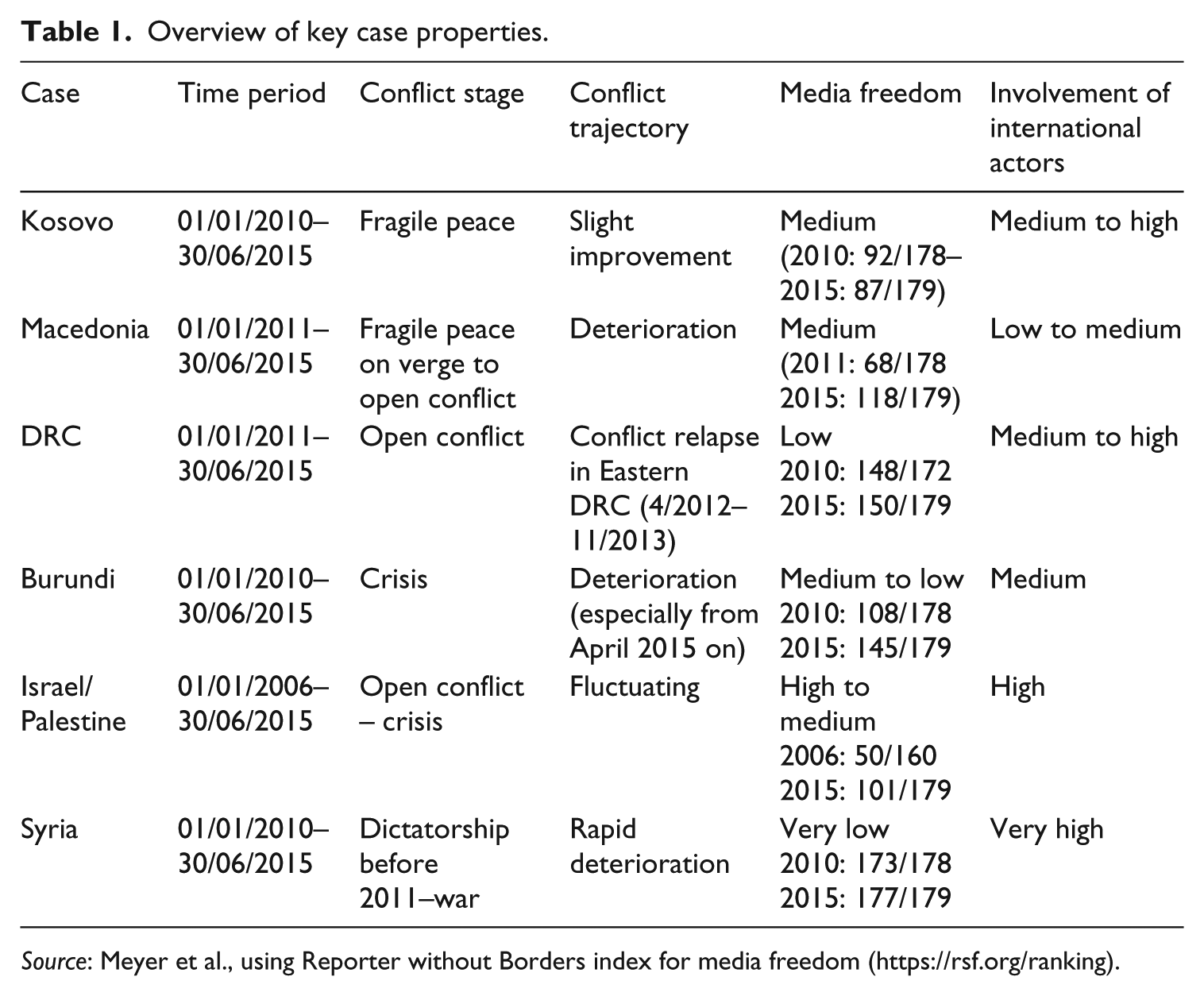
Source: Meyer et al., using Reporter without Borders index for media freedom (https://rsf.org/ranking).
We have collected and analysed a huge amount of media texts (Baden and Tenenboim-Weinblatt, 2018), including Twitter feeds and Facebook posts (Dimitrakopoulou and Boukala, 2018), but also upstream and downstream texts such as NGOs PR, press releases and reports (Fröhlich and Jungblut, 2018) as well as parliamentary debates (Herrero-Jiménez et al., 2018). Moreover, we have conducted interviews with NGO staff, political leaders and journalists to analyse how news stories are actually produced rather than the actors’ own theories about them (Hoxha and Hanitzsch, 2018), how NGOs differ in their communication strategies and influence (Meyer et al., this issue) and how political leaders perceive the impact of legacy and social media on their ability to control events and make peace (Wolfsfeld, 2018). Apart from the focus-groups and survey that aim to explore how the audiences in conflict countries interact with news (Trpevska et al., 2016), we have conducted more than 400 individual interviews which helped us to build up a nuanced picture of the dynamics between the most significant actors in each of these conflict settings, but also to detect overarching patterns and key conditioning factors behind media coverage. In the following, we want to present four findings that have emerged from the contributions to this special issue as well as the broader research project about the causes and effects of conflict communication and coverage.
Identifying patterns of conflict coverage
The contribution by Baden and Tenenboim-Weinblatt (2018) provides us with nuanced data from these different conflicts to confirm that ‘much media attention is narrowly focused around salient events, oriented toward reporting violence rather than peace-related news, and wanes as violence drags on.’ Indeed, they find that media coverage is not strongly related to actual changes in the level of violence except for the Israeli/Palestinian conflict and while media do pay more attention to periods of initial escalation or large-scale violent events as in the case of Syria, they find only ‘weak evidence of escalation induced changes, particularly in domestic news coverage’. They find highly significant differences though between foreign news coverage and the much less well researched domestic news coverage with the latter being less short-lived than the former and starting to cover escalating tensions earlier. This may not be entirely surprising, but has important implications for those who rely on media as early warning systems of conflict (Chadefaux, 2014). They conclude that attention does not wane as quickly as some of the more pessimistic critics of media coverage argue. A potentially more positive finding is that even though the data confirm the preference for violence-related as opposed to peace-related news, there is not as much change in situations of escalation as one might have expected and the same is true of the frequently hypothesized lack of critical distance. They find, therefore, less support for the thesis of ‘news media abandoning professional standards and rallying around the flag’ during periods of escalation as the literature might lead us to expect. Finally, the findings from the quantitative media content analysis point to the importance of paying more attention to how particular features of each of our six cases account for significant differences in the patterns of media coverage. The Israeli/Palestinian conflict stands out as unusual in the degree to which foreign media attention and political attention are closely correlated and react highly sensitively to any incident of violence, whereas other conflicts geographically and politically closer to Western realpolitik interest attract much less foreign media attention such as Macedonia and Kosovo.
While the nature of the data-set and indicators used impose limitations on the depth of the analysis, the qualitative findings from the interviews do point to important variations between cases in the characteristics of media coverage, especially the degree to which the media are contributing to polarization in situations where there is considerable potential for identity-based conflict. In the cases of Kosovo and, to a lesser degree, Burundi, interviewees highlighted a general sense of caution and reluctance in terms of portraying incidents of violence along ethnic lines. The same applies to Burundi, a country which has been considered as a ‘laboratory’ for media and peace-building initiatives during a decade. In some cases, this caution may only apply to one part of the media system. For instance, we have qualitative evidence of the Albanian language media in Macedonia playing a calming role during episodes such as the Kumanovo incident (Trpevska et al., 2016), whereas our research shows less restraint and greater openness to playing up inter-ethnic differences in the Macedonian media. Similarly, in the case of Syria in the early months of the uprising, the state-controlled media were ready to support the government’s message of branding the initial uprising as sectarian and ethnic in nature, whereas the gradually evolving but much less powerful ‘revolutionary’ media emphasized the non-sectarian nature of their grievances against the Assad regime. Qualitative evidence from the interviews and the surveys gathered by Trpevska et al. (2016) also point to the influential role of media transmitting from across the border or indeed the regional TV networks such as Al-Arabiya and Al-Jazeera, each with a distinctive take on a given conflict situation given their audiences and funders.
Who shapes media content?
We know that news does not ‘naturally’ emerge from events in the real-word, but is in various ways constructed according to professional routines and norms held by journalists as well as a number of factors external to journalists (Shoemaker and Reese, 2013). Hoxha and Hanitzsch (2018) show through the novel method of story reconstruction how conflict news comes into being. Their research into article biographies shows that, contrary to journalists’ self-legitimizing professional narrative of ‘authoritative storytellers’ producing ‘original’ news emerging from open-minded research in the real world, journalists actually produce news in at least partially contradictory ways. They typically conduct their research according to pre-existing narratives about what the conflict is about and are influenced in this by their main sources as well as what is possible to research in practical terms. Here, potentially significant differences emerge between journalists as typically younger freelance journalists relying more on social media for the story ideation and European capital-based journalists on news agencies, whereas more experienced correspondents rely on the professional networks they have grown over many years. The authors highlight the risk of conflict coverage becoming ‘self-referential’ and missing out on complexities and inconvenient truths about conflict parties as journalists tend to follow a small number of leading news outlets and the homogenizing perspective arising from social media. They also note the importance of physical access (as in Syria) and diplomatic secrecy (as in negotiation between EU and Kosovarian authorities) for explaining why certain facts cannot be gathered and related stories never be written. As a result, conflict news becomes more vulnerable to various forms of source manipulation as well as one-dimensional conflict narratives, especially under conditions of increasing prevarication in journalistic careers and increasing pressures from owners and political actors in many conflict settings.
The article by Meyer et al. (2017) complements these findings by theorizing the growing influence NGOs have had on media coverage in France and the UK in the case of Syria. They develop a ‘supply-and-demand model’ of NGO contents in mediated coverage of conflict to clarify some of the reasons why and when NGO influence has grown. These include the growing difficulty of media access to particularly dangerous conflict areas or the rising costs of safety and insurances for journalists. On the other hand, they note the growing professionalization and reputation management of large international NGOs, but also find surprising evidence of how relatively small and little known semi-local NGOs can become frequently cited sources of media coverage. The Syrian Observatory of Human Rights and Raqqa is Being Slaughtered Silently demonstrate how strong local networks of informers, empowered by new communication technology and social media, can give poorly resourced NGOs a competitive edge and credibility as providers of raw material for news – even though some of these organizations are associated with one conflict party. The other finding is that the strong reliance on Human Rights-focused NGOs, such as Amnesty International and Human Rights Watch, for conflict coverage creates a systematic bias for a moral framing not just of the event coverage, but also the analytical judgements, to some extent, prescriptions for Western policy-makers on how to act. In contrast, NGOs such as the International Crisis Group who tend to complexify a conflict and attempt to understand the motives of all conflict parties, including those who have committed most human rights violations, are less influential.
The rise of social media and new communication technology has not just helped to amplify the voice of less well-resourced local and semi-local NGOs as well as exiled journalists forced to emigrate because of conflict (Frère 2017), but also empowered ordinary citizens in complex ways as Trpevska et al. (2016) and Wolfsfeld (2018) show. The former demonstrate that between 5–15 percent of surveyed citizens use the growing range of interaction opportunities offered by media organizations, such as phoning into radio shows, participating through comments on online forums and news websites. Active citizens are of course also the main contributors to social media such as Facebook, which have in some conflict settings become the major source of news, or have challenged official accounts on Twitter as the case of Burundi shows (Dimitrakopoulou and Boukala, 2018). Wolfsfeld’s interviews with Palestinian and Israeli political leaders confirm that political authorities perceive some loss of control over the flow of information shaping conflict news. Under conditions of high international attention and scrutiny of actions of the Israeli security services, the recording and online transmission of events by citizens using increasingly ubiquitous mobile phones has developed into a major source of conflict news. He notes that this new technology may be a means for structurally weaker conflict parties to bring domestic as well as international media attention to disproportionate use of force and outright human rights violations. Particularly for the audiovisual media, such material becomes highly valuable in cases of severe access restrictions and we have qualitative evidence of larger media organizations investing in their capacities to cross-check and if possible verify the authenticity of such uploads or live-streamings (Meyer and Michaels, 2016: 8). In contrast, there is also evidence that less-resourced organizations are so vulnerable to the imperative of ‘being first’ and ‘maximizing clicks’ associated with advertising revenue that they increasingly pass on news without confirming their accuracy as well as becoming inadvertent accomplices in the propagandistic events of terrorist groups such as Islamic State/Daesh.
How can we account for variations in media influence?
One of the strongest insights emerging from our comparative research is the highly contingent and variable nature of media influence. Trpevska et al. (2016) have conducted a number of focused group interviews and surveys with lay-members of the audience in Macedonia, Burundi and Syria to determine their media use, their reception of, trust in and engagement with the media and their conflict coverage. This research underlines the considerable importance of domestic media, particularly TV in the Balkans and the Middle-East, and radio in Africa, as the main source of news but also shows considerable variation in how citizens use and perceive different types of media based on three factors: the development of the media systems and the availability of diverse information sources; the extent to which the media are free from political and military influences and manipulation; and the specific phase of the conflict cycle or the extent to which the media system is disrupted by the violence on the field.
Some media are limited by the geographic reach of the transmission (radio or newspapers in Burundi), some are not consumed because a significant proportion of the population does not understand the language of transmission (Albanian media in Macedonia) and some media are not accessible due to the intensity of fighting and the breakdown of communication infrastructure (in parts of Syria). Moreover, they highlight that trust in different media is generally low, but even here highly variable given the extent to which conflict parties control parts of the media (Macedonia) or journalists are being seen as corrupt (DRC). In cases of great deficiencies in local media, citizens in countries such as Burundi rely to substantial degree on word-of-mouth, on foreign broadcasters, or on social media as in Syria or Macedonia. Regional, neighbouring or international channels also play a significant role as sources of conflict news, particularly in the Syrian, and to some degree the Macedonian case. An additional factor may be the degree of internationalization of a given conflict, which makes domestic media as well as political actors more sensitive to criticism in foreign news media and empowers domestic media to raise those issues that are salient for international actors.
Looking at the impact of media on foreign policy in four Western countries, the study of Herrero-Jiménez et al. (2018) shows to what extent which media, social media and NGOs are being used in parliamentary debates in Paris, London, Berlin and Brussels. They do not find any significant increase or decrease over time, but references to these actors fluctuate according to the occurrence of focusing events as well as distinct phases within a conflict. A remarkable finding is that social media are almost as much referenced as traditional media in these debates, although they note significant if moderate differences between different parliaments, possibly reflecting differences in the prevalence of social media in national political cultures. In Germany, traditional media and NGOs are referred to substantially more than in the British Parliament where social media are used particularly frequently. Differences between the conflicts are moderate except for the use of social media in the case of Syria which could be easily explained by a combination of journalistic access difficulties and the impact of the social media campaigns by ISIS/Daesh. There is some preliminary evidence to suggest that parliamentary debates pick up more positive references to media given their problem-solving orientation in foreign policy.
Normative approaches to media content and influence
The contributors to the special issue do not subscribe to a single normative benchmark for investigating what ‘good’ or ‘bad’ communication is. Some of the contributors have been critical about the concept of peace journalism in particular, to serve as a suitable normative yardstick to judge journalistic practices (Hanitzsch, 2007; Tenenboim-Weinblatt et al, 2016), whereas others have shown how multi-ethnic newsrooms and ‘peace-sensitive’ media outlets supported by foreign NGOs could have a positive impact (Frère and Fiedler, 2016). If anything, this project’s first findings show how problematic it would be to narrowly focus on journalist performance when key determinants of coverage are situated at the level of well-resourced and strategic sources, media owners, or political actors at domestic or international levels. In two of our country cases (Kosovo and Burundi), we have found some evidence that many media outlets exercise a considerable degree of caution and sensitivity in using ethnicity in their coverage of conflict events or dynamics. While this may partly reflect lessons learnt from previous escalations of violence by political actors, it does simultaneously point to the positive effects the international community has had by engaging for the long-term, before the outbreak of major hostilities, and providing sufficient financial support for journalist training and media organizations. In other cases such as Macedonia, there was less forceful, tailored and sustained engagement by the international community and insufficient external pressure was exerted to overcome the ethnic polarization and political instrumentalization shaping the media system.
Our research also indicates that conflict communication has spread substantially beyond what professionally trained and permanently employed journalists do, to include part-time journalists working for multiple media as well as non-media organizations, political activists and ordinary citizens as they act as communicators in places like Syria and Macedonia. This includes local and international NGOs becoming more media-like in their communication strategies and practices. The digital transformation of the existing media landscape as well as the rise of social media is transforming political communication about conflict, albeit with variable consequences between cases and within conflict stages. This has implications not just for the risks individual actors face, but also for questions of trust in the media and journalism more broadly that require further exploration.
Some of our contributors engage directly with normative questions and in particular whether media coverage has conflict dampening or heightening effects. Normative dilemmas are often unavoidable, for instance when considering the positive role the media can play in democratic transitions, which simultaneously increase risks of instability and mass atrocities. The rise of social media in particular is normatively ambivalent as it facilitates the expression of repressed voices within civil society and holding security services to account for violations of their human rights. At the same time, as Wolfsfeld (2018) argues, political leaders from both sides of the conflict tend to see social media as inherently unhelpful to efforts of building peace. They can breed self-referentialism among journalists, underpin a political economy of attention for the most emotive and often violent content, and can be used by conflict parties for spreading fear and as tools for surveillance and identification of political challengers. The article by Dimitrakopoulou and Boukala (2018) demonstrates this normative ambivalence by looking at the tweets of the Burundian President office and his spokesperson. Expressed in English and therefore mainly aimed at international and elite audiences, it could be squarely described as propagandistic in its efforts to portray a deeply flawed election based on illegitimate constitutional change as a normal and transparent democratic practice. At the same time, it demonstrates how this official hegemonic discourse can be challenged by opposition ‘followers’ and how the mask and pretence of such communication slips as the spokesperson resorts to dehumanizing language and threats against those who want to protest against the president.
Even if prescriptions about how precisely to cover a conflict, how much room one should give to other conflict parties and what constitutes conflict-sensitive, inflammatory or dangerous coverage will remain contentious, it is easier to find agreement about the basic needs for audiences to be supplied with accurate and trustworthy information. Fröhlich and Jungblut (2018) argue that not only media content but also (strategic and persuasive) communication of NGOs needs to fulfil normative expectations. Their evidential claims are expected to be supported by evidence, to be transparent about the sources of evidence whenever possible to allow verification, and to express whether such claims are highly certain or need to be approached with caution for a number of reasons. While they find a significant proportion of NGOs statements contain such epistemological qualifiers, they do see substantial potential for improvement in terms of providing sources of evidence and not overselling their claims in terms of certainty.
Conclusion
With the first findings of the collaborative research project available, we have gained a more nuanced understanding of how different media discuss matters of peace and violence and how audiences at different levels perceive, react and engage. On a conceptual–theoretical level, we argue that our approach centred on the effects of evidential claims, frames and agendas for action offers a more nuanced basis for analysing the dynamics of conflict communication and their impacts on conflict escalation and pacification than existing approaches. The specific role played by the media depends, chiefly: (a) on the ways in which it transforms conflict actors’ claims, interpretations and prescriptions into contents that fit specific media; and (b) on their ability to amplify these contents and endow them with reach, visibility and consonance. We found significant variation in media roles across the six cases and suggest that they are best explained by taking into account four closely interlocking conditioning factors: (i) the degree to which the media landscape is diverse and free, or conversely, controlled and instrumentalized by conflict parties; (ii) societal attitudes to and uses of different media by audiences; (iii) different degrees of conflict intensity and dynamics between the conflict parties; and (iv) the degree and nature of the involvement of regional and international actors.
We found that media landscapes vary significantly in the opportunities they offer to both political actors as well as media organizations to inform and influence audiences. Domestic and indeed local conditions for media communication in our conflict cases often differ in important respects from the extensively researched dynamics of foreign news in Western countries, particularly the United States. Conflict communication cannot be disconnected from the issues and political interests underlying the conflict and the actors shaping it. Conflict parties attempt to use the media to turn up or down the temperature of media coverage and compete over key claims, frames and agendas for action. In most of our cases, state authorities manage to exercise significant influence both in social as well as conventional media environments through their disproportionate resources and communication power, as well as their control of widely consumed domestic television channels. By focusing on the interests behind this competition and their degree of media control, we gain a better understanding of how conflict discourse evolves and what the results of such competitive claims-making in different arenas of public communication might be.
However, we also saw how journalists and other communicators attempt to escape such control and how audiences are highly active and selective in whom they listen to and trust. Media consumption patterns point to domestic publics in conflict regions being, in some places, more compartmentalized, locally focused as well as polarized, with a tendency to confirm rather than challenge existing beliefs, attitudes and patterns of behaviour. But in the African cases, for instance, audiences appear to be composed of ‘poly-consumers’ who turn to a wide diversity of media (even the ones they do not trust) in order to get a full picture and then ‘balance’ the different versions by themselves. In the case of Syria, we see the influence of international and regional broadcasters as well as media operating from across the border. Social media are increasingly used to express dissent, mobilize protest, offer practical help to citizens faced with the consequences of conflict, and gain alternative views in highly polarized settings. Yet even as citizens and political activists adapt and innovate to overcome numerous restrictions on communication, they often struggle to push through against traditional conflict actors and achieve the same kind of reach.
We also see that media roles vary over time and in relation to specific conflict episodes, phases and dynamics. This means that during high intensity conflict the domestic media infrastructure can weaken or break down in parts of the country whilst foreign journalists struggle to get access to the country or regions within it as they deem the risk of being kidnapped, tortured or killed too high, or find their reporting compromised by having to become ‘embedded’ with whatever political authority controls a territory at the time. Their place is often filled by domestic activists and ordinary citizens who get involved in political communication, often at considerable risk to their own safety. In a more immediate sense, paying attention to conflict dynamics is important because the ability of conflict parties to effectively control territory and the actors within it is closely linked with their capacity to shape conflict communication emanating from and to this territory.
In addition to these domestic factors, we see that the involvement of regional and international powers matters both to the conflict itself as well as the shape of political communication about it. An extraordinarily high degree of international attention to the Israeli/Palestinian conflict helps to explain why this case is so different from the others in the patterns of media coverage. It also influences why Israeli defence forces are so worried about the loss of control over information through mobile phones and social media. In Kosovo and Burundi, foreign engagement has helped to promote higher sensitivity of some media at the risk of heightening inter-ethnic tensions through the way they portray and comment on events. In the DR Congo, a radio station established and financially supported by the UN remains the only inclusive public service broadcaster with national coverage and it played a part in restoring the social fabric. While we cannot be optimistic about the short-term efforts of influencing media coverage on conflict, it appears that media assistance programmes can have a positive impact if they are carefully tailored to the conditions of each country and conflict, embedded in a broader strategy of addressing conflict courses and sustained over a longer term.
Finally, our research confirmed and accentuated some worrying trends for audience trust in accurate and reliable journalist coverage of conflict. A growing gap has been created by the retreat of well-resourced, professional and independent journalism, particularly at the domestic level, as there are less and less foreign war correspondents covering conflict zones for international media, and more and more local journalists taking positions as PR or communication officers in international organizations with better working conditions. That has created a space for other types of actors with primarily political and commercial or indeed value-driven objectives such as NGOs. Evidential claims, frames and agendas are therefore now widely circulated by media content producers other than professional journalists. This can lead to a narrowing of perspectives, for instance, when a moral framing of conflict parties leads to a distorted perception of conflict causes and flawed prescriptions on how to act in order to prevent further escalation. And while the increased role of social media might in some instances contribute to a widening of viewpoints, we found that social media tend to play more of an escalatory role.
Footnotes
Acknowledgements
The guest editors would like to thank all members of the project for their contribution to the special issue as well as comments on the introduction, particularly Romy Fröhlich, Thomas Hanitzsch, Abit Hoxha, Eric Sangar and Eva Michaels.
Funding
Author biographies
 ). He has been working on foreign, security and defence policy, including early warning for conflict prevention, public communication and media coverage as well as economic governance. He is currently working on two books related to Heeding Warnings about War: Persuasion in Foreign Affairs (with De Franco, Brante and Otto) and The Changing Influence of NGOs in Mediated Conflict Communication (with E Sangar).
).