



Abstract
The crisis over Confederate memory in the United States has dominated international headlines since the tragic events of racist violence associated with the 2017 Charlottesville tragedy. Yet the scale of debate and attention paid to this crisis has been mostly limited to the United States, despite the globalized nature of Confederate memory politics. Little known is the fact that after the US Civil War, several thousand ex-Confederates migrated to Brazil where descendants still celebrate their heritage with a festival that draws thousands to a rural area of São Paulo state. A descendant-curated museum also narrates the Confederate migration. Drawing on work in critical settler colonial and comparative racial and ethnic studies, the “transcultural turn” in memory studies, and a year of fieldwork, this article traces the crisis of Confederate memory to the interior of São Paulo, Brazil, and explores the global impact the 2017 Charlottesville tragedy has had on Confederate commemoration.
Introduction
“Longe de Charlottesville, São Paulo também celebra o ‘lado errado de história’.” [“Far from Charlottesville, São Paulo also celebrates the ‘wrong side of history’.”]
The tragic incident which took the life of Heather Heyer in Charlottesville, Virginia, on 12 August 2017 when a white supremacist deliberately drove a car into a crowd of people peacefully counter-protesting against a “Unite the Right” rally has garnered significant attention from memory studies scholars and a growing international audience. The rally—infamously organized in objection to the removal and relocation of a statue of Confederate General Robert E. Lee from what is now called Emancipation Park to a place on the periphery of town—became a flashpoint in broader public debate around the country’s (un)willingness to acknowledge the lingering legacies and memories of the US Civil War and ongoing issues with white supremacist violence and structural racism. Politicians, pundits, members of the public, and academic experts have weighed in to interpret what the moment meant for memory politics and race relations in the United States, what to do with disavowed Confederate monuments and memorials, and how to move forward from vitriolic rhetoric and outright violence toward social and commemorative repair and transitional justice (Evans and Lees, 2021).
Yet, despite this increased public attention to issues of racism and Confederate monuments and memorials, few have grasped the globalized scale of the crisis of Confederate memory and the role of the Charlottesville tragedy in amplifying and magnifying this crisis. For most of the public, news media, and even academics, activists, and experts, issues of Confederate (de)commemoration are confined to the US South, or perhaps to the United States more broadly. Southern Confederate states, after all, separated from the Union and waged a Civil War (1861–1865) to preserve the institution of chattel slavery—“the greatest material interest of the world” as the state of Mississippi so boldly declared in its article of secession (American Battlefield Trust, 1861a). Confederate veterans and their women descendants in the United Daughters of the Confederacy in the following decades carefully crafted a profoundly romanticized, whitewashed version of what life was like in the US South under slavery to deal with the effects that losing the war wrought across the region.
The narrative they developed and enshrined through building monuments, wrote into school textbooks (Bailey, 1991) and helped embed in the US Southern white collective memory (Cox, 2003), has come to be popularly described as the “Lost Cause”—the idea that enslavers were kind toward those they enslaved, that the enslaved were happy and grateful for their lives, and importantly, that the Civil War was really fought not over slavery but over political disagreements as to the balance of power between states and the federal union, sometimes also referred to as “states’ rights” (Cox, 2003; Domby, 2020; Gallagher and Nolan, 2000). Understanding and debunking this “Lost Cause” has been a keen interest of US social studies teachers, historians, memory studies scholars, anti-racist advocates and educators, and concerned citizens. It remains a critically important issue given the 2018 report by the Southern Poverty Law Center, indicating that an appallingly low 8% of graduating US high school seniors could correctly identify slavery as the primary cause of the Civil War (Southern Poverty Law Center, 2018).
Little known, however, is the fact that issues of Confederate commemoration inflame historic traumas and underlying social and political tensions not just in the United States but in a variety of places around the world, including in Europe and Latin America. In addition, the 2017 Charlottesville tragedy has had an important international role in spurring a renewed moment of both consciousness and crisis around the politics of Confederate memory in the United States and of slavery in the wider transatlantic world. Public debates over Confederate memory since 2017 have taken place in countries like Ireland, Germany, and the United Kingdom, as well as Brazil, the latter of which is the focus of this article. Indeed, as the epigraph indicates, “far from Charlottesville, São Paulo also celebrates the ‘wrong side of history’” (Gonçalves, 2017).
In the aftermath of the Civil War, several thousand ex-Confederates emigrated from the United States to several Latin American countries (Hill, 1935; Sutherland, 1985), including Mexico (Rolle, 1992; Wahlstrom, 2020), Cuba, Honduras (Simmons, 2017), Peru, Chile, Venezuela, and Brazil (Dawsey and Dawsey, 1995; Harter, 1985; Jarnagin, 2008). This was the largest out-migration of white people from the United States in recorded history (Marcus, 2021). Rather than face the possibility of Reconstruction in the US South and the incorporation of the formerly enslaved into Southern life and politics, many former Confederates chose to pack their bags and start again elsewhere. One of the emigration destination countries that shared similarities with the pre–Civil War US South is Brazil, with its similar racist hierarchy and an enduring political economy built on chattel slavery, which would not be formally abolished until 1888—23 years after the end of the US Civil War. As a result, thousands of Confederate emigrants chose Brazil as the place where they would start their lives over. Exactly how many Confederates emigrated remains up for debate, but 4,000–10,000 is commonly accepted among scholars (Marcus, 2021; Silva, 2015). Figure 1 shows known locations where Confederates migrated to Brazil and founded settlements based on the 2015 book Soldado Descansa! (Soldier Rest!) by Judith MacKnight Jones, a Brazilian Confederate descendant who conducted extensive historical and genealogical research on the Confederate migration to Brazil.
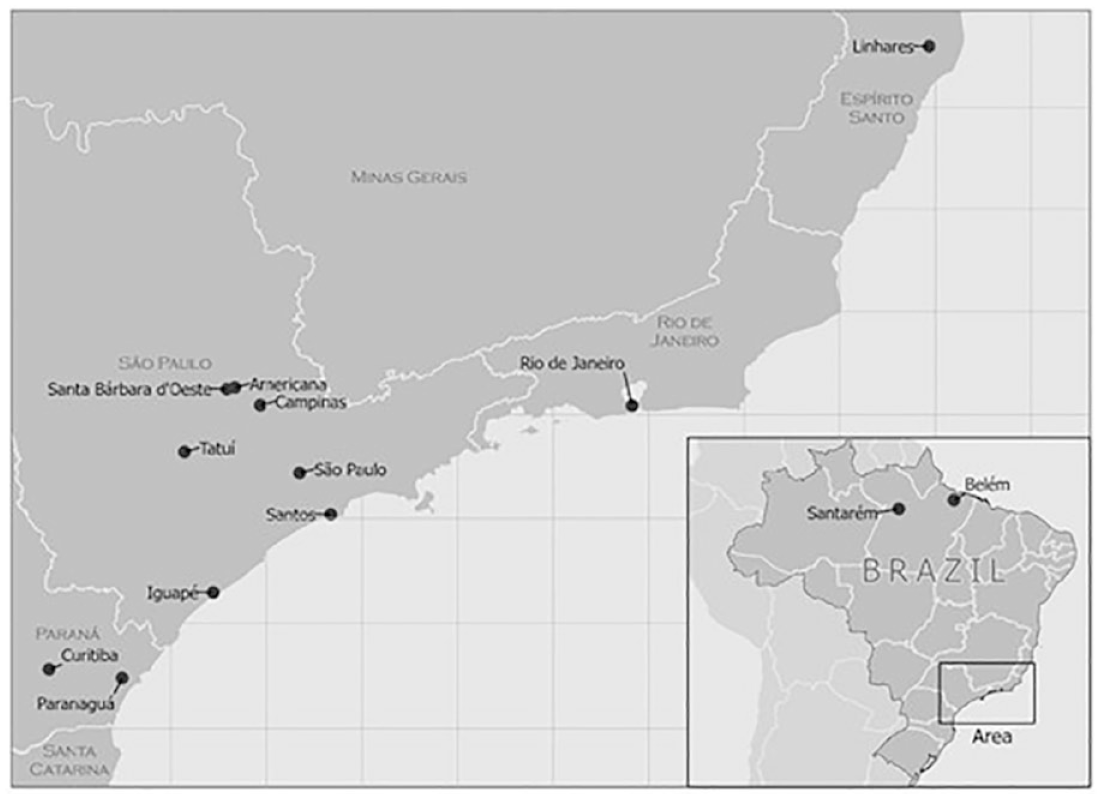
Map of known Confederate settlements based on 2015 book Soldado Descansa! By Judith MacKnight Jones.
In this article, I argue that to truly grasp the globalized scope of the Confederate memory crisis, it is important to understand how Confederate-descended Brazilians commemorate their heritage and how others—including the Union of Black People for Equality (UNEGRO)—contest and problematize these memories. Annually since 1980, Confederate descendants celebrate their heritage with a festival (called the Festa Confederada) in Santa Bárbara d’Oeste in rural São Paulo state (Brasher, 2019). The festival features Antebellum traditions of dance, dress, music, and food and draws around 2,000 tourists each year, who also often visit the nearby Museu da Imigração (Immigration Museum), a Confederate descendant-curated museum that tells the story of the Confederate migration to Brazil (Brasher, 2021). In what follows, I review scholarly literature at the intersection of settler colonialism, slavery, and the “transcultural turn” in memory studies (Bond and Rapson, 2014). I then briefly chronicle the 40-year history of the Festa Confederada to make the case that although its organizers suggest it is a “family event” with no intended political implications, the festival has long been politicized, paying special attention to the political circumstances surrounding the festival’s periodic cancellation (and times in which it ostensibly could have been canceled but was not) throughout the years. I argue that the 2017 Charlottesville tragedy brought renewed attention and conflict to the festival and offers insights into its globalized implications for understanding the transcultural entanglements of the memories of slavery and settler colonialism. Importantly, I find no evidence of protest surrounding the festival’s celebration of Confederate heritage and iconography until after the 2017 Charlottesville tragedy, which spurred intense and still ongoing local debates around Confederate memory and recent legislative attempts at the city and state level to impede the festival’s public celebration of Confederate iconography. By way of conclusion, I call for further analysis of the politics of Confederate memory that recognizes the globalized legacies and continuing influences of Confederate iconography, symbology, and memory, traveling across political geographic and cultural boundaries around the world.
Settler colonialism, slavery, and transcultural Confederate memory
Most of the critical scholarly work on Confederate memory—with good reason—has focused on the relationship between anti-Black racism, slavery, and Confederate commemoration. After all, Confederate Vice President Alexander Stephens famously articulated that the Confederacy’s “corner-stone rests . . . upon the great truth that the negro is not equal to the white man; that slavery subordination to the superior race is his natural and normal condition” (American Battlefield Trust, 1861b). Scholars in fields such as anthropology, literature and rhetoric, sociology, public history, cultural geography, memory studies, and others have critically analyzed the politics of writing US Southern textbooks and school standards (Bailey, 1991; Loewen, 2007; Sebesta, 2012), constructing, relocating, and removing monuments to Confederate heroes (Cox, 2003, 2021; Domby, 2020; Sheehan and Speights-Binet, 2019; Wahlers, 2015), (re)naming streets and schools after Confederate soldiers (Brasher et al., 2017; Hague and Sebesta, 2011; Levy et al., 2017), and fighting to retain traces of Confederate imagery within official state buildings and flags and on courthouse grounds and centrally located plazas (Webster and Leib, 2001, 2002). Studies of Confederate and US Southern memory politics, as a result, have often focused on the racialized memories of enslavement to the exclusion of Indigenous genocide and dispossession (but see Denson, 2017). A principal impetus of these studies and the wider literature of critical inquiry into Confederate memory has been to highlight how the legacies of slavery, Jim Crow, and anti-Black racism are at once embedded into and contested within the commemorative landscape in the United States. This contestedness has occupied much US national and international public and media attention (Gonçalves, 2017) since the 2015 Charleston massacre and the 2017 Charlottesville tragedy, even prompting festival organizers to release public statements in response to the incidents.
Yet, missing from this literature is any critical exploration of the globalized, transcultural dimensions of Confederate memory or of Confederates as implicated within settler colonial projects in the United States or, for the purposes of this article, in Brazil. The “transcultural turn” in memory studies (Bond and Rapson, 2014; Bond et al., 2018) can help make sense of the curious case of Confederate memory in Brazil by foregrounding how “memories may travel across geographic or cultural boundaries” and marginalize “the experiences and histories of particular individuals or collectives” (Bond et al., 2018: 4). The transcultural turn decenters the normative framework of the nation, transcending but not negating the continuing influence of the nation on memory regimes, and paying special attention to the dynamic movement of memory across places and among groups of people. The transcultural turn in memory studies emerged in response to the “container cultures” of foundational collective memory theories which posited cultures as “collectively clear cut social formations, usually coinciding with the contours of regions, kingdoms, and nation-states” (Erll, 2011: 7). The notion of the existence of a transcultural Confederate memory then insists that analysis move beyond the region (i.e. the US South) and the nation of origin and attend to the cross-cultural processes “unbounding” Confederate memory (Bond et al., 2018).
To fully comprehend the transcultural dimensions of Confederate memory, particularly via the case of the Confederados of Brazil, it is important to engage with recent scholarship at the intersection of critical settler colonial studies and comparative racial and ethnic studies. Settler colonialism is “a continuously unfolding project of empire that is enabled through specific configurations that are tied to geographies of white supremacy” (Inwood and Bonds, 2016: 523). This unfolding project involves “the interplay between the removal of indigenous peoples from the land and the creation of labor systems and infrastructures that make the land productive” (Bonds and Inwood, 2016: 721). Although some settler colonial studies scholarship has argued that settler colonialism involves “replacing natives on their land rather than extracting an economic surplus from mixing their labor with it” (Wolfe, 2008: 103), more recent scholarship is troubling the relationship between race, racism, place, dispossession, and labor, with some scholars pushing back on the stricter emphasis on land over labor and arguing that understanding the lingering legacies and ongoing dynamics of settler colonial exploitation requires a more dialectical approach that moves away from a land/labor binary (Bonds and Inwood, 2016; Day, 2015; Inwood and Bonds, 2016; Leroy, 2016; Smallwood, 2019).
Building on innovations in critical settler colonial and comparative racial and ethnic studies (Day, 2015; Leroy, 2016; Smallwood, 2019; Wolfe, 2006, 2008), I argue that this binary is unnecessary and instead should be reframed—particularly in terms of memory politics—as dialectically constituted as white settlers in the Americas have created societies that rely on both the expropriation of Indigenous lands and the exploitation of enslaved labor. The transcultural memory of the Confederate migration to Brazil—a country typically associated with its long history of African slavery as the last country in the Western hemisphere to formally abolish the practice, rather than settler colonialism in terms of comparative critical race analysis—offers a unique case study for exploding the land/labor binary and centering the foundational role white supremacy has played and continues to play in constituting the world’s largest “racial democracy” (Da Costa, 2014, 2016; Twine, 1997). The debunked yet still somewhat popular notion of Brazil as a racial democracy harkens to the myth that due to widespread intensive racial miscegenation, “somos todos misturados” (we’re all mixed), so there cannot be any racism. Racial miscegenation, too, fits within the logic of elimination at the center of wider settler colonial patterns and practices, as it seeks to disrupt and dissolve Native dominion and ways of relating to land (Smallwood, 2019; Wolfe, 2006).
Day (2015) argues that what distinguishes the United States as a settler colony is “the way it epitomizes a paradigm of endless invasion of both Indigenous and foreign lands” (p. 104, emphasis in original). This includes the white settler invasion and colonization of the contiguous 48 US states and its expropriation of Hawai’i, Guam, Saipan, and Puerto Rico, among other islands, as well as its network of global imperial militarist expansion abroad (Immerwahr, 2019). Yet missing from scholarship on US settler imperialist expansion is an analysis of the memories of the largest exodus of Anglo-American whites from the country in its history—namely, the Confederate exodus to Brazil. At the same time that Confederate memory politics are deeply rooted in the conflict over slavery and its expansion within the US empire (Waite, 2021), and that the Confederate migration to Brazil was deeply shaped by a desire to re-insert themselves atop a racist hierarchy rooted in chattel slavery (Brito, 2015; Silva, 2015), an analysis of transcultural Confederate memory remains incomplete without attention to the dialectic of slavery and settler colonialism at the center of the US Civil War and the Confederate exodus to Brazil. Rather than relying on analyses of the memories of colonial land theft and slavery that reify the land/labor binary, I argue, following Day (2015) and Smallwood (2019), that the two are best understood in a dialectical relation to one another and that distinct transcultural memory politics emerge from the entanglement of these traumatic pasts. As Day (2015) remarked, Putting colonial land and enslaved labor at the center of a dialectical analysis, we can see that blackness is neither reducible to Indigenous land nor Indigeneity to enslaved labor. Indigenous peoples and slaves are not reducible to each other because settler colonialism abides by a dual logic that is originally driven to eliminate Native peoples from land and mix the land with enslaved black labor. (Day, 2015: 113)
Within this expanded conception of settler colonialism that considers both colonial land theft and enslaved labor as critical participants in the construction of settler societies in the Americas, Confederate settler-migrants to Brazil can be considered “settlers twice over” (Brasher, 2021) in the sense that they descend from white settlers in North America and upon defeat in a war fought to maintain and expand African slavery re-settled themselves atop a settler colonial racial hierarchy based on slavery in Brazil rather than face the possibility of the incorporation of the formerly enslaved into US Southern life and politics.
Settler colonialism is an underdeveloped theoretical lens for understanding the socio-spatial organization of political life in South America (Andrews, 1996; Santos and Hallewell, 2002). Castellanos (2017), and other contributors to a special issue in American Quarterly on settler colonialism in Latin America address some of the reasons for the dearth of scholarly work that takes up settler colonialism in the region. One reason is that settler colonialism has taken place—both historically and geographically—differently in Latin America compared with places like the United States, Canada, and Australia. According to Castellanos (2017), Indigeneity in Latin America can be understood as “continually shaped by a colonial legacy rooted in racial mixing, rather than Indigenous elimination and white settlement” (p. 778). In other words, racial miscegenation, rather than direct elimination, has functioned as a different social, political mechanism through which white settler colonialism is enacted. According to Smallwood (2019), “settler colonialism’s eliminatory logic finds expression in varied forms, not all of them literal calls for outright Native extermination” (p. 412). This definitional expansion makes space for the inclusion of all European colonizing projects across the “hemispheric Americas” to be considered settler colonial projects, not just those in North America. A forthcoming special issue of Settler Colonial Studies explores the application of settler colonialism to Latin American countries like Bolivia (Baker, 2021), Argentina (Taylor, 2021), Uruguay (Verdesio, 2021), Chile (Young, 2021), and Brazil (Poets, 2021). Smallwood (2019) continues, the settler colonialism concept disturbs the familiar comparative framework that too easily figures . . . Spanish colonizing as less objectionable than their English correlates, and it helps us understand the disruption and disavowal of Native dominion as inherent to European colonizing across the hemispheric Americas. (Smallwood, 2019: 412)
In addition, an analysis of settler colonialism within a Brazilian context disturbs the comparative framework that too easily figures Portuguese colonizing as less objectionable than English or Spanish colonizing. Famed Brazilian anthropologists Gilberto Freyre and Darcy Ribeiro popularized the notion of “Luso-tropicalism” in the 1950s—the idea that the Portuguese had a special skill for developing harmonious relations with other people groups (like the Indigenous peoples they colonized in South America) and adapting to tropical climates (Ribeiro, 1995). Essentially, Luso-tropicalism is a colonial idea of “racial exceptionalism” suggesting that Portuguese colonization was less violent than other forms of colonization in the Americas; the idea undergirded and justified the myth of racial democracy by asserting that the Portuguese were easygoing, adaptable people who seamlessly and without much violence intermarried with Indigenous and Afro-descended Brazilians (Bastos, 2019).
Yet, Poets (2021) argues that racial miscegenation in Brazil, far from nonviolent, should be considered a form of “assimilation/elimination” characteristic of wider patterns of Latin American settler colonialism. Given the recent critical scholarly insights into settler colonialism and slavery outlined in this section, the crisis of Confederate memory offers an opportunity to advance scholarship in this area and, in alignment with the goals of the special issue, offers insights into the globalized scope and influence of the 2017 Charlottesville tragedy to include its ramifications around the world, especially in Brazil. As Lloyd and Pulido (2010) have written, a key part of settler colonialism is memory and narration; in their words, “the settler is plagued by the insecurity of a never quite legitimate possession” (p. 799). Yet, how the memories of “settlers twice over” (Brasher, 2021) are articulated transculturally remains underexplored. To begin to examine this question, in what follows, I briefly outline the history of the Confederate migration to Brazil and the ways in which that migration has been commemorated in the interior of São Paulo state. I emphasize the entanglement of the memories of slavery and settler colonialism via the Festa Confederada and the Immigration Museum and the transcultural impacts of the 2017 Charlottesville tragedy on memory politics in the region.
A brief history of the Confederate migration and its commemoration in Brazil
After the US Civil War formally ended in 1865, ending chattel slavery in the United States, some four to ten thousand Confederate soldiers and their families left the defeated Confederacy and boarded ships bound for Brazil where slavery was still legal, no significant abolitionist movement had been organized, and the institution would not be abolished for another 23 years (Brito, 2015; Dawsey and Dawsey, 1995; Harter, 1985; Jarnagin, 2008; Marcus, 2021; Silva, 2015). The degree to which the existence of slavery motivated the Confederate exodus to Brazil has been the subject of much debate and disagreement within the historiographic literature, with some American historians arguing that it played little or no role (Dawsey and Dawsey, 1995; Harter, 1985; Jarnagin, 2008) and with some Brazilian historians and political economists showing that it did indeed play a significant role through analyses of Confederate diaries and letters written home (Brito, 2015) as well as letters written to Brazilian consulate offices inquiring about emigration opportunities (Silva, 2015). Marcus (2021) shows that other social and environmental forces like immigration policies, and agro-economic and commercial opportunities—all importantly mediated by global racial formations and hemispheric settler colonialism—shaped the Confederate exodus from the US South to Brazil.
“Confederados”—as they came to be called in Portuguese—brought Protestant Christianity to an otherwise mostly Catholic-dominated Brazil and built schools and universities. In terms of agriculture, they also introduced watermelons and pecans to the region. Brazilian Emperor Dom Pedro II offered them land at a discounted rate and many settled near present-day Americana and Santa Bárbara d’Oeste in São Paulo state (see Figure 1). This would become the most successful (i.e. longest lasting) Confederate settlement to take hold in Brazil, although there were other settlements spread throughout the country (Marcus, 2021). Confederado settlers made advances in education, establishing several “American schools” in the region, and using the Bible, taught English reading comprehension widely using innovative pedagogical techniques (Marcus, 2021). Historical accounts of the Confederate emigration have, with romanticized sentimentalism, typically emphasized these themes of agriculture, education, and religion, as some of the primary contributions that Confederados made to Brazilian society (Dawsey and Dawsey, 1995; Harter, 1985; see Marcus, 2021, for an important correction to this sentimentalism). Wolfe (2006) reminds us that Christian religious conversion and resocialization into institutions such as missions or boarding schools fit within wider patterns of settler colonial domination in the Americas. The introduction of Protestant Christianity and a missionizing ethos among Confederados is heralded by Brazilian Confederate descendants today in the Immigration Museum and by the Fraternity of American Descendants (which organizes the Festa Confederada; hereafter fraternity) as a key point of pride in Confederados’ contributions to “civilizing” Brazil (Brasher, 2019, 2021; Jones, 2015). A brief examination of the museum and festival in Santa Bárbara d’Oeste which commemorate the Confederate migration to Brazil helps contextualize how the politics of Confederate memory, especially among Confederate descendant communities, Afro-Brazilians, and festivalgoers—amplified by the 2017 Charlottesville tragedy—remain unresolved today. An interrogation of the Immigration Museum’s narrative, juxtaposed alongside the politics of (not) canceling the festival, demonstrates the importance of the dialectical relationship between slavery and settler colonialism at the heart of the transcultural memories of the Confederate migration.
The immigration museum and the “Confederate pioneer” narrative
The Confederate descendant-curated Immigration Museum in Santa Bárbara d’Oeste presents a narrative of the Confederate migration to Brazil that claims that the territory now known as Brazil was “empty” upon the Confederates’ arrival (Brasher, 2021). The museum additionally fails to recognize the role of slavery in the causes and consequences of both the US Civil War and the subsequent Confederate migration to Brazil. It combines elements of Lost Cause Civil War memory with Brazil’s hegemonic narrative of racial democracy to craft a “Confederate pioneer” narrative of the migration, depicting Confederate settlers as swashbuckling, bootstrapping pioneers who did what they had to do to with bravery to make new lives for themselves after suffering a devastating defeat in the Civil War. The museum does this by emphasizing the virtue of white settlers, the relative emptiness of the land upon their “discovery” of it, and framing settlement as a process of turning “wild, untamed” land into a productive part of the emerging modern Brazilian nation-state (Brasher, 2021). Confederates are referred to on multiple occasions as heeding their “pioneer instincts” in search of “new horizons.” The presence of Indigenous communities and their differently productive relationship to the land is diminished and nearly erased, and their dispossession is framed as an inevitable part of the march of time toward modernity. Museum exhibit texts frame the Confederate migration to Brazil within the larger European settler colonial context by suggesting that they found the land “almost deserted” and took the opportunity to “settle the large emptiness” to “make it productive” and contribute to the “modernization” and the “development and progress” of Brazil (Brasher, 2021).
In addition, slavery goes almost entirely unmentioned within the museum and its marginalization within its narrative elides the foundational role of slavery in creating the conditions for the migration and settlement. The lone mention of slavery in the museum depicts an enslaved man as simply “escravo” (slave) and includes no further context about the man’s life nor the wider context and influence of slavery on the Confederate migration and subsequent settlement in Brazil. Importantly, this one mention of slavery takes place within an unlit corner of the museum exhibit space, centering instead the valor and heroism of enslavers and colonizers while obscuring and marginalizing the agency and existence of the both the enslaved and the original Indigenous peoples who inhabited the area prior to white settlement (Brasher, 2021). The marginalization or outright erasure of the existence, experiences, agency, and memories of the Black enslaved and Indigenous peoples of Brazil in the museum’s narrative demonstrates the entanglement of the dialectical relationship between Black slavery and Indigenous genocide at the center of the Confederate memory crisis and of settler colonialism in the hemispheric Americas. To truly grapple with, challenge, and ultimately begin to heal and repair the ongoing legacies of slavery and genocide, it is important to recognize how this dialectic works to discursively entrench and consolidate white settler capitalist hegemony. In the case of the Immigration Museum, assembling a narrative of swashbuckling Confederate pioneers that centers the experiences, artifacts, and memories of the Confederates to the exclusion of any meaningful discussion of slavery or the violence of settler colonialism upholds the romanticized, whitewashed memories of Confederate settlers and their descendants. The Immigration Museum’s narrative, juxtaposed alongside the politics of (not) canceling the festival, lends insight into the dialectical relationship between slavery and settler colonialism at the center of the crisis of Confederate memory.
The Festa Confederada and the politics of festival cancellation
Since 1980, Confederate descendants in Brazil have celebrated their heritage and traditions, as well as the memory of the migration, with an annual festival called the Festa Confederada that draws thousands to Santa Bárbara d’Oeste each April (Brasher, 2019; see Figure 2(a) and 2(b)). Throughout most of its four decades of regular occurrence, the festival has taken place without much public criticism or notable protest. The first festival was originally called “Festa Country,” an ode to its emphasis on musical performance and its common renditions of the music of Johnny Cash, Allison Krause, Alan Jackson, and other popular country singers from the American South. The regular occurrence of the festival has been impeded several times due to intense rains, which make the rural dirt roads one must travel to reach the festival impassable. However, other key instances in which the festival has been canceled by organizers (and other instances in which it was not canceled) merit some further critical consideration. According to the public statements made by various festival organizers throughout the years in news outlets and in interviews with fraternity leaders in my fieldwork, the festival emerged as a way for Confederate-descended families to get together, to honor and remember their ancestors, and to foster a sense of familial pride among them as those original settlers were dying and out of a desire to retain and cultivate the memory of the migration among the descendants who were not alive when it took place. All fraternity leaders who have made public statements in recent years have emphatically denied that the organization has any political goals or promotes any form of racism, slavery, or white supremacy, maintaining instead that it is strictly a “family event” (Souza, 2017). Yet, evidence from the archival record suggests that the festival is less politically neutral than fraternity members might wish for it to seem; at least some political consciousness has certainly been involved in the planning and execution of the festival each year. This is reflected through instances in which the festival has been canceled, and arguably also when it has not been canceled, within key political moments and contexts.
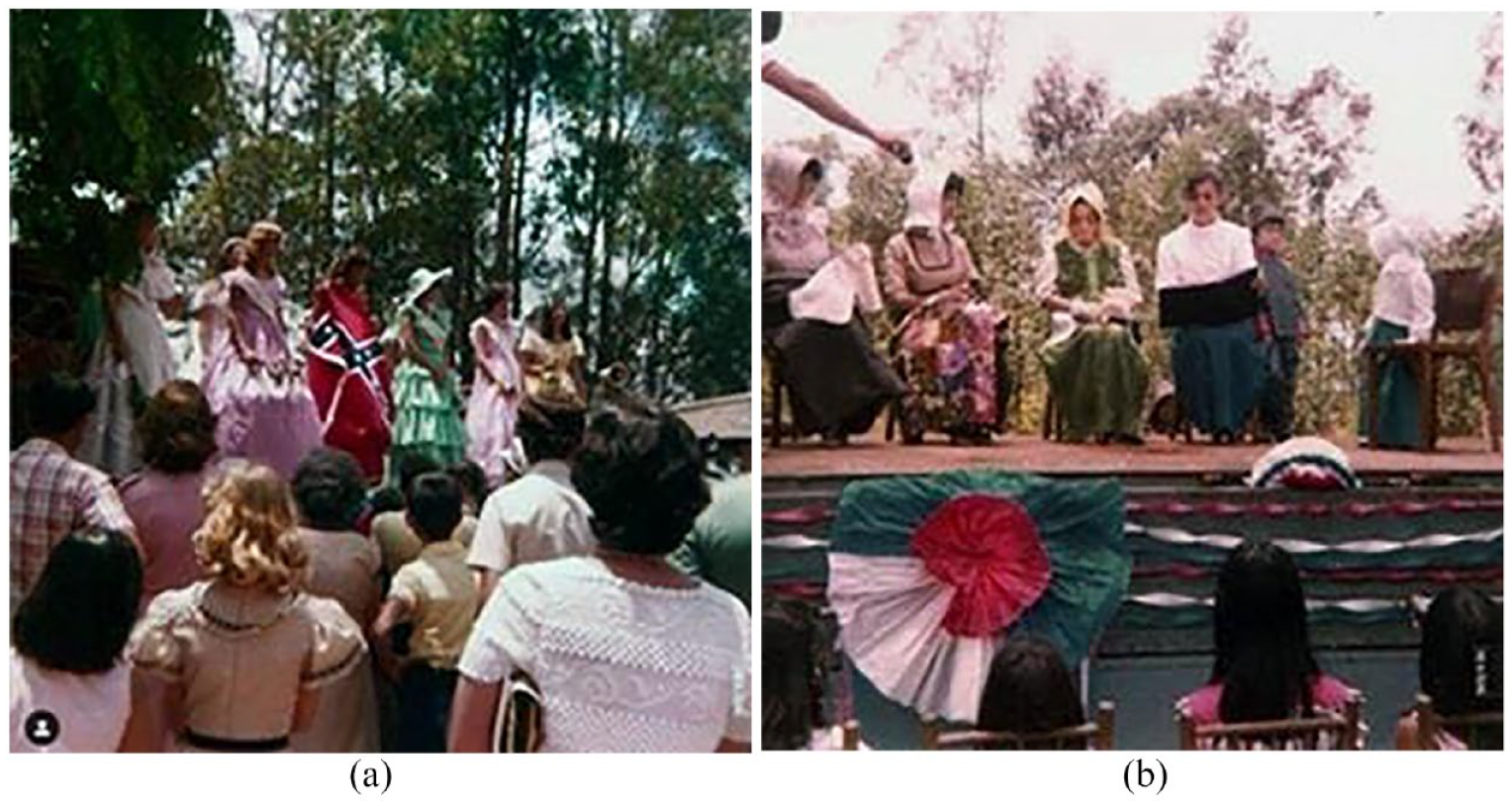
Figures 2a and 2b show women participants in the first Confederate festival in 1980. In Figure 2a, the women represent the 13 Confederate states with a sash and dress. In Figure 2b, women are pictured reading the Bible aloud and demonstrating the types of manual labor early Confederate women performed. Retrieved from: https://www.instagram.com/festaconfederada/.
For example, the fraternity in 2003 decided to cancel the annual festival due to the US invasion of Iraq. A news article from the local paper in Santa Bárbara d’Oeste (O Liberal, 2003) entitled “Descendants lament the war” shows a picture of a young boy sitting on the dirt in Iraq with a US military tank behind him. Naomi Cullen Pyles, prominent Confederate descendant and former festival organizer, is quoted in the article as saying, “It is no climate for a festival now, owing to the United States-Iraq War.” The same article also quotes Nanci Maria Ferreira Padovese, who has been involved with the fraternity’s leadership for more than 20 years and whose son João Leopoldo Padovese is the fraternity president at the time of this writing, saying, “We don’t think it’s right to put on a festival while there’s a war.” The 2003 decision to not host the festival based on the US invasion of Iraq belies the assertion by fraternity leaders and festival organizers that the festival is a benign family event that has nothing to do with politics. It also reflects a certain level of sensitivity by the fraternity to its public image and perception and perhaps even a desire to head off potential protests of a festival that could have been perceived as celebrating a country at war. In addition, it points to the ontological difficulties in transcultural commemorations, suggested by the conflation of the United States with the Confederate symbol, heritage, and iconography. I observed this conflation in my year of fieldwork; few people I met in the Americana and Santa Bárbara d’Oeste region could immediately recall who the “Confederados” were, but “Norte-Americanos” (i.e. North Americans) or simply “Americanos” (i.e. Americans) they usually understood.
Indeed, a reputation sensitivity can also be noted in the events that unfolded at the festival some years later in 2010. According to fraternity members and regular festivalgoers that I interviewed, 2010 marked a shift in festival organization planning due to the violence that broke out at the event. People described to me as “skinheads” in interviews attended the festival and a fight broke out between a group of racist skinheads and motorcyclists in which one person was stabbed with a knife. The skirmish forced fraternity leadership to cancel the festival a second time, this time for 2 years to reorganize and especially to increase the police security presence at the festival, a fact that one long-time festival attendee mentioned as a noticeable change to the event in recent years. The interviewee, who attended the festival in the year of the fight, said, The first time we went there [to the festival], the skinheads went in and they got into an altercation with the bikers . . . A guy stabbing a knife in the back of another, and the guy bleeding and the fight, a lot of violence and such. And the security was not enough, they didn’t even have any . . .
These two instances in 2003 and 2010 suggest that the festival has never been quite the apolitical family event that organizers claim it is. Canceling the festival in response to the US invasion of Iraq and then to reorganize and increase security after a violent fight broke out among white supremacists certainly mark episodes of political tension and even outright violence as significant features of the festival’s recent history. However, the 2017 Charlottesville tragedy would spark even more tension and controversy around the festival and provoke a transcultural crisis of Confederate memory. Soon after the Charlottesville tragedy took Heather Heyer’s life in August of that year, members of the local chapter of UNEGRO in Americana called for and held a public debate with the fraternity over the history and meaning of the Confederate symbol. Representatives from the fraternity, UNEGRO, and other social movement groups discussed the history of the US Civil War, the Confederate migration, and the social uses of the flag. In the 2017 debate, which was filmed and posted to YouTube (Encontro de Formação, 2017), the opposing sides found very little common ground, with fraternity leaders repeating tropes of the Lost Cause and UNEGRO representatives emphasizing the importance of slavery and segregation in the history of the symbol’s use. Curiously, fraternity leaders did not view the 2017 Charlottesville tragedy nor the debate as sufficient motive to cancel or even modify the festival in April 2018, despite the previous cancellations in other political contexts. As such, a small group of activists from UNEGRO protested outside the festival entrance (see Figure 3), emphasizing that they are not against the festival itself, just against the use of the Confederate flag, a “symbol of oppression” under which “a lot of Black peoples’ blood” was shed, according to a local news report (Rossi, 2019). This marked the first recorded instance of protest of Confederate iconography at the festival. In an interview with the lead organizer for the Americana chapter of UNEGRO, a history teacher leading the local effort to combat the public celebration of Confederate iconography, she recounted their protest:
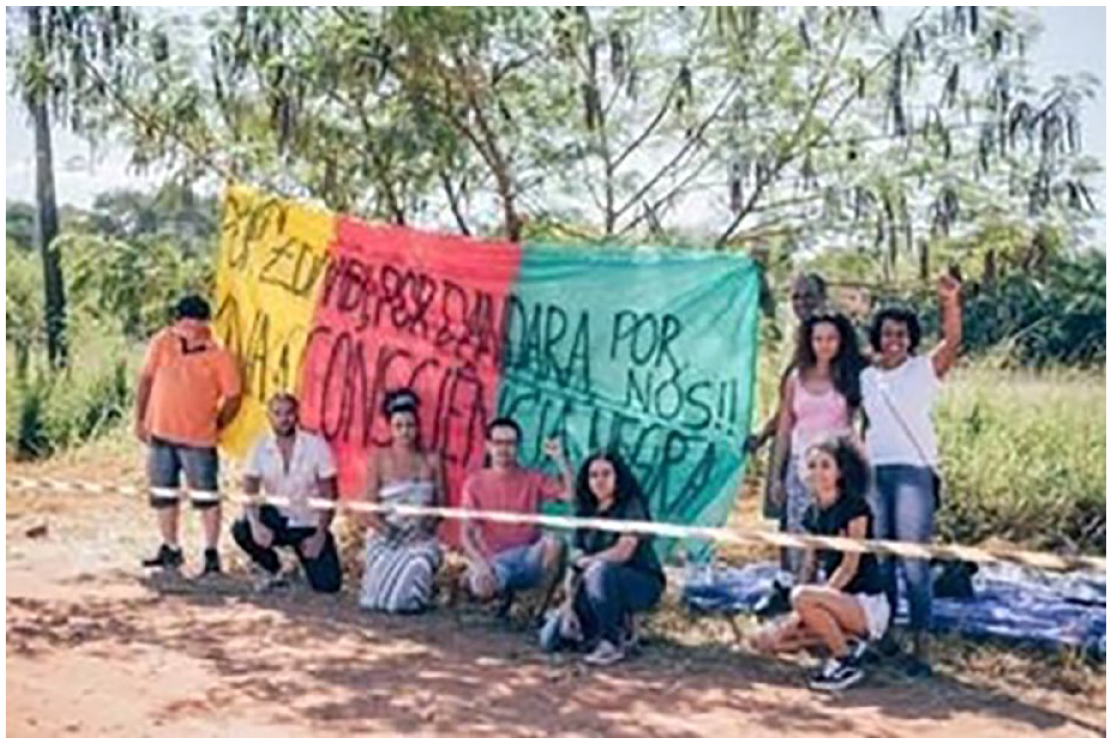
Photo shows a small gathering of UNEGRO members in protest outside the 2018 Festa Confederada with a banner that reads (translated from Portuguese): "For Zumbi, for Dandara, for us! Long live Black consciousness" Retrieved from: https://www.facebook.com/UnegroAmericana.
. . . since we did not aim to enter or confront the space restricted to invited guests, we positioned ourselves peacefully and yet inconveniently, and we were received, even after having formed a discussion roundtable on “the history of the Confederados and enslavement in Brazil” with racist epithets and hostilities . . .
She reiterates that despite the public dialogue they engaged in with festival organizers, the festival not only went on as planned without modification but that they endured racist epithets and a generally hostile environment at the festival entrance.
Building on the momentum gained throughout 2017 and 2018 in response to the Charlottesville tragedy, opposition to the festival’s use of Confederate iconography increased again in 2019. Protests at the 2019 Festa Confederada grew much larger than they had been in 2018 when they numbered less than 10, reaching as many as 50 or more this time, as indicated by photographs of the protests captured by UNEGRO and posted to their Facebook page (see Figures 3 and 4). Afro-Brazilian protestors registered their indignation at the use of symbols romanticizing slavery by invoking the legacies of Zumbi and Dandara dos Palmares (see Figure 5)—icons of the Black resistance movement in Brazil during the era of slavery and leaders of the Palmares quilombola. Quilombolas are settlements established by the escaped formerly enslaved throughout Brazil (Bledsoe, 2017). In addition, UNEGRO drafted and circulated a manifesto statement in opposition to the use of the Confederate flag that received over 100 signatures from other civil society organizations. Parts of the manifesto made it into local newspapers, which brought further public attention to the festival and protests against it. Written in the wake of the recent election of far-right populist Jair Bolsonaro, the statement highlighted not just the group’s opposition to Confederate iconography but also the quotidian dynamics of racial inequality present at the festival:
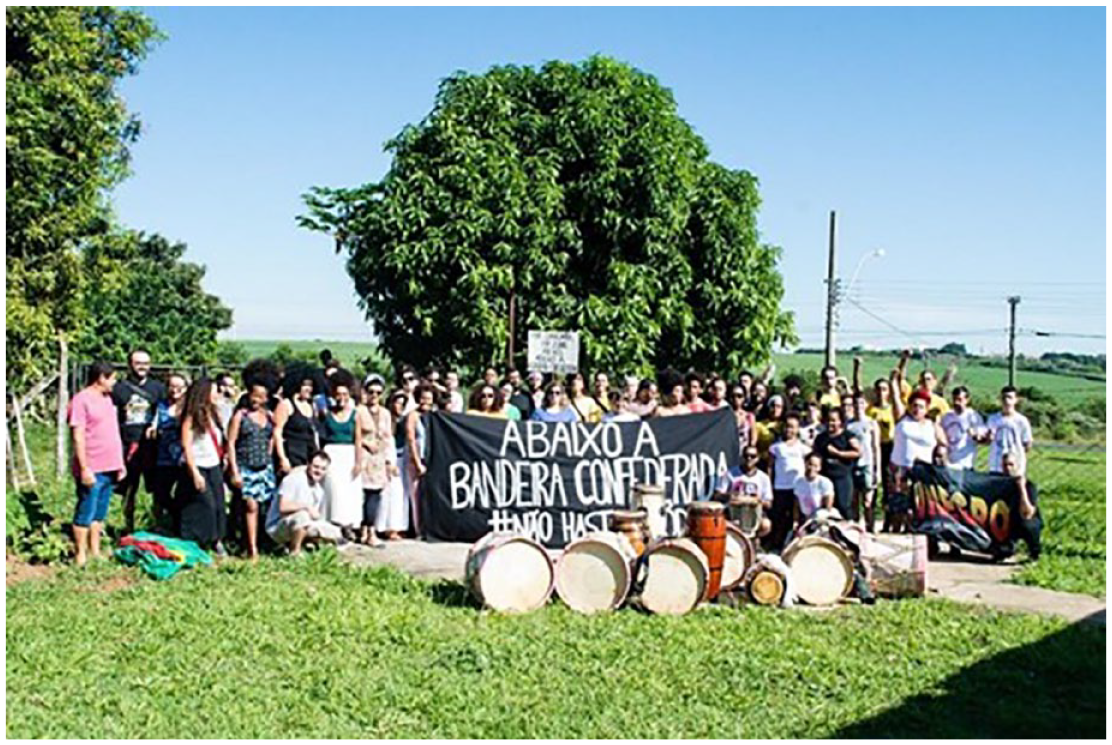
Photo shows a larger group of UNEGRO members gathered in protest before the 2019 Festa Confederada with a banner that says (translated from Portuguese): “Take Down the Confederate Flag #Don’tHoistHate” Retrieved from: https://www.facebook.com/UnegroAmericana.
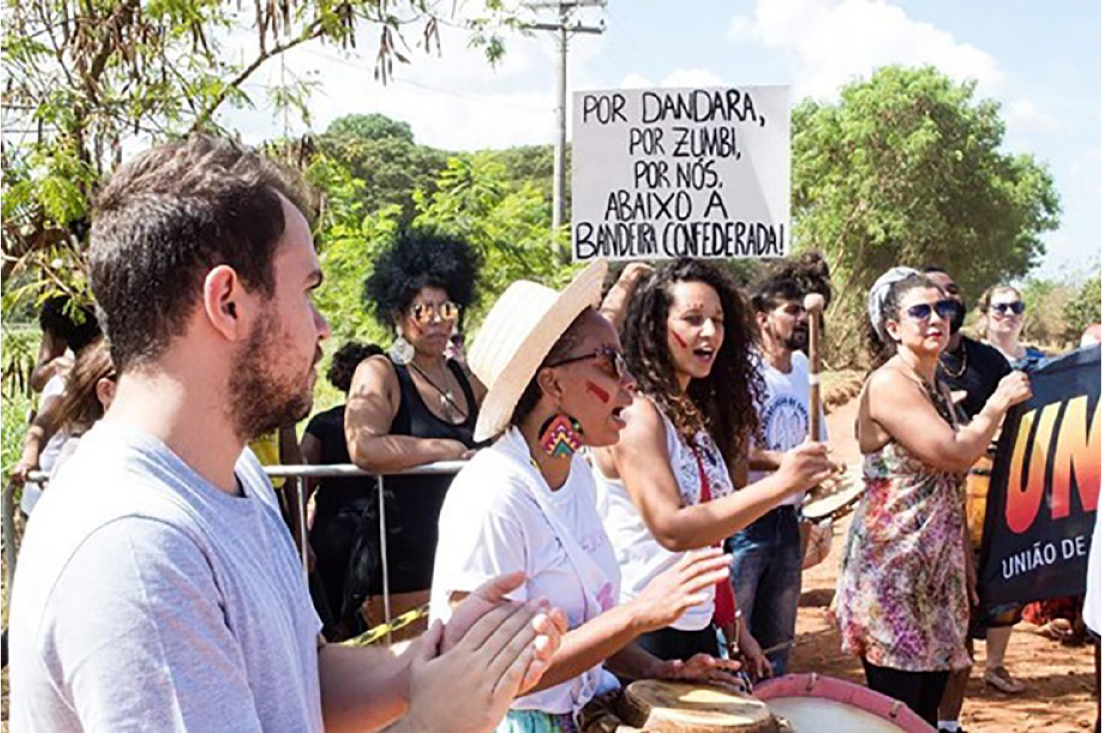
Photo shows UNEGRO members gathered in protest invoking the legacy of Zumbi dos Palmares with a sign that reads (translated from Portuguese): “For Dandara, for Zumbi, for us. Take down the Confederate flag!” Retrieved from: https://www.facebook.com/UnegroAmericana.
In our observations we registered what we usually see in Brazilian society: white people in their luxurious cars and Black people working security. Even though we were treated politely by the festival organizers and observed with attention by the police officers, it is impossible not to recognize there the permanence of the relationship between the Big House and the slave quarters. (Quoted in Brasher, 2019)
In the wake of the public police execution of George Floyd in May 2020 and the subsequent global uprisings for Black lives, the festival has been the target of renewed local and São Paulo state-level efforts to prohibit the use of Confederate symbols and iconography. At the local level, city councilwoman Esther Moraes proposed a law in January 2021 that would prohibit festivals that hoist racist symbols in Santa Bárbara d’Oeste from taking place, with the Festa Confederada as its main focus (Oliveira, 2021). At the state level, elected deputy in charge of the Center Specializing in the Defense of Diversity and Racial Equality, Erica Malunguinho—a Black transgender woman—released a statement in November 2020 that her office would be launching an investigation into the use of Confederate symbols at the Festa Confederada, expressing concern over the public monies being used to finance the festival (Carvalho, 2020). Her official statement, cited here from a Santa Bárbara d’Oeste news article, highlights the dialectic of slavery and settler colonialism at the heart of the globalized entanglements of Confederate memory surrounding the festival: The official history of the Brazilian State still reproduces narratives that exclude the experiences of Black and Indigenous populations. This manifestation of structural racism creates barriers to the full effectuation of democracy.
Deputy Malunguinho reminds us that the hegemonic memory politics of the Confederate migration are rooted in not just anti-Blackness and the memory of slavery, as it is commonly conceived in the United States, but also of the experiences of Indigenous peoples in the hemispheric Americas who have suffered genocide and the expropriation of their traditional lands.
Toward a globalized challenge to the Confederate memory crisis
The 2017 Charlottesville tragedy as well as the wider crisis of Confederate memory cannot be fully understood outside a globalized context. Innovations in critical settler colonial and comparative racial and ethnic studies offer an expanded theoretical framework through which to begin to make sense of the Confederate memory crisis as it unfolds in Brazil and the wider hemispheric Americas. In particular, I interpret the Confederate memory crisis as buttressed by the racist dialectic of settler colonial genocide and Black enslavement as a way to explode the land/labor binary that often divides memory politics into either struggles over the memory of slavery or over the memory of Indigenous genocide and land expropriation. I argue that this binary preemptively forecloses a more comprehensive analysis of white settler memory regimes in the hemispheric Americas and limits grassroots and critical challenges to the crisis of Confederate memory like the efforts of UNEGRO.
In addition, the strategic ways in which the Festa Confederada organizers have canceled the festival reflects a particular set of commemorative and political commitments that are enmeshed in transcultural entanglements of memory from the Lost Cause to the notion of racial democracy and the conflation of the Confederate States of America with the United States. Canceling the festival in 2003 in response to the US invasion of Iraq and in 2011 and 2012 to increase police presence and reorganize after violence broke out in 2010 among white supremacist “skinheads” suggests that the festival is not quite the apolitical “family event” that organizers claim. On the contrary, decisions about what constitutes a crisis of memory and what does not—including not canceling the festival in 2018 in response to the 2017 Charlottesville tragedy (or in 2016 in response to the 2015 Charleston Massacre for that matter)—reflect a chasm between how fraternity members make sense of the Confederate migration and the symbol’s long historical association with white supremacy. Widened public attention to and participation in the 2019 festival protests built on the momentum of the reverberations of the 2017 Charlottesville tragedy (Brasher, 2019). Then, George Floyd’s May 2020 public police execution re-energized opposition to the public display of Confederate symbols in the area that has grown since 2017 and prompted a local city councilwoman and a São Paulo state official to introduce legislation and launch an investigation, respectively, into the festival’s use of racist symbols. Whether or not protests and legal measures will successfully bar the use of Confederate symbols in Santa Bárbara d’Oeste remains to be seen.
Finally, this article has taken up the Confederate migration to Brazil as a starting point for exploring the transcultural contours of the Confederate memory crisis. However, Brazil is not the only place in which public debates and struggles have taken place in the 5 years since the 2017 Charlottesville tragedy. Indeed, the events of Charlottesville have made international impacts in Europe as well. Ireland and Germany, for example, are two other geopolitical contexts in which controversy around the public display of Confederate iconography has occurred. In the city of Cork, Ireland, fans of the local hurling and soccer teams have long flown the Confederate flag. Both teams are called “the Rebels,” (a mascot name long associated with the Confederacy in the US South, see Bever, 2011) and their team colors match the red, white, and blue of the Confederate flag. The international attention that the 2017 Charlottesville tragedy received brought a new awareness and consciousness to many Cork fans about the history and politics of displaying the flag, cementing for some fans its association with racism and souring them on its use (Brady, 2017). It was not, however, until the Black Lives Matter uprisings in the aftermath of George Floyd’s murder in 2020 that the Gaelic Athletic Association announced that it would ban the flag at Cork soccer games, not long after US NASCAR officials banned it at races (Bieler, 2020). Ireland’s connection with the Confederacy actually dates back to the US Civil War; many of the Confederate generals whose statues dot the US South, including the one at the center of the 2017 Charlottesville tragedy, were of Scots-Irish descent from the Ulster region of Ireland and Northern Ireland (Gleeson, 2013). In 2008, a Belfast-based photography company captured some images of murals painted on the sides of walls and buildings in the Ulster region celebrating the Ulster heritage of generals Jeb Stuart, Stonewall Jackson, and Robert E. Lee (Extramural Activity, 2008).
In addition, Confederate iconography appears on Germany’s cultural landscape. Recent research suggests that perceptions of the US Civil War in Germany are influenced by the transcultural infiltration of the “Lost Cause” into the German education system (Crelling, 2019). Moreover, Germans have been organizing US Civil War reenactments for decades. Some reenactors purposefully seek out roles in the reenactment that place them on the side of the Confederacy in what American Studies professor Wolfgang Hochbruck has called an attempt to act out “Nazi fantasies of racial superiority” (Applebaum, 2011; Horowitz, 1998). For some, the Confederate flag serves as a useful stand-in for the Nazi swastika, long outlawed in German public space. The Confederate flag even appeared in an infamous photograph of the fall of the Berlin Wall in 1989, where perhaps it was viewed as a symbol of anti-federalism, fitting with wider American “states’ rights” discourse. Flying the Confederate flag in rural Alberta, Canada, too, has been documented as a source of racialized fear and anxiety for Filipino temporary foreign workers (Tungohan, 2016). These examples of Confederate memorialization outside the United States underscore a need to place Confederate memory within a broader globalized context that takes seriously the ways in which the “Lost Cause” and other dominant forms of Confederate memory become embedded into (and challenged within) wider landscapes of memory in other social, cultural, political, geographic, and commemorative contexts.
What might these examples of and struggles over Confederate iconography in Brazil, Ireland, Germany, and other places around the world say about the commemorative crisis facing Europe, the Americas, and the wider settler colonial world? What does it say about slavery and its “afterlives” (Hartman, 2008)? What are the “multidirectional” (Rothberg, 2009) dimensions of Confederate memory as it becomes embedded, negotiated, borrowed from, and cross-referenced within and among other memory regimes transculturally? I argue that the near exclusive focus on Confederate memory controversies in the United States, and particularly its southern region, forecloses a more comprehensive, necessarily globalized analysis of the transcultural dimensions of the Confederate memory crisis. In Brazil and arguably in the hemispheric Americas more broadly, the dialectic of Black enslavement and Indigenous genocide that together buttress settler colonial formations help make sense of just one aspect of the Confederate memory crisis. Perhaps explicitly global interventions in studying and challenging dominant patterns of Confederate memory are warranted, not unlike the transnational conferences, seminars, writing projects, and truth commissions that have been organized to deal with the globalized dimensions of Holocaust memory. To come to grips with and begin to heal from and repair the racist violence of the Confederate past and its ongoing legacies in the present, further research and interventions that examine the cultural globalization of Confederate memory are necessary.
Footnotes
Acknowledgements
I am grateful for the encouragement and support of my colleagues Eric Spears and Bryan Banks and for their helpful feedback on earlier versions of this article. I also wish to thank Hanna Teichler and Jeff Olick for their editorial leadership in compiling this special issue, as well as the anonymous peer reviewers who provided thoughtful feedback to improve this article.
Funding
The author(s) disclosed receipt of the following financial support for the research, authorship, and/or publication of this article: The research for this article was supported by the David L. Boren Fellowship, the Penley-Thomas-Allen Fellowship, the W.K. McClure Scholarship for the Study of World Affairs, and the New Faculty Summer Scholarship Support Award from the College of Letters and Sciences at Columbus State University.