




Abstract
The article broadens the definition of “memory activism” by examining the interplay between national and personal commemoration of the fallen in times of war. The personal voice is usually perceived as opposing the national-heroic commemoration narrative. The Iron Swords war has created a new articulation between the two—the sticker—which has become ubiquitous in the Israeli public space. The sticker combines the picture of the fallen soldier with a sentence unique to them. It thus represents a personal, transformative voice, acting from the bottom up and adhering to the characteristics of memory activism. A visual analysis of the phenomenon suggests that although the stickers create a new vernacular of commemoration, the transformation they enact relates to the meanings and roles that are ascribed to personal memory by using the personal to reinforce the national-heroic discourse. These findings recontextualize the definition of memory activism in light of the geopolitical conditions created by the war.
Introduction
Commemorating the fallen has become a moral imperative in the modern nation state (Mosse, 1990). Commemoration emphasizes the heroic courage of soldiers at war, and hence also the justification of the war’s existence (Bar-Tal, 2003). Memory activism wishes to create a different, alternative commemoration, a counter-memory. Memory activism has been defined as a not-for-profit emancipatory work of memory, operating from the bottom up, and producing a memory designed to question and change the accepted narrative of memory, or bring to the surface unwanted memories, or oppose those who wish to undermine an existing memory (Gutman, 2017; Gutman and Wüstenberg, 2021; Reading and Katriel, 2015). The agent(s) of memory activism are working outside state channels and memory movements (Fridman and Ristić, 2020). The practices and objects that serve to reframe the discourse and the memory spaces are the message, the goal, and the meaning of the commemoration discourse that the activism tries to promote. This article wishes to challenge and broaden the concept of “memory activism” by examining the interplay between national memory and private memory in the process of commemorating the fallen “from the bottom up” in times of war. Examining the relationship between the personal and the national relies on the supposition, widespread in the study of commemoration, that the personal voice opposes the narrative conveyed by the national voice. As opposed to national memory, personal memory focuses on the story experienced by the fallen themselves (Assman, 2008). Commemoration in light of the personal voice is usually described as focusing on the story and unique figure of the fallen, and lacking, or challenging, the generalized symbolic-heroic dimension of the war, which the institutional national commemoration sanctifies.
When the Iron Swords war broke out after the events of 7 October 2023, a dramatic change occurred in the Israeli mnemonic practice that represents the personal voice of the fallen—the sticker. 1 Hundreds of stickers commemorating the fallen have been displayed in the Israeli public spaces. The stickers are shaped as an elongated rectangle. Each sticker is dedicated to one fallen soldier. In the center of the sticker is their picture, usually smiling. Next to the picture there is a sentence describing their personality, or their vision or dream, along with the date on which they fell (Image 1).
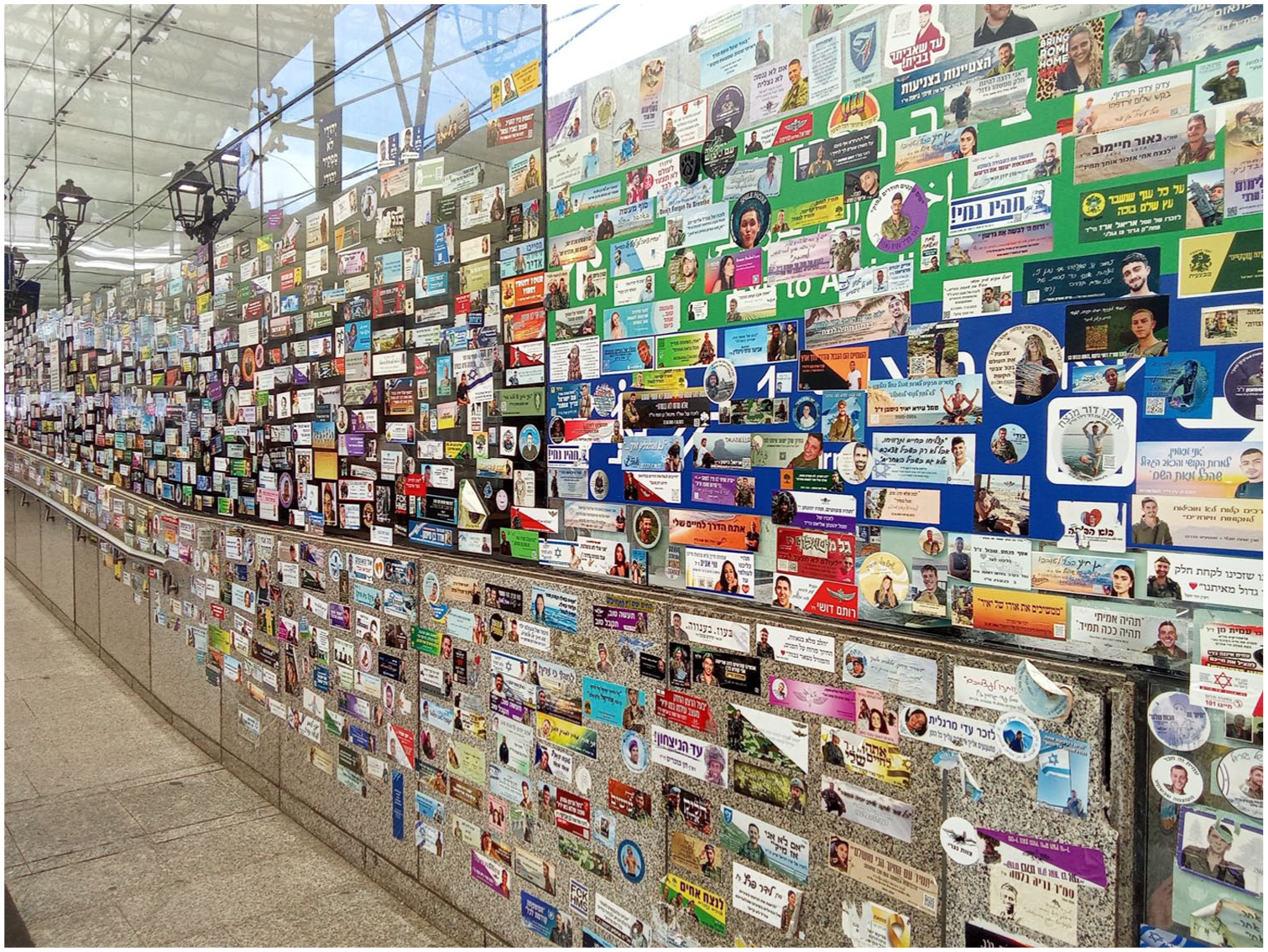
Stickers in Tel Aviv.
Walking through the city’s streets feels like walking in a rather colorful and cheerful “memorial park.” But the stickers differ in their characteristics from the templates of institutional national commemoration, and in particular from the monument (Jameson et al., 2025). The monument is a focal point of visibility situated in a significant place in the public sphere and carrying state-collective visual and verbal messages (Huyssen, 1995) that shape the space and the national narrative (Anderson, 1983; Tveskov and Bissonnette, 2023). The sticker is a decentralized focal point of visibility located anywhere in the public space and carrying personal visual and verbal messages unique to the particular fallen soldier. On the face of it, the personal voice represented in the sticker adheres to the characteristics of memory activism. It is a mnemonic object and practice that creates grassroots action and undermines the ways we remember and what we remember: the rigid materiality is replaced by degradable raw material; the general object is replaced by a private picture; the state text is replaced by a personal text; the demarcated space is replaced by multiple spaces; the historical past is replaced by a continuous present. However, examining this “memory mythology” by analyzing 350 stickers posted in the public space, visiting two websites that offer to create stickers for the fallen, and conducting an interview with a graphic designer engaged with commemoration, reveals that the materiality, the visuals, the narrative, the space and the time in which the stickers operate form a different framework that creates a new memory vernacular. Indeed, the memory language of the stickers offers new ways in which to remember, focused on the personal voice of the fallen; but these, I will suggest, actually act to reinforce the national commemoration discourse and voice. In other words, the sticker is not just the story of new means, channels, and agents of memory, armed with a different narrative and breaking out of the official national commemoration channels with rhizomatic-chaotic force. The sticker recontextualizes memory activism and broadens its definition. Rather than changing the heroic message characterizing institutional national commemoration, this practice transforms the meanings and roles that are ascribed to personal memory, changing and adapting them to the social reality and geopolitical conditions in which the commemoration operates.
The monument as a means to construct institutional collective memory
Commemorating the fallen is central to Israeli culture as Israel has been in constant war since the beginning of Zionism. The struggle over what character the commemoration of the Zionist memory would take on began even before the state of Israel was founded, and quickly became part of its “civil religion” (Liebman and Don-Yihya, 1983). 2 Out of all the means of commemoration created in the modern state and making nationality self-evident—stamps, postcards, badges, forests and parks (Billig, 1995)—pride of place is given in Israel to the monument (Shamir, 1996). The number of monuments in Israel is the highest per capita in the world. This number marks seven decades of constant war, through which the monuments have sought to shape the collective memory and have become a major means of mnemonic socialization that didactically conveys the ethos of heroism (Almog, 1992) and helps reinforce the national identification of most of the Jewish public (Ariely, 2017).
The monuments’ institutionalization attests to the centrality of the national voice and message. Initially, the monuments were the private initiative of groups of parents, comrades, commanders, and the Yad LaBanim organization. 3 Even after the Soldier Commemoration Department was founded in the Ministry of Defense, about a year after the founding of the state (1949), personal voluntary commemoration, unwilling to wait for the initiatives of public institutions, continued to exist. Furthermore, opposing political groups, from the left and from the right, wished to use the monument to entrench the “correct” historical story in light of their socialist/revisionist heroes, respectively (Lebel, 2013). The Soldier Commemoration Department dealt with these phenomena by claiming a monopoly on the erection of monuments and taking over the maintenance of privately erected monuments. After the Yom Kippur War (1973) the monuments underwent an accelerated institutionalization, which completely expropriated them from the individual domain and from the realm of personal commemoration (Levinger, 1993). In 1982, the commemoration sites were further institutionalized, being included under the National Parks and Nature Reserves Law. Moreover, the memorial sites were joined by religious sites such as “Tombs of Tzaddikim,” which draw thousands of believers. Although these were built as monuments representing extra-national, religious traditions, they have also acted to ratify the national narrative and voice (Bilu, 1998). Despite a claimed lack of hierarchy among the monuments, in the local “geography of sanctity,” the national monument has been perceived as publicly the most important, followed in a descending order of importance by the community monument, and then the private monument. Thus, the centrality of the national institutional voice and message overcame the personal voice and message.
The monuments’ character similarly attests to the centrality of the national voice and message. Before the state of Israel was founded, many monuments evoked ancient myths taken from Jewish history and integrated into the developing political culture of the Yishuv. Since the 1970s, the pathos of the national collective has been slightly attenuated, but is still audible, as manifested in the narrative-visual characteristics of the monuments. First, most of the monuments commemorate groups of fallen soldiers or sites of battle, rather than individual soldiers. Even in cases where the monuments name the individual soldiers, there is no separation between holders of different ranks 4 or between soldiers who were killed in different circumstances, or between Jewish IDF soldiers and Druze, Bedouin, or Palestinian IDF soldiers. 5 This tendency emphasizes “comrades in arms” relationships based on equivalence and on refraining from glorifying and deifying a single hero. Second, most of the monuments consist of realistic sculptures, abstract objects, natural chunks of rock, obelisks, columns, and memorial walls that convey a clear collective national message free of ambiguity or ambivalence (Barkay and Schiller, 2005). Few state monuments represent single heroes or make use of authentic relics from the battlefield (Azaryahu, 1993). This is designed to prevent the sanctification and fetishization of specific figures/objects. And third, the monument has become a focus of collective gatherings for the general public, not necessarily belonging to the family of the bereaved. The monuments have been flanked with public buildings, such as Yad LaBanim houses, combining the monument with multiuse spaces (library, gallery, convention center, and courses) and making it part of the community’s fabric of life. 6 In addition, the monument itself functions as an active and activated medium, hosting annual school trips and various civil and religious ceremonies that activate performances of nationhood and recreate the collective national narrative. Thus, the centrality of the national collective message has overcome the importance of the personal message.
The changing importance of the institutional national message, and the deviation to a more personal direction, began after the First Lebanon War (1982) and the First Intifada (1988), and the growing number of citizens murdered in terrorist attacks in the 1990s. The changes stemmed from weariness of the war, diminished trust in the military system and in the necessity of war, and an aspiration for peace (Brog, 2003; Zerubavel, 2006). These reignited the struggle against the institutional commemoration, calling for more space for the fallen soldier’s personal voice. 7 The personal voice took away the monument’s heroic tone and focused the memory on a stance against heroism and war (Shamir, 1996). 8 The first attack that opened the way for the personal voice was directed against the unified inscription imposed by the state on the gravestone (Katz, 2007). The Supreme Court of Justice decided in favor of the families and allowed them to change the inscription (Yizrael, 2005). The change turned the grave into a kind of personal monument featuring the fallen soldiers’ pictures, unit flags, balloons in unit colors, military objects, figurines, toys, prayer books, and personal letters from family and friends, which ruffled the national appearance and message, and gave each grave an informal and intimate look (Guilat and Waksman, 2014). Additional changes that emphasized the counter, personal voice in the “work of memory” took place in various commemoration sites: school ceremonies (Lomsky-Feder, 2011), memorial songs (Meyers and Zandberg, 2002), educational programs (Ben-Amos, 2003), prime ministers’ letters to the bereaved parents (Shenhav, 2009), memorial videoclips produced by bereaved families (Melamed, 2023), and private associations and fundraising campaigns dedicated to commemoration (Feigi, 2010). The personal voice was further augmented by organizations that propagated the anti-heroic voices of refuseniks and soldiers who opposed the national narrative, and by joint commemoration organizations of Palestinian and Jewish-Israeli parents (Weiss, 2011).
The increasing presence of opposing personal voices expressed the polarization of the Israeli society, and mainly the processes of particularization that split the collectivist Zionist ethos into nationalist theology, messianic fundamentalism, and liberal-civil religion (Wistrich and Ohana, 1993). Furthermore, deepening globalization and a multiplicity of identities and political rifts (Kimmerling, 2001), backed by postmodernist trends issuing from academia (Gur-Ze’ev, 2010), contributed to the demystification of the Zionist heroic ethos and the iconoclastic attack on its symbols.
On the verge of 7 October 2023, the “personal turn” in the sphere of commemoration intensified, and with it the erosion of the national heroic myth, the retreat away from patriotic images, and the creation of an alternative message countering the institutional Zionist one. It seems, however, that it was too early to announce the demise of the heroic national discourse, let alone nationalism itself.
Methodology
This study was based on a visual analysis of 350 stickers, out of around 700 stickers created in memory of the fallen and posted in the public space. The data were collected from a number of sources. First, the photographed documentation of stickers posted in the public space in various Jewish cities across Israel, representing populations from a variety of economic classes, social origins, and areas of residence. Second, a study of two websites that distribute the stickers commemorating the fallen. The Stickerim LeZichram (“Stickers in their Memory”) site (https://stickerim.org/), designed to “create a library of all the stickers that people have prepared in memory of the fallen.” And the Madbikim Zikaron (“Gluing Memory”) site (https://madbikim-zikaron.co.il/), which serves as “a free platform for disseminating the stickers in memory of the fallen.” The site is designed in particular to disseminate the stickers outside Israel’s borders: to travelers and people all over the world. Third, an interview with a graphic designer who since 7 October 2023 has been involved in various voluntary projects graphically designing commemoration. Some of the projects have been commissioned by private individuals, and some are the initiative of colleagues from the design world. None of the projects was initiated by the Soldier Commemoration Unit at the Ministry of Defense.
The stickers started appearing in the public space, first little by little and then in great numbers, already with the announcement of the first casualties after the Hamas organization invaded Israel. I documented the stickers between 1 January 2024 and 1 January 2025. It is important to note that the stickers represent soldiers who fell in the war, in the Gaza Strip and in Lebanon. This study will not refer to stickers created in memory of civilians murdered at the Nova festival, or to stickers created in memory of civilians and migrant workers—women, children, babies, and the elderly—who were murdered in towns, kibbutzim, and moshavim. Furthermore, the study does not refer to stickers and posters that concern civilians who have been kidnapped and taken to Gaza.
The analysis was done in light of two central themes from which the stickers’ ideological message may be inferred. (1) Material and visual aspects, namely: the raw materials, the template, and the visual aspects governing the stickers’ design. (2) aspects of space and time, namely: the spaces and times in which the stickers are present, and the spaces and times from which they are absent.
The sticker as a means to construct memory that moves between the personal and the national
Material and visual aspects
The sticker’s structure, and particularly its material and visual aspects, have a bearing on the ways it activates memory and on the meanings it conveys. In contrast to the raw materials constituting the memory comprised in the monument that represents the national voice, the stickers are made of cheap and degradable raw materials, and therefore their presence is necessarily temporary. While the material language used in designing the national pantheon is not accessible to the general public, the generic materials that make up the stickers are readily available. 9 In contrast to the grayness of limestone, marble, bronze, and iron, the sticker is colored. The colorful vividness creates a surprising presence that cannot be ignored. The deviation from the palette of the formal-institutional memory calls us to divert our gaze, delay, focus on the sticker, and halt the flow of our lives. It is not a monument whose presence the space has adapted to, and which has already become an architectural object taken for granted.
The sticker is designed using a template with a uniform rectangular size. The modest size allows the stickers to easily blend in around the city and become part of the urban syntax. To be sure, the sticker is dwarfed by the aesthetic and formal density of the public space, and is certainly dwarfed by the mammoth dimensions of the monument. But it is precisely its modest size that allows it to spread and fill the city/eye from every direction. Instead of being swallowed by the space, it floods the space in multiple, unexpected, and uncommon places, where its work of mourning is conspicuous by its otherness. The sticker’s visual narrative includes a personal photograph of the fallen and a short personal text. The image testifies to the living presence of the person it represents: their face, the uniform they are wearing, the beret on their head, and mainly their smile. In most of the stickers, there is a big smile on the fallen soldiers’ face. The beaming face shown on the sticker deviates from the familiar national memory landscapes. In the military cemeteries in Israel, it was until recently forbidden to engrave the deceased’s face on the tombstone, since this is not an established practice in the Jewish burial tradition. The custom of engraving the portrait of the deceased has seeped into the non-military cemeteries mainly after the large immigration from the former Soviet Union during the 1990s. Furthermore, most of the institutional monuments built in Israel do not focus on the fallen soldiers’ specific face/body. The tradition of presenting the single hero has been relatively short in Israel. Very few monuments in the Israeli memory landscape are sharply realistic and dedicated to the memory of specific heroes. Putting the faces of the fallen in the center of the sticker and making them its focal point is a deviation from the familiar visual language of commemoration, as is the text accompanying the smiling faces. The text in the stickers is short and succinct and conveys differing messages: some of the texts were written by family members or friends in the name of the fallen. These statements wish to characterize the deceased: Rotem Dushi OBM: “Always with a smile on his face”; Itay Eliyahu Marciano OBM: “Your smile is always with me”; Neria Aharon Nagari OBM: “Joyful and joy-bringing”; Koren Bitan OBM: “His smile is always radiating within us.” As the statements suggest, most of the messages written about the fallen wish to remember them with a smile and with joy. Needless to say, an inscription carrying the words “smile” and “joy” is not common in the institutional national monuments. Other statements convey messages on behalf of the fallen: vision, dream or worldview. These messages also contain multiple references to joy and joie de vivre. Ili Gamzu OBM: “Smile, because a smile is joy and joy is the power to go on”; Roee Weizer OBM: “Life is a lot easier when you simply smile (:”; Uri Yitzhak Haddad OBM: “To be always joyful!”; Arie Susnov OBM: “What are you worried about? Everything’s good!”; Neve Yair Asulin OBM: “Ayuni (friend in Arabic, D. M.), live the moment.” Other texts refer to human virtues that the soldiers believed in. Alon Skagio OBM: “Be a people’s person, there are no transparent people”; Ariel Ben Moshe OBM: “The sky is the limit and the right way is the respectful way”; Yaron Gahali OBM: “Be people before fighters”; Asaf Hamami OBM: “Be good, the simplest is the best!” While other texts refer to the soldiers’ belief that they must give their lives for the homeland. Some say it metaphorically and others explicitly. Noam Bitan OBM: “A real lion doesn’t have to roar to let people know he’s a lion”; Daniel Maimon To’ef OBM: “You didn’t get up in the morning to be mediocre”; Tal (Talco) Cohen OBM: “To be good at everything. Not to do kind of or almost, to give everything to accomplish the goal”; Roei Dawi OBM: “I do it for the Land of Israel”; Liron Snir OBM: “What d’you mean, bro? (Why do I give my life for the country, D. M.) The People of Israel need us”; Bar Yankelov OBM: “Hero of Israel.” “I have pursued mine enemies, and overtaken them: neither did I turn again till they were consumed” (verse from Psalms 18, 37, D. M.); Amir Galilov OBM: “If you’re going to do it, do it all the way.” Only few texts reveal an explicit effort to suppress forgetfulness and etch the dead in the memory: Amit Man OBM: “Your life’s song has stopped but will continue to play in our hearts forever”; Ofir Yeruhin OBM: “Your tune will never stop”; Itay Eliyahu Marciano OBM: “Your smile is always with me.” What do the smile, the joy, the virtues, and the contribution to the state teach us? All suggest that the death was not random, that it did not happen to “random” people, and therefore it was not in vain. The fallen are presented as life-loving youngsters, with good virtues, and as having willingly sacrificed the most precious thing—their lives, so that others can live. Although some of the statements are patriotic and sanctify the defense of the nation, all the statements are worded in the first person and in everyday language, without florid, pompous, and distant jargon. This is an informal national narrative, contrasting in register the official-institutional national narrative, and hence its power. The speaker is not an army general, a leader, or the generalized dead. The speaker is the dead soldier who is addressing the living person—the reader of the sticker—at eye level, conveying to them a message of joy and sacrifice blended together. The personal voice confronts the passing stranger with a fallen soldier who until the moment of encounter was for them part of one big, anonymous, and symbolic family of the bereaved. But now, in light of the chance encounter with the sticker, the bereavement no longer exists only on the abstract national level, but also on the personal national level. Or as the graphic designer put it: “I look at the sticker and I miss someone I never knew” (2004, personal communication).
None of the stickers contained a subversive voice or a narrative that contested death at war or the political conditions that led to the war. The stickers suggest that they were not created by the agents of memory as a space of conflict, challenge, or defiance. Quite the reverse. The personal presentation of the dead soldiers—their faces, images, uniforms, and words—conveys a personal, private, and subjective story. Although this story does not include military moves, battles, numbers, and facts, like the story told by the institutional national monument, it still pledges unreserved support for the institutional national narrative. Supporting the national heroic narrative is done through the personal narrative and by means of it.
Aspects of space and time
The sticker is memory in motion. A dynamic and mobile monument. It appears on benches, poles, bus stops, shop windows, fences, and in fact almost everywhere in the urban space. Or as the members of the Madbikim Zikaron project put it: “[The sticker, D. M] helps bereaved families to disseminate the memory of their loved ones” (https://madbikim-zikaron.co.il/). The area of the sticker’s dissemination has a bearing on the way it activates memory and the meanings it conveys. The sticker leaves the defined parameter of grief and pain (monuments and military cemeteries) for the city, where it creates multiple eruptions of memory. It thus transports the events of the war into the continuous present. The very fact that the stickers are not present in the symbolic sites where the battle took place means that they refuse to become frozen in a specific history (Winter, 2009). Their spatial presence in daily life is a symbolic suspension of death and a demand to be included in real time, in the now. In this sense, the sticker is time-specific. Thus, and in contrast to the monument, which tells us who we were in the past, the stickers demand our attention in the continuous present of our lives and the continuous present of the war. On the face of it, undermining the boundary between life and death is not unique to the stickers. Due to the centrality of the army in its civilian arena, its constant readiness for war, and the frequent deaths in military contexts, Israel’s cults of the fallen do not amount to a mere purification of death (Kimmerling, 1990). In other words, the intensive presence of military death requires the commemorating mission to also engage with life and its continuity, if only to justify the death of the fallen and inspire hope in those left behind. Tying life and death together—“in their death they bequeathed us life” 10 —is enshrined by discursive, institutional, and ceremonial means. The suspension of death enacted by the stickers, however, engages with the consciousness of life differently. Although life and death permanently reside side by side in the Israeli experience, during the Iron Swords war the two were rearticulated in a way that increased the scope for maneuver between them. 11 Putting the emphasis on life has become a kind of preferred symbolic possibility in light of the extreme crisis caused by the war. Putting the emphasis on life makes it possible to turn one’s back on death and even get caught, even if only for a moment, in a space that lies outside the binary-cruel structure in which death is an absolute and finite pole. As the sticker designer puts it: “You can print them again and again and again, and continue to make them relive with us again and again and again” (2004, personal communication).
The stickers also transport the work of mourning from the personal space to the public space (Frankenburg and Oreg, 2024). No longer a hidden world of bereavement withdrawing into the walls of the home or restricted to the cemeteries and the monuments. The sticker’s space is outside the physical borders of the institutional state memory, and of the institutional processes of socialization that charge them with meaning. At the same time, the new spatialization of commemoration does not represent a defiant and subversive “parasitic” taking over of urban no-man’s lands. On the contrary. The sticker induces the viewer’s sympathy for and emotional and physical identification with the dead soldier. “I see people reattaching sticker-ends that have come loose,” the designer recounts, adding: “The design speaks to people, or more precisely the [dead, D. M] soldier speaks to people” (2004, personal communication) making their testimony ubiquitous. Indeed, the stickers assault you from all directions: anarchic, spontaneous, and ad-hocly situated. Free of the professional considerations ascribed to the national institutions and the politics of commemoration. Their unexpected location turns them into monuments in constant motion, fragmentary and decentralized, and frequently changing, popping into the viewer’s field of vision in an unplanned way (Image 2).
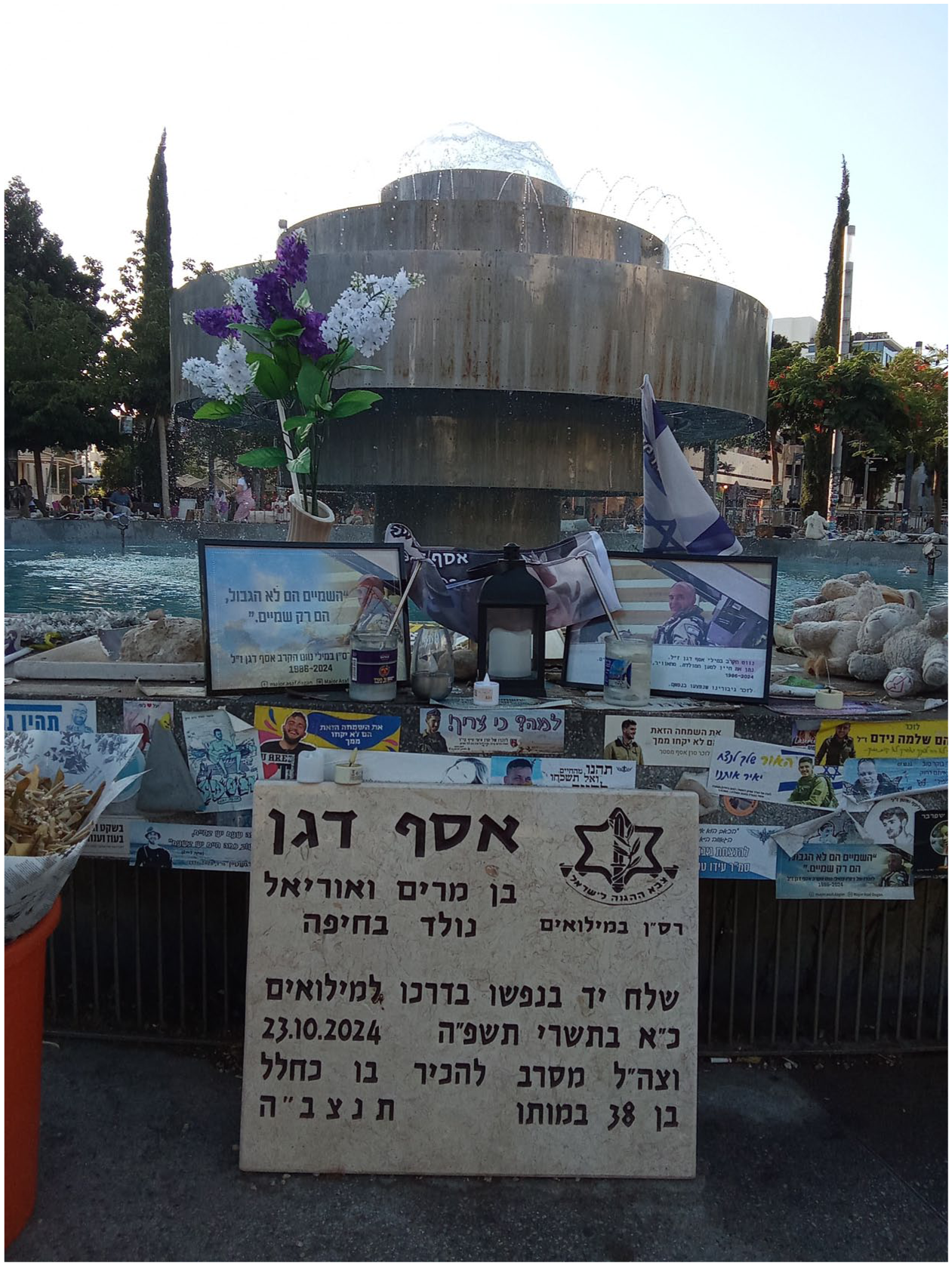
Stickers in Tel Aviv.
It is important to note that the mobility of the commemorative stickers is different from that of the stickers that appeared in the 1990s after the assassination of prime minister Yitzhak Rabin. The stickers that dealt with the deepening political crisis following the assassination were mainly affixed to cars’ rear windshields. They thus became a moving stage that presented polarized positions and voices within the intra-Israeli conflict. When cars with stickers moved around attempting to convince anonymous addressees of the rightness of their ways, they didn’t just delineate the identity of their owners, but even formed a dynamic seismograph of a conflict (Salamon, 2005). Although the stickers breathed life into the public arena and gave people a voice on important and controversial issues (Bloch, 2000), they did not manage to consolidate an agreed-upon and unified narrative and articulate a clear “end” to the political struggle, in contrast to the clear message fashioned by the stickers in memory of the fallen.
As opposed to them, the alternative spatialization creates a semantic displacement that gives rise to a new semiotic order, in which the work of mourning and the personal voice become a broad and multi-participant public social effort. And a few words about the city as a space. The city is a living, active, dynamic, and bustling space. Although every public space is equally “haunted” by the past and by death, the dead are present in the city only on the margins, and in separated complexes designed for that purpose. 12 In this sense, the city is a site of forgetting and erasure. The stickers form a spatial window to this confidential landscape, from which they activate the viewer’s engines of emotion. Connecting them together, name to name, memory to memory, creates an improvised map that encapsulates a new spatial story. It is a rhizomatic map that deviates from the common mapping and adds to it. Alongside the map of the entertainment areas, the map of the residential neighborhoods, the map of the educational centers, there is also a map of the dead, which was not drawn in the city before. This is a map with no center and no vanishing point, and no pathos of the kind that characterized the monument. The stickers that accumulate, as the days of the war add up, make the map wider and more elaborate. Moving the memory around the city without a predetermined plan also changes our patterns of interacting with commemoration. Kluge and Negt (2016) claim that the experiences of the city’s residents in the public space are based on previous experience. The stickers disrupt the experience that the (urban) body has accrued. They are a medium that summons a new experience, demanding a different attention from the passersby. The stickers demand that we delay in front of the dead; they ask us to get to know them, they implore us not to forget the person, the event, and the nation. Since the stickers’ spaces of appearance are rooted in the everyday, the interaction they summon is also everyday: on the way to the store, walking the child to school, or waiting at a bus stop. The graphic designer says: “People go past them and caress them [the fallen soldiers’ faces, D. M], touch them with their hands, sometimes pray quietly” (2004, personal communication). The members of the Stickerim LeZichram project add: “These stickers are not just any stickers. [. . .] They are our way of passing on the stories that touched us deeply” (https://stickerim.org/). These “small,” local, spontaneous memory experiences produce a new type of “Situated Solidarities” (Routledge and Driscoll Derickson, 2015), unconnected to any previous acquaintance with the fallen. In contrast to the monument, which after a while becomes a spatial routine, the focused solidarity created by the sticker has a charismatic pull that replicates the power held by the monument at the nation’s inception (Schwartz, 1982). Thus, supporting the national heroic narrative is done through the personal, multiple, extended and temporary space of appearance.
Discussion
The visual and verbal raw materials that the stickers are made of, and their behavior in space and time, create a new and dynamic sphere of memory. This sphere blurs the border between the personal memory and the national memory, and creates a new framework for understanding commemoration, broadening the definition of memory activism. What kind of transformation do the stickers enact, and what activist sphere does the new semiotic order embody?
Examining the stickers in light of several dimensions suggests that they represent national memory differently, but do not represent a different kind of national memory. The memory is present in the sticker through a personal, dispersed voice, rooted in the daily routine and the present. However, the fragmentation of memory does not mean that memory is reduced or privatized. The multiplicity and the dynamism of the commemoration in times of war have turned national remembering into personal remembering, and personal remembering into the new national remembering. In other words, the sticker individualizes national memory but does not undermine it. Personal, readily available, cheap, and accessible technologies of memory have already changed the ways we remember. But the transgressive transition from the national voice to the personal voice has not necessarily expressed an abandonment or contestation of national ideals. Thus, for example, the creation of an online synagogue has not led to the privatization of the ideology that the prayer wishes to convey (Julean and Pop, 2015). At times it was precisely the articulation of the personal voice that helped shape the institutional national voice. See the Heichal HaShemot (“Hall of Names”) and Sefer HaShemot (“Book of Names”) project, which archivally preserves a short biography of hundreds of thousands who were murdered in the Holocaust. This process strove against the anonymization of the victims and then recreated a symbolic and abstract repository of the dead, which reproduces the national voice and narrative of death (van Alphen, 2021).
The findings suggest that the power of the stickers lies in the new kind of personal-ideological-national agency they activate, in which the fallen address the living. This address is not meant to defy death and war, nor to indict the decision-makers. 13 The stickers operate outside the civil crisis of trust created by the war, and outside the question that has resonated in it ever since: Where was the state in the moment of truth, when it was charged with protecting its citizens and soldiers (Kravel-Tovi, 2024). In other words, they do not confront the historical narrative of the war and its necessity. As such, they function as mechanisms of emotional “interpellation” that lie beyond political, class, ethnic, and other disputes. They thus enable the observer to surrender themselves, to identify, and to reconfirm their patriotic identity without “interruptions.”
The transformation that has taken place in personal memory centers on the way the fallen address the living in order to recruit them to the national-heroic discourse of memory. By turning the living into the witnesses of the patriotic testimony given by those who have fallen in battle, the national-heroic voice is reproduced through the personal channels. The direct (dead) person to (living) person address creates a patchwork of personal memories and voices, which paint the public space with patriotic colors. Thus, the stickers represent a change both in the definition of the personal voice and in its role in the system of commemoration. If until now the struggle between the personal voice and the national voice has been defined in terms of a “zero-sum game,” then the personal voice embodied in the sticker evades this binary equation. The personal voice represents a nationhood that grows from the bottom up, personifying memory not in order to create a cacophonous multiplicity of voices that opposes the national-heroic voice, but in order to bring together many personal stories that bear testimony to a heroic death for the nation. In doing so, it continues the generalized heroic past. Every soldier, every story, every image, every character trait, weaves together a visual manifestation that reproduces the ethos of heroism. Foregrounding the personal voices may stem from the wish to use them to repair the rifts that had characterized the Israeli society before 7 October, or to unite the Israeli society in light of the sense of existential threat created by the war. In other words, the transformation enacted by the personal voice and narrative lies in the meanings and roles that are ascribed to the personal memory, rather than in the meanings and roles that are ascribed to the national memory. The personal voice embodied in the stickers continues the cultural-conceptual regulation exercised by the national-heroic commemoration. It is not part of the phenomenon of contesting, challenging, and resisting the institutional national narrative (Ram, 2000), and it does not produce an alternative socialization space to manage bereavement and its messages. The transformation enacted by the stickers lies in the role played by the personal voice, in light of the social and geopolitical changes in Israel and in the Middle East. Despite Chidgey’s (2024) claim that the “activist turn” must indicate a radical social-justice paradigm shift, such as adopting an anti-militaristic stance, the case of the stickers shows that memory activism is much more polarized and not necessarily subjected just to supranational or anti-national positions. Thus, the stickers broaden the repertoire and definition of memory activism, offering it a new direction of research located outside the epistemic spaces on which its theoretical conceptualization has hitherto relied.
Footnotes

Funding
The author received no financial support for the research, authorship, and/or publication of this article.
Declaration of conflicting interests
The author declared no potential conflicts of interest with respect to the research, authorship, and/or publication of this article.