



Abstract
A 32-year-old Thai woman in her first pregnancy presented with multiple hyperpigmented, hyperkeratotic, pruritic, discrete papules coalescing to form plaques with a rippled pattern on the extensor surfaces of upper and lower limbs, back, chest, and abdomen. Her mother had a similar history. Histopathology of the lesion revealed a diagnosis of lichen amyloidosis, confirmed by the Congo red stain. The lesions had started one year prior and had remained stable before pregnancy; however, they became widespread after pregnancy. Thus, prompting the question as to whether this was a coincidence or if the pregnancy had exacerbated the condition. In this case report, we will discuss our approach to this patient and our opinions concerning the relationship between pregnancy and lichen amyloidosis.
Keywords
Introduction
The term “amyloidosis” refers to the extracellular deposition of insoluble polymeric protein fibrils in tissue and organs. 1 Amyloid deposition in previously seeming normal skin without internal organ deposits is known as primary localized cutaneous amyloidosis (PLCA). PLCA is a rare disorder with a prevalence of 0.2–0.3%. 2 There are several subtypes of PLCA, including lichen amyloidosis. 2 Regarding lichen amyloidosis in pregnancy, Panicker et al. conducted a large observational cross-sectional study on cutaneous changes in pregnancy. Within this study, they identified a single case of lichen amyloidosis diagnosed during pregnancy. However, no specific details regarding this case were provided in their report. 3 Therefore, there is only one reported instance of lichen amyloidosis during pregnancy, but without any accompanying description. Our case report offers insight into the possible etiological factors, clinical presentation, diagnosis, and management of a rare case of generalized lichen amyloidosis in a pregnant woman.
Case description
A 32-year-old pregnant Thai woman in her first pregnancy, presented to the outpatient Dermatology clinic at 29 weeks and 5 days of gestation. She complained of generalized small “bumpy” lesions that had started 1 year ago, mainly over the medial malleoli. The lesions waxed and waned spontaneously, but when she became pregnant, they progressed and extended to her legs, arms, back, and trunk. She also reported itching all over her body, but denied any numbness, pain, or stinging sensation. She did not have any history of previous skin lesions, atopy, or insect bites, nor any drug or food allergies. She was an office worker with significant past medical history. She had a family history of similar lesions in her mother which were not severe and had not been treated.
On physical examination, her Fitzpatrick skin type was found to be Type IV. We noticed multiple hyperpigmented, hyperkeratotic, discrete papules of 1–2 mm that coalesced to form poorly delineated plaques of a rippled pattern on almost all parts of her body, excluding her head and neck. These lesions were most pronounced on the extensor surfaces of her upper and lower limbs (Figures 1 and 2), chest, abdomen (Figure 2), back, and shoulder regions. No other significant lesions were observed. Our provisional diagnosis was therefore lichen amyloidosis.
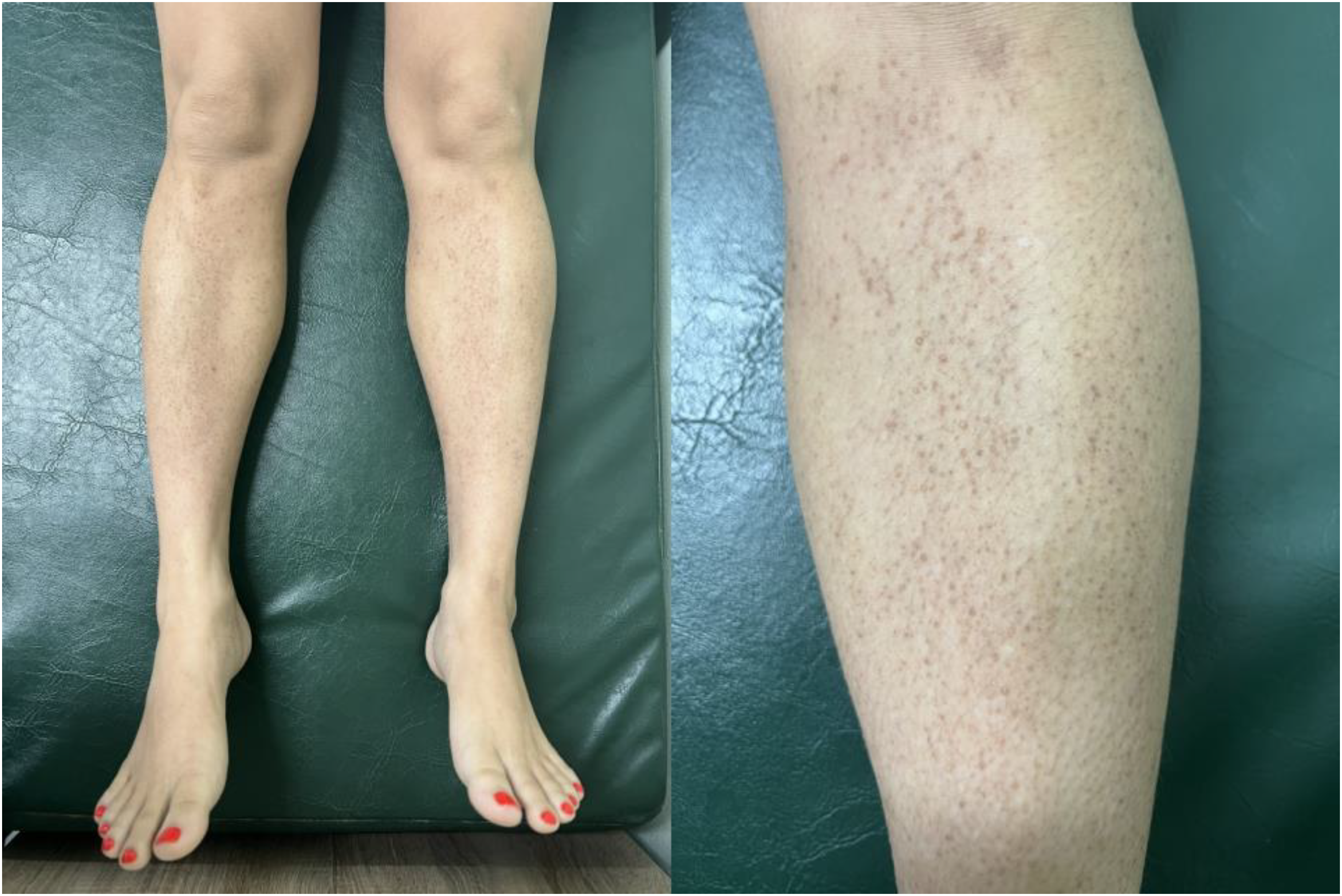
Lesions on legs.

Lesions on right upper limb and abdomen.
We performed an excisional biopsy on one of the lesions on the right lower leg. Histopathology revealed focal hyperkeratosis of the epidermis, as well as focal aggregates of dark pink crystals with clefts in the papillary dermis. The aggregates were stained positive with Congo red stain, confirming the diagnosis of lichen amyloidosis. Additionally, we conducted thyroid function tests (Free T4, T3, and TSH), liver function tests (bilirubin, AST, ALT), renal function tests (urea, creatinine, electrolytes), and reviewed her infection screening (e.g., anti-HIV antibody) from her antenatal care record to investigate any associated diseases, and the results showed no abnormalities. Treatment included 5% salicylic acid in 0.1% triamcinolone, cold cream (moisturizing cream), and an antihistamine (hydroxyzine). Her baby was born via uneventful spontaneous vaginal delivery at 38 weeks and 2 days of gestation with no perinatal and postnatal complications. We monitored her response with monthly follow-ups. Pruritus was significantly relieved, and the number of lesions visibly decreased three months after delivery. Some lesions remained on her shins, but they had become less pruritic and less bothersome.
Discussion
Lichen amyloidosis is the most common form of primary cutaneous amyloidosis. 4 The exact pathophysiology is unknown, but it is thought to be related to various factors, including genetics, viruses, and chronic scratching.5,6 In this case, the patient's mother having similar lesions suggests a genetic factor. The patient also reported feeling itchy during her pregnancy, which was relieved by scratching. This can lead to keratinocyte degeneration, which triggers the release of degraded keratin peptides that form amyloid fibrils, causing the lesions to worsen.5,7,8 Additionally, malfunctioning sweat glands or sweat ducts may cause perspiration to flow into the dermo-epidermal junction, resulting in inflammation, epidermal injury, and amyloid deposition. 9 Since Thailand is a tropical country with hot weather year-round, sweating could also be a contributing factor in the patient's case.
It manifests as numerous pruritic, hard, hyperpigmented, hyperkeratotic papules on the shins, which typically combine to form a ripple-like pattern. These lesions often appear in areas that are easily scratched or rubbed. In time, the papules may become thickened plaques that are resistant to treatment.4,10 This patient's findings were consistent with these usual features, the diagnosis then being confirmed by biopsy.
Since lichen amyloidosis is a chronic disease without malignant transformation or visceral involvement, treatment is not necessary unless there are symptomatic or cosmetic concerns. 10 There are limited therapeutic options for it, and no treatment is consistently effective or curative. Some therapeutic modalities such as topical or intralesional steroids, antihistamines, ultraviolet light therapy, laser therapy, dermabrasion, scalpel scraping, and retinoid agents can be used. 10 In this patient, the lesions and symptoms were partly controlled by treatment with a topical corticosteroid together with an emollient and antihistamine.
In literature, lichen amyloidosis is found to be associated with multiple other diseases, such as atopic dermatitis, lichen planus, chronic urticaria, HIV, ankylosing spondylitis, and autoimmune thyroiditis. 5 Nevertheless, in our patient, we observed no features indicative of these associated diseases. To the best of our knowledge, only one case of lichen amyloidosis has been reported in the literature but not described. 3 Consequently, it is unclear if the occurrence of lichen amyloidosis in conjunction with pregnancy is a coincidence or if it has a contributive role in the etiopathogenesis of the condition. In our case, lesions of lichen amyloidosis became more prominent during pregnancy and significantly alleviated after childbirth, suggesting a correlation between pregnancy and lichen amyloidosis. However, further case reports and objective studies are needed to confirm this speculation.
Footnotes
Acknowledgments
Not applicable.
Consent for publication
The patient provided written consent for publication.
Declaration of conflicting interests
The authors declared no potential conflicts of interest with respect to the research, authorship, and/or publication of this article.
Funding
The authors received no financial support for the research, authorship, and/or publication of this article.
Ethical approval
Not applicable.
Guarantor
PZ.
Contributorship
Phyo Zaw Aung, am the sole author of this work, which is original, unpublished, and not under consideration for publication anywhere else.
