



Abstract
Emotions evolved to guide animals in pursuing specific motives and goals (e.g., to find food, avoid harm, seek out sexual partners, rear offspring). They function as short-term alertors and regulators of behaviour and can be grouped into their evolved functions (evolutionary function analysis). Emotions can coregulate/influence each other, where one emotion can activate or suppress another. Importantly, affiliative emotions, that arise from experiencing validation, care and support from others, have major impacts on how people process and respond to threats and emotions associated with threats. Hence, exploring how affiliative emotional experiences change and transform the capacity to cope with threat and pursue life goals, are salient research issues.
Keywords
One of the major problems evolutionary psychology and psychiatry have identified is that psychiatric diagnosis, and treatment, are rarely based upon careful analysis of “process and function” that underpin psychiatric phenomenology (Brune et al., 2012). For example, it is adaptive that, in some contexts, animals should be able to down regulate positive affect and curb confidence, explorative and acquisitive behaviour; to “hunker down,” a phenomenology commonly observed in depressed states. Some examples of well identified contexts for triggering these “demobilised states” include: attachment loss, particularly in the young (Bowlby, 1980); major social defeats and entrapments (Gilbert, 1992, 2006; Taylor, Gooding, Wood, & Tarrier, 2011); helplessness in situations of high risk (Allen & Badcock, 2003); and where efforts may have poor outcomes (Nesse, 2000). This highlights the fact that motives, emotions, and mood states have natural functions and regulators, and can be tuned up or down.
Evolution theorists do not suggest that modern day presentations of “disorders” are necessarily adaptive. Indeed, much depends on the concept of “adaptive” because even conditions like bipolar illness or generalised anxiety can influence gene replication (Wilson, 1998). In addition, many bodily processes, including defences for ridding the bodies of toxins, such as diarrhoea and vomiting, have a range over which they are adaptive and outside that range they may not be (Nesse & Ellsworth, 2009; Nesse & Williams, 1995; Stein & Nesse, 2015). The range of adaptiveness of any bodily process, especially motives and emotions include: triggers, frequency, duration, intensity, and recovery. Any one of these domains can cause problems. Looked at this way, many mental health problems are linked to the regulation and expression of emotion, affect, and moods (Gross & Jazaieri, 2014; Scherer, 2015). Regulation can be linked to the stimulation of the emotion itself (its triggers, frequency, duration, intensity, and recovery), reaction to emotion (e.g., avoidance, fear, shame, pleasure), the behavioural response (e.g., expression, inhibition, coping), and a range of other processes (Thoma & McKay, 2015). Complex cognitive mechanisms, for self-awareness, reasoning, anticipation, rumination, and especially self-identity and self-monitoring with evaluative judging, which arose during human evolution over the last 2 million years, can seriously impact on emotion regulation and expression (Gilbert, 2009). No animal can stimulate or regulate their emotions through rumination, worry, self-criticism, shame, deliberate imagination (e.g., sexual fantasy), or wise reflection in the way that humans can. However, while such competencies have obvious advantages, they can also cause major problems for mental and physical health (Sapolsky, 2004). For this reason humans have very serious problems with the way the human brain has evolved, because it has many glitches and problematic features to it, which gives rise to our ease by which we can be exceptionally cruel on the one hand and prone to many and various mental health problems yet also be very compassionate and caring on the other (Gilbert, 1998a, 2009).
Unlike other animals, humans can be fearful of and try to avoid and suppress what they feel, think, fantasise, or want to do. Since the days of Freud’s concept of “unconscious defence mechanisms” many psychotherapies put emotional avoidance (not wanting to “feel an emotion”) as central to the development of emotional difficulties (Greenberg, 2004; for reviews see Thoma & McKay, 2015). In a recent, small, clinical study Gilbert, McEwan, Catarino, and Baião (2014) explored the fears of feeling and the fear of expressing three threat emotions—anger, anxiety, and sadness. Interestingly, it was fear of sadness that was significantly correlated with depression, while fear of anxiety and anger were not. Moreover, the correlations between the fears were not high, suggesting that people can fear different emotions, rather than there being a general fear of (any) negative affect.
Some of the evolutionary reasons for why adaptive mechanisms like emotions can come to function mal-adaptively have been well articulated and explored elsewhere (Buss, Haselton, Shackelford, Bleske, & Wakefield, 1998; Gilbert 1998a, 2002; Nesse & Williams, 1995; Smith, 2002; Stein & Nesse, 2015; Wakefield, 1999). Reasons include: evolved constraints, trade-offs, poor integration of evolved functions with recently evolved cognitive competencies, contextual overload, and contextual constraints. Another is phenotypic plasticity (Boyce, Essex, & Ellis, 2005). Compared to even 10 years ago, it is now known that there is far greater opportunity for environment-generated phenotypic variation due to neuroplasticity and gene expression through processes such as methylation, than previously thought (Slavich & Cole, 2013). So the question of normalily versus abnormality is very tricky unless we are able to specify what phenotypes constitute an abnormality (Buss et al., 1998). Children growing up in secure, loving environments will develop very different phenotypes to those in hostile and abusive environments but both sets of phenotypes, with their cognitive, emotional, and behavioural manifestations, may well be “normal” to that environmental niche (Boyce et al., 2005).
Motives and Emotions
Motives
Derived from the Latin word motivus, meaning “moving” or ‘to move,” motives are linked to desires, wishes, and wants; they give rise to specific incentives and concerns, but differ from values and emotions (Klinger, 1977). Specific motives evolve because they “move” the animal to achieve biosocial goals, supporting reproduction and survival; they guide animals to what to pay attention to and be emotionally aroused by (Dunbar & Barrett, 2007). Evolved motives include those for avoidance of harms and those for seeking, approaching and securing resources. These include: seeking food, shelter, sexual opportunities, care for the young, group living (involving motives for alliance building, social acceptance, and avoidance of exclusion/rejection), cooperating/sharing, and contesting resources with social rank-linked motives to negotiate/win social position and place and the avoidance of unwanted low rank or inferiority. In pursuing any of these basic motives and biosocial goals, emotions will ebb and flow according to the degree that they are desired and successfully pursued (Gilbert, 1989).
Pursuing motives can have benefits but also costs, and create approach-avoidance conflicts; for example, to seek food while minimising exploration time to reduce risk of predation. Indeed, motivational conflicts are common (e.g., to compete vs. cooperate; satisfy the desire to eat or resist eating to lose weight and be healthy). Thus, different motives can coregulate (conflict or support) each other and can be core to understanding psychological problems. Recently, Huang and Bargh (2014) have offered an evolutionary analysis of how different motivational systems can follow their own “goals,” often unconsciously, creating complex conflicts.
Motives can be both social and nonsocial, with a range of attention directing mechanisms and action tendencies linked to them. Nonsocial motives would include harm avoidance, seeking food and shelter, but also for humans the desire for meaning, control, or knowledge. Different motives direct attention to different classes of stimuli with processing systems to evaluate and select response (including an emotion). For example, we can contrast the processing systems required for food seeking with sexual partner seeking. Processing systems for social motives, such as sexuality, attachment, alliance building, or social competition are more complex because they need to process the flow of interactions and signals between self and other, which can be constantly changing, and be able to remember those interactions. For this reason, Gilbert (1989, 2005, 2014) suggested the concept of social mentality, which refers to the inner organisation of complex processing systems, supporting, and co-ordinating interactional sequences. Social mentalities enable interactional sequences of behaviours to be played out in the gradual formation and maintenance of specific social role relationships. For example, for sexual relating and role-formation the interaction might involve courting displays involving approach–display–stop–avoidance, all the way through to final copulation. Females of many species can attack or withdraw from males who are clumsy and get this “dance” or timing wrong. For forming friendship role relations these are developed, maintained, or broken according to repeated interactional sequences of supporting, sharing, and co-operation. Friendships can be broken if (for example) one party feels they are being exploited and/or the other is no fun to be with.
Different emotions have evolved for different social mentalities/motives. So for example, affiliative love is valuable for kin caring; gratitude and guilt for cooperative relations; envy and jealousy for competitive ones. Hence, socially interacting participants are constantly processing and decoding the signals coming from “the other” and then responding appropriately in a reciprocally dynamic way. So humans cocreate their social roles, from which a sense of self can emerge which generates new textures to social motives; social roles and social-identities cannot be created autonomously. A further complexity is that different social motives can be seeking to create different kinds of roles and self-identities at the same time, and may even be in conflict with each other (Huang & Bargh, 2014).
Thwarted, innate motives and needs, such as the child’s evolved need for love and affection can have serious consequences on maturation and emotional development (Cozolino, 2007; Siegel, 2012). Thwarted motives for social connection (friendships and belonging) can also have serious psychological and physiological consequences (Cacioppo & Patrick, 2008). Some innate motives then are not preferences but “needs” which, if not fulfilled, have consequences for the development of the phenotypic forms of social mentalities. Sometimes a social mentality remains in a “seeking” state whereby (for example) individuals live life constantly wanting to find people who will love them or care for them, like parental figures; while others try to repress any such needs (Mikulincer & Shaver, 2007). Therapy may focus on trying to disentangle complex conflicting motivational systems, and facilitate their maturational development.
Motives can become problematic when they become excessive, inhibited, and/or poorly regulated. For example, poor regulation of motives can lead to addictions such as sex addiction, problems regulating eating, needing to be in control and dominant, or as in dependency, constantly seeking out caring others. Failure to develop motivational systems can be problematic, for example psychopaths lack the motivation to be caring and helpful to others (Baron-Cohen, 2011). In addition, lack of motivation can be problematic in depression, although here it is important to distinguish between a genuine disinterest (lack of motivation) rather than a form of lethargy. For example, some depressed people would very much like to be able to (say) go to the party or take a holiday (they are motivated) but there is a sense of a lack of energy that comes more from a problem of fatigue, lethargy, or sometimes anxiety (Gilbert, 2013). This is a good example of why motives and emotions should not be confused. It is not that depressed people lack motives or desires, rather they may lack the emotional capacity or expectancy to put motives into action (Gilbert, 2013).
When one motivational system is thwarted another may seek to compensate or become the primary solution. For example, individuals who become overly driven and “seeking” achievements or status may be doing so because they lacked certain types of caring in their life (a blocked motive/need) and are seeking ways to find acceptance and belonging through achievement (Gilbert, 2009; Mikulincer & Shaver, 2007). This may work temporarily but seeking and competing are very different to affiliating, connecting, and sharing. To feel safe, connected, and valued requires the oxytocin and parasympathetic systems to be accessible in a way that striving and competitive behaviour does not (Porges, 2007). We can feel loved when we have nothing and unloved when we have much. So those who are compensating for their sense of insecurity in the world, by seeking resources or reputations, can go back to feeling vulnerable to abandonment and rejection if they fail or struggle. In contrast, for people who feel secure in the world, failure and setbacks do not generate fears of rejection. Indeed, research has distinguished between secure and insecure seeking/striving. It is not “striving” or “seeking” in itself but the reasons for doing so that can give rise to emotional difficulties (Gilbert et al., 2007; Gilbert et al., 2009). So the motives behind striving for accomplishments or achievements vary enormously. Helping fear-focused, insecure strivers to achieve more may, in the long term, make the problem worse, whereas helping them to (re)activate and experience the effect of the parasympathetic system, developing experiences of slowing (mindfulness) with social connectedness along with cultivating affiliative emotions, may be preferable.
Emotions
While at any point in time a motive might not be active or observable, emotions (in contrast) represent physiological states and behavioural outputs that are measurable and detectable at any point in time (Greenberg, 2004; Scherer, 2015). Often threat emotions may be stimulated if a motive is blocked or has been unsuccessful (Nesse & Ellsworth, 2009; Scherer, 2015). For example, once an animal has learnt an avoidance behaviour then, provided it can respond to the threat stimulus with the appropriate behaviour, it will show little anxiety; only if its avoidance behaviours are blocked does anxiety return. As another example, Bowlby (1969) noted that while children are highly motivated to stay in close proximity to their parents, that motivation would only become apparent if the parent became too distant, triggering distressed searching. While a child is in safe proximity to the care-provider, the child’s motivation and conscious attention is on play or something other than the care-provider. So motives can operate in the background and be nonconscious (Huang & Bargh, 2014). We also know that mood states and personality traits influence the patterns of the triggering, frequency, duration, intensity, and recovery of emotions. So, for example, the accessibility of joy, excitement, and contentment are significantly reduced in depression, whereas emotions for irritability, anxiety and disgust are increased. In addition, emotions, like motives, can be in conflict and in the extreme are linked to dissociation and trauma states, leading to derealisation, depersonalisation, and at times compartmentalised emotions (Dell & O’Neil, 2009).
Emotions can be used for any motivation. Whether it is a threat to one’s own health, family members’ health, job security, getting lost in a strange city—all these will use the same threat emotions (e.g., anxiety) and processing systems, for example the amygdala and hypothalamic-pituitary adrenal axis. Excitement could be generated by winning the lottery or by somebody you love agreeing to marry you.
Emotions are central to how social mentalities are played out in social roles. As physiological states, they are more than individual experiences because they also function as social communications, conveying information about one’s state of mind, values, social intentions, and orientation toward others in terms of safeness, threat, and needs (Keltner & Haidt, 1999). The emotions displayed by one person can elicit emotions in another, which may then accentuate, reduce, or change the emotions in the original actor. So emotions influence not only the behaviour of the experiencer but also impact on those who perceive or are recipients of emotion displays in reciprocal, dynamic, coregulating ways. Thus, emotions are “part of the dance” of social communication that provides the basis for the coregulation of participating actors. Indeed, the evolution of social mentalities, which facilitate interactional sequences for (say) sexual, competitive, cooperative, or caring behaviour, is dependent on these complex interactions and coregulations (Gilbert, 2005). This is why the evolution of empathy has been so important because it facilitates emotion and motivation sharing which enables and complexifies these kind of dances (Olderbak, Sassenrath, Keller, & Wilhelm, 2014). Recent research has shown that the emotions that we experience through empathic awareness and connectedness are very dependent upon the motivation that is operating. In highly competitive, tribal, or aggressive situations empathic (or lack of) emotions are quite different to those in caring relationships (Zaki, 2014)
Emotions are not the only processes that guide motivated actions because reasoning and foresight do too. Sometimes we do things that feel bad, frightening, or boring because we know that good outcomes will flow in the future. We don’t do things we might enjoy because we foresee negative consequences in the future. So wise foresight can override a motive and emotion. Equally, however, we can avoid doing things that would be helpful because we over anticipate the risks or engage in rumination about potential failure. Here actions are linked to anticipated outcomes. However, emotions can themselves become the source of motives (seeking pleasure and avoiding pain); for example, being motivated to be happy, or avoid anger, anxiety or sadness. We are often motivated to try to create feeling states of mind that we may not be in at the time of wanting them. Again this complexity emerges from our recently evolved, cognitive competencies of humans for internal representations. Indeed, the desire to create and experience emotional states can be such that we do things that are detrimental to our long-term well-being (e.g., drug taking).
There have been many efforts to derive functional classifications of emotions and identify their universal regulators (Gross & Jazaieri, 2014), and the way they can become dysregulated in clinical problems (Nesse & Ellsworth, 2009). Panskepp (2010) has delineated different types of emotion that are linked to function. He identifies (a) emotions for seeking of rewards/resources; (b) emotions linked to lust that are particularly (but not only) focused on sexual stimuli; (c) emotions linked to caring and affection; (d) emotions linked to loss and feelings of grief; (e). Threat emotions are divided into (f) rage and (g) fear and (h) emotions that are linked to play and give a sense of joyfulness in activities.
Three Types of Emotion Regulation
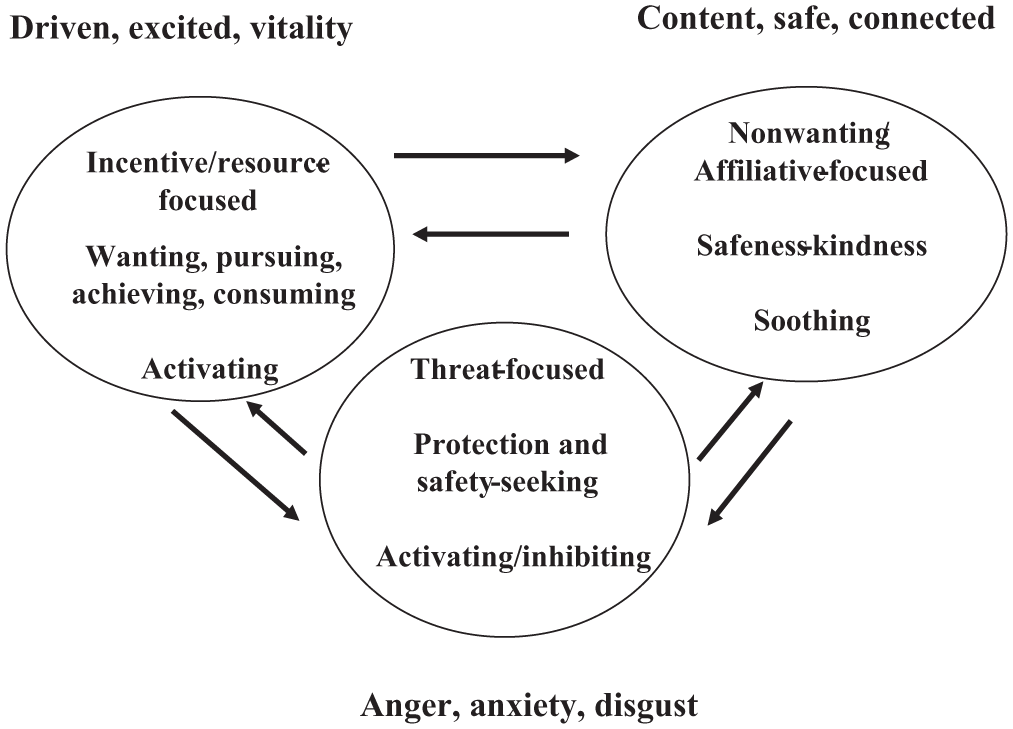
Panksepp’s (2010) type of microanalysis of emotion can also be supplemented by a more macroanalysis which focuses on clusters of emotions that have certain evolved functions. Derived from the work of Depue and Morrone-Strupinsky (2005), LeDoux (1998) and others, three core evolved functions of emotions can be loosely identified: (a) emotions that serve the functions of threat detection and generating defensive and safety strategies; (b) emotions that serve the functions of detecting, energising, and seeking/acquiring resources for survival and reproduction; (c) emotions that serve the function of contentment, satisfaction, calming, settling, and allowing “rest and digest.” Space does not allow us to investigate each of these in detail but we can briefly outline the key elements (see Gilbert, 2009, 2014). Although described as “systems” it’s more accurate to see them as rooted in patterns of (neuro)physiological activation that are constantly blending with and coregulating each other.
Threat and Self-Protection Focused Systems
Keeping safe and injury/harm free is an obvious basic motivation for all animals. So threat-based emotions evolved to alert and direct attention to detect and create body-readiness to respond to threats. Once activated, this system has a menu of threat-based emotions such as anger, anxiety and disgust, and a menu of defensive behaviours such as fight, flight, submission, freeze, and demobilisation. These are all in the service of the motive to keep safe and injury/harm free (Gilbert, 1998b, 2001; Le Doux, 1998; Panksepp, 2010).
It is now known that this is our most dominant affect processing system and gives rise to the negativity bias; that is, it is easier for us to pay attention to negative stimuli, to remember aversive events, be influenced in our decision-making by aversive events, and ruminate on negative events, rather than positive ones (Baumeister, Bratslavsky, Finkenauer, & Vohs, 2001). Problematic threat emotions are commonly the reason people seek psychological help because of how they are triggered, their frequency, intensity duration, and/or lack of recovery. Threat emotions can coregulate and be in conflict with each other. For example, fear of expressing anger can lead to its inhibition and submissiveness. In contrast, a lack of anxiety/caution in expressing anger or rage can lead to damaging behaviours.
Drive-Seeking and Acquisition Focused Systems
The emotions associated with energising, exploring for, and obtaining resources conducive to survival and reproduction are usually regarded as positive and energising. Moreover, it is the experience and anticipation of the emotion that partly “drives” the motives forward. As noted before, there can be problems with the system (addictions, for example). In individuals who are highly focused on competitive resource-seeking there can be a desire to constantly stimulate these “activation emotions”—to get “buzz” or “feel good” feelings repeatedly from “doing and achieving.” There have been cases of young people being so “driven” to make money in the financial industry (because the rewards are so high) that they have literally collapsed and died because of excessive working hours. Western society overly drives the dopaminergic and sympathetic nervous systems and may be producing abnormal motives and emotion dysregulation in the rush-rush, “must have, must do, must be” of modern life, thereby increasing risk of mental health problems (Pani, 2000).
Threat and seeking emotions and motives can coregulate each other. For example, sky-diving is exciting because it offers both opportunities for sensation thrill but also threat—without some threat there would be less thrill perhaps. If the threat gets too great however then the individual may pull out of the jump (there is a fun old saying that “if at first you don’t succeed skydiving is not for you!”). Seeking and trying to acquire resources is always partly regulated by the estimated risks and costs of doing so, which is the basis for approach-avoidance conflicts (Allen & Badcock, 2003).
Contentment, Soothing, and Affiliative Focused Systems
These systems enable states of quiescence and peacefulness when individuals are no longer threat-focused or focused on seeking, striving for, or consuming resources. Over evolutionary time this system of calming was adapted for some of the functions of affiliative and attachment behaviour (Porges, 2007; Uvnäs Moberg, 2013). Indeed, while affiliative behaviour can be activating and joyful (such as sharing jokes or going to parties together) it also has a potential quality of calming and soothing. If we are distressed, the care, kindness, and support of others we like or love helps to calm us down. Considerable research now points to important hormones such as oxytocin, playing crucial roles in the soothing qualities of social relationships (Insel, 2010; Uvnäs Moberg, 2013). In addition, the myelinated parasympathetic vagal nervous system plays a major role in the experience of contentment, slowing, peacefulness, and safeness, especially as created through caring relationships (Porges, 2007).
Figure 1 offers a simple overview of these three types of emotion regulation systems, highlighting the importance of their interaction and coregulation, because in reality they do not exist as clearly “separate systems” but rather are complex patterns of neurochemical activation and deactivation.
Three types of affect regulation system.
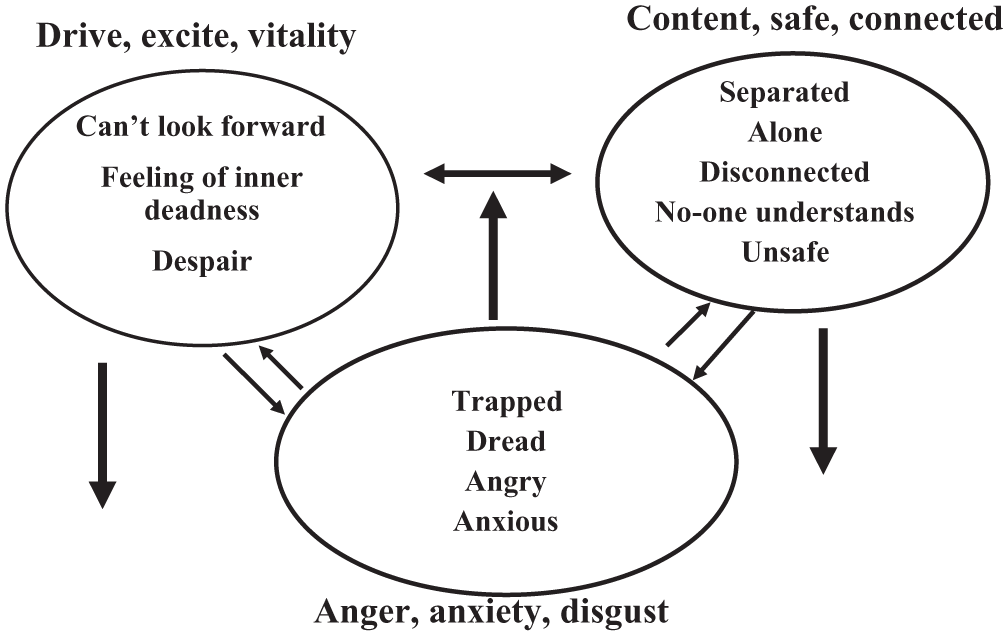
Thinking about types of functional emotional systems, in terms of their coregulating pattern, rather than as unitary processes, opens up new ways of understanding emotional difficulties. For example, Figure 2 offers an example of how threat, seeking and soothing may all become problematic in depression, and it is the relationship between these functional emotional system that needs to be better understood.
Changes in the three affect systems in depression.
Threat systems are clearly elevated in depression, with increased anxiety and irritability, and with feelings of “dread” being common (Gilbert, 1992). In addition, there is a toning down in the two, quite different types of positive emotion. One is linked to seeking (with symptoms of loss of energy, drive, enthusiasm, not able to experience joyful feelings or anticipate positive feelings in the future), whereas the other is linked to feelings of loss of connectedness, belonging and feeling disconnected, separated and alone. It is possible that different depressions reflect different combinations of these types of emotion regulation system. A study by Keller and Nesse (2006) is highly suggestive that some depressions are more rooted in competitive loss and sense of defeat with collapse of the seeking, energising system and with anhedonia (Taylor et al., 2011), whereas others are more textured by loneliness, disconnectedness, and sadness (Cacioppo & Patrick, 2008). These are not mutually exclusive but more like dimensions. Gilbert et al. (2008) showed that feelings of (a) activation-excitement, (b) relaxation, and (c) feeling safe and contented can be psychometrically separated, and that it was the feeling safe/content factor that was the best predictor of depressed symptoms in students.
Figure 2 depicts depression with disturbances in all three, different functional emotional systems, not just one. So, depressions and many other pathologies reflect ways in which different emotions are interacting, patterning, and coregulating each other, enabling functional (phenotypic) engagement in their environments. As other examples, borderline personality disorders have been considered to emerge from difficulties in accessing affiliative emotions, in particular ones that maybe underpinned by oxytocin (Stanley & Siever, 2010) and parasympathetic systems (Austin, Riniolob, & Porges, 2007). As another example, traumatised veterans may not only suffer from heightened threat processing but also from problems in accessing the parasympathetic safeness/soothing system. People who have felt safe in the presence of their “gun carrying buddies” may struggle when they return home as these safe/soothing stimuli are no longer present for them. So people may need help with all three systems.
Other models also suggest that depressions need to be understood in terms of their patterning and interactions in a number of different underlying emotional systems. So, for example, Panksepp, Wright, Döbrössy, Schlaepfer, and Coenen (2014) utilise Panksepp’s seven emotion system approach (noted before) to suggest that depression is particularly associated with disturbances in seeking, panic, and play. Many clinicians of course would also add rage (Busch, 2009). Again this highlights that various mental health problems reflect ways in which different motives and emotions are interacting, patterning, and coregulating each other enabling functional and strategic engagement in their environments.
Affiliation and Emotion Coregulation
A central theme of this article is that emotions share complex coregulating relationships with each other, and in particular with the affiliative emotions. Research in the last 40 years has highlighted how shared affiliative emotions (emotions that are basically friendly, with caring interest, and indicate prosocial intent), are crucial to well-being and the regulation of emotion (Cozolino, 2007; Keltner, 2014; Siegel, 2012). Indeed, the way we experience threat, make threat appraisals, and respond to threat stimuli is very different if we feel connected and supported than if we feel alone or criticised (Cacioppo & Patrick, 2008). Affiliative relationships stimulate oxytocin, which regulates threat processing, partly via oxytocin receptors in the amygdala and the parasympathetic system (Uvnäs Moberg, 2013). There are many studies showing that oxytocin increases our capacity for trust and responding to the supportiveness and helpfulness of others, which impacts on threat processing and states like anxiety and depression (Insel, 2010; Keltner, 2014). This area links with the very large literature on social support and mental health (Cacioppo & Patrick, 2008). There are also many studies showing that patients who are able to experience affiliative relationships with others, and this includes with their therapist/clinician, are more likely to recover from mental health problems than those who do not or cannot (Cozolino, 2007).
Why Affiliative Emotions Matter
One reason that affiliative emotions and experiences are so important in the regulation of motives and emotions can be traced back to the evolution of mammalian attachment over 120 million or so years ago. Here the parent became a source of provisions (needs satisfier) and safeness/soothing (Bowlby 1969, 1973, 1980). Bowlby described three basic functions of attachment: (a) proximity seeking; (b) secure base from which infants can begin to explore, be playful, and develop skills with encouragement; (c) safe haven, which offers the provision of sources of comfort and threat regulation when the infant has become distressed. These functions unfold throughout our lives with different individuals and are a source of different and changing emotional textures of our lives. So, for example, our close friends and intimate partners can function as sources of proximity seeking (we like/enjoy to be close to them); they can provide a secure base (support our sense of connectedness, sense of being valued, share our values, and offer encouragement/confidence). They can act as safe havens (providing emotional support and soothing when in difficulty or distressed). Indeed, feeling safe and connected is more positively linked to well-being than other constructs such as social support or positive affect (Kelly, Zuroff, Leybman, & Gilbert, 2012).
There is now considerable evidence that the caring/affiliative quality of early life attachments have major impacts on how we experience ourselves, our ability to navigate social relationships, emotional regulation, and our general well-being (Mikulincer & Shaver, 2007; Keltner, 2014; Siegel, 2012). The quality of early attachments even influences genetic expression (Slavich & Cole, 2013). In addition, the qualities of our everyday relationships, especially whether they are reasonably harmonious or conflictual, or if we lack access to relationships that provide a secure base and safe haven, can have an impact on our mental health (Cacioppo & Patrick, 2008; Mikulincer & Shaver, 2007). From childhood onward, if others are not available as sources of care/support, or are threatening, this causes major disruption to the maturation of emotion regulation systems, especially those pertaining to our oxytocin/parasympathetic capacities for soothing (Liotti, 2000, 2010). In essence, infants and young children can experience high levels of threat emotions with no resolution because they are unable to elicit the caring signals from others that would stimulate the soothing system and tone down threat. A child is unlikely to seek comfort and caring from a parent who is frightening or nonresponsive. The absence of caring, soothing adults leads to problems in the maturation of the parasympathetic and oxytocin systems with knock-on effects to affect regulation and social behaviour (Porges, 2007). Indeed, this is why some therapies specifically target the patient’s capacity for experiencing affiliative emotions both to themselves and with others in general (Gilbert, 2009, 2010). Hence, many different psychological therapies are beginning to focus on attachment processes as major sources of mental health difficulties and healing (Danquah & Berry, 2013). In addition, attention is turning to training people in affiliative emotional processing, and in particular compassion, for which there is increasing evidence of effectiveness (Gilbert, 2010; Hoffmann, Grossman, & Hinton, 2011; Leaviss & Uttley, 2014). Interestingly, one of the blocks to developing more affiliative relationships with oneself and others is that people can be frightened of the feelings generated by affiliation and compassion. Addressing these fears is thus part of the therapeutic intervention (Gilbert et al., 2013). In compassion focused therapies building competencies to generate and experience affiliative emotions can be a goal in itself. However more commonly these competencies are necessary in order to help build the courage people need in order to engage in things they are frightened of and may be avoiding. So compassion building becomes a way of courage building and tackling one’s difficulties in life (Gilbert, 2010).
Conclusion
An evolutionary functional analysis of motives and emotions offer important insights into the nature and function of emotions linked to well-being and mental health problems. While most theorists distinguish positive/seeking/acquiring based emotions from threat ones, increasing attention is being focused on positive emotions associated with contentment, peacefulness, and calmness and their link to affiliative and caring relations (Gilbert 2009; Porges, 2007). Evidence now suggests that soothing is not simply low activity in the threat system, but there are specialised emotion processing systems that support it, examples of which are the myelinated parasympathetic system and oxytocin pathways (Depue & Morrone-Strupinsky, 2005). Over evolutionary time, close interpersonal relationships became regulators of this “soothing slowing down system” and in particular of the ability to feel safe and calmed by relating to others.
This article highlights the importance of understanding the role of affiliative emotion in mental health difficulties. Indeed, from the day we are born to the day we die, the kindness, care, helpfulness, and support of others will have a huge impact on our lives, organising our basic values and sense of ourselves and our physiology architecture, right down to genetic expression. Even dying is easier in the context of feeling loved and wanted than alone and unwanted. Some individuals will show symptoms linked to reduced drive/seeking emotions and increased threat emotions, but the underlying difficulty may be in the ability to feel safe and able to have calming affiliative relationships with self or others. This is crucial for therapy because symptom profiles are not necessarily accurate reflections of the underlying process(es) that need attention.
The article also explored how motives need to be distinguished from emotions and that interrelationships (conflicts and harmonies) between these systems can be a major source of mental health difficulties. Dilemmas, approach-avoidance conflicts, and avoided and feared motives and emotions, are central to many mental health difficulties (Gilbert, 2010; Huang & Bargh, 2014). Again, symptom profiles won’t necessarily help here. For example, there is good evidence that many states of dissociation and trauma-based difficulties are related to intense internal conflicts (Dell & O’Neil, 2009). A key insight for the topic under discussion of this special issue is that different emotional systems have different functions, and importantly they can coregulate each other. Hence, it may be limited to think of them as stand-alone systems.
In terms of the normal versus “abnormal,” these are always tricky constructs and much comes down to definition and context as much as presentation and consequence. For example, developing and dropping atomic bombs in 1945 was horrendously destructive and caused immense suffering for generations with a lack of sympathy and empathy for victims but would not be regarded as abnormal because of what motivated the behavior and the social consensus. An alternative therefore is to understand how systems evolve to work at the functional optimum levels, and for the most part the evidence points to the relationships we have with each other as key to how we regulate emotions and internalise emotion regulation (Keltner, 2014). In fact, in regard to cardiovascular health, immune system, frontal cortex, creativity, and general well-being, all the evidence points to two strong factors. These best develop when we feel loved and valued, and when we are able to be loving and valuing (Gilbert, 2014).
Footnotes
Declaration of Conflicting Interests
None declared.