



Abstract
Three main versions of cognition-arousal theory are distinguished depending on how they interpret the theory’s basic postulate, that an emotion is a function of cognition and arousal: objectivist causal theories, attributional theories, and fusion theories. The objectivist causal and attributional theories each comprise a causal-functional and a part-whole version, and the fusion theory subsumes in particular a categorization and a perceptual integration version. In addition, the attributional version of cognition-arousal theory can be reinterpreted as a theory of emotion self-ascription. Although arousal may in fact not be necessary for emotions, a modified cognition-feeling theory that replaces arousal with intrinsically affective feelings, seems still viable. Arguments are presented why the objectivist causal-functional version of this theory should be preferred.
Schachter’s (1964) theory of emotion is often regarded as the cognition-arousal theory of emotion. In fact, however, “cognition-arousal theory” does not refer to a single theory, but to a whole family of theories that share Schachter’s (1964) assumption that emotions are, as he put it, “a function of” (i.e., depend in some way on) two factors: arousal, and a cognition about the arousing situation. Some cognition-arousal theories are the result of attempts to interpret Schachter’s rather vague and ambiguous formulation, others were proposed as improvements of Schachter’s theory (e.g., Mandler, 1984), and still others were independently advanced, some in fact long before Schachter (e.g., Duffy, 1941; Marañon, 1924; Ruckmick, 1936; B. Russell, 1927/1960).
My aim is to give an overview of the most important varieties of cognition-arousal theory and to highlight some of their advantages and problems. This discussion is not only of historical interest. Although cognition-arousal theory in its original form is no longer widely endorsed today, the more general idea of the theory, that the theoretical definition of emotions requires reference to both cognitions and to sensation-like mental states (feelings), lives on in several current emotion theories (e.g., Barrett, 2006; Castelfranchi & Miceli, 2009; Laird, 2007; MacCormack & Lindquist, 2017; Oatley, 2009; Reisenzein, 2009a; J. A. Russell, 2003; Shaked & Clore, 2017). Many questions that arise for these current cognition-feeling theories—in fact, all that do not hinge on the specific nature of the feeling component—can be fruitfully discussed, and possibly even answered, by reflecting on cognition-arousal theory.
My review of the varieties of cognition-arousal theory focuses on the interpretation of the theory’s basic postulate, that emotion is “a function of cognition and arousal.” However, before looking at the differences between cognition-arousal theories, it is necessary to summarize their shared assumptions.
Shared Assumptions of Cognition-Arousal Theories
Historically, most cognition-arousal theories emerged, or were at least presented by their proponents (see Dror, 2017), as attempts to improve the bodily feeling theory of emotion proposed by James (1884, 1890/1950; see also Deonna & Teroni, 2017). As in the case of James’s theory, the central postulate of cognition-arousal theory—emotion is “a function of cognition and arousal”—is a claim about the nature of emotions. And as in the case of James’s theory, this postulate is embedded in, and plausibilized by, assumptions about the processes that generate emotional experiences. Let us first look at these latter assumptions.
The Process of Emotion Generation
Most cognition-arousal theorists agree that the standard case of how an instance of an emotion E (e.g., joy, fear) directed at an object (typically a state of affairs p) is generated, comprises at least the following three, sequential processes: (a) p is appraised as concern-relevant in a particular way, that is specific for E. For example, roughly following Arnold (1960), in joy the person comes to believe that a desired p has occurred, whereas in fear, she comes to believe that an undesired p is possible. (b) The E-specific appraisal of p causes (largely) emotion-unspecific peripheral-physiological changes. (c) These bodily changes are detected by interoceptors in the body and are subjectively experienced as an undifferentiated feeling of arousal or activation.
The assumption that the arousal component of an emotion directed at p is normally caused by an appraisal of p, broadly understood, is explicitly made by several cognition-arousal theorists (e.g., Gordon, 1978; Lyons, 1980; Mandler, 1984, p. 123) and most others can be read as holding this assumption as well. To be sure, Schachter (1964; Schachter & Singer, 1962) also proposed a second way of emotion generation. This process starts with the perception of unexplained arousal, which instigates a search for its cause; if the arousal is attributed to an “emotional” cause (read this as: the arousal is attributed to an E-specific appraisal of an event p, or to the event so appraised), then an emotion of type E directed at p results. Some have taken Schachter to mean that emotions are always or at least typically produced this way, but a close reading of Schachter’s writings suggests to me that is a misinterpretation: The normal, everyday process of emotion generation begins with the appraisal of an event that elicits arousal and simultaneously provides an explanation for the arousal. 1
In fact, the assumption that the arousal component of an emotion directed at p is normally generated by an appraisal of p as concern-relevant is not only plausible on independent grounds (e.g., Ellsworth & Scherer, 2003), but also from the perspective of cognition-arousal theory. First, this assumption provides cognition-arousal theorists with an intuitively plausible explanation of how the two necessary conditions of an emotion E—an E-specific cognition and a feeling of arousal—are created in everyday emotion episodes. In particular, this explanation fits the intuition that emotions are normally evoked by perceptions or thoughts of the events at which they seem to be directed (see also Shargel, 2017). Second, the alternative, misattribution-of-arousal pathway to emotion proposed by Schachter seems to be parasitic on the existence of the appraisal-arousal path. The reason is that, to be plausible candidates of causes to which arousal can be misattributed, appraisals of events as concern-relevant must be regarded by people as typical elicitors of arousal, and the best explanation for this is that they are, in fact, typical arousal causes.
The Nature of Emotions
The central postulate of cognition-arousal theory, that an emotion is “a function of cognition and arousal” is meant to be an improved answer to James’s (1884) question “What is an emotion?” I propose to interpret James’s question as asking for a theoretical definition of emotions (Reisenzein, 2012): The task is to specify, from the scientific perspective, the essential features of all, or at least a core subset, of the states subsumed under the category “emotion” in common-sense psychology—states like happiness, sadness, anger, fear, pity, guilt, and so on. 2 As to cognition-arousal theory, its potential domain of application comprises all common-sense emotions characterized by appraisal and arousal. If one assumes that all E-specific appraisals elicit arousal under normal conditions, this means that the theory should be applicable to all emotions characterized by a distinct appraisal pattern, which seems to be the case for the vast majority of the emotions of common sense (e.g., Ellsworth & Scherer, 2003; Ortony, Clore, & Collins, 1988).
The main issue that divides cognition-arousal theorists is the interpretation of the theory’s central but vague postulate. There is, however, agreement on three points: (a) the presence of an E-specific appraisal and of arousal are necessary conditions for having an emotion E; (b) the appraisal is responsible for the quality of the resulting emotion (joy, fear, etc.), whereas the arousal is responsible for its intensity, as well as the distinction between emotions and nonemotional mental states (cf. Schachter, 1964, p. 76); and (c) the mere co-occurrence of an appraisal and arousal is not sufficient for an emotion.
Although these assumptions put constraints on the theoretical definition of emotion in cognition-arousal theory, they still leave room for interpretation and hence, disagreement. The disagreements concern mainly two issues: First, what other conditions are required for the existence or occurrence of an emotion? Second, precisely what is the emotion itself, and connected to this question, how exactly are appraisal and arousal related to the emotion? 3 Different versions of cognition-arousal theory result from different answers given to these questions.
Varieties of Cognition-Arousal Theory
Regarding the first controversial question (what other conditions are required for an emotion?), the central intuition of cognition-arousal theorists has been that appraisal and arousal must be more intimately conjoined than by mere temporal coincidence. Three proposals have been made to explicate this idea (see Table 1).
Varieties of cognition-arousal theory.
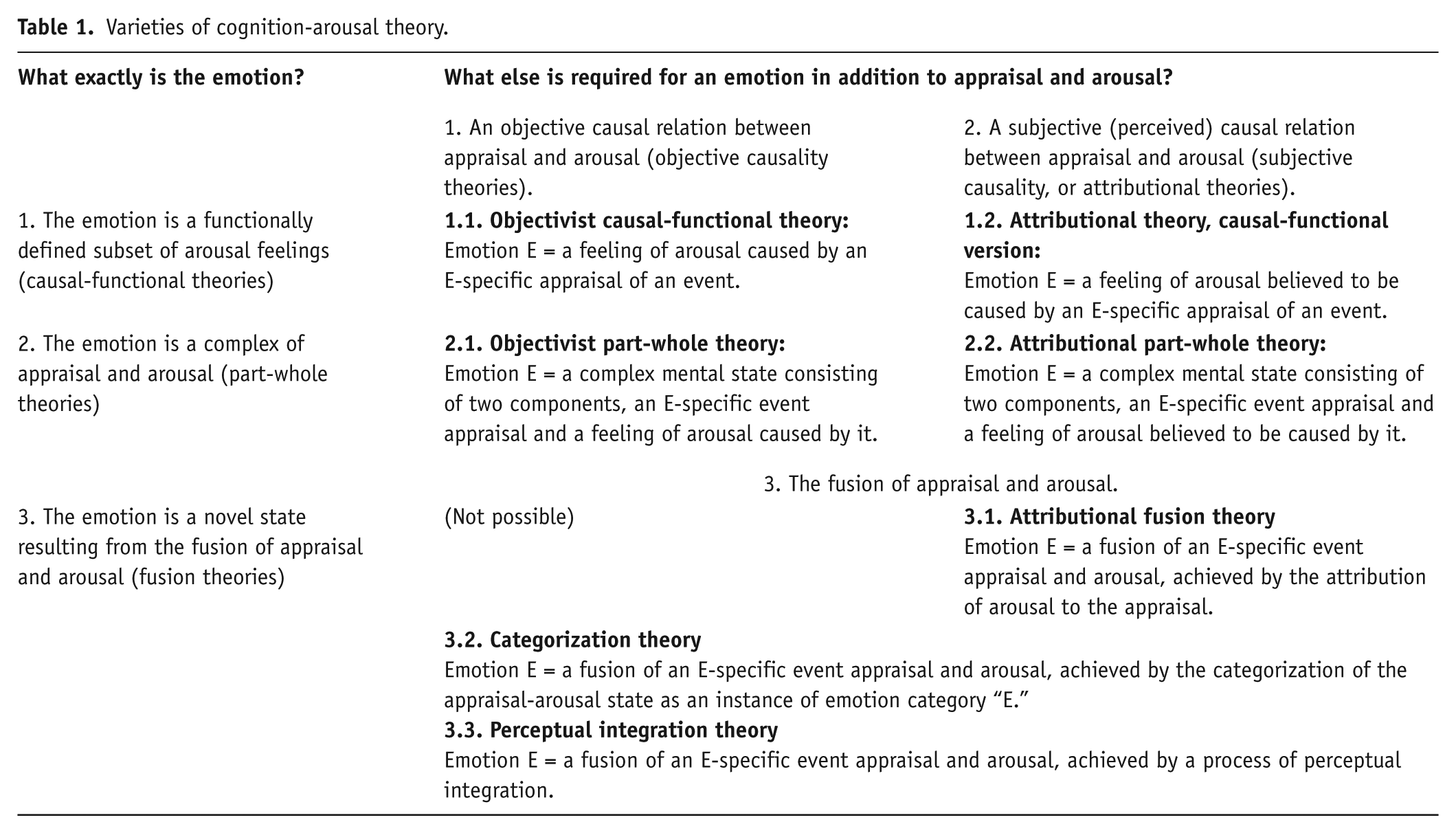
The first two proposals have in common that both appeal to the concept of causality. The first, objective causality proposal is that what is necessary for an emotion E (directed at an event p) in addition to a feeling of arousal and an E-specific appraisal of p, is an objective causal connection between the two; that is, the arousal must be caused by the appraisal. In contrast, the subjective causality or attributional proposal is that the additional requirement consists of the person’s causal attribution of her arousal to the appraisal; that is, the person must believe that her arousal is caused by the appraisal of p (or by p so appraised), regardless of whether or not this is the case.
Both these versions of cognition-arousal theory exist in two subforms depending on the answer given to the second controversial question (what exactly is the emotion?). According to the functional definition view, emotions are a subclass of arousal states, those objectively caused by appraisals (1.1. Objectivist causal-functional theory in Table 1), or those believed to be so caused (1.2. Subjectivist or attributional version of the causal-functional theory). According to the part-whole view, in contrast, emotions are complex mental states consisting of two components (appraisal and arousal) connected by an objective causal link (2.1. Objectivist part-whole theory), or by a perceived causal link (2.2. Attributional part-whole theory).
The third explication of the intuition that in emotion, arousal and cognition are conjoined more intimately than by mere co-occurrence, is that the two emotion components are integrated or fused into a novel mental state (Table 1). This proposal simultaneously answers the question of what the emotion is: it is the resulting, fused state. However, to give substance to the fusion theory, it is imperative to explicate the postulated fusion process (Reisenzein, 2012). Here, three proposals can be distinguished, giving rise to three variants of fusion theory: the attributional version of fusion theory, the categorization version, and the perceptual integration version (3.1 to 3.3 in Table 1).
The different versions of cognition-arousal theory distinguished so far are all theories of emotion. In addition, the attributional version of cognition-arousal theory can be reinterpreted as being, not (directly) a theory of emotions, but a theory of the self-ascription of emotions.
Let us look at the varieties of cognition-arousal theory in more detail.
Objectivist Versions of Cognition-Arousal Theory
The causal-functional theory
In general, (objectivist) causal-functional definitions of emotion assume that emotions are defined, at least in part, by their causes and/or consequences; analogous to the definition of “sunburn” as “an inflammation of the skin caused by over-exposure to sunlight” (Gordon, 1978, p. 125). These definitions of emotion are in agreement with the functionalist theory of mental states (e.g., Block, 1980; for a recent overview, see Levin, 2013), according to which mental states in general are defined by the causal role they play in the mental economy. Causal-functional definitions of emotion go back to Aristotle and have been repeatedly proposed in the history of emotion research up to the present (see Reisenzein, 2012). Within the cognition-arousal framework, functional definitions of emotions have been proposed by Gordon (1978; see also Gordon, 1987) as well as (although for objective arousal rather than for arousal feelings) by Gean (1979) and Lyons (1980).
Gordon (1978) proposes that emotions are a subclass of arousal feelings, those caused by appraisals (in Gordon’s theory: emotion-specific constellations of beliefs and desires). More precisely, an emotion of type E (e.g., fear, joy) is a feeling of arousal caused by an E-specific appraisal (belief-desire constellation). 4 Gean (1979) and Lyons (1980) propose the same kind of functional emotion definition, but with the difference that feelings of bodily arousal are replaced by objective bodily arousal. This change of assumptions is made to account for the possibility that one can have an emotion without feeling it. Strictly speaking, these theories fall out of the cognition-arousal framework as defined in the Introduction, because emotions are construed as bodily rather than mental states; however, they do fit an appropriately broadened concept of cognition-arousal theory. More important, the authors of these theories have pointed out a potential problem of the “mentalistic” cognition-arousal theories: the problem of unconscious emotions. However, to accommodate unconscious emotions, one need not construe emotions as bodily states. Instead, one could assume that emotions are appraisal-caused mental representations of physiological feedback that in some cases remain unconscious (e.g., Damasio, 1994; see also the last section of the Discussion).
Of all variants of cognition-arousal theory, the objectivist causal-functional version (together with the corresponding, attributional version) remains closest to James’s (1890/1950) theory of emotions that it seeks to improve. Just as James had claimed, emotions are a subgroup (see in particular James, 1894) of bodily arousal feelings, and the intensity of an emotion is thus simply the intensity of the arousal feeling that it is. Different from James (1894), however, emotional arousal feelings do not differ intrinsically (in terms of how they feel to the person) from nonemotional arousal feelings, but only in terms of their causal history: Emotions are that subset of arousal feelings that are caused by appraisals. Also different from James, emotions (i.e., subtypes of arousal feelings) do not differ from each other in phenomenal quality, but only in terms of the cognitions (appraisals) by which they are caused. For example, joy is the arousal feeling caused by the belief that a desired event has occurred, whereas fear is the arousal feeling caused by the belief that an undesired event is possible.
This causal-functional theory of emotions suggests a straightforward adjunct theory of the self-ascription of emotions, that is, the formation of beliefs to the effect that one currently has an emotion of a particular type (Gordon, 1978). The simplest way to obtain this theory is to make the following assumptions: (a) The proposed theoretical definition of emotions (an emotion E is an arousal feeling caused by an E-specific appraisal) corresponds to the implicit definition of the emotion concept “E” (e.g., “joy,” “fear”) in everyday language (see Endnote 2); (b) when people form a belief about whether they have an emotion and which one it is, they rely on the emotion concepts’ defining features. These assumptions imply that a person introspecting her emotions will form the belief that she has emotion E if, and only if, she believes to experience arousal caused by an E-specific appraisal of an event (or an event appraised in an E-specific way).
The part-whole version of cognition-arousal theory
The part-whole version of (objectivist) cognition-arousal theory proposes that an emotion of type E is a complex mental state consisting of two, causally linked components, an E-specific appraisal of an event and a feeling of arousal caused by it. Emotions are thus regarded as hybrid mental states containing both cognitive and noncognitive, sensation-like components. As in the causal-functional theory, emotions are distinguished from each other by appraisals. The intensity of the emotion is presumably equal to, or a simple monotone function of, the intensity of the arousal.
It is not easy to name an unambiguous proponent of the objectivist part-whole version of cognition-arousal theory, although Marañon (1924) comes close. However, the part-whole view is a popular approach to the definition of emotions in other cognitive-noncognitive hybrid theories of emotion, particularly among appraisal theorists (see Moors, 2013), and the reasons offered for preferring a part-whole definition in these other theories are also relevant for cognition-arousal theory (see the Discussion section).
Like the causal-functional version of cognition-arousal theory, the part-whole version suggests a simple adjunct theory of emotion self-ascription, which is analogous to that suggested by the causal theory.
Subjectivist (Attributional) Versions of Cognition-Arousal Theory
On the background of the preceding section, the “subjective causality,” or attributional versions of cognition-arousal theory can be described quickly: They are parallel to the “objectivist” causal-functional and part-whole versions of cognition-arousal theory, with the difference that the objective causal link between appraisal and arousal is replaced by a perceived causal connection (Table 1). Hence, according to the “subjectivist” (attributional) version of the causal-functional theory, an emotion E is an arousal feeling believed to have been caused by an E-specific appraisal; whereas according the attributional version of the part-whole theory, E is a complex mental state consisting of arousal plus an E-specific appraisal that the person believes to be its cause (e.g., Ross, Rodin, & Zimbardo, 1969). In addition, there is a fusion version of the attributional theory (see the section The attributional fusion theory.).
Readers may wonder which of these versions of the attributional cognition-arousal theory represents Schachter’s (1964) view of the nature of emotions. Meyer, Schützwohl, and Reisenzein (2001) propose that it is either the part-whole or the fusion theory (see also Leventhal, 1979). It can be argued, however, that the causal-functional version of attribution theory—an emotion E is an arousal feeling believed to be caused by an E-specific appraisal—fits Schachter’s views even better (this agrees with Shaked and Clore’s [2017] interpretation). In particular, this interpretation fits well with Schachter’s (1964) proposal that “an individual . . . will ‘label’ this state [of arousal] and describe his feelings in terms of the cognitions available to him” (p. 53): This formulation suggests that the attribution of arousal to a particular kind of cognitive cause serves to identify one’s arousal feeling as an instance of a particular (functionally defined) type of arousal state, which is a particular emotion type. In addition, this reading of Schachter allows a sensible interpretation of his claim that the intensity of emotion is determined by the intensity of arousal: If emotions are subtypes of arousal feelings (distinguished by the appraisals that cause them), then their intensity is simply the intensity of these feelings.
Fusion Versions of Cognition-Arousal Theory
The fusion version of cognition-arousal theory posits that emotions are novel mental states that arise from appraisal and arousal through a process of mental integration or fusion. Specifically, an emotion of type E is a mental state created via the integration of an E-specific appraisal of an event and a feeling of arousal that is (at least typically) caused by it.
The fusion version of cognition-arousal theory can be regarded as an attempt to remedy a perceived deficit of the part-whole version. The intuition of fusion theorists is that conceptualizing emotions as unintegrated complexes of appraisals and arousal fails to account for the subjective impression that emotions are unitary experiences, possibly with unique experiential qualities not traceable to their components (e.g., Castelfranchi & Miceli, 2009). The fusion process is postulated to account for these intuitions about emotions (cf. Reisenzein, 2012). Most fusion theories regard the attribution of arousal to an “emotional” cause as a component or precondition of the fusion process and are therefore elaborations of the “subjective causality” (attributional) version of part-whole theory (Table 1). The exception are Castelfranchi and Miceli (2009), who do not mention causal attributions. These authors could therefore also be interpreted as endorsing an “objective causality” version of their perceptual integration theory, or even a version that does not refer to causality in the definition of emotions at all. Corresponding alternatives are also conceivable for categorization theory. To take account of these possibilities, I refrained from assigning the perceptual integration and categorization theories to either the subjective or objective causality cell in Table 1.
The attributional fusion theory
According to the attributional explication of fusion theory, the attribution of an arousal feeling to an appraisal achieves more than providing the person with a causal understanding of her arousal; it also causes arousal and appraisal to merge into a compound state, the emotion (e.g., Leventhal, 1979). It seems to me, however, that this theory describes the immediate cause of the fusion, rather than the fusion process itself.
Categorization theory
The categorization version of cognition-arousal theory assumes that cognition and arousal are integrated into an emotion by the classification of the experienced appraisal-arousal pattern as an instance of an emotion category (understood here as a mental representation of a class). Specifically, the person experiences an emotion of type E if she appraises an object in an E-specific way, feels aroused, and categorizes this constellation of mental states as an instance of emotion category “E.” Categorization theory has been offered as an interpretation of Schachter’s views (e.g., Greenwood, 1994) and as a separate version of cognition-arousal theory (Mandler, 1984). Categorization-theoretical accounts of (some forms of) emotional experience have also been proposed in recent constructionist theories of emotion (e.g., Barrett, 2006; J. A. Russell, 2003; see also Barrett & Russell, 2015; MacCormack & Lindquist, 2017). 5
Emotion categories are presumably conceptual rather than (entirely) preconceptual (perceptual-sensory; Crane, 1992) representations. Categorization theory thus requires that, to experience an emotion E, the person needs to have the emotion concept “E” at her disposal. The required emotion concepts are plausibly those of ordinary language (e.g., Barrett, 2006; J. A. Russell, 2003), but in theory they could also be concepts that exist in a mental language only (this may be Mandler’s [1984] view).
To categorize an own currently experienced appraisal-arousal pattern as falling under emotion concept “E” seems to be essentially equivalent to, or at least to comprise, forming an (implicit) belief that one currently experiences an instance of emotion E (Greenwood, 1994). If this is correct, categorization theory assumes that the experience of an emotion E presupposes the self-ascription of E. 6 This involves at minimum the self-ascription of the emotion components, cognition and arousal; that is, the person must implicitly judge that she is aroused and that she appraises an event in an E-specific way. In addition, however, the person must presumably judge that her arousal was caused by her E-specific appraisal of the event (Mandler, 1984). This is why the categorization theory is an elaboration of the attributional version of cognition-arousal theory. Going beyond the attributional theory, however, categorization theory assumes that the person must implicitly also judge that the appraisal-arousal pattern she experiences is an instance of emotion E. By doing so, the person identifies this pattern as a token of a general type of appraisal-arousal patterns with a particular name (e.g., “fear”), that under this name is embedded in a network of folk-psychological assumptions (e.g., Barrett, 2006). According to the categorization version of cognition-arousal theory, this conceptual interpretation transforms an experienced appraisal-arousal pattern into the experience of a specific emotion.
Perceptual integration theory
The perceptual integration version of fusion theory was originally proposed for different cognition-feeling theories (e.g., Castelfranchi & Miceli, 2009; Laird, 2007), but it can be easily adapted to cognition-arousal theory (in fact, Laird’s model can be viewed as a generalized version of cognition-arousal theory). The basic idea of perceptual integration theory is that the integration of cognition and arousal into an emotion is analogous to the integration of perceptual features of objects into more complex features, or into object percepts. For example, Laird (2007) proposes that the integration of emotion components is akin to the perception of depth. Like the latter process, the emotion integration process is assumed to be unconscious and automatic, and its outputs are emotional feelings, which are said to be “higher order integrations” of its inputs. Castelfranchi and Miceli (2009) liken the fusion of emotion components into an emotion to the merging of the perceptions of individual line segments into the perception of a triangle. The emotional experience resulting from this fusion, they suggest, is a mental gestalt in the sense of the gestalt theorists (e.g., Köhler, 1947): It is a holistic, emergent mental state whose properties cannot be fully traced back to any single one of its components. Furthermore, Castelfranchi and Miceli (2009) argue that while the emotional gestalt contains the emotion components as parts, it is also the causal product of their integration. In contrast, Laird (2007) suggests that the relation between the emotion components and the emotion is not causal, but constitutional (part-whole) only.
Seen from a unified schema-theoretic view of cognition (Rumelhart, 1984; see also, Mandler, 1984), the integration of perceptual features into object percepts is but a special case of categorization, in which perceptual features (e.g., visual representations of lines) are subsumed under a perceptual schema (e.g., the schema of a triangle). From this perspective, the categorization and the perceptual integration versions of cognition-arousal theory can be regarded as variants of the same idea. In fact, the two views may turn out to be indistinguishable. Although the perceptual analogies invoked by the perceptual integration theorists suggest that the schemas that integrate cognition and arousal are nonconceptual (Crane, 1992), closer examination reveals that they need to be at least partly conceptual. The reason is that one of the emotion components, the appraisal, is itself a conceptual-propositional representation and conceptual representations can only be subsumed under conceptual schemas. Conceptual schemas for emotion-specific appraisal-arousal patterns, however, begin to look very similar to the emotion concepts of the categorization theorists (Mandler, 1984). Further increasing the similarity, at least one perceptual integration theorist (Laird, 2007) assumes, like the categorization theorists, that the emotion integration process is sensitive to the person’s causal attributions of her arousal.
Schachter’s Theory as a Theory of Emotion Ascription
Schachter’s theory is standardly interpreted as a theory of emotions. However, a close reading of Schachter (Schachter, 1964; Schachter & Singer, 1962) reveals that he is actually ambiguous about the explanandum of the theory, referring to it—seemingly interchangeably—as “emotion” and “emotion labeling” (i.e., the self-ascription of emotions). This ambiguity opens the door to an alternative interpretation of Schachter’s theory: This theory is not (at least not directly) a theory of emotions, but a theory of the self-ascription of emotions, that is, the formation of beliefs about one’s emotions. As a matter of fact, several prominent attribution researchers (e.g., Bem, 1972; Nisbett & Ross, 1980; Valins, 1966) seem to have interpreted Schachter’s theory this way (although they, too, ultimately remain ambiguous). More important, it can be argued that the self-ascription interpretation of the attributional version of Schachter’s theory, while nonstandard, actually makes the best sense out of this theory and the research tradition that emerged from it.
Interpreted as a theory of emotion self-ascription, the central postulate of the attributional version of cognition-arousal theory claims: A person introspecting her emotions will form the belief that she has an emotion of type E, if and only if she believes she has appraised an event in an E-specific way, believes to feel aroused, and believes that her arousal has been caused by her appraisal.
Although the reinterpreted postulate of cognition-arousal theory states necessary and sufficient conditions for the self-ascriptions of emotions, it can indirectly also provide necessary and sufficient conditions for emotions; namely for emotions as (implicitly) defined in everyday language (see Endnote 2). To obtain these conditions, one needs to assume that the conditions that, according to the reinterpreted postulate, are checked by people when they form beliefs about their emotions, are the defining features of the folk-psychological emotion concepts, rather than features that merely correlate with the defining features (see Smith & Medin, 1981). If one makes this assumption, the necessary and sufficient conditions of emotion as defined in common-sense psychology (the presence of an E-specific appraisal, arousal, and a causal link between the two), turn out to be identical to those proposed in the objective causality versions of cognition-arousal theory, the objectivist causal-functional and part-whole theory (Table 1). Furthermore, if one assumes that (as I argued before) Schachter (1964) regarded emotions as a subclass of arousal states, rather than as complexes of arousal and cognition, one can conclude that according to Schachter, emotions in common-sense psychology are functionally defined: Emotions are arousal feelings objectively caused by an appraisal. Interpreted this way, Schachter’s theory reduces to Gordon’s (1978) causal-functional version of cognition-arousal theory (Table 1) plus the described, adjunct theory of emotion self-ascription.
The reinterpretation of the attributional version of cognition-arousal theory as a theory of emotion self-ascription necessitates a parallel reinterpretation of the empirical research conducted to test the theory (e.g., Parkinson, 1995; Reisenzein, 1983). Specifically, seen from the self-ascription perspective, manipulations of the attribution of arousal to or away from an “emotional” source (e.g., Nisbett & Schachter, 1966; Schachter & Singer, 1962) are not (at least not directly) methods for influencing a person’s emotions, but methods for changing her beliefs about emotions. Likewise, changed self-reports and behaviors induced by arousal misattributions reflect, first and foremost, errors in the self-ascriptions of emotion rather than changes in emotions. Indirectly, however, false beliefs about the cause of one’s arousal could also influence emotions, for example by instigating a reappraisal of the eliciting event (see also Valins, 1966).
Discussion
Problems With Arousal
A main goal that James (1884, 1890/1950) pursued with his theory of emotions was to explain the peculiar experiential quality, including the intensity, of emotional experiences (Reisenzein & Stephan, 2014). To explain these features of emotions, James proposed that emotions are a class of sensations: the sensations of the bodily changes caused by emotion-eliciting stimuli. Indeed, the assumption that emotions are sensation-like mental states, or even are sensations, allows to explain their phenomenal quality and intensity in a natural way, because it belongs to the essence of sensations to have a phenomenal quality and an intensity (Külpe, 1893; Wundt, 1896).
Schachter’s (1964) theory was apparently motivated by parallel considerations. Although Schachter accepted the arguments of James’s critics (e.g., Cannon, 1927) that arousal feelings are not sufficient for emotions, he remained convinced that they are needed to imbue otherwise “cold” cognitions with “emotional warmth” (see e.g., Schachter, 1964, p. 76), and to explain the intensity of emotions.
The empirical evidence that has accumulated since Schachter and Singer (1962) suggests to me, however (see Reisenzein & Stephan, 2014, for the details), that bodily arousal feelings are not just insufficient, but also unnecessary for emotions. In addition, it is doubtful to me that arousal could even in theory fulfill the explanatory functions assigned to it by Schachter and other cognition-arousal theorists. How can feelings of bodily arousal provide emotions with “affective warmth” if, as cognition-arousal theorists assume and empirical evidence confirms (e.g., Marañon, 1924; White, Fishbein, & Rutstein, 1981), these feelings are per se affectively neutral? And how can arousal (alone) explain the intensity of emotional experiences given that their intensity also varies along a hedonic (pleasure–displeasure) dimension (Reisenzein, 1994)?
Alternative Cognition-Feeling Theories
If bodily arousal is indeed not necessary for emotions, then cognition-arousal theories of all varieties are false. Even then, however, the more general idea about the nature of emotion contained in cognition-arousal theory continues to hold intuitive force. This is the idea that the theoretical definition of emotions requires reference to both cognitions and to sensation-like mental states, that explain the peculiar phenomenal quality and the intensity of emotional experiences (Reisenzein, 2012). This intuition can be saved by assuming that while emotions are, or perhaps contain, sensation-like feelings, these feelings are not created in the body but in the brain.
The oldest and most prominent of these “mental” feeling theories assumes that emotions are, or at least contain as components, feelings of pleasure and displeasure (e.g., Bentham, 1789/1970; Castelfranchi & Miceli, 2009; Mellers, 2000; Reisenzein, 2009b, 2012). Alternative proposals are that the feeling core of emotions consists of mixtures of pleasure/displeasure and (cortically generated) activation/deactivation (Barrett, 2006; J. A. Russell, 2003; see also Reisenzein, 1994), or of several mental feeling qualities corresponding to a few distinct emotions (e.g., Oatley, 2009). In fact, the precise number and identity of the sensation-like emotional qualities postulated by “mental feeling” theories seems less important than the assumption (a) that they are tightly correlated with emotions and (b) are intrinsically affective (i.e., are experienced as emotional independent of context). These assumptions are most plausible if one assumes that emotional feelings are produced by mental mechanisms dedicated to emotions (Reisenzein, 2009b).
For the remainder of the discussion, I will assume that intrinsically emotional feelings exist. By replacing arousal with such feelings, a (in my view) central problem of cognition-arousal theory is solved. In contrast to arousal, these feelings can plausibly explain the special phenomenal quality of emotions (compared to nonemotional states) and even some of the qualitative distinctions between emotions (e.g., pleasant vs. unpleasant), as well as the intensity of emotions (Reisenzein, 2009b). For the finer distinctions between emotions, one can again take recourse to appraisals.
However, this defines only the basic framework of the modified cognition-feeling theory; we still need to give a theoretical definition of emotions within this framework. Paralleling the cognition-arousal case, we have a choice between at least five different definitions of emotion (cf. Table 1). Which is best? Because a comprehensive discussion of this question is not possible given the space constraints of this article, I will simplify the problem to a choice between my preferred option, the objectivist causal-functional theory (Theory 1.1 in Table 1), and the alternative theories, more specifically those that assume cognitions to be not merely causes, but parts of emotions (possibly as components of a fused emotion state).
Arguments for the Causal-Functional Version of Cognition-Feeling Theory
The causal version of cognition-feeling theory is conceptually simple and empirically modest: It presupposes no more than what is assumed by most cognition-arousal, as well as (as far as I can tell) the majority of other cognition-feeling theorists: that emotional feelings are normally caused by appraisals of eliciting events. Despite its frugality, the theory can explain the distinction between emotions and nonemotions, the type distinctions between emotions, and the intensity of emotions as well as can more complex versions of cognition-feeling theory. Before we adopt one of these latter theories, we need additional reasons.
Actually, with respect to the explanation of emotion intensity, the causal-functional theory even seems to do a better job than the part-whole and fusion theories. According to cognition-feeling theory, the intensity of emotion is determined by the intensity of emotional feelings. This is easy to understand if emotions are feelings, as assumed by the causal theory: The intensity of an emotion is then simply the intensity of the feeling that it is. In contrast, it is not immediately clear what it means to attribute an intensity to a complex mental state consisting of feelings and appraisals. Nor is it evident how the intensity of this complex state is determined by the intensity of one of its components.
Another advantage of the causal-functional theory is that it allows us to continue speaking of cognitions (appraisals) as causes of emotion, as done in common-sense psychology (see e.g., Siemer, 2009) and in much of emotion science. In contrast, for the part-whole and the fusion theories, this seems possible only by reinterpreting the causal talk as nonliteral (see Moors, 2013).
Finally, the causal-functional theory avoids two potential problems of specifically the categorization version of cognition-feeling theory. The first problem concerns the possibility of error in the self-ascription of emotions (e.g., Gordon, 1978; Greenwood, 1994). If the occurrence of an emotion requires the belief that one has that emotion, then it seems impossible to be angry or jealous, for example, without knowing it, or whilst believing the opposite. But in fact, this seems to happen sometimes.
A second problem of categorization theory is the threat of an infinite regress. According to categorization theory (as I interpreted it) the occurrence of emotion E implies that the person forms the (implicit) belief that she has E; the presence of this belief is thus a necessary condition for E. As such, this condition is a natural candidate for being part of the definiens of the concept “E” applied in the self-categorization process. However, this seemingly natural elaboration of categorization theory leads into a regress: Now, the occurrence of E requires not only the belief that one has E but (since “having E” implies “believing that one has E”) also the belief that one believes to have E, and so on ad infinitum. To block the regress, one must either assume that the defining conditions of emotion concepts do not contain the self-categorization requirement, implying that they omit a necessary condition for emotions; or one must assume that emotions exist, at a basic level at least, without self-ascriptions (see the section A Reinterpretation of Categorization Theory).
Two Unconvincing Arguments for the Part-Whole and Fusion Theories
Notwithstanding the virtues of the causal-functional version of cognition-feeling theory, it remains possible that the part-whole and fusion versions of the theory offer significant explanatory advantages. Indeed, at least two such advantages have been claimed for these theories (Reisenzein, 2012).
The emotion quality argument
Although the causal-functional definition of emotions allows to distinguish emotions by their different cognitive causes, it could be argued that appraisals must be regarded as components of emotions to explain their differences in phenomenal quality (Reisenzein, 2012).
This argument rests on the presupposition that all, or at least very many of the emotions of common sense differ from each other not only in their causes and consequences, but also in experiential quality. However, this assumption is by no means self-evident. In fact, some introspectionist psychologists came to the opposite conclusion. For example, Külpe (1893) argued that all pleasant feelings are alike phenomenologically, as are all unpleasant feelings. If so, there is nothing for cognitions to explain here. Furthermore, even assuming that each emotion has its own feeling tone, cognitions may not be of much help for explaining this feeling tone. The reason is that cognitions may not have any phenomenal properties, or at least none of a kind that would be helpful for explaining the experiential quality of emotions (Reisenzein, 2012; see also Bayne & Montague, 2011, for a discussion of “cognitive phenomenology”).
The intentionality argument
The intentionality argument holds that cognitions must be regarded as components of emotions to explain the (apparent) intentionality or object-directedness of emotions; that is, the fact that at least in the typical case, emotions present themselves to the experiencer as being directed at specific objects (e.g., Mary is happy that she won a prize in the lottery). According to the part-whole and fusion theories, emotions have objects because they contain object-directed cognitions as components, and their objects are simply the objects of these cognitions (see also Shargel, 2017). In contrast, the feelings with which emotions are identified in the causal-functional feeling theory (e.g., pleasure/displeasure) are usually conceptualized as sensation-like, nonpropositional and nonconceptual mental states (cf. Oatley, 2009). As such, they cannot be directed at the specific objects of emotions (e.g., Mary’s winning in the lottery).
However, the intentionality argument is no compelling reason to abandon the causal-functional theory either. One can escape this argument by simply denying that emotions are intentional in the strict sense of the word; that is, in the same sense as beliefs and desires, the paradigmatic intentional mental states. The essence of the intentionality of beliefs and desires is that they are representational: they represent the objects at which they are directed (Green, 1992). Counter perhaps to first appearances, that may not be the case for emotions. The subjective impression that emotions focus on objects could be due to the attention-directing effect of emotions (Reisenzein, 2009a), to a subsequent cognitive process that binds feelings to object representations, or to a causal attribution process (Reisenzein, 2012; J. A. Russell, 2003). This explanation of the (apparent) object-directedness of emotions additionally recommends itself because, at second sight, the part-whole and fusion versions of cognition-feeling theory do not seem to provide a satisfactory explanation of emotional intentionality either (see Reisenzein, 2012).
A Reinterpretation of Categorization Theory
To conclude, I will try to show that the objectivist causal-functional version of cognition-feeling theory can be reconciled, to a degree, with categorization theory. This reconciliation can be achieved if one assumes that the categorization of one’s current state as an emotion does not create emotions (as assumed by categorization theory), but is one way how already present, unconscious emotional states can be raised to the level of conscious awareness.
Actually, this reinterpretation of categorization theory is fairly directly suggested by Mandler’s (1984) version of the theory, for Mandler regards the categorization process that is taken to construct emotional experiences as but a special case of a more general process (of subsuming one’s current mental states under abstract schemas) that constructs all conscious experiences (see Mandler, 1984, Chapter 4). Mandler’s views of the construction of consciousness are broadly consistent with a prominent philosophical theory of consciousness, the higher-order thought theory (Rosenthal, 1997, 2009). The basic premise of this theory is that consciousness is not an intrinsic but a relational property of mental states. Specifically, the theory assumes that a mental state becomes conscious if it becomes the object of a co-occurring (typically unconscious) higher-order thought.
This theory of consciousness is quite compatible with the causal-functional version of cognition-feeling theory. To illustrate, let us assume that happiness is functionally defined as a pleasant feeling caused by the belief that a positive event has occurred. According to the higher-order thought theory (a) happiness is present unconsciously if the person has a pleasure feeling caused by her belief that a positive event has occurred; and (b) this unconscious state becomes conscious if the person forms the (typically unconscious) higher-order thought that she has a pleasant feeling caused by the belief that a positive event has occurred. Furthermore, if the person has the concept of happiness at her disposal, she can also become conscious of her happiness by forming the higher-order thought that she is currently happy. Because this higher-order thought is an (although usually unconscious) emotion self-ascription, the assumption of categorization theorists that the emergence of an emotion involves the self-ascription of this emotion, is in one sense vindicated: This is indeed one way how conscious emotions can arise.
However, note that even for conscious emotions, higher-order thought theory does not require the self-ascription of emotions (e.g., “I am happy”); it is sufficient to think that one experiences a feeling (e.g., pleasure) caused by a particular appraisal. Indeed, it is sufficient for happiness to become conscious to think that one experiences pleasure. 7 Furthermore, neither of these self-ascriptions is necessary for unconscious emotions: A suitable higher-order thought only makes an already present emotion conscious, it does not construct the emotion from scratch. This remains true even if one allows that, in the process of being conceptualized as the content of a higher-order thought, the unconscious emotion can simultaneously be “conceptually refined” (Rosenthal, 2009).
I conclude that the causal-functional theory of emotion is not only the simplest but also the most adequate version of cognition-feeling theory.
Footnotes
Declaration of Conflicting Interests
The author declared no potential conflicts of interest with respect to the research, authorship, and/or publication of this article.