



Abstract
This article presents seven principles that have guided our thinking about emotional intelligence, some of them new. We have reformulated our original ability model here guided by these principles, clarified earlier statements of the model that were unclear, and revised portions of it in response to current research. In this revision, we also positioned emotional intelligence amidst other hot intelligences including personal and social intelligences, and examined the implications of the changes to the model. We discuss the present and future of the concept of emotional intelligence as a mental ability.
Keywords
In 1990, two of us proposed the existence of a new intelligence, called “emotional intelligence.” Drawing on research findings in the areas of emotion, intelligence, psychotherapy, and cognition, we suggested that some people might be more intelligent about emotions than others (Salovey & Mayer, 1990, p. 189). We called attention to people’s problem solving in areas related to emotion: recognizing emotions in faces, understanding the meanings of emotion words, and managing feelings, among others. We argued that, collectively, such skills implied the existence of a broader, overlooked capacity to reason about emotions: an emotional intelligence (Cacioppo, Semin, & Berntson, 2004; Haig, 2005). We later characterized the problem-solving people carried out as falling into four areas or “branches” (Mayer & Salovey, 1997).
In the present article, we revisit the theoretical aspects of our ability model of emotional intelligence, update the model so as to enhance its usefulness, and examine its implications. We begin by considering a set of principles that guide our thinking about emotional intelligence. After discussing these principles, we revise the four-branch model slightly. We then locate emotional intelligence amidst related “broad” intelligences, taking care to distinguish emotional intelligence from personal and social intelligences, and elucidate examples of reasoning for each one of these intelligences. We wrap up by considering the influence of the model and its implications for the future.
Seven Principles of Emotional Intelligence
We will describe a set of principles that have guided our theorizing about emotional intelligence. Together, these principles—guidelines really—succinctly represent how we think about emotional intelligence.
Principle 1: Emotional Intelligence Is a Mental Ability
Like most psychologists, we regard intelligence as the capacity to carry out abstract reasoning: to understand meanings, to grasp the similarities and differences between two concepts, to formulate powerful generalizations, and to understand when generalizations may not be appropriate because of context (Carroll, 1993; Gottfredson, 1997). We agree also that intelligence can be regarded as a system of mental abilities (Detterman, 1982).
Regarding how people reason about emotions, we proposed that emotionally intelligent people (a) perceive emotions accurately, (b) use emotions to accurately facilitate thought, (c) understand emotions and emotional meanings, and (d) manage emotions in themselves and others (Mayer & Salovey, 1997).
Principle 2: Emotional Intelligence Is Best Measured as an Ability
A foundation of our thinking is that intelligences are best measured as abilities—by posing problems for people to solve, and examining the resulting patterns of correct answers (Carroll, 1993; Mayer, Panter, & Caruso, 2012). (Correct answers are those that authorities identify within the problem-solving area.) The best answers to a question can be recognized by consulting reference works, convening a panel of experts, or (more controversially for certain classes of problems), by identifying a general consensus among the test-takers (Legree, Psotka, Tremble, & Bourne, 2005; MacCann & Roberts, 2008; Mayer, Salovey, Caruso, & Sitarenios, 2003).
People are poor at estimating their own levels of intelligence—whether it is their general intelligence or their emotional intelligence (Brackett, Rivers, Shiffman, Lerner, & Salovey, 2006; Paulhus, Lysy, & Yik, 1998). Because people lack knowledge of what good problem-solving actually entails, they estimate their abilities on other bases. These include a mix of general self-confidence, self-esteem, misunderstandings of what is involved in successful reasoning, and wishful thinking. These nonintellectual features add construct-irrelevant variance to people’s self-estimated abilities, rendering their judgments invalid as indices of their actual abilities (Joint Committee, 2014).
Principle 3: Intelligent Problem Solving Does Not Correspond Neatly to Intelligent Behavior
We believe there is a meaningful distinction between intelligence and behavior. A person’s behavior is an expression of that individual’s personality in a given social context (Mischel, 2009). An individual’s personality includes motives and emotions, social styles, self-awareness, and self-control, all of which contribute to consistencies in behavior, apart from intelligence. Among the Big Five personality traits, for example, extraversion, agreeableness, and conscientiousness correlate near zero with general intelligence. Neuroticism correlates at r = −.15, and openness about r = .30 (DeYoung, 2011). The Big Five exhibit correlations of similar magnitude with emotional intelligence: Neuroticism correlates r = −.17 with emotional intelligence and openness r = .18; extraversion and conscientiousness correlate with emotional intelligence between r = .12 and .15, and agreeableness, r = .25 (Joseph & Newman, 2010). These correlations indicate the relative independence of intelligences from socioemotional styles. They confirm what everyday observation suggests: that emotionally stable, outgoing, and conscientious people may be emotionally intelligent or not.
Similarly, a person may possess high analytical intelligence but not deploy it— illustrating a gap between ability and achievement (Duckworth, Quinn, & Tsukayama, 2012; Greven, Harlaar, Kovas, Chamorro-Premuzic, & Plomin, 2009). Intelligence tests tend to measure potential better than the typical performance of everyday behavior. Many people with high levels of intelligence may not deploy their ability when it would be useful (Ackerman & Kanfer, 2004). For these reasons, the prediction from intelligence to individual instances of “smart” behavior is fraught with complications and weak in any single instance (Ayduk & Mischel, 2002; Sternberg, 2004). At the same time, more emotionally intelligent people have outcomes that differ in important ways from those who are less emotionally intelligent. They have better interpersonal relationships both in their everyday lives and on the job—as articles in this issue and elsewhere address (Fernández-Berrocal & Extremera, 2016; Izard et al., 2001; Karim & Weisz, 2010; Lopes, 2016; Mayer, Roberts, & Barsade, 2008; Mayer, Salovey, & Caruso, 2008; Nathanson, Rivers, Flynn & Brackett, 2016; Roberts et al., 2006; Rossen & Kranzler, 2009; Trentacosta, Izard, Mostow, & Fine, 2006)
Although intelligences predict some long-term behavioral outcomes, predicting any individual behavior is fraught with uncertainty because of the other personality—and social— variables involved (Funder, 2001; Mischel, 2009).
Principle 4: A Test’s Content—the Problem Solving Area Involved—Must Be Clearly Specified as a Precondition for the Measurement of Human Mental Abilities
Establishing the content of the area
To measure emotional intelligence well, tests must sample from the necessary subject matter; the content of the test must cover the area of problem-solving (Joint Committee, 2014). A test of verbal intelligence ought to sample from a wide range of verbal problems in order to assess a test-taker’s problem-solving ability. Test developers therefore must cover the key areas of verbal problem-solving required, such as understanding vocabulary, comprehending sentences, and other similar skills. The specification of a problem-solving area—vocabulary, sentence comprehension, and the like for verbal reasoning—defines the intelligence and its range of application. The content specification is designed to ensure that the test samples a representative group of problems.
Subject matter differs from ability
Once the test’s content is established, the test can be used to identify a person’s mental abilities. People’s problem-solving abilities are reflected by the correlational (or covariance) structure of the responses they make to the test items. People’s abilities are revealed when a group of scores on test items rise and fall together across a sample of individuals. Note that the mental abilities measured by a test are independent to some degree from the nature of the problems to be solved. That is, a person’s abilities will not necessarily correspond directly to the different types of content in a subject area—a matter we consider further in the next principle.
Principle 5: Valid Tests Have Well-Defined Subject Matter That Draws Out Relevant Human Mental Abilities
People exhibit their reasoning abilities as they solve problems within a given subject area. As such, a test’s validity depends both on the content it samples and the human mental abilities it elicits. From this perspective, test scores represent an interaction between a person’s mental abilities and the to-be-solved problems. If the test content is poorly specified, the items will misrepresent the domain, and any hoped-for research understanding of mental abilities may be inconclusive. If problem-solving domains overlap too much with other areas, ability factors redundant with other areas may emerge; if the test content is too broad, eclectic sets of ability factors may arise, and if the content is too narrow the test may fail to draw out key mental abilities. A garbage in, garbage out process will replace good measurement.
As implied in the previous lines, human abilities do not necessarily map directly onto test content: The abilities people use to solve problems have their own existence independent of the organization of the subject matter involved. In the intelligence field, a test of verbal knowledge may ask a person questions about nonfiction passages, fiction, poetry, and instruction manuals. Despite the diversity of material, people use just one verbal intelligence to comprehend them all. On the other hand, the skill to identify what is missing in a picture and the skill to rotate an object in space (in our minds) may appear to draw on the same visual understanding. However, identifying the missing part of a picture draws primarily on perceptual-organizational intelligence whereas the object-rotation task draws primarily on spatial ability, and these mental abilities are distinct (Wai, Lubinski, & Benbow, 2009). As applied to emotional intelligence, we need both to describe accurately the emotional problem solving that people undertake and the abilities people employ to solve those problems—which are two different matters (Joint Committee, 2014).
Principle 6: Emotional Intelligence is a Broad Intelligence
We view emotional intelligence as a “broad” intelligence. The concept of broad intelligences emerges from a hierarchical view of intelligence often referred to as the Cattell–Horn–Carroll or “three-stratum model” (McGrew, 2009). In this model, general intelligence, or g, resides at the top of the hierarchy, and it is divided at the second stratum into a series of eight to 15 broad intelligences (Flanagan, McGrew, & Ortiz, 2000; McGrew, 2009). The model is based on factor-analytic explorations of how mental abilities correlate with one another. Such analyses suggest that human thinking can be fruitfully divided into areas such as fluid reasoning, comprehension-knowledge (similar to verbal intelligence), visual-spatial processing, working memory, long-term storage and retrieval, and speed of retrieval. The three-stratum model also includes at its lowest level more specific mental abilities. For example, the broad intelligence, “comprehension-knowledge” includes the specific ability to understand vocabulary and general knowledge about the world.
Broad intelligences fall into subclasses (McGrew, 2009; Schneider & Newman, 2015). One class of broad intelligences reflects basic functional capacities of the brain such as mental processing speed and the scope of working memory. A second class of broad intelligences includes members identified by the sensory system they relate to, including auditory intelligence and tactile/physical intelligence. Still others may reflect subject matter knowledge such as verbal intelligence. Mental abilities in late adolescence and adulthood may be shaped and strengthened into “aptitude complexes” by educational pursuits and interests to form domain-specific knowledge such as in mathematics, sciences, or government and history (Ackerman & Heggestad, 1997; Rolfhus & Ackerman, 1999).
Emotional intelligence fits such descriptions of a broad intelligence. MacCann, Joseph, Newman, and Roberts (2014) collected data on 702 students who took a wide range of intelligence tests, including one of emotional intelligence, over an 8-hour testing period. Using confirmatory factor analysis, MacCann et al. (2014) found that emotional intelligence, indicated by three of the four branches of the Mayer, Salovey, Caruso Emotional Intelligence Test (MSCEIT; Mayer, Salovey, & Caruso, 2002), fits well among other known broad intelligences within the second-stratum of the Cattell–Horn–Carroll model. In a reanalysis of the same data, Legree et al. (2014) were also able to fit emotional intelligence into the Cattell–Horn–Carroll framework; they included all four branches of the MSCEIT as indicators of emotional intelligence by correcting for the different response scales used across the test’s subtasks (Legree et al., 2014).
Principle 7: Emotional Intelligence is a Member of the Class of Broad Intelligences Focused on Hot Information Processing
We believe that the broad intelligences—especially those defined by their subject matter—can be divided into hot and cool sets. Cool intelligences are those that deal with relatively impersonal knowledge such as verbal-propositional intelligence, math abilities, and visual-spatial intelligence. We view hot intelligences as involving reasoning with information of significance to an individual—matters that may chill our hearts or make our blood boil. People use these hot intelligences to manage what matters most to them: their senses of social acceptance, identity coherence, and emotional well-being. Repeated failures to reason well in these areas lead to psychic pain which—at intense levels—is coprocessed in the same brain centers that process physical pain (Eisenberger, 2015). By thinking clearly about feelings, personality, and social groups, however, people can better evaluate, cope with, and predict the consequences of their own actions, and the behavior of the individuals around them.
Emotional intelligence falls within this category because emotions are organized responses involving physical changes, felt experiences, cognitions, and action plans—all with strong evaluative components (Izard, 2010). Social intelligence is another member of the category (Conzelmann, Weis, & Süß, 2013; Hoepfner & O’Sullivan, 1968; Weis & Süß, 2007; Wong, Day, Maxwell, & Meara, 1995). Social intelligence is “hot” because social acceptance is fundamentally important to us; among social animals, group exclusion is a source of primal pain (Baumeister & Leary, 1995). Finally, personal intelligence—an intelligence about personality—is a newly proposed member of this group (Mayer, 2008, 2014; Mayer et al., 2012). Personal intelligence is a hot intelligence because our sense of self is a primary source of inner pleasure and pain—ranging from self-satisfaction and pride on the positive side to self-loathing and suicidal thoughts and action on the negative side (Freud, 1962; Greenwald, 1980).
Summary and Applications
In this section, we described seven principles that guide our thinking about emotional intelligence. We employed some of these principles—notably that emotional intelligence is an ability and a hot intelligence—from the outset of our work. We also introduced some new principles, such as those concerning broad intelligences. In the next section, we review the four-branch model of emotional intelligence and present an updated view of our model and of our present thinking, recognizing that these principles could lead to other models as well.
The Four-Branch Model: Original and Revised
In this section of the article, we briefly revisit our 1997 four-branch model of emotional intelligence and then proceed to renew it—as well as to clarify its range of usefulness in the context of the field’s current understanding of intelligences. More specifically, we (a) add more abilities to the model, (b) distinguish the four-branch model of problem-solving content from the structure of human abilities relevant to emotional intelligence, (c) relate emotional intelligence to closely allied broad intelligences, (d) examine the key characteristics of the problem-solving involved, and (e) more clearly distinguish between areas of problem-solving and areas of human mental abilities.
The Four-Branch Model of Emotional Intelligence
Our four-branch ability model distinguished among four areas of problem-solving necessary to carry out emotional reasoning: The first was (a) perceiving emotions, which we regarded as computationally most basic. We then proceeded through the increasingly integrated and more cognitively complex areas of (b) facilitating thought by using emotions, (c) understanding emotions, and (d) managing emotions in oneself and others (Mayer & Salovey, 1997). (We referred to these problem-solving areas as branches after the line drawing in our original diagram.)
Each branch represents a group of skills that proceeds developmentally from basic tasks to more challenging ones. The Perceiving Emotions branch leads off with the “ability to identify emotions in one’s physical states, feelings, and thoughts,” and proceeds to such developmentally advanced tasks (as we saw them then) as the ability to discriminate between truthful and dishonest expressions of feeling. The parallel developmental progression in the Understanding branch begins with the ability to label emotions and progressed to more challenging tasks such as understanding “likely transitions among emotions,” such as from anger to satisfaction.
Update 1. The Four-Branch Model Includes More Instances of Problem-Solving Than Before
Table 1 recapitulates the four branches of the original model in its four rows, from perceiving emotions to managing emotions (see left column). To the right, we have included many of the original types of reasoning that illustrated each branch, sometimes rewriting them for clarity. Within a row, each set of abilities is arranged (approximately) from the simplest to the most complex skills, from bottom to top.
The four-branch model of emotional intelligence, with added areas of reasoning a .
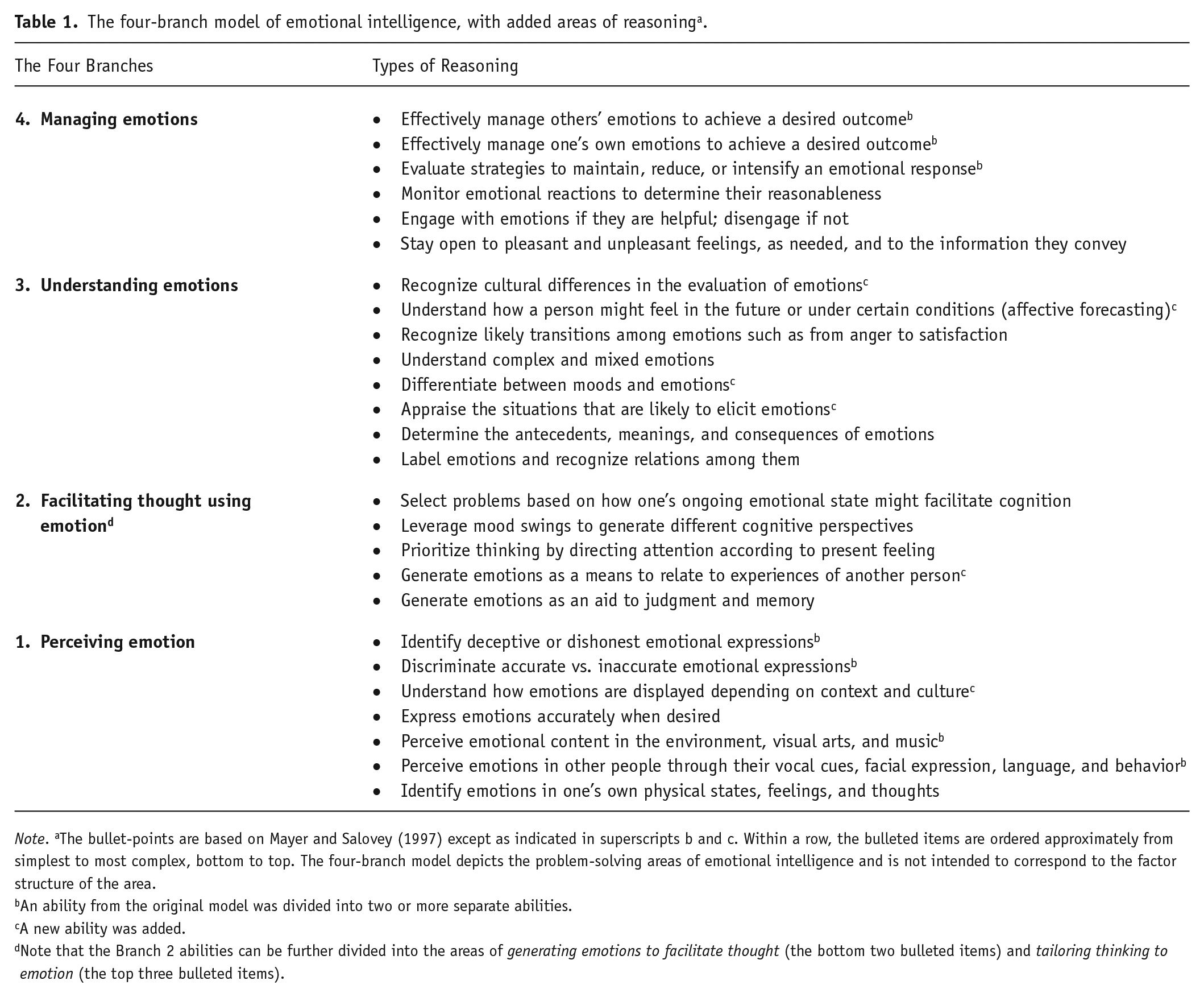
Note. aThe bullet-points are based on Mayer and Salovey (1997) except as indicated in superscripts b and c. Within a row, the bulleted items are ordered approximately from simplest to most complex, bottom to top. The four-branch model depicts the problem-solving areas of emotional intelligence and is not intended to correspond to the factor structure of the area.
An ability from the original model was divided into two or more separate abilities.
A new ability was added.
Note that the Branch 2 abilities can be further divided into the areas of generating emotions to facilitate thought (the bottom two bulleted items) and tailoring thinking to emotion (the top three bulleted items).
Based on research since 1997, we have added several areas of problem solving to this revised model that initially we overlooked. For example, the “Understanding Emotion” area originally included the abilities to label emotions, to know their causes and consequences, and to understand complex emotions. To those original areas of understanding, we have added emotional appraisal and emotional forecasting—topics that have experienced increased research attention and that have been directly related to emotionally intelligent reasoning (see also Barrett, Mesquita, & Gendron, 2011; Dunn, Brackett, Ashton-James, Schneiderman, & Salovey, 2007; MacCann & Roberts, 2008)—as well as a sensitivity to cultural contexts (Matsumoto & Hwang, 2012). As others have pointed out, reasoning in an individual area is not necessarily discrete; rather, problem-solving activities can spill or cascade into one another. For example, emotion perception is often helpful to accurate emotion understanding (see Joseph & Newman, 2010).
Update 2: The Mental Abilities Involved in Emotional Intelligence Remain To Be Determined
When we first proposed the four-branch model, we believed it could reasonably correspond to four mental ability factors in the area (Mayer & Salovey, 1997). That said, the content domains are independent of the mental abilities within the domain (by Principles 4 and 5). In fact, the four-branch model is not well reflected in the factor structure of our ability-based measures (Legree et al., 2014; Maul, 2011; Palmer, Gignac, Manocha, & Stough, 2005; Rossen, Kranzler, & Algina, 2008).
From an empirical standpoint, tasks on the Mayer–Salovey–Caruso Emotional Intelligence Test (MSCEIT) have been represented by between one and three factors (Legree et al., 2014; MacCann et al., 2014). Those theorists who favor a three-factor model have argued for dropping Branch 2, Facilitating Thought Using Emotions—which describes how drawing on emotions can enhance cognition. Critics contend that confirmatory factor models of the MSCEIT fit branches 1, 3 and 4 of the model reasonably well, but not Branch 2 (Joseph & Newman, 2010).
We agree that a mental ability factor of Facilitating Thought has not reliably emerged from studies of the MSCEIT. This may be a failure of the test construction, or because people solve such problems using their ability at emotional understanding (or another ability) rather than any reasoning distinctly related to facilitating thought.
Although Facilitating Thought may fail to emerge as a discrete mathematical factor on the MSCEIT, we believe it makes sense to retain the branch in our four-branch model of problem solving areas. Being able to draw on emotions to facilitate thought is part of an overall emotional intelligence: Knowing that sadness can promote the performance of detail-oriented work—and that creativity burgeons with happiness—seems to us integral to the construct (Isen, Daubman, & Nowicki, 1987), and additional findings point to the idea that people use inner emotional states to solve problems (Cohen & Andrade, 2004; Leung et al., 2014). Moreover, tasks that involve Facilitating Thought do correlate with scores of overall emotional intelligence on the MSCEIT.
The four-branch model of emotional intelligence demarcates emotional problem-solving overall. We no longer expect, however, that the specific mental abilities involved in emotional intelligence will necessarily coincide with the specific problem solving areas described by the four-branch model.
Update 3. Emotional Intelligence Is a Broad, Hot Intelligence and Invites Comparisons With Personal and Social Intelligences
In our early works we sometimes wrote that emotional intelligence was similar to social intelligence (Mayer & Salovey, 1993; Salovey & Mayer, 1990) and at other times we described emotional intelligence as sui generis—it did not appear to be like any other intelligence—surely nothing in the Cattell–Horn–Carroll model as originally formulated. Neither of these positions appear helpful today.
Today, we believe there exists a group of hot intelligences of which emotional intelligence is a member. Two other candidates for this group are social intelligence and personal intelligence (see Principle 7). Some of these intelligences are better understood than others.
Social intelligence has been the most challenging to measure (Conzelmann et al., 2013; Romney & Pyryt, 1999; Wong et al., 1995). Work conducted early in the 20th century indicated that social intelligence correlated so highly with general intelligence as to be indistinguishable from it (Wyer & Srull, 1989). Recent research bears this out: Conzelmann et al. (2013) found that both social memory and social perception appeared to blend into general intelligence, consistent with earlier studies. They also found, however, more promising evidence for an independent social understanding task.
Another currently researched member of this group is personal intelligence: the capacity to reason about personalities—both one’s own and the personalities of others. There is now preliminary evidence that personal intelligence can be measured, exists, and predicts consequential outcomes ( Mayer et al., 2012; Mayer & Skimmyhorn, 2015).
The existence of other hot broad intelligences that form a group with emotional intelligence arguably does more to jeopardize the conceptual integrity of emotional intelligence than any other development in the past 25 years. After all, if emotional intelligence were just a part of the arguably broader personal intelligence, and could not be distinguished from it empirically, then emotional intelligence might need to be subsumed into that broader intelligence. It is for that reason that we focus next on a comparative examination of these hot intelligences.
Comparative definitions
To fully understand emotional intelligence, it helps to think about its relationship to personal and social intelligences. Emotional, personal, and social intelligences share in common their concern for the human world of inner experience and outer relationships. That is, they concern the understanding of people from their biosocial needs to their interactions in social groups. To compare these intelligences, we provide working definitions of each one in the first row of Table 2. Emotional intelligence is defined as “The ability to reason validly with emotions and with emotion-related information and to use emotions to enhance thought” (Table 2, column 2). Similar definitions are offered for personal and social intelligences. Definitions can provide a helpful start to specifying the members of the class of hot intelligences.
A comparison of emotional, personal, and social intelligences.

Problem-solving areas involved
The three intelligences can be specified in a second way by describing each one’s area of problem-solving. Emotional intelligence draws on problems described in the four-branch model. Personal intelligence has similarly been divided into four problem-solving areas (Table 2, column 3) that include (a) identifying personality-related information, (b) forming models of personality, (c) guiding personal choices, and (d) systematizing life goals and plans (Mayer, 2009). Once again, we remind readers that (as we now view it) problem-solving areas do not necessarily predict the structure of mental abilities used to find solutions to those problems. In fact, the evidence indicates that simpler models may describe mental abilities in both emotional and personal intelligences (Legree et al., 2014; MacCann et al., 2014; Mayer, Panter, & Caruso, 2014).
The problem-solving areas for social intelligence are less well demarcated. From our standpoint, Conzelmann et al. (2013) examined something closer to personal intelligence than social intelligence in their operationalization of social understanding: They asked test-takers to guess the background information of a target person and to judge the person’s mental states (including emotions and thoughts). A definition of social intelligence that better distinguishes it from emotional and personal intelligences would focus on reasoning about groups and relationships between individuals and groups. The relevant areas of reasoning, as we see them, are shown in Table 2, column 3.
Update 4: Emotional Intelligence Can Be Positioned Among Other Hot Intelligences
Emotional intelligence, personal intelligence, and social intelligence can be “positioned” amidst one another in different ways. We suspect that the three intelligences themselves—emotional, personal, and social—may each be of comparable complexity in that they all involve human cognitive reasoning of an equally sophisticated nature.
At the same time, the problem-solving they address—about emotions, personality characteristics, and social processes—concerns systems at three different levels of complexity: emotions are relatively small psychological subsystems; personality exists at the level of the whole individual; social organizations involve groups of people. More formally, the phenomena being reasoned about occupy different levels along the biopsychosocial continuum, with emotions lowest and social systems highest (Engel, 1977; Sheldon, Cheng, & Hilpert, 2011).
One matter that remains indeterminate is, therefore, whether all three intelligences can be considered broad intelligences, or whether, alternatively, emotional intelligence (because it concerns the smallest system) is a specific ability within personal (or social) intelligence. For now, it seems reasonable to keep them separate until such a time as mathematical models indicate more about their relationships.
Finally, all three intelligences concern understanding the human world, and yet, because their topic areas are sufficiently diverse, the capacity to reason in each area may be somewhat independent of one another. Some people may possess considerable social intelligence without having a good deal of emotional intelligence; some people may possess personal intelligence without social intelligence. That said, most people will employ the intelligences in an intertwined fashion. It is easier to understand personality if one has a reasonable feel for a person’s emotions; easier to understand people if one understands the social systems they operate within, and so forth. These relationships explain why the intelligences—even though they can be defined in discrete terms to a considerable degree—are likely to correlate at substantial levels.
Update 5: Emotional Intelligence Employs Specific Forms of Problem Solving
Whatever the structure of human intelligences turns out to be, demarcating the reasoning involved is important to educating people so as to improve their problem solving in the area—and also may contribute to the implementation of formal problem solving in the area using artificial intelligence. Our model can be expanded to describe the units, operators, and solutions of each intelligence that people manipulate to analyze a problem. Our concept of problem analysis borrows heavily from Newell and Simon’s (1972) concept of the “problem space.” Their aim was to show “in detail how the processes that occur in human problem solving can be compounded out of elementary information processes” (Newell, Shaw, & Simon, 1958, p. 152).
People create a mental problem space when they recognize and encode a problem they hope to solve. Within the problem space, they specify the criteria for a correct solution, as well as rules to solve it by. Individuals may also set up intermediate stages of problem solving: parts of the problem that can be solved individually and are likely to contribute to an ultimate solution (Newell & Simon, 1972, p. 59). In Newell et al.’s formulation, people solve problems by identifying: (a) a finite set of information (items, relationships among them, and knowledge about them), (b) a small and finite set of operators, and (c) a small number of alternative possible solutions (Newell & Simon, 1972, pp. 810–811). Related models of intelligence that anticipated such divisions—or that used a similar approach—include Guilford’s structure of intellect model and the Berlin model of intelligence both of which pair operators with contents (Beauducel & Kersting, 2002; Guilford, 1966, 1988).
These approaches from human and artificial intelligence share the idea that test-takers have a certain amount of information at their disposal, can operate on that information in certain valid ways and come up with a set of possible answers. Consequently, specifying the units, operators, and solutions to a specific problem further helps to describe the problem-solving intrinsic to a given task.
A proposed problem space for emotional and personal intelligences is provided in Table 3. For example, a person might apply emotional intelligence to the question of whether a friend is sad. To answer the question, the person will draw on units that include facial expressions, tone of voice, mood-congruent judgment and situational appraisals. The problem-solver then operates on those units given a specific problem. For example, by perceiving her friend’s flaccid facial expression, understanding a setback he suffered, and hearing his negative attitude, she is likely to conclude her friend is sad. A parallel breakdown is specified in Table 3 for an example pertinent to personal intelligence.
Examples of problem analysis in the realms of emotional and personal intelligences.

Such analyses point out how the hot intelligences emphasize somewhat different units of analysis. For emotions, the units involve facial expressions, emotions, and mood-congruent judgment; for personal intelligence, traits, behaviors, and relationship status are important. Each of the hot intelligences is likely to emphasize different classes of units—although there is some overlap as well: Both emotional and personal intelligence make use of situation understanding.
Educators, intelligence researchers, and computer scientists can make use of these analyses. For example, educators can develop new curricula that explicitly focus on the units of problem solving and that explain the varieties of reasoning involved; educators who understand the units and operators involved may better teach problem solving in the area.
Discussion
Twenty-five years after its introduction, a good deal of evidence has accumulated that emotional intelligence exists as a mental ability among the class of hot, broad intelligences. Ability measures of emotional intelligence are still evolving, and the factor structure of the area remains uncertain—although support exists for both one- and three-factor models (Legree et al., 2014; MacCann et al., 2014). Emotional intelligence could turn out to be a part of a larger personal or social intelligence. We further know that emotional intelligence predicts important outcomes.
If emotional intelligence is a discrete intelligence, we need to make the case that there has evolved a separate reasoning capacity to understand emotions. In fact, there is some evidence to support this idea. For example Heberlein and colleagues showed that the brain areas responsible for perceiving emotional expressions—happiness, fear, and anger—are to a degree distinct from the brain areas for perceiving expressions of personality—shyness, warmth, and unfriendliness (Heberlein, Adolphs, Tranel, & Damasio, 2004; Heberlein & Saxe, 2005).
Correlations among broad intelligence range greatly. In one study of ours, spatial and personal intelligences, which are conceptually very distinct, correlated r = .23 (Mayer & Skimmyhorn, 2016); in another, personal intelligence and aspects of emotional intelligence were related r = .69 suggesting they are closely related intelligences (Mayer et al., 2012).
Thus, there is the possibility that emotional intelligence seamlessly operates as part a broader personal or social intelligence, or a combined socio-emotional-personal intelligence. In this instance, there would be nothing special or unique about an individual’s ability to reason about emotions; rather, it would be part of a broader reasoning about human nature. In that eventuality, the construction of tests of emotional intelligence would be nothing more than the construction of a subscale of a broader test.
Twenty-five years after the fact, our view is fairly sanguine: We believe that it is likely emotional intelligence will be partly distinct from both personal and social intelligences. Even if it is not, there has been much to gain and little to lose from working out the reasoning employed to understand emotions. Emotional intelligence has helped to codify at least some of the abundance of emotion research from the 1970s forward, indicating that there are indeed rules for reasoning about emotions and that knowing such rules is adaptive.
By using the principles developed here to understand how people solve problems in the area of emotions, we can improve education in the subject matter. Once the problems in an area such as understanding emotions are well-described, educators can teach people how to think better about them (Durlak, Weissberg, Dymnicki, Taylor, & Schellinger, 2011; Rivers, Brackett, Reyes, Elbertson, & Salovey, 2013). Such understanding also enables computer scientists to create expert systems that emulate human reasoning—matters of importance with the growing relevance of expert computer systems and robots in our lives. For example, Cambria and colleagues describe the common sense computer movement which seeks to construct expert systems that contain tacit knowledge about the world of all sorts (Cambria, Hussain, Havasi, & Eckl, 2009, p. 253); they hope such machines “extract users’ emotions and attitudes and use this information to be able to better interact with them” (Cambria et al., 2009, p. 258).
Concluding Comments
People engage with subject matter about people when they use hot intelligences. The revised four-branch model developed here provides an overview of the problem content involved in emotional intelligence. Related models covered here outline content for personal and social intelligences. These content specifications are relevant to evaluating test coverage in the area, but are less relevant as suggestions of the underlying mental abilities that people employ to solve problems in the area.
The principles stated in this article suggest that it will sometimes make sense to consider emotional, personal, and social intelligences as a set and to be sensitive to their distinctions and overlap. Moreover, just as our understanding of emotional intelligence has depended upon the development of ability measures, however imperfect, so must personal, social, and related intelligences develop their own measures—as is happening now (Allen, Weissman, Hellwig, MacCann, & Roberts, 2014; Conzelmann et al., 2013; Mayer et al., 2012; Mayer et al., 2014). This will take some time and our measures and our data are always fallible. In 1990 there were virtually no data relevant to these topics, whereas now there is some. As Funder (2013, p. 56) has reminded us, data are always fallible. The only thing worse than the fallible data we have on these topics today is the nearly total absence of relevant data we had in 1990.
Footnotes
Author note:
The authors gratefully acknowledge the assistance of Jessica Hoffmann, Zorana Ivcevic, Kateryna Sylaska, and Ethan Spector, whose comments on an earlier draft strengthened this work in key areas.
Declaration of Conflicting Interests
The authors receive royalties from Multi-Health Systems on sales of the Mayer–Salovey–Caruso Emotional Intelligence Tests (MSCEIT and MSCEIT-YRV).