



Abstract
When communal sharing relationships (CSRs) suddenly intensify, people experience an emotion that English speakers may label, depending on context, “moved,” “touched,” “heart-warming,” “nostalgia,” “patriotism,” or “rapture” (although sometimes people use each of these terms for other emotions). We call the emotion kama muta (Sanskrit, “moved by love”). Kama muta evokes adaptive motives to devote and commit to the CSRs that are fundamental to social life. It occurs in diverse contexts and appears to be pervasive across cultures and throughout history, while people experience it with reference to its cultural and contextual meanings. Cultures have evolved diverse practices, institutions, roles, narratives, arts, and artifacts whose core function is to evoke kama muta. Kama muta mediates much of human sociality.
Keywords
Remember or imagine holding your newborn baby in your arms; welcoming home a loved one who has been in combat for a year; receiving an unexpected, great kindness from someone; watching a tear-jerking animated movie; or suddenly feeling the love of a divinity. What did or would you feel? 1 Is the emotion evoked by each of these events fundamentally the same? What causes it? What is its social relational function? How do psychology and culture combine to afford occasions for experiencing it? What are the myriad practices, institutions, and artifacts that evoke this emotion across history and cultures? Why are these practices, institutions, and artifacts ubiquitous and enduring?
Answering these questions may lead us to a solution to the fundamental question of social science posed by Durkheim (1912/1991): what is the source of social solidarity? Society is composed of groups of people who feel that they are the same, who support each other—but how do these groups form? What is it that creates or renews the sense of unitary identity, emotional devotion, and moral commitment to society, particularly the mechanical solidarity in which everyone feels that they are essentially equivalent? What motivates the individual to more or less altruistically dedicate herself to the transcendent social units to which she belongs? And what is going on in religious rituals? What is their function, and what does religious ritual have to do with social solidarity?
The most fundamental and universal form of sociality is communal sharing relationships (CSRs; A. P. Fiske, 1991, 1992), in which participants feel that in some distinctive way they are equivalent, belong together, care for and trust each other. How are CSRs created, reinvigorated, and restored? Durkheim (1912/1991) posited that the glue of mechanical solidarity is “collective effervescence” produced by joint participation in religious rituals. Durkheim did not make a clear distinction between a social relational emotion, affect, mood, motivation, and social relationship—or indicate the precise mechanism that evokes collective effervescence. Here we delineate these distinctions and processes, positing that in many cultural contexts and practices (not just ritual), the sudden intensification of communal sharing evokes an emotion, kama muta, that generates a sense of unitary identity, affective devotion, and moral commitment to the CSRs. So in a sense we are explicating how Durkheim’s collective effervescence functions as an emotion.
Writing the first textbook on social psychology 7 years after Durkheim’s treatise on religion, McDougall (1919) offered the germ of a psychosocial answer:
Like the other primary emotions, the tender emotion cannot be described; a person who had not experienced it could no more be made to understand its quality than a totally colour-blind person can be made to understand the experience of colour-sensation. Its impulse is primarily to afford physical protection to the child, especially by throwing the arms about it; and that fundamental impulse persists in spite of the immense extension of the range of application of the impulse and its incorporation in many ideal sentiments . . . In the human being, just as is the case in some degree with all the instinctive responses, and as we noticed especially in the case of disgust, there takes place a vast extension of the field of application of the maternal instinct. The similarity of various objects to the primary or natively given object, similarities which in many cases can only be operative for a highly developed mind, enables them to evoke tender emotion and its protective impulse directly. (McDougall, 1919, pp. 57–58)
The thesis of this article is that the sudden intensification of CSRs triggers an adaptive psychological disposition to devote and commit to them. A CSR is one of social equivalence, when people feel in some respect one with others, whether in love, solidarity, fusion, union, patriotism, or identity. People experience this abrupt communal sharing (CS) intensification as an emotion that we call kama muta (Sanskrit, “moved by love”). We posit that the psychological disposition to kama muta is responsible for the prevalence, stability, and cultural salience of many culturally evolved practices, institutions, roles, narratives, arts and artifacts that evoke kama muta. Such practices, institutions, roles, narratives, and artifacts are culturally selected by the evolved disposition because evoking this very positive emotional experience motivates people to pay attention to, join in and recruit others to join, remember, and reenact cultural activities that evoke it.
We further theorize that the prevalence of practices, institutions, roles, narratives, arts and artifacts that evoke kama muta contributes to the ubiquity of kama muta experiences across cultures and history. Conversely, kama muta seems to be crucial to creating or invigorating the CSRs underlying a number of important religious practices, political appeals, marketing, literature and media, war and sports, life-cycle transitions, as well as social bonding and identity at every level from the care of infants to ethnic and political allegiance. It also commonly occurs in the course of everyday experiences that are not structured so as to evoke it, such as when people are reunited after a separation, or someone is unexpectedly or exceptionally kind. Since McDougall identified this “tender emotion” as one of the seven primary emotions in 1919, it has not been studied much.
CSRs are relations in which a dyad or group feels that in some essential respect they are socially equivalent (A. P. Fiske, 1991, 1992). CSRs are characterized by kindness, compassion, feelings of belonging, identification, shared responsibility, and a sense of what is mine is yours. CSRs are not in any way limited to material sharing, but may involve decision making by consensus, collective responsibility for tasks, a common home or homeland, or merely a feeling of being one with people who are in some way the same as oneself. Lovers, close family members, best friends, teammates, soldiers in battle, members of a social movement or an identity group typically organize many aspects of their relations according to CS, though some aspects of their interaction may be structured in other ways, too. In relational models theory, CS is one of the four fundamental structures of social life, the others being authority ranking (legitimate, responsible hierarchy), equality matching (one-to-one balancing among separate but ideally even peers), and market pricing (proportionality). Relational models theory has been experimentally validated, verified by mathematical analysis, applied, extended, and used as a template for interpretation by over 300 scholars in over 300 publications (A. P. Fiske, 2017).
CS is sustained by suckling, feeding, commensalism, cuddling, and otherwise assimilating each other’s bodies (A. P. Fiske, 2004). This affords sentiments of belonging, oneness, and security, along with devotion motivation and moral commitment, all of which tend to be durable and tacit, even taken for granted. But CS often emerges suddenly, so that a new CS relationship (CSR) is instantly established or an existing one is abruptly reinvigorated; these are kama muta moments. That is, kama muta emotionally mediates the dynamic relational transition in which people quickly create, renew, and restore CS. CS is an aspect of social coordination that may be short term, but may also endure; kama muta is an emotion that mediates transitions when a CSR suddenly becomes especially propitious.
Our aims in this article include sketching kama muta theory and briefly summarizing new experimental and survey evidence about its psychological mechanisms. Drawing on our ethnographic, ethnological, historical, and linguistic research, we further aim to suggest that evoking kama muta is a principal, culturally evolved function of a great many practices, institutions, roles, narratives, and artifacts. We thus offer a theory of why these cultural elicitors are ubiquitous and enduring (A. P. Fiske, Schubert, & Seibt, in press). And we indicate the parameters that must be culturally specified in order for the universal disposition to kama muta to be realized in any particular emotional experience.
Introducing a New Concept: Kama Muta Theory
We propose a new emotion construct with roots and connections to other emotion constructs, but distinctively characterized. It is correlated with many vernacular lexemes in many languages, but not equivalent to any. Our construct is based on comparisons of hundreds of ethnographies, historical sources, classic texts, interviews, surveys, participant observation, and experiments involving over 4,000 participants. We posit the existence of an emotion, kama muta, defined by the coherence of the following five features:
1. It is evoked by the perception of a sudden intensification of a CSR between the participant and another being (human, animal, deity) or entity (the earth, the cosmos), or by the observation of a sudden intensification of a CSR between third parties (Schubert, Zickfeld, Seibt, & Fiske, 2016; Seibt, Schubert, Zickfeld, & Fiske, 2017; Seibt, Schubert, Zickfeld, Zhu, et al., 2017; Steinnes, 2017; see also Janicke & Oliver, 2015; Kuehnast, Wagner, Wassiliwizky, Jacobsen, & Menninghaus, 2014; Menninghaus, Wagner, Hanich, & Wassiliwizky, 2015). “Intensification” may consist of a rapid temporal increase in the strength of a CS bond; the creation of a new CS bond; or the figure-ground contrast that occurs when memory, anticipation, or imagining of CS springs forth against a background of separation, longing, or loss. The CSR that suddenly intensifies may be initiated by the person who feels kama muta, or someone else may act to intensify the relationship with the person who consequently feels kama muta. And people often feel kama muta when they observe the sudden intensification of CS between other beings—real, fictional, or imagined.
2. It is a positive emotion in five respects (Schubert et al., 2016; Seibt, Schubert, Zickfeld, & Fiske, 2017; Seibt, Schubert, Zickfeld, Zhu, et al., 2017; Steinnes, 2017):
• People report liking it and rate it as positive.
• People actively seek it out, and seek to reexperience it.
• People want to give the experience to others they care about.
• People want to experience it together with others.
• In many cultures in appropriate circumstances, the emotion is culturally valued or even prescribed for at least some people, such as kawaii for contemporary Japanese women, patriotic sentiment for European men between about 1770 and 1840, the feeling of union with God for worshippers attending Methodist revival meetings in the Great Awakenings, and the feeling of hal for Sufis or saltana for Egyptians listening to tarab music.
3. When it is mild, many people experience few or no sensations, but when it is strongly felt, most (but not all) people usually have some of the following sensations and/or show some of the following signs (Schubert et al., 2016; Seibt, Schubert, Zickfeld, & Fiske, 2017; Seibt, Schubert, Zickfeld, Zhu, et al., 2017; Steinnes, 2017; Zickfeld, 2015; Zickfeld, Schubert, Seibt, & Fiske, 2017; see also Benedek & Kaernbach, 2011; Wassiliwizky, Jacobsen, Heinrich, Schneiderbauer, & Menninghaus, 2017; Wassiliwizky, Wagner, Jacobsen, & Menninghaus, 2015):
• A pleasantly warm, swelling, heavy, or other pleasant feeling in the center of the chest (“heart”).
• Moist eyes, tears, or weeping.
• Goosebumps, piloerection, chills, or shivers.
• Choked up (lump in throat), with difficulty speaking or a creaky voice.
• Placement of one or both open hands to the chest, palm inwards.
• A deep breath and/or a pause in breathing.
• In some contexts, an utterance such as awww! (the sound varies across languages; Buckley, 2016). 2
• Feelings of buoyancy, lightness, floating, rising (often at the end or afterwards).
• Exhilaration, being energized, feeling refreshed, optimism (often at the end or afterwards).
(Though all common in kama muta, experiences of all of these sensations together are very rare, if they ever all occur together.) 3
4. Devotion motivation and a sense of moral commitment emerge: people aim to strengthen, repair, and sustain the focal CSR and their other CSRs (Steinnes, 2017; Zickfeld, 2015).
5. In English, depending on the context and depending on with whom the CSR suddenly intensifies, people may label the experience as being moved, touched (Seibt, Schubert, Zickfeld, & Fiske, 2017), having a heart-warming experience, having a poignant experience, feeling tenderness, nostalgia, ecstasy, rapture, being touched by the Spirit. However, people also use each of these lexemes for other emotions, and do not always give kama muta the same name, so the labels are by no means definitive. Each language has a different set of lexemes that may typically denote kama muta, though languages partition the emotion domain differently, with different degrees of specificity.
Kama muta ordinarily lasts no more than a minute or two, but may be experienced again and again during the course of an event, sometimes in rapid succession. Note that the positivity of kama muta itself does not mean that the total experience in which it occurs is purely positive; on balance, the
Of course, just like any other emotion, kama muta can occur simultaneously with other emotions. We know that some of our experimental stimuli evoke kama muta together with sadness, while other stimuli evoke only sadness, and others only kama muta; some videos first evoke sadness or anxiety, and then kama muta (Schubert et al., 2016; Seibt, Schubert, Zickfeld, & Fiske, 2017). We suppose that kama muta may commonly co-occur with awe, especially in religious contexts, though we have not seen this in response to the stimuli we have used in our experiments. It may occur along with surprise (e.g., at someone’s unexpected return), or embarrassment (e.g., sometimes when men unwillingly shed tears because of feeling kama muta). And because kama muta is a very positive emotion, people report joy and happiness along with it, although that does not mean these feelings are distinct emotions in these events (Schubert et al., 2016; Seibt, Schubert, Zickfeld, & Fiske, 2017; Seibt, Schubert, Zickfeld, Zhu, et al., 2017; Steinnes, 2017).
As an ontological entity or scientific construct, “kama muta” is the coherence among these five sets of features: the fact that across cultures, contexts, and events, these sets of features tend to co-occur, as part of one dynamic system. Instances (tokens) of kama muta are events that have many of these sets of features, especially when the features are pronounced. This does not imply that kama muta is a family resemblance category with a fuzzy boundary; we think it is a polythetically defined category with a sharp boundary that we have not yet delineated by valid quantitative weighting of the five sets of features and the contingencies among them. The intensity of kama muta varies from experiences that are barely appreciable, on up to the peak experiences that make life meaningful (Maslow, 1962).
As an epistemological strategy, these sets of features tell us where to look for kama muta, as well as how to recognize it when we see it, and discriminate it from other emotions. Of course, no single one of the five sets of features alone is sufficient to make a valid identification of an instance of kama muta. However, if people perceive a CSR suddenly intensifying, we should generally find kama muta (though likely there are moderating contingencies). We should not find kama muta where no CSR suddenly intensifies. If CS suddenly intensifies, we expect to find most of the four additional sets of features, though perhaps not all in every case, since these features may have their own moderators. Moreover, because it is often difficult—especially outside the lab—to know for certain whether or to what extent any given set of features is present, it is all the more important to consider all five.
The validity of the identification of an emotion (or any other construct) depends on the convergence among multiple lines of inference and on the independence of the sources of error and bias in each of the respective lines of inference (for “lines of inference,” read “methods,” broadly defined; see Campbell & Fiske, 1959; D. W. Fiske & Campbell, 1992). The five sets of features that jointly constitute kama muta inherently provide convergent evidence, and whenever possible, each should be assessed in multiple ways. To quantitatively assess these five features in experiments and surveys, we have created and are at the second stage of validating an instrument, the KAMMUS in English, Norwegian, German, Dutch, Spanish, Portuguese, Serbian, Croatian, Polish, Finnish, Hungarian, Hebrew, Japanese, and Mandarin (https://osf.io/cydaw/).
A person may feel first-person kama muta when she suddenly feels new or intensified CS with an other who has done nothing in particular to actively create or enhance the relationship. For example, a person who sees a very cute sleeping infant may experience first-person kama muta, and a person may also feel kama muta when she nostalgically remembers her first love, or her deceased grandmother. When the second person takes the initiative, doing something intended to create or intensify the CSR with the first person—such as an extraordinary kindness, great generosity, compassionate self-sacrifice for the sake of the person, huge effort to be reunited, or a heart-felt expression of love—the recipient feels second-person kama muta. When a person observes familiar others, strangers, actors, or fictional characters suddenly intensifying the CSR between or among them, the observer may feel third-person kama muta. For example, literature and other narrative media often evoke third-person kama muta when separated loved ones finally reunite (A. P. Fiske, Schubert, & Seibt, 2017).
Our experiments, diary studies, interviews, and ethnological and historical analyses indicate that first-person, second-person, and third-person kama muta have the same five sets of features (Seibt, Schubert, Zickfeld, & Fiske, 2017). Moreover, all of the five defining features seem to be present regardless of whether the sudden intensification of CSRs is with living people who are physically present, with people communicating through various media, or with people remembering CS. All five are present when people suddenly intensify CS with imagined communities such as a nation, race, or other allegiance; or suddenly intensify CS with deceased people, deities, animals, or fictional characters. They are present when people suddenly feel oneness, union, or dissolution of the self into some entity such as nature, earth, or the cosmos. One can feel kama muta when one dissolves into music, or is in perfect sync in a dance.
In order to define the emotion of kama muta, we obviously have to make theoretical assumptions about what emotions are, in general. But there is little consensus on this question, as a recent issue of this journal demonstrated (Russell, 2014). Theories of emotions differ widely, some taking a more biological view and arguing that only a few culturally universal emotions exist (Tracy, 2014), and others adopting a constructivist view and arguing that emotions are not natural kinds but instead are entirely arbitrary cultural constructions (Barrett, 2014). Both views have to grapple with the evidence that there is simultaneously coherence and variability across cultures in what emotions are recognized and labeled, as well as in the subcomponents such as emotional appraisal, expression, and physiology.
Our view integrates these two views of emotions. We think emotions in general, and especially social emotions, are best understood as assemblies of evolutionarily prepared mechanisms to react to environmental challenges together with culturally transmitted implementations and elaborations of such preparedness (A. P. Fiske, 2000; Jack, 2013). These assemblies lead to states that combine appraisals, physical sensations, and motivations that are typically labeled with feeling terms—although not all languages name the emotion.
At least three other approaches to conceptualize feelings labeled as being moved or touched have been formulated in recent years: The elevation framework by Jon Haidt and colleagues (Algoe & Haidt, 2009; Haidt, 2000); Deonna and Cova’s framing of being moved as emerging from positive core values (Cova & Deonna, 2014); and Menninghaus and colleagues’ conceptualization (e.g., Menninghaus et al., 2015). Throughout this article, we report evidence by these authors if it touches upon our hypothesis, but because of space constraints, we only undertake a detailed comparison to the most established framework, namely the one on elevation.
The Labeling of Kama Muta
Some psychologists, indulging our natural tendency to reïfy whatever we name, seem to assume that we have to recognize “an emotion” of distinctive quality corresponding to every name used in popular and literary description of emotional experience. (McDougall, 1923, p. 314)
Our explorations find that, while kama muta is not precisely or consistently delineated in any vernacular language that we have looked at, in many languages there are one or more lexemes that approximately denote kama muta. Such “approximately kama muta lexemes” are more or less specific, and are typically used to denote kama muta in a more or less restricted range of circumstances, when CSRs with certain kinds of beings intensify. In English, the closest approximations include moved, touched, heart-warming, the feels, stirring, rapture, emotional, tears of joy, thrilled, nostalgic, and tenderness in response to cuteness—but each of these vernacular lexemes is sometimes used to denote other states. For example, people may say they are moved when a movie makes them sad, or when a speech makes them indignantly moved to political action.
Furthermore, people often have different names for the same emotion in different contexts (e.g., we believe that many of the experiences that English speakers call nostalgia are kama muta), and may have no name for it in some contexts (e.g., when seeing cute kittens, holding one’s baby for the first time, or feeling one with nature). When an English speaker feels kama muta for his country, he is likely to label his feeling patriotism, but his wife would not say she felt patriotic when he proposed to her. At some points in history in some sects, English speakers have described kama muta experiences with deities using the words ecstasy or mystical experience. A Pentecostal worshipper calls her kama muta feeling of Jesus’s love being touched by the Sprit, or being raptured, but would use different terms for kama muta in response to a Pixar movie. Mormons call the religious kama muta experience burning in the bosom, but when evoked by fond memories of their grandmother, they call kama muta nostalgia.
For these reasons we cannot use any vernacular lexeme to conceptualize or research this emotion; we need a technical term, kama muta (A. P. Fiske et al., in press). Figure 1 schematically depicts the manner in which vernacular lexemes intersect the kama muta emotion—and hence illustrates why we need a technical term, kama muta, for the emotion construct. Hence we cannot validly or reliably identify instances of kama muta
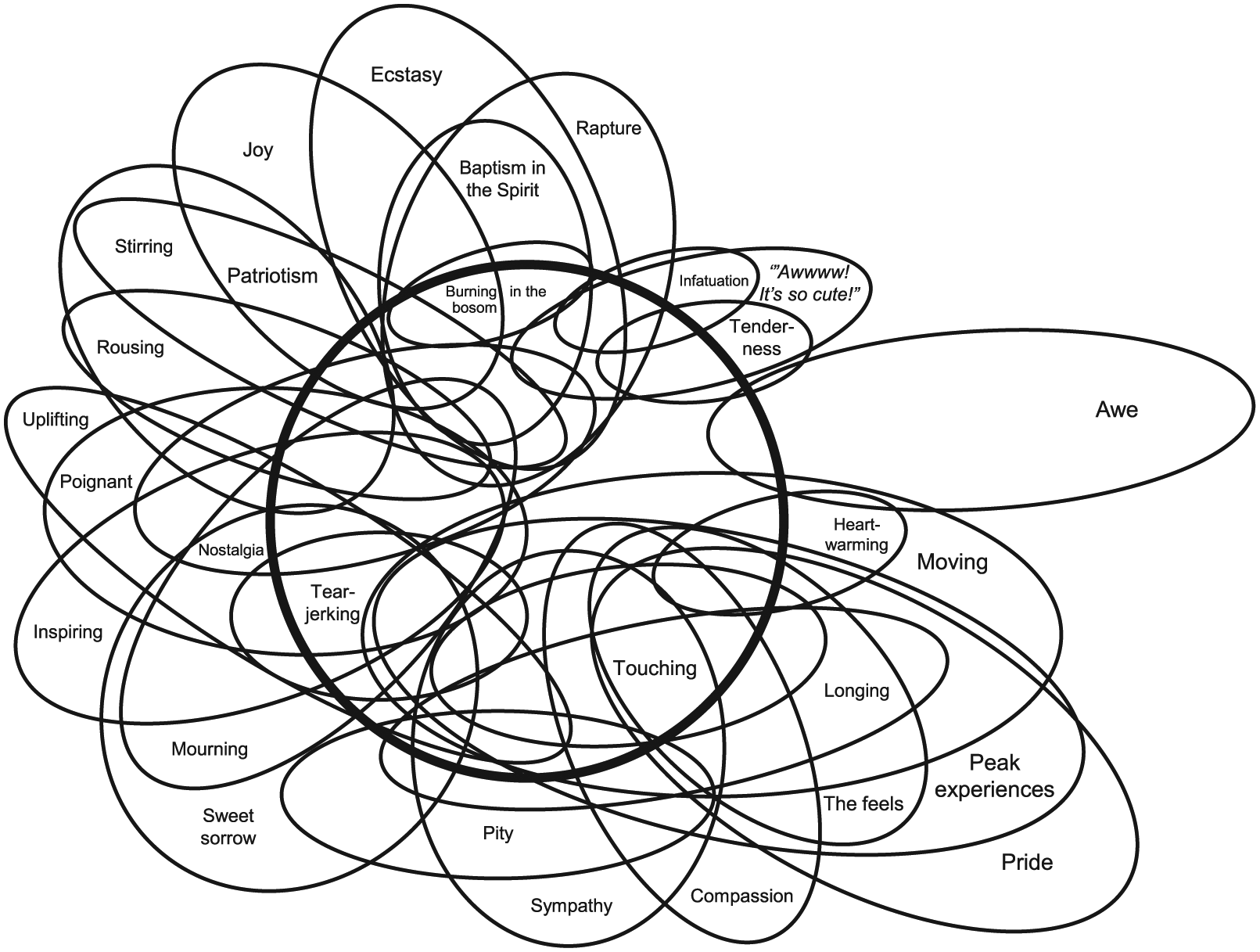
Schematic of the denotational fields of some of the English vernacular terms related to kama muta. Bold circle indicates the kama muta construct.
The Experience of Kama Muta and the Relationships Whose Sudden Intensification Evokes It
Several studies tie the physiological sensations in Feature Set 3 to labels relevant to Feature Set 5 (Benedek & Kaernbach, 2011; Oliver, Hartmann, & Woolley, 2012; Panksepp, 1995; Sloboda, 1991; Strick, de Bruin, de Ruiter, & Jonkers, 2015; Vingerhoets, 2013; Vingerhoets & Bylsma, 2016; Wassiliwizky et al., 2017; Wassiliwizky et al., 2015). Our own work confirms these findings. In one study, we asked different sets of participants each to rate just one of six variables continuously while watching short video clips that were commented on as “moving” or “touching” on social media. Among the rated variables were feelings of “being moved or touched” and physiological responses of crying, goosebumps, and felt warmth in the body. We then cross-correlated the time series resulting from averaging these ratings. Moment-by-moment reports of feeling moved and touched cross-correlated strongly with moments of reported crying, goosebumps, and felt warmth (Schubert et al., 2016; see following lines for more results from this study).
We have shown the same or similar videos and immediately afterwards asked about appraisals, feelings, sensations, and motivations. When we compared the outcome when American and Norwegian samples watched a moving video to watching sad, happy, and frightening videos, we found that the combination of warm feelings in the chest, weeping, and goosebumps was uniquely associated with seeing moving videos (Seibt, Schubert, Zickfeld, & Fiske, 2017). In another study, we compared reactions to such video clips in seven samples in five different cultures (US, Norway, China, Portugal, and Israel). In all samples, ratings of the viewing experience as “moving and touching,” or translations of these terms in the respective languages, covaried with tears, a feeling of warmth in the chest, and chills or goosebumps (Seibt, Schubert, Zickfeld, Zhu, et al., 2017).
Kama muta may appear to be related to Haidt’s construct of “elevation,” which indeed has been measured with scales including items asking about being “moved” and “touched,” and sometimes sensations of warmth in the chest, goosebumps, and chills (Algoe & Haidt, 2009; Haidt, 2003; Thomson & Siegel, 2016). Haidt and colleagues define elevation as an emotion experienced when observing or hearing about “moral beauty” or acts that reveal “humanity’s higher or better nature.” We believe that when a person observes a dramatic act of compassion, kindness, or sacrifice that indicates intense CS, they experience a specific emotion. Whether we call the resultant emotion “elevation” or “kama muta” is just nomenclature. But we believe that acts of authority ranking, equality matching, or market pricing virtue do not evoke kama muta. Moreover, moral beauty or even virtue is not necessary to kama muta.
Our interviews, participant observation, and experiments show that all five sets of features of kama muta can be evoked by kittens (Steinnes, 2017), by viewing the first ultrasound of one’s baby, participating in Sufi worship, listening to poems that tell of suffering that the listener identifies with, sharing intimate secrets about fears and traumas, gathering for holiday meals, seeing commercials that evoke nostalgic memories, or simply coming home after an absence (A. P. Fiske et al., in press). These events do not involve “moral beauty” or “manifestations of humanity’s higher or better nature” unless the definitions of these terms are stretched quite far.
Furthermore, elevation is conceptualized as occurring when one observes or learns about something, implying an observational third-person stance, while kama muta is not restricted to third-person experiences. One can feel kama muta when one merges into a single being in perfect synchrony with other rowers in a boat (Brown, 2013). In 132 Americans’ reports of a recent experience of “positive tears,” we found that they rated the events they witnessed (or read or saw on screen) as no more moving and touching than events in which they personally participated (Seibt, Schubert, Zickfeld, & Fiske, 2017). For example, they reported being moved when going trick-or-treating with a child, at graduation, when receiving a happy birthday phone call from an ex-husband, and when remembering working closely with friends to lose weight for a wedding. There is certainly a moral facet involved in some experiences of kama muta, but we posit that it is limited to the morality of CS: loving-kindness, compassion, and sacrifice for the group or partner (on CS morality vs. the moralities of the other three fundamental relational models, see Rai & Fiske, 2011). Further research will be needed to determine whether elevation is a specific form of kama muta or a distinct emotion in itself.
The Function of Kama Muta and Its Biological and Cultural Evolution
Communal sharing is one of the four basic relational models that humans use to coordinate all aspects of social life; it consists of treating the focal aspect of participants in the dyad or group as equivalent (A. P. Fiske, 1991, 1992, 2004). Partners may share an identity, a resource, land, a decision, a task, or a responsibility. Participants feel love, affection, solidarity, and identification with each other; their feeling that they are kin or one kind makes it feel natural to be kind. Going far beyond the kin-based bonds and troops in other species, human CS bonds are uniquely numerous, dynamically flexible, and generatively capable of coordinating any new sort of cooperative endeavor. This enormously enhances inclusive fitness—
This is what kama muta does: with precise temporal and personal discrimination, it motivates instantly updated devotion and commitment to a CSR when something suddenly makes that particular CSR newly promising, or its potential is suddenly renewed (Steinnes, 2017; Zickfeld, 2015).
We hypothesize that the motivation to devote and commit to CS is primarily (but not solely) oriented to the relationship with the particular partner(s) in first- and second-person kama muta, but more diffuse in third-person kama muta. Since caring, kindness, and connection are core features of communal sharing devotion and commitment (cf. Hollan & Throop, 2011), this raises the question of how the attitude, trait, or emotion of empathy or compassion are related to kama muta. In a meta-analysis of 16 of our studies with 2,918 participants, Zickfeld et al. (2017) found that self-reported trait empathic concern—the disposition to feel compassion when seeing someone in need—correlates (r = .35) with self-reports of being moved and touched by our kama muta stimuli and participants’ recalled kama muta experiences. Across these 16 studies, trait empathic concern also correlates substantially with self-reports of the characteristic signs of kama muta: warmth (especially in the chest), tears or moist eyes, and goosebumps or chills. This suggests that feeling compassion is a specific form of kama muta in the particular context of perceiving another’s need.
Similarly, in two studies, Steinnes (2017) found that emotional responses to images of cute animals (who presumably are vulnerable, in need of care and protection) have all the features of kama muta (sensations, perception of suddenly increased closeness, positivity, desire to share the emotion with others, motivation to care for others, and labels such as “heart-warming,” “moved,” and “touched”). In short, often a person’s heart suddenly goes out to another person in need, or to cute and cuddly kittens: the perceiver feels immediate CS care and compassion, evoking first-person kama muta. Steinnes found that cute animals licking or cuddling (perceived as intensifying a CSR) were rated as cuter and evoked more kama muta than the same animals when they were not interacting affectionately. This is third-person kama muta added to first-person cuteness kama muta.
The fact that cuteness, vulnerability, and need evoke kama muta makes sense given our assumption that the phylogenetic source of kama muta is maternal bonding to newborns. The generativity of human kama muta makes it flexibly adaptive. This explains why kama muta occurs in response to babies, kittens, marriage proposals and weddings, rituals of solidarity, religious moments of union with divinities, homecomings and reunions, the kindness of strangers, sentimental narratives and cinema, addiction recovery groups, team spirit moments in war and sports, oratory, marketing, choral singing, making and listening to music, dancing, rowing, and so forth.
We posit that humans have an evolved disposition to attend to indices of sudden intensification of culturally important CSRs, mapping these opportunities onto culturally fruitful forms of devotion and commitment (A. P. Fiske et al., in press). That is, there is a psychological mechanism consisting of a function that maps CS opportunities onto fresh motivation to devote and commit to those newly opportune CSRs. By its very nature, this mapping function is culturally informed. It is socially functional and biologically adaptive only insofar as it takes culturally informed indices of CS intensification as the domain (input) of a function, then maps these intensifications onto a culturally appropriate range of motives to act in the particular ways that are locally effective in enhancing the specific CSRs that are important in the participant’s community. (In alternative terminologies, culturally oriented, culturally informed CS devotion and commitments are the “image” or “output” of the kama muta function.) We posit that this innate kama muta function is evolutionarily adaptive when (and only when) it operates to devote and commit people in the culturally appropriate manner to the particular intensifications of the specific CSRs that enhance inclusive fitness in the particular culture. At the same time, building on this evolved kama muta adaptation, relatively rapid processes of cultural evolution construct many practices that diffuse and endure simply because they evoke this attractive emotion, without thereby promoting the biological fitness of the people who participate.
How can an innate, biologically evolved mechanism do this culturally attuned mapping? People naturally cognize, communicate, constitute, and commit to CSRs in an indexical semiotics in which their bodies represent their social selves (A. P. Fiske, 1991, 2004; A. P. Fiske & Schubert, 2012). This conformation system is called consubstantial assimilation—the assimilation of bodies to each other. People feel CS:
• When they feel that the essential substances (e.g., blood, genes) of their bodies are the same.
• When they interchange essential substances (e.g., semen, breast milk, ritual food and drink).
• When they feed each other, eat and drink commensally, or share tobacco and other comestibles.
• When they caress, groom, kiss, snuggle affectionately, or sleep alongside each other;
• When they move in rhythmic synchrony (in military drill, rowing, working in time to drums or ditties, in ritual or other dance).
• When they mark or modify their bodies alike (e.g., with ethnic scarification, tattoos, body paint, the same kind of circumcision or excision, or wear uniforms).
When these acts of consubstantial assimilation are habitual and routinely taken for granted, they continuously express and sustain a CSR—but do not tend to evoke much kama muta. The evolved kama muta function is tuned to respond to extraordinary, remarkable, wonderful, special, or unexpected acts of consubstantial assimilation.
By association and inference, the adaptive mechanism can also learn to respond to linguistic or other symbolic cues of sudden CS intensification, though not usually as readily or as strongly as to indexical acts of consubstantial assimilation. In either case, through experience, the kama muta function adjusts to tune itself to the particular forms of consubstantial assimilation that are strikingly meaningful modes of constituting and committing to the particular CSRs that are salient in a particular culture. Such modes include the bride and groom kissing, feeding each other wedding cake, and dancing; the circumcision or excision of the initiates; touching a holy shrine; or, in a romantic culture of true love, intimate sexual union.
As we will show in what follows, our reading of ethnographies, histories, primary source documents, and media, together with our own observations and experiences of contemporary cultures, our interviews, and our focused participant observation suggest that practices that evoke kama muta are ubiquitous (A. P. Fiske et al., in press). Why? Culture consists of whatever people do, have, know, want, avoid, or experience because they participate in a particular community or network. In particular, let us consider cultural practices, institutions, roles, narratives, arts and artifacts (hereafter, all denoted as “practices”). Practices endure and become widespread only if they attract attention; if people seek to participate in them and find them engaging; if people remember them vividly; if people want to reenact, reproduce, transmit, or communicate them; and if performing and participating in them affords other desirable social relationships.
The nature of kama muta is such that when a practice evokes kama muta, it captures people’s attention; people seek it out, attend or participate, and invite others to attend or participate together with them. People remember the practice and want to reenact it. They talk about it, create visual representations of it, and, in contemporary cultures, write about, post, blog, share online, and broadcast it on radio and television. Consequently, people are motivated to craft art, artifacts, representations, activities, and events to evoke kama muta in others; those who succeed in so evoking kama muta in others are much admired and sought out, further motivating people to create such practices. Shaped by these selective forces of the psychological disposition to kama muta, cultural evolution has generated and sustained numerous practices that evoke kama muta. Examples are many aspects of religion and life-cycle rituals, common narrative and media themes, forms of music and art, marketing campaigns and political oratory, memorials and patriotic rituals, tropes of war and sports, and the domestication and keeping of pets (A. P. Fiske et al., in press).
Cultural Practices, Institutions, Narratives, and Artifacts That Evoke Kama Muta
Where does kama muta occur and what meanings can it have? Most people engage in many CSRs every day. But how often and when do CSRs suddenly intensify? Interviews and diary studies suggest that in contemporary Western cultures, people experience kama muta in a great many domains of life (about three times a week in an unpublished Norwegian diary study with daily recall that we did; Seibt & Schubert, 2017), though strong and memorable kama muta experiences are less frequent. The peak experiences that contribute to meaningful lives are often kama muta moments, according to our interpretation of the literature (Ho, Chen, Hoffman, Guan, & Iversen, 2013; Maslow, 1962, 1970; Wuthnow, 1978).
Kama muta occurs incidentally in everyday life in all kinds of events that are not always culturally structured especially to evoke it. Examples are childbirth and nursing, return of a loved one from war, kindness to strangers and the rescue or care for those in need, friends who are “there for you” when you need them, and courageous loving sacrifice for comrades in war. But one of the most intriguing things about kama muta is how often it is evoked by various practices that appear specifically “designed” to evoke it. That is, there are many cultural practices (e.g., weddings, funerals, winners’ thanking supporters), institutions (e.g., Pentecostal churches, Alcoholics Anonymous), roles (e.g., blues and country-and-Western singers, Pixar animators, Sufi saints), arts (e.g., icon painting, opera, some kinds of dance, some kinds of cinema), artifacts and architecture (e.g., engagement rings, the Vietnam War Memorial, shrines) whose major functions include evoking kama muta. Kama muta, in turn, motivates devotion and commitment to the CSRs entailed.
The most universal and salient plot lines of Western and world literature, as well as modern “sentimental” literature, consist of narratives in which two people who love each other are separated, struggle to be reunited, and are finally reunited (in “comedy”) or display and declare their undying love (in “tragedy”; A. P. Fiske et al., 2017). In the space remaining we focus on the wide variety of such cultural practices whose primary function—or one of whose major functions—is to evoke kama muta. They shape our emotional lives to a remarkable but barely remarked degree.
We posit that the activation of the innate psychological mechanism that disposes people to feel kama muta, and then the manner in which they act, depend on cultural precedents, prototypes, paragons, paradigms, and precepts. In the terms of complementarity theory, these are the cultural preos, while the universal psychological mechanism is a mod (A. P. Fiske, 2000). The preos for the kama muta mod are essential for realizing it in any particular moment because they determine:
What the intensification of each specific kind of CSR
Whether and precisely
Once people experience kama muta,
In short, any experience of kama muta is the joint product of a biologically evolved adaptive system, together with that system’s cultural complements that are necessary to give it a particular form. That is, the innate adaptive system is sensitively oriented to, and its realization depends on, cultural parameters specifying how to implement it. In the rest of this article, we illustratively set out the
Homo Movens
In all of the practices we describe next, a CSR suddenly intensifies, and people commonly shed tears but report they are happy and/or actively seek the experience and attract others to participate together with them. There is often evidence of other characteristic kama muta sensations and signs. CS devotion sentiments and commitment motives can often be inferred from accounts of social events, but not always discerned with certainty.
If Homo movens lives in a Western culture, blogs and informal interviews indicate that an important
Although these affordances, constitutive signs, performances, and promises seem entirely natural to most readers of this article, they all depend on Western cultural preos: in most other cultures throughout history there have been no proposals or engagement rings, no ultrasounds, in many cultures no weddings in the Western sense, and no Mother’s Day. Many traditional Africans consider kissing gross. In some cultures, giving a puppy would be a
People also like to evoke kama muta in their partners in CSRs, inviting them to view or hear a video, performance, or story that evoked kama muta in oneself. This sharing of media content is an important contemporary
In cultures around the world, reunions
Occasions that require specific kama muta
In Papua New Guinea, when Kaluli (Bosavi) hear the beautiful calls of the visually elusive fruit doves and other birds of the rainforest canopy, they interpret the bird calls as the cries of their children who have died and whose bird spirits still plead for food (Feld, 1990). Feeding is the focal Kaluli constitutive sign of CS caring, compassion, and kinship (Schieffelin, 1976). So these calls apparently evoke kama muta. Furthermore, when they feel kama muta, Kaluli women sing melodic four-pitch “choked-up and breathy” weeping laments which are also said to sound like the calls of the fruit doves (Feld, 1990). In addition, Kaluli men have an elaborate esthetics of kama muta. From time to time, a group of men compose songs and construct elaborate feather costumes, and then go together to the men’s house of another village for a gisaro performance (Feld, 1990; Schieffelin, 1976). When the visitors’ songs evoke mnemonic kama muta in one of the host men in the audience, the affected listener, first sad, then enraged at the singer for making him feel the loss of his loved one, grabs a torch and burns the dancer, often seriously. The crying burner may then hug the singer before going outside to cry some more. The dancer keeps singing, to be burned again by other men whom he subsequently moves to tears of nostalgic love. Eventually another singer replaces him, trying in his turn to evoke the same nostalgic kama muta—and get burned for it. The entire
In ancient Greece, the Homeric heroes were portrayed as unabashedly expressing an “appetite” for nostalgic weeping. They would declare the desire to weep, for example, over their memories of warrior comradeship at Troy, and weep together until their appetite was satisfied (e.g., Homer, 2011a, 4:102, 24:507–514; Homer, 2011b, 4:194, 4:102–103, 15:398–401, 16:213–219). Such comradely weeping was a
While the sudden intensification of CS is most often a temporal dynamic, kama muta is also
World Religions: Sudden Union With a Divinity
Homo movens in each culture learns to respond appropriately to the specific local
• A Pentecostal or charismatic Homo movens learns to feel and
• A Catholic taking communion on a special occasion, a Marian pilgrim arriving at Lourdes, or a haji arriving at the Ka’ba learns to feel and
• A Sufi Muslim learns to chant and sway or swirl until they attain a state of hal with Allah, which they may perform with goosebumps, ecstatic movements, and sometimes culminating with collapse into torpor (Frishkopf, 2001; Nasr, 1972/1980).
• By reading or hearing recitations of the Upanishads while observing and imitating other listeners, a Krishna worshipper learns to get goosebumps and perhaps weep in devotion, or at least to identify with the loving goosebumps of the cow-herd girls whose erotic bhakti attachment to Krishna is the prototype for Krishna worship (Hardy, 1983; Schweig, 2005).
A devoted Buddhist reads that the final stage of a bodhisattva’s path to moksha (enlightenment and cessation of perpetual rebirth) is indexed by his goosebumps and tears on hearing a Mahāyāna sutra (aphorism of the Buddha; Buswell & Lopez, 2013).
• The Jātaka stories of the past lives of the Buddha likewise tell that, encountering the perfect self-sacrificing compassion of the Buddha, humans and even the earth itself broke out in goosebumps of kama muta (Dhammarama & Bareau, 1963; Khoroche, 1989, pp. 58–59). Likewise, contemporary women Buddhists in the Ciji movement are known for their weeping
Kama muta theory posits that these and many other core religious experiences of kama muta are produced by practices that were culturally selected precisely because they strongly afford kama muta, and hence they are “contagious” (Sperber, 1985) and endemic. Perhaps
In constructing his sociology, Emile Durkheim (1912/1991) assiduously eschewed psychology—so far as possible. But he posited that the fundamental social bonds that constitute society arise in ritual experiences in religious gatherings that generate “collective effervescence”—which sounds to us a lot like kama muta. Like collective effervescence, kama muta is evoked by many religious rituals; it motivates sentiments of devotion to CSRs and creates moral commitment to core social groups. Among many anthropologists who used Durkheim’s framework for ethnographic analysis, Victor Turner’s work (Turner, 1969) is particularly relevant here. Turner studied rituals among the Ndembu (of what is now Zambia), finding that some rituals did indeed create a state that Turner famously called “communitas.” He defined communitas as the suspension and antithesis of “structure,” by which he mainly meant legitimate hierarchy. Like Durkheim, Turner eschewed psychology, and so, like Durkheim, Turner was never clear about whether what he described as communitas is a relational state corresponding to what we call communal sharing (see the discussion in A. P. Fiske, 1991), or whether communitas is a momentary emotion.
In sum, kama muta theory posits that when people perceive the sudden intensification of any sort of CSR they are likely to experience an emotion that generates CS devotion and commitment motives. They may feel warmth in the chest, tears, goosebumps, buoyancy, elation, or certain other sensations. They may place their palm(s) on their chest or say something like aww! They may label the emotion, especially with passive verbs meaning “moved,” “stirred,” “touched,” or “touches my heart.” The universal psychosocial mechanism of kama muta is closely attuned to culture and context so that it responds to culturally shaped indices of intensification of culturally propitious CSRs. And its cultural tuning orients the consequent motives so that people aim to sustain the CSR in a locally appropriate manner. This means that to understand the social relational psychology of kama muta, we need to characterize the full domain of culturally diverse CSR intensifications to which it responds, together with the full range of culturally apt devotion and commitment motives that it generates. To understand the mapping of these inputs onto these outputs, we need to collate data about a great variety of CS intensifications in many truly diverse cultures.
Footnotes
Acknowledgements
We are grateful to Andrew Beatty, Jonathan Haidt, Richard A. Shweder, Kamilla Knutsen Steinnes, and Janis H. Zickfeld for their perceptive, cogent, and constructive comments on earlier versions of this manuscript. Their comments enabled us to improve it considerably. Many of the ideas in this manuscript were developed and refined in fruitful discussions with Janis H. Zickfeld, Johanna Katarina Blomster, Kamilla Knutsen Steinnes, as well as audiences and fellow speakers at several conferences, symposia, and colloquia.
Declaration of Conflicting Interests
The author(s) declared no potential conflicts of interest with respect to the research, authorship, and/or publication of this article.