




Abstract
The field of emotion regulation has developed rapidly, and a number of emotion regulatory strategies have been identified. To date, empirical attention has focused on contrasting specific regulation strategies to determine their unique profile of consequences. However, it is becoming clear that people commonly pursue multiple regulation approaches within any given emotional episode (e.g., pursuing different regulation goals, strategies, or tactics). We refer to the concurrent or sequential use of multiple approaches to regulate emotions within a single emotion episode as polyregulation. Here, we extend existing theoretical frameworks of emotion regulation to consider polyregulation. We then pose several core questions to summarize and inspire research on polyregulation, thereby improving our understanding of emotion regulation as it unfolds in everyday life.
Research on emotion has grown dramatically in recent decades and has catalyzed the emergence of the field of affective science, a discipline centered upon understanding emotion and related affective processes (e.g., DeSteno, Gross, & Kubzansky, 2013; Gross & Barrett, 2013; Tracy, Klonsky, & Proudfit, 2014). One of the enduring questions in affective science—indeed, a question that has been asked for millennia by scientists and philosophers alike—is how people go about trying to manage or regulate their emotions. A growing body of research has convincingly demonstrated that emotion regulation plays a key role in well-being, psychopathology, physical health, and interpersonal functioning (Bonanno, Papa, Lalande, Westphal, & Coifman, 2004; Butler et al., 2003; DeSteno et al., 2013; Gross, 1998, 2007, 2014, 2015; Gruber, Harvey, & Gross, 2012; Halperin, Porat, Tamir, & Gross, 2013). Thus far, much of this important work has focused on carefully examining specific emotion regulation approaches in isolation—examining single regulation goals (the emotion people want to feel), single regulation strategies (the type of regulation they select), or single regulation tactics (the specific implementation of a strategy)—to establish unique psychological effects of each approach (e.g., Ford & Mauss, 2014; Gross, 2002; McRae, Ciesielski, & Gross, 2012).
The field is now ripe for the next generation of research that more fully embraces the complexity of emotion regulation in everyday life. This involves expanding beyond studying individual regulation goals, strategies, or tactics in isolation by considering the more complex ways that people often manage emotions in their daily lives (Aldao, Sheppes, & Gross, 2015; Bonanno & Burton, 2013; Bonanno et al., 2004). While individuals often respond to emotions by trying to regulate them (Gross, 1998, 2015; Koole, 2009; Thompson, 1994), regulating an emotion is rarely as simple as choosing one regulation approach, using it, and then disengaging from it. Here, we focus on an underexamined facet of emotion regulation by considering the idea that individuals often use more than one approach to regulate a single emotion episode (e.g., adopting multiple regulation strategies within a given episode). We refer to this phenomenon as emotion polyregulation, which borrows from the well-known construct of “polypharmacy” in the psychiatric and medical fields that describes the use of more than one form of medication during a single illness (e.g., Gurwitz, 2004).
Embracing the idea that people often use more than one regulation approach within a single emotional episode represents a contrast from how research has typically considered emotion regulation. For good reason, research has historically focused on single emotion regulation approaches employed in isolation. We propose that this earlier, more targeted, approach to emotion regulation—while providing an important foundation for current research—has generated a large gap in emotion regulation knowledge that the field is now well poised to address. Recently, a small but growing body of research has begun to provide proof of concept that polyregulation has a place in the broader framework of emotion regulation. As such, the present treatment builds upon theoretical models of emotion regulation to provide a useful framework to scaffold research on this understudied topic by articulating the concepts and processes underlying polyregulation and then posing a core set of questions that can summarize current work and guide future research.
Historical Roots
Given the lack of empirical work examining polyregulation, it may seem surprising that the notion of polyregulation has strong historical roots, including key sources of inspiration in coping and emotion regulation literatures. The seminal literature on coping pioneered by Lazarus (1966) traditionally focused on attempts to manage stress. This literature featured early theoretical acknowledgements that coactivation of coping strategies was common. Over the subsequent decades, coping research has expanded to capture literally hundreds of distinct ways individuals manage stress (for reviews, see Parkinson & Totterdell, 1999; Skinner, Edge, Altman, & Sherwood, 2003). Many of these coping approaches are nonmutually exclusive and thus highlight the likelihood that individuals will employ multiple approaches at once.
Subsequent models of emotion regulation (Gross, 1998; Koole, 2009; Thompson, 1994) focused on attempts to influence momentary emotions, including when one has emotions and how one experiences or expresses these emotions. This literature on emotion regulation has acknowledged that multiple regulation approaches could potentially be implemented within an emotional episode concurrently (i.e., at approximately the same time) or sequentially (i.e., one after the other, as monitoring processes reveal a continued need to regulate; Gross, 2015). Although these theoretical models of coping and emotion regulation point to the complex and dynamic nature of managing one’s emotions, they have not yet devoted explicit theoretical discussion to a polyregulation approach. This represents a core gap in the literature given that a polyregulation approach may better account for how regulation unfolds in everyday life.
Despite the long-standing acknowledgement that different forms of coping or emotion regulation often occur in parallel or in rapid succession in everyday life, empirical work has remained largely restricted to measuring “pure” forms of emotion regulation, and for good reason: for example, by carefully targeting a small number of specific regulation strategies used one at a time, researchers can make direct comparisons between specific strategies (e.g., Gross, 2002; Gross & John, 2003). This work has included experimental research on basic emotion regulation processes, often focusing on which strategies are most effective to use in the short run (e.g., Webb, Miles, & Sheeran, 2012), as well as correlational research on individual differences in emotion regulation, often focusing on which strategies are most adaptive to use in the long run (e.g., Aldao, Nolen-Hoeksema, & Schweizer, 2010). This research has provided pivotal insights across several domains, including the affective, cognitive, and physiological consequences of specific emotion regulation strategies (Gross, 2002; Richards & Gross, 2000); the importance of positive emotion regulation in fostering psychological well-being (e.g., du Pont, Welker, Gilbert, & Gruber, 2016; Kashdan, Young, & Machell, 2015; Tugade & Fredrickson, 2006); and the role of emotion dysregulation in psychopathology (e.g., Cole, Michel, & Teti, 1994; Sheppes, Suri, & Gross, 2015). The rapidly expanding field of emotion regulation has also recently drawn attention to emotion regulation flexibility, which concerns the use of multiple emotion regulation strategies that are selected to correspond to changes across emotional episodes (Aldao et al., 2015; Kashdan & Rottenberg, 2010). Now that this foundational work has been conducted, a new generation of emotion regulation research is ready to emerge. Indeed, the notion of polyregulation suggests promising new avenues for research on emotion regulation flexibility by suggesting that flexibility may arise not only by using one strategy versus another across emotion episodes, but also in using sequences or blends of emotion regulation approaches within emotion episodes.
Expanding Existing Theoretical Frameworks to Consider Polyregulation
To articulate the ideas underlying polyregulation and inspire future systematic work, we present a theoretical framework that can be fruitfully expanded to consider polyregulation. First, we describe a canonical emotion regulation episode and describe how polyregulation is compatible with and builds upon fundamental emotion regulation processes. Second, we walk through each stage in the emotion regulation process and discuss how polyregulation could occur at each stage. Third, we consider different time courses on which polyregulation could be initiated. Lastly, we consider different processes that may lead an individual to engage in polyregulation.
Polyregulation Builds on Fundamental Emotion Regulation Processes
Our approach towards emotion polyregulation is informed by our understanding of fundamental emotion regulation processes, as they have been described by more traditional emotion regulation frameworks. Although traditional frameworks have often focused on individuals’ use of singular emotion regulation approaches within a given emotional episode (e.g., Ford & Mauss, 2014; Gross, 2002; McRae et al., 2012), these approaches can be expanded to consider polyregulation. We use the term “emotional episode” to indicate anything starting from the stimulus (which can be external or internal) to the later components or immediate consequences of the emotion (Moors, 2009), while also allowing for dynamic changes in experience over time (Davidson, 1998, 2015). Here, we outline the fundamental processes that occur during a given regulation episode (see Figure 1), which we will later build upon to consider polyregulation.
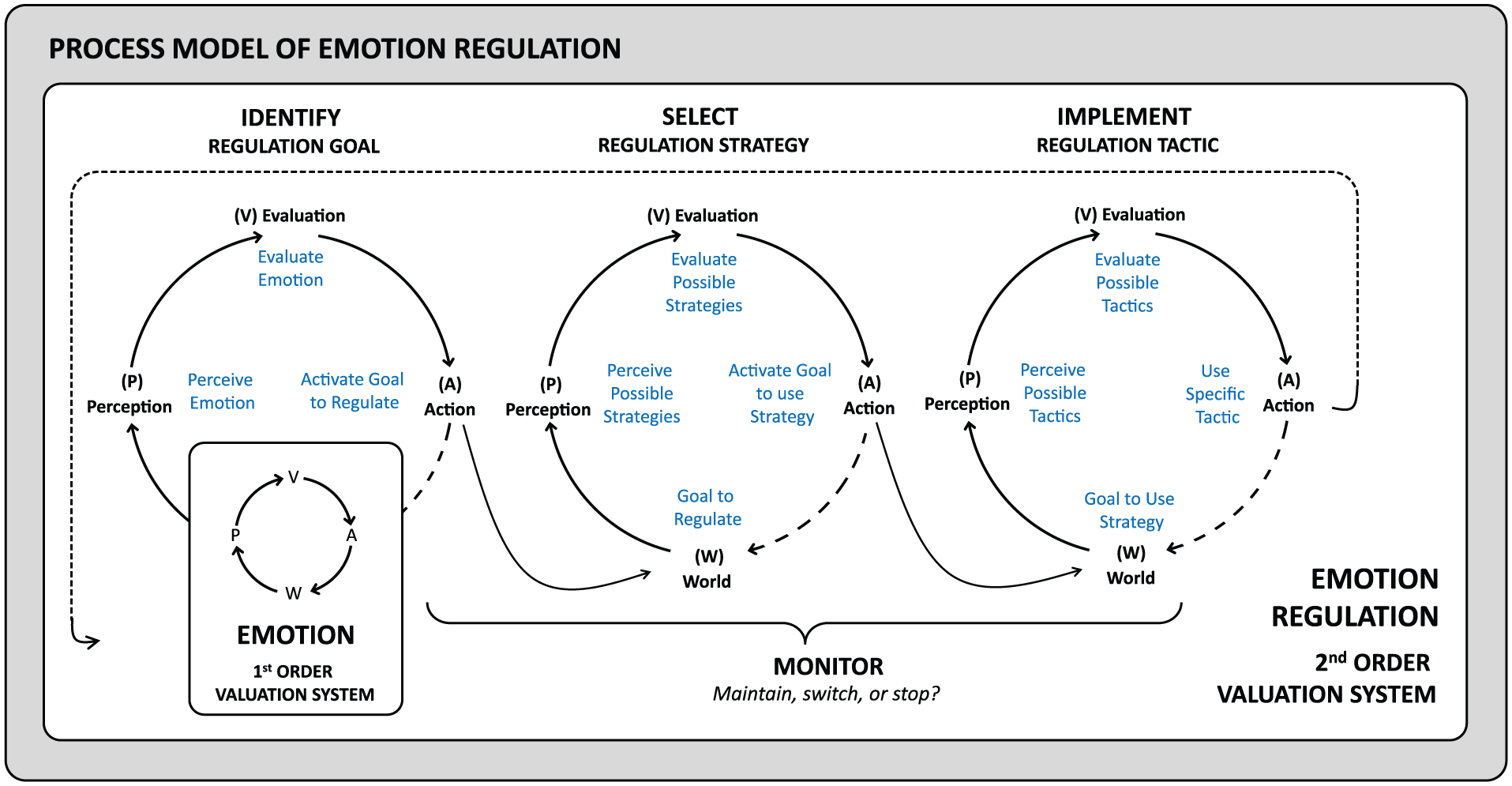
The canonical process model of emotion regulation (Gross, 2015). An emotion is a first-order valuation system representing a response to the world, and emotion regulation is a second-order valuation system representing a response to an emotion. The process of emotion regulation (notated in blue) can be understood as unfolding across multiple predictable systems whereby the world (W) is perceived (P), evaluated (V), and then acted upon (A). Specifically, emotion regulation consists of linked systems that involve identifying a regulation goal, selecting a regulation strategy, and implementing a particular regulation tactic. Implementing a particular tactic results in a possible change to the original emotion, which may then be reevaluated for another regulation cycle. Individuals monitor their progress throughout this process.
Following from the process model of emotion regulation (Gross, 2015), an emotion is considered to be a phenomenon that centrally involves valuation, or an assessment of the extent to which some feature of the world, broadly construed, is good versus bad. This valuation process begins with the world (W, which can be external or internal), which is perceived (P) and evaluated (V) to determine the extent to which it is good or bad compared to an individual’s desired state of the world. Following the evaluation, an individual may then be motivated to engage in action (A) to change the state of the world. In many cases, the action that results from an emotion is functional, helping the individual flexibly respond to changing situational demands (Frijda, 1988; Keltner & Haidt, 1999). Given that emotions can provide critical motivation to change our circumstances for the better, it is neither necessary nor adaptive to always try to regulate these emotions (Ford & Troy, 2019; Troy, Shallcross, & Mauss, 2013). That being said, the functional and hedonic implications of emotions render them as natural targets of further evaluation and regulation. Indeed, many different valuation systems can operate at once and even interact with each other (Rangel, Camerer, & Montague, 2008). This idea sets the stage for emotion regulation: whereas emotion is a first-order valuation system where the original input to the system is the state of the world, emotion regulation represents a second-order valuation system where the original input to the system is a first-order valuation system—the emotion (see Figure 1, for a visual depiction of these interconnected valuation systems).
Emotion regulation, in turn, is a dynamic multistage process where each stage in the process can trigger a subsequent stage. First, individuals identify a regulation goal (or goals, in the case of polyregulation). Second, they select a particular regulation strategy (or strategies, in the case of polyregulation). Third, they implement a particular regulation tactic (or tactics, in the case of polyregulation). This process may result in a change to the original emotion, which may then be reevaluated for another regulation cycle. Throughout this process, individuals monitor their progress and decide whether to maintain, switch, or stop the current approach.
Polyregulation Can Occur at Multiple Emotion Regulation Stages
Building on the process model, it is possible to theorize about how and where polyregulation might occur (see Figure 2). First, the identification stage involves identifying an emotion regulation goal. As shown in Figure 1, the identification stage is a valuation system itself, consisting of three steps. In the perception step (P), the emotion is detected. In the valuation step (V), the emotion is evaluated to determine whether regulation is necessary. If the value to regulate is strong enough, the action step (A) will activate an emotion regulation goal. As shown in Figure 2 (Panel A), more than one regulation goal can be activated within the same regulation episode. It is important to note that these emotion goals may be hedonic in nature (i.e., aimed at increasing pleasure or decreasing pain), but may also be instrumental in nature (i.e., aimed at achieving other valued outcomes which can involve the up- or down-regulation of any emotion; Tamir, 2016). Furthermore, we propose that these goals can be complementary (e.g., when faced with a humorous thought while attending a funeral, one can activate a goal to decrease one’s amusement while also activating a goal to increase one’s sadness), but these goals may also be contradictory, reflecting ambivalence (e.g., when preparing for a stressful work presentation, one can activate a goal to decrease one’s anxiety to feel better, but can also activate a goal to maintain one’s anxiety for the purposes of motivating one’s preparation of the presentation). Regardless of their content, activating these emotion regulation goals represents a change to the state of the world (W), which becomes the target of the next stage.

Polyregulation can occur at each stage in the emotion regulation process: identifying a regulation goal (i.e., multiple goals can be identified; see red and blue arrows in Panel A), selecting a strategy family (i.e., multiple strategies can be selected; Panel B), and implementing a specific tactic (i.e., multiple tactics can be implemented; Panel C). At each stage, monitoring processes will also help the individual determine the progress of their regulatory goal and may result in a shift in the polyregulation approach (i.e., a shift in emotion regulation goal, strategy, or tactic). For simplicity, this figure portrays only two branches at each stage, but more than two are possible at any stage. Also, each panel of the figure portrays polyregulation branches occurring at one stage, but it is also possible to have branching at multiple stages within a single emotional episode. Lastly, this figure portrays only one emotion being regulated at a time, but multiple emotions can occur within a given emotional episode and each may be a target of polyregulation.
Second, the selection stage involves determining which strategies will be used to pursue the emotion goal(s). In the perception step (P), different regulatory strategies are represented. In the valuation step (V), the costs and benefits of these strategies are evaluated in light of relevant features of the world that might influence the strategy (e.g., one’s cognitive resources; the intensity of the emotion). If a given strategy is evaluated sufficiently positively, the action step (A) will activate a goal to use that strategy. As shown in Figure 2 (Panel B), more than one regulation strategy can be selected within the same regulation episode. For example, people can aim to change the state of the world (i.e., engage in situation selection or modification strategies), change the focus of their attention (i.e., engage in attentional deployment strategies), change how they are thinking (i.e., engage in cognitive change strategies), and change their ongoing emotional response (i.e., engage in response modulation strategies). Given this diversity of approaches, it is plausible that multiple strategies may be useful for regulating a particular emotion (e.g., when faced with a humorous thought while attending a funeral, one can aim to increase sadness by both refocusing one’s attention and by changing one’s outward emotional expression). In turn, selecting one or more strategies represents a change to the state of the world (W), which becomes the target of the next stage.
Third, the implementation stage involves translating the selected strategy or strategies into situation-specific tactics. Although we refer to “strategies” and “tactics” dichotomously for simplicity, it is useful to think these two constructs as being on a continuum from relatively general regulatory approaches (strategies) to more concrete regulatory actions (tactics). In the perception step (P), different tactics are represented. In the valuation step (V), the costs and benefits of these tactics are evaluated in light of relevant features of the world that might influence the tactics. If a given tactic is evaluated sufficiently positively, the action step (A) implements the tactic. As shown in Figure 2 (Panel C), more than one tactic can be selected within the same regulation episode. Individuals have many different tactics to choose from (e.g., when aiming to decrease one’s anxiety when preparing for a stressful work presentation, one can select the broader strategy of cognitive change and then implement that strategy by both considering the possible benefits of the presentation while also downplaying any possible negative long-term consequences). See Table 1 for examples of tactics, as they pertain to the different types of strategies. These multiple tactics could, but need not, be implemented with the same level of effort (e.g., one’s effort could be balanced across tactics, but one’s effort could also focus on a primary strategy that is deemed more challenging to implement and/or is deemed a better “bet”). In turn, implementing an emotion regulation tactic or tactics represents a change to the state of the world (W), which in this case is the emotion itself—the original target of the emotion regulation process. At this point, monitoring processes will help the individual determine the progress of their regulatory goal(s) and may result in stopping the regulation, maintaining a similar approach, or shifting the approach (i.e., a change in emotion regulation goals, strategies, or tactics).
Emotion regulation strategy families and examples of tactics.
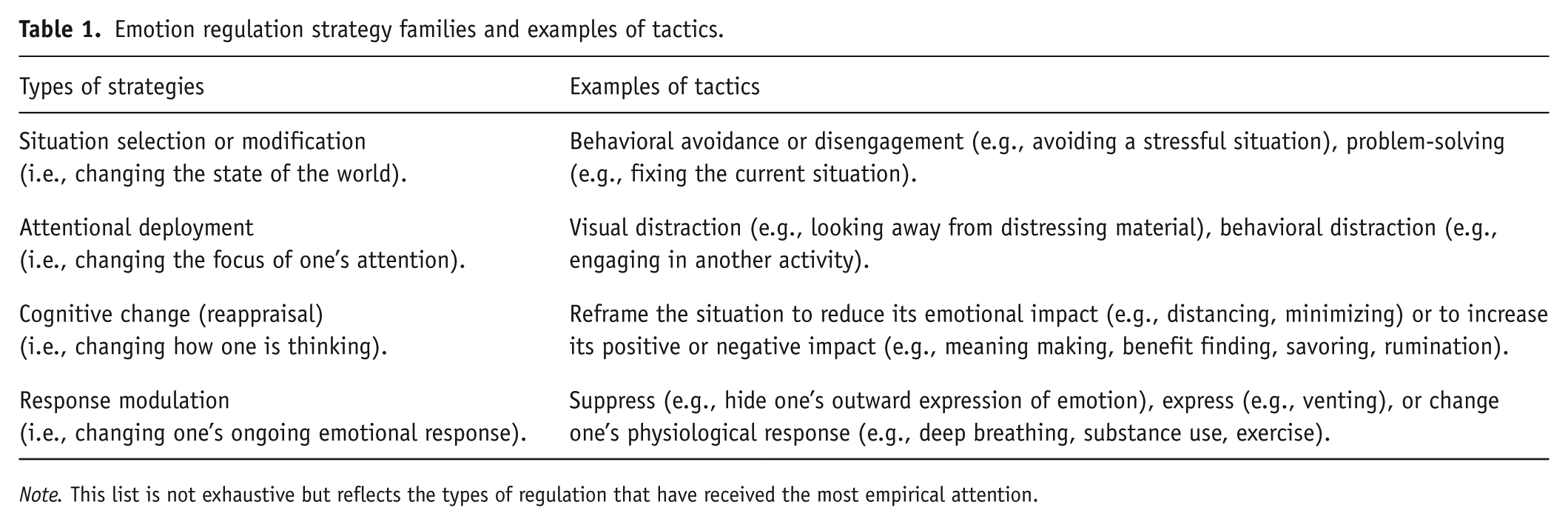
Note. This list is not exhaustive but reflects the types of regulation that have received the most empirical attention.
Thus far, we have discussed polyregulation occurring at only one stage in the emotion regulation process at a time—people either setting multiple goals, selecting multiple strategies, or implementing multiple tactics. Of course, more complex forms of polyregulation are also possible, as when an individual engages in polyregulation at multiple emotion regulation stages during the same emotional episode (e.g., identifying two or more emotion goals and selecting two or more strategy families for each of the emotion goals). One can imagine combining any of the panels in Figure 2 to portray such an example. Complexity can also occur when an individual attempts to regulate a mixed emotional episode, where an individual experiences two or more emotional responses in the same emotional episode. When an individual regulates two or more emotions within the same emotional episode, they may be especially likely to engage in polyregulation. In this context, polyregulation would occur if and when an individual selects different goals, strategies, and/or tactics for the different emotional responses. For example, during an argument with their partner, an individual who feels both angry at their partner and worried for the future of the relationship, may take a different approach for the two emotions by, for instance, engaging in deep breathing (a response modulation strategy) to reduce their anger while also reframing the argument as an opportunity to strengthen the relationship (a cognitive change strategy) to reduce their worry.
Polyregulation Can Occur on Different Time Courses
The examples in Figure 2 portray polyregulation as occurring relatively concurrently, wherein an individual pursues multiple emotion goals, strategies, or tactics at approximately the same time. However, polyregulation approaches need not unfold concurrently—polyregulation approaches may also unfold sequentially or somewhere in between (switching back and forth between two or more approaches across time).
The distinction between concurrent and sequential polyregulation is likely blurry and may be best represented as a spectrum where some examples of polyregulation are clearly concurrent (e.g., as when an individual seeks both social support and cognitive change at the same time by asking a friend to help them reframe a current stressful experience), some examples are clearly sequential (e.g., as when someone implements one tactic, monitoring processes determine that it was unsuccessful, and so the individual attempts another tactic), and some fall somewhere in between (e.g., as when an individual toggles between two tactics over time). Additionally, it is possible for polyregulation to occur both sequentially and concurrently if polyregulation is occurring at multiple regulation stages within a given regulation episode (e.g., as an individual sequentially pursues two different emotion goals but concurrently implements two or more tactics within each emotional goal).
Polyregulation Can Occur Via Different Processes
Different processes may lead an individual to engage in polyregulation. Namely, individuals may pursue multiple emotion goals, select multiple strategies, and/or implement multiple tactics strategically (e.g., a particular sequence or blend of strategies was deemed particularly useful), nonstrategically (e.g., the sequence or blend of strategies was a haphazard decision), or a mix of both within a specific emotion episode. An individual may strategically engage in a polyregulation due to the particular benefits the individual expects that approach to yield. A strategic approach may unfold sequentially (e.g., when faced with a misbehaving child, a parent could immediately suppress the outward expression of their anger and afterwards engage in cognitive change to reframe the moment as a learning opportunity for the child), but a strategic approach may also unfold concurrently (e.g., when faced with a misbehaving child, a parent could immediately suppress the outward expression of their anger and simultaneously modify the situation by calling upon their partner to provide a distraction to the child). An individual may also nonstrategically engage in polyregulation due to a failure to settle (e.g., launching more than one approach before assessing the success of the first approach) or a failure to adjudicate (e.g., launching more than one approach based on an inability to successfully choose the most promising approach). Nonstrategic polyregulation may also unfold either sequentially or concurrently.
We also note that a “decision” to engage in polyregulation (like many other forms of regulation) likely occurs quickly and with little deliberation. Even the strategic use of polyregulation could, but need not, be driven by a conscious and deliberate decision. That being said, there is likely to be much variability in the degree of deliberation involved in any given polyregulation attempt: strategic and nonstrategic polyregulation efforts may unfold outside of conscious awareness or with a high degree of intentionality. The extent to which a given polyregulation attempt is strategic (i.e., selected for its utility vs. selected haphazardly) is conceptually orthogonal to the extent to which the attempt is deliberate (i.e., effortful vs. automatic). For example, a high level of effort can be brought to a polyregulation attempt characterized by a disorganized selection of strategies (as in the case when someone double downs on a poorly selected polyregulation blend or sequence); or, a relatively low level of effort can be brought to a polyregulation attempt characterized by a useful selection of strategies (as when someone has automatized a particularly beneficial polyregulation blend or sequence). Overall, the degree of strategy and intentionality should vary by the situation, the individual, and the precise form of polyregulation under consideration (e.g., more practiced forms may be executed with relatively little deliberation).
Fundamental Questions to Guide Research on Polyregulation
Our goal in presenting a polyregulation perspective is to facilitate a new generation of exciting research questions. Towards this end, we outline several questions for researchers to consider, but also note that these are not exhaustive. For each question, we consider what we already know based on existing empirical findings and what we still need to learn.
Question 1: Who Uses Polyregulation?
Empirical findings
The short answer to this question might be “nearly everyone”. The available research that has captured polyregulation suggests that it is exceptionally common. For example, one early study reported that people use more than one type of strategy or tactic 1 in nearly all of their coping efforts (i.e., in over 98% of the > 1,000 discrete coping episodes assessed; Folkman & Lazarus, 1980). A recent experience sampling study has corroborated the wide-spread use of polyregulation, finding that participants reported using seven different emotion regulation strategies per negative emotion episode, on average (Heiy & Cheavens, 2014). People even commonly use multiple emotion regulation strategies when responding to daily positive episodes (Heiy & Cheavens, 2014). Another recent experience sampling study revealed moderate within-person correlations between six emotion regulation strategies used on a daily basis, suggesting that people who used one strategy during an emotion experience were likely to use others as well (Brans, Koval, Verduyn, Lim, & Kuppens, 2013). These important preliminary results tell us that people use polyregulation frequently in real life.
Experimental studies also support the spontaneous occurrence of polyregulation; for example, in one study, participants viewed a disgust-eliciting film clip and reported whether and how they chose to regulate their emotions (Aldao & Nolen-Hoeksema, 2013). Of the 87% of participants who chose to regulate their disgust, 65% chose to regulate their emotions using more than one strategy. Thus, participants often spontaneously draw on multiple emotion regulation strategies, even when not asked to regulate their emotions. Evidence for polyregulation also comes from research when participants were specifically asked to only use a single emotion regulation strategy. For example, the majority of participants who were asked to suppress their emotional facial expressions in response to both negative and positive film clips also used cognitive emotion regulation strategies (Demaree, Robinson, Pu, & Allen, 2006). Overall, these few studies from daily life and from the laboratory suggest that individuals commonly engage in polyregulation, in both negative and positive settings.
Future directions
Although research has suggested that most people may use polyregulation in daily life, research has not yet explored who, exactly, is more likely to engage in polyregulation. Preliminary work indicates that there is substantial variability in the extent to which people engage in polyregulation, thereby underscoring sizeable individual differences in polyregulation that need to be accounted for. For example, in one experience sampling study, participants used between 1 and 17 regulation tactics during each regulation episode, with a standard deviation of 3 strategies (Heiy & Cheavens, 2014). Future work would benefit from examining the factors that predict who is more (vs. less) likely to engage in polyregulation, which likely include person-level factors (e.g., emotional reactivity, awareness, regulation ability) as well as culture-level factors (e.g., age, gender, ethnicity). It will also be important to identify when polyregulation begins to appear across development and how its frequency and success vary across the lifespan. The origins of polyregulation may also be fruitfully examined with a cross-cultural approach that can identify the values that influence polyregulation use.
More generally, much of the fundamental descriptive research on polyregulation has yet to be conducted. Building on the previous theoretical framework, future work would benefit from examining how common it is for polyregulation to occur at different stages of the emotion regulation process (e.g., selecting different goals, different strategies, and different tactics), at different time courses (e.g., distinguishing between concurrent and sequential polyregulation), or for different reasons (e.g., strategic vs. nonstrategic use of polyregulation).
Question 2: When Is Polyregulation Used?
Empirical findings
The few studies that have captured polyregulation to date have found that its frequency varies widely—occurring between 7% and 98% of the time, depending on the study context—suggesting there may be key contextual factors that influence the use of polyregulation (e.g., Opitz, Cavanagh, & Urry, 2015). While many factors could promote or inhibit polyregulation, several studies have converged on a similar pattern regarding one particular factor: people are more likely to use polyregulation during more (vs. less) intense emotional episodes. In the context of daily life, participants reported using a greater number of emotion regulation strategies across 2 weeks of daily diaries when they experienced more (vs. less) intense emotions (Barrett, Gross, Christensen, & Benvenuto, 2001). Additionally, participants reported using more emotion regulation strategies when recalling highly negative (vs. moderately negative) autobiographical memories (Dixon-Gordon, Aldao, & De Los Reyes, 2015). In standardized laboratory contexts, participants were more likely to report using multiple emotion regulation strategies when confronted with more (vs. less) intense emotional stimuli (Opitz et al., 2015), or when they subjectively experienced higher (vs. lower) levels of negative emotion in response to the same stimuli (Wolgast, Lundh, & Viborg, 2011). Lastly, participants instructed to use one strategy (i.e., reappraisal, where they took a new perspective on an emotional situation) were more likely to switch to a second strategy (i.e., attentional deployment, where they shifted their focus away from the emotional situation) when they were experiencing more (vs. less) intense negative emotion in response to standardized stimuli (Birk & Bonanno, 2016). Taken together, these findings suggest that individuals who are feeling more intensely negative are more likely to engage in polyregulation.
Future directions
Although several studies converge to suggest that people may engage in polyregulation more often during more versus less intense stressors, future work should examine why polyregulation is more common during more intense situations. For example, this pattern could point towards polyregulation being a functional compensatory mechanism: during more intense negative situations, individuals may not be able to successfully down-regulate their negative emotions using a single strategy and may seek relief by attempting other strategies.
Moving beyond intensity, other contexts may have particular affordances that lend themselves to polyregulation. For example, intense situations that are relatively less controllable (i.e., there is not much the individual can do to change the situation itself) may generate a greater incentive for polyregulation, as the individual is more likely to be motivated to adjust their emotions versus adjust the situation itself (see Haines et al., 2016; Troy et al., 2013). Or, highly complex multifaceted situations would likely provide more opportunities (and perhaps a greater incentive) for multiple regulatory approaches to be useful. Similarly, complex emotional experiences (e.g., mixed emotions) may also provide more opportunities to engage in polyregulation. Situations that change over time may also provide more opportunities to engage in polyregulation, as changing needs and affordances of the situation may require different approaches. Particular emotions may also be particularly likely to generate a polyregulation approach. For example, if an individual experiences a culturally inappropriate emotion (e.g., anger in the workplace), the individual may be especially likely to engage in a short-term response-focused strategy (e.g., masking the expression of one’s anger) to avoid the immediate consequences of displaying the emotion, while also engaging in other longer term strategies (e.g., taking their coworker’s perspective to reduce the experience of anger) to provide longer lasting relief. Overall, theoretical considerations suggest that numerous external and internal contextual determinants may shape the likelihood and configuration (and likely, the outcomes) of polyregulation.
People also likely differ in the extent to which they use contextual information to guide their use of polyregulation (i.e., engaging in context-sensitive use of polyregulation). Specifically, building on the theoretical framework provided before (see Figure 2), individuals should vary in their ability to represent relevant features of the situation and bring those features to bear when evaluating which regulation strategies to select and which tactics to implement. For example, an individual with high context sensitivity should be more likely to select reappraisal in lower intensity situations, while being more likely to select distraction in higher intensity situations (see Sheppes & Gross, 2011). Given the prior work suggesting a connection between context sensitivity and mental health (Bonanno et al., 2004; Haines et al., 2016; Kashdan & Rottenberg, 2010), it is likely that individuals with greater mental health may be particularly prone to engage in context-sensitive use of polyregulation (e.g., Levy-Gigi, Bonanno, Shapiro, Richter-Levin, Kéri, & Sheppes, 2016). In turn, the degree to which individuals engage in context-sensitive versus context-insensitive polyregulation will be centrally important in understanding the downstream outcomes of polyregulation.
Question 3: Is Polyregulation Effective?
Empirical findings
To begin understanding polyregulation’s effectiveness—the extent to which it helps individuals reach their desired emotional outcomes—we look to studies that have assessed the link between polyregulation and shorter term emotional outcomes (i.e., the emotions individuals experience after attempting to regulate their emotions). For example, one study provides a relatively unfavorable view: after watching a disgusting film clip, individuals who used multiple emotion regulation strategies reported greater levels of disgust than those who reported using a single strategy (Aldao & Nolen-Hoeksema, 2013). However, another recent experience sampling study provides a more favorable view of polyregulation: although using a greater number of strategies overall during a given emotional episode did not predict postregulation emotional experiences, using a greater number of strategies that participants identified as being effective did predict better postregulation emotional experiences (Heiy & Cheavens, 2014). These findings suggest each emotion regulation strategy employed during polyregulation may not be equally effective. Reaping the benefits of polyregulation likely depends on using effective forms of emotion regulation, and not simply more forms of emotion regulation.
Future directions
Looking forward, future research might consider how polyregulation can be used in a variety of ways, some of which may conflict with each other’s effectiveness, some may synergize with each other, and some may not influence each other at all. Understanding the degree of conflict versus synergy in how people use polyregulation is crucial given that this should strongly influence the effectiveness of a given polyregulation attempt (i.e., the extent to which the attempt results in the desired emotional outcome). Importantly, the degree of conflict versus synergy may also influence the likelihood that an individual employs polyregulation in the first place: on average, individuals should be less likely to engage in polyregulation that is characterized by a high degree of conflict, perhaps because individuals have learned that these forms of polyregulation are less likely to be effective.
The nature of conflict versus synergy within an instance of polyregulation should vary depending on when polyregulation occurs during the emotion regulation process (e.g., when setting multiple regulation goals, selecting multiple regulation strategies, or implementing multiple regulation tactics). When considering the pursuit of multiple regulation goals, we posit that polyregulation should be less effective if an individual is pursuing two or more emotional goals that conflict with each other. For example, there should be more conflict when pursuing multiple emotion goals that differ in valence (e.g., increasing both worry and happiness) compared to goals that share valence (e.g., decreasing both worry and sadness). There should also be more conflict when pursuing multiple emotion goals that differ in arousal levels (e.g., increasing both excitement and calmness) compared to goals that share arousal levels (e.g., increasing both excitement and pride). When considering multiple regulation strategies (or their subsequent tactics), we posit that polyregulation should be less effective if an individual is pursuing two or more strategies that conflict with each other. For example, conflict may be more likely when using a strategy that involves engaging with the emotion being regulated (e.g., forms of cognitive change that hinge on reconsidering the meaning of a stressful experience) while also using a strategy that involves disengagement (e.g., forms of attentional deployment that hinge on ignoring a stressful experience). Additionally, conflict may be more likely if an individual selects multiple regulation strategies that are cognitively taxing, wherein the strategies are competing for the same cognitive resources. For similar reasons, conflict may be more likely during concurrent (vs. sequential) polyregulation, wherein an individual engages in simultaneous regulatory efforts (especially when those strategies are competing for the same resources).
Future research that systematically examines the outcomes of different blends of concurrent polyregulation and different sequences of sequential polyregulation will help us better understand which goals, strategies, and tactics are most likely to conflict versus synergize with each other. Building upon existing findings and theory, we highlight one possible synergistic polyregulation approach here, as an example: when facing a significant stressor, it may be useful to first implement an emotion regulation strategy that can give quick relief and then switch to a strategy that provides better longer term processing of the stressor (Shallcross, Troy, & Mauss, 2015; Sheppes & Gross, 2011). Specifically, attentional deployment that involves redirecting attention away from an emotional situation (distraction) is highly effective at reducing initial negative emotion (Webb et al., 2012). Distraction is considered maladaptive in the long run, however, because it involves disengaging from stressors and missing opportunities to learn from them (Sheppes & Gross, 2011). On the other hand, reframing an emotional situation to change its emotional impact (cognitive reappraisal) can be challenging to use effectively within high-intensity stressors (Gross, 2015; Sheppes & Gross, 2011). However, reappraisal can be quite beneficial in the long run and can enhance one’s ability to derive meaning, purpose, and growth from a significant stressor (Kross, Ayduk, & Mischel, 2005). Therefore, when coping with a significant stressor, a sequence of distraction followed by reappraisal may be particularly effective, compared to using either strategy alone (Gross, 2015). Such a sequence should also be more effective than its inverse—reappraisal followed by distraction—which could even be maladaptive if an individual cannot effectively reduce a stressor’s initial intensity and cannot engage in successful long-term processing of the stressor (consistent with prior work demonstrating that the continued ineffective use of reappraisal is associated with worse emotional outcomes; Ford, Karnilowicz, & Mauss, 2017). Examining the conflict versus synergy of various polyregulation blends and sequences represents a crucial area for future research.
Question 4: Is Polyregulation Adaptive?
Empirical findings
To begin understanding polyregulation’s adaptiveness—the extent to which it is associated with better longer term outcomes—we look to studies that have assessed the link between polyregulation and psychological health. Although very few studies have examined this association, the available research points towards an important association between polyregulation and mental health. Using one clinical disorder as an example (e.g., bipolar disorder) to illustrate this point, research suggests that individuals with bipolar disorder report using more strategies than healthy controls within a given emotional episode in laboratory studies (Gruber et al., 2012) and in daily life (Gruber, Kogan, Mennin, & Murray, 2013). Results from these studies also indicate that the link between polyregulation and mental health is not simply due to having different (e.g., more intense) initial emotional responses: individuals with bipolar disorder still reported using more strategies in response to emotionally evocative film clips even though they had comparable initial emotional reactions to those film clips as healthy controls. Taken together, these findings add to the overarching idea that more is not necessarily better when it comes to emotion regulation. Certain forms of polyregulation may be a feature of—and even a risk factor for—particular disorders characterized by emotion regulation difficulties.
Although using a greater total number of strategies may not necessarily promote psychological health, some recent research suggests that an individual’s ability to engage in particular polyregulation sequences is associated with greater psychological health. In this study, individuals were exposed to a series of negative images and were asked to use reappraisal to manage their emotional response to each image, but individuals were also allowed to switch to another strategy for each image, thereby enabling participants to engage in a polyregulation sequence if they so desired (Birk & Bonanno, 2016). Among individuals who experienced relatively intense negative emotional reactions to the negative images, those who more frequently chose to switch away from reappraisal (a less effective strategy for high-intensity emotions; see Sheppes, 2014) to distraction (a more effective strategy for high-intensity emotions) reported higher life satisfaction. Conversely, among individuals who experienced relatively low levels of negative emotion in a series of laboratory stressors, those who chose to switch away from reappraisal (a more effective strategy for low-intensity emotions; see Sheppes, 2014) reported lower life satisfaction, even when controlling for how effectively they were able to use reappraisal. These findings suggest that individuals who are able to recognize and engage in effective polyregulation sequences may be able to maintain higher levels of well-being, even when controlling for their effective use of individual regulation strategies.
Future directions
We suggest that future research on the psychological health correlates of polyregulation consider that polyregulation is neither good nor bad—its adaptiveness should depend on a combination of when it is used (which determines the functionality of the polyregulation; see Question 2, above) and how it is used (which determines the effectiveness of the polyregulation; see Question 3, above). First, considering when polyregulation is used, polyregulation attempts that are sensitive to the context should be more functional (i.e., help the individual manage their current situation more effectively), compared to polyregulation attempts that are insensitive to the current context. This theorizing is consistent with a growing discussion of context sensitivity in emotion regulation research (e.g., Aldao et al., 2015; Bonanno & Burton, 2013), which acknowledges that even effective forms of emotion regulation can have drawbacks when used in context-insensitive ways (see Ford & Troy, 2019). Second, considering how polyregulation is used, we propose that polyregulation attempts that are characterized by synergy between the different polyregulation approaches being used within that attempt will be more effective (i.e., help the individual attain their emotional goal), compared to polyregulation attempts that are characterized by conflict between the different polyregulation approaches. In turn, it is necessary to take both features into account—both when and how polyregulation is used—and consider their joint role to understand whether polyregulation will be most adaptive (see Figure 3).
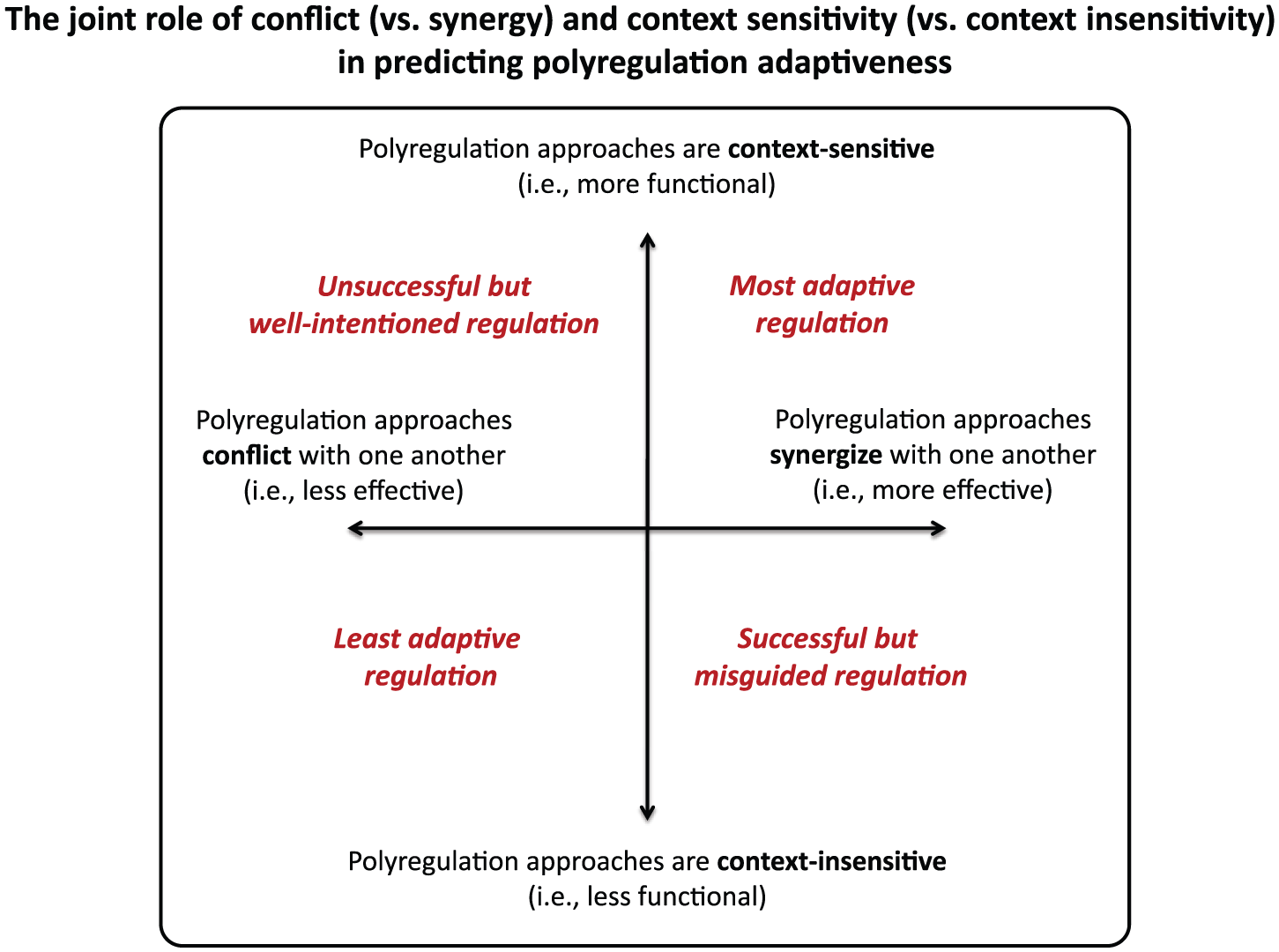
A conceptual portrayal of the joint role of polyregulation context sensitivity (vs. insensitivity) and conflict (vs. synergy) in contributing to the overall adaptiveness of a given polyregulation attempt. The degree to which the polyregulation is context-sensitive versus context-insensitive should influence the functionality of a given polyregulation approach (i.e., whether the regulation will be useful in a given context). The degree of conflict versus synergy should influence the effectiveness of a given polyregulation approach (i.e., whether the regulation results in the desired emotional outcome). Over time, engaging in more adaptive polyregulation approaches (and fewer maladaptive approaches) should accumulate and shape psychological health for the better.
As portrayed in Figure 3, the most adaptive polyregulation attempts should be characterized by high context sensitivity and high synergy. The least adaptive polyregulation attempts should be characterized by high context insensitivity and high conflict. Over time, engaging in more adaptive polyregulation approaches (and fewer maladaptive approaches) should accumulate and shape psychological health for the better. That said, the directionality of the link between polyregulation and health remains an open question. Longitudinal and intervention research focusing on traditional approaches to emotion regulation indicate that emotion regulation can indeed play a driving role in shaping subsequent health (Berking et al., 2008; Ford, Lam, John, & Mauss, 2018). However, the associations between emotion regulation and health are likely bidirectional, and the same logic should apply to the associations between polyregulation and health: people who are less likely to implement effective forms of polyregulation should be at risk for worse mental health; but in turn, worse mental health may make it harder to implement effective forms of polyregulation.
When research has uncovered which polyregulation approaches are most beneficial, this work will be highly relevant for clinical application. To appreciate the clinical translational significance of polyregulation, it will be useful to examine polyregulation within psychiatric populations with documented emotion disturbances. Examining clinical samples would also provide an opportunity to capture the possibly distinct polyregulation profiles of different disorders and/or to establish the transdiagnostic relevance of polyregulation. Once translational research has established which forms of polyregulation promote relatively adaptive versus maladaptive outcomes, subsequent work can leverage these insights to develop targeted psychosocial interventions. For example, by identifying particularly effective emotion regulation blends and sequences, it becomes possible for practitioners to incorporate a polyregulation perspective into empirically supported treatment programs to reduce the frequency and severity of relapse and symptom onset. Harnessing the clinical relevance and power of polyregulation can promote the development of interventions focused on alleviating emotion regulation difficulties.
Concluding Comment
The field of emotion regulation has matured to a point where it can now more fully examine the complexities of emotion regulation processes as they play out in everyday life.
Capturing the complexities of polyregulation moving forward will require not only a broader theoretical perspective, but also an enhanced set of methods. Assessing polyregulation hinges on measures that are able to detect multiple emotion regulation approaches within the same emotional episode. Because of this, trait-level questionnaires that ask about habitual emotion regulation are not able to capture polyregulation processes. Instead, researchers can more effectively capture polyregulation by asking participants about their use of multiple emotion regulation approaches in response to standardized emotion-eliciting stimuli within the laboratory (Demaree et al., 2006) or in response to particular daily events with experience sampling (Brans et al., 2013; Gruber et al., 2013; Heiy & Cheavens, 2014) and daily diaries (Kalokerinos, Résibois, Verduyn, & Kuppens, 2017). When researchers assess multiple regulation strategies within a given emotional episode, they will likely find evidence of polyregulation, even if participants were explicitly asked to only use one strategy (Demaree et al., 2006) and even if they are in a control condition (e.g., when asked to “just watch” a distressing film clip). Researchers can take an important step forward by recognizing that polyregulation is likely occurring within their studies, even when unintended. In turn, by measuring polyregulation and reporting these results, the field can gain a clearer picture of the polyregulation phenomenon.
We also note that researchers will be more likely to find a higher degree of polyregulation in their studies if they assess a greater number of polyregulation approaches (e.g., including longer lists of regulation strategies or tactics to choose from). For example, the seminal study finding that individuals used more than one regulation tactic in 98% of regulation episodes had asked participants to choose from a list of 68 possible tactics (Folkman & Lazarus, 1980). This level of nuance creates a wider net with which to capture polyregulation, but its complexity may also make it more challenging to explore specific hypotheses for how particular forms of polyregulation may unfold. These methods—like many emotion regulation methods—also rely on participants being able to accurately report on their regulation efforts, which can make it challenging to detect relatively implicit forms of regulation, including polyregulation.
To examine specific hypotheses about particular forms of polyregulation, a targeted approach may be useful. For example, polyregulation has begun to be explored using experimental manipulations that ask participants to use particular sequences of emotion regulation strategies (Yoon & Joormann, 2012). Experimental paradigms would have the added benefit of providing evidence for the causal implications of polyregulation approaches for various outcomes, including subjective experience, expressive behavior, and physiological responding. The growing field of computational modeling should also enable researchers to disentangle the simultaneous use of emotion regulation strategies from the sequential use of emotion regulation strategies and to strengthen our understanding of the interplay between polyregulation and dynamic emotional outcomes.
Our hope is that broadening the focus of emotion regulation research to include polyregulation will push the field to heightened levels of theoretical and empirical clarity. We believe a polyregulation approach represents a new and exciting direction in affective science research that provides useful suggestions for testing the effectiveness of combinations and sequences of emotion regulation approaches, and generates a more nuanced understanding of what it means to effectively regulate one’s emotions.
