




Abstract
The ability to represent emotional experiences in a precise fashion with language, termed emotional granularity, is related to a number of beneficial outcomes. However, the emotion granularity construct and operationalization are rooted in the lens of so-called Western, Educated, Industrialized, Rich and Democratic (WEIRD) societies that focus on emotions as a mental-state phenomena. Using evidence from multiple non-WEIRD societies, we illustrate that people's everyday vernacular often emphasizes bodily over, or in addition to, mental states. This suggests that granularity focused only on mental state language may limit our ability to operationalize this construct in a culturally valid manner. To overcome this limitation, we propose capturing “experiential” granularity and a concept model on how it may link to regulation and health.
In many experimental studies examining emotional experience, researchers ask participants a seemingly simple question—how do you feel? Often, researchers also provide perceivers with a set of emotion labels that they can use to report on these feelings. This use of these emotion labels ostensibly offers the promise of comparable data across individuals and within an individual over time. The assumption is that we can know whether a person is feeling more or less angry, sad or fearful by asking them to self-report on their inner experience. An important caveat is that individuals are not necessarily directly comparable in these reports. Some individuals report on their experiences with a great deal of distinctiveness between emotion terms across instances—as indexed by low correlations between term use. In contrast, other individuals report on their experiences with low distinctiveness between emotions across instances – as indexed by relatively large correlations between term use. These two different profiles of response are referred to as high versus low emotional granularity (EG), respectively, although granularity can be considered along a continuum (Barrett et al., 2001). The term emotion differentiation is often used interchangeably with granularity in the literature (Hoemann et al., 2021; Kashdan et al., 2015). What do the high correlations in low granularity imply? When an individual who is lower in EG endorses that they feel angry, this may instead reflect a broader state of negative affect. This is because this individual is also likely to endorse that they feel other negative emotions like sadness or disgust in that same instance and across many other instances. That is, use of negative emotion terms is non-specific. In contrast, when an individual who is high in EG indicates they feel angry, they are likely using that same term in a more precise manner—to point to a state with a more specific set of features, ones that presumably are shared with how other members of their cultural group represent anger, such that the label is being used in an informational manner.
Here, we pursue the idea that the emotional granularity construct and current approaches to operationalization, which are rooted in Western, Educated, Industrialized, Rich and Democratic (WEIRD; Henrich et al., 2010) psychological science focused on racial/ethnic majority populations, may limit granularity's predictive utility. A burgeoning literature in WEIRD psychological contexts suggests that having a granular representation of emotional experience may be good for mental health outcomes (Kashdan et al., 2015; Trull et al., 2015). Yet evidence from other cultural models, including non-Western cultural contexts that we highlight here, suggests that granularity is unlikely to take the same form across all populations. Recently, researchers suggested that granularity may simply be lacking in some cultural contexts because representations of “emotional” events are often represented in terms of bodily or action states (Zhou et al., 2021). Other findings suggest, in contrast, there may be higher emotional granularity across several non-WEIRD cultural contexts (Grossmann et al., 2016). Here we propose that granularity may take a different form in non-WEIRD cultural contexts, even in East, Educated, Industrialized, and Rich societies (EEIR; Mercier, 2014), such that individuals do represent emotional events with precision, but they may often do so by relying on a conceptual framework that is less strictly mentalistic. We suggest that expanding the scope of the cultural contexts in which granularity research is conducted (i.e., choosing who to study), including in neglected contexts such as in South and Central America, Northern Africa and the Middle East, will necessarily impact how the granularity construct is defined and operationalized (i.e., what to study) (for broader discussion of these issues, see Barrett, 2020; Medin et al., 2017).
In the following sections, we first provide a constructionist account of EG and review current operational definitions. Next, we describe why current conceptualizations of EG may be problematic from a cultural, methodological and developmental perspective and provide possible ways to address these issues. We focus on reviewing cross-cultural studies, primarily from Asian and African societies as well as studies of indigenous and immigrant communities and individuals acculturating within the Western context. After that, we briefly review the current evidence linking emotional granularity and health outcomes and we then highlight why it is problematic by illustrating how emotional distress is ‘constructed’ as a psychological versus somatization problem in different cultures. We conclude with a testable model that granular representations of emotional experience beyond using mental state language may bring online regulation processes that are culturally relevant to people in non-WEIRD societies, indigenous people and immigrants within WEIRD societies, which has strong implications in understanding health and well-being across cultural groups.
A Constructionist Account of Emotional Granularity
Emotional Episodes and Allostatic Regulation
Before describing a constructionist account of emotional granularity, it is useful to first outline a constructionist account of emotional episodes. That is, we propose that variation in emotional granularity is reflective of variation in how individuals use emotion concepts to construct their experiences of emotions. In one prominent constructionist account we draw on, the Theory of Constructed Emotion (Barrett, 2017; Barrett et al., 2019), emotions are proposed to occur when prior stored experiences about emotions, referred to as conceptual knowledge, is brought to bear to predict and constrain the meaning of incoming bodily (interoceptive) and external (exteroceptive) inputs. This prior stored knowledge includes a set of sensory, motor, and abstract mental features (e.g., attributes of mental representations such as arousal, experience of novelty, and pleasantness; Barrett et al., 2019) that are brought online to make meaning of the present instance and to organize the individual. In other words, from a constructionist account, emotions are not defined by a set of necessary or specific features within the brain or body (Barrett, 2017). Instead, constructionist theory proposes that emotions occur when individuals bring online conceptual knowledge that is culturally accrued, like anger or pride, to conceptualize their affective experience. For example, conceptualizing a set of circumstances as unfair, as blocking one's goal(s), and as something that someone else should be accountable for, fulfills one possible cultural pattern for anger (Kuppens et al., 2003).
Important, this construction process is assumed to be a predictive, rather than reactive one. Knowledge is brought online to anticipate upcoming needs and guide the individual to regulate their body and act within a given context, via a process termed allostasis (Sterling, 2012). An implication of this theory is that in the act of constructing emotion, one is also organizing coherent responses to anticipated demands to minimize disruptions to allostasis, referred to as allostatic regulation.
Emotional Granularity Reflects Variation in Emotion Construction
Granularity, when viewed through this lens, may reflect how precisely an individual issues predictions, based on prior experience, within a given situational (real or imagined) context. When an individual is low in granularity, this might reflect a few different aspects of the construction process. For example, an individual may have issues with selection. That is, they may have too many competing predictions that they are unable to resolve based on the features of the specific context (Hoemann et al., 2017). Even when selection proceeds and a specific concept is brought online to guide predictions, an individual may fail to issue sufficiently precise predictions because the conceptual features representing emotions like anger and sadness are not sufficiently distinct (for an example in emotion perception domain, see Brooks & Freeman, 2018). Finally, imprecise predictions may also reflect a failure to use the context to adequately situate which aspects of the emotion concept are relevant, such that all instances of fear, for example, would be highly similar in their features. Ultimately, each of these might lead to imprecision in the emotion construction process and, we would hypothesize, less functional emotional episodes including their unfolding dynamics or allostatic regulation (Barrett et al., 2014). Now that we have provided an overview of a constructionist account of emotional episodes and the implications for emotional granularity, we can outline how the current operationalization of this construct is limited.
Current Approaches to Operationalizing Emotional Granularity
The standard approach to assess emotional granularity is to ask individuals to report on their emotional experiences across a series of instances and to examine the correlational structure of emotion word use across these instances. At each instance, participants are asked to rate the intensity with which they are experiencing a range of different emotions (e.g., “afraid”, “sad”, “angry”, “happy” or “calm”). High correlations (either based on Pearson correlation or intraclass correlation coefficients; ICCs) between similarly-valenced emotion labels (e.g., “afraid”, “sad”, “angry”) are interpreted as low EG. The assumption underlying this approach is that individuals who provide similar intensity ratings of different labels across instances are not using the labels in a meaningfully distinct manner. Like the logic of scale construction, terms that have strong correlations across instances are assumed to reflect the same underlying, and necessarily broader, representation.
The early literature on emotional granularity typically involved behavioral measures from experience sampling approaches—daily diary or ecological momentary assessment (EMA). More recently, researchers have used tasks that present participant with standardized stimuli (standard-stimulus paradigm) or ask participants to recall particular types of situations. Each of these approaches has distinct strengths. The experience sampling approaches derive strength from the real world, everyday emotional experiences that they tap. As a result, this approach may better approximate emotion granularity in the daily experiences of participants. Further, EMA approaches avoid the pitfalls of memory reconstruction or further processing of emotional events when reports are made after a temporal delay. One the other hand, the standard-stimulus paradigm ensures that the measurements across individuals are more directly comparable because the emotion eliciting stimuli are the same across individuals. As a result, individual differences in granularity are less attributable to differences in the daily events that individuals encounter.
While granularity is often referred to as a single construct, granularity metrics (i.e., ICC) are typically constructed within similarly-valenced terms, resulting in two different measures: negative emotional granularity and positive emotional granularity. This is done because similarly-valenced emotional states tend to show the highest within-class correlation such that within-valence emotion pairs will likely show the most variation in granularity. However, this within class distinction will likely be less pronounced in cultural contexts where dialecticism is prevalent (Grossmann et al., 2016). Many researchers have exclusively focused on within class correlations among negative emotions. This relatively greater focus on negative emotional granularity compared to positive emotional granularity may be due to the less clear and consistent associations with well-being/mental health for the latter (O’Toole et al., 2014, but also see Liu et al., 2019).
Emotional granularity can also be assessed via global self-report (e.g., the Range and Differentiation of Emotional Experience Scale; Kang & Shaver, 2004). Self-report measures tend to capture both individuals’ meta-awareness of their trait ability as well as beliefs about ability rooted in identity (Robinson & Clore, 2002). Given this, metrics derived from behavioral assessment are widely considered a more robust way to capture individuals’ emotional granularity (Kashdan et al., 2015).
Limitations of the Current Approach
Two specific limitations of using the standard approach have been described elsewhere (see Erbas et al., 2014; Kashdan et al., 2015; Ottenstein & Lischetzke, 2020), therefore we only briefly summarize them here. First, correlation coefficients do not account for the degree of variability in the rate of emotional events people encounter across time. For example, some people may go through a stressful or challenging time over the study period, in which a range of emotions are potentially experienced, whereas others may go through a non-stressful period with limited affect being elicited. To address this limitation, some studies have proposed using emotion-eliciting situations (e.g., looking at emotion-provoking pictures) in controlled laboratory settings (Erbas et al., 2014), hypothetical vignettes (Kirby et al., 2014) or in-the-moment (rather than trait-level) ICC that captures the consistency of individual item ratings across affect subscales (Tomko et al., 2015). Second, with correlation coefficients it is hard to separate emotion granularity from variation in the extent to which specific versus multiple emotions are being experienced in a given situation, also referred to as emotion diversity (Grossmann et al., 2016). Hence, high co-activations of different emotions could be influenced by complex situations in which multiple emotions of the same valence are elicited and represented, rather than people's failure to subjectively differentiate between emotional experiences in a granular manner (i.e., emotion terms are rated in a similar way).
Here we propose four additional considerations and provide suggestions on how to tackle these issues. First, as noted in Ottenstein and Lischetzke (2020), most current behavioral approaches (EMA, vignettes, emotion-eliciting stimuli, etc.) share a common feature: they rely on individuals’ responses to a list of emotion labels provided by the researchers. While studies vary in the number of emotion labels terms used, as well as which specific emotion labels are used, they similarly provide category labels for participants. However, these emotion category labels may or may not adequately capture individuals’ emotion lexicon or vernacular (i.e., emotion language or dialect spoken in daily life), and this is likely to be a problem exacerbated across diverse cultural contexts. Second, current approaches to operationalizing emotional granularity do not directly speak to variation in the precision of underlying conceptual knowledge. There is some evidence that the precision of representations is related to emotional granularity. Individuals who more precisely distinguish between the abstract features of emotional events such as how responsible they are for an event or how well they could change the situation (referred to as appraisals; see Smith & Lazarus, 1993) across different emotions tend to be more granular in their self-reported experiences of emotions (Erbas et al., 2014). However, additional evidence directly linking the representation of conceptual knowledge to emotional granularity is needed. Third, it is unclear how cultural variations in socialization practices relate to granular representations of their emotional experience and the underlying conceptual knowledge. Fourth and finally, we highlight why it is problematic to only assess the association of emotion granularity and “mental” health outcomes by illustrating how emotional distress is ‘constructed’ as a psychological versus somatization problem in different cultures.
Consideration 1. Cultural Models of Emotion Revealed by the Everyday Lexicons
Language is an important tool to understand the structure of conceptual knowledge about emotion because it can reveal shared cultural models (Barrett et al., 2007; Lindquist, 2017). Cultural models of emotion are akin to Dzokoto and colleagues’ (2016) concept of cultural scripts: “the shared understanding of what emotions are and how they function within a particular social context”. These models vary quite extensively across nations and cultures within nations (Heelas, 1996; Lillard, 1998; Mesquita & Frijda, 1992; Ogarkova, 2013; Russell, 1991; Wierzbicka, 1992), yet a WEIRD cultural model of emotion, largely rooted in English-language representations of emotion of highly-educated individuals, continues to be the anchor point within much of psychological science. In this dominant cultural model, emotional events are frequently referred to with terms that centrally reference internal mental states. Indeed, assessment of emotional granularity with internal mental state labels is predictive of wellbeing within these narrow cultural contexts as described earlier, which lends apparent validity to focusing on the mental state lexicon. Yet this mentalistic focus maps on to the philosophical tradition of Cartesian mind-body dualism in which mind (mental-states) and body (physical-states) are treated as separate entities. Even within WEIRD cultural contexts, it may lead to a relative neglect of the bodily and somatic representations that are central to emotions as phenomena.
Cross-linguistic studies reveal how societies vary in their cultural models of emotion. Previous reviews have highlighted how distinctions between body states and mental states (Lillard, 1998) or between emotions and other mental or physical states (Russell, 1991) are culture-bound. For example, in a range of non-Western societies (e.g., in Japan, China and African societies) and immigrant communities, people tend to describe their daily experiences of “emotions” using language that is about the body (Choi et al., 2016; Dzokoto et al., 2016; Matsuki, 2010; Tsai et al., 2004). This tendency seems to stem from cultural models that view emotions as embodied (e.g., Dzokoto et al., 2016; Matsuki, 2010; Yu, 2002) and the belief that mind and body are more integrated (for a more comprehensive recent discussion, see Zhou et al., 2021). For example, in the Japanese cultural model of emotion, differentiated forms of anger can be ascertained based on use of language for the body (progressing in intensity from hara, the belly, to mune, the chest, and finally to atama, the head; Matsuki, 2010). In West African Kwa languages (Ga and Ewe), there is a “heart-action theme” which centers the heart in emotional states, as well as frequent references to body parts, the body as a whole, and bodily sensations when describing emotions (Dzokoto et al., 2016). In the indigenous languages of Ghana (Fante and Dagbani), there are substantial somatic references in people's affective expressions and experiences; Fante language uses the word atsinka to cover both emotional and physical experiences with reference to many body parts (e.g., skin, chest, stomach, heart, ear, and face) (Dzokoto & Okazaki, 2006). In recent research conducted with the Hadza hunter-gatherer community in Tanzania, emotional events were described primarily in terms of implications for the body, for action, and were focused on the practical concerns that were relevant for a given situation (Hoemann et al., 2023). These findings suggest that emphasis on the body observed in language may extend to psychological variation in how meaning is made about positive and negative events.
Similar cultural models of emotion marked by heightened use of body-based language also exist within North American immigrant communities. For example, Chinese Americans (CA) tended to use higher body related language (in English) than European Americans when discussing a variety of emotionally-laden events. Critically this variation appears to vary within CA samples: in CA individuals more oriented toward American culture, there was less use of somatic language than those in the less acculturated CA sample (Tsai et al., 2004). These findings suggest that the Chinese cultural focus on the body in emotion extends to usage in English, and that it also tracks which changes in levels of acculturation.
Collectively, these examples undermine the WEIRD cultural model of emotion that view mind as the “controller” of the body, and instead, bodily states are viewed as integral parts of people's emotional experiences. In fact, before the eighteenth century Industrial Revolution, it is also very common for Western societies to use embodied spoken English words (e.g., hearts could shake, expand, grow cold) in daily emotional expression. However, with increasing mechanization and the view that the body as a “machine”, emotion words have shifted from relatively transparent metonymical reference to the body and physical actions, to more opaque metaphorical reference to the body with the view that emotions as mentally abstract concepts (Stearns, 1994).
Suggestion 1a. Expanding Term Lists to Capture Experiential Granularity
We suggest an expansion of the measurement approach of emotional granularity beyond traditional mental state emotion labels will help to address concerns over content validity. Emotion categories like anger, fear and sadness may adequately capture the construct of emotional granularity within WEIRD cultural models, where emotions, body states, and actions are treated as largely separated domains. But this model does not apply equally well across cultures. In a non-WEIRD society where body and mind are more integrated, the exclusion of body states in measurement of experience may be problematic. We propose that this pursuit of measuring experiential granularity, which includes a range of concepts that perceivers routinely use to conceptualize their emotional experience (ideally using terms in the everyday lexicon). Inclusion of terms that focus on the body alongside terms that focus on the mind in the assessment of granularity may provide a more culturally sensitive and, ultimately, predictive measure than only including mental state categories. Indeed, in the measurement of mental health symptoms in East Asian cultural contexts, this has proved to be critical of addressing issues with content validity (Ryder et al., 2008). When measures fail to include key aspects of a phenomenon because of a culturally restrictive starting point (e.g., only sampling participants from the cultural west), this is referred to as category truncation (Hinton et al., 2018). Category truncation may be occurring in the measurement of granularity. One strategy, then, for operationalizing experiential granularity is to compute a global ICC that includes both bodily and mental state words. A strength of this approach is that it does not require forced classification of terms as strictly bodily or strictly mentalistic, as many terms may not fall into one category clearly (see Figure 1). A further strength of this approach is that it captures the conceptual model depicted in Figure 2 where the same symptoms of distress may be conceptualized in both bodily and mental terms within a given instance (i.e., the use of terms is integrated), a phenomenon that is likely in many cultural contexts. Another strategy is to compute ICC based estimates of granularity for bodily and mental state terms separately. This may hold some utility, particularly if the goal is to determine whether granularity for one class of terms has better utility for predicting mental health symptoms, including via regulation processes.
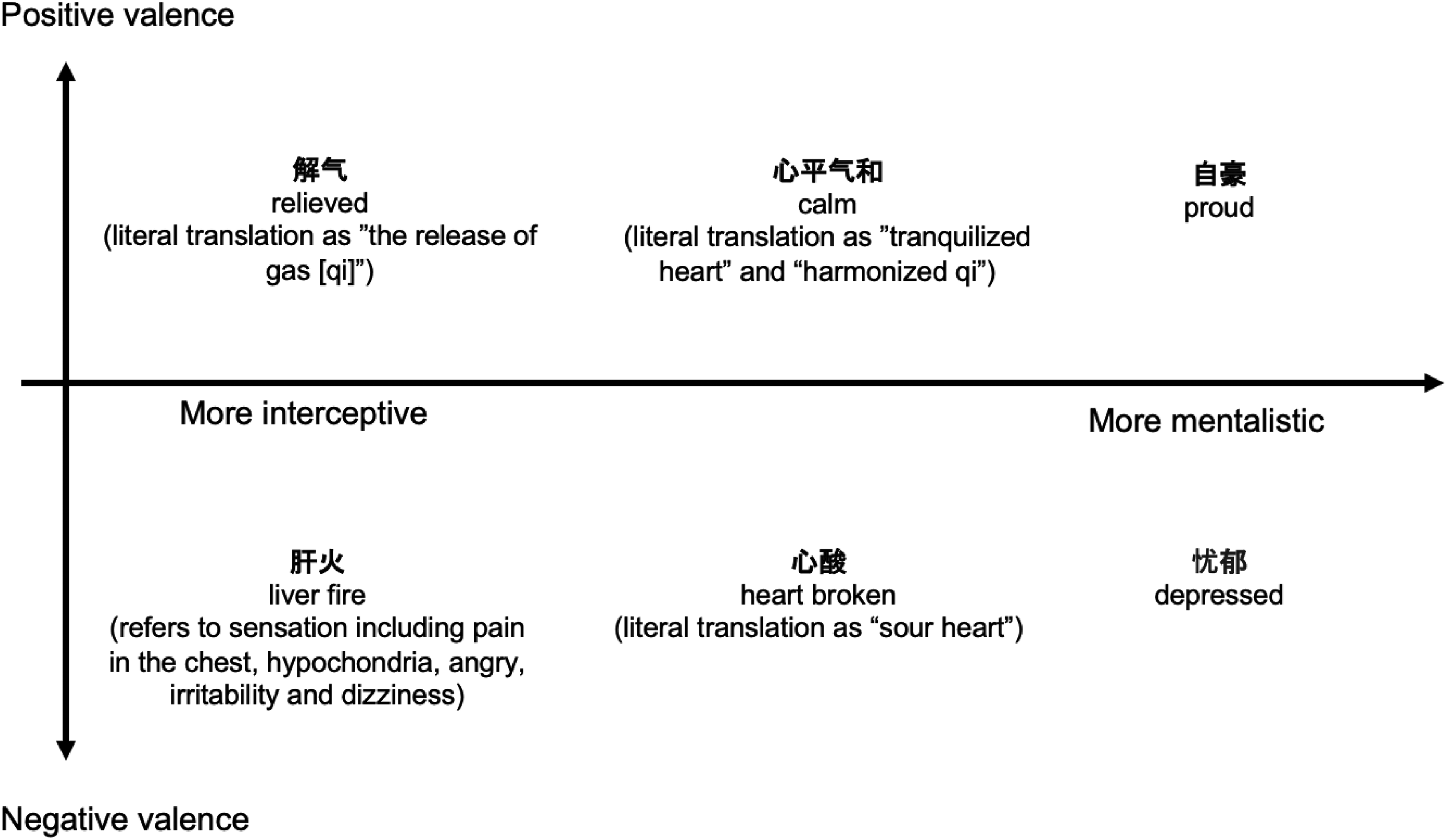
Emotion terms varying in reference to interoceptive versus mentalistic connotation.

Conceptual model of experiential granularity, regulation and health across cultures.
It is also important to note that bodily language is heterogenous. Many conventionalized emotional expressions make relatively concrete metonymical reference to the body and physical actions, while others despite referencing the body, are more mentalistic in connotation and thus abstracted away from the body and do not carry information about bodily sensations (see Figure 1 for an example in the context of the Chinese language). A second dimension that cross-cuts these emotional expressions is the associated abstract knowledge related to regulation. One common assumption in the WEIRD cultural model of emotion is that only the more “mentalistic” terms carry abstract regulatory knowledge. Here, we propose that it is an open empirical question whether this holds true for even the most concrete emotional expressions referring to the body. Both mentalistic and bodily terms may provide a basis for regulation and both types of categories may benefit from some degree of abstractness. Furthermore, abstraction can occur across mental and physical features and these different types of abstract categories may have distinct implications in health and well-being outcomes.
In sum, we suggest that to improve our measurement of emotional granularity, researchers could move beyond looking at granularity solely via standard lists of mental state terms. Instead, we recommend that researchers capture granularity using terms that reflect the local emotion lexicon.
Suggestion 1b. Advancing Analytical Approaches
The proposed shift to measuring experiential granularity also welcomes innovations in analytic approaches. It is not only interesting to ask how interchangeably terms are being used over time, but which terms, and from which domain. Network analytic approaches may be fruitful for operationalizing granularity at multiple levels of analysis. Networks can be constructed such that each “node” is a term such as anger or liver fire and each “edge” between the nodes represents a measure of association such as the Pearson correlation. From this network, overall metrics representing the characteristics of the entire network can be calculated. Global clustering (Onnela et al., 2005) of emotion term use is highly related to the ICC-based quantification of emotional granularity (Hoemann et al., 2020). Individuals who are lower in granularity (as indexed by the ICC) will tend to have a very dense network (Barrat et al., 2004), which is reflected by a high global clustering coefficient. Just as an ICC can be calculated across both bodily and mental state terms, a network containing both bodily and mental state terms can be similarly characterized in terms of global characteristics like clustering. For example, it may be that network metrics like global clustering that reflect a broader set of nodes including both bodily and mental state terms may have stronger associations with wellbeing and mental health outcomes. This type of result would suggest that mentalistic approaches to granularity have suffered from category truncation (Hinton et al., 2018). A value to a network approach beyond the ICC is that the data can be more readily visualized, and that metrics can be quantified at the level of a given emotion term (node). Term-specific (or, node-specific) measures can characterize how individual concepts are situated within the network and relate to one another. For example, one can quantify how integrated mental state terms or bodily terms are within the network by their average degree (i.e., the average pairwise correlation with other terms within the network) (Hoemann et al., 2020). Similarly, one can quantify whether nodes form distinct communities, such that nodes within a community are more strongly related to one another (based on correlations) than nodes assigned to distinct communities (Blondel et al., 2008; Rubinov & Sporns, 2011). This approach can quantify the extent to which emotion terms that are referenced to the mind vs body are integrated within the same communities or whether networks are organized such that bodily and mental state nodes tend to be in distinct communities. Of course, some of the recommendations provided here do not necessary require a network analysis framework when a simpler statistical approach is sufficient. For example, if one does not intend to use networks for visualization or community detection, average correlations may be sufficient to characterize how integrated bodily and mental state term use is.
Consideration 2. Capturing Underlying Representations
Beyond approaches to granularity that focus on term endorsement patterns, a more complete picture of granularity would also benefit from mapping terms to underlying conceptual representations. Low granularity may also manifest as insufficiently precise predictions, even when an individual may use a specific mental state term when labeling their emotional state. That is, some individuals may use terms in a relatively superficial manner whereas others may use those same terms to refer to very specific features. Further, it is possible that the use of non-mental state terms may carry similar knowledge to mental state labels, such that the measurement of underlying conceptual representations can reveal commonalities in representations of emotion that may be obscured by linguistic distinctions.
Suggestion 2. Measuring Conceptual Knowledge
Methods like property verification tasks where participants are asked to indicate whether a feature is a property of a concept (e.g., how related is “heart racing” to the emotion [Sad]?”; Brooks & Freeman, 2018; Wu & Barsalou, 2009) can be used to look at decontextualized, highly abstracted representations of emotion. Following work by Brooks & Freeman (2018) who used a property verification approach, researchers can use methods like representational similarity analysis, to assess the extent to which these decontextualized representations are overlapping between emotion categories or are more distinct.
Importantly, the same approaches to mapping conceptual features could also be applied to non-mentalistic category labels, such as cultural models of emotion that emphasize the body. We may find that, ultimately, similar sets of features are grounded by bodily terms within these cultural contexts. This would imply that these concepts should function similarly to emotion (mental state) concepts in constraining prediction and guiding situated action. If so, this would suggest that granularity within the body domain should have a similar link to positive mental health outcomes within non-WEIRD cultural contexts.
Consideration 3. The Role of Emotion Socialization in the Development of Granularity
Socialization allows cultural knowledge to pass on to new members or generation of the cultural group (Harkness & Super, 2020), including in the domain of emotion (Atzil & Gendron, 2017; Chen et al., 2012; Cole & Tan, 2007; Raval & Walker, 2019; Tardif et al., 2009). Therefore, looking at how parents describe emotional experiences and the language they use to socialize their children in daily life can shed light on how cultural models of emotion (e.g., emotion lexica and conceptual knowledge) is being transmitted across generations (Hoemann et al., 2019). There are different ways parents can discuss emotions with children (Chen et al., 2012). First, parents can label their own or their child's emotional states to parse the ongoing flow of action and physiology in a given context with discrete words like “happy”, “sad” and “fear” (Thompson, 2006). These labels support the emerging emotional vocabulary that children then use to label their own emotional experience (Doan & Wang, 2010) or to label the emotional states of others (Harris et al., 2005). Second, parents may also discuss the causes and consequences of certain emotional states (Lagattuta & Wellman, 2001), which again enriches those labeled instances with explicit conceptual knowledge about emotional states. By being able to understand the causes and consequences of emotions, children could learn how to anticipate and regulate their emotions (Eisenberg et al., 1998), be better able to take others’ perspective, and be better able to predict other's behaviors based on knowledge of the situation (Rosnay et al., 2004). Indeed, increased vocabulary knowledge across development was found to expand emotion concept representations from broad valenced representations (distinguishing positive versus negative) in childhood to multi-dimensional representations (distinguishing valence and arousal) in adulthood (Nook et al., 2017) which increase in their level of abstraction (here refers to category specific generalizations that extend beyond the specific situation of use (Nook et al., 2020a).
To date, most prior studies have only focused on socialization of emotions using internal mental state language. Despite this limited literature, the available evidence suggests there is cultural variation in family discussions about emotions and that this has consequences for children's emotion knowledge. Compared to European American mothers, Chinese mothers used fewer mental state language (i.e., make fewer references to thoughts and emotions) but more frequently commented on behaviors during storytelling with their young children (Doan & Wang, 2010). Fivush & Wang (2005) found that even during conversations about positive and negative emotionally salient events (e.g., conflict with parents), European American mothers often provided more causal explanations for both their children's and others’ emotion than Chinese mothers who tended to focus on social norms and behavioral expectations. Compared to European American mothers, Indian immigrant mothers reported lower endorsement of emotion coaching (e.g., validating their child's emotions, helping their child verbally label emotions; Daga et al., 2015). More interestingly, the same study found that emotion coaching was associated with lower child's externalizing problems and higher social competence among European American mothers, it was unrelated to child outcomes among Indian immigrant families (Daga et al., 2015). This finding thus highlights that the benefit of emotion socialization via the use of mental state language on child's socio- and behavioral development may not apply to non-WEIRD (e.g., Indian immigrant) populations (Daga et al., 2015). This may be in part because non-WEIRD parents are less likely to make attributions of negative internal states (e.g., frustration, sad) as causal of a child's misbehavior (Cheah & Park, 2006).
Collectively, cultural differences in socialization (e.g., use of mental state language vs. action - oriented practices) may shape how children may express and regulate their emotional experience (Ip et al., 2021). Empirically, however, it is unclear how cultural variation in socialization practices relate to granularity of emotional experience into adulthood and whether this potential link might reflect variation in underlying conceptual representations.
Suggestion 3. Deepening the Study of Granularity from a Developmental Perspective. We suggest future research to elucidate the socialization processes that may contribute to individual differences in granularity in adulthood within a particular cultural model. The evidence reviewed here on socialization practices within a non-WEIRD cultural context suggests that this early exposure and reinforcement of distinct cultural models of emotion should encourage distinct cultural endpoints in how concepts are used to organize affective experiences. One interesting question is also whether there is sensitive developmental timing, such that navigating a host culture later in life will be more challenging to achieve a culturally fitting form of emotional granularity. Work on emotional acculturation suggests it should be possible to shift one's emotional conceptual repertoire to achieve a similar patterning to a host cultural context (Consedine et al., 2014; Jasini et al., 2019), but this may be more challenging when the cultural shift is between societies that differ in how emotion terms with reference to the mind vs body are represented. Finally, cultures themselves are not static, but are dynamically changing over time—often in predictable ways (Varnum & Grossmann, 2017). For example, there appear to be shifts within the Eastern cultural context (e.g., Hamamura & Xu, 2015; Zeng & Greenfield, 2015) that may be reflected in a rise in mentalistic focus (although empirical data are limited; see Yik & Chen, 2023). These findings suggest that in some instances, the concerns over culturally tailored emotional granularity measurement may apply only to certain segments of a population, such as older adults, and in less urbanized and less highly educated or acculturated samples.
Consideration 4: The Cultural Construction of Distress
One of the key reasons that the construct of emotional granularity has gained such traction is that it appears to hold predictive value for understanding mental health outcomes in WEIRD cultural contexts. Most previous studies focused specifically on the benefit of having high granularity for negative emotions (i.e., negative EG), albeit with mixed results depending on analytical approach (Trull et al., 2015) and domain of well-being and mental health. 1 In clinical adult studies, individuals with major depressive disorders (Demiralp et al., 2012), social anxiety disorder (Kashdan & Farmer, 2014), borderline personality disorder (Zaki et al., 2013), and schizophrenia (Kimhy et al., 2014) were less likely to report on their negative emotions in a granular manner compared to healthy controls. Among non-clinical samples, adult participants who had higher negative EG were less likely to drink excessively when responding to intense negative emotions (Kashdan et al., 2010), had lower impulsivity (Tomko et al., 2015) and aggressive retaliation against someone who has hurt them (Pond et al., 2012). In studies of adolescents, higher negative EG was associated with lower intensity in self-reported ratings of affect, assessed momentarily and during the previous two weeks, and to beliefs that emotions are malleable (Lennarz et al., 2018). Moreover, higher negative EG attenuated the associations between momentary-levels of perceived stress and feelings of depression (but not anxiety), and monthly-level stressful life events and severity of anxiety symptoms (but not depression; Nook et al., 2020b). Collectively, the available evidence suggests that people who are more granular in how they report on their emotions, especially on negative emotions, may have more beneficial mental health outcomes across clinical and non-clinical samples, and across adolescence and adulthood, but the specific effects may depend on outcomes and circumstances. Further, the exact mechanisms driving the improved psychosocial adjustment outcomes among people with higher emotion differentiation are less clear.
An important consideration is whether these links would be expected to hold cross-culturally. In many of the same cultural contexts in which emotions are lexicalized as bodily states, distress is also “constructed” in the form of somatic symptoms. In particular, we draw on anthropological and clinical studies to articulate how cultural contexts can shape the way negative mental health (e.g., symptoms of distress) are “constructed” using different lexica (i.e., mentalistic versus bodily).
While experiencing distress appears to be a universal phenomenon, how people describe and express distress is influenced by cultural models (Ryder et al., 2008). Over the past few decades, high rates of somatization (i.e., the expression of physical complaints that cannot fully be explained by any known organic pathology) among people with depression have been well-documented in non-Western societies, including for example, among depressed patients from Iraq (Bazzoui, 1970), West Africa (Binitie, 1975), Peru (Mezzich & Raab, 1980), Hong Kong (Cheung et al., 1981), the People's Republic of China (Ryder et al., 2008) and India (Bagayogo et al., 2013). Higher somatic expression can also be found among racial-ethnic minoritized (e.g., Native American and African American) and immigrant (e.g., Asians and Latinx) groups within Western societal contexts (Kirmayer, 2001; Kirmayer & Young, 1998). For example, a recent study found that Chinese American women experienced higher levels of somatic sensations (e.g., heartbeat changes) relative to European American women when watching a sad film, despite both groups reported experiencing similar levels of sadness and physiological reactions (e.g., heartrate, respiratory activity) (Chentsova-Dutton et al., 2019). Similarly, interviews with Hmong immigrants in the US revealed that individuals from this community frequently use bodily phrases (e.g., kev kau siab [peaceful liver]; kev mob siab mob ntsws [traumatized liver and lung]) to describe various emotions and mental illness (Xiong et al., 2016).
Historically, this somatization phenomenon was thought to reflect an inadequate or early developmental stage of linguistic knowledge, in which the individual fails to differentiate psychological experience of unpleasant emotion into distinct mental state categories (Leff, 1981). That is, this phenomenon might appear to be an instance of low granularity for emotions in individuals from non-Western and developing societies, and among ethnic groups within western cultural contexts. A further related assumption was that psychological mindedness (i.e., use of mentalistic categories) is a product of higher education, such that psychologizing emotions is a higher-order tool that allows individuals to express previously unrecognized or unstated emotions. Indeed, the concept of “alexithymia” is a cognitive deficit that refers to an inability to accurately identify and describe one's subjective feelings and to distinguish between feelings and bodily sensation. It was often used to pathologize patients with psychosomatic disease (Sifneos, 1973).
However, as noted in Kleinman (1982), the emphasis of “psychologization” of distress is a classic example of Western Cartesian dualism or body as “machine” assumption that “overt somatic complaints are less “real” than allegedly hidden psychological problems” (page 132). The deeply rooted influence of Cartesian bias in the conceptualization of emotional distress perhaps can be seen in discrete category of somatoform disorders in medical nosology (i.e., Diagnostic and Statistical Manual of Mental Disorder) that has separated “psychological” disorders from “somatic” disorders. This is contradicted with strong evidence that somatic expression is the most common clinical expression of emotional distress across many “psychological” disorders and this dichotomized “psychological” versus “somatic” categorization is not reflected in syndromes of distress worldwide (Kirmayer, 2001; Kirmayer & Young, 1998).
Moreover, the patterns of somatizing versus psychologizing do not necessarily preclude mental features from being represented by members of cultural groups that will typically spontaneously somatize. Some researchers have argued that higher endorsement of somatization among people in many non-Western societies and ethnic groups may best viewed as a matter of somatic symptom emphasis informed by cultural models of emotion and contexts, rather than a complete lack of access to psychological symptoms (Ryder et al., 2008). For example, the emphasis of somatic words in communicating distress may be a more effective form of communication because it increases positive reactions (e.g., empathy) from others as it fits with the cultural model of how distress should be expressed (Choi et al., 2016).
Rather than viewing somatization of distress as a “cultural-bound” syndrome in non-Western societies, the tendency to emphasize “psychologization” of distress may be best described as a WEIRD phenomenon compared to the rest of the world (Ryder et al., 2008). That is, psychologizing distress and “mental” illness can be viewed as a construction of reality that emphasizes mind over the body, and that same affective sensation can be “constructed” with different reality (e.g., psychological versus somatic) influenced by cultural models of emotion.
Indeed, when we look at the neurobiology of emotion, it is clear that the body is central to these phenomena. First, interoceptive cortices involved in representing (and, predicting) the state of the body are engaged across instances of emotion (and non-emotional states) (e.g., Critchley & Garfinkel, 2017; Kleckner et al., 2017; Seth, 2013). This suggests that foregrounded representations of the state of the body characterize most experiences of emotion. Second, regions that routinely engaged across instances of emotion and have long been considered the “seed” of emotions can be understood in terms of their primary function: visceromotor control (Barrett, 2017). This suggests that dynamically regulating the viscera, via allostatic regulation, is an important feature of emotional experiences (although not unique to these experiences). From this perspective, cultural models of emotion that center the body in their psychological and linguistic representations of emotional events are emphasizing aspects of emotional events that are often neglected in “psychologization” of emotion.
So far, we primarily focus on how many cultural models of distress emphasize somatic over, or in addition to, mental states. However, in many African societies (e.g., Ghana, South Africa, Malawi) and some immigrant (e.g., Hmong) communities, physical and mental illness are conceptualized as “spiritual illness”; Illness is thought to cause by supernatural powers or evil spirits (Ae-Ngibise et al., 2010), human agents (enemies, ancestors, witches, spirits, and God) and physical agents (sun, dust, rain, and food) (Shizha & Charema, 2011). Traditional (herbal medicine) healers and faith healers diagnose mental illness through spiritual means and provide their clients with spiritual explanations and treatment for their predicaments (Ae-Ngibise et al., 2010). Similarly, among some native American communities in North America, illness can be conceived as stemmed from a lack of harmony and balance of mind, body and spirit with the universe (Garrett et al., 2011). Thus, it is possible that a granular representation of experience via the use of spiritual language within these societies may help bring online allostatic regulation processes (e.g., herbal medicine, prayers, holy water, confessions of wrongdoing to support healing processes) that are grounded in local cultural models.
Suggestion 4. Measuring Broader Outcomes
Given the evidence that distress is ‘constructed’ in different cultures, we suggest that it may be problematic to only capture “mental” health outcomes when studying the consequences of granularity. Researchers in global health have made considerable progress articulating how measurement can be made more appropriate to a range of cultural contexts. For example, it may be productive to measure mental health symptoms using local idioms of distress (e.g., Kaiser et al., 2015), although researchers should be cautious in constructing measures that assume these idioms of distress are necessarily “pathological” (Kidron & Kirmayer, 2019).
A New Testable Model of Experiential Granularity and Links to Health Across Cultures
We conclude by proposing a testable model (see Figure 2) that granular representation of distress experiences across cultures may bring online regulation processes for maintaining allostasis via an enhanced ability to draw on relevant conceptual knowledge. This model has implications for how we understand and assess health and well-being across cultures.
In WEIRD cultural models of emotion, the precise use of mental state language for emotion may help to bring online a set of strategies to facilitate allostatic regulation processes as individuals are able to access stored conceptual knowledge associated with specific state labels (Figure 2A). This is often distinct from bringing online knowledge associated with physical dysregulation of the body (e.g., fatigue) where distinct, body-based conceptual knowledge may be applied to support allostatic regulation. For example, cognitive behavioral therapy (CBT) may be particularly efficacious because it enhances granularity for emotion concepts. Individuals in CBT can learn how to label and differentiate their emotional experiences in a more precise manner, which may facilitate the selection of adaptive emotion regulation skills (e.g., cognitive (re)appraisal) and the identification of cognitive biases anchored in conceptual knowledge formed from past emotional experiences.
Contrary to WEIRD societies that often view mind and body as separate entities and illnesses which are divided into “physical” and “mental” categories (Figure 2A), many non-WEIRD societies conceptualize mind and body as more integrated (Figure 2B). Among these societies, the use of terms that are not putatively mentalistic (e.g., bodily) in a more precise manner may bring online a different, more culturally relevant set of allostatic regulation processes (e.g., indigenous healing practices) than those from WEIRD societies. Further, it is likely that individuals in many non-WEIRD societies will draw on concepts that have both mental and bodily connotations, often using words that capture features of both (Figure 2B).
To illustrate, individuals from many “Eastern” (e.g., Korea, China, Japan, Vietnam, India) societies and immigrant (e.g., Hmong) communities acquire conceptual knowledge (through socialization) that many physical and mental illnesses are often caused by an imbalance (either deficiency or excess) of vital bodily energy (e.g., qi [energy]) generated by different viscera (Kang et al., 2017; Patwardhan et al., 2005; Phan & Silove, 1999; Tan et al., 2013; Tatsumi et al., 2019). For example, excessive anger leads to a disharmonized qi that are linked to impairment of the liver with downstream consequences of physical and mental illness (the concept of “liver fire”; Chen et al., 2017). The use of bodily terms may bring online a set of body-based solutions to facilitate allostatic regulation among people in these societies. For example, indigenous healing practices to physical and mental illness involve rebalancing vital energy movement via the use of herbal medicine (Chen et al., 2017), sweat lodge (Garrett et al., 2011), social problem-solving interventions (Hall et al., 2021), acupuncture and qigong (a form of physical exercise to regulate the bodily energy; Tan et al., 2013). In parallel to CBT, patients gain more conceptual knowledge about allostatic regulation processes through indigenous healing practices that improves granularity about the body. For example, Eastern medicine practitioners discuss with their clients with depression the bodily representation of their psychological distress (e.g., tightened pulse string (脉弦有力), dark purpled tongue (舌紫暗), and clients learn how their bodily symptoms can provide a predictive signal to bring online allostatic regulation processes (e.g., herbal medicine, bodily-based healing activities) that can restore the energy balance when there are allostatic perturbations. Indeed, while the CBT treatment approach works quite well within a high mentalistic cultural model of emotion, it may be viewed as less acceptable to implement when it specifically focuses on internal or psychological states in non-WEIRD cultural model of emotion (Hall et al., 2021).
Subsequently, the use different types of allostatic regulation strategies stemmed from different cultural models of allostatic dysregulation and distress may help to shed light on cultural variations in mental health outcomes and disparities (Hall et al., 2021). For example, it may help to explain the mental health paradox among racial/ethnic minoritized populations: that racial-ethnic minorities in North America often report better mental health outcomes than non-Hispanic whites, despite experiencing higher levels of adversity (Schnittker & Do, 2020). Recent studies have suggested that higher depression among non-Hispanic whites may be in part attributed to the negative side effect of higher consumption of pharmaceutical medication (Schnittker & Do, 2020)—a type of strategy for regulating distress that is more common among non-Hispanic whites relative to other racial-ethnic minorities. Further, this framework can underline the importance of a broader range of practitioners. For example, in many African societies, seeking traditional and faith healers is more common than seeing a Western modern medicine doctor (Atindanbila & Thompson, 2011). This may be because traditional and faith healers better understand their clients’ physical and mental health concerns by effectively representing distress through spiritual language and concepts that are in line with the local cultural beliefs about the etiology of mental and physical illness.
Conclusions
We started off by asking a seemingly simple question - “How do you feel?”. From this review, we illustrated that the way individuals respond to this prompt may depend upon how their emotional experiences are represented, and the way it is conveyed is heavily influenced by their cultural models of emotion. Among many non-WEIRD societies and in racial/ethnic minority and immigrant communities, cultural models of emotion in people's everyday vernacular emphasize language with reference to the body over, or in addition to, the mind, and that regulating mental- and physical- states are often viewed as integrated process. Therefore, capturing “experiential” granularity more broadly instead of restricting it to putatively mental states, and their underlying conceptual knowledge will help us to overcome validity concerns that stem from this cultural variation. Moreover, it is important to elucidate the socialization processes that may contribute to individual differences in granularity within a particular cultural context. This will allow us to understand sources of variability both within individuals and across cultures. We proposed a testable conceptual model of experiential granularity (Figure 2) that a more granular representation of emotional experiences (i.e., higher experiential granularity) allow individuals to draw on more relevant conceptual knowledge of these experiences, which in turn bring online different allostatic regulation processes. This model can shed light on variations in health outcomes among individuals, and across cultures.
Footnotes
Acknowledgments
We thank members of the ASCL for contributions to early discussions of the ideas in this manuscript.
Declaration of Conflicting Interests
The authors declare that the research was conducted in the absence of any commercial or financial relationships that could be construed as a potential conflict of interest.
Funding
The authors received no financial support for the research, authorship, and/or publication of this article.
Author Contributions
All authors contributed to the writing of this manuscript. Final review and edits provided by Ka I Ip and Maria Gendron.
