



Abstract
This article systematically reviews studies investigating the effect of three operationalizations of complexity in emotion experience (i.e., differentiation, covariation, and variability) on situational behavioral adaptation (i.e., physiological, cognitive, and overt action responses), and quantifies the results with meta-analyses. Twenty-seven studies of emotion complexity were identified and divided into four categories: (a) trait and (b) state studies within clinical samples, and (c) trait and (d) state studies within nonclinical samples. Most studies investigated trait emotion differentiation, revealing negligible to small effects (r range: .06 to .15). Only 4 studies in total assessed indicators of state emotion complexity. The theoretical assumptions behind the indicators of emotion complexity as well as the conceptualization of behavioral adaptiveness are critically discussed, and a number of future avenues for this type of research are proposed.
The present study addresses the role of emotion experience in behavioral adaptation, synthesizing the literature on the association between three proposed components of emotion complexity in emotion experiences (i.e., emotion differentiation, emotion covariation, and emotional variability; Brose, de Roover, Ceulemans, & Kuppens, 2015; Grühn, Lumley, Diehl, & Labouvie-Vief, 2013) and behavior (i.e., physiological, cognitive, and overt action responses) by means of systematic review and meta-analyses. We apply a distinction between trait and state indicators of emotion experience complexity, that is, between emotion experience complexity at the person level (i.e., trait-like) and momentary emotion experience complexity (i.e., state), with the aim of exploring the association between these indicators and behavioral adaptation at both levels of analysis.
Emotion Complexity
Across different theoretical accounts of emotion, it has been suggested that the complexity of an individual’s emotion experience is closely associated with their behavioral adaptation to the situation (i.e., physiological, cognitive, and overt action responses; Barrett, 2012; Frijda, 2009; Scherer & Moors, 2019). This consensus stems in part from the notion that emotions are functional, and that increased awareness of emotions can help inform an optimal course of action. A prominent feature of the emotion process is considered to be its preparation of the organism to take action towards achieving a specific goal in a specific situation (Barrett, 2006; Frijda, 2007; Scherer & Moors, 2019). In contemporary appraisal-based functional accounts of emotions (Frijda, 2007; Gross, 2015; Scherer & Moors, 2019), emotions are considered “meaning detectors,” involving appraisals of the personal relevance of a situation in light of the individual’s active goals. The detection of a discrepancy between the current situation and a goal results in a number of action tendencies, preparing the individual to approach or avoid (e.g., Carver & Scheier, 2012). Thus, emotions provide the individual with information about the emotion-eliciting event and potential courses of action to take in order to reach a specific goal. If the emotion processes enter consciousness, they may be labeled according to the culturally specific, language-based emotion categories that the individual has internalized (Frijda, 2009; Scherer & Moors, 2019). To some extent, this suggestion aligns with a constructionist account of emotion experiences, which also views emotions as functional. However, the main difference between the appraisal-based and the constructionist accounts is whether or not the changes already have a function as emotional processes before the categorization (i.e., appraisal-based view; Scherer & Moors, 2019), or they assume particular functions in the very act of categorizing the changes (i.e., constructionist view; Barrett, 2012). Thus, despite differences in accounts of emotion and its processes, there is consensus concerning the functional nature of emotions. Given this functional feature, a great deal of interest has been devoted to the different ways in which individuals experience or represent their emotions, and what this means for their ability to respond adaptively to an emotion-inducing situation.
In this regard, it has been proposed that individuals differ in how they become aware of the composition of their emotions, which sometimes is referred to as differences in emotion experience complexity (Grossmann, Huynh, & Ellsworth, 2016; Lindquist & Barrett, 2010). Currently, there is no conceptual consensus concerning the definition of emotion complexity, which is evident from the ambiguous use of the term in the literature. Emotion complexity may be viewed as an umbrealla term, covering two broad conceptual definitions (Grossmann, Huynh, & Ellsworth, 2016; Lindquist & Barrett, 2010). The first definition is referred to as emotional dialecticism, concerning the simultaneous experience of positive and negative emotions. The other definition has been termed emotion differentiation, which concerns the granular experience of, or variety in, experienced emotions. Both of these broad definitions hold a number of subconceptualizations, proposed to “capture some distinct facets of the construct, but none can be taken as ‘definitive’ of emotional complexity” (Grossmann, Huynh, & Ellsworth, 2016, p. 896). This lack of conceptual consensus is reflected both in differential hypotheses about the adaptive value of emotion complexity, and in the multitude of ways that emotion complexity has been operationalized.
Empirically Derived Indicators of Emotion Complexity
Emotion complexity has most often been operationalized based on data derived from daily diary studies or experience sampling studies, in which individuals rate their emotion experience on multiple occasions (i.e., in real time), typically as level of intensity of a number of discrete emotions (e.g., anger, sadness, anxiety; Grühn et al., 2013; Kashdan, Barrett, & McKnight, 2015). This method of assessment has been suggested to be a better and more direct way of measuring complexity in emotion experience as compared with global, retrospective self-report measures (e.g., self-reported clarity of emotion experience; Grühn et al., 2013; Kashdan et al., 2015).
In an experience sampling study, Grühn et al. (2013) calculated a number of different time-based indicators, assumed to differentially reflect emotion complexity. The interrelations between the indicators suggested four distinct components of emotion complexity, including emotion differentiation (i.e., an indicator of specificity or granularity in a an individual’s experience, typically evaluated as the intraclass correlation [ICC], which is a measure of the average consistency between emotions), covariation of emotion categories (i.e., indicators of whether negative and/or positive emotions are experienced independently and consequently can be experienced simultaneously, typically evaluated as a correlation between negative and positive emotions or count of emotion labels), and variability in emotions (i.e., an indicator of fluctuation or amplitude in emotion experience, typically evaluated as the within-person standard deviation across time points of a particular emotion [e.g., fear] or between a set of emotions [e.g., negative emotions]). They also identified factorial components detected in an individual’s emotion experiences (i.e., an indicator of variance either as number of components detected or as residual variance), which Brose et al. (2015), however, argue is to be considered another operationalization of emotion differentiation. In the present study, we therefore investigate three components of emotion complexity, namely emotion differentiation, covariation, and variability.
Emotion Complexity and Behavioral Adaptation
Rooted in the assumption that the ability to respond adaptively to an emotion-inducing situation is largely dependent on how the individual experiences their emotions, a great deal of interest has been devoted to the association between the complexity indicators and different aspects of well-being (e.g., life quality and psychopathology). However, despite—presumably—being indicators of the same construct, there is no reason to believe that they measure the same psychological tendency or would be equally associated with well-being outcomes (Grossmann, Huynh, & Ellsworth, 2016; Grühn et al., 2013). Indeed, the literature points to differential associations for the three components. First, concerning emotion differentiation, two studies have reviewed the potential mental health benefits of emotion differentiation (Kashdan et al., 2015; Smidt & Suvak, 2015). Both reviews suggest a positive association between mental health and differentiated emotion experience, in particular for the differentiation of negative emotions. These reviews have recently been supplemented by a synthesis of six studies, also pointing to emotion differentiation being positively associated with measures of well-being (Erbas, Ceulemans, Blanke, et al., 2018). Within a clinical context specifically, poor emotion differentiation has been demonstrated in a range of disorders (for a review, see Smidt & Suvak, 2015). Little research exists on the association between emotion covariation and well-being. Grühn et al. (2013) found emotion covariation to be negatively correlated with emotion differentiation, but emotion covariation was not associated with measures of well-being (Grühn et al., 2013). Finally, emotion variability has been found to be negatively correlated with emotion differentiation (e.g., Grühn et al., 2013) and has also been shown to be associated with negative outcomes, such as higher levels of depression, lower levels of self-esteem (e.g., Eid & Diener, 1999; Kuppens, van Mechelen, Nezlek, Dossche, & Timmermans, 2007), and overall lower levels of well-being (Houben, van den Noortgate, & Kuppens, 2015). At first glance, these findings appear contradictory to the idea that emotions provide information about the person in relation to the context, in which case fluctuations could be indicative of an individual being attuned to the changing context, responding with corresponding levels of emotions. However, it has been suggested that emotion variability, when measured over time, reflects heightened emotional reactivity (Kuppens et al., 2007). From a perspective where emotion variability largely reflects emotion reactivity, one could argue that it would be conceptually inappropriate to consider it an indicator of emotion complexity. Where emotion differentiation and covariation concern certain qualities of an individual’s experience of emotion constellations (i.e., granularity and range, respectively), variability, if understood as reactivity, may be taken to simply concern a quantitative matter, that is, more or less emotion intensity. It has therefore recently been suggested that researchers should control for the individual’s mean emotion intensity when computing variability indicators in order not to confound variability with overall reactivity (Blanke et al., 2019).
Taken together, there seems to be evidence pointing to a differential association between the indicators of emotion complexity and overall well-being. However, when it comes to the role of emotion complexity in facilitating specific behaviors in a given situation, there has been no attempt to synthesize the available evidence. Kashdan and colleagues (e.g., 2015) have provided some support for the assumption that emotion differentiation is associated with specific adaptive behaviors (e.g., less alcohol consumption, less aggression; Kashdan, Ferssizidis, Collins, & Muraven, 2010; Pond et al., 2012). However, studies concerning this association were not reviewed systematically, and other indicators of emotion complexity (i.e., covariation, variability) were not included. We therefore know very little about how—and even if—certain indicators of emotion complexity would translate into behavioral adaptation in a given situation. Given that emotion theories operate at the situational level, when claiming that emotions prepare the organism to take action towards achieving a specific goal in a specific situation (Barrett, 2006; Frijda, 2007; Scherer & Moors, 2019) it appears crucial to study the adaptive value of the ways in which the individual experiences their emotions (i.e., emotion complexity) at the situational level.
Capturing Indicators of Emotion Complexity at the Trait and State Levels
Just as the outcomes associated with emotion complexity indicators may be captured both at the overall level across situations (e.g., general measures of well-being) and at the situational level (e.g., situational alcohol consumption), so may the indicators of emotion complexity (Erbas, Ceulemans, Kalokerinos, & Houben, 2018; Grossmann, Huynh, & Ellsworth, 2016; Tomko et al., 2015). These indicators have typically been studied as a person-level variable, reflecting the assumption that emotion complexity is a trait-like characteristic, that is, a matter of relatively stable individual differences (e.g., Erbas, Ceulemans, Blanke, et al., 2018; Erbas, Ceulemans, Lee Pe, Koval, & Kuppens, 2014; Houben et al., 2015; Kashdan et al., 2015). In deriving these trait-like indicators of emotion complexity, emotion ratings are collapsed across time points (e.g., the ICC). However, the indicators may be considered to have both a stable and a variable part (Fleeson, 2001), and a few recent studies have begun to look at how emotion complexity indicators vary from one time point to the other (e.g., Erbas, Ceulemans, Kalokerinos, & Houben, 2018; Tomko et al., 2015). Indeed, Tomko et al. (2015) argue that these indicators should be evaluated both at the trait and state levels, claiming that disaggregating trait-level indicators into their state occurrences is a key step in understanding how emotion experience influences behavior. A distinction is therefore made throughout the present study between trait and state indicators of emotion experience complexity, where “trait” simply refers to indicators at the person level, and “state” to a single rating in a particular situation or to variation in an indicator from one moment to the other. Extending previous literature investigating the association between emotional complexity indicators and overall adaptation and well-being, we will focus on the association between emotion complexity indicators and situational behavioral adaptation.
The Present Study
The purpose of the present article was to systematically review studies that investigated the association between the different emotion complexity indicators, at both the trait and state levels, and specific behaviors. In addition to this, we sought to quantify the results with meta-analyses when appropriate (i.e., when studies applied the same indicators of emotion complexity and when a sufficient number of studies were identified). First, the association between trait-like indicators of emotion complexity and specific behaviors will be reviewed, followed by a review of the association between state indicators of emotion complexity and specific behaviors. Studies on clinical and nonclinical populations will be reviewed separately.
Methods
Selection Criteria
Concerning emotion complexity, included studies evaluated emotion complexity either at a single point in time (e.g., based on emotions reported during exposure to something feared; Kircanski, Lieberman, & Craske, 2012) or by collapsing repeated measurements of emotions across time points (e.g., experience sampling studies; Kashdan et al., 2010). In both cases, studies had to include a momentary measure of one or more discrete emotions (e.g., anger, anxiety, joy). In addition, studies had to include an indicator of emotion complexity operationalized as emotion differentiation, covariation, or variability (Brose et al., 2015; Grühn et al., 2013). Studies were excluded if they only assessed overall valence or arousal. They were also excluded if they only assessed propositional emotion knowledge (e.g., emotional clarity as measured by the Trait Meta-Mood Scale; Salovey, Mayer, Goldman, Turvey, & Palfai, 1995) or if they evaluated awareness of single emotions (e.g., anger awareness; Boden & Berenbaum, 2007).
Concerning behavioral adaptation, only studies investigating the association between emotion complexity and specific behaviors were included. Specific behaviors were defined as behaviors or behavioral indicators (i.e., physiological, cognitive, and overt action responses) taking place within the time frame of 1 day and assessed in real time. These could, for instance, include heart rate (Carels, Blumenthal, & Sherwood, 2000), emotion regulation efforts (Barrett, Gross, Christensen, & Benvenuto, 2001), urges to self-harm (Zaki, Coifman, Rafaeli, Berenson, & Downey, 2013), or alcohol consumption (Kashdan et al., 2010). Studies were excluded if they did not assess specific behaviors (e.g., only assessed the overall level of affect, well-being, or symptoms of a particular disorder).
Search Strategy
Search terms were established based on target articles. Literature searches in PsycInfo and Embase were conducted with keywords pertaining to emotion complexity (i.e., “emotion* intelligence” OR “emotion* understanding” OR “emotion differentiation” OR “affect labeling” OR “emotion* awareness” OR “emotion* clarity” OR “differentiate emotion*” OR “emotion* complexity” OR “emotion* granularity” OR “emotion* variability”) and behavior (i.e., “emotion* regulation” OR action OR behavior* OR anger OR aggression OR alcohol OR substance OR overeating OR obesity OR “weight*” OR exercise OR value OR situation OR exposure OR “experience sampling” OR daily diary OR diary OR physiolog* OR momentary assessment). In addition, a backward search (snowballing) was conducted in reference lists of identified articles and earlier systematic reviews together with a forward search (citation tracking) until no additional relevant articles were found. Literature searches and determination of inclusion were conducted by the first and third authors independent of each other. All disagreements were solved by consensus. Databases were searched from inception to March 2018 for peer-reviewed studies.
Data Extraction
Studies were described in terms of design (e.g., experimental, diary study), type of measure of emotion complexity (e.g., emotion differentiation), behavioral outcome (e.g., frequency of emotion regulation, alcohol consumption), and participant characteristics (i.e., gender and age). Studies were divided into trait studies (i.e., studies investigating the behavioral effect of trait indicators of emotion complexity) and state studies (i.e., studies investigating the behavioral effect of state indicators of emotion complexity), and reviewed accordingly. Studies were categorized as trait studies if the indicator investigated was based on multiple episodic ratings, and state studies if ratings were based on a single moment in time or variation in an indicator from one moment to the other (i.e., within-person variability). Some studies had multiple assessments within a single day. These were also considered trait studies as the emotion categories were collapsed across situations within that particular day (cf. our definition above). Within the trait and state studies, studies on nonclinical and clinical populations were reviewed separately.
Behavioral adaptation was described in accordance with the study author’s framing of the specific behaviors. Thus, when a study described anxiety attenuation as adaptive (e.g., Kircanski et al., 2012), a reduction in anxiety was taken to reflect a positive effect. This categorization is critically evaluated in the discussion. When effect sizes were derived from studies using multilevel models, this was done by converting relevant test parameters (e.g., F-test) or a measure of explained variance.
Analytic Strategy
All included studies were subjected to a descriptive review. Additionally, when a sufficient number of studies (K ≥ 3) was available, meta-analyses were performed in order to evaluate the average association between the different indicators of emotion complexity and behavioral adaptation within the four groups of studies (i.e., trait and state studies in clinical and nonclinical populations). Positive effect sizes indicate a positive association between the particular indicator and behavioral adaptation. Effect sizes are expressed in r, where an effect size of .1, .3, and .5 was considered a small, medium, and large effect, respectively (Cohen, 1988). All effects were based on random-effects models where a p value of < .05 was considered statistically significant. Heterogeneity was explored using the Q-statistic, which concerns the probability that results reflect systematic between-study differences. Due to the generally low statistical power of heterogeneity tests, a p value of .10 was used to indicate heterogeneity (Hedges & Pigott, 2001). In case of a statistically significant result, publication bias was evaluated by visual inspection of the funnel plot and Egger’s test of asymmetry (Egger, Davey Smith, Schneider, & Minder, 1997). Finally, the file-drawer problem, that is, the possibility that unidentified or unpublished studies with null findings could alter statistically significant meta-analysis results, was evaluated by Rosenthal’s fail-safe number (Rosenthal, 1979). If the fail-safe number exceeded 5K + 10, with K being the number of studies included in the meta-analysis, the file-drawer problem was considered sufficiently small to allow acceptance of results as unaffected by that potential source of bias. All meta-analyses were conducted using the Comprehensive Meta-Analysis program Version 3.3.070.
Results
Study Descriptive Statistics
In total, 837 records were located. After screening abstracts, 118 full text articles were evaluated, leaving 30 independent studies in 24 articles fulfilling the inclusion criteria. In three cases, analyses of the association between the measures of interest were not performed in the publication, and the authors did not respond to our data request. The 27 remaining studies (in 20 articles) are described in Table 1. See also Figure 1 for a flow chart of study selection. The 27 studies comprised a total of 3,268 participants. Thirteen of the 27 studies included participants with elevated symptoms of psychopathology or a psychiatric diagnosis (i.e., borderline personality disorder, generalized anxiety disorder, social anxiety disorder, spider phobia, anorexia, depression). Three studies counted as both clinical and nonclinical studies, because they included both healthy and clinical samples. Twenty-five studies investigated trait indicators of emotion complexity, while four studies investigated state indicators of emotion complexity (two did both).
Descriptive statistics of included studies.

Note. BP = borderline pathology; BPD = borderline personality disorder; GAD = generalized anxiety disorder; HC = healthy control; MDD = major depressive disorder; NSSI = nonsuicidal self-injury urges and acts; SIT = self-injury thoughts; WLEIS = Wong and Law Emotional Intelligence Scale (Wong & Law, 2002). When nothing else is noted, emotion differentiation was derived from multiple records across multiple days.
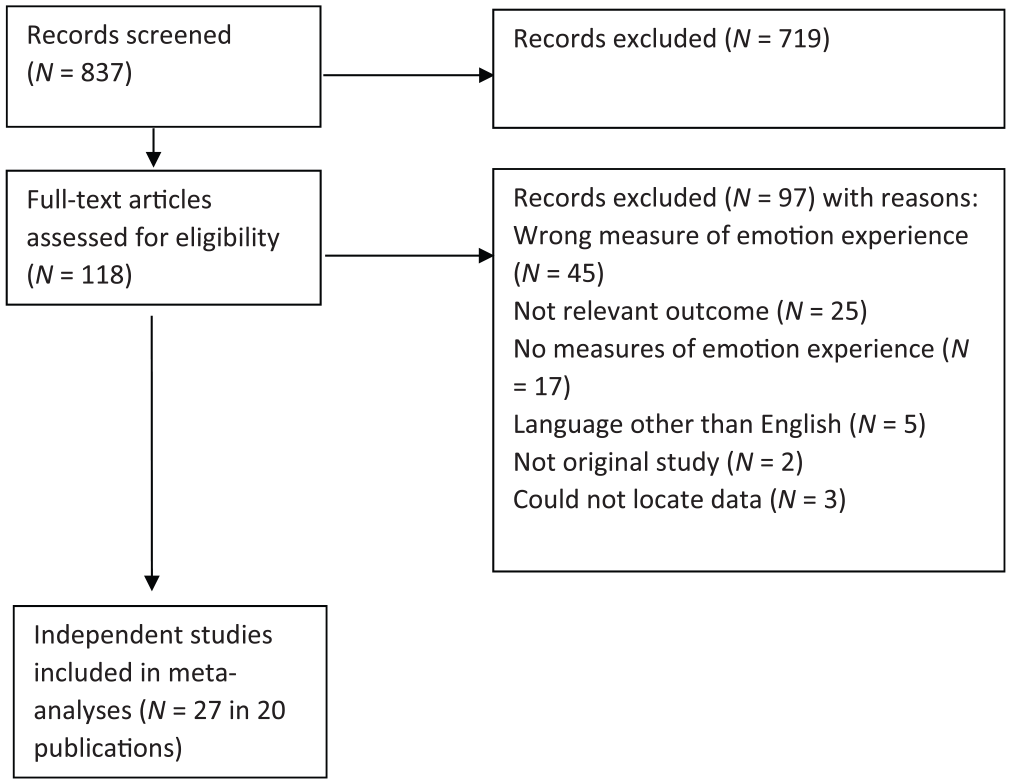
Flow chart of study selection.
Trait Emotion Complexity
The majority of studies on trait indicators of emotion complexity concerned emotion differentiation, derived from multiple measurements of emotions across situations. The most commonly used operationalization of emotion differentiation was the calculation of the ICC for emotion pairs over time. Sixteen studies were experience sampling studies (i.e., based on multiple daily measures), eight studies were diary studies (i.e., based on one measure per day). These studies varied in length from 1 day to 28 days. Finally, one study derived the indicator based on the emotions experienced in response to reading emotional scenarios.
Trait emotion representation in nonclinical populations
Seventeen studies investigated trait indicators of emotion complexity in nonclinical populations. In the studies investigating emotion differentiation (i.e., negative and/or positive), the behaviors evaluated were: frequency of emotion regulation (Barrett et al., 2001; Tong & Keng, 2017), the ability to accurately infer the valence and arousal of partner’s emotional state (Erbas et al., 2016), caloric intake (Jones & Herr, 2018), employees’ intrinsic motivation (Vandercammen et al., 2014), differentiation in cognitive appraisals (i.e., subjective account of what caused the negative and positive emotions experienced in a particular moment; Erbas et al., 2015; Tong & Keng, 2017), alcohol intake (Kashdan et al., 2010), anger intensity and aggressive tendencies (Pond et al., 2012), and wise reasoning, forgiveness, suppression, cognitive reappraisal, and postevent reactivity (Grossmann, Gerlach, & Denissen, 2016). In three separate studies, Ebner-Priemer et al. (2015) investigated the association between variability indicators and emotional recovery (i.e., operationalized as the attractor strength from changes around the person’s baseline back to the baseline [see Kuppens, Oravecz, & Tuerlinckx, 2010]). Carels et al. (2000) investigated the association between negative emotion variability and blood pressure (for a narrative description of the results, consult Table 1).
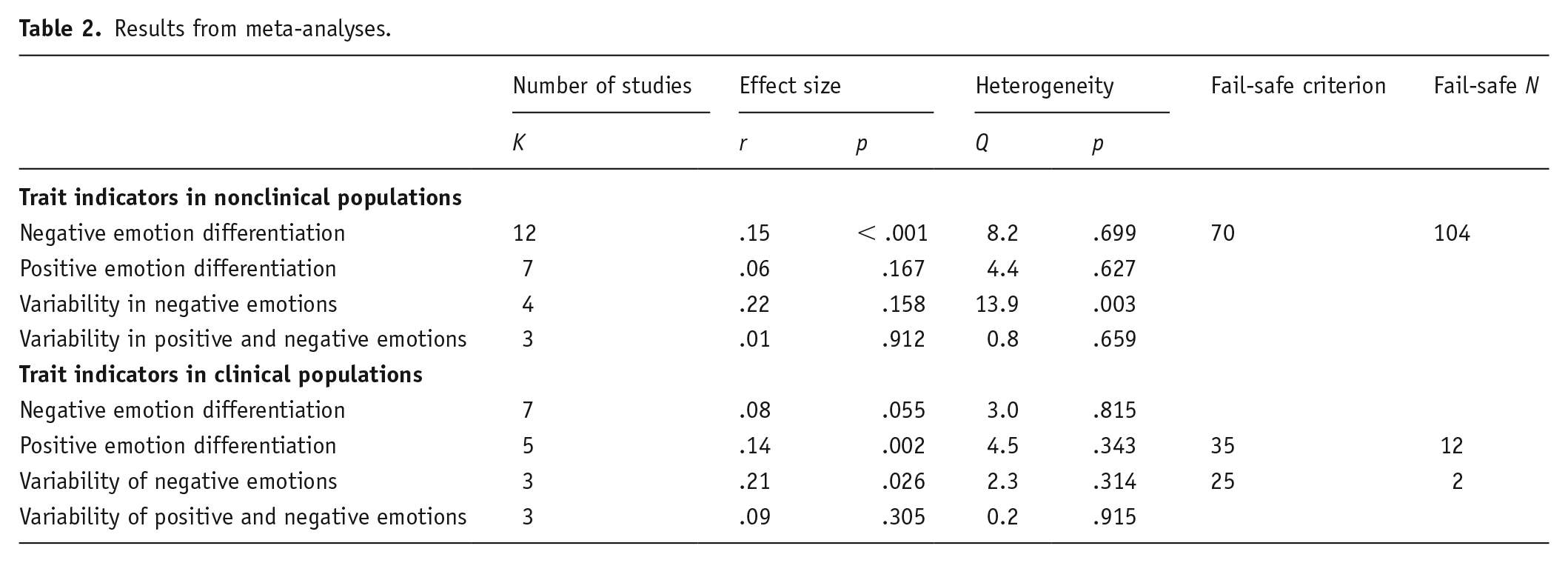
Four indicators (i.e., negative and positive emotion differentiation, variability in negative emotions, and variability in positive and negative emotions) were investigated in three or more studies. The association between negative emotion differentiation and behavioral adaptation was significant and of a small magnitude (K = 12, r = .15, p < .001). No significant heterogeneity was detected (Q = 8.2, p = .699), and the fail-safe number exceeded the criterion (see Table 2 and Figure 2). For positive emotion differentiation, the association was not significant and of a negligible magnitude (K = 7, r = .06, p = .167) with no significant heterogeneity (Q = 4.4, p = .627; see Figure 3). Concerning variability in negative emotions, a small to medium effect size was detected, which was not significant (K = 4, r = .22, p = .158), and with significant heterogeneity between study effect sizes (Q = 13.9, p = .003). Variability in negative and positive emotions was not associated with behavioral adaptation (K = 3, r = .01, p = .912), and there was no significant heterogeneity (Q = .8, p = .659; see Table 2).
Results from meta-analyses.
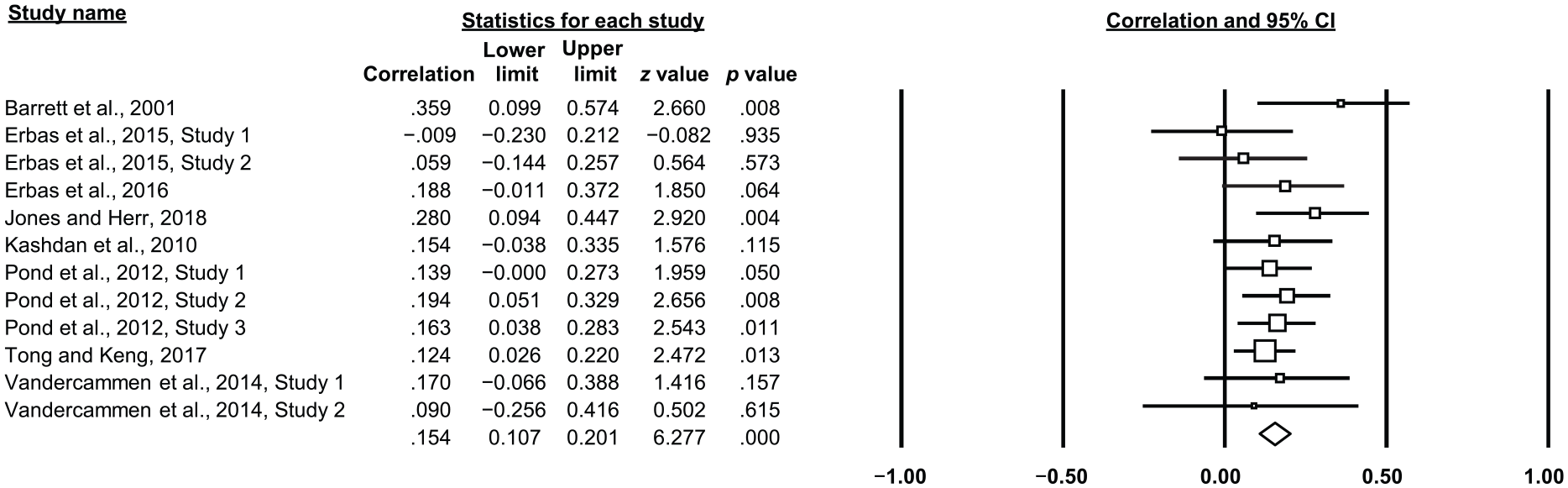
Forest plot of effect sizes for the 12 studies investigating the association between trait negative emotion differentiation and behavioral adaptation in nonclinical populations.
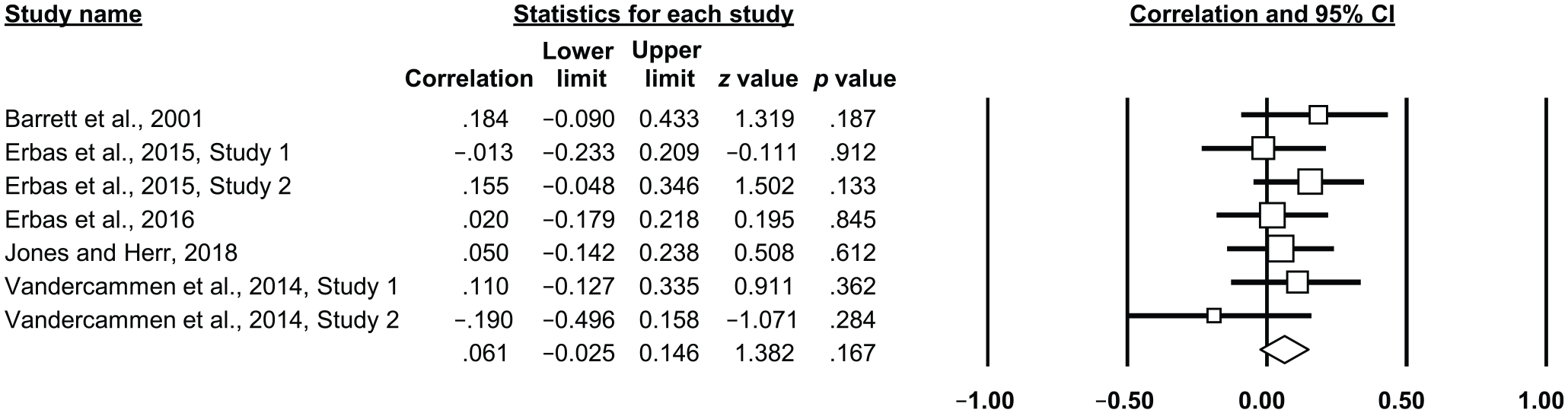
Forest plot of effect sizes for the seven studies investigating the association between trait positive emotion differentiation and behavioral adaptation in nonclinical populations.
Trait emotion representation in clinical populations
Turning to the studies of trait indicators of emotion complexity in clinical populations (K = 11), the majority of studies (K = 5) investigated borderline pathology, followed by eating disorders (K = 2), depression (K = 2), and social anxiety (K = 1), and finally one study that included a mixed sample of individuals with borderline personality disorder or depression.
Seven studies investigated negative or positive emotion differentiation. In these studies, the behaviors evaluated were: urges to engage in maladaptive behavior as well as difficulties controlling maladaptive behavior (Dixon-Gordon et al., 2014), emotion regulation (O’Toole et al., 2014; Starr et al., 2017), nonsuicidal self-injury urges and acts (Zaki et al., 2013), impulsivity (Tomko et al., 2015), weight-loss activities (Selby et al., 2014). In the four studies investigating variability indicators, the behavioral outcomes were emotional recovery (Ebner-Priemer et al., 2015) and disordered eating and self-destructive behaviors (Selby et al., 2012; see Table 1).
Four indicators (i.e., negative emotion differentiation, positive emotion differentiation, variability in negative emotions, and variability in positive and negative emotions) were investigated in three or more studies. For negative emotion differentiation, a marginally significant effect was detected (K = 7, r = .08, p = .055). No significant heterogeneity was detected (Q = 3.0, p = .815). For positive emotion differentiation, the association was significant and of a small magnitude (K = 5, r = .14, p = .002) with no significant heterogeneity (Q = 4.5, p = .343). However, the fail-safe number did not meet the criterion. Variability in negative emotions was significantly associated with behavioral adaptation with an effect of a small magnitude (K = 3, r = .21, p = .026) and no significant heterogeneity (Q = 2.3, p = .314). However, the fail-safe number did not meet the criterion. Variability in negative and positive emotions was not associated with behavioral adaptation (K = 3, r = .09, p = .305), and there was no indication of heterogeneity (Q = 0.2, p = .915; see Table 2).
State Emotion Complexity
Four studies relied on state measures of emotion complexity, three of which were conducted on clinical populations, including individuals with borderline personality disorder, depression, and spider phobia. Two studies computed what could be considered covariation of negative emotions as an indicator of emotion complexity. In one study, this indicator was obtained using a count of negative emotion labels derived from a task where participants were instructed to create and speak a sentence including a negative word to describe the object (i.e., spider) and a negative word or two to describe their emotional response to the object (Kircanski et al., 2012). In the other study, Andrewes et al. (2017) evaluated changes in negative complex emotions (i.e., instances with two or more co-occurring negative emotions above a certain threshold). A third study calculated emotion differentiation as a person’s number of experienced emotions, both positive and negative, in relation to their intensity as an index of diversity in both negative and positive emotions (Grossmann, Gerlach, & Denissen, 2016). In the final study, Tomko et al. (2015) evaluated state emotion differentiation, calculated as consistency of ratings of negative affect. Specifically, participants rated emotion labels belonging to different negative emotion category subscales. Based on these ratings, an index for negative emotion differentiation was calculated by obtaining the ICC for consistency of ratings across the negative subscales. As individuals differentiate between the different items of the subscales, the variance due to a particular subscale will increase, and the more variability that is accounted for by the subscales, the more an individual is assumed to differentiate between the emotional states (Erbas, Ceulemans, Kalokerinos, & Houben, 2018; Tomko et al., 2015).
Behaviors evaluated in these state studies were: skin conductance and steps taken towards a feared object during exposure (Kircanski et al., 2012), nonsuicidal self-injury actions and self-injury thoughts (Andrewes et al., 2017), impulsivity (Tomko et al., 2015), wise reasoning, emotion regulation, postevent reactivity, and forgiveness (Grossmann, Gerlach, & Denissen, 2016). A meta-analysis could not be performed since no indicator of emotion complexity had been investigated in three or more studies within either a healthy or clinical population. Kircanski et al. (2012) found that a greater percentage of anxiety and fear words was associated with greater reduction in skin conductance in response to a feared object, whereas Andrewes et al. (2017) found that changes in negative complex emotions predicted subsequent nonsuicidal self-injury actions and self-injury thoughts. Grossmann et al. (Grossmann, Gerlach, & Denissen, 2016) found a positive association between emotion differentiation and wise reasoning. Finally, Tomko et al. (2015) found that emotion differentiation was associated with less subsequent impulsivity (see Table 1).
Discussion
The aim of the present study was to evaluate the association between indicators of complexity in emotion experience and behavioral adaptation. To date, research has mainly investigated trait indicators of emotion complexity, that is, a person-level index. However, given that emotion complexity has been proposed to have both a stable and a variable part (Erbas, Ceulemans, Kalokerinos, & Houben, 2018; Fleeson, 2001), we sought to address the role of both trait and state indicators of emotion complexity in situational behavioral adaptation (i.e., physiological, cognitive, and action responses within the time frame of 1 day). To achieve this, we systematically reviewed the literature and were able to locate 27 studies fitting the inclusion criteria.
Emotion Complexity at the Trait Level
Concerning trait studies on nonclinical populations, most studies assessed negative emotion differentiation (K = 12), and the results from these studies revealed a small and statistically significant association with behavioral outcomes (r = .15). Thus, these results support the conclusion reached by Kashdan et al. (2015) that trait negative emotion differentiation is beneficial. The present study specifically adds to the literature by showing that negative emotion differentiation is associated not only with overall mental health but with concrete, presumably adaptive behaviors. However, this finding should be interpreted according to its effect size. Obtaining only a small effect size may put into question the importance of negative emotion differentiation in terms of its association with measures of situational behavioral adaptation. It could be hypothesized that negative emotion differentiation would be more important under certain circumstances than others (e.g., stressful events), or more important for some outcomes than others (e.g., emotion regulation). Although the lack of between-study heterogeneity points to no systematic variation in the included studies, this does not preclude the existence of such, which is worthy of future investigation given the strong consensus in the field that negative emotion differentiation has an adaptive value (e.g., Erbas, Ceulemans, Blanke, et al., 2018; Kashdan et al., 2015; Smidt & Suvak, 2015). Turning to positive differentiation, this indicator was not associated with behavioral adaptation (r = .06). This finding may be due to negative emotions motivating action more so than positive emotions (Barrett et al., 2001, p. 715). Indeed, negative emotional experiences have been proposed to have greater informational value in signaling the need to change or adjust one’s behavior with the purpose of avoiding harm and threat to the individual (e.g., Pratto & John, 1991).
Two variability indicators were also addressed, revealing that variability within negative emotions (r = .22), but not in negative and positive emotions (r = .01), was significantly associated with behavioral adaptation. The finding concerning negative emotion variability is noteworthy, because variability as an indicator of emotion complexity previously has been associated with negative health outcomes (Houben et al., 2015; Kuppens et al., 2007). Three of the four studies addressing variability of negative emotions found positive effects (Ebner-Priemer et al., 2015). However, all three studies evaluated variation in distress, measured with a single item, as opposed to variation over a number of negative emotions. Furthermore, these three studies employed the same outcome, namely emotional recovery operationalized as return to one’s affective baseline (Ebner-Priemer et al., 2015). Concerning this particular outcome, larger deviations overall from one’s baseline (i.e., variability) can be assumed, by default, to create steeper slopes of return to the point of departure. As such, the outcome may to some extent overlap with the predictor in this particular case, thereby possibly resulting in a positive association. The fourth study addressed variation across a number of negative emotions and found the expected negative effect on behavioral adaptation (i.e., blood pressure; Carels et al., 2000). These opposing results were reflected in significant heterogeneity between studies, possibly due to the different measures of behavior and different operationalizations of emotion variability. At this point, there are too few studies to reach a definite conclusion regarding the effect of emotion variability indicators on specific behaviors.
Within clinical populations, negative emotion differentiation was not significantly associated with behavioral adaptation (r = .08), while positive emotion differentiation was (r = .14), although of a small magnitude. This is a somewhat surprising finding, given the proposed association between negative emotion differentiation and overall mental health (e.g., Smidt & Suvak, 2015). These results should also be interpreted with caution given the low number of studies (K = 7), pointing to a need for further investigation. Given that many clinical conditions are characterized by a failure to engage in rewarding or meaningful activities (e.g., anxiety disorders and depression; Renna, Quintero, Fresco, & Mennin, 2017), one could speculate that positive emotion differentiation may play an important role in overcoming such difficulties. The ability to envision an activity involving emotions such as pride, curiosity, and happiness (i.e., high granularity) may motivate the individual to take action more so than simply envisioning an activity as being good (i.e., low granularity). With a more granular perception of positive emotions, the individual may have more concrete and nuanced information about the situation, allowing them to approach a reward.
The two variability indicators also showed nonsignificant effects (i.e., negative emotions: r = .21; negative and positive emotions: r = .09), although the effect size obtained for negative emotion variability was of a small to medium magnitude. Again, these results should be interpreted with caution considering the low number of studies included in the analyses (K = 3).
Taken together, a number of nonsignificant findings and significant findings of only small effect sizes were detected, pointing to a lack of or weak association between person-level indicators of emotion complexity and behavioral adaptation in a given situation. However, it could be argued that it is problematic when researchers address the association between emotional complexity and behavioral adaptation exclusively based on person-level indicators of complexity. Indeed, there is strong theoretical consensus concerning the situational nature of emotions, lasting seconds to minutes (e.g., Frijda, 1986; Gross, 2014), and theories and derived hypotheses surrounding emotion complexity tend to claim that the very reason that certain aspects of emotion experiences are adaptive (e.g., emotion differentiation) is because the experienced emotions point to the situation and potential actions to be taken in that particular situation (e.g., Demiralp et al., 2012; Grühn et al., 2013; Kashdan et al., 2015; Robinson & Clore, 2002). One may therefore question if the association between emotion complexity and behavioral adaptation is best addressed using trait-like indicators of complexity. For instance, when finding that better trait-like negative emotion differentiation leads to less alcohol intake when experiencing higher levels of negative emotions (Kashdan et al., 2010), this is believed to be because emotion differentiation is particularly helpful in the context of intense negative emotions, because it allows for better emotion regulation (p. 1342). Thus, there appears to be an assumption that trait-like emotion differentiation automatically translates into state emotion differentiation. However, the weak associations between trait-like indicators of emotion complexity and behavioral adaptation detected in this study, the context-dependent nature of emotions, and the acknowledgement that emotion complexity may also have a variable part worth investigating in its own right (Erbas, Ceulemans, Kalokerinos, & Houben, 2018; Grossmann, Gerlach, & Denissen, 2016; Grossmann, Huynh, & Ellsworth, 2016; Tomko et al., 2015), all point to the importance of investigating emotion complexity at the state level.
Emotion Complexity at the State Level
Only four studies were identified in total, three of which were conducted on clinical populations. This is in itself a noteworthy finding, given the prevailing assumption in the literature that indicators of emotion complexity play an important role in the individual’s ability to take appropriate action (e.g., Barrett, 2012; Frijda, 2007; Gross, 2015). With only one detected study on these matters in a healthy population, there is an obvious need for such investigations from a normative perspective.
A meta-analysis could not be performed since no indicator of emotion complexity had been investigated in three or more studies. Two studies in total assessed covariation in negative emotions as an indicator of emotion complexity (operationalized as a count of emotions). However, the studies relied on opposite hypotheses concerning the behavioral effect of covariation of negative emotions. That is, where Kircanski et al. (2012) argued that more emotion labels would have a positive behavioral effect (i.e., on anxiety attenuation within phobic individuals), Andrewes et al. (2017) claimed that this indicator was reflective of emotional distress or being emotionally overwhelmed, which would have a negative behavioral effect (i.e., nonsuicidal self-injury actions and self-injury thoughts). Indeed, this discrepancy reflects a general paradox in the literature concerning the experience of multiple emotions. From one perspective, such experience may be considered emotion “overload,” however, from another perspective it may be seen as adaptive, granting the individual more information about the situation (Kuppens, Allen, & Sheeber, 2010). If negative emotions are related to appraisals of the potential for goal fulfillment in a specific situation, as for instance in the case of exposure to something feared (e.g., Kircanski et al., 2012), different emotions could be argued to provide nuanced information about the individual’s goals and possible courses of action in that particular situation. Outside of an experimental setting, however, emotion ratings are typically made without asking participants about the context and their goals surrounding these ratings, which prohibits definite conclusions about the potential (mal)adaptive properties of emotion covariation. These detected state studies underscore the variety both in the ways in which researchers operationalize the indicators and in their predictions of the behavioral effects of the indicators.
Future Implications and Directions
Gaining an understanding of when and which indicators of emotion experience are likely to be behaviorally adaptive is a crucial matter both from a basic affective science point of view and in guiding psychotherapies’ theory and practice related to the treatment of individuals with emotional disorders, where behavioral adaptation is a common goal (Mennin, Ellard, Fresco, & Gross, 2013). A number of avenues for future investigation of the role of state emotion experience in behavioral adaptation should be outlined. One issue in moving forward concerns the evaluation of a behavior to be adaptive or not. Is refraining from smoking adaptive if the individual has no intention of quitting smoking? Is careful consideration of one’s emotion regulation options appropriate in situations calling for immediate action? Behavioral adaptation needs to be evaluated against something, such as individual goals and/or the contextual surroundings (e.g., Aldao, Sheppes, & Gross, 2015; Bonanno & Burton, 2013). For instance, one of the studies had skin conductance as outcome measure, on which larger covariation of negative emotions had an attenuating effect (Kircanski et al., 2012). This outcome could indeed be considered adaptive in the sense that participants were exposed to a feared object, but experienced an attenuated physiological fear response. However, in the study by Andrewes et al. (2017), the behaviors under investigation were self-harm and self-injury thoughts, which are, from a long-term perspective, more obvious maladaptive behaviors and indeed associated with adverse consequences (e.g., Adams, Kaiser, Lynam, Charnigo, & Milich, 2012; Tice, Bratslavsky, & Baumeister, 2001). But within the context of emotional arousal, such behaviors can be congruent with a short-term goal of emotion attenuation. The same can be said for the study by Tomko et al. (2015), where impulsivity was considered an indicator of behavioral maladaptation. Indeed, relying on impulsive coping in order to reduce negative affect may be maladaptive in the long term, but congruent with a momentary goal held by the individual. Thus, future studies should consider the individual’s goal in the evaluation of the detected effect of emotion experience complexity on behavior. Without information about goals, it will be difficult to judge the potential adaptive value of a specific behavior.
Second, a critical evaluation of the complexity indicators employed across the identified studies is warranted. Over and above the empirical findings, one may question the conceptual validity of emotion variability as a component of emotion complexity if it most of all concerns a matter of emotion reactivity. If that is the case, it may be taken to concern a quantitative matter rather than an experiential qualitative matter. Although it has been suggested that researchers should control for the individual’s mean emotion intensity when computing variability indicators in order not to confound variability with overall reactivity (Blanke et al., 2019), it remains to be theoretically elaborated upon what variability then would reflect in terms of experiential qualities, and how it may or may not have adaptive value. Furthermore, the indicators are based on an assumption that emotion categories have the same value in providing information about the person in relation to the context. For instance, when calculating emotion differentiation, emotions are granted equal weight in obtaining this indicator. However, where certain emotions in a given situation may provide important information about a particular goal and courses of action, other emotions may be reactions to those emotions. Along these lines, some clinical researchers distinguish between primary and secondary emotions, where primary emotional responses are believed to facilitate more adaptive behavior because they are the individual’s initial response to the situation, thereby being reflective of an individual’s current goals or needs. In contrast, secondary emotional responses are believed to reflect reactions to the individual’s initial responses and are therefore less aligned with the context, presumably facilitating less adaptive behavior (e.g., Mennin & Fresco, 2014; Pascual-Leone & Greenberg, 2007). In other words, single emotion categories may vary in their potential adaptiveness. For instance, consider a person reacting with sadness in response to a need for emotional closeness with their spouse. In looking forward to seeing the spouse, the person learns that they will be home from work late, which quickly leads to anger, including the action tendencies to fight and confront. Here it would appear crucial that the person is able to experience both emotions simultaneously (i.e., emotion covariation) and decipher which course of action will most likely lead to goal fulfillment. Thus, some emotions can be considered to have primacy over others in being more or less congruent with the individual’s short- and long-term goals and/or more or less appropriate to the context. This line of thinking resembles that proposed by Aldao et al. (2015) as well as by Bonanno and Burton (2013) concerning emotion regulation flexibility. Here, emotion regulation repertoire concerns the number of emotion regulation strategies that the individual is able to use. However, in order for this repertoire to be employed in an adaptive way, it is suggested that the strategies must be employed in a context-sensitive manner and in line with the individual’s goals. Such thinking can be translated into empirical studies of emotion experience complexity by evaluating the behavioral effect of manipulating the experience of single or multiple emotions, expected to vary in their potential action tendencies’ adaptiveness as per the context and the individual’s goals. One could hypothesize that emotion covariation in a given situation is necessary but not sufficient for behavioral adaptation, in that the individual needs to be able to calibrate their behavioral response in light of their most important goals, to which not all experienced emotions are equally potent signals. We therefore speculate that the methods for obtaining complexity indicators at the person level may not be directly transferrable into a state setting, where the context and goals are determining factors for which emotions and behaviors are considered adaptive.
With more knowledge about adaptive characteristics of emotion complexity indicators, we can begin to develop strategies to alter emotion experience in psychotherapy. Psychotherapies are already employing techniques with which to alter a client’s emotion experience in terms of complexity (e.g., unified protocol: Barlow et al., 2011; emotion regulation therapy: Mennin & Fresco, 2014; mindfulness and acceptance-based behavioral therapy: Roemer & Orsillo, 2009), but this work could indeed be strengthened with a stronger body of empirical literature to draw from. Functional analysis, for instance, is a cornerstone of behavioral interventions reflecting a clinical hypothesis-testing approach that involves the identification and targeting of temporal and causal relationships between emotions and behavior (Yoman, 2008). This technique could be deepened by focusing on the characteristics of the emotion experience, mapping the association between experiential complexity characteristics and specific actions.
Limitations
The present findings should be viewed in light of several limitations. First of all, the results from the meta-analyses must be considered preliminary given the small number of studies included. Second, these studies were required to address indicators of emotion complexity derived from momentary ratings of emotion categories. Other characteristics of emotion representation could also be relevant in terms of facilitating behavioral adaptation, such as emotion clarity (e.g., Boden & Berenbaum, 2012; Gohm & Clore, 2002). Third, the categorization of studies into trait and state studies could be called into question, including the categorizing of a study as a trait study following multiple assessment points within the same day. Such measures may lie somewhere between trait and state (see Tomko et al., 2015), but were categorized as trait studies due to the collapsing of multiple emotion ratings across instances. Fourth, across studies, a number of different behavioral outcomes were evaluated, and it could be argued that these outcomes vary to an extent where it would be inappropriate to compare effects. However, with one exception, the heterogeneity between studies was consistently nonsignificant, indicating that the studies did not systematically vary in terms of the detected effects, which would have been the case if the effect of emotional complexity were dependent on the specific behavioral outcome under investigation. Finally, the causal effect of emotion complexity on behavioral adaptation cannot be fully addressed by the included studies. Whereas three of the four studies evaluating the effect of state indicators on behavior did allow for some causal inference, given either their experimental design or the use of time-lagged analyses, all studies on trait indicators of emotion complexity relied on correlational analyses, precluding causal interpretations.
Conclusion
The present study synthesized the literature on both trait and state indicators of emotion complexity and their association with situational behavioral adaptation (i.e., physiological, cognitive, and overt action responses). The majority of included studies relied on trait indicators of emotion complexity, most often emotion differentiation. Here, differentiation of negative emotions showed a significant, but small effect on behavioral adaptation in nonclinical populations. In contrast, investigations in clinical populations showed that positive emotion differentiation may be more important than negative emotion differentiation for behavioral adaptation, but this result was not robust, and more research is therefore needed before definite conclusions can be drawn. In terms of state emotion complexity, only four studies were located, revealing a field of research in its infancy. In advancing the field, we suggest that researchers carefully consider the conceptualization of the adaptiveness of the behaviors under investigation, either by experimentally controlling the goal or otherwise taking the individual’s goals into account. In relation to this, we encourage research on state indicators of emotion complexity to acknowledge that not all emotion categories are equally valuable in terms of pointing to the goal or the situation. We speculate that the methods for obtaining complexity indicators at the person level may not be directly transferrable into a state setting, where the context and goals are determining factors for which emotions and behaviors can be considered adaptive. Conducting research into these matters is crucial both from a basic affective science point of view and in guiding the theory that provide the foundation for psychotherapy for individuals with emotional disorders.
