



Abstract
Mutual coupling of (thermofluiddynamic) modes of perturbations can affect the thermo-acoustic stability of combustors and contribute to combustion noise. For example, vortical or entropic perturbations can be transferred to acoustic perturbations if accelerated by the mean flow. The decomposition of perturbation fields into the respective modes and a linear description of their interactions in terms of fluctuating primitive variables is challenging. In contrast, Doak’s momentum potential theory promises an unambiguous decomposition in terms of momentum fluctuations, which is not limited to the linear regime. Whereas classical momentum potential theory takes into account hydrodynamic, acoustic and entropic modes in unconfined flows, the investigation of noise generation in combustion chambers requires the extension of the momentum potential theory to capture modes linked to the fluctuation of species mass fractions (“species mode”) arising from the change in chemical composition due to the reaction. Furthermore, a rigorous treatment of boundary conditions due to the confinement of the flow inside the combustor is required. The herein presented extension to reactive flows consists of two steps, (i) the formulation of a potential for momentum fluctuations related to species modes and (ii) identification of the total fluctuating enthalpy related to species modes. The extended theory is applied to post-process computational fluid dynamic simulation data of the propagation of entropy and species perturbations through one-dimensional ducts, nozzles and premixed flames. We find that although momentum potential theory offers a complete decomposition of momentum perturbations for reactive flows, the meaningful interpretation of this decomposition is rather challenging, even for non-reactive flows.
Introduction
Combustion noise and thermo-acoustic instabilities become of increasing importance for modern low emission combustion devices. On the one hand, combustors are operated in the lean regime to reduce emissions, making them more prone to thermo-acoustic instabilities. On the other hand, especially aero-engines are subject to increasing noise emission regulations.
Two classes of combustion noise can be distinguished. Direct combustion noise emitted from the flame acting as a monopole source of sound, and indirect combustion noise due to (thermofluiddynamic) mode conversion, 1 where “thermofluiddynamic mode” in this context denotes perturbations of acoustic, entropic, compositional or vortical nature. For example, entropic perturbations in the flow stemming from the flame can be converted to acoustic perturbations if accelerated by the flow, as would be the case in turbine inlet guide vanes.
Thermofluiddynamic mode conversions have been extensively studied in the past. The seminal work by Marbel and Candel 2 studies acoustic disturbances resulting from hot spots (entropy disturbances) that convect through nozzles. Magri et al.3,4 studied compositional disturbances as a source of indirect combustion noise, the so-called compositional noise. For a review on indirect combustion noise with a focus on entropy noise see the review paper by Morgans and Duran 1 . Mode conversion from acoustic to hydrodynamic swirl perturbations have been studied by Komarek and Polifke, 5 Palies et al., 6 Albayrak et al.,7,8 and Varillon et al. 9 Lieuwen presents a decomposition of acoustic, rotational and entropic disturbances in the context of the interaction of an acoustic wave with a planar flame, 10 and gives a comprehensive discussion on the decomposition and evolution of flow disturbances. 11 Flame-acoustic-vorticity interactions have been studied for example by Baillot et al., 12 Birbaud et al., 13 Blanchard et al., 14 and Steinbacher and Polifke. 15
Furthermore, various disturbance energy norms have been defined which append the classical acoustic energy to account for entropic perturbations and mean flow effects, for example, the energy norms formulated by Chu, 16 Myers, 17 and Cantrell and Hart. 18 Notably, Brear et al. 19 extended Myers’ energy norm for reactive flows. George and Sujith 20 formulated general properties of a proper disturbance energy and reviewed common disturbance energy norms in the light of these properties.
By simulating the compressible fluid dynamics equations directly, the interaction between thermofluiddynamic modes is inherently included in the simulation data. However, decomposition of such data into the respective thermofluiddynamic modes, as well as the interpretation in terms of mode interaction, is extremely challenging without further post-processing.
The Helmholtz Hodge decomposition, see Bhatia et al. 21 for a review, was employed in previous studies to decompose a velocity field into its acoustic and hydrodynamic components. Schoder et al. 22 suggested a unique Helmholtz Hodge decomposition on arbitrary domains by requiring the acoustic (compressible) and hydrodynamic (incompressible) field to be L2-orthogonal to each other. However, the Helmholtz Hodge decomposition inherently assumes that all compressible effects may be ascribed to the acoustics. 22 Apparently, this assumption is not valid in the limit of high Mach numbers or strong thermal expansion of the fluid, the latter being crucial in the case of combustor physics.
In his paper on “Momentum Potential Theory of energy flux carried by momentum fluctuations” (from hereon referred to as MPT), Doak23,24 “identifies acoustic motion as being associated isentropically with the fluctuating pressure.” 25 This allows an unambiguous decomposition of the momentum perturbations (perturbations of momentum density/mass flow) in a single component flow into their acoustic, entropic and hydrodynamic components, where all but the last can be described by a respective potential. One example application of MPT by Doak 24 was the investigation of acoustic wave propagation through a two-dimensional unidirectional sheared mean flow. Thanks to today’s computational resources, the MPT can be used as a post-processing tool of high-fidelity simulation data. The decomposition into the various thermofluiddynamic modes is then achieved by solving a Poisson equation for each of the potentials. In the MPT framework, no further assumption other than a steady mean flow is necessary. In particular, perturbations are not limited to the linear regime. This makes the theory appealing for combustor flows, where thermal expansion is very strong and non-isentropic and the high power density of the flame can lead to perturbations of significant magnitude.
In subsequent work, Jenvey 25 employs Doak’s definition of acoustic and entropic momentum perturbations to split the total fluctuating enthalpy (TFE) of a single component flow into its acoustic, entropic and hydrodynamic contributions.
The MPT has recently been applied to investigate the aero-acoustics of turbulent high Mach number jets.26–30 Unnikrishnan and Gaitonde 31 extended MPT by a decomposition of the pressure field, which was used by Ho and Kim 32 to investigate a cavity flow in acoustic resonance. Separating acoustic pressure fluctuations from hydrodynamic ones permitted the authors to study the interaction of vortex dynamics and acoustic modes to explore the sources of noise generation.
A combustion chamber with cold flow was recently investigated by D’Aniello et al.
33
The first application of MPT to a reactive flow was performed by D’Aniello et al.
34
based on LES data of the PRECCINSTA gas turbine model combustor. Although the flow is reactive, the study restricted itself to “the classical formulation of the MPT”
34
which does not account for compositional inhomogeneities. Nevertheless, the authors identified the “GAF [acoustic part of the TFE] [
Despite the progress reported in the above mentioned studies, two challenges in applying the MPT framework to confined reactive flows to analyze flame-flow-acoustics interaction and combustion noise remain: (i) the confinement of the flow, and hence, the absence of a far-field boundary, where all perturbations can be associated with non-evanescent acoustic waves. Assuming solely acoustic perturbations at far-field boundaries is justified only if all “convective waves” are dissipated before reaching the far-field; and such a split at a far-field boundary tremendously simplifies the choice of physical boundary condition for the Poisson equations of the MPT. D’Aniello et al. 35 discussed the uncertainty in boundary condition for confined flows in their appendix. (ii) The effect of local changes in chemical composition due to chemical reactions on the local density, that is, to account for compositional inhomogeneities in the flow.
In the present article, we study the classical indirect noise scenarios of entropy perturbations2,36 and compositional perturbations3,4 convecting through a quasi one-dimensional nozzle, as well as the interaction of such perturbations with a one-dimensional premixed flame that is kinematically stabilized in an area expansion. We opt for quasi one-dimensional canonical test cases because they allow physically motivated boundary conditions for the MPT. In spite of the simplicity of the chosen test cases, the employed boundary conditions can be generalized to some extent to more realistic higher-dimensional combustor flows. The contribution of the present study is twofold. (i) We present the extension of the momentum potential theory (MPT) for reactive flows characterized by changes in their chemical composition. (ii) We present a quasi-one-dimensional formulation of the MPT that allows to study canonical setups commonly investigated in the indirect noise literature, such as one-dimensional nozzle flows. 2 To the authors’ knowledge, a validation of MPT for post-processing of canonical one-dimensional enclosed flows has not yet been presented.
This article is organized as follows. First, we review the classical MPT as introduced by Doak. Subsequently, the theory is extended to reactive flows. To prepare our analysis of quasi-one-dimensional canonical flows, the MPT is adapted to quasi-one-dimensional flows featuring variable cross-sectional area along the flow direction. We then describe the investigated test cases and numerical methods employed, and results are presented and discussed subsequently.
Doak’s momentum potential theory
In this section, we recapitulate the MPT for single component flows as originally introduced by Doak.23,24 This review includes the decomposition of momentum density (mass flux) perturbations into acoustic, entropic, and hydrodynamic (thermofluiddynamic) modes, as well as a proposed decomposition of TFE.
The underlying idea of Doak’s MPT is to split the momentum perturbation field



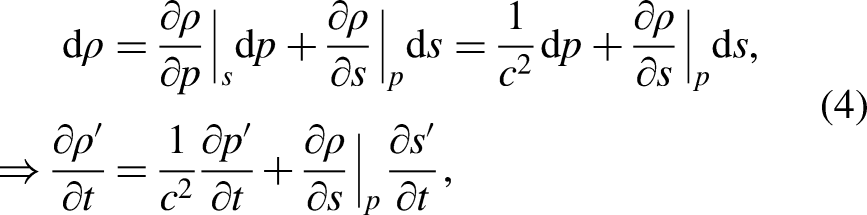


Jenvey’s approach33,25 showed that the fluctuations in total enthalpy/TFE itself can be decomposed similarly into the respective thermofluiddynamic modes. In the case of small, and hence, linear perturbations, the explicit expressions



Extension to reactive flows
In this section, we extend the MPT by Doak to reactive flows, which are characterized by changes in their chemical composition. The extension is done in two steps, (i) we derive the source term for the Poisson equation for the momentum perturbation related to a perturbation of the chemical composition (“species mode”) and (ii) propose a decomposition of the total fluctuating enthalpy that accounts for this species mode.
Species potential
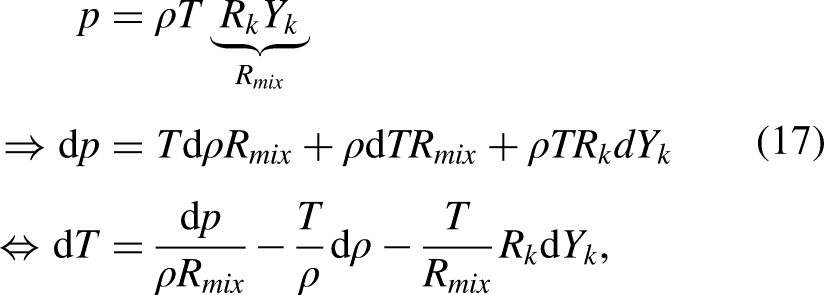
For the case of a reactive mixture with




We now seek expressions for the partial differentials in equations (11) to (13) by comparing coefficients with Gibbs’ equation in mass specific form for a mixture of ideal gases, that is,






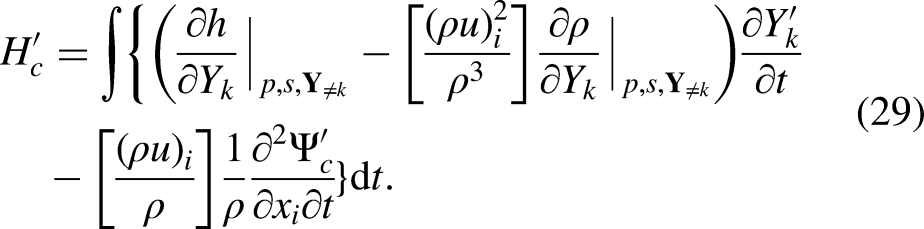
Total fluctuating enthalpy related to species mode
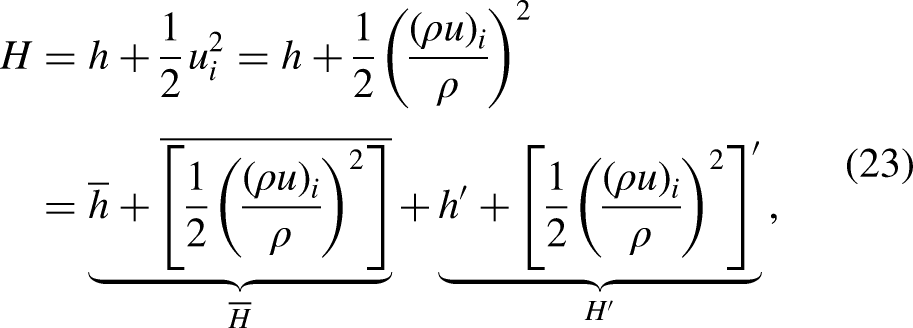
Following Doak,
24
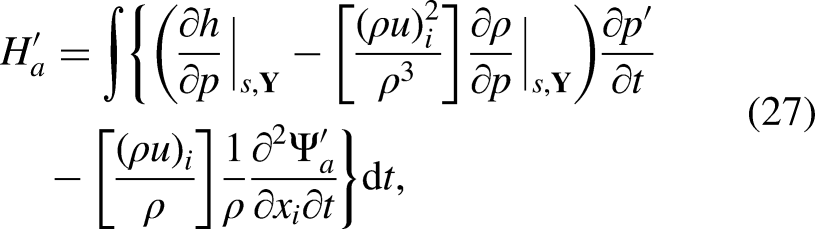
the total enthalpy is decomposed in its temporal mean








MPT for quasi-one-dimensional flows
In the following, we want to apply the MPT to quasi-one-dimensional flows featuring variable cross-sectional area along the flow direction. To this end, we have to slightly modify the MPT to account for the change in the continuity equation due to variable cross-sectional area, that is,





Problem formulation and computational set-up
This section presents the canonical test cases studied, that is, propagation of entropy and mixture inhomogeneities through (i) a duct, (ii) two ducts connected to each other by an isentropic nozzle, 37 and (iii) a premixed flame stabilized in an area expansion.
Problem formulation
Figure 1 gives an impression of the computational domains. The mean flow direction is from left to right. The duct in case (i) is 2 m long and sustains a mean flow of Mach number

Propagation of hot and cold spots (associated with a convective “entropy wave”) through a duct with constant cross-sectional area (top), two ducts connected by a nozzle (middle) and downstream of a planar flame subjected to equivalence ratio fluctuations (bottom).
In the non-reactive cases (i) and (ii), entropy perturbations are forced with a volumetric heat source term




Numerical models & solution approach
The MPT is a
The flow-field data in this study is obtained by solving the fully compressible Navier-Stokes equations and species transport equations with the finite volume software OpenFOAM,
38
using an in-house solver based on “reactingFoam.”39,40 The thermodynamic model of an ideal mixture of ideal gases is employed and differential species diffusion is neglected by assuming unity Lewis number for all species. Quasi-one-dimensionality is achieved by stacking polyhedral finite volumes along the flow direction. All fluxes across finite volume surfaces but the ones in flow direction are set to zero. Flow acceleration due to cross-sectional area changes then results from the different cross-sectional area on both sides of the finite volume in the flux computation. To keep the numerical dissipation of perturbations small, a second-order time discretization scheme and second-order (limited) flux discretization schemes are used. An implicit segregated solution approach (PIMPLE algorithm) allows here a maximum acoustic Courant-Friedrich-Lewy number of approximately
We now turn our attention to the numerical solution of the partial differential equations of the acoustic, entropic and species potentials, that is, equations (36) to (38) in the MPT framework. The spatial derivatives in the Poisson equations are discretized within the finite element framework FEniCS. 43 The mesh consists of one-dimensional finite-elements and first-order polynomials are chosen for ansatz- and test functions. The mesh resolution results in approximately 350 and 18 elements per hydrodynamic wave length in the non-reactive and reactive cases, respectively. The independence of results on the mesh was verified. The flow field data needed to compute the source terms on the right hand side of equations (36) to (38) are directly available from the CFD simulation and interpolated on the finite-element mesh. Time derivatives that occur in the source terms are approximated with second-order accurate central finite differences.
Finally, appropriate boundary conditions for the potentials must be chosen. Equation (22) shows that a Neumann boundary condition for a potential directly relates to prescribing the respective momentum perturbation fluctuation at the boundary. Recall that



At the outlet, momentum perturbations must be able to leave the domain unrestrained. Since momentum perturbations are the spatial derivatives of the potentials, we cannot prescribe the slope of the potential at the outlet. However, a Dirichlet boundary condition at the outlet, in combination with the Neumann boundary condition at the inlet, only sets the overall level of the potential. The slope of the potential at the outlet remains unrestrained by setting a Dirichlet boundary condition there. Hence, a perturbation approaching the outlet can carry its own gradient of the potential. Consequently, the actual value of the potential prescribed at the outlet is not relevant. We chose homogeneous Dirichlet boundary conditions,

Results
In this section, we present the decomposition of momentum perturbations for flow fields obtained from entropic and compositional perturbations propagating through a duct, quasi-one-dimensional nozzle and premixed flame. Subsequently, we test the generalized acoustic intensity35,34 as a marker for regions of sound production.
Decomposition of momentum perturbations
We first focus our attention on the simplest test case, that is, the straight duct with oscillatory heat source. Figure 2 shows for four phase angles
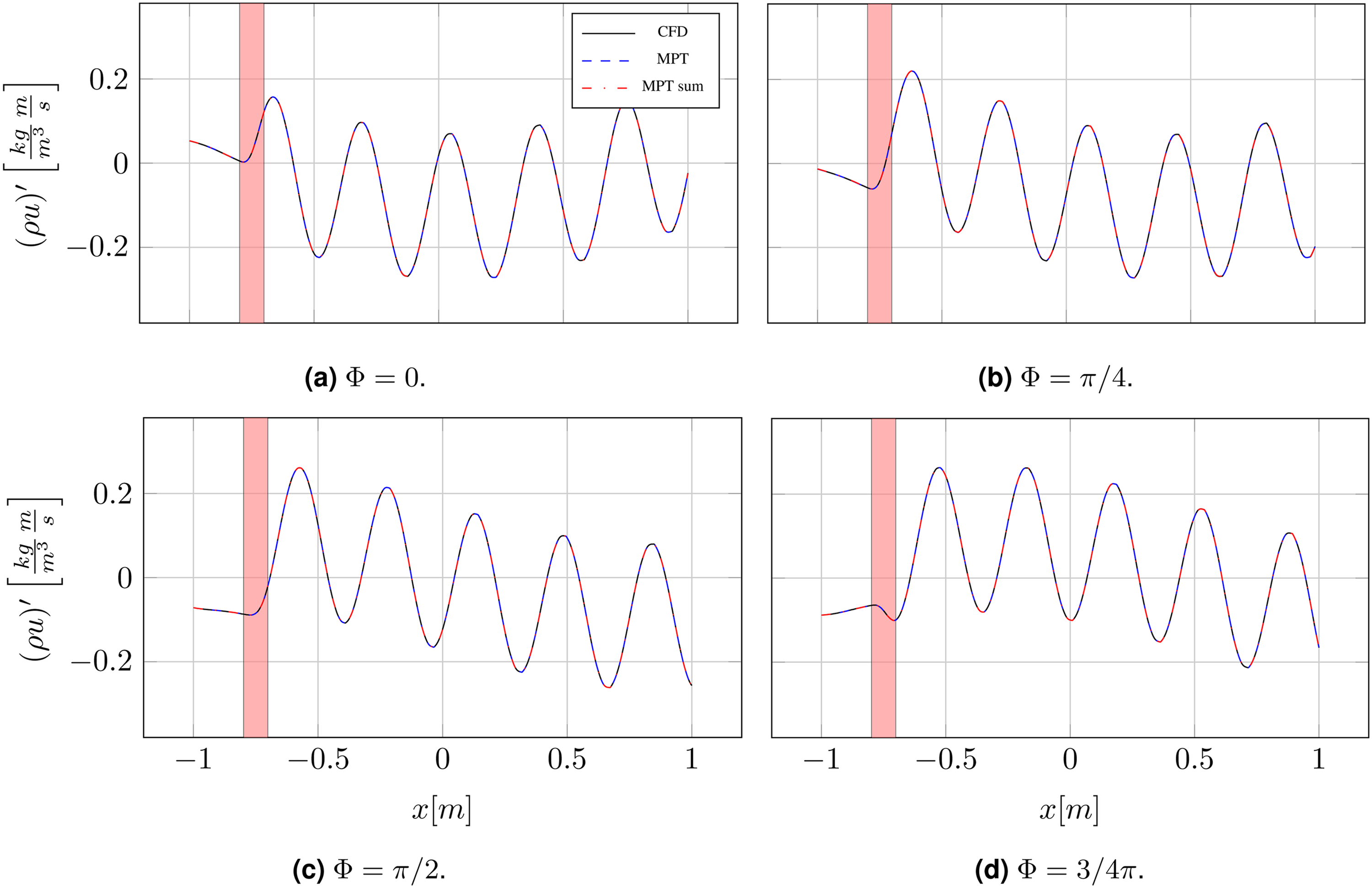
Validation of the decomposition for the duct with unsteady heat source. Snapshots at different phase angles
Figure 3 shows for the same phase angles of the oscillatory heat source the individual momentum perturbations related to the acoustic, entropic, compositional, and solenodial thermofluiddynamic modes. As expected in this case, the overall momentum perturbations are dominated by a short wave length entropic component and a long wave length acoustic component. The presence of acoustic and entropic momentum perturbations agrees with the heat source acting as a source for entropy perturbations and as an acoustic monopole. Momentum perturbations ascribed to compositional inhomgeneities are zero for this homogeneously mixed flow, and the solenoidal momentum perturbations are zero everywhere. Note that the solenoidal field is computed as the difference between overall momentum perturbations directly obtained from CFD and overall irrotational momentum perturbations from MPT. Hence, all discrepancies of the decomposition will be lumped in the solenoidal field. It is the one-dimensionality of the canonical test-cases that makes it possible to conclude on the completeness of the decomposition. In a situation where MPT is applied to a three-dimensional turbulent flow, any mistakes made in the decomposition may be wrongly ascribed to turbulent fluctuations.
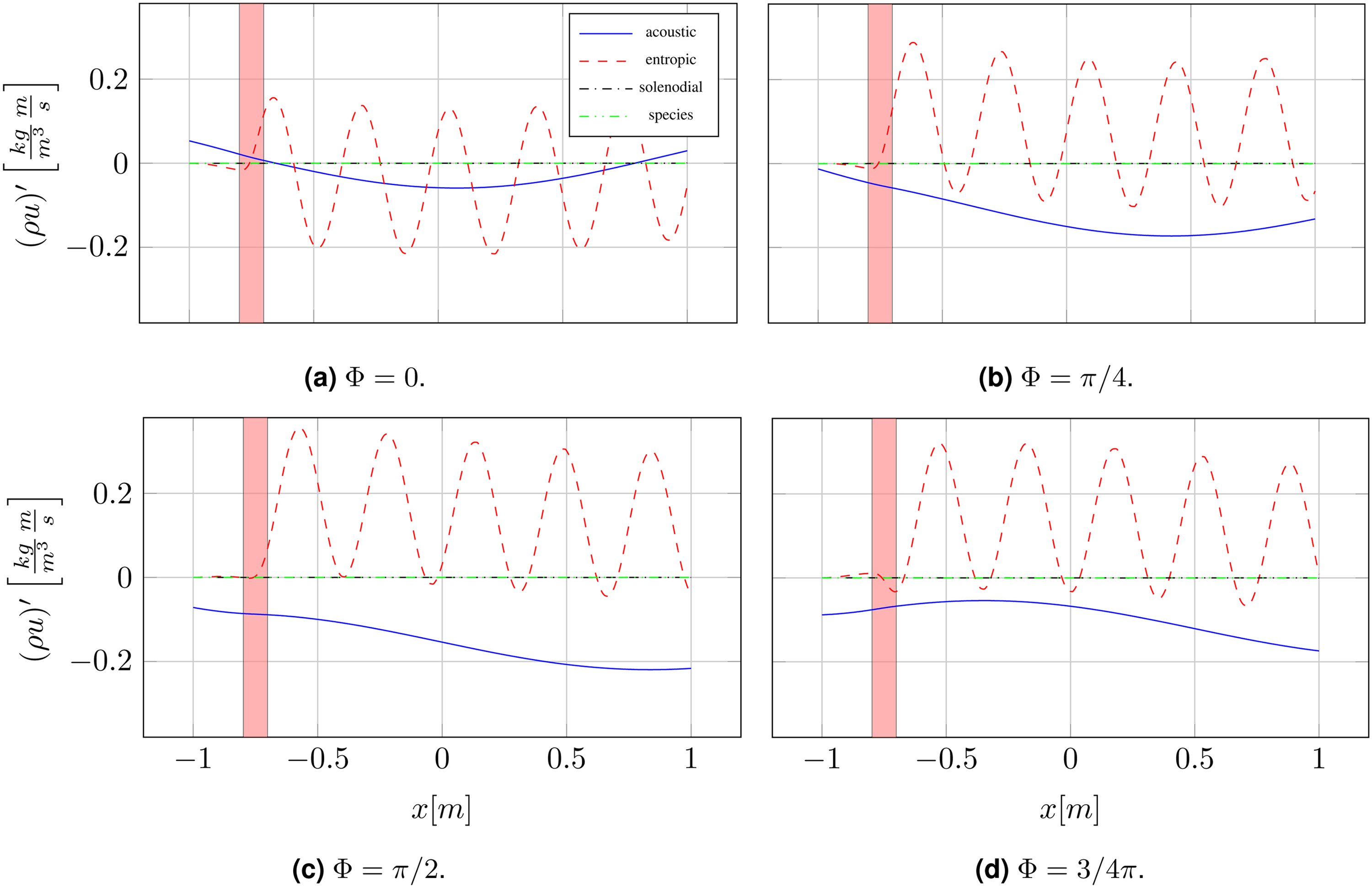
Decomposition of momentum fluctuations for the duct with unsteady heat source. Snapshots at different phase angles
Furthermore, Figure 3 shows that downstream of the oscillating heat source, the entropic momentum perturbations oscillate “globally” with a phase difference of
To gain further insight into the reason for these “global” oscillations, we plot in Figure 4, the distribution of the source term of the Poisson equation for the entropic momentum perturbations, that is,

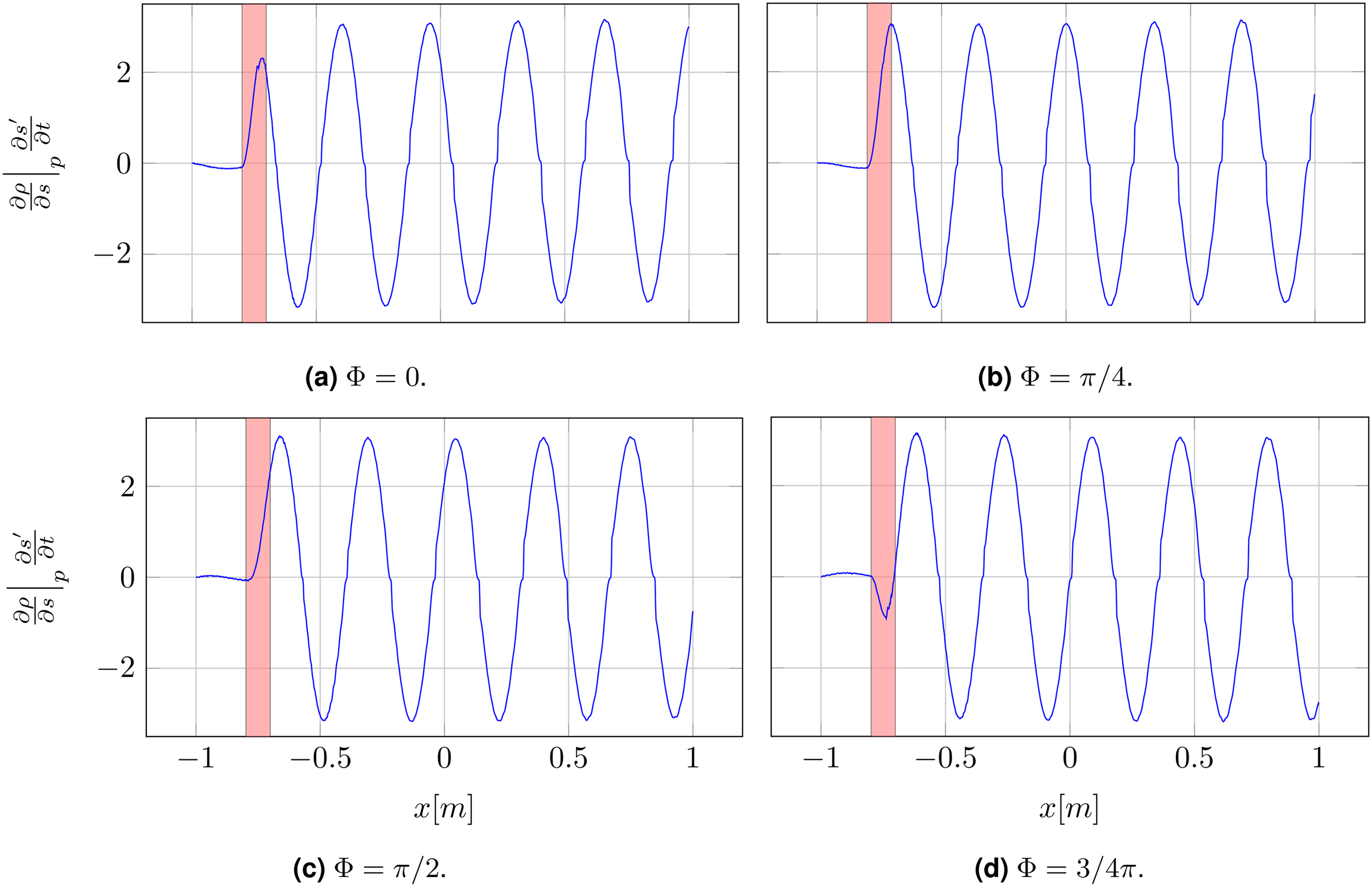
Spatial profile of the source term of the Poission equation for the entropic momentum perturbation. Snapshots at different phase angles
Since we are interested in the fluctuating momentum perturbations


Figures 5 to 8 show snapshots of the decomposed momentum perturbations for the remaining test cases, that is, the duct with unsteady species sources, nozzle with unsteady heat source, nozzle with unsteady species source, and flame with unsteady species sources.

Duct with unsteady species sources: comparison with computational fluid dynamics (CFD) for validation (left) and decomposition of momentum fluctuations (right). Red area indicates the extent of the source.
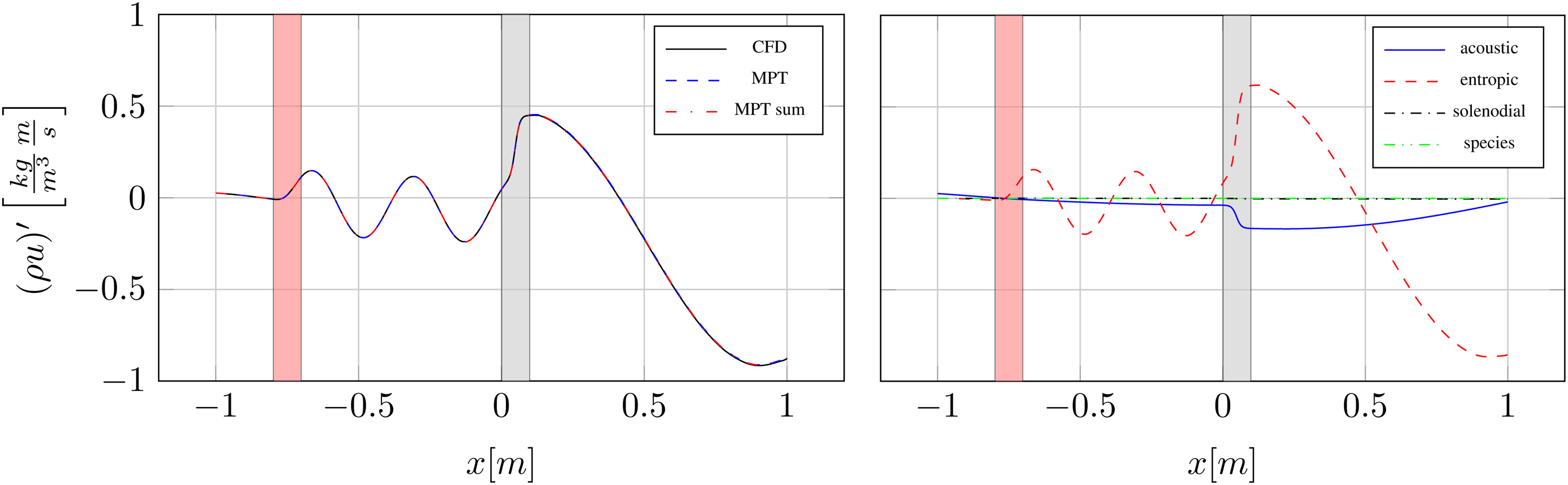
Nozzle with unsteady heat source in upstream duct: comparison with computational fluid dynamics (CFD) for validation (left) and decomposition of momentum fluctuations (right). Red and gray area indicate the extent of source and nozzle, respectively.
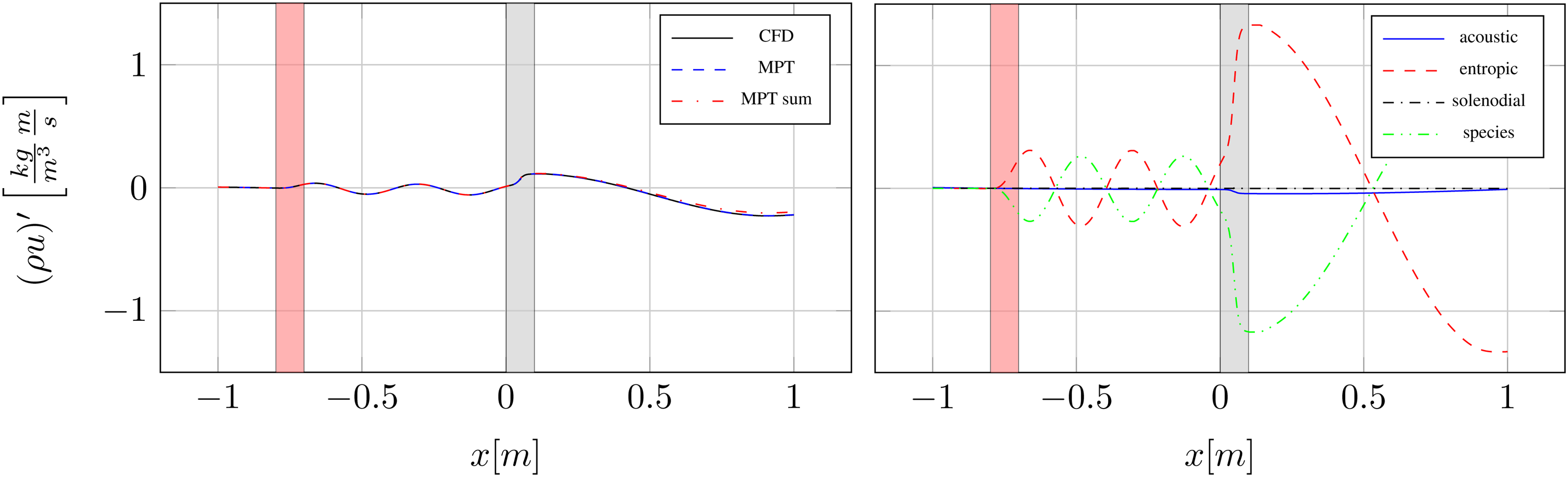
Nozzle with unsteady species sources in upstream duct: comparison with computational fluid dynamics (CFD) for validation (left) and decomposition of momentum fluctuations (right). Red and gray area indicate the extent of source and nozzle, respectively.
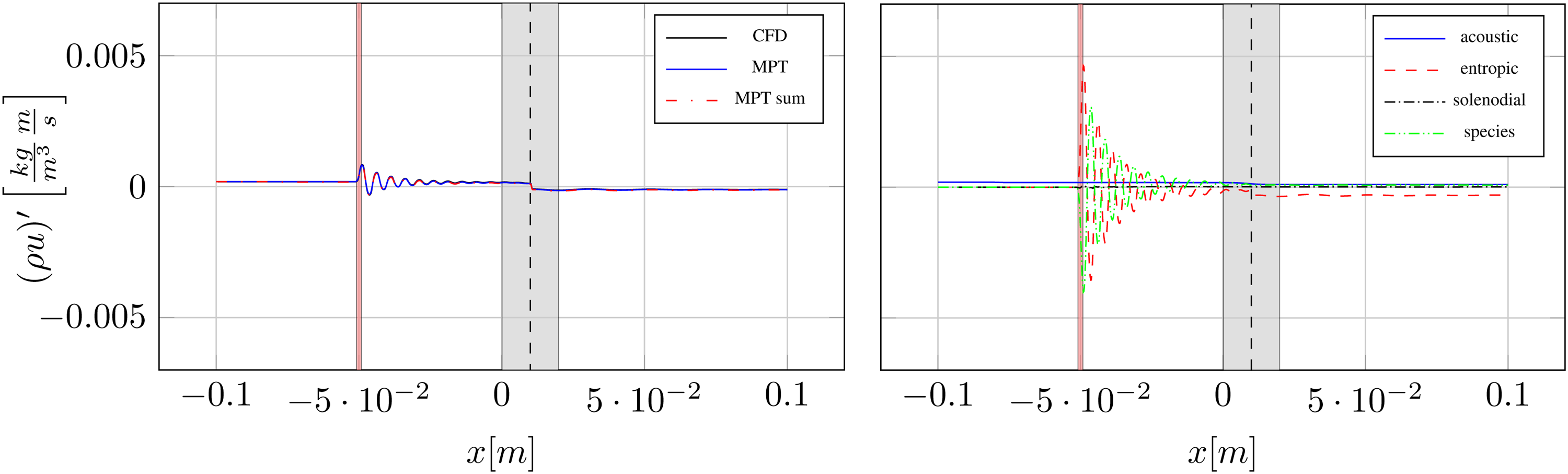
Flame in area expansion with unsteady species sources in upstream duct: comparison with computational fluid dynamics (CFD) for validation (left) and decomposition of momentum fluctuations (right). Red area, gray area, and dashed line indicate the extent of source, area expansion, and location of flame, respectively.
For all cases, we find similar to the discussion above that (i) the sum of the irrotational momentum perturbations from MPT recovers well the momentum perturbations directly obtained from CFD at all phase angles of the oscillatory sources, and (ii) individual momentum perturbation fields show “global” oscillations downstream of the respective oscillatory heat/species sources. Despite the ambiguity in the interpretation of these “global” oscillations we draw from the analysis of the presented canonical test-cases the following three conclusions:
The decomposition for cases with compositional inhomogeneties (Figures 5 and 7) and even a flame (Figure 8) is complete. Hence, we conclude that our formulation of the source term for the species potential is correct. In case of the species sources (Figures 5 and 7), the respective momentum perturbations ascribed to compositional inhomogeneities and entropy perturbations seem to counterbalance. The resulting overall momentum perturbations are significantly smaller. For the quasi-one-dimensional nozzle with upstream heat and species sources (Figures 6 and 7), we observe that the wave lengths of convected momentum perturbations (entropic and species) increase with the increase in flow velocity from upstream to downstream duct, as do the amplitudes of the momentum perturbations. For the acoustic momentum perturbation, we find a discontinuous jump in amplitude across the nozzle. Since the nozzle is acoustically compact, the acoustic perturbation field is locally incompressible across the nozzle, that is, the perturbation density is almost constant and the perturbation velocity scales with the factor between cross-sectional areas of the upstream and downstream duct. This quasi one-dimensional nozzle example shows that MPT can handle mean flow gradients and their interaction with the momentum perturbations.
Identification of acoustic sources
In the previous section, we showed that MPT offers a complete decomposition of momentum perturbations
As dicussed in the introduction of this study, much prior work has been attributed to formulating disturbance energies for (reactive) compressible flows.16,18,17,19 Comparison of the linear expressions of the TFE components, equations (30) to (33), with common expressions for disturbance energies shows that the TFE is of first order in fluctuating quantities whereas disturbance energies are of second order, as discussed by George and Sujith. 20
Therefore, in an attempt to improve comparability with the general understanding of perturbation energies, we analyse the temporal mean of the flux of TFE which resembles the standard acoustic intensity under far-field conditions33,35

In contrast, for the flux of TFE we can identify an acoustic component also in the near-field, namely the acoustic TFE flux


Figure 9 shows the distribution of the time averaged source term

Duct with unsteady heat source: distribution of acoustic source term as defined in equation (52). Red shaded area indicates the extent of the oscillatory heat source.
We will now show that the non-zero source term downstream of the oscillatory heat source is directly related to the “global” oscillations of the momentum perturbations as discussed in the previous section on the “Decomposition of momentum perturbations.” Since the entropic and acoustic momentum perturbations add up to the momentum perturbations directly obtained from CFD (see Figure 2), the acoustic momentum perturbations must compensate for the global oscillations of the entropic momentum perturbations downstream of the oscillatory heat source. From Figure 3, we can clearly see that the acoustic momentum perturbations have a global offset downstream of the oscillatory heat source. That is, as the oscillatory heat source acts as an acoustic monopole in an anechoic environment, we would expect acoustic mass flow/momentum density perturbations

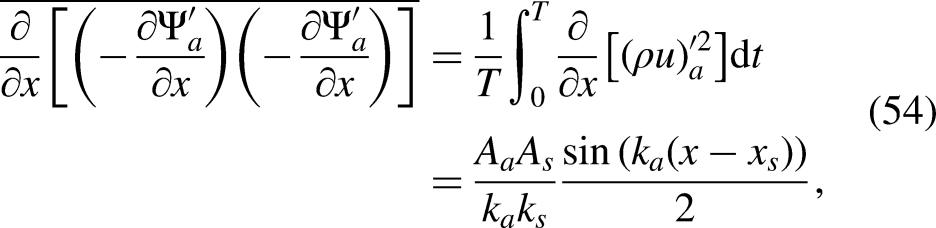
The time average of the divergence of acoustic TFE contains the term
Discussion
This study presents an extension of the MPT to flows with varying chemical composition. This extension was tested with quasi-one-dimensional test cases for which physically motivated boundary conditions were formulated. We observed that a decomposition of the perturbation field into its various thermofluiddynamic modes can be achieved with the MPT, even in the presence of mean flow gradients and chemical reactions. However, the interpretation of momentum density fluctuations proved difficult. Analytical modeling of the spatio-temporal distribution of the source terms of the MPT Poisson equations supports the argument that the ambiguity in the interpretation of the MPT decomposition is a direct consequence of the structure of the Poisson equations. Since the time-derivatives appearing in the source terms are post-processed from CFD data, the equations reduce in the one-dimensional case to an initial value problem in space for the momentum perturbations, not supporting the expected wave solutions.
Regarding the application of the extended MPT to more realistic combustor flows, the source terms, equations (19) to (21), for the Poisson equations for the momentum perturbations of the various thermofluiddynamic modes stay valid for ideal gas mixtures of an unrestricted number of species. Thus, these terms are applicable for post-processing of CFD data that relies on detailed reaction mechanisms.
The question of appropriate boundary conditions, on the other hand, appears more challenging. On the one side, the inlet boundary condition, equations (43) to (45), formulated here can be transferred in many cases to higher dimensional combustor flows. If the simulation has laminar flow inlet boundary conditions, as turbulence is often generated within the computational domain, for example, through swirlers, the assumption that only acoustic perturbations reach the inlet is justified. Often, these acoustic waves are planar, and hence, allow to set exactly the same set of inlet boundary condition as for the present quasi-one-dimensional cases.
On the other side, setting homogeneous constant Dirichlet boundary conditions at the outlet for a higher-dimensional problem, as was done here for the quasi-one-dimensional cases, prohibits perturbations tangential to the outlet (since spatial derivatives of the potentials tangential to the outlet become zero). This is clearly inconsistent with flows where non-planar perturbation, for example, hot spots, leave the flow domain. D’Aniello et al. 33 proposed to solve the MPT Poisson equations on subdomains close to the outlet boundary (e.g. a plane parallel to the outlet plane) and to impose the subdomain solution as a Dirichlet boundary condition for the actual domain. However, since the MPT is based on mass conservation of the perturbation field, equation (3), this mass conservation of perturbations should also hold in the chosen subdomain. In any case, if computationally feasible, the computational domain should be expanded to a point where far-field conditions apply.
Even more challenging is the choice of boundary conditions for the potentials at no-slip walls. Whereas the sum of all momentum perturbations must vanish to obey the no-slip condition, a similar conclusion does not hold for the individual momentum perturbations. In fact, thermofluiddynamic mode conversion may very well happen at a wall, for example, an acoustic wave impinging a wall under an angle will lead to the generation of vorticity. 11 Furthermore, Eder et al. 39 reported the generation of entropy waves at walls due to unsteady heat transfer even in fully premixed configurations. Hence, the actual strength of each perturbation mode at a wall boundary seems to be unknown as long as the decomposition is not obtained, whilst at the same time this information is needed to formulate boundary conditions to compute the decomposition from the potentials. Unnikrishnan and Gaitonde 31 suggested to superimpose a filter on the fluctuating flow fields that damps fluctuations close to the boundaries, allowing to focus the analysis on thermofluddynamic mode conversion within the domain. However, in thermoacoustics, thermofluiddynmmic mode conversion at for example, injector edges are often of interest but excluded by this filtering approach.
In higher dimensional cases, the solenoidal field
Conclusion
The MPT can be used as a post-processing procedure to decompose high-fidelity simulation data into its various thermofluiddynamic perturbation modes. Since MPT does not rely on the linearity of perturbations, it is especially appealing for the analysis of combustor flows with large oscillations. We showed that the MPT can be extended to account for changes in chemical composition of a reactive flow and demonstrated for canonical quasi-one-dimensional flows with well defined boundary conditions the decomposition of the perturbation fields in the presence of mean flow gradients and chemical reactions. However, interpretation of the MPT decomposition in terms of momentum perturbations and total fluctuating enthalpies proved difficult, even for the canonical quasi-one-dimensional flows presented here. Finally, we discussed the challenges in choosing well defined boundary conditions for the MPT potentials when moving on to three-dimensional turbulent flows.
Footnotes
Declaration of Conflicting Interests
The author(s) declare no potential conflicts of interest with respect to the research, authorship, and/or publication of this article.
Funding
The author(s) received no financial support for this article’s research, authorship, and/or publication.
