



Abstract
With advancements in science and technology, disaster prediction methods have become more mature, enabling the forecasting of events like typhoons, tsunamis, and floods. However, unpredictable disasters such as earthquakes and car accidents remain challenging, particularly in densely populated areas where even minor incidents can cause significant losses. Emergency rescue operations are crucial after a disaster, but effectively utilizing limited resources to meet dynamic needs and prevent secondary disasters remains a critical issue. The key challenge lies in dynamically scheduling emergency resources across multiple periods to adapt to changing demands during post-disaster scenarios. Uncertainty in disaster situations and evolving needs make it difficult to create effective resource allocation plans. Traditional scheduling methods often fail to address these dynamic conditions, leading to inefficiencies in disaster relief efforts. This paper proposes a kernel function automatic multi-stream resource scheduling method based on a heterogeneous cluster scheduling algorithm. A fast decision-making approach and an improved multi-objective evolutionary algorithm (MOEA/D-DE-mdERS) were developed to optimize resource allocation under dynamic demand conditions. The solution incorporates three adjustment strategies to handle changes in resource needs across cycles and improve scheduling efficiency.Through simulations and a case study of the Taiwan Chi-Chi earthquake, the proposed method demonstrated superior performance compared to traditional algorithms like MOEA/D-SBX. For example, in one resource allocation scenario, demand at a disaster point increased significantly—such as a 6.3-unit rise in the second cycle and an 8-unit increase in the fourth cycle—highlighting the method's ability to adapt to dynamic changes. Additionally, the new algorithm achieved better computational efficiency and solution quality. The proposed method provides an effective solution for multi-period emergency resource scheduling, enhancing disaster response capabilities. By improving resource utilization and reducing losses, this approach supports timely and efficient disaster relief. Future research could extend the model by considering factors like road restoration, transportation modes, and priority grading to further enhance its practical applicability.
Introduction
In recent years, the continuous evolution of science and technology has significantly improved our ability to predict natural disasters such as typhoons, tsunamis, and floods. Despite these advancements, certain types of emergencies—such as earthquakes, industrial explosions, or vehicular accidents—remain unpredictable and difficult to manage, especially in densely populated areas. In such scenarios, even minor disruptions can lead to catastrophic consequences. Timely and effective post-disaster emergency response is therefore critical, not only for minimizing losses but also for preventing secondary disasters. A core issue that persists in this context is how to rationally and efficiently deploy limited emergency resources to meet the dynamic and evolving demands of affected regions.
While many governments, including China's, have enacted comprehensive emergency management frameworks and legal provisions, there are still gaps in research and implementation, particularly in dynamic and large-scale emergency scenarios. These gaps manifest in inefficient resource allocation, delays in response time, and a lack of adaptability to real-time changes in demand. Although disasters cannot be fully prevented or controlled, their impact can be mitigated through strategic planning and adaptive scheduling. In this context, dynamic scheduling of emergency resources—especially across multiple planning cycles has emerged as a crucial area of study. It requires consideration of fluctuating needs, incomplete information, and logistical uncertainties. Addressing this problem effectively can enhance the resilience of disaster response systems and significantly improve the overall efficiency of rescue operations.
Traditional scheduling approaches often assume static demand and fixed resource availability, limiting their effectiveness in complex, real-world post-disaster environments. These methods typically fall short when it comes to handling time-varying conditions or multiple competing objectives, such as minimizing both resource shortages and transportation risks. Moreover, most existing models neglect the advantages brought by heterogeneous computing clusters, which can offer substantial gains in processing speed, task parallelism, and adaptability. Recognizing this gap, the present study introduces a dynamic, multi-period resource scheduling method that leverages both the computational efficiency of heterogeneous clusters and the flexibility of evolutionary algorithms. By integrating adaptive mechanisms and real-time data feedback into the scheduling process, the proposed method aims to overcome the limitations of existing models and offer a more robust solution for emergency resource deployment.
The main contribution of this paper is to construct a multi-period emergency resource scheduling model, which takes into account the dynamic changes of post-disaster demand, transportation risks and resource costs, and provides theoretical support for complex emergency scenarios. An improved multi-objective evolutionary algorithm MOEA/D-DE-mdERS is proposed in the framework of heterogeneous clusters. By incorporating differential evolution and three dynamic adjustment strategies, its adaptability and convergence efficiency in the dynamic scheduling environment are enhanced. The scheduling algorithm is integrated into the heterogeneous cluster computing environment to achieve parallel processing and rapid response, significantly improving the computing efficiency of large-scale emergency tasks. The effectiveness of this method is verified through simulation experiments and the actual case of the Chi-Chi earthquake in Taiwan. Compared with traditional algorithms such as MOEA/D-SBX, it performs better in terms of objective function value, solution quality and running time.
Related work
Uncertainty is the most challenging problem in implementing scheduling algorithms in real-world environments, as the schedule issued to the workshop with the best objective often deteriorates or even becomes infeasible during its execution. On this basis, Wei Z has given the resources of the cloud data center and the energy consumption model of physical machines, and on this basis, he has given a three-dimensional virtual resource allocation scheme (TVRSM) for energy saving based on cloud computing. 1 Jiang S L has proposed a Multi-objective Soft Scheduling (MOSS) to overcome this challenge. 2 In recent years, the inefficient use of power resources has attracted much attention. Kang M has proposed a real-time distributed load scheduling algorithm considering power supply constraints. 3 The flexible job shop scheduling problem (FJSP) is critical for manufacturers, especially in today's changing environment. This is a strong NP-hard problem, so Wu X has proposed to adopt meta-heuristics or heuristics to solve it. 4 However, they have not analyzed the scheduling algorithm under heterogeneous clusters.
Minimum energy consumption in heterogeneous cluster systems (HCS) is an important and challenging task. It can bring many benefits, such as lower operating costs enhanced system reliability, and a green environment. Kumar N has proposed a scheduling algorithm for parallel application execution with green Service Level Agreement (SLA) constraints. 5 Tang J Y has studied heterogeneous non-uniformly distributed wireless sensor networks and proposed a solar energy harvesting model ISHE based on light intensity. 6 Eskandari L has proposed a heuristic scheduling algorithm -T3-Scheduler for heterogeneous fog or cloud clusters. It can efficiently identify tasks that communicate with each other and assign them to the same node to achieve a specified utilization level. 7 Li X studied the multi-objective vehicle scheduling problem in urban emergency rescue, and used NSGA-II to optimize the allocation path and scheduling time, taking into account the response delay and resource utilization efficiency. 8 Li H designed a scheduling algorithm based on improved SPEA2 incorporating two-stage individual encoding, disturbance-sensitive initialization, multi-point crossover and local greedy search strategies. The results show that the algorithm is significantly superior to traditional methods in terms of solution quality, convergence and diversity, and is suitable for highly dynamic emergency task scheduling environments. 9
Although classic multi-objective evolutionary algorithms such as NSGA-II and SPEA2 have achieved certain results in solving multi-objective optimization problems and can obtain a better Pareto optimal solution set through non-dominated sorting and congestion calculation, they have certain limitations when dealing with multi-period emergency resource dynamic scheduling problems in heterogeneous cluster environments. When faced with dynamically changing demands, NSGA-II's population update strategy is difficult to quickly adapt to environmental changes, resulting in a decrease in the timeliness and quality of the solution; although SPEA2 saves excellent individuals by establishing external archives, it lacks a specific adjustment mechanism for dynamic demands in parallel processing and task allocation optimization of heterogeneous clusters. This paper selects the improved multi-objective evolutionary algorithm MOEA/D-DE as the basic framework because it shows strong robustness and efficiency in dealing with complex multi-objective optimization problems, and can better adapt to dynamic demand conditions through differential evolution strategies, thereby providing a better solution for multi-period emergency resource scheduling problems.
Heterogeneous cluster scheduling algorithm
Cluster management and resource scheduling
Heterogeneous clustering is a hot research topic in recent years. In the scheduling algorithm, the performance difference of the cluster nodes is considered, and the tasks with a large amount of computation are allocated to the computer with better CPU performance, which can maximize the use of the hardware performance of the cluster and shorten the running time, thus increasing the resource utilization of the cluster rate.
Since the resource management and task scheduling algorithms of the cluster are the keys to ensuring its efficient and balanced operation, this paper has introduced and analyzed the current mainstream cluster systems and task scheduling strategies.
Introduction to the Main Cluster Management System
The cluster management system is mainly used to effectively schedule various resources, queues, and jobs in the cluster, and allocate resources to users to ensure the rational use of cluster system resources.10–11 Cluster management is a key part of the cluster system, which can ensure the normal operation of the cluster and its rational use.12–13
The cluster operating system layer is composed of the operating system and cluster drivers; the application development layer is mainly composed of development tools, development environment, parallel program function library, performance function library, etc..14–15 For most ordinary users, the main goal of building a high-performance computer cluster is to make it have supercomputing power at a lower cost. 16
Therefore, how to make the cluster system be able to make full use of its huge computing power like a supercomputer is the biggest problem that is faced by cluster construction at present. At the same time, ensuring the fair use of cluster resources and the load balancing of the cluster is also a very critical issue.
17
IDC once mentioned in a study that the biggest challenge in building a cluster system is managing complex software. Therefore, how to effectively solve this problem has become an important criterion to measure the pros and cons of a cluster system. Linux virtual server is a typical cluster management system in the world.
18
LVS (Linux virtual server)
The physical servers (computing nodes) in the cluster are connected to each other by a high-speed network. There is a load balancer at the front end of the cluster. Its main function is to hide the real computing node and send a virtual IP to the outside so that users can submit tasks to this address. The tasks are then equally distributed to the actual compute nodes by the balancer. This scheme can effectively achieve access to multiple physical servers and achieve high transfer rates.19–20 At the same time, the load balancer can effectively protect the failed server, thus ensuring the availability of the system. Figure 1 shows the architecture of an LVS cluster.
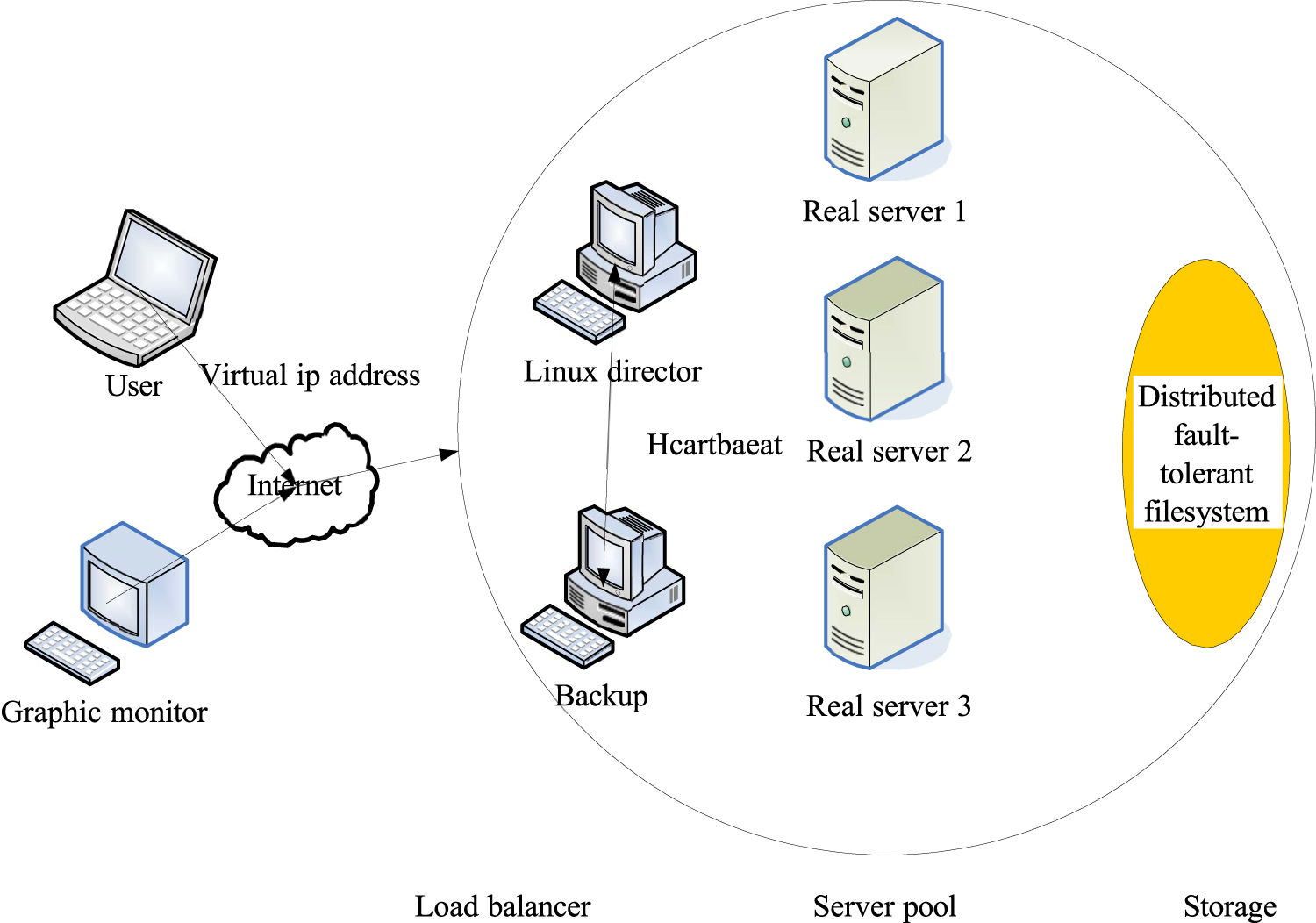
LVS cluster architecture diagram.
As key system components, the cluster management system and LVS provide important support for the proposed MOEA/D-DE-mdERS scheduling model. The cluster management layer ensures the reasonable allocation of resources and the efficient operation of the cluster system by effectively managing and scheduling various resources, queues, and tasks in the cluster. In the multi-period emergency resource dynamic scheduling method proposed in this paper, the role of the cluster management layer is particularly prominent, and it can dynamically adjust the resource allocation strategy according to real-time needs. For example, in the post-disaster emergency scheduling scenario, the cluster management layer can quickly reallocate the task load of the computing nodes according to the demand changes of the disaster site, thereby optimizing resource utilization and shortening the task completion time. This flexibility enables MOEA/D-DE-mdERS to achieve efficient resource scheduling under dynamic demand conditions.
In addition, the characteristics of LVS further enhance the performance of the scheduling model. LVS hides the actual computing nodes through the front-end load balancer and exposes the virtual IP address to the user, thereby achieving transparent access to multiple physical servers. This mechanism not only improves the availability and fault tolerance of the system but also provides a stable and efficient operating environment for MOEA/D-DE-mdERS. In the multi-cycle scheduling process, LVS can dynamically allocate tasks to appropriate computing nodes, while protecting servers that fail due to failures to ensure the continuity of the scheduling process. By combining the load balancing capabilities of LVS and the resource allocation strategy of the cluster management layer, the scheduling model proposed in this paper can better adapt to demand changes in a complex dynamic environment, thereby significantly improving the efficiency and reliability of emergency resource scheduling.
Task scheduling algorithm
When studying the task scheduling of multi-core systems, it is often abstracted into a mathematical model to facilitate its analysis and understanding.21–22 The main task of the task scheduling algorithm is to correspond the task model with the operating environment model. These parts and scheduling processes are called planning patterns and are shown in Figure 2.

Task scheduling model.
Figure 2 shows the core framework of the task scheduling model, which defines the goals of task allocation and optimization by mapping tasks to the operating environment. This model is the basis of the scheduling strategy, helping to analyze task attributes, resource requirements, and dependencies between tasks, thereby providing theoretical support for subsequent scheduling algorithms. This model can clearly understand how to select tasks, allocate resources, and optimize objective functions in the task scheduling process. 23
Job scheduling means that on a specific job, time, and node, the scheduler determines the job volume, job time, and job node of the job based on a specific scheduling algorithm and mechanism. Its contents include: selecting tasks, analyzing task properties, resource configuration, etc. Scheduling is a key link in cluster management. The quality of its working status would directly affect the performance of the cluster.24–25 The throughput of the cluster, the load balance of resources, and the energy consumption of the cluster are all key factors that affect its performance. Therefore, the job plan occupies a pivotal position in the cluster system.

If md is the exit node, then
ranku(md) Is the longest path length from the entry node to the current node md, excluding the execution time of this node. Is


Through the propCP value of the node, it is judged whether it is a critical path node. If the propCP of a node is equal to the entry node (or exit node), the node is a critical path node.
CPD(md, q j) Represents the earliest completion time of the current task md on the processor Qj . The calculation method CPD(md, q j) is as follows:


In this formula, Q_available represents the effective time of a processor. That is, the processor has completed all the work currently assigned to this processor.
Processor idle time refers to the idle time between two scheduled jobs in a processor, as shown in Figure 3, and the shaded area represents the idle time of the processor. 26

Example diagram of idle time period.
Figure 3 visualizes the idle time periods of the processor during task scheduling, where the shaded area represents the idle time. The formation of these idle time periods is usually related to communication delays or data transmission between tasks. This concept of idle time is closely related to scheduling strategies because efficient scheduling algorithms can use these idle time periods to insert new tasks, thereby improving resource utilization and reducing overall scheduling time.
In the figure, the number represents the number of nodes, and the arrow represents the communication between a task. Because of the data transfer, there are idle periods, such as 2 to 4, which are formed because the execution of 4 requires the data transfer of 3 and the data transfer of 3 to 4.
The interval insertion technique is that during a task allocation, when a processor Qj has an idle period on which a new job can be scheduled, it would be inserted into this idle period. For example, in Figure 3, if 5 satisfies the status of the idle period between 2 and 4, then the scheduling result can be represented by Figure 4.

Example diagram of interval insertion technology.
Figure 4 further illustrates the application of interval insertion technology, showing how to insert new tasks during the idle time period of the processor to optimize scheduling efficiency. This technology is directly related to dynamic scheduling strategies, especially in multi-cycle emergency resource scheduling. By making reasonable use of idle time, it can better adapt to dynamic demand changes and improve the system's response speed and resource utilization efficiency.
It can be clearly seen from the figure that the use of spatial interpolation technology can greatly save processor resources, reduce scheduling time, and so on.
The STS (Heterogeneous Earliest Finish Time) algorithm is divided into two steps: selecting tasks and assigning tasks. In the task selection stage, the rank of each node is first calculated according to the formula and then arranged according to the rank value from large to small. When the ranks of two jobs are equal, a random ordering would be performed.
In the task assignment phase, the node at the head of the list is selected each time, which is the largest one in the list, and then the earliest end time is calculated by Formula (4). md is assigned to the processor core Qi . The interval interpolation technique is used to solve the EFT of the earliest completion time of the node.
In the HCNF algorithm, the copy technology is used, and the calculation method of the earliest start time EST of the node is obtained by the following formula:

CWD1(md, qj) is the earliest start time of the key precursor for non-replicating md, and CWD2(md, q j) is the earliest start time for the replication of the key precursor. The key precursor mem is the last precursor to transmit information to the current node. CWD1 and CWD2 are calculated as follows:


Prepare node: It has obtained all the information of the predecessor node and can be executed immediately. The HCNF algorithm is further divided into two stages: task selection and task sorting. During the task selection process, the system would continuously update a new preparation task. The new prep work is added to another prep work list, and all tasks are sorted by priority. Among them, the priority is the most important, followed by the average execution time. During the task scheduling phase, the list head node is selected each time. According to the above formula, the earliest completion time and the earliest start time are calculated respectively, and the node is assigned to the processor core with the smallest EFT. The relevant specifications and terminology are shown in Table 1:
Fair scheduling algorithm
Summary of symbols and terms.

Another difference between the fair scheduling algorithm and the FIFO (first in first out) scheduling algorithm is that it supports the queuing of multiple tasks, each with a different priority. The scheduler uses the priority of the queue to determine the resources and priority that a queue can share. The feature allows for a variety of tasks to be completed in a reasonable amount of time without being "starved" for fewer tasks. In the fair scheduling algorithm, in order to facilitate the scheduler to determine which queue can share resources, its priority is assigned to the allocation group. It is verified by an example that the algorithm is an efficient multi-user sharing cluster.
Compared with the FIFO scheduling algorithm, the fair scheduling algorithm can make tasks from different queues share cluster resources, so as to achieve the purpose of parallel execution. For example: Task 1 enters the queue; Task 2 then arrives in the system. In this example, Task 1 is submitted to another queue. In the fair scheduling algorithm, two queues can be allocated certain computational resources, so that both tasks can get parallel resources. This can be seen in Figure 5. If two queues have the same permissions, then they can be assigned the same resource, that is, Job-2 which arrives later also gets half.
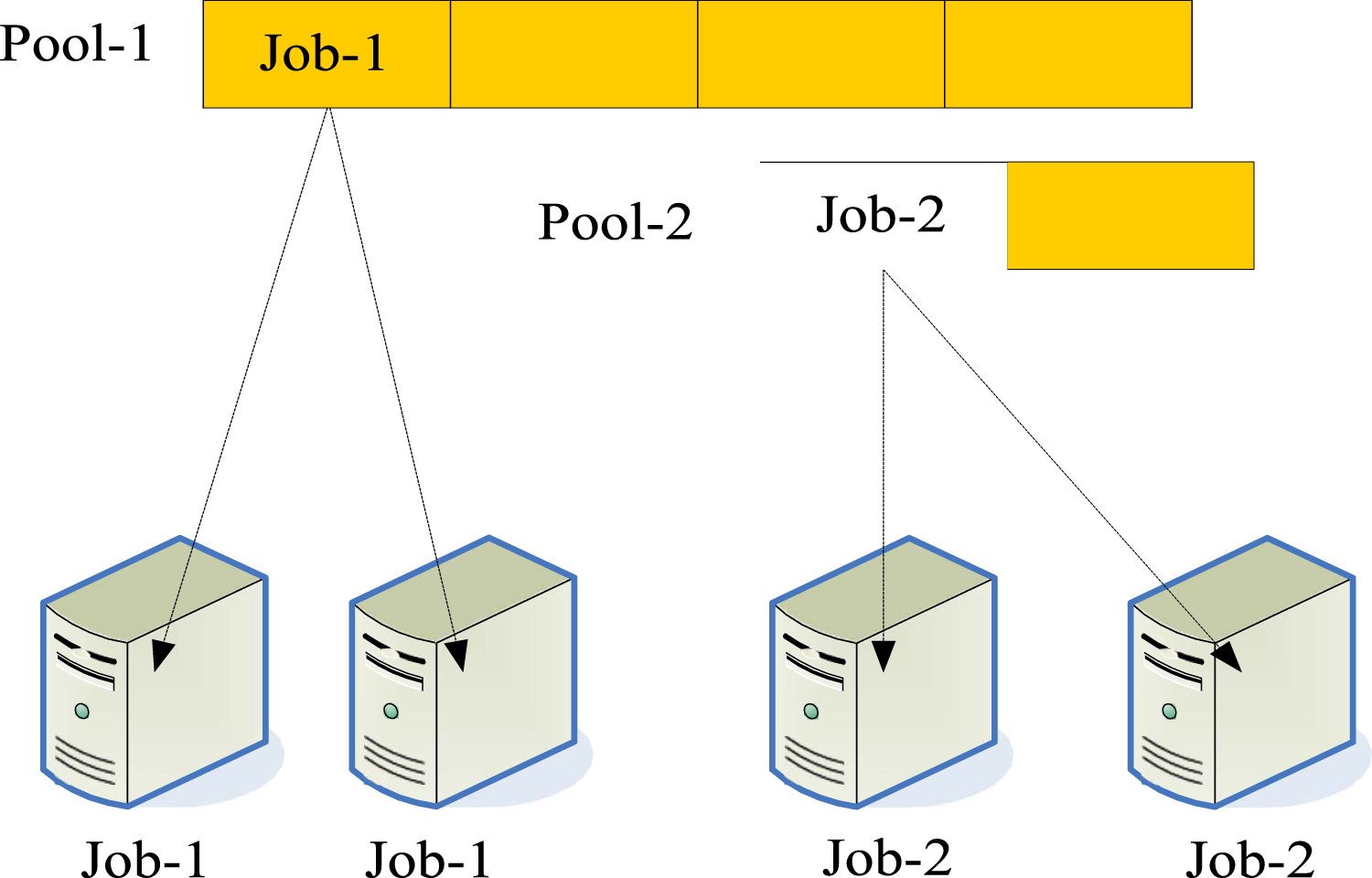
Schematic diagram of the fair scheduling algorithm.
In the post-disaster emergency dispatch, due to the influence of various uncertain factors, the information about the disaster situation collected before the start of the plan cannot truly reflect the actual needs of the disaster situation. Therefore, in the scheduling process, dynamic changes in demand would be taken into account. The work of this paper mainly includes the following aspects:
In this paper, the dynamics of demand during emergency situations are studied. First, the multi-cycle emergency resource scheduling problem is divided into two steps: one is to optimize multiple objectives in the early stage of planning. The model contains two main purposes: one is to minimize the shortage of demand in the affected areas. Another aim is to minimize the risks in transport. Uncertainty in the network minimizes the risk of shipping resources. The second step is to optimize the above optimization method according to the dynamic change of demand so that it can adapt to the changed needs to the greatest extent.
This model is a mixed model of linear programming. In addition, this paper also applies three regulation strategies in MOEA/D-DE-mdERS to address the application under dynamic demand conditions.
The first control strategy focuses on the demand forecast deviation in the early stage of the plan. By re-evaluating the resource demand, the resource allocation plan is dynamically updated in each scheduling cycle to ensure that the supply of materials in the affected areas can meet the actual demand. This strategy is usually applicable to the early stage after the disaster when the demand information is incomplete or there is uncertainty.
The second control strategy focuses more on real-time and local adjustment capabilities, especially when there are sudden changes in demand during the execution of the plan. When the demand at a disaster site suddenly increases, the strategy will give priority to the nearest supply site that can be reached in a short time for replenishment. This strategy requires the system to respond quickly within a limited time and adjust the flow of resources according to the actual situation while minimizing the impact on the scheduling plan of other regions. It is usually used in the mid-term stage when the scope of the disaster is expanded or secondary disasters occur in some areas.
The third control strategy emphasizes long-term planning and sustainability and is applicable to the later stages of the planning cycle. Under this strategy, the system needs to not only consider the demand of the current cycle but also reserve a certain amount of resource reserves for subsequent cycles to cope with potential secondary disasters or demand fluctuations. This strategy usually combines complex factors such as road network repair and transportation mode conversion to ensure the continuity and stability of resource scheduling. Through the synergistic effect of these three control strategies, the MOEA/D-DE-mdERS method can better solve the multi-period dynamic emergency resource scheduling problem, improve resource utilization efficiency, and reduce disaster losses.
Disaster rescue work is not done overnight, but in an emergency, taking into account various factors, multiple rounds of rescue work must be carried out. The same goes for the distribution of emergency supplies. After a disaster occurs, the materials in the disaster area would have a certain shelf life, especially food, which must be delivered to the disaster area within the specified time limit, otherwise, it would not be available; in addition, the spread of the disease is cyclical, and the treatment cycle is also multi-faceted. In order to solve the emergency situation of an earthquake disaster, multi-stage scheduling must be carried out, thus forming a multi-stage emergency resource scheduling problem.
In transportation scheduling, there are a large number of dynamic factors, such as changes in the supply side, changes in demand in disaster areas, and the possibility of road traffic. Aiming at the multi-cycle dynamic emergency resource scheduling problem, it is proposed to increase the remaining resource reserves of each supply node to the next supply cycle after the end of one plan, so as to realize the dynamic response to each supply link. Due to the uncertainty of the road, at different time points, the hidden dangers of traffic safety on the same road section cannot be ignored. On this basis, a mathematical model has been established in this paper, and the evolutionary algorithm is used to solve this problem in order to obtain the optimal schedule.
Objective function
In emergency resource planning, the effectiveness, safety, and reasonable cost of the objective function are the three elements. In order to satisfy the disaster relief work to the greatest extent, it is necessary to take the sum of the unsatisfied quantity of each demand point in each production cycle as the primary task. Due to the uncertain factors in the transportation process, there would inevitably be transportation risks when selecting damaged road sections, so transportation risks are secondary. In addition, vehicle cost is also a factor that cannot be ignored. A reasonable traffic accident scheduling strategy should not only meet the needs of disaster areas but also reduce vehicle costs. Therefore, the cost of trucks required in transportation decision-making is one of its three major purposes.




The constraints are:




In this mode, Formulas (9), (10), and (11) are three indicators, and φ and η are two weighting factors. Formula (12) is the weight sum function of the three objects; Formulas (13) and (14) are two constraints in the model. Formula (13) guarantees that during each cycle, the amount of various resources transported from the supply point to the demand point will not exceed the reserve of the supply point; Formula (14) guarantees the load capacity of the transport vehicle. Formulas (15) and (16) are the two formulas for calculating the intermediate value. Formula (15) is the method for calculating the updated storage capacity of the supply point; Formula (16) gives the calculation method short j,n,d that does not satisfy the resource.
MAGA-members
This paper proposes a multi-agent genetic algorithm for multi-period emergency resource planning problems based on MAGA-mdERS. For multiple problems, agents represent a series of alternatives to multi-period emergency resource scheduling problems. As can be seen from Figure 6, it is assumed that the coordinate of an agent is (a, b), which is denoted by Xa,b, a, b = 1,2, … , Lsize .
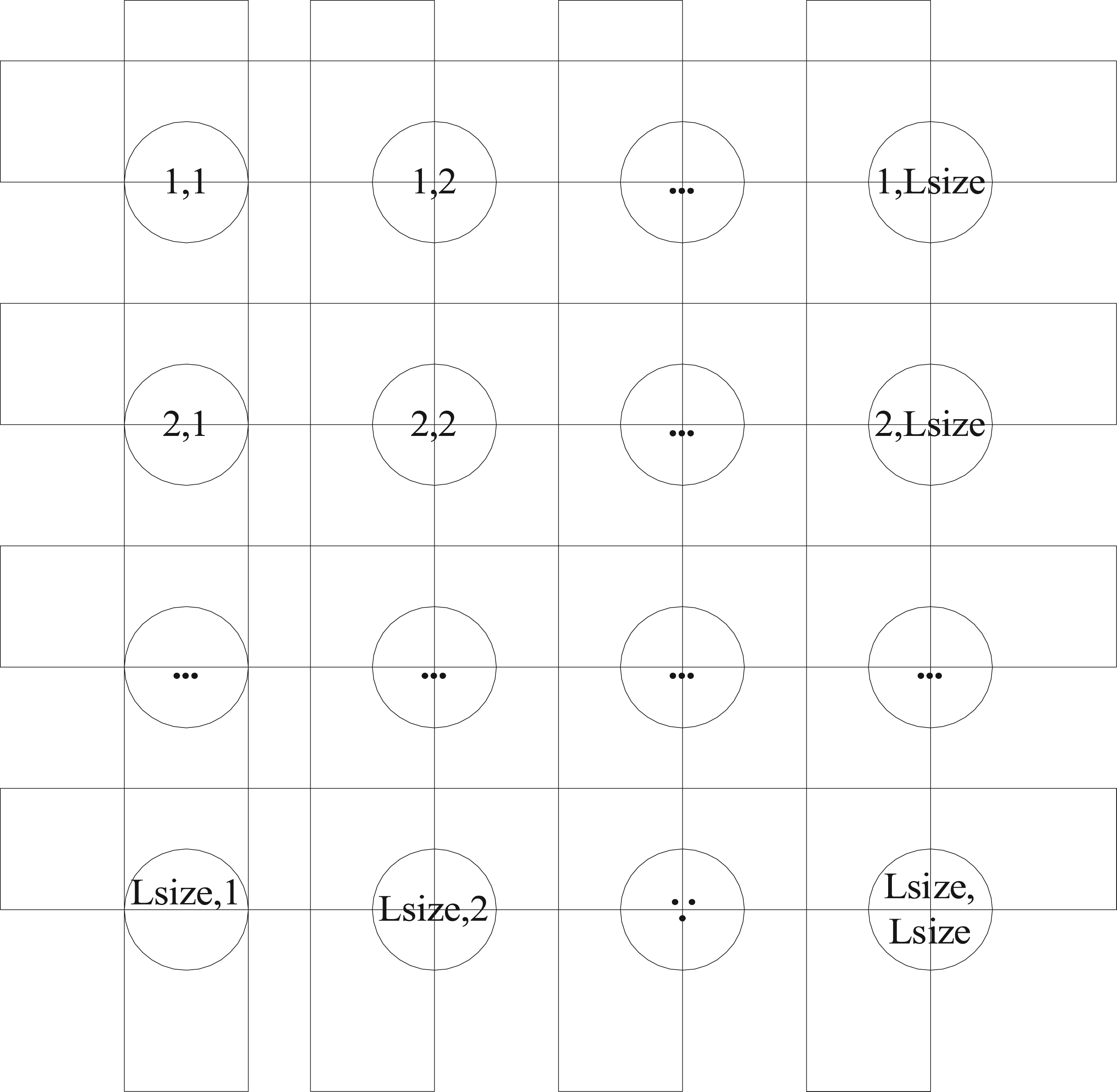
Agent network model.
Aneighbora,b is the neighborhood of X a,b, expressed as:

Experimental evaluation
In order to clarify the theory of this model and the research results of MOEA/D-DE-mdERS, a small case and a case of the Taiwan Chi-Chi earthquake have been tested in this paper. In addition, a comparative experiment between MOEA/D-DE-mdERS and MOEA/D-SBX has been carried out in this paper. In the experiment, this paper has also used the supercapacity evaluation method based on the multi-objective evolutionary algorithm. The reference point (500, 1000) has been chosen as the small example and (5000, 10000) as the example for the Taiwan set.
In order to determine the appropriate Qn Qt population sizes, many experiments have been done in this paper on a small example. In the experiments below, the number of repetitions is 1000. In order to find the optimal probability of crossover and mutation, various combinations of Qn Qt and are tested in this paper, and the results have shown that both Qn Qt are in units of 0.1, increasing from 0.1 to 1.0. First, the population is set to 100. By performing 10 calculations for different combinations of Qn Qt components, the optimal solution that is most suitable for Qn Qt and is obtained. On this basis, this paper has further tested the effect of the population size on the algorithm. The population sizes were set at 50, 100, and 200, and 20 separate trials were performed for each population. Table 2 shows the average overcapacity, the average CPU work time, and the average number of functional evaluations. As the population increases, the average overcapacity gradually increases, and the computing time of the CPU also increases. By analyzing the calculation results listed in Table 2.
Performance of MOEA/D-DE-mdERS at different population sizes.

Performance of MOEA/D-DE-mdERS at different population sizes.
Table 2 shows the performance of the MOEA/D-DE-mdERS algorithm under different population sizes, which is mainly evaluated by three indicators: Super Volume Value, CPU Runtime, and Evaluation Times. The super volume value is a key indicator to measure the performance of multi-objective optimization algorithms. The larger the value, the higher the quality and diversity of the solution set; the CPU runtime and the number of evaluations reflect the computational cost and efficiency of the algorithm. From the data, as the population size increases from 50 to 200, the super volume value gradually increases, indicating that the optimization effect has improved, but at the same time, the CPU runtime and the number of evaluations have also increased significantly. Comprehensive analysis shows that when the population size is 100, the super volume value is close to that of the scale of 200, and the computational cost is lower, so a good balance is achieved between performance and efficiency, which is the best choice.
A1, A2, A3, B1, B2, B3, C1, C2, C3 represent the resource demand or allocation of different disaster-stricken points in multiple scheduling cycles, where A, B, C represent different disaster-stricken areas, and 1, 2, 3 represent the demand for different types of resources (food, water, medical supplies) in each area. Cycle 1, Cycle 2, Cycle 3, and Cycle 4 represent different time stages of emergency resource scheduling, reflecting the dynamic changes in demand during post-disaster rescue. In order to reflect the dynamic scheduling of emergency resources in different periods, this paper proposes the following situations.
Test results of adjustment Scheme 1
Within an hour of the start of a particular planning cycle, the system would adjust to the first adjustment strategy. That is, all depots can cope with new emergencies. It is assumed that the demand in the third phase has changed dynamically, and the demand in the affected area has increased by 1.5 times. In the three periods, the resource demands of each disaster point A1 are 1.4, 2.3, and 3.2; the disaster values of B1 are 2, 7, and 0, respectively; the disaster points of C1 are 2, 1.3, and 0. Therefore, the new requirements are that the disaster points A1 are 1.4, 2.3, 5.2; the disaster values of B1 are 7, 0, 0; the disaster value of C1 are 1.3, 0, 0. Figure 7 is a preliminary plan based on the first strategy.
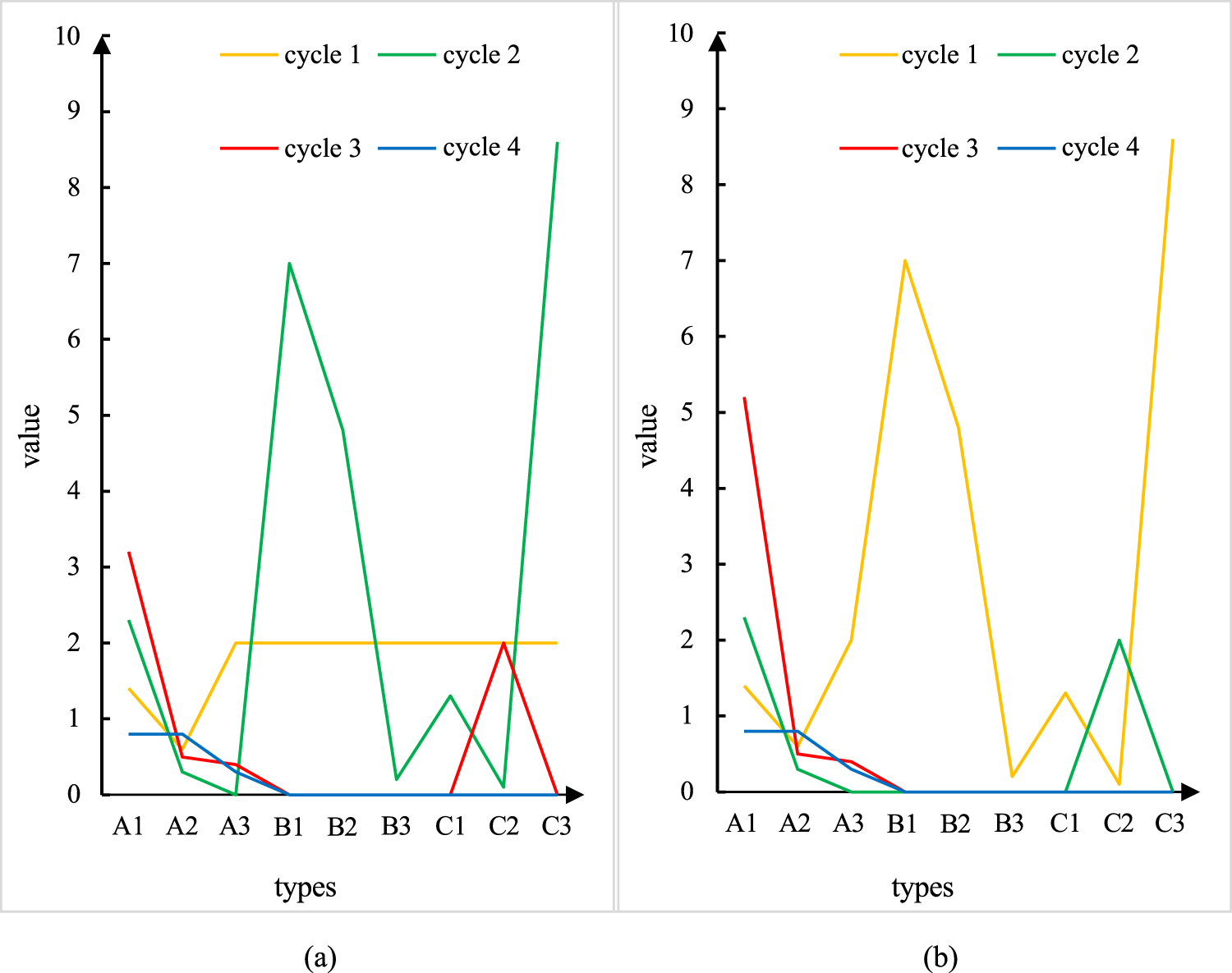
An initial scheduling scheme and an adjusted scheduling scheme according to an adjustment strategy. (a) Initial scheduling Scheme 1; (b) Adjusted scheduling Scheme 1.
Figure 7(a) is the initial scheduling Scheme 1, and Figure 7(b) is the adjusted scheduling Scheme 1. It can be seen from the calculation results: A1(3) changes from 3.2 to 5.2, an increase of 2; B1(1) changes from 2 to 7, an increase of 5; B2(1) changes from 2 to 4.8, an increase of 2.8; C3(1) increases from 2 to 8.6, an increase of 6.6. In addition, in the original scheduling plan, the scheduling pattern from the 3rd cycle can still be satisfied, so it remains as it is.
Experimental results of adjusting Scheme 2
During a planning cycle, when dynamic changes in demand occur, the plan adjusts accordingly according to the second adjustment strategy. That is, the new demand can only be met if the supply station at the disaster site is reached within two hours. When there is a dynamic change in demand in the 4th cycle, the demand needs to increase by a factor of 1.5. After the change, the resource requirements of each disaster point are 10, 12.3, 14.8, 2.5; the disaster points in B1 are 3.6, 0, 0, 0; the disaster points in C1 are 5.6, 1.6, 0, 0. Then, there are the new requirements: disaster points in A1 are 10, 12.3, 20, 2.5; disaster points in B1 are 3.6, 0, 5, 0; disaster points in C1 are 5.6, 1.6, 0, 0. Figure 8 shows the preliminary planning and scheduling according to the second adjustment strategy.
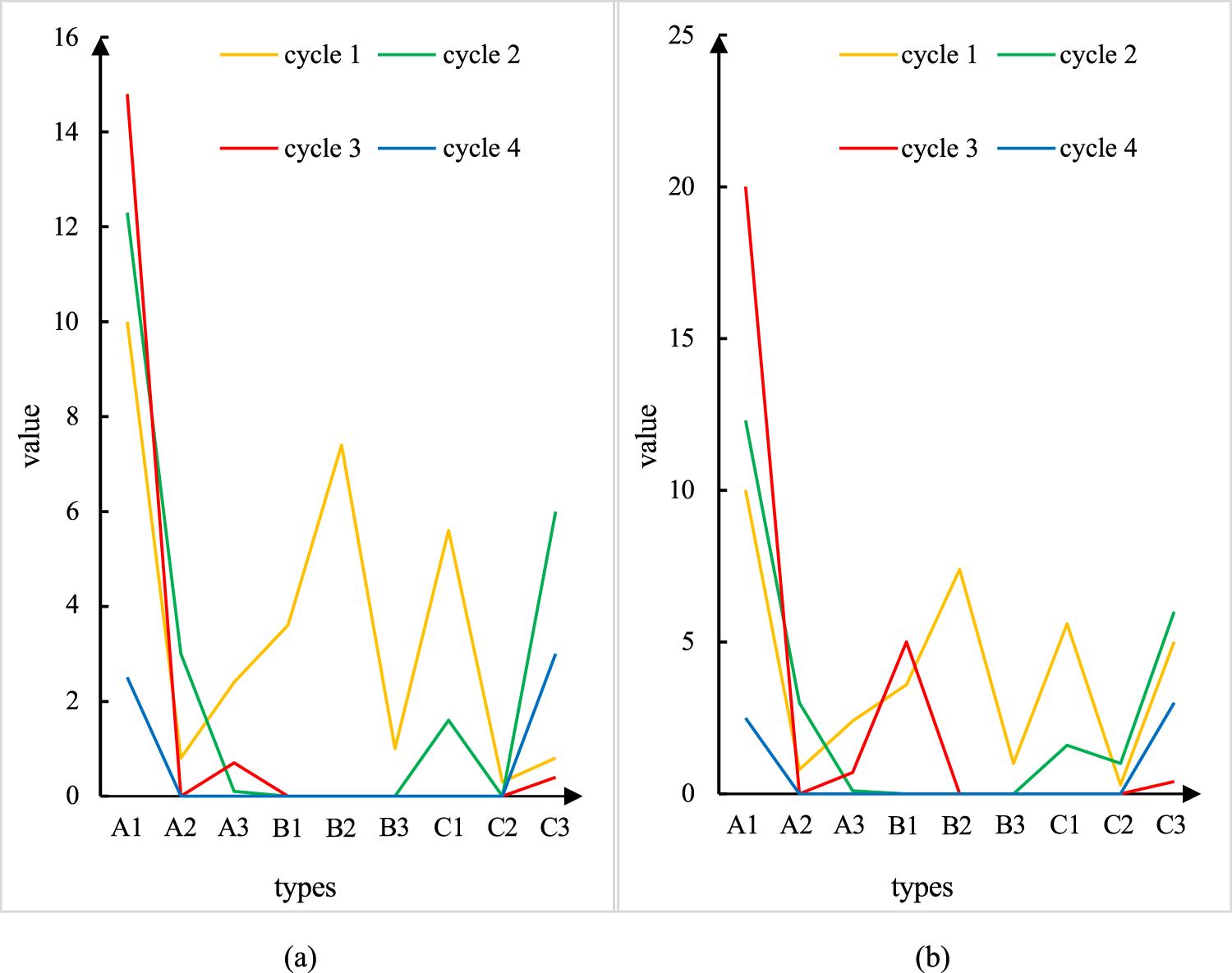
An initial scheduling scheme and the scheduling scheme adjusted according to the second adjustment strategy. (a) Initial scheduling Scheme 2; (b) Adjusted scheduling Scheme 2.
Figure 8(a) is the initial scheduling Scheme 2, and Figure 8(b) is the adjusted scheduling Scheme 2. It can be seen from the calculation results: A1(3) increased by 5.2 from 14.8 to 20; B1(3) changed from 0 to 5, increased by 5; C3(1) increased by 4.2 from 0.8 to 5. In the original schedule, the scheduling method for the remaining cycles can still be satisfied.
Experimental results of adjusting Scheme 3
If dynamic demand changes occur at three-quarters of a planning cycle, the plan is still adjusted according to the second correction strategy. This means that the new demand can only be met if the supply depots at the affected site are reached within an hour. It is assumed that in Cycle 2, there would be a 1.5x increase. Therefore, in the second cycle, the resource requirements of each disaster point are 10, 12.3; the disaster points in B1 are 6.8, 0; the disaster values of C1 are 1.8, 0.1. Then, the new demand values are that the disaster points in A1 are 10, 18.6; the disaster points in B1 are 6.8, 0; the disaster values of C1 are 1.8, 0.1. Figure 9 shows the plan based on the third adjustment.
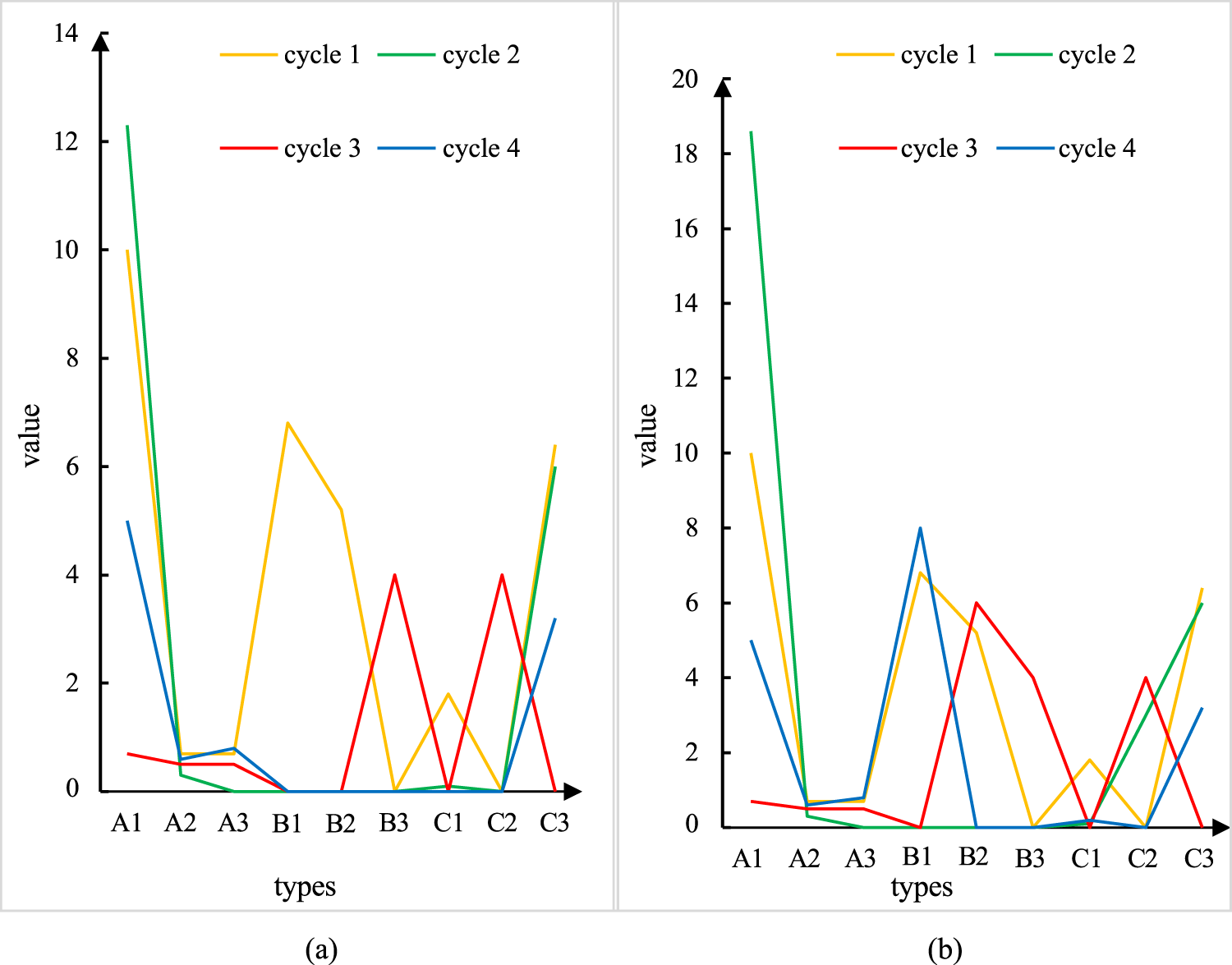
An initial scheduling scheme and the scheduling scheme adjusted according to adjustment scheme 3. (a) Initial scheduling Scheme 3; (b) Adjusted scheduling Scheme 3.
Figure 9(a) is the initial scheduling Scheme 3, and Figure 9(b) is the adjusted scheduling Scheme 3. It can be seen from the calculation results: A1(2) has changed from 12.3 to 18.6, an increase of 6.3; B1(4) has changed from 0 to 8, an increase of 8; C2(2) from 0 to 3, an increase of 3; B2(3) from 0 to 6, an increase of 6. In the original planning arrangement, the scheduling method of the remaining cycles can still be maintained as it is.
During the last quarter of a planning period, dynamic changes in demand would occur, and the scheduling scheme would be adjusted accordingly according to three adjustment strategies. Supplies to the affected area can only be delivered to the affected area if they arrive at the resupply station at the affected location within an hour, and the original plan has not changed, except that the number of resources would definitely grow.
Table 3 presents the mean and other performance indices for the mean Fs=(F1+F2) obtained by 10 separate operations.
Experimental results from MOEA/D-DE-mdERS and MOEA/D-SBX runs.

From the data in Table 3, we can see that MOEA/D-DE-mdERS outperforms MOEA/D-SBX in multiple key indicators: the Super Volume Value is higher, indicating that the quality and diversity of its solution set are better; the CPU running time is significantly reduced, indicating that the computational efficiency is higher; at the same order of magnitude of the number of evaluations, MOEA/D-DE-mdERS can better meet the dynamic demand conditions. For example, in adjustment strategy 3, the minimum objective function value (Fs min) of MOEA/D-DE-mdERS is 40.24, while that of MOEA/D-SBX is 47.68, and the super volume value of the former reaches 4.88 (higher than 4.81 of SBX). These results show that MOEA/D-DE-mdERS has stronger optimization capabilities and higher computational efficiency when solving multi-period emergency resource dynamic scheduling problems, and can more effectively cope with complex dynamic demand changes.
The Taiwan Chi-Chi earthquake is a typical emergency logistics scheduling problem. This paper continues to use the experimental data provided above to compare MOEA/D-DE-mdERS and MOEA/D-SBX. In Table 4, the performances of the three modulations for MOEA/D-DE-mdERS and MOEA/D-SBX are compared. It can be seen from Table 4 that the quality and computational efficiency of the solution of the multi-stage emergency resource dynamic scheduling problem are higher than those of MOEA/D-SBX in the order of magnitude of function evaluation under the condition of satisfying the dynamic demand.
Experimental results obtained from MOEA/D-DE-mdERS and MOEA/D-SBX operations in the Taiwan Chi-Chi earthquake case.

Experimental results obtained from MOEA/D-DE-mdERS and MOEA/D-SBX operations in the Taiwan Chi-Chi earthquake case.
Resource allocation in an emergency is a very complex process. A single demand forecast cannot fully reflect the actual needs of the affected areas. On this basis, the multi-period emergency resources are studied, and a multi-objective optimization method based on the multi-period emergency resource planning problem is presented. In this model, a dispatch plan is designed based on the predicted demand at the initial stage of the disaster. When demand changes, the plan selects an appropriate adjustment strategy according to the change in demand. Some examples are given in the paper to verify whether the proposed algorithm is suitable for this mode. The experimental results have shown that MOEA/D-DE-mdERS can solve the dynamic scheduling problem of multi-stage emergency resources.
Although people have no way to control emergencies, timely emergency handling can prevent the further expansion of disasters, and the allocation of emergency resources is also very necessary. Emergency resource scheduling is different from commercial scheduling. Its primary goal is to meet the needs of the disaster victims as much as possible, ensure the safe and effective scheduling of the work, reduce the impact of the disaster on the disaster victims, and thus ensure the safety of people's lives and properties in the disaster area. Based on multi-cycle emergency resource scheduling, a scheduling model is established, and an optimization algorithm based on an evolutionary algorithm is given to optimize the model.
This paper studies the problem of multi-period emergency resource dynamic scheduling, proposes a kernel function automatic multi-flow resource scheduling method based on a heterogeneous cluster scheduling algorithm, and designs MOEA/D-DE-mdERS. Experimental results show that this method can significantly improve the efficiency of resource scheduling under the condition of meeting dynamic demand, and is superior to traditional algorithms in terms of computational performance and solution quality. However, this study still has shortcomings: practical issues such as road repair, traffic mode conversion, and priority classification are less considered, and the practical applicability of the model needs to be further improved. Future research can be carried out from the following aspects: first, combining post-disaster road repair and traffic optimization strategies to improve the reliability of resource transportation; second, exploring the coordinated scheduling of multiple modes of transportation, such as the joint use of trucks and helicopters to cope with large-scale disasters; third, optimizing rescue plans according to different conditions of the injured to reduce casualties. Through these improvements, it is expected to build a more complete emergency resource scheduling system and provide more efficient solutions for post-disaster rescue.
Footnotes
Funding
The author received no financial support for the research, authorship, and/or publication of this article.
Declaration of conflicting interests
The author declared no potential conflicts of interest with respect to the research, authorship, and/or publication of this article.