Accurately assessing academic performance is a persistent challenge due to the uncertain and imprecise nature of evaluative information. While Hesitant Fuzzy Sets (HFS) provide a useful tool for handling uncertainty, existing hesitant fuzzy relation (HFR) structures often fail to preserve original information, leading to incomplete evaluations. The main objective of this research is to develop a new HFR structure that preserves original data more effectively, enabling more accurate, reasonable, and complete assessments. We generalize the Cartesian product and hesitant fuzzy relations by introducing a hesitant fuzzy Cartesian product (HFCP), where each pair is associated with hesitant fuzzy elements. This extends classical and intuitionistic fuzzy models using a lattice-based mathematical framework. The analytical approach relies on set theory and lattice structures. An illustrative example using simulated academic data demonstrates the improved representation and accuracy of lecturer–student evaluations. Key findings highlight that the new structure reduces information loss and increases the reliability of performance assessment. This framework supports better-informed decision-making in academic management. We recommend incorporating hesitant fuzzy-based evaluation models in institutional appraisal systems to enhance fairness, clarity, and data completeness in academic performance reviews.
Fuzzy set theory (FS), introduced by Lotfi Zadeh in 1965 (Zadeh, 1965), generalizes classical set theory by replacing characteristic functions with membership functions that assign degrees of membership between zero and one. FS was created to establish a mathematical framework that models the inherent vagueness and uncertainty encountered in everyday situations, addressing the limitations of classical set theory, which needed that elements either fully belong or entirely do not belong to a set. This innovation has led to applications across various fields, including topology, logic, matrices, probability theory, and algebra (Beer, 2023; Chang, 1968; Dib, 1994; Dib, 1999; Gudder, 1998; Jawarneh et al., 2024; Pal, 2024; Rosenfeld, 1971; Ying, 1991; Zadeh, 2009). Decision-making applications also use the FS (Amini et al., 2024; Karnavas et al., 2025).
Moreover, several types of information cannot be dealt with by FS, such as the information that comes from answering a questionnaire with yes, no, not sure, maybe, and so on. Therefore, in response to limitations in Zadeh's original FS theory, particularly its inability to explicitly represent hesitation and uncertainty stemming from incomplete or conflicting information, Atanassov (Atanassov, 1986) introduced intuitionistic fuzzy sets (IFS) in (1986). (Garg et al., 2024; Khan et al., 2025; Zhang et al., 2025). As a more generalization, in 2009, Torra and Narukawa (Torra, 2010; Torra & Narukawa, 2009) introduced the hesitant fuzzy set (HFS) to address the challenge of assigning multiple membership values to an object in cases where there are several possible values. Unlike an FS, which assigns a single membership degree, or an IFS, which handles a margin of error, the HFS accommodates a range of possible values. For example, the FS and IFS frameworks cannot fully resolve a situation where four decision-makers assign different membership degrees, such as 0.4, 0.5, 0.6, and 0.7, to an object within a set. The HFS generalizes both theories by letting the membership degree of an object be shown as a range of possible values, which makes it better at handling uncertain information than other uncertainty models. In 2011, Xia and Xu (2011) defined the hesitant fuzzy element (HFE) as a fundamental unit of HFS, facilitating the expression of uncertain preferences in decision-making. Researchers have extensively explored applications of hesitant fuzzy information in various areas, including decision-making and medical diagnosis. Recently, other studies have focused on aggregation methods, similarity measures, and correlation coefficients of hesitant fuzzy sets, underscoring their utility in decision-making and analysis (see Alsharo et al., 2024; Ashraf et al., 2024; Ashraf et al., 2025; Dawlet & Bao, 2024; Gupta et al., 2024; Gupta & Kumar, 2024; Liu et al., 2023; Liu et al., 2021; Mahmood et al., 2021; Narukawa & Torra, 2023; Talafha et al., 2021; Xin & Ying, 2024). Dib and Youssef found that numerous authors in the literature have explored fuzzy relations (FR) without adequately addressing the concept of the fuzzy Cartesian product (FCP), which is insufficiently defined. Therefore, Dib and Youssef (1991) have developed the concepts of FCP and FR, creating a closely analogous structure to classical algebra. The concept of an FCP circumvents this issue and simplifies the classical Cartesian product in the crisp case. Also, in 2008, Fatih and Salleh (Fathi, 2010; Fathi & Salleh, 2008a) introduced the concept of intuitionistic fuzzy Cartesian products (IFCP) as a generalization of FCP. They defined the concept of intuitionistic fuzzy relation (IFR) as a subset of IFCP, following Dib and Youssef's approach. Furthermore, Al-Zu’bi et al. (2024a) defined a new trend of bipolar-valued fuzzy Cartesian products (BVFCP) as a generalization of FCP. Additionally, define Bipolar-Valued Fuzzy Relations (BVFR) as a subset of BVFCP, following Dib and Youssef's approach as well.
The main objective of this research is to define hesitant fuzzy relations (HFRs) as subsets of hesitant fuzzy Cartesian products (HFCPs), thereby introducing a new structure that differs from the traditional Zadeh-style HFRs defined without Cartesian product foundations. This work addresses a critical gap in the literature, namely the absence of a hesitant fuzzy universal set and a well-defined binary operation for hesitant fuzzy subgroups, as noted in (Rosenfeld, 1971) and not covered by Rosenfeld's original fuzzy group approach. Motivated by this gap, we adopt and extend Dib's methodology to generalize fuzzy Cartesian products and relations into the hesitant fuzzy context. Our contribution lies in laying the foundational structure for a new algebraic system which termed a hesitant fuzzy group that parallels the concept of ordinary groups while accommodating hesitation and uncertainty. This not only enhances the theoretical underpinnings of hesitant fuzzy set theory but also opens avenues for its practical application in decision-making systems that require nuanced algebraic modelling of uncertainty.
This research is motivated by the absence of a well-defined structure for hesitant fuzzy relations (HFR) that can preserve original data and allow accurate interpretation. To address this, we define HFR as a subset of the hesitant fuzzy Cartesian product (HFCP), enabling full data retrieval and offering a more logical and algebraic structure inspired by ordinary groups. Our contributions include generalizing fuzzy relations to the hesitant fuzzy setting and applying the model to evaluate academic performance, supporting more precise educational assessments and decisions.
The innovative value of this research lies in the introduction of a new hesitant fuzzy Cartesian product (HFCP) structure that preserves original hesitant fuzzy elements of the input sets, overcoming the information loss found in traditional definitions. This enables the definition of hesitant fuzzy relations (HFRs) as proper subsets of HFCPs, generalizing existing fuzzy relation frameworks and offering a more robust foundation for both theoretical development and practical applications in decision-making and evaluation systems.
As illustrated by Figure 1, the proposed methodology begins by extending a hesitant fuzzy set on X to , leading to the construction of an M -hesitant fuzzy subset on . This enables the definition of the hesitant fuzzy Cartesian product and hesitant fuzzy relation, forming a basis for future definitions of hesitant fuzzy functions and binary operations. Ultimately, this approach aims to establish a new algebraic structure called a hesitant fuzzy group, as a generalization of a fuzzy group.
In this research, we chose a hesitant fuzzy set to combine with classical algebra using the Dib approach in fuzzy algebra. This is to fill in the gaps in the absence of hesitant fuzzy space in Kim et al. (2019) and Divakaran and John (2016) definitions of a hesitant fuzzy subgroup. Our contribution started by defining some new definitions for the hesitant fuzzy Cartesian product (HFCP) and hesitant fuzzy relations (HFR), along with some associated properties. These definitions are the cornerstone for creating the foundation of the future algebraic structure, known as a hesitant fuzzy algebra. Also, we validate these concepts by addressing the question: “How do these concepts allow academic faculty and decision-makers to evaluate a student's academic performance?” By utilizing the hesitant fuzzy Cartesian product (HFCP), hesitant fuzzy relation (HFR), and certain operations on hesitant fuzzy sets, we model the relationship between the student and the lecturer based on a set of evaluation criteria for both. This approach enables us to define the student's optimal performance, taking into account the complex, multi-faceted interactions that occur during the evaluation process.
Preliminaries
This section lays the groundwork for the HFS framework by first reviewing essential concepts from FS theory and IFS theory. While the foundational aspects of FS and IFS are well-established, this section also introduces new notions related to intuitionistic fuzzy sets that have not yet appeared in the literature. We will explore the relationship between IFSs and HFSs later in this work, using these novel concepts as crucial tools. We begin by revisiting the basic definitions and properties of fuzzy sets, followed by an extended discussion on intuitionistic fuzzy sets and the newly proposed notions.
An FS is a fundamental concept in fuzzy logic, introduced by Zadeh in 1965. An FS allows for partial membership in contrast to classical set theory, which is defined as follows:
(Zadeh, 1965) For a universal set a fuzzy set (FS) A can be defined as and the membership function .
(Zadeh, 1965) Let A and B any two FSs defined on a universal set X. Then A is said to be a subset of B if for every , and is denoted by . If for every , then A is a proper subset of B and denoted by
(Zadeh, 1965) Let and be two FSs on X. The union and intersection of two FSs are denoted by and respectively, are defined as follows
The and represent the minimum and maximum operators, respectively.
An L-fuzzy subset refers to a membership function that derives its values from the lattice , where . An L -fuzzy subset of X is, thus, a function mapping X to L.
(Dib and Youssef, 1991) The fuzzy Cartesian product (FCP) of two ordinary sets X and Y, denoted by , is the collection of all L-fuzzy subsets of . That is, .
An element of FCP is then a function , or
This definition represents the fuzzy Cartesian product notion, but it operates on two FSs.
(Dib & Youssef, 1991) For two fuzzy subsets of X and of Y, fuzzy Cartesian product of A and B (denoted by ) is the L-fuzzy subset of specified by:
It is clear that is an element of for every and .
(Dib & Youssef, 1991) A fuzzy relation (FR) is a subset of the FCP . That is, is a collection of some L-fuzzy subsets . If is from X to X, then is called an FR in X.
Intuitionistic fuzzy sets, introduced by Atanassov in 1986, extend the notion of FSs by incorporating a degree of non-membership alongside the degree of membership. This additional component allows for a richer representation of uncertainty compared to traditional fuzzy sets.
(Atanassov, 1986) For a universal set X, an intuitionistic fuzzy set (IFS) K can be defined as
where the membership functions , and the non-membership functions , with the condition .
(Fathi, 2010; Fathi & Salleh, 2008a) Given the lattice , where . The intuitionistic fuzzy Cartesian product (IFCP) of two ordinary sets X and Y, denoted by , is the collection of all intuitionistic L-fuzzy subsets of . Therefore, the element of IFCP is an object with a specified form.
and .
Motivated by Definition 2.5 on the FCP of two FSs by Dib, we introduce a novel concept that has not yet been defined in the literature. These new definitions are driven by the need to capture interactions that emerge from our findings in the subsequent section. Based on Definition 2.8, we define the intuitionistic fuzzy Cartesian product of two IFSs as follows.
Let and be two IFSs on X and Y respectively. The IFCP of and (denoted by )
is an intuitionistic L -fuzzy subset of .
(Fathi, 2010; Fathi & Salleh, 2008a) An intuitionistic fuzzy relation (IFR) is a subset of the IFCP . That is, is a collection of some intuitionistic L-fuzzy subsets . If from X to X, then is called an IFR in X.
Hesitant Fuzzy Set Theory
In this section, we delve into the concept of a hesitant fuzzy set (HFS), which serves as a natural extension of a traditional fuzzy set by allowing for multiple degrees of membership for each element in a universe.
Hesitant Fuzzy Set
We will begin by presenting the foundational definitions of HFSs, followed by a discussion of their concepts that have been established in the literature.
(Torra, 2010; Torra & Narukawa, 2009) For a universal set X, a hesitant fuzzy set (HFS) on X is in terms of function that when applied to X returns a subset of .
To be easily understood, we expressed the HFS (say set ) by a mathematical symbol:
where is a set of finite values in . The set , is called a Hesitant Fuzzy Element (shortly HFE) of A, and the function is called a hesitant fuzzy membership function of A. We also write .
For , if , then we say that x has an empty HFE and we exclude x from A.
There are two operations we consider on HFS, they are union and intersection which defined as follows;
(Torra & Narukawa, 2009) Let A and B be two HFSs on X, where and are HF membership functions for A and B respectively. The union and intersection of two HFS are denoted by and respectively, are other HFSs on X where its HF membership functions, denoted as and are defined as follows
where and are lower bound and upper bound of , respectively.
After conducting a literature review, we discovered the absence of a definition for the inclusion of an HFS. As a result, we developed the following definition for the inclusion of an HFS.
Recalling Definition 2.2, a subset of two fuzzy sets, note that is a singleton membership degree. In contrast, the HFE contains a set of membership degrees, so it's difficult to compare two HFEs. Therefore, we choose the mean to reduce HFE to one value so we can compare it more easily. Furthermore, Xia and Xu (Xia and Xu, 2011) used the score definition of to reduce HFE to one value to compare between HFSs.
Let X be a universal set, and be two HFSs on X. Then we say that A is a subset of B (denoted as ), iff , then
where
If for every , then A is a proper subset of B, denoted as .
Let A and B be two HFSs on X. Then we say that A and B are equal (denoted as ), iff for every
where and are HFEs of A and B respectively.
(Torra & Narukawa, 2009) Let A be an HFS on a universal set X, the envelope of the hesitant fuzzy element of A can be defined as
where and .
We will treat X as a special finite set, known as a reference set, in our upcoming discussion on the application of hesitant fuzzy sets (HFS). This set will serve as the foundation for applying HFS in practical scenarios. Before proceeding, it is crucial to introduce several key terms essential for the effective application of HFS.
(Guan et al., 2018; Liao et al., 2015) For a reference set X, let be an HFS on X, where be an HFE being the possible membership grades of to a given set and positive integer k being the number of values in .
The mean of HFS A is defined as:
The variance of HFS A is defined as:
(Guan et al., 2018; Liao et al., 2015) For a reference set X, let and be HFSs on X, where and be an HFEs being the possible membership grades of to a given set and positive integer k being the number of values in .
The correlation between two HFSs A and B is defined as:
The correlation coefficient between two HFSs A and B is defined as:
(Liao et al., 2015) For an HFS on X with , the following equation holds:
We then introduce IFS on HFS as follows:
(Torra & Narukawa, 2009) Given an HFS on X, then the intuitionistic fuzzy set on A (denoted by ) is defined as the collection of envelopes of , for all . Therefore
Recall that and are the lower bound and the upper bound of HFEs .
We now introduce a hesitant fuzzy set (HFS) on the Cartesian product , which is a specific extension of earlier concepts of HFSs. Our approach is motivated by Dib's definition of a fuzzy set on (Dib & Youssef, 1991). This new HFS is defined analogously to Definition 3.1 of an HFS on X, with the universal set X replaced by , where Y is another universal set. This framework sets the stage for discussing new findings that will emerge later in the paper.
For universal sets X and Y, an HFS on is in terms of function that when applied to returns a subset of .
To be easily understood, we expressed the HFS (say set ) on by a mathematical symbol:
where is a set of finite values in , or simply .
For universal sets X and Y, suppose and be two HFSs on . Then we say that A is a subset of B (denoted as ), iff for each , then
If for each , then A is a proper subset of B, denoted as
Let A and B be two HFSs on . Then we say that A and B are equal (denoted as ), iff for each
where and are HFEs of A and B respectively.
In the following, we will prove certain properties of hesitant fuzzy subsets, setting the stage for deeper analysis and application in later discussions.
For any hesitant fuzzy sets and C on X, we have:
,
,
and ,
and .
Proof.
Let , then , so , definitely.
The proof has similarities to the proof presented in (1).
Let , so .
Suppose that , so
Therefore and hence, .
The converse is also true by the same arguments.
The proof has similarities to the proof presented in (3).□
From these findings, we conclude that the new definition of inclusion of the HFS is consistent with the properties of classical inclusion of the ordinary set. This means that the new inclusion respects the fundamental characteristics of classical inclusion. In conclusion, our new definition is well-founded and consistent with established mathematical concepts because it satisfies our new inclusion with the properties of classical inclusion. It demonstrates that the new inclusion does not contradict the fundamental principles of inclusion and, when applied properly, may even provide fresh perspectives or a wider range of applications. Therefore, we can reduce the inclusion of two HFSs to the inclusion of two FSs.
M -Hesitant Fuzzy Subset
In this subsection, we introduce a key concept fundamental to our framework: the M-hesitant fuzzy subset (M-HFS). This new definition extends the traditional understanding of HFSs by incorporating a broader range of values through the Cartesian product of fuzzy sets. The idea of L-fuzzy subsets, first introduced by Dib (1991), motivated us to create these sets. They let us capture a more nuanced representation of uncertainty within hesitant fuzzy environments.
Let , where . For a universal set X, an M -hesitant fuzzy subset (-HFS) on X is in terms of function that when applied to X returns an element of M. To be easily understood, we expressed the M -HFS (say set ) by a mathematical symbol:
where and are sets of finite values in , or in other words , . is called an M -Hesitant Fuzzy Element (shortly M -HFE) of on X.
Since the operations of inclusion, union, and intersection are fundamental in classical set theory, it is natural to extend them to the context of M -HFSs, as follows;
Let X be a universal set, suppose and be two M -HFSs on X. Then is said to be a subset of , denoted by if for all
and .
Let and be two M -HFSs on X, where and are M -HF membership functions for and and are M -HF membership functions for . The union and intersection of two M -HFSs denoted by and respectively, are another M -HFS on X where its M -HF membership functions denoted as , defined as follows
where and are lower bound and upper bound of , respectively. The same goes to , and .
Let be an M -hesitant fuzzy subset on X, then the envelope of an M -hesitant fuzzy subset on X can be defined as
Analog to Definition 3.12 of M -HFS on X, we also define M -HFS on by simply replacing X to .
Let , where . For universal sets X and Y, an M -hesitant fuzzy subset (-HFS) on is in terms of function that when applied to returns an element of To be easily understood, we expressed the M -HFS (say set ) on by a mathematical symbol:
where are sets of finite values in [0,1]. is called an M -HFE of on .
It is important to note that the inclusion, union, and intersection of M -HFS on is analog to Definition 3.13 and Definition 3.14, simply replacing x to .
Let be an M -hesitant fuzzy subset on , then the envelope of an M -hesitant fuzzy subset on can be defined as
Before proceeding, we establish a foundational relationship between hesitant fuzzy sets (HFSs) and M -hesitant fuzzy subsets (-HFSs). The following lemma formalizes this connection;
If we have two HFSs A and B on X and Y respectively, then we may have an M -HFS on where and . The converse is also true i.e., every M -HFS on is defined by two HFSs on X and Y.
Proof:
Firstly let and be two HFSs on X and Y respectively. We want to show that is an M-HFS on .
For , , and , then
for every and .
Secondly, we let be an M -HFS on . For every and , then is an HFS on X and is an HFS on Y.□
We then say that the resulting M -HFS is generated by A and B, the two HFSs.
To each M -HFS of we associate an M-HFS of defined by
where is called the inverse of M -hesitant fuzzy subset .
Hesitant Fuzzy Cartesian Product
In this section, we introduce the notion of the Hesitant Fuzzy Cartesian Product (HFCP), which generalizes the classical Cartesian product of two sets by incorporating hesitant fuzzy elements. HFCP extends the traditional product to account for uncertainty and hesitation, allowing us to model more complex relationships between two ordinary sets, X and Y. By defining the HFCP as the collection of all M -hesitant fuzzy subsets on , we create a framework that accommodates the inherent fuzziness in decision-making environments. This concept is pivotal in understanding interactions between sets within hesitant fuzzy systems, as it serves as the foundation for hesitant fuzzy relations and other related operations. We now formally define the hesitant fuzzy Cartesian product as follows:
The hesitant fuzzy Cartesian product (HFCP) of two ordinary sets X and Y, denoted by , is the collection of all M-hesitant fuzzy subsets of .
In other words, i.e., a collection of all functions from to . An element of is then an M -HFS on ,
We now extend the concept of the Hesitant Fuzzy Cartesian Product (HFCP) by applying it to two Hesitant Fuzzy Sets (HFSs).
For two HFSs A and B on X and Y respectively, the HFCP of A and B (denoted by ) is the M-HFS on generated by A and B.
Recall Lemma 3.1 on the construction of M -HFS on by two HFSs on X and Y, the HFCP of two HFSs and is
which is an M-hesitant fuzzy subset of . So, is an element of . Therefore, we may characterize any element of as either an M -hesitant fuzzy subset on or as a hesitant fuzzy Cartesian product of two HFSs A and B on X and Y, respectively.
The HFCP of two ordinary sets X and Y, is the collection of all HFCPs of A and B, for two HFSs A and B on X and Y, respectively.
Proof. The proof is straightforward by utilizing Lemma 3.1.
We then delve into specific characteristics of the hesitant fuzzy Cartesian product in relation to both hesitant fuzzy sets and ordinary sets. These remarks clarify the relationships between these concepts and highlight cases where the distinctions between them blur.
If the HFS has only one membership value, i.e., the FSs A and B are considered as HFSs, i.e., , the notions of hesitant fuzzy Cartesian product and fuzzy Cartesian product of A and B are same, i.e., . therefore, we may detect the M-hesitant fuzzy subset with , i.e., the membership function and has only one membership value.
When we consider the ordinary sets X and Y as hesitant fuzzy sets of themselves, i.e., , , the concepts of an HFCP and the classical Cartesian product of X and Y coincide, i.e., . In this instance, we can identify the M-hesitant fuzzy subset with .
It is essential to examine their inclusion properties to ensure consistency with the principles of classical set theory, and we present the following findings;
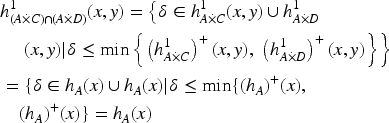
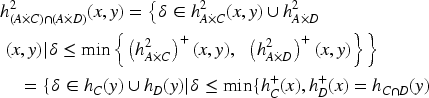
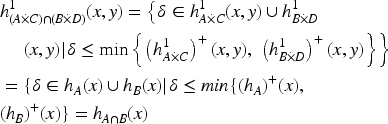
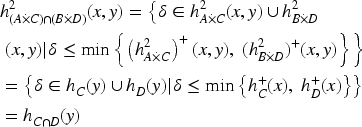
For every non-empty HFSs A and B of and non-empty HFSs C and D of Y, we have:
Proof. Let A, B be HFSs on X and C, D be HFSs on Y, written as follows
where and .
which is an M -HFS on . So and
Now we observe that
is an -HFS on where and
And
, is an M -HFS on where and
Therefore
is an M -HFS on where its M-HF membership functions are given by
So .
Therefore, .
The proof has similarities to the proof presented in (1).
which is an M -hesitant fuzzy subset on .
So
and
Now we observe that is an M -HFS on where and
And
is an M -HFS on where and
Therefore
is an M -HFS on where its M -HF membership functions are given by
So
Therefore .
The proof has similarities to the proof presented in (3).
Let .
Therefore .
So .
So and .
So and .
Therefore, and , definitely.□
Note that Dib's findings show that the equality of proposition 4.1 (4) does not hold for fuzzy Cartesian product and we may conclude that the properties are not fully inherited from fuzzy Cartesian product (FCP) to hesitant fuzzy Cartesian product (HFCP).
The next part of this paper aims to connect our defined HFCP of two ordinary sets with the intuitionistic fuzzy Cartesian product (IFCP) for the same set, as presented by Fathi and Saleh (Fathi, 2010; Fathi & Salleh, 2008a). This comparison will highlight the similarities and differences between HFCP and IFCP.
Since the hesitant fuzzy Cartesian product is also an M -hesitant fuzzy subset on , so we may also define the envelope of , using Definition 3.17 the envelope of an M -hesitant fuzzy subset on and get the following
The following theorem represents the relationship between the HFCP and the IFCP (Fathi, 2010) in the sense of Dib's approach.
For any two HFSs A and B on X and Y respectively, there exist two intuitionistic fuzzy sets and on X and Y respectively, such that
Let and be two HFSs on X and Y respectively, then the Hesitant fuzzy cartesian product of A and B is
By the definition of the envelope of the HFCP of , we then have
Let us define two IFSs on X and Y as follows,
and .
Then,
Therefore .
Thus, it can be concluded that every HFCP can indeed be represented as an intuitionistic fuzzy Cartesian product through the envelope operation.
It is important to note that there is a direct relationship between an intuitionistic fuzzy set (IFS) and a fuzzy set (FS). Specifically, every FS can be represented as an IFS; however, the reverse is not true. According to Atanassov (1986), fuzzy sets can be viewed as special types of intuitionistic fuzzy sets. In this context, the non-membership degree is defined as , where represents the membership degree of the element x in the fuzzy set A. Additionally, the hesitation degree is given by which is always equal to zero for the fuzzy set. This reflects that fuzzy sets do not exhibit hesitation, as their membership completely determines their non-membership. Also, we observed a relation between HFS and IFS, demonstrating that we can represent the hesitant fuzzy element (HFE) as an intuitionistic fuzzy number (IFN) by using the definition of the envelope of HFE (Torra, 2010; Torra & Narukawa, 2009). Therefore, the HFS is a generalization of FS and IFS.
Consequently, the relationship between IFS and FS can also be applied to the relationship between intuitionistic fuzzy Cartesian product (IFCP) and fuzzy Cartesian product (FCP). Specifically, every FCP can be represented as IFCP, but vice versa is not true, as noted by Fathi and Salleh (2008a).
Utilizing the established relationship between hesitant fuzzy set (HFS) and IFS, along with Theorem 4.1, we can conclude that any hesitant fuzzy Cartesian product (HFCP) serves as a generalization of both FCP and IFCP. This illustrates the significance of our new definition of hesitant fuzzy Cartesian product (HFCP).
Hesitant Fuzzy Relations
In this section, we introduce the concept of a hesitant fuzzy relation (HFR), which serves as a foundational element in the study of hesitant fuzzy systems. An HFR encapsulates the connections between elements of two sets, allowing for a nuanced representation of relationships that incorporates uncertainty and hesitation. By considering hesitant fuzzy relations as subsets of the hesitant fuzzy Cartesian product, we can effectively model the interactions between the elements of these sets.
A hesitant fuzzy relation (HFR) from X to Y is a subset of the HFCP . If is from X to X, then is called a hesitant fuzzy relation on .
Thus, from Lemma 4.1, the element of relation is either an M-hesitant fuzzy subset on , or a hesitant fuzzy Cartesian product of two HFSs A and B on X and Y, respectively.
The hesitant fuzzy Cartesian product itself is considered as an HFR from X to Y. For any element of , let say , where A and B are HFSs of X and Y, respectively, and with the hesitant fuzzy functions given by and , the singleton set is another example of an HFR from X to . Note also that is also an M -hesitant fuzzy subsets on . Therefore, for any relation from X to Y, means that
as used earlier in Section 3.2, for an M -hesitant fuzzy subset on .
Let the complete hesitant fuzzy relation in X be a hesitant fuzzy Cartesian product . The null hesitant fuzzy relation on X is where is the non-sense M -hesitant fuzzy subset on . Between these two extreme cases lies the identity hesitant fuzzy relation, denoted by . This is an HFR in X whose members are the following M-hesitant fuzzy subsets
is nonempty,
To each function , there corresponds a hesitant fuzzy relation from X to Y defined by .
Let and be hesitant fuzzy relations from X to Y. We say that is a subset of , (denoted by ), iff for all and . We say that and are equal, , iff and .
Let be an HFR map X into Y. The inverse of , represented by , is the hesitant fuzzy relation maps Y into X characterized by
For any hesitant fuzzy relations and , we have:
Let and , where
So
So
So
So
Therefore .
Firstly, we let .
So .
So .
So .
Now we let .
So .
So
So .
Therefore .
Let and be two HFRs maps X to Y and Y to Z, respectively. The composition of and , represented by , is the HFR maps X to Z. This composition is a subset of the HFCP , consisting of all M-hesitant fuzzy subsets characterized as follows:
if and only if there exists such that and for some and .
In other words, , is the HFR maps X to Z if for two HFSs A and B on X and Z respectively, such that , then there exists an HFS on Y say C such that and .
Following our exploration of the composition of hesitant fuzzy relations, we delve into several significant properties that arise from this operation. These findings highlight the algebraic structure of hesitant fuzzy relations, demonstrating how composition interacts with both union and intersection operations, as well as inclusion relationships between different hesitant fuzzy relations.
For any hesitant fuzzy relations and , we have:
.
Suppose and are an HFRs from Z to W, Y to Z and X to Y, respectively. Therefore and are an HFRs from Y to W and X to W.
Firstly, suppose , and .
Then there exists an element and .
Since , then there must be at least two elements, say and such that and .
Since and then , and since , we conclude that .
So .
Secondly, suppose , and we let . Then there exists an element and .
Since then there must be at least two elements, say and such that and
Since and then , and since , we conclude that . So
Therefore .
and and .
Since , then .
Now let and since , then .
Suppose so and , so , and , so .
So , definitely.
Let arbitrary element k and firstly suppose such that
So the exist and .
So or .
By using the definition of composition, then or .
So . Therefore .
Secondly suppose such that , then or , or .
If , then there exists at least one element
Then, and < >.
And if , then there exists at least one element
Then, and .
Since and or , then
and .
By using the definition of composition, then .
So .
So .
Therefore .
The proof has similarities to the proof presented in (3).
The following theorem presents the inverse of the composition, union, and intersection of two HFRs.
For any hesitant fuzzy relations and , we have:
,
,
.
Firstly, let and .
Therefore .
Therefore .
Secondly, let .
Therefore .
And let .
Therefore .
Therefore .
Firstly, let .
Then .
Then or .
Then or .
Then .
Then .
Secondly, let .
Then or .
Then or .
Then .
Then .
Then .
So .
The proof has similarities to that presented in (2).
We are going to establish the connection between the hesitant fuzzy relation and the intuitionistic fuzzy relation using Fathi and Salleh's (Fathi, 2010) approach. According to the Fathi and Salleh framework, every hesitant fuzzy relation from X to Y can be reduced to an intuitionistic fuzzy relation, from X to Y by utilizing the envelope of M -hesitant fuzzy subset as follows, for every ,
Therefore, we present it in the following theorem.
Let X and Y be two ordinary sets. For every HFR, from X to Y, there exists an IFR from X to Y such that , for some IFR
Let be an M -HFS on X and Y. Then is an intuitionistic L -fuzzy subset on . Therefore is an IFR on .
As previously mentioned, we demonstrate that there is a relationship between intuitionistic fuzzy sets (IFS) and fuzzy sets (FS), as well as a relationship between hesitant fuzzy sets (HFS) and IFS. Fathi and Salleh have also established that there is a relationship between intuitionistic fuzzy relations (IFR) and fuzzy relations (FR); specifically, every FR can be represented as an IFR, although the reverse is not true (Fathi, 2010). Furthermore, we have shown that Theorem 5.3 provides a valid relationship between our hesitant fuzzy relation (HFR) and IFR. Therefore, we regard every HFR as a generalization of both FR and IFR, which underscores the significance of our new definition of HFR.
Table 1 illustrates the comparative study of FS, IFS, HFS, and PVFS regarding Zadeh concepts and Deb concepts.
Application of HFCP and HFR Criteria in Student Evaluation
In this section, we explore a specific application of the hesitant fuzzy Cartesian product (HFCP) and hesitant fuzzy relation (HFR) criteria in the context of evaluating student performance across various classes. This application demonstrates how our theoretical framework can be practically implemented to assess the ideal performance of students in relation to their lecturers. By analyzing the interactions between students and lecturers, we aim to provide a comprehensive evaluation mechanism that enhances understanding of student outcomes and informs strategies for improvement. This case study serves to validate our approach, showcasing the effectiveness of HFCP and HFR in capturing the complexities of the educational evaluation process.
A Comparative Study Between Different Uncertainty Sets (FS, IFS, HFS and BVFS) with Zaded and Dib Approaches.
Criteria
Crisp Set
Fuzzy Set
Intuitionistic Fuzzy Set
Hesitant Fuzzy Set
Bipolar Valued Fuzzy Set
Zadeh concepts
Domain
Power set of
Mathematical conditions
: membership : non-membership
No condition
Identity Element, existence as classical axiom
Yes
No, Defined as
No, Defined as and
No, Defined as
No, Defined as and
Inverse Element Condition, existence
Yes
No, Defined as
No, Defined as and
No, Defined as
No, Defined as and
Ability to retrieve values
Yes
No
No
No
No
Structure
Universal set
Dib concepts
Identity Element existence as classical axiom
Yes
Yes
Yes
Yes
Yes
Inverse Element existence as classical axiom
Yes
Yes
Yes
Yes
Yes
Ability to retrieve values
Yes
Yes
Yes
Yes
Yes
structure
Universal set
Fuzzy space:
IF space:
HF space:
BVF space:
Evaluating a student's position within a university is critical because it takes into account their academic performance. It enables academic faculty, educational administrators, and decision-makers to accurately assess students enrolled in diverse courses throughout a semester to enhance their performance. The assessment is not solely dependent on the student, but also on the lecturers. In this section, we examine the relationship between the student and the lecturer, utilizing HFCP and HFR criteria to determine the student's optimal performance.
In 2022, Al-Husaini and Shukor (2022) comprehensively studied the factors affecting student academic performance. The results of their research discovered that the most significant factors influencing students’ academic performance are students’ e-learning activity, low entry grades, GPA, previous assessment grade, student gender, student internal assessment grade, accommodation, and family support. Additionally, Wei (2012) proposed a set of evaluation criteria for foreign lecturers to enhance the quality of their teaching and scientific research. These criteria are teaching capacity, morality, research ability, and educational experience.
In this study, without losing the generality in constructing different terms in the presented algorithm, we chose four factors and four criteria to study the first and second components of the HFCP and HFR between students (student academic performance) and lecturers (the quality of their teaching and research proficiency), respectively. Now, assume there are three groups of students , having four factors (criteria), which are : low entry grades, : students’ e-learning activity, : GPA and previous assessment grade. Furthermore, assume there are three groups of lecturers , having four criteria, which are : teaching capacity, : educational experience, : research ability and morality.
Step 1. In Table 2, the hesitant fuzzy value for each group of students and each factor affecting student academic performance can be predictable and identified by collecting the opinions of some academic experts. For instance, assume we have three experts at this level. The first expert believed that the group of students “ ” satisfied the factors and , and he assigned the values 1, 0.8, 0.9, and 0.9 as a degree of belongingness for each factor, respectively. Similarly, the second and third experts assign the values , and , respectively, for the consecutive factors for “ ”. Therefore, the second row in Table 2 is obtained.
HF Decision Matrix Based on the Academic Performance of Groups of Students.
Moreover, the HF values in Table 2, for the other groups of students “ and ”, can be identified in the same manner as “”.
In this stage, Table 3 represents the hesitant fuzzy decision matrix to signify the quality of teaching and research proficiency for three groups of university lecturers. Using the method described in reference (Gupta et al., 2024), we obtain the following table.
Step 2. Making of aggregation operator to get two HFSs S and T as follows:
The HF Decision Matrix Based on the Lecturer's Teaching and Research Proficiency of Groups of Lecturers.
Using the definitions of the mean of HFEs and the mean and variance of HFS for students, we can determine Table 4 and Table 5.
The Mean of HFEs , the Mean of HFS and the Variance of HFS .
The Mean of HFEs , the Mean of HFS and the Variance of HFS .
Now, Table 4 represents the mean of HFEs , the mean of HFSs and the variance of HFS by using Definition 3.3 and equation (1) and (2) of Definition 3.6, where and
Also, Table 5 represents the mean of HFEs , the mean of HFSs and the variance of HFS by using Definition 3.3 and equation (1) and (2) of Definition 3.6, where and .
Step 3. Now, we create Table 6 by applying equation (3) from Definition 3.7, which illustrates the correlation between the hesitant fuzzy sets and of X and Y, respectively, where .
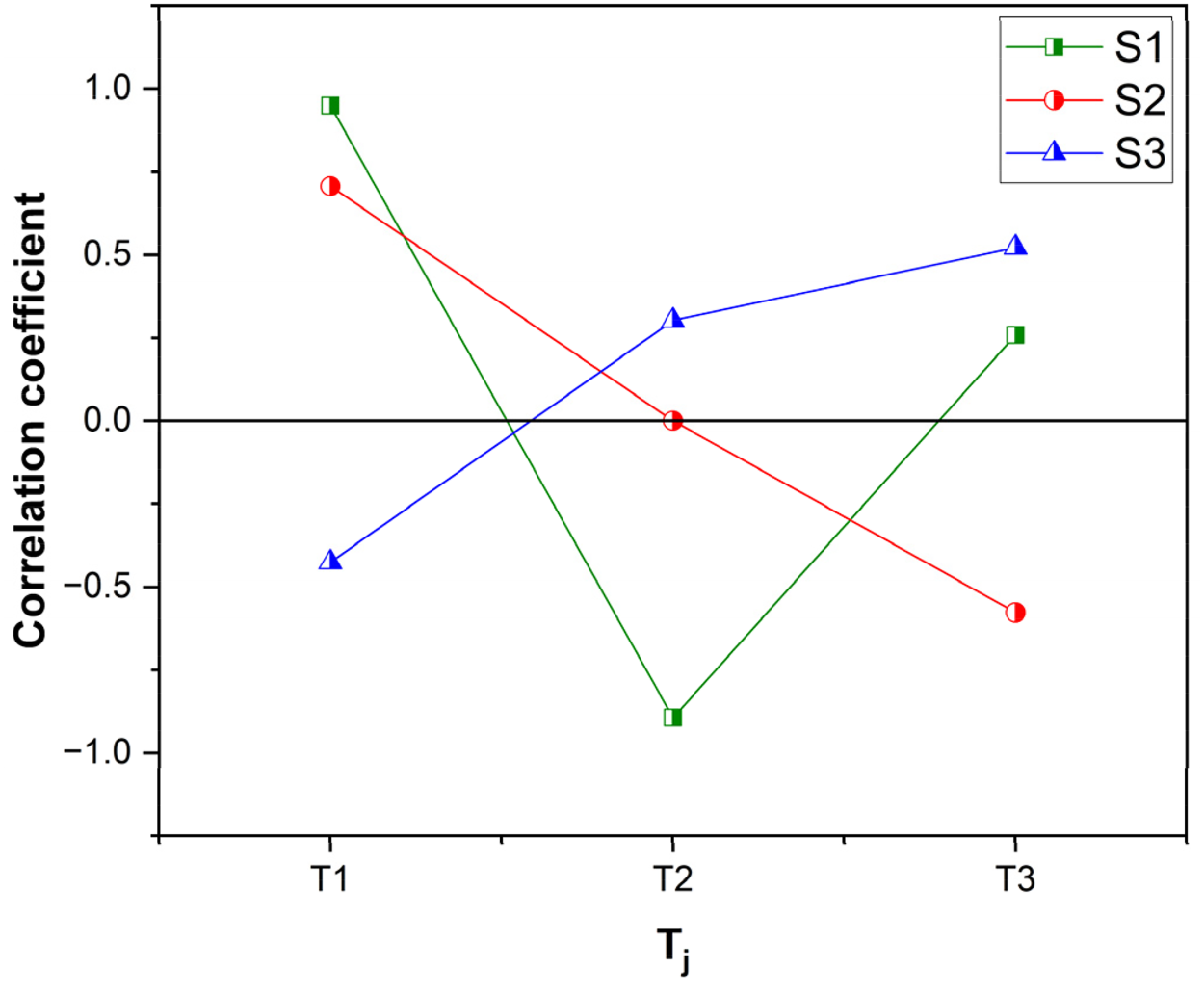
Step 4. Now, we create Table 7 by applying equation (4) from Definition 3.7, which illustrates the correlation coefficient between the hesitant fuzzy sets and of X and Y, respectively, where . See Figure 2, which graphically illustrates the correlation coefficients presented in Table 7.
Step 5. Decision analysis
Case 1 (): The correlation between the first group of lecturers (excellent lecturers) and the first group of students (excellent students) can be analyzed based on their respective criteria and values. For the group of lecturers , the criteria include : teaching capacity, : educational experience, : research ability and morality, with its values from Table 3 as , and from Table 5, the mean of equals 0.83 and the variance is 0.0022. For the group of students , the criteria include : low entry grades, : students’ e-learning activity, : GPA and previous assessment grade, with its values from Table 2 as and from Table 4, the mean of is 0.85 and the variance is 0.0014. From Table 6, the calculated correlation between these two groups, and , is 0.00167. Furthermore, according to Table 7, the correlation coefficient between these two groups, and , is 0.949, indicating a strong positive relationship.
Case 2 (): The correlation between the second group of lecturers (intermediate lecturers) and the first group of students (intermediate students) can be analyzed based on their respective criteria and values. For the group of lecturers , the criteria include : teaching capacity, : educational experience, : research ability and morality, with its values from Table 3 as , and from Table 5 the mean of equals 0.55 and the variance is 0.0003. For the group of students , the criteria include : low entry grades, : students’ e-learning activity, : GPA and previous assessment grade, with its values from Table 2 as and from Table 4 the mean of is 0.62 and the variance is 0.0003. From Table 6, the calculated correlation between these two groups, and , is 0. Furthermore, according to Table 7, the correlation coefficient between these two groups, and , is 0, indicating that there is no relationship at all.
Case 3 (): The correlation between the second group of lecturers (intermediate lecturers) and the first group of students (excellent students) can be analyzed based on their respective criteria and values. For the group of lecturers , the criteria include : teaching capacity, : educational experience, : research ability and morality, with its values from Table 3 as , From Table 5, the mean of equals 0.55 and the variance is 0.0003. For the group of students , the criteria include : low entry grades, : students’ e-learning activity, : GPA and previous assessment grade, with its values from Table 2 as and from Table 4, the mean of is and the variance is 0.0014. From Table 6, the calculated correlation between these two groups, and , is −0.00056. Furthermore, according to Table 7, the correlation coefficient between these two groups, and , is −0.894, indicating that the relationship has a strong negative relationship.
The Correlation Coefficient Between the Hesitant Fuzzy Sets of X and of Y.
The Correlation Between the Hesitant Fuzzy Sets of X and of Y.
0.00111
0.00056
0.00014
The Correlation Coefficient Between the Hesitant Fuzzy Sets of X and of Y.
0.426
0.894
0.577
Based on the results above in Table 7 (correlation coefficient table), we can infer different relationships between groups of lecturers and students. Excellent lecturers have a strong to moderately strong positive relationship with excellent and intermediate students, while there is a moderate negative relationship with weak students. The intermediate lecturers exhibit a strong negative relationship with excellent students, while their relationship with intermediate and weak students ranges from no relationship to a weak positive relationship. Weak lecturers have a weak positive relationship with excellent students, a moderate negative relationship with intermediate students, and a moderate positive relationship with weak students. After conducting an analysis, we determined that the first group of excellent lecturers and the first group of excellent students yielded the best results in terms of student performance. The second group of intermediate students, along with the same group of lecturers, followed suit.
Based on the results, university administrators can identify student and lecturer performance levels and take appropriate actions. For example, they may offer extra classes for weak students, provide incentives for moderately performing lecturers, and conduct training workshops to improve teaching methods and awareness of university rankings. High-performing students and lecturers could also be rewarded to encourage continued excellence.
Conclusions
This study investigates the role of hesitant fuzzy sets in enhancing fuzzy relational structures, particularly within the frameworks proposed by Dib and Youssef. It highlights key distinctions between hesitant fuzzy relations in Zadeh's classical approach and those adapted in recent methodologies, demonstrating that HFS-based constructs, such as hesitant fuzzy Cartesian products and Relation, offer a more expressive and nuanced representation of information than traditional fuzzy Cartesian products, fuzzy relations, and their counterparts (IFCP and IFR). These generalizations allow for improved modelling of complex, multi-valued relationships, particularly in decision-making contexts like student performance evaluation. Despite these contributions, the current models are limited in expressing information involving uncertainty with periodic semantics. To overcome this, the study proposes the development of complex hesitant fuzzy Cartesian products and relations, as well as a novel algebraic framework, hesitant fuzzy algebra based on hesitant fuzzy functions and binary operations. This framework establishes an algebraic structure on hesitant fuzzy spaces, analogous to those in complex fuzzy, intuitionistic fuzzy, bipolar-valued fuzzy, and classical algebra, thereby laying the groundwork for further theoretical expansion and practical applications (Al-Husban & Salleh, 2016; Al-Husbana et al., 2016; Al-Zu’bi et al., 2024b; Dib, 1994; Fathi, 2010; Fathi & Salleh, 2008c; Jaradat & Al-Husban, 2021; Al Husban et al., 2016; Al-Husban, 2022).
Footnotes
Acknowledgements
The authors extend their appreciation to the National University of Malaysia for supporting this work under the research grant: TAP-K014049.
ORCID iDs
Mohammad Talafha
Abd Ulazeez Alkouri
Funding
The authors received no financial support for the research, authorship, and/or publication of this article.
Declaration of Conflicting Interests
The authors declared no potential conflicts of interest with respect to the research, authorship, and/or publication of this article.
References
1.
AbuhijlehE. A.Massa’dehM.SheimatA.AlkouriA. (2021). Complex fuzzy groups based on Rosenfeld’s approach. WSEAS Trans Math, 20, 368–377. https://doi.org/10.37394/23206.2021.20.38
Al-HusbanA.SallehA. R. (2016). Complex fuzzy group based on Complex fuzzy space. Global Journal of Pure and Applied Mathematics, 12(2), 1433–1450. https://www.researchgate.net/profile/Abdallah-Husban/publication/303124625_Complex_ fuzzy_group_based_on_complex_fuzzy_space/links/58bb0cd245851591c5e0d929/Complex-fuzzy-group-based-on-complex-fuzzy-space.pdf (accessed October 3, 2024).
4.
Al-HusbanaR.SallehA. R.AhmadA. G. B. (2016). Complex intuitionistic fuzzy group. Global Journal of Pure and Applied Mathematics, 12(1), 4929–4949.
5.
Al-Zu’biF. M. A.AhmadA. G.AlkouriA. U.DarusM. (2024a). A new trend of bipolar-valued fuzzy Cartesian products, relations, and functions. WSEAS Trans Math, 23, 502–514. https://doi.org/10.37394/23206.2024.23.53
6.
Al-Zu’biF.AhmadA. G.AlkouriA. U.DarusM. (2024b). A novel bipolar valued fuzzy group based on Dib’s approach. European Journal of Pure and Applied Mathematics, 17(4), 2898–2914.
7.
Al HusainiY.ShukorN. S. (2022). Factors affecting students’ academic performance: A review. Res Militaris, 12(6), 284–294.
8.
Al HusbanR.SallehA. R.AhmadA. G. (2016). Complex intuitionistic fuzzy subrings, in: 2016: p. 020005. https://doi.org/10.1063/1.4952485
9.
AlsharoD.AbuteenE.AlkouriA. U. M. J. S.AlkhasawnehM.Al-ZubiF. M. A. (2024). Complex shadowed set theory and its application in decision-making problems. AIMS Mathematics, 9(6), 16810–16825. https://doi.org/10.3934/math.2024815
10.
AminiA.AbdollahiA.Hariri-ArdebiliM. A. (2024). An automated machine-learning-assisted stochastic-fuzzy multi-criteria decision making tool: Addressing record-to-record variability in seismic design. Appl Soft Comput, 154(March), 111354. https://doi.org/10.1016/j.asoc.2024.111354
AshrafS.JanaC.SohailM.ChoudharyR.AhmadS.DeveciM. (2025). Multi-criteria decision-making model based on picture hesitant fuzzy soft set approach: An application of sustainable solar energy management. Inf Sci (N Y), 686(January), 121334. https://doi.org/10.1016/j.ins.2024.121334
DivakaranD.JohnS. J. (2016). Hesitant fuzzy subgroups. Journal of New Theory, 2016(11), 54–68. http://www.newtheory.org
22.
FathiM. (2010). Intuitionistic fuzzy algebra and fuzzy hyperalgebra, Thesis (Ph.D.), Universiti Kebangsaan Malaysia, 2010.
23.
FathiM.SallehA. R. (2008a). On Intuitionistic Fuzzy Functions. In Proceedings International Symposium on New Development of Geometric Functions Theory and Its Applications (GFTA). Universiti Kebangsaan Malaysia.
24.
FathiM.SallehA. R. (2008b). on Intuitionistic Fuzzy spaces. In Proceedings 16th National Symposium of Mathematical Sciences (SKSM-16). University Malaysia Terengganu.
GargH.DuttaD.DuttaP.GohainB. (2024). An extended group decision-making algorithm with intuitionistic fuzzy set information distance measures and their applications. Comput Ind Eng, 197(November), 110537. https://doi.org/10.1016/j.cie.2024.110537
27.
GuanX.SunG.YiX.ZhouZ. (2018). Synthetic correlation coefficient between hesitant fuzzy sets with applications. International Journal of Fuzzy Systems, 20(6), 1968–1985. https://doi.org/10.1007/s40815-018-0496-1
GuptaS.JoshiD. K.AwasthiN.PantM.prasad JoshiB.ChaubeS. (2024). Distance and similarity measures of hesitant bi-fuzzy set and its applications in renewable energy systems. Math Comput Simul, 219(May), 321–336. https://doi.org/10.1016/j.matcom.2023.12.021
30.
GuptaR.KumarS. (2024). Novel similarity measure between hesitant fuzzy set and their applications in pattern recognition and clustering analysis. Journal of Engineering and Applied Science, 71(1). https://doi.org/10.1186/s44147-023-00329-y
31.
JaradatA.Al-HusbanA. (2021). The multi-fuzzy group spaces on multi-fuzzy space. Journal of Mathematical and Computational Science, 11(6), 7535–7552. https://doi.org/10.28919/jmcs/5998
32.
JawarnehI.AlkouriA. U.AlJaradenJ.Al-HasanatB.HazaimehM. (2024). On the fuzzy topological spaces based on A fuzzy space (X,I). Applied Mathematics & Information Sciences, 18(6), 1295–1301. https://doi.org/10.18576/amis/180611
33.
KarnavasS. I.PeteinatosI.KyriazisA.BarbounakiS. G. (2025). Using fuzzy multi-criteria decision-making as a human-centered AI approach to adopting new technologies in maritime education in Greece. Information, 16(4), 283. https://doi.org/10.3390/info16040283
34.
KhanM. J.DingW.JiangS.AkramM. (2025). Group decision making using circular intuitionistic fuzzy preference relations. Expert Syst Appl, 270(April ), 126502. https://doi.org/10.1016/j.eswa.2025.126502
35.
KimJ. H.LimP. K.LeeJ.HurK. (2019). Hesitant fuzzy subgroups and subrings. Annals of Fuzzy Mathematics and Informatics, 18(2), 105–122. https://doi.org/10.30948/afmi.2019.18.2.105
36.
LiaoH.XuZ.ZengX.-J. (2015). Novel correlation coefficients between hesitant fuzzy sets and their application in decision making. Knowl Based Syst, 82(July), 115–127. https://doi.org/10.1016/j.knosys.2015.02.020
37.
LiuX.WangZ.ZhangS.GargH. (2021). Novel correlation coefficient between hesitant fuzzy sets with application to medical diagnosis. Expert Syst Appl, 183(30 November), 115393. https://doi.org/10.1016/j.eswa.2021.115393
38.
LiuM.ZhangX.MoZ. (2023). A modified correlation coefficient of probabilistic hesitant fuzzy sets and its applications of decision making, medical diagnosis, cluster analysis. International Journal of Fuzzy Systems, 25(7), 2609–2627. https://doi.org/10.1007/s40815-023-01509-x
39.
MahmoodT.AliW.AliZ.ChinramR. (2021). Power aggregation operators and similarity measures based on improved intuitionistic hesitant fuzzy sets and their applications to multiple attribute decision making. Computer Modeling in Engineering & Sciences, 126(3), 1165–1187. https://doi.org/10.32604/cmes.2021.014393
40.
NarukawaY.TorraV. (2023). Scores for hesitant fuzzy sets: Aggregation functions and generalized integrals. IEEE Transactions on Fuzzy Systems, 31(7), 2425–2434. https://doi.org/10.1109/TFUZZ.2022.3226249
41.
PalM. (2024). Fuzzy matrices: Recent developments of fuzzy matrix theory and applications. In Recent developments of fuzzy matrix theory and applications (pp. 1–63). Springer Nature Switzerland. https://doi.org/10.1007/978-3-031-56936-4_1
TorraV.NarukawaY. (2009). On hesitant fuzzy sets and decision. In 2009 IEEE international conference on fuzzy systems (pp. 1378–1382). IEEE. https://doi.org/10.1109/FUZZY.2009.5276884
46.
WeiG. (2012). Hesitant fuzzy prioritized operators and their application to multiple attribute decision making. Knowl Based Syst, 31(July), 176–182. https://doi.org/10.1016/j.knosys.2012.03.011
47.
XiaM.XuZ. (2011). Hesitant fuzzy information aggregation in decision making. International Journal of Approximate Reasoning, 52(3), 395–407. https://doi.org/10.1016/j.ijar.2010.09.002
48.
XinG.YingL. (2024). Multi-attribute decision-making based on comprehensive hesitant fuzzy entropy. Expert Syst Appl, 237(July), 121459. https://doi.org/10.1016/j.knosys.2012.03.011
ZhangT.GaoJ.LiuH.TanQ.WangY.HuangN. (2025). An applied study of multi-stage multi-attribute group decision-making based on intuitionistic fuzzy sets—selection of hydrogen energy projects in the context of “dual-carbon”. Journal of the Operational Research Society, 1–19. https://doi.org/10.1080/01605682.2025.2450289