




Abstract
This study proposes a novel methodology for solving constrained bi-matrix games with payoffs represented by fuzzy rough numbers, addressing uncertainties common in real-world decision-making. By integrating fuzzy rough set theory with α-cut techniques, the method establishes the existence of an fuzzy rough equilibrium value. Five linear programming models are developed to compute the mean equilibrium and its lower-lower, lower-upper, upper-lower, and upper-upper bounds, based on 0-cut and 1-cut representations. For any confidence level α, corresponding equilibrium bounds are determined through α-cut-based optimization. The methodology is validated through a case study on corporate environmental behavior, demonstrating its effectiveness and practical relevance.
Introduction
Background
Game theory primarily focuses on the strategic and competitive interactions between decision-makers. Understanding how to make effective decisions in a competitive environment is both a significant and common challenge. Over the years, game theory play a vital role in many fields, such as military strategy, finance, economics, strategic negotiations, cartel behavior, management issues, auctions, social challenges, political voting systems, research and development, and competitive races (Hung et al., 1996; Von Neumann & Morgenstern, 1944).
Constrained bi-matrix games are an advanced extension of classical bi-matrix games that incorporate additional restrictions or limitations on players’ strategies, reflecting more realistic and practical decision-making scenarios. Unlike standard bi-matrix games, where each player aims to optimize their payoff based solely on a fixed strategy set, constrained versions introduce conditions such as budget limits, policy rules, or capacity restrictions that must be satisfied during the strategic interaction. These constraints significantly increase the complexity of the solution process, as they often transform the game into a constrained optimization problem. Constrained bi-matrix games are particularly useful in modeling real-world competitive situations in economics, environmental policy, defense, and resource management, where players not only strive for optimal outcomes but must also operate within regulatory or structural boundaries. The integration of constraints into bi-matrix games has motivated the development of specialized solution techniques, including linear and nonlinear programming, fuzzy set theory, and other soft computing approaches to handle imprecise information and uncertainty inherent in many practical applications. Several papers on constrained matrix and bi-matrix games have evolved significantly to incorporate diverse fuzzy and uncertain environments. Early foundational work by Dengfeng and Chuntian (2002) introduced fuzzy multi-objective programming methods for fuzzy-constrained matrix games, later extended to handle triangular (Li & Hong, 2012) and trapezoidal (Li & Hong, 2013) fuzzy payoffs using α-cut based linear programming. Nan and Li (2014) further enhanced this with techniques for interval-valued constraint games. Ammar and Brikaa (2019) introduced a rough interval approach, adding granularity to constraint modeling. The extension to bi-matrix settings emerged with An and Li (2019), who proposed a linear programming method for games with intuitionistic fuzzy payoffs. Brikaa et al. (2019a) addressed constrained matrix games involving fuzzy rough numbers payoffs via a multi-objective framework. Verma (2021) presented a novel solution method for fuzzy-constrained matrix games, while Gaber et al. (2021) addressed constrained bi-matrix games under single-valued trapezoidal neutrosophic environments. More recently, Djebara et al. (2023) explored a new approach for solving constrained matrix games with fuzzy constraints and fuzzy payoffs.
In real-world decision-making scenarios, imprecision and uncertainty are inherent in many parameters. Often, these situations involve a hybrid uncertain environment where roughness and fuzziness coexist. Fuzzy rough numbers have proven effective for modeling such decision-making problems, as roughness and fuzziness are key contributors to uncertainty. Dubois and Prade (1990) explored the fuzzification of rough sets, while Morsi and Yakout (1998) introduced the lower and upper approximations of fuzzy rough sets. Decision-making approaches, such as rough programming and fuzzy programming, have been developed to address uncertainty by treating fuzziness and roughness as distinct factors. Numerous studies have focused on integrating roughness and fuzziness into a unified framework for analyzing fuzzy rough sets. Presently, fuzzy rough set theory has been applied to a wide range of practical problems.
In the context of matrix game theory, numerous fuzzy models have been developed to address the complexity and uncertainty inherent in real-world payoffs. However, these traditional fuzzy approaches primarily capture vagueness arising from imprecise linguistic or numerical data, and often lack the capacity to deal with ambiguity due to indiscernibility or incomplete information. To overcome this limitation, this study adopts the fuzzy rough model, which effectively integrates the descriptive strength of fuzzy set theory with the boundary approximation ability of rough set theory. This hybrid model allows for more nuanced modeling of payoffs by accommodating both the degree of uncertainty in player preferences and the vagueness in constraint boundaries. Such a dual-level treatment of uncertainty is especially critical in constrained bi-matrix games, where strategic decisions are influenced by both subjective judgments and limited information. Thus, the fuzzy rough framework provides a more comprehensive and realistic representation of strategic interactions, justifying its selection for this study.
Literature Review
In recent years, extensive research has been conducted to enhance decision-making models under uncertainty through various fuzzy and rough set extensions applied to matrix and bi-matrix games. Brikaa et al. (2020) addressed multi-criteria zero-sum matrix games by employing intuitionistic fuzzy goals and a novel indeterminacy resolution technique, contributing to more robust decision frameworks under uncertainty. Singh et al. (2020) proposed the use of 2-tuple linguistic information in matrix games, enabling more refined and human-consistent expressions of vague preferences. Khan and Mehra (2020) introduced a unique equilibrium solution concept for intuitionistic fuzzy bi-matrix games by integrating possibility and necessity expectations, thus enhancing realism in uncertain environments. Seikh et al. (2020) focused on matrix games with hesitant fuzzy payoffs, providing algorithms that accommodate hesitation and ambiguity in strategic evaluations. Meanwhile, Bhaumik et al. (2021a) advanced bi-matrix game analysis in neutrosophic environments using an (α,β,γ)-cut set-based ranking method, enabling multi-criteria and indeterminate factor incorporation. Roy and Maiti (2020) developed reduction methods for type-2 fuzzy variables and applied them to Stackelberg games, improving computational efficiency and solution accuracy under higher-order fuzziness. Additionally, Bhaumik et al. (2020) examined the Prisoner's Dilemma using a hesitant interval-valued intuitionistic fuzzy-linguistic term set combined with TOPSIS, showcasing the applicability of complex fuzzy tools in real-world socio-economic problems such as human trafficking.
Bhaumik et al. (2021b) introduced a multi-objective linguistic-neutrosophic matrix game framework, applying it to tourism management to better handle imprecise and conflicting criteria. Extending this line of work, Bhaumik and Roy (2021) proposed a novel aggregation operator for intuitionistic interval-valued hesitant fuzzy matrix games, specifically designed to support complex management decision-making scenarios. Seikh et al. (2021c) explored matrix games with dense fuzzy payoffs, contributing to a richer modeling of vagueness in payoff structures. Further, Seikh et al. (2021a) tackled the telecom market share problem using rough interval payoffs, combining fuzzy and rough set theory for enhanced realism. In the realm of neutrosophic modeling, Seikh and Dutta (2021a) presented a nonlinear programming model using single-valued neutrosophic numbers to solve matrix games, reflecting on strategic interactions under ambiguous environments. Similarly, they (Seikh & Dutta, 2021b) developed an intuitionistic fuzzy optimization-based method to address interval-valued matrix games. Seikh et al. (2021b) introduced a new defuzzification technique for type-2 fuzzy variables, applying it effectively to the plastic ban problem. Seikh and Karmakar (2021) also proposed a credibility equilibrium strategy for matrix games involving triangular dense fuzzy lock sets, offering deeper insights into equilibrium analysis. Verma and Aggarwal (2021a) and Verma and Aggarwal (2021b) addressed matrix games with linguistic intuitionistic fuzzy and 2-tuple intuitionistic fuzzy linguistic payoffs, respectively, enhancing the linguistic expressiveness in game settings. Additionally, Xue et al. (2021) applied hesitant fuzzy information and the Ambika method to matrix games, demonstrating its utility in counter-terrorism decision-making. Karmakar et al. (2021) introduced a type-2 intuitionistic fuzzy model with a novel distance measure for application in biogas plant implementation. Chauhan and Gupta (2021) explored matrix games with proportional linguistic payoffs, while Jangid and Kumar (2021) dealt with triangular neutrosophic number-based payoffs. Naqvi et al. (2021) applied the Tanaka and Asai approach to I-fuzzy zero-sum games, and Kon (2021) provided a theoretical characterization for equilibrium strategies with LR fuzzy payoffs. Kumar (2021) used piecewise linear programming to address multi-objective games with I-fuzzy goals. Namarta and Gupta (2021) and Mi et al. (2021) explored expert-based evaluation and probabilistic linguistic information in matrix games, expanding the decision-making capabilities under subjective and probabilistic uncertainty.
Seikh and Dutta (2022) addressed uncertainty using single-valued trapezoidal neutrosophic numbers to model matrix games more effectively. Li and Tu (2022a) examined bi-matrix games with intuitionistic fuzzy payoffs, particularly in the context of corporate environmental behavior, demonstrating the relevance of fuzzy game theory in sustainable decision-making. The rough fuzzy environment explored by Jangid and Kumar (2022b) introduced new computational techniques to handle dual-layer uncertainty in two-person zero-sum games, while Brikaa et al. (2022b) proposed the Mehar approach for matrix games with triangular dual hesitant fuzzy payoffs, enhancing modeling flexibility. Additionally, the Ambika method developed by Brikaa et al. (2022a) provided a robust defuzzification mechanism for neutrosophic settings. Qiu and Xiang (2022) introduced 2-tuple linguistic bi-matrix games, extending applicability to qualitative decision contexts. In parallel, Zheng and Brikaa (2022) presented a multi-objective aspiration-level-based model for bi-matrix games with intuitionistic fuzzy goals, offering strategic depth for goal-driven decision-makers. Furthermore, Jangid and Kumar (2022a) introduced hexadecagonal fuzzy numbers and novel ranking methods, pushing the boundaries of fuzzy set applications in game theory. Li and Tu (2022b) complemented this body of work by combining fuzzy envelope models with prospect theory in probabilistic linguistic game environments.
Jana and Roy (2023) introduced linguistic Pythagorean hesitant fuzzy frameworks to tackle multi-criteria decision-making scenarios, offering enhanced expressiveness for vague human judgments. Karmakar and Seikh (2023) explored dense fuzzy environments in bimatrix games, applying their findings to disaster management problems, thus bridging the gap between abstract models and real-world crisis applications. Naqvi et al. (2023b) proposed a novel approach using linguistic interval-valued intuitionistic fuzzy sets to enrich traditional matrix games, while Seikh and Dutta (2023a) and (2023b) formulated single-valued neutrosophic and interval neutrosophic models to address real-life issues such as cybersecurity and market share dynamics. Verma et al. (2023) incorporated self-confidence levels into Pythagorean fuzzy matrix games, capturing player subjectivity in uncertain environments. In the marketing domain, Bisht and Dangwal (2023) developed a fuzzy ranking technique for bi-matrix games with interval payoffs, while Singla et al. (2023) modeled multi-opinion-based intuitionistic fuzzy bi-matrix games to reflect consensus-driven decision-making. Further broadening the application spectrum, Naqvi et al. (2023a) employed interval-valued hesitant fuzzy linguistic sets in modeling electric vehicle adoption strategies. Achemine and Larbani (2023) offered a Nash equilibrium framework under fuzzy randomness, emphasizing stochastic behaviors in bi-matrix contexts. Li et al. (2023) investigated fuzzy weighted Pareto–Nash equilibria in multi-objective bi-matrix games, expanding the theoretical toolkit for trade-off analysis under vagueness. Bigdeli and Mousazadeh (2023) adopted the Analytic Hierarchy Process within neutrosophic environments to address military decision-making problems, highlighting hybrid modeling approaches. Similarly, Chauhan and Gupta (2023) addressed 2-tuple linguistic bimatrix games, while Jangid et al. (2023) developed a fuzzy rough game solution for two-player settings, combining rough sets with fuzzy logic to better capture granulated uncertainty. Naqvi and Sachdev (2023) extended the discussion to linguistic Pythagorean fuzzy sets in uncertain games, offering a more expressive fuzzy logic structure. Khan and Kumar (2023) introduced regret theory into hesitant fuzzy linguistic matrix games, providing psychological realism in player behavior modeling.
Further advancements have been made by Dong and Wan (2024) proposed a Type-2 interval-valued intuitionistic fuzzy matrix game approach, effectively applied to strategic decisions in the energy vehicle industry, showcasing its robustness in handling multilayered uncertainties. Seikh and Dutta (2024) extended this direction by formulating a nonlinear solution method for matrix games with picture fuzzy payoffs, with practical application to mitigating cyberterrorism attacks, thus bridging game theory with cybersecurity challenges. Karmakar and Seikh (2024) introduced a nonlinear programming model for interval-valued intuitionistic hesitant fuzzy matrix games, contributing a symmetry-based perspective to noncooperative decision-making frameworks. Ahuja and Kumar (2024) offered the Mehar approach to solve hesitant fuzzy linear programming problems, enhancing the precision of solutions under hesitation and vagueness. Kirti et al. (2024) explored modified strategies for solving matrix games with single-valued trapezoidal neutrosophic payoffs, delivering a comprehensive technique suitable for more nuanced and imprecise payoff environments. In the realm of stochastic analysis, İzgi et al. (2024) proposed a hybrid Shapley and iterative method based on matrix norms, enabling effective handling of stochastic matrix games where uncertainty arises from probabilistic behavior. Djebara et al. (2024) dealt with fuzzy random constraints in matrix games, providing a practical optimization approach that combines fuzziness and randomness to model real-world constraints. Bisht et al. (2024) introduced a method for solving interval-valued matrix games, supported by a MATLAB implementation, offering accessibility to both theorists and practitioners. Wan and Qiu (2024) presented a timely application by integrating sentiment analysis with trapezoidal Type-2 fuzzy linguistic intuitionistic matrix games, demonstrating its relevance in pandemic response management where emotions and uncertainties coexist. Kumar and Garg (2025) proposed a novel two-level fuzzy set theoretic framework to solve multi-objective matrix games, enhancing decision-making under layered uncertainty and offering broad applicability across domains. Similarly, Devi and Sowmiya (2025) introduced the use of octagonal neutrosophic fuzzy numbers to address game problems, enriching the modeling of indeterminacy in strategic interactions. Still, despite these advancements, most works remain centered on single matrix or zero-sum frameworks, lacking the comprehensive treatment of constrained bi-matrix games under hybrid uncertainties like fuzzy rough sets, which limits their applicability in highly complex, real-world multi-agent systems underscoring the novelty and necessity of the constrained fuzzy rough bi-matrix model proposed in this study.
Motivation
The increasing complexity of real-world decision-making scenarios, particularly in fields like environmental regulation, cybersecurity, and resource allocation, necessitates game-theoretic models that can effectively handle multiple layers of uncertainty and interdependent strategies. Traditional matrix games and their constrained extensions have evolved significantly, incorporating fuzzy numbers, intuitionistic fuzzy sets, neutrosophic logic, and rough set theory to model imprecision and vagueness in payoffs or constraints. However, most of these models are restricted to single-player constrained games or zero-sum frameworks, lacking the flexibility to represent non-cooperative interactions between two strategic players with mutual but distinct objectives as is the case in bi-matrix games
The Contribution and Structure of this Article
This article introduces a novel type of constraint bi-matrix games grounded in the concept of α-cut sets. Specifically, it focuses on fuzzy rough constraint bi-matrix games where the payoffs for each player are represented by fuzzy rough numbers. These games are referred to as constraint bi-matrix games with fuzzy rough numbers payoffs. To the best of our knowledge, no prior research has investigated a methodology for solving constraint bi-matrix games within a fuzzy rough environment. The primary contributions and innovations of this study are summarized as follows:
This paper introduces a novel class of constraint bi-matrix games models formulated under a fuzzy rough environment, expanding the scope of game theory in uncertain settings. The α-cut approach is systematically developed to address the constraint bi-matrix games problem under fuzzy rough conditions. The equilibrium values for each player are derived in fuzzy rough form, which enhances decision-making under uncertainty. To achieve optimal results, the problem is transformed into five distinct crisp constraint bi-matrix games models derived using data from the 1-cut and 0-cut sets of fuzzy rough payoffs, facilitating computational efficiency. The effectiveness of the proposed framework is demonstrated through its application to a corporate environmental behavior problem. Furthermore, the proposed method is adaptable for solving non-cooperative matrix games involving specialized forms of fuzzy rough numbers, including Gaussian fuzzy rough numbers, neutrosophic fuzzy rough numbers, intuitionistic fuzzy rough numbers, and hesitant fuzzy rough numbers. This broad applicability makes it a valuable tool for addressing a wide range of real-world strategic decision-making problems.
The structure of this paper is as follows: Section 2 provides a brief overview of fundamental concepts, including triangular fuzzy numbers, rough intervals, and fuzzy rough numbers. Section 3 defines classical constraint bi-matrix games. Section 4 formulates constraint bi-matrix games with fuzzy rough payoffs and develops α-cut solution. Section 5 presents a numerical example for corporate environmental behavior, and discusses the results to validate the proposed methodologies. Finally, Section 6 concludes the paper with a concise summary.
Preliminaries
In this section, certain fundamental definitions of triangular fuzzy numbers (Zadeh, 1965), rough interval numbers (Pawlak, 1982) and fuzzy rough numbers (Ammar & Muamer, 2016) are presented.
Triangular Fuzzy Number
A fuzzy number

The
Suppose
If
If
If
Let
Let Y denote a compact set of real numbers. A fuzzy rough variable
A fuzzy rough number

The

Suppose
Suppose
In this section, we shall describe the classical constrained bi-matrix game problem discussed by An and Li (2019). The pure strategies sets for both players I and II are represented by
Without loss of generality, suppose that the both players I and II, respectively, select mixed strategies


If


If

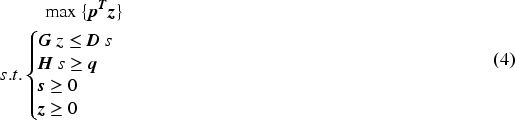
In this section, three subsections are allowed. First one describes the mathematical model of fuzzy rough constrained bi-matrix game, whereas the second provide the proposed approach for solving constrained bi-matrix game with fuzzy rough payoffs and the third introduce the solution procedure to solve such type of matrix games using ranking function method.
Constrained bi-Matrix Games with Fuzzy Rough Payoffs
Let's suppose that the constrained bi-matrix game with fuzzy rough payoffs, where the pure strategies sets
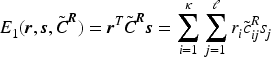
The fuzzy rough expected payoffs of both players I and II can be obtained as follows:

Computing the equilibrium strategies
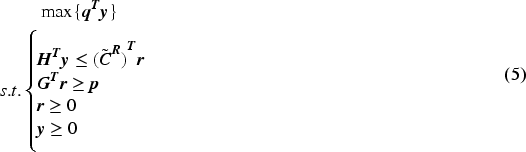
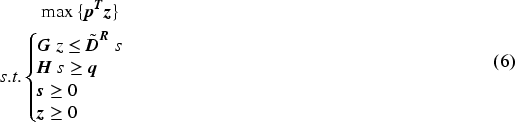
In this section, we will discuss the linear programming algorithm and models for solving constrained bi-matrix games with fuzzy rough payoffs based on the
It is clear from equations (1) and (2) that the player I's equilibrium value V is a function of
The equilibrium values
For any values






As stated earlier, the equilibrium values of the two players in the rough interval constraint bi-matrix game

Using the Lingo software to solve equation (15), we get the optimal solution
Analogously, the upper lower bound
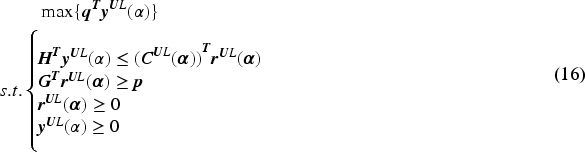
Using the lingo software to solve equation (16), we get the optimal solution
Similarly, the lower upper bound
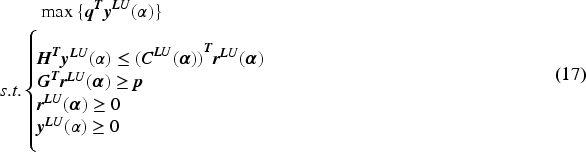
Using the lingo software to solve equation (17), we get the optimal solution
Also, the upper upper bound
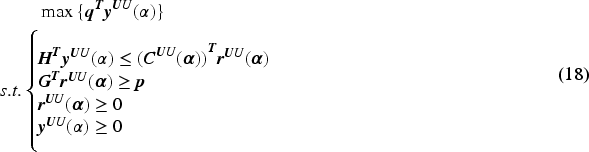
Using the lingo software to solve equation (18), we get the optimal solution
In a similar way, the lower lower bound

Using the lingo software to solve equation (19), we get the optimal solution
Likewise, the upper lower bound
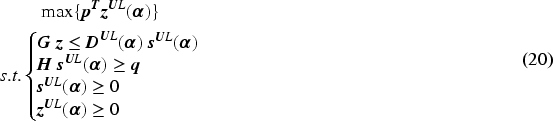
Using the lingo software to solve equation (20), we get the optimal solution
Similarly, the lower upper bound

Using the lingo software to solve equation (21), we get the optimal solution
Also, the upper upper bound

Using the lingo software to solve equation (22), we get the optimal solution
For any
In particular, for

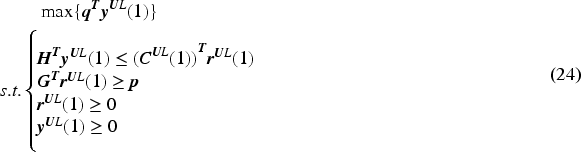
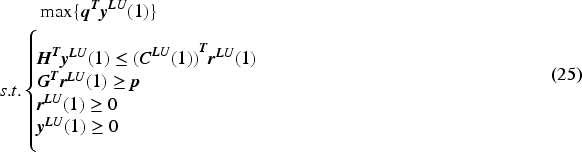
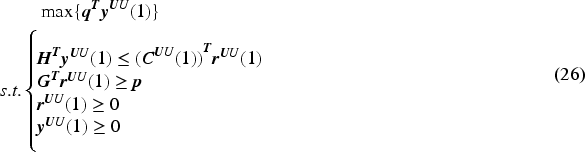
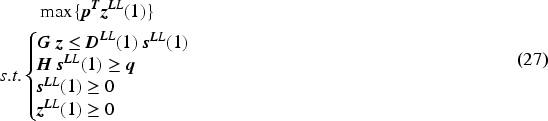

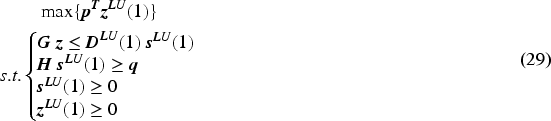

Using the Simplex technique, we can obtain the mean of player I's fuzzy rough equilibrium value
For
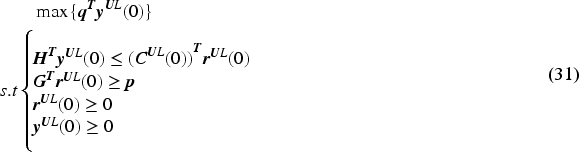
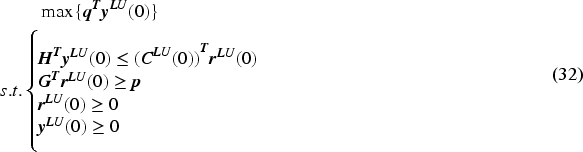
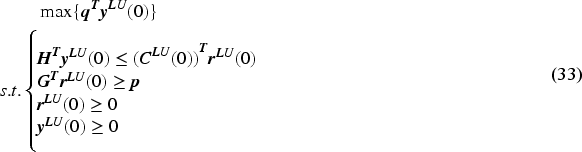



Using the Simplex technique, we can obtain the lower and the upper limits of player I's fuzzy rough equilibrium value
The fuzzy rough interval constraint bi-matrix game
The proof follows a similar structure to that of Theorem 5 in Li and Hong (2012) and is therefore omitted for brevity.
Based on the preceding discussion, the procedure for solving a constrained bi-matrix game with fuzzy rough payoffs can be systematically outlined as follows:
In practical scenarios, decision makers (DMs), such as governmental bodies and corporations, often rely on multiple, and occasionally conflicting, sources of information. Much of this information is derived from secondary data, which may lack precision and introduce ambiguity into the decision-making process. Moreover, the data involved in strategic environmental assessments is frequently characterized by vagueness and uncertainty. In such contexts, fuzzy rough sets offer a robust and appropriate tool for modeling imprecise, incomplete, and vague information. Applying fuzzy rough set theory within a constrained bi-matrix game framework allows for more realistic modeling of the strategic interactions between the government and corporations. This approach is particularly useful in analyzing complex decisions related to environmental regulation and compliance, where both players operate under uncertainty and limited information. The proposed model demonstrates how fuzzy rough environments can be effectively utilized to support decision-making in corporate environmental behavior.
Description of Strategy Choice Problem in Corporate Environmental Behavior
With the accelerating pace of industrial development, environmental challenges have intensified significantly. In pursuit of economic gains, some corporations compromise environmental protection efforts, leading to deteriorating ecological conditions. Within this context, environmental regulation emerges as a critical area where strategic interaction takes place between governmental authorities and corporations.
These two agents act as decision-makers in a non-cooperative game. The government seeks to maximize overall social and ecological welfare, while the corporation aims to maximize its own economic interests. Their conflicting objectives, constrained by regulatory and financial limitations, create a suitable environment for modeling via fuzzy rough constrained bi-matrix games, where uncertainty and vagueness in payoffs are naturally handled through fuzzy rough theory.
Environmental governance is influenced by various strategic choices:
Government strategies:
Corporate strategies:
When the government enforces stringent policies, ecological welfare improves, although this often comes with economic trade-offs. Conversely, relaxed regulation may lead to a decrease in environmental performance, government penalties, and reduced public trust. Similarly, if a corporation avoids implementing sustainable practices, it risks reputational damage, regulatory penalties, and reduced competitiveness in green markets, hindering high-quality economic development. To account for the uncertainty and boundary vagueness in evaluating social and economic outcomes, we formulate the problem as a constrained bi-matrix game with fuzzy rough payoffs. This approach enables a more nuanced representation of players’ strategies under incomplete information and external limitations.
Let Player Government's constrained strategy set:
Corporation's constrained strategy set:


These constraints may reflect resource availability, legal boundaries, or policy limitations.
Let the payoff matrices under fuzzy rough conditions be:
Government's fuzzy rough payoff matrix Corporation's fuzzy rough payoff matrix


The constraints on the strategy vectors can be compactly formulated using matrix-vector notation:
Government:
Corporation:


The Solution Procedure by the Proposed Approach
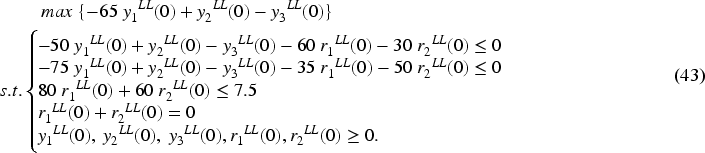
According to equation (23), the linear programming problem is formulated as follows:
Using the Simplex technique, we can compute the optimal solution
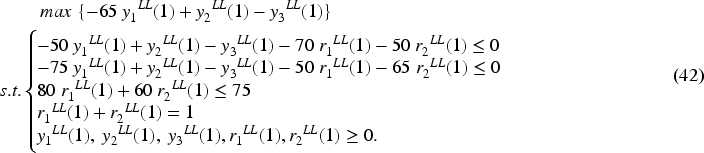
According to equation (31), the linear programming problem is formulated as follows:
Using the Simplex technique, we can compute the optimal solution
According to equation (32), the linear programming problem is formulated as follows:
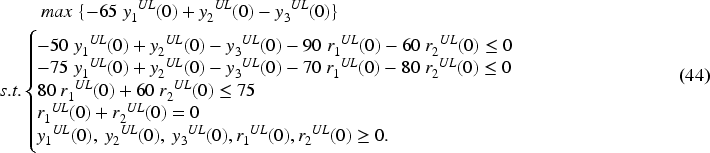
Using the Simplex technique, we can compute the optimal solution
According to equation (33), the linear programming problem is formulated as follows:

Using the Simplex technique, we can compute the optimal solution
According to equation (34), the linear programming problem is formulated as follows:
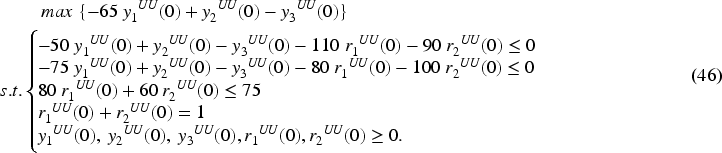
Using the Simplex technique, we can compute the optimal solution
According to equation (27), the linear programming problem is formulated as follows:
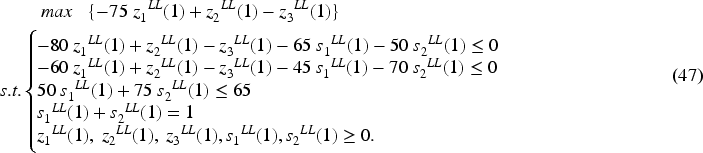
Using the Simplex technique, we can compute the optimal solution
According to equation (35), the linear programming problem is formulated as follows:
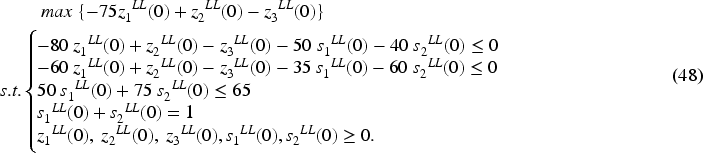
Using the Simplex technique, we can compute the optimal solution
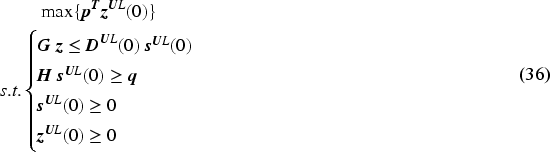
According to equation (36), the linear programming problem is formulated as follows:

Using the Simplex technique, we can compute the optimal solution
According to equation (37), the linear programming problem is formulated as follows:

Using the Simplex technique, we can compute the optimal solution
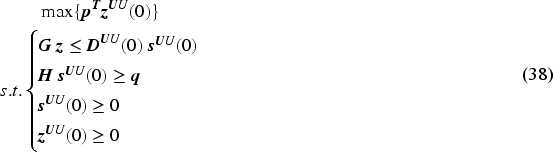
According to equation (38), the linear programming problem is formulated as follows:

Using the Simplex technique, we can compute the optimal solution
The numerical example presented in this study effectively demonstrates the practical application of constrained bi-matrix games with fuzzy rough payoffs in modeling strategic decision-making in corporate environmental behavior. The dual-player model, consisting of a governmental regulator and a profit-oriented corporation, captures a typical conflict of interest: social welfare maximization versus profit maximization. By formulating and solving a series of linear programming problems (equations 42–51), the study systematically derives the equilibrium values and optimal strategies for both players using five α-cut–based fuzzy rough constructs: lower-lower, lower-upper, upper-lower, upper-upper, and the mean. These outcomes offer a complete fuzzy rough characterization of the equilibrium space, allowing decision-makers to assess risk and robustness in strategy selection.
The numerical results obtained from solving the fuzzy rough constrained bi-matrix game demonstrate the efficacy of incorporating both fuzziness and roughness to handle uncertainty in real-world decision-making, particularly in the context of corporate environmental behavior. The fuzzy rough equilibrium value for Player I (the government) is
The modal values 58.57 for Player I and 57.5 for Player II represent the most credible expected payoffs in this uncertain environment, while the lower-lower (28 and 30) and upper-upper bounds (95 and 87) delineate the most pessimistic and optimistic outcomes, respectively. These wide bounds highlight the variability and ambiguity in strategic decision-making under complex regulatory, environmental, and economic factors. For instance, the government's equilibrium value suggests that strict or positive supervision can lead to high social welfare under favorable conditions (up to 95), but in unfavorable situations (such as lack of compliance or poor enforcement), it may yield only 28 units of utility. Similarly, the corporation can achieve up to 87 units in best-case scenarios when aligning with environmental norms, but this value could drop to 30 if regulations tighten or market pressure intensifies.
The associated
In summary, the fuzzy rough equilibrium values provide a nuanced and informative depiction of each player's potential outcomes, ensuring that decision-makers can better assess risks and opportunities within a dual-layer uncertainty framework. This approach significantly enhances traditional game models by offering greater realism and flexibility in complex environmental policy planning and corporate strategic management. The obtained results and the derived strategies show consistency with rational decision-making behavior while providing more flexible and realistic outcomes than models limited to either fuzzy or rough paradigms alone. The alignment with environmental strategy games makes this methodology well-suited for multi-criteria decision analysis and regulatory policy planning.
The proposed fuzzy rough constrained bi-matrix game model distinguishes itself through its capability to handle complex environmental decision-making scenarios under dual-layer uncertainty, offering a more practical extension of fuzzy rough matrix games compared to existing approaches. Compared to the model in An and Li (2019), which uses intuitionistic fuzzy values and yields a single crisp solution (e.g., optimal strategies (0.75, 0.25) for Player I and (0.45, 0.6055 for Player I with expected game value around 4.033 for Player I and 4.193 for Player II), the current study incorporates fuzzy rough intervals, allowing for a richer representation of uncertainty and generating a range of outcomes (e.g., fuzzy rough equilibrium value for Player I is The key differences and novel aspects of our study and the earlier studies by An and Li (2019) and Li and Hong (2012) are summarized below: Use of Fuzzy Rough Numbers:
While An and Li (2019) applied intuitionistic fuzzy numbers and Li and Hong (2012) utilized triangular fuzzy numbers for representing uncertainty in constrained matrix bi-matrix and constrained matrix games, our study introduces fuzzy rough numbers as a new way of modeling ambiguity and vagueness in the payoffs. Fuzzy rough sets integrate the concepts of both fuzziness and roughness, enabling a more flexible and granular representation of uncertain information, especially when exact membership values are difficult to determine due to incomplete or overlapping data.
Game Structure – Bi-matrix with Constraints:
Similar to An and Li (2019), our model addresses constrained bi-matrix games, but extends the framework by adopting a new class of payoff structure (i.e., fuzzy rough numbers), which has not been considered in either of the referenced studies. This incorporation allows for richer modeling in environments where both vagueness (fuzziness) and boundary uncertainty (roughness) coexist.
Modeling and Computational Approach:
We develop a hybrid modeling framework that constructs fuzzy models based on fuzzy rough sets and subsequently transforms them into crisp linear programming problems using α-cut and rough boundary approximations. While both An and Li (2019) and Li and Hong (2012) relied on α-cut or linear programming techniques tailored to specific fuzzy environments, our approach is novel in the way it adapts these methods to handle the dual uncertainty layers inherent in fuzzy rough structures.
Generalization and Application:
Our method generalizes previous models by enabling the solution of a broader class of constrained bi-matrix games under more complex uncertainty settings. In addition, we validate the proposed approach through a real-world case study on corporate environmental behavior, which demonstrates the flexibility and effectiveness of fuzzy rough sets in capturing nuanced decision-making scenarios. This type of application was not considered in the aforementioned studies.
Advantages, disadvantages, and limitations
Advantages
Handles Dual Uncertainty: Combines the strengths of fuzzy sets (handling vagueness) and rough sets (handling ambiguity due to lack of knowledge), allowing for a more robust modeling of real-world imprecise payoffs. Incorporates Constraints: Allows the incorporation of realistic constraints (e.g., budget, capacity, or policy limits) into the players’ strategy sets, increasing applicability to real decision-making scenarios. Captures Subjective Judgments: Useful in situations where expert opinion or linguistic assessments dominate (e.g., sustainability evaluations, policy-making, environmental strategies). Flexible Strategy Representation: α-cut and fuzzy rough interval representations offer flexibility to decision-makers with different confidence or risk levels. Equilibrium Analysis Under Uncertainty: Provides structured equilibrium strategies even when data is incomplete or uncertain, which is crucial for sectors like environmental regulation, economics, or negotiation models.
Disadvantages
Computational Complexity: Solving multiple linear programming models (especially across α-cuts) for each strategy and payoff interval can be time-consuming and computationally expensive. Requires Advanced Mathematical Knowledge: Understanding and implementing fuzzy rough sets, constraint models, and equilibrium concepts may be too complex for non-technical users. Dependence on α-Level Choice: The outcomes can vary depending on the choice of α-level, which may introduce subjective bias or inconsistency if not justified.
Limitations
Data Quality Sensitivity: The accuracy of fuzzy rough payoffs relies heavily on the quality and structure of the input data. Poor or biased data leads to unreliable outputs. Limited Real-Time Application: Due to computational requirements and the need for detailed modeling, it might not be feasible for time-sensitive or real-time decision-making processes. Interpretability Challenges: Fuzzy rough outputs (e.g., lower-upper bounds) may be harder to interpret for decision-makers unfamiliar with fuzzy logic or set theory, reducing the model's accessibility. Not Always Uniquely Solvable: Depending on the structure of the constraints and the payoffs, the game may have multiple or non-dominant equilibria, complicating solution selection.
In addressing real-world constraint bi-matrix games problems, uncertainty and hesitation frequently arise due to various uncontrollable factors. To mitigate these challenges, the fuzzy rough approach is employed as a viable solution methodology. In this paper, we present linear programming models and methodologies for solving fuzzy rough constraint bi-matrix games, grounded in the fuzzy rough sets theorem and α-cut sets. The main scientific contributions of this study can be outlined as follows:
A novel formulation of constrained bi-matrix games is introduced, wherein the payoff values are characterized using fuzzy rough numbers to capture deeper uncertainty and vagueness. Fuzzy modeling frameworks are constructed based on the proposed fuzzy rough representation to facilitate the mathematical handling of imprecision. An efficient computational algorithm grounded in the α-cut methodology (Li & Hong, 2012) is proposed to derive optimal strategic solutions for the formulated game models. This work extends the existing constrained bi-matrix game frameworks with fuzzy payoffs, as previously examined by Bigdeli et al. (2018) and An and Li (2019), by incorporating fuzzy rough structures. The fuzzy rough models are further transformed into equivalent crisp linear programming models to enable tractable computation. These crisp reformulations are solved using LINGO 14.0 (Lindo Systems, Chicago, IL, USA), ensuring practical implementation. The developed method guarantees the existence of an equilibrium value expressed in terms of fuzzy rough numbers, which can be precisely determined by solving the linear programming formulations provided in equations (15)–(18) and (19)–(22). A numerical case study related to corporate environmental decision-making is carried out to validate the applicability and robustness of the proposed framework. The experimental findings suggest that fuzzy rough sets provide a more nuanced and comprehensive representation of uncertainty compared to traditional fuzzy sets, particularly when addressing ambiguity in game-theoretic environments.
In the future, the proposed methodology is anticipated to be applicable to various related domains, including ecological management, environmental studies, military science, medical science, forest management, telecom market competition, plastic ban policies, tourism environment management, and biogas plant implementation. Moreover, an intriguing research direction involves extending the proposed approach to address other categories of game-theoretic problems, such as cooperative games, matrix games, evolutionary games, multi-objective games, bi-matrix games, non-zero-sum games, constrained matrix games, and other complex decision-making scenarios.
Footnotes

Funding
The authors received no financial support for the research, authorship, and/or publication of this article.
Declaration of Conflicting Interests
The authors declared no potential conflicts of interest with respect to the research, authorship, and/or publication of this article.