In solving real life fractional programming problem, we often face the state of uncertainty as well as hesitation due to various uncontrollable factors. To overcome these limitations, the fuzzy rough approach is applied to this problem. In this paper, an efficient method is proposed for solving fuzzy rough multiobjective integer linear fractional programming problem where all the variables and parameters are fuzzy rough numbers. Here, the fuzzy rough multiobjective problem transformed into an equivalent multiobjective integer linear fractional programming problem. Furthermore, from the obtained problem, five crisp multiobjective integer linear fractional programming problems are constructed and the resultant problems are solved as a crisp integer linear programming problem by using Dinkelbach concept. Finally, the effectiveness of the proposed procedure is illustrated through numerical examples.
The linear fractional programming problemhas significant applications in various areas of life such as production planning, financial sector, health care, and all engineering fields. The main aim of this problem is maximize/minimize a ratio of physical and/or economical linear functions subject to linear constraints. In the literature, several methods (see [2, 18]) have been recommended to solve integer linear fractional programming (ILFP) problems.
Authors [6, 11] proposed methods for finding efficient solutions to multiobjective linear fractional programming problems. In the actual applications, a model involves many parameters whose values are given by experts. However, both experts and decision makers frequently do not know the value of those parameters due to various uncontrollable factors.
From this point of view, some researchers [1, 12] have used rough interval to deal with the imprecision of parameters and proposed methods to solve the linear programming problems with rough interval. Hamazehee et al. [12] introduced a new class of Linear Programming (LP) problems in which some or all of the coefficients are rough interval data and proposed a method to compute the range of optimal values. E. Ammar and M. Muamer. [1] proposed a method to solve linear fractional programming problem with rough interval coefficients in the objective function.
Many researchers [7, 19] dealt with the imprecision of parameters by using the concept of fuzzy set theory [3, 21] and represented some or all of the parameters as fuzzy numbers. So, the linear fractional programming is generalized to fuzzy linear fractional programming (FLFP). Authors [8, 14] proposed methods for solving linear fractional programming problems in which the coefficients in the objective function are assumed to be fuzzy numbers.While others [7, 19] proposed methods for solving linear fractional programming problem in which all the parameters are represented by fuzzy numbers and the variables are represented by real numbers. In [17], an algorithm to solve fuzzy multi objective integer linear fractional programming (FMOILFP) problem has been described. The basic idea of the computational phase of the algorithm is based mainly upon a modified Isbell-Marlow method together with the brunch and bound technique.
A few researchers [13, 20] have proposed methods to deal with the linear fractional programming problems in which all the parameters as well as variables are represented as fuzzy numbers, called fully fuzzy linear fractional programming (FFLFP) problems.
This study will demonstrate that it is more effective to propose and use fuzzy rough linear fractional programming (FRLFP) to solve many real world problems where uncertain parameters exist, this is because the FRLFP solution method can generate fuzzy rough solutions, respectively corresponding to the two levels of uncertain information (lower and upper approximation fuzzy numbers) and thus avoid losing uncertain information.
The concept of “fuzzy rough number” will be introduced to represent uncertain information of all parameters and decision variables, and the associated solution method will be presented to solve fuzzy rough multiobjective integer linear fractional programming (FRMOILFP) problem providing uncertain solutions.
After the modeling formulation, a case study will be provided for demonstrating its applicability and advantages upon the approach.
This paper is organized as follows: In Section 2 some basic definitions and some arithmetic results are presented. In Section 3, formulation of FRMOILFP problem and application for solving FRMOILFP problem are established. Analgorithm solution for FRMOILFP problem is proposed in Section 4. In Section 5, advantages of the proposed method are discussed. In Section 6, two numerical examples are given to illustrate the theory developed in this paper. Finally, the conclusion part is present in Section 7.
Preliminaries
Triangular fuzzy number
The following are some definitions of the basic arithmetic operators and partial ordering relations on triangular fuzzy numbers based on the function principle which can be established in [3, 21] and are used in Section 3.
Definition 2.1. A fuzzy number is a triangular fuzzy number denoted by (a1, a2, a3) where a1, a2 and a3 are real numbers and its membership function is given below:
Definition 2.2. Let (a1, a2, a3) and (b1, b2, b3) be two positive triangular fuzzy numbers, then
Let F (R) be the set of all real triangular fuzzy numbers.
Definition 2.3. Let and be in F (R), then
.
Fuzzy rough interval
In this section, the definitions of fuzzy rough interval, fuzzy rough numbers, triangular fuzzy rough numbers and basic operations for triangular fuzzy rough number are presented [9, 15].
Definition 2.4. Let X be denote a compact set of real numbers. A fuzzy rough interval is defined as where and are fuzzy set called lower and upper approximation fuzzy numbers of with .
Definition 2.5. A fuzzy rough number is a convex normalized fuzzy rough interval of the real line whose membership function is piecewise continuous.
Definition 2.6. A fuzzy rough number is a triangular fuzzy rough number denoted by , aM, aUL) : (aLU, aM, aUU)] where aLU, such that aLU ≤ aLL ≤ aM ≤ aUL ≤ aUU and the membership function can be defined as:
Note that , aM, aUU) and . Where and are membership functions of lower and upper approximation triangular fuzzy number respectively.
The membership function of triangular fuzzy rough number is shown in Fig. 1.
Membership function of the triangular fuzzy rough number.
Definition 2.7. Let be two fuzzy rough intervals, then
.
.
.
.
Integer linear fractional programming problem
The general form of integer linear fractional programming (ILFP) problem is discussed as follows:
where c, d ∈ Rn, α, β ∈ R, B ∈ Rm, A ∈ Rm×n and D (x) >0
Theorem 2.1.The solutionx*is an optimal solution of the (ILFP) problem (2.1) if and only ifMax {N (x) - Z*D (x) ∀ x ∈ S} =0 where .
Proof. Let x* be an optimal solution of problem (2.1), then
Hence
N (x) - Z*D (x) ≤0
N (x) - Z*D (x*) =0
From (1) Max {N (x) - Z*D (x) ∀ x ∈ S} =0. From (2) the maximum is taken on at x*.
Thus the first part of the proof is finished. Now let x* be a solution of the problem:
This leads to that Z* is maximum value of problem (2.1) and x* is optimal solution of problem (2.1). Thus the theorem is proved.
Multiobjective integer linear fractional programming problem
The general multiobjective integer linear fractional programming (MOILFP) problem may be written as:
Definition 2.8. (Efficient solution of MOILFP);
A point is an efficient solution of MOILFP problem if and only if there does not exist another such that , for all i and
, for at least on i.
Theorem 2.2.If is an optimal solution of is an efficient solution of MOILFP problem (2.2).
Proof. Let and be the global maximum points and values of each objective function of (MOILFP) respectively, that is,
Thus,
or for all i = 1, 2, . . . , k and for all x ∈ S.
Again, let be an optimal solution of the problem:
Therefore,
From these inequalities,
Both via Theorem (2.1) and the inequality , one can write that
Hence, is an efficient solution of the MOILFP problem (2.2).
Now, if is not an efficient solution of the MOILFP problem, then there exist x ∈ S such that,
for at least one j.
Then,
for at least one j.
Summing the k inequalities,
which contradicts that is an optimal solution of the problem:
Hence the theorem is proved.
Problem formulation
The multiobjective integer linear fractional programming problems with fully fuzzy rough coefficients and variables (FRMOILFP) are defined as follows:
where are (1 × n) positive vectors of fuzzy rough intervals, are positive fuzzy rough intervals, is (m × n) positive matrix of fuzzy rough intervals coefficients of constraints, is (m × 1) positive column of fuzzy rough intervals and is (n × 1) column of all decision variables.
The problem (3.1) can be written as:
Now using the operations of fuzzy rough interval:
Let us assume that , are triangular fuzzy numbers. Therefore, the problem (3.3) can be written as:
The problem (3.4) is equivalent to the following crisp multiobjective problem
Subject to:
where ,
From the above problem five multiobjective integer linear fractional programming (MOILFP) problems will be constructed as follows:
The problems (Pi, i = 1, 2, 3, 4, 5) will be converted into the equivalent ILP problems by Theorem (2.2) as follows:
Finally, by using the following theorems the efficient solution of the given FRMOILFP problem will be obtained.
Theorem 3.1.If is an optimal solution of ILP problems then is an efficient solution of the corresponding MOILFP problems (Pi, i = 1, 2, 3, 4, 5)
Proof. By Theorem (2.2), the proof is trivial.
Theorem 3.2.Let be an efficient solutions of P1, P2, P3, P4andP5 respectively, then
is an efficient fuzzy rough solution of the problem (3.1).
Proof. Let be a feasible solution of the problem (3.1). Clearly, yM, yUU, yLU, yULandyLL are feasible solutions of P1, P2, P3, P4andP5 respectively,
Now, since be an efficient solutions of P1, P2, P3, P4andP5 respectively, then
Zi ≥ Zi (yM), Zi ≥ Zi (yUU), Zi ≥ Zi (yLU), Zi ≥ Zi (yUL), and Zi ≥ Zi (yLL) for all i = 1, 2, . . ., k and Zi > Zi (yM),
Zj > Zj (yUU), Zj > Zj (yLU), Zj > Zj (yUL), and Zj > Zj (yLL) for at least one j.
This implies that for all
i = 1, 2, . . . , k and for at least one j.
Therefore, , is an efficient fuzzy rough solution to the given problem (3.1).
Algorithm solution for FRMOILFP problem
The algorithm for solving FRMOILFP problem can be constructed as follows:
Step 1. Convert the problem to the form of FRMOILFP problem (3.4).
Step 2. Transfer the problem (3.4) to five problems with forms, P1, P2, P3, P4andP5, which are MOILFP problems.
Step 3. Find the maximum value of each objective function of the problems P1, P2, P3, P4and
Step 4. Use the weighting method to convert each problem P1, P2, P3, P4andP5 with a single objective in the form and respectively.
Step 5. Find the optimal solution of each integer linear programming ILP problems , .
Step 6. Using the results of step 5, obtain an efficient solution to the given FRMOILFP problem by the Theorems (3.1) and (3.2) with objective value: :
Advantages of the proposed method
A fuzzy rough linear fractional programming (FRLFP) is slightly similar to the existing fuzzy linear fractional programming (FLFP) [13, 20] in terms of the capability in handling complex uncertainties, it is necessary to compare their effectiveness in dealing with uncertainty problems. By comparing the objective values of FRLFP (lower and upper fuzzy number) with that of FLFP, it is illustrated that all FLFP objective values fall into the upper objective values of the FRLFP, indicating the reliability of FRLFP in searching for all efficient solutions. In other words, the upper objective values always cover all objective values for the same problem whatever the solution method is used. Comparisons between efficient solutions of decision variables from FRLFP and FLFP also indicate that all efficient solutions obtained from FLFP are involved in the upper efficient solution of FRLFP. It has to be mentioned that, the efficient solutions obtained from FLFP show only the lower efficient solutions of FRLFP, indicating that numerous information of uncertain parameters will be lost in the optimization process. However, the solution method of FRLFP can generate efficient solutions in the form of two fuzzy numbers (lower efficient solution and upper efficient solution), which embeds more information derived from the uncertain modeling inputs. Therefore, less information would be lost within the computation process of FRLFP than FLFP.
Numerical examples
Example 6.1. Let us consider the following FRMOILFP problem:
Subject to:
Where
Solution: Let us assume that:
The above FRMOILFP problem can be converted into the following MOILFP problem:
Subject to:
andinteger.
From the above problem, five multiobjective integer linear fractional programming problem can be constructed and solved as follows:
It is observed that .
This MOILFP problem is equivalent to the following ILP problem by Theorem (2.2):
For w1, w2 = 0.5, this integer linear programming problem has been solved using the branch and bound method and the optimal integer solution has been found and then this optimal integer solution is an efficient solution of MOILFP problem (P1) by Theorem (3.1) with objective values and .
Subject to:
It is observed that and
This MOILFP problem is equivalent to the following ILP problem by Theorem (2.2):
Subject to:
For w1, w2 = 0.5, this integer linear programming problem has been solved using the branch and bound method and the optimal integer solution has been found and then this optimal integer solution is an efficient solution of MOILFP problem (P2) by Theorem (3.1) with objective values and .
Subject to:
Now, substituting in (P3), then the efficient solution of MOILFP problem (P3) is with objective values .
Subject to:
It is observed that
This MOILFP problem is equivalent to the following ILP problem by Theorem (2.2):
Subject to:
For w1, w2 = 0.5, this integer linear programming problem has been solved using the branch and bound method and the optimal integer solution has been found and then this optimal integer solution is an efficient solution of MOILFP problem (P4) by Theorem (3.1) with objective value:
Subject to:
Now, substituting in (P5), then the efficient solution of MOILFP problem (P5) is with objective values
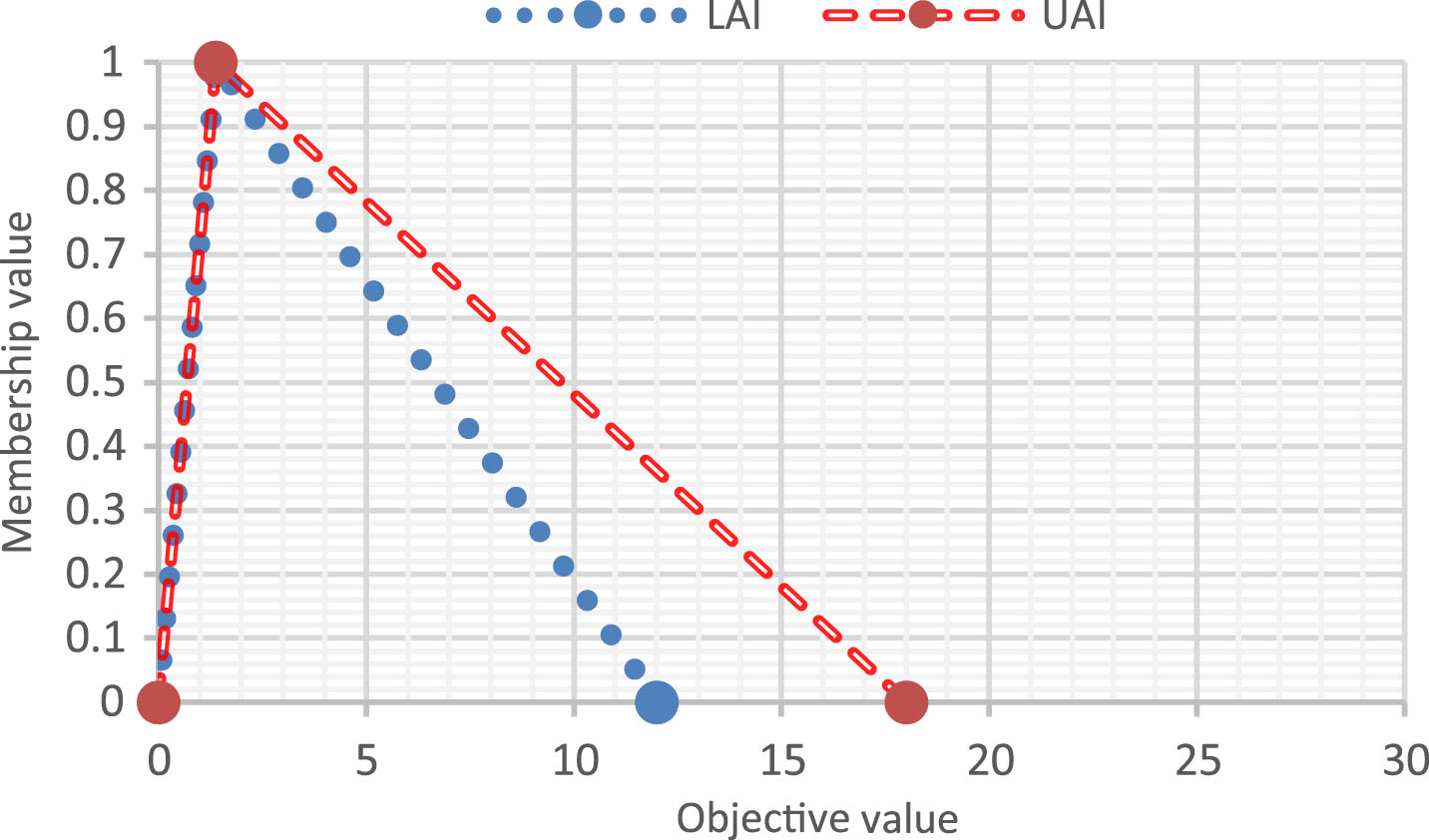
Then by Theorem (3.2) the efficient solution of original FRMOILFP problem is: with objective values: , .
The membership functions of and are shown in Figs. 2 and 3 respectively.
Membership function of .
Membership function of .
Example 6.2. Solve the following FRMOILFP problem:
Subject to:
Where
Solution: Let us assume that:
The above FRMOILFP problem can be converted into the following MOILFP problem:
Subject to:
and integer.
From the above problem, five multiobjective integer linear fractional programming problem can be constructed and solved as follows:
Subject to:
An ILP problem, which is equivalent to the , is constructed according to the proposed algorithm as follows:
Subject to:
For w1, w2 = 0.25 andw3 = 0.5, the optimal solution of is
Hence, an efficient solution of the P1 is with
Subject to:
An ILP problem, which is equivalent to the P2, is constructed according to the proposed algorithm as follows:
Subject to:
For w1, w2 = 0.25 andw3 = 0.5, the optimal solution of is ,
Hence, an efficient solution of P2 is
with ,
Subject to:
Now, substituting in P3, the efficient solution of P3 is with , ,
Subject to:
An ILP problem, which is equivalent to the P4, is constructed according to the proposed algorithm as follows:
Subject to:
For w1, w2 = 0.25 andw3 = 0.5, the optimal solution of is
Hence, an efficient solution of P4 is , with , .
Subject to:
Now, substituting = 0, = 0, = 3, = 7 in P5, the efficient solution of P5 is = 0, = 0, = 3, = 7 with (x) = 0, (x) = 0, (x) = 0.
Finally, by Theorem (3.2) the efficient solution of original FRMOILFP problem is:
7)] with the objective values
By comparing the results of the proposed method with existing methods, we can conclude that all objective values of the existing methods fall into the upper objective values of our proposed method, indicating the reliability of FRLFP in searching for all efficient solutions. In other words, the upper objective values always cover all objective values for the same problem whatever the solution method is used. Therefore, less information would be lost within the computation process of the proposed method than existing methods.
Conclusion
In this paper, a method is proposed to obtained the efficient solution of the fuzzy rough multiobjective integer linear fractional programming (FRMOILFP) problem, In the discussed method, FRMOILFP problem is transformed to a crisp multiobjective integer linear fractional programming problem and the resultant problem is converted to five multiobjective integer linear fractional programming (MOILFP) problems and the resultant problems are solved as a crisp Integer linear programming ILP problem by using Dinkelbach method. The numerical results for the real life problems obtained to validity of the proposed method. The approach appears to be promising and computationally easy to implement.
Footnotes
Acknowledgments
The authors would like to thank the Editor-in-Chief and anonymous referees for the various suggestions which have led to an improvement in both the quality and the clarity of this paper.
References
1.
AmmarE. and MuamerM., Solving a rough linear fractional programming problem, Journal of Advances in Mathematics10 (2015), 3374–3380.
2.
BajalinovE.B., Linear fractional Programming Theory, Methods, Applications and Software, Boston: Kluwer Academic Publishers, (2003).
3.
BellmanR.E. and ZadehL.A., Decision Making in a Fuzzy Environment, Management Science17 (1970), 141–164.
4.
BorzaM., RambelyA.S. and SarajM., Solving linear fractional programming problems with interval coefficients in the objective function, A new approach, Applied Mathematical Sciences6 (2012), 3443–3459.
5.
BuckleyJ.J. and FeuringT., Evolutionary algorithm solution to fuzzy problems: Fuzzy linear programming, Fuzzy Sets and Systems109 (2000), 35–53.
6.
ChankongV. and HaimesY., Multi objective decision making: Theory and Methodology, In: North Holland series in system science and engineering, North- Holland, (1983).
7.
DasS.K., MandalT. and EdalatpanahS.A., A new approach for solving fully fuzzy linear fractional programming problems using the multi – objective linear programming, RAIRO Operations Research51 (2017), 285–297.
8.
DheyabA.N., Finding the optimal solution for fractional linear programming problems with fuzzy numbers, Journal of Kerbala University10 (2012), 105–110.
9.
DuboisD. and PradeH., Rough fuzzy sets and fuzzy rough sets, International Journal of General System17 (1990), 191–209.
10.
EbrahimnejadA., GhomiS.J. and Mirhosseini-AlizaminiS.M., A revisit of numerical approach for solving linear fractional programming problem in a fuzzy environment, Applied Mathematical Modelling57 (2018), 459–473.
11.
GuzelN., A proposal to the solution of multi objective linear fractional programming problem, Abstract and Applied Analysis2013, Article ID 435030, (2013), 4.
12.
HamzeheeA., YaghoobiM.A. and MashinchiM., Linear programming with rough interval coefficients, Journal of Intelligent & Fuzzy Systems26 (2014), 1179–1189.
13.
KaurJ. and KumarA., A novel method for solving fully fuzzy linear fractional progr-amming problems, Journal of Intelligent & Fuzzy Systems33 (2017), 1983–1990.
14.
LiD.F. and ChenS., A fuzzy programming approach to fuzzy linear fractional programming with fuzzy coefficients, The Journal of Fuzzy Mathematics4 (1996), 829–834.
15.
MorsiN.N. and YakoutM.M., Axiomatics for fuzzy rough sets, Fuzzy Sets and Systems100 (1998), 327–342.
16.
PopB. and Stancu-MinasianI.M., A method of solving fully fuzzi?ed linear fractional programming problems, Journal of Applied Mathematics and Computing27 (2008), 227–242.
17.
SaadO.M., BiltagyM.S. and FaragT.B., On the solution of fuzzy multiobjective integer linear fractional programming problem, Int J Contemp Math Sciences41 (2010), 2003–2018.
VeeramaniC. and SumathiM., Fuzzy mathematical programming approach for solving fuzzy linear programming problem, RAIRO Operation Research48 (2014), 109–122.
20.
VeeramaniC. and SumathiM., Solving the linear fractional programming problem in a fuzzy environment: Numerical approach, Applied Mathematical Modelling40 (2016), 6148–6164.
21.
ZimmermannH.J., Fuzzy Set Theory and its Applications, Kluwer Academic, Boston (1985).