This paper focuses on investigating the algebraic structures within the complex neutrosophic soft model. Two key concepts, the complex neutrosophic soft ring (CNSR) and the complex neutrosophic soft ideal (CNSI), are introduced. The former integrates the characteristics of complex neutrosophic soft sets with the foundational principles of ring theory, to effectively address the issue of uncertainty and indeterminacy in a ring environment using complex neutrosophic membership values. The latter, on the other hand, are specific subsets of CNSRs with unique properties that play important roles in the study of ring theory. We examine and validate the algebraic properties of both CNSRs and CNSIs, enhancing the understanding of their algebraic behaviors and interactions. Specifically, we explore the connection between CNSRs and soft rings, offering insights into how CNSRs align with the broader framework of soft rings while emphazising the distinctive features of complex neutrosophic soft structures in algebraic analyses. Furthermore, we determine the relationships between CNSRs and neutrosophic soft rings, as well as between CNSIs and neutrosophic soft ideals. This thorough analysis aims to advance the knowledge of CNSRs and CNSIs, contributing to algebraic analysis and its application in managing uncertainty and vagueness.
Although significant progress has been made in managing uncertain data, uncertainty and vagueness remain persistent challenges for many researchers in their daily work. To address these issues and to manage the associated uncertainties, Smarandache (1998) introduced the concept of the neutrosophic set (NS) to overcome the inadequacy related to the available fuzzy set tools. Meanwhile, Molodtsov (1999) developed the soft set (SS) as an additional mathematical tool to provide a better precision of everyday data. Both NS and SS research have gained significant momentum, leading to the publication of numerous studies and applications. Tran et al. (2022) added a key contribution by establishing the connection between topologies on neutrosophic soft sets (NSSs) and fuzzy soft sets. Specifically, the topology on NSSs which can be used to parameterize topologies on fuzzy soft sets; however, the converse does not necessarily hold. Some models combining NS and SS have resulted in a more enhanced ability to address real-world problems.
The previously mentioned models that deal with uncertainties, have been applied in various areas, including soft computing (Jumaili et al., 2019), graph-related problems (Yow et al., 2021, 2023), algebraic structures (Abed et al., 2021), and medical diagnosis (Karataş & Ozturk, 2023) where a three-step neutrosophic algorithm was used. Al-Sharqi et al. (2022) presented their model with the ability to provide a comprehensive representation of two-dimensional interval neutrosophic information (amplitude terms and phase terms), as well as adequate parameterization and opinions of experts, all in the form of an interval. Ali and Smarandache (2017) extended the concept of NS into complex space, by defining the complex neutrosophic set (CNS) that is characterized by three membership functions, namely truth, indeterminacy and falsity, each of which is assigned a complex value that takes periodicity into account. Smarandache et al. (2017) further integrated the SS and CNS models to introduce the concept of complex neutrosophic soft sets (CNSSs). A complex neutrosophic soft decision-making algorithm was constructed and used in signal processing applications to improve the CNS theory (Khan et al., 2021).
Rahoumah et al. (2024) introduced the concept of complex neutrosophic soft groups (CNSGs) and conducted an extensive investigation, which included the verification of their properties and the exploration of their fundamental characteristics. The study of CNSGs allows the extension to the ring and field environments within the scope of complex neutrosophic soft settings. Alsarahead and Ahmad (2017) introduced complex fuzzy sub-ring and defined some new concepts such as -fuzzy sub-ring and -fuzzy ideal, in addition to the characteristics of complex fuzzy sub-ring and complex fuzzy ideal., but three years later they introduced the complex fuzzy soft ring (Alsarahead & Ahmad, 2020). The extension of the neutrosophic soft group (NSG) to the complex plane to produce CNSG has resulted in a comprehensive study of their algebraic structures within group theory (Smarandache et al., 2017). Neutrosophic soft ring (NSR) was introduced by Bera and Mahapatra (2017) where the properties of neutrosophic soft set (NSS) were examined in the ring environment. In this study, the aim is to extend the complex neutrosophic soft group to the ring environment and to introduce neutrosophic soft rings (NSRs) and neutrosophic soft ideals (NSIs) in the complex space. Special attention is given to some algebraic structures within the CNSS models by introducing the concepts of CNSR and CNSI. The verification of some specific algebraic properties of CNSRs and CNSIs will be carried on to gain a detailed insight into their algebraic behavior and to highlight the relationship between CNSRs and soft rings. The connections between CNSRs and NSRs, and between CNSIs and NSIs are also investigated.
Preliminaries
We first present definitions of different components related to neutrosophic theory and describe the gradual evolution of concepts related to soft set (SS), soft ring (SR), soft ideal (SI), fuzzy subring, fuzzy ideal (FI), neutrosophic subring, CNS, CFSR and complex fuzzy soft ideal (CFSI). We then include definitions related to the properties and operations within neutrosophic theory.
Molodtsov (1999) Let represent a universal set and be a collection of parameters. The power set of is denoted by . For a subset of , the pair is defined as a soft set over , where is a mapping from to .
Acar et al. (2010) Let be a soft set defined over the ring . For every , if is a sub-ring of , then the pair is referred to as a soft ring.
Ghosh et al. (2011) Let be a soft set over the ring . For every , if is both a left and right ideal of , then the pair is referred to as a soft ideal.
.
.
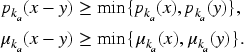
Liu (1982) Let be a ring and be a fuzzy set where, is the degree of membership and . Then is called a fuzzy sub-ring if the following conditions are satisfied:
.
.
Liu (1982) Let be a ring and be a fuzzy set where, is the membership degree and . The set is referred to as a fuzzy ideal if the following conditions are satisfied:
.
.
Ali and Smarandache (2017) Let S be a CNS in the universe , represented by three membership functions . For every , these three membership terms lie within the unit circle in the complex plane, as illustrated below:
.
.
.
where are amplitude terms and are phase terms of truth, indeterminacy and falsity membership functions respectively and such that .
Alsarahead and Ahmad (2020) Let be a ring and be a homogeneous complex fuzzy soft set over . The pair is called a CFSR if and only if the following conditions are satisfied:
.
.
Alsarahead and Ahmad (2020) Let be a ring and be a homogeneous complex fuzzy soft set over . The set is called a complex fuzzy soft ideal if and only if the following conditions are met:
.
.
Developing Complex Neutrosophic Soft Ring
We now investigate the properties of CNSR by providing detailed definitions and presenting a series of theorems to illustrate their importance and potential applications within this framework.
If and are two complex neutrosophic soft sets over the universe , they are defined by complex-valued membership functions as follows:
Then,
The set is referred to as a homogeneous-CNSS if, for all and , the following conditions hold:
.
.
.
A complex neutrosophic soft set is considered a completely homogeneous complex neutrosophic soft set if it is homogeneous and satisfies the following conditions for all and for all :
.
.
.
A complex neutrosophic soft set is said to be homogeneous with if and only if, for all and for all , the following conditions hold:
.
.
.
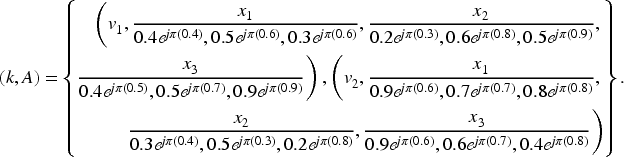
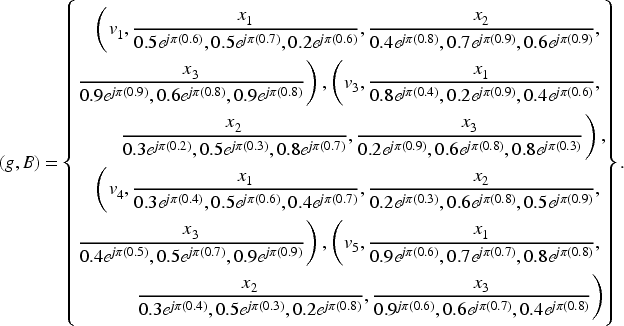
Let be a set top oil producing nations in Africa and let be a set of parameters describing each country’s economic indicators, with , where and , where these sets are defined as follows:
In decision-making under uncertainty, complex numbers can represent probabilities or likelihoods with a phase component. In quantum decision theory, decisions are modelled similarly to quantum mechanics – where complex probability amplitudes are used.
Assume that and are two CNSSs defined as follows:
According to Definition 3.1, the given conditions demonstrate that is both homogeneous and completely homogeneous. In contrast, does not satisfy the criteria for being homogeneous, and therefore, it is also not completely homogeneous.
Let be a neutrosophic soft set on the ring . Then, is defined as a neutrosophic soft ring if, for all and for all , the following conditions are satisfied:
.
.
.
.
.
.
Let be a neutrosophic soft set on the ring . Then, is defined as a neutrosophic soft ideal if for all and for all , the following conditions are satisfied:
.
.
.
.
.
.
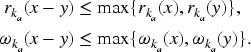
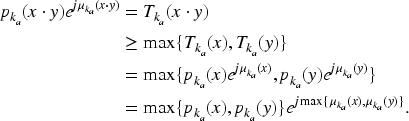
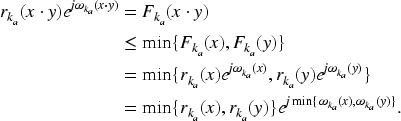
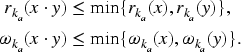
Let be a homogenous complex neutrosophic soft set on the ring . Then defines a complex neutrosophic soft ring (CNSR) if and only if for every and the following conditions are satisfied:
.
.
.
.
.
.
.
.
.
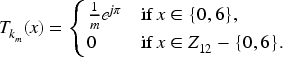
Let be the set of parameters and be the set of all positive integers, where and be a ring. Define a mapping , where for any ,
Then is a complex neutrosophic soft ring over . By examining Definition 3.4, it can be verified that is a complex neutrosophic subring of . Therefore, is a complex neutrosophic soft ring of .
Suppose and are two CNSSs. Then, is a complex neutrosophic soft subring of if it satisfies the following:
where exemplify a CNS-subset.
and are both CNS-rings.
The following theorem sets the reduced CNSR conditions when compared to Definition 3.4, where the nine conditions can be reduced to only six conditions as shown in the following result.
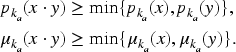
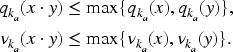
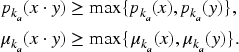
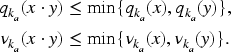
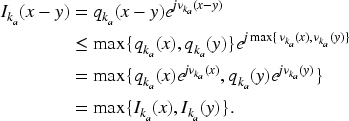
Consider to be a homogenous complex neutrosophic soft set on the ring . Then, is defined as a CNSR if and only if for every , and all , the following conditions hold:
.
.
.
.
.
.
Let and be a CNSR for all . This implies that satisfies all nine conditions of Definition 3.4 .
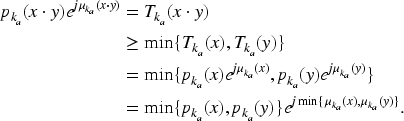
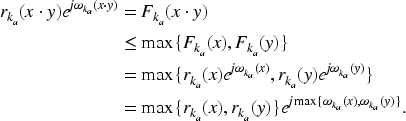
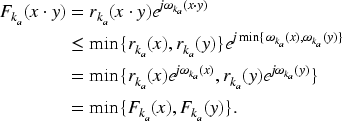
To prove the first condition in this theorem, we have
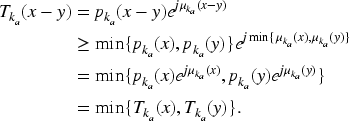
To prove the second condition in this theorem, we have
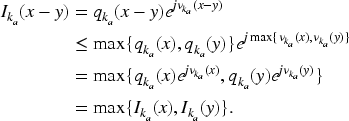
For the third condition in this theorem, we have
Since is a CNSR, and satisfies the nine conditions stated in Definition 3.4 including Conditions 4-6, therefore, satisfies the six conditions in this theorem.
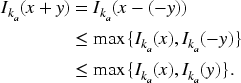
Assuming that satisfies the six conditions stated in Theorem 3.1. To validate Conditions 1-3 in Definition 3.4, we use the following property.
Utilizing the additive identity in the set , we have
The indeterminacy membership can be proven in the similar manner as the truth membership function has been demonstrated.
Similarly, we prove that as follows:
Therefore, Conditions 1-3 in Definition 3.4 are verified.
Since satisfies the six conditions in this theorem, Conditions 4-6 in Definition 3.4 follow immediately.
To establish the bases for Conditions 7-9 in Definition 3.4, we consider the following:
Since satisfies the six conditions in this theorem, therefore is a CNSR.
The next theorem highlights the relation between CNSRs and NSRs.
Let , be a homogenous CNSS in the ring . Assuming that generates the two NSSs
Then, is a CNSR of if and only if both and are NSRs.
To prove this direction, it is important to show how the six conditions outlined in Definition 3.2 are satisfied. Consider that is a CNSR of , then for all and , we have
Since is homogenous, then we obtain the following:
In the same manner, we have
Since is homogenous, then we obtain the following inequalities:
Next,
Since is homogenous, then we get the following:
Therefore, Conditions 1-3 are verified.
To prove Conditions 4-6, we need to show that:
Since is homogenous, then
In the same manner, we have
Since is homogenous, then we have
Next,
Since is homogenous, then
So, Conditions 4-6 are verified.
Therefore, (m,A) and (n,A) are NSRs.
To prove the other direction of this theorem, it must satisfy the pre-stated six conditions associated with Theorem 3.1.
Let and be NSRs. To prove that is a CNSR, we have to show that
Since is homogenous, then the truth term is written as:
In the same manner, we have,
Since is homogenous, then indeterminacy membership function is expressed as:
Next,
Since is homogenous, then the falsity term is shown in the following inequality:
So, Conditions 1-3 are verified.
To prove Conditions 4-6, we need to show that:
Since is homogenous, then
In the same manner, we have,
Since is homogenous, then we get
Next,
Since is homogenous, then we have
Therefore, the pre-stated six conditions in Theorem 3.1 have been satisfied, which implies that is a CNSR.
The next theorem deals with the six conditions associated with CNSRs in Theorem 3.1 to highlight the intersection property.
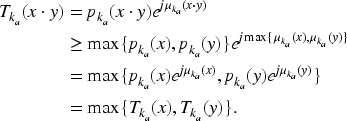
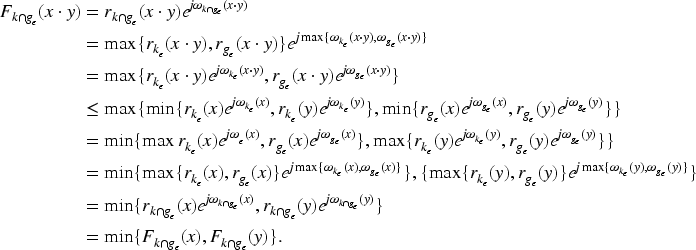
Let and be two homogenous-NSSs on , where is homogenous with . If and are two complex neutrosophic soft rings on , then the intersection is a CNSR.
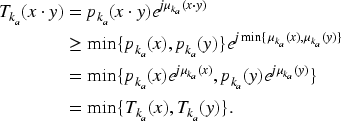
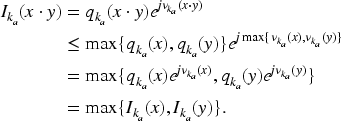
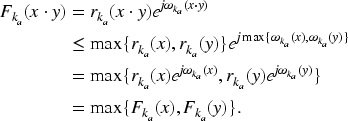
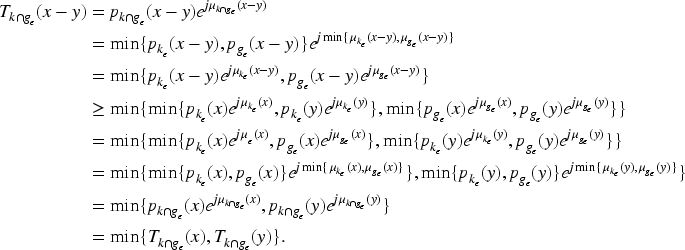
Let and . Then, by Theorem 3.1, it is sufficient to demonstrate that
.
.
.
.
.
.
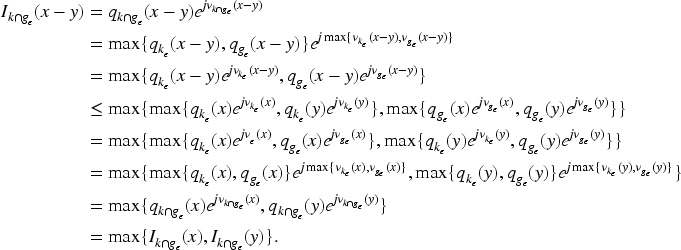
Looking into the first condition, we have:
Considering the second condition, we have
Examining the third condition,
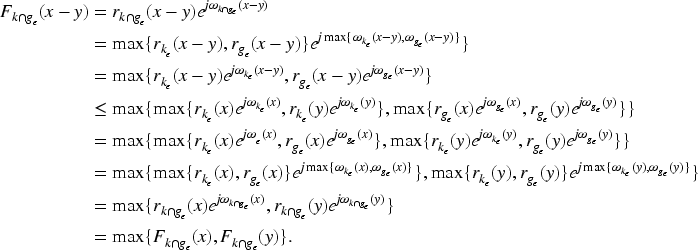
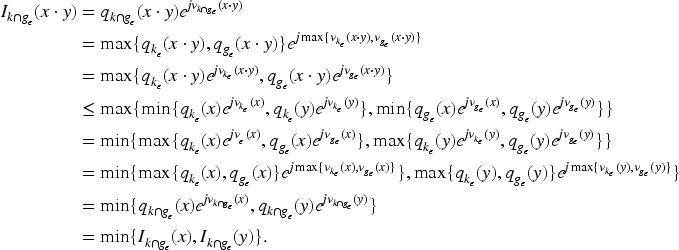
Next, for the fourth condition, we have
Considering the fifth condition, we obtain
Lastly, for the final condition,
Therefore, is a CNSR.
Complex Neutrosophic Soft Ideal Approach
Let be a homogenous complex neutrosophic soft set on the ring . The set is considered as a complex neutrosophic soft ideal (CNSI) if and only if, for all and for all the following holds:
.
.
.
.
.
.
The relation between CNSIs and NSIs is shown in the following theorem.
Let be a homogenous CNSS in the ring . Assuming that generates the two NSSs
Then, is a CNSI of if and only if both and are NSIs.
To prove this direction, we show that the six conditions outlined in Definition 3.3 are satisfied. Suppose is a CNSI of , then for all and , we have
Since is homogenous, then we get the following:
In the same manner, we have
Since is homogenous, then we obtain the following two inequalities: inequalities:
Next,
Since is homogenous, then we have
Therefore, Conditions 1-3 are verified.
To prove Conditions 4-6, we need to show that:
Since is homogenous, then we obtain the following two inequalities:
In the same manner, we have
Since is homogenous, then
Next,
Since is homogenous, then
Therefore, (m,A) and (n,A) are NSIs.
To prove the other direction of this theorem, the six pre-stated conditions associated with Definition 4.1 must be satisfied.
Let and be NSIs. To prove that is a CNSI, we have to show that
Since is homogenous, then the truth membership term is written as:
In the same manner, we have,
Since is homogenous, then the indeterminacy term is written as follows:
Next,
Since is homogenous, then the falsity term is expressed as:
So, Conditions 1-3 are verified.
To prove Conditions 4-6, we need to show that:
Since is homogenous, then
In the same manner, we have,
Since is homogenous, then
Next,
Since is homogenous, then
Therefore, the pre-stated six conditions in Definition 4.1 have been satisfied, which implies that is a CNSI.
The following theorem explains the intersection of two ideals using Definition 4.1.
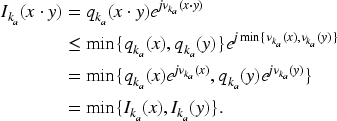
Let and be two complex neutrosophic soft ideals on the ring , where is homogenous with . Then is a CNSI on .
Let and . Then, by Definition 4.1, it is sufficient to demonstrate that
.
.
.
.
.
.
For the first condition, we have
Then, considering the second condition, we obtain
Next, for the third condition,
Addressing the fourth condition, we have
Considering the fifth condition, we obtain
Lastly,
Therefore, is a CNSI.
Conclusions and Future Work
Various algebraic structures within the CNSS model have been explored through the introduction of CNSR and CNSI concepts. The study focuses on examining and verifying the distinct algebraic properties of CNSRs and CNSIs to gain a deeper insight of their algebraic characteristics. The investigation highlights the relationship between CNSRs and soft rings, and explains the connections between CNSRs and NSRs, as well as between CNSIs and NSIs. This thorough and detailed analysis aims to enhance the comprehension of CNSRs and CNSIs while contributing to the advancement of algebraic analysis.
Moving forward, our future research will delve into additional algebraic structures related to CNSSs, with a particular focus on complex neutrosophic soft fields (CNSFs). By extending our study to CNSFs, we aim to deepen the understanding of the algebraic behaviors and properties of CNSSs within this context. In addition, incorporating CNSRs and CNSIs into more complex problems, where precise decision-making is crucial, will be highly beneficial. Since many real-world problems can be modeled by graphs, investigating the relationships between CNSRs, CNSIs and is another promising direction, enabling solutions through both conventional and learning-based frameworks (Yow et al., 2022, 2023). Additionally, exploring optimization problems involving uncertainty and imprecision with CNSRs or CNSIs could lead to the development of efficient algorithms, particularly for large-scale or real-time applications (Yow & Li, 2024).
Footnotes
Declaration of Conflicting Interests
The author(s) declared no potential conflicts of interest with respect to the research, authorship, and/or publication of this article.
Funding
This research was partially supported under Putra Grant GP-IPS/2024/9787900 by Universiti Putra Malaysia.
ORCID iDs
Fatimah Rahoumah
Kai Siong Yow
Menshawi Gasim
Hoa Pham
References
1.
AbedM. M.Al-SharqiF.ZailS. H. (2021). A certain conditions on some rings give pp ring. In Journal of physics: Conference series (Vol. 1818, p. 012068). IOP Publishing.
2.
AcarU.KoyuncuF.TanayB. (2010). Soft sets and soft rings. Computers & Mathematics with Applications, 59(11), 3458–3463.
3.
Al-SharqiF.AhmadA. G.Al-QuranA. (2022). Interval-valued neutrosophic soft expert set from real space to complex space. CMES-Computer Modeling in Engineering & Sciences, 132(1), 267–293.
AlsaraheadM.AhmadA. (2017). Complex fuzzy subrings. International Journal of Pure and Applied Mathematics, 117(4), 563–577.
6.
AlsaraheadM. O.AhmadA. G. (2020). Complex fuzzy soft rings. Palestine Journal of Mathematics, 9(1), 289–298.
7.
BeraT.MahapatraN. K. (2017). On neutrosophic soft rings. Opsearch, 54(1), 143–167.
8.
GhoshJ.DindaB.SamantaT. (2011). Fuzzy soft rings and fuzzy soft ideals. International Journal of Pure and Applied Sciences and Technology, 2(2), 66–74.
9.
JumailiA. M. A.AbedM. M.Al-sharqiF. G. (2019). Other new types of mappings with strongly closed graphs in topological spaces via e- and ---open sets. In Journal of physics: Conference series (Vol. 1234, p. 012101). IOP Publishing.
10.
KarataşE.OzturkT. Y. (2023). An application method for the use of neutrosophic soft mappings in decision-making the diagnosis of COVID-19 and other lung diseases. Process Integration and Optimization for Sustainability, 7(3), 545–558.
11.
KhanM.AnisS.BibiK.IqbalS.SmarandacheF. (2021). Complex neutrosophic soft matrices framework: An application in signal processing. Journal of Mathematics, 2021(1), 8887824.
12.
LiuW. J. (1982). Fuzzy invariant subgroups and fuzzy ideals. Fuzzy Sets and Systems, 8(2), 133–139.
13.
MolodtsovD. (1999). Soft set theory—first results. Computers & Mathematics with Applications, 37(4-5), 19–31.
14.
RahoumahF.YowK. S.Nik LongN. M. A.GasimM. (2024). On properties and operations of complex neutrosophic soft groups. Journal of Inequalities and Applications, 2024(1), 103.
SmarandacheF.BroumiS.BakaliA.TaleaM.AliM.SelvachandranG. (2017). Complex neutrosophic soft set. In 2017 FUZZ-IEEE conference on fuzzy systems, Naples, Italy, 9-12 July 2017 (p. 1). IEEE.
17.
TranT.NgoM. P.BuiQ. T.SnaselV.VoB. (2022). A new approach for operations on neutrosophic soft sets based on the novel norms for constructing topological structures. AIMS Mathematics, 7(6), 9603–9626.
18.
YowK. S.LiC. (2024). D&a: Resource optimization in personalized pagerank computations using multi-core machines. IEEE Transactions on Knowledge and Data Engineering, 36(11), 5905–5910.
19.
YowK. S.LiaoN.LuoS.ChengR. (2023). Machine learning for subgraph extraction: Methods, applications and challenges. Proceedings of the VLDB Endowment, 16(12), 3864–3867.
20.
YowK. S.LiaoN.LuoS.ChengR.MaC.HanX. (2022). A survey on machine learning solutions for graph pattern extraction. arXiv preprint arXiv:2204.01057.
21.
YowK. S.MorganK.FarrG. (2021). Factorisation of greedoid polynomials of rooted digraphs. Graphs and Combinatorics, 37(6), 2245–2264.