Some of the important concepts in ordinary topological spaces like -homogeneity, strongly locally homogeneity, almost countable dense homogeneity, and transposition homogeneity are extended to fuzzy topological spaces and the relationship between these spaces together with fuzzy semi-discreteness is well studied here. Since there are spaces that fail to be fuzzy countable dense homogeneous () or fuzzy semi discrete (), only due to finitely many points, we found it necessary to study such spaces, which we refer to as almost fuzzy countable dense homogeneous () and almost fuzzy semi discrete spaces () respectively. It is shown that the fuzzy extensions of the above notions are all fuzzy topological properties. A further variant of almost countable dense homogeneity called was introduced to fuzzy spaces and proved that a countable fuzzy separable space is if and only if it is or . Hence, in countable fuzzy separable spaces, the notions and are equivalent. One of the main results identifies conditions under which an space becomes an space. Further, the paper discusses ordinary topological spaces generated by fuzzy topological spaces and we shall observe that whenever the fuzzy topological space is almost fuzzy semi discrete, or fuzzy transposition homogeneous or almost fuzzy countable dense homogeneous, so is the corresponding ordinary space.
Since L.A. Zadeh introduced fuzzy sets in 1965 (Zadeh, 1965), the field has grown over the past 60 years into an active area of research that connects traditional math with the study of uncertainty and imprecision. Some of the milestones in this integration include the development of fuzzy topologies by Chang (1968) and fuzzy metric spaces by Kramosil and Michálek (1975). Apart from its theoretical advancements, the practical application of fuzzy sets includes image processing (Selvy & Vinod Kumar, 2024), natural language processing, pattern recognition, decision-making, and optimization problems. Motivated by these developments, many authors have extended classical topological concepts to the fuzzy setting. In this paper, we extend different homogeneity concepts like -homogeneity (Ungar, 1978), almost countable dense homogeneity (Tallafha & Al-Rawashdeh, 2010), strongly locally homogeneity (Van Mill, 1982), and transposition homogeneity (Tallafha & Al-Rawashdeh, 2010) to fuzzy topological spaces and examine the relationships among these fuzzy analogues. The fuzzy extension of countable dense homogeneity by Al-Ghour and Fora (2016) laid the foundation for this paper. From the literature, we see two types of denseness for a collection of fuzzy points namely dense and dense and, a type of homogeneity in ordinary space called almost . Based on these ideas, new concepts called almost fuzzy and almost fuzzy were developed. However, the equivalence between these notions leads to the general concept of almost fuzzy CDH () which generalizes the fuzzy space of Al-Ghour and Fora (2016). In particular, this generalization accounts for cases where two countable dense subsets and are not homeomorphic due to finitely many points; by appropriately adding points to and , homeomorphism can be achieved. Conversely, there exist spaces where removing finitely many points makes the countable dense subsets homeomorphic. Such spaces are called almost fuzzy of type *. Finally, this framework can be further extended to intuitionistic fuzzy sets, paving the way for broader applications in pattern recognition and robustness analysis. Intuitionistic fuzzy sets, introduced by Atanassov (1999), provide a more flexible representation of uncertainty through three parameters: membership, non-membership, and hesitation degrees. The concluding section of this paper discusses about ordinary topological spaces called -cut topological space for that are generated by the fuzzy topological space and we shall observe that whenever the fuzzy topological space is almost fuzzy semi-discrete or fuzzy transposition homogeneous or almost fuzzy countable dense homogeneous (AFCDH), the corresponding ordinary space also inherits these properties.
Preliminary Concepts
Some basic notations and definitions needed for our study are given here: Let be a non empty set. A fuzzy set on is a function from to (i.e., . The fuzzy set that maps all elements to 0 (or 1 resp.) is denoted by 0 (or 1 resp.). If is a collection of fuzzy sets on , then , and . Let and , then a fuzzy point on is the fuzzy set mapping only to and all other elements to . Here, is called the support of . A fuzzy set is a fuzzy crisp point, denoted as if for and for . For any two fuzzy sets and , is a subset of denoted as iff and iff and . A fuzzy point is said to belong to a fuzzy set , denoted as iff , i.e., iff . Two fuzzy points are said to be distinct iff their supports are distinct. A family of fuzzy sets is said to be a fuzzy topology for if it satisfies the three axioms: (i) , (ii) and (iii) . The elements of are called as fuzzy open sets w.r.t . A fuzzy set is said to be closed w.r.t. iff it is equal to for some , and is denoted as . The closure of a fuzzy set is iff is the smallest (w.r.t the images) closed set such that , denoted as . A fuzzy topological space is said to be iff for any two distinct fuzzy points in , there exists such that and . If and are two fuzzy topological spaces and is a bijective map, then is called a fuzzy homeomorphism iff both and are continuous. We denote as the space of all fuzzy homeomorphisms on . Suppose and are two fuzzy topological spaces such that has the property and is a fuzzy homeomorphism; then is said to be a fuzzy topological property if also satisfies . If is an ordinary topological space and is the usual Euclidean topology on , then the class of all lower semi-continuous functions from to is a fuzzy topology on , denoted by . i.e. (Johnson, 1993).
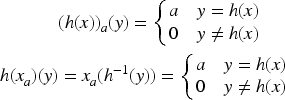
Let and be two sets, and let be a function. Then, for any fuzzy set on , is a fuzzy set on and for any fuzzy set on , is a fuzzy set on , which are defined by
Therefore, if is a bijective function, then , and , .
If is a bijective function and is a fuzzy point, then . For,
A fuzzy topological space is said to be fuzzy semi-discrete, abbreviated as iff for any , the fuzzy crisp point or there exists a fuzzy point for some such that .
Clearly, is a fuzzy topological property.
Let be a collection of fuzzy points in the fuzzy topological space . The support of , denoted by , is defined by
Let and be two fuzzy topological spaces and be a bijective map. Then for any collection of fuzzy points of .
The proof is straightforward. For instance, let
A fuzzy topological space is said to be fuzzy -homogeneous, if for any two sets and of distinct fuzzy points, there exists such that
For , we simply say that the space is fuzzy homogeneous.
Fuzzy -homogeneity is a fuzzy topological property.
Let and be two fuzzy topological spaces such that is fuzzy -homogeneous and be a homeomorphism. Suppose that and are two -element sets of distinct fuzzy points of . Then are two -element sets of distinct fuzzy points of , and thus a homeomorphism such that . By the above lemma, or .
If is fuzzy homogeneous and for some , then is .
Let . Being fuzzy homogeneous a fuzzy homeomorphism on such that . Clearly,
Since continuous image of an open set is open, and being arbitrary implies is .
Suppose that is a fuzzy -homogeneous space and and are two sets of distinct fuzzy points. Define . Then is closed.
Let . Then such that and there by implying if . Since , is a converging sequence with elements from a finite set , implies , . Thus, . But since and have the same number of elements, .
A fuzzy topological space is said to be fuzzy strongly locally homogeneous abbreviated as if is any open set and is a fuzzy point, then there exists such that and for any , a fuzzy homeomorphism on mapping to and leaving all other points outside fixed.
If is fuzzy homogeneous and contains a fuzzy crisp point, then is .
Let be the fuzzy crisp point of and . Then such that . Thus, all fuzzy crisp points are open. Now, let be a non-zero open set and . Take . Then is an open fuzzy point such that and hence and for any . That is, is the fuzzy point and thus . Therefore, is vacuously.
Thus a fuzzy homogeneous space containing an open crisp point is both and .
is a fuzzy topological property.
Let and be fuzzy topological spaces such that is and be a fuzzy homeomorphism. Let be an open set in and let be a fuzzy point. Then is a fuzzy point in the open set of and so, an open set of such that and if is any distinct fuzzy point, a homeomorphism such that and all other points outside are fixed by . Now . Any fuzzy point in can be written as with , hence
Then, is our required homeomorphism. For,
Therefore, .
Almost Fuzzy Countable Dense Homogeneity (AFCDH)
In the ordinary sense, a separable space is said to be countable dense homogeneous () if given any two countable dense subsets and of , such that . Later, Al-Ghour and Fora (2016) extended the notion of to fuzzy topological spaces and introduced the concept of fuzzy countable dense homogeneity (). A fuzzy topological space is iff it is separable and for any countable dense (see Definition 3.1) collections of fuzzy points, such that . Since there are spaces that are not but are more likely to be, this paper has further extended to include such spaces that are known as almost fuzzy spaces. For that, let us start with some definitions.
A collection of fuzzy points in a fuzzy topological space is said to be dense if .
It is easy to show that dense and dense are fuzzy topological properties. The following facts can be observed from Al-Ghour and Fora (2016): The above two definitions are independent of each other. Depending on the presence of dense (or dense resp.) collection of fuzzy points, the space is separable (or separable resp.). But finally, it is proven that a fuzzy topological space is separable iff it is separable. Thus, we simply say that the fuzzy topological space is separable.
Let be a fuzzy topological space and be a set of fuzzy points such that iff . Then is dense iff is dense.
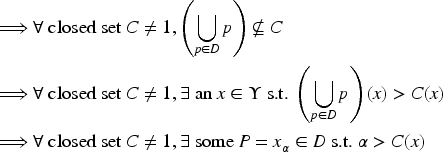
Suppose is dense(I), then open set , such that . That is, closed set , such that or otherwise, closed set , such that . This implies (.
Conversely, let (.
Let be an open set, then is closed. This implies such that . Thus , but by the hypothesis.
In ordinary topology, a separable space is called an almost countable dense homogeneous space abbreviated as if for any two countable dense subsets , there are two finite subsets of , such that and , the space of homeomorphisms on , such that and .
This notion of almost countable dense homogeneity has been extended to fuzzy topological spaces, giving rise to the concept of almost fuzzy countable dense homogeneity, which forms a proper extension. Studying such spaces is important, as there exist spaces that are not fuzzy countable dense homogeneous () due to finitely many points, but are AFCDH, as illustrated in Example 3.25.
Let be a fuzzy topological space. Then is said to be almost fuzzy countable dense homogeneous denoted as (or almost fuzzy countable dense homogeneous denoted as resp.) if for any two countably dense (or dense resp.) collection of fuzzy points of , there exist two finite subsets of fuzzy points of such that
and,
satisfying and .
is a fuzzy topological property.
Let and be two fuzzy topological spaces and be a fuzzy homeomorphism. Suppose is and are two countable dense collection of fuzzy points of . Then so are in . Thus finite sets of fuzzy points of such that
and such that and .
A fuzzy topological space is iff it is .
Let be and be two countably dense collection of fuzzy points of . Then by Theorem 3.5, and are dense collection of fuzzy points and thus there exists two finite subsets of fuzzy points such that
and there exists a homeomorphism satisfying
Thus, is . The converse is similar.
In fuzzy topological spaces, is a fuzzy topological property.
Let and be fuzzy topological spaces such that is and let be a fuzzy homeomorphism. By Theorem 3.10, is and by Theorem 3.9, is . Again by Theorem 3.10, is .
From here onward, we do not distinguish between and , instead we simply say the space is . In general, spaces need not be . For example, consider and where and are two fuzzy points with and (i.e. maps 1 to 0.1 and 2 to 0.2). Considering with shows that is not . But clearly it is , since any countable dense collection of fuzzy points contains and (where denotes any positive value less than and respectively) and thus the identity map will be the required homeomorphism.
If is a countable space and is any dense collection of fuzzy points of , then is finite.
Suppose that is countably infinite. Since is a countable dense collection of fuzzy points, finite sets and a homeomorphism satisfying conditions, particularly , a contradiction since .
Let be a fuzzy topological space and be the collection of all open fuzzy points of . Then, is said to be almost fuzzy semi discrete, denoted by if is finite.
Clearly, every finite fuzzy topological space is .
By definition, every semi discrete space is almost semi discrete and for an space to be , can be at the most countably infinite only.
Let be a countable fuzzy separable space. Then is is .
Let be fuzzy separable and be the collection of all open fuzzy points of . Suppose that is , then , a finite set. Let and be two countable dense collections of fuzzy points of . Then clearly and . Choose finite sets of fuzzy points and such that and . Then, and the identity homeomorphism satisfies and .
Conversely, suppose that is infinite. Since is and is a countable dense set of fuzzy points, there exists a finite set of fuzzy points and such that , which is a contradiction.
In spaces, if cardinality of and are the same, such spaces are said to be strong almost fuzzy countable dense homogeneous, abbreviated as .
A fuzzy topological space is if and only if for every two countable dense sets of fuzzy points, there exist two finite subsets of fuzzy points having the same cardinality such that and there exists such that .
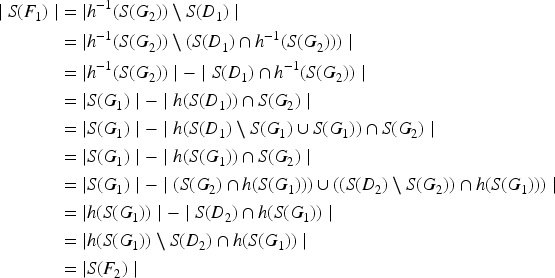
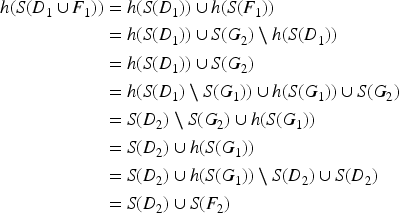
Let be two countable dense sets of fuzzy points. Suppose that there exist two finite subsets of fuzzy points of the same cardinality such that and such that . Let and . It is clear that . Also,
And,
Finally, . For if, , not possible. Thus is .
Conversely, let be two countable dense sets of fuzzy points. Then there exist two finite subsets of fuzzy points of the same cardinality such that and such that and . Take and . Then and
In contrast to spaces, we could think of the deletion of finitely many points from the spaces and , so that they can be countable dense homogeneous and this provides the rationale for the following definition.
A separable fuzzy topological space is called an almost fuzzy of type *, denoted as if there exist a finite subset of fuzzy points such that for any countable dense subsets and of fuzzy points, such that
This is referred as a related fuzzy finite set.
Let be a countable space with a related fuzzy finite set , then , is open for some .
Let and suppose that is not open . Then both and are countable dense subsets of fuzzy points and so such that
which is a contradiction.
Let be a countable fuzzy topological space. Then is iff is .
The first part easily follows from the above proposition.
Conversely, let be the set of all open fuzzy points, then is finite. Let and be any two countable dense subsets of fuzzy points. Clearly, and . Choose such that , then for and hence the identity map will be the required homeomorphism for to be .
A countable fuzzy topological space is iff is .
By Theorem 3.16, a countable fuzzy space is iff is and by Theorem 3.22, is it is .
Therefore, by Theorems 3.16 and 3.22, a countable fuzzy separable space is is or .
The following is an example of a fuzzy space that is not but is . Consider the space with and where . Let and . Then both are countable dense sets of fuzzy points with and . Clearly and are not homeomorphic, and thus the space is not . If we take , then and are homeomorphic by the trivial homeomorphism. Similarly, for any and , choose appropriately so that cardinality of and are the same, then, any bijection would be a homeomorhism on mapping to . Hence is by the above Corollary.
Fuzzy Transposition Homogeneity
A transposition on a non-empty set refers to a permutation on that swaps the positions of two elements and leaves all other elements unaffected. An ordinary topological space is called transposition-homogeneous abbreviated as if every transposition on is a homeomorphism (Tallafha & Al-Rawashdeh, 2010). A corresponding formulation can be introduced in fuzzy topological spaces, yielding a proper extension of the classical concept.
A fuzzy topological space is said to be fuzzy transposition homogeneous denoted by , if every transposition on is a fuzzy homeomorphism.
An fuzzy topological space is said to be strongly homogeneous if for every pair of elements there exists a homeomorphism such that and .
It is evident that is a stronger notion than strong homogeneity. Hence, every fuzzy transposition homogeneous space is necessarily strongly homogeneous.
In an space , any finite composition of transpositions of an open set is open.
If , then any that agrees with at all except at two points is an open set, since is . Let be any finite set and be any permutation that fixes . Clearly is a composition of finitely many transpositions which are homeomorphisms, and thus is a homeomorphism. Therefore, for any open set , an that agrees with at all but a finite number of points is also open.
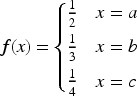
Let and be defined by
In short, let . By Theorem 4.4, a topology for which is and containing , shall contain all permutations of , their unions, and intersections. Thus, is given by
An space is iff either a fuzzy point or a fuzzy crisp point is open.
By the above theorem, for an space , if is any fuzzy point, then for every making the space semi-discrete. The same is the case if contains any crisp point.
A fuzzy semi-discrete space is iff it is countable.
The first part is immediate.
Conversely, suppose that is countable. Then, by property, for any countable dense collection of fuzzy points of , making the space using the identity map.
is a fuzzy topological property.
Let be two fuzzy topological spaces, and be a fuzzy homeomorphism. Suppose that is . Let and be defined by , and , . It is enough to show that is a fuzzy homeomorphism. Clearly, it is a bijection. Let . Now, . By definition,
i.e., is a transposition of . But, and hence , since is .
An space is iff either a fuzzy crisp point is open or the set for some , is dense in .
Suppose is . Then for any two fuzzy points , there exists open sets such that and . Suppose that no fuzzy crisp points are open. Then . Since such ’s exists for all but can coincide at infinitely many ’’ values, it follows that is dense in .
Conversely, suppose that contains a fuzzy crisp point. Since is , all fuzzy crisp points are open and hence is . Suppose that for some ordered pair , the set is dense in , then, property of implies is dense in for any ordered pair . Thus for any fuzzy points , there exists such that
Thus and .
A fuzzy topological space is iff for any two finite subsets of fuzzy points having the same cardinality and for every , there exists such that
,
Let be and be any homeomorphism, then for any transposition , is a homeomorphism. This is true even if is a finite composition of transpositions. i.e., if and are finite sets of fuzzy points of the same size, then for any bijective map for which finite set is a homeomorphism. The image of under is .
In particular, can map to and or to . Thus the first part of the proof is done by renaming by .
Converse is obvious if and , the identity map.
If is an , space, then is a space.
Let be two countable dense subsets of fuzzy points of . Then by Theorem 3.18, there exist two finite sets of fuzzy points having the same cardinality such that and there exists such that . Also, since is , there exists such that , , for every and . We shall prove that . It is enough to show that . If possible, suppose that . Then former part implies , a contradiction to the latter part. Finally, .
For an ordinary topological space , and a collection of fuzzy points of , we have
If is dense in , then is dense in .
If is dense in , then is dense in .
The above lemma provides the essential link between the almost property of the ordinary space and that of its corresponding fuzzy topological space , which is stated in the following theorem.
Let be an ordinary topological space. Then is iff is .
Let be and be two countable dense(I) collection of fuzzy points of . Then, are countable dense subsets of and so there exists finite sets such that and such that and . Let be two finite sets of fuzzy points such that and . Then, we have , and . Thus, is .
The converse is similar.
Ordinary Topologies Generated by Fuzzy Topologies
This section deals with the study of topological spaces that are generated by fuzzy topological spaces. Further, we shall observe that whenever the fuzzy topological space is , or or , then so is the corresponding ordinary space (See Definition 5.1). Now, let us start with the following definition:
Let be a fuzzy topological space and . Then, is an ordinary topology on called as -cut topological space of .
Clearly, is the collection of all supports of open sets.
If is space, then is .
If is the collection of all fuzzy points, then is finite .
It is obvious that the above result need not be true for with . But in certain cases can be semi discrete where as the space is not . For example, let , the set of all natural numbers and be the smallest topology containing the set
Clearly does not contain fuzzy points and, contains a singleton iff contains a fuzzy point. Where as contains all singletons of , making semi-discrete.
For a fuzzy topological space , if is a fuzzy continuous(homeomorphism) map on , then is continuous(homeomorphism) on for all .
Let . Then such that . It is enough to show that . But and . For,
Thus, for any continuous is continuous. The homeomorphism part is straightforward.
The converse of the above need not be true in general. For, let and where . Then is a fuzzy topological space, and for . Define by . Clearly is a homeomorphism on . But .
If is , then is .
Let be . Then every transposition on is a fuzzy homeomorphism and by Theorem 5.4 , they are also homeomorphisms on . This implies is .
For a fuzzy topological space , and a collection of fuzzy points of . Then we have,
If is dense in , then is dense in .
If is dense in , then is dense in .
If is an space, then is .
Let be then, by Lemma 5.6 is separable. Let and be two countable dense subsets of then, again by Lemma 5.6 are countable and dense in . So finite subsets of fuzzy points satisfying
and a homeomorphism such that and
By Theorem 5.4, is a homeomorphism on and the proof is done.
The above theorem holds only for and not for any with as we shall see in the following counter-example.
Let be fixed and , the set of all natural numbers. Let be the smallest fuzzy topology generated by the set where . Then , which is not . But is since any countable dense will have its .
Conclusion
Homogeneity plays a significant role in the study of general topology, as evidenced in Cinderella and Vinod Kumar (2024), Dobrowolski et al. (2021), Fitzpatrick and Hao-xuan (1992), Kennedy (1977, 1990), Ungar (1978), and Van Mill (1982). In this work, several forms of homogeneity namely -homogeneity, almost countable dense homogeneity, strongly locally homogeneity, and transposition homogeneity have been extended to fuzzy topological spaces and relationships among these fuzzy concepts are well studied. The following are some of the main results of the study.
Fuzzy -homogeneity, are fuzzy topological properties.
and are equivalent notions.
If is a fuzzy homogeneous space containing an open fuzzy crisp point, then is .
If is an space, then is a space.
A countable fuzzy separable space is is or .
A countable fuzzy separable space is .
If the fuzzy topological space is or or , so is the corresponding ordinary space .
In future work, these notions may be extended to intuitionistic fuzzy sets—a generalization of fuzzy sets with wide applications in image processing and pattern recognition.
Footnotes
Acknowledgements
We sincerely thank the reviewers for their valuable comments and the University Grants Commission (UGC) of India for financial support.
ORCID iDs
T J Cinderella
PB Vinod Kumar
Author Contributions
The manuscript was prepared by TJ Cinderella and the PB Vinod Kumar supervised it.
Funding
The authors disclosed receipt of the following financial support for the research, authorship, and/or publication of this article: The research work of first author is financially supported by the University Grants Commission (UGC), India.
Declaration of Conflicting Interests
The authors declared no potential conflicts of interest with respect to the research, authorship, and/or publication of this article.
References
1.
Al-GhourS.ForaA. (2016, February 9). On CDH fuzzy spaces. Journal of Intelligent & Fuzzy Systems, 30(2), 935–941. 10.3233/IFS-151815
2.
AtanassovK. T. (1999). Intuitionistic fuzzy sets. In Intuitionistic fuzzy sets: theory and applications (pp. 1–137). Physica-Verlag HD.
3.
ChangC. L. (1968, October 1). Fuzzy topological spaces. Journal of mathematical Analysis and Applications, 24(1), 182–190.
4.
CinderellaT. J.Vinod KumarP. B. (2024, September 22). Countable dense homogeneity property of connected compact manifolds. Gulf Journal of Mathematics, 17(2), 208–215. 10.56947/gjom.v17i2.2122
5.
DobrowolskiT.KrupskiM.MarciszewskiW. (2021). A countable dense homogeneous topological vector space is a Baire space. Proceedings of the American Mathematical Society, 149(4), 1773–1789. 10.48550/arXiv.2002.07423
6.
FitzpatrickB., Jr., & Hao-xuanZ (1992). Countable dense homogeneity and the Baire property. Topology and its Applications, 43(1), 1–14. 10.1016/0166-8641(92)90148-S
7.
JohnsonT. P. (1993, May 15). On the group of fuzzy homeomorphisms. Journal of Mathematical Analysis and Applications, 175(2), 333–336. 10.1006/jmaa.1993.1173
8.
JoseA.MathewS. C. (2011). Strongly homogeneous fuzzy topological spaces. International Journal of Fuzzy Mathematics and Systems, 3, 263–271.
9.
KennedyJ. (1977). A eaker form of countable dense homogeneity. The Houston Journal of Mathematics, 3, 89–97.
10.
KennedyJ. (1990). Some facts about homogeneity properties. Colloquium Mathematicum, 59(1), 103–116.
SelvyR.Vinod KumarP. B. (2024, April 18). Chaotic fuzzy iterated function systems. Journal of Intelligent & Fuzzy Systems, 46(4), 9261–9270. 10.3233/JIFS-236563
13.
TallafhaA.Al-RawashdehA. (2010). New types of almost countable dense homogeneous space. International Journal of Mathematics and Mathematical Sciences, 2010(1), 375293. 10.1155/2010/375293
Van MillJ. (1982). Strong local homogeneity does not imply countable dense homogeneity. Proceedings of the American Mathematical Society, 84(1), 143–148.