




Abstract
A review of the history of relations between the Islamic Republic of Iran and the Russian Federation reveals that military and security aspects have been more prominent than economic and trade relations. This article aimed to outline the strengthened military-security tendency in relations between Iran and Russia by examining various vectors of cooperation between these two states from the early 1990s to the present. The author identified, categorized, and analyzed the underlying factors impacting the prevailing military-security aspects in Iran–Russia relations. Domestic and regional aspects of Iranian politics, including elite militarization of politics, security-centric policy rhetoric, and Russia’s political and security support as demonstrated in Iran’s nuclear program, through to the mediating role of shared security threats manifested in the regional instability and insecurity due to terrorism, and U.S. presence in the areas adjacent to these two states, were found to contribute to a strengthened military-security tendency in Iran–Russia ties. It was concluded that as long as Iran remains a security-seeker state under sanctions, isolation, and existential threats from the collective West and its neighbors in the Middle East, it continues to purchase the services and products that Russia can offer most effectively, resulting in a strengthened military-security inclination toward Russia.
Introduction
In the South Caucasus, Central Asia, and recently the Middle East, whenever sensitive issues of political instability, terrorism, military conflicts, security threats, and geopolitical matters have arisen over the past decades, Iran and Russia have been discovered to be aligned or cooperated in various forms from a bilateral to a regional level (Pieper, 2012; Sadegi, 2020): from regional conflict resolutions in the South Caucasus and Central Asia in the 1990s (Blank, 2017; Tarock, 1996) to fighting Islamist terrorism in the Middle East in the mid-2010s (Aledwan & Al-Nouimat, 2020), and countering the U.S. presence and opposing the Western hegemony in favor of a multipolar international system (Zarif, 2020; Javadi et al., 2021; Parfinenko, 2023).
The increasing military-security alignment between Tehran and the Kremlin in the regional context in recent decades, primarily after 2014 and particularly since 2022, raises the question of “why and how the military and security dimension has become more dominant in Iran-Russia relations than other aspects of the relationship.”
To address this question, the present research aimed to analyze the military-security tendency in cooperation between Iran and Russia by examining various dimensions of their mutual relations across the political, military, security, and economic spectrums, with a focus on the historical context of their cooperation. The research’s temporal scope spanned more than three decades of mutual relations between the two countries, from the early 1990s to the present, and focused on the geographical scope of the Middle East, Eastern Europe, Central Asia, and the South Caucasus, examining military-security cooperation between Iran and Russia as the thematic scope.
The importance of studying the military and security ties between Iran and Russia lies in their far-reaching implications, extending beyond their bilateral relations to regional stability and global power dynamics. Given their influential presence in these regions, their cooperation can have a significant impact on the Middle East, South Caucasus, and Central Asia. Iran and Russia’s Joint efforts can foster peace in conflict-ridden areas, as seen in their collaborations in Afghanistan, Tajikistan, and Syria. Moreover, their cooperation against extremist groups (Sadegi, 2020) can contribute to global counter-terrorism efforts. Both states reject U.S. unipolarity, so their alliance is a soft (Papageorgiou et al., 2023) counterbalance to Western influence (Monaghan, 2006). Iran–Russia ties are relevant because any changes in their relations, especially in the energy sector, and their presence in the Persian Gulf region can directly affect the U.S. interests. On the other hand, any potential alliance between Tehran, Moscow, and China would also alter the prospects for regional and international security and economics.
Researchers’ attention to the various dimensions of Iran–Russia relations has yet to adequately cover the reasons for the growth of military-security orientation in Tehran–Moscow relations. Therefore, the gap as a result of poor identification of the underlying factors in shaping the military-security orientation in the relations of the two countries, even situational, as suggested by Kortunov (2016), has prompted the present research to fill the research gap by recognizing the necessity of an examination of the contributing factors of the strengthened military-security relations between Iran and Russia against the underdevelopment of their mutual economic and trade ties.
The originality and innovation of this research lie in its selection of subject matter and approach. By focusing on understudied domestic political dynamics within Iran and their impact on military-security relations with Russia—a dimension often overlooked in existing literature—this study offered a novel perspective that challenged conventional assumptions and filled a significant gap in the field. This research employed an innovative agenda to inspect the implications of military presence in Iran’s foreign and domestic policy and explain the Iranian policymakers’ inclination towards Russia as an ally, arms supplier, protector, and priority in foreign relations. In combination with a mutual understanding of the existential threats in adjacent regions and the underlying problems in economic ties between Tehran and Moscow, the innovative structure of this research is designed to address the aforementioned gap in the literature. Thus, it filled a critical gap by addressing the “why” and “how” behind a strategically consequential yet underexplored aspect of bilateral relations.
The findings of the present research contribute to the knowledge by advancing our understanding of the multifactor nature of Iran–Russia relations and delving beyond the mere economic aspects by focusing on the political, military, and security dimensions that link the two countries. Its reliance on the dynamics of Iran’s internal politics and governance discourse, which have significantly influenced the trajectory of Tehran–Kremlin relations over the past three decades, makes this research’s contribution vital to advancing scholarship.
Critical Literature Review
A broad consensus in the literature identifies a dual-pillar foundation for Iran-Russia security cooperation: a shared anti-hegemonic posture against U.S. influence and a convergent threat perception regarding regional terrorism. Scholars such as Azizi and Hamidfar (2019) and Nouri (2020) argue that a mutual desire to counterbalance the United States’ security umbrella and its perceived destabilizing policies in Central Asia and the Middle East constitutes the primary systemic driver of the partnership. A more immediate security catalyst complements this geopolitical alignment. Jabbarinasir (2023) pinpoints the post-Arab Spring expansion of terrorism as the trigger for an “unprecedented military-political rapprochement,” a view supported by quantitative analyses showing a direct link between Middle Eastern instability and increased terrorist threats to Russia (Issaev et al., 2020) and parallel studies on the growing threat of Sunni jihadism to Iran itself (Czulda, 2023; Shayan, 2020). Divsallar (2019) offers a compelling theoretical frame, suggesting this cooperation is rooted in a joint strategy of “power maximization” born from shared feelings of “international misrecognition,” which provides the psychological underpinning for their collective sense of insecurity.
The Syrian crisis serves as the primary case study in the literature for the operationalization of this security convergence, transforming theoretical alignment into a functional coalition. Sadeghi and Moradi (2017) and Mahmoudoghli et al. (2024) posit that the conflict provided the ideal “platform” or “environment” for realizing a strategic partnership that had otherwise fluctuated. The cooperation in Syria was driven by the specific, shared objectives of combating extremist terrorist groups, preserving the Syrian state’s territorial integrity, and reducing Western institutional influence (Mahmoudoghli et al., 2024). Nouri (2020) effectively frames this as cooperation on both a micro-level (Syria) and a macro-level (challenging the U.S.-led order), demonstrating how regional action serves broader strategic goals of re-establishing a regional balance of power. This body of work effectively illustrates how a specific regional crisis can foster a durable, albeit complex, security partnership between two powers with otherwise divergent interests.
Despite these powerful drivers, a significant portion of the scholarship critically tempers the narrative of a deep-seated alliance, emphasizing its pragmatic and limited nature. Naseem and Mahmadov (2018) provide a key cautionary analysis, concluding that despite defense engagements, Russia views Iran as a “regional ally rather than a strategic partner” and remains cautious about strategic weapon transfers. This assessment is echoed by observations of “distrust, disagreements, and rivalries” that persist alongside cooperation (Divsallar, 2019) and the “ongoing legacy of historical antagonism” that fosters internal skepticism within Iran (Nikounahad et al., 2024). The partnership is thus frequently characterized as a tactical marriage of convenience, prone to instability and driven more by short-term common threats than a shared, long-term vision. This critical perspective is crucial, as it suggests the relationship’s durability is contingent on the persistence of external pressures rather than intrinsic strategic alignment.
The recent geopolitical shift caused by the 2022 Russian invasion of Ukraine, however, presents a significant challenge to this established understanding and highlights a crucial gap in the literature. While most studies analyze a pre-2022 context, the conflict has intensified Russia’s isolation (Khudoley, 2022) and seemingly elevated Iran’s status from a convenient regional ally to a vital partner in specific military-industrial domains. Nikounahad et al. (2024) are among the first to explore this new dynamic, noting the dual effects of deepening defense cooperation, including enhanced deterrence for Iran, as well as the risk of greater international isolation and the militarization of the relationship. Therefore, while the literature has robustly explained the foundations and historical limits of the Iran-Russia security relationship, it has yet to fully grapple with the qualitative transformation of this partnership in the post-Ukraine era. The specific mechanisms, scope, and long-term strategic implications of this new, intensified phase of military and security cooperation remain underexplored, providing a clear rationale for further investigation.
Methodology
Design and Method
This research, focusing on Iran–Russia relations, employed an explanatory design to formulate hypotheses based on existing literature and scrutinize the cause-and-effect relationship between variables, explaining why and how the military-security dimension has dominated Iran–Russia relations.
The study adopted a post-positivist philosophy, using Stephen Walt’s Balance of Threat Theory (1987) as its theoretical basis, while acknowledging that objective patterns in Iran–Russia relations remain subject to contextual interpretations. This approach enabled a critical analysis of observable realities while taking into account the subjective dimensions that shape security partnerships.
This research employed a deductive approach grounded in Balance of Threat Theory (Walt, 1987). First, the hypothesis about the military-security tendency in Iran-Russia relations was formulated based on the theory’s propositions regarding alliance formation under shared threats. This hypothesis was then systematically tested against empirical evidence from secondary sources, progressing from theoretical assumptions (e.g., threat perception as a driver of security cooperation) to specific conclusions about the dynamics between Iran and Russia.
The author employed a case study strategy to examine Iran-Russia relations, focusing on the military-security dynamics through detailed contextual analysis. This enabled the identification of underlying causal mechanisms and unique patterns that might be overlooked in broader comparative studies.
Given the study’s constraints, the time horizon was cross-sectional, collecting data and trends within a specific timeframe rather than longitudinally.
Data collection relied exclusively on secondary sources, including peer-reviewed articles, policy reports, and historical analyses, to synthesize and critically evaluate existing findings. These sources were systematically analyzed to test the study’s hypothesis while maintaining transparency about limitations inherent in desk-based research.
Theoretical Basis
Stephen Walt’s
Due to the shared threat perception, both Iran and Russia perceive the U.S. and its regional influence as an existential security threat, which aligns with Walt’s argument that states ally against threats, not just stronger powers (Walt, 1987, pp. 5, 263). The theory conducts a multidimensional threat assessment, considering aggregate power, geographic proximity, offensive capabilities, and aggressive intentions—all of which are relevant to Iran and Russia’s security calculus (e.g., the U.S. military presence in the Middle East, NATO expansion near Russia). Unlike liberal theories that prioritize economic ties, Walt’s model explains Security-Centric Alliances and explains why military-security cooperation dominates Iran-Russia relations despite limited economic interdependence.
Walt’s theory posits that states form alliances to counter the most immediate threats, which are determined by: (1) Aggregate Power: The stronger a state, the more likely others will see it as a threat. (2) Geographic Proximity: Nearby powers are perceived as more dangerous than distant ones. (3) Offensive Capabilities: States with offensive military potential (e.g., U.S. bases near Iran/Russia) provoke balancing behavior. (4) Aggressive Intentions: Perceived hostility (e.g., U.S. sanctions, regime-change rhetoric) drives defensive alliances (Walt, 1985, pp. 8–12, 1987, pp. 22–25).
States may either balance (ally against the threat) or bandwagon (submit to it). In the cases of Iran and Russia, they balance against the U.S. by strengthening their military-security ties, as the theory explains (Walt, 1987, p. 32).
The application of Balance of Threat Theory to Iran-Russia relations reveals that shared perceptions (1987, pp. 22–26) of the U.S. proximity as an existential threat fundamentally drive their military-security cooperation. Iran faces sanctions, isolation, and American military presence in the Persian Gulf, while Russia contends with NATO expansion and Western sanctions. This mutual threat perception has led to deepened military collaboration, including arms sales, joint intervention in Syria, and nuclear program support. Regional instability further reinforces this alignment, as shared security challenges, such as terrorism (e.g., ISIS), and U.S. military deployments in Iraq, Syria, and Afghanistan, create common ground for strategic coordination, precisely the balancing behavior that Walt’s theory predicts (1985, pp. 11–12). Additionally, Iran’s domestic militarization, particularly the IRGC’s political dominance and securitized worldview, intensifies threat perceptions and increases reliance on Russian military support, demonstrating how domestic elite perceptions, as emphasized by Walt, critically shape alliance decisions. Together, these factors explain why Iran–Russia relations have developed a distinctly security-oriented character despite limited economic ties.
Hypothesis
The initial inspection and review of the existing literature related to the research topic revealed that Iran–Russia relations have shifted in emphasis from economic and trade relations to military-security affairs for several reasons: threats against Iran and Russia, the nature of governance in Iran, and trade challenges between the two countries.
Therefore, based on what was inferred from the literature review, the researcher developed the following hypothesis: “The domestic and regional conditions of Iran, through common security threats for Iran and Russia, have strengthened the military-security tendency in Iran-Russia relations.”
To operationalize the independent variable of “the domestic and regional conditions of Iran” into measurable components, the research focused on three key dimensions: elite militarization of politics, security-centric policy rhetoric, and political and security support as demonstrated in Iran’s nuclear program.
To operationalize the mediating variable of “common security threats,” two measurable factors were examined: the risks associated with the regional stability and security, and the threat posed by the U.S. military presence in the regions surrounding both countries.
Furthermore, the dependent variable, “strengthened the military-security tendency in Iran-Russia relations,” was operationalized by examining two key factors: increasing arms purchases from Russia and enhanced military cooperation within the context of a strategic alignment.
Conceptual Framework
This research employed a one-directional explanatory-predictive conceptual framework, beginning with the independent variable (X) and ending with the dependent variable (Y). The mediating variables (M) explain how the independent variable influences the dependent variable. The conceptual framework for this research was developed through a literature review of sources related to the research topic, as illustrated in Figure 1. The Research Conceptual Framework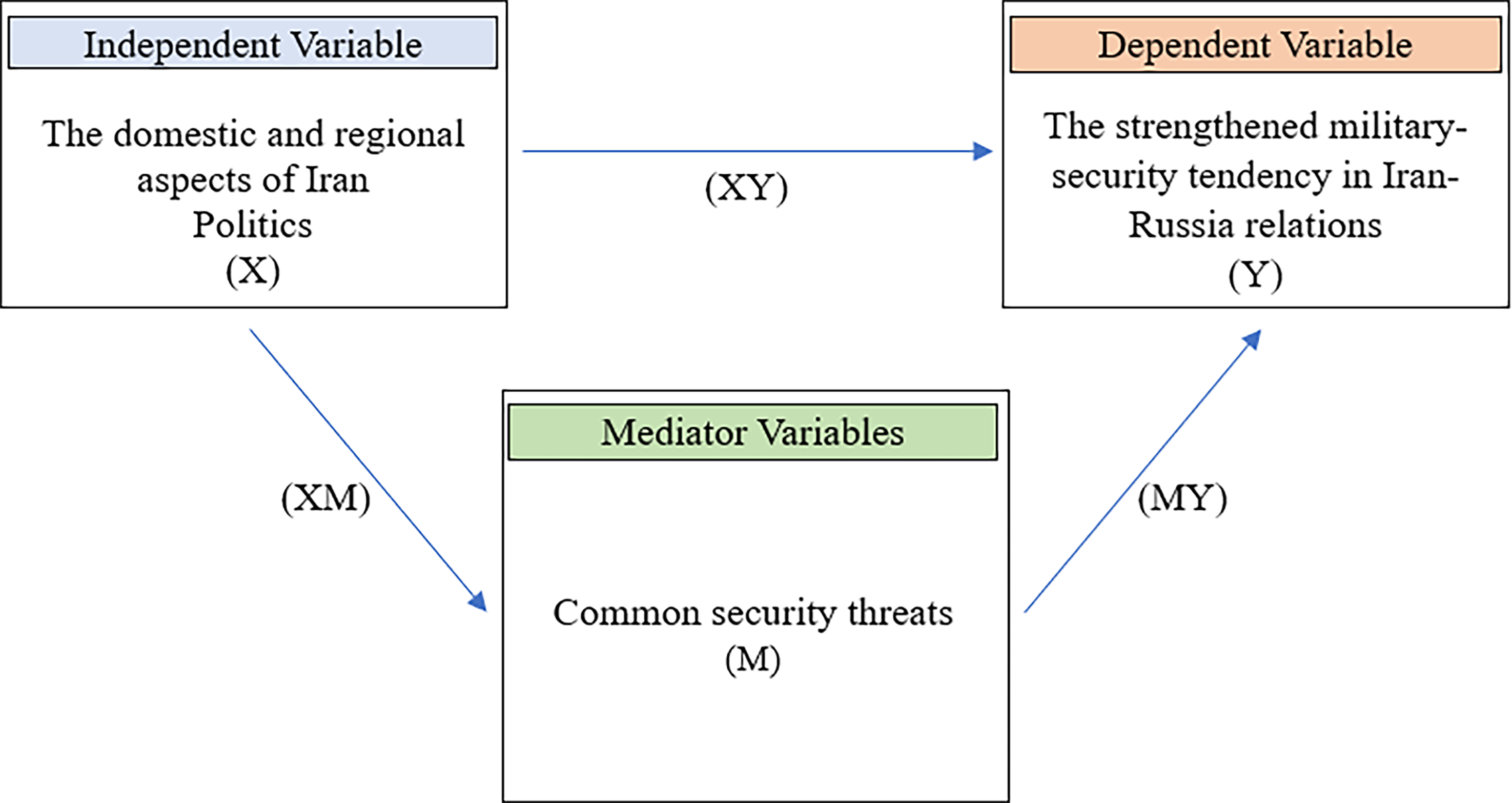
Results
A review of the existing literature on the factors influencing Iran–Russia relations and guiding them towards military-security cooperation reveals several underlying factors contributing to the expansion of the military-security aspect in Tehran–Moscow relations.
The Domestic and Regional Aspects of Iranian Politics
This section presents the findings on the transformation of Iran’s political landscape through three key dimensions that have shaped its domestic governance and regional posture. First, it documented the systematic militarization of Iranian politics, tracing how IRGC commanders progressively dominated executive cabinets (peaking under Ahmadinejad and Raisi), parliamentary blocs (particularly the 11th–12th Majlis), and provincial administrations since 2005—with Rouhani’s presidency (2013–2021) serving as a temporary exception to this trend. The military-inclined culture and discourse in Iran’s politics have been strengthened by several factors: the culture of revolutionary resistance through militarism, fueled after the Iranian 1979 Revolution and manifested in the establishment of the Islamic Revolutionary Guard Corps, the Iran–Iraq War (1980–1988), and the entry of military commanders into foreign and domestic policy establishment and economic activities. These factors have led to a prominent presence of military figures in various formal and informal political, economic, and social arenas in present-day Iran.
Second, it examined Iran’s security-centric policy rhetoric, demonstrating how the leadership’s securitized discourse framed Russia as an indispensable ally against Western threats, particularly through military cooperation. The common enmity with the unipolar international system and resistance against Western hegemony, led by the United States, has led to the viewpoints of Iranian high-ranking military and political figures, as well as Russian leaders, aligning at times.
Third, it assessed Russia’s strategic backing of Iran’s nuclear program since the 1990s, highlighting Moscow’s consistent diplomatic protection and technical assistance despite Western pressure.
Together, these elements revealed how Iran’s internal militarization and external alignment with Russia became mutually reinforcing processes. The IRGC’s political ascendancy correlated with deeper security cooperation with Moscow, particularly in Syria and nuclear negotiations, while Russia’s support enabled Tehran to withstand international isolation. These domestic-regional linkages fundamentally shaped Iran’s security priorities and foreign policy trajectory during the studied period.
Elite Militarization of Politics
The military’s role in Iran’s domestic politics was not very noticeable until the mid-2000s. After the arrival of Mahmoud Ahmadinejad’s administration (from August 3, 2005), the Revolutionary Guards openly stepped into policy-making at the macro level and now have a prominent presence in the domestic political arena (Ikder, 2021).
With 11 military personnel in his two cabinets (2005–2013), Ahmadinejad has had the most militaristic government of the Islamic Republic so far: eight military figures were in his first government (2005–2009) and six commanders were in his second government (2009-2013) (Ghazi, 2021).
Hassan Rouhani’s cabinets (2013–2017 and 2017–2021) only had two military personnel as defense ministers and two others with military backgrounds as the heads of other ministries (Voice of America, 2023).
During Ebrahim Raisi’s 13th administration (August 3, 2021–July 30, 2024), the presence of military personnel in high-ranking posts increased, as commanders were appointed to ministries, governmental organizations, and provincial, county, and district governor positions (Voice of America, 2023). Among the 19 members of his cabinet, five ministers were former commanders of the Revolutionary Guards (Ikder, 2021). Among the 10 vice presidents, three were military personnel (Esmaeil Nejad, 2021; IRNA, 2021; Norouzian, 2021). Two advisors (Tasnim News Agency, 2021) and five special representatives (Government Information Base, 2023; ISNA, 2021; Tasnim News Agency, 2022) of the president were also military figures.
His minister of interior, Brigadier General Ahmad Vahidi, was the deputy of Intelligence of the Joint Staff of the Revolutionary Guards, the former commander of the Quds Force, and the minister of defense in Ahmadinejad’s administration. With the start of Vahidi’s activities in Raisi’s administration, he introduced four commanders of the Revolutionary Guards as provincial governors, all of whom reached governorship (Rouydad News Agency, 2021). Among the 44 people who were named as potential candidates for the governorship of 18 other provinces, at least the names of 35 Revolutionary Guard personnel were noticeable (Ikder, 2021).
Masoud Pezeshkian, the head of Iran’s 14th government (from July 28, 2024), presented two military commanders among ministry candidates of his future administration to the Islamic Consultative Assembly on August 11, 2024, to get a vote of confidence from the Parliament.
The IRGC members’ entry into the Islamic Consultative Assembly (i.e., Iran’s Parliament) has also been one of the main vectors of the militarization of domestic politics in Iran. It began with the seventh term elections of the Islamic Consultative Assembly (2004–2008), but on the eve of the start of the ninth parliament (2012–2016), it was generally and widely raised and supported by hard-liners (Kheyrandish, 2018).
In the ninth parliament, nearly 40 P.M.s had a history of membership in the Revolutionary Guards (Youqoubi, 2016). The 10th parliament (2016–2020) had 18 representatives who were members of the Revolutionary Guards, but the number had decreased significantly compared to the seventh, eighth, and ninth parliaments (Gooya Newsletter, 2019).
In the 11th parliament (2020–2024), nine brigadier generals and 18 colonels of the Revolutionary Guards, along with a few of the highest commanders of the Basij (or Resistance Mobilization Force) and political staff of the Revolutionary Guards, were entered: while in the 10th parliament about 15 Revolutionary Guards commanders and three ordinary members of this institution were active, the number of Revolutionary Guards commanders in the 11th parliament raised to more than 30, and also some of the former members of the Quds Force, the extraterritorial branch of the IRGC, entered the parliament (Kheyrandish, 2018).
Mohammad Bagher Ghalibaf, the speaker of the 11th parliament, was a brigadier general of the Revolutionary Guards. About two-thirds of the parliament’s presidium were commanders and members of the Revolutionary Guards and Basij, and the parliament’s leading figures were mainly IRGC members (Veysi, 2020).
In the 12th parliament (from 2024), with the election of 5 brigadier generals of the Revolutionary Guards in the second round of the elections, the number of members of the IRGC in the parliament reached 28 people, plus 23 members of the Revolutionary Guards and law enforcement forces who had already entered the parliament in the first round of the elections (Iran Wire, 2024).
Security-Centric Policy Rhetoric
The domestic discourse of Russia’s role in Iran’s politics reflects a complicated interplay of geopolitical alignment and ideological debates within Iran. Iran’s security-centric policy rhetoric—characterized by the dominance of militarized discourse in governance—has reinforced its inclination toward Russia as a strategic partner, driven by shared anti-Western alignment and defense needs. Analyses of Iranian leadership speeches reveal frequent securitized language framing the U.S. and NATO as existential threats, justifying reliance on Russia for advanced arms and joint military exercises.
Seyyed Ali Hosseini Khāmenei, Iran’s leader, who has been the principal architect of the country’s overarching policies, including its foreign policy, over the past several decades, has on numerous occasions pointed to decades of U.S. threats against Iran: “America’s confrontation with Iran, from the beginning of the [1979] Revolution up to now, under various pretexts—such as human rights, democracy, women’s rights, enrichment, the nuclear issue, or missile capabilities—has all been mere pretext-seeking. In reality, they seek nothing but Iran’s surrender.” (Khamenei, 2025a).
He has further noted that Iran’s 1979 Revolution “snatched the ‘America-desired Iran’ out of their grasp, yet America still longs for that Iran,” while highlighting Washington’s sanctions against Tehran, which “aimed to bring Iran to its knees economically”—referring to the damage these sanctions have inflicted on the country (Khamenei, 2025b).
He considers long-term cooperation between Iran and Russia to be profoundly beneficial for both countries, stressing that global events underscore the need for ever-increasing cooperation between the two nations: “Cooperation between the two countries must reach its peak…” (Khamenei, 2022a).
This rhetoric aligns with the Iranian conservatives, hardliners, and military-security officials of the Islamic Revolutionary Guard Corps’ (IRGC) political ascendancy, where security elites advocate deeper ties with Moscow and view Russia as an indispensable ally against Western pressure. High-ranking military commanders in the General Staff of the Armed Forces, the Ministry of Defense, the IRGC, and the Army (Artesh) generally comment on or express opinions regarding Russia that align with the Leader’s views. For example, Major General Mohammad Bāqeri, Chief of Staff of the Armed Forces of the Islamic Republic of Iran, described the reciprocal ties as strategic, deep, and long-term, which will not be disrupted by changes in governments (Donya-ye Eqtesad, 2024).
Similar views among Iranian officials and politicians regarding Russia’s role in the issue of Iran’s nuclear diplomacy are evident. Foreign Affairs Minister Abbās Arāqchi says, “We are delighted with Russia’s role in the JCPOA [Joint Comprehensive Plan of Action] agreement, and they played a very beneficial and important role in the past” (IRNA, 2025). Hasan Beheshti Pour, an independent political analyst, believes that “in the matter of defense cooperation, Iran and Russia can complement each other and share mutual experiences” (Khamenei, 2022b).
Political and Security Support: The Case of Iran’s Nuclear Program
The two states’ regional and global political collaboration has been affected by Iran’s nuclear program and Russia’s involvement in it. In May 1995, President Yeltsin rejected President Clinton’s request to withdraw from a $1 billion sale of a light-water nuclear reactor to Iran. The Russians also disclosed in September 1995 that they had signed a new contract to construct two more nuclear power reactors in Iran, increasing the total value of the agreements to $2 billion. It was vividly illustrated to the Iranians when Moscow defied pressure from Washington to revoke the nuclear power reactor agreements (Tarock, 1996, p. 210).
The West felt that Russia was supporting Iran’s development of nuclear weapons, and sanctions were imposed on Russian businesses suspected of being involved (Belopolsky, 2009, p. 102). Since the mid-2000s, international powers have engaged Tehran in negotiations and discussions aimed at addressing the nuclear issue. In addition to cautioning the West against any potential assault on Iran (Parker, 2016), Russia pushed against a resolution demanding military action based on Chapter VII of the UN Charter while defending Iran in the U.N. Security Council. It warned about the need to avoid unilateral actions outside the Security Council’s framework to stop the West from attacking Iran’s nuclear facilities.
The 2012 suggestions by Russia set the stage for new negotiations between Iran and the P5+1, which included the five permanent members of the UNSC and Germany, who actively participated in the nuclear talks with Tehran (Bekkevold, 2018, p. 151). Providing the required framework for a comprehensive nuclear agreement concluded in 2015 was the most significant component of the political collaboration between Iran and Russia (Topychkanov, 2016, p. 33). The Kremlin was also a key player in the negotiations for the multilateral agreement on Iran’s suspension of uranium enrichment, reached in July 2015 (Rodkiewicz, 2019, p. 2). Russia has regularly been accused of being Iran’s defense counsel, strategic partner, arms supplier, and energy dealer since the JCPOA was adopted in 2015.
On May 8, 2018, then-US President Donald Trump announced America’s withdrawal from the Iran nuclear deal. This unilateral decision was strongly condemned by Russia, which said it demonstrated Washington’s unreliability as a negotiator. The ongoing disputes between Russia and the West have occasionally led to Moscow showing more substantial support for Tehran’s nuclear program.
Common Security Threats
Iran and Russia, following the collapse of the Soviet Union, have identified regional stability and security as a common area in their relations and share a relatively similar understanding of its requirements, especially at the global level. Although there are differences between the two regarding security in the Middle East, particularly in Palestine and the Persian Gulf, overall, security due to the determining factor of Islamist terrorism and the activities of jihadist forces around the borders of these two countries and Iran and Russia’s concern of the spread of terrorism in the radicalism-prone Middle East, South Caucasus, and Central Asia and especially the entry of terrorism into the territory of these two, which has also happened repeatedly in the past, has been one of the most important contexts for military-security cooperation between Tehran and Moscow.
An important mediating factor commonly perceived as a significant threat is the presence of the West, especially the United States, in the regions around these two countries, specifically in the Middle East and Eastern Europe. The proximity of the United States’ military presence and economic-social activities to the borders of Iran and Russia poses a threat to Washington’s relations with Tehran and Moscow’s neighbors, challenging the national and supranational interests of these two countries.
Iran and Russia, in response to these two threats, have had military-security cooperation in three periods of their mutual relations history: the 1990s, the mid-2010s, and the early 2020s.
Regional Instability in the 1990s
In the 1990s, Iran and Russia cooperated on security in Central Asia, particularly in Tajikistan and Afghanistan. Despite concerns about Iran’s religious influence, Iran often aligned with Russia’s security priorities. They jointly supported the same side in Tajikistan’s civil war, with Iran playing a key role in ending the conflict in 1997 (Blank, 2017). Their cooperation was crucial during regional crises, such as the 1992–1994 Azerbaijan–Armenia conflict over Nagorno–Karabakh, where they tacitly supported Armenia to curb Turkey’s influence. In the 1990s, they also cooperated in Afghanistan to support the Northern Alliance against the Taliban.
During the Chechen wars, Iran, then head of the Organization of Islamic Cooperation, supported Russia’s observer status in the organization and provided cover for Russia against criticism from Muslim countries. With its extensive cultural and religious influence, Iran has cooperated with Russia on security matters, including the conflict in Chechnya (Tarock, 1996, p. 214). This cooperation extended to military aspects, with Iran purchasing significant Russian armaments in the early 1990s (Belopolsky, 2009, p. 107; Naseem & Mahmadov, 2018, p. 98).
The Challenge of the Proximate U.S. Presence
Despite ideological and religious differences, Iran and Russia jointly oppose Western hegemony and seek to limit Western influence. Russia supports the rise of emerging powers and “new centers of power” such as China, ASEAN nations, Brazil, South Africa, India, and Iran (Charap et al., 2021, p. 153). Since 1979, Iran has sought to establish international norms that reflect its worldview and views Russia as a critical ally in challenging Western supremacy.
Iran and Russia, both alternative political systems to the Western model, align in their resistance against Western global norms and threats from the West (Eslami & Papageorgiou, 2020, p. 17; Flanagan, 2013). They cooperate to restrict U.S. influence in Central Asia and the Caucasus and counter Taliban extremism in Afghanistan (Jalali, 2001).
Their cooperation is expected to continue as long as tensions exist between Tehran and Washington, and between Russia and the West (Tarock, 1996, p. 221). Iran’s geopolitical position necessitates attention to events in its periphery, including U.S. military presence and Israel’s increasing military cooperation with Azerbaijan.
The growing U.S. presence in the region has led to shared concerns for Tehran and Moscow, prompting increased cooperation. Despite ending the Cold War’s spheres of influence, Moscow continued to seek connections with Iran due to its anti-American stance (Golan, 1992, p. 47). Both states view the U.S.-backed Arab–Israeli alliance as a threat to their interests (Truevtsev, 2022). The Abraham Accords, urging Arab governments to partner with Israel, are seen by Iran as an attempt to establish an anti-Iran front (Behravesh & Azizi, 2020). It, along with U.S. relations with Arab countries, weakens Russia’s role in the Middle East.
Middle Eastern geopolitics favors increased cooperation between Iran and Russia. Moscow needs Iran for its regional strategy, and Iran, with its anti-American stance, is a suitable partner. U.S. military deployments in Afghanistan and Iraq have led to mutual threat assessments between Russia and Iran (Naseem & Mahmadov, 2018, p. 105). Both countries aim to establish a more comprehensive Middle Eastern order and reduce U.S. influence.
In the eyes of Iran’s Leader, Seyyed Ali Khāmenei, he and Russian President Vladimir Putin face a common threat, which makes Iran and Russia natural allies that should pool resources to protect themselves in a hostile strategic environment. Thus, any problems and conflicts of interest that might stand in the way are deemed minor and should be resolved to achieve the more significant strategic objective of ensuring state security (Vatanka & Divsallar, 2023).
The Strengthened Military-Security Tendency in Iran-Russia Relations
Iran’s inclination toward military affairs and security discourse in its domestic and foreign policies has contributed to emphasizing military-security aspects in its relations with Russia (dependent variable). When security concerns take center stage, they often shape the tone and priorities of diplomatic interactions.
Iranian hard-liners see Putin’s Russia as a supporter of Iran’s revolutionary agenda (Faghihi, 2018). While Washington designated the IRGC as a Terrorist entity in April 2019, Moscow took a different approach, emphasizing the Revolutionary Guards’ importance in maintaining stability in Iran and acknowledging their role in shaping that country’s national, regional, and international policies (Therme, 2022).
For Tehran’s military and political leaders, closer relations with Moscow are seen as an insurance policy against the West; thus, the regime’s internal dynamics are increasingly leaning towards Russia.
Iran’s expanded military-security inclination toward Russia can be explained by its four-decade history of arms purchases from Moscow and increasing strategic alignment perceptions materialized in Syria and Ukraine.
Increasing Arms Purchases
After the fall of the Shah in 1979, the Islamic Republic of Iran sought to secure itself by purchasing conventional arms mainly from China, North Korea, and, despite prickly bilateral relations, the Soviet Union (Beehner, 2006), with which it developed a close cooperation since the late 1980s (Jalali, 2001). In June 1989, they negotiated a major arms deal and agreements on trade, economic, and scientific-technical cooperation (Eisenstadt, 2001), which resulted in nearly $1.9 billion in equipment from Moscow between 1990 and 1993 (Every CRS Report, 2003). Since 1994–1995, various Russian individuals and entities have been assisting Iran’s missile programs (Eisenstadt, 2001), which helped Iran to accelerate its medium-range ballistic missiles development, manufacturing, and deployment (Speier et al., 2000)
Russian and Iranian officials met in early 1997 to discuss new arms deals (Gertz, 1997a, 1997b; Korotenko, 2001). Five Mi-17s were eventually transferred to Iran in January 2000 (Iran Times, 2000). In the 2000s, Russia delivered 750 SA-15 Gauntlet short-to medium-range surface-to-air missiles (Arms Control Association, 2010) and 29 Tor-M1 air defense systems in December 2005, valued at $700-900 million (Kassianova, 2012). Between 2000 and 2006, Tehran only made two major purchases from Russia—air defense systems and Su-25 ground attack aircraft—(The Iran Primer, 2023). In December 2007, Iran confirmed that Russia had agreed to deliver the S-300 air defense system (Harding, 2007). However, Iran received the $800 million S-300 missile systems in late 2016 due to international sanctions and strong objections from the United States and Israel (Cook, 2024).
From 2022, this relationship has evolved as Russia’s military struggles in Ukraine have pushed it to purchase Iranian UAVs and kamikaze drones (Mahmoudian, 2023) and allegedly Fateh-110 and Zolfaghar ballistic missiles (Salisbury, 2022). In exchange, Russia is now providing an unprecedented level of military and technical support to Iran (Kube & Lee, 2022), including arrangements for Iran’s acquisition of Su-35 multirole fighters, Mil Mi-28 attack helicopters, and Yak-130 jet trainers for its regular armed forces, which have been finalized (Tasnim News Agency, 2023).
Russia’s involvement in Ukraine has driven it to acquire Iranian weapons and military equipment. Since February 2022, Iran has provided Moscow with over 2,000 Shahed-136/131 kamikaze drones and 18 Mohajer-6 drones (Martynyuk, 2024). Iran’s Shahed-136 drones, priced at $20,000−$40,000 per unit, have generated millions in revenue for Tehran, with over 2,000 sold to Russia (Citrinowicz, 2024). The Prana Network recently claimed to expose Iran’s $1.75 billion arms deal agreement with Russia (Shokri, 2024). Russia reportedly paid for some imports in gold, with Alabuga Machinery transferring 2 million grams of gold to Sahara Thunder in February 2023 (Brennan, 2024). While Iranians have trained Russians on using the Fateh 360, dozens of Russian military personnel have been trained in Iran to operate the missile system (Lopez, 2024).
In return, Russia has reportedly agreed to provide Iran with Su-35 fighter jets and advanced air defense systems, at an estimated price tag of $9 billion (Weir, 2024). Some equipment, such as Yak-130 training aircraft, has already been delivered (Martynyuk, 2024).
The expansion of military cooperation between Russia and Iran has also been reflected in the growing presence and activity of Russian military firms in Iran. Rosoboronexport, Russia’s state-run arms exporter under Rostec, operates in Iran, while other Rostec subsidiaries like Kamaz, Uralvagonzavod, and United Aircraft Corporation—alongside firms such as Almaz-Antey, Tactical Missiles Corp., and United Shipbuilding Corp.—likely engage in military-technical cooperation with Tehran (Notte & Lamson, 2024: 26).
Since 2022, military cooperation has been guided by several agreements: the 2015 defense pact, a 2023 security-intelligence cooperation agreement, a 2023 agreement on improving cooperation between the two sides’ ground forces, and a 2024 memorandum of understanding to increase cooperation in unspecified “strategic” areas (Notte & Lamson, 2024: 22). From 2021 to 2024, they negotiated a new 20-year strategic agreement—covering military and technical ties—replacing the 2001 pact in January 2025.
Military Cooperation in the Context of a Strategic Alignment
The strategic alignment between Iran and Russia has been solidified through their shared experiences in Syria and Ukraine, where both states have cooperated to counter Western influence while advancing their regional interests. These conflicts underscored their alignment as pragmatic, driven by immediate geopolitical needs, with Syria serving as a model for military coordination and Ukraine revealing the limits and opportunities of their economic-defense trade-offs.
Iran, a vital actor in the region, is a significant partner for Russia, particularly in combating Sunni extremism and jihadist terrorism (Kozhanov, 2017). This cooperation is crucial in their operations in Syria and efforts to combat ISIS. In Syria, their military partnership—evidenced by joint operations, Iranian ground forces backed by Russian airpower—demonstrated a functional division of labor to preserve the Assad regime, reinforcing mutual trust in security collaboration.
While Moscow believed no long-term solution in Syria could be reached without Iran, they shared a common interest in maintaining al-Assad in power in Damascus. Moscow entered the Syrian theatre when Western sanctions reached an unprecedented level, aiming to decrease the U.S. role in the Middle East (Yacoubian, 2021). Iran and its Shiite allies supported the Syrian government, and Iran has permitted Moscow to use their airspace for missile strikes in Syria (Trenin, 2016). Analysts view the 2015 security cooperation in Syria as a peak in Iran-Russia relations, driven by shared security interests, strengthening the Russia–Iran relationship while contributing to greater coherence.
General Qasem Soleimani, the then-commander of Iran’s Quds Force, traveled to Moscow in July 2015 to facilitate and coordinate Russia’s entry into the military conflict in Syria (Dixon, 2020). Soleimani’s decision to allow Russian warplanes and missiles to transit Iranian airspace to target groups in Syria, as well as using aircraft of the state-run airlines to transport military materiel and personnel to Syria (Fassihi, 2021). The Iranian political-military governmental apparatus even allowed Russian warplanes to take off from the Hamedan Airbase to strike ISIS targets in 2016 (Eqbali & Fitch, 2016).
In Ukraine, Iran’s provision of drones to Russia and Moscow’s reciprocal diplomatic shielding of Tehran at the UN highlighted a transactional yet deepening alliance, where both leverage each other’s resources to mitigate isolation under Western sanctions.
The significant developments in Russia-West relations, starting with Russia’s 2014 military intervention in Ukraine (undertaken to protect its interests), are a turning point in Iran’s standing from the perspective of Russian researchers, to the extent that, for example, Fyodor Lukyanov, Chairman of the Council on Foreign and Defense Policy, admitted that “the relationship between Russia and Iran has grown far more intense than anyone could have imagined a couple of years ago” (Weir, 2024). In the context of sanctions pressure and changes in the global geopolitical situation, cooperation between Russia and Iran is acquiring strategic importance (Kurbanova, 2024: 259).
Russia’s 2023 foreign policy doctrine identifies the U.S.’s destabilizing role as a threat to its interests in Eastern Europe, particularly in Ukraine (Ministry of Foreign Affairs of the Russian Federation, 2023, p. 5). Post-2014 events in Ukraine and Western sanctions led Russia to prioritize cooperation with non-Western governments. Iran, despite its neutral stance on Ukraine, saw the growing Russia-West conflict as an opportunity to strengthen ties with Moscow. This allowed Iran to boost cooperation with Russia. Iran’s strengthened military cooperation with Russia includes the sale of kamikaze drones and missiles (Eslami, 2022; Warrick et al., 2022), positioning Iran as a significant supplier of weapons and shifting the international geopolitical balance (Eslami & Vieira, 2022). The conflict in Ukraine has ushered in unprecedented security cooperation between Iran and Russia, with Russia using Iranian drones for attacks.
Discussion
Consistent with Balance of Threat Theory (Walt, 1987), this research hypothesized that “The domestic and regional conditions of Iran, through common security threats for Iran and Russia, have strengthened the military-security tendency in Iran-Russia relations.”
Balance of Threat Theory provided strong theoretical support for this hypothesis through three key findings:
First, regarding the independent variable, Iran’s militarized elite (i.e., the significant presence of Iranian military commanders in foreign and domestic policy apparatuses such as the cabinet and parliament) and security-centric policies frame the U.S. and its regional allies as existential threats. In contrast, regional instability stemming from U.S. military presence further exacerbates Iranian insecurity, factors that Walt’s model identifies as crucial in shaping threat perception and alliance behavior.
Second, examining the mediating variable, both nations face common security threats stemming from regional instability due to radical Islamist terrorism. At the same time, they confront common security challenges posed by the U.S. and NATO military presence in their vicinity in the Middle East, South Caucasus, Central Asia, and Eastern Europe, conditions that Walt’s theory predicts would drive alliance formation.
Third, the dependent variable manifests in concrete military-security cooperation, including Russian S-300 missile sales, joint operations in Syria, and drone sales to Russia—outcomes consistent with Walt’s framework, which anticipates that states facing common threats will prioritize military alliances.
The author operationalized each variable and examined and analyzed the collected data to demonstrate the relationship between the independent and dependent variables through an observable mediating factor. The researcher demonstrated that the domestic and regional political conditions in Iran, as well as shared common security threats with Russia, have strengthened the military-security tendency in Tehran–Moscow relations, as evident in the data analyzed during the present research.
Ultimately, Balance of Threat Theory not only confirms the hypothesis by demonstrating how Iran’s security perceptions and shared threats with Russia produce military-security-dominated relations but also provides a robust explanatory framework for understanding why the partnership remains fundamentally security-oriented.
The primary factor influencing the military-security-oriented focus in Iran–Russian relations is the common security threats in the regions surrounding the two countries, which stem from the activities of regional non-state and extra-regional state actors. These threats include the risk of the growth and entry of Islamic extremism into Iran and Russia, as well as the threat arising from the military presence of the United States and NATO in the region. These findings are confirmed by Czulda (2023), who highlighted the growing threat of Sunni jihadists and ethnic separatists, which could potentially destabilize Iran. Hahn (2007) further underscores the potential for a more considerable Muslim challenge to Russia’s stability, particularly in the North Caucasus, and the need for effective policy responses. Grabowski (2021) suggested that foreign terrorist fighters returning from the Middle East pose a potential threat to Russia. Also, Nagornyi and Popov (2022) highlighted the danger posed by radical religious groups, particularly Wahhabists, and the role of foreign non-profit organizations in spreading extremist ideology.
On the other hand, the threat of U.S. proximity to Iran is a complex issue involving a combination of economic sanctions, propaganda, and covert operations, as confirmed by Torbat (2020). The U.S. presence in Russia’s neighboring regions, mainly Central Asia and the Southern Caucasus, has been a source of tension and concern for Russia (Giragosian, 2004; Kanet, 2010).
The security discourse (in response to the constant perceived existential threats) and the revolutionary nature of governance in Iran (promoting resistance and confrontation against the West) are factors that make security a fundamental matter in Iran–Russia relations. Several factors, including the prominent presence of the security discourse and military figures’ upper hand in Iran’s political arena, which traditionally has a better inclination to Russia and China compared to the West, the attractiveness of Russian military weapons for Iran, and also the necessity of Russia’s support for Iran against the hard power of the West are influential in the constant growth of Iran-Russia security relations. The Iranian regime’s support for Russia is evident in their collaboration in various fields, as endorsed in research by Nemets and Kurz (2009). Grajewski (2021) also indicated the Iranian hard-liners’ support for Russia in various ways. The Iranian regime, in turn, seeks diplomatic support and technology from Russia and China to maintain its grip on power, as confirmed by Vatanka (2015).
Conclusion
The present study aimed to elucidate the dominance of the military-security tendency in Iran–Russia relations, thereby illuminating the role of multiple factors in understanding the relationship between the two countries based on an investigation of the domestic and regional aspects of Iranian politics.
The findings are theoretically significant, as they provide robust empirical validation for Stephen Walt’s Balance of Threat Theory (1987) by demonstrating its explanatory power in the context of Iran–Russia relations. The findings confirm that shared security threats drive an increased military-security cooperation between the two states, reinforcing Walt’s core argument that alliances form in response to perceived threats rather than mere power imbalances. Additionally, the research extends the theory by highlighting how domestic factors, particularly Iran’s militarized elite and security-centric governance, amplify threat perceptions and shape alliance behavior. Focusing on existential threats (e.g., radical terrorism, U.S. sanctions, and regional proximity) and the military-security tendency (e.g., arms deals and joint operations), the present research theoretically refines Walt’s framework, making it more applicable to hybrid regimes and ideologically driven states.
Also, these findings have practical significance for policymakers, particularly in understanding the unintended consequences of coercive strategies. The research demonstrates that U.S. sanctions and military posturing in the Middle East and Eurasia have paradoxically strengthened Iran–Russia security ties, prompting both states to deepen their military collaboration. This dynamic is evident in arms transfers (e.g., S-300 missiles, drones) and joint operations in conflict zones like Syria. For regional stability, the study underscores the risks of policies that amplify threat perceptions, as they may consolidate adversarial alliances rather than isolate target states. Additionally, the analysis suggests that counterterrorism efforts, if perceived as geopolitical encroachment, can inadvertently foster closer military cooperation among rival states.
The study findings have implications as they challenge conventional liberal assumptions that economic interdependence naturally moderates security competition, showing instead that existential threat perceptions can override economic incentives. This has broad consequences for international relations, particularly in explaining why Iran and Russia prioritize military collaboration despite limited trade ties. For Western policymakers, the findings suggest that containment strategies may backfire by reinforcing threat narratives and solidifying opposing alliances. The research also highlights the role of ideological factors—such as Iran’s “resistance discourse”—in institutionalizing threat perceptions and making diplomatic resolutions more difficult. These insights call for a reassessment of policies that rely heavily on sanctions and military deterrence, advocating instead for strategies that address underlying security concerns.
In terms of application, this study’s framework can be applied to predict and analyze emerging security alliances in regions where shared threats exist. For instance, the growing Iran–Russia–China axis in response to the U.S. Indo-Pacific strategy could be examined using similar variables. Additionally, the findings offer practical guidance for conflict mitigation, suggesting that reducing perceived threats (e.g., through confidence-building measures or diplomatic engagement) could weaken the rationale for military partnerships. The research also provides a methodological template for analyzing security alliances in other contexts, particularly where domestic elite structures and ideological narratives shape foreign policy decisions.
This research makes several key contributions to the field of international relations. Empirically, it provides a systematic test of Balance of Threat Theory in a non-Western context, using Iran-Russia relations as a case study to validate and refine Walt’s propositions. Methodologically, it demonstrates how to operationalize complex variables, such as “shared threats” and “militarized elites,” in both qualitative and quantitative research. From a policy perspective, the study cautions against overreliance on coercive measures, demonstrating how sanctions and military containment can strengthen rather than weaken adversarial alliances.
Future research could expand on this study by examining how ideological alignment—such as shared anti-Western narratives—further reinforces security cooperation between Iran and Russia, particularly in regions like Central Asia or the Caucasus. A comparative analysis with other threat-driven alliances (e.g., China-Russia) could test the generalizability of Balance of Threat Theory across different geopolitical contexts. Additionally, quantitative studies could measure the correlation between specific threat levels (e.g., U.S. military deployments, severity of sanctions) and the scale of military collaboration (e.g., arms trade volume, frequency of joint exercises). Exploring how economic incentives (e.g., energy trade) might eventually mitigate security-centric relations could also provide insights into the conditions under which threat perceptions diminish. Ultimately, fieldwork or elite interviews with Iranian and Russian policymakers could reveal the nuanced decision-making processes behind alliance formation.
Footnotes

Funding
The author received no financial support for the research, authorship, and/or publication of this article.
Declaration of Conflicting Interests
The author declared no potential conflicts of interest with respect to the research, authorship, and/or publication of this article.