



Abstract
Despite a growing trend of using multimedia to enhance online news and audience engagement, little is known about the actual benefit of such a practice. Empirical evidence regarding multimedia effects on user evaluations of news websites has been mixed and scanty. The current undertaking utilizes theoretical frameworks from modality and vividness effects research as well as the congruency/incongruency literature in an effort to bring greater insight into effects of multimedia enhancements on user responses. A 3 × 3 factorial experiment was conducted with multimedia use and multimedia congruency serving as two between-subjects factors. User perceptions were gauged through attitudes and behavioral intentions toward a news website. As the results indicate, multimedia elements serve to appeal to news consumers. However, online journalists need to consider the limitations of blending multimedia with text, including a ceiling effect on evaluations and possible side effects of incongruent multimedia on news processing.
Technological advances have enabled more vivid presentation of information in web settings. These advances include multimedia capability, which allows the combination of content across formats (text, photos, graphics, animation, audio, and video) within a single platform. Multimedia, along with interactivity or customization, became the defining features of online journalism. Despite a growing trend of using multimedia to enhance news content (Jacobson, 2012; Karlsson & Clerwall, 2012), little is known about the actual benefit of this practice. In many cases, the inclusion of multimedia is based on the intuitive thoughts, even afterthoughts (Yaros, 2009). Meanwhile, incorporating multimedia into a user-controlled system remains a challenge, especially when it comes to communicating a coherent news message (Schumacher, 2005).
Multimedia research has heavily focused on learning and memory benefits (Mayer, 2001; Rockwell & Singleton, 2007), while overlooking multimedia effects on evaluative outcomes. Some online journalism studies have addressed cognitive effects of multimedia news (Tran, 2012; Opgenhaffen & d’Haenens, 2011; Pipps, Walter, Endres, & Tabatcher, 2009). Nevertheless, empirical evidence regarding the impact of multimedia enhancements on perceptions of news sites and other web-based mass communication platforms has been mixed and scanty (Appiah, 2006; Coyle & Thorson, 2001; Kiousis, 2006; Sundar, 2000). Although multimedia design is important to audience engagement with online news, it remains unclear if it is worth it to spend money and effort blending multimedia and text in reporting and whether news users appreciate such integrations.
The current undertaking is a step toward filling that gap. While most previous work has merely looked at multimedia use as the single source of influence on perceptions of news sites (Kiousis, 2006; Sundar, 2000), this study takes into account two other related variables: perceived vividness and congruency. In doing so, the author hopes to contribute to a more nuanced understanding of multimedia effects as evidenced through evaluative responses. Findings from this study also inform journalists and news organizations about the pros and cons of using multimedia to enhance online news.
Multimedia
Although the ambiguous nature of the term might cause some confusion (Jacobson, 2010), several journalism scholars associate multimedia with multimodality (Deuze, 2004; McGregor, 2003; Opgenhaffen & d’Haenens, 2011). This conceptualization of multimedia has been adopted in human–computer interaction research. According to Hoogeveen (1997), multimedia can be defined as “a property of a system or object, indicating that multiple perceptual representation media” (p. 151) are used in an integrated manner. The term implies both multisensory processing and multimodal transmitting of a message (Marmolin, 1991).
The widespread adoption of multimedia has been driven by the belief that adding multimedia leads to positive effects on message receivers. This argument received empirical support in the multimedia learning literature. Mayer (2001) and colleagues have demonstrated the advantages of multimedia instruction as well as cognitive principles moderating multimedia effects on learning enhancement. In journalism studies, some scholars have detected multimedia effects on knowledge or memory (Opgenhaffen & d’Haenens, 2011; Pipps et al., 2009).
Although the purpose of news presentation is mostly informational, design considerations also pertain to the appeal of news content. In reality, multimedia enhancements are often used in the newsroom to engage online audiences (Dimitrova & Neznanski, 2006), thereby increasing page views. Meanwhile, multimedia research has yielded contradictory results when it comes to perceived user satisfaction. Multimedia use on marketing websites has been found to induce positive responses (Appiah, 2006; Coyle & Thorson, 2001). In journalism research, Sundar (2000) documented a negative impact of multimedia enhancements on the processing of story content and perceptions of news websites. However, Kiousis (2006) found that though the availability of multimedia alone might not affect perceived credibility of online news stories, actual use of these features led to a positive impact. The appeal and actual benefit of multimedia use on news sites, therefore, are not well understood.
Theoretical Frameworks
Modality effects research provides a variety of insight in gauging multimedia effects. Modality is a construct referring to the type of channels (text, picture, audio, and video) that are present in a communication scenario (Kalyanaraman & Sundar, 2008). It is also defined as code, which corresponds to the information stored as a result of sensory and perceptual processing of a message (Kalyanaraman & Ivory, 2009; Penney, 1989). Because empirical findings of modality effects are inconclusive, it is beyond the scope of the current undertaking to provide an exhaustive review of this complex literature. The following discussion focuses on two theoretical perspectives that demonstrate the enhancement effects of increased modality.
Media Richness
Daft and Lengel (1984, 1986) propose that richer media (those with the ability to transmit more nonverbal cues for developing meaning) are superior to text-based media, because their information provides substantial new understanding. Rich media allow joint combinations of various verbal and nonverbal modalities upon which people rely to contextualize messages. Leaner media formats with less social cues oversimplify complex topics and restrain the exchange of sufficient information that contributes to understanding. The use of “rich media” was found to remove ambiguities and induce positive effects when it comes to evaluations of a communication platform (Liu, Liao, & Pratt, 2009).
Dual Coding
According to Paivio (1986), the human brain uses two cognitive systems independently when processing information. One system specializes in dealing with verbal information (text and audio), while the other processes nonverbal information (pictures, moving images, and sounds). The underlying proposition is that delivering information to both systems creates more cognitive pathways. Increased modality is advantageous, because it is cognitively more appealing. Research suggests that multimodal presentations stimulating dual coding positively influenced both memory and evaluations of the interface (Hong, Thong, & Tam, 2004).
Taken together, the aforementioned theories point to the psychological appeal of rich media platforms, which deliver information in multimodality. The dynamic presence of multimedia is thought to facilitate greater involvement and engagement among users. Street and Manning (1997) suggested that multimedia enhancements foster positive attitudes toward a system. Although an early study of online news failed to document a positive effect of multimedia on evaluative responses (Sundar, 2000), more recent work found that greater use of modality could lead to favorable perceptions of online media platforms (Appiah, 2006; Coyle & Thorson, 2001; Kiousis, 2006). The present research relies on these new findings to gauge the relationship between multimedia and evaluations of a news website.
Modality-Induced Vividness
Since modality is a structural characteristic of a media platform, it can be correlated with vividness, defined as the way in which information is presented to the senses (Steuer, 1992). Although vividness can be generated through various means, research tends to compare different modalities to determine effects of message vividness (Coupey & Sandgathe, 2000). Steuer (1992) describes vividness as the representational richness of a mediated environment, depending on two variables: sensory breadth and sensory depth. Sensory breadth is defined by the number of sensory dimensions simultaneously presented, whereas sensory depth refers to the quality of the sensory information available in each perceptual channel. In terms of sensory breadth, the engagement of multiple perceptual systems serves to enhance vividness. In other words, presenting online information through more modalities makes it more vivid to Web users.
Online advertising research often operationalizes vividness through multimedia use (Appiah, 2006; Coyle & Thorson, 2001). Applied to the present study, it is expected that blending the text with multimedia enhancements, which engage more perceptual channels (i.e., modalities), would increase the richness of users’ experience, thereby increasing vividness.
Vividness Effects
Research on different media, characterized by different types and combinations of modalities, has been guided by assumptions about vividness effects (Chaiken & Eagly, 1983; Kisielius & Sternthal, 1984). According to Nisbett and Ross (1980), vivid content attracts our attention and excites the imagination. Vivid information is emotionally interesting, personally relevant, imagery-provoking, and sensory immediate, thereby having memory and persuasive advantages over pallid information. Although empirical data on vividness effects are mixed (Smith & Shaffer, 2000; Taylor & Thompson, 1982), the dominant conviction seems to suggest that increased vividness heightens the persuasiveness of information and positive perceptions of the media platform (Appiah, 2006). Applied to the current study, it is predicted that vividness induced by multimedia use would influence users’ evaluations of a news website.
The aforementioned hypotheses point to a possible instance of mediation with multimedia acting as the causal variable, evaluations being the outcomes, and vividness serving as the intervening variable (Baron & Kenny, 1986; Frazier, Tix, & Barron, 2004). Therefore,
Congruency
In online communication research, empirical evidence regarding multimedia effects on user perceptions toward websites remains inconsistent. One reason for the conflicting outcomes might be a lack of attention to the conditions under which the inclusion of multimedia can either enhance or inhibit information processing, thereby affecting evaluative responses. In online news design, there is a certain degree of concern about coherence when multimedia accompaniments are added and combined with text (Schumacher, 2005; Yaros, 2009). Sundar (2000) found that the use of multimedia enhancements negatively impacted evaluations of story coherence.
Highly relevant to coherence is the concept of congruency, which refers to a match or a mismatch when information is presented in multimodality. According to Smith and Shaffer (2000), congruency is the extent to which the vivid elements of a message are congruent with the theme of the message itself. As the congruency/incongruency literature indicates, while congruent presentations involve little elaboration, incongruency triggers higher levels of cognitive intensity (Russell, 2002). Increased elaboration coupled with extreme incongruency might induce an adverse effect on evaluations. Thus, it is reasonable to argue that the degree of congruency between multimedia and the news text would influence evaluative responses.
Meanwhile, the concept of heuristics in psychology offers a different view on effects of multimedia incongruency. As knowledge structures learned and stored in memory (Chen, Duckworth, & Chaiken, 1999), heuristics are mental shortcuts that allow people to make judgments quickly (Kahneman, Slovic, & Tversky, 1982). Faced with massive flows of information in multimedia environments, online users might become “cognitive misers” and rely on expedient shortcuts in reasoning. Multimedia enhancements, due to their vividness, potentially cause enough distraction and prevent message receivers from completely processing the whole story. Because multimedia accompaniments are attentionally favored, the typical news consumer would remain oblivious to the mismatch between multimedia and the news text. Consequently, user evaluations of a news site may not be contingent on levels of congruency between multimedia and the news text.
Taking both theoretical views into account, the following research question is advanced:
Methodology
A posttest-only experiment was conducted to test the study’s hypotheses and research question. This research employed a factorial 3 × 3 design with multimedia (low, moderate, and high) and congruency (incongruent-negative, congruent, incongruent-positive) serving as two between-subjects factors. A sample of 180 mass communication students from a major U.S. university participated in the experiment in exchange for class credit. The majority of the participants were Caucasian (78.8%) and female (78.3%) with the mean age of 20.36.
Stimulus Materials
Each participant viewed three identical international news stories, with variations in the degree of multimedia components presented and level of multimedia-text congruency. The Global Journalist, a fictitious online magazine, featured a homepage with title logo, navigation bar, commercial ads, and clickable headlines of three stories. Each story page inside contained a headline, byline, date line, news text, and extra-text enhancements in the form of multimedia predetermined by condition. The first story, “Peace Paths, War Paths in Mindanao,” provided a mixed picture of the threat of all-out war and the prospect for peace between the Philippine government and the Muslim separatists. The second story, “Poll Shows Snapshot of African Psyche,” reported both challenges and opportunities for development in Africa. In order to ensure ecological validity, the third story, “Rich Nations Agree on Gas Emissions Cuts,” served as disguise. The textual content of each story was one-page long (650–700 words) and verbally identical across all conditions. Only multimedia enhancements were varied in terms of modality and congruency with the news text.
Multimedia
The manipulation of multimedia was accomplished by varying the modality of extra-text enhancements (see Figure 1). The low condition (text only) contained a pull quote (color, bold) accompanying the text. The moderate condition (text + picture) featured a pull quote and a pictorial display in color. The high condition (text + picture + video) included a pull quote, a pictorial display, and a video clip (86–99 s) accessible by clicking on the play button.

Examples of stimulus materials.
Congruency
Although the textual content of each story was two-sided and kept constant across all conditions, the multimedia content was varied with three versions. One version provided congruent information with the text (balanced). The other two versions presented incongruent information with the text by stressing the extreme sides of an issue (incongruent-negative vs. incongruent-positive; see Figure 1). Specifically, the textual content of the Africa story demonstrated both challenges and opportunities for development. The incongruent-negative multimedia included a pull quote that says, “In Africa, average citizens have not seen a significant improvement in their living condition,” a picture of poor, sad-looking women and children, and a video emphasizing extreme poverty, mismanagement, and underdevelopment. Incongruent-positive multimedia comprised a pull quote that says, “We have seen significant strides for democratic liberty and practices here in Africa,” a picture of a young woman with a bright smile, and a video stressing positive changes. In the Mindanao story, the text addressed both threats of all-out war and prospect for peace. Incongruent-negative multimedia consisted of a pull quote, “We are heading to a situation where the peace process has no future. Things are going from bad to worse,” a picture of child soldiers carrying guns and a video clip emphasizing the escalation of violence. Incongruent-positive multimedia elements included a pull quote stating, “There is no alternative to peace. We are confident it (peace) will happen,” a picture of young children waving peace signs and a video stressing hopes for a final peace agreement.
Measures
Vividness
Two instruments (Fortin & Dholakia, 2005; Smith & Shaffer, 2000) were used to assess perceived vividness of the website. The first item gauged participants’ overall impressions of multimedia elements on the website with (1) being not at all vivid and (9) being extremely vivid. The second item asked participants to use a 9-point scale anchored by strongly disagree (1) and strongly agree (9) to respond to the following: “I could perceive a lot of dynamism on this website.”
Site Evaluations
Two evaluation measures were used: attitudes toward the website and behavioral intentions. To index attitudes toward the website, participants used a 9-point Likert-type scale anchored by very poor (1) and very well (9) to indicate how well 11 adjectives describe the news site (Kalyanaraman & Sundar, 2006). Behavioral intentions were measured by a 9-point Likert-type scale anchored by strongly disagree (1) and strongly agree (9) to gauge participants’ response to 2 questionnaire items (“It is very likely that I will return to this site” and “I will return to this site the next time I need information about what is happening in the world”). A 9-point Likert item anchored by absolutely (1) and absolutely not (9) was used to measure participants’ response to the following question: “Suppose that a friend called you last night to get your advice on his/her search for information about nations of the world. Would you recommend him/her to visit this news site?” (Coyle & Thorson, 2001).
Control Variables
As in most online news studies, participants in this experiment were also screened for internet use, age, gender, and race.
Procedure
Participants were asked to review and sign a consent form before accessing the website. An equal number of participants was randomly assigned to each condition. They were told to view the stimulus stories and all available multimedia accompaniments on each story page. After accessing the three stories, participants turned off the computer screen and completed a questionnaire. Upon completion of the experiment, participants were debriefed and dismissed.
Manipulation Check
A pretest was conducted to ascertain the both-sided nature of the textual content and the effectiveness of congruency manipulations in the multimedia content. Twenty participants were randomly assigned to one of three conditions: congruent multimedia, incongruent-negative multimedia, and incongruent-positive multimedia. Participants across all conditions found the textual content of the stories relatively balanced. 1 The manipulation of multimedia congruency proved to be successful. Relative to the text, congruent multimedia were rated as most balanced as compared to two incongruent versions of multimedia accompaniments. 2
Scale Validation
Multi-item scales were averaged to form indices. Reverse-coded items were transformed before being collapsed. All indices, attitudes toward the website (AttitudesSite, Cronbach’s α = .94), behavioral intentions (IntentionsSite, Cronbach’s α = .85), perceived vividness (Vividness, r = .57, p < .01), were found to be reliable.
Results
Effects of Multimedia on Site Evaluations
Multimedia use was a single factor. The dependent variables were AttitudesSite and IntentionsSite with higher scores reflecting more positive evaluations. Because the dependent variables were correlated (r = .59, p < .010), one-way multivariate analysis of variance (MANOVA) was conducted. The analysis found significant differences among the three groups on the two dependent variables (see Table 1). Subsequently, the DISCRIM procedure was used to examine the linear composites of the two outcome variables and gauge the nature of this multivariate effect. Raw canonical coefficients were used to create two variates for Tukey’s honestly significant difference (HSD) post hoc test. According to the results (see Table 2), participants in the low-multimedia group scored significantly lower than those in the moderate and high conditions on the first variate, which weighed on AttitudesSite. The pairwise comparison between the moderate and high groups for the first linear function was not significant (p = .969). No significant differences (p > .05) in group means were found on the second variate, which weighed on IntentionsSite. Thus, greater use of multimedia induced more positive evaluations and this effect was observed most clearly in attitudes toward the website. The results of MANOVA and post hoc tests provided partial support for Hypothesis 1. 3
Summary of MANOVA and MANCOVA Results.
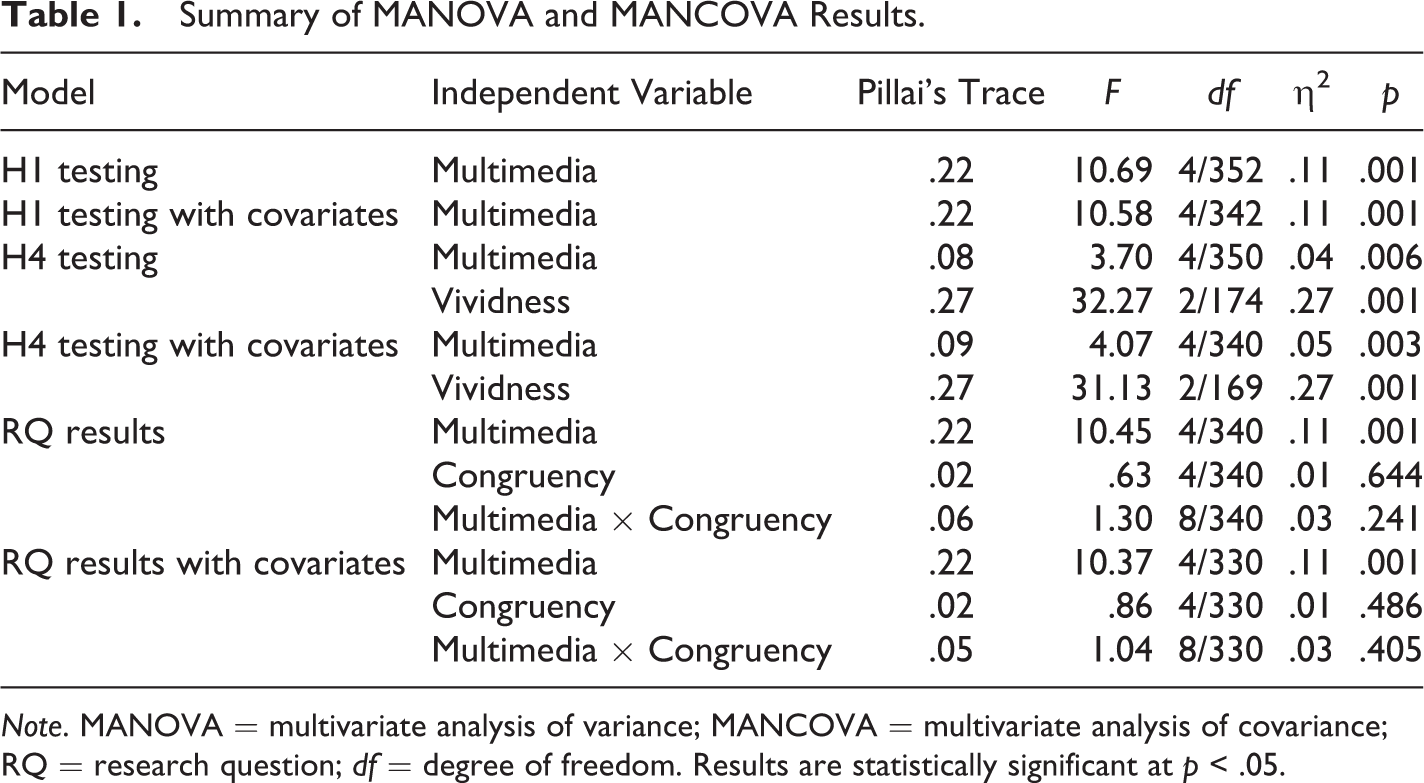
Note. MANOVA = multivariate analysis of variance; MANCOVA = multivariate analysis of covariance; RQ = research question; df = degree of freedom. Results are statistically significant at p < .05.
Differences in Group Means on Site Evaluations and Perceived Vividness.
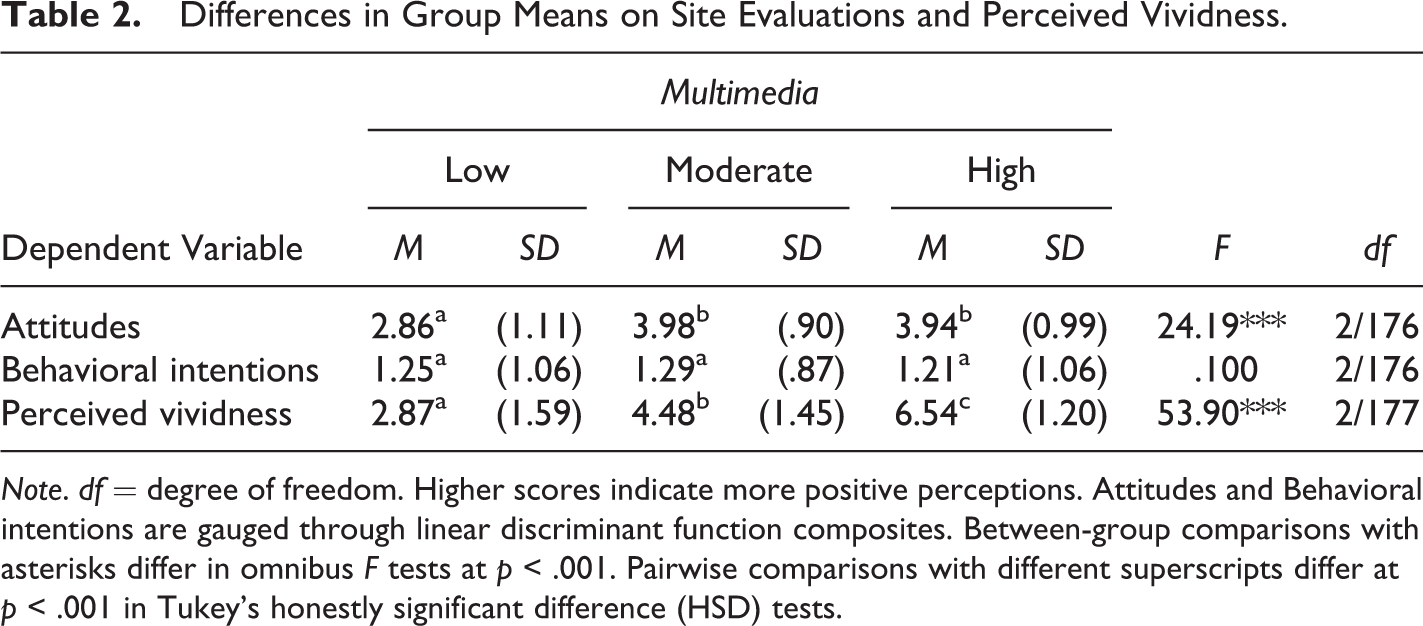
Note. df = degree of freedom. Higher scores indicate more positive perceptions. Attitudes and Behavioral intentions are gauged through linear discriminant function composites. Between-group comparisons with asterisks differ in omnibus F tests at p < .001. Pairwise comparisons with different superscripts differ at p < .001 in Tukey’s honestly significant difference (HSD) tests.
Effects of Multimedia on Perceived Vividness
Multimedia use was a single factor. The dependent variable was perceived vividness with higher scores indicating higher levels of vividness. A one-way analysis of variance (ANOVA) found significant differences between groups, F(2, 177) = 53.90, p < .001, η2 = .38. Tukey’s HSD post hoc test results were straightforward: Greater use of multimedia led to increased perceived vividness (see Table 2). An additional analysis of covariance (ANCOVA) further confirmed the main effect of multimedia, controlling for age, race, gender, and internet, F(2, 172) = 56.31, p < .001, η2 = .40. Thus, full support was found for Hypothesis 2.
Effects of Perceived Vividness on Site Evaluations
The independent variable was perceived vividness. The dependent variables were AttitudesSite and IntentionsSite. Because both input and outcome variables were measured on Likert scales, two sets of hierarchical regression analysis were employed to determine the direct effect of perceived vividness on evaluations, controlling for possible confounds (age, race, gender, and internet use.)
First, perceived vividness was regressed against AttitudesSite. The analysis found a positive relationship between the two variables (b = .52, β = .61, p < .001). Controlling for demographics and internet use, vividness explained 36.2% of the variance in attitudes (p < .001). Increased vividness as perceived by the users led to more positive attitudes toward the website. The second regression analysis focused on the link between vividness and IntentionsSite. Beyond control variables, vividness accounted for 12.7% of the explained variance in IntentionsSite (p < .001). Perceived vividness enhanced users’ willingness to revisit the website (b = .36, β = .36, p < .001). Overall, the findings provided full support for Hypothesis 3.
Testing Mediation
Following the four steps required in mediation analysis (Baron & Kenny, 1986; James & Brett, 1984; Judd & Kenny, 1981), it has been established that (a) multimedia impacts site perceptions,(b) multimedia associates with vividness, and (c) vividness affects site perceptions. In order to examine whether vividness acts as the mediator, a MANCOVA was conducted to gauge the effect of multimedia on site perceptions, controlling for vividness. Significant differences existed among the three groups on the two dependent variables (see Table 1). Because the effect size (η2 = .04) was reduced (as compared to η2 = .11 in Hypothesis 1 results) but different from zero when the mediator is introduced, partial mediation was detected in this case. Tests of between-subjects effects suggested that multimedia-vividness mediation process only involved AttitudesSite as the outcome. Thus, Hypothesis 4 was partially supported (see Note 3).
Interaction Effects of Congruency and Multimedia on Site Evaluations
A factorial MANOVA was performed with multimedia and congruency being the factors and AttitudesSite and IntentionsSite being the outcome variables. Multimedia and congruency served as the factors. The analysis found a main effect for multimedia use, whereas neither congruency nor multimedia-congruency interaction yielded significant results (see Table 1; see Note 3).
Discussion and Conclusions
The present study sought to offer a closer look at the actual benefit of multimedia use on news sites. As suggested by the data, greater use of multimedia enhancements led to more positive attitudes toward the news website, though the effect might not be additive. Relative to the text-only version, adding more complex multimedia to the site (picture or picture + video) made it more appealing to news audiences. This finding is consistent with recent evidence of multimedia effects in mass communication research (Appiah, 2006; Coyle & Thorson, 2001). Meanwhile, the current undertaking did not find the impact of multimedia use on behavioral intentions. A plausible explanation might be that the stimulus website was introduced to participants as a news outlet specializing in international issues. Even though participants assigned to different versions of the site saw it as more or less attractive (due to multimedia use), they still regarded this website as a specialized source of foreign news, which is hardly reported in other media outlets. Consequently, the desire to revisit or recommend the site might not be influenced by multimedia use.
As shown in the results, there was a direct link between multimedia use and vividness. Perceived vividness progressively increased with greater use of multimedia. According to Steuer (1992), vividness depends on two variables: sensory breadth and sensory depth. Sensory breadth corresponds to modality, because it refers to the quantity of perceptual channels that a presentation seeks to engage. As such, increased modality on a website makes it more vivid to news users. The present study also demonstrates that perceived vividness significantly influenced evaluations of the news site. Higher levels of perceived vividness were found to enhance both dimensions of site perceptions: attitudes and behavioral intentions. In many ways, this finding corroborates previous work on the effectiveness of vivid stimuli (Kisielius & Sternthal, 1984; Nisbett & Ross, 1980; Taylor & Thompson, 1982). The detection of the role of vividness in partially mediating multimedia effects on attitudes toward the website is novel and has not been reported elsewhere. Past research often focuses on multimedia as the sole factor, while ignoring other relational variables or contingent conditions. The present research shows that multimedia affects evaluative responses both directly and indirectly through intervening variables.
It is noteworthy that this study did not find an impact of congruency. The use of congruent or incongruent multimedia to blend with text did not lead to changes in evaluations. This null effect is somewhat counterintuitive in the light of the congruency/incongruency literature (Russell, 2002). Meanwhile, the rationale of heuristics offers a tentative explanation for this phenomenon (Kahneman et al., 1982). Multimedia stimuli are more vivid, thereby being more likely to be absorbed and processed at the expense of the news text. Moreover, in this study, multimedia elements were congruent with each other, while being incongruent with the textual content. Distraction coupled with multimedia enhancements might have decreased the ability to cognitively elaborate news content as a whole. Thus, some semblance of incongruency went undetected as news users relied on multimedia as shortcuts when making judgments.
Overall, the current undertaking has several implications for online journalism research and news organizations. While the extant literature focuses heavily on multimedia learning and cognitive effects, much less is known about the specific effects of multimedia news on attitudinal and behavioral responses (Kiousis, 2006; Sundar, 2000). In practice, online producers and designers embrace multimedia as a key strategy to make the news appealing to the audience. As shown in this study, online news users appear to respond positively to multimedia enhancements. Meanwhile, news organizations need judicious consideration when incorporating multimedia into news presentation. There seems to be a ceiling effect in this practice: Multimedia use could have a positive impact by which news consumers favor a multimodal platform over a mono-modal platform, but the use of rich multimedia (text + picture + video) versus moderate multimedia (text + picture) did not lead to differences in their evaluations. Arguably, the audience might find the inclusion of online video highly redundant (Chen, Ghinea, & Macredie, 2006) and less than standard as compared to the fidelity of video display via television screens (Sundar, 2000). Thus, adding more “bells and whistles” does not always translate into more positive outcomes (Xu, Oh, & Teo, 2009). It is also noteworthy that multimedia could not influence users’ desire to revisit a news site, especially when they find its content useful or novel.
In addition, the null effect of multimedia-text incongruence on evaluative responses indicates news consumers’ failure to recognize discrepancies in vivid multimedia displays on websites. It is plausible to further argue that there might be side effects by which incongruent multimedia potentially undermine the careful processing of news information. Although this post hoc speculation is not directly tested here, it does warrant a closer examination. Despite a growing popularity of multimedia use in newsrooms, the question remains whether it is worth it to pay too much attention to packaging the news, while overlooking content quality. The primary goal of the news media is to inform the public with an intelligent account of the day’s events. Multimedia enhancements should be the means, but not the end.
As in any experimental research, this one has limitations. Acknowledged is the fact that the use of a convenience sample was not an ideal method to test and draw inferences about effects of multimedia news on general audiences. The artificial nature of a controlled lab experiment also limits the generalizability of the findings. In this study, participants were specifically asked to access the multimedia content. This instruction created a form of forced exposure that may not be the case under natural circumstances. In reality, the web is a user-controlled environment in which users have almost complete control over what information they choose to receive or disregard.
Future research may look more closely at the actual ceiling effect of multimedia on evaluations. It is also worth exploring the conditions under which multimedia help or harm information processing. These include both media and nonmedia moderators of multimedia effects. Content complexity, informational utility, need for cognition, involvement, user control, and individual differences are variables that may come into play. Another direction for future studies is to examine multimedia effects on perceived credibility and selective exposure.
In closing, multimedia effects remain an underresearched area in online journalism studies. Given the widespread adoption of multimedia reporting, several research opportunities are there for scholars to explore. The current undertaking hopes to renew some interest in finding empirical evidence for the pros and cons of incorporating multimedia into news presentation.
Footnotes
Declaration of Conflicting Interests
The author declared no potential conflicts of interest with respect to the research, authorship, and/or publication of this article.
Funding
The author received no financial support for the research, authorship, and/or publication of this article.