



Abstract
The relationship of digital media platforms and public participation in election campaigns was investigated through an original survey of randomly selected registered voters. The goal was to produce a better understanding of how exposure and attention to political news on different digital platforms were associated with participatory behaviors and to test whether the association of participation and digital news was moderated by online political expression as predicted by the differential gains model of political engagement. Among platforms, news websites, Facebook, and Twitter produced the strongest positive relationship with online expression, while news websites and mobile news apps were the strongest predictors of off-line participation. Online expression was significantly related to participation, and enhanced digital news use’s association with participation across platforms. These results hold practical implications for journalists to better understand how to allocate resources across digital platforms, anticipate audience interest, and engage with digital news users during election campaigns.
Scholarly and popular interest in how political news is distributed through digital platforms during election campaigns has intensified with the proliferation of platforms and devices, the public’s growing interest in using digital media to engage with politics, and the increased focus on social and mobile media by campaigns and journalists alike (Benton, 2015). Studying whether and how digital media alter citizens’ participation in democracy also holds important social significance because individual-level disparities may result in macro-level inequalities in societal power with repercussions for democratic decision-making (Mossberger, Tolbert, & McNeal, 2008). And yet relatively little is known about how citizens engage with news across digital news platforms, especially compared to research that has shown the stable and positive association of traditional forms of news with political participation (Boulianne, 2009, 2015). Research designs less often have accounted for multiple distinct measures of digital news within the broader context of an election campaign (Yamamoto, Kushin, & Dalisay, 2015). Therefore, more work is needed to explain the conditional influence of digital platforms on citizens’ engagement with political news, and subsequently their participation in election campaigns (Hyun & Kim, 2015).
Journalists and news organizations also have a practical interest in research that explains how citizens use local political news across digital platforms as reporting and user engagement migrate to a variety of social and mobile platforms (Pew Research Center, 2015). Competition comes from political campaigns that increasingly adapt social media content and engagement strategies from marketing experts as an emerging form of branded messaging and storytelling that competes with news reporting (Vaynerchuk, 2009). And candidates and interest groups also have diversified multiplatform advertising buys across websites, mobile, and social media platforms, meaning journalists need to have a better understanding of which platforms and which messages reach the most engaged digital news users and how those audiences interact with different digital sources of news in order to better allocate resources (Benton, 2015; Fulgoni & Lipsman, 2014; Trent & Friedenberg, 2008).
This study investigates those research problems with a survey of 405 randomly selected registered voters that assessed respondents’ use of digital news platforms available from local news sources for political coverage in relation to how they participated in the campaign. The goal was to better understand how exposure and attention to news from digital platforms were associated with online political expression and off-line electoral participation; what could be learned from variations in those associations; and whether online expression enhanced the association of digital news use and participation.
Do Platforms Matter?
This study investigates the relationship of several popular digital platforms for delivering news with participation in an election campaign to better understand whether the context of engagement with digital news produced significant associations with online political expression and traditional off-line campaign participation. This analytical approach addresses the need for more attention to the content and context of digital news that conceptualizes use of different platforms as distinctive ways of experiencing and engaging with political news (Bimber & Copeland, 2013). While previous studies have focused on use of the internet for informational purposes, online news sites, social networking sites, or political blogs separately (or combined together as a single “online news” or “internet news” variable), the literature has less often examined those measures simultaneously across mobile, social, and web platforms (Yamamoto et al., 2015). Further contributions of this inquiry to the literature come from the robust set of controls absent from many digital news use models predicting political participation (Druckman, 2005); the method of combining measures of news exposure and attention by platform, which increases validity in drawing comparisons (Eveland, Hutchens, & Shen, 2009); and the participatory behaviors analyzed, which allow for the replication and extension of models explaining digital platform use in democracy (Gil de Zuñiga, Veenstra, Vraga, & Shah, 2010).
The need for more sophisticated understanding of how local news distributed on digital platforms is related to participating in elections is particularly important, given the focus of political campaigns, advertisers, and marketers on using digital platforms to reach individual voters (Fulgoni & Lipsman, 2014). Essentially all local political news available to citizens comes from traditional news organizations with less than 2% of local news websites unaffiliated with traditional print or broadcast media (Hindman, 2010). However, news organizations and journalists continue to grapple with how to most effectively use social and mobile platforms to better inform citizens as they increasingly compete with social contacts and other nonnews media for attention, especially on mobile and social platforms (Pew Research Center, 2015). Therefore, a more nuanced understanding of how voters engage with digital news platforms in an empirical context such as traditionally low information situation like a midterm election holds significance for both theory and practice.
Previous studies focusing on general measures of exposure, attention, and seeking internet news and information use in elections have found relatively modest but consistently positive associations with voter participation (Kenski & Stroud, 2006). Meta-analysis supports this interpretation with data from a variety of studies that demonstrate a persistent positive effect of internet news sources on political participation across election contexts (Boulianne, 2009). Traditional news organization websites, which now reach voters in desktop and mobile formats, were some of the first platforms to be studied in relation to political participation in presidential elections in the 2000s (Drew & Weaver, 2006; Xenos & Kyoung, 2008). And specific to local election campaigns, local traditional news organization websites have been found to produce a significant positive association with online and off-line political participation in nonpresidential election contexts in which political information on the campaign is relatively scarce (Martin, 2014).
Other recent studies of digital media and political participation have expanded to focus on blogs, mobile media, and social media. For instance, research into political blog produced by citizens has found a positive association for such blog use with online and off-line participation (Kaufhold, Valenzuela, & Gil de Zuñiga, 2010). Further examination found that political blog use was positively related to online participation, but not off-line participation after controlling for traditional online news media sources (Gil de Zuñiga, Puig-i-Abril, & Rojas, 2009). However, another study focused on a subset of blog readers found that online messaging (such as emailing friends, journalists, and politicians, or signing online petitions) facilitated political participation online and off-line (Gil de Zuñiga et al., 2010). And in terms of mobile media, informational use of mobile phones to exchange news and information about public affairs has been found to produce positive associations with online political expression and off-line political participation (Campbell & Kwak, 2010; Kwak, Campbell, Choi, & Base, 2011; Rojas & Puig-i-Abril, 2009).
Social media use also has produced a range of findings based on the population surveyed and the political context studied. Studies of social media use in the 2008 presidential election generally found consistently positive and significant associations for participation and social networking site use on platforms such as Facebook and Myspace (Bode, Vraga, Borah, & Shah, 2014; Gil de Zuñiga, 2012; Gil de Zuñiga, Jung, & Valenzuela, 2012). Meta-analysis supports the conclusion of a consistent positive association of social networking site use and participation across published studies, but questions remain about the relative impact of social media as a platform for political engagement (Boulianne, 2015). One area for greater precision regarding social media’s relationship with political participation is in refining measures of social networking use by platform. Previous studies, often focused on early adopters and thus concerned with relatively low frequencies of use, have often lumped together platforms such as Facebook, Twitter, and Myspace, or measured in terms of general social networking site use. Scholars have less often separated specific social media platforms based on conceptualizations of their utility in the political process, although findings have shown a significant relationship of participation online and off-line with Facebook use (Vitak et al., 2011; Yoo & Gil de Zuñiga, 2014). Other research has accounted for differences in platform design and contextual use, such as separating micro blogs, video-sharing sites, and social networking from online expression (Kushin & Yamamoto, 2010) or focusing on constructs of social networking site use based on reception, following, dissemination, and conversation (Hyun & Kim, 2015). In the most comprehensive analysis of digital platforms and participation, Yamamoto, Kushin, and Dalisay (2015) studied college students during the 2012 U.S. presidential election and found that using blogs and forums, mobile apps, and online expression positively predicted off-line political participation, while sharing and networking via social media was negatively related and traditional media produced no significant relationship.
This line of literature on online news, digital platforms, and political participation forms the basis for further targeted inquiry into how registered voters’ engagement with digital news platforms was related to online and off-line political participation in the 2014 midterm election.
Online Political Expression and the Differential Gains Model
Research Question 2 concerns how digital news platforms are related to political participation when accounting for potential interactions with individual differences in online political expression. The goal was to produce a better understanding of whether more frequent exposure and attention to digital news platforms enhanced the relationship of these forms of online and off-line political participation. The theoretical structure tested is the differential gains model, which in a digital media context posits that digital news use interacts with mediated interpersonal political information exchange to influence higher levels of political participation for the most active users (Hardy & Scheufele, 2005; Hyun & Kim, 2015). The differential gains model’s focus on the intertwined effects of news consumption, mediated interpersonal communication, and platform use is related to research focusing on theories of technology acceptance, social information processing of computer-mediated communication, and diffusion of innovation that seek to explain the motivations and consequences of using digital media (Chan-Olmstead, Rim, & Zerba, 2013; Rogers, 2003; Walther, Van Der Heid, Ramirez, Burgoon, & Peña, 2015).
Yamamoto and colleagues (2015) advanced the differential gains model in their study of college students and the 2012 presidential election by incorporating online expression and multiple aspects of social media as a resource for news and information. They found that online expression significantly enhanced the political participatory effects of social sharing, blog/forum use, mobile app use, and traditional online and off-line media. Their focus, however, was on understanding how different dimensions of social media use that could enhance young adults’ political engagement, and not specifically on the platforms as distinct contexts for receiving and engaging with political news.
This study aims to advance the differential gains model literature within the digital media framework by adapting and applying online expression and mediated interpersonal communication measures from previous studies in a midterm election context, broadening the variety of digital platforms analyzed, and producing findings from a representative sample of adult registered voters in the 2014 midterm election with a focus on better understanding how citizens’ online expression interacted with local political news use across platforms. Thus, the line of literature on the differential gains model forms the basis of the hypothesis predicting a significant positive interaction of digital platform use and online political expression in predicting participation.
Method
A survey measuring digital news use, online expression, and electoral participation was distributed by postal mail in the days immediately after the 2014 U.S. general midterm election. Multistage random sampling was used to assure random selection of potential respondents from registered voters in a county that comprised a top 20 media market. A numbered list was made of the 590 voting precincts in the county, each containing about 1,000 registered voters for a total of about 600,000 registered voters. Three precincts were chosen using a random number generator. Next, a list of registered voters and their addresses was acquired from the county voter registration office through a public records request. This list included 3,265 names arranged by street address, from which 1,200 names were randomly selected to represent the survey sample. Using voter registration and random sampling attempted to account for concerns about coverage and nonresponse bias in mail surveys (Dillman, Smyth, & Christian, 2009). Potential respondents were mailed a hard copy of the questionnaire that included a link to an online version of the survey on the day of the election followed by a reminder postcard a week later. A welcome letter emphasized the social utility of the survey for citizens, scholars, and journalists. Envelopes returned as undeliverable were subtracted from the sample. Ultimately, 405 surveys were completed by November 4–18, 2014, of the 958 valid mailing addresses, for a final response rate of 42.3%, and a final margin of sampling error of ±2.8%. 1
Respondents as a group were closely representative of the larger population from which the sample was drawn in all demographic categories, which allowed for analysis using an unweighted sample. Respondents were 50.9% female and 71.7% White. Political affiliation was split among democrats (33.3%), republicans (31.9%), and independents (30.5%). Median age was 49, and respondents were split between college graduates (46%) and those without a college degree (54%).
Control variables: Demographic, political, and traditional news use
Sex, age, race, education, and income were measured as demographic controls. Respondents were asked their sex, year in which they were born, highest year completed in school, and an open-ended question asking to self-identify race or ethnicity. Gender and race were recoded as dichotomous variables (1 for female and white; 0 for male and minority). Education was recoded on a 5-point scale ranging from some high school to postgraduate degree (M = 3.34, SD = 1.15). Income was measured using nine categories with a range of 1 for US$10,000 and less for annual income and 9 for more than US$100,000 (M = 6.15, SD = 2.31).
Four additional controls adapted from previous studies accounted for individual-level variations in political exposure and motivation. To tap multiple dimensions of political interest, respondents were asked three questions about attention, interest, and perceived importance of following election campaigns. Respondents were asked to agree or disagree with three statements about their campaign interest on a 5-point scale, with 1 indicating strong disagreement and 5 indicating strong agreement. The statements at issue were “I pay attention to election campaigns,” “I’m interested in election campaigns,” and “It’s important to follow what’s happening in election campaigns.” These responses were combined into an index of political interest (α = .88, M = 10.15, SD = 2.92). The political efficacy variable was adapted from Kenski and Stroud (2006) by combining responses to two statements: “Sometimes elections seems so complicated that a person like me cannot really understand what is going on” (internal efficacy) and “People like me have no say over who gets elected” (external efficacy). Disagreement and higher values indicated efficacy, and responses were coded on a 5-point scale, with 1 indicating “strongly agree” to 5 indicating “strongly disagree” (α = .78, M = 6.25, SD = 2.01). Off-line political talk was measured by averaging 3 items that asked respondents how often they had talked about political news or the election campaign with family, friends, and adults outside their family. All 3 items were measured on an 8-point scale from “not at all” (1) to “very frequently” (8; α = .82, M = 3.62, SD = 1.82). Finally, respondents were asked how many days in the past week they recalled seeing campaign-related advertising and how much attention they paid to advertising (M = 4.99, SD = 2.12).
Three additional control variables allowed for conservative estimates of the relationship of digital news use and political participation. General internet use was adapted from Yoo and Gil de Zuñiga (2014) and combined 4 items. Respondents were asked how often in the past week they used the internet use for entertainment, games, sports information, and celebrity/lifestyle news. Items were measured on a 7-point scale ranging from “no time at all” to “more than 3 hr” and averaged (α = .72, M = 3.43, SD = 1.87). Relational social and mobile media use was adapted from Campbell and Kwak (2010) and assessed by averaging 3 items that asked respondents how often in the past week they used social media, texting, or instant messaging to interact with friends, family, and other social contacts. Items were measured on a 7-point scale ranging from “no time at all” to “more than 3 hr” (α = .75, M = 2.89, SD = 1.55). Entertainment or recreational use of social media was measured by 2 items asking respondents how often in the past week they used social media or social networking sites for entertainment or recreational purposes. Items were measured on a 7-point scale ranging from “no time at all” to “more than three hours” and averaged (α = .88, M = 4.11, SD = 1.95).
The final set of controls was exposure and attention to traditional news sources in the form of the local newspaper, television (TV), and radio stations. In a specific context such as a campaign, measuring both exposure and attention to individual media channels, and combining those measures into an index for each channel, has been found to be more reliable and valid to general media use measures such as asking “Where do you get your news?” (Drew & Weaver, 2006; Druckman, 2005; Eveland et al., 2009). Respondents were asked how many days per week they read a newspaper, watched TV news, and listened to the radio for news about the campaign. Attention was measured by asking respondents how much attention they paid to the various sources during the election campaign. A 4-point scale was used ranging from “no attention” to “very little attention” to “some attention” to “a lot of attention.” Responses were combined into additive scales of combined exposure and attention for newspaper (M = 5.56, SD = 3.66), TV (M = 9.92, SD = 5.31), and radio (M = 4.54, SD = 3.37).
Independent variables: Digital news platforms
Respondents also were asked about their exposure and attention to news about the election campaign on seven digital platforms using the same method as traditional news sources. Results were combined into additive scales for the local newspaper website (M = 3.92, SD = 3.51), the local TV station websites (M = 2.92, SD = 2.41), local radio news websites (M = 2.95, SD = 1.84), political blogs and forums (M = .98, SD = 1.13), local news mobile apps (M = .93, SD = 1.67), Twitter (M = 1.57, SD = 1.33), and Facebook (M = 2.87, SD = .97).
Dependent variables: Online expression and political participation
The first dependent variable measured online political expression and was adapted from similar studies (Kushin & Yamamoto, 2010; Yamamoto et al., 2015). Respondents were asked how often during the election campaign they engaged in each of the following seven activities: wrote blog posts about the election, candidates, and political issues; wrote posts on Facebook about the election, candidates, and political issues; wrote posts on Twitter about the election, candidates, and political issues; shared political news, video clips, photos, or others’ blog posts online; created and posted audio, video, animation, photos, or artwork to express political views on websites; shared opinions about the election, candidates, and political issues on Facebook; and shared opinions about the election, candidates, and political issues on Twitter. Responses for each item on a 7-point scale (1 = never, 7 = very often) were averaged (α = .86, M = 1.85, SD = 2.27).
The second criterion variable measured off-line political participation in the election campaign as adapted from similar studies (Xenos & Moy, 2007; Yamamoto et al., 2015). Respondents were asked how often during the election campaign they engaged in each of the following seven activities: attended a campaign appearance, meeting, or rally; volunteered time for a candidate or attended a campaign meeting; volunteered time for campaign work such as getting out the vote; called or sent a letter to a candidate; displayed a political sign, button, or sticker; and contributed money for a candidate; and contacted other people to raise money for a candidate. Responses for each item on a 7-point scale (1 = never, 7 = very often) were averaged (α = .81, M = 2.09, SD = 1.78).
Statistical analyses
Linear regression analyzed the relationship of digital news platform use with online political expression and off-line electoral participation to address the first set of research questions. To further examine the interaction of online expression and digital news use, two-way interaction terms were constructed to analyze the multivariate relationship of digital news use and participation conditional across values of online expression while leaving the relationships among the independent variables unchanged (Campbell & Kwak, 2010; Hayes, Glynn, & Huge, 2011).
Findings
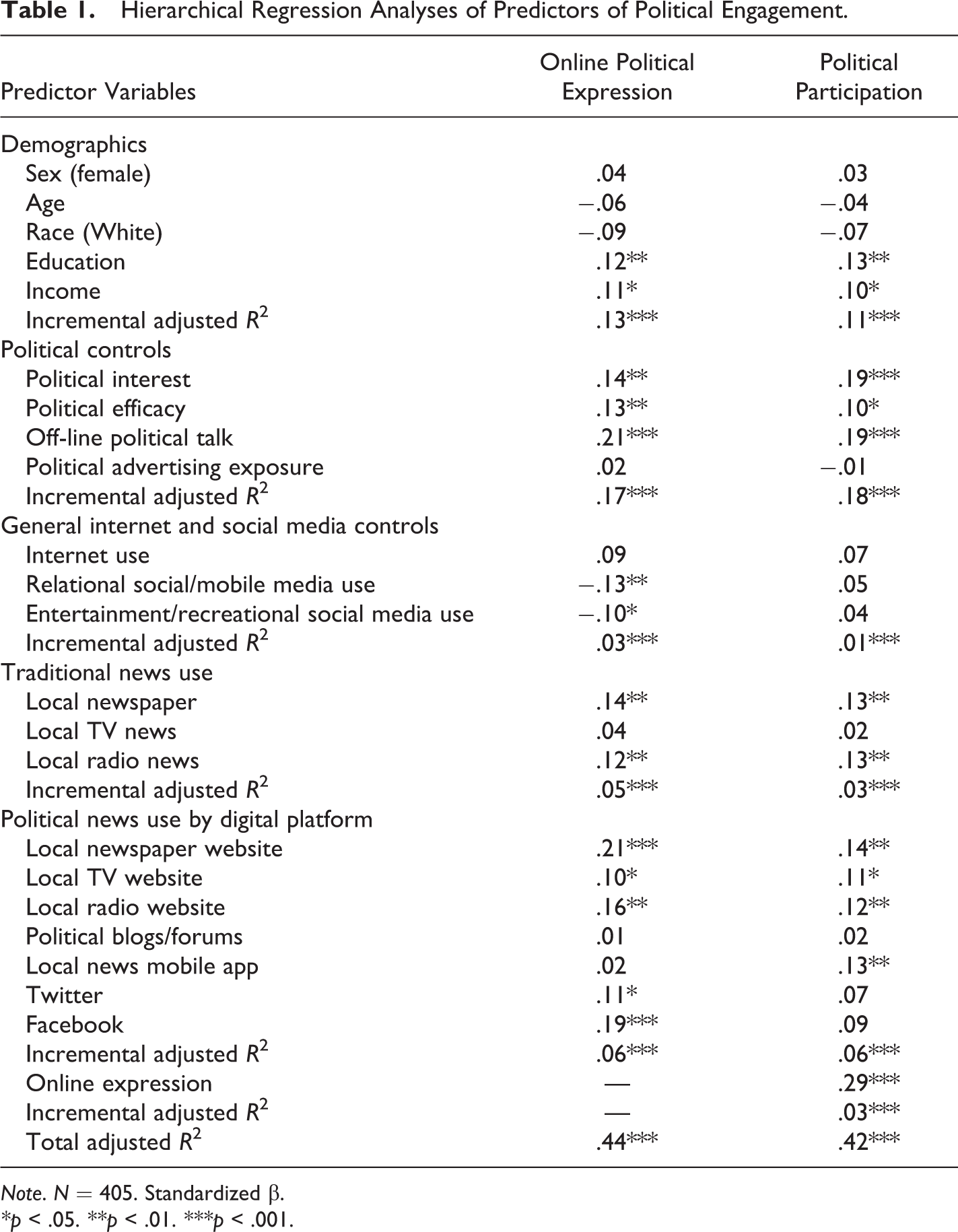
Table 1 summarizes the results of two regression estimations of digital news use predicting online political expression and off-line political participation. Control variables, traditional news use, and digital news use combined to predict about 44% of the variance in online political expression and 42% of the variance in off-line political participation. These findings, based on a conservative set of controls, and the statistical fit of the models support the validity of the results in order to generalize to the larger population who used digital news and participated in the election campaign. These results demonstrate significant variations in the participatory effects of using of digital platforms for political news and support an interpretation that platforms matter in relation to democratic outcomes.
Hierarchical Regression Analyses of Predictors of Political Engagement.
Note. N = 405. Standardized β.
*p < .05. **p < .01. ***p < .001.
The first column in Table 1 focuses on predictors of online political expression to understand which digital news platforms were significantly associated. Using the local newspaper website (β = .21, p < .001), Facebook news use (β = .19, p < .001), and local radio news website use (β = .16, p < .01) were the strongest predictors of online political expression among digital news sources. Twitter news use (β = .11, p < .05) and local TV website use (β = .10, p < .05) also produced significant positive associations. Interestingly, news organization websites were consistently stronger predictors of online expression than their traditional forms of dissemination. The statistical significance of control variables followed an expected pattern with positive associations for higher levels of education, income, political interest, political efficacy, and off-line political talk with online political expression. Finally, noninformational uses of social media, such as relational and recreational, were negatively associated with online political expression, revealing that citizens less engaged with the election campaign online were more likely to spend their time and interest on nonnews interests.
The second column in Table 1 examined digital platforms’ association with off-line political participation. In this instance, using the local newspaper website (β = .14, p < .01), local news mobile app use (β = .13, p < .01), and local radio news website use (β = .12, p < .01) were the strongest predictors. Local TV website use (β = .11, p < .05) also produced a significant positive association. None of the digital news platforms, however, was as strong of a predictor as online political expression (β = .29, p < .01), a finding that indicates a pathway from digital news platform use to online expression to off-line participation in the election campaign. Online expression’s significance also speaks to the importance of analyzing not just reception of digital news but what citizens do further to engage, exchange, and share political information. And as with the estimation predicting online expression, traditional news organization websites were better predictors of political participation than their conventional means of distribution. However, social networking sites did not produce a significant relationship with off-line participation; instead, mobile news apps were significantly more likely to be associated with participating in the election campaign. Among controls, education, income, political interest, political efficacy, and off-line political talk again produced significant positive relationships with political participation as expected based on previous studies.
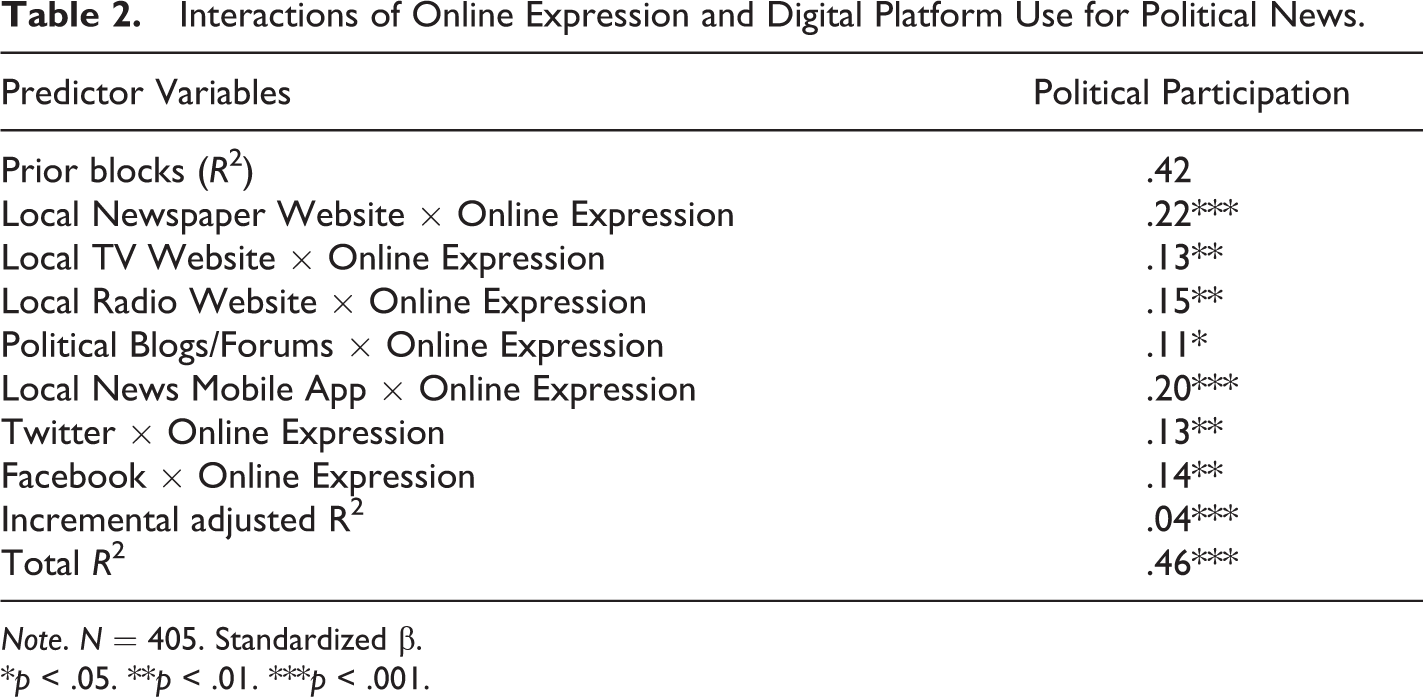
Research Question 2 focused on whether the relationship of digital news use and political participation was moderated by online political expression. Table 2 shows findings from testing the hypothesis that online expression would enhance that relationship. Results of the significance and direction of the interaction terms, entered as a block after the variables in the right column of Table 1, support the hypothesis. As predicted, online political expression enhanced the effects of digital news use on off-line participation across all of the platforms. For citizens who were more likely to engage with a digital news platform, higher rates of expressing themselves online strengthened the likelihood that they participated in the election off-line. These findings were significant for digital news platforms that produced significant conditional direct effects (websites and mobile apps) and for platforms that did not produce statistical significance on their own (blogs, Twitter, and Facebook). Thus, this result again points to the importance and significance of online political expression as an emerging phenomenon with how citizens engage with digital media.
Interactions of Online Expression and Digital Platform Use for Political News.
Note. N = 405. Standardized β.
*p < .05. **p < .01. ***p < .001.
Discussion
These findings support previous theoretical models of digital news use predicting political participation, and they present new knowledge about the effects of exposure and attention across platforms (Yamamoto et al., 2015). Traditional news organization websites and social networking sites were the digital platforms that produced the strongest positive association with online political expression, while traditional news websites and mobile news apps were the strongest predictors of increased levels of off-line political participation. These results contribute to a burgeoning body of studies on the conditional importance of traditional forms of online news, social networking sites, mobile media, and online expression as key predictors of online and off-line forms of political participation (Boulianne, 2015; Campbell & Kwak, 2010; Drew & Weaver, 2006; Kwak et al., 2011).
Additionally, the relationship of exposure and attention to digital news platforms and political participation was significantly enhanced by online political expression across platforms, indicating that the most active digital political news consumers who also were most likely to engage in online expression derived the most participatory benefits from their digital media use. These results advance the differential gains model in a digital news context by demonstrating the complementary importance of digital news use in a variety of formats with mediated interpersonal communication in the form of online expression (Yamamoto et al., 2015). As parts of our political and relational lives increasingly move online in an array of digital forms, differential gains continue to be realized by those citizens who are the most invested in both consuming and exchanging political news (Hardy & Scheufele, 2005). The results also underscore the significance of online political expression in the political process and demonstrate how citizens are engaging with news across digital platforms to elaborate on the election through sharing and exchanging information.
Findings regarding the individual-level motivations and participatory consequences of digital platform use also support related theoretical inquiries into the complicated relationship of digital news consumption and mediated interpersonal communication from the perspective of diffusion of innovations, computer-mediated communication, and technology acceptance (Chan-Olmstead et al., 2013; Rogers, 2003; Walther et al., 2015). In a broad sense, this analysis supports a sophisticated reading of the democratic effects of using digital platforms in politics and demonstrates that citizens are active, creative, and opportunistic in how they access and use digital news about campaigns.
These findings also address concerns from scholars of the need for more nuanced knowledge of digital media’s influence on democracy by using targeted measures of digital news behaviors to better conceptualize platform usage (Bimber & Copeland, 2013; Hyun & Kim, 2015). Collectively, digital platforms matter in the democratic process, but closer analysis reveals even more illuminating patterns of how citizens engage with political information for different purposes. For example, exposure and attention to political news on Facebook and Twitter were significant predictors of online political expression and mobile news app use was not significant, while the opposite relationship was true for off-line political participation. One explanation is how users engage with content on those platforms: Citizens more likely to consume news on social networking sites may prefer the convenience of being able to share, comment, and reallocate that political content among social contacts on Facebook or Twitter, while citizens who prefer mobile news apps might be more likely to use that platform before, during, or after attending political events in person. Further research attention to political context and shifting patterns of behavior surrounding digital media platforms would provide greater clarity for questions that move beyond the scope of this analysis.
A few other notable themes and implications emerging from the findings also should be mentioned. First, digital forms of traditional news organization content were consistently more likely to predict both online political expression and off-line participation even for electronic legacy media such as broadcast TV and radio news. These results indicate that the most politically engaged citizens are increasingly turning to digital platforms for news in relation to their online and off-line political activities. The significance of traditional and digital forms of radio news also is important relative to the number of scholarly studies that ignore radio newsgathering or focus only on talk radio’s influence on political outcomes (Drew & Weaver, 2006). As audio and video forms of news increasingly gain popularity on digital platforms (Pew Research Center, 2015), further scholarly attention should be paid to radio news as a significant predictor of political participation.
Also, any minor variations in findings compared to previous studies may be indicative of the rapid changing nature of digital platform news use and the role of digital media technologies in politics. Most of the literature has focused on U.S. presidential elections from 2004, 2008, and 2012, but rates of adoption and sophistication of use by journalists, politicians, interest groups, and citizens indicate the need for more recent attention to digital platform developments (Benton, 2015; Fulgoni & Lipsman, 2014). Analyzing the 2014 midterm elections produced valid, reliable findings that replicate and extend a model of digital news use’s political participation effects without waiting for another presidential election cycle. These findings also provide a novel focus on local news coverage as an empirical extension of previous models of the differential gains model.
Finally, this study provides sharper clarity on how social and mobile news platforms fit into the broader digital and electronic news landscape in the context of an election campaign. Results show that the most engaged digital news users favor platforms that are highlighted by immediacy, choice, and expressive forms of interaction with news and relational contacts. Experimental forms of digital news delivery such as local news mobile apps are significantly more likely to be used for politically expressive acts yet also related to traditional forms of electoral participation. Such conclusions hold practical implications for helping journalists and news organizations better understand how to allocate resources, anticipate the interests and needs of their audience, and devise strategies for more productive news engagement while also providing evidence of the democratic effectiveness of news delivery across digital platforms.
Overall, this study demonstrates a positive and optimistic role for many digital forms of journalism on political participation in election campaigns even as candidates continue to invest in individualized digital political marketing software and tools, news organizations continue to grapple with how to best invest resources in digital platforms, and rates of digital platform use ascend. Such research on individual-level political outcomes in a world of rapid digital media change remains essential for producing a better understanding of journalism’s role in contemporary democratic governance.
Conclusion
The rapid growth in popularity of digital media platforms has generated intense interest in how Americans use digital news platforms to engage with democracy, but a more refined theoretical explanation for how digital news use is associated with political participation remains lacking. To address that problem, this analysis offered more nuanced findings about how different forms of digital news use are associated with online political expression and electoral campaign participation.
This study also holds several practical implications for journalists and news organizations. The consistent relative strength of local news organization websites as predictors of political participation compared to their traditional formats indicates a migration of the most politically active portions of the audience to digital platforms. As a result, investment in reporting and storytelling in emerging platforms may offer the opportunity to cultivate relationships with new and existing audience members. News managers should recognize that the most politically active users are most likely to consume digital news content across platforms and also use that news in active ways to express themselves to their social contacts. Such knowledge may inform more effective strategies for designing and using platforms such as mobile apps for disseminating news or engaging with their audience that is most likely to share and repurpose political news across social networking sites such as Facebook and Twitter. Journalists also should recognize that online expression via social and mobile media has created a strong and significant pathway to traditional forms of political participation and as a result, provides an opportunity for digital forms of news coverage to inform and influence social media-based discussion of the issues and events surrounding an election. A commitment to effective and creative coverage of political campaigns may produce a reciprocal effect that benefits a news organization’s website traffic and its social networking site engagement.
Three main areas of limitations should be acknowledged. First, cross-sectional surveys are estimations of behavior, and therefore any inferences regarding causality should be tempered. Future studies should use panel data or laboratory experimental controls to better assess causality. Second, self-reported data also may produce some error in estimates of measures such as news use or in the overestimation of socially desirable behaviors such as political participation. However, to best address this limitation, this study design used measures established as rigorous and reliable in previous studies (Drew & Weaver, 2006; Druckman, 2005; Eveland et al., 2009). A final caution comes from the inability to truly generalize from a single election campaign due to data that recruited respondents from three precincts in a single geographic location; however, to mitigate those concerns, this research design replicates and adapts from similar studies with the inclusion of robust controls that increase the rigor of analysis (Druckman, 2005).
Further research is needed to clarify how political news and the public’s media habits are changing in the midst of digital platform adoption. Future study designs should incorporate emerging platforms for innovative multimedia news delivery that features audio and video such as Instagram, Snapchat, and Periscope. Scholars also would be well served to move beyond frequency-based analyses and instead examine more complicated factors of platform use such as utility, competence, and nature of engagement that could better reflect how digital platforms and political participation intertwine. Incorporating multiple methods such as in-depth interviews and diary entries also would bolster validity of survey findings regarding citizens’ digital news platform use and better prepare journalists to more effectively disseminate news across digital platforms.
Footnotes
Declaration of Conflicting Interests
The author declared no potential conflicts of interest with respect to the research, authorship, and/or publication of this article.
Funding
The author received no financial support for the research, authorship, and/or publication of this article.