



Abstract
A web survey of college students was conducted to examine whether online political expression moderates the effects of political media use on political participation. Results showed that online political expression enhanced the effects of political mobile apps, traditional offline and online media, and social media on political participation. Implications are discussed for a mobilizing role of online media in the democratic process for young adults.
The use of social media and mobile web applications has grown in recent elections, particularly among young adults (Rainie et al., 2012; Smith and Duggan, 2012a, 2012b). Of significance for this age group is the rise in the use of social media and mobile devices for obtaining political information, creating user-generated political content, and expressing political views and opinions. Surveys by the Pew Internet & American Life Project indicate the increasing popularity of social media use, led by users aged 18–29, for political activities such as posting views regarding political and social issues, sharing news articles, following political figures, and watching political videos (Rainie et al., 2012).
In response to the growing political use of social media and mobile devices, recent research has examined whether these media affect young adults’ political behaviors (e.g., Baumgartner and Morris, 2010; Campbell and Kwak, 2010; Vitak et al., 2011).
While evidence for social media use for political information consumption is somewhat mixed, for the most part, research supports the role of mobile web applications and online political expression in fostering political participation (e.g., Campbell and Kwak, 2010; Gil de Zúñiga et al., 2009, 2010). Yet theoretical attention in these lines of work has focused largely on the main effects of these newer communication activities on political participation among the general public. Few studies have explored whether citizens, particularly young adults, may become more politically engaged through actively seeking out news while also frequently expressing opinions online. To address this gap, the present study, an extension of the differential gains model (Scheufele, 2002), examines the role of online political expression in moderating the relationship between political information consumption and offline political participation for young adults.
To assess this plausibility, we analyze data from a web survey of college students conducted shortly before the 2012 US presidential election. We study young adults because political social media use is greatest among persons aged 18–29 (Rainie et al., 2012). Greater understanding of the impact of online political expression on young adults’ political behaviors may have important democratic implications, as concerns over political disengagement have long focused on this age group (CIRCLE, 2013). A prolonged lack of engagement hampers young adults’ representation in the democratic process, which may ultimately undermine the efficacy of the American democratic system.
The present study extends the literature on the differential gains model by, firstly, examining online political expression as a moderator of the relationship between media use and political participation. Secondly, this study examines a wide variety of communicative activities that are common among young adults (Rainie et al., 2012) and that are considered part of online expression. Finally, we investigate the use of social media and mobile devices as unique sources of political information. Given that new technologies have facilitated alternative forms of opinion expression and information consumption, more research is needed into the ways in which these technologies promote young adults’ political participation. The study’s overall goal is to advance our understanding of how political expression enabled by social media contributes to the democratic process.
The differential gains model
Going beyond the main effects of individual communication variables on political participation, the differential gains model theorizes joint effects of political communication activities in explaining why certain citizens are more actively engaged in politics than others. The model originally focused on the role of interpersonal political discussion in enhancing the effects of news media use on political behaviors, such that citizens who use media sources for hard news are more politically engaged if they also discuss politics with others frequently (Scheufele, 2002).
The model is based on two theoretical assumptions. Firstly, political discussion helps increase meaningful political learning. Applying what is learned from news sources to interpersonal communicative contexts enables citizens to think about current events, relate personal experiences to politics, address uncertainty, learn different perspectives, reconsider issue stances, and foster political engagement (Kim and Kim, 2008; Scheufele, 2002). Secondly, political discussion, based on a uses-and-gratifications perspective, helps foster the motivation to comprehend political information. Those who frequently talk with others about politics tend to anticipate future discussions and disagreements, which induces careful processing of news in order to clearly express opinions and present logical arguments on issues (Scheufele, 2002). Such active media use allows individuals to extract useful information for political action.
Bringing the differential gains model to the Internet, research shows that Internet use interacts with political information use to promote political participation (Hardy and Scheufele, 2005; Nisbet and Scheufele, 2004). For example, Hardy and Scheufele (2005) found that the relationship between Internet hard news use and offline political participation was stronger for respondents who more frequently engaged in political chat online. Yet a few extensions are warranted, and we identify three.
Firstly, Hardy and Scheufele’s (2005) work measured online hard news use in terms of attention and exposure to local, national, and international news. This measure, however, does not precisely capture today’s online news content characterized by nonlinear, multimedia, and user-generated information, such as blogs, social network sites, and video streaming sites, as well as growing mobile applications. These media arguably allow for more detailed reporting of alternative events, ideas, and perspectives that consumers may not easily find in traditional news stories (e.g., Carpenter, 2010; Fico et al., 2013; Meraz, 2009; Wall, 2005). In fact, an assumption of the differential gains model is that the interaction between political information consumption and political discussion is impacted by the attributes of media content such as detail-oriented, in-depth coverage or how easy it is to process news content (Scheufele, 2002). Thus, it is important to examine how the utility of user-generated, participatory information sources may be enhanced by online political expression.
Secondly, the types of online expression that have been examined in past research have been limited in scope. While Hardy and Scheufele (2005) reported a moderating role of online political chat, they acknowledged that chatting online about politics is only one aspect of online political expression. Thus, although prior research has shown that this form of online discussion is important, novel forms of political expression enabled by social media have not been studied satisfactorily. The present study explores the rich multimedia interactivity that characterizes today’s social web, in which users are both content consumers and creators (Bruns, 2006). Moving beyond a traditional form of political chat and discussion, social media avenues offer users opportunities to express political ideas through text, graphics, and video by writing a blog post, posting opinions, and sharing news stories or multimedia content.
Lastly, prior research on the differential gains model has focused on the general public, while its application to young adults has not been studied. Combined with the relative political disengagement of the young and the popularity of social media among young adults, the present study examines whether online political expression strengthens the utility of political information consumption (i.e., traditional offline and online media, social media, and mobile apps) in relation to their political participation.
Political participation
As noted, the outcome variable in the differential gains model is political participation, which refers to behavior that could affect government action – either directly by influencing the public policies that are implemented, or indirectly by influencing the elections of political actors creating those policies (Verba et al., 1995). This has traditionally included activities such as voting, circulating a petition for an issue, working for a political campaign, contacting elected officials or news outlets, attending town hall meetings, and making political donations (Verba et al., 1995). Some scholars have distinguished between institutional and deliberative, or expressive, forms of political participation (e.g., McLeod et al., 1999). Institutional participation is conceived of as action aimed at institutions in an effort to affect government action. Deliberative participation occurs when citizens engage in politics through the expression or discussion of political topics. To be consistent with prior research on the differential gains model (e.g., Hardy and Scheufele, 2005; Scheufele, 2002), the present study focuses on offline institutional political participation, rather than offline deliberative participation, as a criterion variable.
Types of political media use and online political expression
Traditional offline and online media
The dynamic growth of the Internet is continuously changing the news landscape. Common online news sources include online editions of traditional news media and portal websites, such as Yahoo (Pew Research Center for the People & the Press, 2012). Although use of these sources for campaign news has risen sharply among young adults, traditional offline media still play a role as a news source. For example, when the Pew Research Center for the People & the Press (2012) asked American adults younger than age 30 what particular medium they used to get news “yesterday,” 34% reported they used television, which was close to the 39% of those who reported obtaining news on a social media site, but far from the 13% who reported using print newspapers.
Social media
Social media sites, such as Facebook, Twitter, YouTube, and blogs, have enabled new opportunities for interactive, user-centered political experiences. While research has focused mainly on the mainstream social media sites noted above (e.g., Baumgartner and Morris, 2010; Hanson et al., 2010), there are other platforms such as photo-sharing sites (e.g., Pinterest) and social news sites (e.g., Reddit).
Political communication activities on these sites have become common in recent elections. User-generated political content can serve as a source of political information. Users can learn about politics by consuming such content as blog commentaries, user comments, and video, audio, and photos uploaded by others. Such user-generated “raw” political content and opinions provided by ordinary citizens often contain information and perspectives that may not be available elsewhere (e.g., Carpenter, 2010; Meraz, 2009; Wall, 2005). Social media also allow users to obtain a stream of customized political information from their online contacts. Citizens increasingly use social media to follow elected officials and candidates and acquire political information (Pew Research Center for the People & the Press, 2012; Pew Research Journalism Project, 2012).
Mobile apps
Mobile devices such as smartphones offer unique political opportunities due to their accessibility and convenience. A recent report shows that 88% of registered voters own a cell phone, 48% of whom own a smartphone (Smith and Duggan, 2012b). Of these smartphone users, 45% used their device to read other people’s comments on a social networking site about a candidate or campaign and 35% fact-checked information about a candidate or the election (Smith and Duggan, 2012b).
In response to the growing popularity of smartphone devices, political campaigns increasingly integrate mobile applications (“apps”) into their campaign tactics. During the 2012 election campaign, Barak Obama and Mitt Romney set up mobile apps, Obama for America and Mitt’s VP. These apps enabled supporters to find campaign events near their locations, organize door-to-door campaigning, and make campaign donations. Major news outlets have mobile apps that provide users with personalized news and news alerts “on-the-go.” A recent report indicates that 45% of voters with smartphones use mobile apps and that 8% of smartphone owners use apps from a candidate, political party, or interest group to acquire information about public affairs (Smith and Duggan, 2012b).
Online political expression
Research shows that political social media use is multidimensional, consisting of cognitive (i.e., information seeking) and behavioral (i.e., expressive) dimensions (e.g., Kushin and Yamamoto, 2010). Gil de Zúñiga et al. (2013) noted that online expressive behaviors occur through forms of real-time, interactive media such as blogs and social network sites. Such media allow for the sharing of, and commenting on, ideas, which are comparable to the real-time nature of offline expression, such as interpersonal political talks.
Online political expression is especially popular among young adults. They tend to use blogs, microblogs, social network sites, and content-sharing sites to express their political opinions, such as posting status updates to their profile, uploading video and photos to express support for a candidate, sharing news articles, and discussing politics with other users (Rainie et al., 2012; Smith and Duggan, 2012a). For example, a nationwide survey conducted in 2012 by the Pew Internet & American Life Project indicated that 42% of 18–29 young adult users of social network sites or Twitter posted thoughts or comments on political and social issues, compared to older users (34% of 30–49 users, 28% of 50–64 users, and 20% of 65 or older users). Also, these young adult users led other forms of online political expression, with 44% of them having liked or promoted political material and 33% having posted links to political stories (Rainie et al., 2012).
It should be noted that online expressive activities are uniquely different from conventional offline political expression. Offline expression typically refers to behaviors such as speaking out about issues in community meetings (Dalisay et al., 2012) and expressing opinions in the presence of strangers (Noelle-Neumann, 1974). To express political views in these offline settings may require greater adherence to the norm of politeness (Papacharissi, 2004) and may encourage more self-censoring (Hayes et al., 2006). In contrast, a stronger sense of anonymity afforded by the Internet may put individuals at ease in expressing opinions online. Thus, individuals may not be monitoring their communicated messages as much as they would in offline settings.
Previous research
Existing literature on the political role of the Internet shows that online political expression has independent positive effects on political participation (e.g., Jung et al., 2011; Vitak et al., 2011). For example, Jung et al. (2011) showed that online political messaging, such as posting blog posts and comments about current issues and public affairs, is positively related to offline political participation.
While evidence for the role of political information seeking indicates that traditional offline and online media use is positively tied to offline political participation and likelihood of voting (e.g., Baumgartner and Morris, 2010; Gil de Zúñiga et al., 2009; Kaufhold et al., 2010), the effects of social media use for political information are somewhat mixed. Gil de Zúñiga et al. (2012) found that social network site use for news had positive effects on offline participation. In contrast, Baumgartner and Morris (2010) found that while using YouTube and social network sites for news was linked to online participation, its effects on offline participation and likelihood of voting were not significant.
A few studies have investigated the role of mobile use in participatory behaviors. Campbell and Kwak (2010) showed a positive link between mobile phone use and civic and political participation. Rojas and Puig-i-Abril (2009) found that cell phone information use was related to online expression, which led to a greater tendency to seek to mobilize others using a cell phone, which in turn was related to offline civic participation. Neither study, however, investigated an interactive association between online political expression and mobile use in affecting political participation. They were also limited in their mobile use measures. Campbell and Kwak’s (2010) measure of mobile phone use for information exchange did not parse information seeking and expressive dimensions; also, some items used to measure mobile phone use were not mobile-specific activities (e.g., “go online to express my opinions about issues”). Moreover, Rojas and Puig-i-Abril’s (2009) measure of cell phone use was limited to a dichotomous item asking respondents whether they used their phones to access news and information.
Complementary role of online expression: Extending the differential gains model
On balance, political communication scholars have focused mainly on the independent and main effects of online political expression and political information seeking via traditional media, social media, and mobiles on political participation. Theoretical refinement is needed to better understand how political communication activities enabled by web interactivity contribute to the democratic process. Given the evidence that online expression is more strongly connected with key cognitive, attitudinal, and behavioral outcomes than information consumption on social media (e.g., Kushin and Yamamoto, 2010), the present study assesses why, and in what ways, online expression is particularly important for motivating young adults politically. As the walls between consumers and producers of content have broken down (Bruns, 2006), young adults may become more politically active when they engage with what they have read, viewed, or heard from political information sources via online expression.
This expectation stems from the differential gains model (Scheufele, 2002), which explains why online political expression moderates the association between political information seeking and political participation. Firstly, expressing opinions online about what one has learned from news sources, such as sharing political news, posting comments on social network sites, and sharing political videos on social media, would facilitate casual political discussions, fact-checking, exposure to different perspectives, and learning new information. Secondly, those who frequently engage in online political expression would be more motivated to actively seek out and understand political information, as they anticipate using it for future expressive activities. Research has reported that sharing knowledge and helping others are important reasons why people use social media (Rainie et al., 2012).
In sum, the present study extends research on the differential gains model by considering a greater diversity of information sources and novel opinion expression opportunities available on social media. Based on the above theoretical discussion, the following hypotheses are formulated:
Method
Data came from a web survey of college students at a public university in the Midwest during the three-week period prior to the November 6, 2012 election. Every student enrolled at the university had a university-assigned email address. A random probability-based sample of the student body was obtained from the university registrar. A total of 839 students responded to the survey for a response rate of 16.8%. Of those who responded, 239 cases were removed due to the failure to complete a large majority of the survey. The final sample was 600 respondents who completed nearly the entire survey, with the final minimum response rate of 12.0%. Although admittedly low, this response rate is common for web surveys (Shih and Fan, 2008). Based on our focus on young adults, 49 respondents who did not report their age or were above the age of 29 were removed from the analysis.
Measures
Attention to social media
Building on prior research (Kushin and Yamamoto, 2010), several social media sites were included capturing a variety of platforms where political information can be acquired, including personal blogs, video-sharing websites (e.g., YouTube), photo-sharing websites (e.g., Pinterest), social news websites (e.g., Reddit), Twitter, social network sites (e.g., Facebook), and online forums and discussion boards. Respondents were asked, on a seven-point Likert-type scale (1 = no attention; 7 = a lot of attention), how much attention they paid to each of the platforms to learn about the election.
Political uses of social media sites may overlap due to cross-platform updates such as Twitter integration enhancements with Facebook. To examine the dimensionality of these items, principal component analysis with promax rotation method was performed. Results produced two factor solutions. One component, which explained 43.10% of the variance, consisted of attention to content-sharing/social network sites (M = 11.04, SD = 5.95, α = .77): video-sharing sites (M = 2.97, SD = 1.94), photo-sharing sites (M = 2.08, SD = 1.66), Twitter (M = 2.29, SD = 1.95), and social network sites (M = 3.73, SD = 2.16). The other component, which explained 17.88% of the variance, comprised attention to blogs/social news/forums (M = 5.73, SD = 3.41, α = .65, inter-item correlation = .40): personal blogs (M = 1.55, SD = 1.16); social news sites (M = 2.20, SD = 1.77); and online forums and discussion boards (M = 1.97, SD = 1.46). No signs of cross-loading were detected.
Mobile app use
Four items were constructed to measure smartphone app use for political information. Respondents were asked, on a seven-point Likert-type scale (1 = none; 7 = very often), how often they engaged in each of the following: using a news media outlet’s smartphone app to learn about the election; using a candidate’s smartphone app to stay up to date with the election such as Obama for America and Mitt’s VP; using a smartphone app that supports a particular political party, ideology, or cause (e.g., conservative, liberal); and receiving alerts on a smartphone about election-related news or events. These items were summed to construct an additive index (M = 5.52, SD = 3.49, α = .79). Note that these items focus on information seeking uniquely enabled by mobile devices not accessible with traditional computer devices.
Attention to traditional online media
Four items were used to measure attention to traditional online media. Respondents were asked, on a seven-point Likert-type scale (1 = no attention; 7 = a lot of attention), how much attention they paid to television websites, online newspapers, radio websites, and news portal sites (e.g., Yahoo News). These items were formed to construct an additive index (M = 12.44, SD = 5.55, α = .74).
Attention to traditional offline media
Five items measured attention to traditional offline media. Respondents were asked, on a seven-point Likert-type scale (1 = no attention; 7 = a lot of attention), how much attention they paid to network television, cable television, print newspapers, radio, and magazines to learn about the election. These items were summed to form an additive index (M = 15.66, SD = 6.35, α = .75).
Online political expression
Five items were used to measure online political expression (e.g., Kushin and Yamamoto, 2010). Respondents were asked, on a seven-point Likert-type scale (1 = none; 7 = very often), how often they engaged in each of the following: writing blog posts on the election, candidates, and political issues; writing posts on online social networks about the election, candidates, and political issues (e.g., Facebook, Twitter, Google+, etc.); sharing political news, video clips, photos, computer artwork, or others’ blog posts online; creating and posting online audio, video, animation, photos or computer artwork to express political views; and exchanging opinions about the election, candidates, and political issues online (e.g., blogs, Facebook, Twitter, Google+, etc.). These items were summed to create an additive index (M = 8.24, SD = 5.05, α = .84).
Offline political participation
Seven items were used to measure offline political participation (e.g., Hardy and Scheufele, 2005). Respondents were asked, on a seven-point Likert-type scale (1 = none; 7 = very often), how often they engaged in each of the following activities offline: attending a meeting related to politics; writing a letter to a newspaper editor or calling into a public affairs radio talk show; circulating a petition for a candidate or issue; working for a political campaign; contacting a public official; calling other people to raise funds for a political organization; and contributing money to a political organization or candidate. These items were combined to form an additive index (M = 9.15, SD = 4.35, α = .83).
Control variables
To counteract misspecification errors, several additional variables were used as controls. Age was measured in an open-ended format (M = 20.13, SD = 1.78). Sex was measured with females as the high value (M = .76, SD = .43). Race was measured with Caucasians as the high value and all other groups as the low value (M = .91, SD = .28). Political ideology was measured by a single item (1 = very conservative; 5 = very liberal) (M = 3.22, SD = .94). Political interest was measured by asking respondents how interested they were in politics (1 = not interested; 7 = absolutely interested) (M = 3.63, SD = 1.77).
Internal political efficacy was measured based on the work of Niemi et al. (1991). Respondents were asked to indicate, on a seven-point Likert-type scale, whether they agreed or disagreed with four statements (e.g., “I consider myself to be well-qualified to participate in politics”). The four internal political efficacy items were summed to form an additive scale (M = 16.24, SD = 5.46, α = .83). External political efficacy was measured based on the work of Gastil and Xenos (2010). Respondents were asked to indicate, on a seven-point Likert-type scale, whether they agreed or disagreed with three statements (e.g., “People like me don’t have any say about what the government does” – reversed-coded). The three external political efficacy items were combined into an additive scale (M = 12.45, SD = 3.15, α = .59, inter-item correlations = .32).
Statistical analysis
An ordinary least squares (OLS) regression equation was estimated. To test the hypothesized interaction effects, it is necessary to create product terms between main effect variables. To reduce potential multicollinearity problems, the six main effect variables were first standardized before computing interaction terms (Cohen et al., 2003). In the regression model, control variables were entered first, followed by the six standardized main effect variables in the second block and the interaction terms in the third block. Before-entry betas were used to test interactive effects controlling only for variables in prior blocks, but not in the same and/or subsequent blocks (Hardy and Scheufele, 2005). Also, simple slope tests were conducted employing the SPSS PROCESS macro (Hayes, 2013). Based on the pick-a-point method, conditional effects at plus and minus one standard deviation around the mean of online expression were estimated, with the main effect variables mean-centered prior to analysis and confidence intervals generated at the 95% level. When this would produce a value outside of the possible range of the data, the lowest possible value was used instead.
Results
H1 stated that the strength of the relationship between attention to traditional offline media use for political information and offline political participation would be greater for those who engage in online expression more frequently. This hypothesis was supported, as shown by the significant interaction effect (β = .14) (see Table 1). Based on its non-significant main effect, traditional offline media had a positive effect on offline political participation only when respondents went online to express political views more often (see Figure 1). Simple slope tests also indicated that this effect was significant when levels of online expression were high (point estimate = .113, 95% CI: .016 to .210), but not low to moderate (point estimates = −.042 and .018, 95% CIs: −.127 to .042 and −.057 to .093, respectively).
Predicting interactive effects on offline political participation.

Note. N = 480. Entries are standardized regression coefficients. Entries in the third block are before-entry betas controlling only for variables in the prior blocks. Block R2 for the third block indicates the block contribution if all interaction terms were entered simultaneously.
p < .001. ** p < .01. * p < .05.

Interactive relationships between traditional offline media and online political expression.
H2 stated that the strength of the relationship between attention to traditional online media use for political information and offline political participation would be greater for those who engage in online expression more frequently. This hypothesis was supported, as evidenced by the significant interaction effect (β = .20) (see Table 1). Combined with its non-significant main effect, traditional online media had a positive effect on offline political participation only when respondents expressed political opinions online more often (see Figure 2). Simple slope tests also showed that this effect was significant when levels of online expression were high (point estimate = .161, 95% CI: .042 to .280), but not low to moderate (point estimates = −.066 and .022, 95% CIs: −.166 to .035 and −.072 to .115, respectively).

Interactive relationships between traditional online media and online political expression.
H3 stated that the strength of the relationship between attention to social media and offline political participation would be greater for those who engage in online expression more frequently. This hypothesis was partially supported. As shown in Table 1, the interaction term between attention to blogs/social news/forums and online expression was related to offline political participation (β = .15), suggesting that the positive main effect of attention to blogs/social news/forums became stronger as respondents expressed their political views online more often (see Figure 3). Simple slope tests also revealed that this link was not significant when levels of online expression were low to moderate (point estimates = −.002 and .083, 95% CIs: −.145 to .141 and −.037 to .204, respectively), but was significant at high levels of online expression (point estimate = .219, 95% CI: .098 to .339).
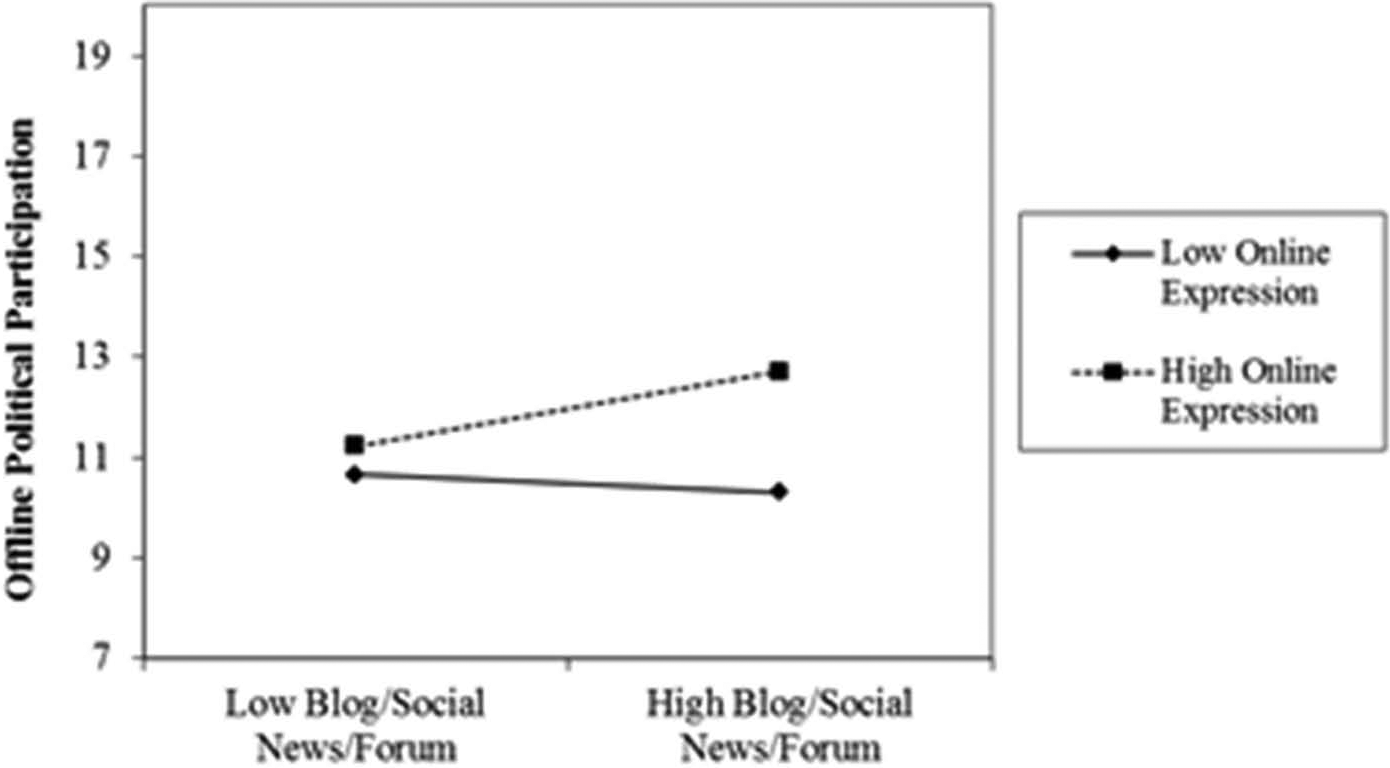
Interactive relationships between blogs/social news/forums and online political expression.
The interaction term between attention to content-sharing/social network sites for political information and online expression was associated with offline political participation (β = .14) (see Table 1). This interactive relationship suggests that the negative main effect of attention to content-sharing/social network sites (β = −.10) became stronger if respondents engaged in online expression more often (see Figure 4). Simple slope tests showed that this effect was significant when levels of online expression were low (point estimate = −.121, 95% CI: −.192 to −.051), but not moderate to high (point estimates = −.055 and .050, 95% CIs: −.120 to .009 and −.047 to .147), implying that the negative effect of attention to content-sharing/social network sites on offline political participation was pronounced for those who engaged in online expression infrequently. However, this effect was reduced to non-significance as respondents expressed political views online more frequently.
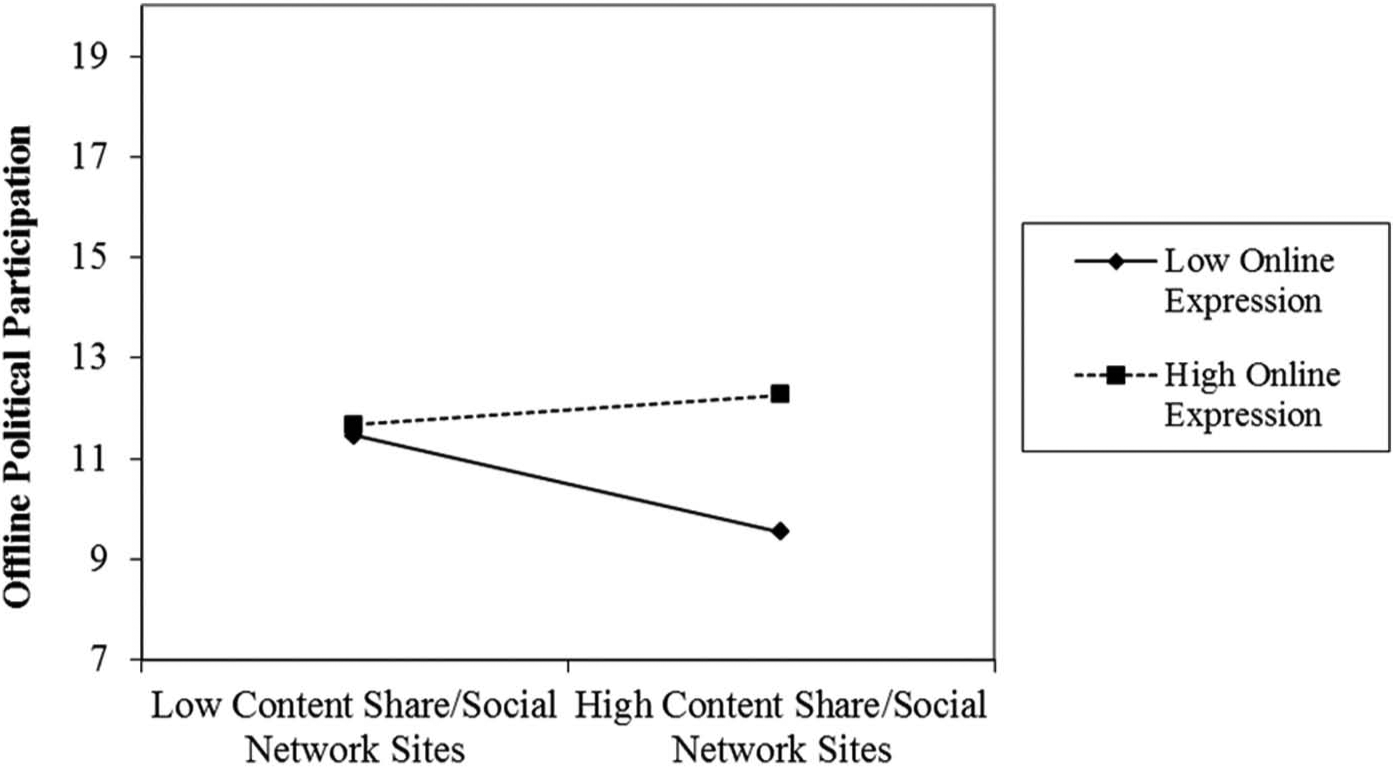
Interactive relationships between content-sharing/social network sites and online political expression.
H4 stated that the strength of the relationship between mobile app use for political information and offline political participation would be greater for those who engage in online expression more frequently. This hypothesis was supported, as evidenced by the significant interaction effect (β = .20) (see Table 1). That is, the effect of mobile app use was amplified as respondents politically expressed themselves online more often (see Figure 5). Simple slope tests showed that this effect was significant when levels of online expression were high (point estimate = .250, 95% CI: .142 to .359), but not low to moderate (point estimates = .041 and .122, 95% CIs: −.124 to .206 and −.015 to .258).
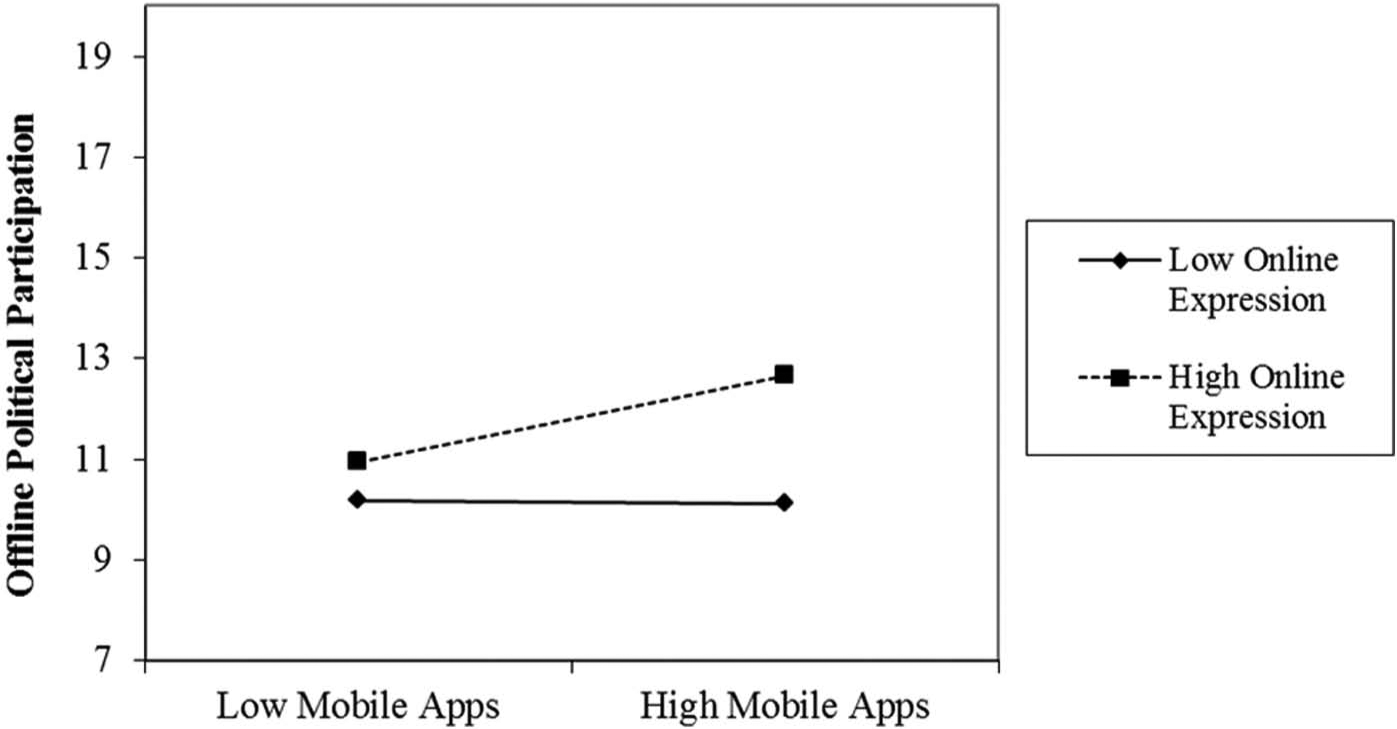
Interactive relationships between mobile apps and online political expression.
Summary and discussion
The current study extends research on the role of social media in young adults’ political participation by assessing potential interactive mechanisms by which online political expression enhances the effects of news media use. This study contributes to the theory and literature in a number of ways. Firstly, on balance, the evidence presented above shows that young adults who consume political information online are more likely to participate in politics offline, as they express political opinions online more often. Specifically, online political expression was found to have a mobilizing effect on offline political participation for those who use blogs/social news/forums and mobile apps, with those who used these tools to obtain political information more likely to participate in politics offline, as they also frequently expressed political views online.
In contrast, the positive interactive effects that online political expression had with traditional online and offline media, coupled with their non-significant main effects on offline political participation, indicate that these information sources become politically meaningful when young adults express political opinions online frequently based on what they learn from these traditional media sources.
Two mechanisms help explain the observed moderating role of online political expression. Firstly, engaging with political information through expressive communicative activities online helps users effectively think about political issues and candidates, relate to politics, eliminate uncertainty, and form or reconsider issue stances (Kim and Kim, 2008). Secondly, frequent online expression of political opinions helps individuals effectively extract information important for political participation, as those who express political views online frequently tend to anticipate using political information, such as using news to write blog posts, sharing news stories with their networks, and exchanging opinions in online discussion forums, and therefore pay close attention to information sources. As explained earlier in this paper, the present results, theoretically informed by the differential gains model (Scheufele, 2002), extend prior research (Hardy and Scheufele, 2005; Nisbet and Scheufele, 2004; Scheufele, 2002), with a consideration of greater expressive activities enabled by the rich, multimedia interactivity available through social media as well as political information consumption via social media and mobile web applications.
It is important to note that online political expression interacted with content-sharing/social network sites in a way that those who engaged in online expression infrequently while paying attention to political information from content-sharing/social network sites were less likely to participate in politics offline, implying that for young adults, these sites perhaps function best as locations of interaction and are not effective in fostering political action.
Still, these findings suggest overall positive support for the political utility of social media. The findings counter prior research suggesting that social media use does not extend to offline participation (e.g., Baumgartner and Morris, 2010; Zhang et al., 2010). With a nuanced examination of social media that considered both cognitive and behavioral aspects, the present study supports the notion that online political expression plays a role in bringing citizens and young adults alike into politics (e.g., Jung et al., 2011; Kushin and Yamamoto, 2010).
Another important finding is that mobile app use for political information had independent effects on offline political participation, which is consistent with prior research (Campbell and Kwak, 2010; Rojas and Puig-i-Abril, 2009). This finding seems encouraging for the democratic process, given a recent trend of using tailored mobile apps for news distribution and political campaigns. Mobile apps enable users to efficiently get the latest news as well as monitor online conversations and trends by, for instance, viewing Tweets about ongoing events and issues posted by news media, campaigns, fact-checkers, partisans, and ordinary users. Also, mobile apps provide mobilizing information that can facilitate political action such as when and where campaign events are held (Lemert, 1981). These characteristics collectively make mobile apps an effective source of information that facilitates political action.
Despite these theoretically suggestive results, several limitations hamper definitive conclusions. Firstly, the findings were based on a sample of college students attending a public university in the Midwest and thus cannot be generalizable to the larger young adult population. The present sample is clearly on the younger end of this population and over-represents females and Caucasians compared to population-based sex and race compositions for those aged 20–29 (Howden and Meyer, 2011; U.S. Department of Commerce, 2012). College students also diverge from people in this age group without a college education in several respects. While there is no significant difference in political blog use and political use of Facebook, college students tend to participate in online political discussions more frequently, be more politically knowledgeable, and be more politically and civically active than young adults without a college education (Portney and O’Leary, 2007). Moreover, the institution where the sample was collected is in one of the swing states in the 2012 presidential election. Taken together, it is possible that the results are unique to the present sample. To increase the confidence in the current findings, future work must replicate the current study with a probability-based sample that represents the young adult population.
Secondly, the cross-sectional nature of the survey data precludes more nuanced investigation of the differential gains model. To qualify the theoretical explanations for the observed findings, it is important to assess which of the two mechanisms help young adults extract political information leading to political action – the actual occurrence or anticipation of opinion expression online, or both. It might be helpful to employ an experimental design where one group of the subjects is asked to engage in expressive activities on politics online and then read a news story, while the other group, to induce the motivation to carefully process information, is led to believe that they will be instructed to engage in expressive activities based on a news story they read. This type of design, with measurement of intentions to participate in politics and/or actual political participation, might allow future studies to dissect the moderating role of online political expression.
Relatedly, the interpretation of the current results is informed by the differential gains model that focuses on the role of online expression as a moderator of the relationship between news media use and participation. However, an alternative interpretation is equally plausible. That is, news media use may moderate associations between online expression and political participation, such that those who express opinions online participate more as they more actively seek political information. Designs such as the one suggested in the previous paragraph might be of help to clarify underlying moderation mechanisms.
Thirdly, offline political discussion was not examined in this analysis, which has been shown to moderate the relationship between traditional news media use and offline political participation (Scheufele, 2002). As an extension, offline political discussion would be expected to strengthen the effects of political information seeking via social media and mobiles on offline political participation. Fourthly, studies conducted in an election context need to assess voting or voting intentions, as voting is considered an end result in an election. Finally, this study did not examine levels of comfort or competence with mobile telephony, a known moderator on the effects of mobiles on political participation (Campbell and Kwak, 2010).
Considering these limitations, this study has extended the role of online political expression in the democratic process. Why young adults differentially engage in politics is in part because expressing political opinions through social media improves the utility of political information seeking. It not only amplifies the positive effects of political information sources on political participation, but also makes information sources with little importance become effective platforms for citizenship. Online expression has become an important element of political communication activities in recent elections, bringing politics closer to young adult citizens. Although further investigation is needed to understand why and how individuals communicate their political opinions online, expressive activities on social media seem to be effective in encouraging young adults’ political participation.
Footnotes
Funding
This research received no specific grant from any funding agency in the public, commercial, or not-for-profit sectors.